EP0465792B1 - Polymère multi-couche, composition de résine thermoplastique le contenant et article moulé fabriqué à partir de cette composition - Google Patents
Polymère multi-couche, composition de résine thermoplastique le contenant et article moulé fabriqué à partir de cette composition Download PDFInfo
- Publication number
- EP0465792B1 EP0465792B1 EP91107467A EP91107467A EP0465792B1 EP 0465792 B1 EP0465792 B1 EP 0465792B1 EP 91107467 A EP91107467 A EP 91107467A EP 91107467 A EP91107467 A EP 91107467A EP 0465792 B1 EP0465792 B1 EP 0465792B1
- Authority
- EP
- European Patent Office
- Prior art keywords
- layer
- weight
- polymer
- shell
- thermoplastic resin
- Prior art date
- Legal status (The legal status is an assumption and is not a legal conclusion. Google has not performed a legal analysis and makes no representation as to the accuracy of the status listed.)
- Expired - Lifetime
Links
- 229920000642 polymer Polymers 0.000 title claims description 138
- 239000011342 resin composition Substances 0.000 title claims description 89
- 229920005992 thermoplastic resin Polymers 0.000 title claims description 56
- 239000000203 mixture Substances 0.000 title description 33
- 239000010410 layer Substances 0.000 claims description 236
- 239000000178 monomer Substances 0.000 claims description 112
- 239000004431 polycarbonate resin Substances 0.000 claims description 47
- 229920005668 polycarbonate resin Polymers 0.000 claims description 47
- 239000012792 core layer Substances 0.000 claims description 40
- 229920001971 elastomer Polymers 0.000 claims description 33
- 229920001225 polyester resin Polymers 0.000 claims description 27
- 239000004645 polyester resin Substances 0.000 claims description 27
- -1 alkyl methacrylate Chemical compound 0.000 claims description 26
- 238000004132 cross linking Methods 0.000 claims description 26
- YXFVVABEGXRONW-UHFFFAOYSA-N Toluene Chemical compound CC1=CC=CC=C1 YXFVVABEGXRONW-UHFFFAOYSA-N 0.000 claims description 18
- 229920002554 vinyl polymer Polymers 0.000 claims description 18
- 229920002285 poly(styrene-co-acrylonitrile) Polymers 0.000 claims description 17
- 125000005250 alkyl acrylate group Chemical group 0.000 claims description 14
- 125000000217 alkyl group Chemical group 0.000 claims description 13
- 229920005989 resin Polymers 0.000 claims description 13
- 239000011347 resin Substances 0.000 claims description 13
- NLHHRLWOUZZQLW-UHFFFAOYSA-N Acrylonitrile Chemical compound C=CC#N NLHHRLWOUZZQLW-UHFFFAOYSA-N 0.000 claims description 12
- 229920001707 polybutylene terephthalate Polymers 0.000 claims description 11
- PPBRXRYQALVLMV-UHFFFAOYSA-N Styrene Chemical compound C=CC1=CC=CC=C1 PPBRXRYQALVLMV-UHFFFAOYSA-N 0.000 claims description 10
- 239000002245 particle Substances 0.000 claims description 9
- SOGAXMICEFXMKE-UHFFFAOYSA-N Butylmethacrylate Chemical compound CCCCOC(=O)C(C)=C SOGAXMICEFXMKE-UHFFFAOYSA-N 0.000 claims description 8
- VVQNEPGJFQJSBK-UHFFFAOYSA-N Methyl methacrylate Chemical group COC(=O)C(C)=C VVQNEPGJFQJSBK-UHFFFAOYSA-N 0.000 claims description 8
- 229920000139 polyethylene terephthalate Polymers 0.000 claims description 8
- 239000005020 polyethylene terephthalate Substances 0.000 claims description 8
- CQEYYJKEWSMYFG-UHFFFAOYSA-N butyl acrylate Chemical compound CCCCOC(=O)C=C CQEYYJKEWSMYFG-UHFFFAOYSA-N 0.000 claims description 5
- GOXQRTZXKQZDDN-UHFFFAOYSA-N 2-Ethylhexyl acrylate Chemical compound CCCCC(CC)COC(=O)C=C GOXQRTZXKQZDDN-UHFFFAOYSA-N 0.000 claims description 4
- 238000006116 polymerization reaction Methods 0.000 description 25
- 238000012360 testing method Methods 0.000 description 22
- MYRTYDVEIRVNKP-UHFFFAOYSA-N 1,2-Divinylbenzene Chemical compound C=CC1=CC=CC=C1C=C MYRTYDVEIRVNKP-UHFFFAOYSA-N 0.000 description 20
- 238000004519 manufacturing process Methods 0.000 description 18
- 239000008188 pellet Substances 0.000 description 17
- 238000000034 method Methods 0.000 description 16
- LYCAIKOWRPUZTN-UHFFFAOYSA-N Ethylene glycol Chemical compound OCCO LYCAIKOWRPUZTN-UHFFFAOYSA-N 0.000 description 14
- 230000000052 comparative effect Effects 0.000 description 13
- IISBACLAFKSPIT-UHFFFAOYSA-N bisphenol A Chemical compound C=1C=C(O)C=CC=1C(C)(C)C1=CC=C(O)C=C1 IISBACLAFKSPIT-UHFFFAOYSA-N 0.000 description 12
- 125000003118 aryl group Chemical group 0.000 description 10
- 239000000839 emulsion Substances 0.000 description 10
- 239000007864 aqueous solution Substances 0.000 description 9
- 229910021641 deionized water Inorganic materials 0.000 description 8
- 239000006229 carbon black Substances 0.000 description 7
- 150000001875 compounds Chemical class 0.000 description 7
- NIXOWILDQLNWCW-UHFFFAOYSA-M Acrylate Chemical compound [O-]C(=O)C=C NIXOWILDQLNWCW-UHFFFAOYSA-M 0.000 description 6
- KKEYFWRCBNTPAC-UHFFFAOYSA-N Terephthalic acid Chemical compound OC(=O)C1=CC=C(C(O)=O)C=C1 KKEYFWRCBNTPAC-UHFFFAOYSA-N 0.000 description 6
- 239000004816 latex Substances 0.000 description 6
- 229920000126 latex Polymers 0.000 description 6
- 239000004417 polycarbonate Substances 0.000 description 6
- 239000000126 substance Substances 0.000 description 6
- 230000032683 aging Effects 0.000 description 5
- 230000032798 delamination Effects 0.000 description 5
- 230000009477 glass transition Effects 0.000 description 5
- 239000000049 pigment Substances 0.000 description 5
- 229920000515 polycarbonate Polymers 0.000 description 5
- IJGRMHOSHXDMSA-UHFFFAOYSA-N Atomic nitrogen Chemical compound N#N IJGRMHOSHXDMSA-UHFFFAOYSA-N 0.000 description 4
- 239000004609 Impact Modifier Substances 0.000 description 4
- 238000000635 electron micrograph Methods 0.000 description 4
- 238000007720 emulsion polymerization reaction Methods 0.000 description 4
- 150000002148 esters Chemical class 0.000 description 4
- WGCNASOHLSPBMP-UHFFFAOYSA-N hydroxyacetaldehyde Natural products OCC=O WGCNASOHLSPBMP-UHFFFAOYSA-N 0.000 description 4
- 230000006872 improvement Effects 0.000 description 4
- 238000002156 mixing Methods 0.000 description 4
- 125000000391 vinyl group Chemical group [H]C([*])=C([H])[H] 0.000 description 4
- PEDCQBHIVMGVHV-UHFFFAOYSA-N Glycerine Chemical compound OCC(O)CO PEDCQBHIVMGVHV-UHFFFAOYSA-N 0.000 description 3
- DNIAPMSPPWPWGF-UHFFFAOYSA-N Propylene glycol Chemical compound CC(O)CO DNIAPMSPPWPWGF-UHFFFAOYSA-N 0.000 description 3
- 125000001931 aliphatic group Chemical group 0.000 description 3
- 230000018044 dehydration Effects 0.000 description 3
- 238000006297 dehydration reaction Methods 0.000 description 3
- 150000002009 diols Chemical class 0.000 description 3
- 238000001035 drying Methods 0.000 description 3
- 229920006351 engineering plastic Polymers 0.000 description 3
- 239000011159 matrix material Substances 0.000 description 3
- 229920000058 polyacrylate Polymers 0.000 description 3
- FBCQUCJYYPMKRO-UHFFFAOYSA-N prop-2-enyl 2-methylprop-2-enoate Chemical compound CC(=C)C(=O)OCC=C FBCQUCJYYPMKRO-UHFFFAOYSA-N 0.000 description 3
- FCYVWWWTHPPJII-UHFFFAOYSA-N 2-methylidenepropanedinitrile Chemical compound N#CC(=C)C#N FCYVWWWTHPPJII-UHFFFAOYSA-N 0.000 description 2
- JIGUQPWFLRLWPJ-UHFFFAOYSA-N Ethyl acrylate Chemical compound CCOC(=O)C=C JIGUQPWFLRLWPJ-UHFFFAOYSA-N 0.000 description 2
- QIGBRXMKCJKVMJ-UHFFFAOYSA-N Hydroquinone Chemical compound OC1=CC=C(O)C=C1 QIGBRXMKCJKVMJ-UHFFFAOYSA-N 0.000 description 2
- UQSXHKLRYXJYBZ-UHFFFAOYSA-N Iron oxide Chemical compound [Fe]=O UQSXHKLRYXJYBZ-UHFFFAOYSA-N 0.000 description 2
- 239000004420 Iupilon Substances 0.000 description 2
- GYCMBHHDWRMZGG-UHFFFAOYSA-N Methylacrylonitrile Chemical compound CC(=C)C#N GYCMBHHDWRMZGG-UHFFFAOYSA-N 0.000 description 2
- UIIMBOGNXHQVGW-UHFFFAOYSA-M Sodium bicarbonate Chemical compound [Na+].OC([O-])=O UIIMBOGNXHQVGW-UHFFFAOYSA-M 0.000 description 2
- ZJCCRDAZUWHFQH-UHFFFAOYSA-N Trimethylolpropane Chemical compound CCC(CO)(CO)CO ZJCCRDAZUWHFQH-UHFFFAOYSA-N 0.000 description 2
- 239000002253 acid Substances 0.000 description 2
- 150000001252 acrylic acid derivatives Chemical class 0.000 description 2
- WNLRTRBMVRJNCN-UHFFFAOYSA-N adipic acid Chemical compound OC(=O)CCCCC(O)=O WNLRTRBMVRJNCN-UHFFFAOYSA-N 0.000 description 2
- 125000005907 alkyl ester group Chemical group 0.000 description 2
- XYLMUPLGERFSHI-UHFFFAOYSA-N alpha-Methylstyrene Chemical compound CC(=C)C1=CC=CC=C1 XYLMUPLGERFSHI-UHFFFAOYSA-N 0.000 description 2
- 230000008901 benefit Effects 0.000 description 2
- WERYXYBDKMZEQL-UHFFFAOYSA-N butane-1,4-diol Chemical compound OCCCCO WERYXYBDKMZEQL-UHFFFAOYSA-N 0.000 description 2
- 239000003086 colorant Substances 0.000 description 2
- 238000001816 cooling Methods 0.000 description 2
- 229920001577 copolymer Polymers 0.000 description 2
- 239000011258 core-shell material Substances 0.000 description 2
- 239000007789 gas Substances 0.000 description 2
- 238000009863 impact test Methods 0.000 description 2
- QQVIHTHCMHWDBS-UHFFFAOYSA-N isophthalic acid Chemical compound OC(=O)C1=CC=CC(C(O)=O)=C1 QQVIHTHCMHWDBS-UHFFFAOYSA-N 0.000 description 2
- 238000003754 machining Methods 0.000 description 2
- 229910052757 nitrogen Inorganic materials 0.000 description 2
- PNJWIWWMYCMZRO-UHFFFAOYSA-N pent‐4‐en‐2‐one Natural products CC(=O)CC=C PNJWIWWMYCMZRO-UHFFFAOYSA-N 0.000 description 2
- XNGIFLGASWRNHJ-UHFFFAOYSA-N phthalic acid Chemical compound OC(=O)C1=CC=CC=C1C(O)=O XNGIFLGASWRNHJ-UHFFFAOYSA-N 0.000 description 2
- 238000002360 preparation method Methods 0.000 description 2
- 230000008569 process Effects 0.000 description 2
- HJWLCRVIBGQPNF-UHFFFAOYSA-N prop-2-enylbenzene Chemical compound C=CCC1=CC=CC=C1 HJWLCRVIBGQPNF-UHFFFAOYSA-N 0.000 description 2
- 239000011541 reaction mixture Substances 0.000 description 2
- 230000009467 reduction Effects 0.000 description 2
- 238000010992 reflux Methods 0.000 description 2
- GHMLBKRAJCXXBS-UHFFFAOYSA-N resorcinol Chemical compound OC1=CC=CC(O)=C1 GHMLBKRAJCXXBS-UHFFFAOYSA-N 0.000 description 2
- CXMXRPHRNRROMY-UHFFFAOYSA-N sebacic acid Chemical compound OC(=O)CCCCCCCCC(O)=O CXMXRPHRNRROMY-UHFFFAOYSA-N 0.000 description 2
- 239000007787 solid Substances 0.000 description 2
- 239000012798 spherical particle Substances 0.000 description 2
- 229910001220 stainless steel Inorganic materials 0.000 description 2
- 239000010935 stainless steel Substances 0.000 description 2
- 238000003756 stirring Methods 0.000 description 2
- 150000005846 sugar alcohols Polymers 0.000 description 2
- 229920006013 termoplastic resin Polymers 0.000 description 2
- ARCGXLSVLAOJQL-UHFFFAOYSA-N trimellitic acid Chemical compound OC(=O)C1=CC=C(C(O)=O)C(C(O)=O)=C1 ARCGXLSVLAOJQL-UHFFFAOYSA-N 0.000 description 2
- PUPZLCDOIYMWBV-UHFFFAOYSA-N (+/-)-1,3-Butanediol Chemical compound CC(O)CCO PUPZLCDOIYMWBV-UHFFFAOYSA-N 0.000 description 1
- WZHKDGJSXCTSCK-FNORWQNLSA-N (E)-Hept-3-ene Chemical compound CCC\C=C\CC WZHKDGJSXCTSCK-FNORWQNLSA-N 0.000 description 1
- BJQFWAQRPATHTR-UHFFFAOYSA-N 1,2-dichloro-4-ethenylbenzene Chemical compound ClC1=CC=C(C=C)C=C1Cl BJQFWAQRPATHTR-UHFFFAOYSA-N 0.000 description 1
- PTXVSDKCUJCCLC-UHFFFAOYSA-N 1-hydroxyindole Chemical compound C1=CC=C2N(O)C=CC2=C1 PTXVSDKCUJCCLC-UHFFFAOYSA-N 0.000 description 1
- VOBUAPTXJKMNCT-UHFFFAOYSA-N 1-prop-2-enoyloxyhexyl prop-2-enoate Chemical compound CCCCCC(OC(=O)C=C)OC(=O)C=C VOBUAPTXJKMNCT-UHFFFAOYSA-N 0.000 description 1
- LCPVQAHEFVXVKT-UHFFFAOYSA-N 2-(2,4-difluorophenoxy)pyridin-3-amine Chemical compound NC1=CC=CN=C1OC1=CC=C(F)C=C1F LCPVQAHEFVXVKT-UHFFFAOYSA-N 0.000 description 1
- SBYMUDUGTIKLCR-UHFFFAOYSA-N 2-chloroethenylbenzene Chemical compound ClC=CC1=CC=CC=C1 SBYMUDUGTIKLCR-UHFFFAOYSA-N 0.000 description 1
- 125000003903 2-propenyl group Chemical group [H]C([*])([H])C([H])=C([H])[H] 0.000 description 1
- VEORPZCZECFIRK-UHFFFAOYSA-N 3,3',5,5'-tetrabromobisphenol A Chemical compound C=1C(Br)=C(O)C(Br)=CC=1C(C)(C)C1=CC(Br)=C(O)C(Br)=C1 VEORPZCZECFIRK-UHFFFAOYSA-N 0.000 description 1
- MPWGZBWDLMDIHO-UHFFFAOYSA-N 3-propylphenol Chemical compound CCCC1=CC=CC(O)=C1 MPWGZBWDLMDIHO-UHFFFAOYSA-N 0.000 description 1
- XOJWAAUYNWGQAU-UHFFFAOYSA-N 4-(2-methylprop-2-enoyloxy)butyl 2-methylprop-2-enoate Chemical compound CC(=C)C(=O)OCCCCOC(=O)C(C)=C XOJWAAUYNWGQAU-UHFFFAOYSA-N 0.000 description 1
- KLSLBUSXWBJMEC-UHFFFAOYSA-N 4-Propylphenol Chemical compound CCCC1=CC=C(O)C=C1 KLSLBUSXWBJMEC-UHFFFAOYSA-N 0.000 description 1
- BRPSWMCDEYMRPE-UHFFFAOYSA-N 4-[1,1-bis(4-hydroxyphenyl)ethyl]phenol Chemical compound C=1C=C(O)C=CC=1C(C=1C=CC(O)=CC=1)(C)C1=CC=C(O)C=C1 BRPSWMCDEYMRPE-UHFFFAOYSA-N 0.000 description 1
- ODJUOZPKKHIEOZ-UHFFFAOYSA-N 4-[2-(4-hydroxy-3,5-dimethylphenyl)propan-2-yl]-2,6-dimethylphenol Chemical compound CC1=C(O)C(C)=CC(C(C)(C)C=2C=C(C)C(O)=C(C)C=2)=C1 ODJUOZPKKHIEOZ-UHFFFAOYSA-N 0.000 description 1
- RQTDWDATSAVLOR-UHFFFAOYSA-N 4-[3,5-bis(4-hydroxyphenyl)phenyl]phenol Chemical compound C1=CC(O)=CC=C1C1=CC(C=2C=CC(O)=CC=2)=CC(C=2C=CC(O)=CC=2)=C1 RQTDWDATSAVLOR-UHFFFAOYSA-N 0.000 description 1
- CIEGINNQDIULCT-UHFFFAOYSA-N 4-[4,6-bis(4-hydroxyphenyl)-4,6-dimethylheptan-2-yl]phenol Chemical compound C=1C=C(O)C=CC=1C(C)CC(C)(C=1C=CC(O)=CC=1)CC(C)(C)C1=CC=C(O)C=C1 CIEGINNQDIULCT-UHFFFAOYSA-N 0.000 description 1
- GZFGOTFRPZRKDS-UHFFFAOYSA-N 4-bromophenol Chemical compound OC1=CC=C(Br)C=C1 GZFGOTFRPZRKDS-UHFFFAOYSA-N 0.000 description 1
- YKXAYLPDMSGWEV-UHFFFAOYSA-N 4-hydroxybutyl 2-methylprop-2-enoate Chemical compound CC(=C)C(=O)OCCCCO YKXAYLPDMSGWEV-UHFFFAOYSA-N 0.000 description 1
- NDWUBGAGUCISDV-UHFFFAOYSA-N 4-hydroxybutyl prop-2-enoate Chemical compound OCCCCOC(=O)C=C NDWUBGAGUCISDV-UHFFFAOYSA-N 0.000 description 1
- JHWGFJBTMHEZME-UHFFFAOYSA-N 4-prop-2-enoyloxybutyl prop-2-enoate Chemical compound C=CC(=O)OCCCCOC(=O)C=C JHWGFJBTMHEZME-UHFFFAOYSA-N 0.000 description 1
- QHPQWRBYOIRBIT-UHFFFAOYSA-N 4-tert-butylphenol Chemical compound CC(C)(C)C1=CC=C(O)C=C1 QHPQWRBYOIRBIT-UHFFFAOYSA-N 0.000 description 1
- AYGGQJHJRFZDFH-UHFFFAOYSA-N 5,7-dichloro-1h-indole-2,3-dione Chemical compound ClC1=CC(Cl)=CC2=C1NC(=O)C2=O AYGGQJHJRFZDFH-UHFFFAOYSA-N 0.000 description 1
- MBVCESWADCIXJN-UHFFFAOYSA-N 5-Bromoisatin Chemical compound BrC1=CC=C2NC(=O)C(=O)C2=C1 MBVCESWADCIXJN-UHFFFAOYSA-N 0.000 description 1
- XHDJYQWGFIBCEP-UHFFFAOYSA-N 5-Chloro-1H-indole-2,3-dione Chemical compound ClC1=CC=C2NC(=O)C(=O)C2=C1 XHDJYQWGFIBCEP-UHFFFAOYSA-N 0.000 description 1
- 241001093575 Alma Species 0.000 description 1
- VZCYOOQTPOCHFL-OWOJBTEDSA-N Fumaric acid Chemical compound OC(=O)\C=C\C(O)=O VZCYOOQTPOCHFL-OWOJBTEDSA-N 0.000 description 1
- JPYHHZQJCSQRJY-UHFFFAOYSA-N Phloroglucinol Natural products CCC=CCC=CCC=CCC=CCCCCC(=O)C1=C(O)C=C(O)C=C1O JPYHHZQJCSQRJY-UHFFFAOYSA-N 0.000 description 1
- YGYAWVDWMABLBF-UHFFFAOYSA-N Phosgene Chemical compound ClC(Cl)=O YGYAWVDWMABLBF-UHFFFAOYSA-N 0.000 description 1
- 229920001283 Polyalkylene terephthalate Polymers 0.000 description 1
- GWEVSGVZZGPLCZ-UHFFFAOYSA-N Titan oxide Chemical compound O=[Ti]=O GWEVSGVZZGPLCZ-UHFFFAOYSA-N 0.000 description 1
- YMOONIIMQBGTDU-VOTSOKGWSA-N [(e)-2-bromoethenyl]benzene Chemical compound Br\C=C\C1=CC=CC=C1 YMOONIIMQBGTDU-VOTSOKGWSA-N 0.000 description 1
- ORLQHILJRHBSAY-UHFFFAOYSA-N [1-(hydroxymethyl)cyclohexyl]methanol Chemical compound OCC1(CO)CCCCC1 ORLQHILJRHBSAY-UHFFFAOYSA-N 0.000 description 1
- XMUZQOKACOLCSS-UHFFFAOYSA-N [2-(hydroxymethyl)phenyl]methanol Chemical compound OCC1=CC=CC=C1CO XMUZQOKACOLCSS-UHFFFAOYSA-N 0.000 description 1
- 239000006096 absorbing agent Substances 0.000 description 1
- 150000007513 acids Chemical class 0.000 description 1
- 229920000800 acrylic rubber Polymers 0.000 description 1
- 150000008360 acrylonitriles Chemical class 0.000 description 1
- 239000000654 additive Substances 0.000 description 1
- 235000011037 adipic acid Nutrition 0.000 description 1
- 239000001361 adipic acid Substances 0.000 description 1
- 150000001335 aliphatic alkanes Chemical class 0.000 description 1
- 239000002216 antistatic agent Substances 0.000 description 1
- 239000000987 azo dye Substances 0.000 description 1
- ZPOLOEWJWXZUSP-WAYWQWQTSA-N bis(prop-2-enyl) (z)-but-2-enedioate Chemical compound C=CCOC(=O)\C=C/C(=O)OCC=C ZPOLOEWJWXZUSP-WAYWQWQTSA-N 0.000 description 1
- 239000011248 coating agent Substances 0.000 description 1
- 238000000576 coating method Methods 0.000 description 1
- 238000000748 compression moulding Methods 0.000 description 1
- PDXRQENMIVHKPI-UHFFFAOYSA-N cyclohexane-1,1-diol Chemical compound OC1(O)CCCCC1 PDXRQENMIVHKPI-UHFFFAOYSA-N 0.000 description 1
- KBLWLMPSVYBVDK-UHFFFAOYSA-N cyclohexyl prop-2-enoate Chemical compound C=CC(=O)OC1CCCCC1 KBLWLMPSVYBVDK-UHFFFAOYSA-N 0.000 description 1
- 230000007547 defect Effects 0.000 description 1
- 239000008367 deionised water Substances 0.000 description 1
- 230000006866 deterioration Effects 0.000 description 1
- 150000005690 diesters Chemical class 0.000 description 1
- VVYDVQWJZWRVPE-UHFFFAOYSA-L dimethyltin(2+);diiodide Chemical compound C[Sn](C)(I)I VVYDVQWJZWRVPE-UHFFFAOYSA-L 0.000 description 1
- 235000019329 dioctyl sodium sulphosuccinate Nutrition 0.000 description 1
- YHAIUSTWZPMYGG-UHFFFAOYSA-L disodium;2,2-dioctyl-3-sulfobutanedioate Chemical compound [Na+].[Na+].CCCCCCCCC(C([O-])=O)(C(C([O-])=O)S(O)(=O)=O)CCCCCCCC YHAIUSTWZPMYGG-UHFFFAOYSA-L 0.000 description 1
- 239000006185 dispersion Substances 0.000 description 1
- 239000000975 dye Substances 0.000 description 1
- 230000008030 elimination Effects 0.000 description 1
- 238000003379 elimination reaction Methods 0.000 description 1
- 238000010556 emulsion polymerization method Methods 0.000 description 1
- 125000002573 ethenylidene group Chemical group [*]=C=C([H])[H] 0.000 description 1
- 238000001125 extrusion Methods 0.000 description 1
- 239000003063 flame retardant Substances 0.000 description 1
- 238000009472 formulation Methods 0.000 description 1
- 239000008187 granular material Substances 0.000 description 1
- OTTZHAVKAVGASB-UHFFFAOYSA-N hept-2-ene Chemical compound CCCCC=CC OTTZHAVKAVGASB-UHFFFAOYSA-N 0.000 description 1
- ACCCMOQWYVYDOT-UHFFFAOYSA-N hexane-1,1-diol Chemical compound CCCCCC(O)O ACCCMOQWYVYDOT-UHFFFAOYSA-N 0.000 description 1
- XXMIOPMDWAUFGU-UHFFFAOYSA-N hexane-1,6-diol Chemical compound OCCCCCCO XXMIOPMDWAUFGU-UHFFFAOYSA-N 0.000 description 1
- 238000010348 incorporation Methods 0.000 description 1
- 238000001746 injection moulding Methods 0.000 description 1
- 239000011256 inorganic filler Substances 0.000 description 1
- 229910003475 inorganic filler Inorganic materials 0.000 description 1
- 239000001023 inorganic pigment Substances 0.000 description 1
- 239000000314 lubricant Substances 0.000 description 1
- RLSSMJSEOOYNOY-UHFFFAOYSA-N m-cresol Chemical compound CC1=CC=CC(O)=C1 RLSSMJSEOOYNOY-UHFFFAOYSA-N 0.000 description 1
- 238000000465 moulding Methods 0.000 description 1
- KYTZHLUVELPASH-UHFFFAOYSA-N naphthalene-1,2-dicarboxylic acid Chemical compound C1=CC=CC2=C(C(O)=O)C(C(=O)O)=CC=C21 KYTZHLUVELPASH-UHFFFAOYSA-N 0.000 description 1
- SJDACOMXKWHBOW-UHFFFAOYSA-N oxyphenisatine Chemical compound C1=CC(O)=CC=C1C1(C=2C=CC(O)=CC=2)C2=CC=CC=C2NC1=O SJDACOMXKWHBOW-UHFFFAOYSA-N 0.000 description 1
- IWDCLRJOBJJRNH-UHFFFAOYSA-N p-cresol Chemical compound CC1=CC=C(O)C=C1 IWDCLRJOBJJRNH-UHFFFAOYSA-N 0.000 description 1
- WXZMFSXDPGVJKK-UHFFFAOYSA-N pentaerythritol Chemical compound OCC(CO)(CO)CO WXZMFSXDPGVJKK-UHFFFAOYSA-N 0.000 description 1
- 150000002989 phenols Chemical class 0.000 description 1
- QCDYQQDYXPDABM-UHFFFAOYSA-N phloroglucinol Chemical compound OC1=CC(O)=CC(O)=C1 QCDYQQDYXPDABM-UHFFFAOYSA-N 0.000 description 1
- 229960001553 phloroglucinol Drugs 0.000 description 1
- 239000001007 phthalocyanine dye Substances 0.000 description 1
- 238000006068 polycondensation reaction Methods 0.000 description 1
- 229920000728 polyester Polymers 0.000 description 1
- 229920000193 polymethacrylate Polymers 0.000 description 1
- 229920005862 polyol Polymers 0.000 description 1
- 150000007519 polyprotic acids Polymers 0.000 description 1
- 239000000843 powder Substances 0.000 description 1
- 238000001556 precipitation Methods 0.000 description 1
- PNXMTCDJUBJHQJ-UHFFFAOYSA-N propyl prop-2-enoate Chemical compound CCCOC(=O)C=C PNXMTCDJUBJHQJ-UHFFFAOYSA-N 0.000 description 1
- 230000009257 reactivity Effects 0.000 description 1
- 239000011369 resultant mixture Substances 0.000 description 1
- 238000005185 salting out Methods 0.000 description 1
- 229910000030 sodium bicarbonate Inorganic materials 0.000 description 1
- 235000017557 sodium bicarbonate Nutrition 0.000 description 1
- CHQMHPLRPQMAMX-UHFFFAOYSA-L sodium persulfate Substances [Na+].[Na+].[O-]S(=O)(=O)OOS([O-])(=O)=O CHQMHPLRPQMAMX-UHFFFAOYSA-L 0.000 description 1
- 239000002904 solvent Substances 0.000 description 1
- 238000001694 spray drying Methods 0.000 description 1
- 239000003381 stabilizer Substances 0.000 description 1
- VERMEZLHWFHDLK-UHFFFAOYSA-N tetrahydroxybenzene Natural products OC1=CC=C(O)C(O)=C1O VERMEZLHWFHDLK-UHFFFAOYSA-N 0.000 description 1
- 229920001169 thermoplastic Polymers 0.000 description 1
- 229920006230 thermoplastic polyester resin Polymers 0.000 description 1
- 239000004416 thermosoftening plastic Substances 0.000 description 1
- OGIDPMRJRNCKJF-UHFFFAOYSA-N titanium oxide Inorganic materials [Ti]=O OGIDPMRJRNCKJF-UHFFFAOYSA-N 0.000 description 1
- VZCYOOQTPOCHFL-UHFFFAOYSA-N trans-butenedioic acid Natural products OC(=O)C=CC(O)=O VZCYOOQTPOCHFL-UHFFFAOYSA-N 0.000 description 1
- KAKZBPTYRLMSJV-UHFFFAOYSA-N vinyl-ethylene Natural products C=CC=C KAKZBPTYRLMSJV-UHFFFAOYSA-N 0.000 description 1
- XLYOFNOQVPJJNP-UHFFFAOYSA-N water Chemical compound O XLYOFNOQVPJJNP-UHFFFAOYSA-N 0.000 description 1
- 230000002087 whitening effect Effects 0.000 description 1
Images

Classifications
-
- B—PERFORMING OPERATIONS; TRANSPORTING
- B32—LAYERED PRODUCTS
- B32B—LAYERED PRODUCTS, i.e. PRODUCTS BUILT-UP OF STRATA OF FLAT OR NON-FLAT, e.g. CELLULAR OR HONEYCOMB, FORM
- B32B27/00—Layered products comprising a layer of synthetic resin
- B32B27/06—Layered products comprising a layer of synthetic resin as the main or only constituent of a layer, which is next to another layer of the same or of a different material
- B32B27/08—Layered products comprising a layer of synthetic resin as the main or only constituent of a layer, which is next to another layer of the same or of a different material of synthetic resin
-
- B—PERFORMING OPERATIONS; TRANSPORTING
- B32—LAYERED PRODUCTS
- B32B—LAYERED PRODUCTS, i.e. PRODUCTS BUILT-UP OF STRATA OF FLAT OR NON-FLAT, e.g. CELLULAR OR HONEYCOMB, FORM
- B32B27/00—Layered products comprising a layer of synthetic resin
- B32B27/30—Layered products comprising a layer of synthetic resin comprising vinyl (co)polymers; comprising acrylic (co)polymers
- B32B27/302—Layered products comprising a layer of synthetic resin comprising vinyl (co)polymers; comprising acrylic (co)polymers comprising aromatic vinyl (co)polymers, e.g. styrenic (co)polymers
-
- B—PERFORMING OPERATIONS; TRANSPORTING
- B32—LAYERED PRODUCTS
- B32B—LAYERED PRODUCTS, i.e. PRODUCTS BUILT-UP OF STRATA OF FLAT OR NON-FLAT, e.g. CELLULAR OR HONEYCOMB, FORM
- B32B27/00—Layered products comprising a layer of synthetic resin
- B32B27/30—Layered products comprising a layer of synthetic resin comprising vinyl (co)polymers; comprising acrylic (co)polymers
- B32B27/308—Layered products comprising a layer of synthetic resin comprising vinyl (co)polymers; comprising acrylic (co)polymers comprising acrylic (co)polymers
-
- C—CHEMISTRY; METALLURGY
- C08—ORGANIC MACROMOLECULAR COMPOUNDS; THEIR PREPARATION OR CHEMICAL WORKING-UP; COMPOSITIONS BASED THEREON
- C08F—MACROMOLECULAR COMPOUNDS OBTAINED BY REACTIONS ONLY INVOLVING CARBON-TO-CARBON UNSATURATED BONDS
- C08F285/00—Macromolecular compounds obtained by polymerising monomers on to preformed graft polymers
-
- C—CHEMISTRY; METALLURGY
- C08—ORGANIC MACROMOLECULAR COMPOUNDS; THEIR PREPARATION OR CHEMICAL WORKING-UP; COMPOSITIONS BASED THEREON
- C08L—COMPOSITIONS OF MACROMOLECULAR COMPOUNDS
- C08L67/00—Compositions of polyesters obtained by reactions forming a carboxylic ester link in the main chain; Compositions of derivatives of such polymers
- C08L67/02—Polyesters derived from dicarboxylic acids and dihydroxy compounds
-
- C—CHEMISTRY; METALLURGY
- C08—ORGANIC MACROMOLECULAR COMPOUNDS; THEIR PREPARATION OR CHEMICAL WORKING-UP; COMPOSITIONS BASED THEREON
- C08L—COMPOSITIONS OF MACROMOLECULAR COMPOUNDS
- C08L69/00—Compositions of polycarbonates; Compositions of derivatives of polycarbonates
-
- B—PERFORMING OPERATIONS; TRANSPORTING
- B32—LAYERED PRODUCTS
- B32B—LAYERED PRODUCTS, i.e. PRODUCTS BUILT-UP OF STRATA OF FLAT OR NON-FLAT, e.g. CELLULAR OR HONEYCOMB, FORM
- B32B2307/00—Properties of the layers or laminate
- B32B2307/40—Properties of the layers or laminate having particular optical properties
- B32B2307/406—Bright, glossy, shiny surface
-
- B—PERFORMING OPERATIONS; TRANSPORTING
- B32—LAYERED PRODUCTS
- B32B—LAYERED PRODUCTS, i.e. PRODUCTS BUILT-UP OF STRATA OF FLAT OR NON-FLAT, e.g. CELLULAR OR HONEYCOMB, FORM
- B32B2325/00—Polymers of vinyl-aromatic compounds, e.g. polystyrene
Definitions
- This invention relates to a multi-layer polymer, a thermoplastic resin composition containing the same as an impact modifier and a shaped article produced using said composition. More particularly, the invention relates to a multi-layer polymer suitable for use as an impact modifier, a thermoplastic resin composition containing the same and providing a shaped article having improved impact resistance, and in particular a colored articles having evenness in color without delamination in the neighborhood of a gate of a mold when being molded.
- polycarbonate resin Being tough, excellent in impact and electrical characteristics, and high in dimensional stability, polycarbonate resin has been used as a versatile engineering plastic.
- this resin has several drawbacks, namely high melt viscosity, poor moldability, thickness dependency of impact resistance, and poor chemical resistance as evidenced by the incidence of cracks in contact with chemicals. For instance, brittle fracture occurs when a test piece of more than 6.35 mm (1/4 inch) thick is given impact; even with a test piece of 3.18 mm (1/8 inch) thick, the lower the temperature, the smaller the impact strength. All these defects delimit its application.
- Japanese Patent Publication No. 36-14035 proposed addition of polyethylene terephthalate resin to an aromatic polycarbonate resin to improve chemical resistance.
- Japanese Patent Laid-open No. 48-54150 proposed addition of polybutylene terephthalate resin to improve surface hardness and chemical resistance.
- these methods do not insure sufficient impact resistance.
- Japanese Patent Laid-opens No. 56-45946 and No. 56-45947 proposed a resin composition composed of an aromatic polycarbonate resin and an acrylic polymer as an impact modifier which is particularly improved in impact resistance at low temperature.
- Japanese Patent Publication No. 62-37671 also proposed a resin composition composed of an aromatic polycarbonate resin, a polyester resin and an acrylic elastomer. It is true that these resin compositions have improved impact resistance, but are colored unevenly when they contain a coloring agent. This phenomenon is known as pearlescence in the trade, and is particularly pronounced when a high shear load is added to the resin composition, for example, in the neighborhood of a gate of a mold. Therefore, the use of the resin composition is limited unless a surface coating or like treatment is applied thereto. Furthermore, when the resin composition is molded, the resultant molded articles are very often accompanied by delamination where the resin composition receives a high shear load, for example, in the gate region, to provide molded articles infeasible for practical use.
- Japanese Patent Publication No. 61-9982 discloses a resin composition composed of polycarbonate resin and a multi-layer polymer composed of a first stage polymer of an aromatic vinyl monomer, a second stage polymer of an alkyl acrylate wherein the alkyl has 1-8 carbons and a third stage polymer or copolymer of an aromatic vinyl monomer which has a glass transition temperature of not less than 50°C to improve impact resistance without reduction of transparency of polycarbonate resin.
- a resin composition composed of polycarbonate resin and a multi-layer polymer composed of a first stage polymer of an aromatic vinyl monomer, a second stage polymer of an alkyl acrylate wherein the alkyl has 1-8 carbons and a third stage polymer or copolymer of an aromatic vinyl monomer which has a glass transition temperature of not less than 50°C to improve impact resistance without reduction of transparency of polycarbonate resin.
- Japanese Patent Publication No. 1-34463 also (EP-A-132339) discloses an attempt to improve evenness in color by adding a multi-layer polymer consisting of a first layer of styrenic polymer, a second layer of alkyl acrylate polymer wherein the alkyl has 1-8 carbons and a third layer of alkyl methacrylate polymer wherein the alkyl has 1-8 carbons to a colored mixture of polycarbonate resin and polyester resin.
- the resultant polymer composition has the multi-layer polymer dispersed in the phase of polycarbonate resin in the mixture of polycarbonate resin and polyester resin, and any improvements realized are not altogether satisfactory.
- a multi-layer polymer which comprises a core layer formed from an aromatic vinyl monomer, an intermediate rubbery polymer layer formed from an alkyl acrylate monomer wherein the alkyl has 2-8 carbons and a glassy shell layer composed of a styrene-acrylonitrile copolymer with the acrylonitrile in an amount of not more than 30 % by weight based on the total of the monomers used for the shell layer wherein the styrene-acrylonitrile copolymer is cross-linked with a cross-linking monomer in an amount of 5-15 % by weight based on the total of the monomers used for the shell layer.
- thermoplastic resin composition which comprises:
- this resin composition will be often referred to as the first resin composition of the invention.
- thermoplastic resin composition which comprises:
- this resin composition will be often referred to as the second resin composition of the invention.
- the polycarbonate resin used in the present invention is commonly utilized for engineering plastics.
- Preferred is an optionally branched thermoplastic polycarbonate resin which is produced by reacting an aromatic dihydroxy compound as such or a mixture thereof with a small proportion of a polyhydroxy compound with phosgene or a carbonic diester.
- aromatic dihydroxy compound examples include 2,2-bis(4-hydroxyphenyl)propane (also known as bisphenol A), tetramethylbisphenol A, tetrabromobisphenol A, bis (4-hydroxyphyl)-p-diisopropylbenzene, hydroquinone, resorcinol and 4,4-dihydroxydiphenyl. Particularly preferred is bisphenol A.
- phloroglucinol 4,6-dimethyl-2,4,6-tri(4-hydroxyphenyl)heptene-2, 4,6-dimethyl-2,4,6-tri(4-hydroxyphenyl)heptane, 2,6-dimethyl-2,4,6-tri(4-hydroxyphenyl)heptene-3, 1,3,5tri(4-hydroxyphenyl)benzene, 1,1,1-tri(4-hydroxyphenyl)-ethane, 3,3-bis(4-hydroxyaryl)oxyindole (also known as isatin bisphenol), 5-chloroisatin, 5,7-dichloroisatin on 5-bromoisatin is used to substitute said dihydroxy compounds in part (for example 0.1 to 2 mole %).
- aromatic monohydroxy compound suited for molecular weight adjustment m- or p-methylphenol, m- or p-propylphenol, p-bromophenol, p-tert-butylphenol and p-long chain alkyl-substituted phenols can be used with advantage.
- polycarbonate resin are these based on bis(4-hydroxyphenyl)alkane dihydroxy compounds, particularly bisphenol A.
- the polycarbonate copolymer obtainable by using two or more different aromatic dihydroxy compounds in combination or the branched polycarbonate obtainable by using a small proportion of a trihydroxy phenol compound in conjunction can also be employed.
- two or more different polycarbonate resins can be used as a mixture.
- the polyester resin can also be one that is commonly employed for engineering plastics. Particularly preferred is a polyalkylene terephthalate obtainable by polycondensation of terephthalic acid or a dialkyl ester thereof with an aliphatic glycol or a copolymer based thereon.
- Typical examples of such thermoplastic polyester resin are polyethylene terephthalate (PET) or polybutylene terephthalate (PBT).
- the aliphatic glycol mentioned above includes ethylene glycol, propylene glycol, tetramethylene glycol, and hexamethylene glycol. These aliphatic glycols can be used in combination with other diols and/or polyhydric alcohols. These diols and polyhydric alcohols are used preferably in a proportion not exceeding 40 parts by weight based on 100 parts by weight of the aliphatic glycol.
- Preferred examples of said diols are cyclohexanediol, cyclohexanedimethanol, xylylene glycol, 2,2-bis(4-hydroxyphenyl)propane, glycerol and pentaerythritol.
- di-, tri- or polybasic acids or alkyl esters thereof can also be used in combination with terephthalic acid or dialkyl esters thereof.
- the proportion thereof is preferably not greater than 40 parts by weight based on 100 parts by weight of terephthalic acid or its dialkyl ester.
- acids and esters examples include phthalic acid, isophthalic acid, naphthalenedicarboxylic acid, diphenyldicarboxylic acid, adipic acid, sebacic acid and trimellitic acid, and the corresponding alkyl esters.
- the multi-layer polymer of the present invention can be produced by a multi-stage seed emulsion polymerization method in which a polymer formed in a preceding stage is serially covered with a polymer formed in the following stage in a continuous sequence.
- three-stage emulsion polymerization is generally carried out.
- the first-stage polymerization which provides said core layer, is carried out using an aromatic vinyl monomer.
- This aromatic vinyl monomer includes, inter alia, styrene, vinyltoluene, ⁇ -methylstyrene, monochlorostyrene, 3,4-dichlorostyrene and bromostyrene. Preferred is styrene.
- a non-aromatic monomer copolymerizable with said aromatic vinyl monomer may be optionally employed. Its proportion is preferably not more than 50% by weight based on the total monomer for the first-stage polymerization. The more useful proportion is not more than 20% by weight.
- the non-aromatic monomer mentioned above includes, inter alia, alkyl acrylates such as ethyl acrylate and butyl acrylate, alkyl methacrylate such as methyl methacrylate and butyl methacrylate, and vinyl cyanides or vinylidene cyanide such as acrylonitrile and methacrylonitrile.
- the core layer may be cross-linked with a cross-linking monomer.
- the cross-linking monomer may be used in an amount of not more than 30% by weight, preferably in an amount of 0.5-20% by weight, more preferably in an amount of 5-15% by weight, based on the total monomer for the first-stage polymerization.
- monomers each containing two or more ethylenic unsaturation may be employed.
- aromatic divinyl monomers such as divinylbenzene and alkane polyol poly(meth)acrylates such as ethylene glycol di(meth)acrylate, butylene glycol di(meth)acrylate, hexanediol di(meth) acrylate, olygoethylene glycol di(meth)acrylates, trimethylolpropane di(meth)acrylate and trimethylolpropane tri(meth)acrylate, among these is preferred divinylbenzene.
- alkane polyol poly(meth)acrylates such as ethylene glycol di(meth)acrylate, butylene glycol di(meth)acrylate, hexanediol di(meth) acrylate, olygoethylene glycol di(meth)acrylates, trimethylolpropane di(meth)acrylate and trimethylolpropane tri(meth)acrylate, among these is preferred divinylbenzene.
- Grafting monomers may also be employed.
- the amount of such monomers is preferably not more than 5% by weight, preferably 0.1-2% by weight based on the total monomer for the first-stage polymerization.
- the grafting monomers are the monomers containing two or more ethylenic unsaturations dissimilar in reactivity. More specifically, unsaturated carboxylic acid allyl esters such as allyl (meth)acrylate, diallyl maleate, dially fumarate and diallyl itaconate can be mentioned. Particularly preferred is allyl methacrylate.
- the second-stage polymerization uses an alkyl acrylate wherein the alkyl has 2-8 carbons or a mixture of such acrylates to form said intermediate rubbery polymer layer.
- the glass transition temperature of such rubbery polymer is preferably not higher than -30°C for practical purposes.
- the alkyl acrylate includes, inter alia, ethyl acrylate, propyl acrylate, butyl acrylate, cyclohexyl acrylate and 2-ethylhexyl acrylate. Particularly useful are butyl acrylate and 2-ethylhexyl acrylate.
- other vinyl monomers copolymerizable with said alkyl acrylates can be employed.
- the proportion of such other vinyl monomers is not more than 50% by weight, preferably not more than 30% by weight based on the total monomer for the second-stage polymerization.
- the vinyl monomers mentioned just above include, inter alia, aromatic vinyl or vinylidene compounds such as styrene, vinyltoluene and ⁇ -methylstyrene, vinyl or vinylidene cyanides such as acrylonitrile and methacrylonitrile, and alkyl methacrylates such as methyl methacrylate and butyl methacrylate.
- aromatic vinyl or vinylidene compounds such as styrene, vinyltoluene and ⁇ -methylstyrene
- vinyl or vinylidene cyanides such as acrylonitrile and methacrylonitrile
- alkyl methacrylates such as methyl methacrylate and butyl methacrylate.
- cross-linking monomers mentioned hereinbefore may also be used in conjunction in the second stage polymerization.
- divinylbenzene, butylene glycol diacrylate or hexanediol diacrylate is useful, among these is preferred divinylbenzene.
- the proportion of such monomers is 0.01-5% by weight, preferably 0.1-2% by weight based on the total monomer for the second-stage polymerization.
- the grafting monomers mentioned hereinbefore may also be employed. Particularly preferred is allyl methacrylate. The proportion of such monomers not more than 5% by weight, preferably 0.1-2% by weight based on the total monomer for the second-stage polymerization.
- the third-stage polymerization for the shell layer is carried out in such a manner that a cross-linked rigid styrene-acrylonitrile copolymer with a glass transition temperature of not less than 50°C will cover the rubbery polymer.
- the proportion of acrylonitrile is not more than 30% by weight based on the total monomer for the third-stage polymerization.
- the crosslinking monomers mentioned for the first-stage polymerization is used in the third-stage polymerization in an amount of 5-15% by weight, based on the total monomer for the third-stage polymerization.
- divinylbenzene and butylene glycol dimethacrylate may be preferably used, and divinylbenzene is most preferred.
- a hard intermediate polymer layer may be interposed between the intermediate rubbery polymer layer and the hard shell layer.
- This hard intermediate polymer layer is composed of a rigid polymer with a glass transition temperature of not less than 50°C and is preferably formed by using, inter alia, an alkyl methacrylate preferably of 1-5 carbons such as methyl methacrylate and butyl methacrylate
- the cross-linking monomers mentioned for the first-stage polymerization may be used for the preparation of the hard intermediate layer in an amount of not more than 30% by weight, preferably 0.5-20% by weight, more preferably 5-15% by weight, based on the total monomer used for the hard intermediate layer.
- Particularly preferred are divinylbenzene and butylene glycol methacrylate, the former being most preferred.
- the grafting monomers mentioned for the first-stage polymerization may also be used for the preparation of the hard intermediate layer in an amount of not more than 5% by weight, preferably not more than 1% by weight based on the total monomer used for the hard intermediate layer.
- the core and/or hard intermediate and shell layers are cross-linked with the cross-linking monomers in an amount of about 5-15% by weight of the monomers used in the each layer, respectively, in contrast to the multi-layer polymer of prior art which contains in each layer, if any, only a small amount of cross-linking monomers to prevent reduction of impact strength.
- the multi-layer polymer of the invention has such a core and/or hard intermediate and shell layers as are cross-linked with the cross-linking monomers in such a large amount as above mentioned, and the incorporation of such a multi-layer polymer into a polycarbonate resin or a mixture of polycarbonate resin and polyester resin provides a polymer composition which has improved evenness in color without deterioration of impact strength.
- the total amount of the cross-linking monomers used in the core, hard intermediate and shell layers is 1-30% by weight, preferably 3-20% by weight, based on the total amount of the monomers used in the core, hard intermediate and shell layers.
- the multi-layer polymer used in the invention may be obtained as follows. From the latex formed by the known seed emulsion polymerization process, the polymer is separated by a freeze-thaw or salting-out procedure and subjected to centrifugal dehydration and drying to give granules, flakes or powders. By the spray-drying technique, the polymer may be directly harvested from the latex. If desired, the multi-layer polymer thus obtained is further processed into pellets with an extruder and pelletizer or be used as it is.
- the multi-layer polymer has a toluene soluble portion of not more than 10% by weight, most preferably not more than 6% by weight.
- the use of such a multi-layer polymer in a polycarbonate or a polycarbonate-polyester resin composition provides a shaped article having improved evenness in color.
- the toluene soluble portion is defined herein as the amount of the polymer in percentage by weight dissolved in toluene in an amount one hundred times in weight the amount of the polymer when the polymer is dispersed in the toluene and left standing at room temperature for 48 hours.
- the multi-layer polymer has a particle size of 100-700 nm, preferably 200-500 nm so that the resultant resin composition has satisfactorily improved impact resistance.
- the multi-layer polymer used in the first resin composition of the invention is preferably composed of 12-42% by weight of the core layer, 48-78% by weight of the intermediate rubbery polymer layer and 10-40% by weight of the shell layer, preferably 15-30% by weight of the core layer, 50-65% by weight of the intermediate rubbery polymer layer and 15-25% by weight of the shell layer based on the multi-layer polymer.
- the multi-layer polymer may contain the hard intermediate polymer layer.
- the amount of the hard intermediate polymer layer should be such that the total amount of this layer and the shell layer accounts for 10-40% by weight, preferably 15-25% by weight, based on the whole multi-layer polymer. Further, the amount should be within the range of 0-100 parts by weight based on 100 parts by weight of the outer shell layer.
- the total of the proportions of said core, intermediate, hard intermediate polymer layer and shell layers is 100 weight percent.
- the first resin composition of the invention contains 0.5 to 60 parts by weight, preferably 1 to 25 parts by weight, of the above multi-layer polymer in relation to 100 parts by weight of the polycarbonate resin.
- the first resin composition of the invention is markedly improved in impact resistance at low temperature and markedly reduced in temperature dependency of impact resitance while it holds inherent dynamic and electrical characteristics and dimensional stability of polycarbonate resin.
- the multi-layer polymer used in the second resin composition of the invention is composed of 10-40% by weight of the core layer, 30-80% by weight of the intermediate rubbery polymer layer and 10-40% by weight of the shell layer, preferably 15-30% by weight of the core layer, 40-70% by weight of the intermediate rubbery polymer layer and 15-25% by weight of the shell layer based on the multi-layer polymer.
- the multi-layer polymer may also contain the hard intermediate polymer layer.
- the amount of the hard intermediate polymer layer is the same as in the first resin composition.
- the second resin composition of the invention contains 0.5 to 50 parts by weight, preferably 1 to 25 parts by weight, of the above described multi-layer polymer in relation to 100 parts by weight of a thermoplastic resin mixture consisting of 5 to 95% by weight of said polycarbonate resin and 95 to 5% by weight of said polyester resin.
- the ratio of polycarbonate resin to polyester resin can be selected as desired within the above-mentioned range.
- the range of 95 to 50% by weight of polycarbonate resin vs. 5 to 50% by weight of polyester resin is preferred.
- the range of 5 to 50% by weight of polycarbonate resin vs. 95 to 50 % by weight of polyester resin is preferred.
- the second resin composition of the invention which contains 50-95% by weight of polycarbonate resin and 50-5% by weight of polyester resin, preferably 60-95% by weight of polycarbonate resin and 40-5% by weight of polyester resin, is composed of a matrix of the polycarbonate resin in which the polyester resin is dispersed, and the multi-layer polymer is dispersed substantially in the phase of the polyester resin. This is most clearly seen in the resin composition containing polybutylene terephthalate as a polyester resin.
- the second resin composition of the invention insures not only the inherent dynamic and electrical characteristics and dimensional stability of polycarbonate resin but also the improved processability and solvent resistance originating from the polyester resin.
- the multi-layer polymer contained in the second resin composition also insures a marked improvement in impact resistance at low temperature without detracting from the above-mentioned desirable chracteristics.
- the resin composition of the invention can be produced by blending the polycarbonate resin (and polyester resin) and multi-layer polymer in the proportions defined herein.
- melt-blending is a preferred procedure.
- Melt-blending is generally carried out at a temperature of 200 to 300°C by means of a hot roll, a Banbury mixer or a single-screw or twin-screw extruder.
- the resin compositions of the invention may contain additives in appropriate proportions.
- additives for example, stabilizers, pigments, flame retardants, lubricants, inorganic fillers, antistatic agents, mold releases and ultraviolet absorbers be incorporated.
- pigments in particular, a variety of pigments including titanium oxide, iron oxide and other types of inorganic pigments, organic dyes and pigments such as azo and phthalocyanine dyes, and carbon black may be employed. These pigments may be used in an amount of 0.01 to 20 parts by weight in relation to 100 parts by weight of the resin composition.
- the resin compositions of the invention may be molded into articles of desired shapes, by ordinary molding techniques such as injection molding, extrusion molding, and compression molding at a temperature of 200°C to 300°C.
- the resulting shaped articles find application as automotive parts such as bumpers, fenders and door-handles, office automation equipment parts and household electrical appliance parts.
- the resin compositions of the invention insure a marked improvement in evenness in color, free from whitening and other colorimetric drawbacks.
- the weight average particle size of the multi-layer polymer was measured with a laser particle analyzer (Ohtsuka Electronics Co., Ltd., LPA-3000).
- a 5-liter polymerization equipment equipped with a reflux condenser was charged with 448 g of DIW, 12 g of 1% aqueous solution of SSS, and 32 g of 1% aqueous solution of SHC and the charge was heated to 70°C in a nitrogen stream with stirring. Then, 30 g of MMA was added and dispersed over a period of 10 minutes, after which 80 g of 2% aqueous solution of SPS was added for seed polymerization.
- First-stage monomer emulsion St 332 g DVB 36 g AlMA 2 g SSS, 1% aq. soln. 308 g SHC, 1% aq. soln. 48 g DIW 192 g
- Second-stage monomer emulsion 2EHA 1176 g DVB 18 g AIMA 6 g SSS, 1% aq. soln. 960 g SHC, 1% aq. soln. 80 g DIW 80 g
- Third-stage monomer emulsion Third-stage monomers St 240 g AN 100 g DVB 60 g SSS, 1% aq. soln. 100 g SHC, 1% aq. soln. 40 g DIW 40 g
- reaction mixture was filtered through a 300-mesh stainless steel sieve to yield a core-shell polymer latex with a solid content of 44.4% and a weight average particle size of 276 nm.
- This latex was precipitated by freeze-thaw, rinsed, dehydrated and dried to provide a multi-layer polymer A.
- Example 1 In accordance with the formula shown in Table 1, the procedure of Example 1 comprising emulsion polymerization, freeze-thaw, rinse, dehydration and drying steps was followed to give multi-layer polymers B and C.
- a 2-liter polymerization equipment equipped with a reflux condenser was charged with 600 g of DIW, 20 g of 2% aqueous solution of SSS and 40 g of 1% aqueous solution of SHC and the mixture was heated to 70°C in a nitrogen stream with constant stirring. Then, 40 g of the following first-stage monomers were added and dispersed over a period of 10 minutes, after which 80 g of 2% aqueous solution of SPS was added for seed polymerization.
- First-stage monomers 2EHA 792 g AIMA 4 g BGA 4 g
- First-stage monomer emulsion First-stage monomers 760 g SSS, 2% aq. soln. 280 g SHC, 1% aq. soln. 40 g
- Second-stage monomer emulsion MMA 200 g SSS, 1% aq. soln. 60 g SHC, 1% aq. soln. 20 g DIW 80 g
- reaction mixture was filtered through a 300-mesh stainless steel sieve to yield a core-shell polymer latex with a solid content of 44.7% and a weight average particle size of 293 nm.
- This latex was precipitated by freeze-thaw, rinsed, dehydrated and dried to provide a multi-layer polymer D.
- Example 1 In accordance with the charge formulations indicated in Table 1, the procedure of Example 1 comprising emulsion polymerization, freeze-thaw precipitation, rinse, dehydration and drying steps was followed to provide multi-layer polymers E to G.
- thermoplastic resin composition (1) To 100 parts by weight of a resin mixture consisting of 95 parts by weight of bisphenol A-based polycarbonate resin (Mitsubishi Gas Chemical, Iupilon S-3000; hereinafter referred to as S-3000) and 5 parts by weight of multi-layer polymer A was added 0.1 part by weight of carbon black, and the mixture was melt-blended and extruded with a 40 mm single-screw extruder at a cylinder temperature of 240-260°C to give pellets of thermoplastic resin composition (1).
- S-3000 bisphenol A-based polycarbonate resin
- multi-layer polymer A To 100 parts by weight of a resin mixture consisting of 95 parts by weight of bisphenol A-based polycarbonate resin (Mitsubishi Gas Chemical, Iupilon S-3000; hereinafter referred to as S-3000) and 5 parts by weight of multi-layer polymer A was added 0.1 part by weight of carbon black, and the mixture was melt-blended and extruded with a 40 mm single
- Example 4 The procedure of Example 4 was repeated except that multi-layer polymers B and C were respectively used in lieu of multi-layer polymer A to provide pellets of thermoplastic resin compositions (2) and (3).
- Example 4 The procedure of Example 4 was repeated except that multi-layer polymers D, E and G were respectively used in lieu of multi-layer polymer A to provide pellets of thermoplastic resin compositions (4) to (6).
- thermoplastic resin composition (7) To 100 parts by weight of polycarbonate resin (S-3000) were added 0.1 part by weight of carbon black and the resultant mixture was melt-blended and extruded with a 40 mm single-screw extruder at a cylinder temperature of 240-260°C to give pellets of thermoplastic resin composition (7).
- thermoplastic resin compositions (1) to (8) Pellets of thermoplastic resin compositions (1) to (8) were respectively dried at 110°C for not less than 6 hours and then injection-molded at 240-260°C to prepare test specimens. Each specimen was notched by machining to give 3.18 mm a (1/8 inch) thick and a 6.35 mm (1/4 inch)- thick test piece for Izod impact test as directed in JIS K7113.
- the impact resistance was measured at 23°C with the 6.35 mm (1/4 inch)-thick test piece, and at -40°C with the 3.18 mm (1/8 inch)-thick test piece in accordance with JIS K7113. The results are shown in Table 2.
- thermoplastic resin compositions (1) to (7) Pellets of thermoplastic resin compositions (1) to (7) were respectively dried at 110°C for not less than 6 hours and then injection-molded at 240-260°C into test specimens of three graded thicknesses (2 mm, 3 mm, 4 mm).
- the L value of the 4 mm thick portion and the color difference ( ⁇ E value ) between the 2 mm and 4 mm thick portions were determined with a Suga Testing Machine SM color computer. The results are shown in Table 2.
- the L value represents the depth of color, and the smaller the value of the color, the nearer to perfect black the color is; while ⁇ E value represents the degree of unevenness of color, and the larger the value, the larger the difference in color between the 2 mm and 4 mm thick portions of the test specimen. Accordingly, it is desirable that both values are as small as possible so that resin compositions are excellent in colorability.
- Example 7 The procedure of Example 7 was repeated except that multi-layer polymers B and C were respectively used in lieu of multi-layer polymer A to provide pellets of termoplastic resin compositions (9) and (10).
- Example 7 The procedure of Example 7 was repeated except that multi-layer polymers D, F and G were respectively used in lieu of multi-layer polymer A to provide pellets of thermoplastic resin compositions (11) to (13).
- thermoplastic resin composition 14
- E-2000 polycarbonate resin
- N-1100 poly(1,4-butylene terephthalate)
- thermoplastic resin composition 15: 100 parts by weight of a resin mixture consisting of 75.04 parts by weight of polycarbonate resin (E-2000), 19.96 parts by weight of polyethylene terephthalate (Japan Unipet, RT-580: hereinafter referred to as RT-580) and 5 parts by weight of multi-layer polymer A were added 0.25 part by weight of carbon black and the resulting mixture was melt-blended and extruded with a 40 mm single-screw extruder at a cylinder temperature of 240-260°C to give pellets of thermoplastic resin composition (15).
- E-2000 polycarbonate resin
- RT-580 polyethylene terephthalate
- multi-layer polymer A 5 parts by weight of multi-layer polymer A
- Example 10 The procedure of Example 10 was repeated except that multi-layer polymer B was used in lieu of multi-layer polymer A to provide pellets of thermoplastic resin composition (16).
- Example 11 The procedure of Example 11 was repeated except that multi-layer polymer D was used in lieu of multi-layer polymer B to give pellets of thermoplastic resin composition (17).
- thermoplastic resin composition (18).
- thermoplastic resin compositions (8) to (18) were respectively dried at 110°C for not less than 6 hours and then injection-molded at 240-260°C to prepare test specimens. Each specimen was notched by machining to give a 3.2 mm-thick test piece for Izod impact test as directed in JIS K7113.
- thermoplastic resin compositions (8) to (18) were respectively dried at 110 °C for not less than 6 hours and then injection-molded at 240-260°C into test specimens of three graded thicknesses (2 mm, 3 mm, 4 mm).
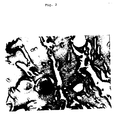
- Fig. 1 is an electron microphotograph (x50000) of the composition of the Example 7.
- the composition is found to have a gray, continuous matrix of the polycarbonate resin phase in which the polybutylene terephthalate resin is dispersed as shapeless particles.
- the multi-layer polymer is seen as dark, spherical particles having white periphery. It is dispersed substantially in the phase of polybutylene terephthalate resin.
- Fig. 2 is an electron microphotograph (x50000) of the resin composition of the Comparative Example 11.
- the composition is likewise has a gray, continuous matrix of the polycarbonate resin phase in which the polybutylene terephthalate resin is dispersed as shapeless particles or elongated phases.
- the multi-layer polymer is seen as substantially spherical particles and is dispersed mainly in the phase of polycarbonate resin.
Landscapes
- Chemical & Material Sciences (AREA)
- Health & Medical Sciences (AREA)
- Chemical Kinetics & Catalysis (AREA)
- Medicinal Chemistry (AREA)
- Polymers & Plastics (AREA)
- Organic Chemistry (AREA)
- Compositions Of Macromolecular Compounds (AREA)
- Laminated Bodies (AREA)
- Graft Or Block Polymers (AREA)
Claims (43)
- Polymère multi-couche qui comprend une couche-âme formée à partir d'un monomère vinyl-aromatique, une couche intermédiaire de polymère de type caoutchouc formée à partir d'un monomère acrylate d'alkyle dans lequel le groupe alkyle comporte de 2 à 8 atomes de carbone, et une couche-enveloppe vitreuse constituée par un copolymère styrène/acrylonitrile avec une teneur en acrylonitrile ne dépassant pas 30% en poids par rapport à la quantité totale de monomères utilisée pour la couche-enveloppe, dans lequel on fait réticuler le copolymère styrène/acrylonitrile avec un monomère de réticulation en une quantité de 5 à 15% en poids par rapport à la quantité totale des monomères utilisée pour la couche-enveloppe.
- Polymère multi-couche conforme à la revendication 1, dans lequel la couche-âme est formée à partir du styrène.
- Polymère multi-couche conforme à la revendication 1, dans lequel la couche intermédiaire de polymère de type caoutchouc est formée à partir d'au moins un des acrylate de 2-éthylhexyle et acrylate de butyle.
- Polymère multi-couche conforme à la revendication 1 qui a de plus une couche intermédiaire dure formée à partir d'un polymère de méthacrylate d'alkyle dans lequel le groupe alkyle comporte de 1 à 5 atomes de carbone, entre la couche intermédiaire de polymère de type caoutchouc et la couche-enveloppe.
- Polymère multi-couche conforme à la revendication 4, dans lequel le méthacrylate d'alkyle est le méthacrylate de méthyle ou le méthacrylate de butyle.
- Polymère multi-couche conforme à la revendication 1, dans lequel on fait réticuler la couche-âme avec un monomère de réticulation en une quantité ne dépassant pas 30% en poids par rapport au monomère utilisé pour la couche-âme.
- Polymère multi-couche conforme à la revendication 1, dans lequel on fait réticuler la couche-âme avec un monomère de réticulation en une quantité de 0,5 à 20% en poids par rapport au monomère utilisé pour la couche-âme.
- Polymère multi-couche conforme à la revendication 1, dans lequel on fait réticuler la couche-âme avec un monomère de réticulation en une quantité de 5 à 15% en poids par rapport au monomère utilisé pour la couche-âme.
- Polymère multi-couche conforme à la revendication 1, dans lequel on fait réticuler la couche intermédiaire dure avec un monomère de réticulation en une quantité ne dépassant pas 30% en poids par rapport au monomère utilisé pour la couche intermédiaire dure.
- Polymère multi-couche conforme à la revendication 1, dans lequel on fait réticuler la couche intermédiaire dure avec un monomère de réticulation en une quantité de 0,5 à 20% en poids par rapport au monomère utilisé pour la couche intermédiaire dure.
- Polymère multi-couche conforme à la revendication 1, dans lequel on fait réticuler la couche intermédiaire dure avec un monomère de réticulation en une quantité de 5 à 15% en poids par rapport au monomère utilisé pour la couche intermédiaire dure.
- Polymère multi-couche conforme à la revendication 1,dans lequel on fait réticuler une, deux ou trois des couche-âme, couche intermédiaire dure et couche-enveloppe avec un monomère de réticulation en une quantité totale de 1 à 30% en poids par rapport à la quantité totale des monomères utilisée pour les couche-âme, couche intermédiaire dure et couche-enveloppe.
- Polymère multi-couche conforme à la revendication 1,dans lequel on fait réticuler une, deux ou trois des couche-âme, couche intermédiaire dure et couche-enveloppe avec un monomère de réticulation en une quantité totale de 3 à 20% en poids par rapport à la quantité totale des monomères utilisée pour les couche-âme, couche intermédiaire dure et couche-enveloppe.
- Polymère multi-couche conforme à la revendication 1 qui est composé respectivement par rapport au polymère multi-couche, de 12 à 42% en poids de couche-âme, de 48 à 78% en poids de couche intermédiaire de polymère de type caoutchouc et de 10 à 40% en poids de couche-enveloppe.
- Polymère multi-couche conforme à la revendication 1 qui est composé respectivement par rapport au polymère multi-couche, de 15 à 30% en poids de couche-âme, de 50 à 65% en poids de couche intermédiaire de polymère de type caoutchouc et de 15 à 25% en poids de couche-enveloppe.
- Polymère multi-couche conforme à la revendication 1 qui est composé respectivement par rapport au polymère multi-couche, de 12 à 42% en poids de couche-âme, de 48 à 78% en poids de couche intermédiaire de polymère de type caoutchouc et de 10 à 40% en poids de la combinaison de la couche intermédiaire dure et de la couche-enveloppe.
- Polymère multi-couche conforme à la revendication 1 qui est composé respectivement par rapport au polymère multi-couche, de 15 à 30% en poids de couche-âme, de 50 à 65% en poids de couche intermédiaire de polymère de type caoutchouc et de 15 à 25 % en poids de la combinaison de la couche intermédiaire dure et de la couche-enveloppe.
- Polymère multi-couche conforme à la revendication 1 qui est composé respectivement par rapport au polymère multi-couche, de 10 à 40% en poids de couche-âme, de 30 à 80% en poids de couche intermédiaire de polymère de type caoutchouc et de 10 à 40% en poids de couche-enveloppe.
- Polymère multi-couche conforme à la revendication 1 qui est composé respectivement par rapport au polymère multi-couche, de 15 à 30% en poids de couche-âme, de 40 à 70% en poids de couche intermédiaire de polymère de type caoutchouc et de 15 à 25 % en poids de couche-enveloppe.
- Polymère multi-couche conforme à la revendication 1 qui est composé respectivement par rapport au polymère multi-couche, de 10 à 40% en poids de couche-âme, de 30 à 80% en poids de couche intermédiaire de polymère de type caoutchouc et de 10 à 40% en poids de la combinaison de la couche intermédiaire dure et de la couche-enveloppe.
- Polymère multi-couche conforme à la revendication 1 qui est composé respectivement par rapport au polymère multi-couche, de 15 à 30% en poids de couche-âme, de 40 à 70% en poids de couche intermédiaire de polymère de type caoutchouc et de 15 à 25 % en poids de la combinaison de la couche intermédiaire dure et de la couche-enveloppe.
- Polymère multi-couche conforme à la revendication 1 qui a une taille de particules de 100 à 700 nm.
- Polymère multi-couche conforme à la revendication 1 qui a une taille de particules de 200 à 500 nm.
- Polymère multi-couche conforme à la revendication 1 qui a une partie soluble dans le toluène ne dépassant pas 10 % en poids.
- Polymère multi-couche conforme à la revendication 1 qui a une partie soluble dans le toluène ne dépassant pas 6 % en poids.
- Composition de résine thermoplastique qui comprend :(a) une résine polycarbonate ; et(b) un polymère multi-couche qui est composé de 12 à 42% en poids d'une couche-âme formée à partir d'un monomère vinyl-aromatique, de 48 à 78% en poids d'une couche de polymère intermédiaire de type caoutchouc formée à partir d'un monomère acrylate d'alkyle dans lequel le groupe alkyle comporte de 2 à 8 atomes de carbone, et de 10 à 40% en poids d'une couche-enveloppe vitreuse constituée par un copolymère styrène/acrylonitrile avec une teneur en acrylonitrile ne dépassant pas 30% en poids par rapport à la quantité totale des monomères utilisée pour la couche-enveloppe, dans lequel on fait réticuler le copolymère styrène/acrylonitrile avec un monomère de réticulation en une quantité de 5 à 15% en poids par rapport à la quantité totale utilisée pour la couche-enveloppe.
- Composition de résine thermoplastique conforme à la revendication 26, dans laquelle le polymère multi-couche est composé respectivement par rapport au polymère multi-couche, de 15 à 30% en poids de couche-âme, de 50 à 65% en poids de couche intermédiaire de type caoutchouc, et de 15 à 25% en poids de couche-enveloppe.
- Composition de résine thermoplastique conforme à la revendication 26, dans laquelle le polymère multi-couche est composé respectivement par rapport au polymère multi-couche,de 12 à 42% en poids de couche-âme, de 48 à 78% en poids de couche intermédiaire de type caoutchouc, et de 10 à 40% en poids de la combinaison de la couche intermédiaire dure et de la couche-enveloppe.
- Composition de résine thermoplastique conforme à la revendication 26, dans laquelle le polymère multi-couche est composé respectivement par rapport au polymère multi-couche, de 15 à 30% en poids de couche-âme, de 50 à 65% en poids de couche intermédiaire de type caoutchouc, et de 15 à 25% en poids de la combinaison de la couche intermédiaire dure et de la couche-enveloppe.
- Composition de résine thermoplastique conforme à la revendication 26 qui contient 0,5 à 60 parties en poids du polymère multi-couche par rapport à 100 parties en poids de résine polycarbonate.
- Article moulé fabriqué avec une composition de résine thermoplastique qui comprend :(a) une résine polycarbonate ; et(b) un polymère multi-couche qui est composé de 12 à 42% en poids d'une couche-âme formée à partir d'un monomère vinyl-atomàtique, de 48 à 78% en poids d'une couche de polymère intermédiaire de type caoutchouc formée à partir d'un monomère acrylate d'alkyle dans lequel le groupe alkyle comporte de 2 à 8 atomes de carbone, et de 10 à 40% en poids d'une couche-enveloppe vitreuse constituée par un copolymère styrène/acrylonitrile avec une teneur en acrylonitrile ne dépassant pas 30% en poids par rapport à la quantité totale des monomères utilisée pour la couche-enveloppe, dans lequel on fait réticuler le copolymère styrène/acrylonitrile avec un monomère de réticulation en une quantité de 5 à 15% en poids par rapport à la quantité totale utilisée pour la couche-enveloppe.
- Composition de résine thermoplastique qui comprend :(a) une résine thermoplastique contenant une résine polycarbonate et une résine polyester ; et(b) un polymère multi-couche qui comprend une couche-âme formée à partir d'un monomère vinyl-aromatique, une couche de polymère intermédiaire de type caoutchouc formée à partir d'un monomère acrylate d'alkyle dans lequel le groupe alkyle comporte de 2 à 8 atomes de carbone, et une couche-enveloppe vitreuse constituée par un copolymère styrène/acrylonitrile avec une teneur en acrylonitrile ne dépassant pas 30% en poids par rapport à la quantité totale des monomères utilisée pour la couche-enveloppe, dans lequel on fait réticuler le copolymère styrène/acrylonitrile avec un monomère de réticulation en une quantité de 5 à 15% en poids par rapport à la quantité totale utilisée pour la couche-enveloppe.
- Composition de résine thermoplastique conforme à la revendication 32, dans laquelle le polymère multi-couche est composé respectivement par rapport au polymère multi-couche, de 10 à 40% en poids de couche-âme, de 30 à 80% en poids de couche intermédiaire de polymère de type caoutchouc et de 10 à 40% en poids de couche-enveloppe.
- Composition de résine thermoplastique conforme à la revendication 32, dans laquelle le polymère multi-couche est composé respectivement par rapport au polymère multi-couche, de 15 à 30% en poids de couche-âme, de 40 à 70% en poids de couche intermédiaire de polymère de type caoutchouc et de 15 à 25% en poids de couche-enveloppe.
- Composition de résine thermoplastique conforme à la revendication 32, dans laquelle le polymère multi-couche est composé respectivement par rapport au polymère multi-couche, de 10 à 40% en poids de couche-âme, de 30 à 80% en poids de couche intermédiaire de polymère de type caoutchouc et de 10 à 40% en poids de la combinaison de la couche intermédiaire dure et de la couche-enveloppe.
- Composition de résine thermoplastique conforme à la revendication 32, dans laquelle le polymère multi-couche est composé respectivement par rapport au polymère multi-couche, de 15 à 30% en poids de couche-âme, de 50 à 65 % en poids de couche intermédiaire de polymère de type caoutchouc et de 15 à 25% en poids de la combinaison de la couche intermédiaire dure et de la couche-enveloppe.
- Composition de résine thermoplastique conforme à la revendication 32 qui contient 0,5 à 50 parties en poids de polymère multi-couche par rapport à 100 parties en poids de résine thermoplastique.
- Composition de résine thermoplastique conforme à la revendication 32, dans laquelle la résine thermoplastique est composée de 5 à 95% en poids de résine polycarbonate et de 95 à 5% en poids de résine polyester.
- Composition de résine thermoplastique conforme à la revendication 32, dans laquelle la résine thermoplastique est composée de 50 à 95% en poids de résine polycarbonate et de 50 à 5% en poids de résine polyester.
- Composition de résine thermoplastique conforme à la revendication 32, dans laquelle la résine multi-couche est pratiquement dispersée dans la phase de la résine polyester.
- Composition de résine thermoplastique conforme à la revendication 32, dans laquelle la résine polyester est un poly(éthylène téréphtalate) ou un poly(butylène téréphtalate).
- Composition de résine thermoplastique conforme à la revendication 40, dans laquelle la résine polyester est un poly(butylène téréphtalate).
- Article moulé fabriqué avec une composition de résine thermoplastique qui comprend :(a) une résine thermoplastique contenant une résine polycarbonate et une résine polyester ; et(b) un polymère multi-couche qui comprend une couche-âme formée à partir d'un monomère vinyl-aromatique, une couche de polymère intermédiaire de type caoutchouc formée à partir d'un monomère acrylate d'alkyle dans lequel le groupe alkyle comporte de 2 à 8 atomes de carbone, et une couche-enveloppe vitreuse constituée par un copolymère styrène/acrylonitrile avec une teneur en acrylonitrile ne dépassant pas 30% en poids par rapport à la quantité totale des monomères utilisée pour la couche-enveloppe, dans lequel on fait réticuler le copolymère styrène/acrylonitrile avec un monomère de réticulation en une quantité de 5 à 15% en poids par rapport à la quantité totale utilisée pour la couche-enveloppe.
Applications Claiming Priority (4)
| Application Number | Priority Date | Filing Date | Title |
|---|---|---|---|
| JP12151790 | 1990-05-11 | ||
| JP121517/90 | 1990-05-11 | ||
| JP19738790 | 1990-07-25 | ||
| JP197387/90 | 1990-07-25 |
Publications (3)
| Publication Number | Publication Date |
|---|---|
| EP0465792A2 EP0465792A2 (fr) | 1992-01-15 |
| EP0465792A3 EP0465792A3 (en) | 1992-05-06 |
| EP0465792B1 true EP0465792B1 (fr) | 1996-08-21 |
Family
ID=26458866
Family Applications (1)
| Application Number | Title | Priority Date | Filing Date |
|---|---|---|---|
| EP91107467A Expired - Lifetime EP0465792B1 (fr) | 1990-05-11 | 1991-05-08 | Polymère multi-couche, composition de résine thermoplastique le contenant et article moulé fabriqué à partir de cette composition |
Country Status (4)
| Country | Link |
|---|---|
| EP (1) | EP0465792B1 (fr) |
| KR (1) | KR0180708B1 (fr) |
| CA (1) | CA2042347C (fr) |
| DE (1) | DE69121485T2 (fr) |
Families Citing this family (15)
| Publication number | Priority date | Publication date | Assignee | Title |
|---|---|---|---|---|
| TW246657B (fr) * | 1991-12-05 | 1995-05-01 | Mitsubishi Gas Chemical Co | |
| JPH11502540A (ja) * | 1995-02-01 | 1999-03-02 | バイエル・アントバーペン・エヌ・ベー | 改善された着色性を有する重合体配合物 |
| CN1063193C (zh) * | 1997-04-03 | 2001-03-14 | 中国石油化工总公司 | 核壳微粒增韧透明聚苯乙烯材料 |
| CN1063186C (zh) * | 1997-04-03 | 2001-03-14 | 中国石油化工总公司 | 制备核壳微粒增韧聚苯乙烯材料工艺 |
| CN1063191C (zh) * | 1997-04-03 | 2001-03-14 | 中国石油化工总公司 | 交联核壳共聚微粒 |
| US6476126B1 (en) | 1999-04-07 | 2002-11-05 | Bayer Corporation | Weatherable molding composition having improved surface appearance |
| CA2299874C (fr) * | 1999-04-07 | 2009-09-15 | Bayer Corporation | Composition de moulage resistant aux intemperies et ayant une meilleure apparence en surface |
| DE10003509A1 (de) * | 2000-01-27 | 2001-08-02 | Basf Ag | Verfahren zur Herstellung schlagzäher Kunststoffe |
| DE60031310T2 (de) | 2000-08-14 | 2007-05-10 | Mitsubishi Rayon Co., Ltd. | Thermoplastische harzzusammensetzung auf polycarbonatbasis und verfahren zu deren herstellung |
| KR100544904B1 (ko) | 2002-12-24 | 2006-01-24 | 주식회사 엘지화학 | 다층구조를 갖는 충격보강제와 이의 제조방법 및 이를 포함하는 열가소성 수지 |
| KR100815995B1 (ko) * | 2006-06-08 | 2008-03-21 | 제일모직주식회사 | 저온 및 상온 내충격성과 착색성 및 내후성이 우수한asa 그라프트 공중합체 및 이를 포함한 열가소성 수지조성물 |
| KR100964103B1 (ko) * | 2006-12-27 | 2010-06-16 | 주식회사 엘지화학 | 가공조제를 포함하는 아크릴계 충격보강제 및 이를포함하는 염화비닐 수지 조성물 |
| KR20130090307A (ko) | 2012-02-03 | 2013-08-13 | 주식회사 엘지화학 | 아크릴계 충격보강제 및 이를 포함하는 열가소성 수지 조성물 |
| KR101401109B1 (ko) * | 2012-02-06 | 2014-05-28 | 주식회사 엘지화학 | 아크릴레이트-스티렌-아크릴로니트릴 공중합체, 이의 제조방법 및 이를 포함하는 열가소성 수지 조성물 |
| CN104231725B (zh) * | 2014-09-30 | 2016-08-31 | 永发印务(东莞)有限公司 | 一种多壳液晶组成的光学异彩油墨组合物及其制备方法 |
Family Cites Families (1)
| Publication number | Priority date | Publication date | Assignee | Title |
|---|---|---|---|---|
| CA1231491A (fr) * | 1983-07-22 | 1988-01-12 | Richard H. Weese | Resines thermoplastiques pigmentees |
-
1991
- 1991-05-08 DE DE69121485T patent/DE69121485T2/de not_active Expired - Lifetime
- 1991-05-08 EP EP91107467A patent/EP0465792B1/fr not_active Expired - Lifetime
- 1991-05-10 CA CA002042347A patent/CA2042347C/fr not_active Expired - Fee Related
- 1991-05-11 KR KR1019910007610A patent/KR0180708B1/ko not_active Expired - Lifetime
Also Published As
| Publication number | Publication date |
|---|---|
| DE69121485T2 (de) | 1997-01-16 |
| CA2042347A1 (fr) | 1991-11-12 |
| KR910020051A (ko) | 1991-12-19 |
| CA2042347C (fr) | 2002-02-12 |
| EP0465792A3 (en) | 1992-05-06 |
| KR0180708B1 (ko) | 1999-05-15 |
| EP0465792A2 (fr) | 1992-01-15 |
| DE69121485D1 (de) | 1996-09-26 |
Similar Documents
| Publication | Publication Date | Title |
|---|---|---|
| EP0465792B1 (fr) | Polymère multi-couche, composition de résine thermoplastique le contenant et article moulé fabriqué à partir de cette composition | |
| AU654057B2 (en) | Multi-layered polymers | |
| EP1529810B1 (fr) | Composition à mouler de polyester modifié résistant aux intempéries | |
| EP3992248B1 (fr) | Composition de résine thermoplastique et produit moulé l'utilisant | |
| US20070049667A1 (en) | High flow polyester composition | |
| KR101958884B1 (ko) | 열가소성 수지 조성물 및 이를 이용한 성형품 | |
| JP2010105226A (ja) | 樹脂成形体 | |
| JP2997544B2 (ja) | 耐発火性ポリカーボネートブレンド | |
| JP3353351B2 (ja) | 多層構造重合体、これを含む熱可塑性樹脂組成物及びその成形品 | |
| JP2980735B2 (ja) | 多層構造重合体、これを含む熱可塑性樹脂組成物及びその成形品 | |
| US6242519B1 (en) | Polyester molding composition | |
| EP0299469B1 (fr) | Composition de résine polycarbonate avec modificateurs d'impact acrylique | |
| JP2001011292A (ja) | 淡色系耐光性ポリエステル樹脂組成物およびそれから成形された照明器具部品 | |
| JPH03124764A (ja) | 熱可塑性樹脂組成物 | |
| KR102001484B1 (ko) | 열가소성 수지 조성물 및 이를 이용한 성형품 | |
| JPH05209115A (ja) | 耐衝撃性、耐ガソリン汚染性ポリエステル/ポリカーボネート成形用組成物 | |
| JPH0245659B2 (fr) | ||
| AU659344B2 (en) | Thermoplastic resin composition containing a polycarbonate resin and a multi-layer polymer, and moulded article made therefrom | |
| JP2000297220A (ja) | 熱可塑性樹脂組成物 | |
| JP2998310B2 (ja) | ポリカーボネート樹脂組成物及びその成形品 | |
| JPH041223A (ja) | ポリアリレート、その製法およびそれを用いた熱可塑性樹脂組成物 | |
| JP2597668B2 (ja) | 難燃性ポリエステル組成物 | |
| EP0299468A2 (fr) | Composition de résine polycarbonate avec des modificateurs d'impact diéniques | |
| JP3176651B2 (ja) | 難燃性ポリエステル樹脂組成物 | |
| JPS61127754A (ja) | 熱可塑性樹脂組成物 |
Legal Events
| Date | Code | Title | Description |
|---|---|---|---|
| PUAI | Public reference made under article 153(3) epc to a published international application that has entered the european phase |
Free format text: ORIGINAL CODE: 0009012 |
|
| AK | Designated contracting states |
Kind code of ref document: A2 Designated state(s): DE FR GB IT NL |
|
| PUAL | Search report despatched |
Free format text: ORIGINAL CODE: 0009013 |
|
| RAP3 | Party data changed (applicant data changed or rights of an application transferred) |
Owner name: MITSUBISHI GAS CHEMICAL COMPANY, INC. Owner name: TAKEDA CHEMICAL INDUSTRIES, LTD. |
|
| AK | Designated contracting states |
Kind code of ref document: A3 Designated state(s): DE FR GB IT NL |
|
| 17P | Request for examination filed |
Effective date: 19920902 |
|
| 17Q | First examination report despatched |
Effective date: 19940221 |
|
| GRAH | Despatch of communication of intention to grant a patent |
Free format text: ORIGINAL CODE: EPIDOS IGRA |
|
| GRAA | (expected) grant |
Free format text: ORIGINAL CODE: 0009210 |
|
| AK | Designated contracting states |
Kind code of ref document: B1 Designated state(s): DE FR GB IT NL |
|
| PG25 | Lapsed in a contracting state [announced via postgrant information from national office to epo] |
Ref country code: IT Free format text: LAPSE BECAUSE OF FAILURE TO SUBMIT A TRANSLATION OF THE DESCRIPTION OR TO PAY THE FEE WITHIN THE PRE;WARNING: LAPSES OF ITALIAN PATENTS WITH EFFECTIVE DATE BEFORE 2007 MAY HAVE OCCURRED AT ANY TIME BEFORE 2007. THE CORRECT EFFECTIVE DATE MAY BE DIFFERENT FROM THE ONE RECORDED.SCRIBED TIME-LIMIT Effective date: 19960821 Ref country code: NL Free format text: LAPSE BECAUSE OF FAILURE TO SUBMIT A TRANSLATION OF THE DESCRIPTION OR TO PAY THE FEE WITHIN THE PRESCRIBED TIME-LIMIT Effective date: 19960821 |
|
| ET | Fr: translation filed | ||
| REF | Corresponds to: |
Ref document number: 69121485 Country of ref document: DE Date of ref document: 19960926 |
|
| NLV1 | Nl: lapsed or annulled due to failure to fulfill the requirements of art. 29p and 29m of the patents act | ||
| PLBE | No opposition filed within time limit |
Free format text: ORIGINAL CODE: 0009261 |
|
| STAA | Information on the status of an ep patent application or granted ep patent |
Free format text: STATUS: NO OPPOSITION FILED WITHIN TIME LIMIT |
|
| 26N | No opposition filed | ||
| REG | Reference to a national code |
Ref country code: GB Ref legal event code: IF02 |
|
| PGFP | Annual fee paid to national office [announced via postgrant information from national office to epo] |
Ref country code: GB Payment date: 20100329 Year of fee payment: 20 |
|
| PGFP | Annual fee paid to national office [announced via postgrant information from national office to epo] |
Ref country code: FR Payment date: 20100525 Year of fee payment: 20 |
|
| PGFP | Annual fee paid to national office [announced via postgrant information from national office to epo] |
Ref country code: DE Payment date: 20100512 Year of fee payment: 20 |
|
| REG | Reference to a national code |
Ref country code: DE Ref legal event code: R071 Ref document number: 69121485 Country of ref document: DE |
|
| REG | Reference to a national code |
Ref country code: GB Ref legal event code: PE20 Expiry date: 20110507 |
|
| PG25 | Lapsed in a contracting state [announced via postgrant information from national office to epo] |
Ref country code: GB Free format text: LAPSE BECAUSE OF EXPIRATION OF PROTECTION Effective date: 20110507 |
|
| PG25 | Lapsed in a contracting state [announced via postgrant information from national office to epo] |
Ref country code: DE Free format text: LAPSE BECAUSE OF EXPIRATION OF PROTECTION Effective date: 20110508 |