EP0466082A2 - Verfahren zur Lichtmodulation und optischer Modulator - Google Patents
Verfahren zur Lichtmodulation und optischer Modulator Download PDFInfo
- Publication number
- EP0466082A2 EP0466082A2 EP91111359A EP91111359A EP0466082A2 EP 0466082 A2 EP0466082 A2 EP 0466082A2 EP 91111359 A EP91111359 A EP 91111359A EP 91111359 A EP91111359 A EP 91111359A EP 0466082 A2 EP0466082 A2 EP 0466082A2
- Authority
- EP
- European Patent Office
- Prior art keywords
- light
- waveguide
- waveguide layer
- layer
- wavelength
- Prior art date
- Legal status (The legal status is an assumption and is not a legal conclusion. Google has not performed a legal analysis and makes no representation as to the accuracy of the status listed.)
- Granted
Links
- 230000003287 optical effect Effects 0.000 title claims abstract description 124
- 238000000034 method Methods 0.000 title claims abstract description 16
- 239000000758 substrate Substances 0.000 claims abstract description 33
- 238000005253 cladding Methods 0.000 claims description 44
- 230000008859 change Effects 0.000 claims description 37
- 239000004065 semiconductor Substances 0.000 claims description 29
- 230000005684 electric field Effects 0.000 claims description 25
- 238000004891 communication Methods 0.000 claims description 19
- 230000001902 propagating effect Effects 0.000 claims description 19
- 230000008878 coupling Effects 0.000 claims description 18
- 238000010168 coupling process Methods 0.000 claims description 18
- 238000005859 coupling reaction Methods 0.000 claims description 18
- 230000005540 biological transmission Effects 0.000 claims description 13
- 238000010521 absorption reaction Methods 0.000 description 33
- 229910001218 Gallium arsenide Inorganic materials 0.000 description 22
- 230000000694 effects Effects 0.000 description 7
- VYPSYNLAJGMNEJ-UHFFFAOYSA-N Silicium dioxide Chemical compound O=[Si]=O VYPSYNLAJGMNEJ-UHFFFAOYSA-N 0.000 description 6
- 238000002834 transmittance Methods 0.000 description 6
- 229910052581 Si3N4 Inorganic materials 0.000 description 4
- 230000000903 blocking effect Effects 0.000 description 4
- 238000002347 injection Methods 0.000 description 4
- 239000007924 injection Substances 0.000 description 4
- 238000003780 insertion Methods 0.000 description 4
- 230000037431 insertion Effects 0.000 description 4
- 238000000411 transmission spectrum Methods 0.000 description 4
- 238000005275 alloying Methods 0.000 description 3
- 229910052782 aluminium Inorganic materials 0.000 description 3
- XAGFODPZIPBFFR-UHFFFAOYSA-N aluminium Chemical compound [Al] XAGFODPZIPBFFR-UHFFFAOYSA-N 0.000 description 3
- 229910052681 coesite Inorganic materials 0.000 description 3
- 229910052906 cristobalite Inorganic materials 0.000 description 3
- 238000004943 liquid phase epitaxy Methods 0.000 description 3
- 238000001451 molecular beam epitaxy Methods 0.000 description 3
- 238000001020 plasma etching Methods 0.000 description 3
- 239000000377 silicon dioxide Substances 0.000 description 3
- 235000012239 silicon dioxide Nutrition 0.000 description 3
- 229910052682 stishovite Inorganic materials 0.000 description 3
- 229910052905 tridymite Inorganic materials 0.000 description 3
- 229910000980 Aluminium gallium arsenide Inorganic materials 0.000 description 2
- QAOWNCQODCNURD-UHFFFAOYSA-N Sulfuric acid Chemical compound OS(O)(=O)=O QAOWNCQODCNURD-UHFFFAOYSA-N 0.000 description 2
- 238000000862 absorption spectrum Methods 0.000 description 2
- 230000004888 barrier function Effects 0.000 description 2
- 230000008033 biological extinction Effects 0.000 description 2
- 238000005229 chemical vapour deposition Methods 0.000 description 2
- 230000003247 decreasing effect Effects 0.000 description 2
- 238000010586 diagram Methods 0.000 description 2
- 238000009826 distribution Methods 0.000 description 2
- 238000005530 etching Methods 0.000 description 2
- 239000000463 material Substances 0.000 description 2
- 230000010355 oscillation Effects 0.000 description 2
- 229920002120 photoresistant polymer Polymers 0.000 description 2
- 230000004044 response Effects 0.000 description 2
- 238000010897 surface acoustic wave method Methods 0.000 description 2
- 230000007704 transition Effects 0.000 description 2
- 229910003327 LiNbO3 Inorganic materials 0.000 description 1
- 230000005697 Pockels effect Effects 0.000 description 1
- 230000005699 Stark effect Effects 0.000 description 1
- 230000008901 benefit Effects 0.000 description 1
- 230000015572 biosynthetic process Effects 0.000 description 1
- 239000000969 carrier Substances 0.000 description 1
- 238000006243 chemical reaction Methods 0.000 description 1
- 150000001875 compounds Chemical class 0.000 description 1
- 238000013461 design Methods 0.000 description 1
- 238000009792 diffusion process Methods 0.000 description 1
- 239000006185 dispersion Substances 0.000 description 1
- 230000005685 electric field effect Effects 0.000 description 1
- 230000010365 information processing Effects 0.000 description 1
- 238000004519 manufacturing process Methods 0.000 description 1
- 229910052751 metal Inorganic materials 0.000 description 1
- 239000002184 metal Substances 0.000 description 1
- 238000012986 modification Methods 0.000 description 1
- 230000004048 modification Effects 0.000 description 1
- 239000013307 optical fiber Substances 0.000 description 1
- 230000005693 optoelectronics Effects 0.000 description 1
- 238000000059 patterning Methods 0.000 description 1
- 230000003068 static effect Effects 0.000 description 1
Images





Classifications
-
- G—PHYSICS
- G02—OPTICS
- G02F—OPTICAL DEVICES OR ARRANGEMENTS FOR THE CONTROL OF LIGHT BY MODIFICATION OF THE OPTICAL PROPERTIES OF THE MEDIA OF THE ELEMENTS INVOLVED THEREIN; NON-LINEAR OPTICS; FREQUENCY-CHANGING OF LIGHT; OPTICAL LOGIC ELEMENTS; OPTICAL ANALOGUE/DIGITAL CONVERTERS
- G02F1/00—Devices or arrangements for the control of the intensity, colour, phase, polarisation or direction of light arriving from an independent light source, e.g. switching, gating or modulating; Non-linear optics
- G02F1/29—Devices or arrangements for the control of the intensity, colour, phase, polarisation or direction of light arriving from an independent light source, e.g. switching, gating or modulating; Non-linear optics for the control of the position or the direction of light beams, i.e. deflection
- G02F1/31—Digital deflection, i.e. optical switching
- G02F1/313—Digital deflection, i.e. optical switching in an optical waveguide structure
- G02F1/3132—Digital deflection, i.e. optical switching in an optical waveguide structure of directional coupler type
- G02F1/3133—Digital deflection, i.e. optical switching in an optical waveguide structure of directional coupler type the optical waveguides being made of semiconducting materials
-
- G—PHYSICS
- G02—OPTICS
- G02F—OPTICAL DEVICES OR ARRANGEMENTS FOR THE CONTROL OF LIGHT BY MODIFICATION OF THE OPTICAL PROPERTIES OF THE MEDIA OF THE ELEMENTS INVOLVED THEREIN; NON-LINEAR OPTICS; FREQUENCY-CHANGING OF LIGHT; OPTICAL LOGIC ELEMENTS; OPTICAL ANALOGUE/DIGITAL CONVERTERS
- G02F1/00—Devices or arrangements for the control of the intensity, colour, phase, polarisation or direction of light arriving from an independent light source, e.g. switching, gating or modulating; Non-linear optics
- G02F1/29—Devices or arrangements for the control of the intensity, colour, phase, polarisation or direction of light arriving from an independent light source, e.g. switching, gating or modulating; Non-linear optics for the control of the position or the direction of light beams, i.e. deflection
- G02F1/31—Digital deflection, i.e. optical switching
- G02F1/313—Digital deflection, i.e. optical switching in an optical waveguide structure
- G02F1/3132—Digital deflection, i.e. optical switching in an optical waveguide structure of directional coupler type
- G02F1/3135—Vertical structure
-
- G—PHYSICS
- G02—OPTICS
- G02F—OPTICAL DEVICES OR ARRANGEMENTS FOR THE CONTROL OF LIGHT BY MODIFICATION OF THE OPTICAL PROPERTIES OF THE MEDIA OF THE ELEMENTS INVOLVED THEREIN; NON-LINEAR OPTICS; FREQUENCY-CHANGING OF LIGHT; OPTICAL LOGIC ELEMENTS; OPTICAL ANALOGUE/DIGITAL CONVERTERS
- G02F2201/00—Constructional arrangements not provided for in groups G02F1/00 - G02F7/00
- G02F2201/30—Constructional arrangements not provided for in groups G02F1/00 - G02F7/00 grating
- G02F2201/302—Constructional arrangements not provided for in groups G02F1/00 - G02F7/00 grating grating coupler
-
- G—PHYSICS
- G02—OPTICS
- G02F—OPTICAL DEVICES OR ARRANGEMENTS FOR THE CONTROL OF LIGHT BY MODIFICATION OF THE OPTICAL PROPERTIES OF THE MEDIA OF THE ELEMENTS INVOLVED THEREIN; NON-LINEAR OPTICS; FREQUENCY-CHANGING OF LIGHT; OPTICAL LOGIC ELEMENTS; OPTICAL ANALOGUE/DIGITAL CONVERTERS
- G02F2203/00—Function characteristic
- G02F2203/05—Function characteristic wavelength dependent
- G02F2203/055—Function characteristic wavelength dependent wavelength filtering
Definitions
- the present invention relates to an optical modulator used in an optical communication system, an optical exchange apparatus, an optical information processing apparatus, or an optical recording apparatus, and a method of modulating light using the same.
- a conventional high-speed optical modulator utilizing a semiconductor element which can be driven with a low drive voltage and can be easily integrated with other optical electronic elements such as a semiconductor laser is known.
- an absorption type optical modulator utilizing an absorption end shift of a semiconductor e.g., a semiconductor layer of a bulk or quantum well structure
- a semiconductor e.g., a semiconductor layer of a bulk or quantum well structure
- a directional coupler type optical modulator utilizing a change in refractive index upon application of an electric field is proposed in Report OQE 86-39, the Institute of Electronic and Communication Engineers of Japan, (1986) is also proposed.
- the former optical modulator comprises a semiconductor waveguide having a p-i-n structure.
- an absorption end is shifted by the Franz-Keldysh effect or QCSE (Quantum Containment Stark Effect), as shown in Fig. 3, to change the absorption index, and a transmittance of light having a given wavelength can be controlled
- a wavelength used must be set closer to the absorption end so as to increase an extinction ratio. For this reason, a transmittance in a transmission state is decreased, and hence an insertion loss is increased.
- Light components having all wavelengths cannot always be modulated depending on the wavelength of the absorption end. That is, a wavelength to be modulated, i.e., the wavelength used, is limited to a predetermined range, resulting in inconvenience.
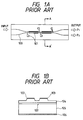
- Fig. 1A is a schematic plan view showing an arrangement of a first conventional directional coupler type optical modulator
- Fig. 1B is a sectional view of the optical modulator along the line A - A' in Fig. 1A.
- This optical modulator comprises ridges 100, aluminum electrodes 101, waveguides 102, aluminum electrodes 103, an n ⁇ -GaAs layer (optical waveguide layer) 104, an n+-GaAs layer 105, an aluminum electrode 106, and a GaAlAs layer 107.
- the electrodes are formed in coupling regions of the two waveguides, and an electric field is applied to these electrodes to cause a change in refractive index, thereby shifting a light wave between the waveguides.
- Fig. 2A is a schematic plan view showing an arrangement of a second conventional directional coupler type optical modulator
- Fig. 2B is a sectional view of the optical modulator along the line A - A' in Fig. 2A.
- This optical modulator comprises optical waveguides 200, a p ⁇ -side electrode 201, an SiO2 layer 202, an InGaAsP gap 203, an InP cladding layer 204, an InGaAsP optical waveguide layer 205, an InP substrate 206, an n ⁇ -side electrode 207, diffusion regions 208, and a graded region (refractive index changing region) 209.
- the electrodes are formed in crossing regions of the two waveguides, and an electric field is applied to these electrodes to cause a change in refractive index, thereby shifting a light wave between the waveguides.
- the optical modulator shown in Figs. 2A and 2B light from an exit end of one of the waveguides is modulated.
- the degree of optical modulation is controlled by a change in refractive index
- an absorption index is necessarily changed with the change in refractive index. Therefore, optical modulation cannot be stably performed, resulting in inconvenience.
- the element length i.e., the waveguide length
- the optical modulator is designed to obtain a large change in refractive index with respect to a constant electric field so as to reduce a drive voltage
- the range of wavelength to be modulated comes close to the range of wavelength corresponding to a large absorption index, resulting in inconvenience.
- a demultiplexer In a conventional wavelength division multiplexing system, a demultiplexer is used as a unit for dividing a given wavelength range into channels. Demultiplexing is performed by using a wavelength dispersion unit, e.g., an interference filter or grating to split light into transmitting and reflected components depending on wavelengths, or by utilizing different reflection angles.
- This demultiplexer has an advantage in that data of several wavelengths can be simultaneously received, but has a disadvantage in that the element area is increased because the data multiplexed in the wavelength region is split into a spatial region.
- the number of photodetectors to be integrated is limited. As a result, it is difficult to obtain a high-density wavelength multiplexing arrangement.
- variable wavelength filter is available to provide one photodetector which can sufficiently cope with a wavelength multiplexing scheme.
- degree of wavelength multiplexing can be increased.
- This variable wavelength filter is exemplified as a filter utilizing a TE-TM mode converter, as proposed in Applied Physics Letters, Vol. 53, pp. 13 - 15 (1988).
- a variable wavelength filter utilizing an even-odd mode converter is proposed.
- a variable wavelength filter utilizing a surface acoustic wave (SAW) is proposed.
- variable wavelength filters have a wide variable wavelength range of 100 ⁇ or more, they are devices utilizing LiNbO3, thus posing a problem as to a coupling loss with a photodetector.
- a refractive index is obtained by an electrooptical effect (i.e., a Pockels effect)
- a high voltage of several tens of V to 200 V is required.
- variable wavelength filters using compound semiconductors such as GaAs and InP
- filters utilizing a DFB (Distributed FeedBack) laser and a DBR (DistriButed Reflection) type laser at a value smaller than an oscillation threshold value are also known.
- a variable wavelength filter utilizing a Fabry-Pérot laser at an oscillation threshold value or less is proposed.
- variable wavelength filters can be easily integrated with photodetectors and have gains upon injection of currents. Since the variable wavelength range is directly determined by the width of a change in refractive index, a practical variable wavelength filter described above can obtain only a variable wavelength range of several ⁇ to several tens of ⁇ .
- an optical modulator comprising: a substrate; a first waveguide layer formed on the substrate, the first waveguide layer being arranged to guide external input light and output modulated light; a second waveguide layer stacked together with the first waveguide layer in a direction of a thickness thereof on the substrate, the second waveguide layer having a waveguide mode different from that of the first waveguide layer; a diffraction grating formed in a region where the waveguide modes of the first and second waveguide layers overlap each other, the diffraction grating coupling to the second waveguide layer light having a wavelength range selected from those of light components propagating through the first waveguide layer; and an electrode for applying a modulated electrical signal, wherein when the electrical signal is applied through the electrode, the wavelength of the light coupled by the diffraction grating is changed, and light output from the second waveguide layer is modulated in accordance with the electrical signal.
- a method of modulating light by using the above optical modulator comprising the steps of: inputting light into a first waveguide layer; causing the input light to propagate through the first waveguide layer; causing a diffraction grating to couple to the second waveguide layer light having a wavelength range selected from those of light components propagating through the first waveguide layer; applying a modulated electrical signal through an electrode to change the wavelength of the light coupled by the diffraction grating, so that the light propagating through the first waveguide layer is modulated by the change in wavelength; and outputting the modulated light from the second waveguide layer.
- an optical modulator comprising: a substrate; a first cladding layer essentially consisting of a semiconductor of a first conductivity type formed on the substrate; a first waveguide layer essentially consisting of a semiconductor of the first conductivity type formed on the first cladding layer, the first waveguide layer being arranged to guide external input light and output modulated light; a second cladding layer essentially consisting of a semiconductor of the first conductivity type formed on the first waveguide layer; a second waveguide layer essentially consisting of an intrinsic semiconductor of a quantum well structure formed on the second cladding layer, the second waveguide layer having a waveguide mode different from that of the first waveguide layer; a third cladding layer essentially consisting of a semiconductor of a second conductivity type formed on the second waveguide layer; a diffraction grating formed in a region where the waveguide modes of the first and second waveguide layers overlap each other, the diffraction grating coupling to the second waveguide layer light
- a method of modulating light by using the above optical modulator comprising the steps of: inputting light into a first waveguide layer; causing the input light to propagate through the first waveguide layer; causing a diffraction grating to couple to the second waveguide layer light having a wavelength range selected from those of light components propagating through the first waveguide layer; applying a reverse-biasing modulated electrical signal to the first and second waveguide layers and the first, second, and third cladding layers through an electrode to change the wavelength of the light coupled by the diffraction grating, so that the light propagating through the first waveguide layer is modulated by the change in wavelength; and outputting the modulated light from the second waveguide layer.
- Figs. 4A and 4B are a side sectional view and a front sectional view of an optical modulator according to the first embodiment of the present invention.
- This embodiment has a stacking directional coupler.
- Two waveguides 1 and 2 constituting this directional coupler have different refractive indice and different hicknesses to constitute a so-called asymmetrical directional coupler.
- This directional coupler transmits 0th- and 1st-order modes.
- the 0th-order mode mainly propagates through the upper waveguide 1
- the first-order mode mainly propagates through the lower waveguide 2.
- a propagation constant of the 0th-order mode is given as ⁇ 0 and a propagation constant of the 1st-order mode is given as ⁇ 1
- the propagation constants ⁇ 0 and ⁇ 1 have a large difference due to asymmetry between the upper and lower waveguides 1 and 2.
- a grating 3 is formed in the upper waveguide 1 in this directional coupler to compensate for the propagation constant difference.
- light 4 incident on the lower waveguide 2 becomes the 1st-order mode and is coupled to the 0th-order mode at the specific wavelength ⁇ to cause transition to the upper waveguide 1.
- the 1st-order mode is not coupled to the 0th-order mode and propagates along the lower waveguide 2.
- the above directional coupler consists of GaAs/AlGaAs.
- the upper waveguide 1 is set in a carrier nondoped state, i.e., comprises an i-type (intrinsic) layer).
- a cladding layer 5 and a contact layer 6 of the upper waveguide 1 are p-type layers.
- a cladding layer 7 between the upper and lower waveguides 1 and 2, the lower waveguide layer path layer 2, and a lower cladding layer 8 of the lower waveguide 2 comprise n-type layers, respectively.
- the upper waveguide (i-type layer) is sandwiched to constitute a p-i-n structure.
- a reverse-biasing electric field is applied from a voltage source 14 to the optical modulator through electrodes 9 and 11.
- the applied electrode field is modulated upon ON/OFF operation of a switch 13 in response to a modulation signal S.
- the propagation constant ⁇ 0 of the 0th-order mode mainly propagating through the upper waveguide 1 is changed to change the value of the wavelength ⁇ satisfying condition (1).
- the width of change in wavelength is not directly determined by the width of change of refractive index.
- Fig. 5 represents a transmission spectrum of the lower waveguide 2 in Fig. 4A, i.e., an intensity ratio of incident light to emerging light 12.
- a static state i.e., a state wherein no electric field is applied
- the transmittance is abruptly decreased at the specific wavelength ⁇ as indicated by reference numeral 21 in Fig. 5, i.e., at a wavelength for shifting the light to the upper waveguide 1.
- a transmission blocking range is formed centered on the wavelength ⁇ .
- the amount of the light 12, i.e., the transmittance of incident light 4 having the wavelength ⁇ upon propagation through the lower waveguide 2 can be controlled, thereby forming an optical modulator.
- the directional coupler having enhanced wavelength selectivity by adding the grating 3 since the directional coupler having enhanced wavelength selectivity by adding the grating 3 is used, a large change in transmittance occurs by slight transition of the transmission blocking range. That is, as shown in Fig. 6, input light having the specific wavelength ⁇ can be ON/OF-controlled by a small voltage difference of about 1 V.
- the lower waveguide serving as a waveguide for light to be modulated does not require a change in refractive index upon application of an electric field. Therefore, an absorption end can be sufficiently separated from the wavelength of the light to be modulated, and an insertion loss caused by absorption of the light to be modulated is very small. The insertion loss is generally 1 dB or less.
- the absorption end of the lower waveguide 2 can be sufficiently separated from the wavelength of the light to be modulated.
- the layer whose refractive index and absorption index are changed upon application of an electric field is separated from the layer for guiding and outputting the light to be modulated (light to be used).
- the light to be modulated (light to be used) is not susceptible to influences of changes in absorption index with a change in refractive index.
- Optical modulation can thus be performed by refractive index control.
- the 1st-order mode light propagating through the lower waveguide 2 is slightly influenced by a change in absorption index because a tailing portion of the light intensity distribution is present in the upper waveguide 1. This change in absorption index, however, is very small with respect to the total change, thus posing no serious problem.
- the absorption end of the upper waveguide 1 is set at a position closer to the wavelength of the light to be modulated.
- the absolute value of the absorption index becomes large, and then the change in absorption index becomes large accordingly.
- the change in refractive index can be designed to be large even if the absorption loss is sacrificed. Light shifted to the upper waveguide 1 is susceptible to a large absorption loss and does not almost emerge.
- the upper waveguide 1 on the emerging side can be omitted, as shown in Fig. 4A.
- the element length i.e., the coupling length of the optical modulator can be a perfect coupling length or more.
- the precision of the perfect coupling length is not strict, and reproducibility of element fabrication can be improved.
- the optical modulator of the first embodiment can be manufactured as follows.
- a 0.5- ⁇ m thick n-GaAs buffer layer 15, a 1.5- ⁇ m thick n-Al 0.5 Ga 0.5 As lower cladding layer 8, a 0. 1- ⁇ m thick n-Al 0.3 Ga 0.7 As lower waveguide layer 2, and a 0. 8- ⁇ m thick n-Al 0.5 Ga 0.5 As intermediate cladding layer 7 were sequentially stacked on an n+-GaAs substrate 10 by molecular beam epitaxy (MBE) or metal organic chemical vapor deposition (MO-CVD).
- MBE molecular beam epitaxy
- MO-CVD metal organic chemical vapor deposition
- a plurality of well layers consisting of i-GaAs (thickness: 60 ⁇ ) and a plurality of barrier layers consisting of i-Al 0.3 Ga 0.7 As (thickness: 100 ⁇ ) were alternately stacked on the layer 7 so that a total film thickness became 0.35 ⁇ m, thereby forming an upper waveguide 1 of a multiple quantum well structure (MQW).
- MQW multiple quantum well structure
- a corrugation having a depth of 0.08 ⁇ m was formed by etching on the upper surface of the upper waveguide 1 by a photolithographic method so that the direction of the groove became a forward mesa direction of the substrate 10, thereby forming a grating 3 having a period of 6.9 ⁇ m.
- a 1.5- ⁇ m thick p-Al 0.5 Ga 0.5 As upper cladding layer 5 and a 0.5- ⁇ m thick p+-GaAs contact layer 6 were formed on the grating 3 by the MO-CVD method.
- a stripe mask was formed by a photoresist in a direction perpendicular to the grating 3, i.e., the reverse mesa direction of the substrate 10, and etching was performed until the GaAs substrate 10 appeared. After the photoresist mask was removed, as shown in Fig. 4B, a p-Al 0.5 Ga 0.5 As layer 41, an i-Al 0.5 Ga 0.5 As layer 42, and an n-Al 0.5 Ga 0.5 As layer 43 were regrown to the level of the contact layer 6. An SiO2 film 44 was formed on the entire surface of the structure except for the stripe region. An electrode 9 was deposited. The lower surface of the substrate 10 was lapped, and a lower electrode 11 was deposited and subjected to alloying.
- a pin optical modulator including the waveguides 1 and 2 is formed, as shown in Fig. 4B.
- the element length of the optical modulator is 350 ⁇ m.
- the peak wavelength of the absorption end of the upper waveguide 1 consisting of an i-MQW is represented by an energy gap between electrons and heavy holes and is given as 1.50 eV, i.e., 0.824 ⁇ m in wavelength.
- a large absorption index can be obtained for the wavelength of the light to be modulated (in this case, the light having a wavelength of 0.83 ⁇ m is radiated on this device and output light is observed).
- a change in refractive index is large.
- the lower waveguide 2 consisting of n-Al 0.3 Ga 0.7 As, its absorption end is located on the sufficiently shorter wavelength side than the wavelength of 0.83 ⁇ m of the light to be modulated. Therefore, the optical absorption index is small.
- a relationship between the applied voltage and the transmittance is obtained, as shown in Fig. 6.
- a 2-GHz input NRZ signal is applied and the intensity of the output CW light (continuous light) is observed, a waveform having good tracking characteristics can be obtained.
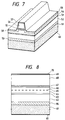
- Fig. 7 shows an optical modulator according to the second embodiment of the present invention.
- a 0.5- ⁇ m n-GaAs buffer layer 50, a 1.5- ⁇ m thick n-Al 0.5 Ga 0.5 As lower cladding layer 52, a 0.08- ⁇ m thick n-Al 0.3 Ga 0.7 As lower waveguide 53, a 0.9- ⁇ m thick n-Al 0.5 Ga 0.5 As intermediate cladding layer 54, and a 0.3- ⁇ m thick i-Al 0.8 Ga 0. 2As upper waveguide 55 were sequentially grown on an n+-GaAs substrate 51. After a grating (not shown) having a period of 7.4 ⁇ m was formed on the upper waveguide 55, the upper waveguide 55 was partially etched. Subsequently, a 1.5- ⁇ m thick p-Al 0.5 Ga 0.5 As upper cladding layer 56 and a 0.5- ⁇ m thick p+-GaAs contact layer 57 were regrown.
- a 2- ⁇ m wide stripe resist mask was formed in a direction perpendicular to the direction of the groove of the grating and was etched to a position 0.2 ⁇ m above the lower waveguide 53 by RIBE (Reactive Ion Etching).
- an Si3N4 film 58 was formed by P-CVD (Plasma Chemical Vapor Deposition).
- the Si3N4 film was etched from an upper portion of the stripe by the photolithographic method to expose the p+-GaAs contact layer 57. Thereafter, an electrode 59 was deposited on the upper surface.
- the lower surface of the substrate 51 was lapped, and an electrode 60 was formed, After alloying was performed, an optical modulator having an element length of 400 ⁇ m, as shown in Fig. 7, was formed.
- the side surfaces of the upper waveguide 55 are in contact with the Si3N4 film 58. Since a difference between the refractive index of 3.4 to 3.6 of the GaAs/AlGaAs and the refractive index of 1.9 to 2.0 of Si3N4 is large, a propagation loss caused by interface scattering of the light guided along the upper waveguide 55 is large. The light coupled to the upper waveguide 55 and not to be used has a large loss, resulting in convenience.
- the light to be modulated and incident on the lower waveguide 53 is coupled to the upper waveguide 55 in accordance with the magnitude of an applied voltage, and the amount of light output from the lower waveguide 53 can be controlled.
- the change in refractive index is based on the absorption end (bulk layer) of the i-Al 0.1 Ga 0.9 As upper waveguide 55 and the Franz-Keldysh effect for changing the absorption spectrum in accordance with the electric field.
- the input/output operation of the light can be performed in only the lower waveguide 53.
- the insertion loss of the optical modulator of the second embodiment is mostly caused by the input/output coupling loss of light, and the propagation loss is very small. More specifically, the propagation loss falls within the range of about 0.7 to 0.8 dB with respect to an element length of 500 ⁇ m. In addition, an extinction loss is as high as 30 dB or more. Furthermore, if a high-speed operation of a drive voltage source can be achieved, a response speed of several GHz to several tens of GHz can be obtained.
- the optical modulator utilizes a change in refractive index caused by the QCSE, i.e., the electric field effect upon application of a reverse voltage, and the Franz-Keldysh effect.
- the optical modulator may utilize a change in refractive index caused by a change in carrier amount such as a plasma or band filling effect based on carrier injection upon application of a forward voltage.
- a sufficiently large degree of modulation can be obtained by a small change in refractive index by a change in ⁇ of ⁇ 0( ⁇ ) and ⁇ 1( ⁇ ) of equation (1), so that generation of heat concomitantly caused by carrier injection can be suppressed.
- Fig. 8 shows an optical modulator according to the third embodiment.
- a grating is formed between upper and lower waveguides.
- the optical modulator of this embodiment is manufactured as follows.
- the MQW layer 65 was etched into a grating by the photolithographic method.
- Waveguides and electrodes 70 and 87 were formed following the same procedures as in the second embodiment, thereby forming an optical modulator.
- the upper waveguide (i-type layer) 67 whose refractive index and absorption index are changed upon application of an electric field is separated from the grating 65 for coupling the 0th-order mode to the 1st-order mode. For this reason, even if the distribution of the 1st-order mode propagating through the lower waveguide 63 does not extend to the upper waveguide 67, coupling with the 0th-order mode (i.e., the mode propagating mainly along the upper waveguide 67) occurs in the grating 65. Therefore, a degree of absorption of the 1st-order mode propagating through the lower waveguide 63 is designed to be lower than those of the previous embodiments.
- Modulation characteristics of output light with respect to input light were almost the same as those of the previous embodiments.
- the grating formation position in the above embodiment is not limited to a specific position, but can be a position where both modes mainly propagating respectively through the waveguides are coupled to each other.
- a grating may be formed in the lower waveguide to obtain the same effect as described above.
- the waveguide through which light used is output must be a waveguide different from an i-type layer waveguide whose refractive index and absorption index are changed upon application of an electric field.
- Figs. 9A and 9B are a side sectional view and a front sectional view, respectively, showing an arrangement of a variable wavelength filter.
- the principle of operation of this variable wavelength filter is almost the same as that described with the optimal modulators of the previous embodiments.
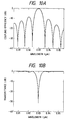
- a band-pass filter characteristic indicated in Fig. 10A is obtained by the upper waveguide 73.
- a notch filter characteristic shown in Fig. 10B is obtained by the lower waveguide 71.
- This embodiment exemplifies a variable wavelength filter for shifting into the upper waveguide 73 a signal having an arbitrary wavelength, selected from multiplexed optical signals having a plurality of wavelengths and outputting the signal having the arbitrary wavelength.
- a wavelength filter utilizing an asymmetrical directional coupler and a grating has filter characteristics having a narrower band width than that of a wavelength filter using mode scattering of waveguides constituting a simple directional coupler because mode conversion is performed using a grating.
- This filter was manufactured as follows. An n-GaAs buffer layer 75, an Al 0.5 Ga 0.5 As cladding layer 76, an MQW i-type lower waveguide 71, a p-Al 0.5 Ga 0.5 As cladding layer 77, and an MQW p-type upper waveguide 73 were grown on an n+-GaAs substrate 74 by MBE. Subsequently, a grating was formed by resist patterning, and a corrugation grating 72 was formed in the upper waveguide 73 by RIBE.
- a p-Al 0.5 Ga 0.5 As cladding layer 78 and a p+-GaAs capping layer 79 were grown by LPE (Liquid-Phase Epitaxy) or MO-CVD.
- a stripe pattern was formed by a resist in a direction perpendicular to the grating 72.
- the wafer was etched into a stripe shape up to the buffer layer 75 by a sulfuric acid etchant.
- a p-Al 0.5 Ga 0.5 As layer 80, a ⁇ -Al 0.5 Ga 0.5 As layer 81, and an n-Al 0.5 Ga 0.5 As layer 82 were grown by LPE to bury the side surfaces of the stripe portion.
- the resultant structure except for the stripe portion was covered with an SiO2 film 83, and thereafter an AuCr/Au electrode 84 was deposited. After the lower surface of the wafer was polished, an AuGe/Au electrode 85 was deposited, and alloying was performed.
- Fig. 11 is a graph showing coupling efficiency from the lower waveguide 71 to the upper waveguide 73 obtained when voltages of 0.5 V, 1.0 V, 1.5 V, and 2 V are applied to the filter. It is apparent that the band-pass filter transmission band is shifted to a longer wavelength range with changes in applied voltages. A channel having one wavelength can be filtered from the multiplexed channels. Light which propagates through the lower waveguide 71 and cannot be absorbed is not used and must be eliminated by absorption or the like.
- the waveguide may be used as a bulk layer to cause the Franz-Keldysh effect upon application of a reverse voltage, thereby causing a shift of the transmission band in the filter characteristics.
- an element length, a grating period, and a grating depth must be reset to appropriate values.
- a forward voltage may be applied to the waveguide consisting of an i-type layer to inject carriers, thereby changing the refractive index by the plasma effect. In this case, a gain may be obtained because carrier injection is performed. A coupling loss of the input signal with the waveguide and a propagation loss within the waveguide can be compensated.
- Fig. 12 is a block diagram showing an arrangement of an optical communication system using an optimal modulator according to the present invention.
- the optical communication system comprises optical transmitters/receivers 251, 252, and 253 connected to an optical transmission line 23 comprising optical fibers or the like through optical nodes 241, 242, and 243.
- the optical transmitters/receivers 251, 252, and 253 are respectively connected to terminal equipments 261, 262, and 263 and perform communication with each other in accordance with commands from these terminal equipments.
- the optical transmitter/receiver 251 includes a controller 29, an optical receiver 30, and an optical transmitter 31.
- the optical receiver 30 comprises a photodetector 32 for detecting an optical signal from another optical transmitter/receiver, and a demodulator 33 for demodulating a signal from an output from the photodetector 32 and sending a modulated signal to the controller 29.
- the optical transmitter 31 comprises a light source 28 such as a semiconductor laser, and an optical modulator 27 for modulating light emitted from the light source 28 in accordance with a communication signal S and transmitting the modulated signal to another optical transmitter/receiver.
- the optical transmitters/receivers 252 and 253 have the same arrangement as that of the optical transmitter/receiver 251.
- the optical modulator 27 comprises one of the optical modulators shown in Figs. 4A, 7, and 8.
- the optical modulator 27 receives an electric field modulated in accordance with the communication signal S sent from the controller 29, as shown in Fig. 4A and modulates light incident from the light source 28.
- each optical modulator is made of a GaAs-based semiconductor material.
- another semiconductor material such as InP/InGaAsP may be used to arrange an optical modulator. All changes and modifications are incorporated in the present invention without departing from the scope of the appended claims.
- An optical modulator includes a substrate, a first waveguide layer formed on the substrate, a second waveguide layer stacked together with the first waveguide layer in a direction of a thickness thereof on the substrate, the second waveguide layer having a waveguide mode different from that of the first waveguide layer, a diffraction grating formed in a region where the waveguide modes of the first and second waveguide layers overlap each other, and an electrode.
- the electrical signal is applied through the electrode, the wavelength of the light coupled by the diffraction grating is changed, and light output from the second waveguide layer is modulated in accordance with the electrical signal.
- a method of modulating light using the above optical modulator is also disclosed.
Landscapes
- Physics & Mathematics (AREA)
- Nonlinear Science (AREA)
- General Physics & Mathematics (AREA)
- Optics & Photonics (AREA)
- Optical Integrated Circuits (AREA)
- Optical Modulation, Optical Deflection, Nonlinear Optics, Optical Demodulation, Optical Logic Elements (AREA)
Applications Claiming Priority (2)
| Application Number | Priority Date | Filing Date | Title |
|---|---|---|---|
| JP181351/90 | 1990-07-09 | ||
| JP18135190 | 1990-07-09 |
Publications (3)
| Publication Number | Publication Date |
|---|---|
| EP0466082A2 true EP0466082A2 (de) | 1992-01-15 |
| EP0466082A3 EP0466082A3 (en) | 1992-07-29 |
| EP0466082B1 EP0466082B1 (de) | 1997-05-02 |
Family
ID=16099194
Family Applications (1)
| Application Number | Title | Priority Date | Filing Date |
|---|---|---|---|
| EP91111359A Expired - Lifetime EP0466082B1 (de) | 1990-07-09 | 1991-07-08 | Verfahren zur Lichtmodulation und optischer Modulator |
Country Status (3)
| Country | Link |
|---|---|
| US (1) | US5131060A (de) |
| EP (1) | EP0466082B1 (de) |
| DE (1) | DE69125888T2 (de) |
Cited By (3)
| Publication number | Priority date | Publication date | Assignee | Title |
|---|---|---|---|---|
| EP0620475A1 (de) * | 1993-03-15 | 1994-10-19 | Canon Kabushiki Kaisha | Optische Vorrichtungen und optische Übertragungssystemen die diese verwenden |
| WO2002067047A1 (en) * | 2001-02-22 | 2002-08-29 | Altitun Ab | A method of improving selectivity in a tuneable waveguide filter |
| US6904065B2 (en) | 2001-02-22 | 2005-06-07 | Adc Telecommunications, Inc. | Method and apparatus for compensating losses in a tunable laser filter |
Families Citing this family (37)
| Publication number | Priority date | Publication date | Assignee | Title |
|---|---|---|---|---|
| JP3067880B2 (ja) * | 1991-01-12 | 2000-07-24 | キヤノン株式会社 | 回折格子を有する光検出装置 |
| US5233187A (en) * | 1991-01-22 | 1993-08-03 | Canon Kabushiki Kaisha | Multi-wavelength light detecting and/or emitting apparatuses having serially arranged grating directional couplers |
| US5276748A (en) * | 1991-11-22 | 1994-01-04 | Texas Instruments Incorporated | Vertically-coupled arrow modulators or switches on silicon |
| FR2684823B1 (fr) * | 1991-12-04 | 1994-01-21 | Alcatel Alsthom Cie Gle Electric | Composant optique semi-conducteur a mode de sortie elargi et son procede de fabrication. |
| US5253314A (en) * | 1992-01-31 | 1993-10-12 | At&T Bell Laboratories | Tunable optical waveguide coupler |
| JP3226067B2 (ja) * | 1992-10-03 | 2001-11-05 | キヤノン株式会社 | 光通信方法及び光通信システム |
| US5265178A (en) * | 1992-10-26 | 1993-11-23 | Science Applications International Corporation | Fiber optic data communication system |
| US5412743A (en) * | 1993-12-06 | 1995-05-02 | Eastman Kodak Company | Method and apparatus for amplitude modulation of a laser beam |
| US6064783A (en) * | 1994-05-25 | 2000-05-16 | Congdon; Philip A. | Integrated laser and coupled waveguide |
| US5647036A (en) * | 1994-09-09 | 1997-07-08 | Deacon Research | Projection display with electrically-controlled waveguide routing |
| US5630004A (en) * | 1994-09-09 | 1997-05-13 | Deacon Research | Controllable beam director using poled structure |
| EP0735635B1 (de) * | 1995-03-31 | 2000-08-02 | Canon Kabushiki Kaisha | Optischer Halbleitervorrichtung, Antriebsverfahren und optisches Kommunikationssystem |
| US5771257A (en) * | 1996-12-26 | 1998-06-23 | Mitsubishi Denki Kabushiki Kaisha | Light absorption modulator and integrated semiconductor laser and modulator |
| US5822108A (en) * | 1997-06-20 | 1998-10-13 | Sun Microsystems, Inc. | Digital optical power modulator |
| US5917974A (en) * | 1997-08-01 | 1999-06-29 | Advanced Photonics Technology, Inc. | Method and apparatus for implementing coupled guiding structures with apodized interaction |
| US6236773B1 (en) | 1998-12-15 | 2001-05-22 | Texas Instruments Incorporated | Single wavelength semiconductor laser with grating-assisted dielectric waveguide coupler |
| JP2001042150A (ja) | 1999-07-30 | 2001-02-16 | Canon Inc | 光導波路、その作製方法、およびこれを用いた光インタコネクション装置 |
| US6456422B1 (en) | 1999-10-20 | 2002-09-24 | Hrl Laboratories, Llc | Direct optical FM discriminator |
| US6804471B1 (en) * | 2000-01-05 | 2004-10-12 | Hrl Laboratories Llc | Apparatus and method of pulsed frequency modulation for analog optical communication |
| JP4690515B2 (ja) * | 2000-02-22 | 2011-06-01 | 古河電気工業株式会社 | 光変調器、半導体光素子、及びそれらの作製方法 |
| WO2002027358A1 (en) * | 2000-09-27 | 2002-04-04 | The Regents Of The University Of California | Method for optical modulation at periodic optical structure band edges |
| US6898343B2 (en) | 2001-08-17 | 2005-05-24 | Fujitsu Limited | Optical switching apparatus and method for fabricating |
| US6922508B2 (en) * | 2001-08-17 | 2005-07-26 | Fujitsu Limited | Optical switching apparatus with adiabatic coupling to optical fiber |
| US6579800B2 (en) * | 2001-10-12 | 2003-06-17 | Nutool, Inc. | Chemical mechanical polishing endpoint detection |
| US7348786B2 (en) * | 2004-08-31 | 2008-03-25 | Georgia Tech Research Corporation | Probe module for testing chips with electrical and optical input/output interconnects, methods of use, and methods of fabrication |
| JP4766131B2 (ja) * | 2009-03-09 | 2011-09-07 | 富士ゼロックス株式会社 | 導波路素子の作製方法 |
| US10281646B2 (en) | 2016-09-20 | 2019-05-07 | Honeywell International Inc. | Etchless acoustic waveguiding in integrated acousto-optic waveguides |
| US10429677B2 (en) | 2016-09-20 | 2019-10-01 | Honeywell International Inc. | Optical waveguide having a wide brillouin bandwidth |
| US10254481B2 (en) | 2016-09-20 | 2019-04-09 | Honeywell International Inc. | Integrated waveguide with reduced brillouin gain and a corresponding reduction in the magnitude of an induced stokes wave |
| US11243450B2 (en) * | 2017-01-30 | 2022-02-08 | The Charles Stark Draper Laboratory, Inc. | Saw modulator having optical power component for extended angular redirection of light |
| US10312658B2 (en) | 2017-06-22 | 2019-06-04 | Honeywell International Inc. | Brillouin gain spectral position control of claddings for tuning acousto-optic waveguides |
| US10935868B2 (en) * | 2017-09-28 | 2021-03-02 | The Charles Stark Draper Laboratory, Inc. | System and method for diffractive steering of electromagnetic radiation |
| US11131601B2 (en) * | 2017-11-30 | 2021-09-28 | Rain Tree Photonics Pte. Ltd. | Method for in-line optical testing |
| WO2020069253A1 (en) * | 2018-09-27 | 2020-04-02 | Massachusetts Institute Of Technology | Strained germanium silicon modulators for integrated high-speed broadband modulation |
| US10935817B2 (en) | 2018-10-01 | 2021-03-02 | Electronics And Telecommunications Research Institute | Optical device and driving method thereof |
| US12461400B2 (en) * | 2020-08-21 | 2025-11-04 | Agency For Science, Technology And Research | Electro-optic modulator and method of forming the same |
| CN116316058B (zh) * | 2021-12-21 | 2025-10-28 | 深圳市速腾聚创科技有限公司 | 激光器、集成芯片、激光雷达及激光器的制备方法 |
Family Cites Families (15)
| Publication number | Priority date | Publication date | Assignee | Title |
|---|---|---|---|---|
| JPS5013061A (de) * | 1973-06-05 | 1975-02-10 | ||
| DE2443038C2 (de) * | 1974-09-09 | 1984-01-12 | Siemens AG, 1000 Berlin und 8000 München | Elektrooptischer Schalter und Modulator für sich kreuzende oder verzweigende optische Wellenleiter |
| US4390236A (en) * | 1981-03-19 | 1983-06-28 | Bell Telephone Laboratories, Incorporated | Tunable polarization independent wavelength filter |
| DE3210980C2 (de) * | 1981-04-01 | 1986-11-20 | Nippon Telegraph And Telephone Corp., Tokio/Tokyo | Optisches Schaltelement und optische Schaltmatrix |
| DE3406207A1 (de) * | 1984-02-21 | 1985-08-29 | Philips Patentverwaltung Gmbh, 2000 Hamburg | Integriert-optische wellenlaengenmultiplex- und -demultiplexeinrichtung fuer monomode-uebertragungssysteme und ihre verwendung |
| DE3687162D1 (de) * | 1985-12-10 | 1993-01-07 | Siemens Ag | Integriert-optischer multiplex-demultiplex-modul fuer die optische nachrichtenuebertragung. |
| US4861130A (en) * | 1986-10-29 | 1989-08-29 | Hitachi, Ltd. | Optical modulating device utilizing polariton substance |
| US4787691A (en) * | 1987-03-26 | 1988-11-29 | The United States Of America As Represented By The Secretary Of The Air Force | Electro-optical silicon devices |
| JPS649414A (en) * | 1987-07-02 | 1989-01-12 | Kokusai Denshin Denwa Co Ltd | Wavelength variable optical multiplexer and demultiplexer |
| US4904045A (en) * | 1988-03-25 | 1990-02-27 | American Telephone And Telegraph Company | Grating coupler with monolithically integrated quantum well index modulator |
| JP2698394B2 (ja) * | 1988-09-30 | 1998-01-19 | キヤノン株式会社 | 非線形光学素子 |
| US4923264A (en) * | 1989-01-18 | 1990-05-08 | University Of Pittsburgh Of The Commonwealth System Of Higher Education | Resonance coupled optical coupler with semiconductor waveguide layer comprising a multi-quantum-well structure |
| EP0386797B1 (de) * | 1989-03-10 | 1997-06-04 | Canon Kabushiki Kaisha | Photodetektor mit wellenlängenselektivem optischem Koppler |
| US4997246A (en) * | 1989-12-21 | 1991-03-05 | International Business Machines Corporation | Silicon-based rib waveguide optical modulator |
| US5067788A (en) * | 1990-03-21 | 1991-11-26 | Physical Optics Corporation | High modulation rate optical plasmon waveguide modulator |
-
1991
- 1991-07-08 EP EP91111359A patent/EP0466082B1/de not_active Expired - Lifetime
- 1991-07-08 DE DE69125888T patent/DE69125888T2/de not_active Expired - Fee Related
- 1991-07-09 US US07/727,072 patent/US5131060A/en not_active Expired - Lifetime
Cited By (5)
| Publication number | Priority date | Publication date | Assignee | Title |
|---|---|---|---|---|
| EP0620475A1 (de) * | 1993-03-15 | 1994-10-19 | Canon Kabushiki Kaisha | Optische Vorrichtungen und optische Übertragungssystemen die diese verwenden |
| US5613020A (en) * | 1993-03-15 | 1997-03-18 | Canon Kabushiki Kaisha | Optical devices having a periodical current restraint layer and optical communication systems using the optical device |
| WO2002067047A1 (en) * | 2001-02-22 | 2002-08-29 | Altitun Ab | A method of improving selectivity in a tuneable waveguide filter |
| US6665474B2 (en) | 2001-02-22 | 2003-12-16 | Altitun Ab | Method of improving selectivity in a tunable waveguide filter |
| US6904065B2 (en) | 2001-02-22 | 2005-06-07 | Adc Telecommunications, Inc. | Method and apparatus for compensating losses in a tunable laser filter |
Also Published As
| Publication number | Publication date |
|---|---|
| EP0466082A3 (en) | 1992-07-29 |
| EP0466082B1 (de) | 1997-05-02 |
| US5131060A (en) | 1992-07-14 |
| DE69125888D1 (de) | 1997-06-05 |
| DE69125888T2 (de) | 1997-11-20 |
Similar Documents
| Publication | Publication Date | Title |
|---|---|---|
| EP0466082B1 (de) | Verfahren zur Lichtmodulation und optischer Modulator | |
| US5801872A (en) | Semiconductor optical modulation device | |
| JP3323725B2 (ja) | 偏波変調レーザ、その駆動方法及びそれを用いた光通信システム | |
| CA2101411C (en) | Tunable optical filter | |
| EP0526023B1 (de) | Optische Halbleiter-Wellenleitervorrichtung und ihr Herstellungsverfahren | |
| US6111998A (en) | Semiconductor optical device, fiber optical amplifier and optical transmission system | |
| KR100244821B1 (ko) | 발광소자와 외부변조기의 집적소자 | |
| EP0558948A1 (de) | Optische Halbleitervorrichtung, Methode zu ihrem Betrieb und ein diese Vorrichtung verwendendes optisches Übertragungssystem | |
| US5339370A (en) | Optical modulator and optical communication system utilizing the same | |
| JP5545847B2 (ja) | 光半導体装置 | |
| US7142343B2 (en) | Electro-absorptive optical modulator module having monolithic integrated photo detector | |
| EP0378098B1 (de) | Optische Halbleitervorrichtung | |
| US4874216A (en) | Variable-waveguide optical branching filter | |
| US5757985A (en) | Semiconductor mach-zehnder-type optical modulator | |
| EP0591863B1 (de) | Optischer Empfänger, optische Halbleitervorrichtung und dieselbigen verwendendes optisches Kommunikationssystem | |
| US6472682B1 (en) | Optical modulator, semiconductor laser device equipped with an optical modulator, and optical communication system | |
| US4887877A (en) | Optical devices and optical integrated circuits | |
| JPH07230066A (ja) | 半導体光変調器 | |
| US6753996B2 (en) | Light-controlled light modulator | |
| EP0296066B1 (de) | Integrierte Laservorrichtung mit Brechungsindex-Modulator | |
| US7065300B1 (en) | Optical transmitter including a linear semiconductor optical amplifier | |
| Tsuzuki et al. | Full C-band tunable DFB laser array copackaged with InP Mach–Zehnder modulator for DWDM optical communication systems | |
| JPH08184789A (ja) | 偏波無依存波長フィルタ | |
| EP0316194A1 (de) | Filter mit abstimmbarer Wellenlänge | |
| EP0444607B1 (de) | Optisches Wellenleiterelement und Verfahren zum Betreiben desselben |
Legal Events
| Date | Code | Title | Description |
|---|---|---|---|
| PUAI | Public reference made under article 153(3) epc to a published international application that has entered the european phase |
Free format text: ORIGINAL CODE: 0009012 |
|
| AK | Designated contracting states |
Kind code of ref document: A2 Designated state(s): DE FR GB IT NL |
|
| PUAL | Search report despatched |
Free format text: ORIGINAL CODE: 0009013 |
|
| AK | Designated contracting states |
Kind code of ref document: A3 Designated state(s): DE FR GB IT NL |
|
| 17P | Request for examination filed |
Effective date: 19921211 |
|
| 17Q | First examination report despatched |
Effective date: 19940817 |
|
| GRAG | Despatch of communication of intention to grant |
Free format text: ORIGINAL CODE: EPIDOS AGRA |
|
| GRAH | Despatch of communication of intention to grant a patent |
Free format text: ORIGINAL CODE: EPIDOS IGRA |
|
| GRAH | Despatch of communication of intention to grant a patent |
Free format text: ORIGINAL CODE: EPIDOS IGRA |
|
| GRAA | (expected) grant |
Free format text: ORIGINAL CODE: 0009210 |
|
| AK | Designated contracting states |
Kind code of ref document: B1 Designated state(s): DE FR GB IT NL |
|
| PG25 | Lapsed in a contracting state [announced via postgrant information from national office to epo] |
Ref country code: IT Free format text: LAPSE BECAUSE OF FAILURE TO SUBMIT A TRANSLATION OF THE DESCRIPTION OR TO PAY THE FEE WITHIN THE PRESCRIBED TIME-LIMIT;WARNING: LAPSES OF ITALIAN PATENTS WITH EFFECTIVE DATE BEFORE 2007 MAY HAVE OCCURRED AT ANY TIME BEFORE 2007. THE CORRECT EFFECTIVE DATE MAY BE DIFFERENT FROM THE ONE RECORDED. Effective date: 19970502 Ref country code: NL Free format text: LAPSE BECAUSE OF FAILURE TO SUBMIT A TRANSLATION OF THE DESCRIPTION OR TO PAY THE FEE WITHIN THE PRESCRIBED TIME-LIMIT Effective date: 19970502 |
|
| REF | Corresponds to: |
Ref document number: 69125888 Country of ref document: DE Date of ref document: 19970605 |
|
| ET | Fr: translation filed | ||
| NLV1 | Nl: lapsed or annulled due to failure to fulfill the requirements of art. 29p and 29m of the patents act | ||
| PLBE | No opposition filed within time limit |
Free format text: ORIGINAL CODE: 0009261 |
|
| STAA | Information on the status of an ep patent application or granted ep patent |
Free format text: STATUS: NO OPPOSITION FILED WITHIN TIME LIMIT |
|
| 26N | No opposition filed | ||
| REG | Reference to a national code |
Ref country code: GB Ref legal event code: IF02 |
|
| PGFP | Annual fee paid to national office [announced via postgrant information from national office to epo] |
Ref country code: DE Payment date: 20080731 Year of fee payment: 18 |
|
| PGFP | Annual fee paid to national office [announced via postgrant information from national office to epo] |
Ref country code: FR Payment date: 20080722 Year of fee payment: 18 |
|
| PGFP | Annual fee paid to national office [announced via postgrant information from national office to epo] |
Ref country code: GB Payment date: 20080722 Year of fee payment: 18 |
|
| GBPC | Gb: european patent ceased through non-payment of renewal fee |
Effective date: 20090708 |
|
| REG | Reference to a national code |
Ref country code: FR Ref legal event code: ST Effective date: 20100331 |
|
| PG25 | Lapsed in a contracting state [announced via postgrant information from national office to epo] |
Ref country code: FR Free format text: LAPSE BECAUSE OF NON-PAYMENT OF DUE FEES Effective date: 20090731 |
|
| PG25 | Lapsed in a contracting state [announced via postgrant information from national office to epo] |
Ref country code: GB Free format text: LAPSE BECAUSE OF NON-PAYMENT OF DUE FEES Effective date: 20090708 |
|
| PG25 | Lapsed in a contracting state [announced via postgrant information from national office to epo] |
Ref country code: DE Free format text: LAPSE BECAUSE OF NON-PAYMENT OF DUE FEES Effective date: 20100202 |