EP0466460A2 - Procédé pour la fabrication d'un film plastique, flexible ayant une structure à lamelles - Google Patents
Procédé pour la fabrication d'un film plastique, flexible ayant une structure à lamelles Download PDFInfo
- Publication number
- EP0466460A2 EP0466460A2 EP91306224A EP91306224A EP0466460A2 EP 0466460 A2 EP0466460 A2 EP 0466460A2 EP 91306224 A EP91306224 A EP 91306224A EP 91306224 A EP91306224 A EP 91306224A EP 0466460 A2 EP0466460 A2 EP 0466460A2
- Authority
- EP
- European Patent Office
- Prior art keywords
- layers
- film
- clear
- billet
- plastic film
- Prior art date
- Legal status (The legal status is an assumption and is not a legal conclusion. Google has not performed a legal analysis and makes no representation as to the accuracy of the status listed.)
- Withdrawn
Links
Images
Classifications
-
- B—PERFORMING OPERATIONS; TRANSPORTING
- B29—WORKING OF PLASTICS; WORKING OF SUBSTANCES IN A PLASTIC STATE IN GENERAL
- B29D—PRODUCING PARTICULAR ARTICLES FROM PLASTICS OR FROM SUBSTANCES IN A PLASTIC STATE
- B29D7/00—Producing flat articles, e.g. films or sheets
- B29D7/01—Films or sheets
-
- B—PERFORMING OPERATIONS; TRANSPORTING
- B29—WORKING OF PLASTICS; WORKING OF SUBSTANCES IN A PLASTIC STATE IN GENERAL
- B29C—SHAPING OR JOINING OF PLASTICS; SHAPING OF MATERIAL IN A PLASTIC STATE, NOT OTHERWISE PROVIDED FOR; AFTER-TREATMENT OF THE SHAPED PRODUCTS, e.g. REPAIRING
- B29C48/00—Extrusion moulding, i.e. expressing the moulding material through a die or nozzle which imparts the desired form; Apparatus therefor
- B29C48/03—Extrusion moulding, i.e. expressing the moulding material through a die or nozzle which imparts the desired form; Apparatus therefor characterised by the shape of the extruded material at extrusion
- B29C48/07—Flat, e.g. panels
- B29C48/08—Flat, e.g. panels flexible, e.g. films
-
- B—PERFORMING OPERATIONS; TRANSPORTING
- B29—WORKING OF PLASTICS; WORKING OF SUBSTANCES IN A PLASTIC STATE IN GENERAL
- B29C—SHAPING OR JOINING OF PLASTICS; SHAPING OF MATERIAL IN A PLASTIC STATE, NOT OTHERWISE PROVIDED FOR; AFTER-TREATMENT OF THE SHAPED PRODUCTS, e.g. REPAIRING
- B29C48/00—Extrusion moulding, i.e. expressing the moulding material through a die or nozzle which imparts the desired form; Apparatus therefor
- B29C48/16—Articles comprising two or more components, e.g. co-extruded layers
- B29C48/18—Articles comprising two or more components, e.g. co-extruded layers the components being layers
- B29C48/21—Articles comprising two or more components, e.g. co-extruded layers the components being layers the layers being joined at their surfaces
-
- B—PERFORMING OPERATIONS; TRANSPORTING
- B29—WORKING OF PLASTICS; WORKING OF SUBSTANCES IN A PLASTIC STATE IN GENERAL
- B29C—SHAPING OR JOINING OF PLASTICS; SHAPING OF MATERIAL IN A PLASTIC STATE, NOT OTHERWISE PROVIDED FOR; AFTER-TREATMENT OF THE SHAPED PRODUCTS, e.g. REPAIRING
- B29C48/00—Extrusion moulding, i.e. expressing the moulding material through a die or nozzle which imparts the desired form; Apparatus therefor
- B29C48/25—Component parts, details or accessories; Auxiliary operations
-
- B—PERFORMING OPERATIONS; TRANSPORTING
- B29—WORKING OF PLASTICS; WORKING OF SUBSTANCES IN A PLASTIC STATE IN GENERAL
- B29C—SHAPING OR JOINING OF PLASTICS; SHAPING OF MATERIAL IN A PLASTIC STATE, NOT OTHERWISE PROVIDED FOR; AFTER-TREATMENT OF THE SHAPED PRODUCTS, e.g. REPAIRING
- B29C48/00—Extrusion moulding, i.e. expressing the moulding material through a die or nozzle which imparts the desired form; Apparatus therefor
- B29C48/25—Component parts, details or accessories; Auxiliary operations
- B29C48/30—Extrusion nozzles or dies
- B29C48/305—Extrusion nozzles or dies having a wide opening, e.g. for forming sheets
- B29C48/307—Extrusion nozzles or dies having a wide opening, e.g. for forming sheets specially adapted for bringing together components, e.g. melts within the die
-
- B—PERFORMING OPERATIONS; TRANSPORTING
- B29—WORKING OF PLASTICS; WORKING OF SUBSTANCES IN A PLASTIC STATE IN GENERAL
- B29C—SHAPING OR JOINING OF PLASTICS; SHAPING OF MATERIAL IN A PLASTIC STATE, NOT OTHERWISE PROVIDED FOR; AFTER-TREATMENT OF THE SHAPED PRODUCTS, e.g. REPAIRING
- B29C71/00—After-treatment of articles without altering their shape; Apparatus therefor
- B29C71/02—Thermal after-treatment
-
- B—PERFORMING OPERATIONS; TRANSPORTING
- B29—WORKING OF PLASTICS; WORKING OF SUBSTANCES IN A PLASTIC STATE IN GENERAL
- B29K—INDEXING SCHEME ASSOCIATED WITH SUBCLASSES B29B, B29C OR B29D, RELATING TO MOULDING MATERIALS OR TO MATERIALS FOR MOULDS, REINFORCEMENTS, FILLERS OR PREFORMED PARTS, e.g. INSERTS
- B29K2001/00—Use of cellulose, modified cellulose or cellulose derivatives, e.g. viscose, as moulding material
-
- B—PERFORMING OPERATIONS; TRANSPORTING
- B29—WORKING OF PLASTICS; WORKING OF SUBSTANCES IN A PLASTIC STATE IN GENERAL
- B29K—INDEXING SCHEME ASSOCIATED WITH SUBCLASSES B29B, B29C OR B29D, RELATING TO MOULDING MATERIALS OR TO MATERIALS FOR MOULDS, REINFORCEMENTS, FILLERS OR PREFORMED PARTS, e.g. INSERTS
- B29K2001/00—Use of cellulose, modified cellulose or cellulose derivatives, e.g. viscose, as moulding material
- B29K2001/08—Cellulose derivatives
- B29K2001/12—Cellulose acetate
-
- B—PERFORMING OPERATIONS; TRANSPORTING
- B29—WORKING OF PLASTICS; WORKING OF SUBSTANCES IN A PLASTIC STATE IN GENERAL
- B29K—INDEXING SCHEME ASSOCIATED WITH SUBCLASSES B29B, B29C OR B29D, RELATING TO MOULDING MATERIALS OR TO MATERIALS FOR MOULDS, REINFORCEMENTS, FILLERS OR PREFORMED PARTS, e.g. INSERTS
- B29K2101/00—Use of unspecified macromolecular compounds as moulding material
- B29K2101/12—Thermoplastic materials
Definitions
- the invention concerns an economical method for making flexible louvered plastic films through which light can pass only within controlled angles of incidence.
- a light control film comprises a transparent synthetic resin incorporating tiny louver-like elements (sometimes called “microlouvers") which are distributed in light-screening or light-collimating fashion, e.g., parallel to each other and perpendicular to the surface of the film.
- U.S. Pat. No. Re. 27,617 (Olsen) teaches a process of making a louvered light control film by skiving a billet of alternating layers of plastic having relatively lower and relatively higher optical densities. Upon skiving the billet, the pigmented layers provide light collimating louver elements, which, as illustrated in the patent, may extend orthogonally to the resulting louvered plastic film.
- the Olsen patent says:
- the primary laminate may be produced by any convenient means or, less conveniently, discs of clear and contrasting material can be used alternately. In the latter instance there is, however, more opportunity to obtain a distubed sequence, for example, of several clear discs superposed.
- the primary laminate is prepared from an extruded film of thermoplast of one type by coating with a layer of contrasting type either by extrusion or other convenient process, e.g., rotogravure or other method of printing, vapor coating, etc.” (Col. 2, lines 40-49)
- louvered plastic films "are thin sheet materials: (1) they are not by themselves capable of structurally withstanding extreme stresses and (2) they are subject to distortion from physical stress and temperatures" (Col. 1,. lines 19-22). Accordingly, as in Example 1 of the Wegwerth patent, the louvered plastic film usually is laminated under pressure between two clear plastic films of a material such as cellulose acetate butyrate, the material usually used in making louvered plastic films.
- U.S. Pat. No. 4,764,410 (Grzywinski) teaches an alternative to the Wegwerth method.
- the alternative method includes the steps of (1) coating the skived louvered plastic film with a solventless monomer composition which polymerizes to an adhesive state upon exposure to ultraviolet radiation, (2) overlaying the monomer composition with a plastic film, and (3) exposing the coating to ultraviolet radiation to polymerize the composition to an adhesive state.
- the plastic liner which was placed over the monomer composition may be left in place to serve as protection for the louvered plastic film, or may be removed, leaving the polymerized composition exposed to act as a pressure-sensitive adhesive for bonding the film to other materials.
- the alternative method is advantageous over the Wegwerth method in that it can be used in a continuous process rather than only in a batch process as is the case with the Wegwerth method.
- a disadvantage which is common to the alternative method and the Wegwerth method lies in the fact that the protective liners and skived louvered plastic film produce a laminate which is relatively stiff. In some applications, such as when the louvered plastic film is to cover a touch sensitive display screen, a more flexible film is desirable.
- louvered plastic film that has appeared on the market has some sort of surface layers that both provide reinforcement and correct surface irregularities at the edges of the microlouvers. Included in commercial products are "Light Control Film (LCF)" produced by 3M Co. (to which the Olsen, Wegwerth, Grzywinski, and Lu patents are assigned). Louvered plastic films are also available from Shin-Etsu Polymer Co. Ltd., Japan and from Asahi Kasei Kogyo KK, Japan.
- LCD Light Control Film
- the invention provides a method for making a flexible louvered plastic film that, as compared to the methods disclosed in the above-cited patents, requires fewer steps and hence is more economical, while avoiding any offsetting disadvantages.
- the resulting louvered plastic film is optically equal or superior to products of the above-cited patents and also can be handled and put to use with very little danger of damage.
- the method of the invention entails the steps of:
- the layers of low optical density are clear.
- the layers of relatively high optical density can be opaque (optical densities greater than 3) or translucent (optical densities of from 0.5 to 2).
- the opacity or translucency is imparted by pigments such as carbon black, but dyes can be used as disclosed in U.S. Pat. No. 4,128,685 (Lowrey).
- the opaque or translucent layers are often called “colored” to distinguish them from “clear” layers.
- all of the layers preferably comprise the same thermoplastic resin, ideally cellulose acetate butyrate because it is inexpensive, easy to extrude and mold, skivable without chatter at moderately elevated temperatures, flexible and tough, and it has excellent transparency.
- Other useful thermoplastic resins include cellulose acetate propanate and plasticized acrylic resins. Polycarbonate would be excellent but must be heated to undesirably high temperatures to be skivable without chatter.
- those thermoplastic resins should be selected to become strongly bonded to each other when coextruded, e.g., alternating layers of cellulose acetate butyrate and cellulose acetate propanate.
- the clear and colored layers can be coextruded in pairs, and the pairs can be trimmed and fused together to form a cylindrical billet. Instead, a large number of the clear and colored layers can be coextruded.
- a billet typically contains from 2000 to 5000 layers, a single die to coextrude that many layers may be unduly expensive, so that it may be desirable to coextrude from 1 to 10 percent of the layers and to fuse the resulting laminates to provide the billet.
- Step c) of the novel method preferably is performed in the same manner as in the prior art.
- the billet preferably is rotatably mounted on a shaft, and while being rotated, the billet is skived by a knife edge that extends parallel to the shaft, which knife edge is continuously advanced toward the shaft until the billet has been substantially completely exhausted.
- step d) the rough skived surface of the web can be optically clarified by being continuously passed between a pair of heated rolls (hot cans) while applying sufficient pressure to the web to ensure complete contact.
- a flying splice can be made between the beginning end of the second web and the trailing end of the first web, thus resulting in a substantially continuous louvered plastic film of the invention which can be wound into long rolls for convenient storage and shipment.
- louvered plastic film produced by the novel method can have attributes possessed by louvered plastic films described in the above-cited patents.
- its colored microlouvers can extend in a direction normal to the plane of the web; or they can extend generally oblique to the plane of the web and substantially parallel to each other as taught in U.S. Pat. No. 3,707,416 (Stevens); or they can have a gradual change in the angle of cant to the surface of the web as taught in U.S. Pat. No. 3,919,559 (Stevens).
- the clear layers that are coextruded in step a) should be from 5 to 20 times the thickness of the colored layers. At substantially lower ratios, the microlouvers might unduly interfere with the transmission of light, and at substantially higher ratios, the microlouvers might be relatively ineffective. For most uses, the clear layers should have a uniform thickness of from 50 to 300 ⁇ m.
- each of the colored layers preferably has a thickness of at least 5 ⁇ m.
- the thickness of each colored layer were substantially greater than 20 ⁇ m, they might unduly interfere with the transmission of light.
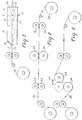
- an adjustable feed block 10 is formed with a first input channel 12 for clear resin and a second input channel 13 for pigmented resin.
- An adjustable vane 14 and distribution pins 15 provide the desired proportional relationship between the clear and pigmented resins.
- the resins are fed into an extrusion die 16, one lip 17 of which is adjustable by a row of bolts 18 so that the extruded laminate 19 has the desired uniform thickness.
- a large number of the 2-layer laminates 19 are trimmed and formed into a cylindrical billet which is shirred to form a louvered film that is wound up into a roll, this being done by known techniques that are not illustrated here.
- a roll of the louvered film 20 is unwound and fed between a pair of heated nip rolls 22 to preheat the film and then into a nip between a pair of hot cans 24, each having a surface temperature sufficient to fuse the faces of the louvered film.
- the louvered film is wound up into a roll 28.
- the apparatus of FIG. 3 is identical to that of FIG. 2 except that instead of passing a louvered film 30 into a nip between hot cans, the film is passed alternately over first and second hot cans 34 and 35.
- the second hot can 35 is movable as indicated by arrows 37 to increase or decrease the length of contact with the hot cans.
- that of FIG. 3 should permit substantially greater line speeds.
- Portions of clear and pigmented (5 percent carbon black by weight) cellulose acetate butyrate were dried at 71 degrees C for four hours in a desiccant dryer. They were then coextruded in apparatus of FIG. 1 with the final heating zone at 218 degrees C to produce a stream of 10:1 clear resin to pigmented resin which was passed laminarly through a coat-hanger extrusion sheet die and made uniformly thick by use of adjustment bolts on one die lip. The formed sheet was then passed through a set of cooling rolls to solidify the resulting 2-layer laminate to approximately 0.134 mm thick. The laminate was wound into a roll at the end of the extrusion line.
- the laminate was punched to form 282 mm dia. disks with a 70 mm dia. center hole that were placed one at a time onto a steel shaft until 3000 disks had been stacked together.
- An 292 mm metal shell was placed around a stack of sheets, and 220N of spring force is applied against end plates of the stack.
- This fixture was placed in a forced air oven set at a maximum temperature of 152 degrees C for about 48 hours.
- the resulting solid cylindrical billet was removed from the fixture and placed on a machining lathe to which a skiving knife has been attached. The billet was rotated and heated to a surface temperature of 121 degrees C while the knife was gradually turned into the billet, thus skiving off a louvered plastic film that was nominally 0.3 mm thick.
- louvered plastic film had a viewing angle of 60 degrees at complete cut-off of light with 77 percent transmission of light normal to the film, and the microlouvers were perpendicular to the broad surfaces of the film.
- a louvered plastic film (here called "Comparative Example A”) was identical to that of Example 1 except in the preparation of 2-layer laminate which was made by extruding a film of clear cellulose acetate butyrate and coating it with aqueous dispersion of a pigmented acrylic resin.
- the louvered plastic film of Comparative Example A broke before it could be folded upon itself along its microlouvers, whereas that of Example 1 could be folded upon itself with difficulty but did not break.
- Example 2 In the procedure of Example 1 except using a pigmented cellulose acetate butyrate resin having only 2 percent pigment (carbon black), a light control film is formed that allows about 10 percent of the total light to pass through the microlouvers at cut-off.
Landscapes
- Engineering & Computer Science (AREA)
- Mechanical Engineering (AREA)
- Manufacturing & Machinery (AREA)
- Physics & Mathematics (AREA)
- Thermal Sciences (AREA)
- Extrusion Moulding Of Plastics Or The Like (AREA)
- Laminated Bodies (AREA)
Applications Claiming Priority (2)
| Application Number | Priority Date | Filing Date | Title |
|---|---|---|---|
| US55155890A | 1990-07-11 | 1990-07-11 | |
| US551558 | 1990-07-11 |
Publications (2)
| Publication Number | Publication Date |
|---|---|
| EP0466460A2 true EP0466460A2 (fr) | 1992-01-15 |
| EP0466460A3 EP0466460A3 (en) | 1993-01-27 |
Family
ID=24201758
Family Applications (1)
| Application Number | Title | Priority Date | Filing Date |
|---|---|---|---|
| EP19910306224 Withdrawn EP0466460A3 (en) | 1990-07-11 | 1991-07-09 | Method of making a flexible louvered plastic film |
Country Status (4)
| Country | Link |
|---|---|
| EP (1) | EP0466460A3 (fr) |
| JP (1) | JPH04232719A (fr) |
| KR (1) | KR920002309A (fr) |
| CA (1) | CA2046686A1 (fr) |
Cited By (5)
| Publication number | Priority date | Publication date | Assignee | Title |
|---|---|---|---|---|
| EP1670037A1 (fr) | 2004-09-10 | 2006-06-14 | Patent-Treuhand-Gesellschaft für elektrische Glühlampen mbH | Lampe à incandescence |
| EP1727635A4 (fr) * | 2004-03-25 | 2011-10-05 | Shehwa P & C Co Ltd | Film de protection de la vie privee |
| US9519080B2 (en) | 2013-10-23 | 2016-12-13 | Eastman Kodak Company | High-aspect-ratio imprinted structure |
| US11167465B2 (en) | 2017-09-26 | 2021-11-09 | Davis-Standard, Llc | Casting apparatus for manufacturing polymer film |
| US11754756B2 (en) | 2014-10-29 | 2023-09-12 | S.V.V. Technology Innovations, Inc. | Angular selective light control sheeting and method of making the same |
Family Cites Families (4)
| Publication number | Priority date | Publication date | Assignee | Title |
|---|---|---|---|---|
| USRE27616E (en) * | 1971-02-01 | 1973-04-17 | Protective device for fire hydrants | |
| JPS61244546A (ja) * | 1985-04-22 | 1986-10-30 | 信越ポリマ−株式会社 | 耐熱防眩シ−ト |
| US4790972A (en) * | 1986-05-16 | 1988-12-13 | Rampart Packaging Inc. | Method for stacking billets and thermoforming |
| US4921646A (en) * | 1988-08-31 | 1990-05-01 | Shell Oil Company | Forming laminated billets from individual billets |
-
1991
- 1991-07-09 EP EP19910306224 patent/EP0466460A3/en not_active Withdrawn
- 1991-07-10 CA CA002046686A patent/CA2046686A1/fr not_active Abandoned
- 1991-07-10 KR KR1019910011663A patent/KR920002309A/ko not_active Withdrawn
- 1991-07-11 JP JP3171338A patent/JPH04232719A/ja active Pending
Cited By (6)
| Publication number | Priority date | Publication date | Assignee | Title |
|---|---|---|---|---|
| EP1727635A4 (fr) * | 2004-03-25 | 2011-10-05 | Shehwa P & C Co Ltd | Film de protection de la vie privee |
| EP1670037A1 (fr) | 2004-09-10 | 2006-06-14 | Patent-Treuhand-Gesellschaft für elektrische Glühlampen mbH | Lampe à incandescence |
| US9519080B2 (en) | 2013-10-23 | 2016-12-13 | Eastman Kodak Company | High-aspect-ratio imprinted structure |
| US11754756B2 (en) | 2014-10-29 | 2023-09-12 | S.V.V. Technology Innovations, Inc. | Angular selective light control sheeting and method of making the same |
| US11167465B2 (en) | 2017-09-26 | 2021-11-09 | Davis-Standard, Llc | Casting apparatus for manufacturing polymer film |
| US11173644B2 (en) | 2017-09-26 | 2021-11-16 | Davis-Standard, Llc | Casting apparatus for manufacturing polymer film |
Also Published As
| Publication number | Publication date |
|---|---|
| JPH04232719A (ja) | 1992-08-21 |
| EP0466460A3 (en) | 1993-01-27 |
| KR920002309A (ko) | 1992-02-28 |
| CA2046686A1 (fr) | 1992-01-12 |
Similar Documents
| Publication | Publication Date | Title |
|---|---|---|
| KR950013993B1 (ko) | 보호 피복물을 가진 가요성 루우버(louver) 플라스틱 필름의 제조방법 및 이에 의해 제조된 필름 | |
| US4764410A (en) | Louvered plastic film and method of making the same | |
| US4310584A (en) | Multilayer light-reflecting film | |
| USRE31780E (en) | Multilayer light-reflecting film | |
| USRE27617E (en) | Louvered transparent sheeting made by skiving | |
| US4505967A (en) | High-angularity retroreflective sheeting and method for manufacture | |
| US5064272A (en) | Encapsulated-lens retroreflective sheeting and method of making | |
| US3992080A (en) | Retroreflective sheet material with controlled stretch and method of making same | |
| US4897136A (en) | Method of making encapsulated-lens retroreflective sheeting | |
| CA1255861A (fr) | Pellicule transparente multicouche pour le recouvrement de feuilles retroreflechissantes | |
| US4162343A (en) | Multilayer light-reflecting film | |
| US3811983A (en) | Method for producing retroreflective sheeting | |
| US4648932A (en) | High-angularity retroreflective sheeting and method for manufacture | |
| US4664966A (en) | Enclosed-lens retroreflective sheeting having tough, weather-resistant, transparent cover film | |
| US4023889A (en) | Retroreflective laminate | |
| US20010018128A1 (en) | Retroreflective sheeting containing a validation image and methods of making the same | |
| EP0466460A2 (fr) | Procédé pour la fabrication d'un film plastique, flexible ayant une structure à lamelles | |
| JP3594969B2 (ja) | 再帰反射性ライセンスプレート及びその製造方法 | |
| EP0225103B1 (fr) | Revêtement rétroréflecteur à lentilles encapsulées et sa méthode de fabrication | |
| US4581268A (en) | Polymer article surface-protecting acrylic film for use in carrying out said process | |
| CA1086628A (fr) | Billette lamellable et produits analogues | |
| EP0326186A2 (fr) | Feuille rétroréflectrice à grand angle et méthode de sa fabrication | |
| JP2003279741A (ja) | 光学用フィルムおよびその製造方法 | |
| EP1489439A2 (fr) | Méthode de fabrication d'une feuille retroréfléchissante possedant une image de validation | |
| JPS5817434A (ja) | 写真フイルム用安全光紙 |
Legal Events
| Date | Code | Title | Description |
|---|---|---|---|
| PUAI | Public reference made under article 153(3) epc to a published international application that has entered the european phase |
Free format text: ORIGINAL CODE: 0009012 |
|
| AK | Designated contracting states |
Kind code of ref document: A2 Designated state(s): DE FR GB IT SE |
|
| PUAL | Search report despatched |
Free format text: ORIGINAL CODE: 0009013 |
|
| AK | Designated contracting states |
Kind code of ref document: A3 Designated state(s): DE FR GB IT SE |
|
| STAA | Information on the status of an ep patent application or granted ep patent |
Free format text: STATUS: THE APPLICATION IS DEEMED TO BE WITHDRAWN |
|
| 18D | Application deemed to be withdrawn |
Effective date: 19930728 |