EP0466754B2 - Dämmstoff aus mineralwolle für die röhrenwärmedämmung und verfahren zur herstellung - Google Patents
Dämmstoff aus mineralwolle für die röhrenwärmedämmung und verfahren zur herstellung Download PDFInfo
- Publication number
- EP0466754B2 EP0466754B2 EP90905535A EP90905535A EP0466754B2 EP 0466754 B2 EP0466754 B2 EP 0466754B2 EP 90905535 A EP90905535 A EP 90905535A EP 90905535 A EP90905535 A EP 90905535A EP 0466754 B2 EP0466754 B2 EP 0466754B2
- Authority
- EP
- European Patent Office
- Prior art keywords
- binder
- slag
- water glass
- product
- mineral fibre
- Prior art date
- Legal status (The legal status is an assumption and is not a legal conclusion. Google has not performed a legal analysis and makes no representation as to the accuracy of the status listed.)
- Expired - Lifetime
Links
- 239000000835 fiber Substances 0.000 title claims abstract description 24
- 229910052500 inorganic mineral Inorganic materials 0.000 title claims abstract description 23
- 239000011707 mineral Substances 0.000 title claims abstract description 23
- 210000002268 wool Anatomy 0.000 title claims abstract description 22
- 238000000034 method Methods 0.000 title claims abstract description 15
- 238000009413 insulation Methods 0.000 title claims abstract description 9
- NTHWMYGWWRZVTN-UHFFFAOYSA-N sodium silicate Chemical compound [Na+].[Na+].[O-][Si]([O-])=O NTHWMYGWWRZVTN-UHFFFAOYSA-N 0.000 claims abstract description 70
- 235000019353 potassium silicate Nutrition 0.000 claims abstract description 67
- 239000002893 slag Substances 0.000 claims abstract description 61
- 239000011230 binding agent Substances 0.000 claims abstract description 60
- XLYOFNOQVPJJNP-UHFFFAOYSA-N water Substances O XLYOFNOQVPJJNP-UHFFFAOYSA-N 0.000 claims abstract description 24
- 239000000725 suspension Substances 0.000 claims abstract description 9
- 238000002360 preparation method Methods 0.000 claims abstract description 3
- 239000003795 chemical substances by application Substances 0.000 claims description 18
- 239000000428 dust Substances 0.000 claims description 17
- 239000000126 substance Substances 0.000 claims description 12
- 239000000654 additive Substances 0.000 claims description 5
- 229920001083 polybutene Polymers 0.000 claims description 4
- 229910000077 silane Inorganic materials 0.000 claims description 4
- BLRPTPMANUNPDV-UHFFFAOYSA-N Silane Chemical compound [SiH4] BLRPTPMANUNPDV-UHFFFAOYSA-N 0.000 claims description 3
- 230000015572 biosynthetic process Effects 0.000 claims description 3
- 238000002156 mixing Methods 0.000 claims description 3
- 238000011065 in-situ storage Methods 0.000 claims description 2
- 229910052751 metal Inorganic materials 0.000 claims description 2
- 239000002184 metal Substances 0.000 claims description 2
- 238000003756 stirring Methods 0.000 claims 1
- 239000007900 aqueous suspension Substances 0.000 abstract 1
- 239000000047 product Substances 0.000 description 29
- 239000011490 mineral wool Substances 0.000 description 11
- 239000003607 modifier Substances 0.000 description 10
- VYPSYNLAJGMNEJ-UHFFFAOYSA-N Silicium dioxide Chemical compound O=[Si]=O VYPSYNLAJGMNEJ-UHFFFAOYSA-N 0.000 description 9
- 238000004519 manufacturing process Methods 0.000 description 9
- 239000000463 material Substances 0.000 description 9
- 150000001875 compounds Chemical class 0.000 description 6
- 230000008961 swelling Effects 0.000 description 6
- ISWSIDIOOBJBQZ-UHFFFAOYSA-N Phenol Chemical compound OC1=CC=CC=C1 ISWSIDIOOBJBQZ-UHFFFAOYSA-N 0.000 description 5
- NBIIXXVUZAFLBC-UHFFFAOYSA-N Phosphoric acid Chemical compound OP(O)(O)=O NBIIXXVUZAFLBC-UHFFFAOYSA-N 0.000 description 5
- 238000006243 chemical reaction Methods 0.000 description 5
- 238000007654 immersion Methods 0.000 description 5
- 239000011810 insulating material Substances 0.000 description 5
- 229920000642 polymer Polymers 0.000 description 5
- 239000004890 Hydrophobing Agent Substances 0.000 description 4
- 239000003513 alkali Substances 0.000 description 4
- 230000008901 benefit Effects 0.000 description 4
- 230000009257 reactivity Effects 0.000 description 4
- 238000012360 testing method Methods 0.000 description 4
- HEMHJVSKTPXQMS-UHFFFAOYSA-M Sodium hydroxide Chemical compound [OH-].[Na+] HEMHJVSKTPXQMS-UHFFFAOYSA-M 0.000 description 3
- 238000010521 absorption reaction Methods 0.000 description 3
- 239000004927 clay Substances 0.000 description 3
- 229910052681 coesite Inorganic materials 0.000 description 3
- 230000006835 compression Effects 0.000 description 3
- 238000007906 compression Methods 0.000 description 3
- 229910052906 cristobalite Inorganic materials 0.000 description 3
- 238000010410 dusting Methods 0.000 description 3
- 239000002557 mineral fiber Substances 0.000 description 3
- 239000000203 mixture Substances 0.000 description 3
- 239000000377 silicon dioxide Substances 0.000 description 3
- 229910052682 stishovite Inorganic materials 0.000 description 3
- 229910052905 tridymite Inorganic materials 0.000 description 3
- BPQQTUXANYXVAA-UHFFFAOYSA-N Orthosilicate Chemical compound [O-][Si]([O-])([O-])[O-] BPQQTUXANYXVAA-UHFFFAOYSA-N 0.000 description 2
- XUIMIQQOPSSXEZ-UHFFFAOYSA-N Silicon Chemical compound [Si] XUIMIQQOPSSXEZ-UHFFFAOYSA-N 0.000 description 2
- CDBYLPFSWZWCQE-UHFFFAOYSA-L Sodium Carbonate Chemical compound [Na+].[Na+].[O-]C([O-])=O CDBYLPFSWZWCQE-UHFFFAOYSA-L 0.000 description 2
- 239000002253 acid Substances 0.000 description 2
- 239000012190 activator Substances 0.000 description 2
- 238000013019 agitation Methods 0.000 description 2
- 150000001298 alcohols Chemical class 0.000 description 2
- 229910000147 aluminium phosphate Inorganic materials 0.000 description 2
- 239000000440 bentonite Substances 0.000 description 2
- 229910000278 bentonite Inorganic materials 0.000 description 2
- SVPXDRXYRYOSEX-UHFFFAOYSA-N bentoquatam Chemical compound O.O=[Si]=O.O=[Al]O[Al]=O SVPXDRXYRYOSEX-UHFFFAOYSA-N 0.000 description 2
- 239000004568 cement Substances 0.000 description 2
- 239000011248 coating agent Substances 0.000 description 2
- 239000002131 composite material Substances 0.000 description 2
- 238000009826 distribution Methods 0.000 description 2
- 230000000694 effects Effects 0.000 description 2
- 238000001704 evaporation Methods 0.000 description 2
- 230000002209 hydrophobic effect Effects 0.000 description 2
- 238000009434 installation Methods 0.000 description 2
- 239000003921 oil Substances 0.000 description 2
- 239000002245 particle Substances 0.000 description 2
- 229920001296 polysiloxane Polymers 0.000 description 2
- 150000003839 salts Chemical class 0.000 description 2
- 229910052710 silicon Inorganic materials 0.000 description 2
- 239000010703 silicon Substances 0.000 description 2
- 239000002002 slurry Substances 0.000 description 2
- 238000003860 storage Methods 0.000 description 2
- 239000005995 Aluminium silicate Substances 0.000 description 1
- QGZKDVFQNNGYKY-UHFFFAOYSA-O Ammonium Chemical compound [NH4+] QGZKDVFQNNGYKY-UHFFFAOYSA-O 0.000 description 1
- DGAQECJNVWCQMB-PUAWFVPOSA-M Ilexoside XXIX Chemical compound C[C@@H]1CC[C@@]2(CC[C@@]3(C(=CC[C@H]4[C@]3(CC[C@@H]5[C@@]4(CC[C@@H](C5(C)C)OS(=O)(=O)[O-])C)C)[C@@H]2[C@]1(C)O)C)C(=O)O[C@H]6[C@@H]([C@H]([C@@H]([C@H](O6)CO)O)O)O.[Na+] DGAQECJNVWCQMB-PUAWFVPOSA-M 0.000 description 1
- 239000005909 Kieselgur Substances 0.000 description 1
- WHXSMMKQMYFTQS-UHFFFAOYSA-N Lithium Chemical compound [Li] WHXSMMKQMYFTQS-UHFFFAOYSA-N 0.000 description 1
- FYYHWMGAXLPEAU-UHFFFAOYSA-N Magnesium Chemical compound [Mg] FYYHWMGAXLPEAU-UHFFFAOYSA-N 0.000 description 1
- ZLMJMSJWJFRBEC-UHFFFAOYSA-N Potassium Chemical compound [K] ZLMJMSJWJFRBEC-UHFFFAOYSA-N 0.000 description 1
- 229920002472 Starch Polymers 0.000 description 1
- 229910021536 Zeolite Inorganic materials 0.000 description 1
- 150000007513 acids Chemical class 0.000 description 1
- 239000004411 aluminium Substances 0.000 description 1
- 229910052782 aluminium Inorganic materials 0.000 description 1
- XAGFODPZIPBFFR-UHFFFAOYSA-N aluminium Chemical compound [Al] XAGFODPZIPBFFR-UHFFFAOYSA-N 0.000 description 1
- PNEYBMLMFCGWSK-UHFFFAOYSA-N aluminium oxide Inorganic materials [O-2].[O-2].[O-2].[Al+3].[Al+3] PNEYBMLMFCGWSK-UHFFFAOYSA-N 0.000 description 1
- 235000012211 aluminium silicate Nutrition 0.000 description 1
- 238000005452 bending Methods 0.000 description 1
- AXCZMVOFGPJBDE-UHFFFAOYSA-L calcium dihydroxide Chemical compound [OH-].[OH-].[Ca+2] AXCZMVOFGPJBDE-UHFFFAOYSA-L 0.000 description 1
- 239000000920 calcium hydroxide Substances 0.000 description 1
- 229910001861 calcium hydroxide Inorganic materials 0.000 description 1
- ODINCKMPIJJUCX-UHFFFAOYSA-N calcium oxide Inorganic materials [Ca]=O ODINCKMPIJJUCX-UHFFFAOYSA-N 0.000 description 1
- 159000000007 calcium salts Chemical class 0.000 description 1
- CJZGTCYPCWQAJB-UHFFFAOYSA-L calcium stearate Chemical class [Ca+2].CCCCCCCCCCCCCCCCCC([O-])=O.CCCCCCCCCCCCCCCCCC([O-])=O CJZGTCYPCWQAJB-UHFFFAOYSA-L 0.000 description 1
- 150000004649 carbonic acid derivatives Chemical class 0.000 description 1
- 239000001913 cellulose Substances 0.000 description 1
- 229920002678 cellulose Polymers 0.000 description 1
- 230000008859 change Effects 0.000 description 1
- 239000002734 clay mineral Substances 0.000 description 1
- 238000000576 coating method Methods 0.000 description 1
- 229910052593 corundum Inorganic materials 0.000 description 1
- 230000003247 decreasing effect Effects 0.000 description 1
- HNPSIPDUKPIQMN-UHFFFAOYSA-N dioxosilane;oxo(oxoalumanyloxy)alumane Chemical compound O=[Si]=O.O=[Al]O[Al]=O HNPSIPDUKPIQMN-UHFFFAOYSA-N 0.000 description 1
- 239000003995 emulsifying agent Substances 0.000 description 1
- 150000002148 esters Chemical class 0.000 description 1
- 230000008020 evaporation Effects 0.000 description 1
- 239000003925 fat Substances 0.000 description 1
- 239000000945 filler Substances 0.000 description 1
- 239000012467 final product Substances 0.000 description 1
- 230000009970 fire resistant effect Effects 0.000 description 1
- 239000010881 fly ash Substances 0.000 description 1
- 239000006260 foam Substances 0.000 description 1
- 239000007789 gas Substances 0.000 description 1
- 239000011521 glass Substances 0.000 description 1
- 238000000227 grinding Methods 0.000 description 1
- 159000000011 group IA salts Chemical class 0.000 description 1
- 150000004679 hydroxides Chemical class 0.000 description 1
- 150000002500 ions Chemical class 0.000 description 1
- NLYAJNPCOHFWQQ-UHFFFAOYSA-N kaolin Chemical compound O.O.O=[Al]O[Si](=O)O[Si](=O)O[Al]=O NLYAJNPCOHFWQQ-UHFFFAOYSA-N 0.000 description 1
- 229910052744 lithium Inorganic materials 0.000 description 1
- 230000005923 long-lasting effect Effects 0.000 description 1
- 239000011777 magnesium Substances 0.000 description 1
- 229910052749 magnesium Inorganic materials 0.000 description 1
- CPLXHLVBOLITMK-UHFFFAOYSA-N magnesium oxide Inorganic materials [Mg]=O CPLXHLVBOLITMK-UHFFFAOYSA-N 0.000 description 1
- 230000007246 mechanism Effects 0.000 description 1
- 238000002844 melting Methods 0.000 description 1
- 230000008018 melting Effects 0.000 description 1
- 230000005012 migration Effects 0.000 description 1
- 238000013508 migration Methods 0.000 description 1
- 238000003801 milling Methods 0.000 description 1
- 239000000178 monomer Substances 0.000 description 1
- 229920000620 organic polymer Polymers 0.000 description 1
- 230000000149 penetrating effect Effects 0.000 description 1
- 230000002093 peripheral effect Effects 0.000 description 1
- 239000010451 perlite Substances 0.000 description 1
- 235000019362 perlite Nutrition 0.000 description 1
- 239000004033 plastic Substances 0.000 description 1
- 231100000614 poison Toxicity 0.000 description 1
- 230000007096 poisonous effect Effects 0.000 description 1
- 229920005862 polyol Polymers 0.000 description 1
- 150000003077 polyols Chemical class 0.000 description 1
- 239000011591 potassium Substances 0.000 description 1
- 229910052700 potassium Inorganic materials 0.000 description 1
- XAEFZNCEHLXOMS-UHFFFAOYSA-M potassium benzoate Chemical compound [K+].[O-]C(=O)C1=CC=CC=C1 XAEFZNCEHLXOMS-UHFFFAOYSA-M 0.000 description 1
- 230000001376 precipitating effect Effects 0.000 description 1
- 230000008569 process Effects 0.000 description 1
- 239000002994 raw material Substances 0.000 description 1
- 238000009418 renovation Methods 0.000 description 1
- 239000005871 repellent Substances 0.000 description 1
- 230000002940 repellent Effects 0.000 description 1
- 239000004576 sand Substances 0.000 description 1
- 230000035945 sensitivity Effects 0.000 description 1
- -1 silane compound Chemical class 0.000 description 1
- 150000004756 silanes Chemical class 0.000 description 1
- 239000000741 silica gel Substances 0.000 description 1
- 229910002027 silica gel Inorganic materials 0.000 description 1
- 239000010802 sludge Substances 0.000 description 1
- 239000011734 sodium Substances 0.000 description 1
- 229910052708 sodium Inorganic materials 0.000 description 1
- 229910000029 sodium carbonate Inorganic materials 0.000 description 1
- 238000005507 spraying Methods 0.000 description 1
- 239000008107 starch Substances 0.000 description 1
- 235000019698 starch Nutrition 0.000 description 1
- 238000004381 surface treatment Methods 0.000 description 1
- 238000001665 trituration Methods 0.000 description 1
- 239000001993 wax Substances 0.000 description 1
- 229910001845 yogo sapphire Inorganic materials 0.000 description 1
- 239000010457 zeolite Substances 0.000 description 1
Images


Classifications
-
- D—TEXTILES; PAPER
- D04—BRAIDING; LACE-MAKING; KNITTING; TRIMMINGS; NON-WOVEN FABRICS
- D04H—MAKING TEXTILE FABRICS, e.g. FROM FIBRES OR FILAMENTARY MATERIAL; FABRICS MADE BY SUCH PROCESSES OR APPARATUS, e.g. FELTS, NON-WOVEN FABRICS; COTTON-WOOL; WADDING ; NON-WOVEN FABRICS FROM STAPLE FIBRES, FILAMENTS OR YARNS, BONDED WITH AT LEAST ONE WEB-LIKE MATERIAL DURING THEIR CONSOLIDATION
- D04H1/00—Non-woven fabrics formed wholly or mainly of staple fibres or like relatively short fibres
- D04H1/40—Non-woven fabrics formed wholly or mainly of staple fibres or like relatively short fibres from fleeces or layers composed of fibres without existing or potential cohesive properties
- D04H1/58—Non-woven fabrics formed wholly or mainly of staple fibres or like relatively short fibres from fleeces or layers composed of fibres without existing or potential cohesive properties by applying, incorporating or activating chemical or thermoplastic bonding agents, e.g. adhesives
- D04H1/64—Non-woven fabrics formed wholly or mainly of staple fibres or like relatively short fibres from fleeces or layers composed of fibres without existing or potential cohesive properties by applying, incorporating or activating chemical or thermoplastic bonding agents, e.g. adhesives the bonding agent being applied in wet state, e.g. chemical agents in dispersions or solutions
- D04H1/645—Impregnation followed by a solidification process
-
- D—TEXTILES; PAPER
- D04—BRAIDING; LACE-MAKING; KNITTING; TRIMMINGS; NON-WOVEN FABRICS
- D04H—MAKING TEXTILE FABRICS, e.g. FROM FIBRES OR FILAMENTARY MATERIAL; FABRICS MADE BY SUCH PROCESSES OR APPARATUS, e.g. FELTS, NON-WOVEN FABRICS; COTTON-WOOL; WADDING ; NON-WOVEN FABRICS FROM STAPLE FIBRES, FILAMENTS OR YARNS, BONDED WITH AT LEAST ONE WEB-LIKE MATERIAL DURING THEIR CONSOLIDATION
- D04H1/00—Non-woven fabrics formed wholly or mainly of staple fibres or like relatively short fibres
- D04H1/40—Non-woven fabrics formed wholly or mainly of staple fibres or like relatively short fibres from fleeces or layers composed of fibres without existing or potential cohesive properties
- D04H1/42—Non-woven fabrics formed wholly or mainly of staple fibres or like relatively short fibres from fleeces or layers composed of fibres without existing or potential cohesive properties characterised by the use of certain kinds of fibres insofar as this use has no preponderant influence on the consolidation of the fleece
- D04H1/4209—Inorganic fibres
-
- D—TEXTILES; PAPER
- D04—BRAIDING; LACE-MAKING; KNITTING; TRIMMINGS; NON-WOVEN FABRICS
- D04H—MAKING TEXTILE FABRICS, e.g. FROM FIBRES OR FILAMENTARY MATERIAL; FABRICS MADE BY SUCH PROCESSES OR APPARATUS, e.g. FELTS, NON-WOVEN FABRICS; COTTON-WOOL; WADDING ; NON-WOVEN FABRICS FROM STAPLE FIBRES, FILAMENTS OR YARNS, BONDED WITH AT LEAST ONE WEB-LIKE MATERIAL DURING THEIR CONSOLIDATION
- D04H1/00—Non-woven fabrics formed wholly or mainly of staple fibres or like relatively short fibres
- D04H1/40—Non-woven fabrics formed wholly or mainly of staple fibres or like relatively short fibres from fleeces or layers composed of fibres without existing or potential cohesive properties
- D04H1/58—Non-woven fabrics formed wholly or mainly of staple fibres or like relatively short fibres from fleeces or layers composed of fibres without existing or potential cohesive properties by applying, incorporating or activating chemical or thermoplastic bonding agents, e.g. adhesives
- D04H1/64—Non-woven fabrics formed wholly or mainly of staple fibres or like relatively short fibres from fleeces or layers composed of fibres without existing or potential cohesive properties by applying, incorporating or activating chemical or thermoplastic bonding agents, e.g. adhesives the bonding agent being applied in wet state, e.g. chemical agents in dispersions or solutions
Definitions
- the present invention relates to an insulating product of mineral fibres intended in particular for the heat insulation of pipes.
- the product shall have a good temperature resistance, moisture resistance and a strength that resists a high temporary load, e.g. the steps of the pipe fitter on the pipe during installation operations.
- the insulating product shall be shapeable at once or later to the desired shape and subsequently curable at the prevailing outer temperature or at a raised temperature.
- the production shall be feasible in a conventional installation for the production of mineral wool webs.
- the curing temperature shall be adaptabe to the circumstances and the curing time shall be short.
- the Finnish patent specification 67751 discloses the production of insulating bodies based on mineral wool.
- clay sludge preferably bentonite
- the process requires a curing of several hours in a furnace.
- the insulating body has a good temperature resistance, of at least 800°C, but is expensive owing to a slow and costly production process and expensive raw material.
- An additional drawback of the bentonite body is its coarse surface, requiring an additional surface treatment, i.e. milling, thus increasing the price of the material.
- Phenol cured insulating bodies are also known. Phenol is a fairly cheap and rapidly curing binder. A phenol cured product resists temperatures of up to 250°C, but if the temperature is above 250°C for a long period of time, the bonds are destroyed. At higher temperatures, of 400°C and more, the binder residues flare up, the temperature rises rapidly and the product collapses. Another drawback of phenol insulating bodies consists in their emitting poisonous gases during burning.
- the SE lay-out print 420 488 discloses the use of a mass based on water glass and clay mineral substances as a binding agent.
- the binder provides a good water and heat resistance in the product.
- the product has a poor compression resistance, meaning that e.g. a tubular bowl made of mineral fibres and treated according to the layout print does not resist temporary load. Moreover, the product is brittle and thus causes dusting.
- SU 614061 discloses an insulating product comprising at least 35 wt-% of perlite sand and optionally up to 20 wt-% of kaolin fibers (not mineral fibers) where the binder consists of synthetic Al-Ca-slag and water glass.
- DK-C-69522 relates to a stiff insulating material of mineral wool, e.g. slag wool, which is impregnated with water glass and subsequently heated so that the water glass is transformed to a foam whereafter the material is cooled.
- mineral wool e.g. slag wool
- GB-A-457 842 relates to an insulating product consisting e.g. of slag wool which is impregnated e.g. with an alkaline or potassium salt in such proportions that a silica gel is formed and a portion of the silicate remains free to combine separately with the slag wool.
- water glass does not act as an activator of slag.
- SU 622781 discloses a fire-resistant coating containing mainly mineral fiber (30-60 wt-%) and water glass (30-50 wt-%).
- US 2 904 444 is related to an insulating material of calcium hydroxide and diatomaceous earth.
- the material does not contain mineral wool nor is it treated with water glass.
- CH-A5-238299 relates to a coating agent containing water glass and slag wool (preferably in the proportion 3:1).
- an insulating product can be achieved, which is especially suitable as a tubular bowl, out of a mineral fibre web prepared in a conventional manner by using as a binding agent a water glass based binder with an addition of slag.
- the slag imparts many valuable properties to the insulating material.
- the alkalis of the water glass act as activators of the slag (cf. slag alkali cement). Together with water glass, slag forms a hydraulic bond giving the cured product an improved compression resistance, a reduced brittleness and thus reduced dusting and greater dust particles, compared to products treated with binders containing water glass without a slag addition.
- a good temperature resistance is achieved in a product containing a binder based on water glass and having a slag addition. Due to the hydraulic bond of the slag to the water glass, the water is firmly bound, chemically bound to the structure. The chemically bound water increases the fire-resistance capacity of the material in that the water evaporating at a fire temperature keeps down the temperature for a longer period.
- a water glass based binder resists a long-lasting temperature charge of up to 800°C.
- the slag increases the crystallinity of the material, thus reducing the moisture absorption tendency and the moisture sensitivity.
- the curing time for a product containing water glass and slag in the binder and by using conventional curing in a curing chamber is approx. 20-60 s for thin products and approx. 20 min. at the most for thick tubular bowls. Equally good curing times are achieved with phenol containing binders, but these binders are unsuitable in other respects. Other known binders require curing times of up to several hours.
- Another advantage of the system water glass/slag is that the binder enables the forming of no-swelling compounds, although the temperature exceeds the swelling temperature of pure water glass, 160°C.
- the weight ratio of the dry substance of the water glass to the slag is 100:1 - 100:50, preferably 10:1 - 10:2.
- the weight ratio of the mineral fibre amount to the dry substance of the water glass is 100:1 - 100:20, preferably 100:5 - 100:15.
- the slag of the binder is preferably blast furnace slag.
- the slag/water glass system is well controllable and thus provides a geat flexiblity for the method of preparing an insulating product of mineral wool.
- Controllable components are among others: slag water glass (VG) curing conditions slag chemistry type of VG temperature slag mineralogy molar ratio time grinding fineness modifier environment (moisture) particle distribution modifier slag amount VG compositions
- the slag reacts with the alkalis of the water glass, i.e. it is activated.
- water resistant hydrate phases of a zeolite type are obtained.
- the molar ratio R s the ratio of the silicon moles to the alkali moles in the water glass
- R s the ratio of the silicon moles to the alkali moles in the water glass
- a higher alkali content, i.e. a lower molar ratio R s requires a higher slag portion in order to tie up the alkalis in a water resistant form.
- the main components of the slag-glass are CaO, MgO, SiO 2 , Al 2 O 3 . It is generally true about slag/water glass systems that the lower the CaO content, i.e. the ratio CaO/SiO 2 , the lower a molar ratio R s should be used in order to obtain a hydraulic bond within a reasonable period of time. When using low molar ratios, R s ⁇ 2.7, the slag content has to be increased. With a higher ratio CaO/SiO 2 ⁇ 1.3, water glass can be used with R s ⁇ 3.3 , still obtaining a sufficient reactivity.
- the reaction degree is controlled by means of the temperature and the curing time. A higher curing temperature shortens the curing time and vice versa.
- a lower R s shortens the curing time at a constant temperature.
- a higher R s requires a longer curing time or a higher temperature.
- reaction degree and the curing rate can be further increased.
- a finished hydrate phase is consequently created, speeding up the curing when the binder has been applied onto the mineral wool.
- the slag content has to be increased in order to prevent the water glass from swelling (cf. slag alkali cement).
- Trituration of the slag increases the reaction rate and the reactivity. This enables to use a water glass with a higher R s , or optionally a very rapid curing can be ahieved at a lower R s .
- a finely ground slag also improves the stability of the slurry of water glass and slag.
- the water glass can be a sodium, potassium, lithium or ammonium silicate solution. In case the slag content is high, hydroxides and/or carbonates can be added.
- the preparation of a mineral wool product and the addition of the binder based on water glass and containing slag takes place conventionally in a conventional set of apparatus.
- the binder is added as a solution through a nozzle to the fibres in the wool chamber of a conventional machine line.
- the water glass and the slag are premixed in water and are kept in agitation before the distribution on the wool.
- the curing of the binder mixed wool material takes place at once or later, at room temperature or at a raised temperature.
- the binder solution can contain possible additional curing, modifying, dust binding and/or hydrophobing agents.
- the spraying of the binder solution and the additives takes place directly after the fibre formation, preferably in the wool chamber. This is an essential advantage, since the wool is in a virginal state here and thus has a good adhesiveness.
- the binder composition is sprayed on the wool through the binder nozzles of the centrifuge, both peripheral and central sprayers being then usable.
- two different solutions can be fed into the wool, so that possible modifying and/or additional curing agents are fed through the one sprayer and a slurry of water glass/slag + possible modifying agents through the other sprayer.
- An additional binder solution can appropriately be added to the wool in a subsequent step of the production of the insulating material.
- a composite having a better resistance is achieved.
- additional additives on the primary web special properties can be given to the material.
- the mixing can be carried out for instance by rapid mixing, e.g. in tubular mixers.
- the dwell time will be short enough not to allow any gelling or precipitating reactions to take place.
- the required additional water is also adjusted by feeding into the rapid mixer.
- the water amount is adjusted so as to provide the correct moisture for the primary web and prevent dusting.
- the water evaporation taking place in the wool chamber increases the viscosity of the binder composition applied onto the fibre.
- the high viscosity means a very low ion migration, thus decreasing the reaction rate. In this manner, the primary web retains its elasticity and curability for several days/weeks, provided that further water discharge is prevented.
- the mineral fibre web is cured at room temperature, for instance between metal sheets.
- the sheet will acquire a better flexibility.
- a slowly cured fibre body is, as is known, more flexible, elastic, than a fibre body that has to be cured at a high temperature.
- a secondary web having the desired thickness is taken up in an uncured state and stored in a non curing environment, e.g. enclosed in plastic at a suitable temperature and during a determined time at the most.
- This insulating material is used in situ for the insulation in places that are not easily accessable and have an awkward shape, such as for instance renovation objects. Afterwards, the insulation cures at the prevailing temperature. It is relatively easy to apply an insulating mat having a suitable thickness onto or around various bodies difficult to access. The curing does not require any special measures or equipment since it takes place spontaneously at the prevailing temperature.
- the method is also suitable for blow wool applications, in which uncured fibre material torn into small tufts is applied onto pipes, where the wool can be cured at the prevailing temperature.
- a secondary web is shaped to the desired shape of a tubular bowl, and is subsequently cured in a known manner.
- the curing can take place rapdily at a high temperature or slower at a lower temperature.
- Additional additives like additional curing, modifying, dust binding and hydrophobizing agents cooperate with the water glass/slag system.
- the additional curing agents consist of mineral salts and compounds, suitable acids, esters or alcohols or of combinations of these.
- the mineral salts can be e.g. magnesium, aluminium or calcium salts or compounds.
- Phosphoric acid for instance, is a usable acid.
- Buffer curing agents can also be used for adjusting the storage time.
- the additional curing agent may be a combination of the above mentioned curing agents.
- modifying agents like organic and unorganic polymers, cellulose and silicones like silicon organic polymers are appropriately used. Also monomers polymerized by e.g. a pH change or a temperature rise during the curing can be used.
- the modifying agents of water glass have in common the fact of not being film forming. By means of the modifying agents one aims at softening the water glass, thus increasing its adhesiveness to the fibre surface.
- the water glass modifier improves the elastic properties, the water resistance, carbonation resistance etc. of the water glass.
- dust binding agents alcohols, polyols, film forming polymers, gelling polymers, waxes, oils, fats, paraffines etc. are appropriately used.
- the task of the dust binding agent is to bind together the dust or to bind it to the main matrice either physically (film forming) or chemically (surface active properties).
- melting dust binding agents e.g. stearates
- curing dust binders forming a film over the matrice.
- a great number of the dust binding agents simultaneously have a water repellent effect.
- hydrophobizing agent The task of the hydrophobizing agent is to prevent water and moisture from penetrating into the product.
- hydrophobizing agents silanes, silicones, oils, various hydrophobic compounds and hydrophobic starch are used. It is essential that possible hydrophilic emulgators are destroyable, which happens by raising the pH value or by a temperature raise.
- the polybutene silane compound has proved especially advantageous as a dust binding agent and a hydrophobing agent.
- the polybutene acts as a dust binder and the silane as a hydrophobing agent.
- compatible compounds can be mixed in advance, whereas non compatible compounds have to be mixed immediately before the application or applied through separate nozzles.
- a modifying solution dry content 8%
- the water glass forms 11.2% of the wool
- the slag 13% of the water glass
- the modifiers 1.8% of the water glass The wool production was 2.8 tons/h and the dosing of the various solutions was 10.2 l/min of water glass-slag-suspension, 3.2 l/min of modyfier solution as well as water 10 l/min.
- the primary web was rolled into a tubular bowl having a diametre of 350 mm and a wall thickness of 60 mm and the tubular bowl was cured at 145°C for 3 min.
- a piece 63.5 x 63.5 mm was cut out from the tubular bowl and was tested with regard to linear shrinking at 600°C according to ASTM 356-60. The shrinking was only 1.4% when the density of the product was 101 kg/m 3 .
- the water glass forms 11.4% of the wool, the slag 5%, the phosphoric acid 2.5% and the modifiers 0.8% of the water glass.
- the wool production was 3.2 tons/h and the dosing of the various solutions was 12.5 l/min of the water glass/slag-suspension, 5.3 l/min of the additional curer, 4.2 l/min of the modifier solution as well as water 11 l/min.
- a sheet web was prepared in a curing chamber at 140°C. Fire tests according to SFS 4193 were carried out on sheets having a thickness of only 26 mm and a density of 217 and 225 kg/m 3 respectively, yielding a fire resistance of 52 and 58 min. respectively.
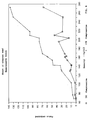
- the temperature rise on the fire side according to SFS 4193 appears from fig. 1 and table 1. The test was continued for one hour and the temperature was 925°C at the end of the test. The sheet was totally undeformed and unbent and the burnt area still had a high residual strength.
- Fig. 2 shows a typical relation between the splitting resistance and the density of a sheet product according to the invention.
- Fig. 3 shows the relation between the tensile bending strength and the density of a number of sheet products according to the invention.
- the force required for compressing a cured sheet product according to the invention 5 and 10% respectively is indicated in fig.4.
- the force is given as kN/m 2 as a function of the density.
- a modifier solution dry content 10%
- the water glass represents 15.8% of the wool
- the wool production was 2.8 tons/h and the dosing of the various solutions was 13.2 l/min of water glass/slag-suspension, 6.0 l/min of modifier solution and water 8 l/min.
- tubular bowls were prepared, having an outer diametre of 520 mm, a thickness of 120 mm and a density of 96.0 kg/m 3 .
- the bowls were mounted on a steam pipe, whose temperature was raised up to 520°C. After 60 hours at this temperature the insulation was inspected and its ⁇ value was determined.
- the ⁇ value was: 0.1010 W/m°C at 520°C.
- the bowls resisted the temperature (520°C) well. The only remarkable difference was that the inner surface of the bowl had become harder than the outer surface, probably due to the continued curing of the binder.
Landscapes
- Chemical & Material Sciences (AREA)
- Engineering & Computer Science (AREA)
- Textile Engineering (AREA)
- Chemical Kinetics & Catalysis (AREA)
- Dispersion Chemistry (AREA)
- General Chemical & Material Sciences (AREA)
- Inorganic Chemistry (AREA)
- Thermal Insulation (AREA)
- Nonwoven Fabrics (AREA)
- Curing Cements, Concrete, And Artificial Stone (AREA)
- Glass Compositions (AREA)
- Steroid Compounds (AREA)
- Surface Treatment Of Glass Fibres Or Filaments (AREA)
Claims (12)
- Dämmprodukt, insbesondere zur Wärmedämmung von Rohren vorgesehen, umfassend ein mit einem Bindemittel versetztes Mineralfaservlies, dadurch gekennzeichnet, dass das Bindemittel vorwiegend aus Wasserglas und aus Schlacke besteht, und das Bindemittel im Produkt in einer solchen Menge vorhanden ist, dass das Gewichtsverhältnis der Mineralfasermenge zur Trockensubstanz des Wasserglases 100:1 - 100:20, bevorzugt 100:5 - 100:15 beträgt, und die Schlacke im Bindemittel in einer solchen Menge vorhanden ist, dass das Gewichtsverhältnis der Trockensubstanz des Wasserglases zur Schlacke 100:1 - 100:50, bevorzugt 10:1 - 10:2 beträgt.
- Dämmprodukt nach Anspruch 1, dadurch gekennzeichnet, dass die Schlacke pulverisierte Hochofenschlacke ist.
- Dämmprodukt nach Anspruch 1 oder 2, dadurch gekennzeichnet, dass das Bindemittel modifizierende, staubbindende, hydrophobierende und/oder zusätzliche härtende Mittel für die Mineralfasern enthält.
- Dämmprodukt nach Anspruch 3, dadurch gekennzeichnet, dass das Bindemittel Polybuten als staubbindendes Mittel und Silan als hydrophobierendes Mittel enthält.
- Dämmprodukt nach einem der vorhergehenden Ansprüche, dadurch gekennzeichnet, dass es ungehärtert ist und in eine feuchtigkeits- und gasundurchlässige Verpackung verpackt ist.
- Verfahren zum Herstellen eines Dämmprodukts aus einem mit einem Bindemittel versetzten Mineralfaservlies, das insbesondere zur Wärmedämmung von Rohren vorgesehen ist, umfassend die Schritte, Herstellen des Bindemittels durch Mischen der Bindemittelkomponenten in Wasser in eine Suspension, Rühren der Suspension, Behandeln von Mineralfasern mit dem Bindemittel unmittelbar nach der Faserbildung und Härten des Bindemittels unmittelbar oder zu einem gewünschten Zeitpunkt, bei der vorherrschenden Aussentemperatur oder bei einer erhöhten Temperatur, dadurch gekennzeichnet, dass das Bindemittel vorwiegend aus Wasserglas und aus Schlacke besteht, so dass im Produkt das Gewichtsverhältnis der Mineralfasermenge zur Trockensubstanz des Wasserglases 100:1 - 100:20, bevorzugt 100:5 - 100:15 beträgt, und das Gewichtsverhältnis der Trockensubstanz des Wasserglases zur Schlacke 100:1 - 100:50, bevorzugt 10:1 - 10:2 begrägt.
- Verfahren nach Anspruch 6, dadurch gekennzeichnet, dass das Molverhältnis Rs des Wasserglases 2,3 - 3 beträgt.
- Verfahren nach Anspruch 6 oder 7, dadurch gekennzeichnet, dass die Additive für weiteres Härten, Modifizieren, Staubbinden und/oder Hydrophobieren des Produkts als eine separate Lösung auf die Mineralfaserwolle aufgebracht werden oder der Bindemittellösung beigemischt werden, unmittelbar bevor diese auf die Minaralfaserwolle aufgbracht wird.
- Verfahren nach Anspruch 8, dadurch gekennzeichnet, dass die Additive unmittelbar nach der Faserbildung und/oder später während der Herstellung auf die Mineralfaserwolle aufgebracht werden.
- Verfahren nach einem der Ansprüche 7 - 9, dadurch gekennzeichnet, dass das mit einem Bindemittel versetzte Mineralfaservlies bei Raumtemperatur gehärtet wird, z.B. zwischen Metallplatten, oder bei einer erhöhten Temperatur, z.B. in einer Härtkammer, wonach das Vlies zu den gewünschsten Produkten, wie Dämmplatten, geschnitten wird.
- Verfahren nach einem der Ansprüche 7 - 9, dadurch gekennzeichnet, dass das mit einem Bindemittel versetzte Mineralfaservlies in Produkte, wie röhrenförmige Teile geformt wird, die in ihren Formen gehärtet werden.
- Verfahren nach einem der Ansprüche 7 - 9, dadurch gekennzeichnet, dass das mit einem Bindemittel versetzte Mineralfaservlies in einer nichthärtenden Umgebung gelagert wird und dass das Härten zu einem gewünschten Zeitpunkt in situ durchgeführt wird, wobei das Produkt auf ein zu dämmendes Objekt aufgebracht worden ist.
Applications Claiming Priority (3)
| Application Number | Priority Date | Filing Date | Title |
|---|---|---|---|
| FI891659 | 1989-04-06 | ||
| FI891659A FI891659A7 (fi) | 1989-04-06 | 1989-04-06 | Foerfarande foer framstaellning av en mineralullsprodukt med god temperaturtaolighet. |
| PCT/FI1990/000093 WO1990012139A1 (en) | 1989-04-06 | 1990-04-05 | Insulating product of mineral fibre wool, intended in particular for heat insulation of pipes, and method for making this product |
Publications (3)
| Publication Number | Publication Date |
|---|---|
| EP0466754A1 EP0466754A1 (de) | 1992-01-22 |
| EP0466754B1 EP0466754B1 (de) | 1995-07-05 |
| EP0466754B2 true EP0466754B2 (de) | 2000-01-19 |
Family
ID=8528194
Family Applications (1)
| Application Number | Title | Priority Date | Filing Date |
|---|---|---|---|
| EP90905535A Expired - Lifetime EP0466754B2 (de) | 1989-04-06 | 1990-04-05 | Dämmstoff aus mineralwolle für die röhrenwärmedämmung und verfahren zur herstellung |
Country Status (9)
| Country | Link |
|---|---|
| EP (1) | EP0466754B2 (de) |
| JP (1) | JPH04506236A (de) |
| AT (1) | ATE124734T1 (de) |
| CA (1) | CA2051405A1 (de) |
| DE (1) | DE69020729T2 (de) |
| FI (1) | FI891659A7 (de) |
| RU (1) | RU2074147C1 (de) |
| WO (1) | WO1990012139A1 (de) |
| YU (1) | YU67090A (de) |
Families Citing this family (12)
| Publication number | Priority date | Publication date | Assignee | Title |
|---|---|---|---|---|
| RU2149853C1 (ru) * | 1998-12-01 | 2000-05-27 | Всероссийский Федеральный головной технологический институт "ВНИИ железобетон" | Жаростойкий шлакощелочной пенобетон |
| PL346134A1 (en) * | 1999-06-24 | 2002-01-28 | Paroc Group Oy Ab | Method for manufacturing a binder and use thereof |
| FI110261B (fi) † | 2000-06-20 | 2002-12-31 | Paroc Group Oy Ab | Menetelmä kolloidisen silikaattidispersion valmistamiseksi |
| RU2320613C1 (ru) * | 2006-08-21 | 2008-03-27 | Юлия Алексеевна Щепочкина | Декоративно-облицовочный материал |
| FI122457B (fi) * | 2006-09-21 | 2012-01-31 | Paroc Oy Ab | Menetelmä ja järjestelmä putkieristyskourun valmistamiseksi |
| DE102008033447C5 (de) * | 2008-07-16 | 2020-03-05 | Hossein Maleki | Silikatische Baustoffmischung und deren Verwendungen |
| EP2899072B1 (de) * | 2014-01-24 | 2019-08-14 | BDD Beteiligungs GmbH | Isoliervorrichtung und Verfahren zu deren Herstellung |
| JP7021994B2 (ja) * | 2018-03-28 | 2022-02-17 | 太平洋マテリアル株式会社 | ロックウール組成物用結合材およびロックウール組成物 |
| RU2691038C1 (ru) * | 2018-10-16 | 2019-06-07 | федеральное государственное бюджетное образовательное учреждение высшего образования "Санкт-Петербургский горный университет" | Вяжущее |
| JP7232658B2 (ja) * | 2019-02-07 | 2023-03-03 | 太平洋マテリアル株式会社 | ロックウール組成物 |
| JP7436172B2 (ja) * | 2019-09-25 | 2024-02-21 | 太平洋マテリアル株式会社 | 無機繊維成形体 |
| EP4060105B1 (de) * | 2021-02-26 | 2024-02-07 | Allshield Holding B.V. | Wasserhärtbares faservliesstoffmaterial |
Family Cites Families (6)
| Publication number | Priority date | Publication date | Assignee | Title |
|---|---|---|---|---|
| FR798208A (fr) * | 1935-02-12 | 1936-05-12 | Isolants Union | Procédé pour l'obtention d'éléments isolants thermiques et phoniques |
| CH238299A (de) * | 1944-01-21 | 1945-07-15 | Bruckmann Alex | Verfahren zur Herstellung eines isolierenden Überzuges auf heissen und kalten Flüssigkeitsleitungen aller Art sowie nach diesem Verfahren hergestellter Überzug. |
| DK69522C (da) * | 1948-03-19 | 1949-07-04 | Herbert Edwards Krenchel | Fremgangsmåde til fremstilling af stive isolationsmaterialer. |
| US2904444A (en) * | 1957-11-26 | 1959-09-15 | Fibreboard Paper Products Corp | Method of making calcareous-silicious insulating material |
| GB1494280A (en) * | 1974-08-28 | 1977-12-07 | Proizv Tekhn Ob Rosorgtekhstro | Water glass compositions for the fabrication of thermal insulating materials |
| DE2804069C2 (de) * | 1978-01-31 | 1986-02-27 | Bernd Dipl.-Chem. Dr. 6700 Ludwigshafen Steinkopf | Verfahren zur Herstellung von nicht-brennbaren Mineralfaserfilzen oder -platten |
-
1989
- 1989-04-06 FI FI891659A patent/FI891659A7/fi not_active Application Discontinuation
-
1990
- 1990-04-05 JP JP2505789A patent/JPH04506236A/ja active Pending
- 1990-04-05 CA CA002051405A patent/CA2051405A1/en not_active Abandoned
- 1990-04-05 YU YU00670/90A patent/YU67090A/xx unknown
- 1990-04-05 RU SU905010086A patent/RU2074147C1/ru not_active IP Right Cessation
- 1990-04-05 AT AT90905535T patent/ATE124734T1/de not_active IP Right Cessation
- 1990-04-05 WO PCT/FI1990/000093 patent/WO1990012139A1/en not_active Ceased
- 1990-04-05 DE DE69020729T patent/DE69020729T2/de not_active Expired - Fee Related
- 1990-04-05 EP EP90905535A patent/EP0466754B2/de not_active Expired - Lifetime
Also Published As
| Publication number | Publication date |
|---|---|
| FI891659A7 (fi) | 1990-10-07 |
| RU2074147C1 (ru) | 1997-02-27 |
| EP0466754A1 (de) | 1992-01-22 |
| DE69020729D1 (de) | 1995-08-10 |
| JPH04506236A (ja) | 1992-10-29 |
| WO1990012139A1 (en) | 1990-10-18 |
| DE69020729T2 (de) | 1995-11-02 |
| CA2051405A1 (en) | 1990-10-07 |
| EP0466754B1 (de) | 1995-07-05 |
| ATE124734T1 (de) | 1995-07-15 |
| YU67090A (en) | 1991-08-31 |
| FI891659A0 (fi) | 1989-04-06 |
Similar Documents
| Publication | Publication Date | Title |
|---|---|---|
| EP0466754B2 (de) | Dämmstoff aus mineralwolle für die röhrenwärmedämmung und verfahren zur herstellung | |
| EP0222932B1 (de) | Verfahren zur Herstellung eines Bau- und/oder Konstruktionsmaterials; polymermodifizierte, wässrige Dispersion; und Verwendung derselben zur Herstellung eines Bau- und/oder Konstruktionsmaterials | |
| KR970002025B1 (ko) | 결합제/전이금속혼합물로피복된경량골재 | |
| DE2808101A1 (de) | Gips-zubereitung | |
| US3684467A (en) | Terpolymer binder composition | |
| DE2751660C2 (de) | ||
| CN106458750A (zh) | 包括含糖的矿棉的复合材料 | |
| CA2377019C (en) | Method for manufacturing a binder and use thereof | |
| US3892586A (en) | Process for the preparation of building units | |
| US20040234595A1 (en) | Composition comprising a phosphate binder and its preparation | |
| EP1851181A1 (de) | Formmasse bestehend aus mit überzugsmasse überzogenen partikeln und deren verwendung zur herstellung von formkörpern | |
| US5352509A (en) | Insulating product of mineral fibre wool, intended in particular for heat insulation of pipes and method for preparing this product | |
| US4033783A (en) | Method for making lime-silica insulation from perlite | |
| US4202851A (en) | Method of preparing a sheet-formed product | |
| EP0128305B1 (de) | Verfahren zur Herstellung von nicht-brennbaren, thermisch isolierenden Formkörpern aus geblähtem Perlit | |
| DE29615484U1 (de) | Nichtbrennbare Wärmedämmplatten auf der Basis von expandierter Perlite-Körnung | |
| EP0458844B1 (de) | Verfahren zum herstellen einer spanplatte und nach diesem verfahren hergestellte spanplatte | |
| DE2551311A1 (de) | Gehaertete masse und verfahren zu ihrer herstellung | |
| DE2217315B2 (de) | Verspritzbare feuerfeste masse und verfahren zu ihrer herstellung | |
| JP3398544B2 (ja) | パーライト硬化体の製造方法 | |
| DE2900225A1 (de) | Feuerfeste und/oder keramische, poroese, schall- und waermeisolierende koerper auf basis von synthetischen mineralfasern sowie verfahren zu ihrer herstellung | |
| WO2002090292A2 (en) | Method of making a finished product from a feedstock, an alkaline earth metal oxide or hydroxide, and a thermosetting resin | |
| DE2463044C2 (de) | Feuerbeständige Bauplatte und Verfahren zu ihrer Herstellung | |
| SU1440900A1 (ru) | Сырьева смесь дл изготовлени огнезащитного отделочного материала | |
| FI110126B (fi) | Menetelmä sideaineen valmistamiseksi mineraalivillatuotteita varten ja menetelmä mineraalivillatuotteiden valmistamiseksi |
Legal Events
| Date | Code | Title | Description |
|---|---|---|---|
| PUAI | Public reference made under article 153(3) epc to a published international application that has entered the european phase |
Free format text: ORIGINAL CODE: 0009012 |
|
| 17P | Request for examination filed |
Effective date: 19911002 |
|
| AK | Designated contracting states |
Kind code of ref document: A1 Designated state(s): AT BE CH DE DK ES FR GB IT LI LU NL SE |
|
| 17Q | First examination report despatched |
Effective date: 19940318 |
|
| GRAA | (expected) grant |
Free format text: ORIGINAL CODE: 0009210 |
|
| AK | Designated contracting states |
Kind code of ref document: B1 Designated state(s): AT BE CH DE DK ES FR GB IT LI LU NL SE |
|
| PG25 | Lapsed in a contracting state [announced via postgrant information from national office to epo] |
Ref country code: IT Free format text: LAPSE BECAUSE OF FAILURE TO SUBMIT A TRANSLATION OF THE DESCRIPTION OR TO PAY THE FEE WITHIN THE PRE;WARNING: LAPSES OF ITALIAN PATENTS WITH EFFECTIVE DATE BEFORE 2007 MAY HAVE OCCURRED AT ANY TIME BEFORE 2007. THE CORRECT EFFECTIVE DATE MAY BE DIFFERENT FROM THE ONE RECORDED.SCRIBED TIME-LIMIT Effective date: 19950705 Ref country code: NL Free format text: LAPSE BECAUSE OF FAILURE TO SUBMIT A TRANSLATION OF THE DESCRIPTION OR TO PAY THE FEE WITHIN THE PRESCRIBED TIME-LIMIT Effective date: 19950705 Ref country code: LI Effective date: 19950705 Ref country code: CH Effective date: 19950705 Ref country code: ES Free format text: THE PATENT HAS BEEN ANNULLED BY A DECISION OF A NATIONAL AUTHORITY Effective date: 19950705 Ref country code: BE Effective date: 19950705 Ref country code: FR Effective date: 19950705 Ref country code: AT Effective date: 19950705 Ref country code: DK Effective date: 19950705 |
|
| REF | Corresponds to: |
Ref document number: 124734 Country of ref document: AT Date of ref document: 19950715 Kind code of ref document: T |
|
| REF | Corresponds to: |
Ref document number: 69020729 Country of ref document: DE Date of ref document: 19950810 |
|
| REG | Reference to a national code |
Ref country code: CH Ref legal event code: PL |
|
| EN | Fr: translation not filed | ||
| NLV1 | Nl: lapsed or annulled due to failure to fulfill the requirements of art. 29p and 29m of the patents act | ||
| PLBI | Opposition filed |
Free format text: ORIGINAL CODE: 0009260 |
|
| PLBQ | Unpublished change to opponent data |
Free format text: ORIGINAL CODE: EPIDOS OPPO |
|
| PLBQ | Unpublished change to opponent data |
Free format text: ORIGINAL CODE: EPIDOS OPPO |
|
| PLAV | Examination of admissibility of opposition |
Free format text: ORIGINAL CODE: EPIDOS OPEX |
|
| PLBI | Opposition filed |
Free format text: ORIGINAL CODE: 0009260 |
|
| PLAV | Examination of admissibility of opposition |
Free format text: ORIGINAL CODE: EPIDOS OPEX |
|
| PG25 | Lapsed in a contracting state [announced via postgrant information from national office to epo] |
Ref country code: LU Free format text: LAPSE BECAUSE OF NON-PAYMENT OF DUE FEES Effective date: 19960430 |
|
| PLBF | Reply of patent proprietor to notice(s) of opposition |
Free format text: ORIGINAL CODE: EPIDOS OBSO |
|
| 26 | Opposition filed |
Opponent name: ROCKWOOL INTERNATIONAL A/S Effective date: 19960403 |
|
| 26 | Opposition filed |
Opponent name: ROCKWOOL INTERNATIONAL A/S Effective date: 19960403 Opponent name: GRUENZWEIG + HARTMANN AG Effective date: 19960403 |
|
| PLBF | Reply of patent proprietor to notice(s) of opposition |
Free format text: ORIGINAL CODE: EPIDOS OBSO |
|
| PLBF | Reply of patent proprietor to notice(s) of opposition |
Free format text: ORIGINAL CODE: EPIDOS OBSO |
|
| PLAW | Interlocutory decision in opposition |
Free format text: ORIGINAL CODE: EPIDOS IDOP |
|
| PLAW | Interlocutory decision in opposition |
Free format text: ORIGINAL CODE: EPIDOS IDOP |
|
| PUAH | Patent maintained in amended form |
Free format text: ORIGINAL CODE: 0009272 |
|
| STAA | Information on the status of an ep patent application or granted ep patent |
Free format text: STATUS: PATENT MAINTAINED AS AMENDED |
|
| RAP2 | Party data changed (patent owner data changed or rights of a patent transferred) |
Owner name: PAROC GROUP OY AB |
|
| 27A | Patent maintained in amended form |
Effective date: 20000119 |
|
| AK | Designated contracting states |
Kind code of ref document: B2 Designated state(s): AT BE CH DE DK ES FR GB IT LI LU NL SE |
|
| REG | Reference to a national code |
Ref country code: GB Ref legal event code: 732E |
|
| EN | Fr: translation not filed | ||
| REG | Reference to a national code |
Ref country code: DE Ref legal event code: 8570 |
|
| REG | Reference to a national code |
Ref country code: GB Ref legal event code: IF02 |
|
| PGFP | Annual fee paid to national office [announced via postgrant information from national office to epo] |
Ref country code: GB Payment date: 20020321 Year of fee payment: 13 |
|
| PGFP | Annual fee paid to national office [announced via postgrant information from national office to epo] |
Ref country code: SE Payment date: 20020410 Year of fee payment: 13 |
|
| PGFP | Annual fee paid to national office [announced via postgrant information from national office to epo] |
Ref country code: DE Payment date: 20020412 Year of fee payment: 13 |
|
| PG25 | Lapsed in a contracting state [announced via postgrant information from national office to epo] |
Ref country code: GB Free format text: LAPSE BECAUSE OF NON-PAYMENT OF DUE FEES Effective date: 20030405 |
|
| PG25 | Lapsed in a contracting state [announced via postgrant information from national office to epo] |
Ref country code: SE Free format text: LAPSE BECAUSE OF NON-PAYMENT OF DUE FEES Effective date: 20030406 |
|
| PG25 | Lapsed in a contracting state [announced via postgrant information from national office to epo] |
Ref country code: DE Free format text: LAPSE BECAUSE OF NON-PAYMENT OF DUE FEES Effective date: 20031101 |
|
| GBPC | Gb: european patent ceased through non-payment of renewal fee |
Effective date: 20030405 |
|
| EUG | Se: european patent has lapsed | ||
| PLAB | Opposition data, opponent's data or that of the opponent's representative modified |
Free format text: ORIGINAL CODE: 0009299OPPO |