EP0467385A2 - Méthode pour la fabrication des articles thermoplastiques renforcés avec des fibres et produit ainsi obtenu - Google Patents
Méthode pour la fabrication des articles thermoplastiques renforcés avec des fibres et produit ainsi obtenu Download PDFInfo
- Publication number
- EP0467385A2 EP0467385A2 EP91112108A EP91112108A EP0467385A2 EP 0467385 A2 EP0467385 A2 EP 0467385A2 EP 91112108 A EP91112108 A EP 91112108A EP 91112108 A EP91112108 A EP 91112108A EP 0467385 A2 EP0467385 A2 EP 0467385A2
- Authority
- EP
- European Patent Office
- Prior art keywords
- temperature
- preform
- molded article
- mold
- article
- Prior art date
- Legal status (The legal status is an assumption and is not a legal conclusion. Google has not performed a legal analysis and makes no representation as to the accuracy of the status listed.)
- Granted
Links
Images

Classifications
-
- B—PERFORMING OPERATIONS; TRANSPORTING
- B29—WORKING OF PLASTICS; WORKING OF SUBSTANCES IN A PLASTIC STATE IN GENERAL
- B29C—SHAPING OR JOINING OF PLASTICS; SHAPING OF MATERIAL IN A PLASTIC STATE, NOT OTHERWISE PROVIDED FOR; AFTER-TREATMENT OF THE SHAPED PRODUCTS, e.g. REPAIRING
- B29C71/00—After-treatment of articles without altering their shape; Apparatus therefor
- B29C71/0063—After-treatment of articles without altering their shape; Apparatus therefor for changing crystallisation
-
- B—PERFORMING OPERATIONS; TRANSPORTING
- B29—WORKING OF PLASTICS; WORKING OF SUBSTANCES IN A PLASTIC STATE IN GENERAL
- B29C—SHAPING OR JOINING OF PLASTICS; SHAPING OF MATERIAL IN A PLASTIC STATE, NOT OTHERWISE PROVIDED FOR; AFTER-TREATMENT OF THE SHAPED PRODUCTS, e.g. REPAIRING
- B29C71/00—After-treatment of articles without altering their shape; Apparatus therefor
- B29C71/02—Thermal after-treatment
-
- B—PERFORMING OPERATIONS; TRANSPORTING
- B29—WORKING OF PLASTICS; WORKING OF SUBSTANCES IN A PLASTIC STATE IN GENERAL
- B29C—SHAPING OR JOINING OF PLASTICS; SHAPING OF MATERIAL IN A PLASTIC STATE, NOT OTHERWISE PROVIDED FOR; AFTER-TREATMENT OF THE SHAPED PRODUCTS, e.g. REPAIRING
- B29C71/00—After-treatment of articles without altering their shape; Apparatus therefor
- B29C71/02—Thermal after-treatment
- B29C2071/025—Quenching, i.e. rapid cooling of an object
-
- B—PERFORMING OPERATIONS; TRANSPORTING
- B29—WORKING OF PLASTICS; WORKING OF SUBSTANCES IN A PLASTIC STATE IN GENERAL
- B29C—SHAPING OR JOINING OF PLASTICS; SHAPING OF MATERIAL IN A PLASTIC STATE, NOT OTHERWISE PROVIDED FOR; AFTER-TREATMENT OF THE SHAPED PRODUCTS, e.g. REPAIRING
- B29C2791/00—Shaping characteristics in general
- B29C2791/001—Shaping in several steps
-
- B—PERFORMING OPERATIONS; TRANSPORTING
- B29—WORKING OF PLASTICS; WORKING OF SUBSTANCES IN A PLASTIC STATE IN GENERAL
- B29C—SHAPING OR JOINING OF PLASTICS; SHAPING OF MATERIAL IN A PLASTIC STATE, NOT OTHERWISE PROVIDED FOR; AFTER-TREATMENT OF THE SHAPED PRODUCTS, e.g. REPAIRING
- B29C37/00—Component parts, details, accessories or auxiliary operations, not covered by group B29C33/00 or B29C35/00
- B29C37/005—Compensating volume or shape change during moulding, in general
-
- B—PERFORMING OPERATIONS; TRANSPORTING
- B29—WORKING OF PLASTICS; WORKING OF SUBSTANCES IN A PLASTIC STATE IN GENERAL
- B29K—INDEXING SCHEME ASSOCIATED WITH SUBCLASSES B29B, B29C OR B29D, RELATING TO MOULDING MATERIALS OR TO MATERIALS FOR MOULDS, REINFORCEMENTS, FILLERS OR PREFORMED PARTS, e.g. INSERTS
- B29K2067/00—Use of polyesters or derivatives thereof, as moulding material
-
- B—PERFORMING OPERATIONS; TRANSPORTING
- B29—WORKING OF PLASTICS; WORKING OF SUBSTANCES IN A PLASTIC STATE IN GENERAL
- B29K—INDEXING SCHEME ASSOCIATED WITH SUBCLASSES B29B, B29C OR B29D, RELATING TO MOULDING MATERIALS OR TO MATERIALS FOR MOULDS, REINFORCEMENTS, FILLERS OR PREFORMED PARTS, e.g. INSERTS
- B29K2105/00—Condition, form or state of moulded material or of the material to be shaped
- B29K2105/06—Condition, form or state of moulded material or of the material to be shaped containing reinforcements, fillers or inserts
- B29K2105/12—Condition, form or state of moulded material or of the material to be shaped containing reinforcements, fillers or inserts of short lengths, e.g. chopped filaments, staple fibres or bristles
-
- B—PERFORMING OPERATIONS; TRANSPORTING
- B29—WORKING OF PLASTICS; WORKING OF SUBSTANCES IN A PLASTIC STATE IN GENERAL
- B29K—INDEXING SCHEME ASSOCIATED WITH SUBCLASSES B29B, B29C OR B29D, RELATING TO MOULDING MATERIALS OR TO MATERIALS FOR MOULDS, REINFORCEMENTS, FILLERS OR PREFORMED PARTS, e.g. INSERTS
- B29K2995/00—Properties of moulding materials, reinforcements, fillers, preformed parts or moulds
- B29K2995/0037—Other properties
- B29K2995/0041—Crystalline
Definitions
- This invention relates to a process for shaping fiber reinforced thermoplastic articles in a molding or stamping operation. More particularly, it relates to shaping such an article wherein a preshaped preform of the final article is preheated in an oven, then transferred to a substantially unheated mold where the preform is compression-consolidated followed by tampering the molded article in an oven to provide predetermined structural integrity.
- thermoplastic resins with or without reinforcement into shaped articles The rapid molding of thermoplastic resins with or without reinforcement into shaped articles is known in the art.
- Fig. 1 is a plot of the magnitude of the shrinkage for several polymers derived from PVT (pressure- volume-temperature) measurement. Nairn measured the strain optically on an amorphous matrix resin where the retardation at the fiber matrix interface could be followed, and the results showed substantial stress build-up at the interfaces.
- thermoplastic materials with a large temperature difference between forming temperature and room temperature, will show substantial internal strain.
- resulting strain levels may be above those the matrix can tolerate and result in actual fraction of the sample. It is clearly important to minimize the strain effects on temperature cycling discussed by Zoller and Nairn.
- P. Aoller and P. Bolli, J. Macromol. Sci. Phys., B18, 555 (1980) disclose heating and cooling curves for polyethylene terephthalate (PET).
- PET polyethylene terephthalate
- PP polypropylene
- PEKK polyether ketone ketone
- PAR polyarylate
- J-2 amorphous copolyamide
- PETG amorphous polyester
- crystallizable polymers are cooled slowly from the melt, they will in general crystallize. PE and PP will crystallize rapidly at only moderate supercooling below the normal melting points. PET will crystallize slowly at a higher (30-40 C) supercooling while a PAR such as DPPG-I may not crystallize in a reasonable time. If the polymers are cooled rapidly from the melt, the differences are more striking. PE and PP will crystallize. Polymers such as PET, PAR or PEKK can be obtained as an amorphous glass below their glass transition temperatures. These amorphous polymers are less dense than their crystalline counterparts and tend to have much higher elongations than the crystalline counterparts. On reheating above Tg, these amorphous materials can relax (and relieve stress) and crystallize.
- a crystallization wave can be illustrated by following events in a thick rod of PET.
- the rod diameter conforming to the mold will be made up of liquid with a specific volume 0.83 cc/g.
- the specific volume will decrease while that of the liquid core remains essentially unchanged.
- the crystallization wave moves inward (heat flows out to the mold) the surface, already under compression from the mold and its own shrinkage, experiences further stress from shrinkage of the inner crystallizing layers.
- Some compessive failure occurs until the crystallizing cylinder becomes thick enough to support the compressive load. At this point, further crystallization occurs and is associated with a large negative pressure of the order of 200 MPa is we assume symmetry of the shrinkage and compressive forces.
- polishing a cut cross section shows cracks throughout the cross section. The largest occur off center in the high negative pressure zone and proceed to the surface at an angle to the glass fiber direction. If the polishing is done by hand, it will be observed that the outer layer - the surface layer - of the cylinder is soft and easily abraded. Proceeding inward, a harder section is seen followed by another soft section and another hard section at the core.
- problems involved in the rapid molding of thick sectioned fiber reinforced resin parts especially those with high loading of reinforcement (>40% volume), for use in applications requiring high rigidity, structural integrity and geometric accuracy has not been addressed in the art.
- the process of this invention involves making an engineered, near net shape preform starting with reinforced thermoplastic tow, debulking with heat and pressure and subjecting it to a controlled heating/compression molding/quenching cycle to obtain the desired final part properties.
- thermoplastic parts use "warm” molds (approximately 300 F) that will result in the above surface flaws and corresponding decrease in structural properties.
- the present invention addresses this problem.
- an amorphous skin approach is utilized to produce a controlled-flaw part.
- the approach involves quenching the external surface to a depth of 4-5 mm while allowing the center to crystallize. Subsequent reheating of the surface to around 150°C allows the amorphous polymer to relax residual shrinkage strain and then crystallize to give an external surface stable in use at temperatures up to the crystallization temperatures. Subsequent cooling to room temperature introduces a strain level which is tolerable to matrix resins such as polyethylene terephthalate.
- the amorphous skin is built by using a "cold" mold with sufficiently high heat transfer coefficient to remove heat from the polymer surface quickly so that crystals do not form.
- the crystallization front forms behind this skin of amorphous resin and proceeds to the center.
- the amorphous skin can be deformed extensively below the Tg of the polymer and, therefore, has the ability to contract and accommodate the continued internal thermal contraction of the core as it subsequently crystallizes due to its slower cooling rate.
- the center Once the center is crystallized, the skin is crystallized to provide long term integrity for the part. If instead the skin is allowed to crystallize fully before the center, the thermal contractions can generate stresses exceeding the polymer strain limit in thick sections and result in formation of large, distributed voids and cracks. This result would occur with the "warm" molds of the prior art previously discussed.
- the process involves preparing a fiber reinforced resin preform, heating the preform in an oven to a temperature sufficient to melt the resin but insufficient to degrade it.
- An inert atmosphere may also be provided to prevent resin degradation and to assist/retard heating in local areas of the preform via altered radiation, convection or conduction pathways.
- the heated preform is then placed in the female cavity of a substantially unheated but controlled temperature mold and consolidated by applying a predetermined force for a fixed period of time.
- the molded part is removed from the mold and tempered in an oven according to a predetermined time temperature relationship. After tempering, the part is removed from the oven.
- the process is also useful for products with amorphous and fast crystallizing matrices, such as amorphous polyamides and PE or PP.
- amorphous resins reheating the system to above the polymer Tg can substantially reduce the level of strain in the surface layer so that a tougher surface layer with low defect level is obtained.
- reheating to near the melting point Tm minus 10 to 20 C will allow strains to relax and yield a tougher surface which retains the low defect level.
- thermoplastic resinous materials which may be used include, but are not limited to, amorphous polyamides, polyether ketone ketones, polyether ether ketones and amorphous or crystalline polyesters.
- the resin of choice is reinforced with fibers as, for example, carbon, glass, thermoplastic and aramid.
- a fiber reinforced resin preform 10 within a female mold cavity 12, which in this embodiment is illustrated as a bar, a preheating oven 14, a hydraulic press 16 and a quench oven 18.
- the molded article 20 is the result.
- the preform materials must be assembled in their required form, arranged precisely and usually debulked.
- the preform 10 is constructed from a prescribed arrangement of one or more forms of thermoplastic material, either reinforced or unreinforced.
- Thermoplastic coated glass tow is preferred and can either be continuous or chopped tow, or even a combination of both, suitable for the final part.
- the thermoplastic polymer coating softens when subjected to appropriate heat and will debulk and form a near net shape structure when subjected to pressure.
- the glass provides structural integrity.
- the debulked structure is suitable for rapid molding while maintaining pre-engineered glass geometry.
- the preform then goes through a very precise heating/molding/tempering cycle designed to obtain the best combination of final part properties in a minimum amount of time.
- the preform In the case of polyesters and polyamides, to prevent hydrolysis of the polymer the preform should be dried to less than 0.02% water by weight before proceeding to the final shaping steps. Hydrolysis is undesirable because the molecular weight level is lowered which can affect toughness properties adversely. In addition, steam bubbles can form and create defects. If preform drying is carried out in air, the drying temperature and time must be carefully selected (standard polymer drying procedures apply). Prolonged exposure to air at elevated temperatures not only has the positive effect of removing moisture, but also can have the negative effect of degrading the polymer.
- the preform 10 is heated in oven 14 until the entire part is up to the thermoplastic melt temperature. Obviously, the preform surface will heat much more rapidly than the center, and in varied cross section parts the thick sections will lag substantially. In all cases, the preform is the limiting heat transfer medium and the center of the thickest section will heat last.
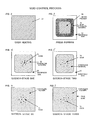
- Fig. 2 represents a cross section of the part at the end of the heating cycle; the polymer 22 is molten throughout. The fibers (not shown) retain their form.
- the heated preform 10 is moved to the mold 16 and is compression molded into the final shape under high pressure with a matched die set operating at substantially room temperature but in all cases lower than the temperature of the preform.
- the surface layer cools rapidly to give a surface skin of amorphous resin.
- the low temperature of the mold rapidly removes heat from the preform 10.
- a stable part is created having an amorphous layer 26 and a molten core 28 with an interface 30 between them of varying degrees of crystallinity (Fig. 3). Areas of the preform where the cross section is less than 1/4 inch thick will be amorphous throughout. Note that fiber ends are not depicted in Figs. 2-7 for clarity. Formation of the amorphous surface layer 26 is important since amorphous material does not go through a phase change during its cooldown and hence, when it is solidified, behaves as a tough glass. This skin can then conform to accommodate the strains imposed by thermal shrinkage and phase changes that occur during further cooldown.
- tempering is divided into stages: cooling the part, a two-part reheating of the surface and a final rapid cooldown.
- the temper has only two stages: a heating step where the right time at temperature will give optimum properties for a particular service followed by a rapid cooldown.
- the purpose of the first temper stage is to maintain the amorphous surface layer by keeping the surface cool while crystallization is occurring in the core 32. Cooling is achieved by bathing the assembly at a low enough temperature and at sufficient flow to remove heat traveling to the surface from the molten core without excessive increase in surface temperature. At the end of this cooldown cycle, a part cross section (Fig. 4) would show that the amorphous skin 26 is maintained, that the polymer crystallized 32 and that some slight flaws 34 formed due to the thermal and phase change strains. Of particular importance is the fact that a substantially flaw-free zone is achieved. Development of this flaw-free zone is the result of using the cold mold process and contributes significantly to the final part properties.
- the next stage is a two-step reheating (Figs. 5-6).
- First, the part surface is heated very rapidly to the highest expected future service temperature and then it is held there for the time required to insure crystallization at that temperature.
- the initial rapid heat-up is necessary to insure that the entire part reaches the desired crystallization temperature and thereby avoid crystallization of the amorphous layer 26 at a temperature lower than the expected future service temperature.
- the reheating step may be eliminated.
- the third stage of the temper cycle is a rapid cooldown of the part. At this point the part is completely crystallized and the flaws 34 are excluded from the surface so that they do not affect the integrity of the part (Fig. 7). Clamping may also be used to achieve fast cooldown with minimum warpage.
- a preform consisting of PET coated glass tow with 60% resin content and 40% glass content was heated to 300 C in a mold, compressed to form a 2.5 cm x 2.5 cm cross section and slowly cooled by convection and conduction. The effect of this processing is to create an outside-in crystallization front.
- a polished cross cut of the specimen showed extensive cracks covering most of the specimen. Surface areas of such samples, measured by BET- helium absorption, are substantial, of the order of 0.15 m 2 /g. Displacement densities are lower than theoretical, usually in the range of 5-10% low.
- a change in the molding cycle of the above- identified preform moderated the surface flaws significantly.
- the preform is transferred to a room temperature mold.
- the surface layer is rapidly cooled to give a surface skin of amorphous resin and the crystallization front forms behind this and proceeds to the center.
- Samples showed a quenched layer of 2-3 mm thick with a similar layer of low crystallinity behind it graduating to a normally crystalline core.
- the skin tolerated the shrinkage forces well and no signs of cracks were observed in polished sections in the outer 4-5 mm.
- Polished cross sections again showed essentially no cracks penetrating the surface layers from the core. Displacement densities were in the range of 0-3% below theoretical. Surface area measurements on specimens cut from the skin (up to 5 mm deep) showed surface areas less than the detection limits by both krypton and helium adsorption.
Landscapes
- Chemical & Material Sciences (AREA)
- Crystallography & Structural Chemistry (AREA)
- Physics & Mathematics (AREA)
- Thermal Sciences (AREA)
- Processing And Handling Of Plastics And Other Materials For Molding In General (AREA)
- Blow-Moulding Or Thermoforming Of Plastics Or The Like (AREA)
- Casting Or Compression Moulding Of Plastics Or The Like (AREA)
- Reinforced Plastic Materials (AREA)
- Moulding By Coating Moulds (AREA)
Applications Claiming Priority (2)
| Application Number | Priority Date | Filing Date | Title |
|---|---|---|---|
| US07/554,476 US5032339A (en) | 1990-07-19 | 1990-07-19 | Process for shaping fiber reinforced thermoplastic articles |
| US554476 | 1995-11-07 |
Publications (3)
| Publication Number | Publication Date |
|---|---|
| EP0467385A2 true EP0467385A2 (fr) | 1992-01-22 |
| EP0467385A3 EP0467385A3 (en) | 1992-03-11 |
| EP0467385B1 EP0467385B1 (fr) | 1995-09-27 |
Family
ID=24213484
Family Applications (1)
| Application Number | Title | Priority Date | Filing Date |
|---|---|---|---|
| EP91112108A Expired - Lifetime EP0467385B1 (fr) | 1990-07-19 | 1991-07-19 | Méthode pour la fabrication des articles thermoplastiques renforcés avec des fibres et produit ainsi obtenu |
Country Status (7)
| Country | Link |
|---|---|
| US (1) | US5032339A (fr) |
| EP (1) | EP0467385B1 (fr) |
| JP (1) | JPH04226720A (fr) |
| AU (1) | AU633239B2 (fr) |
| CA (1) | CA2047292A1 (fr) |
| DE (1) | DE69113344T2 (fr) |
| ES (1) | ES2079000T3 (fr) |
Cited By (1)
| Publication number | Priority date | Publication date | Assignee | Title |
|---|---|---|---|---|
| WO2006103013A3 (fr) * | 2005-04-01 | 2007-01-11 | Behr Gmbh & Co Kg | Procede de production d'une piece en plastique, et dispositif comportant cette piece en plastique |
Families Citing this family (7)
| Publication number | Priority date | Publication date | Assignee | Title |
|---|---|---|---|---|
| US5211902A (en) * | 1990-08-22 | 1993-05-18 | The Univ. Of Toronto Innovations Foundation | Method of reducing residual stresses in thermoplastic laminates |
| US5223203A (en) * | 1991-04-08 | 1993-06-29 | The Torrington Company | Method for making a polymer part having an amorphous surface layer |
| US5427731A (en) * | 1993-01-28 | 1995-06-27 | E. I. Du Pont De Nemours And Company | Compression molding of structures |
| EP0888207A4 (fr) * | 1996-12-24 | 2001-01-17 | American Materials & Technolog | Moulage par injection utilisant un insert a structure composite dans la cavite de moulage |
| GB0128405D0 (en) * | 2001-11-27 | 2002-01-16 | Btg Int Ltd | Process for fabricating polyolefin sheet |
| PL3184275T3 (pl) * | 2003-05-22 | 2020-11-16 | Canco Hungary Investment Ltd. | Wyroby polimerowe |
| WO2006091594A1 (fr) * | 2005-02-22 | 2006-08-31 | Donaldson Company, Inc. | Separateur d’aerosol |
Family Cites Families (8)
| Publication number | Priority date | Publication date | Assignee | Title |
|---|---|---|---|---|
| DE1245578B (de) * | 1963-08-14 | 1967-07-27 | Huels Chemische Werke Ag | Verfahren zum Herstellen lunkerfreier Formteile grosser Dimensionen aus thermoplastischen Kunststoffen |
| US4390489A (en) * | 1977-12-19 | 1983-06-28 | Allied Corporation | Method of shaping thermoplastic compositions on aluminum foil support |
| US4304751A (en) * | 1978-05-30 | 1981-12-08 | Allied Corporation | Process for shaping thermoplastic articles |
| DE2938905A1 (de) * | 1979-09-26 | 1981-04-16 | Bellaplast Gmbh, 6200 Wiesbaden | Verfahren und vorrichtung zum herstellen von formlingen aus thermoplastischem kunststoff, der sich mittels physikalischer einfluesse, insbesondere temperatureinfluesse, wahlweise in seinem teilkristallinen zustand einstellen laesst |
| US4469270A (en) * | 1981-03-18 | 1984-09-04 | The Goodyear Tire & Rubber Company | Article of partially crystalline organic resin and method and apparatus for making same |
| EP0068714B1 (fr) * | 1981-06-25 | 1985-10-30 | BP Chemicals Limited | Procédé de thermoformage |
| US4455417A (en) * | 1982-07-06 | 1984-06-19 | Allied Corporation | Process to form amorphous, crystallizable thermoplastic polymers |
| US4970044A (en) * | 1988-03-30 | 1990-11-13 | General Electric Company | Compression molding using insulating films |
-
1990
- 1990-07-19 US US07/554,476 patent/US5032339A/en not_active Expired - Fee Related
-
1991
- 1991-07-17 JP JP3201153A patent/JPH04226720A/ja active Pending
- 1991-07-17 CA CA002047292A patent/CA2047292A1/fr not_active Abandoned
- 1991-07-19 EP EP91112108A patent/EP0467385B1/fr not_active Expired - Lifetime
- 1991-07-19 ES ES91112108T patent/ES2079000T3/es not_active Expired - Lifetime
- 1991-07-19 AU AU81168/91A patent/AU633239B2/en not_active Ceased
- 1991-07-19 DE DE69113344T patent/DE69113344T2/de not_active Expired - Fee Related
Cited By (1)
| Publication number | Priority date | Publication date | Assignee | Title |
|---|---|---|---|---|
| WO2006103013A3 (fr) * | 2005-04-01 | 2007-01-11 | Behr Gmbh & Co Kg | Procede de production d'une piece en plastique, et dispositif comportant cette piece en plastique |
Also Published As
| Publication number | Publication date |
|---|---|
| DE69113344D1 (de) | 1995-11-02 |
| CA2047292A1 (fr) | 1992-01-20 |
| EP0467385B1 (fr) | 1995-09-27 |
| AU8116891A (en) | 1992-01-23 |
| DE69113344T2 (de) | 1996-04-04 |
| JPH04226720A (ja) | 1992-08-17 |
| EP0467385A3 (en) | 1992-03-11 |
| ES2079000T3 (es) | 1996-01-01 |
| AU633239B2 (en) | 1993-01-21 |
| US5032339A (en) | 1991-07-16 |
Similar Documents
| Publication | Publication Date | Title |
|---|---|---|
| Davidovits et al. | Geopolymer: ultra-high temperature tooling material for the manufacture of advanced composites | |
| EP0188120B2 (fr) | Procédé de moulage | |
| Barera et al. | Screw extrusion additive manufacturing of carbon fiber reinforced PA6 tools | |
| KR950009720B1 (ko) | 사출연산취입성형방법 | |
| US5032339A (en) | Process for shaping fiber reinforced thermoplastic articles | |
| US5260017A (en) | Method for improved surface profile of composite structures | |
| EP0004531B1 (fr) | Procédé de moulage par compression | |
| Vatandaş et al. | Additive manufacturing and mechanical performance of short fiber reinforced PEEK (polyether ether ketone) thermoplastic composites in a vacuum environment | |
| EP0335098B1 (fr) | Moulage par compression de pièces en matière composite sur des surfaces de moule chaudes en employant un temps de cycle court | |
| US4798690A (en) | Molding a glass-plastic composite lens | |
| US4789328A (en) | Hot/cold press forming apparatus for thermoformable plastic materials | |
| EP0682592B1 (fr) | Moulage des structures par compression | |
| Wagner et al. | Microstructure and ultimate properties of injection molded amorphous engineering plastics: Poly (ether imide) and poly (2, 6‐dimethyl‐1, 4‐phenylene ether) | |
| JPH02209223A (ja) | 繊維強化熱可塑性合成樹脂の成形用金型 | |
| JPH0651332B2 (ja) | 射出圧縮成形方法 | |
| JP3549341B2 (ja) | ポリマーアロイ材料から成る成形品の成形方法 | |
| EP0551692A1 (fr) | Méthode d'amélioration du profil de surface d'objets composites | |
| JP3440217B2 (ja) | 芯材入りポリアミド樹脂の製造方法 | |
| JPH05162191A (ja) | Frp中空成形体の製造方法 | |
| CA1316658C (fr) | Moulage sous pression de pieces composites en contact avec des surfaces chaudes durant un cycle court | |
| JPH0767705B2 (ja) | 複合構造体の表面形状の改良方法 | |
| JPH10296812A (ja) | 射出圧縮成形方法 | |
| NZ207071A (en) | Orientation blow moulding:low thermal mass inner mould | |
| JPH09155877A (ja) | 結晶性熱可塑性樹脂から成る成形品の成形方法 |
Legal Events
| Date | Code | Title | Description |
|---|---|---|---|
| PUAI | Public reference made under article 153(3) epc to a published international application that has entered the european phase |
Free format text: ORIGINAL CODE: 0009012 |
|
| PUAL | Search report despatched |
Free format text: ORIGINAL CODE: 0009013 |
|
| AK | Designated contracting states |
Kind code of ref document: A2 Designated state(s): CH DE ES FR IT LI LU NL SE |
|
| AK | Designated contracting states |
Kind code of ref document: A3 Designated state(s): CH DE ES FR IT LI LU NL SE |
|
| 17P | Request for examination filed |
Effective date: 19920903 |
|
| 17Q | First examination report despatched |
Effective date: 19940419 |
|
| GRAA | (expected) grant |
Free format text: ORIGINAL CODE: 0009210 |
|
| AK | Designated contracting states |
Kind code of ref document: B1 Designated state(s): DE ES FR IT NL |
|
| ET | Fr: translation filed | ||
| REF | Corresponds to: |
Ref document number: 69113344 Country of ref document: DE Date of ref document: 19951102 |
|
| ITF | It: translation for a ep patent filed | ||
| REG | Reference to a national code |
Ref country code: ES Ref legal event code: FG2A Ref document number: 2079000 Country of ref document: ES Kind code of ref document: T3 |
|
| PLBE | No opposition filed within time limit |
Free format text: ORIGINAL CODE: 0009261 |
|
| STAA | Information on the status of an ep patent application or granted ep patent |
Free format text: STATUS: NO OPPOSITION FILED WITHIN TIME LIMIT |
|
| 26N | No opposition filed | ||
| PGFP | Annual fee paid to national office [announced via postgrant information from national office to epo] |
Ref country code: FR Payment date: 19980602 Year of fee payment: 8 |
|
| PGFP | Annual fee paid to national office [announced via postgrant information from national office to epo] |
Ref country code: DE Payment date: 19980605 Year of fee payment: 8 |
|
| PGFP | Annual fee paid to national office [announced via postgrant information from national office to epo] |
Ref country code: NL Payment date: 19980612 Year of fee payment: 8 |
|
| PGFP | Annual fee paid to national office [announced via postgrant information from national office to epo] |
Ref country code: ES Payment date: 19980713 Year of fee payment: 8 |
|
| PG25 | Lapsed in a contracting state [announced via postgrant information from national office to epo] |
Ref country code: ES Free format text: LAPSE BECAUSE OF NON-PAYMENT OF DUE FEES Effective date: 19990720 |
|
| PG25 | Lapsed in a contracting state [announced via postgrant information from national office to epo] |
Ref country code: FR Free format text: THE PATENT HAS BEEN ANNULLED BY A DECISION OF A NATIONAL AUTHORITY Effective date: 19990731 |
|
| PG25 | Lapsed in a contracting state [announced via postgrant information from national office to epo] |
Ref country code: NL Free format text: LAPSE BECAUSE OF NON-PAYMENT OF DUE FEES Effective date: 20000201 |
|
| NLV4 | Nl: lapsed or anulled due to non-payment of the annual fee |
Effective date: 20000201 |
|
| PG25 | Lapsed in a contracting state [announced via postgrant information from national office to epo] |
Ref country code: DE Free format text: LAPSE BECAUSE OF NON-PAYMENT OF DUE FEES Effective date: 20000503 |
|
| REG | Reference to a national code |
Ref country code: FR Ref legal event code: ST |
|
| REG | Reference to a national code |
Ref country code: ES Ref legal event code: FD2A Effective date: 20000810 |
|
| PG25 | Lapsed in a contracting state [announced via postgrant information from national office to epo] |
Ref country code: IT Free format text: LAPSE BECAUSE OF NON-PAYMENT OF DUE FEES;WARNING: LAPSES OF ITALIAN PATENTS WITH EFFECTIVE DATE BEFORE 2007 MAY HAVE OCCURRED AT ANY TIME BEFORE 2007. THE CORRECT EFFECTIVE DATE MAY BE DIFFERENT FROM THE ONE RECORDED. Effective date: 20050719 |