EP0467502A2 - Système de surveillance cardio-vasculaire - Google Patents
Système de surveillance cardio-vasculaire Download PDFInfo
- Publication number
- EP0467502A2 EP0467502A2 EP91303239A EP91303239A EP0467502A2 EP 0467502 A2 EP0467502 A2 EP 0467502A2 EP 91303239 A EP91303239 A EP 91303239A EP 91303239 A EP91303239 A EP 91303239A EP 0467502 A2 EP0467502 A2 EP 0467502A2
- Authority
- EP
- European Patent Office
- Prior art keywords
- subject
- signals
- sensor means
- monitoring system
- recording
- Prior art date
- Legal status (The legal status is an assumption and is not a legal conclusion. Google has not performed a legal analysis and makes no representation as to the accuracy of the status listed.)
- Ceased
Links
Images




Classifications
-
- G—PHYSICS
- G10—MUSICAL INSTRUMENTS; ACOUSTICS
- G10L—SPEECH ANALYSIS TECHNIQUES OR SPEECH SYNTHESIS; SPEECH RECOGNITION; SPEECH OR VOICE PROCESSING TECHNIQUES; SPEECH OR AUDIO CODING OR DECODING
- G10L25/00—Speech or voice analysis techniques not restricted to a single one of groups G10L15/00 - G10L21/00
- G10L25/78—Detection of presence or absence of voice signals
-
- A—HUMAN NECESSITIES
- A61—MEDICAL OR VETERINARY SCIENCE; HYGIENE
- A61B—DIAGNOSIS; SURGERY; IDENTIFICATION
- A61B5/00—Measuring for diagnostic purposes; Identification of persons
- A61B5/103—Measuring devices for testing the shape, pattern, colour, size or movement of the body or parts thereof, for diagnostic purposes
- A61B5/11—Measuring movement of the entire body or parts thereof, e.g. head or hand tremor or mobility of a limb
- A61B5/1104—Measuring movement of the entire body or parts thereof, e.g. head or hand tremor or mobility of a limb induced by stimuli or drugs
-
- A—HUMAN NECESSITIES
- A61—MEDICAL OR VETERINARY SCIENCE; HYGIENE
- A61B—DIAGNOSIS; SURGERY; IDENTIFICATION
- A61B5/00—Measuring for diagnostic purposes; Identification of persons
- A61B5/24—Detecting, measuring or recording bioelectric or biomagnetic signals of the body or parts thereof
- A61B5/316—Modalities, i.e. specific diagnostic methods
- A61B5/318—Heart-related electrical modalities, e.g. electrocardiography [ECG]
- A61B5/333—Recording apparatus specially adapted therefor
- A61B5/336—Magnetic recording apparatus
-
- A—HUMAN NECESSITIES
- A61—MEDICAL OR VETERINARY SCIENCE; HYGIENE
- A61B—DIAGNOSIS; SURGERY; IDENTIFICATION
- A61B7/00—Instruments for auscultation
- A61B7/02—Stethoscopes
- A61B7/04—Electric stethoscopes
-
- A—HUMAN NECESSITIES
- A61—MEDICAL OR VETERINARY SCIENCE; HYGIENE
- A61B—DIAGNOSIS; SURGERY; IDENTIFICATION
- A61B2560/00—Constructional details of operational features of apparatus; Accessories for medical measuring apparatus
- A61B2560/02—Operational features
- A61B2560/0242—Operational features adapted to measure environmental factors, e.g. temperature, pollution
-
- A—HUMAN NECESSITIES
- A61—MEDICAL OR VETERINARY SCIENCE; HYGIENE
- A61B—DIAGNOSIS; SURGERY; IDENTIFICATION
- A61B2562/00—Details of sensors; Constructional details of sensor housings or probes; Accessories for sensors
- A61B2562/02—Details of sensors specially adapted for in-vivo measurements
- A61B2562/0204—Acoustic sensors
-
- A—HUMAN NECESSITIES
- A61—MEDICAL OR VETERINARY SCIENCE; HYGIENE
- A61B—DIAGNOSIS; SURGERY; IDENTIFICATION
- A61B5/00—Measuring for diagnostic purposes; Identification of persons
- A61B5/68—Arrangements of detecting, measuring or recording means, e.g. sensors, in relation to patient
- A61B5/6801—Arrangements of detecting, measuring or recording means, e.g. sensors, in relation to patient specially adapted to be attached to or worn on the body surface
- A61B5/6813—Specially adapted to be attached to a specific body part
- A61B5/6822—Neck
-
- A—HUMAN NECESSITIES
- A61—MEDICAL OR VETERINARY SCIENCE; HYGIENE
- A61B—DIAGNOSIS; SURGERY; IDENTIFICATION
- A61B5/00—Measuring for diagnostic purposes; Identification of persons
- A61B5/68—Arrangements of detecting, measuring or recording means, e.g. sensors, in relation to patient
- A61B5/6801—Arrangements of detecting, measuring or recording means, e.g. sensors, in relation to patient specially adapted to be attached to or worn on the body surface
- A61B5/6813—Specially adapted to be attached to a specific body part
- A61B5/6823—Trunk, e.g., chest, back, abdomen, hip
-
- A—HUMAN NECESSITIES
- A61—MEDICAL OR VETERINARY SCIENCE; HYGIENE
- A61B—DIAGNOSIS; SURGERY; IDENTIFICATION
- A61B5/00—Measuring for diagnostic purposes; Identification of persons
- A61B5/68—Arrangements of detecting, measuring or recording means, e.g. sensors, in relation to patient
- A61B5/6801—Arrangements of detecting, measuring or recording means, e.g. sensors, in relation to patient specially adapted to be attached to or worn on the body surface
- A61B5/6813—Specially adapted to be attached to a specific body part
- A61B5/6828—Leg
Definitions
- EKG monitoring Holter
- the Holter system has no detection/recording capability other than time, EKG readings and a patient marker.
- the patient maintains a time related diary of such events.
- this approach is qualitative. It is also incomplete, since no data is entered, for example when the patient is asleep. In essence, there is no objective or recorded evidence of any patient activity.
- cardiac abnormalities which are revealed by the prior art cardiac monitoring systems are equated only to physical activities. However, such cardiac abnormalities may also be revealed by a number of other conditions in the body. Knowledge of these conditions, other than physical activity, which provoke detectable cardiac abnormalities is frequently important for determining the proper treatment. As noted above, such knowledge cannot be acquired from the current cardiac monitoring systems and techniques.
- Copending United States Application Serial No. 07/554,549 discloses a cardiac monitoring system which in addition to physical activities also monitors such other conditions in the body.
- the system disclosed in the Copending Application in addition to collecting ambulatory data such as described in Patent 4,830,021 also collects additional data relating to activities which also affect or define cardiac responses of the subject.
- additional activities may include, for example, verbal exchanges, evidence of emotional stress arising from verbal exchanges between the subject and others, emotional stress arising from dreams, and other physical conditions such as the posture of the subject, air temperature, ambient light level, elapsed time, and so on.
- cardiovascular problems include: physical stress; work; exercise; temperature extremes and changes; and fatigue.
- emotional stresses which also can cause cardiovascular problems, and these include, for example, such emotional stresses as real or perceived danger, anger, conflict, and the like; which may be provoked by the environment, or which may arise during certain phases of sleep.
- One objective of the present invention is to provide a relatively simple and practical system which detects and records parameters affecting the cardiovascular system of a subject simultaneously with the recording of the EKG data. On reply, should EKG abnormalities be detected in the operation of the system of the invention, the record can be correlated and examined for physical and emotional activities and environmental parameters which could cause such abnormalities.
- a prior art four-channel Holter magnetic tape recorder may be provided, three channels of which may be used to record EKG signals, and the fourth channel used to record time signals and additional patient data in multiplexed digital and other encoded form.
- This additional patient data may then be stored/analyzed in a digital computer which correlates the data and produces a report which contains, for example, a summary of the EKG data such as heart rate, S.T. level, plots of the data, examples of abnormal EKG activity, and potential diagnosis based on the data.
- the system of the invention also has the ability of cross correlation of environmental data to enhance its ability and reliability in the detection of specific events and correlation of EKG events and external events to improve diagnosis.
- the invention provides a cardiovascular monitoring system which monitors not only the EKG of a subject, but also certain physical activities and emotional states of the subject and environmental data.
- the system includes in addition to the EKG sensors, additional sensors which are affixed to the subject and which generate additional signals indicative of certain physical activities being carried out by the subject and also of the emotional state of the subject. These additional signals are digitized and multiplexed and recorded along with the EKG signals, either on the same recorder or on a separate recorder and are used in the examination of the physical activities and emotional states of the subject which could have caused detected abnormalities in the EKG signals.
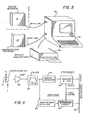
- a multiple sensor 22 is mounted on the neck of the subject 18.
- This multiple sensor may include two microphones, as will be described, as well as light and temperature sensors.
- the light sensor may be a simple photodiode circuit which generates electrical signals indicative of ambient light levels.
- the temperature sensor may be a thermistor circuit which generates electrical signals indicative of ambient temperature.
- the sensors 20, SW1, SW2 and 22 are all connected to a second recorder 27 which may fit into a second shirt pocket of subject 18, or which may be clipped to the Holter recorder 16. Alternatively, recorder 24 may be combined in Holder recorder 16.
- multiple sensor 22 includes two microphones designated Mic “A” and Mic “B".
- Microphones Mic “A” and Mic “B” may be sub-miniature microphones of the dynamic, electrode or semiconductor type, and preferably have frequency responses in the range of 20-3000 Hz.
- Microphone Mic “B” is attached to the neck of subject 18 adjacent to the sterno- cleido-mastoid (SCM) muscle above the collar.
- Microphone Mic “B” registers strong vibrations from the voice of subject 18 (.3-3 KHz); weaker vibrations from external sources including voices (.3-3 KHz); and lower frequency vibrations due to muscle contractions of the subject occurring, for example, when the subject is asleep and is experiencing an emotional dream.
- Microphone Mic “B” should have a high/low frequency response at approximately 10 Hz to respond to the low frequency (16 Hz) of muscle activity.
- microphone Mic “A” and Mic “B” are shown displaced from one another in FIGURE 2A, microphone Mic “A”, is preferably mounted on microphone Mic “B” as shown in FIGURE 21 B, and the microphones are acoustically isolated from one another. Microphone Mic “A” serves to register the speech of the subject as transmitted through air, and it also registers other sounds transmitted to it by air.
- the vertical acceleration (Gz) outputs of accelerometer 20 of FIGURE 1 which represents the locomotor activity of the subject, has a characteristic waveform which varies synchronously both in frequency and amplitude with the step frequency of the subject.
- the locomotor activity is such that a sample rate of one per minute, that is, the number of steps and mean force developed, is adequate.
- a circuit for achieving the foregoing would normally be incorporated into recorder 24. Such a circuit is shown in the block diagram of FIGURE 4.
- accelerometer 20 is connected to an amplifier 50 which, in turn, is connected through a bandpass filter 52 to a period detector 54.
- the period detector 54 is connected to a counter 56 for detecting the frequency of the waveform.
- the output of counter 56 is connected to a bus 58 which carries the signals from the counter to an appropriate multiplexer (MUPX).
- Filter 52 is also connected to a peak-to-peak detector 60 for detecting the amplitude of the wave form.
- the output of peak-to-peak detector 60 is connected to an averaging circuit 62 whose output is also connected to bus 58.
- Counter 56 and integrator circuit 62 are each reset by an appropriate one minute strobe, as shown.
- the multiplexer MUPX causes the date from the circuit of FIGURE 4 to be recorded in recorder 24, multiplexed with other data from the sensors of FIGURE 1. All of the data is preferably recorded in digital form.
- the outputs from microphones Mic “A” and Mic “B” of FIGURES 2A and 2B are amplified by respective log amplifiers 150 and 152 in the circuit of FIGURE 6, which circuit is included in recorder 24.
- the amplified outputs from the log amplifiers are compared in a level comparator 154 for amplitude differences.
- the comparator 154 provides output signals which distinguish the subject's speech from the speech of others, and such signals are applied to bus 58 to be carried to multiplexer MUPX and to be recorded in recorder 24 in digital form.
- the circuit of FIGURE 6 also includes a timer 156 which provides time signals for timing the duration of speech components of the subject and of others. The speech of the subject and the speech of others may be distinguished because of amplitude differences, as shown in the representation of FIGURE 7.
- the normal voice of the subject 18, when not under emotional stress, is represented by curves A, B and C in FIGURE 8; and the voice of the subject when under emotional stress is represented by the curves of FIGURE 9.
- the speech of the subject and its emotional content is detected by the duty cycle of the sound envelopes, and this is achieved by comparing the ratios of the on and off times of the speech of the subject. That is, as the subject becomes emotional there will be less space between the words and the words will be shorter. It is also desirable to include an amplitude detector, since a raised voice is also a usual concomitant of emotion.
Landscapes
- Health & Medical Sciences (AREA)
- Life Sciences & Earth Sciences (AREA)
- Engineering & Computer Science (AREA)
- Physics & Mathematics (AREA)
- Molecular Biology (AREA)
- Biomedical Technology (AREA)
- Heart & Thoracic Surgery (AREA)
- Medical Informatics (AREA)
- Surgery (AREA)
- Animal Behavior & Ethology (AREA)
- General Health & Medical Sciences (AREA)
- Public Health (AREA)
- Veterinary Medicine (AREA)
- Acoustics & Sound (AREA)
- Pathology (AREA)
- Biophysics (AREA)
- Cardiology (AREA)
- Chemical & Material Sciences (AREA)
- Bioinformatics & Cheminformatics (AREA)
- Medicinal Chemistry (AREA)
- Physiology (AREA)
- Dentistry (AREA)
- Oral & Maxillofacial Surgery (AREA)
- Computational Linguistics (AREA)
- Signal Processing (AREA)
- Audiology, Speech & Language Pathology (AREA)
- Human Computer Interaction (AREA)
- Multimedia (AREA)
- Measuring And Recording Apparatus For Diagnosis (AREA)
Applications Claiming Priority (2)
| Application Number | Priority Date | Filing Date | Title |
|---|---|---|---|
| US554421 | 1983-11-22 | ||
| US07/554,421 US5036856A (en) | 1990-07-19 | 1990-07-19 | Cardiovascular monitoring system |
Publications (2)
| Publication Number | Publication Date |
|---|---|
| EP0467502A2 true EP0467502A2 (fr) | 1992-01-22 |
| EP0467502A3 EP0467502A3 (en) | 1992-03-18 |
Family
ID=24213264
Family Applications (1)
| Application Number | Title | Priority Date | Filing Date |
|---|---|---|---|
| EP19910303239 Ceased EP0467502A3 (en) | 1990-07-19 | 1991-04-11 | Improved cardiovascular monitoring system |
Country Status (2)
| Country | Link |
|---|---|
| US (1) | US5036856A (fr) |
| EP (1) | EP0467502A3 (fr) |
Families Citing this family (37)
| Publication number | Priority date | Publication date | Assignee | Title |
|---|---|---|---|---|
| US5125412A (en) * | 1990-07-23 | 1992-06-30 | Thornton William E | Musculoskeletal activity monitor |
| US5197489A (en) * | 1991-06-17 | 1993-03-30 | Precision Control Design, Inc. | Activity monitoring apparatus with configurable filters |
| US5238001A (en) * | 1991-11-12 | 1993-08-24 | Stuart Medical Inc. | Ambulatory patient monitoring system having multiple monitoring units and optical communications therebetween |
| US5353793A (en) * | 1991-11-25 | 1994-10-11 | Oishi-Kogyo Company | Sensor apparatus |
| DE69328011T2 (de) * | 1992-12-11 | 2000-08-03 | Siemens Medical Systems, Inc. | Tragbares modulares Patientenüberwachungsgerät mit Datenerfassungsmodul |
| US5375604A (en) * | 1992-12-11 | 1994-12-27 | Siemens Medical Electronics, Inc. | Transportable modular patient monitor |
| US5566676A (en) * | 1992-12-11 | 1996-10-22 | Siemens Medical Systems, Inc. | Pressure data acquisition device for a patient monitoring system |
| CA2121413A1 (fr) * | 1993-04-22 | 1994-10-23 | Gregory A. Mckeag | Methode et systeme d'extraction en temps reel de contextes contenus dans une base de donnees |
| US5381798A (en) * | 1993-11-02 | 1995-01-17 | Quinton Instrument Company | Spread spectrum telemetry of physiological signals |
| US6049730A (en) * | 1998-12-28 | 2000-04-11 | Flaga Hf | Method and apparatus for improving the accuracy of interpretation of ECG-signals |
| DE102005059435A1 (de) * | 2005-12-13 | 2007-06-14 | Robert Bosch Gmbh | Vorrichtung zur nichtinvasiven Blutdruckmessung |
| US8838217B2 (en) | 2009-11-10 | 2014-09-16 | Makor Issues And Rights Ltd. | System and apparatus for providing diagnosis and personalized abnormalities alerts and for providing adaptive responses in clinical trials |
| US9167991B2 (en) | 2010-09-30 | 2015-10-27 | Fitbit, Inc. | Portable monitoring devices and methods of operating same |
| US10216893B2 (en) * | 2010-09-30 | 2019-02-26 | Fitbit, Inc. | Multimode sensor devices |
| US9126055B2 (en) | 2012-04-20 | 2015-09-08 | Cardiac Science Corporation | AED faster time to shock method and device |
| US11029199B2 (en) | 2012-06-22 | 2021-06-08 | Fitbit, Inc. | Ambient light determination using physiological metric sensor data |
| US9597014B2 (en) | 2012-06-22 | 2017-03-21 | Fitbit, Inc. | GPS accuracy refinement using external sensors |
| US9049998B2 (en) | 2012-06-22 | 2015-06-09 | Fitbit, Inc. | Biometric monitoring device with heart rate measurement activated by a single user-gesture |
| US8954135B2 (en) | 2012-06-22 | 2015-02-10 | Fitbit, Inc. | Portable biometric monitoring devices and methods of operating same |
| US9042971B2 (en) | 2012-06-22 | 2015-05-26 | Fitbit, Inc. | Biometric monitoring device with heart rate measurement activated by a single user-gesture |
| US8948832B2 (en) | 2012-06-22 | 2015-02-03 | Fitbit, Inc. | Wearable heart rate monitor |
| US9005129B2 (en) | 2012-06-22 | 2015-04-14 | Fitbit, Inc. | Wearable heart rate monitor |
| US9044171B2 (en) | 2012-06-22 | 2015-06-02 | Fitbit, Inc. | GPS power conservation using environmental data |
| US9044149B2 (en) | 2012-06-22 | 2015-06-02 | Fitbit, Inc. | Heart rate data collection |
| JP6031863B2 (ja) * | 2012-07-19 | 2016-11-24 | 株式会社Jvcケンウッド | 心音分析装置、心音分析方法および心音分析プログラム |
| US9039614B2 (en) | 2013-01-15 | 2015-05-26 | Fitbit, Inc. | Methods, systems and devices for measuring fingertip heart rate |
| US8976062B2 (en) | 2013-04-01 | 2015-03-10 | Fitbit, Inc. | Portable biometric monitoring devices having location sensors |
| US10512407B2 (en) | 2013-06-24 | 2019-12-24 | Fitbit, Inc. | Heart rate data collection |
| US9392946B1 (en) | 2015-05-28 | 2016-07-19 | Fitbit, Inc. | Heart rate sensor with high-aspect-ratio photodetector element |
| US11206989B2 (en) | 2015-12-10 | 2021-12-28 | Fitbit, Inc. | Light field management in an optical biological parameter sensor |
| US10568525B1 (en) | 2015-12-14 | 2020-02-25 | Fitbit, Inc. | Multi-wavelength pulse oximetry |
| EP3448249A4 (fr) | 2016-04-29 | 2019-10-09 | Fitbit, Inc. | Détecteur multi-canal de photopléthysmographie |
| US10918907B2 (en) | 2016-08-14 | 2021-02-16 | Fitbit, Inc. | Automatic detection and quantification of swimming |
| US11051706B1 (en) | 2017-04-07 | 2021-07-06 | Fitbit, Inc. | Multiple source-detector pair photoplethysmography (PPG) sensor |
| US12471790B2 (en) | 2017-04-07 | 2025-11-18 | Fitbit, LLC | Multiple source-detector pair photoplethysmography (PPG) sensor |
| US10388034B2 (en) * | 2017-04-24 | 2019-08-20 | International Business Machines Corporation | Augmenting web content to improve user experience |
| US11726105B2 (en) | 2019-06-26 | 2023-08-15 | Qualcomm Incorporated | Piezoelectric accelerometer with wake function |
Family Cites Families (11)
| Publication number | Priority date | Publication date | Assignee | Title |
|---|---|---|---|---|
| US3548806A (en) * | 1968-06-26 | 1970-12-22 | Gen Electric | Mass emotional reaction measurement system |
| US3675640A (en) * | 1970-04-09 | 1972-07-11 | Gatts J D | Method and apparatus for dynamic health testing evaluation and treatment |
| US3894533A (en) * | 1973-11-02 | 1975-07-15 | American Optical Corp | Vital sign trend intuitive display system |
| US4100536A (en) * | 1976-10-07 | 1978-07-11 | Thomas S. Ball | Bio-alarm security system |
| FR2501996A1 (fr) * | 1981-03-19 | 1982-09-24 | Silicone Medicale | Procede et appareil de plethysmographie penienne |
| US4483346A (en) * | 1983-08-25 | 1984-11-20 | Intech Systems Corp. | Electrocardiograph with digitally-printing waveform display |
| US4827943A (en) * | 1986-09-23 | 1989-05-09 | Advanced Medical Technologies, Inc. | Portable, multi-channel, physiological data monitoring system |
| US4883063A (en) * | 1987-05-29 | 1989-11-28 | Electric Power Research Institute, Inc. | Personal monitor and process for heat and work stress |
| US4803996A (en) * | 1987-09-28 | 1989-02-14 | Nippon Colin Co., Ltd. | Cardiovascular monitor |
| US4905706A (en) * | 1988-04-20 | 1990-03-06 | Nippon Colin Co., Ltd. | Method an apparatus for detection of heart disease |
| US4830021A (en) * | 1988-08-29 | 1989-05-16 | Thornton William E | Monitoring system for locomotor activity |
-
1990
- 1990-07-19 US US07/554,421 patent/US5036856A/en not_active Expired - Lifetime
-
1991
- 1991-04-11 EP EP19910303239 patent/EP0467502A3/en not_active Ceased
Also Published As
| Publication number | Publication date |
|---|---|
| EP0467502A3 (en) | 1992-03-18 |
| US5036856A (en) | 1991-08-06 |
Similar Documents
| Publication | Publication Date | Title |
|---|---|---|
| US5036856A (en) | Cardiovascular monitoring system | |
| US4993421A (en) | Cardiac monitoring system | |
| US5080105A (en) | Cardiovascular monitoring system | |
| US5349962A (en) | Method and apparatus for detecting epileptic seizures | |
| US7137955B2 (en) | Methods and systems for distal recording of phonocardiographic signals | |
| US5280791A (en) | Monitor system for determining the sleep stages of a person | |
| EP0444594B1 (fr) | Procédé et dispositif destinés à la détection et à l'analyse du mouvement d'engloutissement d'un sujet | |
| JP4558288B2 (ja) | 弱い生理的信号を検出する生理監視システム | |
| US5928156A (en) | Process and device for the automatic detection of abnormal breathing sounds | |
| JPH10510440A (ja) | 仮想トリガを使用する心拍同期化用パルス酸素計 | |
| JPH05505954A (ja) | 心筋虚血検出システム | |
| CA2624718C (fr) | Procede et systeme d'extraction a haute resolution de signaux quasi-periodiques | |
| US4941477A (en) | Method and apparatus for detection of deception | |
| JPH07376A (ja) | 咳記録装置 | |
| JPH07204169A (ja) | 生体情報検出装置とその応用機器 | |
| Tuomisto et al. | The ambulatory measurement of posture, thigh acceleration, and muscle tension and their relationship to heart rate | |
| JPH04161143A (ja) | 身体運動記録装置 | |
| CN120531355A (zh) | 基于ai数据分析的血压连续测量异常预警方法和系统 | |
| WO2006050725A1 (fr) | Procede et appareil permettant d'enregistrer et de presenter des donnees physiologiques | |
| DE69634901D1 (de) | Vorrichtung zum messen induzierter störsingnale zum bestimmen des physiologischen zustandes des menschlichen arteriensystems | |
| JP2003225211A (ja) | 心電図、脈拍および音声を同時に測定するための検出システム、および同検出システムを含む解析システム | |
| JPH05329110A (ja) | 活動態様生体情報計測記録装置 | |
| EP0468611A2 (fr) | Système de surveillance de l'activité de la musculature | |
| CN115670415A (zh) | 一种胎动监护和胎动识别方法、设备 | |
| JPH04226628A (ja) | 筋骨活動監視システム |
Legal Events
| Date | Code | Title | Description |
|---|---|---|---|
| PUAI | Public reference made under article 153(3) epc to a published international application that has entered the european phase |
Free format text: ORIGINAL CODE: 0009012 |
|
| AK | Designated contracting states |
Kind code of ref document: A2 Designated state(s): DE FR GB IT |
|
| PUAL | Search report despatched |
Free format text: ORIGINAL CODE: 0009013 |
|
| AK | Designated contracting states |
Kind code of ref document: A3 Designated state(s): DE FR GB IT |
|
| 17P | Request for examination filed |
Effective date: 19920910 |
|
| 17Q | First examination report despatched |
Effective date: 19940314 |
|
| STAA | Information on the status of an ep patent application or granted ep patent |
Free format text: STATUS: THE APPLICATION HAS BEEN REFUSED |
|
| 18R | Application refused |
Effective date: 19950709 |