EP0468095B1 - Verwendung von oxalkylierten Alkylpolyglycosiden als Demulgatoren zur Spaltung von Erdölemulsionen - Google Patents
Verwendung von oxalkylierten Alkylpolyglycosiden als Demulgatoren zur Spaltung von Erdölemulsionen Download PDFInfo
- Publication number
- EP0468095B1 EP0468095B1 EP90124138A EP90124138A EP0468095B1 EP 0468095 B1 EP0468095 B1 EP 0468095B1 EP 90124138 A EP90124138 A EP 90124138A EP 90124138 A EP90124138 A EP 90124138A EP 0468095 B1 EP0468095 B1 EP 0468095B1
- Authority
- EP
- European Patent Office
- Prior art keywords
- oxyalkylated
- alkyl polyglycoside
- denotes
- radical
- mixtures
- Prior art date
- Legal status (The legal status is an assumption and is not a legal conclusion. Google has not performed a legal analysis and makes no representation as to the accuracy of the status listed.)
- Expired - Lifetime
Links
- 239000000839 emulsion Substances 0.000 title claims description 22
- 239000003795 chemical substances by application Substances 0.000 title 1
- 239000002480 mineral oil Substances 0.000 title 1
- 235000010446 mineral oil Nutrition 0.000 title 1
- 125000000217 alkyl group Chemical group 0.000 claims description 30
- 239000000203 mixture Substances 0.000 claims description 18
- 239000003921 oil Substances 0.000 claims description 10
- GOOHAUXETOMSMM-UHFFFAOYSA-N Propylene oxide Chemical compound CC1CO1 GOOHAUXETOMSMM-UHFFFAOYSA-N 0.000 claims description 9
- IAYPIBMASNFSPL-UHFFFAOYSA-N Ethylene oxide Chemical compound C1CO1 IAYPIBMASNFSPL-UHFFFAOYSA-N 0.000 claims description 7
- 125000004432 carbon atom Chemical group C* 0.000 claims description 5
- 239000010779 crude oil Substances 0.000 claims description 4
- 150000002402 hexoses Chemical class 0.000 claims description 4
- 150000002972 pentoses Chemical group 0.000 claims description 4
- 229920006395 saturated elastomer Polymers 0.000 claims description 4
- 239000003208 petroleum Substances 0.000 description 14
- KWYUFKZDYYNOTN-UHFFFAOYSA-M Potassium hydroxide Chemical compound [OH-].[K+] KWYUFKZDYYNOTN-UHFFFAOYSA-M 0.000 description 6
- YXFVVABEGXRONW-UHFFFAOYSA-N Toluene Chemical compound CC1=CC=CC=C1 YXFVVABEGXRONW-UHFFFAOYSA-N 0.000 description 6
- XLYOFNOQVPJJNP-UHFFFAOYSA-N water Substances O XLYOFNOQVPJJNP-UHFFFAOYSA-N 0.000 description 6
- 150000001298 alcohols Chemical class 0.000 description 5
- 238000003776 cleavage reaction Methods 0.000 description 5
- 125000005442 diisocyanate group Chemical group 0.000 description 5
- 230000007017 scission Effects 0.000 description 5
- WQZGKKKJIJFFOK-GASJEMHNSA-N Glucose Natural products OC[C@H]1OC(O)[C@H](O)[C@@H](O)[C@@H]1O WQZGKKKJIJFFOK-GASJEMHNSA-N 0.000 description 4
- 150000001875 compounds Chemical class 0.000 description 4
- 239000003431 cross linking reagent Substances 0.000 description 4
- 239000008121 dextrose Substances 0.000 description 4
- 150000001991 dicarboxylic acids Chemical class 0.000 description 4
- 125000000963 oxybis(methylene) group Chemical group [H]C([H])(*)OC([H])([H])* 0.000 description 4
- 239000000047 product Substances 0.000 description 4
- WSFSSNUMVMOOMR-UHFFFAOYSA-N Formaldehyde Chemical compound O=C WSFSSNUMVMOOMR-UHFFFAOYSA-N 0.000 description 3
- 239000000654 additive Substances 0.000 description 3
- 150000001720 carbohydrates Chemical class 0.000 description 3
- 239000003054 catalyst Substances 0.000 description 3
- 239000007795 chemical reaction product Substances 0.000 description 3
- 150000002191 fatty alcohols Chemical class 0.000 description 3
- 229920000642 polymer Polymers 0.000 description 3
- SRBFZHDQGSBBOR-IOVATXLUSA-N D-xylopyranose Chemical compound O[C@@H]1COC(O)[C@H](O)[C@H]1O SRBFZHDQGSBBOR-IOVATXLUSA-N 0.000 description 2
- RTZKZFJDLAIYFH-UHFFFAOYSA-N Diethyl ether Chemical compound CCOCC RTZKZFJDLAIYFH-UHFFFAOYSA-N 0.000 description 2
- LFQSCWFLJHTTHZ-UHFFFAOYSA-N Ethanol Chemical compound CCO LFQSCWFLJHTTHZ-UHFFFAOYSA-N 0.000 description 2
- LRHPLDYGYMQRHN-UHFFFAOYSA-N N-Butanol Chemical compound CCCCO LRHPLDYGYMQRHN-UHFFFAOYSA-N 0.000 description 2
- 229920002472 Starch Polymers 0.000 description 2
- WYURNTSHIVDZCO-UHFFFAOYSA-N Tetrahydrofuran Chemical compound C1CCOC1 WYURNTSHIVDZCO-UHFFFAOYSA-N 0.000 description 2
- 230000002378 acidificating effect Effects 0.000 description 2
- 239000004480 active ingredient Substances 0.000 description 2
- 235000014633 carbohydrates Nutrition 0.000 description 2
- 239000003995 emulsifying agent Substances 0.000 description 2
- 238000005858 glycosidation reaction Methods 0.000 description 2
- 238000000034 method Methods 0.000 description 2
- 229920000768 polyamine Polymers 0.000 description 2
- 229920005989 resin Polymers 0.000 description 2
- 239000011347 resin Substances 0.000 description 2
- 235000019698 starch Nutrition 0.000 description 2
- 239000008107 starch Substances 0.000 description 2
- 238000003786 synthesis reaction Methods 0.000 description 2
- 238000005160 1H NMR spectroscopy Methods 0.000 description 1
- KXGFMDJXCMQABM-UHFFFAOYSA-N 2-methoxy-6-methylphenol Chemical class [CH]OC1=CC=CC([CH])=C1O KXGFMDJXCMQABM-UHFFFAOYSA-N 0.000 description 1
- 0 C*C1C(C)CCCC1C Chemical compound C*C1C(C)CCCC1C 0.000 description 1
- VEXZGXHMUGYJMC-UHFFFAOYSA-M Chloride anion Chemical compound [Cl-] VEXZGXHMUGYJMC-UHFFFAOYSA-M 0.000 description 1
- WQZGKKKJIJFFOK-QTVWNMPRSA-N D-mannopyranose Chemical compound OC[C@H]1OC(O)[C@@H](O)[C@@H](O)[C@@H]1O WQZGKKKJIJFFOK-QTVWNMPRSA-N 0.000 description 1
- OFOBLEOULBTSOW-UHFFFAOYSA-N Malonic acid Chemical compound OC(=O)CC(O)=O OFOBLEOULBTSOW-UHFFFAOYSA-N 0.000 description 1
- 229920002774 Maltodextrin Polymers 0.000 description 1
- CTQNGGLPUBDAKN-UHFFFAOYSA-N O-Xylene Chemical compound CC1=CC=CC=C1C CTQNGGLPUBDAKN-UHFFFAOYSA-N 0.000 description 1
- 239000004435 Oxo alcohol Substances 0.000 description 1
- 238000010521 absorption reaction Methods 0.000 description 1
- 150000001336 alkenes Chemical class 0.000 description 1
- 125000002947 alkylene group Chemical group 0.000 description 1
- WQZGKKKJIJFFOK-PHYPRBDBSA-N alpha-D-galactose Chemical compound OC[C@H]1O[C@H](O)[C@H](O)[C@@H](O)[C@H]1O WQZGKKKJIJFFOK-PHYPRBDBSA-N 0.000 description 1
- 229940053200 antiepileptics fatty acid derivative Drugs 0.000 description 1
- PYMYPHUHKUWMLA-UHFFFAOYSA-N arabinose Natural products OCC(O)C(O)C(O)C=O PYMYPHUHKUWMLA-UHFFFAOYSA-N 0.000 description 1
- SRBFZHDQGSBBOR-UHFFFAOYSA-N beta-D-Pyranose-Lyxose Natural products OC1COC(O)C(O)C1O SRBFZHDQGSBBOR-UHFFFAOYSA-N 0.000 description 1
- WQZGKKKJIJFFOK-VFUOTHLCSA-N beta-D-glucose Chemical compound OC[C@H]1O[C@@H](O)[C@H](O)[C@@H](O)[C@@H]1O WQZGKKKJIJFFOK-VFUOTHLCSA-N 0.000 description 1
- 230000015572 biosynthetic process Effects 0.000 description 1
- 238000006243 chemical reaction Methods 0.000 description 1
- 230000000052 comparative effect Effects 0.000 description 1
- 230000007797 corrosion Effects 0.000 description 1
- 238000005260 corrosion Methods 0.000 description 1
- 239000003599 detergent Substances 0.000 description 1
- 235000014113 dietary fatty acids Nutrition 0.000 description 1
- 230000000694 effects Effects 0.000 description 1
- 230000005684 electric field Effects 0.000 description 1
- 229930195729 fatty acid Natural products 0.000 description 1
- 239000000194 fatty acid Substances 0.000 description 1
- 150000004665 fatty acids Chemical class 0.000 description 1
- 230000002349 favourable effect Effects 0.000 description 1
- 150000002243 furanoses Chemical group 0.000 description 1
- 229930182830 galactose Natural products 0.000 description 1
- 150000004676 glycans Chemical class 0.000 description 1
- 150000002314 glycerols Chemical class 0.000 description 1
- 238000005984 hydrogenation reaction Methods 0.000 description 1
- 239000004615 ingredient Substances 0.000 description 1
- 231100000053 low toxicity Toxicity 0.000 description 1
- 150000002772 monosaccharides Chemical class 0.000 description 1
- 229920001542 oligosaccharide Polymers 0.000 description 1
- 150000002482 oligosaccharides Chemical class 0.000 description 1
- 239000003960 organic solvent Substances 0.000 description 1
- 238000006116 polymerization reaction Methods 0.000 description 1
- 229920001282 polysaccharide Polymers 0.000 description 1
- 239000005017 polysaccharide Substances 0.000 description 1
- 238000002360 preparation method Methods 0.000 description 1
- 238000005086 pumping Methods 0.000 description 1
- 150000003215 pyranoses Chemical class 0.000 description 1
- 239000002994 raw material Substances 0.000 description 1
- 150000003839 salts Chemical class 0.000 description 1
- 239000000523 sample Substances 0.000 description 1
- 238000000926 separation method Methods 0.000 description 1
- 230000000707 stereoselective effect Effects 0.000 description 1
- 239000000126 substance Substances 0.000 description 1
- 150000005846 sugar alcohols Polymers 0.000 description 1
- 239000004094 surface-active agent Substances 0.000 description 1
- 231100000419 toxicity Toxicity 0.000 description 1
- 230000001988 toxicity Effects 0.000 description 1
- 239000008096 xylene Substances 0.000 description 1
Images
Classifications
-
- C—CHEMISTRY; METALLURGY
- C10—PETROLEUM, GAS OR COKE INDUSTRIES; TECHNICAL GASES CONTAINING CARBON MONOXIDE; FUELS; LUBRICANTS; PEAT
- C10G—CRACKING HYDROCARBON OILS; PRODUCTION OF LIQUID HYDROCARBON MIXTURES, e.g. BY DESTRUCTIVE HYDROGENATION, OLIGOMERISATION, POLYMERISATION; RECOVERY OF HYDROCARBON OILS FROM OIL-SHALE, OIL-SAND, OR GASES; REFINING MIXTURES MAINLY CONSISTING OF HYDROCARBONS; REFORMING OF NAPHTHA; MINERAL WAXES
- C10G33/00—Dewatering or demulsification of hydrocarbon oils
- C10G33/04—Dewatering or demulsification of hydrocarbon oils with chemical means
Definitions
- the present invention relates to demulsifiers for splitting water-in-oil emulsions using oxyalkylated alkyl polyglycosides.
- the effective emulsifiers are surface-active petroleum ingredients that are particularly enriched in petroleum resins and asphaltenes. Since the petroleum emulsions always have a much higher viscosity than that of the oil, their transport would mean a correspondingly higher pumping capacity. It is therefore necessary to split them up as a process step in oil preparation before transport.
- the disperse phase consists of salt water, usually high in chloride, which would lead to considerable corrosion problems in refinery processing. The water should therefore be separated as much as possible. This is usually done by adding small amounts of demulsifiers (emulsion breakers) in the presence of heat.
- Demulsification with reaction products of alkylene oxides with alkylphenol formaldehyde resins such as e.g. B. in DE-OSS 20 13 820 and 31 42 955 and US 2 560 333 described.
- Another important group of demulsifiers are ethylene oxide / propylene oxide block polymers, as used, for. B. are described in DE-OSS 10 18 179 and 15 45 250.
- Another petroleum emulsion splitter class consists of alkoxylated polyamines (DE-OS 22 27 546 and EP-A 147 743).
- demulsifiers based on alkoxylated diisocyanates DE-OS 20 59 707) and bisglycidyl ether (EP-A 55 434) are also described.
- the disadvantage of the demulsifiers mentioned is their extremely high specificity, that is to say a given demulsifier structure or composition is only suitable for one deposit, and in some cases only for a sub-area.
- Other, now very significant, disadvantages are ecological.
- the biodegradability of the demulsifiers mentioned is usually completely inadequate and their aquatoxicity is considerable. The latter property is particularly important in off-shore fields.
- the invention is therefore based on the object of finding demulsifiers for splitting petroleum emulsions which can be used under different storage conditions and which, in particular, have high biodegradability and low toxicity.
- the object of the invention is therefore the use of oxalkylated alkyl polyglycosides of the formula I.
- the demulsifiers according to the invention have a significantly lower specificity than known petroleum demulsifiers.
- the ecological profile of the oxyalkylated alkyl polyglycosides is also of great advantage over known demulsifier systems; this applies to both biodegradability and toxicity to aquatic organisms.
- the oxyalkylated alkyl polyglycosides to be used according to the invention correspond to the general formula I.
- RON n -O- (AO) x H I in the R for a linear or branched, saturated or unsaturated alkyl radical having 8 to 18, preferably 9 to 16 carbon atoms
- AO for an ethylene oxide, propylene oxide or 1,2-butylene oxide radical or mixtures thereof, blocks of these radicals being preferred
- x representing the number 1 to 100, preferably 10 to 75.
- a structure in which the alkyl polyglycoside is first propoxylated and then ethoxylated is particularly advantageous.
- oxyalkylated alkylpolyglycosides to be used according to the invention were obtained approximately in analogy to US Pat. No. 4,834,903 by alkoxylation at elevated temperature and pressure from alkylpolyglycoside and alkene oxide in the presence of alkaline catalysts, such as, for. B. KOH implemented.
- alkaline catalysts such as, for. B. KOH implemented.
- Preferred reaction conditions are temperatures of 120-180 ° C and pressures of 2 to 7 bar.
- the basic alkyl polyglycosides can be produced by known processes based on renewable raw materials. For example, dextrose implemented in the presence of an acidic catalyst with n-butanol to give butylpolyglycoside mixtures which are transglycosidated with long-chain alcohols, likewise in the presence of an acidic catalyst, to give the desired alkylpolyglycoside mixtures. Or dextrose is immediately reacted with the desired long-chain alcohol.
- the structure of the products can be varied within certain limits.
- the alkyl radical R is determined by the choice of the long-chain alcohol.
- the industrially accessible surfactant alcohols with 10 to 18 carbon atoms, in particular native fatty alcohols from the hydrogenation of fatty acids or fatty acid derivatives.
- Ziegler alcohols or oxo alcohols can also be used.
- the polyglycosyl radical Z n is determined, on the one hand, by the selection of the carbohydrate and, on the other hand, by the setting of the average degree of polymerization n z. B. according to DE-OS 19 43 689.
- polysaccharides e.g. B. starch, maltodextrins, dextrose, galactose, mannose, xylose, etc. can be used.
- alkyl polyglycosides are always mixtures of oligomers, which in turn represent mixtures of different isomeric forms. They exist side by side with ⁇ - and ⁇ -glycosidic bonds in pyranose and furanose form. The linkages between two saccharide residues are also different.
- the degree of glycosidation is expediently determined by means of 1 H-NMR.
- Preferred base alkyl polyglycosides are alkyl polyglucosides.
- the alkyl polyglycosides can also contain accompanying substances such as residual alcohols, monosaccharides, oligosaccharides and oligoalkyl polyglycosides.
- the oxyalkylated alkyl polyglycosides according to the invention are preferably used as solutions for cleaving the water-in-oil emulsions - also for reasons of easier metering.
- Water and organic solvents such as. B. toluene, xylene, lower alcohols, THF or light petroleum serve.
- Such solutions have active ingredient concentrations of 0.1 to 50%. They are preferably added to the conveyor probes, the cleavage then takes place during the pipe transport and can optionally be completed with the aid of an electrical field.
- the amount of demulsifier to be used to cleave the crude oil emulsion is 1 to 5,000 ppm, preferably 1 to 1,000 ppm, based on the mass of the crude oil emulsion; the temperature is advantageously 30-90 ° C., preferably 40-80 ° C.
- splitting components can be added to the demulsifier solutions, the amounts of these additives being from 10 to 90%.
- the additives are, for example, compounds of the formulas II to V, these being added individually or in a mixture: Formula II: HO- (C2H4O) a (C3H6O) b (C2H4O) c H where b ⁇ 17 and the proportion of ethylene oxide is between 30 and 80%, and which are optionally reacted with difunctional crosslinking agents such as diisocyanates and / or dicarboxylic acids.
- Formula III [HO- (C2H4O) d (C3H6O) e ] k -R'- [(C3H6O) f (C2H4O) g H] l
- R ' is a polyhydric alcohol radical, d + g 10-80 and the propylene oxide content is between 20 and 90%, and k 1 or 2 and l 1 or 2, and which are optionally reacted with difunctional crosslinking agents such as diisocyanates and / or dicarboxylic acids.
- h 6 to 14, i is 2 to 3, y is 5 to 40 and z is 3 to 25, and which are optionally reacted with difunctional crosslinking agents such as diisocyanates and / or dicarboxylic acids.
- difunctional crosslinking agents such as diisocyanates and / or dicarboxylic acids.
- C10C12 alkyl polyglucoside (D.P. 1.1, monoglucoside content 50%, residual fatty alcohol 0.5%) was first propoxylated and then ethoxylated.
- the product contains 8% APG, 60% PO and 32% EO.
- the effect of the demulsifiers was tested on different petroleum emulsions in comparison with currently customary splitters according to the so-called “bottle test” (cf. "Treating Oil Field Emulsions", Ed. American Petrol. Instit., Dallas, Tex., 1974).
- the comparative splitters were a propoxylated, ethoxylated glycerol block polymer (A), a mixture of an A-analog block polymer with an alkoxylated polyamine according to DE 22 27 546 (B) and a mixture of an alkylated phenol formaldehyde resin with a reaction product of an A-analog compound with a dicarboxylic acid (C).
Landscapes
- Chemical & Material Sciences (AREA)
- Oil, Petroleum & Natural Gas (AREA)
- Engineering & Computer Science (AREA)
- Chemical Kinetics & Catalysis (AREA)
- General Chemical & Material Sciences (AREA)
- Organic Chemistry (AREA)
- Emulsifying, Dispersing, Foam-Producing Or Wetting Agents (AREA)
Description
- Die vorliegende Erfindung betrifft Demulgatoren zum Spalten von Wasser-in-Öl-Emulsionen unter Verwendnung von oxalkylierten Alkylpolyglycosiden.
- Bei der Förderung von Erdöl aus unterirdischen Lagerstätten fallen häufig Wasser-in-Öl-Emulsionen an, die gewöhnlich sehr beständig sind. Die wirksamen Emulgatoren sind grenzflächenaktive Erdölinhaltsstoffe, die besonders in den Erdölharzen und Asphaltenen angereichert sind. Da die Erdölemulsionen immer eine weit höhere Viskosität als die des Öls haben, würde ihr Transport eine entsprechend höhere Pumpleistung bedeuten. Ihre Spaltung als Verfahrensschritt der Erdölaufbereitung vor dem Transport ist daher erforderlich. Außerdem besteht die disperse Phase aus Salzwasser, meist in hohem Maße chloridhaltig, das in der Raffinerieaufarbeitung zu erheblichen Korrosionsproblemen fuhren würde. Das Wasser ist daher weitestgehend abzutrennen. Dies erfolgt gewöhnlich durch den Zusatz geringer Mengen an Demulgatoren (Emulsionsspalter) in Gegenwart von Wärme. Gute Demulgatoren führen zu einer möglichst quantitativen Öl/Wasser-Trennung bei möglichst niedrigen Anwendungskonzentrationen, niedrigen Temperaturen sowie kurzer Einwirkungszeit. Weltweit sind die Erdöle sehr verschieden zusammengesetzt, dies gilt ebenfalls für die Emulgatoren der Erdölemulsionen. Folglich sind auch die Demulgatoren jeweils für jede Erdölemulsion strukturmäßig zu optimieren.
- Derzeit häufig angewendet wird die Demulgierung mit Umsetzungsprodukten von Alkylenoxiden mit Alkylphenolformaldehydharzen, wie z. B. in DE-OSS 20 13 820 und 31 42 955 sowie US 2 560 333 beschrieben. Eine andere wichtige Demulgatorengruppe sind Ethylenoxid/Propylenoxid-Blockpolymere, wie sie z. B. in den DE-OSS 10 18 179 und 15 45 250 beschrieben sind. Eine weitere Erdölemulsionsspalterklasse besteht aus alkoxylierten Polyaminen (DE-OS 22 27 546 und EP-A 147 743). Schließlich werden noch Demulgatoren auf der Basis alkoxylierter Diisocyanate (DE-OS 20 59 707) und Bisglycidylether (EP-A 55 434) beschrieben.
- Nachteil der genannten Demulgatoren ist ihre extrem hohe Spezifität, das heißt eine gegebene Demulgatorstruktur oder -zusammensetzung ist nur für eine Lagerstätte, zum Teil auch nur für einen Teilbereich, geeignet. Weitere, inzwischen sehr bedeutende Nachteile, sind ökologischer Natur. So ist die biologische Abbaubarkeit der genannten Demulgatoren meist völlig unzureichend und ihre Aquatoxizität beträchtlich. Letztere Eigenschaft ist insbesondere bei Off-Shore-Feldern von großer Bedeutung.
- Der Erfindung liegt daher die Aufgabe zu Grunde, Demulgatoren zur Spaltung von Erdölemulsionen aufzufinden, die bei unterschiedlichen Lagerstättenbedingungen einzusetzen sind und zudem insbesondere eine hohe biologische Abbaubarkeit sowie geringe Toxizität aufweisen.
- Diese Aufgabe wurde erfindungsgemäß durch den Einsatz von oxalkylierten Alkylpolyglycosiden der Formel I
R-O-Zn-O-(AO)xH I
gelöst. - Der Gegenstand der Erfindung ist daher die Verwendung von oxalkylierten Alkylpolyglycosiden der Formel I
R-O-Zn-O-(AO)xH I,
wobei R einen linearen oder verzweigten, gesättigten oder ungesättigten Alkylrest mit 8 - 18 C-Atomen, Zn ein Oligoglycosylradikal mit n = 1 bis 5 Hexose- oder Pentoseeinheiten oder Mischungen davon, AO ein Ethylenoxid-, Proyplenoxid- oder Butylenoxidradikal oder Gemische davon und x 1 bis 100 bedeuten, als Demulgatoren zur Spaltung von Wasser-in-Öl-Erdölemulsionen. - Die Verbindungklasse der oxalkylierten Alkylpolyglycoside und ihre Verwendung in Waschmitteln ist seit längerer Zeit bekannt (US 3 640 998 und 4 834 903); unbekannt ist hingegen ihre Verwendung als Demulgatoren für ölexterne Erdölemulsionen.
- Es wurde nun überraschend gefunden, daß die erfindungsgemäßen Demulgatoren eine wesentlich geringere Spezifität aufweisen als bekannte Erdöldemulgatoren. Von großem Vorteil gegenüber bekannten Demulgatorsystemen ist ebenfalls das ökologische Profil der oxalkylierten Alkylpolyglycoside; dies gilt sowohl für die biologische Abbaubarkeit als auch für die Toxizität gegenüber Wasserorganismen.
- Die erfindungsgemäß einzusetzenden oxalkylierten Alkylpolyglycoside entsprechen der allgemeinen Formel I
R-O-Zn-O-(AO)xH I
in der R für einen linearen oder verzweigten, gesättigten oder ungesättigten Alkylrest mit 8 bis 18, vorzugsweise 9 bis 16 Kohlenstoffatomen, Zn für einen Oligoglycosidrest mit n = 1,0 bis 5, vorzugsweise 1,1 bis 3,0 Hexose- oder Pentoseeinheiten oder Gemische davon, AO für einen Ethylenoxid, Propylenoxid- oder 1,2-Butylenoxidrest oder Mischungen davon, wobei Blöcke dieser Reste vorzuziehen sind, und x für die Zahl 1 bis 100, vorzugsweise 10 bis 75 stehen. Besonders vorteilhaft ist eine Struktur, bei der das Alkylpolyglycosid zunächst propoxyliert und sodann ethoxyliert wird. - Die erfindungsgemäß einzusetzenden oxalkylierten Alkylpolyglycoside wurden etwa in Analogie zu US 4 834 903 durch Alkoxylierung bei erhöhter Temperatur und erhöhtem Druck aus Alkylpolyglycosid und Alkenoxid in Gegenwart alkalischer Katalysatoren, wie z. B. KOH, umgesetzt. Bevorzugte Reaktionsbedingungen sind Temperaturen von 120 - 180 °C und Drücke von 2 bis 7 bar.
- Die Basisalkylpolyglycoside können nach bekannten Verfahren auf Basis nachwachsender Rohstoffe hergestellt werden. Beispielsweise wird Dextrose in Gegenwart eines sauren Katalysators mit n-Butanol zu Butylpolyglycosidgemischen umgesetzt, welche mit langkettigen Alkoholen ebenfalls in Gegenwart eines sauren Katalysators zu den gewünschten Alkylpolyglycosidgemischen umglycosidiert werden. Oder Dextrose wird unmittelbar mit dem gewünschten langkettigen Alkohol umgesetzt.
- Die Struktur der Produkte ist in bestimmten Grenzen variierbar. Der Alkylrest R wird durch die Auswahl des langkettigen Alkohols festgelegt. Günstig aus wirtschaftlichen Gründen sind die großtechnisch zugänglichen Tensidalkohole mit 10 bis 18 C-Atomen, insbesondere native Fettalkohole aus der Hydrierung von Fettsäuren bzw. Fettsäurederivaten. Verwendbar sind auch Ziegleralkohole oder Oxoalkohole.
- Der Polyglycosylrest Zn wird einerseits durch die Auswahl des Kohlenhydrats und andererseits durch die Einstellung des mittleren Polymerisationsgrads n z. B. nach DE-OS 19 43 689 festgelegt. Im Prinzip können bekanntlich Polysaccharide, z. B. Stärke, Maltodextrine, Dextrose, Galaktose, Mannose, Xylose, etc. eingesetzt werden.
- Bevorzugt sind die großtechnisch verfügbaren Kohlenhydrate Stärke, Maltrodextrine und besonders Dextrose. Da die wirtschaftlich interessanten Alkylpolyglycosidsynthesen nicht regio- und stereoselektiv verlaufen, sind die Alkylpolyglycoside stets Gemische von Oligomeren, die ihrerseits Gemische verschiedener isomerer Formen darstellen. Sie liegen nebeneinander mit α- und β-glycosidischen Bindungen in Pyranose- und Furanoseform vor. Auch die Verknüpfungsstellen zwischen zwei Saccharidresten sind unterschiedlich.
- Der Glycosidierungsgrad wird zweckmäßigerweise mittels ¹H-NMR bestimmt.
- Bevorzugte Basisalkylpolyglycoside sind Alkylpolyglucoside.
- Synthesebedingt können die Alkylpolyglycoside auch Begleitsubstanzen wie Restalkohole, Monosaccharide, Oligosaccharide sowie Oligoalkylpolyglycoside enthalten.
- Die erfindungsgemäßen oxalkylierten Alkylpolyglycoside werden zur Spaltung der Wasser-in-Öl-Emulsionen - auch aus Gründen der leichteren Dosierung - bevorzugt als Lösungen eingesetzt. Als Lösungsmittel können Wasser und organische Lösemittel, wie z. B. Toluol, Xylol, niedere Alkohole, THF oder Leichtbezin, dienen. Solche Lösungen haben Wirkstoffkonzentrationen von 0,1 bis 50 %. Sie werden bevorzugt an den Fördersonden zugegeben, die Spaltung erfolgt dann während des Rohrtransports und läßt sich ggf. unter Zuhilfenahme eines elektrischen Feldes vervollständigen. Die zur Spaltung der Rohölemulsion einzusetzende Demulgatormenge liegt bezogen auf die Masse der Rohölemulsion bei 1 bis 5.000 ppm, vorzugsweise bei 1 bis 1.000 ppm; die Temperatur beträgt vorteilhaft 30 - 90 °C, vorzugsweise 40 - 80 °C.
- In den Demulgatoren-Lösungen können weitere bekannte Spalter-Komponenten zugesetzt werden, wobei die Mengen dieser Zusatzstoffe von 10 bis 90 % betragen.
Die Zusatzstoffe sind zum Beispiel Verbindungen der Formel II bis V, wobei diese einzeln oder in Mischung zugesetzt werden:
Formel II: HO-(C₂H₄O)a(C₃H₆O)b(C₂H₄O)cH
wobei b ≧ 17 und der Anteil an Ethylenoxid zwischen 30 und 80 % liegt, und die gegebenenfalls mit difunktionellen Vernetzern wie Diisocyanaten und/oder Dicarbonsäuren umgesetzt werden.
Formel III: [HO-(C₂H₄O)d(C₃H₆O)e]k -R'- [(C₃H₆O)f(C₂H₄O)gH]l
worin R' ein mehrwertiges Alkoholradikal, d + g 10 - 80 und der Propylenoxidgehalt zwischen 20 und 90 % liegt, sowie k 1 oder 2 und l 1 oder 2, und die gegebenenfalls mit difunktionellen Vernetzungsmitteln wie Diisocyanaten und/oder Dicarbonsäuren umgesetzt sind.
in der h 6 bis 14, i 2 bis 3, y 5 bis 40 und z 3 bis 25 bedeuten, und die gegebenenfalls mit difunktionellen Vernetzern wie Diisocyanaten und/oder Dicarbonsäuren umgesetzt sind.
worin q 2 und/oder 3, r 50 - 1.000, s 2 und/oder 3, t 50 bis 200 bedeuten, und die ggf. mit difunktionellen Vernetzern wie Diisocynanaten und/oder Dicarbonsäuren umgesetzt werden. - Die folgenden Beispiele sollen die Erfindung erläutern:
- In einem Alkoxylierungsautoklav wurden 300 g C₁₂C₁₄-Alkylpolyglucosid mit einem Glycosidierungsgrad (D.P.) von 1,2 (Monoglucosidgehalt 43 %, Restfettalkohol 0,8 %) mit 1.200 g Propylenoxid bei 155 °C unter Zugabe von ca. 1 g Kaliumhydroxid bis zur Totalabsorption umgesetzt. Das Endprodukt enthält ca. 75 % Propylenoxid und 25 % Alkylpolyglycosid.
- Unter ähnlichen Bedingungen wie in Beispiel 1 wurde C₁₂C₁₄-Alkylpolyglucosid (D.P. von 1,2) propoxyliert. Anschließend wurden die Produkte ethoxyliert (vgl. Tab. 1).
Tabelle 1 Demulgatoren Beispiel APG (%) PO (%) EO (%) 2 6,3 75 19 3 5,4 66 29 4 4,6 56 39 5 3,9 47 49 6 3,1 37 60 7 4,3 76 20 - Unter ähnlichen Bedingungen wie in den Beispielen 2 bis 7 wurde C₁₀C₁₂-Alkylpolyglucosid (D.P. 1,1, Monoglucosidgehalt 50 %, Restfettalkohol 0,5 %) zunächst propoxyliert und so dann ethoxyliert. Das Produkt enthält 8 % APG, 60 % PO und 32 % EO.
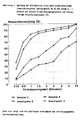
- Die Wirkung der Demulgatoren wurde an unterschiedlichen Erdölemulsionen im Vergleich mit derzeit üblichen Spaltern nach dem sogenannten "Bottle Test" (vgl. "Treating Oil Field Emulsions", Ed. American Petrol. Instit., Dallas, Tex., 1974) geprüft. Die Vergleichsspalter waren ein propoxyliertes, ethoxyliertes Glycerinblockpolymerisat (A), eine Mischung aus einem A-analogen Blockpolymerisat mit einem alkoxylierten Polyamin entsprechend DE 22 27 546 (B) und eine Mischung eines alkylierten Phenolformaldehydharzes mit einem Umsetzungsprodukt aus einer A-analogen Verbindung mit einer Dicarbonsäure (C). Die Verbindungen wurden in toluolischer Lösung mit einer Wirkstoffkonzentration von 30 ppm bei 60 °C angewendet. Die hohe Effektivität der erfindungsgemäßen Demulgatoren im Vergleich zu heute üblichen Produkten wird in Tabelle 2, 3 und in Abbildung 1 an verschiedenen Erdölemulsionen demonstriert.
Tabelle 2 Spaltung der Emulsion einer ost-niederländischen Lager stätte, Wassergehalt 26 %, Spaltzeit 2 h, Demulgatoren-Nr. vgl. Ausführungen zu den Beispielen 1 - 9 Demulgator Spaltung (%) A 62 1 60 2 75 3 88 4 94 5 99 6 75 Tabelle 3 Spaltung der Emulsion eines niederländischen Off-Shore-Feldes, Wassergehalt 31 %, Spaltzeit 2 h, Demulgatoren-Nr. vgl. Ausführungen zu den Beispielen 1 - 9 Demulgator Spaltung (%) B 73 1 68 2 78 3 85 4 92 5 100
Claims (7)
- Verwendung von oxalkylierten Alkylpolyglycosiden der Formel I
R-O-Zn-O-(AO)xH I,
wobei R einen linearen oder verzweigten, gesättigten oder ungesättigten Alkylrest mit 8 bis 18 C-Atomen, Zn ein Oligoglycosylradikal mit n = 1 bis 5 Hexose- oder Pentoseeinheiten oder Mischungen davon, AO ein Ethylenoxid-, Propylenoxid- oder Butylenoxidradikal oder Gemische davon und x 1 bis 100 bedeuten, als Demulgatoren zur Spaltung von Wasser-in-Öl-Erdölemulsionen. - Verwendung von oxalkylierten Alkylpolyglycosiden der Formel I
R-O-Zn-O-(AO)xH I,
wobei R einen linearen oder verzweigten, gesättigten oder ungesättigten Alkylrest mit 9 bis 16 C-Atomen, Zn ein Oligoglycosylradikal mit n = 1,1 bis 3 Hexose- oder Pentoseeinheiten oder Mischungen davon, AO ein Ethylenoxid-, Propylenoxid- oder 1,2-Butylenoxidradikal oder Gemische davon und x 10 bis 75 bedeuten, als Demulgatoren zur Spaltung von Wasser-in-Öl-Erdölemulsionen. - Verwendung von oxalkylierten Alkylpolyglycosiden nach den Ansprüchen 1 und 2, wobei in der Formel I AO für Mischungen in Blöcken von Ethylenoxid-, Propylenoxid- oder 1,2-Butylenoxidradikalen steht.
- Verwendung von oxalkylierten Alkylpolyglycosiden nach den Ansprüchen 1 bis 3, wobei die oxalkylierten Alkylpolyglycoside in Kombination mit bekannten Spalterkomponenten eingesetzt werden.
- Verwendung von oxalkylierten Alkylpolyglycosiden nach den Ansprüchen 1 bis 4, wobei der Gehalt an oxalkylierten Alkylpolyglycosiden mindestens 10 % beträgt.
- Verwendung von oxalkylierten Alkylpolyglycosiden nach den Ansprüchen 1 bis 5, wobei der Gehalt an oxalkylierten Alkylpolyglycosiden mindestens 20 % beträgt.
- Verwendung von oxalkylierten Alkylpolyglycosiden nach den Ansprüchen 1 bis 6, wobei sie in Konzentrationen von 1 bis 1 000 ppm der Emulsion zugesetzt werden.
Applications Claiming Priority (2)
| Application Number | Priority Date | Filing Date | Title |
|---|---|---|---|
| DE4023834 | 1990-07-27 | ||
| DE4023834A DE4023834A1 (de) | 1990-07-27 | 1990-07-27 | Demulgatoren zur spaltung von erdoelemulsionen |
Publications (3)
| Publication Number | Publication Date |
|---|---|
| EP0468095A2 EP0468095A2 (de) | 1992-01-29 |
| EP0468095A3 EP0468095A3 (en) | 1992-07-29 |
| EP0468095B1 true EP0468095B1 (de) | 1994-05-04 |
Family
ID=6411094
Family Applications (1)
| Application Number | Title | Priority Date | Filing Date |
|---|---|---|---|
| EP90124138A Expired - Lifetime EP0468095B1 (de) | 1990-07-27 | 1990-12-13 | Verwendung von oxalkylierten Alkylpolyglycosiden als Demulgatoren zur Spaltung von Erdölemulsionen |
Country Status (5)
| Country | Link |
|---|---|
| US (1) | US5164116A (de) |
| EP (1) | EP0468095B1 (de) |
| CA (1) | CA2047921A1 (de) |
| DE (2) | DE4023834A1 (de) |
| NO (1) | NO912926L (de) |
Families Citing this family (25)
| Publication number | Priority date | Publication date | Assignee | Title |
|---|---|---|---|---|
| US5609794A (en) * | 1994-08-05 | 1997-03-11 | Exxon Chemical Patents, Inc. | Demulsifier for water-in-oil emulsions, and method of use |
| US6090754A (en) * | 1995-05-11 | 2000-07-18 | Atlantic Richfield Company | Surfactant blends for well operation |
| US5830831A (en) * | 1995-05-11 | 1998-11-03 | Atlantic Richfield Company | Surfactant blends for well operations |
| FR2754739B1 (fr) * | 1996-10-22 | 1998-12-18 | Seppic Sa | Compositions anti-mousse et compositions anhydres intermediaires |
| US6583102B2 (en) | 1996-10-22 | 2003-06-24 | Societe D'exploitation De Produits Pour Les Industries Chimiques Seppic | Antifoaming compositions and intermediate anhydrous compositions |
| US6077945A (en) * | 1997-02-18 | 2000-06-20 | Eastman Chemical Company | Process for making alkylpolyglycosides |
| US6000412A (en) * | 1998-02-13 | 1999-12-14 | Atlantic Richfield Company | Method for cleaning deposits from a tank using a surfactant composition |
| US5874386A (en) * | 1998-02-13 | 1999-02-23 | Atlantic Richfield Company | Method for cleaning drilling fluid solids from a wellbore using a surfactant composition |
| US6112814A (en) * | 1998-02-13 | 2000-09-05 | Atlantic Richfield Company | Method for cleaning wellbore surfaces using coiled tubing with a surfactant composition |
| US5996692A (en) | 1998-02-13 | 1999-12-07 | Atlantic Richfield Company | Surfactant composition and method for cleaning wellbore and oil field surfaces using the surfactant composition |
| US5977032A (en) * | 1998-09-26 | 1999-11-02 | Atlantic Richfield Company | Acidic surfactant composition and method for cleaning wellbore and flowline surfaces using the surfactant composition |
| DE19924771A1 (de) * | 1999-05-29 | 2000-12-21 | Buna Sow Leuna Olefinverb Gmbh | Verfahren zur Herstellung von Polyetherpolyolen aus Polysaccariden und deren Verwendung für die Herstellung von PUR-Schäumen |
| US6283213B1 (en) | 1999-08-12 | 2001-09-04 | Atlantic Richfield Company | Tandem spacer fluid system and method for positioning a cement slurry in a wellbore annulus |
| US6881349B2 (en) * | 2002-11-15 | 2005-04-19 | M-I Llc | Method for recycling of oil based drilling fluid contaminated with water and water contaminated with oil based drilling fluid |
| DE60234584D1 (de) * | 2001-04-24 | 2010-01-14 | Mi Llc | Verfahren zur reinigung von wasser verunreinigt durch auf öl-basierender bohrflüflüssigkeit |
| RU2225431C1 (ru) * | 2002-07-31 | 2004-03-10 | Гильмияров Рафик Раисович | Способ получения деэмульгатора для разрушения водонефтяных эмульсий, обладающего эффектом подавления сульфатвосстанавливающих бактерий, ингибирования коррозии, асфальтено-смоло-парафиновых отложений и обессеривания нефти |
| RU2225432C1 (ru) * | 2002-07-31 | 2004-03-10 | Гильмияров Рафик Раисович | Способ получения деэмульгатора для разрушения водонефтяных эмульсий, обладающего эффектом подавления сульфатвосстанавливающих бактерий, ингибирования коррозии, асфальтено-смоло-парафиновых отложений и обессеривания нефти |
| RU2234526C2 (ru) * | 2002-10-16 | 2004-08-20 | Закрытое акционерное общество "Агентство Технологий и Оперативной Науки" | Состав для разрушения водонефтяных эмульсий и защиты нефтепромыслового оборудования от асфальтено-смолопарафиновых отложений |
| DE10325198B4 (de) * | 2003-06-04 | 2007-10-25 | Clariant Produkte (Deutschland) Gmbh | Verwendung von alkoxylierten vernetzten Polyglycerinen als biologisch abbaubare Emulsionsspalter |
| ITMI20071196A1 (it) * | 2007-06-14 | 2008-12-15 | Eni Spa | Fluidi a base acquosa per prevenire la formazione di emulsioni w-o o per risolvere emulsioni w-o gia'formate in matrici porose |
| US20090197978A1 (en) * | 2008-01-31 | 2009-08-06 | Nimeshkumar Kantilal Patel | Methods for breaking crude oil and water emulsions |
| US20100025300A1 (en) * | 2008-07-30 | 2010-02-04 | Bp Corporation North America Inc. | Controlling emulsion stability during fuel stock processing |
| US8283304B2 (en) * | 2009-10-14 | 2012-10-09 | S.C. Johnson & Son, Inc. | Green compositions containing synergistic blends of surfactants and linkers |
| WO2013165701A1 (en) * | 2012-05-01 | 2013-11-07 | Baker Hughes Incorporated | Incorporation of lactones into crosslinked-modified polyols for demulsification |
| CN107022372B (zh) * | 2017-06-12 | 2018-06-22 | 扬州工业职业技术学院 | 一种硅胶负载的长链烷基鼠李糖苷在污油破乳脱水中的应用 |
Family Cites Families (10)
| Publication number | Priority date | Publication date | Assignee | Title |
|---|---|---|---|---|
| US3640998A (en) * | 1969-06-18 | 1972-02-08 | Richard C Mansfield | Alkylene oxide adducts of alkyloligosaccharides and their mixtures with alkylene oxide adducts of bord alkyl glucosides and alkanols |
| DE2719978C3 (de) * | 1977-05-04 | 1980-09-25 | Basf Ag, 6700 Ludwigshafen | Erdölemulsionsspalter |
| DE3142955A1 (de) * | 1981-10-29 | 1983-05-11 | Hoechst Ag, 6230 Frankfurt | "neue grenzflaechenaktive verbindungen, verfahren zu ihrer herstellung und ihre verwendung" |
| US4551239A (en) * | 1983-04-11 | 1985-11-05 | Exxon Research & Engineering Co. | Water based demulsifier formulation and process for its use in dewatering and desalting crude hydrocarbon oils |
| US4978459A (en) * | 1986-03-15 | 1990-12-18 | Exxon Research And Engineering Company | Oil spill microemulsion dispersants |
| US4834903A (en) * | 1986-09-29 | 1989-05-30 | Henkel Corporation | Alkylene oxide adducts of glycoside surfactants and detergent compositions containing same |
| DE3720330A1 (de) * | 1987-06-19 | 1988-12-29 | Huels Chemische Werke Ag | Verfahren zur gewinnung von erdoel aus einer unterirdischen lagerstaette mit tensiden |
| DE3809067A1 (de) * | 1988-03-18 | 1989-09-28 | Hoechst Ag | Verfahren zum trennen von erdoelemulsionen vom typ wasser-in-oel |
| DE3809065A1 (de) * | 1988-03-18 | 1989-09-28 | Hoechst Ag | Veresterte glycidylether-additionsprodukte und deren verwendung |
| US4968449A (en) * | 1989-03-17 | 1990-11-06 | Nalco Chemical Company | Alkoxylated vinyl polymer demulsifiers |
-
1990
- 1990-07-27 DE DE4023834A patent/DE4023834A1/de not_active Withdrawn
- 1990-12-13 DE DE59005642T patent/DE59005642D1/de not_active Expired - Fee Related
- 1990-12-13 EP EP90124138A patent/EP0468095B1/de not_active Expired - Lifetime
-
1991
- 1991-06-17 US US07/716,107 patent/US5164116A/en not_active Expired - Fee Related
- 1991-07-25 CA CA002047921A patent/CA2047921A1/en not_active Abandoned
- 1991-07-26 NO NO91912926A patent/NO912926L/no unknown
Also Published As
| Publication number | Publication date |
|---|---|
| DE59005642D1 (de) | 1994-06-09 |
| EP0468095A2 (de) | 1992-01-29 |
| US5164116A (en) | 1992-11-17 |
| EP0468095A3 (en) | 1992-07-29 |
| NO912926L (no) | 1992-01-28 |
| DE4023834A1 (de) | 1992-01-30 |
| NO912926D0 (no) | 1991-07-26 |
| CA2047921A1 (en) | 1992-01-28 |
Similar Documents
| Publication | Publication Date | Title |
|---|---|---|
| EP0468095B1 (de) | Verwendung von oxalkylierten Alkylpolyglycosiden als Demulgatoren zur Spaltung von Erdölemulsionen | |
| EP1230200B1 (de) | C13-alkoholgemisch und funktionalisiertes c13-alkoholgemisch | |
| DE2719978C3 (de) | Erdölemulsionsspalter | |
| EP0418479B1 (de) | Emulgatoren zur Herstellung von lagerstabilen, wässrigen Polysiloxan-bzw. Polysiloxan-Paraffinöl-Emulsionen | |
| EP0549918B1 (de) | Erdölemulsionsspalter auf der Basis eines Alkoxilats und Verfahren zur Herstellung dieses Alkoxilats | |
| DE69905825T2 (de) | Verfahren zur Hemmung von Öl- und Wasser-Emulsionen | |
| WO2011032640A2 (de) | Alkoxylierte trialkanolaminkondensate und deren verwendung als emulsionsspalter | |
| DE10325198A1 (de) | Alkoxylierte vernetzte Polyglycerine und ihre Verwendung als biologisch abbaubare Emulsionsspalter | |
| EP0116915B1 (de) | Verfahren zur Stimulierung von Erdölfördersonden | |
| EP0267517A2 (de) | Verzweigte Polyoxalkylenmischpolyester, Verfahren zu ihrer Herstellung und ihre Verwendung | |
| EP0333141B1 (de) | Verfahren zum Trennen von Erdölemulsionen vom Typ Wasser-in-Oel | |
| EP0333135B1 (de) | Veresterte Glycidylether-Additionsprodukte und deren Verwendung | |
| DE102009040495B4 (de) | Alkoxylierte Thiacalixarene und deren Verwendung als Rohöl-Emulsionsspalter | |
| DE69424658T2 (de) | Verfahren zur herstellung von alkylpolyglykosiden | |
| DE10224275B4 (de) | Emulsionsspalter | |
| EP0097897B1 (de) | Modifizierte veretherte Phenol-Aldehyd-Kondensationsprodukte und deren Verwendung zum Spalten von Erdölemulsionen | |
| EP1363715B1 (de) | Alkoxylierte polyglycerine und ihre verwendung als emulsionsspalter | |
| DE3300866A1 (de) | Oxalkylierte polyamidoamine, deren herstellung und deren verwendung als erdoelemulsionsspalter | |
| EP1341831A1 (de) | Alkylphenolglyoxalharze und ihre verwendung als emulsionsspalter | |
| EP0252241B1 (de) | Verfahren zur Herstellung von Butyloligoglycosiden | |
| EP0396044B1 (de) | Mischung aus Alkylglucosiden und Alkoholen als Entschäumer | |
| DE69420280T2 (de) | Produktion von alkylpolyglykosiden | |
| EP0167873B1 (de) | Tensidmischung und deren Verwendung zur tertiären Ölförderung | |
| EP1337571A1 (de) | Harze aus alkylphenolen und glyoxalsäurederivaten, und ihre verwendung als emulsionsspalter | |
| DE69225375T2 (de) | Glycosiduronsäuren (Herstellungsverfahren) |
Legal Events
| Date | Code | Title | Description |
|---|---|---|---|
| PUAI | Public reference made under article 153(3) epc to a published international application that has entered the european phase |
Free format text: ORIGINAL CODE: 0009012 |
|
| 17P | Request for examination filed |
Effective date: 19901213 |
|
| AK | Designated contracting states |
Kind code of ref document: A2 Designated state(s): DE GB NL |
|
| PUAL | Search report despatched |
Free format text: ORIGINAL CODE: 0009013 |
|
| AK | Designated contracting states |
Kind code of ref document: A3 Designated state(s): DE GB NL |
|
| 17Q | First examination report despatched |
Effective date: 19930713 |
|
| GRAA | (expected) grant |
Free format text: ORIGINAL CODE: 0009210 |
|
| AK | Designated contracting states |
Kind code of ref document: B1 Designated state(s): DE GB NL |
|
| REF | Corresponds to: |
Ref document number: 59005642 Country of ref document: DE Date of ref document: 19940609 |
|
| GBT | Gb: translation of ep patent filed (gb section 77(6)(a)/1977) |
Effective date: 19940526 |
|
| PLBE | No opposition filed within time limit |
Free format text: ORIGINAL CODE: 0009261 |
|
| STAA | Information on the status of an ep patent application or granted ep patent |
Free format text: STATUS: NO OPPOSITION FILED WITHIN TIME LIMIT |
|
| 26N | No opposition filed | ||
| PGFP | Annual fee paid to national office [announced via postgrant information from national office to epo] |
Ref country code: GB Payment date: 19951128 Year of fee payment: 6 |
|
| PGFP | Annual fee paid to national office [announced via postgrant information from national office to epo] |
Ref country code: DE Payment date: 19951220 Year of fee payment: 6 |
|
| PGFP | Annual fee paid to national office [announced via postgrant information from national office to epo] |
Ref country code: NL Payment date: 19951230 Year of fee payment: 6 |
|
| PG25 | Lapsed in a contracting state [announced via postgrant information from national office to epo] |
Ref country code: GB Effective date: 19961213 |
|
| PG25 | Lapsed in a contracting state [announced via postgrant information from national office to epo] |
Ref country code: NL Effective date: 19970701 |
|
| GBPC | Gb: european patent ceased through non-payment of renewal fee |
Effective date: 19961213 |
|
| NLV4 | Nl: lapsed or anulled due to non-payment of the annual fee |
Effective date: 19970701 |
|
| PG25 | Lapsed in a contracting state [announced via postgrant information from national office to epo] |
Ref country code: DE Effective date: 19970902 |