EP0468270A1 - Verwendung von mit Oxyalkylenethergruppen modifizierten Epoxypolysiloxanen als härtbare Beschichtungsmittel - Google Patents
Verwendung von mit Oxyalkylenethergruppen modifizierten Epoxypolysiloxanen als härtbare Beschichtungsmittel Download PDFInfo
- Publication number
- EP0468270A1 EP0468270A1 EP91111380A EP91111380A EP0468270A1 EP 0468270 A1 EP0468270 A1 EP 0468270A1 EP 91111380 A EP91111380 A EP 91111380A EP 91111380 A EP91111380 A EP 91111380A EP 0468270 A1 EP0468270 A1 EP 0468270A1
- Authority
- EP
- European Patent Office
- Prior art keywords
- value
- epoxy
- average
- radical
- group
- Prior art date
- Legal status (The legal status is an assumption and is not a legal conclusion. Google has not performed a legal analysis and makes no representation as to the accuracy of the status listed.)
- Granted
Links
- 229920001296 polysiloxane Polymers 0.000 title claims abstract description 45
- 239000008199 coating composition Substances 0.000 title claims abstract description 7
- -1 polysiloxane Polymers 0.000 claims abstract description 48
- 125000003700 epoxy group Chemical group 0.000 claims abstract description 28
- 125000004432 carbon atom Chemical group C* 0.000 claims abstract description 15
- 150000001875 compounds Chemical class 0.000 claims abstract description 9
- 239000000203 mixture Substances 0.000 claims abstract description 8
- 229910052710 silicon Inorganic materials 0.000 claims abstract description 8
- 125000004429 atom Chemical group 0.000 claims abstract description 7
- 239000004593 Epoxy Substances 0.000 claims description 9
- 229910018540 Si C Inorganic materials 0.000 claims description 2
- 125000003118 aryl group Chemical group 0.000 claims description 2
- 229910010271 silicon carbide Inorganic materials 0.000 claims description 2
- 150000003254 radicals Chemical class 0.000 description 20
- 235000013870 dimethyl polysiloxane Nutrition 0.000 description 11
- 229920000435 poly(dimethylsiloxane) Polymers 0.000 description 11
- 239000002390 adhesive tape Substances 0.000 description 10
- 230000001070 adhesive effect Effects 0.000 description 9
- 238000000576 coating method Methods 0.000 description 9
- 239000004205 dimethyl polysiloxane Substances 0.000 description 9
- 229940125904 compound 1 Drugs 0.000 description 8
- 239000004215 Carbon black (E152) Substances 0.000 description 7
- 239000004721 Polyphenylene oxide Substances 0.000 description 7
- 239000000853 adhesive Substances 0.000 description 7
- 229930195733 hydrocarbon Natural products 0.000 description 7
- 229920000570 polyether Polymers 0.000 description 7
- 238000002360 preparation method Methods 0.000 description 7
- 125000003903 2-propenyl group Chemical group [H]C([*])([H])C([H])=C([H])[H] 0.000 description 6
- XAYDWGMOPRHLEP-UHFFFAOYSA-N 6-ethenyl-7-oxabicyclo[4.1.0]heptane Chemical compound C1CCCC2OC21C=C XAYDWGMOPRHLEP-UHFFFAOYSA-N 0.000 description 6
- MTHSVFCYNBDYFN-UHFFFAOYSA-N diethylene glycol Chemical compound OCCOCCO MTHSVFCYNBDYFN-UHFFFAOYSA-N 0.000 description 6
- 239000011248 coating agent Substances 0.000 description 5
- 239000000758 substrate Substances 0.000 description 5
- RTZKZFJDLAIYFH-UHFFFAOYSA-N Diethyl ether Chemical compound CCOCC RTZKZFJDLAIYFH-UHFFFAOYSA-N 0.000 description 4
- 238000004519 manufacturing process Methods 0.000 description 4
- 239000004848 polyfunctional curative Substances 0.000 description 4
- 239000004820 Pressure-sensitive adhesive Substances 0.000 description 3
- 239000002253 acid Substances 0.000 description 3
- 239000003054 catalyst Substances 0.000 description 3
- 229940125782 compound 2 Drugs 0.000 description 3
- 239000003365 glass fiber Substances 0.000 description 3
- 125000002887 hydroxy group Chemical group [H]O* 0.000 description 3
- 150000003839 salts Chemical class 0.000 description 3
- 239000000080 wetting agent Substances 0.000 description 3
- 238000005160 1H NMR spectroscopy Methods 0.000 description 2
- STMDPCBYJCIZOD-UHFFFAOYSA-N 2-(2,4-dinitroanilino)-4-methylpentanoic acid Chemical compound CC(C)CC(C(O)=O)NC1=CC=C([N+]([O-])=O)C=C1[N+]([O-])=O STMDPCBYJCIZOD-UHFFFAOYSA-N 0.000 description 2
- 101100522123 Caenorhabditis elegans ptc-1 gene Proteins 0.000 description 2
- CURLTUGMZLYLDI-UHFFFAOYSA-N Carbon dioxide Chemical compound O=C=O CURLTUGMZLYLDI-UHFFFAOYSA-N 0.000 description 2
- GXBYFVGCMPJVJX-UHFFFAOYSA-N Epoxybutene Chemical compound C=CC1CO1 GXBYFVGCMPJVJX-UHFFFAOYSA-N 0.000 description 2
- XUIMIQQOPSSXEZ-UHFFFAOYSA-N Silicon Chemical group [Si] XUIMIQQOPSSXEZ-UHFFFAOYSA-N 0.000 description 2
- 150000007513 acids Chemical class 0.000 description 2
- 125000000217 alkyl group Chemical group 0.000 description 2
- WPYMKLBDIGXBTP-UHFFFAOYSA-N benzoic acid Chemical compound OC(=O)C1=CC=CC=C1 WPYMKLBDIGXBTP-UHFFFAOYSA-N 0.000 description 2
- 238000005266 casting Methods 0.000 description 2
- 238000006243 chemical reaction Methods 0.000 description 2
- 230000000052 comparative effect Effects 0.000 description 2
- 229940126214 compound 3 Drugs 0.000 description 2
- 125000001495 ethyl group Chemical group [H]C([H])([H])C([H])([H])* 0.000 description 2
- 238000002474 experimental method Methods 0.000 description 2
- 239000004744 fabric Substances 0.000 description 2
- 239000003292 glue Substances 0.000 description 2
- 239000000463 material Substances 0.000 description 2
- 125000002496 methyl group Chemical group [H]C([H])([H])* 0.000 description 2
- 239000003921 oil Substances 0.000 description 2
- 125000005702 oxyalkylene group Chemical group 0.000 description 2
- 239000000047 product Substances 0.000 description 2
- 125000001436 propyl group Chemical group [H]C([*])([H])C([H])([H])C([H])([H])[H] 0.000 description 2
- 238000000926 separation method Methods 0.000 description 2
- 125000004469 siloxy group Chemical group [SiH3]O* 0.000 description 2
- WPWHSFAFEBZWBB-UHFFFAOYSA-N 1-butyl radical Chemical compound [CH2]CCC WPWHSFAFEBZWBB-UHFFFAOYSA-N 0.000 description 1
- SMZOUWXMTYCWNB-UHFFFAOYSA-N 2-(2-methoxy-5-methylphenyl)ethanamine Chemical compound COC1=CC=C(C)C=C1CCN SMZOUWXMTYCWNB-UHFFFAOYSA-N 0.000 description 1
- NIXOWILDQLNWCW-UHFFFAOYSA-N 2-Propenoic acid Natural products OC(=O)C=C NIXOWILDQLNWCW-UHFFFAOYSA-N 0.000 description 1
- SLRMQYXOBQWXCR-UHFFFAOYSA-N 2154-56-5 Chemical compound [CH2]C1=CC=CC=C1 SLRMQYXOBQWXCR-UHFFFAOYSA-N 0.000 description 1
- NIXOWILDQLNWCW-UHFFFAOYSA-M Acrylate Chemical compound [O-]C(=O)C=C NIXOWILDQLNWCW-UHFFFAOYSA-M 0.000 description 1
- 239000005711 Benzoic acid Substances 0.000 description 1
- OKTJSMMVPCPJKN-UHFFFAOYSA-N Carbon Chemical compound [C] OKTJSMMVPCPJKN-UHFFFAOYSA-N 0.000 description 1
- SNRUBQQJIBEYMU-UHFFFAOYSA-N Dodecane Natural products CCCCCCCCCCCC SNRUBQQJIBEYMU-UHFFFAOYSA-N 0.000 description 1
- 239000002841 Lewis acid Substances 0.000 description 1
- 239000004698 Polyethylene Substances 0.000 description 1
- 239000004743 Polypropylene Substances 0.000 description 1
- YZCKVEUIGOORGS-IGMARMGPSA-N Protium Chemical compound [1H] YZCKVEUIGOORGS-IGMARMGPSA-N 0.000 description 1
- 229910018286 SbF 6 Inorganic materials 0.000 description 1
- CIUQDSCDWFSTQR-UHFFFAOYSA-N [C]1=CC=CC=C1 Chemical compound [C]1=CC=CC=C1 CIUQDSCDWFSTQR-UHFFFAOYSA-N 0.000 description 1
- 239000003522 acrylic cement Substances 0.000 description 1
- 150000001412 amines Chemical class 0.000 description 1
- 159000000032 aromatic acids Chemical class 0.000 description 1
- 150000005840 aryl radicals Chemical class 0.000 description 1
- 235000010233 benzoic acid Nutrition 0.000 description 1
- 125000000484 butyl group Chemical group [H]C([*])([H])C([H])([H])C([H])([H])C([H])([H])[H] 0.000 description 1
- 229910052799 carbon Inorganic materials 0.000 description 1
- 239000007795 chemical reaction product Substances 0.000 description 1
- 238000004140 cleaning Methods 0.000 description 1
- 239000000470 constituent Substances 0.000 description 1
- 125000002704 decyl group Chemical group [H]C([H])([H])C([H])([H])C([H])([H])C([H])([H])C([H])([H])C([H])([H])C([H])([H])C([H])([H])C([H])([H])C([H])([H])* 0.000 description 1
- 229920005645 diorganopolysiloxane polymer Polymers 0.000 description 1
- 125000003438 dodecyl group Chemical group [H]C([H])([H])C([H])([H])C([H])([H])C([H])([H])C([H])([H])C([H])([H])C([H])([H])C([H])([H])C([H])([H])C([H])([H])C([H])([H])C([H])([H])* 0.000 description 1
- 125000001033 ether group Chemical group 0.000 description 1
- 150000002170 ethers Chemical class 0.000 description 1
- 238000001914 filtration Methods 0.000 description 1
- 239000011888 foil Substances 0.000 description 1
- 230000004927 fusion Effects 0.000 description 1
- 238000001879 gelation Methods 0.000 description 1
- 125000004051 hexyl group Chemical group [H]C([H])([H])C([H])([H])C([H])([H])C([H])([H])C([H])([H])C([H])([H])* 0.000 description 1
- 150000002430 hydrocarbons Chemical group 0.000 description 1
- 125000004435 hydrogen atom Chemical group [H]* 0.000 description 1
- 239000000976 ink Substances 0.000 description 1
- MGFYSGNNHQQTJW-UHFFFAOYSA-N iodonium Chemical compound [IH2+] MGFYSGNNHQQTJW-UHFFFAOYSA-N 0.000 description 1
- 150000007517 lewis acids Chemical class 0.000 description 1
- WCYWZMWISLQXQU-UHFFFAOYSA-N methyl Chemical group [CH3] WCYWZMWISLQXQU-UHFFFAOYSA-N 0.000 description 1
- 238000012986 modification Methods 0.000 description 1
- 230000004048 modification Effects 0.000 description 1
- MDLWEBWGXACWGE-UHFFFAOYSA-N octadecane Chemical compound [CH2]CCCCCCCCCCCCCCCCC MDLWEBWGXACWGE-UHFFFAOYSA-N 0.000 description 1
- 239000013307 optical fiber Substances 0.000 description 1
- 150000007524 organic acids Chemical class 0.000 description 1
- 235000005985 organic acids Nutrition 0.000 description 1
- 150000003961 organosilicon compounds Chemical class 0.000 description 1
- 239000005026 oriented polypropylene Substances 0.000 description 1
- CABDEMAGSHRORS-UHFFFAOYSA-N oxirane;hydrate Chemical compound O.C1CO1 CABDEMAGSHRORS-UHFFFAOYSA-N 0.000 description 1
- 125000004430 oxygen atom Chemical group O* 0.000 description 1
- 239000005022 packaging material Substances 0.000 description 1
- 238000004806 packaging method and process Methods 0.000 description 1
- 125000000913 palmityl group Chemical group [H]C([*])([H])C([H])([H])C([H])([H])C([H])([H])C([H])([H])C([H])([H])C([H])([H])C([H])([H])C([H])([H])C([H])([H])C([H])([H])C([H])([H])C([H])([H])C([H])([H])C([H])([H])C([H])([H])[H] 0.000 description 1
- 229920000728 polyester Polymers 0.000 description 1
- 229920000573 polyethylene Polymers 0.000 description 1
- 238000006116 polymerization reaction Methods 0.000 description 1
- 229920001155 polypropylene Polymers 0.000 description 1
- 125000003808 silyl group Chemical group [H][Si]([H])([H])[*] 0.000 description 1
- 239000002904 solvent Substances 0.000 description 1
- 238000001228 spectrum Methods 0.000 description 1
- 238000003860 storage Methods 0.000 description 1
- 239000000126 substance Substances 0.000 description 1
- 125000001424 substituent group Chemical group 0.000 description 1
- 150000003460 sulfonic acids Chemical class 0.000 description 1
- RWSOTUBLDIXVET-UHFFFAOYSA-O sulfonium Chemical compound [SH3+] RWSOTUBLDIXVET-UHFFFAOYSA-O 0.000 description 1
- 150000003512 tertiary amines Chemical class 0.000 description 1
- 210000003813 thumb Anatomy 0.000 description 1
Classifications
-
- C—CHEMISTRY; METALLURGY
- C09—DYES; PAINTS; POLISHES; NATURAL RESINS; ADHESIVES; COMPOSITIONS NOT OTHERWISE PROVIDED FOR; APPLICATIONS OF MATERIALS NOT OTHERWISE PROVIDED FOR
- C09D—COATING COMPOSITIONS, e.g. PAINTS, VARNISHES OR LACQUERS; FILLING PASTES; CHEMICAL PAINT OR INK REMOVERS; INKS; CORRECTING FLUIDS; WOODSTAINS; PASTES OR SOLIDS FOR COLOURING OR PRINTING; USE OF MATERIALS THEREFOR
- C09D183/00—Coating compositions based on macromolecular compounds obtained by reactions forming in the main chain of the macromolecule a linkage containing silicon, with or without sulfur, nitrogen, oxygen, or carbon only; Coating compositions based on derivatives of such polymers
- C09D183/10—Block or graft copolymers containing polysiloxane sequences
- C09D183/12—Block or graft copolymers containing polysiloxane sequences containing polyether sequences
-
- C—CHEMISTRY; METALLURGY
- C08—ORGANIC MACROMOLECULAR COMPOUNDS; THEIR PREPARATION OR CHEMICAL WORKING-UP; COMPOSITIONS BASED THEREON
- C08G—MACROMOLECULAR COMPOUNDS OBTAINED OTHERWISE THAN BY REACTIONS ONLY INVOLVING UNSATURATED CARBON-TO-CARBON BONDS
- C08G59/00—Polycondensates containing more than one epoxy group per molecule; Macromolecules obtained by polymerising compounds containing more than one epoxy group per molecule using curing agents or catalysts which react with the epoxy groups
- C08G59/18—Macromolecules obtained by polymerising compounds containing more than one epoxy group per molecule using curing agents or catalysts which react with the epoxy groups ; e.g. general methods of curing
- C08G59/20—Macromolecules obtained by polymerising compounds containing more than one epoxy group per molecule using curing agents or catalysts which react with the epoxy groups ; e.g. general methods of curing characterised by the epoxy compounds used
- C08G59/22—Di-epoxy compounds
- C08G59/30—Di-epoxy compounds containing atoms other than carbon, hydrogen, oxygen and nitrogen
- C08G59/306—Di-epoxy compounds containing atoms other than carbon, hydrogen, oxygen and nitrogen containing silicon
-
- C—CHEMISTRY; METALLURGY
- C08—ORGANIC MACROMOLECULAR COMPOUNDS; THEIR PREPARATION OR CHEMICAL WORKING-UP; COMPOSITIONS BASED THEREON
- C08G—MACROMOLECULAR COMPOUNDS OBTAINED OTHERWISE THAN BY REACTIONS ONLY INVOLVING UNSATURATED CARBON-TO-CARBON BONDS
- C08G59/00—Polycondensates containing more than one epoxy group per molecule; Macromolecules obtained by polymerising compounds containing more than one epoxy group per molecule using curing agents or catalysts which react with the epoxy groups
- C08G59/18—Macromolecules obtained by polymerising compounds containing more than one epoxy group per molecule using curing agents or catalysts which react with the epoxy groups ; e.g. general methods of curing
- C08G59/20—Macromolecules obtained by polymerising compounds containing more than one epoxy group per molecule using curing agents or catalysts which react with the epoxy groups ; e.g. general methods of curing characterised by the epoxy compounds used
- C08G59/32—Epoxy compounds containing three or more epoxy groups
- C08G59/3254—Epoxy compounds containing three or more epoxy groups containing atoms other than carbon, hydrogen, oxygen or nitrogen
-
- C—CHEMISTRY; METALLURGY
- C08—ORGANIC MACROMOLECULAR COMPOUNDS; THEIR PREPARATION OR CHEMICAL WORKING-UP; COMPOSITIONS BASED THEREON
- C08G—MACROMOLECULAR COMPOUNDS OBTAINED OTHERWISE THAN BY REACTIONS ONLY INVOLVING UNSATURATED CARBON-TO-CARBON BONDS
- C08G65/00—Macromolecular compounds obtained by reactions forming an ether link in the main chain of the macromolecule
- C08G65/02—Macromolecular compounds obtained by reactions forming an ether link in the main chain of the macromolecule from cyclic ethers by opening of the heterocyclic ring
- C08G65/32—Polymers modified by chemical after-treatment
- C08G65/329—Polymers modified by chemical after-treatment with organic compounds
- C08G65/336—Polymers modified by chemical after-treatment with organic compounds containing silicon
-
- C—CHEMISTRY; METALLURGY
- C08—ORGANIC MACROMOLECULAR COMPOUNDS; THEIR PREPARATION OR CHEMICAL WORKING-UP; COMPOSITIONS BASED THEREON
- C08L—COMPOSITIONS OF MACROMOLECULAR COMPOUNDS
- C08L83/00—Compositions of macromolecular compounds obtained by reactions forming in the main chain of the macromolecule a linkage containing silicon with or without sulfur, nitrogen, oxygen or carbon only; Compositions of derivatives of such polymers
- C08L83/10—Block- or graft-copolymers containing polysiloxane sequences
- C08L83/12—Block- or graft-copolymers containing polysiloxane sequences containing polyether sequences
Definitions
- the invention relates to the use of curable organopolysiloxanes, which contain oxyalkylene ether groups in addition to epoxy groups, as curable coating compositions with abhesive properties.
- the preparation can additionally contain, based on epoxypolysiloxane, up to 98% by weight of an epoxysilane.
- the epoxysiloxanes contain at least one polymerizable epoxy group of the formula the following groups can be given as examples:
- the epoxy groups are preferably located at the end of the hydrocarbon residue.
- Preferred epoxypolysiloxanes of US Pat. No. 4,313,988 are those of the formula where R is a methyl radical, b has a value of 0 and group E is a ⁇ - (3,4-epoxycyclohexyl) ethyl or y-glycidoxypropyl radical.
- the epoxypolysiloxanes or the preparations containing such epoxypolysiloxanes are cured by addition and in the presence of customary epoxy curing catalysts.
- catalysts are tertiary amines, Lewis acids, such as BF 3 , and their complexes, such as, for example, with ethers or amines, polyaromatic iodonium and sulfonium complex salts which contain, for example, SbF 6 or BF 4 anions.
- Suitable hardeners are also described in U.S. Patent 4,394,403 and U.S. Patent 4,310,469.
- EP-A-0 334 068 describes epoxy-functional siloxanes in which some of the epoxy groups have been esterified by reaction with aromatic acids such as benzoic acid or unsaturated acids such as acrylic acid. This increases the compatibility of the epoxysiloxanes with the curing catalysts, but at the same time reduces the content of curable epoxy groups. Epoxy groups are reactive groups. You can also by Schmie Chere acids are activated for polymerization. This makes controlled implementation extremely difficult. In extreme cases, the reaction can get out of control and lead to gelation. Furthermore, residual levels of acid must be removed to ensure storage stability.
- a cleaning and wiping cloth is known from EP-A-0 343 304, which contains a wetting agent which imparts permanent hydrophilicity to the cloth.
- a wetting agent can be an organosilicon compound of the formula MDXD) D z '' M.
- M is in each case an end-limiting group of the formula A 3 Si0 1/2 , where A is a monovalent organic radical which is free from olefinic double bonds or hydroxyl groups and is bonded directly to the Si atom. M can also be an alkoxy radical having 1 to 13 carbon atoms.
- R ' is a polyoxyalkylene unit of the formula where R "is a hydrogen radical, an acyl radical having 1 to 8 carbon atoms or a monovalent hydrocarbon radical having 1 to 13 carbon atoms.
- n is an integer with an average value of 1 to 8.
- a and b are integers whose sum is a value of 5 has to 200 and the product a / (a + b) has a value of 1.0 to 0.
- R ' is a monovalent organic radical which has at least one vicinal epoxy group.
- x is an integer with an average value from 10 to 5000.
- y is an integer with an average value from 1 to x, and
- z is an integer with an average value from 1 to 0.5x, with the proviso that the sum y + z is not greater than 0.75x.
- modified silicones described in EP-A-0 343 304 are used as hydrophilizing wetting agents. Their use for the production of curable coating compositions with abhesive properties is not apparent from this publication.
- the object of the present invention is to find and provide curable organopolysiloxanes containing epoxy groups, which have good compatibility with photoinitiators, without having the disadvantages mentioned above.
- the modification of the epoxysiloxanes also aims to improve their adhesion to the substrate and, at the same time, to enable the release properties to be modified in accordance with the intended use, i.e. adjust to the application.
- organopolysiloxanes containing epoxy groups and modified in a certain way meet these requirements.
- radicals R 3 are the radicals -CH 2 CH 2 -, -CH 2 CH 2 CH 2 -, - (CH 2 ),
- n has absolute values of 2, 3 or 4. There are therefore ethyleneoxy, propyleneoxy, butyleneoxy units. In the average molecule, however, the mean value of n is 2 to 3, in particular 2 to 2.6.
- the number of oxyalkylene units results from the index x, which has a value from 1 to 200, preferably a value from 1 to 100 and in particular a value from 5 to 50.
- the above-mentioned modifying group has an OH group at the end. This OH group can react with the epoxy groups during curing.
- the introduction of the modifying group of formula 1 described above improves the compatibility of the modified siloxanes with photoinitiators.
- the adhesion of the epoxysiloxane to the substrate is improved.
- organopolysiloxanes containing oxyalkylene-modified epoxy groups are particularly preferably used, which correspond to the following general average formula R 1 in the polysiloxane molecule can be the same or different and can mean alkyl radicals with 1 to 4 carbon atoms.
- examples of such radicals are the methyl, ethyl, propyl or butyl radical.
- At least 90% of the radicals R 1 and particularly preferably 100% of the radicals R 1 are methyl radicals.
- R 2 can each be an alkyl radical having 1 to 20 carbon atoms, an aryl or aralkyl radical.
- alkyl radicals are the methyl, ethyl, propyl, butyl, hexyl, decyl, dodecyl, hexadecyl or octadecyl radical; the aryl radical is in particular the phenyl radical and the aralkyl radical is the benzyl radical.
- the radical R 2 can also have the meaning of an epoxy radical, the epoxy radical being linked via an Si-C bond to an Si atom of the polysiloxane. Examples of such epoxy residues have already been mentioned in the description of the prior art.
- the radical R 2 can also correspond to the formula I, the radical R 3 having the meaning given above and the indices n, x, y and z having the values already indicated.
- the index a indicates the number of chain-forming difunctional siloxy units and has a value from 1 to 1000, preferably from 5 to 200.
- b indicates the number of trifunctional branching siloxy units. b has a value from 0 to 10, preferably from 0 to 2.
- the epoxy groups to be used according to the invention additionally contain at least one group of the general formula which is bonded to an Si atom of the polysiloxane
- This group directly affects the compatibility of the epoxysiloxane with photoinitiators, improves the adhesion of the cured siloxanes to the substrate and their abhesiveness.
- organopolysiloxanes to be used according to the invention can in particular be used as coatings which have a separating action against pressure-sensitive adhesives on labels, decorative laminates, transfer papers and transfer tapes. They can also be used for the production of non-adhesive packaging materials for food and as industrial packaging.
- paper webs or foils made of polyethylene, polypropylene or polyesters serve as carrier webs for the adhesive coatings.
- organopolysiloxanes to be used according to the invention can advantageously be used for the production of printing inks and decorative coatings.
- organopolysiloxanes to be used according to the invention are used alone or in a mixture with other curable compounds as casting compounds. These casting compounds are used in particular for electrical or electronic components, such as printed circuit boards, switching elements, plugs and the like, which are exposed to the influence of aggressive media, moisture and the like.
- the compounds to be used according to the invention or their mixtures can also be used for coating glass fibers, which are intended in particular for the production of optical fibers.
- the coating protects the glass fibers from damage and damaging external influences, and at the same time the reflection of the glass fibers is influenced by the coating agent.
- modified organopolysiloxanes which can be used according to the invention and have curable epoxy groups can be used as curable coating compositions alone after the addition of conventional photoinitiators, which are added in an amount of 0.01 to 7% by weight, based on organopolysiloxane.
- These preparations may optionally contain solvents for the purpose of better application. However, solvent-free preparations are preferred.
- the organopolysiloxanes to be used according to the invention can also be added to conventional epoxy group-containing organopolysiloxanes of the prior art in order to influence and modify their properties during the joint curing.
- H 2 PtC1 6 16 mg are added to an amount of 950 g (0.1 mol) of a polydimethylsiloxane containing Si-H groups. 6 H 2 0 at 120 ° C and 32 g (0.45 mol) of butadiene monoepoxide added dropwise. After 5 hours at 120 ° C., 2 g of CsF are added and 150 g (1.05 mol) of diethylene glycol are added dropwise and the mixture is stirred at this temperature for 15 hours until no more H 2 evolution can be detected. It is then filtered and volatile constituents are removed at 120 ° C./0.1 mbar. Yield 1020 g.
- organopolysiloxanes of the following average formulas are prepared from polydimethylsiloxanes containing vinylcyclohexene oxide and Si-H groups.
- the compounds 1 to 9 are mixed with 1% by weight bis (dodecylphenyl) iodonium hexafluoroantimonate, applied to an oriented polypropylene film and cured with a fusion UV lamp (120 W / cm).
- the application amount is in any case approx. 1.1 g / cm 2.
- Various 80 mm wide adhesive tapes are used for the comparative examples, namely adhesive tapes coated with acrylate adhesives, which are commercially available under the names Tesa @ 154 and Tesa @ 970 , as well as an adhesive tape coated with rubber adhesive, which is commercially available under the name Tesa @ 969.
- these adhesive tapes are rolled onto the substrate and then stored at 70 ° C. in the case of the acrylic adhesive tapes and at 40 ° C. in the case of the rubber adhesive tape. After 24 hours, the force is measured which is required to pull the respective adhesive tape off the surface at a peel angle of 180 °. This force is called the separating force.
- the adhesion of the modified polysiloxanes to the substrate is checked by rubbing vigorously with the thumb. If there is insufficient adhesion, rubber-like crumbs form (so-called "rub off” test).
- the table shows that the organopolysiloxanes modified according to the invention have the desired performance properties. They show good adhesion to the backing, can be hardened quickly, show good adhesive properties compared to chemically different types of glue, in contrast to the prior art, can be adjusted to the chemical character of the glue by a suitable choice of substituents with the same siloxane structure and show good compatibility with photoinitiators. It is particularly striking that the organopolysiloxanes modified according to the invention, due to the synergism of the epoxy radical and the R 3 OH radical, cure without problems with a lower epoxy functionality.
Landscapes
- Chemical & Material Sciences (AREA)
- Organic Chemistry (AREA)
- Chemical Kinetics & Catalysis (AREA)
- Health & Medical Sciences (AREA)
- Medicinal Chemistry (AREA)
- Polymers & Plastics (AREA)
- General Chemical & Material Sciences (AREA)
- Life Sciences & Earth Sciences (AREA)
- Engineering & Computer Science (AREA)
- Materials Engineering (AREA)
- Wood Science & Technology (AREA)
- Silicon Polymers (AREA)
- Epoxy Resins (AREA)
Abstract
Description
- Die Erfindung betrifft die Verwendung von härtbaren Organopolysiloxanen, welche neben Epoxygruppen Oxyalkylenethergruppen enthalten, als härtbare Beschichtungsmittel mit abhäsiven Eigenschaften.
- Über härtbare Epoxysiloxane und deren Verwendung als Beschichtungsmittel mit abhäsiven Eigenschaften gibt es eine umfangreiche Patentliteratur. Aus der großen Anzahl von Patentschriften sei zunächst die US-PS 4 313 988 genannt. In dieser US-Patentschrift ist ein Produkt beschrieben, bestehend aus einem Trägerband mit einem druckempfindlichen Klebstoff, wobei auf einer Seite eine Lage eines normal klebenden und druckempfindlichen Klebstoffes vorgesehen ist und auf der anderen Oberfläche des Trägerbandes ein Material mit abhäsiven Eigenschaften angeordnet ist. Dieses Material besteht aus einem härtbaren Epoxypolysiloxan entweder in Lösung oder in 100 %iger Form, welches der Formel

- R die Bedeutung einer niederen Alkylgruppe mit 1 bis 3 Kohlenstoffatomen;
- R1 ist ein einwertiger Kohlenwasserstoffrest mit 4 bis 20 Kohlenstoffatomen;
- E ist ein einwertiger Epoxygruppen enthaltender Kohlenwasserstoffrest;
- M ist eine Silylgruppe der Formel R3Si-, R2R'Si- oder R2ESi-, wobei R, R1 und E wie vorstehend definiert sind;
- a hat einen Wert von 5 bis 200;
- b ist 0 oder hat einen Wert bis zu 20 % des Wertes von a und
- a + ist 5 bis 200;
- c kann den Wert 0 annehmen, wenn M die Gruppe R2ESi ist, oder ist größer als 0, jedoch kleiner als 20 % des Wertes von a + b, wenn M die Gruppe R3Si-, R2R1Si- oder R2ESi- ist;
- n hat einen Wert von 1 bis 75;
- Die Zubereitung kann zusätzlich, bezogen auf Epoxypolysiloxan, bis zu 98 Gew.-% eines Epoxysilans enthalten.
- In der vorgenannten US-PS 4 313 988 wird darauf hingewiesen, daß entsprechend dem Stand der Technik Überzüge mit abhäsiven Eigenschaften, also Trenneigenschaften, gegenüber Klebstoffen weit verwendet werden. Dimethylpolysiloxane ergeben Überzüge, von denen sich ein Klebeband mit der niedrigen Trennkraft von 4 bis 16 g/cm Bandbreite abziehen läßt. Dieses Maß gibt die Kraft an, die aufgewandt werden muß, um ein Klebeband der Breite 1 cm von der abhäsiv ausgerüsteten Oberfläche abzuziehen. Will man jedoch Klebebänder z.B. in Rollenform herstellen und abhäsiv ausrüsten, ist dieser Grad der Abhäsivität zu hoch, da es zu Instabilitäten der gewickelten Rolle kommt. Für solche Zwecke sind Überzüge erwünscht, deren Trennkräfte gegenüber Klebebändern gezielt erhöht sind und beispielsweise 60 bis 350 g/cm, insbesondere etwa 60 bis 200 g/cm, betragen.
- Die Epoxysiloxane enthalten wenigstens eine polymerisierbare Epoxygruppe der Formel


- Die Epoxygruppen befinden sich vorzugsweise endständig am Kohlenwasserstoffrest. Bevorzugte Epoxypolysiloxane der US-PS 4 313 988 sind solche der Formel

- Die Härtung der Epoxypolysiloxane oder der Zubereitungen, die derartige Epoxypolysiloxane enthalten, erfolgt durch Zusatz und in Gegenwart von üblichen Epoxyhärtungskatalysatoren. Beispiele solcher Katalysatoren sind tertiäre Amine, Lewis-Säuren, wie z.B. BF3, und deren Komplexe, wie z.B. mit Ethern oder Aminen, polyaromatische lodonium- und Sulfoniumkomplexsalze, die als Anionen z.B. SbF6- oder BF4-Anionen enthalten. Man kann auch organische Säuren und deren Salze oder Derivate, wie z.B. perfluorierte Sulfonsäuren, als Härter verwenden.
- Geeignete Härter sind auch in der US-PS 4 394 403 und der US-PS 4 310 469 beschrieben.
- Es wird jedoch beim Zusatz der Härter sehr häufig beobachtet, daß, abhängig von der Struktur der Zubereitung, insbesondere der Siloxane, die Mischbarkeit und Löslichkeit der Photoinitiatoren (Härter) begrenzt ist. Man hat bereits epoxyfunktionelle Siloxane modifiziert, um deren Verträglichkeit mit Oniumsalz-Photoinitiatoren zu verbessern. So sind beispielsweise in der EP-A-0 334 068 epoxyfunktionelle Siloxane beschrieben, bei denen ein Teil der Epoxygruppen durch Umsetzung mit aromatischen Säuren, wie z.B. Benzoesäure, oder ungesättigten Säuren, wie z.B. Acrylsäure, verestert wurde. Hierdurch wird die Verträglichkeit der Epoxysiloxane mit den Härtungskatalysatoren erhöht, gleichzeitig jedoch der Gehalt an härtbaren Epoxygruppen erniedrigt. Epoxygruppen sind reaktive Gruppen. Sie können auch durch schwächere Säuren zur Polymerisation aktiviert werden. Dies macht eine kontrollierte Umsetzung äußerst schwierig. Im extremen Fall kann die Reaktion außer Kontrolle geraten und zur Vergelung führen. Des weiteren müssen Restgehalte an Säure beseitigt werden, um eine Lagerstabilität zu gewährleisten.
- Aus der EP-A-0 343 304 ist ein Putz- und Wischtuch (wiper) bekannt, welches ein Netzmittel enthält, das dem Tuch dauerhafte Hydrophilie verleiht. Ein solches Netzmittel kann eine Organosiliciumverbindung der Formel MDXD) Dz'' M sein.
- In dieser Formel bedeutet M jeweils eine endbegrenzende Gruppe der Formel A3Si01/2, wobei A ein einwertiger organischer Rest ist, welcher frei von olefinischen Doppelbindungen oder Hydroxylgruppen und direkt an das Si-Atom gebunden ist. M kann auch ein Alkoxyrest mit 1 bis 13 Kohlenstoffatomen sein.
- D ist eine Einheit der Formel R2SiO, wobei R ein einwertiger Kohlenwasserstoffrest ist und keine C=C-Bindungen aufweisen darf.
- D' ist eine Einheit der Formel RR'SiO, wobei R wiederum ein einwertiger Kohlenwasserstoffrest ist, welcher keine C=C-Bindungen aufweisen darf. R' ist eine Polyoxyalkyleneinheit der Formel

- D" ist eine Einheit der Formel RR"'SiO, wobei R ein einwertiger Kohlenwasserstoffrest frei von C=C-Bindungen ist. R'" ist ein einwertiger organischer Rest, welcher wenigstens eine vicinale Epoxygruppe aufweist.
- x ist eine ganze Zahl mit einem durchschnittlichen Wert von 10 bis 5000. y ist eine ganze Zahl mit einem durchschnittlichen Wert von 1 bis x, und z ist eine ganze Zahl mit einem durchschnittlichen Wert von 1 bis 0,5x, mit der Maßgabe, daß die Summe y + z nicht größer als 0,75x ist.
- Die modifizierten Silicone, welche in der EP-A-0 343 304 beschrieben sind, werden als hydrophilierende Netzmittel verwendet. Ihre Verwendbarkeit zur Herstellung härtbarer Beschichtungsmittel mit abhäsiven Eigenschaften ist dieser Veröffentlichung nicht zu entnehmen.
- Der vorliegenden Erfindung liegt die Aufgabe zugrunde, härtbare Epoxygruppen aufweisende Organopolysiloxane aufzufinden und bereitzustellen, welche eine gute Verträglichkeit gegenüber Photoinitiatoren aufweisen, ohne die oben erwähnten Nachteile aufzuweisen. Es wird außerdem angestrebt, durch die Modifizierung der Epoxysiloxane deren Haftung auf dem Untergrund zu verbessern und gleichzeitig die Möglichkeit zu geben, die Release-Eigenschaften entsprechend dem Anwendungszweck zu modifizieren, d.h. auf den Anwendungszweck einzustellen.
- Es wurde nun gefunden, daß in bestimmter Weise aufgebaute und modifizierte Epoxygruppen aufweisende Organopolysiloxane diese Forderungen erfüllen.
- Gegenstand der vorliegenden Erfindung ist die Verwendung von härtbaren Organopolysiloxanen mit Epoxygruppen, welche zusätzlich mindestens eine an ein Si-Atom des Polysiloxans gebundene Gruppe der allgemeinen Formel

- R3 ein zweiwertiger Alkylenrest mit 2 bis 11 Kohlenstoffatomen,
- z 0 oder 1,
- y 0 oder 1,
- z + y 1 oder 2 ist,
- n im durchschnittlichen Molekül einen mittleren Wert von 2 bis 3 hat, wobei die Absolutwerte von n 2, 3 oder 4 betragen, und
- x einen Wert von 1 bis 200 hat,
- Beispiele für Reste R3 sind die Reste -CH2CH2-, -CH2CH2CH2-,

- Der Rest R3 kann direkt mit einem Siliciumatom des Organopolysiloxans verbunden sein. In diesem Falle ist z = 0. Hat z den Wert 1 und ist y = 0, ist der Rest R3 über ein Sauerstoffatom mit einem Siliciumatom des Organopolysiloxans verbunden.
- n hat Absolutwerte von 2, 3 oder 4. Es liegen somit Ethylenoxy-, Propylenoxy-, Butylenoxyeinheiten vor. Im durchschnittlichen Molekül ist jedoch der mittlere Wert von n 2 bis 3, insbesondere 2 bis 2,6.
- Die Anzahl der Oxyalkyleneinheiten ergibt sich aus dem Index x, welcher einen Wert von 1 bis 200, vorzugsweise einen Wert von 1 bis 100 und insbesondere einen Wert von 5 bis 50 hat.
- Es ist von besonderer Bedeutung, daß die vorstehend genannte modifizierende Gruppe endständig eine OH-Gruppe aufweist. Diese OH-Gruppe kann bei der Aushärtung mit den Epoxygruppen reagieren.
- Durch die Einführung der oben beschriebenen modifizierenden Gruppe der Formel 1 wird die Verträglichkeit der modifizierten Siloxane gegenüber Photoinitiatoren verbessert. Die Haftung des Epoxysiloxans auf dem Untergrund wird verbessert. Durch Variation der Indices n, x und y können außerdem die Trennkräfte des ausgehärteten Epoxysiloxans beeinflußt werden. Dabei werden die Trennkräfte im allgemeinen erhöht, wenn y = 1, x hohe und n niedrige Werte annimmt.
- Erfindungsgemäß werden besonders bevorzugt oxyalkylenmodifizierte Epoxygruppen aufweisende Organopolysiloxane verwendet, die der folgenden allgemeinen durchschnittlichen Formel entsprechen

- R2 kann jeweils ein Alkylrest mit 1 bis 20 Kohlenstoffatomen, ein Aryl- oder Aralkylrest sein. Beispiele für Alkylreste sind der Methyl-, Ethyl-, Propyl-, Butyl-, Hexyl-, Decyl-, Dodecyl-, Hexadecyl- oder Octadecylrest; als Arylrest kommt insbesondere der Phenylrest und als Aralkylrest der Benzylrest in Frage.
- Der Rest R2 kann auch die Bedeutung eines Epoxyrestes haben, wobei der Epoxyrest über eine Si-C-Bindung mit einem Si-Atom des Polysiloxans verknüpft ist. Beispiele solcher Epoxyreste sind bereits in der Beschreibung zum Stand der Technik genannt.
- Der Rest R2 kann ferner der Formel I entsprechen, wobei der Rest R3 die oben angegebene Bedeutung hat und die Indices n, x, y und z die bereits angegebenen Werte aufweisen.
- Der Index a gibt die Anzahl der kettenbildenden difunktionellen Siloxyeinheiten an und hat einen Wert von 1 bis 1000, vorzugsweise von 5 bis 200. b gibt die Anzahl der trifunktionellen verzweigenden Siloxyeinheiten an. b hat einen Wert von 0 bis 10, vorzugsweise von 0 bis 2.
- Beispiele erfindungsgemäß zu verwendender, Epoxygruppen aufweisender, modifizierter Organopolysiloxane sind in den Formeln wiedergegeben:
- Verbindung 1

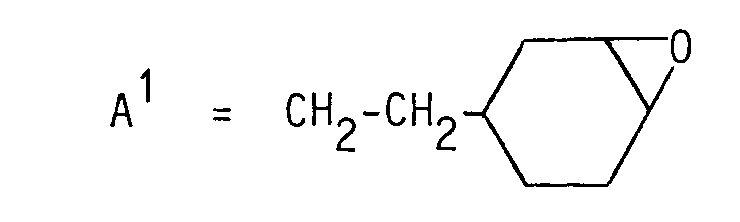
- A2 = (CH2)3-O(C2H4O)8-H
- n = 0,5
- m = 0,5
- Verbindung 2


- A4 = -O(C2H4O)2H
- m = 0,7
- n = 0,3
- Verbindung 3


- A6 = -O(C2H4O)10-C4H8-O(C2H4O)10-H
- m = 0,7
- n = 0,3
- Verbindung 4

- m = 0,75
- n = 0,25
- Verbindung 5

- m = 0,8
- n = 0,2
- Verbindung 6

- m = 0,8
- n = 0,2
- In der letzten europäischen Patentanmeldung EP-A-0 391 162 A2 wird eine photopolymerisierbare Zubereitung zum Beschichten beansprucht, die als Komponente (A) ein epoxyfunktionelles Diorganopolysiloxan der allgemeinen Formel

- R eine Alkylgruppe mit 1 bis 8 C-Atomen,
- R' = R oder ein einwertiger, epoxyfunktioneller organischer Rest mit 2 bis 20 C-Atomen ist, mit der Maßgabe, daß wenigstens 2 Reste R' einwertige, epoxyfunktionelle organische Reste sind und
- x einen Wert von 0 bis 20 hat.
- Im Gegensatz zu den Verbindungen der europäischen Patentanmeldung EP-A-0 391 162 A2 enthalten die erfindungsgemäß zu verwendenden Epoxygruppen zusätzlich mindestens eine an ein Si-Atom des Polysiloxans gebundene Gruppe der allgemeinen Formel

- Diese Gruppe beeinflußt unmittelbar die Verträglichkeit des Epoxysiloxans mit Photoinitiatoren, verbessert die Haftung der ausgehärteten Siloxane auf dem Untergrund und deren Abhäsivität.
- Die erfindungsgemäß zu verwendenden Organopolysiloxane können insbesondere als Überzüge benutzt werden, die gegenüber Haftklebern von Etiketten, dekorativen Laminaten, Transferpapieren und Transferbändern Trennwirkung entfalten. Sie können außerdem zur Herstellung von nicht klebenden Verpackungsmaterialien für Nahrungsmittel und als industrielle Verpackungsmittel eingesetzt werden. Dabei dienen als Trägerbahnen für die abhäsiven Beschichtungen insbesondere Papierbahnen oder Folien aus Polyethylen, Polypropylen oder Polyestern.
- Die erfindungsgemäß zu verwendenden Organopolysiloxane können mit Vorteil zur Herstellung von Druckfarben und dekorativen Überzügen eingesetzt werden.
- Ein weiterer bevorzugter Verwendungszweck der erfindungsgemäß zu verwendenden Organopolysiloxane besteht darin, daß man sie allein oder in Mischung mit anderen härtbaren Verbindungen als Vergußmassen einsetzt. Diese Vergußmassen werden insbesondere für elektrische oder elektronische Bauteile, wie bestückte Platinen, Schaltelemente, Stecker und dgl. verwendet, welche dem Einfluß von aggressiven Medien, Feuchtigkeit und dgl. ausgesetzt sind.
- Man kann die erfindungsgemäß zu verwendenden Verbindungen oder deren Abmischungen auch zum Beschichten von Glasfasern verwenden, die insbesondere zur Herstellung von Lichtwellenleitern bestimmt sind. Durch die Beschichtung werden die Glasfasern vor Beschädigungen und schädigenden äußeren Einflüssen bewahrt, und gleichzeitig wird die Reflexion der Glasfasern durch das Beschichtungsmittel beeinflußt.
- Die erfindungsgemäß zu verwendenden, härtbare Epoxygruppen aufweisenden, modifizierten Organopolysiloxane können für sich allein nach Zusatz von üblichen Photoinitiatoren, die in einer Menge von 0,01 bis 7 Gew.-%, bezogen auf Organopolysiloxan, zugesetzt werden, als härtbare Beschichtungsmittel eingesetzt werden. Dabei können diese Zubereitungen gegebenenfalls zum Zweck des besseren Auftragens Lösungsmittel enthalten. Bevorzugt sind jedoch lösungsmittelfreie Zubereitungen. Man kann die erfindungsgemäß zu verwendenden Organopolysiloxane jedoch auch üblichen, Epoxygruppen enthaltenden Organopolysiloxanen des Standes der Technik zusetzen, um deren Eigenschaften bei der gemeinsamen Aushärtung zu beeinflussen und zu modifizieren.
- In den folgenden Beispielen wird zunächst die Herstellung der erfindungsgemäß zu verwendenden, härtbare Epoxygruppen aufweisenden, modifizierten Organopolysiloxane beschrieben, und in den nachfolgenden anwendungstechnischen Vergleichsversuchen werden die Eigenschaften der erfindungsgemäß zu verwendenden Organopolysiloxane mit solchen des Standes der Technik verglichen.
- Zu einer Mischung von 496 g (4,0 Mol) Vinylcyclohexenoxid, 1071 g (2,6 Mol) Allylpolyether und 16 mg H2PtC16 . 6 H20 werden bei 120° C 1942 g (1 Mol) eines Si-H-Gruppen enthaltenden Polydimethylsiloxans zugetropft. Nach Beendigung des Zutropfens wird noch 8 h bei 130°C gerührt. Nach Filtration und Abziehen der flüchtigen Reaktionsprodukte bei 120°C/0,1 mbar werden 3164 g (94 % der Theorie) eines mittelviskosen Öls erhalten, dem laut 'H-NMR-Spektrum die allgemeine Formel

- n = 0,6
- m = 0,4
- Analog zu Beispiel 1 wird aus 376 g (3,3 Mol) Allylglycidether, 1359 g (3,3 Mol) Allylpolyether und 2330 g (1,2 Mol) Si-H-Gruppen enthaltenden Polydimethylsiloxans ein Polydimethylsiloxan der allgemeinen Formel

- A5 wie in Verbindung 3 definiert
- A2 wie in Verbindung 1 definiert
- n = 0,5
- m = 0,5
- erhalten.
- Analog zu Beispiel 1 wird aus 50 g (0,4 Mol) Vinylcyclohexenoxid, 107 g (0,26 Mol) Allylpolyether und 1159 g (0,1 Mol) eines Si-H-Gruppen enthaltenden Polydimethylsiloxans ein Polydimethylsiloxan der durchschnittlichen Formel

- A1, A2 wie in Verbindung 1 definiert
- n = 0,6
- m = 0,4
- erhalten.
- Analog zu Beispiel 1 wird aus 136 g (1,1 Mol) Vinylcyclohexenoxid, 453 g (1,1 Mol) Allylpolyether und 2980 g (1 Mol) eines Si-H-Gruppen enthaltenden Organopolysiloxans ein Organopolysiloxan der mittleren Formel

- A1, A2 wie in Verbindung 1 definiert
- n = 0,5
- m = 0,5
- Zu einer Menge von 950 g (0,1 Mol) eines Si-H-Gruppen enthaltenden Polydimethylsiloxans werden 16 mg H2PtC16 . 6 H20 bei 120°C zugegeben und 32 g (0,45 Mol) Butadienmonoepoxid zugetropft. Nach 5 h bei 120°C werden 2 g CsF zugegeben und 150 g (1,05 Mol) Diethylenglycol zugetropft und 15 h bei dieser Temperatur gerührt, bis keine H2-Entwicklung mehr festzustellen ist. Danach wird filtriert und flüchtige Bestandteile bei 120°C/0,1 mbar entfernt. Ausbeute 1020 g.
- 1H-NMR-spektroskopisch hat das mittelviskose Öl die durchschnittliche Formel

- A3, A4 wie in Verbindung 2 definiert
- m = 0,7
- n = 0,3
- Analog zu Beispiel 5 wird aus 120 g (1,05 Mol) Allylglycidether, 437 g (0,45 Mol) eines Polyethers und 1134 g (0,1 Mol) eines Si-H-Gruppen enthaltenden Organopolysiloxans ein Organopolysiloxan der durchschnittlichen Formel

- A5, A6 wie in Verbindung 3 definiert,
- m = 0,7
- n = 0,3
- erhalten.
- Analog zu Beispiel 1 wird aus 41 g (0,33 Mol) Vinylcyclohexenoxid, 46,3 g (0,11 Mol) Allylpolyether und 219 g (0,1 Mol) eines Si-H-Gruppen enthaltenden Polydimethylsiloxans ein Polydimethylsiloxan der mittleren Formel

- A1, A2 wie in Verbindung 1 definiert
- m = 0,75
- n = 0,25
- Analog zu Beispiel 1 wird aus 130 g (1,0 Mol) Vinylcyclohexenoxid, 110 g (0,3 Mol) Allylpolyether und 2465 g (0,1 Mol) eines Si-H-Gruppen enthaltenden Organopolysiloxans ein Organopolysiloxan der durchschnittlichen Formel

- A1, A2 wie in Verbindung 1 definiert,
- m = 0,8
- n = 0,2
- Analog zu Beispiel 5 wird aus 70 g (1 Mol) Butadienmonoepoxid, 34 g Diethylenglycol und 813 g eines Si-H-Gruppen enthaltenden Polydimethylsiloxans ein Organopolysiloxan der allgemeinen Formel
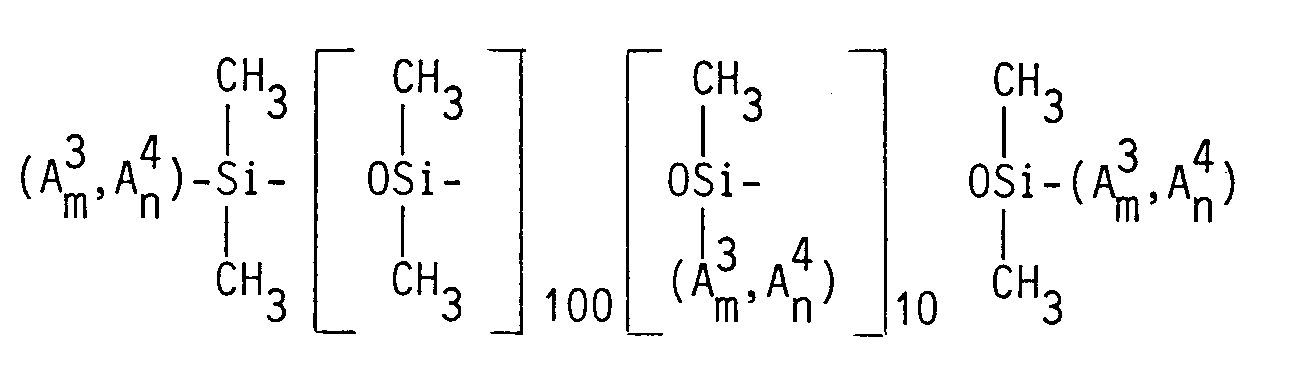
- A3, A4 wie in Verbindung 2 definiert,
- m = 0,8
- n = 0,2
- Analog zu Beispiel 1 werden aus Vinylcyclohexenoxid und Si-H-Gruppen enthaltenden Polydimethylsiloxanen Organopolysiloxane folgender durchschnittlicher Formeln hergestellt.


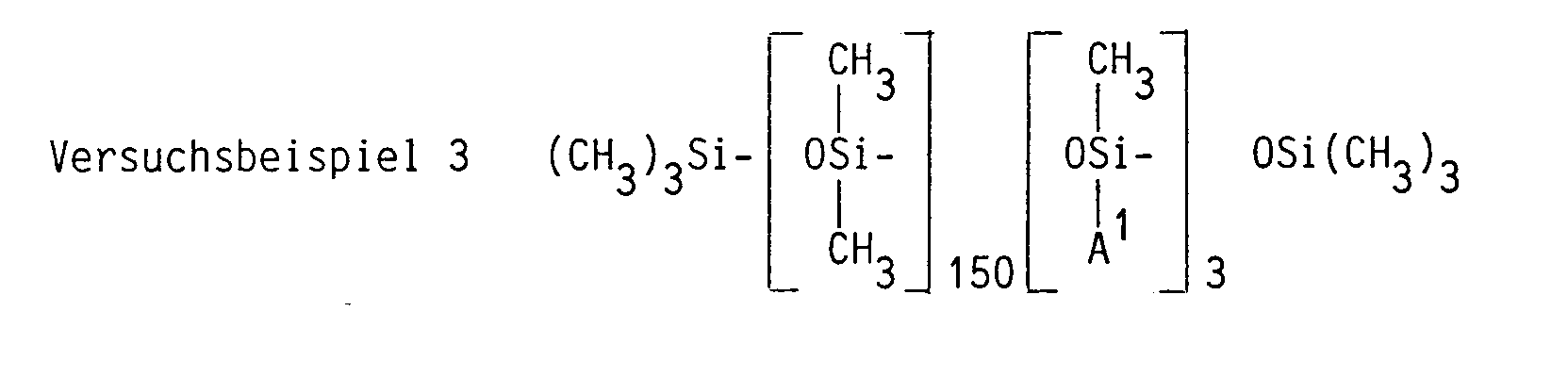
- Zur Überprüfung der anwendungstechnischen Eigenschaften der erfindungsgemäß modifizierten Polysiloxane werden die Verbindungen 1 bis 9 mit 1 Gew.-% Bis(dodecylphenyl)iodoniumhexafluoroantimonat versetzt, auf eine orientierte Polypropylenfolie aufgetragen und mit einer Fusion UV-Lampe (120 W/cm) gehärtet. Die Auftragsmenge beträgt in jedem Falle ca. 1,1 g/cm2. Für die Vergleichsbeispiele werden verschiedene, 80 mm breite Klebebänder verwendet, und zwar mit Acrylatklebern beschichtete Klebebänder, die im Handel unter der Bezeichnung Tesa@154 und Tesa@970 erhältlich sind, sowie ein mit Kautschukkleber beschichtetes Klebeband, welches im Handel unter der Bezeichnung Tesa@969 erhältlich ist.
- Zur Messung der Abhäsivität werden diese Klebebänder auf den Untergrund aufgewalzt und anschließend im Falle der Acrylatklebebänder bei 70°C und im Falle des Kautschukklebebandes bei 40 C gelagert. Nach 24 Stunden wird die Kraft gemessen, die benötigt wird, um das jeweilige Klebeband unter einem Schälwinkel von 180° vom Untergrund abzuziehen. Diese Kraft wird als Trennkraft bezeichnet. Außerdem erfolgt eine Prüfung der Adhäsion der modifizierten Polysiloxane auf dem Substrat durch kräftiges Reiben mit dem Daumen. Bei mangelnder Haftung bilden sich gummiartige Krümel (sogenannter "Rub off" Test).
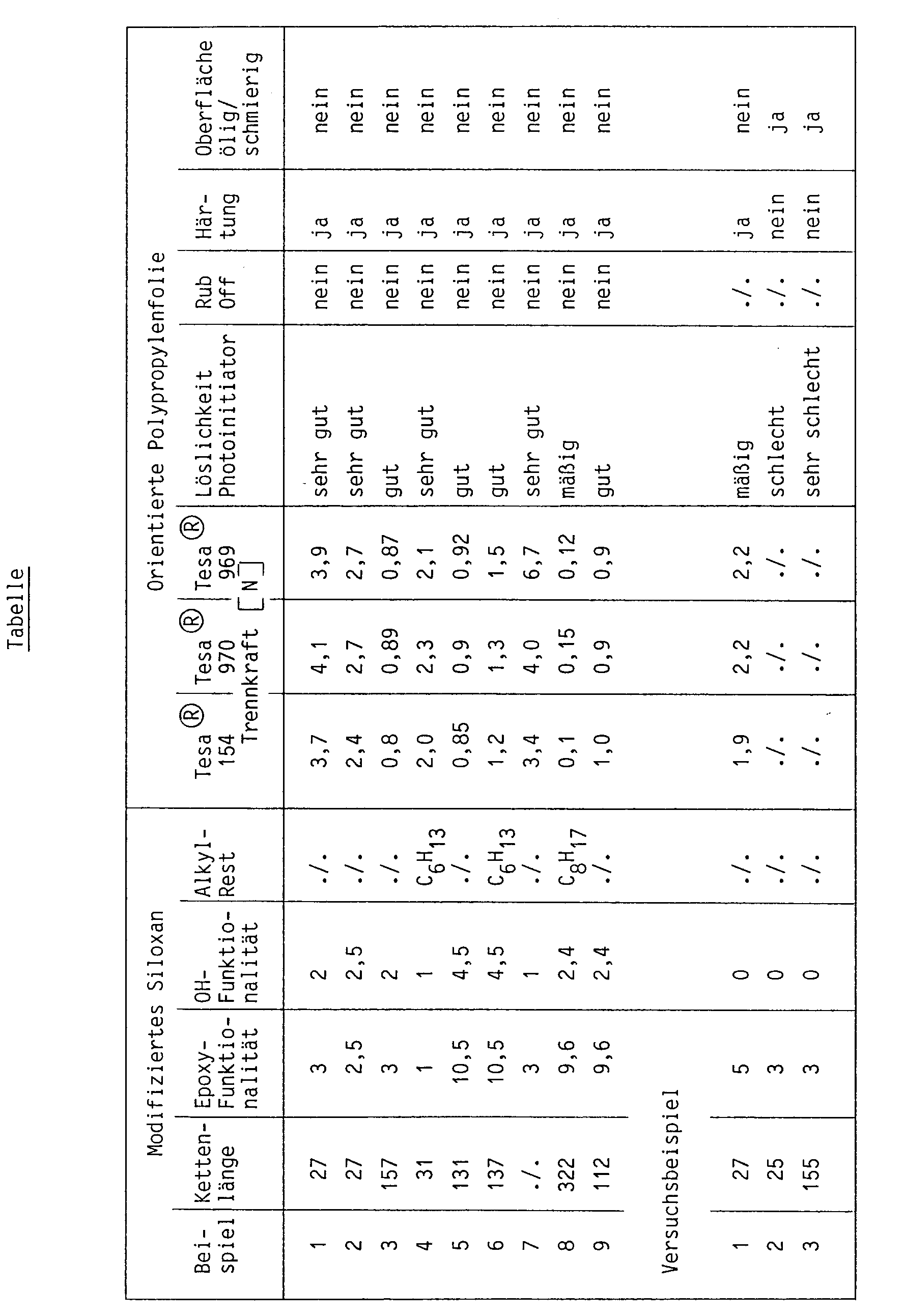
- Aus der Tabelle ergibt sich, daß die erfindungsgemäß modifizierten Organopolysiloxane die gewünschten anwendungstechnischen Eigenschaften aufweisen. Sie zeigen eine gute Haftung auf dem Träger, lassen sich schnell aushärten, zeigen gute abhäsive Eigenschaften gegenüber chemisch verschiedenartig aufgebauten Klebern, lassen sich im Gegensatz zum Stand der Technik durch eine geeignete Wahl der Substituenten bei gleichem Siloxangerüst auf den chemischen Charakter des Klebstoffes einstellen und zeigen eine gute Verträglichkeit gegenüber Photoinitiatoren. Besonders auffallend ist, daß die erfindungsgemäß modifizierten Organopolysiloxane, bedingt durch den Synergismus von Epoxy-Rest und R3-OH-Rest, bei einer geringeren Epoxy-Funktionalität noch anstandslos härten.
dabei muß die Bedingung erfüllt sein, daß der einwertige Epoxy enthaltende Kohlenwasserstoffrest E mindestens eine polymerisierbare Epoxygruppe der Formel


alleine oder in Mischung mit härtbaren Verbindungen, welche Epoxygruppen aufweisen, insbesondere Epoxygruppen enthaltenden Organopolysiloxanen, welche jedoch frei von der vorgenannten Gruppe sind, als härtbare Beschichtungsmittel mit abhäsiven Eigenschaften.
Claims (3)

alleine oder in Mischung mit härtbaren Verbindungen, welche Epoxygruppen aufweisen, insbesondere Epoxygruppen enthaltenden Organopolysiloxanen, welche jedoch frei von der vorgenannten Gruppe sind, als härtbare Beschichtungsmittel mit abhäsiven Eigenschaften.


mit der Maßgabe, daß im durchschnittlichen Organopolysiloxanmolekül jeweils mindestens ein Rest R2 die Bedeutung b) und die Bedeutung c) hat.
Applications Claiming Priority (2)
| Application Number | Priority Date | Filing Date | Title |
|---|---|---|---|
| DE4023247 | 1990-07-21 | ||
| DE4023247A DE4023247C1 (de) | 1990-07-21 | 1990-07-21 |
Publications (2)
| Publication Number | Publication Date |
|---|---|
| EP0468270A1 true EP0468270A1 (de) | 1992-01-29 |
| EP0468270B1 EP0468270B1 (de) | 1994-02-23 |
Family
ID=6410765
Family Applications (1)
| Application Number | Title | Priority Date | Filing Date |
|---|---|---|---|
| EP91111380A Expired - Lifetime EP0468270B1 (de) | 1990-07-21 | 1991-07-09 | Verwendung von mit Oxyalkylenethergruppen modifizierten Epoxypolysiloxanen als härtbare Beschichtungsmittel |
Country Status (3)
| Country | Link |
|---|---|
| US (1) | US5204433A (de) |
| EP (1) | EP0468270B1 (de) |
| DE (2) | DE4023247C1 (de) |
Cited By (2)
| Publication number | Priority date | Publication date | Assignee | Title |
|---|---|---|---|---|
| WO2004009675A1 (de) * | 2002-07-18 | 2004-01-29 | Siemens Aktiengesellschaft | Hydrophile polyorganosiloxane |
| EP1403349A1 (de) * | 2002-04-16 | 2004-03-31 | Goldschmidt AG | Verwendung von mit Oxyalkylenethergruppen modifizierten Epoxypolysiloxanen als Additive für strahlenhärtende Beschichtungen |
Families Citing this family (12)
| Publication number | Priority date | Publication date | Assignee | Title |
|---|---|---|---|---|
| US5411996A (en) * | 1992-06-25 | 1995-05-02 | General Electric Company | One-part UV-curable epoxy silicone compositions containing a fluorinated alcohol |
| US5891930A (en) * | 1995-08-17 | 1999-04-06 | Dsm N.V. | High temperature coating composition for glass optical fibers, a method of making a coating composition and a coated optical glass fiber |
| AU7508496A (en) * | 1996-11-14 | 1998-06-03 | Dsm N.V. | A high temperature coating composition for glass optical fibers |
| DE10232695A1 (de) * | 2002-07-18 | 2004-02-05 | Siemens Ag | Immobilisierungsschicht für Biosensoren |
| DE102005043742A1 (de) * | 2005-09-14 | 2007-03-22 | Goldschmidt Gmbh | Verwendung von Epoxy-funktionellen Silanen als Haftungsadditiv für kationisch strahlenhärtende Silikontrennbeschichtungen |
| DE102005057857A1 (de) * | 2005-12-03 | 2010-02-25 | Evonik Goldschmidt Gmbh | Polyethermodifizierte Polysiloxane mit Blockcharakter und deren Verwendung zur Herstellung von kosmetischen Formulierungen |
| US7833541B2 (en) * | 2006-05-01 | 2010-11-16 | Momentive Performance Materials Inc. | Cosmetic compositions utilizing acrylate cross linked silicone copolymer networks |
| US7687574B2 (en) * | 2006-05-01 | 2010-03-30 | Momentive Performance Materials Inc. | Acrylate cross linked silicone copolymer networks |
| DE102007023762A1 (de) * | 2006-08-10 | 2008-02-14 | Evonik Degussa Gmbh | Anlage und Verfahren zur kontinuierlichen industriellen Herstellung von 3-Glycidyloxypropylalkoxysilanen |
| DE102007023763A1 (de) * | 2006-08-10 | 2008-02-14 | Evonik Degussa Gmbh | Anlage, Reaktor und Verfahren zur kontinuierlichen industriellen Herstellung von Polyetheralkylalkoxysilanen |
| US8604150B2 (en) * | 2007-11-07 | 2013-12-10 | Showa Denko K.K. | Epoxy group-containing organosiloxane compound, curable composition for transfer materials and method for forming micropattern using the composition |
| CN113105864A (zh) * | 2021-03-01 | 2021-07-13 | 华南理工大学 | 一种环氧改性有机硅凝胶及其制备方法与应用 |
Citations (2)
| Publication number | Priority date | Publication date | Assignee | Title |
|---|---|---|---|---|
| US4313988A (en) * | 1980-02-25 | 1982-02-02 | Minnesota Mining And Manufacturing Company | Epoxypolysiloxane release coatings for adhesive materials |
| EP0046796B1 (de) * | 1980-02-25 | 1984-08-01 | Minnesota Mining And Manufacturing Company | Epoxypolysiloxan-trennschichten für klebemittel |
Family Cites Families (8)
| Publication number | Priority date | Publication date | Assignee | Title |
|---|---|---|---|---|
| AU497960B2 (en) * | 1974-04-11 | 1979-01-25 | Minnesota Mining And Manufacturing Company | Photopolymerizable compositions |
| US4184004A (en) * | 1978-04-21 | 1980-01-15 | Union Carbide Corporation | Treatment of textile fabrics with epoxy-polyoxyalkylene modified organosilicones |
| US4310469A (en) * | 1978-12-29 | 1982-01-12 | General Electric Company | Diaryliodonium salts |
| US4490416A (en) * | 1984-05-15 | 1984-12-25 | Dow Corning Limited | Organosiloxane-oxyalkylene copolymers |
| US4977198A (en) * | 1988-03-21 | 1990-12-11 | General Electric Company | UV curable epoxy functional silicones |
| US4940626A (en) * | 1988-05-26 | 1990-07-10 | The James River Corporation | Meltblown wiper incorporating a silicone surfactant |
| FI900741A7 (fi) * | 1989-04-03 | 1990-10-04 | Gen Electric | Ultraviolettisäteilyllä kovetettava epoksisilikoni-/polyolisysteemi |
| US4987158A (en) * | 1990-03-23 | 1991-01-22 | General Electric Company | UV-curable pre-crosslinked epoxy functional silicones |
-
1990
- 1990-07-21 DE DE4023247A patent/DE4023247C1/de not_active Expired - Lifetime
-
1991
- 1991-07-09 EP EP91111380A patent/EP0468270B1/de not_active Expired - Lifetime
- 1991-07-09 DE DE91111380T patent/DE59101043D1/de not_active Expired - Fee Related
- 1991-07-15 US US07/730,279 patent/US5204433A/en not_active Expired - Lifetime
Patent Citations (2)
| Publication number | Priority date | Publication date | Assignee | Title |
|---|---|---|---|---|
| US4313988A (en) * | 1980-02-25 | 1982-02-02 | Minnesota Mining And Manufacturing Company | Epoxypolysiloxane release coatings for adhesive materials |
| EP0046796B1 (de) * | 1980-02-25 | 1984-08-01 | Minnesota Mining And Manufacturing Company | Epoxypolysiloxan-trennschichten für klebemittel |
Cited By (2)
| Publication number | Priority date | Publication date | Assignee | Title |
|---|---|---|---|---|
| EP1403349A1 (de) * | 2002-04-16 | 2004-03-31 | Goldschmidt AG | Verwendung von mit Oxyalkylenethergruppen modifizierten Epoxypolysiloxanen als Additive für strahlenhärtende Beschichtungen |
| WO2004009675A1 (de) * | 2002-07-18 | 2004-01-29 | Siemens Aktiengesellschaft | Hydrophile polyorganosiloxane |
Also Published As
| Publication number | Publication date |
|---|---|
| EP0468270B1 (de) | 1994-02-23 |
| US5204433A (en) | 1993-04-20 |
| DE59101043D1 (de) | 1994-03-31 |
| DE4023247C1 (de) | 1991-11-21 |
Similar Documents
| Publication | Publication Date | Title |
|---|---|---|
| EP0468305B1 (de) | Härtbare Epoxygruppen aufweisende Organopolysiloxane, Verfahren zu ihrer Herstellung und ihre Verwendung als härtbare Beschichtungsmittel mit abhäsiven Eigenschaften | |
| EP0449050B1 (de) | Härtbare Organopolysiloxane mit über SiC-Gruppen gebundenen Oxyalkylenethergruppen, ihre Herstellung und Verwendung | |
| EP0336141B1 (de) | Verfahren zum Beschichten von flächigen Trägern durch Aufbringen von mit (Meth)acrylsäureestergruppen modifizierten härtbaren Organopolysiloxanen | |
| EP1897917B1 (de) | Verwendung von partikulären Emulgatoren in abhäsiven siloxanhaltigen Beschichtungsmassen | |
| EP0979851B1 (de) | Strahlenhärtbare Beschichtungsmassen | |
| EP0168713B1 (de) | (Meth)acrylsäureestermodifizierte Organopolysiloxangemische, deren Herstellung und Verwendung als abhäsive Beschichtungsmassen | |
| EP0281681B1 (de) | Polysiloxane mit über SiC-Gruppen gebundenen (Meth)acrylsäureestergruppen und deren Verwendung als strahlenhärtbare Beschichtungsmittel für flächige Träger | |
| DE2948708C2 (de) | Verfahren zur Herstellung von mit Pentaerythrittriacrylsäure- oder Pentaerythrittrimethacrylsäureestern modifizierten Organopolysiloxanen | |
| DE2622126C3 (de) | Verwendung einer durch Bestrahlung hartbaren Beschichtungsmasse auf Polydiorganosiloxanbasis zur Herstellung von Trennüberzügen auf Trägermaterialien | |
| DE68909968T2 (de) | Zusammensetzung für Trennbeschichtungen auf der Basis von Polysiloxanen. | |
| EP0468270B1 (de) | Verwendung von mit Oxyalkylenethergruppen modifizierten Epoxypolysiloxanen als härtbare Beschichtungsmittel | |
| DE69107938T2 (de) | Funktionnelle Epoxygruppen-enthaltende Polysiloxanharze und Additive mit kontrolierter Haftverminderung. | |
| DE3841843C1 (de) | ||
| DE69421779T2 (de) | Siloxanzusammenzetzungen zur Herstellung von adhäsiven Beschichtungen | |
| DE19649844C1 (de) | Mit Acrylatgruppen modifizierte Organosiloxanylderivate von Alkandiolmonovinylethern, Verfahren zu deren Herstellung und deren Verwendung als strahlenhärtbare Bindemittel | |
| EP1764394A1 (de) | Verwendung von Epoxy-funktionellen Silanen als Haftungsadditiv für kationisch strahlenhärtende Silicontrennbeschichtungen | |
| EP0940422A1 (de) | (Meth)Acrylatester von Organosiloxanpolyolen, Verfahren zu deren Herstellung und deren Verwendung als strahlenhärtbare Beschichtungsmassen | |
| DE4331608A1 (de) | Mit Acrylatgruppen modifizierte Organopolysiloxane | |
| DE2700990A1 (de) | Organopolysiloxangemisch und seine verwendung | |
| DE68920302T2 (de) | Lösemittelfreie Silikonzusammensetzungen für Trennpapier. | |
| DE3032626A1 (de) | Photovernetzbare organopolysiloxanmassen | |
| DE69123529T2 (de) | Durch UV-Licht härtbare Organopolysiloxanmasse | |
| DE69730800T2 (de) | Oxaalkylcarbonsäure-modifizierte Epoxysiliconzusammensetzungen | |
| EP1403349B1 (de) | Verwendung von mit Oxyalkylenethergruppen modifizierten Epoxypolysiloxanen als Additive für strahlenhärtende Beschichtungen | |
| DE3533350A1 (de) | Organopolysiloxane und diese enthaltende aushaertbare organopolysiloxanzubereitung |
Legal Events
| Date | Code | Title | Description |
|---|---|---|---|
| PUAI | Public reference made under article 153(3) epc to a published international application that has entered the european phase |
Free format text: ORIGINAL CODE: 0009012 |
|
| 17P | Request for examination filed |
Effective date: 19910716 |
|
| AK | Designated contracting states |
Kind code of ref document: A1 Designated state(s): DE FR GB IT |
|
| 17Q | First examination report despatched |
Effective date: 19930727 |
|
| ITF | It: translation for a ep patent filed | ||
| GRAA | (expected) grant |
Free format text: ORIGINAL CODE: 0009210 |
|
| AK | Designated contracting states |
Kind code of ref document: B1 Designated state(s): DE FR GB IT |
|
| GBT | Gb: translation of ep patent filed (gb section 77(6)(a)/1977) |
Effective date: 19940302 |
|
| REF | Corresponds to: |
Ref document number: 59101043 Country of ref document: DE Date of ref document: 19940331 |
|
| ET | Fr: translation filed | ||
| PLBE | No opposition filed within time limit |
Free format text: ORIGINAL CODE: 0009261 |
|
| STAA | Information on the status of an ep patent application or granted ep patent |
Free format text: STATUS: NO OPPOSITION FILED WITHIN TIME LIMIT |
|
| 26N | No opposition filed | ||
| REG | Reference to a national code |
Ref country code: FR Ref legal event code: CD |
|
| REG | Reference to a national code |
Ref country code: GB Ref legal event code: IF02 |
|
| REG | Reference to a national code |
Ref country code: FR Ref legal event code: CJ Ref country code: FR Ref legal event code: CD |
|
| PGFP | Annual fee paid to national office [announced via postgrant information from national office to epo] |
Ref country code: FR Payment date: 20090716 Year of fee payment: 19 |
|
| PGFP | Annual fee paid to national office [announced via postgrant information from national office to epo] |
Ref country code: GB Payment date: 20090720 Year of fee payment: 19 Ref country code: DE Payment date: 20090722 Year of fee payment: 19 |
|
| REG | Reference to a national code |
Ref country code: FR Ref legal event code: CD |
|
| PGFP | Annual fee paid to national office [announced via postgrant information from national office to epo] |
Ref country code: IT Payment date: 20090723 Year of fee payment: 19 |
|
| GBPC | Gb: european patent ceased through non-payment of renewal fee |
Effective date: 20100709 |
|
| REG | Reference to a national code |
Ref country code: FR Ref legal event code: ST Effective date: 20110331 |
|
| PG25 | Lapsed in a contracting state [announced via postgrant information from national office to epo] |
Ref country code: DE Free format text: LAPSE BECAUSE OF NON-PAYMENT OF DUE FEES Effective date: 20110201 |
|
| REG | Reference to a national code |
Ref country code: DE Ref legal event code: R119 Ref document number: 59101043 Country of ref document: DE Effective date: 20110201 |
|
| PG25 | Lapsed in a contracting state [announced via postgrant information from national office to epo] |
Ref country code: IT Free format text: LAPSE BECAUSE OF NON-PAYMENT OF DUE FEES Effective date: 20100709 Ref country code: FR Free format text: LAPSE BECAUSE OF NON-PAYMENT OF DUE FEES Effective date: 20100802 |
|
| PG25 | Lapsed in a contracting state [announced via postgrant information from national office to epo] |
Ref country code: GB Free format text: LAPSE BECAUSE OF NON-PAYMENT OF DUE FEES Effective date: 20100709 |