EP0468351B1 - Orthopädische Therapie-Schuhe und -Innenschuhe - Google Patents
Orthopädische Therapie-Schuhe und -Innenschuhe Download PDFInfo
- Publication number
- EP0468351B1 EP0468351B1 EP91111916A EP91111916A EP0468351B1 EP 0468351 B1 EP0468351 B1 EP 0468351B1 EP 91111916 A EP91111916 A EP 91111916A EP 91111916 A EP91111916 A EP 91111916A EP 0468351 B1 EP0468351 B1 EP 0468351B1
- Authority
- EP
- European Patent Office
- Prior art keywords
- cap
- leg
- shoe
- plastics
- paralysis
- Prior art date
- Legal status (The legal status is an assumption and is not a legal conclusion. Google has not performed a legal analysis and makes no representation as to the accuracy of the status listed.)
- Expired - Lifetime
Links
- 239000004033 plastic Substances 0.000 claims abstract description 43
- 229920003023 plastic Polymers 0.000 claims abstract description 43
- 208000037873 arthrodesis Diseases 0.000 claims abstract description 21
- 239000000463 material Substances 0.000 claims abstract description 16
- 210000001361 achilles tendon Anatomy 0.000 claims abstract description 5
- 229920001169 thermoplastic Polymers 0.000 claims abstract description 5
- 239000004416 thermosoftening plastic Substances 0.000 claims abstract description 5
- 238000005520 cutting process Methods 0.000 claims abstract description 4
- 206010033799 Paralysis Diseases 0.000 claims description 22
- 210000003423 ankle Anatomy 0.000 claims description 22
- 229920002994 synthetic fiber Polymers 0.000 claims 1
- 238000009826 distribution Methods 0.000 abstract description 4
- 238000001746 injection moulding Methods 0.000 abstract description 4
- 230000007794 irritation Effects 0.000 abstract description 2
- 210000002683 foot Anatomy 0.000 description 22
- 238000004519 manufacturing process Methods 0.000 description 11
- 230000000399 orthopedic effect Effects 0.000 description 10
- 238000002560 therapeutic procedure Methods 0.000 description 8
- 239000010985 leather Substances 0.000 description 5
- 238000000034 method Methods 0.000 description 4
- 238000009417 prefabrication Methods 0.000 description 4
- 230000005021 gait Effects 0.000 description 3
- 238000010438 heat treatment Methods 0.000 description 3
- 239000002991 molded plastic Substances 0.000 description 3
- 239000011505 plaster Substances 0.000 description 3
- 239000012815 thermoplastic material Substances 0.000 description 3
- 230000006978 adaptation Effects 0.000 description 2
- 239000000853 adhesive Substances 0.000 description 2
- 230000001070 adhesive effect Effects 0.000 description 2
- 238000013461 design Methods 0.000 description 2
- 238000011161 development Methods 0.000 description 2
- 239000000428 dust Substances 0.000 description 2
- 230000000694 effects Effects 0.000 description 2
- 238000003825 pressing Methods 0.000 description 2
- 230000001148 spastic effect Effects 0.000 description 2
- 239000007858 starting material Substances 0.000 description 2
- 230000007704 transition Effects 0.000 description 2
- 238000009966 trimming Methods 0.000 description 2
- 206010017577 Gait disturbance Diseases 0.000 description 1
- 239000004743 Polypropylene Substances 0.000 description 1
- 206010052428 Wound Diseases 0.000 description 1
- 208000027418 Wounds and injury Diseases 0.000 description 1
- 238000005299 abrasion Methods 0.000 description 1
- 238000005266 casting Methods 0.000 description 1
- POIUWJQBRNEFGX-XAMSXPGMSA-N cathelicidin Chemical compound C([C@@H](C(=O)N[C@@H](CCCNC(N)=N)C(=O)N[C@@H](CCCCN)C(=O)N[C@@H](CO)C(=O)N[C@@H](CCCCN)C(=O)N[C@@H](CCC(O)=O)C(=O)N[C@@H](CCCCN)C(=O)N[C@@H]([C@@H](C)CC)C(=O)NCC(=O)N[C@@H](CCCCN)C(=O)N[C@@H](CCC(O)=O)C(=O)N[C@@H](CC=1C=CC=CC=1)C(=O)N[C@@H](CCCCN)C(=O)N[C@@H](CCCNC(N)=N)C(=O)N[C@@H]([C@@H](C)CC)C(=O)N[C@@H](C(C)C)C(=O)N[C@@H](CCC(N)=O)C(=O)N[C@@H](CCCNC(N)=N)C(=O)N[C@@H]([C@@H](C)CC)C(=O)N[C@@H](CCCCN)C(=O)N[C@@H](CC(O)=O)C(=O)N[C@@H](CC=1C=CC=CC=1)C(=O)N[C@@H](CC(C)C)C(=O)N[C@@H](CCCNC(N)=N)C(=O)N[C@@H](CC(N)=O)C(=O)N[C@@H](CC(C)C)C(=O)N[C@@H](C(C)C)C(=O)N1[C@@H](CCC1)C(=O)N[C@@H](CCCNC(N)=N)C(=O)N[C@@H]([C@@H](C)O)C(=O)N[C@@H](CCC(O)=O)C(=O)N[C@@H](CO)C(O)=O)NC(=O)[C@H](CC=1C=CC=CC=1)NC(=O)[C@H](CC(O)=O)NC(=O)CNC(=O)[C@H](CC(C)C)NC(=O)[C@@H](N)CC(C)C)C1=CC=CC=C1 POIUWJQBRNEFGX-XAMSXPGMSA-N 0.000 description 1
- 238000001816 cooling Methods 0.000 description 1
- 238000012937 correction Methods 0.000 description 1
- 238000002347 injection Methods 0.000 description 1
- 239000007924 injection Substances 0.000 description 1
- 238000000465 moulding Methods 0.000 description 1
- -1 polypropylene Polymers 0.000 description 1
- 229920001155 polypropylene Polymers 0.000 description 1
- 238000012805 post-processing Methods 0.000 description 1
- 238000012545 processing Methods 0.000 description 1
- 238000004064 recycling Methods 0.000 description 1
- 239000012783 reinforcing fiber Substances 0.000 description 1
- 210000002345 respiratory system Anatomy 0.000 description 1
- 239000005060 rubber Substances 0.000 description 1
- 230000037390 scarring Effects 0.000 description 1
- 238000007493 shaping process Methods 0.000 description 1
- 238000004904 shortening Methods 0.000 description 1
- 230000001225 therapeutic effect Effects 0.000 description 1
- 239000002699 waste material Substances 0.000 description 1
Images



Classifications
-
- A—HUMAN NECESSITIES
- A61—MEDICAL OR VETERINARY SCIENCE; HYGIENE
- A61F—FILTERS IMPLANTABLE INTO BLOOD VESSELS; PROSTHESES; DEVICES PROVIDING PATENCY TO, OR PREVENTING COLLAPSING OF, TUBULAR STRUCTURES OF THE BODY, e.g. STENTS; ORTHOPAEDIC, NURSING OR CONTRACEPTIVE DEVICES; FOMENTATION; TREATMENT OR PROTECTION OF EYES OR EARS; BANDAGES, DRESSINGS OR ABSORBENT PADS; FIRST-AID KITS
- A61F5/00—Orthopaedic methods or devices for non-surgical treatment of bones or joints; Nursing devices ; Anti-rape devices
- A61F5/01—Orthopaedic devices, e.g. long-term immobilising or pressure directing devices for treating broken or deformed bones such as splints, casts or braces
- A61F5/0102—Orthopaedic devices, e.g. long-term immobilising or pressure directing devices for treating broken or deformed bones such as splints, casts or braces specially adapted for correcting deformities of the limbs or for supporting them; Ortheses, e.g. with articulations
- A61F5/0104—Orthopaedic devices, e.g. long-term immobilising or pressure directing devices for treating broken or deformed bones such as splints, casts or braces specially adapted for correcting deformities of the limbs or for supporting them; Ortheses, e.g. with articulations without articulation
- A61F5/0111—Orthopaedic devices, e.g. long-term immobilising or pressure directing devices for treating broken or deformed bones such as splints, casts or braces specially adapted for correcting deformities of the limbs or for supporting them; Ortheses, e.g. with articulations without articulation for the feet or ankles
-
- A—HUMAN NECESSITIES
- A43—FOOTWEAR
- A43B—CHARACTERISTIC FEATURES OF FOOTWEAR; PARTS OF FOOTWEAR
- A43B7/00—Footwear with health or hygienic arrangements
- A43B7/14—Footwear with health or hygienic arrangements with foot-supporting parts
- A43B7/18—Joint supports, e.g. instep supports
- A43B7/20—Ankle-joint supports or holders
Definitions
- the invention relates to orthopedic inner shoes according to the preamble of claim 1.
- DE-U 89 07 464 shows a device for supporting the ankles, consisting of an integral molded part made of polypropylene, which has two side parts, a footbed part, a back part and a front part that is open over the entire length. A heel cutout is provided in the back section. Further recesses are arranged in the area of the ankles.
- the two side parts are each provided with a stiffening rib, which begins laterally next to the ankle recess, is led upwards from there, describes an arc of approximately 180 degrees, then leads downwards again and ends on the outside on the other side of the ankle recess.
- Both side parts are provided with one or more slots through which fastener tapes, for example Velcro fastener tapes, are drawn.
- the known support device can be softened by heating and thus shaped according to the patient's foot. Since the actual shaping takes place in the deep-drawing process, a plastic plate of uniform thickness is used as the starting material, so that the finished support device also has a substantially uniform thickness everywhere. This initially results in a relatively high weight. However, it is much more unpleasant that pressure and abrasion points occur on the rigid edges of the support device. For this reason, it is proposed to also pad the inside of the fitting or to additionally wrap the patient's foot with a rubber tricot bandage. These support devices therefore have little acceptance among the patients.
- Another ankle orthosis is known from DE-U 90 04 108. This consists of a one-piece shell made of a waterproof plastic that is slit at the front and back over the full height. Two Velcro straps, which are riveted to the plastic shell and can be pulled through prepared slots, are used for fastening to the foot. Recesses can be provided in the area of the ankles. Due to the use of a plastic plate as the starting material for producing the shell shape, the finished orthosis has a uniform thickness essentially everywhere, so that the risk of pressure and chafing points must be prevented by padding.
- orthopedic inner shoes of the type described here which are designed to immobilize the ankle
- orthopedic inner shoes for spastic patients since, according to medical knowledge, relaxation of the child's spastic foot and even correction to the normal position is possible when the foot is fixed at right angles to the lower leg.
- the therapy shoes should not only keep the foot still, but also enable the patient to walk painlessly with a normal gait pattern.
- the uniform thickness of the plate material would increase from 4 to 6 mm, to which the thickness of the upper leather and lining is added, the finished therapy shoe is so thick that it can only be worn together with handcrafted special orthopedic shoes.
- such shoes are not particularly elegant and are therefore generally rejected by many, especially female, patients.
- the present invention has for its object to provide orthopedic inner shoes of the type mentioned, which combine an optimal fixation of the sick foot with a minimal manufacturing effort thanks to industrial prefabrication.
- the therapy shoe can also be worn as an inner shoe or cuff in fashionable ready-made shoes, thereby increasing patient acceptance is increased drastically.
- a further increase in acceptance is the fact that, thanks to the prefabrication, in particular the inner shoe upper and the lacing part, fashionable aspects can be taken into account without any problems.
- the patient can choose his preferred model in advance using a catalog.
- the plastic material in the area of the ankles and under the heel is kept very thin, it can also be shaped for extreme ankle shapes. At the doctor's instruction, the ankle area can also be cut out completely.
- the plastic material is advantageously transparent. As a result, sensitive areas, such as wounds, scarring, surgical sites, etc., can be precisely exposed through cutouts.
- the plastic caps have perforation holes. This improves air circulation without compromising strength. Thanks to the production of the caps in the Soritz casting process, these air holes can be attached without additional effort.
- Cut lines are preferably formed on the plastic cap, which enable the orthopedic shoemaker to produce a paralysis cap with leg clamp, a high paralysis cap, a medium-high paralysis cap, a low paralysis cap or even an ankle cap from the industrially prefabricated plastic cap. All he has to do is cut along the corresponding cutting line.
- a preferably high inner shoe upper can be provided for the completion of the orthopedic inner shoe, in which pockets are prefabricated which hold the molded plastic cap and the footbed with a precise fit, with a lacing part being placed on the completed, completed shaft , is preferably glued.
- fastening straps with a Velcro fastener can also be provided.
- Fig. 1 shows a plastic cap 0, which is integrally molded from a thermoplastic material together with a footbed 5.
- the Achilles tendon area 2 is recessed in order to reduce friction and pressure effects. So that the two cap parts do not slip and so that the predetermined Achilles tendon opening 2 remains true to shape, connecting webs 3 are formed.
- a heel area 4 is also left out. As a result, the patient's shoe size remains unchanged even when the therapy liner is worn.
- plastic cap 0 and footbed 5 Due to the production of plastic cap 0 and footbed 5 in the injection molding process, it is possible to optimally design the material distribution from the outset, i. H. stronger in the stressed areas, weaker in the unloaded and sensitive areas.
- An adaptation to the individual shape of the patient's foot or patient's last 14 can also be carried out by auxiliary personnel without problems by heating the thermoplastic material and pressing it on the leg lasts 14 or the plaster cast. Regrinding, re-sanding or trimming the plastic cap 0 is no longer necessary for arthrodesis caps, and is hardly necessary for ankle or paralysis caps.
- the plastic material is kept very thin. This means that it can also be shaped for extreme ankle shapes. At the doctor's instruction, one can cut out the ankle section 8 completely.
- cut lines are formed in the plastic cap 0 in order to convert the large plastic cap 1, which is intended for an arthrodesis shoe or inner shoe, into a paralysis cap 16 with a leg clip and footbed 5, and a high paralysis cap 17 with a footbed 5, to be able to produce a medium-high paralysis cap 18 with a foot bed 5, a low paralysis cap 19 with a foot bed 5 or also an ankle cap 20 with a foot bed 5.
- This method has the advantage that a separate injection mold does not have to be produced for each type of cap and for each foot size. The stock of orthopedic shoemakers is also limited.
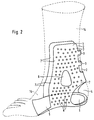
- FIG. 2 shows an arthrodesis cap 1 produced using the plastic cap 0 of FIG. 1. This is provided with a multiplicity of air holes 6.
- the air holes can be made thanks to the production of the cap 1 by injection molding without additional effort; they improve the air circulation and thus the wearing properties.
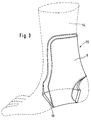
- FIG. 3 shows a partially prefabricated inner shoe upper 15 for producing an arthrodesis inner shoe using the arthrodesis cap 1 according to FIG. 2.
- the arthrodesis caps 1 can be manufactured in any shoe size with the same circumferential size also the shafts 15 are prefabricated with suitably fitting pockets 8 between the upper leather and the lining.
- the arthrodesis core 1 is inserted through the opening 10 into the pocket 9, possibly after its individual reshaping according to the plaster cast or strips 14.
- Arthrodesis cap 1 and footbed 5 are firmly seated in the prefabricated pockets 9. This makes it possible to dispense with the use of adhesive. This in turn enables recycling of the plastic from used therapy shoes.
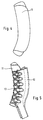
- Fig. 4 shows a simple arthrodesis tab 11, as it often has to be used for therapeutic reasons. It is also made of thermoplastic and is manufactured and shaped using the same processes as the plastic cap 0.
- FIG. 5 shows a prefabricated lacing part 12. Thanks to industrial prefabrication, fashionable aspects can be taken into account when designing the tongue 11 or the lacing 13, when selecting the leather, the leather color, etc. For example, a modeler can be commissioned to design the models because their costs can be passed on to the series. Thanks to the extensive prefabrication and thanks to the possibility of completely dispensing with the sanding of plastic, there is overall such a material and time saving that price savings, but also an accelerated delivery and thus often one Shortening the hospital stay can be achieved.
- Fig. 7 shows an inner shoe with a high paralysis cap 16 with leg clamp and footbed 5, inserted in an industrially prefabricated paralysis cap pocket 23.
- a fastening strap 22 with Velcro fastener 21 is used for fastening to the patient's leg 25, represented here by the leg strips 14.
- Manufacturing, processing and The paralysis inner shoe is used analogously to the arthrodesis inner shoe of FIG. 6.
Landscapes
- Health & Medical Sciences (AREA)
- Public Health (AREA)
- General Health & Medical Sciences (AREA)
- Animal Behavior & Ethology (AREA)
- Biomedical Technology (AREA)
- Heart & Thoracic Surgery (AREA)
- Vascular Medicine (AREA)
- Life Sciences & Earth Sciences (AREA)
- Engineering & Computer Science (AREA)
- Orthopedic Medicine & Surgery (AREA)
- Nursing (AREA)
- Veterinary Medicine (AREA)
- Epidemiology (AREA)
- Footwear And Its Accessory, Manufacturing Method And Apparatuses (AREA)
- Acyclic And Carbocyclic Compounds In Medicinal Compositions (AREA)
- Prostheses (AREA)
Description
- Die Erfindung betrifft orthopädische Innenschuhe gemäß dem Oberbegriff des Anspruchs 1.
- Die DE-U 89 07 464 zeigt eine Vorrichtung zum Stützen der Sprunggelenke, bestehend aus einem einstückig aus Polypropylen tiefgezogenem Paßformteil, das zwei Seitenteile, ein Fußbetteil, ein Rückenteil und ein über die ganze Länge offenes Vorderteil aufweist. Im Rückenteil ist eine Fersenaussparung vorgesehen. Weitere Aussparungen sind im Bereich der Knöchel angeordnet. Die beiden Seitenteile sind mit je einer Versteifungsrippe vorgesehen, die jeweils seitlich neben der Knöchelaussparung beginnt, von dort aus nach oben geführt wird, einen Bogen von annähernd 180 Grad beschreibt, dann wieder nach unten geführt ist und außenseitig auf der anderen Seite der Knöchelaussparung endet. Beide Seitenteile sind mit einem oder mehreren Schlitzen versehen, durch die Verschlußbänder, beispielsweise Klettverschlußbänder, gezogen werden.
- Dank ihrer Herstellung aus thermoplastischem Kunststoff kann die bekannte Stützvorrichtung durch Erwärmen erweicht und so entsprechend dem Patientenfuß nachgeformt werden. Da die eigentliche Formgebung im Tiefziehverfahren erfolgt, wird als Ausgangsmaterial eine Kunststoffplatte einheitlicher Stärke verwendet, so daß auch die fertige Stützvorrichtung eine im wesentlichen überall gleichmäßige Stärke besitzt. Daraus resultiert zunächst ein relativ hohes Gewicht. Wesentlich unangenehmer ist jedoch, daß es an den steifen Rändern der Stützvorrichtung zu Druck- und Scheuerstellen kommt. Aus diesem Grunde wird vorgeschlagen, das Paßformteil auch innenseitig auszupolstern oder den Fuß des Patienten zusätzlich mit einer Gummitrikotbandage zu umwickeln. Diese Stützvorrichtungen besitzen daher nur eine geringe Akzeptanz bei den Patienten.
- Eine weitere Sprunggelenkorthese ist bekannt aus der DE-U 90 04 108. Diese besteht aus einer einstückigen, vorn und hinten über die volle Höhe geschlitzten Schale aus einem wasserfesten Kunststoff. Zur Befestigung am Fuß dienen zwei Klettverschlußgurte, die an der Kunststoffschale angenietet sind und durch vorbereitete Schlitze hindurchgezogen werden können. Im Bereich der Knöchel können Aussparungen vorgesehen sein. Aufgrund der Verwendung einer Kunststoffplatte als Ausgangsmaterial zur Herstellung der Schalenform hat die fertige Orthese im wesentlichen überall eine gleichmäßige Dicke, so daß der Gefahr von Druck- und Scheuerstellen durch eine Polsterung vorgebeugt werden muß.
- Neben den orthopädischen Innenschuhen der hier beschriebenen Art, die dazu bestimmt sind, das Sprunggelenk ruhig zu stellen, gibt es auch orthopädische Innenschuhe für Spastiker, da nach medizinischer Erkenntnis eine Entspannung des kindlichen Spastikerfußes und sogar eine Korrektur bis zur Normalstellung möglich ist, wenn der Fuß im rechten Winkel zum Unterschenkel fixiert wird. Die Therapie-Schuhe sollen jedoch nicht nur den Fuß ruhigstellen, sondern den Patienten auch das schmerzfreie Gehen mit einem normalen Gangbild ermöglichen.
- Bei Lähmungen wird mit orthopädischen Innenschuhen in Form von sogenannten Lähmungskappen ein plantares Abkippen des Fußes verhindert. Das Gangbild wird normalisiert, indem der Auftritt von der Zehenspitze wieder auf die Ferse umgestellt wird. Die Stolper- und Sturzgefahr wird dadurch behoben, der Gang wieder normal, sicher und ermüdungsfrei.
- Für alle diese Anwendungsfälle liefert die Industrie vorgeformte Platten aus thermoplastischem Kunststoff, der in vielen Fällen auch mit Verstärkungsfasern gefüllt ist. Daraus fertigt der Orthopädieschuhmacher die Arthrodesen-Kappen, Lähmungskappen, Knöchelkappen, indem er die Platten aussägt, erwärmt und über den Rückfuß des Patienten-Beinleistens preßt. Bei etwas Glück und viel Geschick hat das Kunststoffmaterial nach dem Erkalten die dem Bein und Rückfuß des Patienten entsprechende Form angenommen. Aus diesen rohen Formlingen müssen Endform und Endgröße sowie die richtigen Materialverteilungen noch herausgearbeitet werden. Hierzu wird das überschüssige Kunststoffmaterial mit Hilfe von Schleifscheiben und Raspeln abgearbeitet. Dieser Vorgang erfordert viel Erfahrung und Fingerspitzengefühl. Wird an der falschen Stelle zuviel Material abgenommen, war die ganze Arbeit umsonst; der Kunststoffkern muß neu hergestellt werden.
- Es versteht sich, daß das Herausarbeiten der Endform aus dem Kunststoff-Rohling zeitaufwendig ist. Außerdem entsteht eine reichliche Menge an Kunststoff- und/oder Lederabfällen, zumeist in Staubform, deren Entsorgung immer schwieriger wird. Dies gilt insbesondere dann, wenn die Kunststoffe faserverstärkt sind. Auch führt der beim Abschleifen von Kunststoffen entstehende Staub oftmals zu Irritationen der Haut und der Atmungsorgane.
- Schließlich liefert die Industrie auch grob vorgefertigte Bein- und Knöchelrohlinge aus Kunststoff. Auch diese müssen jedoch unter erheblichem Zeitaufwand individuell nachgearbeitet und insbesondere von Hand nachgeschmirgelt werden.
- Falls man versuchen würde, die verformten Kunststoffplatten ohne weitere Nachbearbeitung zu verwenden, würde, bedingt durch die einheitliche Stärke des Plattenmaterials von 4 bis 6 mm, zu der sich noch die Stärke von Oberleder und Futter addiert, der fertige Therapie-Schuh derart dick, daß er nur noch Zusammen mit ebenfalls handgefertigten orthopädischen Spezialschuhen getragen werden kann. Solche Schuhe zeichnen sich jedoch nicht gerade durch besondere Eleganz aus und werden deshalb von vielen, insbesondere weiblichen, Patienten grundsätzlich abgelehnt.
- Der vorliegenden Erfindung liegt die Aufgabe zugrunde, orthopädische Innenschuhe der eingangs genannten Art anzugeben, die eine optimale Fixierung des kranken Fußes verbinden mit einem minimalen Fertigungsaufwand dank industrieller Vorfertigung.
- Diese Aufgabe wird gelöst durch Innenschuhe mit den Merkmalen des Anspruchs 1.
- Damit ergeben sich die Vorteile, daß dank der Herstellung im Spritzgußverfahren Materialverteilung und -dicke der Rohlinge bereits der optimalen Endform entsprechen, daß die individuelle Anpassung an den Patienten-Leisten bzw. -Gipsabguß in einfachster Weise auch von Hilfspersonal optimal durchgeführt werden kann, daß Nachschleifen, Nachschmirgeln oder Beschneiden nicht mehr bzw. nur noch ausnahmsweise erforderlich sind, daß dank der vorgefertigten Taschen im Schuh- bzw. Innenschuhschaft die Arthrodesen-, Knöchel- bzw. Lähmungskappe in kürzester Zeit paßgenau mit dem Schaft verbunden werden kann, wobei auf die Verwendung von Klebstoff völlig verzichtet werden kann, wodurch es möglich wird, das Kunststoffmaterial ausgedienter Therapie-Schuhe bzw. -Innenschuhe zu recyclen, daß dank der einstückigen Herstellung von Kappe und Fußbett der Fuß sicher in der gewünschten optimalen Position zum Unterschenkel gehalten wird und daß dank der Möglichkeit, das Schnürteil als letzten Arbeitsgang mit dem aufgeleisteten, komplettierten Schuhschaft zu verbinden, der fertige Therapie-Schuh exakt den Beinmaßen des Patienten entspricht. Dank der Tatsache, daß das Kunststoffmaterial beim Auftritt und an den übergangsstellen zum Bein bzw. Fuß des Patienten geschärft und an der Ferse offen ist, kann der Therapie-Schuh als Innenschuh oder Manschette auch in modischen Konfektionsschuhen getragen werden, wodurch die Akzeptanz bei den Patienten drastisch erhöht wird.
- Einer weiteren Erhöhung der Akzeptanz dient die Tatsache, daß dank der Vorfertigung insbesondere des Innen-Schuhschaftes und des Schnürteiles modische Aspekte problemlos berücksichtigt werden können. Der Patient kann sich anhand eines Kataloges sein Wunschmodell schon vorab aussuchen.
- Da das Kunststoffmaterial im Bereich der Knöchel und unter der Ferse sehr dünn gehalten ist, kann es auch für extreme Knöchelformen umgeformt werden. Auf Anweisung des Arztes kann die Knöchelpartie auch ganz ausgeschnitten werden.
- Vorteilhafterweise ist das Kunststoffmaterial transparent. Dadurch können empfindliche Stellen, beispielsweise Wunden, Vernarbungen, Operationsstellen usw., durch Ausschnitte exakt freigelegt werden.
- Gemäß einer vorteilhaften Weiterbildung der Erfindung weisen die Kunststoff-Kappen Perforationslöcher auf. Dies verbessert die Luftzirkulation, ohne die Festigkeit zu beeinträchtigen. Dank der Herstellung der Kappen im Soritzgußverfahren können diese Luftlöcher ohne Zusatzaufwand angebracht werden.
- Da die Kunststoff-Kappe im Fersen- und Achillessehnenbereich ausgespart ist, werden Reib- und Druckeffekte vermieden. Außerdem bleibt auch bei angelegtem Innenschuh die Schuhgröße für Konfektionsschuhe unverändert. Vorzugsweise sind an der Kunststoff-Kappe Schnittlinien angeformt, die es dem Orthopädie-Schuhmacher ermöglichen, aus der industriell vorgefertigten Kunststoff-Kappe je nach Bedarf eine Lähmungskappe mit Beinklammer, eine hohe Lähmungskappe, eine mittelhohe Lähmungskappe, eine niedrige Lähmungskappe oder auch eine Knöchelkappe herzustellen. Er muß dazu lediglich an der entsprechenden Schnittlinie entlangschneiden.
- Zur Fertigstellung des orthopädischen Innenschuhs kann gemäß einer bevorzugten Weiterbildung der Erfindung ein vorzugsweise hoher Innen-Schuhschaft vorgesehen sein, in dem Taschen vorgefertigt sind, die die leistengetreu verformte Kunststoff-Kappe und das Fußbett paßgenau aufnehmen, wobei ein Schnürteil auf den komplettierten, ausgeleisteten Schaft aufgesetzt, vorzugsweise geklebt ist.
- Es versteht sich, daß auch Verschlußriemen mit Klettverschluß vorgesehen werden können.
- Anhand der Zeichnung soll die Erfindung in Form von Ausführungsbeispielen näher erläutert werden. Es zeigen jeweils in schematischer, perspektivischer Darstellung
- Fig. 1
- eine thermoplastische, spritzgegossene Kunststoff-Kappe zur Herstellung von Arthrodesen-Kappen sowie mit eingeformten Schnittlinien zur Herstellung von Lähmungs- bzw. Knöchelkappen,
- Fig. 2
- eine Arthrodesen-Kappe mit angeformtem Fußbett,
- Fig. 3
- einen vorgefertigten Innen-Schuhschaft,
- Fig. 4
- eine einfache Arthrodesenlasche,
- Fig. 5
- ein vorgefertigtes Schnürteil,
- Fig. 6
- einen fertiggestellten Arthrodesen-Innenschuh am Patientenfuß und
- Fig. 7
- einen fertiggestellten Lähmungsinnenschuh.
- Fig. 1 zeigt eine Kunststoff-Kappe 0, welche zusammen mit einem Fußbett 5 einstückig aus thermoplastischem Kunststoff gespritzt ist. Der Achillessehnenbereich 2 ist ausgespart, um Reib- und Druckeffekte zu verringern. Damit die beiden Kappenteile nicht verrutschen und damit die vorgegebene Achillessehnenöffnung 2 formgetreu bleibt, sind Verbindungsstege 3 angeformt.
- Auch ein Fersenbereich 4 ist ausgespart. Dadurch bleibt die Schuhkonfektionsgröße des Patienten auch beim Tragen des Therapie-Innenschuhs unverändert.
- Aufgrund der Herstellung von Kunststoff-Kappe 0 und Fußbett 5 im Spritzgußverfahren ist es möglich, die Materialverteilung von vornherein gleich optimal zu gestalten, d. h. an den belasteten Stellen stärker, an den unbelasteten und empfindlichen Stellen dagegen schwächer. Eine Anpassung an die individuelle Form des Patientenfußes bzw. Patientenleistens 14 laßt sich ohne Probleme auch von Hilfspersonal vornehmen, indem das thermoplastische Kunststoffmaterial erwärmt und auf den Beinleisten 14 bzw. den Gipsabguß gepreßt wird. Ein Nachschleifen, Nachschmirgeln oder Beschneiden der Kunststoff-Kappe 0 ist für Arthrodesen-Kappen nicht, für Knöchel- bzw. Lähmungskappen kaum noch erforderlich.
- Im Bereich der Knöchelpartie 8 ist das Kunststoffmaterial sehr dünn gehalten. Dadurch kann es auch für extreme Knöchelformen umgeformt werden. Auf Anweisung des Arztes kann man die Knöchelpartie 8 ganz ausschneiden.
- Alle Ränder 7 im Bereich der Kunststoff-Kappe 0 und des Fußbettes 5, dort insbesondere im Bereich des Auftritts und der Ferse, sind geschärft, d. h. laufen dünn aus, wodurch sich weiche, elastische und somit für den Patienten angenehme Kantenübergänge zum Bein und Fuß ergeben. Gleichzeitig besitzt jedoch die spritzgegossene Kunststoff-Kappe 0 dank dieser Herestellungsart aine berechenbare und gleichbleibende Festigkeitsstruktur.
- Es versteht sich, daß Polsterungen, Pelotten oder sonstige, die Versorgung des Patientenfußes bewirkende Maßnahmen ohne weiteres individuell angebracht werden können.
- In die Kunststoff-Kappe 0 sind vergleichbar einem Schnittmuster Schnittlinien eingeformt, um aus der großen Kunststoff-Kappe 1, die für einen Arthrodesen-Schuh bzw. -Innenschuh bestimmt ist, eine Lähmungskappe 16 mit Beinklammer und Fußbett 5, eine hohe Lähmungskappe 17 mit Fußbett 5, eine mittelhohe Lähmungskappe 18 mit Fußbett 5, eine niedrige Lähmungskappe 19 mit Fußbett 5 oder auch eine sogenannte Knöchelkappe 20 mit Fußbett 5 herstellen zu können. Diese Methode hat den Vorteil, daß nicht für jeden Kappentyp und für jede Fußgröße eine eigene Spritzgußform hergestellt werden muß. Auch hält sich das Vorratslager beim Orthopädieschuhmacher so in Grenzen.
- Fig. 2 zeigt eine unter Verwendung der Kunststoff-Kappe 0 der Fig. 1 hergestellte Arthrodesen-Kappe 1. Diese ist mit einer Vielzahl von Luftlöchern 6 versehen. Die Luftlöcher können dank der Herstellung der Kappe 1 im Spritzgußverfahren ohne Zusatzaufwand angebracht werden; sie verbessern die Luftzirkulation und damit die Trageigenschaften.
- Eine materialabnehmende Nachbearbeitung ist bei dieser Arthrodesen-Kappe 1 nicht, allenfalls nur in besonderen Ausnahmefällen erforderlich.
- Fig. 3 zeigt einen teilweise vorgefertigten Innen-Schuhschaft 15 zur Herstellung eines Arthrodesen-Innenschuhs unter Verwendung der Arthrodesen-Kappe 1 gemäß Fig. 2. Dank der Tatsache, daß die Arthrodesen-Kappen 1 in jeder Schuhgröße mit jeweils gleicher Umfassungsgröße gefertigt werden, können auch die Schäfte 15 mit entsprechend paßgenauen Taschen 8 zwischen Oberleder und Futter vorgefertigt werden. Der Arthrodesen-Kern 1 wird, gegebenenfalls nach seiner individuellen Umformung gemäß dem Gipsabdruck oder Leisten 14, durch die Öffnung 10 in die Tasche 9 eingeschoben. Arthrodesen-Kappe 1 und Fußbett 5 sitzen fest in den vorgefertigten Taschen 9. Dadurch kann auf die Verwendung von Klebstoff verzichtet werden. Dies ermöglicht wiederum das Recycling des Kunststoffs aus ausgedienten Therapie-Schuhen.
- Fig. 4 zeigt eine einfache Arthrodesen-Lasche 11, wie sie aus Therapiegründen oftmals verwendet werden muß. Sie besteht ebenfalls aus thermoplastischem Kunststoff und wird mit denselben Verfahren hergestellt und endgeformt wie die Kunststoff-Kappe 0.
- Fig. 5 zeigt ein vorgefertigtes Schnürteil 12. Dank der industriellen Vorfertigung können bei der Gestaltung der Zunge 11 bzw. der Schnürung 13, bei der Auswahl des Leders, der Lederfarbe usw. modische Aspekte berücksichtigt werden. Beispielsweise kann ein Modelleur mit der Gestaltung der Modelle beauftragt werden, da sich dessen Kosten auf die Serie umlegen lassen. Dank der weitgehenden Vorfertigung und dank der Möglichkeit, auf das Abschmirgeln von Kunststoff völlig zu verzichten, ergibt sich insgesamt eine derartige Material- und Zeitersparnis, daß Preiseinsparungen, aber auch eine beschleunigte Lieferung und damit oft eine Verkürzung der Krankenhausverweildauer erreicht werden können.
- Fig. 6 schließlich zeigt das Aussehen des fertiggestellten Arthrodesen-Innenschuhs am Patientenfuß 25. Man erkennt, daß die Länge des Fußes durch den Innenschuh nicht, Höhe und Breite nur wenig verändert werden. Dadurch ist es möglich, auch bei angelegtem Arthrodesen-Innenschuh mit optimaler Stützfunktion Konfektionsschuhe zu tragen. Der Patient unterscheidet sich somit nicht mehr von einem Gesunden, insbesondere dann, wenn der hohe Schuhschaft 15 des Therapie-Schuhes beispielsweise unter einer langen Hose verschwindet.
- Fig. 7 zeigt einen Innenschuh mit einer hohen Lähmungskappe 16 mit Beinklammer und Fußbett 5, eingesetzt in eine industriell vorgefertigte Lähmungskappentasche 23. Zur Befestigung am Patientenbein 25, hier repräsentiert durch den Beinleisten 14, dient ein Verschlußriemen 22 mit Klettverschluß 21. Herstellung, Verarbeitung und Anwendung des Lähmungsinnenschuhs erfolgen analog zum Arthrodesen-Innenschuh der Fig. 6.
Claims (6)
- Orthopädischer Innenschuh, umfassend eine beingerecht vorgeformte Kunststoff-Kappe (0) mit einstückig angeformtem Fußbett (5) und einer Aussparung (4) im Fersenbereich, wobei Kappe (0) und Fußbett (5) aus thermoplastischem Kunststoff bestehen, dadurch gekennzeichnet, daß die Kunststoff-Kappe (0) mit geschärften Rändern (7) formgespritzt ist, daß das Kunststoffmaterial im Bereich (8) der Knöchel und unter der Ferse sehr dünn gehalten ist, daß die Kunststoff-Kappe (0) auch im Achillessehnenbereich (2) derart ausgespart ist, daß Verbindungsstege (3) verbleiben, und daß die Kunststoff-Kappe (0) in Form und Größe einer Arthrodesen-Kappe (1) entspricht.
- Innenschuh nach Anspruch 1, dadurch gekennzeichnet, daß das Kunststoffmaterial transparent ist.
- Innenschuh nach Anspruch 1 oder 2, dadurch gekennzeichnet, daß die Kunststoff-Kappe (0) Perforationslöcher (6) aufweist.
- Innenschuh nach Anspruch 1, 2 oder 3, dadurch gekennzeichnet, daß an der Kunststoff-Kappe (0) Schnittlinien angeformt sind zur Herstellung einer Lähmungskappe (16) mit Beinklammer, einer hohen Lähmungskappe (17), einer mittelhohen Lähmungskappe (18), einer niedrigen Lähmungskappe (19) bzw. einer Knöchelkappe (20).
- Innenschuh nach einem der Ansprüche 1 bis 4, dadurch gekennzeichnet, daß ein vorzugsweise hoher Innen-Schuhschaft (15) vorgesehen ist, daß im Schuh- bzw. Innenschaft (15, 23) zwischen Oberleder und Futter Taschen (9) vorgefertigt sind, die die leistengetreu verformte Kunststoff-Kappe (0) und das Fußbett (5) paßgenau aufnehmen, und daß ein Schnürteil (12; 21, 22) auf den komplettierten, ausgeleisteten Schuh- bzw. Innenschaft aufgesetzt, vorzugsweise geklebt ist.
- Innenschuh nach Anspruch 5, dadurch gekennzeichnet, daß ein Verschlußriemen (22) mit Klettverschluß (21) vorgesehen ist.
Applications Claiming Priority (2)
| Application Number | Priority Date | Filing Date | Title |
|---|---|---|---|
| DE9011037U DE9011037U1 (de) | 1990-07-26 | 1990-07-26 | Therapie-Schuh |
| DE9011037U | 1990-07-26 |
Publications (2)
| Publication Number | Publication Date |
|---|---|
| EP0468351A1 EP0468351A1 (de) | 1992-01-29 |
| EP0468351B1 true EP0468351B1 (de) | 1995-10-11 |
Family
ID=6855946
Family Applications (1)
| Application Number | Title | Priority Date | Filing Date |
|---|---|---|---|
| EP91111916A Expired - Lifetime EP0468351B1 (de) | 1990-07-26 | 1991-07-17 | Orthopädische Therapie-Schuhe und -Innenschuhe |
Country Status (6)
| Country | Link |
|---|---|
| EP (1) | EP0468351B1 (de) |
| AT (1) | ATE128852T1 (de) |
| DE (2) | DE9011037U1 (de) |
| DK (1) | DK0468351T3 (de) |
| ES (1) | ES2080860T3 (de) |
| GR (1) | GR3018290T3 (de) |
Families Citing this family (7)
| Publication number | Priority date | Publication date | Assignee | Title |
|---|---|---|---|---|
| US5421822A (en) * | 1993-10-08 | 1995-06-06 | Wang; Tzu-Chiang | Rehabilitating apparatus for an injured leg |
| DE4430493A1 (de) * | 1994-08-27 | 1996-02-29 | Bock Orthopaed Ind | Fußorthese |
| SE515196C2 (sv) * | 1995-02-22 | 2001-06-25 | Rehband Anatomiska Ab | Vristbandage, som ger stöd åt såväl ankelområdet som hälbenet |
| NL1004931C2 (nl) * | 1997-01-05 | 1998-07-08 | Floor Schrijver | Middelzware enkelsteun. |
| DE102014110979B4 (de) * | 2014-08-01 | 2023-06-01 | Rahm Zentrum für Gesundheit GmbH | Fußorthese zur externen Versteifung eines Sprunggelenks |
| WO2021223034A1 (en) * | 2020-05-07 | 2021-11-11 | 2752590 Ontario Inc. | Rearfoot support device |
| CN113303550B (zh) * | 2021-06-04 | 2023-04-07 | 贵阳市第四人民医院 | 一种针对趾骨关节融合患者的糖尿病足鞋及其制备方法 |
Family Cites Families (4)
| Publication number | Priority date | Publication date | Assignee | Title |
|---|---|---|---|---|
| DE8700201U1 (de) * | 1987-01-05 | 1987-02-19 | Rau, Roland, Dr.med., 7614 Gengenbach | Stütze für den Sprunggelenkbereich |
| DE8809794U1 (de) * | 1988-08-01 | 1988-12-22 | Ott, Gerhard, Prof. Dr. | Fußfixierungsschiene |
| DE8907464U1 (de) * | 1989-05-17 | 1989-09-14 | Saniwey medizinische Lagerungstechnik GmbH, 7080 Aalen | Vorrichtung zum Stützen der Sprunggelenke |
| DE9004108U1 (de) * | 1990-04-09 | 1990-06-13 | Rexing Orthopädie-Technik, 2330 Eckernförde | Sprunggelenkorthese |
-
1990
- 1990-07-26 DE DE9011037U patent/DE9011037U1/de not_active Expired - Lifetime
-
1991
- 1991-07-17 AT AT91111916T patent/ATE128852T1/de not_active IP Right Cessation
- 1991-07-17 DK DK91111916.2T patent/DK0468351T3/da active
- 1991-07-17 EP EP91111916A patent/EP0468351B1/de not_active Expired - Lifetime
- 1991-07-17 DE DE59106656T patent/DE59106656D1/de not_active Expired - Lifetime
- 1991-07-17 ES ES91111916T patent/ES2080860T3/es not_active Expired - Lifetime
-
1995
- 1995-12-05 GR GR950403408T patent/GR3018290T3/el unknown
Also Published As
| Publication number | Publication date |
|---|---|
| ES2080860T3 (es) | 1996-02-16 |
| DE9011037U1 (de) | 1990-09-27 |
| DE59106656D1 (de) | 1995-11-16 |
| GR3018290T3 (en) | 1996-03-31 |
| ATE128852T1 (de) | 1995-10-15 |
| EP0468351A1 (de) | 1992-01-29 |
| DK0468351T3 (da) | 1996-03-04 |
Similar Documents
| Publication | Publication Date | Title |
|---|---|---|
| EP0048965B1 (de) | Polstersohle mit orthopädischen Eigenschaften | |
| DE60116865T2 (de) | Schuhe | |
| DE69820214T2 (de) | Verstellbare Fuss- und Sprunggelenkorthese | |
| EP2736461B1 (de) | Orthopädische vorrichtung, insbesondere zur korrektur von zehenfehlstellungen | |
| CH626793A5 (en) | Cushionable inner boot for sports boots, in particular ski boots | |
| DE69220696T2 (de) | Gegossene orthopädische Sohlen | |
| AT507888B1 (de) | Verfahren zum herstellen einer stützeinrichtung für einen körperteil | |
| EP0305999A1 (de) | Fussgelenk-Stützmanschette | |
| EP0468351B1 (de) | Orthopädische Therapie-Schuhe und -Innenschuhe | |
| DE9314920U1 (de) | Fußentlastungsschiene | |
| EP1887899B1 (de) | Orthopädisch zugerichteter schuh | |
| EP0443121B1 (de) | yrthopädische Schuheinlage | |
| EP2589311A1 (de) | Verfahren und Vorrichtung zum Herstellen und Anpassen individuell angepasster Orthopädischer Schuheinlagen | |
| DE3304537A1 (de) | Orthopaedische schuheinlage und verfahren zur herstellung und anpassung | |
| DE4224827C2 (de) | Verfahren zur Herstellung eines Abdruckes eines Teiles des menschlichen oder tierischen Körpers | |
| DE8907464U1 (de) | Vorrichtung zum Stützen der Sprunggelenke | |
| EP0338351B1 (de) | Verfahren zum Herstellen von orthopädischen Massschuhen | |
| EP1952710B1 (de) | Schuh mit variabler Weite und Verfahren zu seiner Herstellung | |
| DE69214794T2 (de) | Orthotische einstellbare Einlage | |
| DE202022102347U1 (de) | Schuh für Kinder mit Fußdeformitäten | |
| EP0006607A1 (de) | Bandage zur Unterbindung der Schwenkbeweglichkeit zweier Teile gegeneinander | |
| EP1253832B1 (de) | Verfahren zur herstellung massgefertigten schuhwerkes | |
| EP1021967B1 (de) | Schuheinlagensystem | |
| DE2828098A1 (de) | Stiefelfoermige abdeckung der dem sprunggelenk benachbarten bereiche von fuss und unterschenkel eines menschlichen beins | |
| DE202015103488U1 (de) | Vorrichtung zur Herstellung von Einlagen oder Sohlen für Schuhe aus Halbzeugen |
Legal Events
| Date | Code | Title | Description |
|---|---|---|---|
| PUAI | Public reference made under article 153(3) epc to a published international application that has entered the european phase |
Free format text: ORIGINAL CODE: 0009012 |
|
| AK | Designated contracting states |
Kind code of ref document: A1 Designated state(s): AT BE CH DE DK ES FR GB GR IT LI LU NL SE |
|
| 17P | Request for examination filed |
Effective date: 19920723 |
|
| 17Q | First examination report despatched |
Effective date: 19940127 |
|
| GRAA | (expected) grant |
Free format text: ORIGINAL CODE: 0009210 |
|
| AK | Designated contracting states |
Kind code of ref document: B1 Designated state(s): AT BE CH DE DK ES FR GB GR IT LI LU NL SE |
|
| REF | Corresponds to: |
Ref document number: 128852 Country of ref document: AT Date of ref document: 19951015 Kind code of ref document: T |
|
| REF | Corresponds to: |
Ref document number: 59106656 Country of ref document: DE Date of ref document: 19951116 |
|
| REG | Reference to a national code |
Ref country code: CH Ref legal event code: NV Representative=s name: SCHAAD, BALASS & PARTNER AG |
|
| ITF | It: translation for a ep patent filed | ||
| ET | Fr: translation filed | ||
| GBT | Gb: translation of ep patent filed (gb section 77(6)(a)/1977) |
Effective date: 19960115 |
|
| REG | Reference to a national code |
Ref country code: ES Ref legal event code: FG2A Ref document number: 2080860 Country of ref document: ES Kind code of ref document: T3 |
|
| REG | Reference to a national code |
Ref country code: GR Ref legal event code: FG4A Free format text: 3018290 |
|
| REG | Reference to a national code |
Ref country code: DK Ref legal event code: T3 |
|
| PLBE | No opposition filed within time limit |
Free format text: ORIGINAL CODE: 0009261 |
|
| STAA | Information on the status of an ep patent application or granted ep patent |
Free format text: STATUS: NO OPPOSITION FILED WITHIN TIME LIMIT |
|
| 26N | No opposition filed | ||
| PGFP | Annual fee paid to national office [announced via postgrant information from national office to epo] |
Ref country code: GB Payment date: 19970623 Year of fee payment: 7 |
|
| PGFP | Annual fee paid to national office [announced via postgrant information from national office to epo] |
Ref country code: GR Payment date: 19970626 Year of fee payment: 7 |
|
| PGFP | Annual fee paid to national office [announced via postgrant information from national office to epo] |
Ref country code: SE Payment date: 19970722 Year of fee payment: 7 |
|
| PGFP | Annual fee paid to national office [announced via postgrant information from national office to epo] |
Ref country code: ES Payment date: 19970730 Year of fee payment: 7 |
|
| PG25 | Lapsed in a contracting state [announced via postgrant information from national office to epo] |
Ref country code: GB Free format text: LAPSE BECAUSE OF NON-PAYMENT OF DUE FEES Effective date: 19980717 |
|
| PG25 | Lapsed in a contracting state [announced via postgrant information from national office to epo] |
Ref country code: ES Free format text: LAPSE BECAUSE OF THE APPLICANT RENOUNCES Effective date: 19980718 Ref country code: SE Free format text: LAPSE BECAUSE OF NON-PAYMENT OF DUE FEES Effective date: 19980718 |
|
| PGFP | Annual fee paid to national office [announced via postgrant information from national office to epo] |
Ref country code: FR Payment date: 19980720 Year of fee payment: 8 |
|
| PGFP | Annual fee paid to national office [announced via postgrant information from national office to epo] |
Ref country code: LU Payment date: 19980723 Year of fee payment: 8 |
|
| PGFP | Annual fee paid to national office [announced via postgrant information from national office to epo] |
Ref country code: DK Payment date: 19980724 Year of fee payment: 8 |
|
| PGFP | Annual fee paid to national office [announced via postgrant information from national office to epo] |
Ref country code: NL Payment date: 19980728 Year of fee payment: 8 |
|
| PG25 | Lapsed in a contracting state [announced via postgrant information from national office to epo] |
Ref country code: GR Free format text: LAPSE BECAUSE OF NON-PAYMENT OF DUE FEES Effective date: 19980731 |
|
| GBPC | Gb: european patent ceased through non-payment of renewal fee |
Effective date: 19980717 |
|
| EUG | Se: european patent has lapsed |
Ref document number: 91111916.2 |
|
| PG25 | Lapsed in a contracting state [announced via postgrant information from national office to epo] |
Ref country code: LU Free format text: LAPSE BECAUSE OF NON-PAYMENT OF DUE FEES Effective date: 19990717 |
|
| PG25 | Lapsed in a contracting state [announced via postgrant information from national office to epo] |
Ref country code: FR Free format text: THE PATENT HAS BEEN ANNULLED BY A DECISION OF A NATIONAL AUTHORITY Effective date: 19990731 |
|
| PG25 | Lapsed in a contracting state [announced via postgrant information from national office to epo] |
Ref country code: DK Free format text: LAPSE BECAUSE OF NON-PAYMENT OF DUE FEES Effective date: 19990802 |
|
| PG25 | Lapsed in a contracting state [announced via postgrant information from national office to epo] |
Ref country code: NL Free format text: LAPSE BECAUSE OF NON-PAYMENT OF DUE FEES Effective date: 20000201 |
|
| REG | Reference to a national code |
Ref country code: DK Ref legal event code: EBP |
|
| NLV4 | Nl: lapsed or anulled due to non-payment of the annual fee |
Effective date: 20000201 |
|
| REG | Reference to a national code |
Ref country code: FR Ref legal event code: ST |
|
| REG | Reference to a national code |
Ref country code: ES Ref legal event code: FD2A Effective date: 20001102 |
|
| PGFP | Annual fee paid to national office [announced via postgrant information from national office to epo] |
Ref country code: CH Payment date: 20010723 Year of fee payment: 11 |
|
| PGFP | Annual fee paid to national office [announced via postgrant information from national office to epo] |
Ref country code: BE Payment date: 20010724 Year of fee payment: 11 |
|
| PGFP | Annual fee paid to national office [announced via postgrant information from national office to epo] |
Ref country code: AT Payment date: 20020722 Year of fee payment: 12 |
|
| PG25 | Lapsed in a contracting state [announced via postgrant information from national office to epo] |
Ref country code: CH Free format text: LAPSE BECAUSE OF NON-PAYMENT OF DUE FEES Effective date: 20020731 Ref country code: BE Free format text: LAPSE BECAUSE OF NON-PAYMENT OF DUE FEES Effective date: 20020731 Ref country code: LI Free format text: LAPSE BECAUSE OF NON-PAYMENT OF DUE FEES Effective date: 20020731 |
|
| BERE | Be: lapsed |
Owner name: *SOLOR SCHUHFORSCHUNG UND ENTWICKLUNG G.M.B.H. Effective date: 20020731 |
|
| REG | Reference to a national code |
Ref country code: CH Ref legal event code: PL |
|
| PG25 | Lapsed in a contracting state [announced via postgrant information from national office to epo] |
Ref country code: AT Free format text: LAPSE BECAUSE OF NON-PAYMENT OF DUE FEES Effective date: 20030717 |
|
| PG25 | Lapsed in a contracting state [announced via postgrant information from national office to epo] |
Ref country code: IT Free format text: LAPSE BECAUSE OF NON-PAYMENT OF DUE FEES;WARNING: LAPSES OF ITALIAN PATENTS WITH EFFECTIVE DATE BEFORE 2007 MAY HAVE OCCURRED AT ANY TIME BEFORE 2007. THE CORRECT EFFECTIVE DATE MAY BE DIFFERENT FROM THE ONE RECORDED. Effective date: 20050717 |
|
| PGFP | Annual fee paid to national office [announced via postgrant information from national office to epo] |
Ref country code: DE Payment date: 20100630 Year of fee payment: 20 |
|
| REG | Reference to a national code |
Ref country code: DE Ref legal event code: R071 Ref document number: 59106656 Country of ref document: DE |
|
| REG | Reference to a national code |
Ref country code: DE Ref legal event code: R071 Ref document number: 59106656 Country of ref document: DE |
|
| PG25 | Lapsed in a contracting state [announced via postgrant information from national office to epo] |
Ref country code: DE Free format text: LAPSE BECAUSE OF EXPIRATION OF PROTECTION Effective date: 20110718 |