EP0468616A2 - Système et procédé de mesure de paramètres sanguins par un cathéter maintenu dans une artère en position centrée - Google Patents
Système et procédé de mesure de paramètres sanguins par un cathéter maintenu dans une artère en position centrée Download PDFInfo
- Publication number
- EP0468616A2 EP0468616A2 EP91303418A EP91303418A EP0468616A2 EP 0468616 A2 EP0468616 A2 EP 0468616A2 EP 91303418 A EP91303418 A EP 91303418A EP 91303418 A EP91303418 A EP 91303418A EP 0468616 A2 EP0468616 A2 EP 0468616A2
- Authority
- EP
- European Patent Office
- Prior art keywords
- catheter
- central axis
- shaft
- probe
- blood vessel
- Prior art date
- Legal status (The legal status is an assumption and is not a legal conclusion. Google has not performed a legal analysis and makes no representation as to the accuracy of the status listed.)
- Withdrawn
Links
- 238000000034 method Methods 0.000 title claims description 6
- 210000001367 artery Anatomy 0.000 title description 48
- 239000008280 blood Substances 0.000 title description 28
- 210000004369 blood Anatomy 0.000 title description 28
- 239000000523 sample Substances 0.000 claims abstract description 51
- 210000004204 blood vessel Anatomy 0.000 claims abstract description 26
- 239000000463 material Substances 0.000 claims description 2
- 239000007789 gas Substances 0.000 description 10
- 230000000694 effects Effects 0.000 description 7
- 230000036772 blood pressure Effects 0.000 description 6
- 238000012544 monitoring process Methods 0.000 description 5
- 230000001594 aberrant effect Effects 0.000 description 4
- 210000002321 radial artery Anatomy 0.000 description 4
- 238000009530 blood pressure measurement Methods 0.000 description 3
- 238000011161 development Methods 0.000 description 3
- 239000012530 fluid Substances 0.000 description 3
- 238000001727 in vivo Methods 0.000 description 3
- 229920000642 polymer Polymers 0.000 description 3
- 238000004891 communication Methods 0.000 description 2
- 238000002405 diagnostic procedure Methods 0.000 description 2
- 239000000835 fiber Substances 0.000 description 2
- 238000003780 insertion Methods 0.000 description 2
- 230000037431 insertion Effects 0.000 description 2
- 238000005259 measurement Methods 0.000 description 2
- 239000013307 optical fiber Substances 0.000 description 2
- 238000012545 processing Methods 0.000 description 2
- 210000000707 wrist Anatomy 0.000 description 2
- 206010053567 Coagulopathies Diseases 0.000 description 1
- 239000004809 Teflon Substances 0.000 description 1
- 229920006362 Teflon® Polymers 0.000 description 1
- 230000002411 adverse Effects 0.000 description 1
- 230000004075 alteration Effects 0.000 description 1
- UBAZGMLMVVQSCD-UHFFFAOYSA-N carbon dioxide;molecular oxygen Chemical compound O=O.O=C=O UBAZGMLMVVQSCD-UHFFFAOYSA-N 0.000 description 1
- 230000035602 clotting Effects 0.000 description 1
- 238000013016 damping Methods 0.000 description 1
- 230000003247 decreasing effect Effects 0.000 description 1
- 238000001514 detection method Methods 0.000 description 1
- 238000005516 engineering process Methods 0.000 description 1
- 238000011835 investigation Methods 0.000 description 1
- 230000001788 irregular Effects 0.000 description 1
- 210000005240 left ventricle Anatomy 0.000 description 1
- 238000012986 modification Methods 0.000 description 1
- 230000004048 modification Effects 0.000 description 1
- 238000012806 monitoring device Methods 0.000 description 1
- 230000003287 optical effect Effects 0.000 description 1
- 230000000737 periodic effect Effects 0.000 description 1
- -1 polytetrafluoroethylene Polymers 0.000 description 1
- 229920001343 polytetrafluoroethylene Polymers 0.000 description 1
- 239000004810 polytetrafluoroethylene Substances 0.000 description 1
- 238000012827 research and development Methods 0.000 description 1
- 230000000087 stabilizing effect Effects 0.000 description 1
- 238000012360 testing method Methods 0.000 description 1
Images


Classifications
-
- A—HUMAN NECESSITIES
- A61—MEDICAL OR VETERINARY SCIENCE; HYGIENE
- A61B—DIAGNOSIS; SURGERY; IDENTIFICATION
- A61B5/00—Measuring for diagnostic purposes; Identification of persons
- A61B5/145—Measuring characteristics of blood in vivo, e.g. gas concentration or pH-value ; Measuring characteristics of body fluids or tissues, e.g. interstitial fluid or cerebral tissue
- A61B5/14503—Measuring characteristics of blood in vivo, e.g. gas concentration or pH-value ; Measuring characteristics of body fluids or tissues, e.g. interstitial fluid or cerebral tissue invasive, e.g. introduced into the body by a catheter or needle or using implanted sensors
-
- A—HUMAN NECESSITIES
- A61—MEDICAL OR VETERINARY SCIENCE; HYGIENE
- A61B—DIAGNOSIS; SURGERY; IDENTIFICATION
- A61B5/00—Measuring for diagnostic purposes; Identification of persons
- A61B5/68—Arrangements of detecting, measuring or recording means, e.g. sensors, in relation to patient
- A61B5/6846—Arrangements of detecting, measuring or recording means, e.g. sensors, in relation to patient specially adapted to be brought in contact with an internal body part, i.e. invasive
- A61B5/6886—Monitoring or controlling distance between sensor and tissue
-
- A—HUMAN NECESSITIES
- A61—MEDICAL OR VETERINARY SCIENCE; HYGIENE
- A61B—DIAGNOSIS; SURGERY; IDENTIFICATION
- A61B5/00—Measuring for diagnostic purposes; Identification of persons
- A61B5/02—Detecting, measuring or recording for evaluating the cardiovascular system, e.g. pulse, heart rate, blood pressure or blood flow
- A61B5/021—Measuring pressure in heart or blood vessels
- A61B5/0215—Measuring pressure in heart or blood vessels by means inserted into the body
- A61B5/02154—Measuring pressure in heart or blood vessels by means inserted into the body by optical transmission
-
- A—HUMAN NECESSITIES
- A61—MEDICAL OR VETERINARY SCIENCE; HYGIENE
- A61B—DIAGNOSIS; SURGERY; IDENTIFICATION
- A61B5/00—Measuring for diagnostic purposes; Identification of persons
- A61B5/145—Measuring characteristics of blood in vivo, e.g. gas concentration or pH-value ; Measuring characteristics of body fluids or tissues, e.g. interstitial fluid or cerebral tissue
- A61B5/1455—Measuring characteristics of blood in vivo, e.g. gas concentration or pH-value ; Measuring characteristics of body fluids or tissues, e.g. interstitial fluid or cerebral tissue using optical sensors, e.g. spectral photometrical oximeters
- A61B5/1459—Measuring characteristics of blood in vivo, e.g. gas concentration or pH-value ; Measuring characteristics of body fluids or tissues, e.g. interstitial fluid or cerebral tissue using optical sensors, e.g. spectral photometrical oximeters invasive, e.g. introduced into the body by a catheter
-
- A—HUMAN NECESSITIES
- A61—MEDICAL OR VETERINARY SCIENCE; HYGIENE
- A61M—DEVICES FOR INTRODUCING MEDIA INTO, OR ONTO, THE BODY; DEVICES FOR TRANSDUCING BODY MEDIA OR FOR TAKING MEDIA FROM THE BODY; DEVICES FOR PRODUCING OR ENDING SLEEP OR STUPOR
- A61M25/00—Catheters; Hollow probes
- A61M25/01—Introducing, guiding, advancing, emplacing or holding catheters
Definitions
- This invention relates to a system for in vivo detection and measurement of selected parameters of a patient's blood, such as blood gas concentrations, pH and the like.
- the desirable medical diagnostic procedures is that of measuring certain characteristics of a patient's blood.
- continuous monitoring is desirable when measuring blood gas concentrations including concentrations of oxygen, carbon dioxide and pH level.
- a variety of blood gas sensing devices have been proposed. Typically they are in the form of a probe that incorporates a light transmissive optical fiber having a sensing element at the distal end of the fiber.
- a number of such sensing devices are described in "Progress in the Development of a Fluorescent Intravascular Blood Gas System Man", CK Mahutte et al., Journal of Clinical Monitoring, Vol. 6, No. 2, April 1990, p. 147-157, the disclosure of which is hereby incorporated by reference in its entirety.
- Sensing devices for sensing pH, PC0 2 and P0 2 have been described in a number of publications including, for example, Gehrich, JL, Lubbers, DW, Opitz, N, et al., "Optical Fluorescence and Its Application to an Intravascular Blood Gas System", IEEE Trans Biomed Eng, 1986;2:117-132 and Miller, WW, Yafuso, M, Yan, CF, et al., "Performance of an In-Vivo Continuous Blood Gas Monitor with Disposable Probe", Clin Chem 1987;33:1538-1542. Reference is made to those publications for further illustrative description of such probes. Reference also is made to U.S. Patents 4,800,886 issued January 31, 1989; 4,861,727 issued August 29, 1989; and 4,900,933 issued February 13, 1990 for further descriptions of such probes.
- the sensing is not continuous but, instead, is periodic as a "batch" of blood is drawn into the cannula into contact with the sensor. Additionally, retraction of the sensing probe within the catheter tip also interferes with fluid communication through the catheter and thus will have a damping effect on blood pressure readings.
- the probe sensor may be placed within the artery so as to be presented to continuous flow of blood but in a manner in which the probe sensor is spaced substantially from the inner surface of the blood vessel wall, preferably at or very close to the center of the blood vessel lumen, thereby avoiding the "wall effect". It is among the objects of the invention to provide such a system.
- the invention utilizes a modified form of introducer catheter that is constructed so as to locate the distal outlet tip of the introducer catheter centrally within the artery. Consequently, when the probe carrying the sensor(s) is advanced through the introducer catheter, the sensor at the tip of the probe will emerge from the distal tip of the catheter and will be located substantially centrally within the artery, away from the wall. More specifically, in accordance with the invention, the introducer catheter includes an elongate tubular body having a luer fitting at its proximal end.
- the catheter is formed so that at least a distal segment of the catheter is non-linear, that is, it has portions that are disposed transversely of the central longitudinal axis of the catheter but in which the distal outlet tip of the catheter is disposed substantially along the central axis of the catheter.
- the catheter is formed in a zigzag pattern having successive bends alternating on opposite sides of the central axis of the catheter. When such a catheter is placed in the patient's artery, the bends on opposite sides of the central axis will engage the wall of the artery on opposite sides of the artery lumen thus tending to stabilize the catheter in the lumen with the central axis of the catheter extending generally along the longitudinal axis of the artery.
- the distal outlet tip which is disposed at the central axis of the catheter will be positioned substantially at the central axis of the artery.
- the sensor at the end of the probe thus can be projected out of the distal tip of the catheter and be disposed substantially centrally within the artery, spaced from the arterial wall.
- the distal segment of the catheter (or in the case of a short catheter, the entire length of the catheter) may be formed in a generally helical configuration in which the distal tip of the catheter extends radially inwardly of the helix and then axially along the central axis of the helix.
- the helical portion of the catheter will center itself within the artery with the distal tip being located substantially along the central axis of the catheter and the artery.
- the distal tip of the catheter will direct and dispose the protruding sensor at a position spaced substantially from the wall of the artery.
- the distal- most portion of the probe is of a reduced diameter and is smaller than the diameter at the distal outlet tip of the catheter, thus leaving an annular space between the probe and the catheter through which fluid communication may be established for the purpose of continuing blood pressure measurements and the like.
- Another object of the invention is to provide an improved technique and system for centering a sensor substantially centrally within the lumen of an artery.
- Another object of the invention is to provide an introducer catheter configured so that when the catheter is placed in a blood vessel, the distal outlet tip of the catheter will be disposed in spaced relation to the wall of the blood vessel, preferably substantially centrally within the lumen of the blood vessel.
- a further object of the invention is to provide an introducer catheter having an irregular shape adapted to prevent the tip of the catheter from contacting the surface of the artery lumen.
- FIG. 1 illustrates, diagrammatically, the manner in which a conventional short catheter is introduced percutaneously into an artery, such as the insertion of such a catheter into the radial artery to monitor a patient's blood pressure as well as to provide arterial access.
- the catheter typically includes an elongate flexible tubular shaft 10.
- the shaft may be considered as having a proximal end (outside of the patient) and a distal end (inside the patient).
- the catheter includes a fitting 12 attached to the proximal end of the shaft 10.
- the fitting 12 typically has a luer configuration so that it may be mated with fittings of other devices, such as other tubes, blood pressure monitoring devices and the like.
- the catheter typically is inserted into the artery 14 in a percutaneous procedure in which the catheter is mounted on a needle 13 (FIG. 1 B) and together they are advanced through the skin to pierce the skin 16 and the wall of the artery. Once the distal end of the catheter has been advanced into the artery 14, the needle 13 is withdrawn. The proximal end of the catheter typically is taped to the patient's skin to secure it in place.
- FIG. 1 also illustrates, somewhat diagrammatically, a sensor assembly, of the type that may be used for blood gas sensing, inserted through the introducer catheter with the sensing tip 18 of the sensing probe 16 protruding from the distal end of the catheter shaft 10 into the lumen 20 of the artery.
- the catheter shaft necessarily enters the artery at an angle, the distal end of the catheter shaft 10 will lie against the inner surface of the lumen 20 of the artery. Consequently, when the sensing probe 16 is advanced through the catheter and into the artery, the extending sensor tip 18 of the probe 16 will tend to lie closely adjacent or in direct contact with the inner luminal surface 21 of the arterial lumen.
- the principal cause for erratic readings of blood gas sensing probes is the "wall effect" which results from the location of the probe in close proximity to or in contact with the luminal surface 20 of the artery.
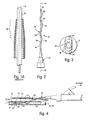
- FIGS. 2-4 illustrate one embodiment of the invention by which it is assured that the distal tip of the probe 16 at which the sensor 18 is carried, will be disposed substantially in the region of the central axis (suggested by the phantom line 22 in FIG. 4) of the lumen 20 of the artery.
- the catheter shaft 22 is formed in a zig-zag configuration including a plurality of segments 24 connected end-to-end at bends or apices 26.
- the introducer catheter 22 may be considered as having a longitudinally extending central axis 28 with the apices 26 being spaced transversely from the central axis 28.
- the distal tip of the catheter shaft 28 is formed to lie substantially along the central axis 28 and includes a distal tip segment 30 that terminates in a distal outlet orifice 32.
- the tip segment 30 and outlet orifice 32 lie along the central axis 28.
- the introducer catheter of the type illustrated in FIGS. 2-4 includes a tubular shaft 23 that is formed from a flexible polymeric material, such as Teflon (polytetrafluoroethylene) or other suitable polymer conventionally used for catheter shafts.
- the polymer should be selected such that the catheter may be straightened temporarily so that it may be placed on the introducing needle as indicated in FIG. 1 B.
- the polymer should have sufficient memory so that after the needle is withdrawn, the catheter will expand to assume its non-linear (zig-zag in FIGS. 2-4) configuration.
- the catheter should be dimensioned with respect to the intended artery in which it is to be placed such that the height of the apices 26 (measured transversely to the central axis 28) is at least as great as the inner diameter of the lumen 20 of the artery into which it is to be placed.
- a properly selected catheter so placed will expand within the artery as suggested in FIG. 4 so that the apices 26 engage the inner luminal surface 21 of the artery thereby centering and stabilizing the position of the catheter in the artery.
- the catheter will be centered in the artery with its central axis 28 being disposed substantially along the central axis 22 of the artery.
- the distal tip segment 30 and outlet orifice 32 of the introducer catheter will be disposed and extend substantially along the center of the artery lumen. Consequently, when the probe 16 carrying the sensor 18 is advanced through the introducer catheter, it will emerge from the outlet orifice 32, extending generally longitudinally of the artery and substantially centralized within the artery.
- the sensor tip thus is maintained in substantial spaced relation from the surface of the artery lumen 20, thereby avoiding the "wall effect" and development of aberrant readings.
- the zig-zag segments 24 lie substantially in a single plane. Such a planar configuration, however, is not essential and the zig-zag segments could assume other configurations, such as a generally helical or twisted pattern. It may be noted that the height of the apices 26 may be substantially the same along the length of the catheter or, as suggested somewhat in FIGS. 2 and 3, the height of the apices may be decreased toward the distal end of the catheter, if desired.
- FIGS. 5A-5C illustrate another facet of the invention by which the introducer catheter may serve to centralize the sensing probe and in which the catheter maintains its fluid capability so as to permit monitoring of blood pressure while the probe remains in place in the introducing catheter.
- the distal end of the catheter typically has a tapered segment 34 terminating in a distal outlet tip of reduced wall thickness and smaller diameter than the more proximal portions of the catheters.
- the purpose for such a tapered configuration is to enable the catheter to fit snugly onto the introducing needle so that when the introducing needle percutaneously pierces the skin and the blood vessel, the catheter that is carried on the needle will not become snagged on the skin or the tissue of the blood vessel.
- the present invention contemplates employing a sensor probe in which the distal tip of the sensor probe is of reduced diameter.
- the probe 18' may have a more proximal segment 36 having a larger diameter while a distal segment 38 of the probe may have a reduced diameter. It is intended that the distal segment 38 extends through the distal portion and the orifice 32 of the catheter shaft.
- the reduced diameter of the distal segment 38 does not adversely restrict the flow area through the distal tip of the catheter thereby permitting continued blood pressure measurements even when the probe is in place.
- the stepped diameter for the probe may be formed by varying the thickness and diameter of the jacket(s) 40 that encase the optical fiber 42 that extends through the probe.
- the configuration of the introducer catheter is not limited to the embodiment as shown and may take other forms.
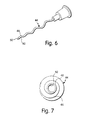
- still another configuration is that illustrated in FIGS. 6 and 7 in which the introducer catheter shaft 44 is formed in a general helical coil pattern.
- the distal end 46 of the catheter shaft extends radially inwardly toward the central axis of the device and terminates in a distal tip segment 48 and distal outlet orifice 50 that lie along the central axis.
- the helically coiled catheter shaft is selected to have a diameter slightly greater than the inner luminal diameter of the blood vessel into which it is to be placed so that when the carrying introducing needle is removed and the catheter expands to its helically coiled configuration, it will expand into firm, supported engagement with the inner surface of the artery lumen.
- the introducer catheter may be provided that will engage the inner luminal surface of the artery to stabilize the catheter within the artery and in which the distal tip of the catheter includes a distal tip segment which extends along the central axis of the catheter and has a distal outlet orifice through which the distal tip of the sensing probe may emerge, extending longitudinally of and centrally within the lumen of the blood vessel.
- the invention provides a means and a technique by which a sensing probe may be positioned centrally within the blood vessel and in which the probe is maintained in substantially spaced relation from the luminal surface of the blood vessel thereby avoiding the "wall effect". Consequently the invention enables blood parameters, such as blood gas concentrations and pH levels to be sensed in vivo, directly in the flowing blood stream without requiring removal of discrete batches for testing outside of the blood stream.
Landscapes
- Health & Medical Sciences (AREA)
- Life Sciences & Earth Sciences (AREA)
- Physics & Mathematics (AREA)
- Veterinary Medicine (AREA)
- Public Health (AREA)
- General Health & Medical Sciences (AREA)
- Biophysics (AREA)
- Animal Behavior & Ethology (AREA)
- Engineering & Computer Science (AREA)
- Biomedical Technology (AREA)
- Heart & Thoracic Surgery (AREA)
- Molecular Biology (AREA)
- Medical Informatics (AREA)
- Surgery (AREA)
- Pathology (AREA)
- Hematology (AREA)
- Cardiology (AREA)
- Optics & Photonics (AREA)
- Pulmonology (AREA)
- Anesthesiology (AREA)
- Vascular Medicine (AREA)
- Physiology (AREA)
- Spectroscopy & Molecular Physics (AREA)
- Media Introduction/Drainage Providing Device (AREA)
- Measurement Of The Respiration, Hearing Ability, Form, And Blood Characteristics Of Living Organisms (AREA)
- Measuring Pulse, Heart Rate, Blood Pressure Or Blood Flow (AREA)
Applications Claiming Priority (2)
| Application Number | Priority Date | Filing Date | Title |
|---|---|---|---|
| US55713390A | 1990-07-23 | 1990-07-23 | |
| US557133 | 1990-07-23 |
Publications (2)
| Publication Number | Publication Date |
|---|---|
| EP0468616A2 true EP0468616A2 (fr) | 1992-01-29 |
| EP0468616A3 EP0468616A3 (en) | 1992-05-13 |
Family
ID=24224182
Family Applications (1)
| Application Number | Title | Priority Date | Filing Date |
|---|---|---|---|
| EP19910303418 Withdrawn EP0468616A3 (en) | 1990-07-23 | 1991-04-17 | System and technique for measuring blood characteristics by centering a sensor in an artery |
Country Status (6)
| Country | Link |
|---|---|
| EP (1) | EP0468616A3 (fr) |
| JP (1) | JPH05337191A (fr) |
| KR (1) | KR920002093A (fr) |
| CN (1) | CN1058537A (fr) |
| AU (1) | AU7516491A (fr) |
| IE (1) | IE911159A1 (fr) |
Cited By (2)
| Publication number | Priority date | Publication date | Assignee | Title |
|---|---|---|---|---|
| EP0522727A1 (fr) * | 1991-07-09 | 1993-01-13 | C.R. Bard, Inc. | Appareil et méthode de positionnement d'un capteur placé à une certaine distance du mur du vaisseau sanguin |
| US6619838B2 (en) | 2001-08-22 | 2003-09-16 | Scimed Life Systems, Inc. | Two-piece sensor assembly |
Families Citing this family (1)
| Publication number | Priority date | Publication date | Assignee | Title |
|---|---|---|---|---|
| EP3328270B1 (fr) * | 2015-07-31 | 2022-04-27 | Koninklijke Philips N.V. | Connecteurs à chargement latéral avec câblage en ligne pour utilisation avec des dispositifs intravasculaires et systèmes et procédés associés |
Family Cites Families (5)
| Publication number | Priority date | Publication date | Assignee | Title |
|---|---|---|---|---|
| EP0132344A3 (fr) * | 1983-07-20 | 1986-01-22 | Purdue Research Foundation | Capteur du débit cardiaque basé sur un cathéter |
| SE441725B (sv) * | 1985-01-10 | 1985-11-04 | Bertil Hok | System for fysiologiska tryckregistreringar |
| US4785814A (en) * | 1987-08-11 | 1988-11-22 | Cordis Corporation | Optical probe for measuring pH and oxygen in blood and employing a composite membrane |
| US4986814A (en) * | 1988-06-13 | 1991-01-22 | Indianapolis Center For Advanced Research | One-punch catheter |
| FR2639237B1 (fr) * | 1988-11-23 | 1997-10-31 | Boussignac Georges | Catheter destine a etre introduit dans un canal corporel |
-
1991
- 1991-04-08 IE IE115991A patent/IE911159A1/en unknown
- 1991-04-17 EP EP19910303418 patent/EP0468616A3/en not_active Withdrawn
- 1991-04-19 AU AU75164/91A patent/AU7516491A/en not_active Abandoned
- 1991-05-23 CN CN91103517A patent/CN1058537A/zh active Pending
- 1991-07-16 JP JP3175560A patent/JPH05337191A/ja active Pending
- 1991-07-23 KR KR1019910012638A patent/KR920002093A/ko not_active Withdrawn
Cited By (3)
| Publication number | Priority date | Publication date | Assignee | Title |
|---|---|---|---|---|
| EP0522727A1 (fr) * | 1991-07-09 | 1993-01-13 | C.R. Bard, Inc. | Appareil et méthode de positionnement d'un capteur placé à une certaine distance du mur du vaisseau sanguin |
| US5284138A (en) * | 1991-07-09 | 1994-02-08 | C. R. Bard, Inc. | Apparatus and method for positioning a sensor away from the blood vessel wall |
| US6619838B2 (en) | 2001-08-22 | 2003-09-16 | Scimed Life Systems, Inc. | Two-piece sensor assembly |
Also Published As
| Publication number | Publication date |
|---|---|
| CN1058537A (zh) | 1992-02-12 |
| IE911159A1 (en) | 1992-01-29 |
| JPH05337191A (ja) | 1993-12-21 |
| KR920002093A (ko) | 1992-02-28 |
| AU7516491A (en) | 1992-01-30 |
| EP0468616A3 (en) | 1992-05-13 |
Similar Documents
| Publication | Publication Date | Title |
|---|---|---|
| US5265606A (en) | System and technique for measuring blood characteristics by centering a sensor in an artery | |
| US5284138A (en) | Apparatus and method for positioning a sensor away from the blood vessel wall | |
| US5788631A (en) | Hollow viscus and solid organ tonometry | |
| US4954129A (en) | Hydrodynamic clot flushing | |
| US5727553A (en) | Catheter with integral electromagnetic location identification device | |
| US4795434A (en) | Apparatus for positioning a sensor in vivo | |
| US6280424B1 (en) | Apparatus and method for using a needle in an intravascular assembly | |
| JP3553088B2 (ja) | カテーテル系 | |
| US5299571A (en) | Apparatus and method for implantation of sensors | |
| US4650472A (en) | Apparatus and method for effecting percutaneous catheterization of a blood vessel using a small gauge introducer needle | |
| CN114886381B (zh) | 光纤传感器 | |
| US7608064B2 (en) | Depth probe for intracranial treatment | |
| EP0825827B1 (fr) | Dispositif pour mesure de la saturation veineuse centrale en oxygene | |
| CA1170528A (fr) | Catheter a fentes pour mesurer la pression interstitielle | |
| US5246016A (en) | Transport catheter and multiple probe analysis method | |
| US20090088609A1 (en) | Method of taking internal physiological measurements | |
| US20040242990A1 (en) | Device, system, and method for detecting vulnerable plaque in a blood vessel | |
| US20120172731A1 (en) | Rapid exchange guide unit | |
| JPH03505822A (ja) | 細長く柔軟で操作可能なガイドワイヤーに係合させるための組立体および圧力センサー | |
| US5526809A (en) | Hollow viscous and soild organ tonometry | |
| US6954665B2 (en) | Catheter system | |
| WO2022055806A1 (fr) | Dispositifs et procédés de navigation, d'évaluation, de traitement et/ou de diagnostic vasculaire | |
| CN119454187A (zh) | 中心静脉导管组件 | |
| EP0468616A2 (fr) | Système et procédé de mesure de paramètres sanguins par un cathéter maintenu dans une artère en position centrée | |
| EP0089647B1 (fr) | Tonométrie de viscères creuses |
Legal Events
| Date | Code | Title | Description |
|---|---|---|---|
| PUAI | Public reference made under article 153(3) epc to a published international application that has entered the european phase |
Free format text: ORIGINAL CODE: 0009012 |
|
| AK | Designated contracting states |
Kind code of ref document: A2 Designated state(s): BE DE ES FR GB IT NL |
|
| PUAL | Search report despatched |
Free format text: ORIGINAL CODE: 0009013 |
|
| AK | Designated contracting states |
Kind code of ref document: A3 Designated state(s): BE DE ES FR GB IT NL |
|
| STAA | Information on the status of an ep patent application or granted ep patent |
Free format text: STATUS: THE APPLICATION IS DEEMED TO BE WITHDRAWN |
|
| 18D | Application deemed to be withdrawn |
Effective date: 19921114 |