EP0469285A1 - Integriertes Verfahren zur Umsetzung von C3-C4-Paraffin bei der Herstellung von tertiären Alkylethern und Benzin - Google Patents
Integriertes Verfahren zur Umsetzung von C3-C4-Paraffin bei der Herstellung von tertiären Alkylethern und Benzin Download PDFInfo
- Publication number
- EP0469285A1 EP0469285A1 EP91110356A EP91110356A EP0469285A1 EP 0469285 A1 EP0469285 A1 EP 0469285A1 EP 91110356 A EP91110356 A EP 91110356A EP 91110356 A EP91110356 A EP 91110356A EP 0469285 A1 EP0469285 A1 EP 0469285A1
- Authority
- EP
- European Patent Office
- Prior art keywords
- alkanol
- hydrocarbons
- contacting
- etherification
- process according
- Prior art date
- Legal status (The legal status is an assumption and is not a legal conclusion. Google has not performed a legal analysis and makes no representation as to the accuracy of the status listed.)
- Ceased
Links
Images
Classifications
-
- C—CHEMISTRY; METALLURGY
- C10—PETROLEUM, GAS OR COKE INDUSTRIES; TECHNICAL GASES CONTAINING CARBON MONOXIDE; FUELS; LUBRICANTS; PEAT
- C10L—FUELS NOT OTHERWISE PROVIDED FOR; NATURAL GAS; SYNTHETIC NATURAL GAS OBTAINED BY PROCESSES NOT COVERED BY SUBCLASSES C10G OR C10K; LIQUIFIED PETROLEUM GAS; USE OF ADDITIVES TO FUELS OR FIRES; FIRE-LIGHTERS
- C10L1/00—Liquid carbonaceous fuels
- C10L1/02—Liquid carbonaceous fuels essentially based on components consisting of carbon, hydrogen, and oxygen only
- C10L1/023—Liquid carbonaceous fuels essentially based on components consisting of carbon, hydrogen, and oxygen only for spark ignition
-
- C—CHEMISTRY; METALLURGY
- C10—PETROLEUM, GAS OR COKE INDUSTRIES; TECHNICAL GASES CONTAINING CARBON MONOXIDE; FUELS; LUBRICANTS; PEAT
- C10G—CRACKING HYDROCARBON OILS; PRODUCTION OF LIQUID HYDROCARBON MIXTURES, e.g. BY DESTRUCTIVE HYDROGENATION, OLIGOMERISATION, POLYMERISATION; RECOVERY OF HYDROCARBON OILS FROM OIL-SHALE, OIL-SAND, OR GASES; REFINING MIXTURES MAINLY CONSISTING OF HYDROCARBONS; REFORMING OF NAPHTHA; MINERAL WAXES
- C10G3/00—Production of liquid hydrocarbon mixtures from oxygen-containing organic materials, e.g. fatty oils, fatty acids
- C10G3/42—Catalytic treatment
- C10G3/44—Catalytic treatment characterised by the catalyst used
-
- C—CHEMISTRY; METALLURGY
- C10—PETROLEUM, GAS OR COKE INDUSTRIES; TECHNICAL GASES CONTAINING CARBON MONOXIDE; FUELS; LUBRICANTS; PEAT
- C10G—CRACKING HYDROCARBON OILS; PRODUCTION OF LIQUID HYDROCARBON MIXTURES, e.g. BY DESTRUCTIVE HYDROGENATION, OLIGOMERISATION, POLYMERISATION; RECOVERY OF HYDROCARBON OILS FROM OIL-SHALE, OIL-SAND, OR GASES; REFINING MIXTURES MAINLY CONSISTING OF HYDROCARBONS; REFORMING OF NAPHTHA; MINERAL WAXES
- C10G3/00—Production of liquid hydrocarbon mixtures from oxygen-containing organic materials, e.g. fatty oils, fatty acids
- C10G3/42—Catalytic treatment
- C10G3/44—Catalytic treatment characterised by the catalyst used
- C10G3/48—Catalytic treatment characterised by the catalyst used further characterised by the catalyst support
- C10G3/49—Catalytic treatment characterised by the catalyst used further characterised by the catalyst support containing crystalline aluminosilicates, e.g. molecular sieves
-
- C—CHEMISTRY; METALLURGY
- C10—PETROLEUM, GAS OR COKE INDUSTRIES; TECHNICAL GASES CONTAINING CARBON MONOXIDE; FUELS; LUBRICANTS; PEAT
- C10G—CRACKING HYDROCARBON OILS; PRODUCTION OF LIQUID HYDROCARBON MIXTURES, e.g. BY DESTRUCTIVE HYDROGENATION, OLIGOMERISATION, POLYMERISATION; RECOVERY OF HYDROCARBON OILS FROM OIL-SHALE, OIL-SAND, OR GASES; REFINING MIXTURES MAINLY CONSISTING OF HYDROCARBONS; REFORMING OF NAPHTHA; MINERAL WAXES
- C10G2300/00—Aspects relating to hydrocarbon processing covered by groups C10G1/00 - C10G99/00
- C10G2300/10—Feedstock materials
- C10G2300/1081—Alkanes
-
- C—CHEMISTRY; METALLURGY
- C10—PETROLEUM, GAS OR COKE INDUSTRIES; TECHNICAL GASES CONTAINING CARBON MONOXIDE; FUELS; LUBRICANTS; PEAT
- C10G—CRACKING HYDROCARBON OILS; PRODUCTION OF LIQUID HYDROCARBON MIXTURES, e.g. BY DESTRUCTIVE HYDROGENATION, OLIGOMERISATION, POLYMERISATION; RECOVERY OF HYDROCARBON OILS FROM OIL-SHALE, OIL-SAND, OR GASES; REFINING MIXTURES MAINLY CONSISTING OF HYDROCARBONS; REFORMING OF NAPHTHA; MINERAL WAXES
- C10G2300/00—Aspects relating to hydrocarbon processing covered by groups C10G1/00 - C10G99/00
- C10G2300/10—Feedstock materials
- C10G2300/1088—Olefins
-
- C—CHEMISTRY; METALLURGY
- C10—PETROLEUM, GAS OR COKE INDUSTRIES; TECHNICAL GASES CONTAINING CARBON MONOXIDE; FUELS; LUBRICANTS; PEAT
- C10G—CRACKING HYDROCARBON OILS; PRODUCTION OF LIQUID HYDROCARBON MIXTURES, e.g. BY DESTRUCTIVE HYDROGENATION, OLIGOMERISATION, POLYMERISATION; RECOVERY OF HYDROCARBON OILS FROM OIL-SHALE, OIL-SAND, OR GASES; REFINING MIXTURES MAINLY CONSISTING OF HYDROCARBONS; REFORMING OF NAPHTHA; MINERAL WAXES
- C10G2300/00—Aspects relating to hydrocarbon processing covered by groups C10G1/00 - C10G99/00
- C10G2300/40—Characteristics of the process deviating from typical ways of processing
- C10G2300/4018—Spatial velocity, e.g. LHSV, WHSV
-
- C—CHEMISTRY; METALLURGY
- C10—PETROLEUM, GAS OR COKE INDUSTRIES; TECHNICAL GASES CONTAINING CARBON MONOXIDE; FUELS; LUBRICANTS; PEAT
- C10G—CRACKING HYDROCARBON OILS; PRODUCTION OF LIQUID HYDROCARBON MIXTURES, e.g. BY DESTRUCTIVE HYDROGENATION, OLIGOMERISATION, POLYMERISATION; RECOVERY OF HYDROCARBON OILS FROM OIL-SHALE, OIL-SAND, OR GASES; REFINING MIXTURES MAINLY CONSISTING OF HYDROCARBONS; REFORMING OF NAPHTHA; MINERAL WAXES
- C10G2400/00—Products obtained by processes covered by groups C10G9/00 - C10G69/14
- C10G2400/02—Gasoline
-
- Y—GENERAL TAGGING OF NEW TECHNOLOGICAL DEVELOPMENTS; GENERAL TAGGING OF CROSS-SECTIONAL TECHNOLOGIES SPANNING OVER SEVERAL SECTIONS OF THE IPC; TECHNICAL SUBJECTS COVERED BY FORMER USPC CROSS-REFERENCE ART COLLECTIONS [XRACs] AND DIGESTS
- Y02—TECHNOLOGIES OR APPLICATIONS FOR MITIGATION OR ADAPTATION AGAINST CLIMATE CHANGE
- Y02P—CLIMATE CHANGE MITIGATION TECHNOLOGIES IN THE PRODUCTION OR PROCESSING OF GOODS
- Y02P30/00—Technologies relating to oil refining and petrochemical industry
- Y02P30/20—Technologies relating to oil refining and petrochemical industry using bio-feedstock
Definitions
- This invention relates to an integrated process for the production of gasoline boiling range hydrocarbons containing alkyl tertiary alkyl ethers.
- the invention relates to a process integration for converting propane and butane in an iso-olefin rich feedstock to higher hydrocarbons and high octane gasoline rich in tertiary alkyl ether, such as the conversion of C 3 + feedstock to C 5 + gasoline containing methyl tertiary butyl ether (MTBE) and tertiary amyl ether (TAME).
- MTBE methyl tertiary butyl ether
- TAME tertiary amyl ether
- isobutylene and other isoalkenes produced by hydrocarbon cracking may be reacted with methanol and other C i - C 4. lower aliphatic alkanols over an acidic catalyst to provide methyl tertiary butyl ether (MTBE) or the like.
- MTBE methyl tertiary butyl ether
- asymmetrical ethers having the formula (CH 3 ) 3 C-O-R, where R is a C 1 -C 4 alkyl radical are particularly useful as octane improvers for liquid fuels, especially gasoline.
- MTBE ethyl t-butyl ether
- TAME tert-amyl methyl ether
- IPTBE isopropyl t-butyl ether
- US-A-4,754,100 discloses a process for converting propane to higher hydrocarbons such as butanes and C 5 aliphatics over zeolite catalyst by adding a monoolefin to the propane feed.
- propane to higher hydrocarbons such as butanes and C 5 aliphatics
- zeolite catalyst by adding a monoolefin to the propane feed.
- US Patent Application Serial No. 210,177 filed June 20, 1988 by C. Sorensen et al
- Both of these processes for converting light paraffins employing zeolite catalysis are carried out under conditions of high severity at high pressure.
- a continuous process for converting a feedstock, comprising lower aliphatic alkanol and C 3 +, C 4 or C 4 + aliphatic hydrocarbon containing alkane and alkene and rich in iso-olefins, to alkyl tertiary-alkyl ethers and C 5 + gasoline boiling range hydrocarbons comprises contacting the alkanol and the aliphatic hydrocarbon under etherification conditions with an acid etherification catalyst to produce an etherification effluent comprising an overhead stream containing unreacted alkanol and C 4 - aliphatic hydrocarbons and a liquid product stream containing C 5 + alkyl tertiary-alkyl ether; and subjecting said overhead stream to high severity contacting with acidic, medium pore metallosilicate catalyst at a temperature of 200 to 427°C and a pressure above 3400 kPa, to convert alkanol, alkane and alkene therein to C 5 + gasoline boiling range hydrocarbons with
- the overhead stream is subjected to a preliminary low severity contacting with acidic, medium pore metallosilicate catalyst to produce C 5 + gasoline boiling range hydrocarbons and unreacted C 4 - aliphatic hydrocarbons which latter are then subjected to said high severity contacting.
- the high severity contacting is preferably carried out at a temperature of 200°C to 427°C.
- the overhead stream is subjected to a preliminary low severity contacting with acidic, medium pore metallosilicate catalyst to produce C 5 + gasoline boiling range hydrocarbons and unreacted C 4 - aliphatic hydrocarbons which latter, together with further lower aliphatic alkanol, are contacted with a further acid etherification catalyst under etherification conditions to provide a further liquid product stream containing C 5 + alkyl tertiary-alkyl ether and an overhead stream containing unreacted alkanol and C 4 - aliphatic hydrocarbons which is subjected to said high severity contacting.
- the high severity contacting is preferably carried out at a temperature of 200°C to 427°C.
- the lower aliphatic alkanol may comprise methanol, ethanol, 1-propanol, isopropanol, 1-butanol and/or 2-butanol.
- the medium pore metallosilicate is preferably a zeolite having the structure of ZSM-5 or zeolite Beta.
- the alkanol feedstock comprises dry methanol and wherein said alkane and alkene comprises C 4 + hydrocarbons.
- the alkyl tertiary-butyl ether comprises methyl tertiary butyl ether and the etherification catalyst is an acidic zeolite or a sulfonated vinyl aromatic resin.
- the integrated process thus converts paraffins contained in the light hydrocarbon feedstream of a process for the production of tertiary alkyl ether from alkanol and iso-olefins, and thus provides for the utilization of C 3 + hydrocarbon feedstream for the production of tertiary alkyl ethers and the conversion of C 3 paraffins and olefins to higher hydrocarbons.
- Paraffin conversion is accomplished by carrying out the conversion of unreacted alkanol and C 4 - hydrocarbon from the etherification step in a high pressure reactor containing high activity zeolite. The conversion of paraffin is accomplished without the production of significant quantities of C 2 -hydrocarbons.
- High octane gasoline is produced in the process and all components of an LPG feed are efficiently utilized.
- a continuous process for converting lower aliphatic alkanol feedstock and C 3 + alkane and alkene feedstock to alkyl tertiary-alkyl ethers and C 5 + gasoline boiling range hydrocarbons comprises: contacting alkanol and a C 3 + aliphatic hydrocarbon stream rich in iso-olefins under iso-olefin etherification conditions in an etherification reaction zone containing acid etherification catalyst; separating the etherification effluent to recover a vapor stream comprising unreacted alkanol plus C 3 -C 4 aliphatic hydrocarbons and a liquid product stream containing C 5 + alkyl tertiary-alkyl ether; and contacting the vapor stream with acidic, medium pore metallosilicate catalyst under conversion conditions sufficient to convert alkanol, alkane and alkene to higher hydrocarbon with no substantial formation of methane, said conditions comprising a temperature of about 200°C to 400°C and a pressure
- the vapor stream is contacted with acidic, medium pore metallosilicate catalyst under low to moderate pressure alkanol and hydrocarbon conversion conditions, separated and a stream comprising C 5 + gasoline boiling range hydrocarbons and a stream containing unreacted C 3 -C 4 hydrocarbons recovered.
- the C 3 -C 4 hydrocarbon stream is also contacted with acidic, medium pore metallosilicate catalyst under conversion conditions sufficient to convert alkane and alkene to higher hydrocarbon with no substantial formation of methane as described above.
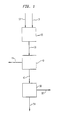
- Figure 1 is a schematic diagram of the present invention integrating etherification and high pressure conversion of alkanol and hydrocarbon.
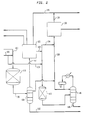
- Figure 2 is a schematic diagram of the present invention integrating etherification, low to moderate pressure conversion of alkanol and hydrocarbon and high pressure conversion of hydrocarbon.
- Typical feedstock materials for etherification reactions include olefinic streams, such as FCC light cracked gas containing butene isomers, often in mixture with substantial amounts of propene, propane, n-butane and isobutane.
- the C 4 components usually contain a major amount of unsaturated compounds, such as 10-35% isobutylene, 20-55% linear butenes, and small amounts of butadiene.
- C 4 + heavier olefinic hydrocarbon streams may be used, particularly mixtures of isobutylene and isoamylene.
- Feedstock includes light alkane and alkene hydrocarbons including C 3 + hydrocarbons, C 4 s or C 4 + hydrocarbons. These aliphatic streams are produced in a variety of petroleum refinery operations such as catalytic cracking of gas oil or the like.
- Suitable alkanols include lower aliphatic Ci-C4. primary or secondary alcohols. When dry methanol is employed it is preferably of 99.8 wt% purity.
- Alkanols which may be used in the present invention include methanol, ethanol, 1-propanol, isopropanol, 1-butanol and 2-butanol.
- a resin catalyst for instance from R.W. Reynolds, et al, The Oil and Gas Journal, June 16, 1975; S, Pecci and T. Floris, Hydrocarbon Processing, December 1977 ; and the aforesaid Chase reference.
- Preferred catalysts are polymeric sulfonic acid exchange resin such as Amberlyst 15. Zeolites such as zeolite Beta and ZSM-5 may be used.
- alkanol and iso-olefins may be reacted in equimolar quantities, or either reactant may be in molar excess to influence the complete conversion of the other reactant. Because etherification is an incomplete reaction the etherification effluent comprises unreacted alkanol and unreacted hydrocarbons.
- Equimolar quantities of methanol and iso-olefins are advantageous, but an excess between 2 and 200% of either component can be employed.
- the molar ratio of alkanol to iso-olefin, such as methanol to iso-butylene, is advantageously between 0.7 and 2, preferably unity when the reactants are actually methanol and isobutylene.
- An excess of methanol of 40% or more when the hydrocarbon feedstream comprises significant quantity of isoamylenes may advantageously be employed, but equimolar quantities are preferred when the hydrocarbon feedstream consists essentially of C 4 hydrocarbons.
- the alcohol-containing stream preferably a vapor stream, may be co- reacted with olefinic light gas and/or other reactive hydrocarbon feedstreams in an oligomerization/aromatization reaction section, as described in US-A-4,547,616, 4,746,762, 4,827,046 and 4,831,203.
- Zeolite conversion technology for upgrading lower aliphatic hydrocarbons and oxygenates (C 2 -C 5 alcohols, ethers, aldehydes, esters and the like) to liquid hydrocarbon products, including gasoline boiling range hydrocarbons and aromatics, are well known.
- Commercial Methanol-to-Gasoline (MTG), methanol-to-olefins (MTO), Mobil Olefin to Gasoline/Distillate (MOG/D) and conversion of olefins and paraffins to aromatics (M-2 Forming) processes employ shape selective medium pore zeolite catalysts.
- the zeolite conversion unit operation of the present invention can have the characteristics of these catalysts and processes to produce a variety of hydrocarbon products, especially liquid aliphatics and aromatics in the C S -C 9 gasoline range.
- the zeolite catalyzed conversion processes can be run in fixed, fluidized or moving catalyst beds.
- the reactions which take place in the zeolite conversion reactor include oligomerization, alkylation, dehydrocyclization, isomerization, and cracking. These include exothermic and endothermic reactions, which can be thermally balanced to require little or no heat exchange to maintain process reaction temperature.
- Mixed hydrocarbons from FCC operations, following the etherification and effluent separation, can be selected or modified to include a balance of olefins and paraffins to achieve the desired thermodynamic properties.
- the preferred process comprises contacting, preferably in the absence of added hydrogen and at a pressure above about 3400 kPa, a feed consisting essentially of propane and a mono-olefin with a catalyst comprising a crystalline alumino-silicate zeolite having a silica-to-alumina ratio of at least 12 and a Constraint Index of 1 to 12, the process reaction being conducted under a combination of conditions of temperature, pressure, and space velocity effective to convert at least 10% of the propane to a mixture of hydrocarbons that contain butanes in an amount equal to at least 35 wt% of the converted propane.
- n-butane is converted directly to propane and gasoline and with no substantial formation of methane by contact with certain intermediate pore size zeolites such as high activity HZSM-5 or zeolite Beta under specified conversion conditions including a relatively low temperature of not more than 800°F (427°C) and a pressure of at least 2100 kPa.
- certain intermediate pore size zeolites such as high activity HZSM-5 or zeolite Beta under specified conversion conditions including a relatively low temperature of not more than 800°F (427°C) and a pressure of at least 2100 kPa.
- this process provides a simple catalytic process for the production of propane and gasoline by contacting in the absence of added hydrogen at a temperature of 475°F to about 800°F (427°C) and at a pressure of 600 (4200 kPa) to about 2000 psig (14,000 kPa) a feed consisting essentially of n-butane or isobutane with a catalyst comprising a crystalline zeolite having a silica-to-alumina ratio of at least 12 and a Constraint Index of 1 to 12, said contacting being conducted under a combination of conditions of temperature, pressure, and WHSV effective to convert about 35 wt% to about 90 wt% of the butane to a mixture of propane and heavier hydrocarbons, with no substantial conversion to hydrocarbon by-products having less than three carbon atoms.
- Propane and gasoline are readily recovered from the reaction mixture.
- the total effluent from the catalytic reactor will contain unreacted normal butane and isobutane.
- zeolite ZSM-5 which is usually synthesized with Bronsted acid active sites by incorporating a tetrahedrally coordinated metal, such as Al, Ga, Fe or mixtures thereof, within the zeolitic framework.
- a tetrahedrally coordinated metal such as Al, Ga, Fe or mixtures thereof.
- These medium pore zeolites are favored for acid catalysis; however, the advantages of ZSM-5 structures may be utilized by employing highly siliceous materials or crystalline metallosilicate having one or more tetrahedral species having varying degrees of acidity.
- the ZSM-5 structure is readily recognized by its x-ray diffraction pattern, for instance as set forth in US-A-3,702,866.
- Zeolite hydrocarbon upgrading catalysts preferred for use herein include the medium pore (i.e. about 5-7A) shape-selective crystalline aluminosilicate zeolites having a silica-to-alumina ratio of at least 12, a Constraint Index of about 1 to 12 and acid cracking activity (alpha value) of about 1-250, preferably about 3 to 80.
- the coked catalyst preferably has an apparent activity (alpha value) of about 1 to 20 under the process conditions to achieve the required degree of reaction severity.
- Suitable medium pore shape selective zeolites are ZSM-5, ZSM-11, ZSM-12, ZSM-23, ZSM-35 and ZSM-48, disclosed inter alia in US-A-3,709,979, 3,832,449, 4,076,979, 3,832,449, 4,076,842, 4,016,245, 4,414,423, 4,417,086, 4,517,396 and 4,542,251.
- zeolites having a silica to alumina (or other metal oxide) molar ratio of 12:1 to 200:1 or higher may be used, it is advantageous to employ ZSM-5 having a silica alumina molar ratio of about 25:1 to 70:1, suitably modified if desired to adjust acidity and oligomerization/aromatization characteristics.
- a typical zeolite catalyst component having Bronsted acid sites may consist essentially of aluminosilicate ZSM-5 zeolite.
- gallosilicate or ferrosilicate materials may be employed.
- Pentasil zeolites are particularly useful in the process because of their regenerability, long life and stability under the extreme conditions of operation. Usually the zeolite has a crystal size from about 0.01 to 2 micrometers, but the crystals may be larger. In order to obtain the desired particle size for fluidization in a turbulent regime, the crystals are bound with a suitable inorganic oxide, such as silica, alumina, etc. to provide a zeolite concentration of about 5 to 95 wt%.
- a suitable inorganic oxide such as silica, alumina, etc.
- ZSM-5 having a silica:alumina molar ratio of 25:1 or greater in a once-through fluidized bed unit to convert 60 to 100 percent, preferably at least 75 wt%, or the monoalkenes and methanol in a single pass.
- 25% H-ZSM-5 catalyst calcined with 75% silica-alumina matrix binder is employed.
- zeolite Beta is also preferred as catalyst in the present invention.
- a continuous stream of C 3 + olefinic and paraffinic hydrocarbon is introduced via conduit 10 to a first reactor 20 and mixed with dry methanol (MeOH) feedstock introduced via conduit 12.
- the combined streams are pressurized to about 1190 kPa (170 psig) and heated to a temperature of about 55°C (130°F) for conversion of methanol in contact with acid etherification catalyst, preferably solid polysulfonic acid resin such as sulfonated vinyl aromatic resins.
- the reactor effluent stream containing MTBE, methanol and unreacted light hydrocarbons is preheated and fed 35 to debutanizer fractionation tower 40.
- separation unit 40 the C 5 + methyl tert-alkyl ether product is recovered 41 as a liquid product, along with byproduct dimer or other heavier hydrocarbons in the effluent.
- Tower overhead product comprising unreacted C 4 - light hydrocarbons and methanol is passed to upgrading reactor 50 as a liquid via conduit 42 by pumping after condensing or the vapor is compressed and fed to the reactor.
- the zeolite catalytic conversion unit 50 under pressure above 3400 kPa, C 4 - paraffins, olefins and methanol are converted to higher hydrocarbons.
- Effluent may be fractionated in a debutanizer to recover a gasoline product stream 52, and C 4 - hydrocarbons 54.
- unreacted C 3 -C 4S can be recycled to reaction zone 50.
- the entire reactor effluent can then be recycled to the debutanizer 40 to recycle LPG to essentially extinction; a minor off-gas purge stream from debutanizer 40 overhead drum may be required to remove C 2 -from the system.
- the principal processes of etherification and high pressure conversion of unreacted hydrocarbons may be combined with low severity zeolite catalyzed conversion to provide a process that converts a major portion of alkenes and alkanes in the hydrocarbon feedstream to gasoline components. This combination is illustrated in Figure 2.
- etherification reactor 110 low to moderate pressure alkanol and olefin conversion reactor 120 and high pressure C 3 -C 4 paraffin conversion reactor 130.
- a C 3 + iso-olefin rich hydrocarbon stream 102 is combined with alkanol feedstream 104, e.g, methanol or isopropanol, and passed to the etherification reactor where etherification of iso-olefins is carried out in contact with acidic catalyst.
- the effluent from the etherification reaction is passed via conduit 106 to debutanizer 108.
- a liquid stream 112 is separated comprising C 5 + gasoline rich in alkyl tertiary alkyl ether, such as MTBE.
- the overhead vapor stream 114 from the debutanizer is passed to the zeolite conversion zone 120 wherein unreacted alkanol and olefins in the vapor stream are converted to higher hydrocarbons at a temperature of about 325°C and 925 kPa.
- a C 5 + gasoline stream 118 is recovered.
- the C 4 - stream 122 from the low severity conversion zone containing paraffins and olefins is passed to a second etherification zone 140 in conjunction with a stream 124 comprising additional alkanol feedstock.
- the conversion of olefins in zone 120 is not complete and leaves some C 3 -C 4 olefins in the effluent to enhance propane conversion in the high pressure reactor.
- the product from the second etherification zone is separated in a second debutanizer 145 to provide a second ether rich gasoline stream 126 a vapor stream 128 containing unreacted alkanol and C 4 - hydrocarbons. These are converted in high pressure zeolite conversion zone 130 to C 5 + gasoline 132.
- stream 122 may be passed directly via conduit 134 to conversion zone 130 for conversion of paraffins and olefins to higher hydrocarbon without carrying out the second etherification step.
- the effluent from high pressure reactor 130 may also be fractionated in the fractionation system for zone 120, or C 5 + or C 6 + hydrocarbons leaving the high pressure system can be passed to the lower pressure 120 reactor to improve the product octane.
Landscapes
- Chemical & Material Sciences (AREA)
- Oil, Petroleum & Natural Gas (AREA)
- Engineering & Computer Science (AREA)
- Chemical Kinetics & Catalysis (AREA)
- General Chemical & Material Sciences (AREA)
- Organic Chemistry (AREA)
- Crystallography & Structural Chemistry (AREA)
- Production Of Liquid Hydrocarbon Mixture For Refining Petroleum (AREA)
- Organic Low-Molecular-Weight Compounds And Preparation Thereof (AREA)
- Liquid Carbonaceous Fuels (AREA)
Applications Claiming Priority (2)
| Application Number | Priority Date | Filing Date | Title |
|---|---|---|---|
| US55973990A | 1990-07-30 | 1990-07-30 | |
| US559739 | 1990-07-30 |
Publications (1)
| Publication Number | Publication Date |
|---|---|
| EP0469285A1 true EP0469285A1 (de) | 1992-02-05 |
Family
ID=24234815
Family Applications (1)
| Application Number | Title | Priority Date | Filing Date |
|---|---|---|---|
| EP91110356A Ceased EP0469285A1 (de) | 1990-07-30 | 1991-06-24 | Integriertes Verfahren zur Umsetzung von C3-C4-Paraffin bei der Herstellung von tertiären Alkylethern und Benzin |
Country Status (4)
| Country | Link |
|---|---|
| EP (1) | EP0469285A1 (de) |
| JP (1) | JPH04233994A (de) |
| AU (1) | AU637239B2 (de) |
| CA (1) | CA2045699A1 (de) |
Cited By (5)
| Publication number | Priority date | Publication date | Assignee | Title |
|---|---|---|---|---|
| WO1997023438A1 (en) * | 1995-12-22 | 1997-07-03 | Neste Oy | Process for preparing alkyl ethers and mixtures thereof |
| RU2155182C2 (ru) * | 1995-12-22 | 2000-08-27 | Несте Ой | Способ получения третичных алкиловых эфиров |
| RU2165405C2 (ru) * | 1996-02-12 | 2001-04-20 | Кемикал Рисерч энд Лайсенсинг Компани | Способ этерификации-гидрирования |
| RU2167142C2 (ru) * | 1999-08-02 | 2001-05-20 | Общество с ограниченной ответственностью "Нефтехимстарт" | Способ получения алкил-трет-алкиловых эфиров |
| RU2170226C2 (ru) * | 1999-08-02 | 2001-07-10 | Общество с ограниченной ответственностью "Нефтехимстарт" | Способ получения алкил-трет-алкиловых эфиров и/или эфирсодержащих смесей |
Citations (5)
| Publication number | Priority date | Publication date | Assignee | Title |
|---|---|---|---|---|
| US4788365A (en) * | 1987-12-08 | 1988-11-29 | Mobil Oil Corporation | High octane gasoline and distillates from oxygenates |
| EP0302581A1 (de) * | 1987-08-06 | 1989-02-08 | Mobil Oil Corporation | Verfahren zur katalytischen Umsetzung von aliphatischen C3-Kohlenwasserstoffen zu höheren Kohlenwasserstoffen |
| US4830635A (en) * | 1987-12-08 | 1989-05-16 | Mobil Oil Corporation | Production of liquid hydrocarbon and ether mixtures |
| EP0320180A2 (de) * | 1987-12-08 | 1989-06-14 | Mobil Oil Corporation | Integriertes Verfahren zur Ätherifizierung und Herstellung von Brennstoff aus sauerstoffhaltigen Verbindungen |
| WO1989011463A1 (en) * | 1988-05-02 | 1989-11-30 | Mobil Oil Corporation | Olefins interconversion and etherification process |
Family Cites Families (1)
| Publication number | Priority date | Publication date | Assignee | Title |
|---|---|---|---|---|
| US4854939A (en) * | 1987-12-08 | 1989-08-08 | Mobil Oil Corporation | Aromatization and etherification process integration |
-
1991
- 1991-06-19 AU AU79108/91A patent/AU637239B2/en not_active Ceased
- 1991-06-24 EP EP91110356A patent/EP0469285A1/de not_active Ceased
- 1991-06-26 CA CA002045699A patent/CA2045699A1/en not_active Abandoned
- 1991-07-30 JP JP3189877A patent/JPH04233994A/ja active Pending
Patent Citations (5)
| Publication number | Priority date | Publication date | Assignee | Title |
|---|---|---|---|---|
| EP0302581A1 (de) * | 1987-08-06 | 1989-02-08 | Mobil Oil Corporation | Verfahren zur katalytischen Umsetzung von aliphatischen C3-Kohlenwasserstoffen zu höheren Kohlenwasserstoffen |
| US4788365A (en) * | 1987-12-08 | 1988-11-29 | Mobil Oil Corporation | High octane gasoline and distillates from oxygenates |
| US4830635A (en) * | 1987-12-08 | 1989-05-16 | Mobil Oil Corporation | Production of liquid hydrocarbon and ether mixtures |
| EP0320180A2 (de) * | 1987-12-08 | 1989-06-14 | Mobil Oil Corporation | Integriertes Verfahren zur Ätherifizierung und Herstellung von Brennstoff aus sauerstoffhaltigen Verbindungen |
| WO1989011463A1 (en) * | 1988-05-02 | 1989-11-30 | Mobil Oil Corporation | Olefins interconversion and etherification process |
Cited By (7)
| Publication number | Priority date | Publication date | Assignee | Title |
|---|---|---|---|---|
| WO1997023438A1 (en) * | 1995-12-22 | 1997-07-03 | Neste Oy | Process for preparing alkyl ethers and mixtures thereof |
| RU2155182C2 (ru) * | 1995-12-22 | 2000-08-27 | Несте Ой | Способ получения третичных алкиловых эфиров |
| RU2155744C2 (ru) * | 1995-12-22 | 2000-09-10 | Фортум Ойл энд Гэс Ой | Способ получения алкильных эфиров и их смесей |
| US6369280B1 (en) | 1995-12-22 | 2002-04-09 | Neste Oy | Process for preparing alkyl ethers and mixtures thereof |
| RU2165405C2 (ru) * | 1996-02-12 | 2001-04-20 | Кемикал Рисерч энд Лайсенсинг Компани | Способ этерификации-гидрирования |
| RU2167142C2 (ru) * | 1999-08-02 | 2001-05-20 | Общество с ограниченной ответственностью "Нефтехимстарт" | Способ получения алкил-трет-алкиловых эфиров |
| RU2170226C2 (ru) * | 1999-08-02 | 2001-07-10 | Общество с ограниченной ответственностью "Нефтехимстарт" | Способ получения алкил-трет-алкиловых эфиров и/или эфирсодержащих смесей |
Also Published As
| Publication number | Publication date |
|---|---|
| CA2045699A1 (en) | 1992-01-31 |
| JPH04233994A (ja) | 1992-08-21 |
| AU7910891A (en) | 1992-02-06 |
| AU637239B2 (en) | 1993-05-20 |
Similar Documents
| Publication | Publication Date | Title |
|---|---|---|
| US5001292A (en) | Ether and hydrocarbon production | |
| CA2030000C (en) | Integrated process for production of gasoline and ether | |
| US4886925A (en) | Olefins interconversion and etherification process | |
| US4684757A (en) | Process for converting methanol to alkyl ethers, gasoline, distillate and alkylate liquid hydrocarbons | |
| US4827046A (en) | Extraction of crude methanol and conversion of raffinate | |
| US4830635A (en) | Production of liquid hydrocarbon and ether mixtures | |
| US4950823A (en) | Benzene upgrading reformer integration | |
| US5166455A (en) | Process for the production of tertiary alkytl ethers from FCC light naphtha | |
| US5041690A (en) | Conversion of alcohols to ether-rich gasoline | |
| US4981491A (en) | Production of ether-rich fuel | |
| US5130101A (en) | Reactor system for conversion of alcohols to ether-rich gasoline | |
| US4835329A (en) | Process for producing high octane gasoline | |
| US5095159A (en) | Ether and hydrocarbon production | |
| US5047070A (en) | Integrated process for production of gasoline and ether from alcohol with feedstock extraction | |
| US4746761A (en) | Process for coverting methanol to alkyl ethers | |
| AU633080B2 (en) | Conversion of alcohols to ether-rich gasoline | |
| US4854939A (en) | Aromatization and etherification process integration | |
| US5064623A (en) | Integrated system for extraction of crude alcohol and co-conversion raffinate with olefin | |
| US5167937A (en) | Production of gasoline and ether from methanol with feedstock extraction | |
| US4975097A (en) | Iso-olefin etherification, upgrading and paraffin transhydrogenation | |
| US5106389A (en) | Process for conversion of light paraffins to alkylate in the production of tertiary alkyl ether rich gasoline | |
| US5260493A (en) | Effluent treatment for ether production | |
| CA2045699A1 (en) | Integrated process for conversion of c3-c4 paraffin in the production of tertiary alkyl ether and gasoline | |
| WO1993001154A1 (en) | Production of alkyl tertiary alkyl ethers from isoalkanes | |
| EP0410689A1 (de) | Verfahren zur Herstellung von Alkyl-t.-Alkylethern und C5+ Benzinkohlenwasserstoffen |
Legal Events
| Date | Code | Title | Description |
|---|---|---|---|
| PUAI | Public reference made under article 153(3) epc to a published international application that has entered the european phase |
Free format text: ORIGINAL CODE: 0009012 |
|
| AK | Designated contracting states |
Kind code of ref document: A1 Designated state(s): BE DE FR GB IT NL |
|
| 17P | Request for examination filed |
Effective date: 19920721 |
|
| 17Q | First examination report despatched |
Effective date: 19941026 |
|
| STAA | Information on the status of an ep patent application or granted ep patent |
Free format text: STATUS: THE APPLICATION HAS BEEN REFUSED |
|
| 18R | Application refused |
Effective date: 19960122 |