EP0469733A2 - Procédé et appareil pour mesurer des concentrations de gaz - Google Patents
Procédé et appareil pour mesurer des concentrations de gaz Download PDFInfo
- Publication number
- EP0469733A2 EP0469733A2 EP91306271A EP91306271A EP0469733A2 EP 0469733 A2 EP0469733 A2 EP 0469733A2 EP 91306271 A EP91306271 A EP 91306271A EP 91306271 A EP91306271 A EP 91306271A EP 0469733 A2 EP0469733 A2 EP 0469733A2
- Authority
- EP
- European Patent Office
- Prior art keywords
- gas
- radiation
- cathode
- radiation source
- measured
- Prior art date
- Legal status (The legal status is an assumption and is not a legal conclusion. Google has not performed a legal analysis and makes no representation as to the accuracy of the status listed.)
- Withdrawn
Links
Images

Classifications
-
- G—PHYSICS
- G01—MEASURING; TESTING
- G01J—MEASUREMENT OF INTENSITY, VELOCITY, SPECTRAL CONTENT, POLARISATION, PHASE OR PULSE CHARACTERISTICS OF INFRARED, VISIBLE OR ULTRAVIOLET LIGHT; COLORIMETRY; RADIATION PYROMETRY
- G01J3/00—Spectrometry; Spectrophotometry; Monochromators; Measuring colours
- G01J3/02—Details
- G01J3/10—Arrangements of light sources specially adapted for spectrometry or colorimetry
- G01J3/108—Arrangements of light sources specially adapted for spectrometry or colorimetry for measurement in the infrared range
-
- G—PHYSICS
- G01—MEASURING; TESTING
- G01N—INVESTIGATING OR ANALYSING MATERIALS BY DETERMINING THEIR CHEMICAL OR PHYSICAL PROPERTIES
- G01N21/00—Investigating or analysing materials by the use of optical means, i.e. using sub-millimetre waves, infrared, visible or ultraviolet light
- G01N21/17—Systems in which incident light is modified in accordance with the properties of the material investigated
- G01N21/25—Colour; Spectral properties, i.e. comparison of effect of material on the light at two or more different wavelengths or wavelength bands
- G01N21/31—Investigating relative effect of material at wavelengths characteristic of specific elements or molecules, e.g. atomic absorption spectrometry
- G01N21/35—Investigating relative effect of material at wavelengths characteristic of specific elements or molecules, e.g. atomic absorption spectrometry using infrared light
- G01N21/3504—Investigating relative effect of material at wavelengths characteristic of specific elements or molecules, e.g. atomic absorption spectrometry using infrared light for analysing gases, e.g. multi-gas analysis
-
- G—PHYSICS
- G01—MEASURING; TESTING
- G01N—INVESTIGATING OR ANALYSING MATERIALS BY DETERMINING THEIR CHEMICAL OR PHYSICAL PROPERTIES
- G01N2201/00—Features of devices classified in G01N21/00
- G01N2201/06—Illumination; Optics
- G01N2201/061—Sources
- G01N2201/06166—Line selective sources
- G01N2201/06173—IR sources from heated molecular species
Definitions
- the present invention relates to an apparatus in accordance with the preamble of claim 1 for measuring gas concentrations.
- the invention also concerns a method of measuring gas concentrations.
- the invention is intended for use particularly in the concentration measurements of gases or liquids with the help of optical absorption.
- Implementations based on conventional techniques use small solid-state LED and laser components of sufficiently high power output in the visible and near-IR wavelength range. Also used are wide- band emitting halogen-cycle incandescent lamps and so-called "globar" sources.
- the solid-state LED and laser components are extremely useful sources of radiation in absorption measurements by virtue of their small size and low power consumption. Their disadvantage is therein that their output wavelength does not necessarily coincide with the absorption wavelength band of the gas or liquid to be measured. Furthermore, the longest wavelength available from them rarely exceeds 1.5 am.
- Incandescent lamps and globar sources are radiation sources characterized by large size and high power consumption, and their emission spectrum closest approximates the wide- spectrum radiation of a blackbody. The desired wavelengths from such a spectrum must generally be selected by means of filters, which make the construction mechanically complicated, particularly when the filters must be movable for modulation purposes.
- the EP patent application 231 639 discloses a light source implementation in which a gas is excited with the help of an electric discharge.
- a disadvantage of such an implementation is that the gas contained in the light source is ionized in the electric discharge. Ionization in turn, however, implies that there is a high gas temperature and Doppler broadening of the spectral lines on one hand, and, on the other hand, that the gas is in a reactive state and undergoes a gradual change in its composition due to chemical reactions. Therefore, the lifespan of light source is limited to a few thousand hours, even if the light source is provided with a gas reservoir, which in turn makes the light source bulky.
- the invention is based on the idea of designing the radiation source to contain identical molecules with those of the material under study, whereby the light emitted by the radiation source contains exactly the correct wavelengths.
- the emitting gas is not ionized and its dissociation is kept minimal.
- the vibration and rotation energy states of the emitting gas are excited at an appropriate pressure with the help of electron bombardment.
- the apparatus according to the invention is characterized by what is stated in the characterizing part of claim 1.
- the invention provides outstanding benefits.
- the electron emitter of the radiation source according to the present invention operates at an extremely low thermal power level, typically in the order of 150 mW, combined with a shallow height of the gas-filled cavity and operation without ionization, temperature of the gas and simultaneously the entire small-size radiation source stay very close to the ambient temperature. This results in narrow spectral bandwidths of the emitted light by virtue of the concomitantly smaller Doppler shift with respect to that occurring in hot gas as is the case with tubular gas-filled electric-discharge sources. Maintaining a low gas temperature in the measurements is advantageous for absorption measurement techniques, because the gas to be measured itself is generally at a temperature very close to ambient temperature, and consequently, has a narrow absorption linewidth.
- the radiation source is subjected to heating in conjunction with, e.g., flue gas measurements
- the broadening of emitted linewidths due to the elevated temperature is not particularly deleterious to the accuracy of measurements, because the linewidth of the gas under study also undergoes a similar increase.
- the small size of the measurement apparatus allows an easy installation in locations actually enclosed by the gas under study.
- the silicon/glass construction of the radiation source is characterized in that it can be designed as a part of an integrated optical structure in which the optical waveguides are made of silicon. Then, the useable wavelength range starts from approx. 1 /1.m and extends to longer wavelengths in accordance with the IR transmission properties of silicon. The wavelength range extending from approx. 1 ⁇ m to 12 /1 .m, so important for practical purposes, can be covered using a structure in accordance with the present invention. Wavelengths shorter than 1 ⁇ m are generated with the help of the alternative embodiments of the present invention.
- the radiation source can be made of monocrystalline silicon and glass using conventional micromechanical processing methods of silicon. These include electrostatic bonding of glass on silicon, anisotropic etching of silicon and thin-film metallizing processes.
- the silicon grade appropriate for use according to the invention is, e.g., p-type (100)-oriented silicon wafer with a thickness of 0.4...1.3 mm. Production is carried out at the wafer level.
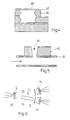
- a body part 10 is comprised of a silicon layer 1 and a glass wafer 2.
- An intermediate part 20 is of silicon and a cover part 30 is comprised of a cover part silicon layer 4 and a glass wafer 5.
- the resistivity of the silicon layer 1 and the intermediate part 20 can typically be in the range 0.01...1 ohm cm.
- the resistivity of the cover part silicon layer 4 can even be increased above 1 ohm cm in order to reduce radiation absorption in this layer to a low value.
- the top of the silicon wafer is covered by bonding atop the silicon wafer a glass wafer 2 of Corning 7070 glass which is then thinned to a thickness of 100...200 ⁇ m using, e.g., diamond paste abrasive grinding.
- the surface of the glass wafer 2 is polished after a possible lapping.
- wells 6 and 7 are etched on the glass layer using, e.g., the BHF etch, whereby a glow filament 9 to act as a cathode remains self-supported at the well 7.
- auxiliary conductors 8 are made with the help of conventional thin-film metallizing using a mechanical mask.
- the purpose of the auxiliary conductors is to make an electrical contact on one hand via the opening of the well 6 to the body part 1, and on the other hand, via a compression/diffusion bond to the intermediate part 20.
- the glow filament 9 can be made of, e.g., tungsten by etching from a thin sheet metal (using the lead frame technique).
- the glow filament is attached to the auxiliary conductors 8 with the help of, e.g., ultrasonic bonding.
- the cathode can be fabricated as a field emission cathode, such as the cathode described by I. Brodie and J.
- Openings to the intermediate part 20 are first fabricated by etching through the silicon wafer from one or both sides using conventional micromechanical processing methods of silicon, and then producing a contact metallization 13 using a mechanical mask.
- the silicon wafer forming a top part 30 is first covered with a bonded glass wafer 5 which is polished in the same manner as the surface of the glass wafer 2.
- a well 5 is etched in the glass wafer 5 down to the silicon wafer surface.
- the cavity 12 can be made by etching the silicon cover part 4 anisotropically with, e.g., KOH at the area of the well until the well bottom has a thickness of approx. 100 /1.m.
- the bottom of the well then acts as an optical exit window 15 of the radiation source.
- the next step is to produce the contact metallizing 11.
- all three wafers 10, 20, 30 are bonded together using, e.g., electrostatic bonding.
- the bonding apparatus is filled with a desired gas mixture at an appropriate pressure, whereby an appropriate gas mixture at a desired pressure remains enclosed in the chip cavities.
- the chip packet 10, 20, 30 is sawn into chips.
- Voltage to the glow filament is applied via contact 13 of the intermediate part 20 and contact 3 of the body part 1.
- the necessary power input to the glow filament varies in the range 100...200 mW, and advantageously is approx. 150 mW. A low voltage of approx.
- 0.5...5 V is applied between the glow filament 9 acting as the cathode and the cover part 4 acting as the anode.
- the necessary voltage level depends, i.a., on the fill gas used.
- the voltage applied between the anode 4 and the cathode 9 determines the intensity of the excitation process, so according to the invention it is essential to maintain as low a voltage level as possible in order to avoid ionization of the gas to be excited.
- the size of the radiation source chip can appropriately be, e.g., 3 x 3 x 4 mm 3 , and the chip can be packaged in a TO-5 can, for instance, using such a die-bonding technology in which the body part 1 becomes electrically bonded to said metallic package. An opening of suitable size for transmission of radiation is fabricated at the top of the package.
- Silicon has an index of refraction of approx. 3.5 in the near-IR range, so a strong reflection occurs from silicon interfaces at approx. 30 % of the radiation incident on the interface. This reflection can be drastically reduced by applying antireflection coatings 31 shown in Fig. 3 to both interface sides of the exit window 15.
- the desired wavelength may fall within the visible wavelength range, which is not transmitted through the silicon window.
- a structure shown in Fig. 4 can be used having the silicon window replaced by a glass window 40.
- the glass window 40 is typically capable of light transmission in the range 0.3...3 ⁇ rn.
- the electrical contacts are made with the help of metallized areas 42 applied on the conductive silicon areas 44 of the top part.
- the radiation source can also be used in a system requiring gas flow. Then, the radiation source is mounted according to Fig. 5 to a flow pipe 60, whose pressure is maintained at a level appropriate for the advantageous function of the radiation source.
- the body part 62 is provided with a feed-through hole 64. Intermediate and cover parts such as those illustrated in Fig. 1, for instance, are arranged above the body part 62.
- the wavelengths and intensities of spectral lines of the emitted radiation are determined by the composition and concentrations of the gas mixture flowing in the pipe, so the embodiment illustrated in the drawing makes it possible to simultaneously analyze and monitor the gas content in a gas pipe.
- the radiation source is used in a dual-channel absorption analyzer as shown in Fig. 6.
- the intensity of the radiation source 70 is modulated by varying its anode voltage at a frequency of, e.g., 1 kHz, whereby the long-term drift effects of the system can be eliminated.
- the modulation is implemented as pulsed amplitude modulation so that the anode voltage is taken to ground potential for one half-cycle and to the normal operating voltage (0.5...5 V) for the other half-cycle. Thus, no polarity reversal between the anode and cathode occurs.
- the purpose of the reference channel 75 is to eliminate changes in the radiation source 70 by comparing the signal from the measurement signal against the signal from a reference channel 75.
- the reference channel 75 does not contain the gas 79 to be measured. Filters 76 placed in front of the measurement channel sensor 74 and the reference channel sensor make it possible to select a desired spectral line of the radiation source if desired.
- the temperature T 1 of the gas 79 to be measured is approximately equal to the temperature of the radiation source 72, and therefore, the temperature T 2 of the fill gas.
- the gas fill of the radiation source according to the invention can also be a gas mixture, whereby the selection of available spectral lines and operating efficiency of the source will be improved.
- the radiation source can be made of silicon and glass, thus offering different wavelengths from near-UV to mid-IR ranges according to the structures used.
Landscapes
- Physics & Mathematics (AREA)
- Spectroscopy & Molecular Physics (AREA)
- General Physics & Mathematics (AREA)
- Health & Medical Sciences (AREA)
- Life Sciences & Earth Sciences (AREA)
- Chemical & Material Sciences (AREA)
- Analytical Chemistry (AREA)
- Biochemistry (AREA)
- General Health & Medical Sciences (AREA)
- Immunology (AREA)
- Pathology (AREA)
- Investigating Or Analysing Materials By Optical Means (AREA)
Applications Claiming Priority (2)
| Application Number | Priority Date | Filing Date | Title |
|---|---|---|---|
| FI903858A FI85426C (fi) | 1990-08-03 | 1990-08-03 | Anordning och foerfarande foer maetning av halten av en gas. |
| FI903858 | 1990-08-03 |
Publications (2)
| Publication Number | Publication Date |
|---|---|
| EP0469733A2 true EP0469733A2 (fr) | 1992-02-05 |
| EP0469733A3 EP0469733A3 (en) | 1992-05-27 |
Family
ID=8530879
Family Applications (1)
| Application Number | Title | Priority Date | Filing Date |
|---|---|---|---|
| EP19910306271 Withdrawn EP0469733A3 (en) | 1990-08-03 | 1991-07-11 | Apparatus and method for measuring gas concentrations |
Country Status (4)
| Country | Link |
|---|---|
| US (1) | US5160843A (fr) |
| EP (1) | EP0469733A3 (fr) |
| JP (1) | JPH04250337A (fr) |
| FI (1) | FI85426C (fr) |
Cited By (5)
| Publication number | Priority date | Publication date | Assignee | Title |
|---|---|---|---|---|
| WO1999037995A1 (fr) * | 1998-01-23 | 1999-07-29 | Instrumentarium Corporation | Alveoles micro-usinees remplies de gaz et leur procede de fabrication |
| EP0809284A4 (fr) * | 1995-12-28 | 2001-04-18 | Nippon Oxygen Co Ltd | Procede et dispositif de transfert de substrats en plaques minces |
| WO2003016880A1 (fr) * | 2001-08-20 | 2003-02-27 | Motorola, Inc. | Appareil de decharge cathodique a microcavite creuse et microcanal fluidique |
| WO2005036140A1 (fr) * | 2003-09-16 | 2005-04-21 | Fraunhofer-Gesellschaft Zur Foerderung Der Angewandten Forschung E.V. | Dispositif pour absorber et/ou emettre un rayonnement, procede pour produire un tel dispositif et procede pour analyser des fluides |
| WO2009000503A1 (fr) * | 2007-06-25 | 2008-12-31 | J&M Analytik Ag | Dispositif de mesure optique de concentration de matières |
Families Citing this family (4)
| Publication number | Priority date | Publication date | Assignee | Title |
|---|---|---|---|---|
| GB2264169B (en) * | 1992-02-07 | 1995-08-02 | Alan John Hayes | Fluid monitoring |
| US5510269A (en) * | 1992-11-20 | 1996-04-23 | Sensors, Inc. | Infrared method and apparatus for measuring gas concentration including electronic calibration |
| FR2713770B1 (fr) * | 1993-12-10 | 1996-02-09 | Sextant Avionique | Procédé et appareil de mesure optique de la pression d'un mélange gazeux. |
| WO2012091715A1 (fr) * | 2010-12-30 | 2012-07-05 | Utc Fire & Security Corporation | Fenêtre d'ionisation |
Family Cites Families (9)
| Publication number | Priority date | Publication date | Assignee | Title |
|---|---|---|---|---|
| US3249754A (en) * | 1962-03-26 | 1966-05-03 | Beckman Instruments Inc | Double beam fluorometer using an alternately activated double beam lamp |
| US3600091A (en) * | 1970-05-13 | 1971-08-17 | Atomic Energy Commission | Bright-line emission source for absorption spectroscopy |
| US3725701A (en) * | 1971-10-26 | 1973-04-03 | Andros Inc | Fluorescent source non-dispersive infrared gas analyzer |
| IN142576B (fr) * | 1974-03-04 | 1977-07-30 | Bbc Brown Boveri & Cie | |
| US4274063A (en) * | 1976-12-30 | 1981-06-16 | Ali Javan | Infrared spectroscopic lamps and gas detectors incorporating such lamps |
| IL77494A (en) * | 1986-01-01 | 1989-12-15 | Irad Technologies Ltd | Gas analyzer |
| US4780613A (en) * | 1986-09-22 | 1988-10-25 | Spectral Sciences, Inc. | Infrared species specific emission source |
| US4721885A (en) * | 1987-02-11 | 1988-01-26 | Sri International | Very high speed integrated microelectronic tubes |
| US4967089A (en) * | 1987-11-19 | 1990-10-30 | Honeywell Inc. | Pulsed optical source |
-
1990
- 1990-08-03 FI FI903858A patent/FI85426C/fi not_active IP Right Cessation
-
1991
- 1991-07-11 EP EP19910306271 patent/EP0469733A3/en not_active Withdrawn
- 1991-07-18 US US07/731,971 patent/US5160843A/en not_active Expired - Fee Related
- 1991-08-02 JP JP3216644A patent/JPH04250337A/ja active Pending
Cited By (8)
| Publication number | Priority date | Publication date | Assignee | Title |
|---|---|---|---|---|
| EP0809284A4 (fr) * | 1995-12-28 | 2001-04-18 | Nippon Oxygen Co Ltd | Procede et dispositif de transfert de substrats en plaques minces |
| WO1999037995A1 (fr) * | 1998-01-23 | 1999-07-29 | Instrumentarium Corporation | Alveoles micro-usinees remplies de gaz et leur procede de fabrication |
| US6124145A (en) * | 1998-01-23 | 2000-09-26 | Instrumentarium Corporation | Micromachined gas-filled chambers and method of microfabrication |
| US6548322B1 (en) | 1998-01-23 | 2003-04-15 | Instrumentarium Corp. | Micromachined gas-filled chambers and method of microfabrication |
| WO2003016880A1 (fr) * | 2001-08-20 | 2003-02-27 | Motorola, Inc. | Appareil de decharge cathodique a microcavite creuse et microcanal fluidique |
| US6586885B2 (en) | 2001-08-20 | 2003-07-01 | Motorola, Inc. | MHCD and microfluidic apparatus and method |
| WO2005036140A1 (fr) * | 2003-09-16 | 2005-04-21 | Fraunhofer-Gesellschaft Zur Foerderung Der Angewandten Forschung E.V. | Dispositif pour absorber et/ou emettre un rayonnement, procede pour produire un tel dispositif et procede pour analyser des fluides |
| WO2009000503A1 (fr) * | 2007-06-25 | 2008-12-31 | J&M Analytik Ag | Dispositif de mesure optique de concentration de matières |
Also Published As
| Publication number | Publication date |
|---|---|
| US5160843A (en) | 1992-11-03 |
| JPH04250337A (ja) | 1992-09-07 |
| FI85426B (fi) | 1991-12-31 |
| EP0469733A3 (en) | 1992-05-27 |
| FI903858A7 (fi) | 1991-12-31 |
| FI903858A0 (fi) | 1990-08-03 |
| FI85426C (fi) | 1992-04-10 |
Similar Documents
| Publication | Publication Date | Title |
|---|---|---|
| US10890533B1 (en) | Spectroscopic chemical analysis methods and apparatus | |
| US6194833B1 (en) | Microdischarge lamp and array | |
| FI77736B (fi) | Foerfarande foer reglering av straolkaella och reglerbar straolkaella. | |
| US8395770B1 (en) | Spectroscopic chemical analysis methods and apparatus | |
| US6828730B2 (en) | Microdischarge photodetectors | |
| US7525653B1 (en) | Spectroscopic chemical analysis methods and apparatus | |
| US6608360B2 (en) | One-chip micro-integrated optoelectronic sensor | |
| US6184517B1 (en) | Particle analyzer system | |
| EP1583156B1 (fr) | Capteur ultraviolet et son procédé de fabrication | |
| KR100214440B1 (ko) | 플라스마에칭의 종점검출장치 | |
| Donnelly et al. | Studies of chemiluminescence accompanying fluorine atom etching of silicon | |
| US5160843A (en) | Apparatus and method for measuring gas concentrations | |
| US10753863B1 (en) | Spectroscopic chemical analysis methods and apparatus | |
| EP2056337A2 (fr) | Source de lumière infrarouge | |
| JP6929570B2 (ja) | 小型放電光イオン化検出器 | |
| Woodworth et al. | Absolute intensities of the vacuum ultraviolet spectra in a metal-etch plasma processing discharge | |
| US5088820A (en) | Laser enhanced ionization detector for Raman spectroscopy | |
| US6547458B1 (en) | Optimized optical system design for endpoint detection | |
| EP0729016A2 (fr) | Source double de rayonnement et capteur l'incorporant | |
| US10937643B2 (en) | Infrared device | |
| US11815452B2 (en) | Gas sensor device and method of manufacturing the same | |
| JP3683461B2 (ja) | キセノンエキシマランプの光強度測定装置 | |
| Dubin et al. | In situ infrared spectroscopic study of luminescent porous silicon | |
| JP3504796B2 (ja) | 半導体の不純物量測定方法および装置 | |
| WO2001097340A9 (fr) | Appareil et procede de production d'une microsonde electronique a canal ionique |
Legal Events
| Date | Code | Title | Description |
|---|---|---|---|
| PUAI | Public reference made under article 153(3) epc to a published international application that has entered the european phase |
Free format text: ORIGINAL CODE: 0009012 |
|
| AK | Designated contracting states |
Kind code of ref document: A2 Designated state(s): CH DE FR GB IT LI |
|
| PUAL | Search report despatched |
Free format text: ORIGINAL CODE: 0009013 |
|
| AK | Designated contracting states |
Kind code of ref document: A3 Designated state(s): CH DE FR GB IT LI |
|
| STAA | Information on the status of an ep patent application or granted ep patent |
Free format text: STATUS: THE APPLICATION IS DEEMED TO BE WITHDRAWN |
|
| 18D | Application deemed to be withdrawn |
Effective date: 19921229 |