EP0470054A2 - Dispositif de contrôle de diffusion au radon - Google Patents
Dispositif de contrôle de diffusion au radon Download PDFInfo
- Publication number
- EP0470054A2 EP0470054A2 EP91830297A EP91830297A EP0470054A2 EP 0470054 A2 EP0470054 A2 EP 0470054A2 EP 91830297 A EP91830297 A EP 91830297A EP 91830297 A EP91830297 A EP 91830297A EP 0470054 A2 EP0470054 A2 EP 0470054A2
- Authority
- EP
- European Patent Office
- Prior art keywords
- cell
- radon
- scintillation
- measurements
- measurement
- Prior art date
- Legal status (The legal status is an assumption and is not a legal conclusion. Google has not performed a legal analysis and makes no representation as to the accuracy of the status listed.)
- Withdrawn
Links
Images



Classifications
-
- G—PHYSICS
- G01—MEASURING; TESTING
- G01T—MEASUREMENT OF NUCLEAR OR X-RADIATION
- G01T1/00—Measuring X-radiation, gamma radiation, corpuscular radiation, or cosmic radiation
- G01T1/003—Scintillation (flow) cells
-
- G—PHYSICS
- G01—MEASURING; TESTING
- G01T—MEASUREMENT OF NUCLEAR OR X-RADIATION
- G01T1/00—Measuring X-radiation, gamma radiation, corpuscular radiation, or cosmic radiation
- G01T1/16—Measuring radiation intensity
- G01T1/17—Circuit arrangements not adapted to a particular type of detector
- G01T1/178—Circuit arrangements not adapted to a particular type of detector for measuring specific activity in the presence of other radioactive substances, e.g. natural, in the air or in liquids such as rain water
Definitions
- the present invention relates to a monitoring diffusion device for measuring the concentration of gas radon in closed rooms like mines, thermal baths, houses, cellars, underground cavities and the like.
- the invention seeks to provide a compact instrument of simple design and practical use which allows the concentration of radon to be measured without causing disturbances in the measurement environment, especially in the small underground cavities of the order of about 100 cm3 at the depth of about 1 meter.
- the main source of radon is located in the subsoil.
- the radon radioactivity levels in the houses and the exposure of the dwellers depend both on the building materials (walls, floors, paints, a.s.o.) and mainly on the subsoil of the site where the house is located (rocky formations, water beds, cracks, cavities, a.s.o.). Accordingly, the measurements relative to the subsoil are of particular importance.
- Instruments using scintillation detectors are mainly based upon the limited or continuous, forced air suction from the environment, and further suffer from a number of drawbacks such as triboluminescence, large dimensions and early degradation of the zinc sulfide.
- Instruments of such type cannot be used to effect radon concentration measurements in the subsoil under the requested conditions.
- Instruments using diffusion silicon detectors have a number of drawbacks, among which the large dimensions preventing them from being used in the subsoil, and the need of an electric field produced by a voltage source of about 3000 V applied to the sensing head of the detector. This is cause of a lot of problems of insulation especially against humidity if the instrument should be used for long measuring times in locations where the humidity levels are critical such as in the subsoil, mines, thermal baths.
- Model PRD-1 A passive monitoring device, Model PRD-1, is traded by the firm Pylon. Even if it makes use of a scintillation detector, it is not adapted to carry out the requested measurement. Actually its construction is such that measurements in the subsoil cannot be carried out. The main difference with respect to the device according to the invention is that the multiplier phototube is not assembled together with the scintillation cell. In fact model PRD-1 consists exclusively of a cell having a volume of 275 ml, which cannot allow measurements of the radon concentration to be carried out continuously under the same operating conditions.
- the cell is filled with the air from the environment in a passive manner through four inlet holes formed in the base surface. After a certain time which is needed to fill the cell, the latter is introduced into an other instrument (model AB-5) containing the multiplier phototube and the associated electronic circuits to count all scintillations produced by radon within the cell.
- a measurement device based upon the natural diffusion of radon between the environment in which the measurement is to be carried out and a scintillation cell of small dimensions (about 100 cm3).
- the teaching of the present invention is based both upon the optimization of the dimensions of cell and of radon inlet/outlet hole, and the assembling of the multiplier phototube together with the scintillation cell. This allows:
- the cell of the device according to the invention is provided with a large opening corresponding to one of the bases of the cylindrical body.
- a filter is applied to that opening to prevent the particles from entering the cell.
- a labyrinth light screen can also be applied to the same opening.
- the dimensions of the scintillation cell and the inlet/outlet hole are such as to allow:
- the device according to the invention besides the measurements described above lends itself to further measurements in any other environment with a radon concentration higher than 100 Bq m ⁇ 3. It is provided with a black filter allowing the instrument to be used also in bright rooms, thus avoiding the problems of the sensitivity of the system to the light.
- the main features of the device are as follows:
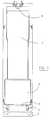
- the device consists of a scintillation cell A made of plastic material of the type "perspex" (registered trademark) with inner walls completely lined with a layer of zinc sulfide.
- Cell A of cylindrical form has a volume of about 100 cm3 (overall dimensions: diameter about 6 cm, height about 5 cm).
- One of the base surfaces of the cylinder is opened and provided with a filter B preventing aerosol from entering the cell and allowing the radon to pass from the outside to the inside of the cell and viceversa.
- the measuremnt is carried out by using a labyrinth device E which can be screwed to the threaded periphery of the filter holder O at the outside of filter B.
- a labyrinth device E which can be screwed to the threaded periphery of the filter holder O at the outside of filter B.
- Such device causes, however, a delay in the measurement.
- water-repellant filters made of teflon
- labyrinth device can be used according to the brightness of the room.
- a multiplier phototube C adapted to zinc sulfide detector and having a diameter of about 53 mm and height not greater than 150 mm is connected to and integral with the cell A.
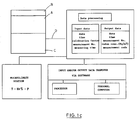
- a programmable microprocessor (Fig. 1C) performing the following functions:
- the instrument is supplied at 220 V - 50 Hz and is provided with buffer batteries to extend its use also to sites without power supply, and is housed into a case suitably protected from dust and rain.
- the device according to the invention has been subjected to several tests.
- the obtained values have been compared with the reference values of the scintillation cells of the firm Eberline which are typically used in the Environment Measuring Laboratory.
- Such tests are aiming at controlling the capacity of the instrument in order to determining its application field.
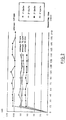
- Fig. 2 the values of four different measuring cycles carried out each at constant concentration are shown. The measurements are expressed in counts per minute (cpm), thus allowing the reproducibility of the measurements within 2-3% to be checked.
- Table 1 below there is shown the average radon concentrations of the four measuring cycles accomplished with cells Eberline and with the diffusion monitoring system of the present invention, respectively.
- Fig. 3 the measurements effected in a radon chamber at the presence of activated carbon are shown.
- the typical effects of the activated carbon such as the absorption and the releasing of the radon have caused the radioactive concentration to vary, thus allowing the diffusion monitor to be subjected to a sensitivity test for short variations of the radioactivity.
- the results show that the instrument follows with optimal precision the dynamic of the variations occurring in a time longer than 15-30 minutes.
- the counts corresponding to the effected measurements are reached by the instrument after a time of 20 minutes (Fig. 4). Accordingly, when the radon concentration is variable, the measurements effected at minimum intervals of 30 minutes are reliable.
- Fig. 5 the respective values measured by means of Eberline's scintillation cells and by the diffusion monitor according to the present invention are compared as far as the theoretical decay curve of the radon within the room is concerned.
- the results point out a greater precision of the diffusion monitor.
- the diffusion instrument and the Eberline cells have a delta varying from 0,04% to 9% and from 3% to 23%, respectively.
- Fig. 6 Two measuring cycles are shown.
- a filter of the Company Sartorius made of water-repellant teflon with a pore diameter of 0,045 m was used.
- the results prove that the first measurement is obtained after 60 minutes with a teflon filter and after 150 minutes, i.e. twice as much, with a microfibre filter.
Landscapes
- Physics & Mathematics (AREA)
- Health & Medical Sciences (AREA)
- Life Sciences & Earth Sciences (AREA)
- General Physics & Mathematics (AREA)
- High Energy & Nuclear Physics (AREA)
- Molecular Biology (AREA)
- Spectroscopy & Molecular Physics (AREA)
- Measurement Of Radiation (AREA)
- Measuring And Recording Apparatus For Diagnosis (AREA)
Applications Claiming Priority (2)
| Application Number | Priority Date | Filing Date | Title |
|---|---|---|---|
| IT3588190U IT220825Z2 (it) | 1990-07-04 | 1990-07-04 | Dispositivo monitore a diffusione per la misura di radon. |
| IT3588190U | 1990-07-04 |
Publications (2)
| Publication Number | Publication Date |
|---|---|
| EP0470054A2 true EP0470054A2 (fr) | 1992-02-05 |
| EP0470054A3 EP0470054A3 (en) | 1993-01-20 |
Family
ID=11243567
Family Applications (1)
| Application Number | Title | Priority Date | Filing Date |
|---|---|---|---|
| EP19910830297 Withdrawn EP0470054A3 (en) | 1990-07-04 | 1991-07-03 | Radon monitoring diffusion device |
Country Status (2)
| Country | Link |
|---|---|
| EP (1) | EP0470054A3 (fr) |
| IT (1) | IT220825Z2 (fr) |
Cited By (4)
| Publication number | Priority date | Publication date | Assignee | Title |
|---|---|---|---|---|
| CN109557263A (zh) * | 2019-01-22 | 2019-04-02 | 南华大学 | 一种电场作用下铀尾砂氡析出试验装置 |
| WO2021099619A1 (fr) * | 2019-11-21 | 2021-05-27 | Radontec Gmbh | Détecteur de rayonnement alpha comportant un capteur optique pour mesurer la concentration de radon dans l'air ambiant |
| CN116429663A (zh) * | 2023-06-08 | 2023-07-14 | 太原理工大学 | 一种测量煤岩介质中氡气渗流速率的装置及方法 |
| EP4471462A1 (fr) * | 2023-06-02 | 2024-12-04 | Corant GmbH | Détecteur de rayons alpha |
Family Cites Families (5)
| Publication number | Priority date | Publication date | Assignee | Title |
|---|---|---|---|---|
| US2883547A (en) * | 1955-11-04 | 1959-04-21 | Isomet Corp | Combined scintillometer and fluorimeter |
| DE2737247C2 (de) * | 1977-08-18 | 1982-06-03 | Herfurth Gmbh, 2000 Hamburg | Einrichtung zum selektiven Messen des in Luft oder sonstigem Gas enthaltenen Jod-129 mit einem Szintillator und einem diesen umgebenden Filter |
| CA1128216A (fr) * | 1979-06-01 | 1982-07-20 | Brian Powell | Echantillonneur et cuve pour detecteurs de radon, et methode d'utilisation |
| DE2926491C2 (de) * | 1979-06-30 | 1983-02-24 | Kernforschungszentrum Karlsruhe Gmbh, 7500 Karlsruhe | Dosimeter zum Nachweis von Radon und/oder Thoron und deren Folgeprodukten |
| US4814608A (en) * | 1986-12-01 | 1989-03-21 | Rad Elec Inc. | Subsoil radioactive gas measuring system |
-
1990
- 1990-07-04 IT IT3588190U patent/IT220825Z2/it active IP Right Grant
-
1991
- 1991-07-03 EP EP19910830297 patent/EP0470054A3/en not_active Withdrawn
Cited By (6)
| Publication number | Priority date | Publication date | Assignee | Title |
|---|---|---|---|---|
| CN109557263A (zh) * | 2019-01-22 | 2019-04-02 | 南华大学 | 一种电场作用下铀尾砂氡析出试验装置 |
| WO2021099619A1 (fr) * | 2019-11-21 | 2021-05-27 | Radontec Gmbh | Détecteur de rayonnement alpha comportant un capteur optique pour mesurer la concentration de radon dans l'air ambiant |
| US12282007B2 (en) | 2019-11-21 | 2025-04-22 | Livair Gmbh | Alpha radiation detector having an optical sensor for measuring the radon concentration in the ambient air |
| EP4471462A1 (fr) * | 2023-06-02 | 2024-12-04 | Corant GmbH | Détecteur de rayons alpha |
| CN116429663A (zh) * | 2023-06-08 | 2023-07-14 | 太原理工大学 | 一种测量煤岩介质中氡气渗流速率的装置及方法 |
| CN116429663B (zh) * | 2023-06-08 | 2023-09-12 | 太原理工大学 | 一种测量煤岩介质中氡气渗流速率的装置及方法 |
Also Published As
| Publication number | Publication date |
|---|---|
| IT220825Z2 (it) | 1993-11-19 |
| EP0470054A3 (en) | 1993-01-20 |
| IT9035881U1 (it) | 1992-01-04 |
| IT9035881V0 (it) | 1990-07-04 |
Similar Documents
| Publication | Publication Date | Title |
|---|---|---|
| Alter et al. | Passive integrating radon monitor for environmental monitoring | |
| Urban et al. | Low level environmental radon dosimetry with a passive track etch detector device | |
| George | State-of-the-art instruments for measuring radon/thoron and their progeny in dwellings-a review | |
| Fleischer et al. | Mapping of integrated radon emanation for detection of long‐distance migration of gases within the Earth: Techniques and principles | |
| Papastefanou | An overview of instrumentantion for measuring radon in soil gas and groundwaters | |
| Jonassen | The determination of radon exhalation rates | |
| Khan et al. | Calibration of a CR-39 plastic track detector for the measurement of radon and its daughters in dwellings | |
| US4800272A (en) | Environmental gamma-ray and radon detector | |
| Wrenn et al. | Design of a continuous digital-output environmental radon monitor | |
| Papastefanou | Measuring radon in soil gas and groundwaters: a review | |
| Speer et al. | An instrument for measuring the liquid water content of aerosols | |
| EP0470054A2 (fr) | Dispositif de contrôle de diffusion au radon | |
| Lucchetti et al. | Using a scale model room to assess the contribution of building material of volcanic origin to indoor radon | |
| Jojo et al. | Interlaboratory calibration of track-etch detectors for the measurement of radon and radon daughter levels | |
| Baskaran | Radon measurement techniques | |
| Neznal et al. | Short-term temporal variations of soil gas radon concentration and comparison of measurement techniques | |
| CN109814144A (zh) | 一种氡和氡子体同步测量及剂量率评价方法 | |
| CN107807380A (zh) | 一种活性炭盒测氡的仪器系数刻度装置及方法 | |
| US7312439B1 (en) | Radon progeny monitor | |
| Tan et al. | Revision for measuring radon exhalation rate in open loop | |
| Chambaudet et al. | Study of the response of silicon detectors for alpha particles | |
| Miles | Methods of radon measurement and devices | |
| Collinson et al. | A scintillation counter for the measurement of radon concentration in air | |
| Ren et al. | A passive integrating indoor radon detector with activated carbon | |
| Tan et al. | A novel method to measure the radon exhalation rate in only one measurement cycle |
Legal Events
| Date | Code | Title | Description |
|---|---|---|---|
| PUAI | Public reference made under article 153(3) epc to a published international application that has entered the european phase |
Free format text: ORIGINAL CODE: 0009012 |
|
| AK | Designated contracting states |
Kind code of ref document: A2 Designated state(s): AT BE CH DE DK ES FR GB GR LI LU NL SE |
|
| PUAL | Search report despatched |
Free format text: ORIGINAL CODE: 0009013 |
|
| AK | Designated contracting states |
Kind code of ref document: A3 Designated state(s): AT BE CH DE DK ES FR GB GR LI LU NL SE |
|
| 17P | Request for examination filed |
Effective date: 19930716 |
|
| 17Q | First examination report despatched |
Effective date: 19941222 |
|
| STAA | Information on the status of an ep patent application or granted ep patent |
Free format text: STATUS: THE APPLICATION IS DEEMED TO BE WITHDRAWN |
|
| 18D | Application deemed to be withdrawn |
Effective date: 19960808 |