EP0470264B1 - Benzoselenazolin-spiro-vinylpyranderivat und darauf basierendes polymer - Google Patents
Benzoselenazolin-spiro-vinylpyranderivat und darauf basierendes polymer Download PDFInfo
- Publication number
- EP0470264B1 EP0470264B1 EP91904455A EP91904455A EP0470264B1 EP 0470264 B1 EP0470264 B1 EP 0470264B1 EP 91904455 A EP91904455 A EP 91904455A EP 91904455 A EP91904455 A EP 91904455A EP 0470264 B1 EP0470264 B1 EP 0470264B1
- Authority
- EP
- European Patent Office
- Prior art keywords
- group
- compound
- formula
- atom
- solution
- Prior art date
- Legal status (The legal status is an assumption and is not a legal conclusion. Google has not performed a legal analysis and makes no representation as to the accuracy of the status listed.)
- Expired - Lifetime
Links
- 150000001875 compounds Chemical class 0.000 title claims abstract description 135
- 229920000642 polymer Polymers 0.000 title description 49
- 125000000449 nitro group Chemical group [O-][N+](*)=O 0.000 claims abstract description 24
- 125000004093 cyano group Chemical group *C#N 0.000 claims abstract description 23
- 125000005843 halogen group Chemical group 0.000 claims abstract description 19
- 125000003710 aryl alkyl group Chemical group 0.000 claims abstract description 18
- 125000003118 aryl group Chemical group 0.000 claims abstract description 13
- 125000003866 trichloromethyl group Chemical group ClC(Cl)(Cl)* 0.000 claims abstract description 11
- 125000002023 trifluoromethyl group Chemical group FC(F)(F)* 0.000 claims abstract description 11
- -1 vinylic compound Chemical class 0.000 claims abstract description 11
- 125000003545 alkoxy group Chemical group 0.000 claims abstract description 9
- 125000004453 alkoxycarbonyl group Chemical group 0.000 claims abstract description 6
- 229910052717 sulfur Chemical group 0.000 claims abstract description 5
- 229920001519 homopolymer Polymers 0.000 claims abstract description 4
- 125000003178 carboxy group Chemical group [H]OC(*)=O 0.000 claims abstract description 3
- 125000003944 tolyl group Chemical group 0.000 claims abstract description 3
- 125000004435 hydrogen atom Chemical group [H]* 0.000 claims description 30
- 125000004432 carbon atom Chemical group C* 0.000 claims description 29
- 125000000217 alkyl group Chemical group 0.000 claims description 22
- 125000002496 methyl group Chemical group [H]C([H])([H])* 0.000 claims description 19
- 239000002904 solvent Substances 0.000 claims description 18
- 125000001997 phenyl group Chemical group [H]C1=C([H])C([H])=C(*)C([H])=C1[H] 0.000 claims description 17
- 238000005227 gel permeation chromatography Methods 0.000 claims description 16
- 125000004430 oxygen atom Chemical group O* 0.000 claims description 13
- WYURNTSHIVDZCO-UHFFFAOYSA-N Tetrahydrofuran Chemical group C1CCOC1 WYURNTSHIVDZCO-UHFFFAOYSA-N 0.000 claims description 10
- 125000004169 (C1-C6) alkyl group Chemical group 0.000 claims description 9
- 125000001424 substituent group Chemical group 0.000 claims description 8
- 125000001495 ethyl group Chemical group [H]C([H])([H])C([H])([H])* 0.000 claims description 7
- 125000004191 (C1-C6) alkoxy group Chemical group 0.000 claims description 6
- WKBOTKDWSSQWDR-UHFFFAOYSA-N Bromine atom Chemical group [Br] WKBOTKDWSSQWDR-UHFFFAOYSA-N 0.000 claims description 6
- 229910052801 chlorine Inorganic materials 0.000 claims description 6
- 125000000956 methoxy group Chemical group [H]C([H])([H])O* 0.000 claims description 6
- 125000001624 naphthyl group Chemical group 0.000 claims description 6
- 229910052731 fluorine Inorganic materials 0.000 claims description 5
- YLQBMQCUIZJEEH-UHFFFAOYSA-N tetrahydrofuran Natural products C=1C=COC=1 YLQBMQCUIZJEEH-UHFFFAOYSA-N 0.000 claims description 5
- 239000004793 Polystyrene Substances 0.000 claims description 4
- 125000001309 chloro group Chemical group Cl* 0.000 claims description 4
- 125000001153 fluoro group Chemical group F* 0.000 claims description 4
- 229920002223 polystyrene Polymers 0.000 claims description 4
- 125000004434 sulfur atom Chemical group 0.000 claims description 4
- 125000001301 ethoxy group Chemical group [H]C([H])([H])C([H])([H])O* 0.000 claims description 3
- 125000004079 stearyl group Chemical group [H]C([*])([H])C([H])([H])C([H])([H])C([H])([H])C([H])([H])C([H])([H])C([H])([H])C([H])([H])C([H])([H])C([H])([H])C([H])([H])C([H])([H])C([H])([H])C([H])([H])C([H])([H])C([H])([H])C([H])([H])C([H])([H])[H] 0.000 claims description 3
- 125000003668 acetyloxy group Chemical group [H]C([H])([H])C(=O)O[*] 0.000 claims description 2
- 125000003917 carbamoyl group Chemical group [H]N([H])C(*)=O 0.000 claims description 2
- 229920001577 copolymer Polymers 0.000 abstract description 19
- 229910052739 hydrogen Inorganic materials 0.000 abstract description 6
- 239000001257 hydrogen Substances 0.000 abstract 2
- 150000002431 hydrogen Chemical class 0.000 abstract 2
- NINIDFKCEFEMDL-UHFFFAOYSA-N Sulfur Chemical group [S] NINIDFKCEFEMDL-UHFFFAOYSA-N 0.000 abstract 1
- QVGXLLKOCUKJST-UHFFFAOYSA-N atomic oxygen Chemical group [O] QVGXLLKOCUKJST-UHFFFAOYSA-N 0.000 abstract 1
- 125000004051 hexyl group Chemical group [H]C([H])([H])C([H])([H])C([H])([H])C([H])([H])C([H])([H])C([H])([H])* 0.000 abstract 1
- 229910052760 oxygen Inorganic materials 0.000 abstract 1
- 239000001301 oxygen Substances 0.000 abstract 1
- 239000011593 sulfur Chemical group 0.000 abstract 1
- 239000000243 solution Substances 0.000 description 152
- OKKJLVBELUTLKV-UHFFFAOYSA-N Methanol Chemical compound OC OKKJLVBELUTLKV-UHFFFAOYSA-N 0.000 description 75
- HEDRZPFGACZZDS-UHFFFAOYSA-N Chloroform Chemical compound ClC(Cl)Cl HEDRZPFGACZZDS-UHFFFAOYSA-N 0.000 description 58
- 230000009102 absorption Effects 0.000 description 49
- 238000010521 absorption reaction Methods 0.000 description 49
- 125000000391 vinyl group Chemical group [H]C([*])=C([H])[H] 0.000 description 28
- IJGRMHOSHXDMSA-UHFFFAOYSA-N Atomic nitrogen Chemical compound N#N IJGRMHOSHXDMSA-UHFFFAOYSA-N 0.000 description 26
- 229920002554 vinyl polymer Polymers 0.000 description 25
- 239000010408 film Substances 0.000 description 22
- ZMXDDKWLCZADIW-UHFFFAOYSA-N N,N-Dimethylformamide Chemical compound CN(C)C=O ZMXDDKWLCZADIW-UHFFFAOYSA-N 0.000 description 21
- 238000002835 absorbance Methods 0.000 description 19
- UHOVQNZJYSORNB-UHFFFAOYSA-N Benzene Chemical compound C1=CC=CC=C1 UHOVQNZJYSORNB-UHFFFAOYSA-N 0.000 description 18
- 239000000203 mixture Substances 0.000 description 17
- 229910052757 nitrogen Inorganic materials 0.000 description 17
- 238000000034 method Methods 0.000 description 16
- RTZKZFJDLAIYFH-UHFFFAOYSA-N Diethyl ether Chemical compound CCOCC RTZKZFJDLAIYFH-UHFFFAOYSA-N 0.000 description 15
- 238000004458 analytical method Methods 0.000 description 15
- NQRYJNQNLNOLGT-UHFFFAOYSA-N Piperidine Chemical compound C1CCNCC1 NQRYJNQNLNOLGT-UHFFFAOYSA-N 0.000 description 14
- 238000010438 heat treatment Methods 0.000 description 13
- 239000000843 powder Substances 0.000 description 13
- IAZDPXIOMUYVGZ-WFGJKAKNSA-N Dimethyl sulfoxide Chemical compound [2H]C([2H])([2H])S(=O)C([2H])([2H])[2H] IAZDPXIOMUYVGZ-WFGJKAKNSA-N 0.000 description 12
- 239000000463 material Substances 0.000 description 12
- QSHDDOUJBYECFT-UHFFFAOYSA-N mercury Chemical compound [Hg] QSHDDOUJBYECFT-UHFFFAOYSA-N 0.000 description 12
- 229910052753 mercury Inorganic materials 0.000 description 12
- 239000002244 precipitate Substances 0.000 description 12
- 239000011541 reaction mixture Substances 0.000 description 12
- 229920002521 macromolecule Polymers 0.000 description 11
- 239000000178 monomer Substances 0.000 description 11
- HEDRZPFGACZZDS-MICDWDOJSA-N Trichloro(2H)methane Chemical compound [2H]C(Cl)(Cl)Cl HEDRZPFGACZZDS-MICDWDOJSA-N 0.000 description 10
- 238000006243 chemical reaction Methods 0.000 description 10
- YPNIGPLVJBUBKQ-UHFFFAOYSA-N 3-ethenyl-2-hydroxy-5-nitrobenzaldehyde Chemical class OC1=C(C=C)C=C([N+]([O-])=O)C=C1C=O YPNIGPLVJBUBKQ-UHFFFAOYSA-N 0.000 description 9
- VVQNEPGJFQJSBK-UHFFFAOYSA-N Methyl methacrylate Chemical compound COC(=O)C(C)=C VVQNEPGJFQJSBK-UHFFFAOYSA-N 0.000 description 9
- YXFVVABEGXRONW-UHFFFAOYSA-N Toluene Chemical compound CC1=CC=CC=C1 YXFVVABEGXRONW-UHFFFAOYSA-N 0.000 description 9
- 238000000862 absorption spectrum Methods 0.000 description 9
- 230000031700 light absorption Effects 0.000 description 9
- CSCPPACGZOOCGX-UHFFFAOYSA-N Acetone Chemical compound CC(C)=O CSCPPACGZOOCGX-UHFFFAOYSA-N 0.000 description 8
- 239000012456 homogeneous solution Substances 0.000 description 8
- 230000003287 optical effect Effects 0.000 description 8
- 238000005160 1H NMR spectroscopy Methods 0.000 description 7
- OZAIFHULBGXAKX-UHFFFAOYSA-N 2-(2-cyanopropan-2-yldiazenyl)-2-methylpropanenitrile Chemical compound N#CC(C)(C)N=NC(C)(C)C#N OZAIFHULBGXAKX-UHFFFAOYSA-N 0.000 description 7
- 238000005481 NMR spectroscopy Methods 0.000 description 7
- 238000005119 centrifugation Methods 0.000 description 7
- 238000005562 fading Methods 0.000 description 7
- 239000007787 solid Substances 0.000 description 7
- ZWEHNKRNPOVVGH-UHFFFAOYSA-N 2-Butanone Chemical compound CCC(C)=O ZWEHNKRNPOVVGH-UHFFFAOYSA-N 0.000 description 6
- IAZDPXIOMUYVGZ-UHFFFAOYSA-N Dimethylsulphoxide Chemical compound CS(C)=O IAZDPXIOMUYVGZ-UHFFFAOYSA-N 0.000 description 6
- LFQSCWFLJHTTHZ-UHFFFAOYSA-N Ethanol Chemical compound CCO LFQSCWFLJHTTHZ-UHFFFAOYSA-N 0.000 description 6
- XEKOWRVHYACXOJ-UHFFFAOYSA-N Ethyl acetate Chemical compound CCOC(C)=O XEKOWRVHYACXOJ-UHFFFAOYSA-N 0.000 description 6
- 238000001914 filtration Methods 0.000 description 6
- JOXIMZWYDAKGHI-UHFFFAOYSA-M toluene-4-sulfonate Chemical compound CC1=CC=C(S([O-])(=O)=O)C=C1 JOXIMZWYDAKGHI-UHFFFAOYSA-M 0.000 description 6
- VYFYELQQECQPHU-UHFFFAOYSA-N 2-methyl-1,3-benzoselenazole Chemical class C1=CC=C2[se]C(C)=NC2=C1 VYFYELQQECQPHU-UHFFFAOYSA-N 0.000 description 5
- 238000007334 copolymerization reaction Methods 0.000 description 5
- 239000013078 crystal Substances 0.000 description 5
- 238000001228 spectrum Methods 0.000 description 5
- KFZMGEQAYNKOFK-UHFFFAOYSA-N Isopropanol Chemical compound CC(C)O KFZMGEQAYNKOFK-UHFFFAOYSA-N 0.000 description 4
- VSCWAEJMTAWNJL-UHFFFAOYSA-K aluminium trichloride Chemical compound Cl[Al](Cl)Cl VSCWAEJMTAWNJL-UHFFFAOYSA-K 0.000 description 4
- 150000001412 amines Chemical class 0.000 description 4
- GRVDJDISBSALJP-UHFFFAOYSA-N methyloxidanyl Chemical compound [O]C GRVDJDISBSALJP-UHFFFAOYSA-N 0.000 description 4
- 239000012299 nitrogen atmosphere Substances 0.000 description 4
- RIOQSEWOXXDEQQ-UHFFFAOYSA-N triphenylphosphine Chemical compound C1=CC=CC=C1P(C=1C=CC=CC=1)C1=CC=CC=C1 RIOQSEWOXXDEQQ-UHFFFAOYSA-N 0.000 description 4
- HVLWUPAPMFBXOF-UHFFFAOYSA-N (3-formyl-2-hydroxy-5-nitrophenyl)methyl-triphenylphosphanium;chloride Chemical class [Cl-].C1=C([N+]([O-])=O)C=C(C=O)C(O)=C1C[P+](C=1C=CC=CC=1)(C=1C=CC=CC=1)C1=CC=CC=C1 HVLWUPAPMFBXOF-UHFFFAOYSA-N 0.000 description 3
- BZYXYGLNJWVQPG-UHFFFAOYSA-N 1,2-benzoselenazole Chemical group C1=CC=C2C=N[se]C2=C1 BZYXYGLNJWVQPG-UHFFFAOYSA-N 0.000 description 3
- VPZKJFJWKLYFQD-UHFFFAOYSA-N 3-(chloromethyl)-2-hydroxy-5-nitrobenzaldehyde Chemical class OC1=C(CCl)C=C([N+]([O-])=O)C=C1C=O VPZKJFJWKLYFQD-UHFFFAOYSA-N 0.000 description 3
- ZCYVEMRRCGMTRW-UHFFFAOYSA-N 7553-56-2 Chemical group [I] ZCYVEMRRCGMTRW-UHFFFAOYSA-N 0.000 description 3
- YMWUJEATGCHHMB-UHFFFAOYSA-N Dichloromethane Chemical compound ClCCl YMWUJEATGCHHMB-UHFFFAOYSA-N 0.000 description 3
- HEMHJVSKTPXQMS-UHFFFAOYSA-M Sodium hydroxide Chemical compound [OH-].[Na+] HEMHJVSKTPXQMS-UHFFFAOYSA-M 0.000 description 3
- ZMANZCXQSJIPKH-UHFFFAOYSA-N Triethylamine Chemical compound CCN(CC)CC ZMANZCXQSJIPKH-UHFFFAOYSA-N 0.000 description 3
- 230000008859 change Effects 0.000 description 3
- 230000003247 decreasing effect Effects 0.000 description 3
- 230000001747 exhibiting effect Effects 0.000 description 3
- 229910052740 iodine Inorganic materials 0.000 description 3
- 239000007788 liquid Substances 0.000 description 3
- VUQUOGPMUUJORT-UHFFFAOYSA-N methyl 4-methylbenzenesulfonate Chemical compound COS(=O)(=O)C1=CC=C(C)C=C1 VUQUOGPMUUJORT-UHFFFAOYSA-N 0.000 description 3
- VLKZOEOYAKHREP-UHFFFAOYSA-N n-Hexane Chemical compound CCCCCC VLKZOEOYAKHREP-UHFFFAOYSA-N 0.000 description 3
- BZMZOJFOPWKCKG-UHFFFAOYSA-N octadecyl 4-chlorobenzenesulfonate Chemical compound CCCCCCCCCCCCCCCCCCOS(=O)(=O)C1=CC=C(Cl)C=C1 BZMZOJFOPWKCKG-UHFFFAOYSA-N 0.000 description 3
- 238000006116 polymerization reaction Methods 0.000 description 3
- 230000008569 process Effects 0.000 description 3
- 239000007858 starting material Substances 0.000 description 3
- 239000010409 thin film Substances 0.000 description 3
- XLYOFNOQVPJJNP-UHFFFAOYSA-N water Substances O XLYOFNOQVPJJNP-UHFFFAOYSA-N 0.000 description 3
- GUMCXNVROROMIG-UHFFFAOYSA-N 2,3,5-trimethyl-1,3-benzoselenazol-3-ium Chemical compound C1=C(C)C=C2[N+](C)=C(C)[se]C2=C1 GUMCXNVROROMIG-UHFFFAOYSA-N 0.000 description 2
- AEGBODVAFYHUOQ-UHFFFAOYSA-N 2,3-dimethyl-1,3-benzoselenazol-3-ium Chemical compound C1=CC=C2[N+](C)=C(C)[se]C2=C1 AEGBODVAFYHUOQ-UHFFFAOYSA-N 0.000 description 2
- HZGFZMGOLYMNGC-UHFFFAOYSA-N 2,5-dimethyl-1,3-benzoselenazole Chemical compound CC1=CC=C2[se]C(C)=NC2=C1 HZGFZMGOLYMNGC-UHFFFAOYSA-N 0.000 description 2
- MGQHDQZSSIQEHY-UHFFFAOYSA-N 2,5-dimethyl-3-octadecyl-1,3-benzoselenazol-3-ium Chemical compound C1=C(C)C=C2[N+](CCCCCCCCCCCCCCCCCC)=C(C)[se]C2=C1 MGQHDQZSSIQEHY-UHFFFAOYSA-N 0.000 description 2
- OISVCGZHLKNMSJ-UHFFFAOYSA-N 2,6-dimethylpyridine Chemical compound CC1=CC=CC(C)=N1 OISVCGZHLKNMSJ-UHFFFAOYSA-N 0.000 description 2
- SMZOUWXMTYCWNB-UHFFFAOYSA-N 2-(2-methoxy-5-methylphenyl)ethanamine Chemical compound COC1=CC=C(C)C=C1CCN SMZOUWXMTYCWNB-UHFFFAOYSA-N 0.000 description 2
- NIXOWILDQLNWCW-UHFFFAOYSA-N 2-Propenoic acid Natural products OC(=O)C=C NIXOWILDQLNWCW-UHFFFAOYSA-N 0.000 description 2
- UFONLSLZAYJKEK-UHFFFAOYSA-N 2-methyl-3-octadecyl-1,3-benzoselenazol-3-ium Chemical compound C1=CC=C2[N+](CCCCCCCCCCCCCCCCCC)=C(C)[se]C2=C1 UFONLSLZAYJKEK-UHFFFAOYSA-N 0.000 description 2
- ZEIALONGOKSYJK-UHFFFAOYSA-N 3-ethenyl-5-nitrobenzaldehyde Chemical class [O-][N+](=O)C1=CC(C=C)=CC(C=O)=C1 ZEIALONGOKSYJK-UHFFFAOYSA-N 0.000 description 2
- XJFCUSDJNKRZHV-UHFFFAOYSA-N 5-methoxy-2,3-dimethyl-1,3-benzoselenazol-3-ium Chemical compound COC1=CC=C2[se]C(C)=[N+](C)C2=C1 XJFCUSDJNKRZHV-UHFFFAOYSA-N 0.000 description 2
- LVIYTMFDCXRSDL-UHFFFAOYSA-N 5-methoxy-2-methyl-1,3-benzoselenazole Chemical compound COC1=CC=C2[se]C(C)=NC2=C1 LVIYTMFDCXRSDL-UHFFFAOYSA-N 0.000 description 2
- OCRZERQHKRIDMJ-UHFFFAOYSA-N 5-methoxy-2-methyl-3-octadecyl-1,3-benzoselenazol-3-ium Chemical compound C1=C(OC)C=C2[N+](CCCCCCCCCCCCCCCCCC)=C(C)[se]C2=C1 OCRZERQHKRIDMJ-UHFFFAOYSA-N 0.000 description 2
- DKPFZGUDAPQIHT-UHFFFAOYSA-N Butyl acetate Natural products CCCCOC(C)=O DKPFZGUDAPQIHT-UHFFFAOYSA-N 0.000 description 2
- ZAMOUSCENKQFHK-UHFFFAOYSA-N Chlorine atom Chemical compound [Cl] ZAMOUSCENKQFHK-UHFFFAOYSA-N 0.000 description 2
- XJUZRXYOEPSWMB-UHFFFAOYSA-N Chloromethyl methyl ether Chemical compound COCCl XJUZRXYOEPSWMB-UHFFFAOYSA-N 0.000 description 2
- CERQOIWHTDAKMF-UHFFFAOYSA-N Methacrylic acid Chemical compound CC(=C)C(O)=O CERQOIWHTDAKMF-UHFFFAOYSA-N 0.000 description 2
- 229930040373 Paraformaldehyde Natural products 0.000 description 2
- GLUUGHFHXGJENI-UHFFFAOYSA-N Piperazine Chemical compound C1CNCCN1 GLUUGHFHXGJENI-UHFFFAOYSA-N 0.000 description 2
- JUJWROOIHBZHMG-UHFFFAOYSA-N Pyridine Chemical compound C1=CC=NC=C1 JUJWROOIHBZHMG-UHFFFAOYSA-N 0.000 description 2
- PPBRXRYQALVLMV-UHFFFAOYSA-N Styrene Chemical compound C=CC1=CC=CC=C1 PPBRXRYQALVLMV-UHFFFAOYSA-N 0.000 description 2
- 150000003935 benzaldehydes Chemical class 0.000 description 2
- 238000009835 boiling Methods 0.000 description 2
- GDTBXPJZTBHREO-UHFFFAOYSA-N bromine Substances BrBr GDTBXPJZTBHREO-UHFFFAOYSA-N 0.000 description 2
- 229910052794 bromium Inorganic materials 0.000 description 2
- 239000003054 catalyst Substances 0.000 description 2
- 239000000460 chlorine Substances 0.000 description 2
- 229940061627 chloromethyl methyl ether Drugs 0.000 description 2
- 239000011521 glass Substances 0.000 description 2
- FUZZWVXGSFPDMH-UHFFFAOYSA-M hexanoate Chemical compound CCCCCC([O-])=O FUZZWVXGSFPDMH-UHFFFAOYSA-M 0.000 description 2
- 239000011630 iodine Substances 0.000 description 2
- 238000002844 melting Methods 0.000 description 2
- 230000008018 melting Effects 0.000 description 2
- 239000003960 organic solvent Substances 0.000 description 2
- 229920002866 paraformaldehyde Polymers 0.000 description 2
- 239000003505 polymerization initiator Substances 0.000 description 2
- 238000002360 preparation method Methods 0.000 description 2
- 230000002035 prolonged effect Effects 0.000 description 2
- BDERNNFJNOPAEC-UHFFFAOYSA-N propan-1-ol Chemical compound CCCO BDERNNFJNOPAEC-UHFFFAOYSA-N 0.000 description 2
- 238000003756 stirring Methods 0.000 description 2
- 239000000126 substance Substances 0.000 description 2
- 239000000758 substrate Substances 0.000 description 2
- FVQMJJQUGGVLEP-UHFFFAOYSA-N (2-methylpropan-2-yl)oxy 2-ethylhexaneperoxoate Chemical compound CCCCC(CC)C(=O)OOOC(C)(C)C FVQMJJQUGGVLEP-UHFFFAOYSA-N 0.000 description 1
- 125000004178 (C1-C4) alkyl group Chemical group 0.000 description 1
- 125000004209 (C1-C8) alkyl group Chemical group 0.000 description 1
- SSUJUUNLZQVZMO-UHFFFAOYSA-N 1,2,3,4,8,9,10,10a-octahydropyrimido[1,2-a]azepine Chemical compound C1CCC=CN2CCCNC21 SSUJUUNLZQVZMO-UHFFFAOYSA-N 0.000 description 1
- XGINAUQXFXVBND-UHFFFAOYSA-N 1,2,6,7,8,8a-hexahydropyrrolo[1,2-a]pyrimidine Chemical compound N1CC=CN2CCCC21 XGINAUQXFXVBND-UHFFFAOYSA-N 0.000 description 1
- IHFRMUGEILMHNU-UHFFFAOYSA-N 2-hydroxy-5-nitrobenzaldehyde Chemical compound OC1=CC=C([N+]([O-])=O)C=C1C=O IHFRMUGEILMHNU-UHFFFAOYSA-N 0.000 description 1
- RCLDZSWPYXNELQ-UHFFFAOYSA-N 3-ethenyl-5-nitro-2-sulfanylbenzaldehyde Chemical class [O-][N+](=O)C1=CC(C=C)=C(S)C(C=O)=C1 RCLDZSWPYXNELQ-UHFFFAOYSA-N 0.000 description 1
- GMVPRGQOIOIIMI-DODZYUBVSA-N 7-[(1R,2R,3R)-3-hydroxy-2-[(3S)-3-hydroxyoct-1-enyl]-5-oxocyclopentyl]heptanoic acid Chemical compound CCCCC[C@H](O)C=C[C@H]1[C@H](O)CC(=O)[C@@H]1CCCCCCC(O)=O GMVPRGQOIOIIMI-DODZYUBVSA-N 0.000 description 1
- HRPVXLWXLXDGHG-UHFFFAOYSA-N Acrylamide Chemical compound NC(=O)C=C HRPVXLWXLXDGHG-UHFFFAOYSA-N 0.000 description 1
- NLHHRLWOUZZQLW-UHFFFAOYSA-N Acrylonitrile Chemical compound C=CC#N NLHHRLWOUZZQLW-UHFFFAOYSA-N 0.000 description 1
- 239000004342 Benzoyl peroxide Substances 0.000 description 1
- OMPJBNCRMGITSC-UHFFFAOYSA-N Benzoylperoxide Chemical compound C=1C=CC=CC=1C(=O)OOC(=O)C1=CC=CC=C1 OMPJBNCRMGITSC-UHFFFAOYSA-N 0.000 description 1
- 0 CC(*1)C(O)=CC(*)=C1N Chemical compound CC(*1)C(O)=CC(*)=C1N 0.000 description 1
- 239000004215 Carbon black (E152) Substances 0.000 description 1
- XTHFKEDIFFGKHM-UHFFFAOYSA-N Dimethoxyethane Chemical compound COCCOC XTHFKEDIFFGKHM-UHFFFAOYSA-N 0.000 description 1
- PXGOKWXKJXAPGV-UHFFFAOYSA-N Fluorine Chemical compound FF PXGOKWXKJXAPGV-UHFFFAOYSA-N 0.000 description 1
- VEXZGXHMUGYJMC-UHFFFAOYSA-N Hydrochloric acid Chemical compound Cl VEXZGXHMUGYJMC-UHFFFAOYSA-N 0.000 description 1
- NTIZESTWPVYFNL-UHFFFAOYSA-N Methyl isobutyl ketone Chemical compound CC(C)CC(C)=O NTIZESTWPVYFNL-UHFFFAOYSA-N 0.000 description 1
- UIHCLUNTQKBZGK-UHFFFAOYSA-N Methyl isobutyl ketone Natural products CCC(C)C(C)=O UIHCLUNTQKBZGK-UHFFFAOYSA-N 0.000 description 1
- RJUFJBKOKNCXHH-UHFFFAOYSA-N Methyl propionate Chemical compound CCC(=O)OC RJUFJBKOKNCXHH-UHFFFAOYSA-N 0.000 description 1
- CTQNGGLPUBDAKN-UHFFFAOYSA-N O-Xylene Chemical compound CC1=CC=CC=C1C CTQNGGLPUBDAKN-UHFFFAOYSA-N 0.000 description 1
- XTXRWKRVRITETP-UHFFFAOYSA-N Vinyl acetate Chemical compound CC(=O)OC=C XTXRWKRVRITETP-UHFFFAOYSA-N 0.000 description 1
- 239000003513 alkali Substances 0.000 description 1
- XYLMUPLGERFSHI-UHFFFAOYSA-N alpha-Methylstyrene Chemical compound CC(=C)C1=CC=CC=C1 XYLMUPLGERFSHI-UHFFFAOYSA-N 0.000 description 1
- 150000001408 amides Chemical class 0.000 description 1
- 239000007864 aqueous solution Substances 0.000 description 1
- 239000002585 base Substances 0.000 description 1
- 235000019400 benzoyl peroxide Nutrition 0.000 description 1
- 239000011230 binding agent Substances 0.000 description 1
- 238000007796 conventional method Methods 0.000 description 1
- 238000001816 cooling Methods 0.000 description 1
- 230000008021 deposition Effects 0.000 description 1
- LSXWFXONGKSEMY-UHFFFAOYSA-N di-tert-butyl peroxide Chemical compound CC(C)(C)OOC(C)(C)C LSXWFXONGKSEMY-UHFFFAOYSA-N 0.000 description 1
- SBZXBUIDTXKZTM-UHFFFAOYSA-N diglyme Chemical compound COCCOCCOC SBZXBUIDTXKZTM-UHFFFAOYSA-N 0.000 description 1
- HPYNZHMRTTWQTB-UHFFFAOYSA-N dimethylpyridine Natural products CC1=CC=CN=C1C HPYNZHMRTTWQTB-UHFFFAOYSA-N 0.000 description 1
- 238000001035 drying Methods 0.000 description 1
- 230000000694 effects Effects 0.000 description 1
- 239000003759 ester based solvent Substances 0.000 description 1
- 239000004210 ether based solvent Substances 0.000 description 1
- 238000000605 extraction Methods 0.000 description 1
- 239000000706 filtrate Substances 0.000 description 1
- 239000011737 fluorine Substances 0.000 description 1
- 150000004795 grignard reagents Chemical class 0.000 description 1
- 229930195733 hydrocarbon Natural products 0.000 description 1
- 150000002430 hydrocarbons Chemical class 0.000 description 1
- 230000007062 hydrolysis Effects 0.000 description 1
- 238000006460 hydrolysis reaction Methods 0.000 description 1
- 239000003999 initiator Substances 0.000 description 1
- 230000001678 irradiating effect Effects 0.000 description 1
- 239000005453 ketone based solvent Substances 0.000 description 1
- 238000004519 manufacturing process Methods 0.000 description 1
- 238000005259 measurement Methods 0.000 description 1
- 229910000000 metal hydroxide Inorganic materials 0.000 description 1
- 150000004692 metal hydroxides Chemical class 0.000 description 1
- 229940017219 methyl propionate Drugs 0.000 description 1
- 239000012452 mother liquor Substances 0.000 description 1
- 229940088644 n,n-dimethylacrylamide Drugs 0.000 description 1
- PHWISQNXPLXQRU-UHFFFAOYSA-N n,n-dimethylcarbamothioyl chloride Chemical compound CN(C)C(Cl)=S PHWISQNXPLXQRU-UHFFFAOYSA-N 0.000 description 1
- YLGYACDQVQQZSW-UHFFFAOYSA-N n,n-dimethylprop-2-enamide Chemical compound CN(C)C(=O)C=C YLGYACDQVQQZSW-UHFFFAOYSA-N 0.000 description 1
- 150000002894 organic compounds Chemical class 0.000 description 1
- 150000002978 peroxides Chemical class 0.000 description 1
- 238000005191 phase separation Methods 0.000 description 1
- ANRQGKOBLBYXFM-UHFFFAOYSA-M phenylmagnesium bromide Chemical compound Br[Mg]C1=CC=CC=C1 ANRQGKOBLBYXFM-UHFFFAOYSA-M 0.000 description 1
- 239000003495 polar organic solvent Substances 0.000 description 1
- 238000001556 precipitation Methods 0.000 description 1
- HJWLCRVIBGQPNF-UHFFFAOYSA-N prop-2-enylbenzene Chemical compound C=CCC1=CC=CC=C1 HJWLCRVIBGQPNF-UHFFFAOYSA-N 0.000 description 1
- 238000000746 purification Methods 0.000 description 1
- UMJSCPRVCHMLSP-UHFFFAOYSA-N pyridine Natural products COC1=CC=CN=C1 UMJSCPRVCHMLSP-UHFFFAOYSA-N 0.000 description 1
- 239000010453 quartz Substances 0.000 description 1
- 239000007870 radical polymerization initiator Substances 0.000 description 1
- 150000003254 radicals Chemical class 0.000 description 1
- 239000000376 reactant Substances 0.000 description 1
- 230000035484 reaction time Effects 0.000 description 1
- 230000008707 rearrangement Effects 0.000 description 1
- 230000009467 reduction Effects 0.000 description 1
- 229920005989 resin Polymers 0.000 description 1
- 239000011347 resin Substances 0.000 description 1
- SMQUZDBALVYZAC-UHFFFAOYSA-N salicylaldehyde Chemical class OC1=CC=CC=C1C=O SMQUZDBALVYZAC-UHFFFAOYSA-N 0.000 description 1
- 238000000926 separation method Methods 0.000 description 1
- 238000007086 side reaction Methods 0.000 description 1
- VYPSYNLAJGMNEJ-UHFFFAOYSA-N silicon dioxide Inorganic materials O=[Si]=O VYPSYNLAJGMNEJ-UHFFFAOYSA-N 0.000 description 1
- IMNIMPAHZVJRPE-UHFFFAOYSA-N triethylenediamine Chemical compound C1CN2CCN1CC2 IMNIMPAHZVJRPE-UHFFFAOYSA-N 0.000 description 1
- FIQMHBFVRAXMOP-UHFFFAOYSA-N triphenylphosphane oxide Chemical compound C=1C=CC=CC=1P(C=1C=CC=CC=1)(=O)C1=CC=CC=C1 FIQMHBFVRAXMOP-UHFFFAOYSA-N 0.000 description 1
- 239000008096 xylene Substances 0.000 description 1
Classifications
-
- C—CHEMISTRY; METALLURGY
- C07—ORGANIC CHEMISTRY
- C07D—HETEROCYCLIC COMPOUNDS
- C07D517/00—Heterocyclic compounds containing in the condensed system at least one hetero ring having selenium, tellurium, or halogen atoms as ring hetero atoms
- C07D517/02—Heterocyclic compounds containing in the condensed system at least one hetero ring having selenium, tellurium, or halogen atoms as ring hetero atoms in which the condensed system contains two hetero rings
- C07D517/10—Spiro-condensed systems
-
- G—PHYSICS
- G03—PHOTOGRAPHY; CINEMATOGRAPHY; ANALOGOUS TECHNIQUES USING WAVES OTHER THAN OPTICAL WAVES; ELECTROGRAPHY; HOLOGRAPHY
- G03C—PHOTOSENSITIVE MATERIALS FOR PHOTOGRAPHIC PURPOSES; PHOTOGRAPHIC PROCESSES, e.g. CINE, X-RAY, COLOUR, STEREO-PHOTOGRAPHIC PROCESSES; AUXILIARY PROCESSES IN PHOTOGRAPHY
- G03C1/00—Photosensitive materials
- G03C1/685—Compositions containing spiro-condensed pyran compounds or derivatives thereof, as photosensitive substances
Definitions
- the present invention relates to a benzoselenazolino-vinylspiropyran compound and polymers prepared from the compound.
- Spiropyran derivatives are best known as typical organic compounds reversibly becoming colored or colorless depending on the light or heat energy condition. Specific examples of these derivatives and physical characteristics thereof are summarized, for example, in G. H. Brown: Photochromism (John Wiley & Sons, Inc., 1971).
- the so-far known spiropyran derivatives have drawbacks; for instance (1) colored species (or uncolored species), in solutions as well as in macromolecular binders, are lacking in light or heat stability and therefore immediately return to the colorless state (or colored state); (2) in the course of repeated color change (recording and erasing) under the influence of light and heat, the spiropyran derivatives are decomposed or degraded due to side reactions arising from the light irradiation, hence can not have satisfactory repetition cycles; (3) while, for use as photochromic media, the spiropyran derivatives are generally dispersed in macromolecular substances, the spiropyran derivatives are exuded from the macromolecular substances or have poor compatibility with the macromolecular substances, so that the derivatives may be undergo phase separation to give deposits.
- drawbacks for instance (1) colored species (or uncolored species), in solutions as well as in macromolecular binders, are lacking in light or heat stability and therefore immediately return to the colorless state (or
- An object of the present invention is to provide a novel vinylspiropyran compound useful for readily preparing macromolecular spiropyran compounds which overcome the aforementioned drawbacks of the prior art photochromic materials.
- Another object of the present invention is to provide a polymer obtained from the foregoing vinylspiropyran compound.
- the present invention provides a benzoselenazolino-vinylspiropyran compound represented by the following formula (Ia) wherein R1 is an alkyl group having 1 to 20 carbon atoms or an aralkyl group; R, R3, R4 and R5 are the same or different and each represents a hydrogen atom, an alkyl group having 1 to 6 carbon atoms, an aryl group, an aralkyl group, an alkoxy group having 1 to 5 carbon atoms, a halogen atom, a cyano group, a trichloromethyl group, a trifluoromethyl group or a nitro group; R6 and R7 are the same or different and each represents a hydrogen atom, an alkyl group having 1 to 6 carbon atoms, an aryl group, an aralkyl group, a halogen atom, a cyano group or a nitro group; and X is an oxygen atom or a sulfur atom.
- R1 is an
- the compound represented by the formula (Ia) of the present invention is a novel compound which has never been heretofore disclosed in the literature and which can be expected to be utilizable in such fields as high-density photo-recording materials, optical filters, image-forming materials, photosensitive materials, nonlinear optical devices, and conversion of light energy to mechanical energy.
- a polymer which is obtained by dissolving the compound in an appropriate macromolecular compound or copolymerizing the compound with an optional polymerizable compound is uniformly applied to a substrate such as a glass material, whereby optical disk and like high-density recording media can be produced by a conventional procedure.
- a macromolecular spiropyran compound which has a desired structure and a desired spiropyran group content can be formed by homopolymerizing the compound represented by the formula (Ia) or by copolymerizing this compound with an appropriate polymerizable compound.
- the present invention also provides a polymer of a benzoselenazolino-vinylspiropyran compound which is characterized by comprising
- the compound of the formula (Ia) of the present invention is designed for obviating the aforemetioned drawbacks of the prior art spiropyran derivatives.
- the compound of the formula (Ia) of the invention can be polymerized because the compound has a polymerizable vinyl group, whereby the compound is expected to have, for example, the following advantages in items (1) and (2):
- the compounds of the present invention are chemically bonded to one another through polymer chains, whereby the structure and/or such performance characteristic as polarity, viscosity or solubility can be controlled photoreversibly.
- the compounds of the formula (Ia) of the invention are characterized in that the compounds are benzoselenazolino-spirobenzopyran compounds or benzoselenazolino-spirobenzothiopyran compounds and that the compounds each have a polymerizable vinyl group in the 8' position of the spirobenzopyran skeleton or spirobenzothiopyran skeleton.
- Spiropyran compounds each having a polymerizable substituent at the side chain and the polymers thereof are disclosed, for example, in Nippon Kagaku Kaishi, 1323 (1972), J. Polym. Sci. Polym. Chem. Ed., 12 , 2511 (1974), and Japanese Unexamined Patent Publications Nos. 88895/1978, 227972/1984 and 76490/1986.
- these compounds and the polymers are all indolino- or benzothiazolino-spiropyran compounds and the polymers thereof, and are different in chemical structure from the compounds of the formula (Ia) of the invention and the polymers obtained therefrom.
- the compounds of the formula (Ia) of the invention are normally (at room temperature) colored, become colorless upon visible light irradiation, and return to the original colored species upon ultraviolet irradiation or heating, thus exhibiting the so-called "negative" photochromism.
- the benzoselenazolino-spiropyran compound having a vinyl group in the 8' position according to the invention is markedly large in molecular absorption coefficient (a value of ⁇ ) as compared with the compounds of the following formula (A) each of which is unsubstituted in 8' position, and therefore has a sufficient strength of color even at a low concentration thereof.
- R1, R, R3, R4, R5, R6 and R7 are as defined above.
- the compounds of the formula (Ia) of the invention are very high in durability in the case of repeated color change under the influence of light or heat and light. Furthermore, using the compounds of the invention, the fixation of the uncolored state (unstable system) or the shift from the uncolored state to the colored state can be controlled by adjustment of temperature.
- the aralkyl group is a phenyl-C1-C6 alkyl group which may optionally have, on its benzene ring, one to five, preferably one, two or three, substituents selected from the group consisting of C1-C6 alkyl group, C1-C6 alkoxy group, halogen atom, cyano group, trichloromethyl group, trifluoromethyl group and nitro group.
- the aryl group is a phenyl group and a naphthyl group which may have one to five, preferably one, two or three, substituents selected from the group consisting of C1-C6 alkyl group, C1-C6 alkoxy group, halogen atom, cyano group, trichloromethyl group, trifluoromethyl group and nitro group.
- substituents selected from the group consisting of C1-C6 alkyl group, C1-C6 alkoxy group, halogen atom, cyano group, trichloromethyl group, trifluoromethyl group and nitro group.
- the halogen atom are a fluorine atom, a chlorine atom, a bromine atom, an iodine atom, etc.
- R1 is an alkyl group having 1 to 20 carbon atoms
- R, R3, R4 and R5 are the same or different and each represents a hydrogen atom, a methyl group, an ethyl group, a phenyl group, a methoxyphenyl group, a methoxy group, an ethoxy group, a fluorine atom, a chlorine atom, a bromine atom, a cyano group or a nitro group
- R6 and R7 are the same or different and each represents a hydrogen atom, a methyl group, an ethyl group, a phenyl group or a naphthyl group
- X is an oxygen atom.
- More preferable compounds are those wherein R1 is an alkyl group having 1 to 18 carbon atoms, each of R, R5, R6 and R7 is a hydrogen atom, each of R3 and R4 is a hydrogen atom, an alkyl group having 1 to 6 carbon atoms or an alkoxy group having 1 to 5 carbon atoms, and X is an oxygen atom, especially those wherein R1 is a methyl group or an octadecyl group, R, R3, R5, R6 and R7 are hydrogen atoms, R4 is a hydrogen atom, a methyl group or a methoxy group, and X is an oxygen atom.
- the compound of the formula (Ia) according to the invention can be readily prepared by condensing a quaternary benzoselenazolenium salt derivative represented by the formula (III) with a 5-nitro-3-vinylbenzaldehyde derivative represented by the formula (IV) in the presence of an amine catalyst.
- R1, R, R3, R4, R5, R6, R7 and X are as defined above
- A is a chlorine, bromine, iodine or like halogen atom or R8SO3 group, etc.
- R8 in the group R8SO3 is a methyl group, an ethyl group or like lower alkyl group, or a phenyl group which may optionally have fluorine, chlorine, bromine, iodine or like halogen atom or C1-C4 alkyl group as the substituent.
- the quaternary benzoselenazolenium salt derivative of the formula (III) which is used as a starting material can be prepared by reacting the corresponding 2-methylbenzoselenazole derivative with at least one mole, preferably 1.05 to 1.5 moles, per mole of the 2-methylbenzoselenazole derivative, of the compound represented by the formula R1A (wherein R1 and A are as defined above) in a solvent such as chloroform in a sealed tube at a temperature of about 50 to about 150°C for about 10 to about 48 hours.
- the 2-methylbenzoselenazole derivative is a known compound set forth in, for example, Ber. 46 , 94 (1913), J. Amer. Chem. Soc., 68 1536 (1946) or British Patent No. 1411957 (1975), or can be prepared by any one of the processes disclosed in these publications.
- the 5-nitro-3-vinylbenzaldehyde derivative of the formula (IV) can be prepared by, for example, the process described in Japanese Unexamined Patent Publication No. 76490/1986. Stated more specifically, first, a salicylaldehyde derivative represented by the formula (V) wherein R6 and R7 are as defined above, (this derivative is a known compound disclosed in Beil.
- the compound of the formula (VI) is reacted with about 0.9 to about 1.1 moles, per mole of the compound of the formula (VI), of triphenylphosphine in a solvent such as benzene, toluene or the like at room temperature to around the boiling point of the solvent used for about 2 to about 24 hours, giving a 3-formyl-2-hydroxy-5-nitrobenzyltriphenyl-phosphonium chloride derivative represented by the formula (VII) wherein R6 and R7 are as defined above.
- the compound thus obtained is heated in a solvent such as methanol, ethanol, isopropanol, dimethylformamide, dimethylsulfoxide at about 50 to about 100°C for about 1 to about 24 hours for rearrangement, giving a 2-S-(N,N-dimethylthiocarbamoyl)benzaldehyde derivative represented by the formula (X) wherein R6 and R7 are as defined above, and the compound thus obtained is subjected to alkali hydrolysis in a solvent such as methanol, ethanol or isopropanol at about 0 to about 50°C for about 1 to about 120 minutes.
- a solvent such as methanol, ethanol, isopropanol, dimethylformamide, dimethylsulfoxide
- the aforementioned reaction between the quaternary benzoselenazolenium salt derivative of the formula (III) and the 5-nitro-3-vinylsalicylaldehyde derivative or 5-nitro-3-vinylthiosalicylaldehyde derivative of the formula (IV) can be conducted by dissolving both the reactants in an appropriate solvent, adding an amine to the solution and heating the resulting mixture at a temperature between room temperature and the boiling point of the solvent for about 1 to about 24 hours.
- a suitable amount of the compound of the formula (III) is about 0.9 to about 1.1 moles per mole of the compound of the formula (IV).
- the solvent mentioned above may be any of those solvents which can dissolve both of the compounds of the formulas (III) and (IV), for example methanol, acetone, methyl ethyl ketone, ethyl acetate, butyl acetate, dichloromethane, dimethylformamide, etc.
- useful amine are piperidine, piperazine, morphorine, triethylamine, pyridine, lutidine, 1,4-diazabicyclo[2,2,2]octane, 1,5-diazabicyclo[4,3,0]nonene, 1,8-diazabicyclo[5,4,0]undecene, etc.
- a suitable amount of the amine is about 1 to about 10 moles per mole of the compound of the formula (III).
- the spiropyran compound of the formula (Ia) of the invention exhibits "negative" photochromism and therefore can be per se utilized for recording materials, photosensitive materials, optical filters, ornamental materials and the like by the same method as disclosed in the foregoing Japanese Unexamined Patent publications Nos. 88895/1978, 227972/1984, 76490/1986, etc.
- the compound of the formula (Ia) of the invention can be polymerized by itself or copolymerized with another polymerizable compound to produce macromolecular spiropyran compounds which can be applied to use as optical devices or photomechanical devices.
- the polymer thus obtained comprises 0.001 to 100 mole % of a structural unit of the formula (I) wherein R1, R, R3, R4, R5, R6, R7 and X are as defined above, and 0 to 99.999 mole % of a structural unit of the formula wherein Y and Z are as defined above.
- the polymer of the benzoselenazolino-vinylspiropyran compound of the invention is a compound which exhibits photochromism.
- a spiropyran skeleton has been introduced into a polymer chain through chemical bonding.
- the macromolecular compounds of the invention are compounds which can be utilized in such fields as high-density photo-recording materials, optical filters, image-forming materials, photosensitive materials, nonlinear optical devices, conversion of light energy to mechanical energy and ornamental materials in the same manner as disclosed in the foregoing Japanese Unexamined Patent Publications Nos. 88895/1978, 227972/1984 and 76490/1986.
- the macromolecular compound of the invention is uniformly applied to a glass or like substrate, whereby high-density recording media such as optical disk can be produced by a conventional method.
- the above macromolecular compounds of the invention are normally (at room temperature) colored, become colorless upon visible light irradiation, and return to the original colored species upon ultraviolet light irradiation or heating or standing in the dark, thus exhibiting the so-called "negative" photochromism.
- colorless species (unstable system) of the above macromolecular benzoselenazolino-vinylspiropyran compound of the invention have much improved stability and much prolonged life as compared with the monomer of the formula (Ia).
- the alkoxy moiety of the alkoxycarbonyl group represented by Z is, for example, of about 1 to about 8 carbon atoms.
- Preferred as the structural unit of the formula (II) is the one in which Y is a hydrogen atom or a methyl group and Z is a lower alkoxycarbonyl group, a cyano group or a phenyl group.
- GPC gel permeation chromatography
- the polymer of the invention may be either homopolymers consisting of the structural unit of the formula (I) alone or copolymers comprising the structural unit of the formula (I) and the structural unit of the formula (II).
- the spiropyran structural unit of the formula (I) should be present in said copolymers in an amount of at least 0.001 mole %, especially about 0.001 to about 50 mole %, preferably about 0.01 to about 25 mole %, more preferably about 0.1 to about 10 mole %, with the balance accounting for the structural unit of the formula (II), since the desired photochromism can not be attained when the content of the spiropyran structural unit of the formula (I) is too small.
- the compounds of the present invention are prepared by homopolymerization of the benzoselenazolino-vinylspiropyran compound of the formula (Ia) which formula corresponds to the structural unit of the formula (I), or copolymerization of said compound of the formula (Ia) with a polymerizable vinyl monomer represented by the formula (IIa) wherein Y and Z are as defined above, which formula corresponds to the structural unit of the formula (II).
- the vinyl monomer of the above formula (IIa) includes known ones only.
- the above-mentioned homopolymerization and copolymerization can be carried out in the same manner and under the same conditions as the synthetic reactions for conventional vinyl resins and the like.
- the monomeric compound of the formula (Ia) is dissolved, either alone or together with the compound of the formula (IIa), in an organic solvent and heating the solution in the presence of a radical polymerization initiator at a temperature of about 50 to about 100°C with stirring.
- the reaction time is usually about 1 to about 150 hours.
- organic solvent Usable as the organic solvent are those which are inert to the monomer(s) used and the polymer obtained, for example polar organic solvents of the amide type such as N,N-dimethylformamide and the like, ether solvents such as diethyl ether, tetrahydrofuran, dimethoxyethane, diglyme and the like, hydrocarbon solvents such as benzene, toluene, xylene and the like, ester solvents such as ethyl acetate, butyl acetate, methyl propionate and the like, ketone solvents such as acetone, methyl ethyl ketone, methyl isobutyl ketone and the like, etc.
- polar organic solvents of the amide type such as N,N-dimethylformamide and the like
- ether solvents such as diethyl ether, tetrahydrofuran, dimethoxyethane, diglyme and the like
- the radical initiator may be any of those commonly used and includes, as typical examples, peroxides such as benzoyl peroxide, di-t-butyl peroxide, t-butyl peroxy-2-ethylhexanoate and the like, azo compounds such as azobisisobutyronitrile, azobisdimethylvaleronitrile and the like, Grignard reagents such as phenylmagnesium bromide and the like, etc.
- peroxides such as benzoyl peroxide, di-t-butyl peroxide, t-butyl peroxy-2-ethylhexanoate and the like
- azo compounds such as azobisisobutyronitrile, azobisdimethylvaleronitrile and the like
- Grignard reagents such as phenylmagnesium bromide and the like, etc.
- the proportions of both structural units in the copolymer is determined by such factors as the charge ratio between the benzoselenazolino-vinylspiropyran compound of the formula (Ia) and the vinyl compound of the formula (IIa) and the method of copolymerization. Therefore, if the relevant relationship is determined in advance with such factors as parameters, the copolymer can be readily produced with a desired copolymerization ratio.
- the thus-produced macromolecular vinylspirobenzopyran compound of the invention can be isolated by a conventional procedure.
- the reaction mixture after completion of the polymerization reaction is added dropwise to a poor solvent for the polymer such as methanol, ether or the like to cause precipitation of said compound as a solid.
- Said solid can be collected by filtration, for instance.
- the macromolecular benzoselenazolino-vinylspiropyran compound obtained above and the monomer of the formula (Ia) as the starting material are both stably colored at normal temperatures and become colorless (metastable state) upon visible light irradiation, thus exhibiting the so-called "negative" photochromism.
- the macromolecular benzoselenazolino-vinylspiropyran compound of the invention is characterized in that the colorless species (metastable state) of the compound have much improved stability and much prolonged life as compared with the monomer of the formula (Ia).
- Figs. 1 and 2 each show visible light absorption spectra measured at 3- or 2-minute intervals after completion of visible light irradiation of each solution of the compound of the invention in chloroform obtained in Examples 1 and 2, respectively until the coloration reaches equilibrium.
- Fig. 3 shows a visible light absorption spectrum measured at the time when the coloration of the compound of the invention obtained in Example 3 reaches equilibrium.
- Figs. 1 and 2 designated (1) is a spectrum measured by starting the measurement immediately after the solution is made colorless by the visible light irradiation; and designated (2) is a spectrum measured at the time when the coloration reaches equilibrium.
- Fig. 4 shows a visible light absorption spectrum measured at the time when the coloration reaches equilibrium after making a solution of the polymer of the invention in chloroform obtained in Example 7 colorless and transparent by visible light irradiation and allowing the solution to return to its colored state by standing the solution at 25°C.
- Fig. 5 shows visible light absorption spectra at room temperature of the film of the polymer according to the invention obtained in Example 9.
- designated (1) is the spectrum just after film manufacture; designated (2) is the spectrum immediately after completion of visible light irradiation; and designated (3) is the spectrum at the time when, after gradual coloration following visible light irradiation, no further coloration is eventually observable (fixation of the colorless species has been achieved).
- Reference Examples 1 to 9 indicate the examples of the preparation of benzoselenazolino-vinylspiropyran compound (monomer) represented by the foregoing formula (Ia).
- the photochromic properties of the compound obtained above in Example 1 were determined.
- a solution of this compound in chloroform which was obtained by dissolving 26 mg of the compound per liter of chloroform was transparent deep blue at room temperature and had an absorption maximum at 598 nm.
- the solution was irradiated with visible rays for 2 minutes with use of a 500-W ultra-high pressure mercury lamp equipped with a cut-off filter allowing passage of visible rays not shorter than 500 nm in wavelength, the initially observed absorption maximum peak disappeared and the solution became colorless and transparent.
- this solution already became blue one minute later, and turned deep blue again within a period of one hour.
- Visible light absorption spectra were measured at 3-minute intervals over a period of about one hour immediately after the visible light irradiation until the colored state reached equilibrium, with the results shown in Fig. 1.
- Example 2 The photochromic properties of the compound obtained above in Example 2 were determined.
- this solution was irradiated with visible rays in the same manner as in Example 1, the initially observed absorption maximum peak disappeared and the solution became colorless and transparent.
- This solution gradually became colored at 26°C, and turned deep blue again when maintained at the same temperature for about 1 hour.
- Visible light absorption spectra were determined at 2-minute intervals over a period of about 1 hour immediately after completion of the visible light irradiation until the colored state reached equilibrium with the results shown in Fig. 2.
- the above solution was maintained at 0°C and irradiated with the same visible rays as used in Example 1 for 1 minute, giving a transparent colorless solution.
- This transparent colorless solution was very stable at this temperature, assumed no color 12 hours later and remained colorless.
- the colorless solution was irradiated with ultraviolet rays at 0°C for 1 minute with use of a 500-W ultra-high pressure mercury lamp equipped with a cut-off filter allowing passage of ultraviolet rays having a wavelength of about 350 nm, the solution turned transparent deep blue again. Further, the solution was subjected to a cycle repeatedly 100 times, one cycle consisting of color fading by means of visible light and coloration by means of ultraviolet light. Consequently, the absorbance of the solution in the colored state was not decreased during the 100 cycles, and the cycle could be repeated with reproducibility.
- Example 3 The photochromic properties of the compound obtained above in Example 3 were determined.
- the solution was irradiated with visible rays in the same manner as in Example 1, the initially observed absorption maximum peak disappeared and the solution became colorless and transparent.
- This solution gradually assumed a color at 25°C and turned deep blue again when maintained at the same temperature for about 1 hour.
- Fig. 3 shows the visible light absorption spectrum measured at the time when the colored state of the solution reached equilibrium.
- the above solution was maintained at 0°C and irradiated with the same visible rays as used in Example 1 for 1 minute, giving a transparent, colorless solution.
- This solution was very stable at this temperature, assumed no color 12 hours later and remained colorless.
- the colorless solution was irradiated with ultraviolet rays at 0°C for 1 minute with use of a 500-W ultra-high pressure mercury lamp equipped with a cut-off filter allowing passage of ultraviolet rays having a wavelength of about 350 nm, the solution turned transparent deep blue again.
- the solution was subjected to a cycle repeatedly 100 times, one cycle consisting of color fading by means of visible light and coloration by means of ultraviolet light. During the 100 cycles, the absorbance of the solution in the colored state never decreased, and the solution could be subjected to the cycle repeatedly with reproducibility.
- the photochromic properties of the compound obtained above in Example 4 were determined.
- a solution of the compound in chloroform which was prepared by dissolving 30 mg of the compound per liter of chloroform was transparent deep blue at room temperature, and had an absorption maximum at 598 nm.
- this solution was irradiated with visible rays for 1 minute using a 500-W ultra-high pressure mercury lamp equipped with a cut-off filter allowing passage of visible rays not shorter than 500 nm in wavelength, the initially observed absorption maximum peak disappeared and the solution became colorless and transparent.
- this solution assumed a blue color one minute later and turned deep blue again within a period of 1 hour.
- the foregoing solution was maintained at 0°C and irradiated with the same visible rays as above for 1 minute, giving a transparent, colorless solution.
- This solution was very stable at this temperature.
- the colorless solution was irradiated with ultraviolet rays at 0°C for 1 minute with use of a 500-W ultra-high pressure mercury lamp equipped with a cut-off filter allowing passage of ultraviolet rays having a wavelength of about 350 nm, the solution turned deep blue again.
- the solution was subjected to a cycle repeatedly 100 times, one cycle consisting of color fading by means of visible light and coloration by means of ultraviolet light. During the 100 cycles, the absorbance of the solution in the colored state was never reduced, and the solution could be subjected to the cycle repeatedly with reproducibility.
- the chloroform solution which was transparent deep blue at room temperature was irradiated with visible rays at 0°C in the same manner as above, giving a transparent, colorless solution.
- the solution When maintained at 25°C for 30 minutes, the solution turned to its original transparent deep blue color.
- this cycle was taken as one cycle, the solution could be subjected to at least 30 cycles with reproducibility. During the cycles, the absorbance of the solution in the colored state was never reduced, and the solution was ready for being subjected to the cycle repeatedly many more times.
- the photochromic properties of the compound obtained above in Example 5 were determined.
- a solution of the compound in chloroform which was prepared by dissolving 30 mg of the compound per liter of chloroform was transparent deep blue at room temperature, and had an absorption maximum at 595 nm.
- this solution was irradiated with visible rays for 1 minute with use of a 500-W ultra-high pressure mercury lamp equipped with a cut-off filter allowing passage of visible rays not shorter than 500 nm in wavelength, the initially observed absorption maximum peak disappeared and the solution became colorless and transparent.
- this solution assumed a blue color one minute later and turned deep blue again within a period of 1 hour.
- the foregoing solution was maintained at 0°C and irradiated with the same visible rays as above for 1 minute, giving a transparent, colorless solution.
- This solution was very stable at this temperature.
- the solution was irradiated with ultraviolet rays at 0°C for 1 minute using a 500-W ultra-high pressure mercury lamp equipped with a cut-off filter allowing passage of ultraviolet rays having a wavelength of about 350 nm, the solution turned deep blue again.
- the solution was further subjected to a cycle repeatedly 100 times, one cycle consisting of color fading by means of visible light and coloration by means of ultraviolet light. During the 100 cycles, the absorbance of the solution in the colored state was never reduced, and the solution could be subjected to the cycle repeatedly with reproducibility.
- the chloroform solution which was transparent deep blue at room temperature was irradiated with visible rays at 0°C in the same manner as above, giving a transparent, colorless solution.
- the solution When maintained at 25°C for 30 minutes, the solution returned to its original transparent deep blue color.
- this procedure was taken as one cycle, the solution could be subjected to the cycle repeatedly at least 30 times with reproducibility. During the cycles, the absorbance of the solution in the colored state was never reduced, and the solution was ready for being subjected to the cycle repeatedly many more times.
- the photochromic properties of the compound obtained above in Example 6 were determined.
- a solution of the compound in chloroform which was prepared by dissolving 30 mg of the compound per liter of chloroform was transparent deep blue at room temperature, and had an absorption maximum at 600 nm.
- this solution was irradiated with visible rays for 1 minute with use of a 500-W ultra-high pressure mercury lamp equipped with a cut-off filter allowing passage of visible rays not shorter than 500 nm in wavelength, the initially observed absorption maximum peak disappeared and the solution became colorless and transparent.
- this solution assumed a blue color one minute later and turned deep blue again within a period of 1 hour.
- the foregoing solution was maintained at 0°C, irradiated with the same visible rays as above for 1 minute, giving a transparent, colorless solution.
- This solution was very stable at this temperature.
- the colorless solution was irradiated with ultraviolet rays at 0°C for 1 minute using a 500-W ultra-high pressure mercury lamp equipped with a cut-off filter allowing passage of ultraviolet rays having a wavelength of about 350 nm, the solution turned deep blue again.
- the solution was further subjected to a cycle repeatedly 100 times, one cycle consisting of color fading by means of visible light and coloration by means of ultraviolet light. During the 100 cycles, the absorbance of the solution in the colored state was never reduced, and the solution could be subjected to the cycle repeatedly with reproducibility.
- Example 2 A 240 mg (0.6 mmole) quantity of 3,5-dimethyl-6'-nitro-8'-vinylspiro[benzoselenazolin-2,2'(2'H)-1'-benzopyran] obtained in Example 2 was dissolved in N,N-dimethylformamide which was distilled in a nitrogen stream. To the solution obtained was added 2.7 g (27 mmoles) of dry methyl methacrylate. As a polymerization initiator, 10 mg (0.06 mmole) of ⁇ , ⁇ '-azobisisobutyronitrile was added thereto to effect a polymerization reaction at 60°C for 97 hours in a nitrogen atmosphere.
- the solution obtained by the reaction was added dropwise to 500 ml of methanol, whereby a purple solid was precipitated.
- the precipitate was isolated by centrifugation, dissolved in 40 ml of benzene and added dropwise to 500 ml of methanol again.
- the precipitate was collected by centrifugation and dried under reduced pressure, giving 312 mg of a purple powdery polymer.
- the polymer obtained was a copolymer of the starting spiropyran compound of the formula (Ia) and methyl methacrylate. Stated more specifically, it was found, from the results of IR analysis, that the copolymer had absorptions (1542, 1400 cm ⁇ 1) due to a nitro group in addition to a strong absorption (1729 cm ⁇ 1) due to an ester carbonyl group.
- a solution of 1.1 mg of the polymer in 50 ml of chloroform was transparent deep blue at room temperature, and had an absorption maximum at 599 nm.
- the solution was irradiated with visible rays using a 500-W ultra-high pressure mercury lamp equipped with a cut-off filter allowing passage of visible rays not shorter than 500 nm in wavelength, the initially observed absorption maximum peak disappeared and the solution became colorless and transparent.
- This solution turned deep blue again when maintained at 25°C for about 1 hour.
- Fig. 4 shows the visible light absorption spectrum determined at the time when the colored state reached equilibrium.
- the solution obtained by the reaction was added dropwise to 700 ml of methanol to precipitate a purple solid.
- the precipitate was isolated by centrifugation, dissolved in 40 ml of benzene and added dropwise to 500 ml of methanol again.
- the precipitate was collected by centrifugation and dried under reduced pressure, giving 3.20 g of a purple powdery polymer.
- this film turned into the colored species, which, upon visible light irradiation, again shifted to the colorless state (uncolored species) and, when allowed to stand at 23°C, maintained the semi-uncolored state at an uncolored species fixation percentage of 54%. This cycle could be repeated.
- the "absorbance in fixed state” means the absorbance at the absorption maximum wavelength in a state such that the increase in absorbance is substantially unobservable any more generally after the lapse of about 24 hours following visible light irradiation, although this period may vary depending on the sample to be tested.
- the "absorbance in uncolored state” means the absorbance at the above-mentioned absorption maximum wavelength immediately after visible light irradiation for fading.
- the obtained polymer was a copolymer of the spiropyran compound of the formula (Ia) and methyl methacrylate.
- the results of IR analysis showed that the polymer had an absorption (1390 cm ⁇ 1) due to a nitro group in addition to a strong absorption (1730 cm ⁇ 1) due to an ester carbonyl group.
- the results of elementary analysis were C: 59.14%, H: 7.83% and N: 0.36%. From this result, it was revealed that the content of spiropyran unit of the formula (I) in the copolymer was 0.01 mole %.
- a purple thin film was produced in the same manner as in Example 8.
- the film initially had an absorption maximum at 574 nm.
- the film was irradiated with visible rays not shorter than 500 nm in wavelength in the same manner as in Example 8, the initially observed absorption maximum peak disappeared and the film became colorless and transparent.
- This colorless film gradually assumed a purple color at room temperature.
- the film did not become fully colored at this temperature but was stably fixed in and maintained a semi-uncolored state at an uncolored species fixation percentage of 47%.
- Fig. 5 shows visible light absorption spectra indicating this fact.
- this film turned into the colored species, which, upon visible light irradiation, again shifted to the colorless state (uncolored species) and, when allowed to stand at 24°C, maintained the semi-uncolored state at an uncolored species fixation percentage of 47%. This cycle could be repeated.
- Example 9 The same procedure as in Example 9 was repeated with the exception of using 100 mg (0.24 mmole) of 5-methoxy-3-methyl-6'-nitro-8'-vinylspiro[benzoselenazolin-2,2'(2'H)-1'-benzopyran] obtained in Example 3, giving 1.81 g of a purple powdery polymer.
- a purple thin film was produced from this polymer by the same procedure as in Example 8.
- the film initially had an absorption maximum at 577 nm.
- the film was irradiated with visible rays not shorter than 500 nm in wavelength in the same manner as in Example 8, the previous absorption maximum peak disappeared and the film became colorless and transparent.
- This colorless film gradually assumed a purple color at room temperature.
- the film did not become fully colored at this temperature but was stably fixed in and maintained a semi-uncolored state at an uncolored species fixation percentage of 65%.
- this film turned into the colored species, which, upon visible light irradiation, again shifted to the colorless state (uncolored species) and, when allowed to stand at 24°C, maintained the semi-uncolored state at an uncolored species fixation percentage of 65%. This cycle could be repeated.
- the molar absorption coefficient of the starting spiropyran monomer in chloroform was 31000, and that of the above polymer was 5000. Assuming that each of the spiropyran units of the monomer and the polymer have the same molecular absorption coefficient in the above solvent, the content of the spiropyran unit of the formula (I) in the copolymer was 0.07 mole %.
- a solution of 2.3 mg of the polymer in 10 ml of chloroform was transparent deep blue at room temperature and had an absorption maximum at 590 nm.
- the solution was irradiated with visible rays not shorter than 500 nm in wavelength, the previous absorption maximum peak disappeared and the solution became colorless and transparent.
- this solution assumed a deep blue color again.
- a 150 mg (0.36 mmole) quantity of 5-methoxy-3-methyl-6'-nitro-8'-vinylspiro[benzeselenazolin-2,2'(2'H)-1'-benzopyran] obtained in Example 3 was dissolved in 10 ml of N,N-dimethylformamide which was distilled in a nitrogen stream. To the solution was added 42 mg (0.25 mmole) of ⁇ , ⁇ '-azobisisobutyronitrile, and the resulting mixture was polymerized at 80°C for 72 hours. The solution obtained by the polymerization reaction was added dropwise to 250 ml of methanol, giving a purple precipitate. The precipitate was isolated by centrifugation and dried, giving 31 mg of a polymer.
Landscapes
- Chemical & Material Sciences (AREA)
- Organic Chemistry (AREA)
- Engineering & Computer Science (AREA)
- Materials Engineering (AREA)
- Physics & Mathematics (AREA)
- General Physics & Mathematics (AREA)
- Heterocyclic Carbon Compounds Containing A Hetero Ring Having Oxygen Or Sulfur (AREA)
- Addition Polymer Or Copolymer, Post-Treatments, Or Chemical Modifications (AREA)
- Non-Silver Salt Photosensitive Materials And Non-Silver Salt Photography (AREA)
Claims (15)
- Benzoselenazolino-vinylspiropyran-Verbindung, dargestellt durch die Formel

- Verbindung nach Anspruch 1, in welcher R¹ eine Alkylgruppe mit 1 bis 20 Kohlenstoffatomen ist; R, R³, R⁴ und R⁵ gleich oder verschieden sind und jeweils ein Wasserstoffatom, eine Methylgruppe, eine Ethylgruppe, eine Phenylgruppe, eine Methoxyphenylgruppe, eine Methoxygruppe, eine Ethoxygruppe, ein Fluoratom, ein Chloratom, ein Bromatom, eine Cyanogruppe oder eine Nitrogruppe darstellen; R⁶ und R⁷ gleich oder verschieden sind und jeweils ein Wasserstoffatom, eine Methylgruppe, eine Ethylgruppe, eine Phenylgruppe oder eine Naphthylgruppe bedeuten; und X für ein Sauerstoffatom steht.
- Verbindung nach Anspruch 1, in welcher R¹ eine Alkylgruppe mit 1 bis 18 Kohlenstoffatomen ist; R, R⁵, R⁶ und R⁷ Wasserstoffatome darstellen; R³ und R⁴ gleich oder verschieden sind und jeweils für ein Wasserstoffatom, eine Alkylgruppe mit 1 bis 6 Kohlenstoffatomen oder eine Alkoxygruppe mit 1 bis 5 Kohlenstoffatomen stehen; und X ein Sauerstoffatom darstellt.
- Verbindung nach Anspruch 1, in welcher R¹ eine Methylgruppe oder eine Octadecylgruppe ist; R, R³, R⁵, R⁶ und R⁷ Wasserstoffatome darstellen; R⁴ ein Wasserstoffatom, eine Methylgruppe oder eine Methoxygruppe repräsentiert; und X für ein Sauerstoffatom steht.
- Makromolekulare Benzoselenazolino-vinylspiropyran-Verbindung, umfassend(a) 0,001 bis 100 Mol-% einer Struktureinheit, die durch die Formel
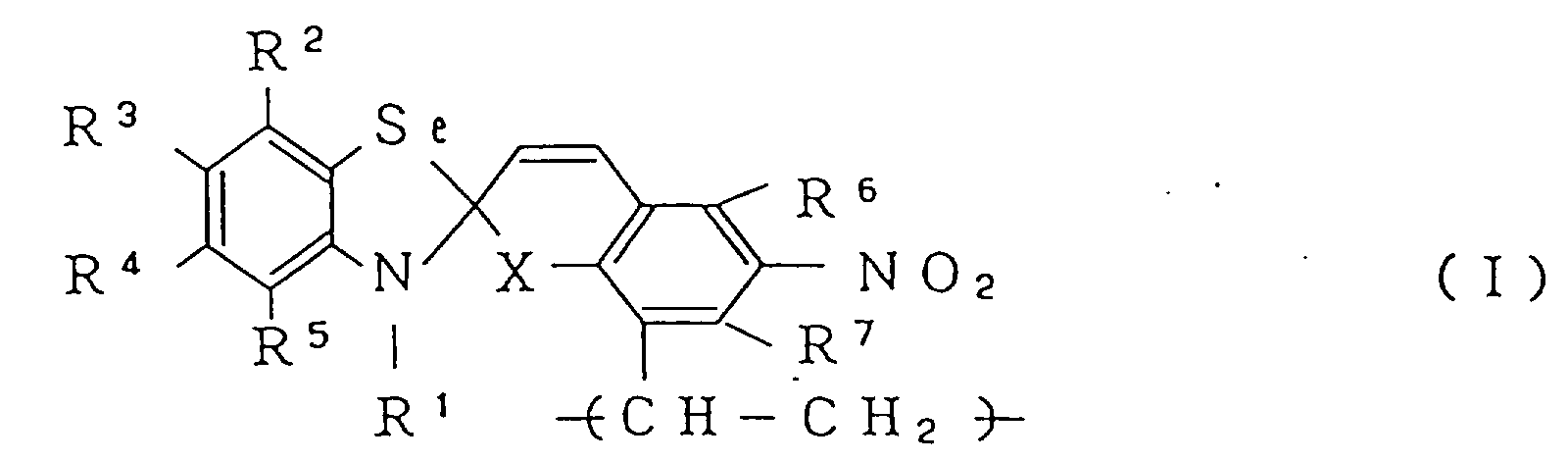 (b) 0 bis 99,999 Mol-% einer Struktureinheit, die durch die Formel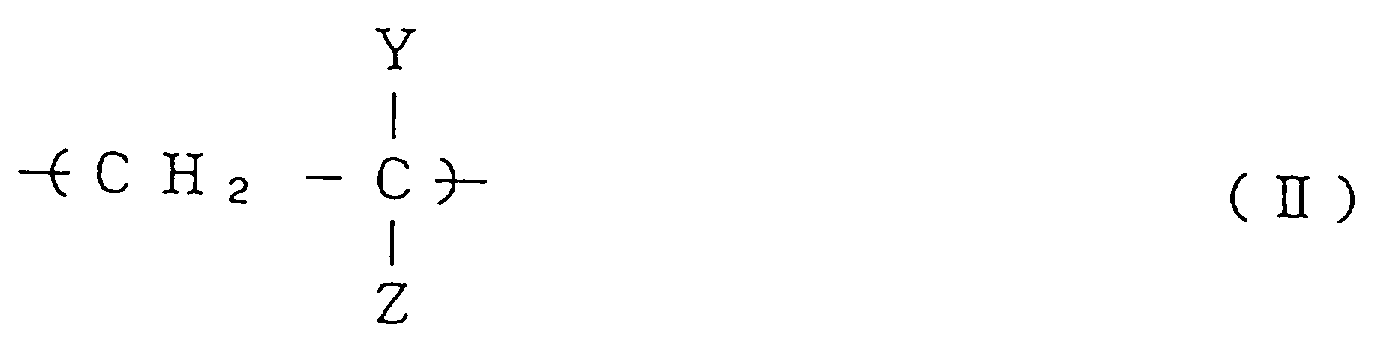
- Verbindung nach Anspruch 5, in welcher in der Struktureinheit der Formel (I) R¹ eine Alkylgruppe mit 1 bis 20 Kohlenstoffatomen ist; R, R³, R⁴ und R⁵ gleich oder verschieden sind und jeweils ein Wasserstoffatom, eine Methylgruppe, eine Ethylgruppe, eine Phenylgruppe, eine Methoxyphenylgruppe, eine Methoxygruppe, eine Ethoxygruppe, ein Fluoratom, ein Chloratom, ein Bromatom, eine Cyanogruppe oder eine Nitrogruppe darstellen; R⁶ und R⁷ gleich oder verschieden sind und jeweils ein Wasserstoffatom, eine Methylgruppe, eine Ethylgruppe, eine Phenylgruppe oder eine Naphthylgruppe bedeuten; und X für ein Sauerstoffatom steht.
- Verbindung nach Anspruch 5, in welcher in der Struktureinheit der Formel (I) R¹ eine Alkylgruppe mit 1 bis 18 Kohlenstoffatomen ist; R, R⁵, R⁶ und R⁷ Wasserstoffatome darstellen; R³ und R⁴ gleich oder verschieden sind und jeweils ein Wasserstoffatom, eine Alkylgruppe mit 1 bis 6 Kohlenstoffatomen oder eine Alkoxygruppe mit 1 bis 5 Kohlenstoffatomen repräsentieren; und X für ein Sauerstoffatom steht.
- Verbindung nach Anspruch 5, in welcher in der Struktureinheit der Formel (I) R¹ eine Methylgruppe oder eine Octadecylgruppe ist; R, R³, R⁵, R⁶ und R⁷ Wasserstoffatome sind; R⁴ ein Wasserstoffatom, eine Methylgruppe oder eine Methoxygruppe darstellt; und X für ein Sauerstoffatom steht.
- Verbindung nach Anspruch 5, in welcher in der Struktureinheit der Formel (II) Y für ein Wasserstoffatom oder eine Methylgruppe steht; und Z eine Niederalkoxycarbonylgruppe, eine Cyanogruppe oder eine Phenylgruppe bedeutet.
- Verbindung nach Anspruch 5, die ein Zahlenmittel des Molekulargewichts von etwa 1 x 10³ bis etwa 1 x 10⁶, wie bestimmt durch Gelpermeationschromatographie (GPC) (Lösungsmittel = Tetrahydrofuran, Temperatur = 40°C, bezogen auf einen Polystyrol-Standard), und ein Gewichtsmittel des Molekulargewichts von etwa 1 x 10³ bis etwa 2 x 10⁶, wie bestimmt durch dieselbe GPC wie oben erwähnt, aufweist.
- Verbindung nach Anspruch 5, die ein Zahlenmittel des Molekulargewichts von etwa 5 x 10³ bis etwa 3 x 10⁵, wie bestimmt durch Gelpermeationschromatographie (GPC) (Lösungsmittel = Tetrahydrofuran, Temperatur = 40°C, bezogen auf einen Polystyrol-Standard), und ein Gewichtsmittel des Molekulargewichts von etwa 5 x 10³ bis etwa 5 x 10⁵, wie bestimmt durch dieselbe GPC wie oben erwähnt, aufweist.
- Verbindung nach Anspruch 5, die ein Homopolymer ist, das allein aus der Struktureinheit der Formel (I) besteht.
- Verbindung nach Anspruch 5, welche etwa 0,001 bis etwa 50 Mol-% der Struktureinheit der Formel (I) und etwa 50 bis etwa 99,999 Mol-% der Struktureinheit der Formel (II) umfaßt.
- Verbindung nach Anspruch 5, welche etwa 0,01 bis etwa 25 Mol-% der Struktureinheit der Formel (I) und etwa 75 bis etwa 99,99 Mol-% der Struktureinheit der Formel (II) umfaßt.
- Verbindung nach Anspruch 5, welche etwa 0,1 bis etwa 10 Mol-% der Struktureinheit der Formel (I) und etwa 90 bis etwa 99,9 Mol-% der Struktureinheit der Formel (II) umfaßt.
Applications Claiming Priority (5)
| Application Number | Priority Date | Filing Date | Title |
|---|---|---|---|
| JP44073/90 | 1990-02-23 | ||
| JP4407390 | 1990-02-23 | ||
| JP4699090 | 1990-02-26 | ||
| JP46990/90 | 1990-02-26 | ||
| PCT/JP1991/000202 WO1991013072A1 (en) | 1990-02-23 | 1991-02-18 | Benzoselenazoline-spiro-vinylpyran compound and polymer comprising the same |
Publications (3)
| Publication Number | Publication Date |
|---|---|
| EP0470264A1 EP0470264A1 (de) | 1992-02-12 |
| EP0470264A4 EP0470264A4 (en) | 1992-06-03 |
| EP0470264B1 true EP0470264B1 (de) | 1996-05-15 |
Family
ID=26383919
Family Applications (1)
| Application Number | Title | Priority Date | Filing Date |
|---|---|---|---|
| EP91904455A Expired - Lifetime EP0470264B1 (de) | 1990-02-23 | 1991-02-18 | Benzoselenazolin-spiro-vinylpyranderivat und darauf basierendes polymer |
Country Status (6)
| Country | Link |
|---|---|
| US (1) | US5236958A (de) |
| EP (1) | EP0470264B1 (de) |
| JP (1) | JP3170613B2 (de) |
| CA (1) | CA2054701C (de) |
| DE (1) | DE69119507T2 (de) |
| WO (1) | WO1991013072A1 (de) |
Families Citing this family (69)
| Publication number | Priority date | Publication date | Assignee | Title |
|---|---|---|---|---|
| AUPN443695A0 (en) * | 1995-07-28 | 1995-08-17 | Sola International Holdings Ltd | Photochromic polymer |
| US6555028B2 (en) | 1998-09-11 | 2003-04-29 | Transitions Optical, Inc. | Polymeric matrix compatibilized naphthopyrans |
| CA2343310C (en) * | 1998-09-11 | 2008-04-15 | Ppg Industries Ohio, Inc. | Polymerizable polyalkoxylated naphthopyrans |
| US6348604B1 (en) | 1999-09-17 | 2002-02-19 | Ppg Industries Ohio, Inc. | Photochromic naphthopyrans |
| US6296785B1 (en) | 1999-09-17 | 2001-10-02 | Ppg Industries Ohio, Inc. | Indeno-fused photochromic naphthopyrans |
| WO2001057106A1 (en) * | 2000-02-04 | 2001-08-09 | Ppg Industries Ohio, Inc. | Photochromic coated articles |
| US6433043B1 (en) * | 2000-11-28 | 2002-08-13 | Transitions Optical, Inc. | Removable imbibition composition of photochromic compound and kinetic enhancing additive |
| US20060241273A1 (en) * | 2001-11-16 | 2006-10-26 | Bojkova Nina V | High impact poly (urethane urea) polysulfides |
| US20070142604A1 (en) * | 2005-12-16 | 2007-06-21 | Nina Bojkova | Polyurethanes and sulfur-containing polyurethanes and methods of preparation |
| US8017720B2 (en) * | 2005-12-16 | 2011-09-13 | Ppg Industries Ohio, Inc. | Sulfur-containing oligomers and high index polyurethanes prepared therefrom |
| US20030096935A1 (en) * | 2001-11-16 | 2003-05-22 | Nagpal Vidhu J. | Impact resistant polyureaurethane and method of preparation |
| US7368072B2 (en) * | 2001-12-10 | 2008-05-06 | Ppg Industries Ohio, Inc. | Photochromic contact lenses and methods of manufacturing |
| US20050258408A1 (en) * | 2001-12-20 | 2005-11-24 | Molock Frank F | Photochromic contact lenses and methods for their production |
| US20030141490A1 (en) * | 2001-12-21 | 2003-07-31 | Walters Robert W. | Photochromic polymer compositions and articles thereof |
| US20040021133A1 (en) * | 2002-07-31 | 2004-02-05 | Nagpal Vidhu J. | High refractive index polymerizable composition |
| US7009032B2 (en) * | 2002-12-20 | 2006-03-07 | Ppg Industries Ohio, Inc. | Sulfide-containing polythiols |
| US20040186241A1 (en) * | 2003-03-20 | 2004-09-23 | Gemert Barry Van | Photochromic ocular devices |
| US7262295B2 (en) | 2003-03-20 | 2007-08-28 | Transitions Optical, Inc. | Indeno-fused photochromic naphthopyrans, naphthols and photochromic articles |
| US7166357B2 (en) * | 2003-03-20 | 2007-01-23 | Transitions Optical, Inc. | Photochromic articles that activate behind ultraviolet radiation blocking transparencies and methods for preparation |
| US7320826B2 (en) * | 2003-03-20 | 2008-01-22 | Ppg Industries Ohio, Inc. | Photochromic articles with reduced temperature dependency and methods for preparation |
| US9096014B2 (en) | 2003-07-01 | 2015-08-04 | Transitions Optical, Inc. | Oriented polymeric sheets exhibiting dichroism and articles containing the same |
| JP4568027B2 (ja) * | 2003-07-17 | 2010-10-27 | パイロットインキ株式会社 | フォトクロミック材料 |
| NL1024808C2 (nl) | 2003-11-18 | 2005-05-23 | Hendrik Glastra | In een lichaamsvat of -holte implanteerbaar therapeutisch werkzaam element. |
| US7094368B2 (en) * | 2003-12-10 | 2006-08-22 | Transitions Optical, Inc. | Pyrano-quinolines, pyrano-quinolinones, combinations thereof, photochromic compositions and articles |
| US7144966B2 (en) * | 2004-03-04 | 2006-12-05 | Basf Corporation | Acrylic composition for use in coating applications and a method of forming the same |
| US7261843B2 (en) * | 2004-03-04 | 2007-08-28 | Transitions Optical, Inc. | Photochromic optical article |
| US20050274055A1 (en) | 2004-06-09 | 2005-12-15 | Cook Roger B | Color-changing fishing equipment |
| US7465415B2 (en) * | 2004-07-30 | 2008-12-16 | Ppg Industries Ohio, Inc. | Photochromic materials derived from ring-opening monomers and photochromic initiators |
| US11149107B2 (en) | 2004-09-01 | 2021-10-19 | Ppg Industries Ohio, Inc. | Polyurethanes, articles and coatings prepared therefrom and methods of making the same |
| US9464169B2 (en) | 2004-09-01 | 2016-10-11 | Ppg Industries Ohio, Inc. | Polyurethanes, articles and coatings prepared therefrom and methods of making the same |
| US20090280329A1 (en) | 2004-09-01 | 2009-11-12 | Ppg Industries Ohio, Inc. | Polyurethanes, Articles and Coatings Prepared Therefrom and Methods of Making the Same |
| US11591436B2 (en) | 2004-09-01 | 2023-02-28 | Ppg Industries Ohio, Inc. | Polyurethane article and methods of making the same |
| US11248083B2 (en) | 2004-09-01 | 2022-02-15 | Ppg Industries Ohio, Inc. | Aircraft windows |
| US9598527B2 (en) | 2004-09-01 | 2017-03-21 | Ppg Industries Ohio, Inc. | Polyurethanes, articles and coatings prepared therefrom and methods of making the same |
| US20090280709A1 (en) | 2004-09-01 | 2009-11-12 | Ppg Industries Ohio, Inc. | Polyurethanes, Articles and Coatings Prepared Therefrom and Methods of Making the Same |
| US11008418B2 (en) | 2004-09-01 | 2021-05-18 | Ppg Industries Ohio, Inc. | Polyurethanes, articles and coatings prepared therefrom and methods of making the same |
| US20060093844A1 (en) * | 2004-10-29 | 2006-05-04 | Conklin Jeanine A | Photochromic coating compositions, methods of making coated articles and articles thereof |
| US7556750B2 (en) * | 2005-04-08 | 2009-07-07 | Transitions Optical, Inc. | Photochromic materials with reactive substituents |
| US8158037B2 (en) | 2005-04-08 | 2012-04-17 | Johnson & Johnson Vision Care, Inc. | Photochromic materials having extended pi-conjugated systems and compositions and articles including the same |
| US20060226402A1 (en) * | 2005-04-08 | 2006-10-12 | Beon-Kyu Kim | Ophthalmic devices comprising photochromic materials having extended PI-conjugated systems |
| US20060227287A1 (en) * | 2005-04-08 | 2006-10-12 | Frank Molock | Photochromic ophthalmic devices made with dual initiator system |
| US9028728B2 (en) | 2005-04-08 | 2015-05-12 | Transitions Optical, Inc. | Photochromic materials that include indeno-fused naphthopyrans |
| US20060228557A1 (en) * | 2005-04-08 | 2006-10-12 | Beon-Kyu Kim | Photochromic materials having extended pi-conjugated systems and compositions and articles including the same |
| US9052438B2 (en) * | 2005-04-08 | 2015-06-09 | Johnson & Johnson Vision Care, Inc. | Ophthalmic devices comprising photochromic materials with reactive substituents |
| US8147725B2 (en) | 2005-04-08 | 2012-04-03 | Transitions Optical, Inc | Photochromic materials having extended pi-conjugated systems and compositions and articles including the same |
| US9139552B2 (en) | 2005-04-08 | 2015-09-22 | Transitions Optical, Inc. | Indeno-fused naphthopyrans having ethylenically unsaturated groups |
| US8647538B2 (en) | 2005-04-08 | 2014-02-11 | Transitions Optical, Inc. | Photochromic compounds having at least two photochromic moieties |
| JP4838882B2 (ja) * | 2006-05-05 | 2011-12-14 | ピーピージー インダストリーズ オハイオ,インコーポレイテッド | チオエーテル官能性ポリチオールオリゴマーおよびそれから調製される物品 |
| US20070257238A1 (en) * | 2006-05-05 | 2007-11-08 | Transitions Optical, Inc. | Polymerizable photochromic compositions with multiple initiators |
| US20080187749A1 (en) * | 2007-01-11 | 2008-08-07 | Ppg Industries Ohio, Inc. | Optical element having light influencing property |
| US7906214B2 (en) | 2007-01-26 | 2011-03-15 | Transitions Optical, Inc. | Optical elements comprising compatiblizing coatings and methods of making the same |
| US20090244479A1 (en) * | 2008-03-31 | 2009-10-01 | Diana Zanini | Tinted silicone ophthalmic devices, processes and polymers used in the preparation of same |
| US8110127B2 (en) | 2008-06-19 | 2012-02-07 | Essilor International (Compagnie Generale D'optique) | Photochromic coating exhibiting improved performance |
| US20100232003A1 (en) | 2009-03-13 | 2010-09-16 | Transitions Optical, Inc. | Vision enhancing optical articles |
| US8608988B2 (en) | 2010-11-23 | 2013-12-17 | Transitions Optical, Inc. | Curable photochromic compositions and optical articles prepared therefrom |
| WO2012121997A1 (en) | 2011-03-04 | 2012-09-13 | Ppg Industries Ohio, Inc. | Polythiourethan based composite articles |
| US8641933B2 (en) | 2011-09-23 | 2014-02-04 | Ppg Industries Ohio, Inc | Composite crystal colloidal array with photochromic member |
| US9133362B2 (en) | 2012-07-16 | 2015-09-15 | Ppg Industries Ohio, Inc. | Coating composition having mechanochromic crystals |
| US9568643B2 (en) | 2012-12-13 | 2017-02-14 | Ppg Industries Ohio, Inc. | Polyurethane urea-containing compositions and optical articles and methods for preparing them |
| CN107924116B (zh) | 2015-09-03 | 2021-06-15 | 光学转变公司 | 多层光致变色制品 |
| EP4022366B1 (de) | 2019-08-30 | 2025-04-30 | Transitions Optical, Ltd. | Fotochromes filmlaminat |
| US12163045B2 (en) | 2019-08-30 | 2024-12-10 | Transitions Optical, Ltd. | Photochromic composition with polyol and poly(anhydride) |
| WO2022100816A1 (en) | 2020-11-10 | 2022-05-19 | Transitions Optical, Ltd. | Photochromic-dichroic articles |
| EP4244304B1 (de) | 2020-11-10 | 2025-05-21 | Transitions Optical, Ltd. | Verfahren zur herstellung eines beschichteten artikels |
| WO2026078251A1 (en) | 2024-10-11 | 2026-04-16 | Transitions Optical Limited | Method of making coated optical elements with microlenses for focusing or defocusing light |
| WO2026078247A1 (en) | 2024-10-11 | 2026-04-16 | Transitions Optical Limited | Coated optical elements with microlenses for focusing or defocusing light |
| WO2026078253A1 (en) | 2024-10-11 | 2026-04-16 | Transitions Optical Limited | Method of making coated optical elements with microlenses for focusing or defocusing light |
| WO2026078249A1 (en) | 2024-10-11 | 2026-04-16 | Transitions Optical Limited | Method of making coated optical elements with microlenses for focusing or defocusing light |
| WO2026078252A1 (en) | 2024-10-11 | 2026-04-16 | Transitions Optical Limited | Method of making coated optical elements with microlenses for focusing or defocusing light |
Family Cites Families (6)
| Publication number | Priority date | Publication date | Assignee | Title |
|---|---|---|---|---|
| US4197124A (en) * | 1975-07-29 | 1980-04-08 | Fuji Photo Film Co., Ltd. | Non-treatment type planographic printing plate materials |
| JPS59227972A (ja) * | 1983-06-09 | 1984-12-21 | Sony Corp | フオトクロミツク感光性材料 |
| JPS6176490A (ja) * | 1984-09-22 | 1986-04-18 | Shiseido Co Ltd | ホトクロミツク化合物 |
| JPS6176514A (ja) * | 1984-09-25 | 1986-04-19 | Shiseido Co Ltd | ホトクロミック剤 |
| JP2762478B2 (ja) * | 1988-09-14 | 1998-06-04 | 三菱化学株式会社 | フォトクロミック材料 |
| DE69027068T2 (de) * | 1989-02-28 | 1997-01-30 | Otsuka Kagaku K.K., Osaka | Spiropyranverbindungen |
-
1991
- 1991-02-18 EP EP91904455A patent/EP0470264B1/de not_active Expired - Lifetime
- 1991-02-18 CA CA002054701A patent/CA2054701C/en not_active Expired - Fee Related
- 1991-02-18 US US07/768,681 patent/US5236958A/en not_active Expired - Fee Related
- 1991-02-18 DE DE69119507T patent/DE69119507T2/de not_active Expired - Fee Related
- 1991-02-18 JP JP50479391A patent/JP3170613B2/ja not_active Expired - Fee Related
- 1991-02-18 WO PCT/JP1991/000202 patent/WO1991013072A1/ja not_active Ceased
Also Published As
| Publication number | Publication date |
|---|---|
| CA2054701C (en) | 2000-02-15 |
| DE69119507D1 (de) | 1996-06-20 |
| WO1991013072A1 (en) | 1991-09-05 |
| US5236958A (en) | 1993-08-17 |
| EP0470264A1 (de) | 1992-02-12 |
| JP3170613B2 (ja) | 2001-05-28 |
| DE69119507T2 (de) | 1996-10-02 |
| EP0470264A4 (en) | 1992-06-03 |
Similar Documents
| Publication | Publication Date | Title |
|---|---|---|
| US5236958A (en) | Benzoselenazolino-vinylspiropyran compound | |
| JPWO1991013072A1 (ja) | ベンゾセレナゾリン系ビニルスピロピラン化合物及該化合物を含む重合体 | |
| US5252742A (en) | Spiropyran compounds | |
| EP0420397B1 (de) | Fulgimidderivate | |
| US4444868A (en) | Photosensitive composition | |
| EP0698608B1 (de) | Spiropyranverbindung | |
| JPH06256758A (ja) | フォトクロミック材料 | |
| EP0466938B1 (de) | Hochmolekulare spiropyranverbindung | |
| CA2028777C (en) | Spiropyran compounds | |
| JPS59227972A (ja) | フオトクロミツク感光性材料 | |
| JP3041642B2 (ja) | 高分子スピロピラン化合物 | |
| JPS63250381A (ja) | フオトクロミツク化合物 | |
| JPWO1991012279A1 (ja) | 高分子スピロピラン化合物 | |
| JPH07300484A (ja) | スピロピラン化合物 | |
| EP0530371B1 (de) | Uebergangsmetall-spirobenzopyrankomplex, deren herstellung und diese enthaltende photochromische materiale | |
| JPS6176514A (ja) | ホトクロミック剤 | |
| US3849144A (en) | Light-sensitive compositions comprising polymers containing diarylcyclopropene moiety and process of using | |
| US5521269A (en) | Spiropyran compounds and optically active spiropyran compounds and their use | |
| EP0640605B1 (de) | Spiropyrane, optisch aktive spiropyrane sowie deren verwendung | |
| JPH07285931A (ja) | 新規化合物 | |
| JPH08245627A (ja) | 架橋スピロピラン化合物 | |
| JP2992424B2 (ja) | ベンゾチオフェン・インドール置換マレイミド誘導体、フォトクロミック材料及びそれを用いた光記録材料 | |
| JPH02289587A (ja) | ベンゾセレナゾリン系スピロピラン化合物 | |
| US4562133A (en) | Polymers photoconductive in the near infra-red | |
| JPS6176513A (ja) | 重合体の製造方法 |
Legal Events
| Date | Code | Title | Description |
|---|---|---|---|
| PUAI | Public reference made under article 153(3) epc to a published international application that has entered the european phase |
Free format text: ORIGINAL CODE: 0009012 |
|
| 17P | Request for examination filed |
Effective date: 19911018 |
|
| AK | Designated contracting states |
Kind code of ref document: A1 Designated state(s): CH DE FR GB LI |
|
| A4 | Supplementary search report drawn up and despatched |
Effective date: 19920416 |
|
| AK | Designated contracting states |
Kind code of ref document: A4 Designated state(s): CH DE FR GB LI |
|
| 17Q | First examination report despatched |
Effective date: 19940624 |
|
| GRAA | (expected) grant |
Free format text: ORIGINAL CODE: 0009210 |
|
| AK | Designated contracting states |
Kind code of ref document: B1 Designated state(s): CH DE FR GB LI |
|
| REF | Corresponds to: |
Ref document number: 69119507 Country of ref document: DE Date of ref document: 19960620 |
|
| ET | Fr: translation filed | ||
| PLBE | No opposition filed within time limit |
Free format text: ORIGINAL CODE: 0009261 |
|
| STAA | Information on the status of an ep patent application or granted ep patent |
Free format text: STATUS: NO OPPOSITION FILED WITHIN TIME LIMIT |
|
| 26N | No opposition filed | ||
| REG | Reference to a national code |
Ref country code: GB Ref legal event code: IF02 |
|
| PGFP | Annual fee paid to national office [announced via postgrant information from national office to epo] |
Ref country code: GB Payment date: 20020220 Year of fee payment: 12 |
|
| PGFP | Annual fee paid to national office [announced via postgrant information from national office to epo] |
Ref country code: CH Payment date: 20020226 Year of fee payment: 12 |
|
| PGFP | Annual fee paid to national office [announced via postgrant information from national office to epo] |
Ref country code: FR Payment date: 20020227 Year of fee payment: 12 |
|
| PGFP | Annual fee paid to national office [announced via postgrant information from national office to epo] |
Ref country code: DE Payment date: 20020228 Year of fee payment: 12 |
|
| PG25 | Lapsed in a contracting state [announced via postgrant information from national office to epo] |
Ref country code: GB Free format text: LAPSE BECAUSE OF NON-PAYMENT OF DUE FEES Effective date: 20030218 |
|
| PG25 | Lapsed in a contracting state [announced via postgrant information from national office to epo] |
Ref country code: LI Free format text: LAPSE BECAUSE OF NON-PAYMENT OF DUE FEES Effective date: 20030228 Ref country code: CH Free format text: LAPSE BECAUSE OF NON-PAYMENT OF DUE FEES Effective date: 20030228 |
|
| PG25 | Lapsed in a contracting state [announced via postgrant information from national office to epo] |
Ref country code: DE Free format text: LAPSE BECAUSE OF NON-PAYMENT OF DUE FEES Effective date: 20030902 |
|
| GBPC | Gb: european patent ceased through non-payment of renewal fee | ||
| REG | Reference to a national code |
Ref country code: CH Ref legal event code: PL |
|
| PG25 | Lapsed in a contracting state [announced via postgrant information from national office to epo] |
Ref country code: FR Free format text: LAPSE BECAUSE OF NON-PAYMENT OF DUE FEES Effective date: 20031031 |
|
| REG | Reference to a national code |
Ref country code: FR Ref legal event code: ST |