EP0470530A2 - Verfahren zur Prüfung von Fingerabdrücken - Google Patents
Verfahren zur Prüfung von Fingerabdrücken Download PDFInfo
- Publication number
- EP0470530A2 EP0470530A2 EP91113070A EP91113070A EP0470530A2 EP 0470530 A2 EP0470530 A2 EP 0470530A2 EP 91113070 A EP91113070 A EP 91113070A EP 91113070 A EP91113070 A EP 91113070A EP 0470530 A2 EP0470530 A2 EP 0470530A2
- Authority
- EP
- European Patent Office
- Prior art keywords
- fingerprint
- image
- center
- respect
- fingerprint verification
- Prior art date
- Legal status (The legal status is an assumption and is not a legal conclusion. Google has not performed a legal analysis and makes no representation as to the accuracy of the status listed.)
- Granted
Links
Images



Classifications
-
- G—PHYSICS
- G06—COMPUTING OR CALCULATING; COUNTING
- G06F—ELECTRIC DIGITAL DATA PROCESSING
- G06F18/00—Pattern recognition
-
- G—PHYSICS
- G06—COMPUTING OR CALCULATING; COUNTING
- G06V—IMAGE OR VIDEO RECOGNITION OR UNDERSTANDING
- G06V40/00—Recognition of biometric, human-related or animal-related patterns in image or video data
- G06V40/10—Human or animal bodies, e.g. vehicle occupants or pedestrians; Body parts, e.g. hands
- G06V40/12—Fingerprints or palmprints
- G06V40/1347—Preprocessing; Feature extraction
-
- G—PHYSICS
- G07—CHECKING-DEVICES
- G07C—TIME OR ATTENDANCE REGISTERS; REGISTERING OR INDICATING THE WORKING OF MACHINES; GENERATING RANDOM NUMBERS; VOTING OR LOTTERY APPARATUS; ARRANGEMENTS, SYSTEMS OR APPARATUS FOR CHECKING NOT PROVIDED FOR ELSEWHERE
- G07C9/00—Individual registration on entry or exit
- G07C9/20—Individual registration on entry or exit involving the use of a pass
- G07C9/22—Individual registration on entry or exit involving the use of a pass in combination with an identity check of the pass holder
- G07C9/25—Individual registration on entry or exit involving the use of a pass in combination with an identity check of the pass holder using biometric data, e.g. fingerprints, iris scans or voice recognition
- G07C9/257—Individual registration on entry or exit involving the use of a pass in combination with an identity check of the pass holder using biometric data, e.g. fingerprints, iris scans or voice recognition electronically
Definitions
- the present invention relates to a verification method by comparing a fingerprint to be examined with a reference fingerprint stored beforehand, and can be adapted to, for example, a security system which opens the door for only registered people.
- an image including the protuberant lines of the fingerprint is binarized and thinned so as to calculate protuberant line pattern. Then branch points, end points and curvature are extracted from the above protuberant line pattern as the main characteristics. Based on those characteristics, comparison is performed between a master image (image of reference fingerprint) and a sample image (image of fingerprint to be examined). Since the characteristics appear all over the fingerprint, it was preferable for the conventional fingerprint verification method to have a fingerprint which covers a wide area. Therefore, the image of the fingerprint has to be taken by rotating the finger which includes not only the front part of the finger but also the sides of the finger.
- the protuberant lines at the portion lower than the fingerprint i.e., a joint part of a finger, are mostly arranged in horizontal direction; therefore, there are few characteristics. Furthermore, the image at the portion lower than the fingerprint is scarcely input correctly; therefore, it is not an effective data for the fingerprint verification. Accordingly, by using such image for the fingerprint verification, the accurate verification will be difficult to perform due to the vast volume of noises in data. Also, by applying the data at lower part of the fingerprint, volume of input data becomes large so that it becomes necessary to expand the memory capacity.
- the present invention is invented so as to solve the above problem and has an object to provide a fingerprint verification method that realizes an accurate fingerprint verification by using a little volume of data.
- the present invention has an object to provide a fingerprint verification method that greatly simplifies the steps of generating a master image and a sample image used for the fingerprint verification, as well as realizes the accurate fingerprint verification with a short period of time.
- a fingerprint verification method comprises the steps of:
- a fingerprint verification method comprises the steps of:
- the lower portion of the fingerprint data than the center of characteristics is ignored, and only upper portion of the data is used for the fingerprint verification. Since most of the characteristics appear at upper part of the fingerprint, it is possible to perform an accurate fingerprint verification by effectively using the characteristics data.
- Fig. 2 shows a fingerprint verification system applying an image comparison method of the present invention.
- the fingerprint verification system consists of an image input system 10 and a verification processing system 20.
- the comparison processing is performed onto the image photographed by the image input system 10 at the verification processing system 20.
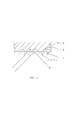
- the total reflection of an illumination incident upon a right-angle prism 11 from a luminous source 12 is detected by a CCD camera 13.
- a slanting surface 14 of the prism 11 is deemed to be the detection surface, where a finger FIN of which fingerprint is to be detected is contacted on. Without being contacted the finger FIN, whole illumination is totally reflected, so the image is detected all in white by the CCD camera 13.
- the illumination at the protruded portions FIN 1 does not totally reflect and passes through the interface of the prism, since the angle of refraction on the interface of the prism changes. Therefore, the protruded portions of the fingerprint are input to the CCD camera 13 as the dark lines with gray levels.
- the verification processing system 20 comprises an image processing portion 21 and a card reader 22.
- the master data is read when the person examined inserts an ID card 23 into the card reader 22, then the comparison is performed of the data input from the image input system 10 with the master data by a computer 27.
- the comparison results are displayed at a display portion 24.
- an actuator 25 is operated and a door 26 is opened.
- Various specifying manners of the master data are adaptable, such as inputting of ID number by the person examined from the keyboard.
- Fig. 4 shows the general directions of the protuberant lines of the fingerprint by arrows.
- inventors adapted a histogram of the direction which partial differential value of the density value for each pixel becomes minimum.
- the partial differential value of the density value of each pixel in an area "I" has the frequency to become minimum in the direction of 45 degrees, since the change in density value of each pixel in the area has the strong tendency to become minimum in the direction rotated to counterclockwise direction by 45 degrees from the horizontal direction.
- a histogram as it is shown in Fig.5 (I), can be obtained with respect to the density value change of pixels in the are "I".
- the partial differential value of the density value of each pixel in an area "II" has the frequency to become minimum in the direction of 90 degree, since the change in density value of each pixel in the area has the strong tendency to become minimum in the direction rotated to counterclockwise direction by 90 degrees from the horizontal direction. Accordingly, a histogram, as it is shown in Fig.5. (II), can be obtained with respect to the density value of pixel in the area "II".
- the density values are calculated for each pixel of an input fingerprint image; i.e., a sample image. Meanwhile, the density values for each pixel of the reference fingerprint image to be compared with above sample image; i.e., a master image, are calculated beforehand, and stored in memory of the computer 27.
- the partial differential is performed according to the density value for each pixel among the neighborhood pixels.
- the neighborhood pixels are not only pixels directly adjacent to an objective pixel on which partial differential is performed, but also the pixels distant by a few pixels from the objective pixel.
- the partial differential is performed over the rage of 157.5 degrees; in the horizontal direction (number 1), in the directions rotated by 22.5 degrees in counterclockwise direction from the horizontal direction (number 2, 3, 4, and 5), and in the directions rotated by 22.5 degrees in clockwise direction from the horizontal direction (numbers 6, 7 and 8).
- the partial differential value z can be expressed by:
- the partial differential with respect to a digital image is discrete. Especially for the distance elements, it is necessary to apply comparatively long distances depending on the direction of the partial differential. However, when the distance is too long, differential is performed onto only the mountains of a fingerprint. As the result, the characteristics of the protuberant lines of the fingerprint are lost. Therefore, the minimum distance value should be applied with heightening the precision of the direction. According to the image processing system 10 in Fig.2, corrections with respect to the elements in Y direction are required for the image input to the CCD camera 13 for the examination of the fingerprint from 45 degrees slantways.
- the partial differentials are performed again in each direction of numbers from 1 to 8 for each pixel, so as to compare those differential values with the precalculated minimum partial differential value.
- the number (out of numbers from 1 to 8 with respect to Fig. 6) is stored in the memory of the image processing portion corresponding to the direction of the newly calculated differential value that coincides to the minimum partial differential value. Accordingly, the directions which take the minimum partial differential values are calculated for all pixels, and the distributions of the directions that take the minimum partial differential values for a whole image can be obtained. Since the direction elements of each area in the image are extracted directly from the gray level image, it is possible to make the efficient use of the information of an original image.
- the fingerprint verification becomes possible by comparing the distribution with respect to the above direction with that of the master image. That is, data of the directions that take the minimum partial differential values for each pixel are compared for each corresponding pixels between the sample image and the master image.
- an image is separated into a plurality of blocks. An index is calculated based on the direction where the partial differential becomes the minimum according to the blocks upper than a center of the characteristics of the fingerprint image, so as to perform the comparison between the sample image and the master image. This is effective since many characteristics of the fingerprint appear at portion upper than the center of the characteristics.
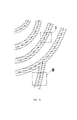
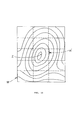
- the protuberant lines FP of the fingerprint are arranged to make the spiral figure, so the pixels with the same density value are arranged along with this spiral.
- the horizontal and vertical directions are deemed to be X and Y directions, respectively.
- the change ratio of the density value according to X direction becomes small at the area P where the protuberant lines are lengthened in X direction, and becomes large at the area Q where the protuberant lines are lengthened in Y direction. Therefore, a histogram with respect to the partial differential value of the density value in X direction becomes the maximum at the center as it is indicated by a letter S.
- the maximal point (letter T) of the histogram (letter S) with respect to the change of density value along X direction is deemed to be a Y coordinate of a center point of the image.
- the maximal point (letter U) of the histogram (letter R) with respect to the change of density value along Y direction is deemed to be a X coordinate of a center point of the image.
- the obtained center point as above is not the center of the configuration; it is the center of the characteristics of the image (for example, the center of the spiral). Accordingly, the point is determined as the center of the characteristics where the extreme value of the histogram of the density partial differential values occurs.
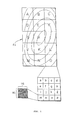
- both the master image and the sample image are divided into, for example, 15 blocks from A to O, respectively.
- the justification of positions between the sample image and the master image is performed, so that the blocks of both images which include the center of the characteristics obtained by the manner described above coincide each other.
- Fig.1 shows the manner to divide a fingerprint image 41 into a plurality of blocks.
- This image 41 are divided into 15 blocks from A to O, each of which is further divided into 16 blocks from area a to p that comprises 16 x 16 pixels.
- the comparison between the sample image and the master image is performed by applying the data with respect to the blocks upper than the center of characteristics; from A to I, out of blocks from A to O.
- the total dispersions for each area from a to p of each of blocks from A to I are calculated.
- the total dispersion is defined by the following formula: where, 0 indicates an aberration angle of the direction where the partial differential value of the master image and the sample image becomes minimum, Vm indicates the dispersions within a class for each area of the master image, and Vs indicates the dispersions within a class for each area of the sample image.
- the total dispersion RE is defined by subtracting the total dispersion defined by the above formula from 1. That is, the total dispersion RE of the present embodiment is define by:
- the dispersions within a class; Vm and Vs, with respect to the master image and the sample image are calculated beforehand. This is described with referring to Fig.8 and Fig.9.
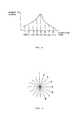
- Fig.8 shows a histogram with respect to the number of pixels for the direction codes.
- Fig.9 shows the definition of the direction codes. That is, the direction toward the vertical direction is determined as a code "1". Based on this code, the number of codes are increased to "2", "3"!8", as the direction rotates in clockwise direction by 22.5 degrees.
- the direction code "1" is deemed to be a center point, temporally. Then the aberrations of directions are calculated with respect to the above direction code "1" for each direction code. Accordingly, the aberrations of directions with respect to the direction codes “2", “3", “4", “5", “6", “7” and “8” are 1, 2, 3, 4, 3, 2, and 1 (numbers in the parentheses in Fig.8), respectively.
- the aberrations of directions with respect to the direction codes “2" and “8", “3” and “7", “4" and “6” are equivalent. This is because the aberration of direction does not consider whether it is in clockwise direction or in counterclockwise direction.
- the sum total T is calculated by multiplying the number of pixels for each direction code by a weight corresponding to the magnitude of its aberration of direction.
- weight is sin 2 8.
- weight is 0.0.
- weight is 0.15.
- weight is 0.15.
- weight is 0.5.
- weight is 0.85.
- weight is 1.0.
- the numbers of pixels for each direction code are multiplied by weights because it is considered that the farther the distance from the temporary center point becomes, the more the number of pixels for the dispersion within a class is influenced.
- the value of the obtained sum of total T divided by the number of pixels, 256, in the area is the dispersion within a class.
- This dispersion within a class is calculated by deeming every direction codes to be a temporary center point. Therefore, totally 8 directions within a class are calculated for each area. Then, the minimum value of those dispersions within a class is calculated so as to determine this minimum value as the dispersion within a class of that area. Also, the direction code which corresponds to the minimum value of dispersion within a class is deemed to be the direction code with respect to that area. Accordingly, the dispersions within a class and the direction codes are determined for each area; from a to p.
- the mean values of the dispersions within a class in each area; from a to p, is calculated for each of blocks from A to I.
- the dispersions within a class obtained as above are dispersions within a class; Vm and Vs, of the master image the sample image used for the above formula (1).
- the mean value of direction codes in each area; from a to p, is calculated so as to be determined as the direction code of the blocks from A to I. This direction code is a code used for the above formula (1), as it is described later.
- cos 2 ( ⁇ /2) according to the above formula (1); that is the aberration of direction is calculated.
- This calculation is performed by determining the angle as " ⁇ " that corresponds to the difference of direction codes between the master image and the sample image according to the blocks from A to I.
- ⁇ the angle that corresponds to the difference of direction codes between the master image and the sample image according to the blocks from A to I.
- the total dispersion RE with respect to the blocks from A to I is calculated from the above formula (1), by using the aberration of direction (dispersion between classes) obtained as above, and the dispersion within a class; Vm and Vs.
- This total dispersion RE changes between 0 and 1.
- the value of total dispersion RE with respect to the blocks from A to I becomes more than 0.8.
- the value of the total dispersion RE with respect to the blocks from A to I becomes less than 0.7.
- CORE is the crosscorrelation
- x(ei) is the number of pixels in ei(deg) direction with respect to the sample image
- X(ei) is the number of pixels in ei(deg) with respect to the master image.
- the crosscorrelations are calculated for each area; from a to p, first. Then mean value of the calculated crosscorrelations is determined as the crosscorrelation of corresponding blocks from A to I.
- the crosscorrelation changes between 0 and 1. The more identical the sample and the master images are, the more the value of the crosscorrelation closes to 1.
- the distances between classes are calculated with respect to the blocks from A to I.
- the distance between classes is defined as the following formula: where, DG is the distance between classes, x(ei) is the number of pixels in ei(deg) direction with respect to the sample image, and X(ei) is the number of pixels in 0 i(deg) direction with respect to the master image.
- the distances between classes are calculated for each area; from a to p, first. Then mean value of the calculated distances between classes is determined as the distance between classes of corresponding blocks from A to I. The distance between classes changes between 0 and 1. The more identical the sample and the master images are, the more the value of the distance between classes closes to 0.
- the total dispersions, the crosscorrelations and the distances between classes with respect to upper blocks; from A to I, than the block H which includes the center of characteristics are calculated with respect to both master and sample images.
- the relative location between the sample image and the master image is changed in horizontal direction by 1 area (from a to p of Fig. 1). Then the comparison between images is performed by the same manner as it is described above.
- the relative location between the sample image and the master image is changed in the opposite direction to the above by 1 area. Then the comparison between images is performed by the same manner as it is described above.
- the relative location of images is change in vertical direction by 1 area from the first location so as to perform the comparison.
- the comparison between the sample image and the master image is performed by justifying their centers of characteristics with one another.
- the comparison between images are continuously performed by changing the relative location between images by 1 area to the right and left, then up and down, successively, from the first justified location. Accordingly, the comparison between images are performed by at most 5 times by changing their relative location to the right and left, then up and down.
- images are judged to be different for 5 times, it is finally judged that the sample image and master image are different.
- the door 26 is opened when the fingerprint to be examined (the sample image) is judged to be coincided with the reference fingerprint (the master image).
- the fingerprint to be examined is judged that is not coincided with the reference fingerprint
- the door 26 will not be opened, and the system will request the person to be examined to input his fingerprint again, or it will output the message of "No Admittance".
- Fig.1 it is possible to perform fingerprint verification by using data of not only the block H, which includes the center of characteristics, but also blocks adjacent to the block H (for example, 1 or more than 1 blocks from D, E, F, G, I, J, K and L).
- the block H' includes the fillet center Z of the rectangle W surrounding the fingerprint image that is determined to be the center of the characteristics.
- indexes that are, the total dispersion, the crosscorrelation, and the distance between classes.
- the comparison between images can be performed by using 1 or 2 indexes from the above.
- an image is separated into a plurality of blocks.
- An index is calculated based on the minimum direction according to the block including a center of the characteristics of the fingerprint image, so as to perform the comparison between the sample image and the master image. This is effective since many characteristics of the fingerprint are appear around the neighborhood of the center of the characteristics.
- the total dispersions for each area from a to p of the block H are calculated according to the formula (1 ).
- the mean value of the dispersions within a class in each area; from a to p, is calculated. This mean value is determined as the dispersion within a class with respect to a block H.
- the dispersions within a class obtained as above are dispersions within a class; Vm and Vs, of the master image and the sample image used for the above formula (1).
- the mean value of direction codes in each area; from a to p, is calculated so as to be determined as the direction code of the block H.
- This direction code is a code used for the above formula (1), as it is described later.
- cos 2 (e/2) according to the above formula (1); that is the aberration of direction is calculated.
- This calculation is performed by determining the angle as "6" that corresponds to the difference of direction codes between the master image and the sample image according to the block H.
- the difference of direction codes between the master image and the sample image is 1, 0 is 22.5 degrees, so that the aberration of direction is 0.96.
- 0 is 45 degrees so that the aberration of direction is 0.85.
- 0 is 67.5 degrees so that the aberration of direction is 0.69.
- 0 is 90 degrees so that the aberration of direction is 0.5.
- the total dispersion RE with respect to the block H is calculated from the above formula (1), by using the aberration of direction (dispersion between classes) obtained as above, and the dispersion within a class; Vm and Vs.
- This total dispersion RE changes between 0 and 1.
- the value of total dispersion RE with respect to the block H becomes more than 0.8.
- the value of the total dispersion RE with respect to the block H becomes less than 0.7.
- the crosscorrelations are calculated for each area; from a to p, first. Then mean value of the calculated crosscorrelations is determined as the crosscorrelation of corresponding block H.
- the crosscorrelation changes between 0 and 1. The more identical the sample and the master images are, the more the value of the crosscorrelation closes to 1.
- the distance between classes is calculated with respect to the block H.
- This distances between classes are calculated for each area; from a to p, first. Then mean value of the calculated distances between classes is determined as the distance between classes of corresponding block H.
- the total dispersion, the crosscorrelation and the distance between classes of the block H are calculated with respect to both master and sample images, which include the center of characteristics.
- Fig.1 it is possible to perform fingerprint verification by using data of not only the block H, which includes the center of characteristics, but also blocks adjacent to the block H (for example, 1 or more than 1 blocks from D, E, F, G, I, J, K and L).
- the block H' includes the fillet center Z of the rectangle W surrounding the fingerprint image that are determined to be the center of the characteristics. Furthermore, it is possible to perform the fingerprint verification by using data in the block H' including the fillet center and adjacent blocks to the block H'.
Landscapes
- Engineering & Computer Science (AREA)
- Physics & Mathematics (AREA)
- General Physics & Mathematics (AREA)
- Human Computer Interaction (AREA)
- Theoretical Computer Science (AREA)
- Computer Vision & Pattern Recognition (AREA)
- Multimedia (AREA)
- Bioinformatics & Computational Biology (AREA)
- Evolutionary Computation (AREA)
- Evolutionary Biology (AREA)
- General Engineering & Computer Science (AREA)
- Data Mining & Analysis (AREA)
- Life Sciences & Earth Sciences (AREA)
- Bioinformatics & Cheminformatics (AREA)
- Artificial Intelligence (AREA)
- Collating Specific Patterns (AREA)
Applications Claiming Priority (4)
| Application Number | Priority Date | Filing Date | Title |
|---|---|---|---|
| JP209052/90 | 1990-08-07 | ||
| JP2209053A JP2926069B2 (ja) | 1990-08-07 | 1990-08-07 | 指紋照合方法 |
| JP209053/90 | 1990-08-07 | ||
| JP2209052A JPH0495175A (ja) | 1990-08-07 | 1990-08-07 | 指紋照合方法 |
Publications (3)
| Publication Number | Publication Date |
|---|---|
| EP0470530A2 true EP0470530A2 (de) | 1992-02-12 |
| EP0470530A3 EP0470530A3 (de) | 1992-12-30 |
| EP0470530B1 EP0470530B1 (de) | 1997-01-22 |
Family
ID=26517193
Family Applications (1)
| Application Number | Title | Priority Date | Filing Date |
|---|---|---|---|
| EP91113070A Expired - Lifetime EP0470530B1 (de) | 1990-08-07 | 1991-08-02 | Verfahren zur Prüfung von Fingerabdrücken |
Country Status (4)
| Country | Link |
|---|---|
| US (1) | US5239590A (de) |
| EP (1) | EP0470530B1 (de) |
| KR (1) | KR920005022A (de) |
| DE (1) | DE69124312T2 (de) |
Cited By (3)
| Publication number | Priority date | Publication date | Assignee | Title |
|---|---|---|---|---|
| WO2002074168A1 (en) * | 2001-03-15 | 2002-09-26 | Fingerprint Cards Ab | Device and method for biometric verification and registration of a persons identity by means of fingerprint information |
| EP1349106A1 (de) * | 2002-03-27 | 2003-10-01 | Fujitsu Limited | Verfahren und Anordnung zur Erkennung von Fingerbewegung |
| EP2600307A4 (de) * | 2010-07-29 | 2017-05-03 | Fujitsu Limited | Vorrichtung zur aufzeichnung von biometrischen informationen, biometrisches authentifizierungsverfahren und computerprogramm für biometrische authentifizierung zusätzlich zu einer vorrichtung zur aufzeichnung von biometrischen informationen |
Families Citing this family (49)
| Publication number | Priority date | Publication date | Assignee | Title |
|---|---|---|---|---|
| US5729334A (en) * | 1992-03-10 | 1998-03-17 | Van Ruyven; Lodewijk Johan | Fraud-proof identification system |
| US6002787A (en) * | 1992-10-27 | 1999-12-14 | Jasper Consulting, Inc. | Fingerprint analyzing and encoding system |
| US5351303A (en) * | 1993-02-25 | 1994-09-27 | Willmore Michael R | Infra-red imaging and pattern recognition system |
| JP3647885B2 (ja) * | 1993-05-07 | 2005-05-18 | 日本電信電話株式会社 | 画像処理装置 |
| JPH0756956A (ja) * | 1993-07-22 | 1995-03-03 | Xerox Corp | 人間の作成したイメージに基づくデータアクセス方法 |
| JPH0778251A (ja) * | 1993-07-22 | 1995-03-20 | Xerox Corp | ソースベリファイ方法 |
| US5420937A (en) * | 1993-09-01 | 1995-05-30 | The Phoenix Group, Inc. | Fingerprint information extraction by twin tracker border line analysis |
| US5509083A (en) * | 1994-06-15 | 1996-04-16 | Nooral S. Abtahi | Method and apparatus for confirming the identity of an individual presenting an identification card |
| US5631972A (en) * | 1995-05-04 | 1997-05-20 | Ferris; Stephen | Hyperladder fingerprint matcher |
| AUPN462995A0 (en) * | 1995-08-07 | 1995-08-31 | Mikoh Technology Limited | Optical memory data detector and authenticator |
| US5841888A (en) | 1996-01-23 | 1998-11-24 | Harris Corporation | Method for fingerprint indexing and searching |
| US5956415A (en) * | 1996-01-26 | 1999-09-21 | Harris Corporation | Enhanced security fingerprint sensor package and related methods |
| US5828773A (en) * | 1996-01-26 | 1998-10-27 | Harris Corporation | Fingerprint sensing method with finger position indication |
| US5963679A (en) * | 1996-01-26 | 1999-10-05 | Harris Corporation | Electric field fingerprint sensor apparatus and related methods |
| US5796858A (en) * | 1996-05-10 | 1998-08-18 | Digital Persona, Inc. | Fingerprint sensing system using a sheet prism |
| US5978495A (en) * | 1996-07-17 | 1999-11-02 | Intelnet Inc. | Method and apparatus for accurate determination of the identity of human beings |
| US5982913A (en) * | 1997-03-25 | 1999-11-09 | The United States Of America As Represented By The National Security Agency | Method of verification using a subset of claimant's fingerprint |
| US6125192A (en) | 1997-04-21 | 2000-09-26 | Digital Persona, Inc. | Fingerprint recognition system |
| US6208264B1 (en) | 1997-05-23 | 2001-03-27 | Automated Identification Service, Inc. | Personal verification in a commercial transaction system |
| US6035398A (en) * | 1997-11-14 | 2000-03-07 | Digitalpersona, Inc. | Cryptographic key generation using biometric data |
| US6122737A (en) * | 1997-11-14 | 2000-09-19 | Digital Persona, Inc. | Method for using fingerprints to distribute information over a network |
| US6324310B1 (en) | 1998-06-02 | 2001-11-27 | Digital Persona, Inc. | Method and apparatus for scanning a fingerprint using a linear sensor |
| US6188781B1 (en) | 1998-07-28 | 2001-02-13 | Digital Persona, Inc. | Method and apparatus for illuminating a fingerprint through side illumination of a platen |
| US6870946B1 (en) | 1998-08-06 | 2005-03-22 | Secugen Corporation | Compact optical fingerprint capturing and recognition system |
| US6950539B2 (en) * | 1998-09-16 | 2005-09-27 | Digital Persona | Configurable multi-function touchpad device |
| US6381347B1 (en) | 1998-11-12 | 2002-04-30 | Secugen | High contrast, low distortion optical acquistion system for image capturing |
| US6097035A (en) * | 1999-02-22 | 2000-08-01 | Digital Persona, Inc. | Fingerprint detection apparatus with partial fingerprint images |
| SE514091C2 (sv) | 1999-08-24 | 2001-01-08 | Fingerprint Cards Ab | Förfarande och anordning vid registrering och verifiering av fingeravtrycksinformation |
| JP3434756B2 (ja) * | 1999-12-07 | 2003-08-11 | エヌイーシ−カスタムテクニカ株式会社 | 指紋認証方法及び装置 |
| WO2001055966A1 (fr) * | 2000-01-28 | 2001-08-02 | Chuo Hatsujo Kabushiki Kaisha | Procede d'evaluation d'une image d'empreinte digitale et dispositif d'appariement d'empreintes digitales |
| US6910132B1 (en) | 2000-09-15 | 2005-06-21 | Matsushita Electric Industrial Co., Ltd. | Secure system and method for accessing files in computers using fingerprints |
| US7359553B1 (en) * | 2001-02-16 | 2008-04-15 | Bio-Key International, Inc. | Image identification system |
| KR100408835B1 (ko) * | 2001-08-07 | 2003-12-06 | 구홍식 | 생체정보 분할 저장 방법 |
| KR100432490B1 (ko) | 2001-09-17 | 2004-05-22 | (주)니트 젠 | 광학식 지문취득 장치 |
| KR100437100B1 (ko) * | 2001-10-08 | 2004-06-23 | 보인정밀 주식회사 | 비월주사 영상신호로부터 순차주사 영상신호로 변환하는비월/순차주사 변환 방법 및 회로 |
| US7450741B2 (en) * | 2003-06-23 | 2008-11-11 | Motorola, Inc. | Gray scale matcher |
| US20050207657A1 (en) * | 2004-02-02 | 2005-09-22 | Clark Adam L | System and method for encoding and decoding video |
| US7155040B2 (en) * | 2004-06-29 | 2006-12-26 | Bio-Key International, Inc. | Generation of quality field information in the context of image processing |
| US20070263913A1 (en) * | 2006-05-15 | 2007-11-15 | Daniel Sam M | Matching methods and apparatus using landmark points in a print |
| TWM322582U (en) * | 2007-04-18 | 2007-11-21 | Quanta Comp Inc | Fingerprint identification system |
| US9569442B2 (en) | 2010-04-27 | 2017-02-14 | The Radiant Group, Inc. | Geo-location video archive system and method |
| US8880718B2 (en) | 2010-04-27 | 2014-11-04 | Afix Technologies, Inc. | Geo-location video archive system and method |
| US8571276B2 (en) | 2011-03-03 | 2013-10-29 | Afix Technologies, Inc. | Automated Biometric Identification System (ABIS) and method |
| US8699764B2 (en) | 2010-04-27 | 2014-04-15 | Afix Technologies, Inc. | Automated biometric submission and improved scanning system and method |
| US8903142B2 (en) | 2010-07-12 | 2014-12-02 | Fingerprint Cards Ab | Biometric verification device and method |
| US8823489B2 (en) * | 2011-04-22 | 2014-09-02 | Qualcomm Incorporated | Systems and methods for generating a derived biometric template |
| US8655032B2 (en) | 2011-06-24 | 2014-02-18 | Afix Technologies, Inc. | Mobile identification system and method |
| US9201560B2 (en) | 2011-07-13 | 2015-12-01 | Afix Technologies, Inc. | Multiple user data entry system and method |
| KR102359556B1 (ko) * | 2016-11-11 | 2022-02-08 | 삼성전자주식회사 | 지문 영상을 이용한 사용자 인증 방법 및 사용자 인증을 위한 부호화 모델 생성 방법 |
Family Cites Families (16)
| Publication number | Priority date | Publication date | Assignee | Title |
|---|---|---|---|---|
| US4581760A (en) * | 1983-04-27 | 1986-04-08 | Fingermatrix, Inc. | Fingerprint verification method |
| DE3409263A1 (de) * | 1984-03-14 | 1985-09-19 | Focke & Co, 2810 Verden | Verfahren und vorrichtung zum verpacken von tabak-portionen |
| US4641350A (en) * | 1984-05-17 | 1987-02-03 | Bunn Robert F | Fingerprint identification system |
| JPS61100A (ja) * | 1984-06-11 | 1986-01-06 | Taiyo Fishery Co Ltd | 軟体動物真皮コラ−ゲンの分離法 |
| JPS6128171A (ja) * | 1984-07-18 | 1986-02-07 | Nec Corp | 画像入力方式 |
| DE3577485D1 (de) * | 1984-07-18 | 1990-06-07 | Nec Corp | Bildeingabevorrichtung zur verarbeitung eines fingerabdruckes vor der identifikation. |
| DE3581865D1 (de) * | 1984-08-30 | 1991-04-04 | Nec Corp | Vorverarbeitungssystem fuer die vorverarbeitung einer folge von bildpunkten vor der identifikation. |
| JPS61145686A (ja) * | 1984-12-19 | 1986-07-03 | Mitsubishi Electric Corp | 指紋画像識別システム |
| US4723298A (en) * | 1985-03-27 | 1988-02-02 | Fingermatrix, Inc. | Image compression technique |
| GB8609620D0 (en) * | 1986-04-19 | 1986-05-21 | Wheatley M R H | Identity verification |
| JPS62266686A (ja) * | 1986-05-15 | 1987-11-19 | Mitsubishi Electric Corp | 指紋照合装置 |
| JPS63308679A (ja) * | 1987-06-11 | 1988-12-16 | Secom Co Ltd | 隆線紋様の隆線方向検出装置 |
| GB8723299D0 (en) * | 1987-10-05 | 1987-11-11 | Imagepack Ltd | Identity verification |
| EP0339527B1 (de) * | 1988-04-23 | 1997-07-09 | Nec Corporation | Fingerabdruckverarbeitungssystem, geeignet für das Ermitteln des Kernes eines Fingerabdruckbildes durch Krümmungsparameter |
| JP2557510B2 (ja) * | 1988-12-29 | 1996-11-27 | 株式会社東芝 | 個人認証装置 |
| US5073949A (en) * | 1989-03-16 | 1991-12-17 | Kabushiki Kaisha Toshiba | Personal verification apparatus |
-
1991
- 1991-08-02 EP EP91113070A patent/EP0470530B1/de not_active Expired - Lifetime
- 1991-08-02 DE DE69124312T patent/DE69124312T2/de not_active Expired - Fee Related
- 1991-08-05 US US07/740,603 patent/US5239590A/en not_active Expired - Lifetime
- 1991-08-07 KR KR1019910013666A patent/KR920005022A/ko not_active Ceased
Cited By (4)
| Publication number | Priority date | Publication date | Assignee | Title |
|---|---|---|---|---|
| WO2002074168A1 (en) * | 2001-03-15 | 2002-09-26 | Fingerprint Cards Ab | Device and method for biometric verification and registration of a persons identity by means of fingerprint information |
| US7330571B2 (en) | 2001-03-15 | 2008-02-12 | Fingerprint Cards Ab | Device and method for biometric verification and registration of a persons identity by means of fingerprint information |
| EP1349106A1 (de) * | 2002-03-27 | 2003-10-01 | Fujitsu Limited | Verfahren und Anordnung zur Erkennung von Fingerbewegung |
| EP2600307A4 (de) * | 2010-07-29 | 2017-05-03 | Fujitsu Limited | Vorrichtung zur aufzeichnung von biometrischen informationen, biometrisches authentifizierungsverfahren und computerprogramm für biometrische authentifizierung zusätzlich zu einer vorrichtung zur aufzeichnung von biometrischen informationen |
Also Published As
| Publication number | Publication date |
|---|---|
| KR920005022A (ko) | 1992-03-28 |
| EP0470530B1 (de) | 1997-01-22 |
| DE69124312D1 (de) | 1997-03-06 |
| EP0470530A3 (de) | 1992-12-30 |
| DE69124312T2 (de) | 1997-05-07 |
| US5239590A (en) | 1993-08-24 |
Similar Documents
| Publication | Publication Date | Title |
|---|---|---|
| EP0470530B1 (de) | Verfahren zur Prüfung von Fingerabdrücken | |
| US5261008A (en) | Fingerprint verification method | |
| US5610993A (en) | Method of co-centering two images using histograms of density change | |
| US6005963A (en) | System and method for determining if a fingerprint image contains an image portion representing a partial fingerprint impression | |
| US5883971A (en) | System and method for determining if a fingerprint image contains an image portion representing a smudged fingerprint impression | |
| US5974163A (en) | Fingerprint classification system | |
| US5493621A (en) | Fingerprint ID system and method | |
| US6049621A (en) | Determining a point correspondence between two points in two respective (fingerprint) images | |
| US5963656A (en) | System and method for determining the quality of fingerprint images | |
| US6314197B1 (en) | Determining an alignment estimation between two (fingerprint) images | |
| US6487306B1 (en) | System and method for deriving a string-based representation of a fingerprint image | |
| US5073950A (en) | Finger profile identification system | |
| US5450504A (en) | Method for finding a most likely matching of a target facial image in a data base of facial images | |
| JP3218004B2 (ja) | 試験署名検証方法 | |
| WO1994023390A1 (en) | Apparatus for identifying person | |
| US20090169072A1 (en) | Method and system for comparing prints using a reconstructed direction image | |
| KR20010021850A (ko) | 피험자 신원 자동 확인 시스템 및 방법 | |
| EP0773508B1 (de) | Gerät zur Extraktion von Fingerabdruckmerkmalen | |
| JP2001351103A (ja) | 画像照合装置、画像照合方法及び画像照合プログラムを記録した記録媒体 | |
| US5995640A (en) | System and method for determining if a fingerprint image contains an image portion representing a dry fingerprint impression | |
| US20060120578A1 (en) | Minutiae matching | |
| JP3505713B2 (ja) | 曲線識別システム | |
| EP0300167A2 (de) | Gerät und Verfahren zur Bestimmung der Übereinstimmung von Bildmerkmalen, wie Fingerabdruckeinzelheiten | |
| EP4481699A1 (de) | Computerimplementiertes verfahren zum erhalten eines kombinierten bildes | |
| GB2271657A (en) | Signature verification |
Legal Events
| Date | Code | Title | Description |
|---|---|---|---|
| PUAI | Public reference made under article 153(3) epc to a published international application that has entered the european phase |
Free format text: ORIGINAL CODE: 0009012 |
|
| AK | Designated contracting states |
Kind code of ref document: A2 Designated state(s): BE DE FR GB IT NL SE |
|
| PUAL | Search report despatched |
Free format text: ORIGINAL CODE: 0009013 |
|
| AK | Designated contracting states |
Kind code of ref document: A3 Designated state(s): BE DE FR GB IT NL SE |
|
| 17P | Request for examination filed |
Effective date: 19930129 |
|
| RAP1 | Party data changed (applicant data changed or rights of an application transferred) |
Owner name: YOZAN INC. Owner name: SHARP KABUSHIKI KAISHA |
|
| 17Q | First examination report despatched |
Effective date: 19940315 |
|
| GRAG | Despatch of communication of intention to grant |
Free format text: ORIGINAL CODE: EPIDOS AGRA |
|
| GRAH | Despatch of communication of intention to grant a patent |
Free format text: ORIGINAL CODE: EPIDOS IGRA |
|
| GRAH | Despatch of communication of intention to grant a patent |
Free format text: ORIGINAL CODE: EPIDOS IGRA |
|
| GRAA | (expected) grant |
Free format text: ORIGINAL CODE: 0009210 |
|
| AK | Designated contracting states |
Kind code of ref document: B1 Designated state(s): BE DE FR GB IT NL SE |
|
| PG25 | Lapsed in a contracting state [announced via postgrant information from national office to epo] |
Ref country code: IT Free format text: LAPSE BECAUSE OF FAILURE TO SUBMIT A TRANSLATION OF THE DESCRIPTION OR TO PAY THE FEE WITHIN THE PRE;WARNING: LAPSES OF ITALIAN PATENTS WITH EFFECTIVE DATE BEFORE 2007 MAY HAVE OCCURRED AT ANY TIME BEFORE 2007. THE CORRECT EFFECTIVE DATE MAY BE DIFFERENT FROM THE ONE RECORDED.SCRIBED TIME-LIMIT Effective date: 19970122 Ref country code: BE Effective date: 19970122 Ref country code: NL Free format text: LAPSE BECAUSE OF FAILURE TO SUBMIT A TRANSLATION OF THE DESCRIPTION OR TO PAY THE FEE WITHIN THE PRESCRIBED TIME-LIMIT Effective date: 19970122 |
|
| REF | Corresponds to: |
Ref document number: 69124312 Country of ref document: DE Date of ref document: 19970306 |
|
| ET | Fr: translation filed | ||
| PG25 | Lapsed in a contracting state [announced via postgrant information from national office to epo] |
Ref country code: SE Effective date: 19970422 |
|
| NLV1 | Nl: lapsed or annulled due to failure to fulfill the requirements of art. 29p and 29m of the patents act | ||
| PLBE | No opposition filed within time limit |
Free format text: ORIGINAL CODE: 0009261 |
|
| STAA | Information on the status of an ep patent application or granted ep patent |
Free format text: STATUS: NO OPPOSITION FILED WITHIN TIME LIMIT |
|
| 26N | No opposition filed | ||
| REG | Reference to a national code |
Ref country code: GB Ref legal event code: IF02 |
|
| PGFP | Annual fee paid to national office [announced via postgrant information from national office to epo] |
Ref country code: DE Payment date: 20080814 Year of fee payment: 18 |
|
| PGFP | Annual fee paid to national office [announced via postgrant information from national office to epo] |
Ref country code: FR Payment date: 20080818 Year of fee payment: 18 |
|
| PGFP | Annual fee paid to national office [announced via postgrant information from national office to epo] |
Ref country code: GB Payment date: 20080813 Year of fee payment: 18 |
|
| GBPC | Gb: european patent ceased through non-payment of renewal fee |
Effective date: 20090802 |
|
| REG | Reference to a national code |
Ref country code: FR Ref legal event code: ST Effective date: 20100430 |
|
| PG25 | Lapsed in a contracting state [announced via postgrant information from national office to epo] |
Ref country code: FR Free format text: LAPSE BECAUSE OF NON-PAYMENT OF DUE FEES Effective date: 20090831 Ref country code: DE Free format text: LAPSE BECAUSE OF NON-PAYMENT OF DUE FEES Effective date: 20100302 |
|
| PG25 | Lapsed in a contracting state [announced via postgrant information from national office to epo] |
Ref country code: GB Free format text: LAPSE BECAUSE OF NON-PAYMENT OF DUE FEES Effective date: 20090802 |