EP0470617A2 - In 17-Stellung substituierte Corticoid-17-alkylcarbonate, Verfahren zu deren Herstellung und diese enthaltende Arzneimittel - Google Patents
In 17-Stellung substituierte Corticoid-17-alkylcarbonate, Verfahren zu deren Herstellung und diese enthaltende Arzneimittel Download PDFInfo
- Publication number
- EP0470617A2 EP0470617A2 EP91113338A EP91113338A EP0470617A2 EP 0470617 A2 EP0470617 A2 EP 0470617A2 EP 91113338 A EP91113338 A EP 91113338A EP 91113338 A EP91113338 A EP 91113338A EP 0470617 A2 EP0470617 A2 EP 0470617A2
- Authority
- EP
- European Patent Office
- Prior art keywords
- formula
- alkyl
- sulfonic acid
- methyl
- hydrogen
- Prior art date
- Legal status (The legal status is an assumption and is not a legal conclusion. Google has not performed a legal analysis and makes no representation as to the accuracy of the status listed.)
- Ceased
Links
- 0 C[C@@](C1)C(C)(C(C(C[C@@]2N)C3C[C@]4N*)(NCC3(C)[C@]4(O*(N)=C)OOO*)I)C2=CC1=O Chemical compound C[C@@](C1)C(C)(C(C(C[C@@]2N)C3C[C@]4N*)(NCC3(C)[C@]4(O*(N)=C)OOO*)I)C2=CC1=O 0.000 description 3
Classifications
-
- C—CHEMISTRY; METALLURGY
- C07—ORGANIC CHEMISTRY
- C07J—STEROIDS
- C07J5/00—Normal steroids containing carbon, hydrogen, halogen or oxygen, substituted in position 17 beta by a chain of two carbon atoms, e.g. pregnane and substituted in position 21 by only one singly bound oxygen atom, i.e. only one oxygen bound to position 21 by a single bond
-
- C—CHEMISTRY; METALLURGY
- C07—ORGANIC CHEMISTRY
- C07J—STEROIDS
- C07J7/00—Normal steroids containing carbon, hydrogen, halogen or oxygen substituted in position 17 beta by a chain of two carbon atoms
- C07J7/008—Normal steroids containing carbon, hydrogen, halogen or oxygen substituted in position 17 beta by a chain of two carbon atoms substituted in position 21
- C07J7/0085—Normal steroids containing carbon, hydrogen, halogen or oxygen substituted in position 17 beta by a chain of two carbon atoms substituted in position 21 by an halogen atom
-
- A—HUMAN NECESSITIES
- A61—MEDICAL OR VETERINARY SCIENCE; HYGIENE
- A61P—SPECIFIC THERAPEUTIC ACTIVITY OF CHEMICAL COMPOUNDS OR MEDICINAL PREPARATIONS
- A61P29/00—Non-central analgesic, antipyretic or antiinflammatory agents, e.g. antirheumatic agents; Non-steroidal antiinflammatory drugs [NSAID]
-
- A—HUMAN NECESSITIES
- A61—MEDICAL OR VETERINARY SCIENCE; HYGIENE
- A61P—SPECIFIC THERAPEUTIC ACTIVITY OF CHEMICAL COMPOUNDS OR MEDICINAL PREPARATIONS
- A61P37/00—Drugs for immunological or allergic disorders
- A61P37/08—Antiallergic agents
-
- C—CHEMISTRY; METALLURGY
- C07—ORGANIC CHEMISTRY
- C07J—STEROIDS
- C07J21/00—Normal steroids containing carbon, hydrogen, halogen or oxygen having an oxygen-containing hetero ring spiro-condensed with the cyclopenta(a)hydrophenanthrene skeleton
-
- C—CHEMISTRY; METALLURGY
- C07—ORGANIC CHEMISTRY
- C07J—STEROIDS
- C07J31/00—Normal steroids containing one or more sulfur atoms not belonging to a hetero ring
- C07J31/006—Normal steroids containing one or more sulfur atoms not belonging to a hetero ring not covered by C07J31/003
-
- C—CHEMISTRY; METALLURGY
- C07—ORGANIC CHEMISTRY
- C07J—STEROIDS
- C07J5/00—Normal steroids containing carbon, hydrogen, halogen or oxygen, substituted in position 17 beta by a chain of two carbon atoms, e.g. pregnane and substituted in position 21 by only one singly bound oxygen atom, i.e. only one oxygen bound to position 21 by a single bond
- C07J5/0046—Normal steroids containing carbon, hydrogen, halogen or oxygen, substituted in position 17 beta by a chain of two carbon atoms, e.g. pregnane and substituted in position 21 by only one singly bound oxygen atom, i.e. only one oxygen bound to position 21 by a single bond substituted in position 17 alfa
- C07J5/0053—Normal steroids containing carbon, hydrogen, halogen or oxygen, substituted in position 17 beta by a chain of two carbon atoms, e.g. pregnane and substituted in position 21 by only one singly bound oxygen atom, i.e. only one oxygen bound to position 21 by a single bond substituted in position 17 alfa not substituted in position 16
-
- C—CHEMISTRY; METALLURGY
- C07—ORGANIC CHEMISTRY
- C07J—STEROIDS
- C07J5/00—Normal steroids containing carbon, hydrogen, halogen or oxygen, substituted in position 17 beta by a chain of two carbon atoms, e.g. pregnane and substituted in position 21 by only one singly bound oxygen atom, i.e. only one oxygen bound to position 21 by a single bond
- C07J5/0046—Normal steroids containing carbon, hydrogen, halogen or oxygen, substituted in position 17 beta by a chain of two carbon atoms, e.g. pregnane and substituted in position 21 by only one singly bound oxygen atom, i.e. only one oxygen bound to position 21 by a single bond substituted in position 17 alfa
- C07J5/0061—Normal steroids containing carbon, hydrogen, halogen or oxygen, substituted in position 17 beta by a chain of two carbon atoms, e.g. pregnane and substituted in position 21 by only one singly bound oxygen atom, i.e. only one oxygen bound to position 21 by a single bond substituted in position 17 alfa substituted in position 16
- C07J5/0069—Normal steroids containing carbon, hydrogen, halogen or oxygen, substituted in position 17 beta by a chain of two carbon atoms, e.g. pregnane and substituted in position 21 by only one singly bound oxygen atom, i.e. only one oxygen bound to position 21 by a single bond substituted in position 17 alfa substituted in position 16 by a saturated or unsaturated hydrocarbon group
- C07J5/0076—Normal steroids containing carbon, hydrogen, halogen or oxygen, substituted in position 17 beta by a chain of two carbon atoms, e.g. pregnane and substituted in position 21 by only one singly bound oxygen atom, i.e. only one oxygen bound to position 21 by a single bond substituted in position 17 alfa substituted in position 16 by a saturated or unsaturated hydrocarbon group by an alkyl group
Definitions
- the invention further relates to a process for the preparation of the compounds of the formula V, in which the basic corticosteroids of the formula VI with branched or substituted tetraalkyl orthocarbonates of the formula VII in the alkyl moiety in inert solvents at temperatures of greater than 20 ° to 120 ° C, preferably up to the boiling point of the reaction mixtures, in particular at about 50 ° to 60 ° C.
- the steroid-17,21-dialkylorthocarbonates of the formula V required as starting substances are prepared in accordance with the process according to German Patent No. 16 68 079.
- the 17.21-dialkylorthocarbonates of the formula V which are branched in the alkyl radical and substituted by alkoxy groups generally higher reaction temperatures, usually greater than 50 ° C., and longer reaction times (twice to four times the reaction times) are required than is the case with the linear analogs according to German patent 16 68 079 (HOE 68 / F 012) is the case.
- the steroid component is dissolved in an inert solvent, for example in an ether, such as dioxane, tetrahydrofuran, diglyme, or optionally halogenated hydrocarbons, such as benzene, toluene, cyclohexane, methylene chloride, chloroform or in a mixture of these solvents.
- an ether such as dioxane, tetrahydrofuran, diglyme
- optionally halogenated hydrocarbons such as benzene, toluene, cyclohexane, methylene chloride, chloroform or in a mixture of these solvents.
- a tertiary base such as pyridine, quinoline, triethylamine or dimethylaniline. But you can also use an inorganic base such as sodium bicarbonate or calcium carbonate to remove the acid.
- 1-200 mol equivalents, preferably 1-3 mol equivalents, of one of the above-mentioned acylating agents, optionally dissolved in one of the above-mentioned solvents, are added dropwise at a temperature from -40 ° C. to the boiling point of the solvent used, preferably from 0 ° C. to 25 C, too.
- the reaction mixture is then left to stand for from one to 120 hours at a temperature from -40 ° C. to the boiling point of the solvent, preferably from 0 ° C. to 25 ° C.
- reaction mixture For working up, the reaction mixture is poured into water, to which sodium bicarbonate has optionally been added, the reaction products generally precipitating out in crystalline form, often only after prolonged standing. Reaction products that have remained oily are enriched by shaking with a suitable extractant and evaporation. If necessary, the reaction products can be separated or purified by recrystallization or by chromatography. Intensive digestion in an organic solvent which dissolves the reaction product as little or as little as possible, such as diethyl ether or cyclohexane or a mixture of these components, is often sufficient for further purification of the reaction products.
- an organic solvent which dissolves the reaction product as little or as little as possible, such as diethyl ether or cyclohexane or a mixture of these components, is often sufficient for further purification of the reaction products.
- a hydroxy group in the 11-position can optionally be oxidized to the keto group by customary methods. This oxidation is preferably carried out with chromium trioxide in an acidic medium and in an inert organic solvent.
- the process products have valuable pharmacological properties. They have a particularly strong local and topical anti-inflammatory activity and sometimes show a surprisingly good ratio of local to systemic anti-inflammatory activity, as can be derived from standard pharmacological tests.
- the invention also relates to an agent for the treatment of inflammatory dermatoses consisting of or containing a compound of formula I.
- the process products can be used in veterinary and human therapy for the treatment of inflammatory dermatoses of various origins in the form of suspensions, ointments, creams, sprays, etc.
- some of the process products also show a stronger local antiinflammatory activity than their known cortocoid analogs with an alkyl portion linearly arranged in the alkyl radical of the 17-alkyl carbonate groups.
- corticoid-17-alkyl carbonate-21 derivatives with a 17-alkyl carbonate group branched in the alkyl part promise an even lower atrophogenicity than analogue corticoid-17-alkyl carbonate-21 derivatives with a linear 17-alkyl carbonate side chain, which would be a further advantage for dermatotherapeutic treatment.
- the paw volumes are given in ml, x ⁇ s.
- the anti-inflammatory effect is also characterized here by stating the approx. 50% inhibitory dose in mg / kg.
- process products according to the invention can be combined with various locally effective antibiotics, e.g. of the type of gentamycin, neomycin, erythromycin, tetracycline or fusidic acid and others, can be combined in galenical formulations.
- various locally effective antibiotics e.g. of the type of gentamycin, neomycin, erythromycin, tetracycline or fusidic acid and others.
- locally effective antibiotics e.g. of the type of gentamycin, neomycin, erythromycin, tetracycline or fusidic acid and others.
- the IR spectra (in KBr) are recorded with the Perkin-Elmer 521 grating spectrophotometer. Only the characteristic bands are listed.
- the UV spectra (in methanol) were recorded with the Beckmann DK 1 A spectrophotometer.
- absolute dioxane is often advantageously added to the reaction mixture, e.g. in the case of cyclopropylcarboxylic acid chloride, the ratio of dioxane / pyridine being about 1: 1, and in order to accelerate the reaction, the reaction mixture is often heated to about 60 ° C., in particular in the case of cyclopropylcarboxylic acid chloride (TLC monitoring of the course of the reaction).
- reaction products can be characterized by thin layer chromatography (TLC); the reaction products have R F values of about 0.65-0.75.
- TLC thin layer chromatography
- IR, 1 H-NMR and UV spectra can also be used for characterization.
- prednisolone 17-isopropyl carbonate-21-p-chlorobenzenesulfonate becomes prednisolone 17-isopropyl carbonate-21 chloride
- prednisolone 17-tert-butyl-methyl carbonate-21-p-chlorobenzenesulfonate the prednisolone-17-tert-butylmethyl carbonate-21-chloride from prednisolone-17-methoxyethyl carbonate-p-chlorobenzenesulfonate the prednisolone-17-methoxyethyl carbonate-21-chloride was obtained.
- prednisolone-17-isopropylcarbonate-21-p-chlorobenzenesulfanate becomes prednisolone-17-isopropylcarbonate-21-bromide
- prednisolone-17-tert-butylmethylcarbonate-21-chlorobenzene-sulfonate becomes prednisolone-17-tert.- butyl methyl carbonate-21-bromide
- prednisolone-17-methoxyethyl carbonate-p-chlorobenzenesulfonate the prednisolone-17-methoxyethyl carbonate-21-bromide was obtained.
- prednisolone-17-isopropyl carbonate-21-p-chlorobenzenesulfonate becomes prednisolone-17-isopropyl carbonate-21-iodide
- prednisolone-17-tert-butylmethyl carbonate-21-p-chlorobenzene sulfonate becomes prednisolone-17-tert .
- -Butylmethyl carbonate-21-iodide from prednisolone-17-methoxyethyl carbonate-p-chlorobenzene sulfonate, the prednisolone-17-methoxyethyl carbonate-21-iodide was obtained.
- alkylihalides obtained from the underlying corticoid 17-alkyl or 17-methoxyethyl carbonate-21-p-chlorobenzenesulfonates give the corresponding 21-halide derivatives of the formula I if the reactions are carried out in the manner as described in Examples 6, 7 and 8:
- the characterization of the reaction products can be carried out by thin layer chromatography (TLC); the reaction products have R F values of about 0.65-0.75.
- IR, H-NMR and UV spectra can also be used for characterization.
Landscapes
- Chemical & Material Sciences (AREA)
- Organic Chemistry (AREA)
- Health & Medical Sciences (AREA)
- General Health & Medical Sciences (AREA)
- Life Sciences & Earth Sciences (AREA)
- Animal Behavior & Ethology (AREA)
- Chemical Kinetics & Catalysis (AREA)
- General Chemical & Material Sciences (AREA)
- Medicinal Chemistry (AREA)
- Nuclear Medicine, Radiotherapy & Molecular Imaging (AREA)
- Veterinary Medicine (AREA)
- Pharmacology & Pharmacy (AREA)
- Public Health (AREA)
- Immunology (AREA)
- Pulmonology (AREA)
- Engineering & Computer Science (AREA)
- Bioinformatics & Cheminformatics (AREA)
- Pain & Pain Management (AREA)
- Rheumatology (AREA)
- Steroid Compounds (AREA)
- Pharmaceuticals Containing Other Organic And Inorganic Compounds (AREA)
- Acyclic And Carbocyclic Compounds In Medicinal Compositions (AREA)
- Organic Low-Molecular-Weight Compounds And Preparation Thereof (AREA)
- Medicinal Preparation (AREA)
Abstract
Description
- Die Erfindung betrifft Corticoid-17-alkylcarbonate der Formel I

- A = CHOH in beliebiger sterischer Anordnung, CH2, C=O,
- Y = Wasserstoff, Fluor, Chlor,
- Z = Wasserstoff, Fluor, Methyl
- R(1) = F, Cl, Br, J, O-Acyl der Formel II: -O-CO-(CH2)n-R(4), Oxycarbonyloxyalkyl der Formel III: -O-CO-O-(CH2)n-R(4) Sulfonsäurealkyl-, Sulfonsäurearylester der Formel IV: -0-S02-R(5) mit R(4) gleich Wasserstoff, (C1-C10)-Alkyl, (C3-C6)-Cycloalkyl oder, wenn n = 1 ist, Fluor, Chlor, Brom, R(5) gleich (C1-C4)-Alkyl, Phenyl, Chlorphenyl, Methylphenyl, n eine ganze Zahl von 0 bis 4,
- R(2) = verzweigtes (C3-C8)-Alkyl, -(CH2)2-4-OCH3
- R(3) = Wasserstoff, a-Methyl. Bevorzugt sind Verbindungen der Formel I mit
- R(1) A, Y, Z und R(3) wie angegeben und
- R(2) gleich verzweigtes (C3-C5)-Alkyl und -(CH2)2-OCH3,
- R(5) gleich Methyl, Ethyl, Propyl, Phenyl, das unsubstituiert ist oder in p-Stellung Chlor- oder Methylsubstituiert ist. Ganz besonders bevorzugt sind Verbindungen I mit
- Y gleich Wasserstoff und
- Z gleich Wasserstoff oder Methyl, sowie
- R(2) gleich -CH(CH3)2, -CH2-CH(CH3)2, -CH2C(CH3)3, -(CH2)2-0-CH3;
- Die Erfindung betrifft desweiteren auch ein Verfahren zur Herstellung von Verbindungen I, welches dadurch gekennzeichnet ist, daß man Verbindungen der Formel V

- R(4)-(CH2)n-COOH VI
- oder einem Halogenformat der Formel VII
- R(4)-(CH2)n-OCO-Halogen
- oder einem Sulfonsäurehalogenid der Formel VIII
- R(5)-S02-Halogen VIII
- verestert
- Gegenstand der Erfindung ist weiterhin ein Verfahren zur Herstellung der Verbindungen der Formel V, bei dem man die Basis-Corticosteroide der Formel VI


- In den Formeln VI haben A, Y, Z, und R(3) die oben angegebenen Bedeutungen,
- R(6) = H, CH3 und
- R(7) = CH3, CH(CH3)2, C(CH3)3 oder CH20CH3.
- Ausgeschlossen ist die Herstellung von Verbindungen, bei denen gleichzeitig R(6) = H ist und R(7) keine verzweigte Kohlenstoffkette enthält.
- Die als Ausgangssubstanzen benötigten Steroid-17,21-dialkylorthocarbonate der Formel V werden in Anlehnung an das Verfahren nach der deutschen Patentschrift Nr. 16 68 079 hergestellt. Allerdings sind zur Herstellung der im Alkylrest verzweigten und durch Alkoxygruppen substituierten 17,21-Dialkylorthocarbonate der Formel V in der Regel wesentlich höhere Reaktionstemperaturen, meistens größer als 50 °C, und längere Reaktionszeiten (doppelt bis vierfache Reaktionszeiten) erforderlich als es bei den linearen Analogen gemäß der deutschen Patentschrift 16 68 079 (HOE 68/F 012) der Fall ist.
- Die 21-Hydroxygruppe kann, je nachdem ob ein 21-Alkylcarbonat, ein 21-Carbonsäurederivat oder ein 21-Alkyl- oder -Arylsulfonsäureester der zugrundeliegenden Corticoid-17-alkylcarbonate hergestellt werden soll, mit den dazu üblichen Acylierungsmitteln umgesetzt werden:
- a) Zur Herstellung von 21-Alkylcarbonaten werden vorzugsweise Chlorameisensäurealkylester der Formel

- b) Zur Herstellung von 21-Carbonsäureestern werden vorzugsweise entweder Carbonsäurehalogenide der Formel

- c) Zur Herstellung von 21-Sulfonsäureestern kommen Sulfonsäurehalogenide der Formel CI-S02-R(5) in der R(5) die zur Formel 1 angegebene Bedeutung hat, in Frage. Vorzugsweise werden Methansulfonsäure- oder p-Chlorphenylsulfonsäurechlorid oder p-Toluolsulfonsäurechlorid eingesetzt.
- d) Die erhaltenen Corticoid-17-alkylcarbonat-21-sulfonsäureester können gegebenenfalls mit Halogenidsalzen in inerten Lösungsmitteln gemäß der Europäischen Patentschrift 00 04 975 zu den entsprechenden Corticoid-17-alkylcarbonat-21-halogeniden umgesetzt werden.
- Für die zweite Verfahrensstufe löst, man die Steroidkomponente in einem inerten Lösungsmittel, beispielsweise in einem Ether, wie Dioxan, Tetrahydrofuran, Diglym, oder gegebenenfalls halogenierten Kohlenwasserstoffen, wie Benzol, Toluol, Cyclohexan, Methylenchlorid, Chloroform oder in einem Gemisch dieser Lösungsmittel. Zur Entfernung der in der Reaktion entstehenden Halogenwasserstoffsäure setzt man 1-1000 Molequivalente einer tertiären Base, wie Pyridin, Chinolin, Triethylamin oder Dimethylanilin zu. Man kann aber auch eine anorganische Base wie Natriumhydrogencarbonat oder Calciumcarbonat zur Entfernung der Säure benutzen.
Anschließend tropft man 1-200 Molequivalente, vorzugsweise 1-3 Molequivalente eines der oben angeführten Acylierungsmittel, gegebenenfalls gelöst in einem der oben angeführten Lösungsmittel, bei einer Temperatur von -40 ° C bis zum Siedepunkt des verwendeten Lösungsmittels, vorzugsweise von 0 °C bis 25 C, zu. Anschließend läßt man das Reaktionsgemisch eine bis 120 Stunden bei einer Temperatur von -40 °C bis zum Siedepunkt des Lösungsmittels, vorzugsweise von 0 °C bis 25 °C stehen. - Bei Verwendung von Carbonsäureanhydriden als Acylierungsmittel ist es oft von Vorteil, ohne Zusatz von Lösungsmitteln zu arbeiten. Es reicht in der Regel aus, lediglich die organische Base, vorzugsweise Pyridin, dem im Überschuß angewandten Säureanhydrid zuzufügen.
- Zur Aufarbeitung gießt man das Reaktionsgemisch in Wasser, das gegebenenfalls mit Natriumbicarbonat versetzt wurde, wobei die Reaktionsprodukte, oft erst nach längerem Stehen, im allgemeinen kristallin ausfallen. Ölig gebliebene Reaktionsprodukte werden durch Ausschütteln mit einem geeigneten Extraktionsmittel und Eindampfen angereichert. Die Reaktionsprodukte können, falls erforderlich, durch Umkristallisieren oder durch Chromatographie aufgetrennt oder gereinigt werden. Oft genügt auch intensives Digerieren in einem das Reaktionsprodukt möglichst wenig oder nicht lösenden organischen Lösungsmittel, wie Diethylether oder Cyclohexan oder einem Gemisch aus diesen Komponenten, zur weiteren Reinigung der Reaktionsprodukte.
- Eine Hydroxygruppe in 11-Stellung kann gegebenenfalls nach üblichen Methoden zur Ketogruppe oxydiert werden. Vorzugsweise wird diese Oxydation mit Chromtrioxid in saurem Medium und in einem inerten organischen Lösungsmittel durchgeführt.
- Die Verfahrensprodukte besitzen wertvolle pharmakologische Eigenschaften. Sie sind insbesondere lokal und topisch sehr stark antiphlogistisch wirksam und zeigen teilweise ein überraschend gutes Verhältnis von lokaler zu systemischer antiinflammtorischer Wirkung, wie aus pharmakologischen Standardtests hergeleitet werden kann.
- Demgemäß ist Gegenstand der Erfindung auch ein Mittel zur Behandlung entzündlicher Dermatosen bestehend aus oder enthaltend eine Verbindung der Formel I.
- Die Verfahrensprodukte können in der Veterinär- und Humantherapie zur Behandlung von entzündlichen Dermatosen verschiedenster Genese in Form von Suspensionen, Salben, Cremes, Sprays usw. Verwendung finden.
- Dabei ist als besonders vorteilhaft für die lokale und topische Therapieform herauszuheben, daß die Verfahrensprodukte aufgrund ihres sehr günstigen Verhältnisses von lokaler zu systemischer antiphlogistischer Wirkung auch bei hochdosierter und langanhaltender Therapie praktisch nur geringfügige systemische Nebenwirkungen hervorrufen können. Bei äußerlicher Behandlung werden Salben, Cremes, Suspensionen usw. mit einer Konzentration von 0,01 bis 2 Gew.-% verwendet. Insbesondere zeigen die Verfahrensprodukte in pharmakologischen Tests einen zum Teil besseren Split (Verhältnis) von lokaler/systemischer antiinflammatorischer Wirkung als entsprechende Präparate mit linearer 17-Alkylcarbonatgruppe, zu denen auch das in der europäischen Patentschrift Nr. 742 beschriebene Prednicarbat zählt. Weiterhin zeigen die Verfahrensprodukte teilweise auch eine stärkere lokale antiphlogistische Wirksamkeit als ihre bekannten Cortocoid-Analogen mit im Alkylrest der 17-Alkylcarbonatgruppen linear angeordneten Alkylanteil. Darüberhinaus versprechen Corticoid-17-alkylcarbonat-21-derivate mit im Alkylanteil verzweigter 17-Alkylcarbonatgruppe gegenüber analogen Corticoid-17-alkylcarbonat-21-derivaten mit linear angeordneter 17-Alkylcarbonatseitenkette eine noch geringere Atrophogenität, was ein weiterer Vorteil für eine dermatotherapeutische Behandlung wäre.
- So zeigte z.B. Prednisolon-17-iso-propylcarbonat-21-acetat (Beispiel 4, vierte Verbindung) = Verbindung I [Schmpkt. 126 -128 C; DC: RF 0,7], im Vergleich zu dem isomeren bekannten (EP 742) Prednisolon-17-n-propylcarbonat-21-acetat = Verbindung 11, einmal eine etwa 3 mal stärkere lokale antiphlogistische Wirkung und zum anderen auch einen deutlich besseren Split von lokalter/systemischer antiphlogistischer Wirkung, wie aus den unten angeführten pharmakologischen Tests hervorgeht:
- 1. Lokale antiphlogistische Wirkung im Crotonöl-Ohrödem an Ratten nach epikutaner Applikation Wir verwendeten die Rattenohr-Methode von Tonelli et al.: Männliche Wistar-Ratten aus eigener Zucht im Gewicht um 50 g wurden am rechten Ohr mit dem Irritans bzw. Testsubstanz enthaltenden Irritans epikutan (20 µl innen bzw. außen) behandelt. Das linke Ohr blieb unbehandelt. Zur Entzündungsauslösung diente wiederum Crotonöl (C), das in folgenden Lösungsmittelgemisch vorlag: C:Pyridin:Ethanol:Ether wie 4:20:10:66. Die zu prüfenden Kortikoide wurden hierin in den angegebenen Endkonzentrationen gelöst. Kontrollen erhielten nur das C-Lösungsmittelgemisch. 4 h nach epikutaner Behandlung wurden die Tiere mit Ether narkotisiert. Aus dem rechten (behandelten) und dem linken (unbehandelten) Ohr wurden 8 mm Durchmesser messende Scheiben ausgestanzt und sofort gewogen. Diese Differenz als Paramter für den Grad der Entzündung bei Kontrollen (mg, x ± s) wurde = 100 gesetzt. Die antiphlogistische Wirkung wird durch Angabe der ca. 50 %-igen Hemmdosis in mg/ml charakterisiert: Verbindung I:

- 2. Prüfung auf systemische antiphlogistische Wirkung im Test "Antiphlogistische Wirkung nach subcutaner Gabe: Carrageenan-Pfotenödem an Ratten". Als Test für die akute systemische antiphlogistische Wirkung wurde das Carrageenan-Pfotenödem an Ratten nach der von Winter et al. (1962) beschriebenen Methode gewählt. Männliche Sprague-Dawley-Ratten im Gewicht um 120 g erhielten die zu prüfenden Substanzen s.c. (0,2 ml/100 g) in Sesamöl gelöst. 30 min später wurde in die linke Hinterpfote 0,1 bis 0,5 % Carrageenan-Lösung injiziert. 6 h später wurde die Schwellungszunahme volumetrisch gemessen. Kontrollen erhielten nur Sesamöl.
- Die Pfotenvolumina sind in ml, x ± s, angegeben. Die antiphlogistische Wirkung wird auch hier durch Angabe der ca. 50 %igen Hemmdosis in mg/kg charakterisiert.

- Aufgrund der oben erhaltenen Ergebnisse aus Test 1 und 2, ergibt sich für das Präperatepaar 1 und II beim gleichen Tier Ratte einmal eine etwa 3 mal stärkere lokale antiphlogistische Wirkung von gegenüber II und zum anderen eine Verringerung der systemischen Wirkung von I gegenüber II um den Faktor >6. Hierdurch ist der um eine Größenordnung günstigere Split von Prednisolon-17-iso-propylcarbonat-21-acetat = I, gegenüber Prednisolon-17-n-propylcarbonat21-acetat = II eindeutig dokumentiert.
- Darüberhinaus können die erfindungsgemäßen Verfahrensprodukte mit diversen gut hautverträglichen lokal wirksamen Antibiotika, z.B. vom Typ des Gentamycins, Neomycins, Erythromycins, Tetracyclins oder der Fusidinsäure und anderen, in galenischen Formulierungen kombiniert werden. Derartige Kombinationen aus den Verfahrensprodukten und den lokal wirksamen Antibiotika können zur Behandlung von primären bakteriellen oder bakteriell superinfizierten entzündlichen Dermatosen verwendet werden.
- Zu den im folgenden aufgeführten Beispielen sind die nachstehenden allgemeinen Bemerkungen zu machen:
Die Schmelzpunkte werden im Apparat nach Tottoli (Fa. Büchi) bestimmt und sind nicht korrigiert. - Die IR-Spektren (in KBr) werden mit dem Gitterspektrophotometer Perkin-Elmer 521 aufgenommen. Es werden jeweils nur die charakteristischen Banden angeführt. Die Aufnahme der UV-Spektren (in Methanol) erfolgte mit dem Spektralphotometer Beckmann DK 1 A. Die massenspektroskopischen Untersuchungen (MS) werden vorwiegend mit dem Gerät MS 9 (Fa. AEI) durchgeführt. Angabe der MS-Spektren (Molgewichtspeak) überwiegend in:
MS = m/z = ..... (M + H ) (Messung mit Reinistopen). In der Regel wurden FAB-MS-Spektren gemessen. - Für die Dünnschichtchromatographie (DC) dienten Fertigplatten Kieselgel F254 (Fa. Merck). Wenn nicht anders angegeben, wurde als Laufmittel Methylenchlorid : Methanol = 19 : 1 benutzt (Laufstrecke 7 cm). Es wurde jeweils zweimal entwickelt. Die Flecken wurden entweder mit einer UV-Lampe bei 254 nm detektiert oder durch Besprühen mit 10 %-iger methanolischer Schwefelsäure sowie durch Erhitzen auf 100 C sichtbar gemacht. Die Rf-Werte sind immer nur relativ zu verstehen. Zur Säulenschromatographie wurde 15 Kieselgel 60, Korngröße 0,063 - 0,2 mm (Fa. Merck) verwendet.
-
-
- a.1.) Eine Lösung 1,2 g Prednisolon-17,21-di-iso-propyl-orthocarbonat (DC:RF etwa 0,65) in 18 ml Eisessig und 0,18 ml Wasser wird 5 Stunden bei 22 °C stehen gelassen. Eine DC-Überprüfung ergab, daß nach dieser Zeit eine optimale Menge an dem gewünschten Prednisolon-17-isopropylcarbonat vorhanden war. Man gießt das Reaktionsgemisch in 0,5 I Wasser ein, das mit Ammoniak-Lösung auf pH = 5 gebracht worden war, wobei ein kristalliner Niederschlag ausfiel. Nach dem Abfiltrieren, Waschen mit Wasser und Trocknen erhält man nach dem Digerieren 0,7 g Prednisolon-17-isopropylcarbonat vom Schmp. 128 °C (Tottoli). Das zurückgebliebene wässerige Filtrat wird mit Methylenchlorid extrahiert. Nach dem Abdestillieren des Lösungsmittels bleibt ein schaumiger Rückstand zurück, der aus Diisopropylether zur Kristallisation gebracht wird und weitere 0,3 g Prednisolon-isopropylcarbonat von Schmp. 126° ergibt. Beide Präparationen werden vereinigt und aus Ethanol umkristallisiert. Schmp. 131 °C (Tottoli) Massenspektrum: MS: m/z = 447 (M + H ) DC: Rf ≅ 0,45 (CH2Cl2:CH3OH =19:1) Charakter. IR-Banden: 3450, 2940, 2870, 1740, 1720, 1270 cm-1.
- a.2.) Zum gleichen Reaktionsprodukt konnte man, wenn man wie folgt verfährt:
- Eine Lösung bzw. Suspension von 24 g Prednisolon-17,21-di-isopropyl-orthocarbonat in 120 ml Eisessig und 50 g Ammoniumacetat wird 2 Std. bei 22 °C gerührt und nach DC-Kontrolle (siehe a.1.)) in 3 I mit NaCl gesättigtes Wasser eingerührt. Das ausgefallene Öl wird nach Abdekantieren der wässrigen Phase über ein Faltenfilter angereichert und mit säurefreiem Methylenchlorid extrahiert. Die organische Phase wird mit Wasser gewaschen und mit Natriumsulfat getrocknet. Nach dem Abdestillieren des Lösungsmittels erhält man 18,5 g Prednisolon-17-iso-propylcarbonat als Öl bzw. Schaum, das laut DC (Rf etwa 0,45) einheitlich ist und nach dem Trocknen im Hochvakuum ohne Weiterbehandlung in die Folgereaktionen eingesetzt werden kann.
- Zur kristallisierten Darstellung werden 5 g aus Ethanol/Di-Diethylether kristallisiert. Man erhält das gleiche Reaktionsprodukt wie unter a.1.) beschrieben mit dem Schmp. 131 °C und DC (RF = 0,45) b.) In gleicher Weise, wie in Beispiel 1) a.2.) beschrieben, werden 35 g Prednisolon-17,21-di-isobutylort- hocarbonat in 175 ml Eisessig und mit 73 g Ammoniumacetat umgesetzt und aufgearbeitet. Man erhält 28,4 g Prednisolon-17-isobutyl-carbonat als Schaum. DC = RF etwa 0,5 MS: m/z = 461 (M+H+)
- c.) In gleicher Weise, wie in Beispiel 1.) a.2.) beschrieben, werden 43 g Prednisolon-17,21-di-tert.-butylmethylorthocarbonat in 201 ml Eisessig und mit 89 g Ammoniumacetat umgesetzt und aufgearbeitet. Das ölige Reaktionsprodukt (34 g) wird an Kieselgel 35-70 (Säulenmaße 5,5 x 41 cm) chromatographisch gereinigt. Nach Durchsatz von 3 I Methylenchlorid/Methanol -89:2 (Nebenprodukte laut DC), werden 1,5 I Eluationsmittel Methylenchlorid/Methanol = 96:4 durchgesetzt. Nach Abdestillieren der Lösungsmittel erhält man das gewünschte Prednisolon-17-tert.-butylmethylcarbonat als helles Öl. DC etwa 0,5 MS: m/z = 475 (M+H+)
- d.) In ähnlicher Weise, wie in Beispiel 1) a.2.) beschrieben, werden 21 g Prednisolon-17,21-di-methoxy- ethylorthocarbonat in 105 ml Eisessig und 44 g Ammoniumacetat 4 Std. bei 35-40 °C gerührt und aufgearbeitet. Das erhaltene ölige Reaktionsprodukt (13,5 g) wird aus Diethylether zur Kristallisation gebracht und ergibt 8,2 g Prednisolon-17-methoxyethylcarbonat vom Schmp. 131 °C MS: m/z = 463 (M + H )
-
- a.) Zu einer Lösung von 6 g Prednisolon-17-isobutylcarbonat in 55 ml Pyridin werden 35 ml Essigsäureanhydrid zugegeben. Nach 4 Std. Rühren bei 20 C, wird in 1,8 I halbgesättigte wässrige Kochsalzlösung eingerührt, wobei ein Öl ausfällt. Die wässrige Phase wird abdekantiert, das Öl mit Methylenchlorid aufgenommen die organische Phase mit Wasser gewaschen und mit Natriumsulfat getrocknet. Nach dem Abdestillieren des Lösungsmittels hinterbleibt ein Öl, das aus Diethylether zur Kristallisation gebracht wird. Man erhält 3,5 g kristallisiertes Prednisolon-17-isobutylcarbonat-21-acetat vom Schmp. 185 C, MS: m/z 503 (M + H )
- b.) Zu einer Lösung 6,85 g Prednisolon-17-isobutylcarbonat in 68 ml absol. Pyridin werden unter Rühren und bei 0 °C innerhalb 60 min. 2 g reinstes Propionsäurechlorid in 2 ml Dioxan zugetropft. Nach 30 Minuten Rühren bei 0 °C und 3 Stunden Rühren bei 20 °C wird das Reaktionsgemisch in 1,8 I Wasser, das 100 g NaCI enthält, eingegossen. Der ölige Niederschlag wird abfiltriert, gut mit Wasser gewaschen und im Hochvakuum getrocknet. Man erhält 6,3 g Schaum, der im DC neben dem Hauptfleck bei RF = 0,7 noch schwache Nebenflecke bei RF etwa 0,5-0,55 aufweist. Zur Reindarstellung wird an 150 g Kieselgel (Korngröße 0,063-0,200 mm (Merck AG); Säule 28 x 5 cm) mit 1,7 1 Methylenchlorid und 800 ml Methylenchlorid/Methanol = 995 : 5 chromatographiert. Nach dem Abdestillieren der Eluationsmittel erhält man aus Diethylether 3,8 g kristallisiertes Prednisolon-17-isobutylcarbonat-21-n-propionat vom Schmp. 136 C MS; m/z = 571 (M+H+) DC:RF ≅ 0,7
- In gleicher Weise, wie in Beispiel 1 a.1.) oder a.2.) beschrieben, werden aus den Corticosteroid-17,21- ortho-alkylcarbonaten der Formel V die in Tabelle 1 aufgeführten Corticosteroid-17-alkylcarbonate mit freier 21-Hydroxylgruppe (R(1) = OH) der Formel I erhalten:

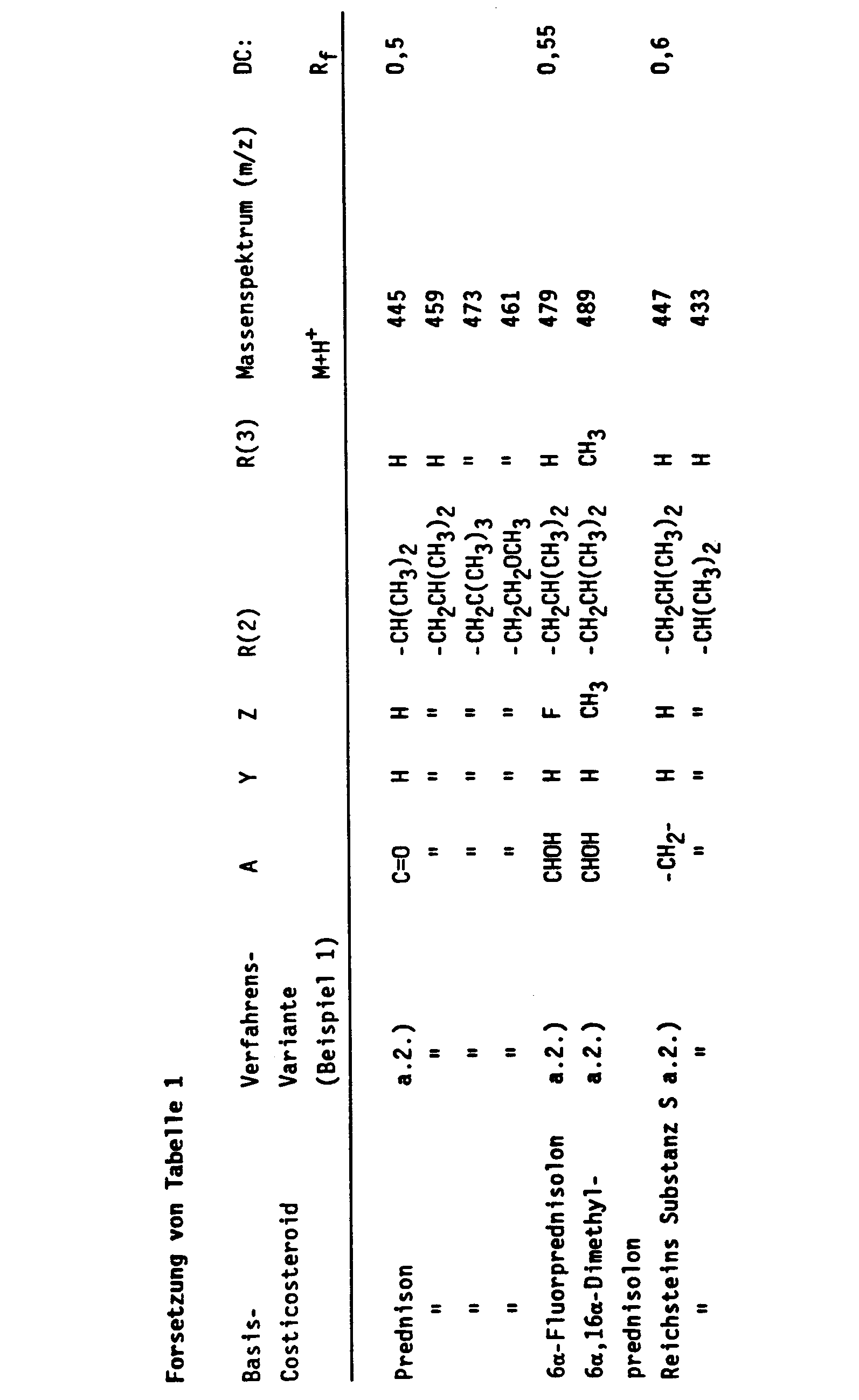
- In gleicher Weise werden aus Prednisolon-17-isopropyl-carbonat, aus Prednisolon-17-tert.-butylmethyl- carbonat, aus Prednisolon-17-methoxyethylcarbonat, wenn man 1.) nach Beispiel 2, b.) verfährt, erhalten:
- Prednisolon-17-isopropylcarbonat-21-propionat
- MS = m/z = 503 (M+H+)
- Prednisolon-17-tert.-butylmethylcarbonat-21-propionat
- MS = m/z 531 (M+H+)
- Prednisolon-17-methoxyethylcarbonat-21-propionat
- MS = m/z = 519 (M+H+)
- wenn man 2.) nach Beispiel 2, a.) verfährt, erhalten:
- Prednisolon-17-iso-propylcarbonat-21-acetat
- MS = m/z = 489 (M+H+),
- Prednisolon-17-tert.-butylmethylcarbonat-21-acetat
- MS = m/z = 505 (M+H+),
- Prednisolon-17-methoxyethylcarbonat-21-acetat
- Ms = m/z = 505 (M+H+)
- In gleicher oder ähnlicher Weise wie in Beispiel 2.a.) und 2.b.) beschrieben, werden folgende Corticosteroid-17-alkylcarbonat-21-carbonsäureester (R(1) = OCO(CH2)n-R(4)), -21-Kohlensäureester (R(1) = OCO2(CH2)n-R(4)) oder 21- Alkyl- bzw. Arylsulfonsäureester (R(1) = OS02R(5)) der Formel I gemäß Tabellen 2-7 hergestellt bzw. erhalten, wenn bei Beispiel 2.a.) anstatt Essigsäureanhydrid die analogen Carbonsäureanhydride (CO[CO(CH2)nR(4)]2) oder anstelle von Propionsäurechlorid bei Beispiel 2.b.) die entsprechenden Carbonsäurechloride (CI-CO-(CH2)nR(4)) oder Kohlensäurechloride bzw. Chlorameisensäureester (CI-CO-O-(CH2)nR(4)) oder Alkyl- bzw.
Arylsulfonsäurechloride (CI-S02-R(5)) eingesetzt werden. - Die Bedeutungen von A, Y, Z, R(3), R(2), R(1), R(4), R(5) sind eingangs zu Formel I angegeben.
- Bei den entsprechenden Reaktionen mit Alkyl- oder Arylsulfonsäurechloriden wird in vorteilhafter Weise absolutes Aceton zum Reaktionsgemisch hinzugefügt, wobei das Verhältnis Aceton/Pyridin etwa 10:4 ist.
- Bei den Reaktionen mit Carbonsäurechloriden wird in vorteilhafter Weise oft absolutes Dioxan zum Reaktionsgemisch gegeben, z.B. bei Cyclopropylcarbonsäurechlorid, wobei das Verhältnis Dioxan/Pyridin etwa 1:1 ist, und zur Reaktionsbeschleunigung wird das Reaktionsgemisch oft, insbesondere bei Cyclopropylcarbonsäurechlorid, auf etwa 60 °C erwärmt (DC-Verfolgung der Reaktionsverläufe).
- Die Charakterisierung der Reaktionsprodukte kann durch Dünnschichtchromatographie (DC) erfolgen; hierbei haben die Reaktionsprodukte RF-Werte von etwa 0,65-0,75. In der Regel werden die Reaktionsprodukte durch Massenspektren mit MS = m/z = .... (M+H+) charakterisiert (In der Regel FAB-Spektren). Die M + H+-Werte wurden jeweils aufgerundet. Auch IR-, 1H-NMR- und UV-Spektren können zur Charakterisierung herangezogen werden.


- Eine Lösung von 540 mg Prednisolon-17-isobutylcarbonat-21-p-Chlorbenzolsulfonat in 5,6 ml absolutem Dimethylformamid wird mit 1,04 g getrocknetem Lithiumchlorid versetzt und in N2-Atmosphäre 4 Std. bei 100 °C gerührt. man gießt in 200 ml wässrige Kochsalzlösung ein, filtriert den gebildeten Niederschlag ab, trocknet ihn und kristallisiert ihn aus Aceton/Methylenchlorid/Diethylether aus. Man erhält 420 mg Prednisolon-17-isobutylcarbonat-21-chlorid. Schmp. 132 C MS : m/z = 480 [M+H+] DC : 0,7
- In gleicher Weise werden aus Prednisolon-17-isopropyl-carbonat-21-p-chlorbenzolsulfonat das Prednisolon-17-iso-propylcarbonat-21-chlorid, aus Prednisolon-17-tert.-butyl-methylcarbonat-21-p-chlorben- zolsulfonat das Prednisolon-17-tert.-butylmethylcarbonat-21-chlorid, aus Prednisolon-17-methoxyethylcarbonat-p-chlorbensolsulfonat das Prednisolon-17-methoxyethylcarbonat-21-chlorid erhalten.
- Eine Lösung von 300 mg Prednisolon-17-isobutylcarbonat-21-p-chlorbensolsulfonat in 3 ml absolutem Dimethylformamid wird mit 630 mg trockenem Lithiumbromid versetzt und unter N2-Atmosphäre 4 Std. bei 110 C, gerührt. Man gießt in 20 ml wässrige Kochsalzlösung ein, filtriert den gebildeten Niederschlag ab, trocknet ihn und chromatographiert ihn an Kieselgel (Säulenmaße 17 x 3 cm) mit Methylenchlorid/Methanol 99:1 als Eluationsmittel. Nach dem Abdestillieren der Lösungsmittel werden nach Kristallisation aus Diethylether 310 mg Prednisolon-17-isobutylcarbonat-21-bromid erhalten: MS : m/z = 524 [M+H+] Zum gleichen Reaktionsprodukt gelangt man, wenn man anstelle von LiBr 0,5 g. Kaliumbromid in die Reaktion einsetzt, weiterbehandelt, aufarbeitet und reindarstellt (Chromatographie). In gleicher Weise werden aus Prednisolon-17-isopropylcarbonat-21-p-chlorbenzolsulfanat das Prednisolon-17-isopropylcarbonat-21-bromid, aus Prednisolon-17-tert.-butylmethylcarbonat-21-chlorbenzol-sulfonat das Prednisolon-17-tert.-butylmethylcarbonat-21-bromid, aus Prednisolon-17-methoxyethylcarbonat-p-chlorbenzolsulfonat, das Prednisolon-17-methoxyethylcarbonat-21-bromid erhalten.
- Eine Lösung von 540 mg Prednisolon-17-isobutylcarbonat-21-p-chlorbenzolsulfonat in 10 ml absol. Dimethylformamid wird mit 1,00 g getrocknetem Kaliumjodid versetzt und in N2-Atmosphäre 2 Std. bei 100 ° C gerührt. Man gießt in 200 ml wässrige Kochsalzlösung ein, filtriert einen gebildeten Niederschlag ab, trocknet ihn und kristallisiert ihn aus Aceton/Methylenchlorid/Diethylether aus oder chromatographiert ihn, wie in Beispiel 7 für das entsprechende 21-Bromid angegeben. Man erhält 300 mg Prednisolon-17-isobutylcarbonat-21-jodid. Schmp. 110 °C MS : m/z = 571 [M+H+] DC : 0,7
- In gleicher Weise werden aus Prednisolon-17-isopropylcarbonat-21-p-chlorbenzolsulfonat das Prednisolon-17-isopropylcarbonat-21-jodid, aus Prednisolon-17-tert.-butylmethylcarbonat-21-p-chlorbenzol-sulfonat das Prednisolon-17-tert.-butylmethylcarbonat-21-jodid, aus Prednisolon-17-methoxyethylcarbonat-p-chlorbenzol-sulfonat das Prednisolon-17-methoxyethylcarbonat-21-jodid erhalten.
- Zu den gleichen Reaktionsprodukten gelangt man, wenn man 300 mg eines o.a. 21-Chlorsulfonats mit 60 mg Lithiumjodid in 6 ml aboslutem Aceton oder Butanol-(2) 3 Std. unter N2 am Rückfluß kocht, in 20 ml H20 eingießt, mit Methylenchlorid extrahiert und nach üblicher Aufarbeitung aus Diisopropylether kristallisiert (200-300 mg Ausbeute).
- Gemäß Tabelle 8 erhält man mit Alkylihalogeniden aus den zugrundeliegenden Corticoid-17-alkyl- bzw. 17-methoxyethyl-carbonat-21-p-chlor-benzolsulfonaten die entsprechenden 21-Halogenidderivate der Formel I, wenn man die Reaktionen in der Weise, wie zu den Beispielen 6, 7 und 8 beschrieben, durchführt: Die Charakterisierung der Reaktionsprodukte kann durch Dünnschichtchromatographie (DC) erfolgen; hierbei haben die Reaktionsprodukte RF-Werte von etwa 0,65-0,75. In der Regel werden die Reaktionsprodukte durch Massenspektren mit MS = m/z = .... (M+H+) charakterisiert (In der Regel FAB-Spektren). Die M + H -Werte wurden jeweils aufgerundet. Auch IR-, H-NMR- und UV-Spektren können zur Charakterisierung herangezogen werden.


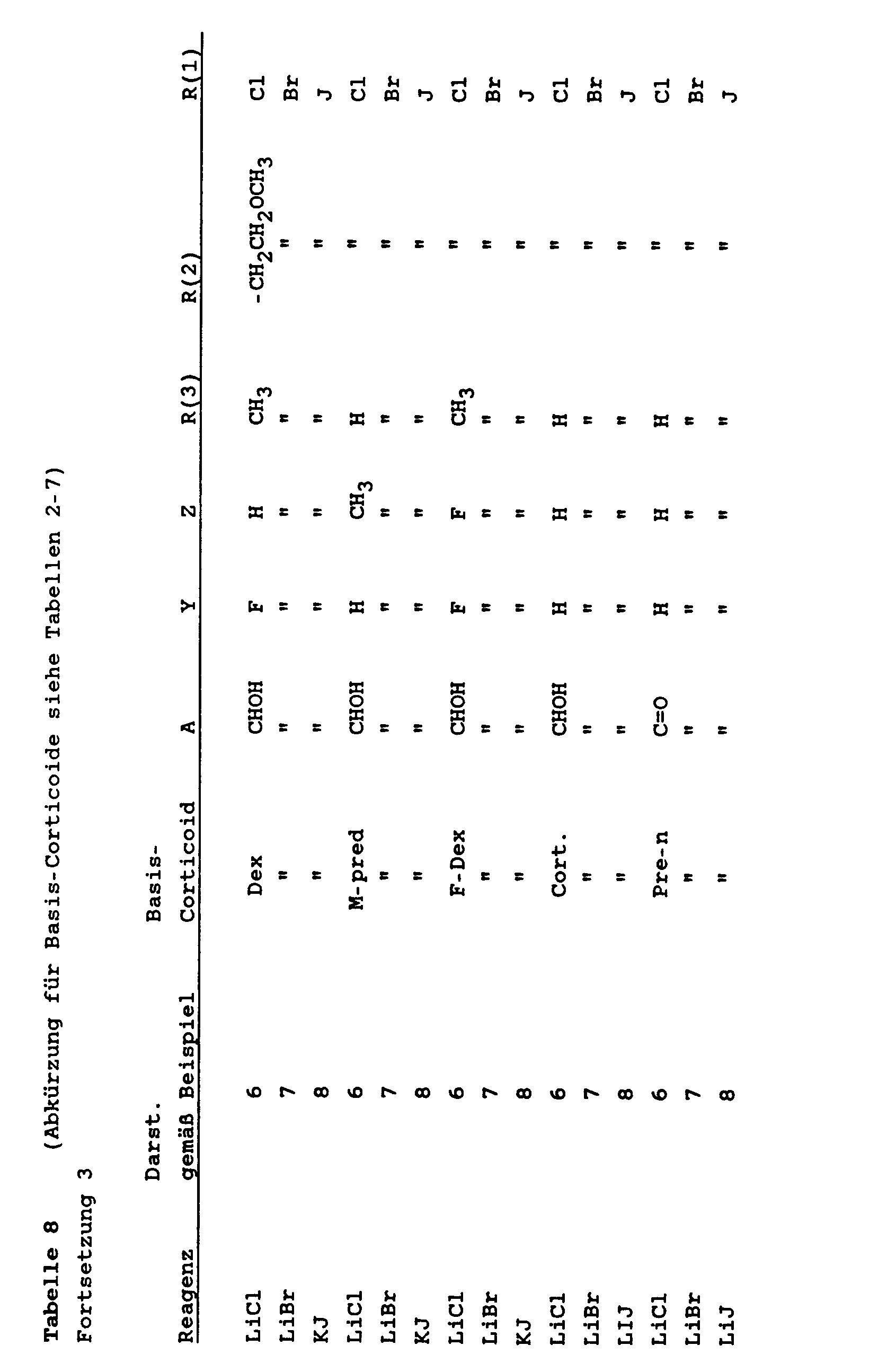
- Zu einer Lösung von 1,5 g Prednisolon in 45 ml absolutem Dioxan gibt man 7 ml Orthokolensäuretetraisopropylether sowie 0,2 g p-Toluolsulfonsäure. Nach 3 bis 5 Std. Erhitzen auf 60 °C und Rühren zeigt ein DC-Diagramm einen intensiven Fleck mit dem RF-Wert von ca. 0,8 für das erwartete Reaktionsprodukt und nur noch einen äußerst schwach sichtbaren "Fleck" für das Ausgangsprodukt mit dem RF-Wert bei ca. 0,3. Man gießt das Reaktionsgemisch in 500 ml wässrige Kochsalzlösung ein, filtriert den Niederschlag ab, wäscht ihn mit Wasser und trocknet ihn. Nach dem Umkristallisieren aus Methylenchlorid/Ethanol/Diethylether erhält man 1,3 g Prednisolon-17,21-di-isopropyl-ortho-carbonat vom Schmp. 185 C. MS = m/z = 489 (M+H+) IR = 3420, 1730, 1660, 1620, 1600, 1100 cm-1 UV: λmax = 242,5 nm, 6 = 15600.
- Wiederholung des Ansatzes, der aber jetzt anstatt auf 60 °C zu erwärmen, 3 Std. bei 20 °C (Zimmertemp.) gerührt wird, ergibt nach dem analogen Aufarbeiten ein Reaktionsprodukt (1,1 g), das in allen spektralen Daten (z.B. MS = M + H+ = 360) mit dem Ausgangsmaterial Prednisolon weitgehend identisch ist. DC: RF = 0,3 = sehr starker Fleck (= Prednisolon), RF etwa 0,8 nur sehr schwacher Fleck sichtbar (= gewünschtes Reaktionsprodukt)
- Zu einer Lösung von 25 g Prednisolon in 750 ml absolutem Dioxan gibt man 70 ml Orthokohlensäuretetraisobutylether sowie 2 g p-Toluolsulfonsäure. Nach 5 Std. Erhitzen auf 60 °C und Rühren zeigt im DC-Diagramm einen intensiven Fleck mit dem RF-Wert von ca. 0,8 für das erwartete Reaktionsprodukt und nur noch einen äußerst schwach sichtbaren "Fleck" für das Ausgangsprodukt mit dem RF-Wert bei ca. 0,3. Man gießt das Reaktionsgemisch in 8 I wässrige Kochsalzlösung ein, filtriert den Niederschlag ab, wäscht ihn mit Wasser und trocknet ihn. Nach dem Umkristallisieren aus Methylenchlorid/Ethanol/Diethylether erhält man 38,8 g Prednisolon-17,21-diisobutyl-orthocarbonat vom Schmp. 113 C. MS = m/z = 517 (M + H") IR = 3380, 1750, 1735, 1660, 1615, 1600, 1120, 1090 cm-1
- Zu einer Lösung von 25 g Prednisolon in 550 ml absolutem Dioxan gibt man 60 ml Orthokohlensäuretetra-tert.-butylmethylester sowie 2 g p-Toluolsulfonsäure. Nach 6 Std. Erhitzen auf 60 °C und Rühren zeigt ein DC-Diagramm einen intensiven Fleck mit dem RF-Wert von ca. 0,8 für das erwartete Reaktionsprodukt und nur noch einen äußerst schwach sichtbaren "Fleck" für das Ausgangsprodukt mit dem RF-Wert bei ca. 0,3. Man gießt das Reaktionsgemisch in 8 I wässrige Kochsalzlösung ein, filtriert den öligen Niederschlag ab, nimmt ihn in Methylenchlorid auf, wäscht die organische Phase mit Wasser, trocknet sie und destilliert das Lösungsmittel ab. Das Öl (35 g) wird an Aluminiumoxid, neutral, Akt-St. II (Säule 25 x 8 cm) mit Methylenchlorid als Eluationsmittel chromatographiert (100 ml Fraktionen). Die Fraktionen, die im DC einen RF-Wert von etwa 0,8 cm zeigen, werden vereinigt, vom Eluationsmittel durch Abdestillieren befreit und ergeben nach Vereinigung 14 g gelbliches öliges Prednisolon-17,21-di-tert.-butylmethyl-orthocarbonat. MS: m/z = 545 (M + H )
- Zu einer Lösung von 25 g Prednisolon in 500 ml absolutem Dioxan gibt man 7 ml Orthokohlensäuretetra-methoxyethylester sowie 2 g p-Toluolsulfonsäure. Nach 5 Std. Erhitzen auf 60 °C und Rühren zeigt ein DC-Diagramm einen intensiven Fleck mit dem RF-Wert von ca. 0,8 für das erwartete Reaktionsprodukt und nur noch einen äußerst schwach sichtbaren "Fleck" für das Ausgangsprodukt mit dem RF-Wert bei ca. 0,3. Man gießt das Reaktionsgemisch in 8 I wässrige Kochsalzlösung ein und filtiert vom öligen Niederschlag ab. Weiterbehandlung und chromatographische Reindarstellung wie bei Beispiel 12. Man erhält 27,5 g Prednisolon-17,21-di-methoxyethyl-orthocarbonat vom Schmp. 125 °C (Zers.) (durch Anreiben mit Diethylether) MS: m/z = 521 (M + H ) IR = 3400, 1725, 1660, 1620, 1600, 1125, 1060 cm-1
- In gleicher Weise, wie in Beispiel 10 beschrieben, werden erhalten, wenn man anstelle von Prednisolon einsetzt:
- aus Dexamethason das
- Dexamethason-17,21-di-isopropyl-orthocarbonat,
- MS: m/z = 521 (M + H+),
- aus 6a-Methylprednisolon das
- 6α-Methylprednisolon-17,21 -di-isopropyl-orthocarbonat,
- MS: m/z = 503 (M+H+),
- aus 6a-Fluordexamethason das
- 6a-Fluordexamethanon-17,21-di-isopropyl-othocarbonat,
- MS: m/z = 539 (M+H+),
- aus Cortisol das
- Cortisol-17,21-di-isopropylorthocarbonat,
- MS: m/z = 491 (M+H+),
- aus Prednison das
- Prednison-17,21-di-isopropylorthocarbonat,
- MS: m/z = 487 (M + H+),
- aus Cortison das
- Cortison-17,21-di-isopropylorthocarbonat,
- MS: m/z = 489 (M+H+),
- aus Reichsteins Substanz S das
- [Reichsteins Substanz S]-17,21-di-isopropylorthocarbonat, MS: m/z = 475 (M+H+),
- aus 6a,16a-Dimethylprednisolon das
- 6α,16α-Dimethylprednisolon-17,21 -di-isopropylorthocarbonat,
- MS: m/z = 517 (M + H+),
- aus 6a-Fluorprednisolon das
- 6α-Fluor-prednisolon-17,21-di-isopropylorthocarbonat,
- MS: m/z = 507 (M + H+),
- In gleicher Weise, wie in Beispiel 11 beschrieben, werden erhalten, wenn man anstelle von Prednisolon einsetzt:
- aus Dexamethason das
- Dexamethason-17,21-di-isobutyl-orthocarbonat,
- MS: m/z 549 (M+H+),
- aus 6a-Methylprednisolon das 6α-Methylprednisolon-17,21-di-isobutyl-orthocaronat,
- MS: m/z = 531 (M+H+),
- aus 6a-Fluordexamethason das
- 6α-Fluordexamethason-17,21-di-isobutyl-orthocarbonat,
- MS: m/z = 567 (M + H+),
- aus Cortisol das
- Cortisol-17,21-di-isobutyl-orthocarbonat,
- MS: m/z = 519 (M+H+),
- aus Prednison das
- Prednison-17,21-di-iso-butylorthocarbonat,
- MS: m/z = 515 (M+H+),
- aus Cortison das
- Cortison-17,21-di-iso-butylorthocarbonat,
- MS: m/z = 517 (M + H+),
- aus Reichsteins Substanz S das
- [Reichsteins Substanz S]-17,21-di-isobutylorthocarbonat,
- MS: m/z = 503 (M+H+),
- aus 6a,16a-Dimethylprednisolon das
- 6α,16α-Dimethylprednisolon-17,21-di-isobutylorthocarbonat,
- MS: m/z = 545 (M+H+),
- aus 6a-Fluor-prednisolon das
- 6a-Fluorprednisolon-17,21-di-isobutyl-orthocarbonat,
- MS: m/z = 535 (M+H+),
- aus
- 6a-Methyl-dexamethason das
- 6a-Methyl-dexamethason-di-isobutyl-orthocarbonat,
- In gleicher Weise, wie in Beispiel 12 beschrieben, werden erhalten, wenn man anstelle von Prednisolon einsetzt:
- aus Dexamethason das
- Dexamethason-17,21-di-tert.-butylmethyl-orthocarbonat,
- MS: m/z = 577 (M + H+),
- aus 6a-Methylprednisolon das
- 6α-Methylprednisolon-17,21-di-tert.-butylmethyl-orthocarbonat,
- MS: m/z = 559 (M+H+),
- aus 6a-Fluordexamethason das
- 6α-Fluordexamethason-17,21-di-tert.-butylmethyl-orthocarbonat,
- MS: m/z = 595 (M+H+),
- aus Cortisol das
- Cortisol-17,21-di-tert.-butylmethyl-orthocarbonat,
- MS: m/z = 547 (M + H+),
- aus Prednison das
- Prednison-17,21-di-tert.-butylmethyl-orthocarbonat,
- MS: m/z = 543 (M+H+),
- In gleicher Weise, wie in Beispiel 13 beschrieben, werden erhalten, wenn man anstelle von Prednisolon einsetzt:
- aus Dexamethason das
- Dexamethason-17,21-di-methoxyethyl-orthocarbonat,
- MS: m/z = 553 (M+H+),
- aus 6a-Methylprednisolon das
- 6α-Methylprednisolon-17,21-di-methoxyethyl-orthocarbonat,
- MS: m/z 535 (M+H+),
- aus 6a-Fluordexamethason das
- 6α-Fluordexamethason-17,21-di-methoxyethyl-ortbocarbonat,
- MS: m/z (M+H+),
- aus Cortisol das
- Cortisol-17,21-di-methoxyethyl-orthocarbonat,
- MS: m/z = 523 (M+H+),
- aus Prednison das
- Prednison-17,21-di-methoxyethyl-orthocarbonat
- MS: m/z = 519 (M+H+).
die Bindung zwischen C1- und C2 ist eine Einfach- oder eine Doppelbindung, wie durch die punktierte Linie in Formel I angegeben.
und gegebenenfalls den so erhaltenen 21-Sulfonsäureester mit Halogenidsalzen zu 21-Halogeniden der Formel I mit R(1) gleich Chlor, Brom, Jod, Fluor umsetzt.
Claims (12)


Applications Claiming Priority (2)
| Application Number | Priority Date | Filing Date | Title |
|---|---|---|---|
| DE4025342A DE4025342A1 (de) | 1990-08-10 | 1990-08-10 | In 17-stellung substituierte corticoid-17-alkylcarbonate, verfahren zu deren herstellung und diese enthaltende arzneimittel |
| DE4025342 | 1990-08-10 |
Publications (2)
| Publication Number | Publication Date |
|---|---|
| EP0470617A2 true EP0470617A2 (de) | 1992-02-12 |
| EP0470617A3 EP0470617A3 (en) | 1992-04-01 |
Family
ID=6411982
Family Applications (1)
| Application Number | Title | Priority Date | Filing Date |
|---|---|---|---|
| EP19910113338 Ceased EP0470617A3 (en) | 1990-08-10 | 1991-08-08 | 17-substituted corticoid-17-alkylcarbonates, a process for their preparation and pharmaceutical compositions containing them |
Country Status (22)
| Country | Link |
|---|---|
| US (1) | US5362721A (de) |
| EP (1) | EP0470617A3 (de) |
| JP (1) | JPH0641187A (de) |
| KR (1) | KR920004407A (de) |
| AU (1) | AU646066B2 (de) |
| CA (1) | CA2048841A1 (de) |
| CZ (1) | CZ279875B6 (de) |
| DE (1) | DE4025342A1 (de) |
| EC (1) | ECSP941049A (de) |
| EG (1) | EG19928A (de) |
| FI (1) | FI913775A7 (de) |
| HU (1) | HU211994B (de) |
| IE (1) | IE912827A1 (de) |
| IL (1) | IL99135A (de) |
| LT (1) | LT3374B (de) |
| LV (1) | LV10459B (de) |
| MX (1) | MX9100613A (de) |
| NO (1) | NO913115L (de) |
| PT (1) | PT98605A (de) |
| RU (1) | RU2060997C1 (de) |
| TW (1) | TW203056B (de) |
| ZA (1) | ZA916291B (de) |
Cited By (6)
| Publication number | Priority date | Publication date | Assignee | Title |
|---|---|---|---|---|
| US5608093A (en) * | 1993-08-27 | 1997-03-04 | Hoechst Aktiengesellschaft | Corticosteroid 17-alkyl carbonate 21-[0]-carboxylic and carbonic esters, and pharmaceuticals containing these compounds |
| US6835724B2 (en) | 1993-10-05 | 2004-12-28 | Aventis Pharma Deutschland Gmbh | Corticoid 17,21-dicarboxylic esters and corticosteroid 17-carboxylic ester 21-carbonic esters, processes for their preparation and pharmaceuticals containing these compounds |
| US7101866B2 (en) | 2000-08-05 | 2006-09-05 | Glaxo Group Limited | Anti-inflammatory androstane derivative |
| US7125985B2 (en) | 2000-08-05 | 2006-10-24 | Glaxo Group Limited | Compounds useful in the manufacture of an anti-inflammatory androstane derivative |
| WO2007057152A1 (en) * | 2005-11-15 | 2007-05-24 | Glaxo Group Limited | 17.beta.-fluoromethoxycarbonyl-androst-4-en-3-one compounds with a 17.alpha.-carbonate substituent |
| US7291608B2 (en) | 2001-04-30 | 2007-11-06 | Glaxo Group Limited | Anti-inflammatory 17.β.-carbothioate ester derivatives of androstane with a cyclic ester group in position 17.α |
Families Citing this family (13)
| Publication number | Priority date | Publication date | Assignee | Title |
|---|---|---|---|---|
| US5981517A (en) * | 1996-05-09 | 1999-11-09 | Soft Drugs, Inc. | Androstene derivatives |
| US6858596B2 (en) * | 2000-08-05 | 2005-02-22 | Smithkline Beecham Corporation | Formulation containing anti-inflammatory androstane derivative |
| US6759398B2 (en) * | 2000-08-05 | 2004-07-06 | Smithkline Beecham Corporation | Anti-inflammatory androstane derivative |
| US6777399B2 (en) * | 2000-08-05 | 2004-08-17 | Smithkline Beecham Corporation | Anti-inflammatory androstane derivative compositions |
| ES2307751T3 (es) * | 2001-06-12 | 2008-12-01 | Glaxo Group Limited | Nuevos esteres heterociclicos centi-inflamatorios 17 alfa de derivados 17 beta de carbotioato de androstano. |
| US20050175545A1 (en) * | 2002-02-04 | 2005-08-11 | Keith Biggadike | Formulation for inhalation comprising a glucocorticoid and a beta 2-adrenoreceptor agonist |
| GB0202635D0 (en) * | 2002-02-05 | 2002-03-20 | Glaxo Wellcome Mfg Pte Ltd | Formulation containing novel anti-inflammatory androstane derivative |
| GB2389530B (en) * | 2002-06-14 | 2007-01-10 | Cipla Ltd | Pharmaceutical compositions |
| DE602006005901D1 (de) * | 2005-02-04 | 2009-05-07 | Us Gov Health & Human Serv | NANDROLON-17ß-CARBONATE |
| GB0507165D0 (en) * | 2005-04-08 | 2005-05-18 | Glaxo Group Ltd | Novel crystalline pharmaceutical product |
| GB0615108D0 (en) * | 2006-07-28 | 2006-09-06 | Glaxo Group Ltd | Novel formulations |
| UA116622C2 (uk) * | 2011-11-11 | 2018-04-25 | Аллерган, Інк. | Похідні 4-прегенен-11ss-17-21-тріол-3,20-діону для лікування хвороб очей |
| WO2023088308A1 (zh) * | 2021-11-16 | 2023-05-25 | 石家庄迪斯凯威医药科技有限公司 | 一种具有抗耐药性的抗菌化合物 |
Family Cites Families (5)
| Publication number | Priority date | Publication date | Assignee | Title |
|---|---|---|---|---|
| DE1668079B2 (de) | 1968-01-18 | 1976-09-16 | Hoechst Ag, 6000 Frankfurt | Dialkylorthocarbonate von 17alpha, 21-dihydroxysteroiden und verfahren zu ihrer herstellung |
| DE2735110A1 (de) * | 1977-08-04 | 1979-02-15 | Hoechst Ag | Corticoid-17-alkylcarbonate und verfahren zu ihrer herstellung |
| DE2817988A1 (de) * | 1978-04-25 | 1979-11-08 | Hoechst Ag | Corticoid 17-alkylcarbonate und verfahren zu deren herstellung |
| SE449106B (sv) * | 1980-07-10 | 1987-04-06 | Otsuka Pharma Co Ltd | Steroid med anti-inflammatorisk verkan samt komposition innehallande denna |
| AU558725B2 (en) * | 1983-09-07 | 1987-02-05 | Mitsubishi Kasei Corporation | Corticoid derivatives |
-
1990
- 1990-08-10 DE DE4025342A patent/DE4025342A1/de not_active Withdrawn
-
1991
- 1991-02-22 TW TW080101348A patent/TW203056B/zh active
- 1991-08-08 FI FI913775A patent/FI913775A7/fi not_active Application Discontinuation
- 1991-08-08 EG EG47991A patent/EG19928A/xx active
- 1991-08-08 RU SU915001317A patent/RU2060997C1/ru active
- 1991-08-08 CZ CS912461A patent/CZ279875B6/cs unknown
- 1991-08-08 EP EP19910113338 patent/EP0470617A3/de not_active Ceased
- 1991-08-08 IL IL9913591A patent/IL99135A/en not_active IP Right Cessation
- 1991-08-08 HU HU912643A patent/HU211994B/hu not_active IP Right Cessation
- 1991-08-08 PT PT98605A patent/PT98605A/pt not_active Application Discontinuation
- 1991-08-09 JP JP3223670A patent/JPH0641187A/ja active Pending
- 1991-08-09 AU AU82560/91A patent/AU646066B2/en not_active Ceased
- 1991-08-09 CA CA002048841A patent/CA2048841A1/en not_active Abandoned
- 1991-08-09 IE IE282791A patent/IE912827A1/en unknown
- 1991-08-09 NO NO91913115A patent/NO913115L/no unknown
- 1991-08-09 ZA ZA916291A patent/ZA916291B/xx unknown
- 1991-08-09 KR KR1019910013758A patent/KR920004407A/ko not_active Withdrawn
- 1991-08-09 MX MX9100613A patent/MX9100613A/es not_active IP Right Cessation
-
1993
- 1993-02-08 US US08/015,041 patent/US5362721A/en not_active Expired - Fee Related
- 1993-05-07 LV LVP-93-302A patent/LV10459B/en unknown
- 1993-06-25 LT LTIP709A patent/LT3374B/lt not_active IP Right Cessation
-
1994
- 1994-02-28 EC EC1994001049A patent/ECSP941049A/es unknown
Cited By (9)
| Publication number | Priority date | Publication date | Assignee | Title |
|---|---|---|---|---|
| US5608093A (en) * | 1993-08-27 | 1997-03-04 | Hoechst Aktiengesellschaft | Corticosteroid 17-alkyl carbonate 21-[0]-carboxylic and carbonic esters, and pharmaceuticals containing these compounds |
| US6835724B2 (en) | 1993-10-05 | 2004-12-28 | Aventis Pharma Deutschland Gmbh | Corticoid 17,21-dicarboxylic esters and corticosteroid 17-carboxylic ester 21-carbonic esters, processes for their preparation and pharmaceuticals containing these compounds |
| US7101866B2 (en) | 2000-08-05 | 2006-09-05 | Glaxo Group Limited | Anti-inflammatory androstane derivative |
| US7125985B2 (en) | 2000-08-05 | 2006-10-24 | Glaxo Group Limited | Compounds useful in the manufacture of an anti-inflammatory androstane derivative |
| US7144845B2 (en) | 2000-08-05 | 2006-12-05 | Glaxo Group Limited | Compounds useful in the manufacture of an anti-inflammatory androstane derivative |
| US7498321B2 (en) | 2000-08-05 | 2009-03-03 | Glaxo Group Limited | 17β-carbothioate 17α-arylcarbonyloxyloxy androstane derivative as anti-inflammatory agents |
| US7629335B2 (en) | 2000-08-05 | 2009-12-08 | Glaxo Group Limited | Anti-inflammatory androstane derivative |
| US7291608B2 (en) | 2001-04-30 | 2007-11-06 | Glaxo Group Limited | Anti-inflammatory 17.β.-carbothioate ester derivatives of androstane with a cyclic ester group in position 17.α |
| WO2007057152A1 (en) * | 2005-11-15 | 2007-05-24 | Glaxo Group Limited | 17.beta.-fluoromethoxycarbonyl-androst-4-en-3-one compounds with a 17.alpha.-carbonate substituent |
Also Published As
| Publication number | Publication date |
|---|---|
| MX9100613A (es) | 1992-04-01 |
| EG19928A (en) | 1996-07-31 |
| IL99135A (en) | 1995-12-08 |
| LV10459A (lv) | 1995-02-20 |
| PT98605A (pt) | 1992-06-30 |
| IL99135A0 (en) | 1992-07-15 |
| FI913775L (fi) | 1992-02-11 |
| LT3374B (en) | 1995-08-25 |
| CA2048841A1 (en) | 1992-02-11 |
| AU646066B2 (en) | 1994-02-03 |
| JPH0641187A (ja) | 1994-02-15 |
| TW203056B (de) | 1993-04-01 |
| NO913115D0 (no) | 1991-08-09 |
| CS246191A3 (en) | 1992-03-18 |
| DE4025342A1 (de) | 1992-02-13 |
| AU8256091A (en) | 1992-02-13 |
| HU211994B (en) | 1996-01-29 |
| HU912643D0 (en) | 1992-01-28 |
| LTIP709A (en) | 1995-01-31 |
| ECSP941049A (es) | 1994-11-16 |
| US5362721A (en) | 1994-11-08 |
| IE912827A1 (en) | 1992-02-12 |
| EP0470617A3 (en) | 1992-04-01 |
| KR920004407A (ko) | 1992-03-27 |
| HUT59155A (en) | 1992-04-28 |
| ZA916291B (en) | 1992-04-29 |
| LV10459B (en) | 1995-08-20 |
| NO913115L (no) | 1992-02-11 |
| FI913775A0 (fi) | 1991-08-08 |
| FI913775A7 (fi) | 1992-02-11 |
| CZ279875B6 (cs) | 1995-07-12 |
| RU2060997C1 (ru) | 1996-05-27 |
Similar Documents
| Publication | Publication Date | Title |
|---|---|---|
| EP0000742B1 (de) | Corticoid-17-Alkylcarbonate und Verfahren zu deren Herstellung und diese enthaltende Mittel | |
| EP0004975B1 (de) | Corticoid-17-Alkylcarbonate, Verfahren zu deren Herstellung sowie deren Verwendung als Arzneimittel gegen Dermatosen | |
| EP0640616B1 (de) | Corticosteroid-17-alkylcarbonat-21-(O)-Carbonsäure- und Kohlensäureester, Verfahren zu deren Herstellung und diese enthaltende Arzneimittel | |
| EP0470617A2 (de) | In 17-Stellung substituierte Corticoid-17-alkylcarbonate, Verfahren zu deren Herstellung und diese enthaltende Arzneimittel | |
| EP0646593B1 (de) | Corticoid-17,21-dicarbonsäureester sowie Verfahren zu deren Herstellung und diese enthaltende Arzneimittel | |
| DE2910899C2 (de) | 17α-Butyryloxy-11β-hydroxy-21-propionyloxy-4-pregnen-3,20-dion und topische Arzneimittel, welche diese Verbindung enthalten | |
| DE1443957B1 (de) | 9 alpha-Chlor- bzw. 9 alpha-Fluor-16 beta-methyl-prednisolon-17,21-diester und ein Verfahren zu deren Herstellung | |
| DE2222491C3 (de) | Steroid-21-salpetersäureester der Pregnanreihe, solche enthaltende Arzneimittel und Verfahren zur Herstellung derselben | |
| CH629825A5 (de) | Verfahren zur herstellung von terpenoiden estern von steroiden der pregnanreihe. | |
| DE2538595A1 (de) | Steroidverbindungen | |
| DE3336292C2 (de) | ||
| EP0708111B1 (de) | 17-Desoxi-corticosteroid-21-[O]-Carbonsäureester, Verfahren zu deren Herstellung und diese enthaltende Arzneimittel | |
| DE3881657T2 (de) | 21-alkoxy-steroid-derivate. | |
| DE2365992C3 (de) | 6α-Fluor-17,21-dihydroxy-16β-methylpregna-4,9(11)-dien-3,20-dion-17,21-diacetat und Verfahren zu dessen Herstellung | |
| CH639399A5 (de) | Steroid-spiro-oxazolidinon-derivate. | |
| DE2904614A1 (de) | Chlormethyl-17 alpha -acetoxy- 9 alpha -fluor-11 beta -hydroxy-16 beta -methyl-3-oxoandrosta-1,4-dien-17 beta -carboxylat, verfahren zu dessen herstellung und dieses enthaltende pharmazeutische zusammensetzungen | |
| EP0063369B1 (de) | Verfahren zur Herstellung von 17-alpha-Äthinyl-17-beta-trifluoracetoxygon-4-en-3-onderivaten | |
| DE3105307C2 (de) | ||
| AT395428B (de) | Verfahren zur herstellung von neuen androstancarbothioaten | |
| CH626633A5 (de) | ||
| DE2259283C2 (de) | 18,19-Dinor-13beta-alkylpregna-4,9,11triene, Verfahren und Zwischenprodukte zur Herstellung dieser Verbindungen sowie diese Verbindungen enthaltende pharmazeutische Zusammensetzungen | |
| DD232497A5 (de) | Verfahren zur herstellung von neuen corticoidderivaten | |
| EP0011121A1 (de) | Hydrocortisonester, diese enthaltende pharmazeutische Zubereitungen und Verfahren zu ihrer Herstellung | |
| EP0039895B1 (de) | Neue Pregnan-20-Carbonsäurederivate und Verfahren zu ihrer Herstellung | |
| DE1768673B1 (de) | 6alpha,9alpha-Difluorprednisolon-17,21-diester |
Legal Events
| Date | Code | Title | Description |
|---|---|---|---|
| PUAI | Public reference made under article 153(3) epc to a published international application that has entered the european phase |
Free format text: ORIGINAL CODE: 0009012 |
|
| PUAL | Search report despatched |
Free format text: ORIGINAL CODE: 0009013 |
|
| AK | Designated contracting states |
Kind code of ref document: A2 Designated state(s): AT BE CH DE DK ES FR GB GR IT LI LU NL SE |
|
| AK | Designated contracting states |
Kind code of ref document: A3 Designated state(s): AT BE CH DE DK ES FR GB GR IT LI LU NL SE |
|
| 17P | Request for examination filed |
Effective date: 19920604 |
|
| 17Q | First examination report despatched |
Effective date: 19930614 |
|
| STAA | Information on the status of an ep patent application or granted ep patent |
Free format text: STATUS: THE APPLICATION HAS BEEN REFUSED |
|
| 18R | Application refused |
Effective date: 19950822 |