EP0470871A1 - Papierhilfsmittel und seine Verwendung - Google Patents
Papierhilfsmittel und seine Verwendung Download PDFInfo
- Publication number
- EP0470871A1 EP0470871A1 EP91307417A EP91307417A EP0470871A1 EP 0470871 A1 EP0470871 A1 EP 0470871A1 EP 91307417 A EP91307417 A EP 91307417A EP 91307417 A EP91307417 A EP 91307417A EP 0470871 A1 EP0470871 A1 EP 0470871A1
- Authority
- EP
- European Patent Office
- Prior art keywords
- mixture
- paper
- oligomers
- paper product
- polymerization
- Prior art date
- Legal status (The legal status is an assumption and is not a legal conclusion. Google has not performed a legal analysis and makes no representation as to the accuracy of the status listed.)
- Granted
Links
Images

Classifications
-
- D—TEXTILES; PAPER
- D21—PAPER-MAKING; PRODUCTION OF CELLULOSE
- D21H—PULP COMPOSITIONS; PREPARATION THEREOF NOT COVERED BY SUBCLASSES D21C OR D21D; IMPREGNATING OR COATING OF PAPER; TREATMENT OF FINISHED PAPER NOT COVERED BY CLASS B31 OR SUBCLASS D21G; PAPER NOT OTHERWISE PROVIDED FOR
- D21H5/00—Special paper or cardboard not otherwise provided for
- D21H5/12—Special paper or cardboard not otherwise provided for characterised by the use of special fibrous materials
- D21H5/14—Special paper or cardboard not otherwise provided for characterised by the use of special fibrous materials of cellulose fibres only
- D21H5/141—Special paper or cardboard not otherwise provided for characterised by the use of special fibrous materials of cellulose fibres only of fibrous cellulose derivatives
-
- D—TEXTILES; PAPER
- D21—PAPER-MAKING; PRODUCTION OF CELLULOSE
- D21H—PULP COMPOSITIONS; PREPARATION THEREOF NOT COVERED BY SUBCLASSES D21C OR D21D; IMPREGNATING OR COATING OF PAPER; TREATMENT OF FINISHED PAPER NOT COVERED BY CLASS B31 OR SUBCLASS D21G; PAPER NOT OTHERWISE PROVIDED FOR
- D21H21/00—Non-fibrous material added to the pulp, characterised by its function, form or properties; Paper-impregnating or coating material, characterised by its function, form or properties
- D21H21/14—Non-fibrous material added to the pulp, characterised by its function, form or properties; Paper-impregnating or coating material, characterised by its function, form or properties characterised by function or properties in or on the paper
- D21H21/18—Reinforcing agents
-
- D—TEXTILES; PAPER
- D21—PAPER-MAKING; PRODUCTION OF CELLULOSE
- D21H—PULP COMPOSITIONS; PREPARATION THEREOF NOT COVERED BY SUBCLASSES D21C OR D21D; IMPREGNATING OR COATING OF PAPER; TREATMENT OF FINISHED PAPER NOT COVERED BY CLASS B31 OR SUBCLASS D21G; PAPER NOT OTHERWISE PROVIDED FOR
- D21H17/00—Non-fibrous material added to the pulp, characterised by its constitution; Paper-impregnating material characterised by its constitution
- D21H17/005—Microorganisms or enzymes
-
- D—TEXTILES; PAPER
- D21—PAPER-MAKING; PRODUCTION OF CELLULOSE
- D21H—PULP COMPOSITIONS; PREPARATION THEREOF NOT COVERED BY SUBCLASSES D21C OR D21D; IMPREGNATING OR COATING OF PAPER; TREATMENT OF FINISHED PAPER NOT COVERED BY CLASS B31 OR SUBCLASS D21G; PAPER NOT OTHERWISE PROVIDED FOR
- D21H17/00—Non-fibrous material added to the pulp, characterised by its constitution; Paper-impregnating material characterised by its constitution
- D21H17/20—Macromolecular organic compounds
- D21H17/21—Macromolecular organic compounds of natural origin; Derivatives thereof
- D21H17/24—Polysaccharides
Definitions
- This invention pertains to the field of paper, pulp and textile making and their chemistry.
- the kraft or sulfate process is probably the most extensively employed method to produce strong cellulose fibers.
- the active ingredients in pulping wood to its fibrous state are sodium hydroxide and sodium sulfide, in a strong alkaline solution.
- the process generates objectionable smells from the sodium sulfide produced during the process.
- Kraft pulps are dark in color, difficult to bleach and very strong.
- cellulose fibers obtained from the pulping process are generally unsuited for paper making and must first be refined. With given pulps, final paper properties are largely controlled by the type and extent of refining action employed.
- a variety of additive materials can be introduced to the paper-making pulps, commonly called “furnish", during stock preparation. Fillers such as clays, or calcium carbonate are used for the control of sheet opacity and for other reasons. Dyes are used extensively for color control and other additives such as wet-strength agents, and defoamers are used as needed.
- off-machine converting operations designed to increase the strength and/or other physical properties of paper take place subsequent to the paper making operation and are called "off-machine converting".
- These converting operations are highly complex and include embossing, coating, waxing, laminating, impregnating, saturating, currogating, and printing.
- food packaging has led to extensive paper utilization with the paper often being coated, waxed, resin-impregnated, or combined with other foils and films.
- a relatively simple and inexpensive method of improving the paper making process and increasing the stiffness and ultimate strength of paper is needed.
- the invention discloses the manufacture of novel paper materials comprising treating paper with water soluble or water suspendable mixtures of relatively low molecular weight polymers.
- the polymers are obtained by degrading polysaccharide derivatives, most preferably starch and cellulose derivatives.
- the invention further pertains to paper products coated or impregnated with water soluble or water dispersable mixtures of relatively low molecular weight polymers obtained by degrading polysaccharide derivatives. Most preferably these mixtures are obtained by degrading starch or cellulose derivatives.
- a water soluble or water dispersable mixture of polymers derived from a degraded polysaccharide derivative the mixture of polymers having an average degree of polymerization in the range of about 3 to about 500, usually 3 to 300, preferably 5 to 100, and more preferably 5 to 50.
- the most preferred polysaccharide derivative comprises starch or cellulose.
- the polysaccharide derivative may be degraded by enzymatic, chemical, physical, or mechanical agents/mechanisms.
- the enzyme preparation is typically selected from the group of polysaccharide degrading enzymes.
- enzymes such as amylases or pullulanases and mixtures thereof are suitable.
- a polymer or an initially degraded polysaccharide derivative mixture may be further separated into fractions of polymers of differing average chain lengths, e.g. using chromatographic techniques.
- the viscosity of the various fractions will vary with the degree of average chain length of the polymers contained within in a fraction.
- one or more fractions are selected from an initial polymeric mixture having a viscosity (average chain length) which is most appropriate for the particular application.
- the method of strengthening paper comprises treating the paper with a water soluble or water dispersable mixture of relatively low molecular weight polymers, which polymers are obtained by degrading polysaccharide derivatives, most preferably starch and cellulose.
- the method of enhancing the dewatering properties of paper pulp comprises treating the pulp with a water soluble or water dispersable mixture of relatively low molecular weight polymers, which polymers are obtained by degrading polysaccharide derivatives, most preferably starch and cellulose.
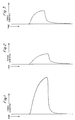
- Figure 1 is a force-distance curve of Whatman No. 1 filter paper treated with carboxylmethyl cellulose hydrolyzate.
- Figure 2 is a force-distance curve of Whatman No. 1 filter paper dipped in distilled water.
- Figure 3 is a force-distance curve of untreated Whatman No. 1 filter paper.
- Figure 4 shows results of drainage tests on furnish treated with carboxymethyl cellulose (CMC) hydrolyzate ( ⁇ ), carboxymethyl cellulose (o), carboxymethyl starch (CM starch) hydrolyzate ( ⁇ ), carboxymethyl starch (CM starch) ( ⁇ ), and untreated furnish ( ⁇ ).
- CMC carboxymethyl cellulose
- Figure 5 shows results of drainage tests on furnish/calcium carbonate mixtures treated with carboxymethyl cellulose (CMC) hydrolyzate ( ⁇ ), carboxymethyl cellulose (o), carboxymethyl starch (CM starch) hydrolyzate ( ⁇ ), and carboxymethyl starch (CM starch) ( ⁇ ).
- CMC carboxymethyl cellulose
- o carboxymethyl cellulose
- CM starch carboxymethyl starch
- CM starch carboxymethyl starch
- polysaccharide refers to a polymeric carbohydrate having a plurality of repeating units comprised of simple sugars.
- polymeric or “polymer” is meant to include both oligmeric and polymeric units and, specifically, those polysaccharides having more than four repeating monomeric simple sugar units.
- the C-O-C linkage formed between two joined simple sugar units in a polysaccharide chain is called a glycosidic linkage, and continued condensation of monosaccharide units will result in polysaccharides.
- the most common polysaccharides are amylose and cellulose, both made up of glucose monomers.
- Amylose is a major constituent of starch and glycogen.
- Cellulose is the major structural component of plants.
- Other polysaccharides useful in this invention have a straight chain or branched polymer backbone including one or more sugar monomers. These polysaccharides include those having sugar monomers such as glucose, galactose, arabinose, mannose, fructose, rahmnose, and xylose.
- Preferred polysaccharides useful in the article and methods of this invention are cellulose and starch. Nevertheless, examples of other such polysaccharides with branched or straight backlones are carragenan, pullulan, pustulan, laminarin, scleroglucan, alginate, guar gum, gum arabic, inulin, pectin, whelan, rhamsan, gellan, xanthan, zooglan, methylan, chitin, cyclodextrin and chitosan.
- the term "derivative” is meant to define polysaccharides according to this invention that are substituted.
- the polysaccharide derivative starting material has a degree of derivatization or substitution of between about 0.1 and about 3.0.
- “Degree of substitution” refers to the number of derivative groups (e.g. carboxymethyl, hydroxypropyl) per monomer unit in the polysaccharide backbone (branch or straight chain backbone).
- a degree of substitution of 0.2 means, for example that there is about one derivative substituent for every five monomer units in the polysaccharide backbone.
- a degree of substitution of three would mean there are three derivative substituents per every monomer unit in a polysaccharide chain.
- Typical substituents comprise one or more of sulfate, carboxylic acid (found in carragenan, alginate, pectin), carboxylic ester, pyruvic acid (found in pectin, xanthan gum, zooglan, and methylan), carboxymethyl, hydroxypropyl, methyl, methylethyl, hydroxyethyl, hydroxyethylmethyl and the like.
- carboxymethyl starch can be degraded enzymatically to produce corresponding carboxymethyl starch hydrolyzates.
- Other typical suitable starch derivatives include hydroxypropyl, methylethyl and hydroxyethyl starches.
- the substituents are typically bonded to a starch glucose monomer unit at the 2, 3 and 6 positions.
- Most typically a starch starting material comprises between about 1% to 85% amylose and about 15% to 99% amylopectin.
- Cellulose derivatives are commercially available. Such exemplary products as methylcellulose (MC, Methocel MC, 64630, Fluka Chemie AG, CH-9470 Buchs, Switzerland), hydroxypropylmethylcellulose (HPMC, H-9262, Sigma Chem. Co., St. Louis, MO) and carboxymethyl cellulose (CMC 7MFD, Blanose, Hercules Chem. Co., 92507 Rueil-Malmaison Ceder, France) all have a degree of substitution between 0.1 and 3. Hydroxypropyl celluloses are also commercially available and suitable for use.
- MC Methocel MC, 64630, Fluka Chemie AG, CH-9470 Buchs, Switzerland
- HPMC hydroxypropylmethylcellulose
- HPMC hydroxypropylmethylcellulose
- CMC 7MFD carboxymethyl cellulose
- Blanose Hercules Chem. Co., 92507 Rueil-Malmaison Ceder, France
- polysaccharide derivatives may be degraded to polymeric mixtures of average degree of polymerization (DP) between about 5 and about 500 by enzymatic, chemical, physical or mechanical agents/means.
- DP degree of polymerization
- the polymeric mixtures are generally referred to as a "hydrolyzate".
- degraded refers to the procedure whereby polysaccharide derivatives are broken down into smaller polymeric units.
- Exemplary enzymes for use in degrading certain of the above described polysaccharide derivatives are pectinases, lyases, lysozymes, xanthanases chitinases and laminarases.
- Exemplary enzymes which are suitable for degrading cellulose derivatives are various cellulases. They can be produced from a multitude of different microorganisms such as strains of Trichoderma , Aspergillus , Penicillium , etc. A selected microorganism strain is grown by conventional means in a suitable medium such that the cellulases are produced, the microorganism is separated from the medium, the medium is collected and typically concentrated and dried.
- Cellulase preparations suitable for use herein are, e.g. the commercially available cellulase preparations designated as the Econase series as produced by Alko Ltd., Helsinki, Finland.
- a polysaccharide derivative may be hydrolyzed by treating a polysaccharide derivative with a solution of acid.
- Typical acid treatment solutions might contain acids such as sulphuric acid, hydrochloric acid, phosphoric acid, or mixtures of the foregoing.
- the concentration of the acid in the treatment solution and the treatment time and temperature may vary depending on the degree of degradation of the polysaccharide derivative which is desired. In any event where an acid hydrolysis treatment is utilized, the acid concentration and the treatment time and temperature is selected to produce a mixture of polymers having an average DP of between 5-500.
- a selected polysaccharide (e.g. starch or cellulose) derivative may be degraded by oxidation with such agents as chlorine, oxygen or hydrogen peroxide.
- oxidative treatments and reaction conditions are well known in the art. It may also be possible to use physical methods like heat or mechanical shear treatment or sonication when cleaving the chain backbone of polysaccharide derivatives.
- the conditions and the degree of treatment are selected such that the polymeric mixture resulting from the initial treatment has an average DP of between about 3 and about 500, and contains less than about 25% preferably less than 10% by weight of mono- and di-saccharides.
- Enzymes which may be used with respect to paper products prepared or coated with degraded starch derivatives are various amylolytic enzyme preparations. They can be produced from a multitude of different microorganisms such as strains of Bacillus , Klebsiella , Clostridium , Aspergillus , Rhizopus . Typical commercially available enzyme preparations suitable for use herein are amylolytic preparations (such as alpha and beta amylases), pullulanases, and cyclodextrin glycosyltransferases (CGTase).
- amylolytic preparations such as alpha and beta amylases
- pullulanases such as pullulanases
- cyclodextrin glycosyltransferases CGTase
- the method comprises preparing a polymeric mixture of substituted polysaccharides having an average degree of polymerization (DP) in the range of 5-500. Next, the mixture is then contacted with paper for a period of time sufficient to treat the paper with the polymer mixture.
- DP average degree of polymerization
- This invention relates more specifically to a paper or paper product treated with water soluble or dispersable mixture of polymers derived from a polysaccharide derivative.
- the polymeric mixtures are characterized by having an average degree of polymerization (DP) in the range of about 5-500.
- DP average degree of polymerization
- the DP range is between 7-200.
- paper and pulp products are intended to include a variety of products made from cellulose, synthetic or other fibers, such products being recognized by those skilled in the art as paper, boards, construction paper.
- these terms refer to articles prepared from cellulose, synthetic, or other fibers or filamenatous materials such as those used in the textile industry. Specific examples include felted or matted sheets of cellulose fibers, formed on a fine wire screen from a dilute water suspension, and bonded together as the water is removed and the sheet is dried. These terms may also include sheet materials produced from other types of fibers, particularly mineral or synthetic fibers, formed and bonded by other means.
- pulped fibers commonly called “furnish”
- various materials such as fillers (clays, calcium carbonate), dyes, wet-strength agents and the like during the typical paper-making process.
- Methods of paper manufacture include the basic steps of pulping fibers, refining the pulp by addition of various materials, as described below, forming the paper on mesh screens, and drying the matted fibers.
- the polymer mixtures can be applied after the paper is made, in the so-called "off-machine converting" procedures.
- the mixtures can be applied using methods well known in the art such as dipping, spraying, and rolling.
- the polysaccharide derivative mixture thus prepared coats the surface of the paper and becomes fixed thereon by attraction between the polysaccharide mixture and the polysaccharide components of the paper including by physical forces such as hydrogen binding, Van der Waals forces and the like.
- the low molecular weight polymers of the invention are aligned along the cellulose, or other fibers. As a result, the intermolecular attraction per unit length increases, facilitating the quality of the final product and improving the processability of the paper or pulp product.
- the polymeric mixtures can also be incorporated into the paper furnish during pulp defining procedures.
- the mixture of degraded polysaccharides can be incorporated into the pulp furnish along with other dyes, colorants, wet-strength agents (agents capable of increasing the strength of wet or suspended materials), defoamers, and the like. In this procedure, the polysaccharides will become impregnated into the matrix of the paper fibers.
- treated or “treatment” are intended to include means or methods for contacting paper products with the polymeric mixtures so that at least one effect of such contact is to strengthen the paper, coat or impregnate the paper, improve the paper or pulp handling properties during manufacturing, improve the paper or pulp handling properties during manufacture, and/or increase the dewatering capacity of the paper pulp.
- methods of treatment include the two methods of introducing the polymer derivatives of the invention to the paper or paper products described above.
- Paper produced according to the method of this invention may be stronger than non-treated paper. Moreover, treated paper may less water spreading than untreated paper. Furnish treated with the polymers of the invention show an increased rate of dewatering during the early stages of draining.
- Starch derivative hydrolyzates may be prepared from starch derivatives as defined above by an enzymatic hydrolysis utilizing an amylolytic preparation having ⁇ -amylase as the main active hydrolytic agent such that only insignificant amounts of mono- and disaccharides are produced.
- the hydrolysis procedure is generally carried out by dissolving the starch derivative in water, adjusting the pH and the temperature to the value suitable for the enzyme activity, adding the enzyme to the solution and allowing the enzyme to react for a suitable time. After the enzyme reaction, the enzyme is inactivated by heating the solution up to about 100°C and the hydrolyzate product is concentrated and dried.
- the average degree of polymerization (DP) of the products formed by such a hydrolysis is less than 500 as determined by the reducing end group measurement, according to Somogyi, M. J. Biol . Chem . 195 , 19-33, (1952).
- the specific conditions suitable for and the specific time sufficient to secure the desirable hydrolysis may be readily determined for each selected starch derivative and each selected enzyme preparation.
- the average DP of the oligomers is less than 500.
- CM starch carboxymethyl starch
- Potato starch Purojel; Avebe, 9607 PT Foxhol, The Netherlands
- the hydrolyzate's value of reducing sugars was 0.28%.
- the viscosity of a 5% by weight suspension of the hydrolyzate, measured using Haake-Rotovisco RV 12 viscometer with sensor systems NV; (Karlsruhe, Federal Republic of Germany) at 25 °C was 57 mPa.s using the shear rate of 692 l/s.
- the viscosity of the unhydrolysed raw CM starch material was 106 mPa.s (25°C, 692 l/s).
- Cellulose derivative hydrolyzates may be prepared from soluble cellulose derivatives as discussed above by an enzymatic hydrolysis utilizing a cellulase preparation having endo -1, 4- beta -glucanase as the sole active hydrolytic agent.
- the average degree of polymerization (DP) of the polymers formed by such a hydrolysis is less than about 500, and thus the viscosity of solutions of the hydrolyzate is reduced significantly compared to the viscosity of solutions of the unhydrolysed cellulose derivatives.
- the specific conditions suitable for and the specific time sufficient to secure the desired hydrolysis may be readily determined for each selected cellulose derivative and each selected enzyme preparation.
- the average DP of the polymers is less than 500 and the viscosity of the resulting mixture is significantly reduced.
- methylcellulose (MC, Methocel MC, 64630, Fluka Chemie AG, CH-9470 Buchs, Switzerland) was mixed in 31 of water and the pH of the solution was adjusted to 5.5 with 15% phosphoric acid and the temperature was raised to 40°C.
- the hydrolyzate product contained less than 0.5% by weight of glucose and cellobiose.
- hydroxypropylmethylcellulose HPMC, H-9262, Sigma Chemical Company, St. Louis, MO, U.S.A.
- the pH of the solution was adjusted to 5.5 with 15% phosphoric acid and the temperature was raised to 40 °C.
- 0.24 ml of the enzyme preparation having a total endo-1, 4 beta-glucanase activity of 1340 nkat from which the beta-glucosidase activity was removed chromatographically (as described above) was added to the solution. After two hours another 20g of hydroxypropylmethylcellulose was added to the solution. After the hydrolysis of 22 hours the enzyme was inactivated by heating (90°C, 15 min.). Finally the hydrolyzate solution was cooled and freeze-dried.
- the product contained less than 0.05% by weight of glucose and cellobiose.
- CMC 7MFD-type a cellulose gum, also designated by the tradename Blanose and available from Hercules Chemical Company, 92507, Rueil-Malmaison Ceder, France; 7MFD designates a medium viscosity, food grade carboxymethylcellulose having 7 out of 10 glucose units substituted with carboxymethyl
- 7MFD designates a medium viscosity, food grade carboxymethylcellulose having 7 out of 10 glucose units substituted with carboxymethyl
- the product contained less than 2% by weight of glucose and cellobiose.
- the amount of produced glucose and cellobiose was above 5% by weight.
- the enzyme preparations selected were commercially available Cellulase AP 3 (Amano Pharmaceutical Co., Ltd., Nagoya, Japan) produced using an Aspergillus strain and Cellulase CP (Sturge Enzymes, North Yorkshire, England) produced using a Penicillium strain.
- Carboxymethylcellulose hydrolyzates were prepared as described in Example c(i), except that 30g of CMC-7MFD was used in 1 l of water, and the amounts of enzymes added were 0.028 g of Cellulase AP 3 (having a total endo -1, 4 beta -glucanase activity of 1350 nkat) and 0.048 g of Cellulase CP (having a total endo -1, 4 beta -glucanase activity of 1350 nkat).
- the viscosities and molecular weight distributions of the hydrolyzates produced by either cellulase were similar to the hydrolyzate produced with enzymes derived from Trichoderma reesei .
- the hydrolyzate of n cellulose derivative has a substantially lower viscosity than an equal amount by weight in aqueous solution of the cellulose derivative itself.
- the viscosity (and average DP) of this hydrolyzate is similar to the viscosities (and average DP) of the hydrolyzates produced by the enzymatic treatments described above utilizing enzymes derived from Trichoderma reesei .
- Carboxymethyl cellulose (CMC) hydrolyzates can be prepared by enzymatic, chemical or physical methods as disclosed in U.S. Patent Applications Serial Nos. 07/309,387, 07/370,629 and 07/464,291.
- CMC hydrolyzates used in present invention have the average degree of polymerization in the range of 5 to 500, based on the viscosity average molecular weight.
- the CMC hydrolysates have the viscosity value in the range of from 5 to 100 mPa.s, when measured in 20% (by weight) solution at 25°C with shear rate 584s ⁇ 1 using a Haake Viscotester, VI 500 with sensor system NV (Karlsruhe, Federal Republic of Germany).
- the Mark-Houwink exponent, a is indicative of the conformation of the polymer chain in solution.
- the conformation of the polymer chain in solution may be classified as an 1) impermeable dense sphere, 2) random coil, e.g. semi-permeable or free draining, and 3) rodlet or rod-like.
- Mark-Houwink exponents of 0.002 to about 0.5 correspond to dense spheres
- exponents of about 0.5 to about 0.8 correspond to semi-permeable random coils
- exponents of 0.8 to about 1.2 correspond to free draining random coils
- exponents of about 1.2 to about 2 correspond to rodlets or rod-like oligomers or polymers.
- the degradation product of the polysaccharide derivative comprises a mixture of oligomers of the polysaccharide having a Mark-Houwink exponent of at least 1.5 at an NaCl concentration of about 0.005N to about 0.5N.
- This NaCL concentration range is typically used when measuring Mark-Houwink exponents.
- the salt content of foodstuffs may also typically fall into this range.
- CMC raw material (Mw>15,000 Daltons) has Mark-Houwink exponents of 0.83-0.97, indicating a free draining random coil conformation.
- polymer coils are confined by the intra-chain interactions; therefore less change is seen in the Mark-Houwink exponent within the same range of ionic strength.
- the weight average molecular weight is less than 15,000 Daltons, the CMC chain is not sufficiently long to form a winding coil, the polymer chain is no longer subjected to the constraint of intra-chain interactions, and a chain of free strip or rod-like configuration may form.
- the electrostatic repulsion force becomes dominant due to the negative charge of the carboxymethyl groups, and the polymer assumes its most stiff rod-like conformation with the highest value of the Mark-Houwink exponents.
- the negative charge of carboxymethyl groups is shielded, the repulsion forces between the neighbouring groups are reduced, and the polymer chains relax, yielding a lower Mark-Houwink exponent.
- the experimentally determined data show that the molecular weight and chain conformational characteristics of the most preferred cellulose derivative oligomeric mixtures used in the invention, i.e. mixtures comprising a significant or substantial portion of oligomers of rod-like conformation, are distinctly different from those of undegraded cellulose derivatives.
- M W weight average molecular weights
- the most preferred oligomeric mixtures according to the invention have a relatively narrow range of molecular weights, i.e. relatively monodispersed, having a polydispersity index (M W /M n , weight average molecular weight divided by number average molecular weight) of less than about 2.0 and typically less than about 1.8.
- M W /M n polydispersity index
- the weight average molecular weights and number average molecular weights of a variety of CMC hydrolysate samples of different degree of hydrolysis were measured and the polydispersity index of all such hydrolysates was calculated as ranging between about 1.1 and about 1.9.
- the oligomers in a most preferred mixture of oligomers extend over a relatively narrow range of M W and, even as to mixtures having an average molecular weight at or near the upper limit of M W where the oligomers may begin to assume a random coil configuration, are comprised of a significant portion, preferably a majority, of oligomers having a rod-like configuration.
- CMC solutions were prepared in 0.2N NaCl solution at pH of 7.
- the solutions were passed through an HPLC column, and the light intensity was detected by multiangle laser light scattering using a Wyatt Technology, multiangle laser light scattering instrument, model DAWN-F.
- the flow rate was 0.2 ml/min.
- the concentrations of the solutions were detected by refractometer, and the sensitivity of the refractometer was 64.
- the weight average molecular weights, M W were determined using appropriate computer software.
- Example 5 Treatment of Paper with Polymers derived from Carboxymethyl cellulose (CMC)
- FIGS. 1, 2, 3 for hydrolyzate-treated water-treated, and untreated papers, respectively.
- the resultant values of the maximum tensile strength before rupturing of treated paper showed a 2 to 3 fold increase over untreated or water treated papers when the paper was treated with the hydrolyzate.
- the strain limit and modulus increased by dipping paper in hydrolyzate (Table 3). Dipping paper in water alone decreased the mechanical strength and increased the strain limit (Table 3).
- Example 6 Treatment of Paper with Polymers derived from Carboxymethyl Starch (CMS)
- CMS carboxymethyl starch
- CMSH carboxymethyl starch hydrolyzate
- Polysaccharide derivatives or their hydrolyzates were prepared and dissolved in water. After stirring for 10 minutes, the solution was added to furnish. The final mixture contained furnish (0.106% w/v solid) and 0.0053% (w/v) polysaccharide derivatives or their hydrolyzates. The mixture was mixed for 10 minutes and poured on basement paper which serves as a screen. The amount of water drained was recorded for the determination of dewatering rate and final water content was measured. The furnish was dried in the oven and used in the tensile strength test.
- this experiment shows that polysaccharide derivatives and their hydrolyzate increase the rate of dewatering in the early stage of drainage.
- the polysaccharide derivative hydrolyzates of the invention significantly improve the mechanical properties of the pulp product.
- Polysaccharides or their hydrolyzates were prepared and dissolved in a warm water (80°C, CM starch and its hydrolyzate) or room temperature water (CMC and its hydrolyzate). After stirring for 10 minutes, the solution was mixed with Ca(CO3)2 solution. After stirring for 10 minutes, the mixture was added to furnish. The mixture contained furnish with 0.106% (w/v) solid, 0.106% (w/v) Ca(CO3)2, and 0.00575% (w/v) polysaccharides or their hydrolyzates. The test for dewatering was repeated. The draining rates were faster in those mixtures containing hydrolyzate than those of high molecular weight polysaccharides (Figure 5).
Landscapes
- Life Sciences & Earth Sciences (AREA)
- Microbiology (AREA)
- Paper (AREA)
- Pens And Brushes (AREA)
- Pharmaceuticals Containing Other Organic And Inorganic Compounds (AREA)
- Polysaccharides And Polysaccharide Derivatives (AREA)
Applications Claiming Priority (2)
| Application Number | Priority Date | Filing Date | Title |
|---|---|---|---|
| US56601390A | 1990-08-10 | 1990-08-10 | |
| US566013 | 1990-08-10 |
Publications (2)
| Publication Number | Publication Date |
|---|---|
| EP0470871A1 true EP0470871A1 (de) | 1992-02-12 |
| EP0470871B1 EP0470871B1 (de) | 1995-11-02 |
Family
ID=24261084
Family Applications (1)
| Application Number | Title | Priority Date | Filing Date |
|---|---|---|---|
| EP91307417A Expired - Lifetime EP0470871B1 (de) | 1990-08-10 | 1991-08-12 | Papierhilfsmittel und seine Verwendung |
Country Status (10)
| Country | Link |
|---|---|
| EP (1) | EP0470871B1 (de) |
| JP (1) | JPH04245997A (de) |
| KR (1) | KR920004666A (de) |
| AT (1) | ATE129764T1 (de) |
| AU (1) | AU648094B2 (de) |
| CA (1) | CA2042560C (de) |
| DE (1) | DE69114208T2 (de) |
| DK (1) | DK0470871T3 (de) |
| ES (1) | ES2081439T3 (de) |
| NZ (1) | NZ239350A (de) |
Cited By (7)
| Publication number | Priority date | Publication date | Assignee | Title |
|---|---|---|---|---|
| WO2004018765A1 (en) * | 2002-08-19 | 2004-03-04 | Unilever Plc | Fabric care composition |
| WO2010064982A1 (en) * | 2008-12-03 | 2010-06-10 | Lyckeby Coatings Ab | Polysaccharide containing composition useful in forming protective film on surfaces selected from concrete, metal, stone, glass, wood, cloth, tissue, weave and paper |
| US8506978B2 (en) | 2010-12-28 | 2013-08-13 | Kimberly-Clark Worldwide, Inc. | Bacteriostatic tissue product |
| US8652610B2 (en) | 2008-12-19 | 2014-02-18 | Kimberly-Clark Worldwide, Inc. | Water-dispersible creping materials |
| JP2015502999A (ja) * | 2011-11-18 | 2015-01-29 | ロケット・フルーレ | 高分子量の部分的に可溶性のデキストリンを基材とするコーティングカラー |
| WO2017029238A3 (en) * | 2015-08-14 | 2017-03-23 | Basf Se | Aqueous surface treatment composition for paper and board |
| CN116005489A (zh) * | 2022-12-13 | 2023-04-25 | 大家智合(北京)网络科技股份有限公司 | 一种茶渣模塑包装纸及其制备方法 |
Families Citing this family (4)
| Publication number | Priority date | Publication date | Assignee | Title |
|---|---|---|---|---|
| US4994112A (en) * | 1989-10-30 | 1991-02-19 | Aqualon Company | Hydrophobically modified cellulosic thickeners for paper coating |
| KR100337995B1 (ko) * | 2000-03-15 | 2002-05-24 | 정삼열 | 재활용이 가능한 레자질감을 갖는 특수지의 제조방법 |
| JP2014511946A (ja) * | 2011-03-29 | 2014-05-19 | ビーエーエスエフ ソシエタス・ヨーロピア | グルカンを用いることによるセルロース材のコーティング方法 |
| CN113502689A (zh) * | 2021-07-06 | 2021-10-15 | 云南中烟工业有限责任公司 | 一种微生物多糖增强的高透滤棒成型纸及其制备方法 |
Citations (4)
| Publication number | Priority date | Publication date | Assignee | Title |
|---|---|---|---|---|
| DE2636951A1 (de) * | 1976-08-17 | 1978-02-23 | Pelikan Werke Wagner Guenther | Staerkeabbau in der leimung von papieren mittels amylasen |
| EP0147380A2 (de) * | 1983-12-16 | 1985-07-03 | Akzo N.V. | Mit Acrylamid gepfropfte Stärke mit funktionellen Gruppen, Nassfestigkeitsmittel für Papier |
| EP0382576A1 (de) * | 1989-02-10 | 1990-08-16 | Alko Ltd. | Hydrolysat von einem Cellulosederivat und dessen Fraktionen |
| EP0301372B1 (de) * | 1987-07-25 | 1991-09-18 | BASF Aktiengesellschaft | Verfahren zur Herstellung von Papier, Pappe und Karton mit hoher Trockenfestigkeit |
Family Cites Families (1)
| Publication number | Priority date | Publication date | Assignee | Title |
|---|---|---|---|---|
| FI103583B (fi) * | 1989-02-10 | 1999-07-30 | Alko Yhtioet Oy | Vesiliukoisesta karboksimetyyliselluloosasta entsymaattisesti valmiste ttu hydrolysaatti |
-
1991
- 1991-05-14 CA CA002042560A patent/CA2042560C/en not_active Expired - Fee Related
- 1991-08-10 KR KR1019910013840A patent/KR920004666A/ko not_active Withdrawn
- 1991-08-10 JP JP3224888A patent/JPH04245997A/ja active Pending
- 1991-08-12 DE DE69114208T patent/DE69114208T2/de not_active Expired - Fee Related
- 1991-08-12 AU AU81743/91A patent/AU648094B2/en not_active Ceased
- 1991-08-12 DK DK91307417.5T patent/DK0470871T3/da active
- 1991-08-12 ES ES91307417T patent/ES2081439T3/es not_active Expired - Lifetime
- 1991-08-12 AT AT91307417T patent/ATE129764T1/de not_active IP Right Cessation
- 1991-08-12 EP EP91307417A patent/EP0470871B1/de not_active Expired - Lifetime
- 1991-08-12 NZ NZ239350A patent/NZ239350A/en unknown
Patent Citations (4)
| Publication number | Priority date | Publication date | Assignee | Title |
|---|---|---|---|---|
| DE2636951A1 (de) * | 1976-08-17 | 1978-02-23 | Pelikan Werke Wagner Guenther | Staerkeabbau in der leimung von papieren mittels amylasen |
| EP0147380A2 (de) * | 1983-12-16 | 1985-07-03 | Akzo N.V. | Mit Acrylamid gepfropfte Stärke mit funktionellen Gruppen, Nassfestigkeitsmittel für Papier |
| EP0301372B1 (de) * | 1987-07-25 | 1991-09-18 | BASF Aktiengesellschaft | Verfahren zur Herstellung von Papier, Pappe und Karton mit hoher Trockenfestigkeit |
| EP0382576A1 (de) * | 1989-02-10 | 1990-08-16 | Alko Ltd. | Hydrolysat von einem Cellulosederivat und dessen Fraktionen |
Cited By (11)
| Publication number | Priority date | Publication date | Assignee | Title |
|---|---|---|---|---|
| WO2004018765A1 (en) * | 2002-08-19 | 2004-03-04 | Unilever Plc | Fabric care composition |
| WO2010064982A1 (en) * | 2008-12-03 | 2010-06-10 | Lyckeby Coatings Ab | Polysaccharide containing composition useful in forming protective film on surfaces selected from concrete, metal, stone, glass, wood, cloth, tissue, weave and paper |
| US9249310B2 (en) | 2008-12-03 | 2016-02-02 | Lyckeby Starch Ab | Polysaccharide containing composition useful in forming protective film on surfaces selected from concrete, metal, stone, glass, wood, cloth, tissue, weave and paper |
| US8652610B2 (en) | 2008-12-19 | 2014-02-18 | Kimberly-Clark Worldwide, Inc. | Water-dispersible creping materials |
| US8506978B2 (en) | 2010-12-28 | 2013-08-13 | Kimberly-Clark Worldwide, Inc. | Bacteriostatic tissue product |
| JP2015502999A (ja) * | 2011-11-18 | 2015-01-29 | ロケット・フルーレ | 高分子量の部分的に可溶性のデキストリンを基材とするコーティングカラー |
| US10323158B2 (en) | 2011-11-18 | 2019-06-18 | Roquettes Freres | Coating slips based on partially soluble dextrins of high molecular weight |
| WO2017029238A3 (en) * | 2015-08-14 | 2017-03-23 | Basf Se | Aqueous surface treatment composition for paper and board |
| US11286621B2 (en) | 2015-08-14 | 2022-03-29 | Basf Se | Aqueous surface treatment composition for paper and board |
| CN116005489A (zh) * | 2022-12-13 | 2023-04-25 | 大家智合(北京)网络科技股份有限公司 | 一种茶渣模塑包装纸及其制备方法 |
| CN116005489B (zh) * | 2022-12-13 | 2024-04-26 | 大家智合(北京)网络科技股份有限公司 | 一种茶渣模塑包装纸及其制备方法 |
Also Published As
| Publication number | Publication date |
|---|---|
| CA2042560A1 (en) | 1992-02-11 |
| DK0470871T3 (da) | 1995-12-04 |
| EP0470871B1 (de) | 1995-11-02 |
| CA2042560C (en) | 2006-07-11 |
| ATE129764T1 (de) | 1995-11-15 |
| NZ239350A (en) | 1994-01-26 |
| DE69114208D1 (de) | 1995-12-07 |
| AU8174391A (en) | 1992-02-13 |
| KR920004666A (ko) | 1992-03-27 |
| DE69114208T2 (de) | 1996-04-25 |
| ES2081439T3 (es) | 1996-03-16 |
| JPH04245997A (ja) | 1992-09-02 |
| AU648094B2 (en) | 1994-04-14 |
Similar Documents
| Publication | Publication Date | Title |
|---|---|---|
| US5354424A (en) | Paper composition and methods therefor | |
| Hannuksela et al. | Sorption of dissolved galactoglucomannans and galactomannans to bleached kraft pulp | |
| Eronen et al. | Interactions of structurally different hemicelluloses with nanofibrillar cellulose | |
| Lima et al. | Seed storage hemicelluloses as wet-end additives in papermaking | |
| US6586588B1 (en) | Polysaccharide aldehydes prepared by oxidation method and used as strength additives in papermaking | |
| Okita et al. | TEMPO-mediated oxidation of softwood thermomechanical pulp. | |
| US6872821B2 (en) | Polysaccharide aldehydes prepared by oxidation method and used as strength additives in papermaking | |
| CA2463312C (en) | Method for the modification of polymeric carbohydrate materials | |
| Janne Laine et al. | Characterization of unbleached kraft pulps by enzymatic treatment, potentiometric titration and polyelectrolyte adsorption | |
| Zhu et al. | Modifications to improve the adhesion of crosslinked starch sizes to fiber substrates | |
| US11286621B2 (en) | Aqueous surface treatment composition for paper and board | |
| EP0470871B1 (de) | Papierhilfsmittel und seine Verwendung | |
| EP0690170A1 (de) | Verfahren zum Leimen auf die Oberfläche und zum Streichen von Papier | |
| Kato et al. | Biodegradation of β-1, 4-linked polyglucuronic acid (cellouronic acid) | |
| Tozluoglu et al. | Examining the efficiency of mechanic/enzymatic pretreatments in micro/nanofibrillated cellulose production | |
| Zha et al. | Mixed-linkage (1, 3; 1, 4)-β-d-glucans as rehydration media for improved redispersion of dried cellulose nanofibrils | |
| Hu et al. | Adsorption of cationized eucalyptus heteropolysaccharides onto chemical and mechanical pulp fibers | |
| CA2296892C (en) | Modified polysaccharides containing aliphatic hydrocarbon moieties | |
| Sarwarjahan et al. | Effects of chitosan as dry and wet strength additive in bamboo and acacia pulp | |
| Golestani | Extraction of hemicelluloses from softwood and hardwood cellulosic fibers by enzymatic treatments | |
| WO2000012746A1 (en) | Improved enzyme thinned starches | |
| EP0737777B1 (de) | Verfahren zur Oberflächenleimung vom Papier, und hergestelltes Papier | |
| Gigac et al. | Improvement of paper strength via surface application of sugar beet pectin | |
| Sudhakar et al. | Polyethylene/hemicellulose-based biocomposites and Bionanocomposites | |
| Thomas et al. | Location of sulfate groups on sulfoacetate derivatives of cellulose |
Legal Events
| Date | Code | Title | Description |
|---|---|---|---|
| PUAI | Public reference made under article 153(3) epc to a published international application that has entered the european phase |
Free format text: ORIGINAL CODE: 0009012 |
|
| AK | Designated contracting states |
Kind code of ref document: A1 Designated state(s): AT BE CH DE DK ES FR GB GR IT LI LU NL SE |
|
| 17P | Request for examination filed |
Effective date: 19920327 |
|
| 17Q | First examination report despatched |
Effective date: 19930928 |
|
| RAP1 | Party data changed (applicant data changed or rights of an application transferred) |
Owner name: ALKO GROUP LTD. |
|
| GRAA | (expected) grant |
Free format text: ORIGINAL CODE: 0009210 |
|
| AK | Designated contracting states |
Kind code of ref document: B1 Designated state(s): AT BE CH DE DK ES FR GB GR IT LI LU NL SE |
|
| PG25 | Lapsed in a contracting state [announced via postgrant information from national office to epo] |
Ref country code: GR Free format text: LAPSE BECAUSE OF FAILURE TO SUBMIT A TRANSLATION OF THE DESCRIPTION OR TO PAY THE FEE WITHIN THE PRESCRIBED TIME-LIMIT Effective date: 19951102 |
|
| REF | Corresponds to: |
Ref document number: 129764 Country of ref document: AT Date of ref document: 19951115 Kind code of ref document: T |
|
| REG | Reference to a national code |
Ref country code: DK Ref legal event code: T3 |
|
| REF | Corresponds to: |
Ref document number: 69114208 Country of ref document: DE Date of ref document: 19951207 |
|
| ITF | It: translation for a ep patent filed | ||
| REG | Reference to a national code |
Ref country code: CH Ref legal event code: NV Representative=s name: SCHAAD, BALASS & PARTNER AG |
|
| ET | Fr: translation filed | ||
| REG | Reference to a national code |
Ref country code: ES Ref legal event code: FG2A Ref document number: 2081439 Country of ref document: ES Kind code of ref document: T3 |
|
| PG25 | Lapsed in a contracting state [announced via postgrant information from national office to epo] |
Ref country code: GB Effective date: 19960812 Ref country code: AT Effective date: 19960812 |
|
| PG25 | Lapsed in a contracting state [announced via postgrant information from national office to epo] |
Ref country code: ES Free format text: LAPSE BECAUSE OF NON-PAYMENT OF DUE FEES Effective date: 19960813 |
|
| PG25 | Lapsed in a contracting state [announced via postgrant information from national office to epo] |
Ref country code: LU Free format text: LAPSE BECAUSE OF NON-PAYMENT OF DUE FEES Effective date: 19960831 Ref country code: LI Effective date: 19960831 Ref country code: CH Effective date: 19960831 Ref country code: BE Effective date: 19960831 |
|
| PLBE | No opposition filed within time limit |
Free format text: ORIGINAL CODE: 0009261 |
|
| STAA | Information on the status of an ep patent application or granted ep patent |
Free format text: STATUS: NO OPPOSITION FILED WITHIN TIME LIMIT |
|
| 26N | No opposition filed | ||
| BERE | Be: lapsed |
Owner name: ALKO GROUP LTD Effective date: 19960831 |
|
| GBPC | Gb: european patent ceased through non-payment of renewal fee |
Effective date: 19960812 |
|
| REG | Reference to a national code |
Ref country code: CH Ref legal event code: PL |
|
| PGFP | Annual fee paid to national office [announced via postgrant information from national office to epo] |
Ref country code: FR Payment date: 19970811 Year of fee payment: 7 |
|
| PGFP | Annual fee paid to national office [announced via postgrant information from national office to epo] |
Ref country code: DK Payment date: 19970815 Year of fee payment: 7 |
|
| PGFP | Annual fee paid to national office [announced via postgrant information from national office to epo] |
Ref country code: SE Payment date: 19970818 Year of fee payment: 7 Ref country code: DE Payment date: 19970818 Year of fee payment: 7 |
|
| PGFP | Annual fee paid to national office [announced via postgrant information from national office to epo] |
Ref country code: NL Payment date: 19970826 Year of fee payment: 7 |
|
| PG25 | Lapsed in a contracting state [announced via postgrant information from national office to epo] |
Ref country code: DK Free format text: LAPSE BECAUSE OF NON-PAYMENT OF DUE FEES Effective date: 19980812 |
|
| PG25 | Lapsed in a contracting state [announced via postgrant information from national office to epo] |
Ref country code: SE Free format text: LAPSE BECAUSE OF NON-PAYMENT OF DUE FEES Effective date: 19980813 |
|
| PG25 | Lapsed in a contracting state [announced via postgrant information from national office to epo] |
Ref country code: NL Free format text: LAPSE BECAUSE OF NON-PAYMENT OF DUE FEES Effective date: 19990301 |
|
| PG25 | Lapsed in a contracting state [announced via postgrant information from national office to epo] |
Ref country code: FR Free format text: LAPSE BECAUSE OF NON-PAYMENT OF DUE FEES Effective date: 19990430 |
|
| EUG | Se: european patent has lapsed |
Ref document number: 91307417.5 |
|
| NLV4 | Nl: lapsed or anulled due to non-payment of the annual fee |
Effective date: 19990301 |
|
| PG25 | Lapsed in a contracting state [announced via postgrant information from national office to epo] |
Ref country code: DE Free format text: LAPSE BECAUSE OF NON-PAYMENT OF DUE FEES Effective date: 19990601 |
|
| REG | Reference to a national code |
Ref country code: FR Ref legal event code: ST |
|
| REG | Reference to a national code |
Ref country code: DK Ref legal event code: EBP |
|
| REG | Reference to a national code |
Ref country code: ES Ref legal event code: FD2A Effective date: 19970912 |
|
| PG25 | Lapsed in a contracting state [announced via postgrant information from national office to epo] |
Ref country code: IT Free format text: LAPSE BECAUSE OF NON-PAYMENT OF DUE FEES;WARNING: LAPSES OF ITALIAN PATENTS WITH EFFECTIVE DATE BEFORE 2007 MAY HAVE OCCURRED AT ANY TIME BEFORE 2007. THE CORRECT EFFECTIVE DATE MAY BE DIFFERENT FROM THE ONE RECORDED. Effective date: 20050812 |