EP0472051A2 - Méthode photographique tridimensionnelle pour le transfer de détails de la surface d'un objet - Google Patents
Méthode photographique tridimensionnelle pour le transfer de détails de la surface d'un objet Download PDFInfo
- Publication number
- EP0472051A2 EP0472051A2 EP91113246A EP91113246A EP0472051A2 EP 0472051 A2 EP0472051 A2 EP 0472051A2 EP 91113246 A EP91113246 A EP 91113246A EP 91113246 A EP91113246 A EP 91113246A EP 0472051 A2 EP0472051 A2 EP 0472051A2
- Authority
- EP
- European Patent Office
- Prior art keywords
- radiation
- holographic
- recording
- reference body
- information
- Prior art date
- Legal status (The legal status is an assumption and is not a legal conclusion. Google has not performed a legal analysis and makes no representation as to the accuracy of the status listed.)
- Withdrawn
Links
Images


Classifications
-
- G—PHYSICS
- G03—PHOTOGRAPHY; CINEMATOGRAPHY; ANALOGOUS TECHNIQUES USING WAVES OTHER THAN OPTICAL WAVES; ELECTROGRAPHY; HOLOGRAPHY
- G03H—HOLOGRAPHIC PROCESSES OR APPARATUS
- G03H1/00—Holographic processes or apparatus using light, infrared or ultraviolet waves for obtaining holograms or for obtaining an image from them; Details peculiar thereto
-
- G—PHYSICS
- G03—PHOTOGRAPHY; CINEMATOGRAPHY; ANALOGOUS TECHNIQUES USING WAVES OTHER THAN OPTICAL WAVES; ELECTROGRAPHY; HOLOGRAPHY
- G03H—HOLOGRAPHIC PROCESSES OR APPARATUS
- G03H1/00—Holographic processes or apparatus using light, infrared or ultraviolet waves for obtaining holograms or for obtaining an image from them; Details peculiar thereto
- G03H1/0005—Adaptation of holography to specific applications
- G03H2001/0094—Adaptation of holography to specific applications for patterning or machining using the holobject as input light distribution
-
- H—ELECTRICITY
- H05—ELECTRIC TECHNIQUES NOT OTHERWISE PROVIDED FOR
- H05K—PRINTED CIRCUITS; CASINGS OR CONSTRUCTIONAL DETAILS OF ELECTRIC APPARATUS; MANUFACTURE OF ASSEMBLAGES OF ELECTRICAL COMPONENTS
- H05K3/00—Apparatus or processes for manufacturing printed circuits
- H05K3/0073—Masks not provided for in groups H05K3/02 - H05K3/46, e.g. for photomechanical production of patterned surfaces
- H05K3/0082—Masks not provided for in groups H05K3/02 - H05K3/46, e.g. for photomechanical production of patterned surfaces characterised by the exposure method of radiation-sensitive masks
Definitions
- the invention relates to a method according to the preamble of claim 1.
- electrical printed circuit boards consist of a non-conductive base body which carries a metallic conductive conductor pattern adapted to a particular problem.
- the base body which is made of a temperature-resistant polymer material, is shaped, for example, by injection molding, the surface of which is then metallized over the entire surface or in partial areas, ie is coated with a metallic layer. In a further process step, this layer is partially removed using different processes in order to create the conductor pattern.
- a photochemically activatable catalyst a selective metallization which directly produces the conductor pattern can also be carried out.
- light-sensitive layers or masking lacquers are applied to the metallic layer, for example by dipping processes, electrostatic spraying or electrophoresis, which are selectively exposed or thermally decomposed by phototechnical means, for example using a laser, depending on the nature of the layer, in order to subsequently expose exposed metallic layers To create a ladder pattern.
- Essential to the invention is thus the use of holographic recording and reproduction techniques in the transmission of surface information, surface patterns or the like - starting from an original body, the surfaces of which carry the information to be imaged or to be transmitted.
- the reference body which is superficially coated with a photosensitive layer, has the same size and in particular shape as the original body, so that after the holographic image has been created, the surface information of the original body is created in a single exposure process the reference body is transferable.
- the further treatment of the reference body exposed in this sense can take place in accordance with the type of photosensitive layer.
- the only prerequisite for the creation of the holographic image is a film material which is located in the said level of the holographic image and has sufficient sensitivity and is suitable for fixing the interference pattern arising in this plane.
- the process of holography as such is generally known. It is based on, for example, the photographic fixation of the interference image of two wave fields, namely a first, which is created by scattering on the body to be imaged, and a second, preferably plane, one of which is sufficient coherent light emitting light source.
- a first which is created by scattering on the body to be imaged
- a second preferably plane, one of which is sufficient coherent light emitting light source.
- the creation of a single holographic image of the original body may be sufficient.
- all holographic recordings can be superimposed on one another, so that - again in a single operation, all surface information can be transferred phototechnically to the reference body.
- the original body and the reference body will have the same size and shape in accordance with the features of claim 3. This means in particular that radiation of the same wavelength is used to create the holographic image and to image it on the reference body.
- the original body and the reference body having the same shape but a different size.
- the surface pattern of the surfaces of the original body can accordingly be reproduced on the reference body in accordance with its absolute size or reduced accordingly. This can be practically achieved in the reproduction of the holographic recording by using a different wavelength than in the recording and / or by using a correspondingly suitable lens system to change the size ratios.
- the photosensitive material on the reference body must of course be selected in particular with regard to its spectral properties as a function of the changed wavelength.
- the same radiation source namely a laser source
- a laser source can be used for recording and reproduction.
- a laser source or another radiation source which emits a sufficiently coherent light is in any case required for the recording, while another, monochromatic light source is also sufficient for the reproduction.
- the most important application is, in accordance with the features of claim 7, the production of three-dimensional printed circuit boards which protrude into at least two planes located at any point on the base body.
- the method according to the invention only relates to the photo-technical structuring of the circuit board surface, whereas the further treatment can be carried out according to the known methods.
- the application of the method leads to in this area a significant reduction in the time required to manufacture a three-dimensional circuit board.
- the method according to the invention can be used not only in the production of printed circuit boards, but can also be used advantageously in all those cases in which surface information of any kind is to be transferred to a reference body which is preferably identical in design and also in some other way by means of a photo technique with a high resolution .
- Applications generally exist in the graphics industry, e.g. in the case of phototechnical transfer of texts and images to spatial objects, e.g. Advertising media, packaging etc.
- FIG. 1 denotes a laser, for example an argon laser, in the beam path of which there is a radiation splitter 2, two beam paths 4 and 5 being generated parallel to one another with the aid of a mirror 3.
- a laser for example an argon laser
- Numeral 8 designates a mirror through which the radiation emerging from the lens system 6 is reflected and deflected in the direction of a body 9.
- the body 9 is shown in the drawing only as a cube. In practice, this can be a body in the manner of a printed circuit board, the surfaces of which carry certain conductor patterns.
- the radiation scattered on the body 9 is superimposed on that of the lens system 7, the interference image resulting in a plane 10 being captured photographically.
- the plate 11 is held stationary in a manner not shown in the drawing and is in particular at a defined angle to the radiation impinging on it.
- the interference image resulting on this plate 11 represents the hologram, from which a spatial image of the body 9 can be reconstructed.
- FIGS. 2 and 3 For this purpose, reference is made to the arrangements according to FIGS. 2 and 3.
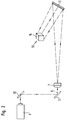
- FIG. 2 an arrangement similar to FIG. 1 is used for reproduction, only the beam splitter 2 being replaced by a mirror 12 and the mirror 8 omitted.
- the beam emerging from the laser 1 thus arrives at the hologram 11 via the mirrors 12, 3 and the lens system 7 in the form of a weakly divergent beam path, a wave field being formed on the interference image thereof by reflection and diffraction, through which at the point 13 An image 14 of the reference body 9 is created.
- the hologram 11 is again used for reproduction, a high-pressure mercury lamp 15 being used as the radiation source, from the spectrum of which the wavelength corresponding to the recording is coupled out by means of a suitable filter 16, so that monochromatic radiation is emitted onto the hologram strikes, which in the same way leads to the formation of an image 14 'at point 13.
- this holographic imaging method is now used to transfer any information spatially fixed on the surface of a body in the form of a surface pattern to a body of the same shape.
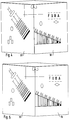
- the test specimen shown schematically in FIGS. 4 and 5 only serves to illustrate an exemplary embodiment.
- Fig. 5 shows the original of a plexiglass cube, the two front sides 15, 16 of which showed the surface pattern shown. It was a black and white pattern on a matt surface. This cube was fixed in a suitable device with a reproducible setting position and recorded in order to create a hologram in incident light at a wavelength of 488 nm.
- the sides 15, 16 of the original cube were then projected onto the corresponding sides 15 ', 16' of the white cube via the hologram, which is also in the same position as when the picture was taken, resulting in the image shown in FIG represents exact reconstruction of the test information of the original cube.
- the geometry of the base body used for illustration purposes is basically arbitrary and in no way based on simple geometric shapes such as spheres, cuboids, cubes. Conic section and the like limited. Problems or blurring can only occur in the case of certain curvature shapes that lead to focusing of the incident radiation.
- the body serving as the projection surface is covered with a corresponding photosensitive coating, it is possible in this way - starting from one or more holograms, but in a single, uniform projection method - reference body geometrically corresponding to the original on all sides with information of any kind, such as images, text, etc to be covered.
- the method according to the invention however only concerns the spatial exposure of a reference body. Its further treatment depends on the nature of the photosensitive coating.
- the essential area of application of the subject matter of the invention lies in the surface design of three-dimensional circuit boards, in particular their photo-technical structuring, it being possible for all surfaces of the circuit board to be treated in a single operation.
- the starting point here is a base body metallized in the surface area, ie carrying a metallic layer, which consists of polymers such as, for example, polyetherimide, polysulfones, liquid crystal polymers, etc., the metallic layer corresponding to the circuitry to be implemented in a network of individual conductor tracks in a photo-technical manner is to be redesigned.
- This design which can be carried out, for example, by etching, is preceded by a photo-technical transfer of the desired conductor pattern to a light-sensitive layer covering the metallic layer.
- three-dimensional phototechnical surface structuring the further processing of which is carried out in a manner known per se, can be carried out according to the invention, starting from one or more holograms - but in a single projection method can.
Landscapes
- Physics & Mathematics (AREA)
- General Physics & Mathematics (AREA)
- Holo Graphy (AREA)
- Exposure Of Semiconductors, Excluding Electron Or Ion Beam Exposure (AREA)
Applications Claiming Priority (2)
| Application Number | Priority Date | Filing Date | Title |
|---|---|---|---|
| DE4026234 | 1990-08-18 | ||
| DE19904026234 DE4026234A1 (de) | 1990-08-18 | 1990-08-18 | Verfahren zur dreidimensionalen fototechnischen uebertragung von oberflaecheninformationen eines koerpers |
Publications (2)
| Publication Number | Publication Date |
|---|---|
| EP0472051A2 true EP0472051A2 (fr) | 1992-02-26 |
| EP0472051A3 EP0472051A3 (fr) | 1992-12-30 |
Family
ID=6412520
Family Applications (1)
| Application Number | Title | Priority Date | Filing Date |
|---|---|---|---|
| EP19910113246 Withdrawn EP0472051A3 (fr) | 1990-08-18 | 1991-08-07 | Méthode photographique tridimensionnelle pour le transfer de détails de la surface d'un objet |
Country Status (3)
| Country | Link |
|---|---|
| EP (1) | EP0472051A3 (fr) |
| JP (1) | JPH04255886A (fr) |
| DE (1) | DE4026234A1 (fr) |
Cited By (1)
| Publication number | Priority date | Publication date | Assignee | Title |
|---|---|---|---|---|
| US6646771B2 (en) | 2000-12-21 | 2003-11-11 | E. I. Du Pont De Nemours And Company | Method for producing holographic optical element comprising primary and complementary holograms and associated methods for establishing authenticity of element used as security device |
Family Cites Families (3)
| Publication number | Priority date | Publication date | Assignee | Title |
|---|---|---|---|---|
| US3526505A (en) * | 1967-11-06 | 1970-09-01 | Fairchild Camera Instr Co | Holographic method of forming and aligning patterns on a photosensitive workpiece |
| US3582176A (en) * | 1968-12-26 | 1971-06-01 | Ibm | Holographic optical method and system for photoprinting three-dimensional patterns on three-dimensional objects |
| FR2449301A1 (fr) * | 1979-02-16 | 1980-09-12 | Thomson Csf | Dispositif optique de copie d'objets plans |
-
1990
- 1990-08-18 DE DE19904026234 patent/DE4026234A1/de not_active Withdrawn
-
1991
- 1991-08-07 EP EP19910113246 patent/EP0472051A3/fr not_active Withdrawn
- 1991-08-12 JP JP20177591A patent/JPH04255886A/ja active Pending
Cited By (1)
| Publication number | Priority date | Publication date | Assignee | Title |
|---|---|---|---|---|
| US6646771B2 (en) | 2000-12-21 | 2003-11-11 | E. I. Du Pont De Nemours And Company | Method for producing holographic optical element comprising primary and complementary holograms and associated methods for establishing authenticity of element used as security device |
Also Published As
| Publication number | Publication date |
|---|---|
| DE4026234A1 (de) | 1992-02-20 |
| EP0472051A3 (fr) | 1992-12-30 |
| JPH04255886A (ja) | 1992-09-10 |
Similar Documents
| Publication | Publication Date | Title |
|---|---|---|
| DE1572600C3 (de) | Verfahren zum Kopieren eines Außer-Achse-Hologramms | |
| DE69028145T2 (de) | Verfahren und Vorrichtung zur Herstellung von Reflexionshologrammen | |
| DE2952607C2 (de) | Verfahren zur optischen Herstellung einer Einstellscheibe für eine Kamera | |
| EP0004559A1 (fr) | Carte d'identité avec un hologramme, procédé pour la fabrication de la carte d'identité et méthode pour enregistrer l'hologramme sur la carte d'identité | |
| DE1963578C3 (de) | Verfahren zum kontaktlosen Belichten | |
| DE2744236C2 (fr) | ||
| DE2116713B2 (de) | Belichtungsverfahren zum Abbilden sehr fein strukturierter Lichtmuster auf Photolackschichten und dazu geeignete Belichtungsvorrichtung | |
| DE1931260A1 (de) | Verfahren zur Wiedergabe eines Hologrammes,das die Funktion einer nach optischen Prinzipien arbeitenden komplexen Wellenaenderungsanordnung ausuebt,mit hoher Wiedergabetreue | |
| DE3855997T2 (de) | Verfahren zur Herstellung eines holographischen Spiegels | |
| DE1772567A1 (de) | Verfahren und Vorrichtungen zur Herstellung von Linsenrastern | |
| DE2047316A1 (de) | Verfahren und Einrichtung zum Er zeugen einer Anordnung diskreter Be reiche mit einer Photolackschicht | |
| DE1940361A1 (de) | Verfahren und Einrichtung zur Erzeugung eines Beugungsmusters sowie zur Herstellung eines Rasters aus gleichen Bildern | |
| DE10013299A1 (de) | Verfahren und Vorrichtung zur geometrischen Kalibrierung pixelorientierter photosensitiver Elemente | |
| DE3025131A1 (de) | Verfahren zum herstellen eines mit mono- oder polychromatischem licht rekonstruierbaren hologramms | |
| DE2129806C3 (de) | Verfahren zum Erzeugen und Wiedergeben einer Vielzahl von überlagerten Hologrammen | |
| DE2019092A1 (de) | Verfahren und Anordnung zum Ausrichten zweter oder mehrerer Objekte | |
| DE2055785A1 (fr) | ||
| DE1572868B2 (de) | Vorrichtung zur vervielfachten Abbildung eines Musterbilds | |
| EP0472051A2 (fr) | Méthode photographique tridimensionnelle pour le transfer de détails de la surface d'un objet | |
| EP1944569A1 (fr) | Procédé et dispositif destinés à la mesure optique d'un objet, en particulier d'une pièce à usiner ou d'un outil | |
| DE2151528A1 (de) | Verfahren und Vorrichtung zur Abtastung eines interferometrischen Linienmusters | |
| DE1922388A1 (de) | Einrichtung zur Erzeugung eines Bildrasters aus mehreren identischen Abbildungen | |
| DE1280581B (de) | Verfahren, Aufzeichnungstraeger und Vorrichtung zum Speichern von Informationen | |
| DE4013195A1 (de) | Vorrichtung und verfahren zum ueberwachen der bearbeitung eines werkstueckes mit gepulster laserstrahlung | |
| DE2018725A1 (de) | Verfahren und Vorrichtung zur Herstel-IHBf Hugn§sMtirc-r§rr8o"!; Culver City, Calif. (V.St.A.) |
Legal Events
| Date | Code | Title | Description |
|---|---|---|---|
| PUAI | Public reference made under article 153(3) epc to a published international application that has entered the european phase |
Free format text: ORIGINAL CODE: 0009012 |
|
| AK | Designated contracting states |
Kind code of ref document: A2 Designated state(s): CH ES FR GB IT LI NL SE |
|
| PUAL | Search report despatched |
Free format text: ORIGINAL CODE: 0009013 |
|
| AK | Designated contracting states |
Kind code of ref document: A3 Designated state(s): CH ES FR GB IT LI NL SE |
|
| STAA | Information on the status of an ep patent application or granted ep patent |
Free format text: STATUS: THE APPLICATION IS DEEMED TO BE WITHDRAWN |
|
| 18D | Application deemed to be withdrawn |
Effective date: 19930701 |