EP0472093B1 - Bis guanidines et fongicides qui les contiennent - Google Patents
Bis guanidines et fongicides qui les contiennent Download PDFInfo
- Publication number
- EP0472093B1 EP0472093B1 EP91113556A EP91113556A EP0472093B1 EP 0472093 B1 EP0472093 B1 EP 0472093B1 EP 91113556 A EP91113556 A EP 91113556A EP 91113556 A EP91113556 A EP 91113556A EP 0472093 B1 EP0472093 B1 EP 0472093B1
- Authority
- EP
- European Patent Office
- Prior art keywords
- alkyl
- alkoxy
- benzyl
- haloalkyl
- substituted
- Prior art date
- Legal status (The legal status is an assumption and is not a legal conclusion. Google has not performed a legal analysis and makes no representation as to the accuracy of the status listed.)
- Expired - Lifetime
Links
- 239000000417 fungicide Substances 0.000 title claims description 9
- 150000002357 guanidines Chemical class 0.000 title description 2
- 150000003839 salts Chemical class 0.000 claims abstract description 18
- 125000001797 benzyl group Chemical group [H]C1=C([H])C([H])=C(C([H])=C1[H])C([H])([H])* 0.000 claims abstract description 15
- 239000002253 acid Substances 0.000 claims abstract description 10
- 125000000623 heterocyclic group Chemical group 0.000 claims abstract description 7
- 229910052751 metal Chemical class 0.000 claims abstract description 6
- 239000002184 metal Chemical class 0.000 claims abstract description 6
- 229910052757 nitrogen Inorganic materials 0.000 claims abstract 2
- 229910052760 oxygen Inorganic materials 0.000 claims abstract 2
- -1 cyano, benzoyl Chemical group 0.000 claims description 123
- 150000001875 compounds Chemical class 0.000 claims description 34
- 125000000008 (C1-C10) alkyl group Chemical group 0.000 claims description 29
- 125000000027 (C1-C10) alkoxy group Chemical group 0.000 claims description 21
- 229910052739 hydrogen Inorganic materials 0.000 claims description 19
- 239000001257 hydrogen Substances 0.000 claims description 19
- 125000001424 substituent group Chemical group 0.000 claims description 19
- UFHFLCQGNIYNRP-UHFFFAOYSA-N Hydrogen Chemical compound [H][H] UFHFLCQGNIYNRP-UHFFFAOYSA-N 0.000 claims description 17
- 238000000034 method Methods 0.000 claims description 17
- 150000001412 amines Chemical class 0.000 claims description 13
- 125000002887 hydroxy group Chemical group [H]O* 0.000 claims description 13
- 150000004985 diamines Chemical class 0.000 claims description 11
- 230000000855 fungicidal effect Effects 0.000 claims description 11
- 125000001997 phenyl group Chemical group [H]C1=C([H])C([H])=C(*)C([H])=C1[H] 0.000 claims description 10
- 239000007787 solid Substances 0.000 claims description 10
- 150000002431 hydrogen Chemical class 0.000 claims description 9
- 241000233866 Fungi Species 0.000 claims description 8
- 229910052736 halogen Inorganic materials 0.000 claims description 8
- 150000002367 halogens Chemical class 0.000 claims description 8
- 125000002496 methyl group Chemical group [H]C([H])([H])* 0.000 claims description 8
- 125000000753 cycloalkyl group Chemical group 0.000 claims description 7
- LFVVNPBBFUSSHL-UHFFFAOYSA-N alexidine Chemical class CCCCC(CC)CNC(=N)NC(=N)NCCCCCCNC(=N)NC(=N)NCC(CC)CCCC LFVVNPBBFUSSHL-UHFFFAOYSA-N 0.000 claims description 6
- 125000004429 atom Chemical group 0.000 claims description 6
- UMGDCJDMYOKAJW-UHFFFAOYSA-N thiourea Chemical class NC(N)=S UMGDCJDMYOKAJW-UHFFFAOYSA-N 0.000 claims description 6
- 125000004191 (C1-C6) alkoxy group Chemical group 0.000 claims description 5
- 125000004432 carbon atom Chemical group C* 0.000 claims description 5
- 229910052500 inorganic mineral Inorganic materials 0.000 claims description 5
- 239000000463 material Substances 0.000 claims description 5
- 239000011707 mineral Substances 0.000 claims description 5
- 150000001450 anions Chemical class 0.000 claims description 4
- ATDGTVJJHBUTRL-UHFFFAOYSA-N cyanogen bromide Chemical compound BrC#N ATDGTVJJHBUTRL-UHFFFAOYSA-N 0.000 claims description 4
- 150000001718 carbodiimides Chemical class 0.000 claims description 3
- 230000002538 fungal effect Effects 0.000 claims description 3
- 238000004519 manufacturing process Methods 0.000 claims description 3
- 125000004178 (C1-C4) alkyl group Chemical group 0.000 claims description 2
- QAOWNCQODCNURD-UHFFFAOYSA-L Sulfate Chemical compound [O-]S([O-])(=O)=O QAOWNCQODCNURD-UHFFFAOYSA-L 0.000 claims description 2
- DQHXIOISRXOSSL-UHFFFAOYSA-N acetic acid 1-cyclohexyl-1-[8-(8-cyclohexyloctylamino)octyl]guanidine Chemical compound CC(O)=O.CC(O)=O.CC(O)=O.C1CCCCC1N(C(=N)N)CCCCCCCCNCCCCCCCCC1CCCCC1 DQHXIOISRXOSSL-UHFFFAOYSA-N 0.000 claims description 2
- ZGMCTVRFYUHUTJ-UHFFFAOYSA-N acetic acid;1-[12-(2-amino-5,6-dihydro-4h-pyrimidin-1-yl)dodecyl]-5,6-dihydro-4h-pyrimidin-2-amine Chemical compound CC(O)=O.CC(O)=O.NC1=NCCCN1CCCCCCCCCCCCN1C(N)=NCCC1 ZGMCTVRFYUHUTJ-UHFFFAOYSA-N 0.000 claims description 2
- JOXIMZWYDAKGHI-UHFFFAOYSA-N toluene-4-sulfonic acid Chemical compound CC1=CC=C(S(O)(=O)=O)C=C1 JOXIMZWYDAKGHI-UHFFFAOYSA-N 0.000 claims description 2
- 229950010221 alexidine Drugs 0.000 claims 4
- 125000004093 cyano group Chemical group *C#N 0.000 claims 4
- 150000004696 coordination complex Chemical class 0.000 claims 3
- 239000012458 free base Substances 0.000 claims 3
- KBCAXXFGEFPMBG-UHFFFAOYSA-N 1,2-dicyclohexyl-1-[6-[6-[cyclohexyl-(n'-cyclohexylcarbamimidoyl)amino]hexylamino]hexyl]guanidine;trihydrochloride Chemical compound Cl.Cl.Cl.C1CCCCC1N(C(N)=NC1CCCCC1)CCCCCCNCCCCCCN(C1CCCCC1)C(N)=NC1CCCCC1 KBCAXXFGEFPMBG-UHFFFAOYSA-N 0.000 claims 1
- QLAJNZSPVITUCQ-UHFFFAOYSA-N 1,3,2-dioxathietane 2,2-dioxide Chemical compound O=S1(=O)OCO1 QLAJNZSPVITUCQ-UHFFFAOYSA-N 0.000 claims 1
- KRIGIPAFGYUDNK-UHFFFAOYSA-N 1-[6-[6-[carbamimidoyl-(3,3-dimethylcyclohexyl)amino]hexylamino]hexyl]-1-(3,3-dimethylcyclohexyl)guanidine;dihydroiodide Chemical compound I.I.C1C(C)(C)CCCC1N(C(N)=N)CCCCCCNCCCCCCN(C(N)=N)C1CC(C)(C)CCC1 KRIGIPAFGYUDNK-UHFFFAOYSA-N 0.000 claims 1
- AOPRFYAPABFRPU-UHFFFAOYSA-N amino(imino)methanesulfonic acid Chemical compound NC(=N)S(O)(=O)=O AOPRFYAPABFRPU-UHFFFAOYSA-N 0.000 claims 1
- 150000001912 cyanamides Chemical class 0.000 claims 1
- 150000004820 halides Chemical class 0.000 claims 1
- 125000004435 hydrogen atom Chemical group [H]* 0.000 claims 1
- 230000003301 hydrolyzing effect Effects 0.000 claims 1
- 239000007788 liquid Substances 0.000 claims 1
- 125000004170 methylsulfonyl group Chemical group [H]C([H])([H])S(*)(=O)=O 0.000 claims 1
- 229910052717 sulfur Inorganic materials 0.000 claims 1
- 125000000217 alkyl group Chemical group 0.000 abstract description 11
- 125000001188 haloalkyl group Chemical group 0.000 abstract description 7
- 125000003342 alkenyl group Chemical group 0.000 abstract description 2
- 125000000304 alkynyl group Chemical group 0.000 abstract description 2
- 125000000262 haloalkenyl group Chemical group 0.000 abstract description 2
- 125000003545 alkoxy group Chemical group 0.000 abstract 6
- 125000001475 halogen functional group Chemical group 0.000 abstract 1
- OKKJLVBELUTLKV-UHFFFAOYSA-N Methanol Chemical compound OC OKKJLVBELUTLKV-UHFFFAOYSA-N 0.000 description 33
- WEVYAHXRMPXWCK-UHFFFAOYSA-N Acetonitrile Chemical compound CC#N WEVYAHXRMPXWCK-UHFFFAOYSA-N 0.000 description 21
- 239000000203 mixture Substances 0.000 description 20
- RTZKZFJDLAIYFH-UHFFFAOYSA-N Diethyl ether Chemical compound CCOCC RTZKZFJDLAIYFH-UHFFFAOYSA-N 0.000 description 14
- XLYOFNOQVPJJNP-UHFFFAOYSA-N water Substances O XLYOFNOQVPJJNP-UHFFFAOYSA-N 0.000 description 14
- 241000196324 Embryophyta Species 0.000 description 13
- 238000006243 chemical reaction Methods 0.000 description 13
- 238000010992 reflux Methods 0.000 description 13
- ZMANZCXQSJIPKH-UHFFFAOYSA-N Triethylamine Chemical compound CCN(CC)CC ZMANZCXQSJIPKH-UHFFFAOYSA-N 0.000 description 12
- 239000004480 active ingredient Substances 0.000 description 12
- LFQSCWFLJHTTHZ-UHFFFAOYSA-N Ethanol Chemical compound CCO LFQSCWFLJHTTHZ-UHFFFAOYSA-N 0.000 description 11
- 239000000243 solution Substances 0.000 description 11
- VYPSYNLAJGMNEJ-UHFFFAOYSA-N Silicium dioxide Chemical compound O=[Si]=O VYPSYNLAJGMNEJ-UHFFFAOYSA-N 0.000 description 10
- YMWUJEATGCHHMB-UHFFFAOYSA-N Dichloromethane Chemical compound ClCCl YMWUJEATGCHHMB-UHFFFAOYSA-N 0.000 description 9
- ZMXDDKWLCZADIW-UHFFFAOYSA-N N,N-Dimethylformamide Chemical compound CN(C)C=O ZMXDDKWLCZADIW-UHFFFAOYSA-N 0.000 description 9
- 239000002904 solvent Substances 0.000 description 9
- VEXZGXHMUGYJMC-UHFFFAOYSA-N Hydrochloric acid Chemical compound Cl VEXZGXHMUGYJMC-UHFFFAOYSA-N 0.000 description 8
- BZLVMXJERCGZMT-UHFFFAOYSA-N Methyl tert-butyl ether Chemical compound COC(C)(C)C BZLVMXJERCGZMT-UHFFFAOYSA-N 0.000 description 8
- 239000002585 base Substances 0.000 description 8
- 125000000999 tert-butyl group Chemical group [H]C([H])([H])C(*)(C([H])([H])[H])C([H])([H])[H] 0.000 description 8
- QTBSBXVTEAMEQO-UHFFFAOYSA-N Acetic acid Chemical compound CC(O)=O QTBSBXVTEAMEQO-UHFFFAOYSA-N 0.000 description 7
- 239000006185 dispersion Substances 0.000 description 7
- 125000001449 isopropyl group Chemical group [H]C([H])([H])C([H])(*)C([H])([H])[H] 0.000 description 7
- CSCPPACGZOOCGX-UHFFFAOYSA-N Acetone Chemical compound CC(C)=O CSCPPACGZOOCGX-UHFFFAOYSA-N 0.000 description 6
- KFZMGEQAYNKOFK-UHFFFAOYSA-N Isopropanol Chemical compound CC(C)O KFZMGEQAYNKOFK-UHFFFAOYSA-N 0.000 description 6
- LSDPWZHWYPCBBB-UHFFFAOYSA-N Methanethiol Chemical compound SC LSDPWZHWYPCBBB-UHFFFAOYSA-N 0.000 description 6
- HEMHJVSKTPXQMS-UHFFFAOYSA-M Sodium hydroxide Chemical compound [OH-].[Na+] HEMHJVSKTPXQMS-UHFFFAOYSA-M 0.000 description 6
- DKGAVHZHDRPRBM-UHFFFAOYSA-N Tert-Butanol Chemical compound CC(C)(C)O DKGAVHZHDRPRBM-UHFFFAOYSA-N 0.000 description 6
- YXFVVABEGXRONW-UHFFFAOYSA-N Toluene Chemical compound CC1=CC=CC=C1 YXFVVABEGXRONW-UHFFFAOYSA-N 0.000 description 6
- 125000001495 ethyl group Chemical group [H]C([H])([H])C([H])([H])* 0.000 description 6
- VLKZOEOYAKHREP-UHFFFAOYSA-N n-Hexane Chemical compound CCCCCC VLKZOEOYAKHREP-UHFFFAOYSA-N 0.000 description 6
- 238000002360 preparation method Methods 0.000 description 6
- 239000000047 product Substances 0.000 description 6
- 125000001973 tert-pentyl group Chemical group [H]C([H])([H])C([H])([H])C(*)(C([H])([H])[H])C([H])([H])[H] 0.000 description 6
- 0 CN*C(NC)=N* Chemical compound CN*C(NC)=N* 0.000 description 5
- 125000000484 butyl group Chemical group [H]C([*])([H])C([H])([H])C([H])([H])C([H])([H])[H] 0.000 description 5
- 239000000969 carrier Substances 0.000 description 5
- 235000013339 cereals Nutrition 0.000 description 5
- 125000002636 imidazolinyl group Chemical group 0.000 description 5
- 125000000959 isobutyl group Chemical group [H]C([H])([H])C([H])(C([H])([H])[H])C([H])([H])* 0.000 description 5
- 125000001436 propyl group Chemical group [H]C([*])([H])C([H])([H])C([H])([H])[H] 0.000 description 5
- 239000000741 silica gel Substances 0.000 description 5
- 229910002027 silica gel Inorganic materials 0.000 description 5
- IAYPIBMASNFSPL-UHFFFAOYSA-N Ethylene oxide Chemical compound C1CO1 IAYPIBMASNFSPL-UHFFFAOYSA-N 0.000 description 4
- ZRALSGWEFCBTJO-UHFFFAOYSA-N Guanidine Chemical compound NC(N)=N ZRALSGWEFCBTJO-UHFFFAOYSA-N 0.000 description 4
- UFWIBTONFRDIAS-UHFFFAOYSA-N Naphthalene Chemical compound C1=CC=CC2=CC=CC=C21 UFWIBTONFRDIAS-UHFFFAOYSA-N 0.000 description 4
- ISWSIDIOOBJBQZ-UHFFFAOYSA-N Phenol Chemical compound OC1=CC=CC=C1 ISWSIDIOOBJBQZ-UHFFFAOYSA-N 0.000 description 4
- UIIMBOGNXHQVGW-UHFFFAOYSA-M Sodium bicarbonate Chemical compound [Na+].OC([O-])=O UIIMBOGNXHQVGW-UHFFFAOYSA-M 0.000 description 4
- WYURNTSHIVDZCO-UHFFFAOYSA-N Tetrahydrofuran Chemical compound C1CCOC1 WYURNTSHIVDZCO-UHFFFAOYSA-N 0.000 description 4
- 239000004359 castor oil Substances 0.000 description 4
- 235000019438 castor oil Nutrition 0.000 description 4
- 125000000582 cycloheptyl group Chemical group [H]C1([H])C([H])([H])C([H])([H])C([H])([H])C([H])(*)C([H])([H])C1([H])[H] 0.000 description 4
- JHIVVAPYMSGYDF-UHFFFAOYSA-N cyclohexanone Chemical compound O=C1CCCCC1 JHIVVAPYMSGYDF-UHFFFAOYSA-N 0.000 description 4
- 125000000113 cyclohexyl group Chemical group [H]C1([H])C([H])([H])C([H])([H])C([H])(*)C([H])([H])C1([H])[H] 0.000 description 4
- 125000001511 cyclopentyl group Chemical group [H]C1([H])C([H])([H])C([H])([H])C([H])(*)C1([H])[H] 0.000 description 4
- 239000003995 emulsifying agent Substances 0.000 description 4
- ZEMPKEQAKRGZGQ-XOQCFJPHSA-N glycerol triricinoleate Natural products CCCCCC[C@@H](O)CC=CCCCCCCCC(=O)OC[C@@H](COC(=O)CCCCCCCC=CC[C@@H](O)CCCCCC)OC(=O)CCCCCCCC=CC[C@H](O)CCCCCC ZEMPKEQAKRGZGQ-XOQCFJPHSA-N 0.000 description 4
- 239000005457 ice water Substances 0.000 description 4
- 125000005447 octyloxy group Chemical group [H]C([H])([H])C([H])([H])C([H])([H])C([H])([H])C([H])([H])C([H])([H])C([H])([H])C([H])([H])O* 0.000 description 4
- 239000000843 powder Substances 0.000 description 4
- 239000011541 reaction mixture Substances 0.000 description 4
- 125000002914 sec-butyl group Chemical group [H]C([H])([H])C([H])([H])C([H])(*)C([H])([H])[H] 0.000 description 4
- 159000000000 sodium salts Chemical class 0.000 description 4
- 125000002023 trifluoromethyl group Chemical group FC(F)(F)* 0.000 description 4
- VEXZGXHMUGYJMC-UHFFFAOYSA-M Chloride anion Chemical compound [Cl-] VEXZGXHMUGYJMC-UHFFFAOYSA-M 0.000 description 3
- LSNNMFCWUKXFEE-UHFFFAOYSA-N Sulfurous acid Chemical compound OS(O)=O LSNNMFCWUKXFEE-UHFFFAOYSA-N 0.000 description 3
- OKJPEAGHQZHRQV-UHFFFAOYSA-N Triiodomethane Natural products IC(I)I OKJPEAGHQZHRQV-UHFFFAOYSA-N 0.000 description 3
- 235000021307 Triticum Nutrition 0.000 description 3
- 244000098338 Triticum aestivum Species 0.000 description 3
- 229960000583 acetic acid Drugs 0.000 description 3
- 150000001298 alcohols Chemical class 0.000 description 3
- 235000012211 aluminium silicate Nutrition 0.000 description 3
- 238000009835 boiling Methods 0.000 description 3
- NLFBCYMMUAKCPC-KQQUZDAGSA-N ethyl (e)-3-[3-amino-2-cyano-1-[(e)-3-ethoxy-3-oxoprop-1-enyl]sulfanyl-3-oxoprop-1-enyl]sulfanylprop-2-enoate Chemical compound CCOC(=O)\C=C\SC(=C(C#N)C(N)=O)S\C=C\C(=O)OCC NLFBCYMMUAKCPC-KQQUZDAGSA-N 0.000 description 3
- 238000001914 filtration Methods 0.000 description 3
- 239000008187 granular material Substances 0.000 description 3
- INQOMBQAUSQDDS-UHFFFAOYSA-N iodomethane Chemical compound IC INQOMBQAUSQDDS-UHFFFAOYSA-N 0.000 description 3
- 229920005610 lignin Polymers 0.000 description 3
- 235000010755 mineral Nutrition 0.000 description 3
- 239000002808 molecular sieve Substances 0.000 description 3
- 150000002825 nitriles Chemical class 0.000 description 3
- 239000012299 nitrogen atmosphere Substances 0.000 description 3
- 125000006340 pentafluoro ethyl group Chemical group FC(F)(F)C(F)(F)* 0.000 description 3
- 150000003254 radicals Chemical class 0.000 description 3
- URGAHOPLAPQHLN-UHFFFAOYSA-N sodium aluminosilicate Chemical compound [Na+].[Al+3].[O-][Si]([O-])=O.[O-][Si]([O-])=O URGAHOPLAPQHLN-UHFFFAOYSA-N 0.000 description 3
- 239000002689 soil Substances 0.000 description 3
- 239000007921 spray Substances 0.000 description 3
- 239000007858 starting material Substances 0.000 description 3
- 239000000725 suspension Substances 0.000 description 3
- 235000013311 vegetables Nutrition 0.000 description 3
- PFMLXBWLZZAHCL-UHFFFAOYSA-N (3,3-dimethylcyclohexyl)thiourea Chemical compound CC1(C)CCCC(NC(N)=S)C1 PFMLXBWLZZAHCL-UHFFFAOYSA-N 0.000 description 2
- MCCBUSFWUIQQGR-UHFFFAOYSA-N 1-[12-(2-amino-5,6-dihydro-4h-pyrimidin-1-yl)dodecyl]-5,6-dihydro-4h-pyrimidin-2-amine;dihydroiodide Chemical compound I.I.NC1=NCCCN1CCCCCCCCCCCCN1C(N)=NCCC1 MCCBUSFWUIQQGR-UHFFFAOYSA-N 0.000 description 2
- MDTGOPRRXHBOAX-UHFFFAOYSA-N 1-cyclohexyl-1-[8-(8-cyclohexyloctylamino)octyl]guanidine dihydroiodide Chemical compound I.I.C1(CCCCC1)N(C(=N)N)CCCCCCCCNCCCCCCCCC1CCCCC1 MDTGOPRRXHBOAX-UHFFFAOYSA-N 0.000 description 2
- 125000006183 2,4-dimethyl benzyl group Chemical group [H]C1=C(C([H])=C(C(=C1[H])C([H])([H])*)C([H])([H])[H])C([H])([H])[H] 0.000 description 2
- HZAXFHJVJLSVMW-UHFFFAOYSA-N 2-Aminoethan-1-ol Chemical compound NCCO HZAXFHJVJLSVMW-UHFFFAOYSA-N 0.000 description 2
- WBIQQQGBSDOWNP-UHFFFAOYSA-N 2-dodecylbenzenesulfonic acid Chemical compound CCCCCCCCCCCCC1=CC=CC=C1S(O)(=O)=O WBIQQQGBSDOWNP-UHFFFAOYSA-N 0.000 description 2
- 125000003903 2-propenyl group Chemical group [H]C([*])([H])C([H])=C([H])[H] 0.000 description 2
- 125000002774 3,4-dimethoxybenzyl group Chemical group [H]C1=C([H])C(=C([H])C(OC([H])([H])[H])=C1OC([H])([H])[H])C([H])([H])* 0.000 description 2
- 125000002528 4-isopropyl benzyl group Chemical group [H]C1=C([H])C(=C([H])C([H])=C1C([H])([H])*)C([H])(C([H])([H])[H])C([H])([H])[H] 0.000 description 2
- 125000004217 4-methoxybenzyl group Chemical group [H]C1=C([H])C(=C([H])C([H])=C1OC([H])([H])[H])C([H])([H])* 0.000 description 2
- 125000006181 4-methyl benzyl group Chemical group [H]C1=C([H])C(=C([H])C([H])=C1C([H])([H])[H])C([H])([H])* 0.000 description 2
- 239000005995 Aluminium silicate Substances 0.000 description 2
- WKBOTKDWSSQWDR-UHFFFAOYSA-N Bromine atom Chemical compound [Br] WKBOTKDWSSQWDR-UHFFFAOYSA-N 0.000 description 2
- ZAMOUSCENKQFHK-UHFFFAOYSA-N Chlorine atom Chemical compound [Cl] ZAMOUSCENKQFHK-UHFFFAOYSA-N 0.000 description 2
- 229920000742 Cotton Polymers 0.000 description 2
- IAZDPXIOMUYVGZ-UHFFFAOYSA-N Dimethylsulphoxide Chemical compound CS(C)=O IAZDPXIOMUYVGZ-UHFFFAOYSA-N 0.000 description 2
- PXGOKWXKJXAPGV-UHFFFAOYSA-N Fluorine Chemical compound FF PXGOKWXKJXAPGV-UHFFFAOYSA-N 0.000 description 2
- 244000299507 Gossypium hirsutum Species 0.000 description 2
- 240000005979 Hordeum vulgare Species 0.000 description 2
- 235000007340 Hordeum vulgare Nutrition 0.000 description 2
- XEEYBQQBJWHFJM-UHFFFAOYSA-N Iron Chemical compound [Fe] XEEYBQQBJWHFJM-UHFFFAOYSA-N 0.000 description 2
- CSNNHWWHGAXBCP-UHFFFAOYSA-L Magnesium sulfate Chemical compound [Mg+2].[O-][S+2]([O-])([O-])[O-] CSNNHWWHGAXBCP-UHFFFAOYSA-L 0.000 description 2
- 244000070406 Malus silvestris Species 0.000 description 2
- LRHPLDYGYMQRHN-UHFFFAOYSA-N N-Butanol Chemical compound CCCCO LRHPLDYGYMQRHN-UHFFFAOYSA-N 0.000 description 2
- SECXISVLQFMRJM-UHFFFAOYSA-N N-Methylpyrrolidone Chemical compound CN1CCCC1=O SECXISVLQFMRJM-UHFFFAOYSA-N 0.000 description 2
- CHJJGSNFBQVOTG-UHFFFAOYSA-N N-methyl-guanidine Natural products CNC(N)=N CHJJGSNFBQVOTG-UHFFFAOYSA-N 0.000 description 2
- PXHVJJICTQNCMI-UHFFFAOYSA-N Nickel Chemical compound [Ni] PXHVJJICTQNCMI-UHFFFAOYSA-N 0.000 description 2
- CTQNGGLPUBDAKN-UHFFFAOYSA-N O-Xylene Chemical compound CC1=CC=CC=C1C CTQNGGLPUBDAKN-UHFFFAOYSA-N 0.000 description 2
- 240000007594 Oryza sativa Species 0.000 description 2
- 235000007164 Oryza sativa Nutrition 0.000 description 2
- 241001223281 Peronospora Species 0.000 description 2
- 241001281803 Plasmopara viticola Species 0.000 description 2
- 229920003171 Poly (ethylene oxide) Polymers 0.000 description 2
- JUJWROOIHBZHMG-UHFFFAOYSA-N Pyridine Chemical compound C1=CC=NC=C1 JUJWROOIHBZHMG-UHFFFAOYSA-N 0.000 description 2
- 240000000111 Saccharum officinarum Species 0.000 description 2
- 235000007201 Saccharum officinarum Nutrition 0.000 description 2
- 229920001807 Urea-formaldehyde Polymers 0.000 description 2
- FMJYDPICXSTNII-UHFFFAOYSA-N [amino(methylsulfanyl)methylidene]-(3,3-dimethylcyclohexyl)azanium;iodide Chemical compound [I-].CSC(N)=[NH+]C1CCCC(C)(C)C1 FMJYDPICXSTNII-UHFFFAOYSA-N 0.000 description 2
- OVEBGEVIVUYCEI-UHFFFAOYSA-N [amino(methylsulfanyl)methylidene]-cyclohexylazanium;iodide Chemical compound I.CSC(N)=NC1CCCCC1 OVEBGEVIVUYCEI-UHFFFAOYSA-N 0.000 description 2
- 239000013543 active substance Substances 0.000 description 2
- 150000008055 alkyl aryl sulfonates Chemical class 0.000 description 2
- SOIFLUNRINLCBN-UHFFFAOYSA-N ammonium thiocyanate Chemical compound [NH4+].[S-]C#N SOIFLUNRINLCBN-UHFFFAOYSA-N 0.000 description 2
- 235000021016 apples Nutrition 0.000 description 2
- PASDCCFISLVPSO-UHFFFAOYSA-N benzoyl chloride Chemical compound ClC(=O)C1=CC=CC=C1 PASDCCFISLVPSO-UHFFFAOYSA-N 0.000 description 2
- MRNZSTMRDWRNNR-UHFFFAOYSA-N bis(hexamethylene)triamine Chemical compound NCCCCCCNCCCCCCN MRNZSTMRDWRNNR-UHFFFAOYSA-N 0.000 description 2
- 159000000007 calcium salts Chemical class 0.000 description 2
- 150000001805 chlorine compounds Chemical class 0.000 description 2
- 230000000052 comparative effect Effects 0.000 description 2
- 239000007859 condensation product Substances 0.000 description 2
- 238000001816 cooling Methods 0.000 description 2
- PAFZNILMFXTMIY-UHFFFAOYSA-N cyclohexylamine Chemical compound NC1CCCCC1 PAFZNILMFXTMIY-UHFFFAOYSA-N 0.000 description 2
- LEEHHPPLIOFGSC-UHFFFAOYSA-N cyclohexylthiourea Chemical compound NC(=S)NC1CCCCC1 LEEHHPPLIOFGSC-UHFFFAOYSA-N 0.000 description 2
- 125000000640 cyclooctyl group Chemical group [H]C1([H])C([H])([H])C([H])([H])C([H])([H])C([H])(*)C([H])([H])C([H])([H])C1([H])[H] 0.000 description 2
- SWSQBOPZIKWTGO-UHFFFAOYSA-N dimethylaminoamidine Natural products CN(C)C(N)=N SWSQBOPZIKWTGO-UHFFFAOYSA-N 0.000 description 2
- 239000002270 dispersing agent Substances 0.000 description 2
- 229940060296 dodecylbenzenesulfonic acid Drugs 0.000 description 2
- 229940079593 drug Drugs 0.000 description 2
- 235000013399 edible fruits Nutrition 0.000 description 2
- 230000000694 effects Effects 0.000 description 2
- 125000005745 ethoxymethyl group Chemical group [H]C([H])([H])C([H])([H])OC([H])([H])* 0.000 description 2
- 150000002191 fatty alcohols Chemical class 0.000 description 2
- 239000003337 fertilizer Substances 0.000 description 2
- 235000013312 flour Nutrition 0.000 description 2
- 239000012362 glacial acetic acid Substances 0.000 description 2
- 239000011872 intimate mixture Substances 0.000 description 2
- 150000002500 ions Chemical class 0.000 description 2
- ZXEKIIBDNHEJCQ-UHFFFAOYSA-N isobutanol Chemical compound CC(C)CO ZXEKIIBDNHEJCQ-UHFFFAOYSA-N 0.000 description 2
- NLYAJNPCOHFWQQ-UHFFFAOYSA-N kaolin Chemical compound O.O.O=[Al]O[Si](=O)O[Si](=O)O[Al]=O NLYAJNPCOHFWQQ-UHFFFAOYSA-N 0.000 description 2
- 150000002576 ketones Chemical class 0.000 description 2
- WSFSSNUMVMOOMR-NJFSPNSNSA-N methanone Chemical compound O=[14CH2] WSFSSNUMVMOOMR-NJFSPNSNSA-N 0.000 description 2
- 125000004184 methoxymethyl group Chemical group [H]C([H])([H])OC([H])([H])* 0.000 description 2
- 229920000609 methyl cellulose Polymers 0.000 description 2
- 239000001923 methylcellulose Substances 0.000 description 2
- 235000010981 methylcellulose Nutrition 0.000 description 2
- 239000002480 mineral oil Substances 0.000 description 2
- 235000010446 mineral oil Nutrition 0.000 description 2
- PSZYNBSKGUBXEH-UHFFFAOYSA-N naphthalene-1-sulfonic acid Chemical class C1=CC=C2C(S(=O)(=O)O)=CC=CC2=C1 PSZYNBSKGUBXEH-UHFFFAOYSA-N 0.000 description 2
- 239000003921 oil Substances 0.000 description 2
- 230000003032 phytopathogenic effect Effects 0.000 description 2
- 239000002798 polar solvent Substances 0.000 description 2
- 229920000151 polyglycol Polymers 0.000 description 2
- 239000010695 polyglycol Substances 0.000 description 2
- 239000002244 precipitate Substances 0.000 description 2
- 235000009566 rice Nutrition 0.000 description 2
- 150000004760 silicates Chemical class 0.000 description 2
- 239000000377 silicon dioxide Substances 0.000 description 2
- 235000017557 sodium bicarbonate Nutrition 0.000 description 2
- 229910000030 sodium bicarbonate Inorganic materials 0.000 description 2
- 238000005507 spraying Methods 0.000 description 2
- 238000003756 stirring Methods 0.000 description 2
- 150000003467 sulfuric acid derivatives Chemical class 0.000 description 2
- 239000000454 talc Substances 0.000 description 2
- 235000012222 talc Nutrition 0.000 description 2
- 229910052623 talc Inorganic materials 0.000 description 2
- YLQBMQCUIZJEEH-UHFFFAOYSA-N tetrahydrofuran Natural products C=1C=COC=1 YLQBMQCUIZJEEH-UHFFFAOYSA-N 0.000 description 2
- 239000002699 waste material Substances 0.000 description 2
- 239000002023 wood Substances 0.000 description 2
- 239000008096 xylene Substances 0.000 description 2
- TWYYFYNJOJGNFP-CUXYNZQBSA-N (2s,4r,5s,6s)-2-[(4s,5r)-4-acetyloxy-5-methyl-3-methylidene-6-phenylhexyl]-2-carbamoyl-4-[[(e,4s,6s)-4,6-dimethyloct-2-enoyl]oxymethyl]-5-hydroxy-1,3-dioxane-4,5,6-tricarboxylic acid Chemical compound O1[C@H](C(O)=O)[C@](C(O)=O)(O)[C@](COC(=O)/C=C/[C@@H](C)C[C@@H](C)CC)(C(O)=O)O[C@]1(C(N)=O)CCC(=C)[C@@H](OC(C)=O)[C@H](C)CC1=CC=CC=C1 TWYYFYNJOJGNFP-CUXYNZQBSA-N 0.000 description 1
- 125000004765 (C1-C4) haloalkyl group Chemical group 0.000 description 1
- NVHNGVXBCWYLFA-UHFFFAOYSA-N 1,3-diazinane-2-thione Chemical compound S=C1NCCCN1 NVHNGVXBCWYLFA-UHFFFAOYSA-N 0.000 description 1
- RYHBNJHYFVUHQT-UHFFFAOYSA-N 1,4-Dioxane Chemical compound C1COCCO1 RYHBNJHYFVUHQT-UHFFFAOYSA-N 0.000 description 1
- JWSPTCUESKJXLH-UHFFFAOYSA-N 1-(3,3-dimethylcyclohexyl)-1-[6-[6-(3,3-dimethylcyclohexyl)hexylamino]hexyl]guanidine dihydroiodide Chemical compound I.I.CC1(CC(CCC1)N(C(=N)N)CCCCCCNCCCCCCC1CC(CCC1)(C)C)C JWSPTCUESKJXLH-UHFFFAOYSA-N 0.000 description 1
- SZCBDIVMCGFVPW-UHFFFAOYSA-N 1-[4-(aminomethyl)-2,6-di(propan-2-yl)phenyl]-3-[1-butyl-4-(3-methoxyphenyl)-2-oxo-1,8-naphthyridin-3-yl]urea;hydrochloride Chemical compound Cl.CC(C)C=1C=C(CN)C=C(C(C)C)C=1NC(=O)NC=1C(=O)N(CCCC)C2=NC=CC=C2C=1C1=CC=CC(OC)=C1 SZCBDIVMCGFVPW-UHFFFAOYSA-N 0.000 description 1
- CMCBDXRRFKYBDG-UHFFFAOYSA-N 1-dodecoxydodecane Chemical compound CCCCCCCCCCCCOCCCCCCCCCCCC CMCBDXRRFKYBDG-UHFFFAOYSA-N 0.000 description 1
- XUJLWPFSUCHPQL-UHFFFAOYSA-N 11-methyldodecan-1-ol Chemical compound CC(C)CCCCCCCCCCO XUJLWPFSUCHPQL-UHFFFAOYSA-N 0.000 description 1
- KBLAMUYRMZPYLS-UHFFFAOYSA-N 2,3-bis(2-methylpropyl)naphthalene-1-sulfonic acid Chemical compound C1=CC=C2C(S(O)(=O)=O)=C(CC(C)C)C(CC(C)C)=CC2=C1 KBLAMUYRMZPYLS-UHFFFAOYSA-N 0.000 description 1
- PAWQVTBBRAZDMG-UHFFFAOYSA-N 2-(3-bromo-2-fluorophenyl)acetic acid Chemical compound OC(=O)CC1=CC=CC(Br)=C1F PAWQVTBBRAZDMG-UHFFFAOYSA-N 0.000 description 1
- 125000000069 2-butynyl group Chemical group [H]C([H])([H])C#CC([H])([H])* 0.000 description 1
- SLRMQYXOBQWXCR-UHFFFAOYSA-N 2154-56-5 Chemical compound [CH2]C1=CC=CC=C1 SLRMQYXOBQWXCR-UHFFFAOYSA-N 0.000 description 1
- DUMSDLPWUAVLJQ-UHFFFAOYSA-N 3,3-dimethylcyclohexan-1-amine Chemical compound CC1(C)CCCC(N)C1 DUMSDLPWUAVLJQ-UHFFFAOYSA-N 0.000 description 1
- FOGYNLXERPKEGN-UHFFFAOYSA-N 3-(2-hydroxy-3-methoxyphenyl)-2-[2-methoxy-4-(3-sulfopropyl)phenoxy]propane-1-sulfonic acid Chemical compound COC1=CC=CC(CC(CS(O)(=O)=O)OC=2C(=CC(CCCS(O)(=O)=O)=CC=2)OC)=C1O FOGYNLXERPKEGN-UHFFFAOYSA-N 0.000 description 1
- UHPMCKVQTMMPCG-UHFFFAOYSA-N 5,8-dihydroxy-2-methoxy-6-methyl-7-(2-oxopropyl)naphthalene-1,4-dione Chemical compound CC1=C(CC(C)=O)C(O)=C2C(=O)C(OC)=CC(=O)C2=C1O UHPMCKVQTMMPCG-UHFFFAOYSA-N 0.000 description 1
- QTBSBXVTEAMEQO-UHFFFAOYSA-M Acetate Chemical compound CC([O-])=O QTBSBXVTEAMEQO-UHFFFAOYSA-M 0.000 description 1
- 241000223600 Alternaria Species 0.000 description 1
- 239000004254 Ammonium phosphate Substances 0.000 description 1
- 244000105624 Arachis hypogaea Species 0.000 description 1
- 241000235349 Ascomycota Species 0.000 description 1
- 235000007319 Avena orientalis Nutrition 0.000 description 1
- 244000075850 Avena orientalis Species 0.000 description 1
- 235000000832 Ayote Nutrition 0.000 description 1
- 241000221198 Basidiomycota Species 0.000 description 1
- 241001480061 Blumeria graminis Species 0.000 description 1
- 241000123650 Botrytis cinerea Species 0.000 description 1
- CPELXLSAUQHCOX-UHFFFAOYSA-M Bromide Chemical compound [Br-] CPELXLSAUQHCOX-UHFFFAOYSA-M 0.000 description 1
- 241000079253 Byssochlamys spectabilis Species 0.000 description 1
- QCMHGCDOZLWPOT-FMNCTDSISA-N COC1=C(CC[C@@H]2CCC3=C(C2)C=CC(=C3)[C@H]2CC[C@](N)(CO)C2)C=CC=C1 Chemical compound COC1=C(CC[C@@H]2CCC3=C(C2)C=CC(=C3)[C@H]2CC[C@](N)(CO)C2)C=CC=C1 QCMHGCDOZLWPOT-FMNCTDSISA-N 0.000 description 1
- OYPRJOBELJOOCE-UHFFFAOYSA-N Calcium Chemical compound [Ca] OYPRJOBELJOOCE-UHFFFAOYSA-N 0.000 description 1
- 244000025254 Cannabis sativa Species 0.000 description 1
- 235000008733 Citrus aurantifolia Nutrition 0.000 description 1
- UEAZLZPSEIDWAD-UHFFFAOYSA-N Cl.Cl.Cl.C1(CCCCC1)N(CCCCCCNC(=NC1CCCCC1)N)CCCCCC Chemical compound Cl.Cl.Cl.C1(CCCCC1)N(CCCCCCNC(=NC1CCCCC1)N)CCCCCC UEAZLZPSEIDWAD-UHFFFAOYSA-N 0.000 description 1
- 240000007154 Coffea arabica Species 0.000 description 1
- RYGMFSIKBFXOCR-UHFFFAOYSA-N Copper Chemical compound [Cu] RYGMFSIKBFXOCR-UHFFFAOYSA-N 0.000 description 1
- 240000008067 Cucumis sativus Species 0.000 description 1
- 235000009849 Cucumis sativus Nutrition 0.000 description 1
- 240000004244 Cucurbita moschata Species 0.000 description 1
- 235000009854 Cucurbita moschata Nutrition 0.000 description 1
- 240000001980 Cucurbita pepo Species 0.000 description 1
- 235000009804 Cucurbita pepo subsp pepo Nutrition 0.000 description 1
- 241000371644 Curvularia ravenelii Species 0.000 description 1
- FBPFZTCFMRRESA-FSIIMWSLSA-N D-Glucitol Natural products OC[C@H](O)[C@H](O)[C@@H](O)[C@H](O)CO FBPFZTCFMRRESA-FSIIMWSLSA-N 0.000 description 1
- QOSSAOTZNIDXMA-UHFFFAOYSA-N Dicylcohexylcarbodiimide Chemical compound C1CCCCC1N=C=NC1CCCCC1 QOSSAOTZNIDXMA-UHFFFAOYSA-N 0.000 description 1
- 241000221785 Erysiphales Species 0.000 description 1
- 241000510928 Erysiphe necator Species 0.000 description 1
- 240000009088 Fragaria x ananassa Species 0.000 description 1
- 241000223218 Fusarium Species 0.000 description 1
- 241001295925 Gegenes Species 0.000 description 1
- 244000068988 Glycine max Species 0.000 description 1
- 235000010469 Glycine max Nutrition 0.000 description 1
- 241000896246 Golovinomyces cichoracearum Species 0.000 description 1
- FKWDSATZSMJRLC-UHFFFAOYSA-N Iminoctadine acetate Chemical compound CC([O-])=O.CC([O-])=O.CC([O-])=O.NC([NH3+])=NCCCCCCCC[NH2+]CCCCCCCCN=C(N)[NH3+] FKWDSATZSMJRLC-UHFFFAOYSA-N 0.000 description 1
- 206010022998 Irritability Diseases 0.000 description 1
- 239000005909 Kieselgur Substances 0.000 description 1
- 235000019738 Limestone Nutrition 0.000 description 1
- 235000007688 Lycopersicon esculentum Nutrition 0.000 description 1
- 241001330975 Magnaporthe oryzae Species 0.000 description 1
- AFVFQIVMOAPDHO-UHFFFAOYSA-M Methanesulfonate Chemical compound CS([O-])(=O)=O AFVFQIVMOAPDHO-UHFFFAOYSA-M 0.000 description 1
- AFVFQIVMOAPDHO-UHFFFAOYSA-N Methanesulfonic acid Chemical group CS(O)(=O)=O AFVFQIVMOAPDHO-UHFFFAOYSA-N 0.000 description 1
- FXHOOIRPVKKKFG-UHFFFAOYSA-N N,N-Dimethylacetamide Chemical compound CN(C)C(C)=O FXHOOIRPVKKKFG-UHFFFAOYSA-N 0.000 description 1
- HPKJGHVHQWJOOT-ZJOUEHCJSA-N N-[(2S)-3-cyclohexyl-1-oxo-1-({(2S)-1-oxo-3-[(3S)-2-oxopyrrolidin-3-yl]propan-2-yl}amino)propan-2-yl]-1H-indole-2-carboxamide Chemical compound C1C(CCCC1)C[C@H](NC(=O)C=1NC2=CC=CC=C2C=1)C(=O)N[C@@H](C[C@H]1C(=O)NCC1)C=O HPKJGHVHQWJOOT-ZJOUEHCJSA-N 0.000 description 1
- IGFHQQFPSIBGKE-UHFFFAOYSA-N Nonylphenol Natural products CCCCCCCCCC1=CC=C(O)C=C1 IGFHQQFPSIBGKE-UHFFFAOYSA-N 0.000 description 1
- 241001668536 Oculimacula yallundae Species 0.000 description 1
- 229910019142 PO4 Inorganic materials 0.000 description 1
- 239000005662 Paraffin oil Substances 0.000 description 1
- 241000736122 Parastagonospora nodorum Species 0.000 description 1
- 241000315044 Passalora arachidicola Species 0.000 description 1
- 244000046052 Phaseolus vulgaris Species 0.000 description 1
- 235000010627 Phaseolus vulgaris Nutrition 0.000 description 1
- 241000233622 Phytophthora infestans Species 0.000 description 1
- 241000317981 Podosphaera fuliginea Species 0.000 description 1
- 241001337928 Podosphaera leucotricha Species 0.000 description 1
- XBDQKXXYIPTUBI-UHFFFAOYSA-N Propionic acid Chemical class CCC(O)=O XBDQKXXYIPTUBI-UHFFFAOYSA-N 0.000 description 1
- 241000221300 Puccinia Species 0.000 description 1
- 241001361634 Rhizoctonia Species 0.000 description 1
- 206010039509 Scab Diseases 0.000 description 1
- 244000082988 Secale cereale Species 0.000 description 1
- 235000007238 Secale cereale Nutrition 0.000 description 1
- 240000003768 Solanum lycopersicum Species 0.000 description 1
- 244000061456 Solanum tuberosum Species 0.000 description 1
- 235000002595 Solanum tuberosum Nutrition 0.000 description 1
- 235000011941 Tilia x europaea Nutrition 0.000 description 1
- ATJFFYVFTNAWJD-UHFFFAOYSA-N Tin Chemical compound [Sn] ATJFFYVFTNAWJD-UHFFFAOYSA-N 0.000 description 1
- 241000221566 Ustilago Species 0.000 description 1
- 241000228452 Venturia inaequalis Species 0.000 description 1
- 241000082085 Verticillium <Phyllachorales> Species 0.000 description 1
- 240000008042 Zea mays Species 0.000 description 1
- 235000005824 Zea mays ssp. parviglumis Nutrition 0.000 description 1
- 235000002017 Zea mays subsp mays Nutrition 0.000 description 1
- HCHKCACWOHOZIP-UHFFFAOYSA-N Zinc Chemical compound [Zn] HCHKCACWOHOZIP-UHFFFAOYSA-N 0.000 description 1
- IYVUCFTZEYNKLS-UHFFFAOYSA-N [amino(methylsulfanyl)methylidene]-(1,4,5,6-tetrahydropyrimidin-2-yl)azanium;iodide Chemical compound [I-].CSC(N)=[NH+]C1=NCCCN1 IYVUCFTZEYNKLS-UHFFFAOYSA-N 0.000 description 1
- 159000000021 acetate salts Chemical class 0.000 description 1
- 150000001242 acetic acid derivatives Chemical class 0.000 description 1
- 150000007513 acids Chemical class 0.000 description 1
- 150000001335 aliphatic alkanes Chemical class 0.000 description 1
- 229910052783 alkali metal Inorganic materials 0.000 description 1
- 150000001340 alkali metals Chemical class 0.000 description 1
- 229910052784 alkaline earth metal Inorganic materials 0.000 description 1
- 150000001342 alkaline earth metals Chemical class 0.000 description 1
- 150000005215 alkyl ethers Chemical class 0.000 description 1
- 229940045714 alkyl sulfonate alkylating agent Drugs 0.000 description 1
- 150000008052 alkyl sulfonates Chemical class 0.000 description 1
- 150000001408 amides Chemical class 0.000 description 1
- 229910000148 ammonium phosphate Inorganic materials 0.000 description 1
- 235000019289 ammonium phosphates Nutrition 0.000 description 1
- 150000003863 ammonium salts Chemical class 0.000 description 1
- BFNBIHQBYMNNAN-UHFFFAOYSA-N ammonium sulfate Chemical compound N.N.OS(O)(=O)=O BFNBIHQBYMNNAN-UHFFFAOYSA-N 0.000 description 1
- 229910052921 ammonium sulfate Inorganic materials 0.000 description 1
- 235000011130 ammonium sulphate Nutrition 0.000 description 1
- 125000000129 anionic group Chemical group 0.000 description 1
- 239000002969 artificial stone Substances 0.000 description 1
- 150000001558 benzoic acid derivatives Chemical class 0.000 description 1
- 125000003236 benzoyl group Chemical group [H]C1=C([H])C([H])=C(C([H])=C1[H])C(*)=O 0.000 description 1
- 150000001642 boronic acid derivatives Chemical class 0.000 description 1
- GDTBXPJZTBHREO-UHFFFAOYSA-N bromine Substances BrBr GDTBXPJZTBHREO-UHFFFAOYSA-N 0.000 description 1
- 229910052794 bromium Inorganic materials 0.000 description 1
- 150000001649 bromium compounds Chemical class 0.000 description 1
- 239000011575 calcium Substances 0.000 description 1
- OSGAYBCDTDRGGQ-UHFFFAOYSA-L calcium sulfate Inorganic materials [Ca+2].[O-]S([O-])(=O)=O OSGAYBCDTDRGGQ-UHFFFAOYSA-L 0.000 description 1
- 235000013877 carbamide Nutrition 0.000 description 1
- 150000004649 carbonic acid derivatives Chemical class 0.000 description 1
- 150000001732 carboxylic acid derivatives Chemical class 0.000 description 1
- 150000008280 chlorinated hydrocarbons Chemical class 0.000 description 1
- 239000000460 chlorine Substances 0.000 description 1
- 229910052801 chlorine Inorganic materials 0.000 description 1
- 150000008422 chlorobenzenes Chemical class 0.000 description 1
- 150000001860 citric acid derivatives Chemical class 0.000 description 1
- 239000004927 clay Substances 0.000 description 1
- 239000010941 cobalt Substances 0.000 description 1
- 229910017052 cobalt Inorganic materials 0.000 description 1
- GUTLYIVDDKVIGB-UHFFFAOYSA-N cobalt atom Chemical compound [Co] GUTLYIVDDKVIGB-UHFFFAOYSA-N 0.000 description 1
- 235000016213 coffee Nutrition 0.000 description 1
- 235000013353 coffee beverage Nutrition 0.000 description 1
- 229910052802 copper Inorganic materials 0.000 description 1
- 239000010949 copper Substances 0.000 description 1
- 235000005822 corn Nutrition 0.000 description 1
- HPXRVTGHNJAIIH-UHFFFAOYSA-N cyclohexanol Chemical compound OC1CCCCC1 HPXRVTGHNJAIIH-UHFFFAOYSA-N 0.000 description 1
- MNNHAPBLZZVQHP-UHFFFAOYSA-N diammonium hydrogen phosphate Chemical compound [NH4+].[NH4+].OP([O-])([O-])=O MNNHAPBLZZVQHP-UHFFFAOYSA-N 0.000 description 1
- 235000014113 dietary fatty acids Nutrition 0.000 description 1
- MTHSVFCYNBDYFN-UHFFFAOYSA-N diethylene glycol Chemical compound OCCOCCO MTHSVFCYNBDYFN-UHFFFAOYSA-N 0.000 description 1
- 239000003085 diluting agent Substances 0.000 description 1
- 201000010099 disease Diseases 0.000 description 1
- 208000037265 diseases, disorders, signs and symptoms Diseases 0.000 description 1
- 238000009826 distribution Methods 0.000 description 1
- LQZZUXJYWNFBMV-UHFFFAOYSA-N dodecan-1-ol Chemical compound CCCCCCCCCCCCO LQZZUXJYWNFBMV-UHFFFAOYSA-N 0.000 description 1
- QFTYSVGGYOXFRQ-UHFFFAOYSA-N dodecane-1,12-diamine Chemical compound NCCCCCCCCCCCCN QFTYSVGGYOXFRQ-UHFFFAOYSA-N 0.000 description 1
- YRIUSKIDOIARQF-UHFFFAOYSA-N dodecyl benzenesulfonate Chemical class CCCCCCCCCCCCOS(=O)(=O)C1=CC=CC=C1 YRIUSKIDOIARQF-UHFFFAOYSA-N 0.000 description 1
- MOTZDAYCYVMXPC-UHFFFAOYSA-N dodecyl hydrogen sulfate Chemical class CCCCCCCCCCCCOS(O)(=O)=O MOTZDAYCYVMXPC-UHFFFAOYSA-N 0.000 description 1
- 239000010459 dolomite Substances 0.000 description 1
- 229910000514 dolomite Inorganic materials 0.000 description 1
- 239000003814 drug Substances 0.000 description 1
- 239000000428 dust Substances 0.000 description 1
- 238000010410 dusting Methods 0.000 description 1
- 230000008030 elimination Effects 0.000 description 1
- 238000003379 elimination reaction Methods 0.000 description 1
- 239000000839 emulsion Substances 0.000 description 1
- 150000002170 ethers Chemical class 0.000 description 1
- 239000000194 fatty acid Substances 0.000 description 1
- 229930195729 fatty acid Natural products 0.000 description 1
- 150000004665 fatty acids Chemical class 0.000 description 1
- 229910052731 fluorine Inorganic materials 0.000 description 1
- 239000011737 fluorine Substances 0.000 description 1
- 150000004675 formic acid derivatives Chemical class 0.000 description 1
- 238000009472 formulation Methods 0.000 description 1
- 239000000499 gel Substances 0.000 description 1
- 238000000227 grinding Methods 0.000 description 1
- 239000003630 growth substance Substances 0.000 description 1
- 239000004009 herbicide Substances 0.000 description 1
- OCUALGGRTZGVPG-UHFFFAOYSA-N hydrazinylidenemethanesulfonic acid Chemical class NN=CS(O)(=O)=O OCUALGGRTZGVPG-UHFFFAOYSA-N 0.000 description 1
- 229930195733 hydrocarbon Natural products 0.000 description 1
- 150000002430 hydrocarbons Chemical class 0.000 description 1
- 150000003840 hydrochlorides Chemical class 0.000 description 1
- XMBWDFGMSWQBCA-UHFFFAOYSA-N hydrogen iodide Chemical compound I XMBWDFGMSWQBCA-UHFFFAOYSA-N 0.000 description 1
- 230000007062 hydrolysis Effects 0.000 description 1
- 238000006460 hydrolysis reaction Methods 0.000 description 1
- 239000012442 inert solvent Substances 0.000 description 1
- 208000015181 infectious disease Diseases 0.000 description 1
- 239000002917 insecticide Substances 0.000 description 1
- 150000004694 iodide salts Chemical class 0.000 description 1
- 229910052742 iron Inorganic materials 0.000 description 1
- 238000002955 isolation Methods 0.000 description 1
- 150000003893 lactate salts Chemical class 0.000 description 1
- 239000004571 lime Substances 0.000 description 1
- 239000006028 limestone Substances 0.000 description 1
- 239000000395 magnesium oxide Substances 0.000 description 1
- CPLXHLVBOLITMK-UHFFFAOYSA-N magnesium oxide Inorganic materials [Mg]=O CPLXHLVBOLITMK-UHFFFAOYSA-N 0.000 description 1
- 229910052943 magnesium sulfate Inorganic materials 0.000 description 1
- 235000019341 magnesium sulphate Nutrition 0.000 description 1
- AXZKOIWUVFPNLO-UHFFFAOYSA-N magnesium;oxygen(2-) Chemical compound [O-2].[Mg+2] AXZKOIWUVFPNLO-UHFFFAOYSA-N 0.000 description 1
- WPBNNNQJVZRUHP-UHFFFAOYSA-L manganese(2+);methyl n-[[2-(methoxycarbonylcarbamothioylamino)phenyl]carbamothioyl]carbamate;n-[2-(sulfidocarbothioylamino)ethyl]carbamodithioate Chemical compound [Mn+2].[S-]C(=S)NCCNC([S-])=S.COC(=O)NC(=S)NC1=CC=CC=C1NC(=S)NC(=O)OC WPBNNNQJVZRUHP-UHFFFAOYSA-L 0.000 description 1
- 150000002739 metals Chemical class 0.000 description 1
- JZMJDSHXVKJFKW-UHFFFAOYSA-M methyl sulfate(1-) Chemical compound COS([O-])(=O)=O JZMJDSHXVKJFKW-UHFFFAOYSA-M 0.000 description 1
- 238000002156 mixing Methods 0.000 description 1
- ZWZITQBHEXYRNP-UHFFFAOYSA-N n'-(8-aminooctyl)octane-1,8-diamine Chemical compound NCCCCCCCCNCCCCCCCCN ZWZITQBHEXYRNP-UHFFFAOYSA-N 0.000 description 1
- 150000002790 naphthalenes Chemical class 0.000 description 1
- 229910052759 nickel Inorganic materials 0.000 description 1
- 150000002823 nitrates Chemical class 0.000 description 1
- SNQQPOLDUKLAAF-UHFFFAOYSA-N nonylphenol Chemical compound CCCCCCCCCC1=CC=CC=C1O SNQQPOLDUKLAAF-UHFFFAOYSA-N 0.000 description 1
- 125000002347 octyl group Chemical group [H]C([*])([H])C([H])([H])C([H])([H])C([H])([H])C([H])([H])C([H])([H])C([H])([H])C([H])([H])[H] 0.000 description 1
- ZQPPMHVWECSIRJ-KTKRTIGZSA-N oleic acid group Chemical group C(CCCCCCC\C=C/CCCCCCCC)(=O)O ZQPPMHVWECSIRJ-KTKRTIGZSA-N 0.000 description 1
- 239000003960 organic solvent Substances 0.000 description 1
- 150000003891 oxalate salts Chemical class 0.000 description 1
- 235000020232 peanut Nutrition 0.000 description 1
- 239000003208 petroleum Substances 0.000 description 1
- 235000021317 phosphate Nutrition 0.000 description 1
- 150000003013 phosphoric acid derivatives Chemical class 0.000 description 1
- 239000004033 plastic Substances 0.000 description 1
- 229920003023 plastic Polymers 0.000 description 1
- 235000012015 potatoes Nutrition 0.000 description 1
- 125000001844 prenyl group Chemical group [H]C([*])([H])C([H])=C(C([H])([H])[H])C([H])([H])[H] 0.000 description 1
- 235000015136 pumpkin Nutrition 0.000 description 1
- UMJSCPRVCHMLSP-UHFFFAOYSA-N pyridine Natural products COC1=CC=CN=C1 UMJSCPRVCHMLSP-UHFFFAOYSA-N 0.000 description 1
- CVHZOJJKTDOEJC-UHFFFAOYSA-N saccharin Chemical compound C1=CC=C2C(=O)NS(=O)(=O)C2=C1 CVHZOJJKTDOEJC-UHFFFAOYSA-N 0.000 description 1
- 229940081974 saccharin Drugs 0.000 description 1
- 235000019204 saccharin Nutrition 0.000 description 1
- 239000000901 saccharin and its Na,K and Ca salt Substances 0.000 description 1
- 229920006395 saturated elastomer Polymers 0.000 description 1
- 239000000600 sorbitol Substances 0.000 description 1
- 238000001228 spectrum Methods 0.000 description 1
- 239000004575 stone Substances 0.000 description 1
- 235000021012 strawberries Nutrition 0.000 description 1
- 150000003512 tertiary amines Chemical class 0.000 description 1
- 150000003585 thioureas Chemical class 0.000 description 1
- 229910052718 tin Inorganic materials 0.000 description 1
- 239000011135 tin Substances 0.000 description 1
- ILJSQTXMGCGYMG-UHFFFAOYSA-N triacetic acid Chemical compound CC(=O)CC(=O)CC(O)=O ILJSQTXMGCGYMG-UHFFFAOYSA-N 0.000 description 1
- 150000003672 ureas Chemical class 0.000 description 1
- 235000014101 wine Nutrition 0.000 description 1
- 239000011701 zinc Substances 0.000 description 1
- 229910052725 zinc Inorganic materials 0.000 description 1
Classifications
-
- C—CHEMISTRY; METALLURGY
- C07—ORGANIC CHEMISTRY
- C07D—HETEROCYCLIC COMPOUNDS
- C07D233/00—Heterocyclic compounds containing 1,3-diazole or hydrogenated 1,3-diazole rings, not condensed with other rings
- C07D233/04—Heterocyclic compounds containing 1,3-diazole or hydrogenated 1,3-diazole rings, not condensed with other rings having one double bond between ring members or between a ring member and a non-ring member
- C07D233/28—Heterocyclic compounds containing 1,3-diazole or hydrogenated 1,3-diazole rings, not condensed with other rings having one double bond between ring members or between a ring member and a non-ring member with hetero atoms or with carbon atoms having three bonds to hetero atoms with at the most one bond to halogen, e.g. ester or nitrile radicals, directly attached to ring carbon atoms
- C07D233/44—Nitrogen atoms not forming part of a nitro radical
- C07D233/48—Nitrogen atoms not forming part of a nitro radical with acyclic hydrocarbon or substituted acyclic hydrocarbon radicals, attached to said nitrogen atoms
-
- A—HUMAN NECESSITIES
- A01—AGRICULTURE; FORESTRY; ANIMAL HUSBANDRY; HUNTING; TRAPPING; FISHING
- A01N—PRESERVATION OF BODIES OF HUMANS OR ANIMALS OR PLANTS OR PARTS THEREOF; BIOCIDES, e.g. AS DISINFECTANTS, AS PESTICIDES OR AS HERBICIDES; PEST REPELLANTS OR ATTRACTANTS; PLANT GROWTH REGULATORS
- A01N43/00—Biocides, pest repellants or attractants, or plant growth regulators containing heterocyclic compounds
- A01N43/48—Biocides, pest repellants or attractants, or plant growth regulators containing heterocyclic compounds having rings with two nitrogen atoms as the only ring hetero atoms
- A01N43/50—1,3-Diazoles; Hydrogenated 1,3-diazoles
-
- A—HUMAN NECESSITIES
- A01—AGRICULTURE; FORESTRY; ANIMAL HUSBANDRY; HUNTING; TRAPPING; FISHING
- A01N—PRESERVATION OF BODIES OF HUMANS OR ANIMALS OR PLANTS OR PARTS THEREOF; BIOCIDES, e.g. AS DISINFECTANTS, AS PESTICIDES OR AS HERBICIDES; PEST REPELLANTS OR ATTRACTANTS; PLANT GROWTH REGULATORS
- A01N43/00—Biocides, pest repellants or attractants, or plant growth regulators containing heterocyclic compounds
- A01N43/48—Biocides, pest repellants or attractants, or plant growth regulators containing heterocyclic compounds having rings with two nitrogen atoms as the only ring hetero atoms
- A01N43/54—1,3-Diazines; Hydrogenated 1,3-diazines
-
- A—HUMAN NECESSITIES
- A01—AGRICULTURE; FORESTRY; ANIMAL HUSBANDRY; HUNTING; TRAPPING; FISHING
- A01N—PRESERVATION OF BODIES OF HUMANS OR ANIMALS OR PLANTS OR PARTS THEREOF; BIOCIDES, e.g. AS DISINFECTANTS, AS PESTICIDES OR AS HERBICIDES; PEST REPELLANTS OR ATTRACTANTS; PLANT GROWTH REGULATORS
- A01N47/00—Biocides, pest repellants or attractants, or plant growth regulators containing organic compounds containing a carbon atom not being member of a ring and having no bond to a carbon or hydrogen atom, e.g. derivatives of carbonic acid
- A01N47/40—Biocides, pest repellants or attractants, or plant growth regulators containing organic compounds containing a carbon atom not being member of a ring and having no bond to a carbon or hydrogen atom, e.g. derivatives of carbonic acid the carbon atom having a double or triple bond to nitrogen, e.g. cyanates, cyanamides
- A01N47/42—Biocides, pest repellants or attractants, or plant growth regulators containing organic compounds containing a carbon atom not being member of a ring and having no bond to a carbon or hydrogen atom, e.g. derivatives of carbonic acid the carbon atom having a double or triple bond to nitrogen, e.g. cyanates, cyanamides containing —N=CX2 groups, e.g. isothiourea
- A01N47/44—Guanidine; Derivatives thereof
-
- C—CHEMISTRY; METALLURGY
- C07—ORGANIC CHEMISTRY
- C07C—ACYCLIC OR CARBOCYCLIC COMPOUNDS
- C07C279/00—Derivatives of guanidine, i.e. compounds containing the group, the singly-bound nitrogen atoms not being part of nitro or nitroso groups
- C07C279/16—Derivatives of guanidine, i.e. compounds containing the group, the singly-bound nitrogen atoms not being part of nitro or nitroso groups having nitrogen atoms of guanidine groups bound to carbon atoms of rings other than six-membered aromatic rings
-
- C—CHEMISTRY; METALLURGY
- C07—ORGANIC CHEMISTRY
- C07D—HETEROCYCLIC COMPOUNDS
- C07D239/00—Heterocyclic compounds containing 1,3-diazine or hydrogenated 1,3-diazine rings
- C07D239/02—Heterocyclic compounds containing 1,3-diazine or hydrogenated 1,3-diazine rings not condensed with other rings
- C07D239/06—Heterocyclic compounds containing 1,3-diazine or hydrogenated 1,3-diazine rings not condensed with other rings having one double bond between ring members or between a ring member and a non-ring member
- C07D239/08—Heterocyclic compounds containing 1,3-diazine or hydrogenated 1,3-diazine rings not condensed with other rings having one double bond between ring members or between a ring member and a non-ring member with hetero atoms directly attached in position 2
- C07D239/12—Nitrogen atoms not forming part of a nitro radical
- C07D239/14—Nitrogen atoms not forming part of a nitro radical with only hydrogen atoms, hydrocarbon or substituted hydrocarbon radicals, attached to said nitrogen atoms
-
- C—CHEMISTRY; METALLURGY
- C07—ORGANIC CHEMISTRY
- C07D—HETEROCYCLIC COMPOUNDS
- C07D243/00—Heterocyclic compounds containing seven-membered rings having two nitrogen atoms as the only ring hetero atoms
- C07D243/04—Heterocyclic compounds containing seven-membered rings having two nitrogen atoms as the only ring hetero atoms having the nitrogen atoms in positions 1 and 3
-
- C—CHEMISTRY; METALLURGY
- C07—ORGANIC CHEMISTRY
- C07C—ACYCLIC OR CARBOCYCLIC COMPOUNDS
- C07C2601/00—Systems containing only non-condensed rings
- C07C2601/06—Systems containing only non-condensed rings with a five-membered ring
- C07C2601/08—Systems containing only non-condensed rings with a five-membered ring the ring being saturated
-
- C—CHEMISTRY; METALLURGY
- C07—ORGANIC CHEMISTRY
- C07C—ACYCLIC OR CARBOCYCLIC COMPOUNDS
- C07C2601/00—Systems containing only non-condensed rings
- C07C2601/12—Systems containing only non-condensed rings with a six-membered ring
- C07C2601/14—The ring being saturated
-
- C—CHEMISTRY; METALLURGY
- C07—ORGANIC CHEMISTRY
- C07C—ACYCLIC OR CARBOCYCLIC COMPOUNDS
- C07C2601/00—Systems containing only non-condensed rings
- C07C2601/18—Systems containing only non-condensed rings with a ring being at least seven-membered
-
- C—CHEMISTRY; METALLURGY
- C07—ORGANIC CHEMISTRY
- C07C—ACYCLIC OR CARBOCYCLIC COMPOUNDS
- C07C2601/00—Systems containing only non-condensed rings
- C07C2601/18—Systems containing only non-condensed rings with a ring being at least seven-membered
- C07C2601/20—Systems containing only non-condensed rings with a ring being at least seven-membered the ring being twelve-membered
Definitions
- the present invention relates to new bis-guanidines with fungicidal activity and fungicides containing them.
- connection is from GB 1 114 155 and their fungicidal effects are known.
- guanidines are known from US 3,468,898, DE 39 22 232.2, EP 338 430, GB 935 614 and EP 406 699.
- R1 or R2 is hydrogen
- the compounds may exist in tautomeric forms which are encompassed by the invention.
- Suitable acid addition salts are the plant-tolerated salts of acids which do not impair the fungicidal activity of I, e.g. B. the iodides, chlorides, bromides, sulfates, dodecyl sulfates, nitrates, carbonates, phosphates, borates, formates, acetates, propionates, benzoates, oxalates, naphthalene sulfonates, dodecylbenzenesulfonates, lactates, citrates and the salts with the anion of saccharin.
- the complexes of copper, zinc, tin, manganese, iron, cobalt or nickel can be considered as metal complexes.
- the complexes are preferably prepared from the free bases I and the mineral acid salts, for example the chlorides or sulfates, of the metals.
- the bis-guanidines I can be prepared in various ways, preferably using the following methods:
- R3 represents a benzyl or a C1-C4 alkyl group, e.g. As methyl or ethyl, and Y 'for chloride, bromide, iodide, sulfate, methyl sulfate, methyl sulfonate or tosylate.
- the starting compounds II and III are known or can be obtained in a known manner (for the isothiuronium salts, see Houben-Weyl, Methods of Organic Chemistry, 4th Edition, Vol. IX, p. 900ff).
- ком ⁇ онент II When carrying out the reaction, 2.0 to 4.0 mol, particularly preferably 2.0 mol, of isothiuronium salt II are generally employed per mol of diamino compound III.
- a tertiary amine such as triethylamine can be added as an auxiliary base. In this case, preference is given to using equimolar amounts of the auxiliary base, based on the isothiuronium salt.
- the reaction temperatures can be between 20 ° C and the boiling point of the solvent, preferably between 60 and 130 ° C.
- the reaction is preferably carried out at normal pressure.
- Anions can be exchanged for salts with other anions - or - when replaced by hydroxyl ions - the free bases I can be obtained.
- the starting compounds IV are known or can be prepared in a known manner from thiourea derivatives (for example BCA Maryanoff et al., J. Org. Chem., 51 (1986) 1882).
- acetonitrile is very particularly preferred.
- the starting compounds V are known or can be prepared analogously to known processes (cf., for example, BM Mikolaiczyk, Tetrahedron 37 (1981) 233).
- Suitable solvents for the reactions are hydrocarbons such as hexane or toluene, short-chain alcohols such as isopropanol or tert-butanol, amides such as dimethylformamide or nitriles such as acetonitrile.
- the known implementation of imidocarbonates with two amines is carried out in two separate stages.
- the reaction of the imidocarbonate with the first amine is preferably carried out in a chlorinated hydrocarbon such as dichloromethane, an ether such as diethyl ether or tetrahydrofuran, a short-chain alcohol such as Methanol or isopropanol, a water / alcohol mixture such as water / methanol or a nitrile such as acetonitrile.
- the further reaction of the product with the second amine is then carried out in a polar solvent such as methanol, ethanol, isopropanol, tert-butanol, pyridine or acetonitrile.
- the hydrolysis of the compounds obtained is carried out in a known manner, advantageously in a mineral acid or else an organic carboxylic acid in, for. B. 70 to 120 ° C. Preferably 2 to 10 M hydrochloric acid or 50 to 80% acetic acid is used.
- the chloride or acetate salts of the compounds I with R 1 or R 2 are hydrogen.
- Y ' is preferably chloride.
- the reaction of the N-substituted cyanamides VIIIa, VIIIb and IX with the hydrochlorides of the amines III, VIIa and VIIb, which is known per se, from Houben-Weyl, Methods of Org. Chemistry, 4th Edition, Volume E4, p. 609, is preferably carried out solvent-free at temperatures from 130 to 250 ° C, for example.
- the compounds of formula I and their salts and metal complexes are suitable as fungicides with good plant tolerance.
- the resulting precipitate was filtered off, washed with water and dried at 80 ° C in a vacuum.
- the resulting precipitate was filtered off, washed with water and dried at 80 ° C in a vacuum.
- the compounds are suitable as fungicides.
- the fungicidal compounds or the compositions containing them can be, for example, in the form of directly sprayable solutions, powders, suspensions, also high-strength aqueous, oily or other suspensions or dispersions, emulsions, oil dispersions, pastes, dusts, sprinkles or granules by spraying, atomizing, dusting , Scattering or pouring can be applied.
- the application forms depend on the purposes; in any case, they should ensure the finest possible distribution of the active compounds according to the invention.
- the plants are sprayed or dusted with the active ingredients or the seeds of the plants are treated with the active ingredients.
- the formulations are prepared in a known manner, e.g. by stretching the active ingredient with solvents and / or carriers, if desired using emulsifiers and dispersants, and in the case of water as diluent other organic solvents can also be used as auxiliary solvents.
- auxiliaries solvents such as aromatics (e.g. xylene), chlorinated aromatics (e.g. chlorobenzenes), paraffins (e.g. petroleum fractions), alcohols (e.g. methanol, butanol), ketones (e.g. cyclohexanone), amines (e.g. ethanolamine, dimethylformamide) ) and water;
- Carriers such as natural stone powder (e.g.
- Emulsifiers such as nonionic and anionic emulsifiers (e.g. polyoxyethylene fatty alcohol ethers, alkyl sulfonates and aryl sulfonates) and dispersants such as lignin sulfite liquors and methyl cellulose.
- nonionic and anionic emulsifiers e.g. polyoxyethylene fatty alcohol ethers, alkyl sulfonates and aryl sulfonates
- dispersants such as lignin sulfite liquors and methyl cellulose.
- the surface-active substances are the alkali metal, alkaline earth metal, ammonium salts of aromatic sulfonic acids, for example lignin, phenol, naphthalene and dibutylnaphthalenesulfonic acid, and of fatty acids, alkyl and alkylarylsulfonates, alkyl, lauryl ether and fatty alcohol sulfates, and salts of sulfated hexa- , Hepta- and octadecanols, as well as fatty alcohol glycol ether, condensation products of sulfonated naphthalene and its derivatives with formaldehyde, condensation products of naphthalene or naphthalenesulfonic acids with phenol and formaldehyde, polyoxyethylene octylphenol ether, ethoxylated isooctyl, octyl or nonylphenol, alkylphenol, alkylphenol, alky
- Powders, materials for broadcasting and dusts can be prepared by mixing or grinding the active substances together with a solid carrier.
- Granules e.g. Coated, impregnated and homogeneous granules can be produced by binding the active ingredients to solid carriers.
- Solid carriers are mineral soils such as silica gel, silicas, silica gels, silicates, talc, kaolin, limestone, lime, chalk, bolus, loess, clay, dolomite, diatomaceous earth, calcium and magnesium sulfate, magnesium oxide, ground plastics, fertilizers such as ammonium sulfate, ammonium phosphate, Ammonium nitrate, ureas and vegetable products, such as cereal flour, tree bark, wood and nutshell flour, cellulose powder or other solid carriers.
- the compounds are distinguished by excellent activity against a broad spectrum of phytopathogenic fungi, in particular from the classes of the Ascomycetes and Basidiomycetes. Some of them are systemically effective and can be used as foliar and soil fungicides.
- the compounds are applied by treating the fungi or the seeds, plants, materials or the soil to be protected against fungal attack with a fungicidally active amount of the active compounds.
- the compounds are particularly suitable for combating the following plant diseases: Erysiphe graminis (powdery mildew) in cereals, Erysiphe cichoracearum and Sphaerotheca fuliginea on pumpkin plants, Podosphaera leucotricha on apples, Uncinula necator on vines, Puccinia species on cereals, Rhizoctonia species on cotton and lawn, Ustilago species on cereals and sugar cane, Venturia inaequalis (scab) on apples, Helminthosporium species on cereals, Septoria nodorum on wheat, Botrytis cinerea (gray mold) on strawberries, vines, Cercospora arachidicola on peanuts, Pseudocercosporella herpotrichoides on wheat, barley, Pyricularia oryzae on rice, Phytophthora infestans on potatoes and tomatoes, Fusarium and Verticillium species on different plants, Plasmopara viticola
- the new connections can also be used in material protection (wood protection), e.g. against Paecilomyces variotii.
- the fungicidal compositions generally contain between 0.1 and 95, preferably between 0.5 and 90% by weight of active ingredient.
- the application rates are between 0.02 and 3 kg of active ingredient per ha.
- active compound 0.001 to 50 g, preferably 0.01 to 10 g, per kg of seed are generally required.
- compositions according to the invention can also be present together with other active compounds, for example with herbicides, insecticides, growth regulators, fungicides or else with fertilizers.
- Guazatine triacetate (A) known from GB 1 114 155, was used as the comparative active ingredient.
- Leaves of pot vines of the "Müller Thurgau” variety were sprayed with an aqueous spray mixture which contained 80% active ingredient and 20% emulsifier in the dry matter.
- the plants were placed in the greenhouse for 8 days after the spray coating had dried on. Only then were the leaves infected with a zoospore suspension of Plasmopara viticola (vine peronospora).
- the vines were then placed for 48 hours in a steam-saturated chamber at 24 ° C and then for 5 days in a greenhouse at temperatures between 20 and 30 ° C. After this time, the plants were again placed in the moist chamber for 16 hours in order to accelerate the sporangium carrier outbreak. Then the extent of the fungal outbreak on the undersides of the leaves was assessed.
Landscapes
- Organic Chemistry (AREA)
- Chemical & Material Sciences (AREA)
- Life Sciences & Earth Sciences (AREA)
- Health & Medical Sciences (AREA)
- Plant Pathology (AREA)
- Engineering & Computer Science (AREA)
- Dentistry (AREA)
- General Health & Medical Sciences (AREA)
- Wood Science & Technology (AREA)
- Zoology (AREA)
- Environmental Sciences (AREA)
- Pest Control & Pesticides (AREA)
- Agronomy & Crop Science (AREA)
- Agricultural Chemicals And Associated Chemicals (AREA)
- Organic Low-Molecular-Weight Compounds And Preparation Thereof (AREA)
- Treatments For Attaching Organic Compounds To Fibrous Goods (AREA)
Claims (8)
- Bis-guanidines substituées de formule générale I
 R¹ et R² représentent chacun, indépendamment l'un de l'autre, l'hydrogène, un groupe alcényle en C3-C10, alcynyle en C3-C10, (alcoxy en C1-C8)-alkyle en C2-C8, halogénoalcényle en C3-C10 ; ou un groupe cycloalkyle contenant 5 à 12 atomes de carbone dans le cycle et qui peut porter jusqu'à trois des substituants suivants : les groupes hydroxy, alkyle en C1-C10, alcoxy en C1-C10, halogénoalkyle en C1-C10 et (alcoxy en C1-C8)-alkyle en C1-C8 ;
ou bien un groupe benzyle qui peut porter jusqu'à trois substituants alkyle en C1-C10 ou alcoxy en C1-C10, le substituant pouvant encore porter un groupe hydroxy ou alcoxy en C1-C6 ; ou bien le groupe benzyle est substitué par un groupe halogénoalkyle en C1-C10,
sous réserve qu'un seul des symboles R1 ou R² peut représenter l'hydrogène ; ou bienR¹ et R² forment ensemble et avec les atomes dont ils sont substituants, un noyau hétérocyclique de 5 à 11 chaînons qui peut être mono- à tri-substitué par des groupes alkyle en C1-C10 ou (alcoxy en C1-C8)-alkyle en C1-C8 ;X représente CH₂ , O, une liaison C-C simple, NH, N-(alkyle en C1-C10) ou N-benzyle, le noyau phényle du radical benzyle pouvant porter un à trois substituants alkyle en C1-C10, alcoxy en C1-C10, halogénoalkyle en C1-C10 ou halogéno, etn est un nombre allant de 5 à 8,ainsi que leurs sels formés par addition avec des acides et complexes métalliques tolérés par les végétaux. - Procédé de préparation des bis-guanidines de formule I
 R¹ et R² représentent chacun, indépendamment l'un de l'autre, l'hydrogène, un groupe alcényle en C3-C10, alcynyle en C3-C10, (alcoxy en C1-C8)-alkyle en C2-C8, halogenoalcényle en C3-C10 ; ou un groupe cycloalkyle contenant 5 à 12 atomes de carbone dans le cycle et qui peut porter jusqu'à trois des substituants suivants :
les groupes hydroxy, alkyle en C1-C10, alcoxy en C1-C10, halogénoalkyle en C1-C10 et (alcoxy en C1-C8)-alkyle en C1-C8 ;
ou bien un groupe benzyle qui peut porter jusqu'à trois substituants alkyle en C1-C10 ou alcoxy en C1-C10, le substituant pouvant encore porter un groupe hydroxy ou alcoxy en C1-C6 ; ou bien le groupe benzyle est substitué par un groupe halogénoalkyle en C1-C10,
sous réserve qu'un seul des symboles R1 et R² peut représenter l'hydrogène ; ou bienR¹ et R² forment ensemble et avec les atomes dont ils sont substituants, un noyau hétérocyclique de 5 à 11 chaînons qui peut être mono- à tri-substitué par des groupes alkyle en C1-C10 ou (alcoxy en C1-C8)-alkyle en C1-C8 ;X représente CH₂ , O, une liaison C-C simple, NH, N-(alkyle en C1-C10) ou N-benzyle, le noyau phényle du radical benzyle pouvant être mono- à tri-substitué par des groupes alkyle en C1-C10, alcoxy en C1-C10, halogénoalkyle en C1-C10 ou des halogènes, etn est un nombre allant de 5 à 8,caractérisé en ce quea) on fait réagir un sel d'isothiuronium II
H₂N-(CH₂)n-X-(CH₂)n-NH₂ III
R³ représentant un groupe benzyle ou alkyle en C1-C4 et Y' un anion, par exemple un anion halogénure, sulfate, méthylsulfate, alkylsulfonate en C1-C4 ou p-tolylsulfonate, ou bienb) on fait réagir un acide aminoiminométhane-sulfonique IV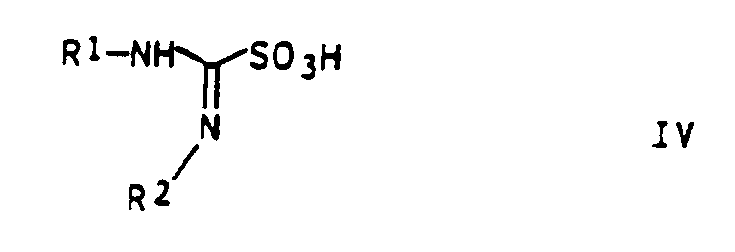
ou bienc) on fait réagir un carbodiimide V
R¹-N=C=N-R² V
avec la diamine III,
ou bien
lorsqu'un des symboles R¹ ou R² représente l'hydrogène,d) on fait réagir un imidocarbonate VI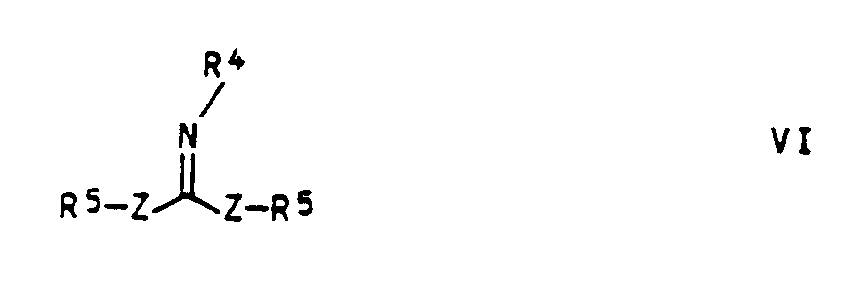
R¹-NH₂ VIIa, R²-NH₂ VIIb
et la diamine III, puis on hydrolyse,
ou biene) on prépare, à partir du bromocyanogène et de l'amine VIIa ou VIIb, le cyanamide substitué à l'azote VIIIa ou VIIIb
R¹-NH-CN VIIIa, R²-NH-CN VIIIb
qu'on fait ensuite réagir avec un sel d'acide minéral de la diamine III, ce qui donne le sel correspondant du composé I, ou bienf) on prépare à partir du bromocyanogène et de la diamine III, le cyanamide N, N' disubstitué IXet, lorsqu'ils ne sont pas déjà à l'état de bases libres ou de sels tolérés par les végétaux, on convertit les produits obtenus en les bases libres ou leurs sels tolérés par les végétaux ou bien on prépare les complexes métalliques à partir des bases libres.
NC-NH-(CH₂)n-X-(CH₂)n-NH-CN IX
qu'on fait ensuite réagir avec un sel d'acide minéral de l'amine VIIIa ou VIIIb, ce qui donne le sel du composé I, - Produit fongicide contenant une quantité fongicide efficace d'une bis-guanidine de formule I
 R¹ et R² représentent chacun, indépendamment l'un de l'autre, l'hydrogène, un groupe alcényle en C3-C10, alcynyle en C3-C10, (alcoxy en C1-C8)-alkyle en C2-C8, halogénoalcényle en C3-C10 ; ou un groupe cycloalkyle contenant 5 à 12 atomes de carbone dans le cycle et qui peut porter jusqu'à trois des substituants suivants : les groupes hydroxy, alkyle en C1-C10, alcoxy en C1-C10, halogénoalkyle en C1-C10 et (alcoxy en C1-C8)-alkyle en C1-C8 ;
ou un groupe benzyle qui peut porter jusqu'à trois substituants alkyle en C1-C10 ou alcoxy en C1-C10, le substituant pouvant encore porter un groupe hydroxy ou alcoxy en C1-C6 ; ou bien le groupe benzyle est substitué par un groupe halogénoalkyle en C1-C10,
sous réserve qu'un seul des symboles R¹ et R² peut représenter l'hydrogène ; ou bienR¹ et R² forment ensemble et avec les atomes dont ils sont substituants un noyau hétérocyclique de 5 à 11 chaînons qui peut porter un à trois substituants alkyle en C1-C10 ou (alcoxy en C1-C8)-alkyle en C1-C8 ;X représente CH₂ , O, une liaison C-C simple, NH, N-(alkyle en C1-C10) ou N-benzyle, le noyau phényle du radical benzyle pouvant porter un à trois substituants alkyle en C1-C10, alcoxy en C1-C10, halogénoalkyle en C1-C10, ou halogéno,n est un nombre allant de 5 à 8,ou d'un de ses sels ou complexe métallique toléré par les végétaux, et un véhicule liquide ou solide. - Procédé pour combattre les mycètes, caractérisé en ce que l'on fait agir sur les mycètes, les végétaux menacés par une attaque par les mycètes, leur habitat, leurs semences, ou sur des matériaux, une quantité fongicide efficace d'une bis-guanidine de formule I
 R¹ et R² représentent chacun, indépendamment l'un de l'autre, l'hydrogène, un groupe alcényle en C3- C10, alcynyle en C3-C10, (alcoxy en C1-C8)-alkyle en C2-C8, halogénoalcényle en C3-C10 ; ou un groupe cycloalkyle contenant 5 à 12 atomes de carbone dans le cycle et qui peut porter jusqu'à trois des substituants suivants : les groupes hydroxy, alkyle en C1-C10, alcoxy en C1-C10, halogénoalkyle en C1-C10 et (alcoxy en C1-C8)-alkyle en C1-C8 ;
ou un groupe benzyle qui peut porter jusqu'à trois substituants alkyle en C1-C10 ou alcoxy en C1-C10, le substituant pouvant encore porter un groupe hydroxy ou alcoxy en C1-C6 ; ou bien le groupe benzyle est substitué par un groupe halogénoalkyle en C1-C10,
sous réserve qu'un seul des symboles R¹ et R² peut représenter l'hydrogène ; ou bienR¹ et R² forment ensemble et avec les atomes dont ils sont substituants un noyau hétérocyclique de 5 à 11 chaînons qui peut porter un à trois substituants alkyle en C1-C10 ou (alcoxy en C1-C8)-alkyle en C1-C8 ;X représente CH₂ , O, une liaison C-C simple, NH, N-(alkyle en C1-C10) ou N-benzyle, le noyau phényle du radical benzyle pouvant porter un à trois substituants alkyle en C1-C10, alcoxy en C1-C10, halogénoalkyle en C1-C10, ou halogéno, etn est un nombre allant de 5 à 8,ou de l'un de ses sels ou complexe métallique. - Le diiodhydrate du 1,13-bis-(3,3-diméthylcyclohexyl)guanidino-7-aza-tridécane.
- Le triacétate du 1,17-bis-cyclohexylguanidino-9-aza-heptadécane.
- Le trichlorhydrate du 1,13-bis-(N-N'-dicyclohexyl)-guanidino-7-aza-tridécane.
- Le diacétate du 1,12-bis-(2-amino-3,4,5,6-tétrahydro-pyrimidinyl)-dodécane.
Applications Claiming Priority (2)
| Application Number | Priority Date | Filing Date | Title |
|---|---|---|---|
| DE4026473A DE4026473A1 (de) | 1990-08-22 | 1990-08-22 | Bis-guanidine und diese enthaltende fungizide |
| DE4026473 | 1990-08-22 |
Publications (2)
| Publication Number | Publication Date |
|---|---|
| EP0472093A1 EP0472093A1 (fr) | 1992-02-26 |
| EP0472093B1 true EP0472093B1 (fr) | 1993-11-03 |
Family
ID=6412649
Family Applications (1)
| Application Number | Title | Priority Date | Filing Date |
|---|---|---|---|
| EP91113556A Expired - Lifetime EP0472093B1 (fr) | 1990-08-22 | 1991-08-13 | Bis guanidines et fongicides qui les contiennent |
Country Status (9)
| Country | Link |
|---|---|
| US (2) | US5242948A (fr) |
| EP (1) | EP0472093B1 (fr) |
| JP (1) | JPH04230654A (fr) |
| AT (1) | ATE96778T1 (fr) |
| CA (1) | CA2048379A1 (fr) |
| DE (2) | DE4026473A1 (fr) |
| DK (1) | DK0472093T3 (fr) |
| ES (1) | ES2060260T3 (fr) |
| IL (1) | IL98840A0 (fr) |
Families Citing this family (15)
| Publication number | Priority date | Publication date | Assignee | Title |
|---|---|---|---|---|
| WO2002030877A1 (fr) * | 2000-09-29 | 2002-04-18 | Regionalnaya Obschestvennaya Organizatsya-Institut Ekologo-Tekhnologicheskikh Problem | Procede de production d'un desinfectant |
| US20050013996A1 (en) * | 2002-03-08 | 2005-01-20 | Hatfield Stephen F. | Hot melt pressure sensitive adhesives for disposable articles |
| FR2842423B1 (fr) * | 2002-07-18 | 2005-07-08 | Centre Nat Rech Scient | Composes a activite anti-parasitaire et medicaments les renfermant |
| JP2007502883A (ja) * | 2003-08-18 | 2007-02-15 | エスケー ケミカルズ カンパニー リミテッド | ポリアルキレンバイグアニジン塩の製造方法 |
| JP4980893B2 (ja) * | 2005-04-28 | 2012-07-18 | 日本曹達株式会社 | 新規なグアニジン化合物、製造方法及びそれらを含有する殺菌性組成物 |
| US7372746B2 (en) * | 2005-08-17 | 2008-05-13 | Micron Technology, Inc. | Low voltage sensing scheme having reduced active power down standby current |
| WO2008029810A1 (fr) * | 2006-09-07 | 2008-03-13 | Ishihara Sangyo Kaisha, Ltd. | Dérivé de phénylguanidine ou sel de celle-ci, et agent antiparasitaire contenant ce dérivé en tant qu'ingrédient actif |
| EP2071954A1 (fr) * | 2007-12-19 | 2009-06-24 | Bayer CropScience AG | Utilisation de dérivés de guanidine polymères destinés à combattre des microorganismes indésirables dans la protection des plantes |
| CA2676461A1 (fr) * | 2006-12-29 | 2008-07-10 | Aka Technology Gmbh | Utilisation de guanidines polymeres pour lutter contre des micro-organismes |
| EP2084967A1 (fr) * | 2008-01-24 | 2009-08-05 | Aka Central Research Laboratories GmbH | Procédé destiné à combattre des microorganismes indésirables sur des plantes bananières |
| CN102461652B (zh) * | 2010-11-14 | 2013-05-22 | 中国科学院华南植物园 | 盐酸聚六亚甲基胍在防治柑桔酸腐病上的应用及其保鲜剂 |
| EP3036269A4 (fr) * | 2013-08-23 | 2017-04-12 | Momentive Performance Materials Inc. | Compositions durcissables à l'humidité |
| TWI632127B (zh) * | 2015-06-03 | 2018-08-11 | 日本曹達股份有限公司 | 胍化合物及殺菌劑 |
| WO2018097126A1 (fr) * | 2016-11-25 | 2018-05-31 | 日本曹達株式会社 | Composé guanidine, et bactéricide |
| CN109223776A (zh) * | 2018-09-05 | 2019-01-18 | 柴梦莹 | 月桂二胺衍生物在制备用于治疗乳腺癌的药物中的应用 |
Family Cites Families (8)
| Publication number | Priority date | Publication date | Assignee | Title |
|---|---|---|---|---|
| GB935614A (en) * | 1960-03-18 | 1963-08-28 | Monsanto Canada Ltd | Diguanidine derivatives |
| NL264809A (fr) * | 1960-07-27 | |||
| GB1114155A (en) * | 1964-08-24 | 1968-05-15 | Evans Medical Ltd | Guanidino derivatives |
| US3468898A (en) * | 1966-05-26 | 1969-09-23 | Sterling Drug Inc | Bridged bis-biguanides and bis-guanidines |
| GB1294443A (en) * | 1969-02-14 | 1972-10-25 | Evans Medical Ltd | Process for the preparation of guanidino derivatives |
| US3905992A (en) * | 1973-09-11 | 1975-09-16 | Warner Lambert Co | N,N{40 -alkylenebis(2-amino-1-(2-imidazolin-2-yl)-2-imidazolines) |
| DE3812945A1 (de) * | 1988-04-19 | 1989-11-02 | Basf Ag | Guanidiniumverbindungen und diese enthaltende fungizide |
| DE3922232A1 (de) * | 1989-07-06 | 1991-01-17 | Basf Ag | Fungizide guanidine |
-
1990
- 1990-08-22 DE DE4026473A patent/DE4026473A1/de not_active Withdrawn
-
1991
- 1991-07-15 IL IL98840A patent/IL98840A0/xx unknown
- 1991-08-02 CA CA002048379A patent/CA2048379A1/fr not_active Abandoned
- 1991-08-09 US US07/743,160 patent/US5242948A/en not_active Expired - Fee Related
- 1991-08-09 JP JP3200176A patent/JPH04230654A/ja not_active Withdrawn
- 1991-08-13 DK DK91113556.4T patent/DK0472093T3/da active
- 1991-08-13 AT AT91113556T patent/ATE96778T1/de active
- 1991-08-13 ES ES91113556T patent/ES2060260T3/es not_active Expired - Lifetime
- 1991-08-13 DE DE91113556T patent/DE59100552D1/de not_active Expired - Fee Related
- 1991-08-13 EP EP91113556A patent/EP0472093B1/fr not_active Expired - Lifetime
-
1993
- 1993-04-20 US US08/049,439 patent/US5302620A/en not_active Expired - Fee Related
Also Published As
| Publication number | Publication date |
|---|---|
| CA2048379A1 (fr) | 1992-02-23 |
| JPH04230654A (ja) | 1992-08-19 |
| ATE96778T1 (de) | 1993-11-15 |
| EP0472093A1 (fr) | 1992-02-26 |
| IL98840A0 (en) | 1992-07-15 |
| DK0472093T3 (da) | 1993-11-29 |
| ES2060260T3 (es) | 1994-11-16 |
| DE4026473A1 (de) | 1992-02-27 |
| DE59100552D1 (de) | 1993-12-09 |
| US5302620A (en) | 1994-04-12 |
| US5242948A (en) | 1993-09-07 |
Similar Documents
| Publication | Publication Date | Title |
|---|---|---|
| EP0472093A1 (fr) | Bis guanidines et fongicides qui les contiennent | |
| EP0206004B1 (fr) | E-isomères de dérivés d'acides N-alpha-(2-cyano-2-alkoxyiminoacétyl)-aminocarboxyliques et de N-alpha-(2-cyano-2-alkoxyiminoacétyl) peptides | |
| EP0406699A2 (fr) | Fongicides guanidines | |
| EP0098953B1 (fr) | Imides substitués de l'acide maléique, procédé de préparation et leur utilisation comme pesticides | |
| EP0338430B1 (fr) | Composés guanidines et fongicides les contenant | |
| DE3014353A1 (de) | Trisubstituierte cyanguanidine, verfahren zu ihrer herstellung sowie ihre verwendung als fungizide | |
| EP0257294B1 (fr) | Mélanges E/Z-isomères et les Z-isomères purs de dérivés d'acides amino et de peptides N-alpha-(2-cyano-2-alkoxyiminoacétyl) | |
| EP0294667B1 (fr) | Dérivés d'acides (2-cyano-2-oximinoacétyl)-aminés | |
| EP0294668B1 (fr) | Dérivés d'acides (2-cyano-2-oximinoacétyl)-aminés | |
| DE2246282A1 (de) | Verwendung von kobaltsalzen | |
| JPS6156166A (ja) | N−(アリ−ルプロピル)−アゾリル尿素及び該化合物を含有する殺菌剤 | |
| EP0117482A1 (fr) | Imides maléiques substituées et leur utilisation comme pesticide | |
| EP0019156A1 (fr) | Urées substituées, procédé pour leur préparation et leur utilisation comme bactéricides à usage végétal | |
| EP0602561A1 (fr) | Dérivés d'oxalylhydrazides de l'acide hydroxamique, procédé pour leur préparation et leur utilisation comme fongicides | |
| DD201969A5 (de) | Fungizide mittel | |
| DE2703266A1 (de) | Substituierte n-phenylmaleinimide, ihre herstellung und verwendung als fungizide | |
| EP0003974B1 (fr) | Dérivés de trifluorométhylimino-thiazolidine, procédé pour leur préparation et leur application comme fongicides | |
| EP0463513B1 (fr) | Benzylecétones et fongicides les contenant | |
| EP0409077B1 (fr) | Aza-1-butadiènes et fongicides les contenant | |
| EP0234255B1 (fr) | N-(Alkylamino)-azolylurées et fongicides les contenant | |
| DE4128789A1 (de) | Substituierte pyridyltriazine, verfahren zu ihrer herstellung, ihre verwendung und neue zwischenprodukte | |
| EP0346733B1 (fr) | Aminométhylphénols et fongicides les contenant | |
| AU636240B2 (en) | Bisguanidines and fungicides containing them | |
| EP0213566A2 (fr) | Benzènesulfonamides N-sulfénylées | |
| DD231480A5 (de) | Pflanzenschutzmittel |
Legal Events
| Date | Code | Title | Description |
|---|---|---|---|
| PUAI | Public reference made under article 153(3) epc to a published international application that has entered the european phase |
Free format text: ORIGINAL CODE: 0009012 |
|
| 17P | Request for examination filed |
Effective date: 19911212 |
|
| AK | Designated contracting states |
Kind code of ref document: A1 Designated state(s): AT BE CH DE DK ES FR GB GR IT LI NL SE |
|
| 17Q | First examination report despatched |
Effective date: 19920709 |
|
| GRAA | (expected) grant |
Free format text: ORIGINAL CODE: 0009210 |
|
| AK | Designated contracting states |
Kind code of ref document: B1 Designated state(s): AT BE CH DE DK ES FR GB GR IT LI NL SE |
|
| REF | Corresponds to: |
Ref document number: 96778 Country of ref document: AT Date of ref document: 19931115 Kind code of ref document: T |
|
| REG | Reference to a national code |
Ref country code: DK Ref legal event code: T3 |
|
| REF | Corresponds to: |
Ref document number: 59100552 Country of ref document: DE Date of ref document: 19931209 |
|
| ITF | It: translation for a ep patent filed | ||
| GBT | Gb: translation of ep patent filed (gb section 77(6)(a)/1977) |
Effective date: 19931130 |
|
| REG | Reference to a national code |
Ref country code: GR Ref legal event code: FG4A Free format text: 3010190 |
|
| ET | Fr: translation filed | ||
| PGFP | Annual fee paid to national office [announced via postgrant information from national office to epo] |
Ref country code: FR Payment date: 19940722 Year of fee payment: 4 |
|
| PGFP | Annual fee paid to national office [announced via postgrant information from national office to epo] |
Ref country code: CH Payment date: 19940725 Year of fee payment: 4 |
|
| PGFP | Annual fee paid to national office [announced via postgrant information from national office to epo] |
Ref country code: DK Payment date: 19940801 Year of fee payment: 4 Ref country code: AT Payment date: 19940801 Year of fee payment: 4 |
|
| PGFP | Annual fee paid to national office [announced via postgrant information from national office to epo] |
Ref country code: DE Payment date: 19940816 Year of fee payment: 4 |
|
| PGFP | Annual fee paid to national office [announced via postgrant information from national office to epo] |
Ref country code: ES Payment date: 19940817 Year of fee payment: 4 |
|
| PGFP | Annual fee paid to national office [announced via postgrant information from national office to epo] |
Ref country code: GR Payment date: 19940818 Year of fee payment: 4 |
|
| PGFP | Annual fee paid to national office [announced via postgrant information from national office to epo] |
Ref country code: BE Payment date: 19940824 Year of fee payment: 4 |
|
| PGFP | Annual fee paid to national office [announced via postgrant information from national office to epo] |
Ref country code: SE Payment date: 19940831 Year of fee payment: 4 Ref country code: NL Payment date: 19940831 Year of fee payment: 4 |
|
| PLBE | No opposition filed within time limit |
Free format text: ORIGINAL CODE: 0009261 |
|
| STAA | Information on the status of an ep patent application or granted ep patent |
Free format text: STATUS: NO OPPOSITION FILED WITHIN TIME LIMIT |
|
| 26N | No opposition filed | ||
| REG | Reference to a national code |
Ref country code: ES Ref legal event code: FG2A Ref document number: 2060260 Country of ref document: ES Kind code of ref document: T3 |
|
| EAL | Se: european patent in force in sweden |
Ref document number: 91113556.4 |
|
| PG25 | Lapsed in a contracting state [announced via postgrant information from national office to epo] |
Ref country code: GB Effective date: 19950813 Ref country code: DK Effective date: 19950813 Ref country code: AT Effective date: 19950813 |
|
| REG | Reference to a national code |
Ref country code: DK Ref legal event code: EBP |
|
| PG25 | Lapsed in a contracting state [announced via postgrant information from national office to epo] |
Ref country code: SE Effective date: 19950814 Ref country code: ES Free format text: LAPSE BECAUSE OF THE APPLICANT RENOUNCES Effective date: 19950814 |
|
| PG25 | Lapsed in a contracting state [announced via postgrant information from national office to epo] |
Ref country code: LI Effective date: 19950831 Ref country code: CH Effective date: 19950831 Ref country code: BE Effective date: 19950831 |
|
| PG25 | Lapsed in a contracting state [announced via postgrant information from national office to epo] |
Ref country code: GR Free format text: THE PATENT HAS BEEN ANNULLED BY A DECISION OF A NATIONAL AUTHORITY Effective date: 19960228 |
|
| BERE | Be: lapsed |
Owner name: BASF A.G. Effective date: 19950831 |
|
| PG25 | Lapsed in a contracting state [announced via postgrant information from national office to epo] |
Ref country code: NL Effective date: 19960301 |
|
| GBPC | Gb: european patent ceased through non-payment of renewal fee |
Effective date: 19950813 |
|
| REG | Reference to a national code |
Ref country code: CH Ref legal event code: PL |
|
| PG25 | Lapsed in a contracting state [announced via postgrant information from national office to epo] |
Ref country code: FR Effective date: 19960430 |
|
| REG | Reference to a national code |
Ref country code: GR Ref legal event code: MM2A Free format text: 3010190 |
|
| NLV4 | Nl: lapsed or anulled due to non-payment of the annual fee |
Effective date: 19960301 |
|
| PG25 | Lapsed in a contracting state [announced via postgrant information from national office to epo] |
Ref country code: DE Effective date: 19960501 |
|
| EUG | Se: european patent has lapsed |
Ref document number: 91113556.4 |
|
| REG | Reference to a national code |
Ref country code: FR Ref legal event code: ST |
|
| REG | Reference to a national code |
Ref country code: ES Ref legal event code: FD2A Effective date: 19991007 |
|
| PG25 | Lapsed in a contracting state [announced via postgrant information from national office to epo] |
Ref country code: IT Free format text: LAPSE BECAUSE OF NON-PAYMENT OF DUE FEES;WARNING: LAPSES OF ITALIAN PATENTS WITH EFFECTIVE DATE BEFORE 2007 MAY HAVE OCCURRED AT ANY TIME BEFORE 2007. THE CORRECT EFFECTIVE DATE MAY BE DIFFERENT FROM THE ONE RECORDED. Effective date: 20050813 |