EP0472901A1 - Datenflussbewertungsverfahren für virtuelle Verbindungen die nichtgleichgetakte zeitmehrfachartige Übertragungswege benutzen - Google Patents
Datenflussbewertungsverfahren für virtuelle Verbindungen die nichtgleichgetakte zeitmehrfachartige Übertragungswege benutzen Download PDFInfo
- Publication number
- EP0472901A1 EP0472901A1 EP91112321A EP91112321A EP0472901A1 EP 0472901 A1 EP0472901 A1 EP 0472901A1 EP 91112321 A EP91112321 A EP 91112321A EP 91112321 A EP91112321 A EP 91112321A EP 0472901 A1 EP0472901 A1 EP 0472901A1
- Authority
- EP
- European Patent Office
- Prior art keywords
- context
- cell
- exploration
- time
- virtual circuit
- Prior art date
- Legal status (The legal status is an assumption and is not a legal conclusion. Google has not performed a legal analysis and makes no representation as to the accuracy of the status listed.)
- Granted
Links
- 230000005540 biological transmission Effects 0.000 title claims description 33
- 238000000034 method Methods 0.000 title description 8
- 238000011156 evaluation Methods 0.000 claims abstract description 28
- 230000001718 repressive effect Effects 0.000 claims abstract description 10
- 238000012545 processing Methods 0.000 claims description 28
- 101100291433 Arabidopsis thaliana MMD1 gene Proteins 0.000 claims description 10
- 101150060453 LIA1 gene Proteins 0.000 claims description 10
- 201000001085 Miyoshi muscular dystrophy 1 Diseases 0.000 claims description 10
- 208000009376 Miyoshi myopathy Diseases 0.000 claims description 10
- 238000012854 evaluation process Methods 0.000 claims description 4
- 230000002401 inhibitory effect Effects 0.000 abstract 1
- 238000005259 measurement Methods 0.000 description 36
- 238000011955 best available control technology Methods 0.000 description 24
- 125000004122 cyclic group Chemical group 0.000 description 6
- 230000006870 function Effects 0.000 description 4
- 238000004891 communication Methods 0.000 description 3
- 238000010200 validation analysis Methods 0.000 description 3
- 101100284548 Neosartorya fumigata (strain ATCC MYA-4609 / Af293 / CBS 101355 / FGSC A1100) helA gene Proteins 0.000 description 2
- 230000009471 action Effects 0.000 description 2
- 230000008901 benefit Effects 0.000 description 2
- 230000000694 effects Effects 0.000 description 2
- 230000004044 response Effects 0.000 description 2
- 230000001629 suppression Effects 0.000 description 2
- 238000010586 diagram Methods 0.000 description 1
- 238000005516 engineering process Methods 0.000 description 1
- 230000004048 modification Effects 0.000 description 1
- 238000012986 modification Methods 0.000 description 1
- 230000008569 process Effects 0.000 description 1
Images

Classifications
-
- H—ELECTRICITY
- H04—ELECTRIC COMMUNICATION TECHNIQUE
- H04L—TRANSMISSION OF DIGITAL INFORMATION, e.g. TELEGRAPHIC COMMUNICATION
- H04L12/00—Data switching networks
- H04L12/54—Store-and-forward switching systems
- H04L12/56—Packet switching systems
- H04L12/5601—Transfer mode dependent, e.g. ATM
- H04L12/5602—Bandwidth control in ATM Networks, e.g. leaky bucket
-
- H—ELECTRICITY
- H04—ELECTRIC COMMUNICATION TECHNIQUE
- H04J—MULTIPLEX COMMUNICATION
- H04J3/00—Time-division multiplex systems
- H04J3/24—Time-division multiplex systems in which the allocation is indicated by an address the different channels being transmitted sequentially
-
- H—ELECTRICITY
- H04—ELECTRIC COMMUNICATION TECHNIQUE
- H04L—TRANSMISSION OF DIGITAL INFORMATION, e.g. TELEGRAPHIC COMMUNICATION
- H04L12/00—Data switching networks
- H04L12/54—Store-and-forward switching systems
- H04L12/56—Packet switching systems
- H04L12/5601—Transfer mode dependent, e.g. ATM
- H04L2012/5629—Admission control
- H04L2012/5631—Resource management and allocation
- H04L2012/5636—Monitoring or policing, e.g. compliance with allocated rate, corrective actions
Definitions
- the present invention relates to a method for evaluating the throughput of virtual circuits using an asynchronous time division multiplex transmission channel and, more particularly, to such a method designed to cope with transmission interruptions in virtual circuits.
- An asynchronous time division multiplex transmission path is a transmission path carrying data messages in digital data structures called cells.
- Each cell includes a header consisting, for example, of four eight-bit characters and a message body consisting of a defined number of characters, 32 for example.
- the transmission channel carries an "empty" cell, that is to say a cell of the same format as a message cell and comprising conventional information, easily recognizable . Arrangements are made to maintain a sufficient proportion of such empty cells in the flow of message cells.
- each message cell contains, for example two characters, information defining, for the receiving end, the destination to which the message body should be forwarded.
- the other two characters in the header contain service information.
- the same destination information is found in irregularly spaced cells, belonging to the same communication. It thus identifies a kind of virtual circuit assigned to this communication, which occupies part of the transmission capacity of the transmission channel. More generally, this virtual circuit will occupy the transmission channel by providing it with a certain bit rate, measured for example in cells per unit of time, and this bit rate is fluctuating, compared to a nominal bit rate assigned to the virtual circuit, because of the characteristics of the message source and / or because of that of the equipment previously crossed.
- the method of the invention has for primary object the measurement of this fluctuating flow.
- the transmission channel supports several virtual circuits at all times, the cells of which intermittently intercalate in what is known as asynchronous time multiplexing.
- the nominal bit rates of the different virtual circuits are different. Each of them fluctuates and the sum of these fluctuating rates is limited by the maximum rate of the transmission channel. This amount also fluctuates, which leaves room for the transmission of empty cells.
- the number of virtual circuits which can be separately identified is very high and reaches for example 64 K. Only a reduced number of them are active at the same time.
- the transmission path supplies the cells, which it routes to switching and transmission equipment located downstream.
- This equipment also receives cells from other transmission channels.
- a second object of the present invention is therefore to provide for this repressive action.
- This start time is subtracted from the current current time and the time difference thus established, with the number of cells observed between that which gave rise to the recording of the start time and the present cell is the basis of evaluation of the flow rate: we can in fact deduce either the number of cells in a given time interval, while waiting for the time difference to reach this given time interval, or the time necessary to receive a given number of cells , until this number of cells has been reached.
- the basic data for the flow assessment is a time difference established between a current time, which is a digital indication provided by a clock, and a start time, which is an indication. Similar digital, provided by the clock before and then saved in context. This time difference is established when a cell arrives.
- a current time which is a digital indication provided by a clock
- start time which is an indication. Similar digital, provided by the clock before and then saved in context. This time difference is established when a cell arrives.
- the problem which arises, in such cases, is that, if the indication provided by the clock is limited in number of bits, which is particularly interesting because it makes it possible to limit the volume of the context of each virtual circuit, it can happen that in case of interruption extended by the transmission of cells of a virtual circuit considered, the clock makes, for this virtual circuit, one or more complete cycles before a new cell of this virtual circuit arrives.
- the time difference then established is no longer significant of the difference between the new cell and the previous cell which gave rise to the recording of the start time; it can therefore lead to a wrong decision, unacceptable when it has the effect of deleting a cell.
- the present invention therefore has the specific object of providing means avoiding such erroneous decisions.
- said given number is a threshold value entered in the context.
- said initial position is a determined position, such as O, and said exploration cycle counter is reset to the initial position during the evaluation processing of each cell received referring to the context considered.
- said initial position is indicated by a benchmark value recorded in the context, and the position of said exploration cycle counter is entered in the context as a new initial position during the evaluation processing of each received cell referring to the context considered.
- it is intended to give said time difference the maximum value that it can take and to give the number of cells counted the minimum value that it can take, for the purpose to resume the evaluation processes starting from a situation in which it is considered that, during the maximum time interval to be considered, no cell has been received.
- the flow rate evaluation system of FIG. 1, incorporating the present invention is interposed between an ENC cell inlet and an STC cell outlet. It is thus inserted on a transmission channel with asynchronous time division multiplexing of the type defined in the preamble of the present application.
- the bit rate of the transmission channel, received on the ENC input is for example 600 Mbit / s.
- This flow passes through a BREC cell reception / transmission block which can be seen as a simple shift register.
- any cell received on the ENC input is purely and simply retransmitted on the STC output, with a delay equal, for example, to the transmission time of a cell, or about 0.5 ⁇ s.
- this AND header is supplied to an access block to the context of the virtual circuit BACT.
- the virtual circuit number, CV is used as an address for reading, from a context memory MCT, the context CT of the virtual circuit to which the received cell belongs.
- This context CT is a set of digital information, some semi-permanent, that is to say fixed for the duration of a communication using the virtual circuit, others modifiable, that is to say likely to '' evolve upon receipt of each cell of the virtual circuit. This context thus contains information defining the "past" of the virtual circuit.
- the access block BACT supplies the context read, then called CTL, to the processing block BT, which moreover has timing information supplied by a counter block BC.
- the processing block BT prepares an updated context CTX which is returned to the access block BACT, to be re-registered with the same CV address, and it supplies an OSC signal, in the event that the bit rate evaluation carried out on the subject of the received cell manifests the need for repressive action, in the sense explained above.
- the updated context CTX contains modifiable information which may have changed, depending on the BT block processing program, depending on the very fact of the reception of a cell and, above all, the arrival time of this cell. , indicated by the counter block BC.
- the OSC signal is transmitted to the BREC block where, in one form of implementation, it will have the effect of replacing the received cell with an empty cell.
- the OSC signal only causes the marking of an indicator provided in the header of the cell; it will mean, in the switching devices which the cell will later pass through, that the latter may not be retransmitted in the event of an overload.
- Other cases of use of the OSC signal can be imagined, materialized by an SOSC output for the OSC signal.
- the time taken by the BACT and BT blocks to accomplish the operations just described is advantageously less than or equal to the transmission time of a cell, so that these blocks are then available for a new operating cycle, upon receipt of the next cell.
- the functions of the two blocks could be arranged so that the operations of reading-processing-rewriting a context, for a received cell, overlap with the same operations relating to the next cell, so that the BACT access block and the BT processing block each have the entire duration of a cell for operations relating to this cell.
- the context information CT is initially written into the memory MCT by a control processor (not shown) communicating with the access block BACT by a CMP command link. Each time, the control processor supplies a virtual circuit address CV and context information CT.
- the BACT access block is for example provided with means for identifying the empty cells and that it proceeds to the recording of a new context in the reception time of each empty cell. It is still possible to use part of the normal operating cycle of the BACT block for this purpose.
- the BACT block will finally contain operating control devices and the processor, via the CMP link, will come to read operating reports there.
- the BREC, BACT, BT and BC blocks have been represented inside a dashed line because, as we will see later, they can be produced collectively in the form of an integrated circuit on demand ( ASIC).
- ASIC integrated circuit on demand
- the invention adds a cyclic exploration block BEX, receiving virtual circuit numbers to explore CVX which are supplied to it by an exploration clock HGX.
- the BEX block is addressed to the BACT access block by the CEX exploration command link, for each CVX number, by supplying this CVX number to the BACT access block, which addresses the corresponding CT context, modifies the content thereof.
- using the BT processing block in a simple way and which will be defined below, then re-enter the CT context thus modified.
- Such an operation can be performed one or more times, that is to say for one or more contexts of virtual circuits, in time intervals reserved for it within the transmission time of a cell.
- the exploration function is thus intertwined with the normal evaluation processing relating to the cells passing through the evaluation device.
- the HGX clock is arranged to successively supply the numbers of all the virtual circuits, whether they are active or not.
- the BREC reception / transmission block which can be, essentially, a shift register, nor of the counter block BC which will be a simple binary counter advancing by one step at each period of an incorporated clock and thus passing cyclically through all its positions.
- the BACT access block the functions of which have been clearly defined and whose implementation, linked to the technology applied for the MCT memory, be within the reach of the skilled person, be described in detail.
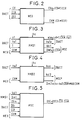
- FIG. 2 represents a MEX exploration circuit module included in the BT processing block.
- the MEX exploration circuit module then prepares a new value CXx which is zero, since CIX is equal to zero.
- the exploration counter is thus reset after the reception of each cell. Consequently, during the reception of this cell, the value CX indicates the number of exploration cycles which have given rise to the increment of the value CX since the last cell received from this virtual circuit, before the cell present.
- the access block BACT also supplies the exploration circuit module MEX of the block BT with an exploration threshold value SEX read in a location for recording the context CT.
- SEX exploration threshold value
- the CX value is compared to this threshold. If the CX value is equal to or greater than the SEX threshold, a CXM pause signal is supplied to the other circuit modules of the LV processing block.
- the CT context of each virtual circuit specifies a number of exploration cycles after which the CXM pause signal is supplied, indicating that the cell transmission has been interrupted for a relatively long time and that, therefore, the process debit evaluation must be modified. We will see that a little later.
- the processing block comprises a certain number of modules of which, within the limited framework of the present invention, only three examples have been provided which are considered to be particularly significant.
- the CXM signal is present, the signal CXM ⁇ has the value O and the number of cells n1x is thus made equal to zero, which is true: no cell was received in a time interval at least equal to the measurement interval.
- the MMD1 module thus normally provides a flow measurement which is the number of cells received in a given time interval. It will be seen by referring to FIG. 5 how such a flow measurement can be used. If a pause has occurred, the module also provides a flow measurement, but which is zero; it will be operated in the same way.
- the measurement module MMD2 of FIG. 4 on the arrival of a cell of a virtual circuit, receives from the context CT of this virtual circuit, and supplied by the access block BACT, a start time ha2 which is this time the current time recorded in the context on receipt of the previous cell of this virtual circuit. It also receives the current time hc and the pause signal CXM already mentioned.
- CXM ⁇ + MAX.CXM which means that this measurement signal Dm2 is equal to the time difference, i.e. to the time interval which has elapsed between the previous cell and the present cell, s 'there was no break, or which is equal to one MAX value, if there has been a pause.
- This MAX value is the maximum time interval which can be taken into account in the flow evaluation process starting from the time interval between consecutive cells.
- the fact that the arriving cell arrives after a pause is signaled by the same CXM signal as in the previous case.
- This can mean that the time interval evaluated by the SEX threshold is the same in both cases, assuming that the two flow evaluation modes are practiced at the same time for the same virtual circuit. This means that the start time saved in the context for these two modes has the same format.
- the CXM signal could be produced under different conditions in these two cases, by giving different values to the SEX threshold.
- FIG. 5 represents a decision module MSC which receives from the measurement module MMD1 the validation signal Val1 and the measurement result Dm1.
- This decision module also receives from the context CT, by the access block BACT, two thresholds DSm and DSi and the exploration signal CIX already mentioned, and from the exploration module MEX the pause signal CXM.
- the threshold DSm is the maximum number of cells that the virtual circuit considered must not exceed, at any time within the measurement interval.
- the DSi threshold is a threshold relating to the number of cells counted in the entire measurement interval, that the virtual circuit considered is authorized to reach in normal traffic and the exceeding of which is the subject of a specific treatment which is outside the scope of the present invention and which will therefore not be described.
- the measurement result Dm1 is compared with the thresholds DSm and DSi.
- the signal OSC3 is supplied as soon as the measurement result Dm1 is equal to or greater than the number DSm, while the validation signal Val1 is not present. This therefore occurs within a measurement interval, if a relatively large number of cells are suddenly received.
- This signal requires repressive action. This repressive action can cause the suppression of the cell present; it will also take place for all subsequent cells, until the end of the measurement interval.
- the signal OSC3 is also supplied when the measurement result Dm1 is equal to or greater than the number DSi, while the validation signal Val1 is present, at the end of a measurement interval (or a pause).
- This module may be only a variant of the module MSC in which the threshold DSm is the minimum time interval between two cells, while the DSi threshold would correspond, for example, to the average interval calculated on a certain number of cells.
- the pause signal CXM (the same or a similar version specific to this evaluation mode, as envisaged above) will prohibit the repressive action caused by the OSC signal, when the evaluation tending to trigger it takes place at the end of a pause in the transmission of cells on the virtual circuit.
- This variant is provided, in particular, although not exclusively, for the case where the entire evaluation device would be implemented, at least partially, using a programmed operator such as a microprocessor.
- a programmed operator such as a microprocessor.
- This evaluation processing modifies the context, as we have seen.
- the interrupted cyclic exploration processing will ignore this modification and will in turn modify the context as if nothing had happened, on the basis of the information provided by the context before the interruption, thus leading to inaccurate modified information; this may subsequently lead to an incorrect decision regarding the routing of the cells of the virtual circuit in question.
- the value CX comprises two separate values C1X and C2X, the other data being the same as in the case of FIG. 2.
- the C1X value constitutes a counter of exploration cycles, the evolution of which remains entrusted to the cyclical exploration processing, while the value C2X is a reference point of beginning of counting, the evolution of which is controlled by the processing for evaluating the context.
- the MEX 'module changes these two values by supplying update values C1Xx and C2Xx composing the updated value CXx, in the manner that will now be described.
- the counter C1X starts from a position indicated by C2X and advances step by step until it reaches a deviation specified by the threshold SEX, from its starting position indicated by C2X, and then it stops.
- the context CT of each virtual circuit specifies a number of exploration cycles after which the pause signal CXM is supplied, indicating that cell transmission has been interrupted for a relatively long period of time and therefore the throughput evaluation process must be changed.
- the variant of the MEX module of FIG. 6 offers the advantage that, if the cyclical exploration processing is interrupted after the reading of C1X, this value being preserved, the evaluation processing causing the interruption does not modify it. It only modifies the C2X coordinate system. After the interruption, when cyclic exploration processing is resumed, the C1X counter advances by one step, which exactly corresponds to the passage of cyclic exploration immediately after the arrival of a cell, unless the intermediate value P was already established and of value 1, which corresponds exactly to the passage of cyclical exploration immediately before the arrival of the cell. The interruption therefore has no disadvantageous consequences.
Landscapes
- Engineering & Computer Science (AREA)
- Computer Networks & Wireless Communication (AREA)
- Signal Processing (AREA)
- Computer Hardware Design (AREA)
- Data Exchanges In Wide-Area Networks (AREA)
- Time-Division Multiplex Systems (AREA)
- Communication Control (AREA)
- Detection And Prevention Of Errors In Transmission (AREA)
- Static Random-Access Memory (AREA)
Applications Claiming Priority (2)
| Application Number | Priority Date | Filing Date | Title |
|---|---|---|---|
| FR9009441A FR2665313B1 (fr) | 1990-07-24 | 1990-07-24 | Procede d'evaluation du debit de circuits virtuels empruntant une voie de transmission a multiplexage temporel asynchrone. |
| FR9009441 | 1990-07-24 |
Publications (2)
| Publication Number | Publication Date |
|---|---|
| EP0472901A1 true EP0472901A1 (de) | 1992-03-04 |
| EP0472901B1 EP0472901B1 (de) | 1995-11-22 |
Family
ID=9399043
Family Applications (1)
| Application Number | Title | Priority Date | Filing Date |
|---|---|---|---|
| EP91112321A Expired - Lifetime EP0472901B1 (de) | 1990-07-24 | 1991-07-23 | Datenflussbewertungsverfahren für virtuelle Verbindungen die nichtgleichgetakte zeitmehrfachartige Übertragungswege benutzen |
Country Status (10)
| Country | Link |
|---|---|
| US (1) | US5260932A (de) |
| EP (1) | EP0472901B1 (de) |
| JP (1) | JP2944054B2 (de) |
| KR (1) | KR100193016B1 (de) |
| AT (1) | ATE130714T1 (de) |
| AU (1) | AU647150B2 (de) |
| CA (1) | CA2047659A1 (de) |
| DE (1) | DE69114787T2 (de) |
| ES (1) | ES2079524T3 (de) |
| FR (1) | FR2665313B1 (de) |
Families Citing this family (8)
| Publication number | Priority date | Publication date | Assignee | Title |
|---|---|---|---|---|
| FR2678122B1 (fr) * | 1991-06-18 | 1993-09-03 | Cit Alcatel | Dispositif de mesure de debit de circuits virtuels empruntant une voie de communication a multiplexage temporel asynchrone. |
| NL9200253A (nl) * | 1992-02-12 | 1993-09-01 | Nederland Ptt | Atm policing function met autonome referentietijdstippen. |
| US5402412A (en) * | 1993-10-15 | 1995-03-28 | Dsc Communications Corporation | System and method for monitoring a stream of events |
| US5781597A (en) * | 1995-02-16 | 1998-07-14 | Alcatel Sel Aktiengesellschaft | Synchronous digital transmission system having justification circuit that counts frame bytes, calculates offsets, compares thresholds, and initiates justification action |
| FI100155B (fi) * | 1995-11-09 | 1997-09-30 | Nokia Telecommunications Oy | Liikenteen mittaus tietoliikennejärjestelmässä |
| DE19547109A1 (de) * | 1995-12-16 | 1997-06-19 | Sel Alcatel Ag | Verfahren zum Aufbau einer Mehrkanalverbindung sowie Vermittlungseinrichtungen, Kommunikationsnetz, sendeseitige und empfangsseitige Zugangseinrichtung zu einem Kommunikationsnetz |
| DE19627728A1 (de) * | 1996-07-10 | 1998-01-15 | Sel Alcatel Ag | Netzelement und Ein-/Ausgabeeinheit für ein synchrones Übertragungssystem |
| US6381214B1 (en) * | 1998-10-09 | 2002-04-30 | Texas Instruments Incorporated | Memory-efficient leaky bucket policer for traffic management of asynchronous transfer mode data communications |
Citations (2)
| Publication number | Priority date | Publication date | Assignee | Title |
|---|---|---|---|---|
| EP0293314A1 (de) * | 1987-05-26 | 1988-11-30 | ETAT FRANCAIS représenté par le Ministre des PTT (Centre National d'Etudes des Télécommunications) | Verfahren und System zur Paketflusssteuerung |
| EP0355243A1 (de) * | 1988-08-26 | 1990-02-28 | International Business Machines Corporation | Hochleistungszeitgeberanordnung |
Family Cites Families (5)
| Publication number | Priority date | Publication date | Assignee | Title |
|---|---|---|---|---|
| FR2648648B1 (fr) * | 1989-06-20 | 1991-08-23 | Cit Alcatel | Procede et dispositif d'evaluation du debit de circuits empruntant une voie de transmission a multiplexage temporel asynchrone |
| FR2648649B1 (fr) * | 1989-06-20 | 1991-08-23 | Cit Alcatel | Procede et dispositif d'evaluation quantifie du debit de circuits virtuels empruntant une voie de transmission a multiplexage temporel asynchrone |
| AU619687B2 (en) * | 1989-06-20 | 1992-01-30 | Alcatel N.V. | Method and device for evaluating the throughput of virtual circuits employing a time-division multiplexed transmission channel |
| FR2648645B1 (fr) * | 1989-06-20 | 1991-08-23 | Cit Alcatel | Procede et dispositif d'evaluation du debit de circuits virtuels empruntant une voie de transmission a multiplexage temporel |
| EP0419958B1 (de) * | 1989-09-29 | 1997-02-19 | Siemens Aktiengesellschaft | Schaltungsanordnung zum Ermitteln der einer ATM-Vermittlungsanlage im Zuge von virtuellen Verbindungen jeweils zugeführten Nachrichtensignalmenge und zur Überprüfung der Einhaltung festgelegter Bitraten |
-
1990
- 1990-07-24 FR FR9009441A patent/FR2665313B1/fr not_active Expired - Lifetime
-
1991
- 1991-07-17 AU AU80455/91A patent/AU647150B2/en not_active Ceased
- 1991-07-19 US US07/732,531 patent/US5260932A/en not_active Expired - Lifetime
- 1991-07-23 AT AT91112321T patent/ATE130714T1/de not_active IP Right Cessation
- 1991-07-23 EP EP91112321A patent/EP0472901B1/de not_active Expired - Lifetime
- 1991-07-23 KR KR1019910012639A patent/KR100193016B1/ko not_active Expired - Fee Related
- 1991-07-23 ES ES91112321T patent/ES2079524T3/es not_active Expired - Lifetime
- 1991-07-23 CA CA002047659A patent/CA2047659A1/fr not_active Abandoned
- 1991-07-23 DE DE69114787T patent/DE69114787T2/de not_active Expired - Fee Related
- 1991-07-24 JP JP18477991A patent/JP2944054B2/ja not_active Expired - Lifetime
Patent Citations (2)
| Publication number | Priority date | Publication date | Assignee | Title |
|---|---|---|---|---|
| EP0293314A1 (de) * | 1987-05-26 | 1988-11-30 | ETAT FRANCAIS représenté par le Ministre des PTT (Centre National d'Etudes des Télécommunications) | Verfahren und System zur Paketflusssteuerung |
| EP0355243A1 (de) * | 1988-08-26 | 1990-02-28 | International Business Machines Corporation | Hochleistungszeitgeberanordnung |
Also Published As
| Publication number | Publication date |
|---|---|
| JPH04234245A (ja) | 1992-08-21 |
| JP2944054B2 (ja) | 1999-08-30 |
| EP0472901B1 (de) | 1995-11-22 |
| AU8045591A (en) | 1992-01-30 |
| FR2665313B1 (fr) | 1992-10-02 |
| CA2047659A1 (fr) | 1992-01-25 |
| KR100193016B1 (ko) | 1999-06-15 |
| US5260932A (en) | 1993-11-09 |
| ATE130714T1 (de) | 1995-12-15 |
| DE69114787T2 (de) | 1996-04-18 |
| KR920003695A (ko) | 1992-02-29 |
| AU647150B2 (en) | 1994-03-17 |
| ES2079524T3 (es) | 1996-01-16 |
| DE69114787D1 (de) | 1996-01-04 |
| FR2665313A1 (fr) | 1992-01-31 |
Similar Documents
| Publication | Publication Date | Title |
|---|---|---|
| EP2940960B1 (de) | Verfahren und vorrichtung zum ordnen von datenpaketen für ihr routing in einem netz mit impliziter bestimmung der pakete, die vorrangig zu verarbeiten sind | |
| EP0858193B1 (de) | Verfahren und Anlage für die Zuweisung von Betriebsmitteln in einem numerischen Paketübertragungsnetzwerk | |
| EP0293314B1 (de) | Verfahren und System zur Paketflusssteuerung | |
| EP1280376B1 (de) | Taskverwaltungsverfahren für einen Router einer Paketvermittlungsstelle, die Teil eines gesicherten und Paketvermittelten Netzes ist | |
| EP0021917A1 (de) | Terminal-Konzentrator für Datenpaketübertragungs- und -vermittlungsnetz | |
| FR2669798A1 (fr) | Dispositif pour la transmission d'informations synchrones par un reseau asynchrone, notamment un reseau atm. | |
| CA2215486A1 (fr) | Systeme de gestion de trafic et de controle d'encombrement pour reseaux a base de paquets | |
| EP0472901B1 (de) | Datenflussbewertungsverfahren für virtuelle Verbindungen die nichtgleichgetakte zeitmehrfachartige Übertragungswege benutzen | |
| EP0403997B1 (de) | Verfahren und Vorrichtung zur quantisierten Flussberechnung virtueller Verbindungen über einen asynchronen Zeitmultiplexübertragungsweg | |
| EP0377204B1 (de) | System für das Senden von HDLC-Rahmen auf einem PCM-Kanal mit einer einzelnen HDLC-Anordnung und Transpositionspufferspeicher | |
| CA2006832C (fr) | Systeme de reception et de traitement de trames hdlc transmises sur liaison mic multivoies a multiplexage temporel, notamment pour commutateur de donnees | |
| EP0048781A1 (de) | Leitungssteuerung für einen Vorschaltrechner in einem Datennetz | |
| EP0162174A1 (de) | Puffereinrichtung für ein Sprachübertragungsnetzwerk | |
| FR2657482A1 (fr) | Methode et systeme de lissage et de controle de debits de communications temporelles asynchrones. | |
| FR2643532A1 (fr) | Procede de reservation de debits et commutateurs temporels de paquets asynchrones | |
| EP0519814B1 (de) | Vorrichtung zur Messung der Datenrate virtueller Verbindungen eines asynchronen Zeitvielfachübertragungsweges | |
| EP0650276B1 (de) | Prüfungsgerät für ATM Telekommunikationsnetze und Messung der Qualität einer ATM Verbindung | |
| EP0422550B1 (de) | Vorrichtung zur Auswertung der Rate von virtuellen Verbindungen aus einer asynchronen Zeit-Multiplexlinie | |
| EP0603056B1 (de) | Verfahren zur Simulation der Übertragung über ein asynchrones Transfermodus-Übertragungsnetz und Simulator zur Übertragung über ein solches Netz | |
| WO2001022684A1 (fr) | Procede et systeme de transmission d'une chaine de messages pour base de donnees | |
| EP0717519A1 (de) | Adaptives Packetmultiplexsystem mit Berechnung dynamischer Lieferzeiten | |
| EP0470875B1 (de) | Fernmeldesteuerungsanordnung zwischen einem Rechner und einer Mehrheit von ISDN-artigen Endgeräten | |
| FR2668324A1 (fr) | Methode et systeme de lissage et de controle de debits de communications temporelles asynchrones. | |
| CA2577173A1 (fr) | Procede apte a modifier le comportement d'un equipement de reseau | |
| FR2781630A1 (fr) | Procede de resequencement et d'espacement des paquets d'au moins une connexion transmis par un emetteur et recus par un recepteur au vu de leur delivrance sur un multiplex de sortie |
Legal Events
| Date | Code | Title | Description |
|---|---|---|---|
| PUAI | Public reference made under article 153(3) epc to a published international application that has entered the european phase |
Free format text: ORIGINAL CODE: 0009012 |
|
| AK | Designated contracting states |
Kind code of ref document: A1 Designated state(s): AT BE CH DE DK ES FR GB IT LI NL SE |
|
| 17P | Request for examination filed |
Effective date: 19920831 |
|
| 17Q | First examination report despatched |
Effective date: 19950131 |
|
| GRAA | (expected) grant |
Free format text: ORIGINAL CODE: 0009210 |
|
| AK | Designated contracting states |
Kind code of ref document: B1 Designated state(s): AT BE CH DE DK ES FR GB IT LI NL SE |
|
| PG25 | Lapsed in a contracting state [announced via postgrant information from national office to epo] |
Ref country code: DK Effective date: 19951122 |
|
| REF | Corresponds to: |
Ref document number: 130714 Country of ref document: AT Date of ref document: 19951215 Kind code of ref document: T |
|
| REF | Corresponds to: |
Ref document number: 69114787 Country of ref document: DE Date of ref document: 19960104 |
|
| ITF | It: translation for a ep patent filed | ||
| REG | Reference to a national code |
Ref country code: ES Ref legal event code: FG2A Ref document number: 2079524 Country of ref document: ES Kind code of ref document: T3 |
|
| GBT | Gb: translation of ep patent filed (gb section 77(6)(a)/1977) |
Effective date: 19960111 |
|
| REG | Reference to a national code |
Ref country code: CH Ref legal event code: NV Representative=s name: GEC ALSTHOM (SUISSE) S.A. DEPARTEMENT DES BREVETS |
|
| PLBE | No opposition filed within time limit |
Free format text: ORIGINAL CODE: 0009261 |
|
| STAA | Information on the status of an ep patent application or granted ep patent |
Free format text: STATUS: NO OPPOSITION FILED WITHIN TIME LIMIT |
|
| 26N | No opposition filed | ||
| REG | Reference to a national code |
Ref country code: GB Ref legal event code: IF02 |
|
| PGFP | Annual fee paid to national office [announced via postgrant information from national office to epo] |
Ref country code: ES Payment date: 20090724 Year of fee payment: 19 Ref country code: FR Payment date: 20090716 Year of fee payment: 19 |
|
| PGFP | Annual fee paid to national office [announced via postgrant information from national office to epo] |
Ref country code: SE Payment date: 20090715 Year of fee payment: 19 Ref country code: NL Payment date: 20090730 Year of fee payment: 19 Ref country code: AT Payment date: 20090715 Year of fee payment: 19 Ref country code: GB Payment date: 20090720 Year of fee payment: 19 Ref country code: CH Payment date: 20090715 Year of fee payment: 19 Ref country code: DE Payment date: 20090722 Year of fee payment: 19 |
|
| PGFP | Annual fee paid to national office [announced via postgrant information from national office to epo] |
Ref country code: BE Payment date: 20090818 Year of fee payment: 19 |
|
| PGFP | Annual fee paid to national office [announced via postgrant information from national office to epo] |
Ref country code: IT Payment date: 20090723 Year of fee payment: 19 |
|
| BERE | Be: lapsed |
Owner name: *ALCATEL CIT Effective date: 20100731 |
|
| REG | Reference to a national code |
Ref country code: NL Ref legal event code: V1 Effective date: 20110201 |
|
| REG | Reference to a national code |
Ref country code: CH Ref legal event code: PL |
|
| GBPC | Gb: european patent ceased through non-payment of renewal fee |
Effective date: 20100723 |
|
| REG | Reference to a national code |
Ref country code: FR Ref legal event code: ST Effective date: 20110331 |
|
| PG25 | Lapsed in a contracting state [announced via postgrant information from national office to epo] |
Ref country code: CH Free format text: LAPSE BECAUSE OF NON-PAYMENT OF DUE FEES Effective date: 20100731 Ref country code: LI Free format text: LAPSE BECAUSE OF NON-PAYMENT OF DUE FEES Effective date: 20100731 Ref country code: DE Free format text: LAPSE BECAUSE OF NON-PAYMENT OF DUE FEES Effective date: 20110201 |
|
| REG | Reference to a national code |
Ref country code: DE Ref legal event code: R119 Ref document number: 69114787 Country of ref document: DE Effective date: 20110201 |
|
| PG25 | Lapsed in a contracting state [announced via postgrant information from national office to epo] |
Ref country code: FR Free format text: LAPSE BECAUSE OF NON-PAYMENT OF DUE FEES Effective date: 20100802 Ref country code: AT Free format text: LAPSE BECAUSE OF NON-PAYMENT OF DUE FEES Effective date: 20100723 Ref country code: IT Free format text: LAPSE BECAUSE OF NON-PAYMENT OF DUE FEES Effective date: 20100723 Ref country code: NL Free format text: LAPSE BECAUSE OF NON-PAYMENT OF DUE FEES Effective date: 20110201 |
|
| PG25 | Lapsed in a contracting state [announced via postgrant information from national office to epo] |
Ref country code: BE Free format text: LAPSE BECAUSE OF NON-PAYMENT OF DUE FEES Effective date: 20100731 |
|
| PG25 | Lapsed in a contracting state [announced via postgrant information from national office to epo] |
Ref country code: GB Free format text: LAPSE BECAUSE OF NON-PAYMENT OF DUE FEES Effective date: 20100723 |
|
| REG | Reference to a national code |
Ref country code: ES Ref legal event code: FD2A Effective date: 20110818 |
|
| PG25 | Lapsed in a contracting state [announced via postgrant information from national office to epo] |
Ref country code: ES Free format text: LAPSE BECAUSE OF NON-PAYMENT OF DUE FEES Effective date: 20100724 |
|
| PG25 | Lapsed in a contracting state [announced via postgrant information from national office to epo] |
Ref country code: SE Free format text: LAPSE BECAUSE OF NON-PAYMENT OF DUE FEES Effective date: 20100724 |