EP0472911B1 - Copolymères triséquencés ignifuges d'organopolysiloxane-polycarbonate - Google Patents
Copolymères triséquencés ignifuges d'organopolysiloxane-polycarbonate Download PDFInfo
- Publication number
- EP0472911B1 EP0472911B1 EP91112484A EP91112484A EP0472911B1 EP 0472911 B1 EP0472911 B1 EP 0472911B1 EP 91112484 A EP91112484 A EP 91112484A EP 91112484 A EP91112484 A EP 91112484A EP 0472911 B1 EP0472911 B1 EP 0472911B1
- Authority
- EP
- European Patent Office
- Prior art keywords
- organopolysiloxane
- flame retardant
- hydroxyphenyl
- bis
- radical
- Prior art date
- Legal status (The legal status is an assumption and is not a legal conclusion. Google has not performed a legal analysis and makes no representation as to the accuracy of the status listed.)
- Expired - Lifetime
Links
Classifications
-
- C—CHEMISTRY; METALLURGY
- C08—ORGANIC MACROMOLECULAR COMPOUNDS; THEIR PREPARATION OR CHEMICAL WORKING-UP; COMPOSITIONS BASED THEREON
- C08G—MACROMOLECULAR COMPOUNDS OBTAINED OTHERWISE THAN BY REACTIONS ONLY INVOLVING UNSATURATED CARBON-TO-CARBON BONDS
- C08G77/00—Macromolecular compounds obtained by reactions forming a linkage containing silicon with or without sulfur, nitrogen, oxygen or carbon in the main chain of the macromolecule
- C08G77/04—Polysiloxanes
- C08G77/38—Polysiloxanes modified by chemical after-treatment
-
- C—CHEMISTRY; METALLURGY
- C08—ORGANIC MACROMOLECULAR COMPOUNDS; THEIR PREPARATION OR CHEMICAL WORKING-UP; COMPOSITIONS BASED THEREON
- C08G—MACROMOLECULAR COMPOUNDS OBTAINED OTHERWISE THAN BY REACTIONS ONLY INVOLVING UNSATURATED CARBON-TO-CARBON BONDS
- C08G64/00—Macromolecular compounds obtained by reactions forming a carbonic ester link in the main chain of the macromolecule
- C08G64/18—Block or graft polymers
- C08G64/186—Block or graft polymers containing polysiloxane sequences
-
- C—CHEMISTRY; METALLURGY
- C08—ORGANIC MACROMOLECULAR COMPOUNDS; THEIR PREPARATION OR CHEMICAL WORKING-UP; COMPOSITIONS BASED THEREON
- C08G—MACROMOLECULAR COMPOUNDS OBTAINED OTHERWISE THAN BY REACTIONS ONLY INVOLVING UNSATURATED CARBON-TO-CARBON BONDS
- C08G77/00—Macromolecular compounds obtained by reactions forming a linkage containing silicon with or without sulfur, nitrogen, oxygen or carbon in the main chain of the macromolecule
- C08G77/42—Block-or graft-polymers containing polysiloxane sequences
- C08G77/448—Block-or graft-polymers containing polysiloxane sequences containing polycarbonate sequences
Definitions
- the present invention relates to flame retardant organopolysiloxne-polycarbonate triblock copolymers which can be made by phosgenating a mixture of a phenol-organopolysiloxane chainstopper and a bisphenol. More particularly, the present invention relates to the use of phenol-organopolysiloxane chainstoppers which can be made by effecting a platinum catalyzed addition reaction between an aliphatically unsaturated phenol and a polyorganosiloxane terminated with a condensed diorganohydrogensiloxy unit.
- FR-A-1507429 discloses reaction products of hydride polydiorganosiloxanes and compounds such as 2-allylphenol or 2-methoxy-4-allylphenol.
- EP-A-0433746 discloses silicone cyclics, such as hexaorganotrisiloxane, may be lithiated with an alkyl lithium compound followed by treatment with a diorganohalosilane to produce a polydiorganosiloxane having a terminal diorganohydridesiloxy unit.
- the platinum catalyzed addition of a 2-alkenyl-6-organophenol results in the production of a phenol-siloxane macromer.
- Conversion of the phenol-siloxane macromer to a silicone polyphenylene ether graft copolymer is effected by oxidatively coupling the 2,6-diorganophenol to the phenol-siloxane macromer.
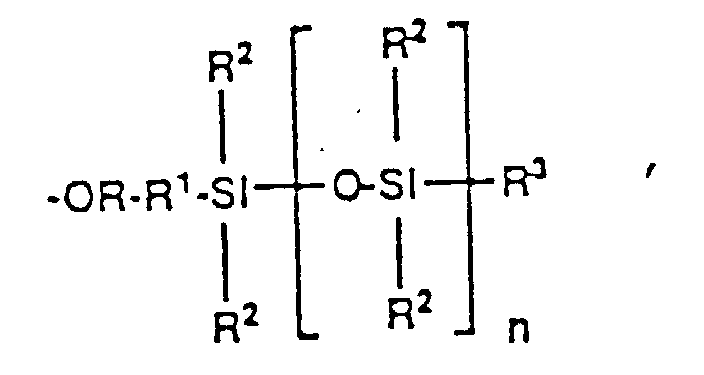
- the present invention is based on the discovery that the phosgenation of a mixture of a phenol-organopolysiloxane chainstopper having the formula, and a bisphenol having the formula, HO-R 4 -OH , can provide a flame retardant organopolysiloxane-polycarbonate triblock copolymer, where R is a C (6-20) polyvalent aromatic organic radical, R 1 is a C (2-8) aliphatic organic radical, R 2 is a C (1-13) monovalent hydrocarbon radical or a C (1-13) monovalent hydrocarbon radical substituted with radicals inert during equilibrium or condensation, R 3 is a C (1-13) monovalent organic radical, R 4 is a C (6-30) divalent aromatic organic radical and n is an integer equal to 0 to 100 inclusive.
- R is a C (6-20) polyvalent aromatic organic radical
- R 1 is a C (2-8) aliphatic organic radical
- R 2 is a C (1-13) monovalent hydrocarbon radical or a C (1
- the phenol organopolysiloxane chainstopper of formula (1) can be made by effecting a platinum catalyzed addition reaction between an aliphatically unsaturated phenol of the formula, HO-R-R 5 , and a hydride polydiorganosiloxane of the formula, where R, R 1 , R 2 , R 3 and n are as previously defined, and R 5 is a C (2-8) aliphatically unsaturated organic radical.
- flame retardance or “nonflammable” with respect to the flame retardant polycarbonate compositions of the present invention means that the flame retardant polycarbonates have satisfied the V-0 UL94 flammability requirements shown in the "Flammability of Plastic Materials Bulletin” of Jan. 24, 1980. More particularly, a 12.7 x 1.27 x 0.32 cm (5" x 1/2" x 1/8") polycarbonate test bar is suspended vertically over a 3/4" Bunsen Burner flame as provided in the aforementioned UL94 test. The test sample preferably exhibits a UL94 V-0 rating which includes the following criteria:
- flame retardant organopolysiloxane-polycarbonate triblock copolymers comprising aromatic polycarbonate having terminal groups of the formula, where R, R 1 , R 2 , R 3 and n are as previously defined.
- Radicals included within R 2 of formulas 1, 3 and 5 are C (1-8) alkyl radicals, such as methyl, ethyl, propyl, butyl, pentyl; C (6-13) aromatic radicals such as phenyl, xylyl, tolyl, naphthyl; halogenated derivatives thereof, such as trifluoropropyl, chlorophenyl.
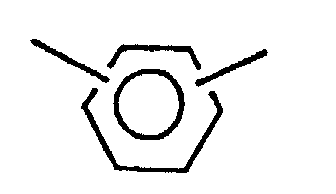
- Some of the radicals included within R of formulas (1), (3) and (5) are, for example, phenylene, naphthylene, and C (1-8) alkoxy-substituted derivatives thereof such as and where R 7 is C (1-8) alkyl, and b is a whole number equal to 0 or 1.
- Radicals included within R 1 are, for example, dimethylene and trimethylene. Radicals included within R 3 are, for example, methyl, butyl and phenyl. R 4 is preferably phenylene and R 5 is preferably vinyl and allyl.
- the hydride polydiorganosiloxane of formula (4) can be made in accordance with the method shown by C.L. Frye et al, Reactions of Organo Lithium Reagents with Siloxane Substrates JOC, 35 , 1308-1314 (1970).
- a typical procedure involves the reaction of 3 equivalents of butyllithium with hexamethylcyclotrisiloxane to produce a polydimethylsiloxane end-stopped at one end with dimethylbutylsiloxy units and at the other end with a dimethyllithiumsiloxy unit.
- This lithiated intermediate can thereafter be reacted under appropriate conditions with a silicon hydride, such as dimethylchlorosilane, to effect the addition of the silicon hydride functional unit.
- a silicon hydride such as dimethylchlorosilane
- hexamethylcyclotrisiloxane is a preferred reactant
- other cyclic diorganosiloxanes can be used, such as
- the phenol-organopolysiloxane chainstopper is made by effecting addition between 2-methoxy-4-allylphenol or 2-allylphenol and a hydride polyorganosiloxane, or by effecting addition between p-acyloxystyrene and a hydride polydiorganosiloxane followed by hydrolysis of the resulting product.
- Platinum catalysts which can be used in the practice of the present invention to effect reaction between the hydride polydiorganosiloxane of formula (4) and the aliphatically unsaturated phenol of formula (3) are, for example, the reaction products of an olefin and chloroplatinic acid as described in Ashby, U.S. Patent No. 3,159,601, or the reaction product of platinic chloride and cyclopropane as described in Ashby, U.S. Patent No. 3,159,662.
- platinum complexes which can be used as the platinum catalyst are reaction products of chloroplatinic acid with up to 2 moles, per gram of platinum of a member selected from the class consisting of alcohols, ethers, aldehydes and mixtures thereof, as shown in Lamoreaux, U.S. Patent 3,220,972.
- platinum dispersed on carbon can be used.
- the preferred platinum catalyst is shown by Karstedt, U.S. Patent 3,775,452, which is formed by reacting chloroplatinic acid with tetramethyldivinyldisiloxane in the presence of sodium bicarbonate in an ethanol solution. It has been found that effective results can be achieved if sufficient platinum catalyst is employed to provide from 1 to 250 parts per million of platinum, preferably from 1 to 200 parts of platinum per million parts of mixture.
- Phosgenation of the mixture of the phenol-organopolysiloxane chainstopper of formula (1) and the bisphenol of formula (2) can be effected under interfacial reaction conditions utilizing water, an inert organic solvent and appropriate base. Temperatures in the range of from 0°C to 45°C can be employed. Suitable inert organic solvents which can be used are, for example, dichloromethane and chloroform.
- Bases which can be employed are, for example, triethylamine, pyridine and sodium hydroxide.
- the resulting phenol adduct was then deprotected by dissolving 10.1 grams of the residue obtained above in 50 ml of methanol. There was then added to the mixture 0.14 ml of water followed by 1.06 grams of potassium carbonate. The mixture was stirred for 15 hours at room temperature. After effecting removal of potassium acetate and excess potassium carbonate, the methanol was stripped by roto-evaporation and a viscous product was obtained which was dissolved in diethylether and washed with 1 normal HCL followed with water. The ether layer was dried over anhydrous magnesium sulfate. The ether was removed by roto-evaporation, leaving 8.9 grams of product. Based on method of preparation, the product was a phenol chainstopper within the scope of formula (1).
- the methylene chloride layers were washed with dilute HCl, washed with water, and precipitated into methanol.
- the resulting polymers were collected, washed with methanol and dried.
- the molecular weights of the polymer were measured by GPC using polystyrene standards. Controls using 2-allylphenol (4), p-cumylphenol (5), or phenol (6) as a chainstoppers were also made.
- UL-94 samples were prepared by compression molding 1.59mm (1/16") plaques from dried powder at 200-210°C under 34.5 MPa (5000 psi) for 2-2.5 minutes, which were converted to 12.7 mm x 12.7 cm (0.5" x 5") flame bars.
Landscapes
- Chemical & Material Sciences (AREA)
- Health & Medical Sciences (AREA)
- Chemical Kinetics & Catalysis (AREA)
- Medicinal Chemistry (AREA)
- Polymers & Plastics (AREA)
- Organic Chemistry (AREA)
- General Chemical & Material Sciences (AREA)
- Silicon Polymers (AREA)
- Polyesters Or Polycarbonates (AREA)
- Other Resins Obtained By Reactions Not Involving Carbon-To-Carbon Unsaturated Bonds (AREA)
- Compositions Of Macromolecular Compounds (AREA)
Claims (9)
- Copolymère tribloc organopolysiloxane-polycarbonate à inflammation retardée, qui comprend un polycarbonate aromatique ayant des groupes terminaux de formule :dans laquelle R représente un groupe organique aromatique plurivalent en C6 à C20, R1 représente un groupe organique aliphatique en C2 à C8, R2 représente un groupe hydrocarboné monovalent en C1 à C13 ou un groupe hydrocarboné monovalent en C1 à C13, substitué par des groupes inertes lors de la mise en équilibre ou de la condensation, R3 représente un groupe organique monovalent en C1 à C13 et n désigne un nombre entier ayant une valeur de 0 à 100, bornes incluses.
- Copolymère tribloc organopolysiloxane-polycarbonate à inflammation retardée selon la revendication 1, dans lequel R2 représente le groupe méthyle.
- Copolymère tribloc organopolysiloxane-polycarbonate à inflammation retardée selon la revendication 1, dans lequel R représente
- Copolymère tribloc organopolysiloxane-polycarbonate à inflammation retardée selon la revendication 1, dans lequel R1 représente le groupe triméthylène et R3 représente le groupe méthyle.
- Procédé de préparation d'un copolymère tribloc organopolysiloxane-polycarbonate à inflammation retardée, qui comprend la phosgénation d'un mélange d'un agent d'arrêt des chaínes du type phénol-organopolysiloxane, de formuleet d'un bisphénol de formule

- Procédé selon la revendication 5, dans lequel le bisphénol est le bisphénol A.
- Procédé selon la revendication 5, dans lequel l'agent d'arrêt des chaínes du type organopolysiloxane est un méthylpolysiloxane.
- Agent d'arrêt des chaínes du type phénolorganopolysiloxane, qui répond à la formule :dans laquelle R1 représente un groupe organique aliphatique en C2 à C8, R2 représente un groupe hydrocarboné monovalent en C1 à C13 ou un groupe hydrocarboné monovalent en C1 à C13, substitué par des groupes inertes lors de la mise en équilibre ou de la condensation, R3 représente un groupe organique monovalent en C1 à C13, R6 représente un groupe aromatique plurivalent choisi parmi
 et
et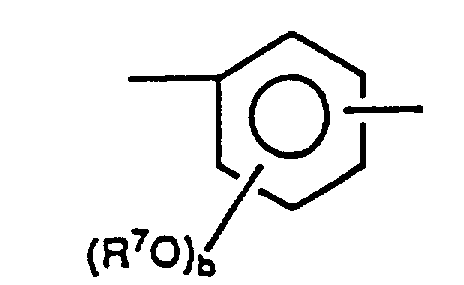 R7 représentant un groupe alkyle en C1 à C8 et b désignant un nombre entier égal à 0 ou 1, et n désigne un nombre entier ayant une valeur de 0 à 100, bornes incluses.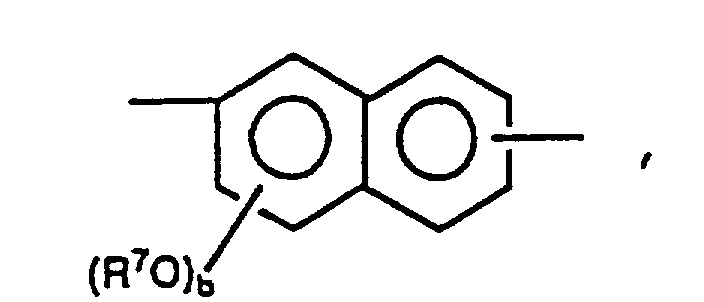
- Agent d'arrêt des chaínes du type phénolorganopolysiloxane, que l'on prépare en réalisant l'addition d'un p-acyloxystyrène sur un hydrogénopolydiorganosiloxane, puis l'hydrolyse du produit d'addition résultant.
Applications Claiming Priority (2)
| Application Number | Priority Date | Filing Date | Title |
|---|---|---|---|
| US07/572,283 US5025074A (en) | 1990-08-27 | 1990-08-27 | Flame retardant organopolysiloxane-polycarbonate triblock copolymers |
| US572283 | 1990-08-27 |
Publications (3)
| Publication Number | Publication Date |
|---|---|
| EP0472911A2 EP0472911A2 (fr) | 1992-03-04 |
| EP0472911A3 EP0472911A3 (en) | 1992-10-14 |
| EP0472911B1 true EP0472911B1 (fr) | 1999-03-10 |
Family
ID=24287135
Family Applications (1)
| Application Number | Title | Priority Date | Filing Date |
|---|---|---|---|
| EP91112484A Expired - Lifetime EP0472911B1 (fr) | 1990-08-27 | 1991-07-25 | Copolymères triséquencés ignifuges d'organopolysiloxane-polycarbonate |
Country Status (5)
| Country | Link |
|---|---|
| US (1) | US5025074A (fr) |
| EP (1) | EP0472911B1 (fr) |
| JP (1) | JP2509025B2 (fr) |
| DE (1) | DE69130969T2 (fr) |
| ES (1) | ES2128303T3 (fr) |
Families Citing this family (17)
| Publication number | Priority date | Publication date | Assignee | Title |
|---|---|---|---|---|
| EP0515196A3 (en) * | 1991-05-24 | 1993-06-09 | General Electric Company | Method for making silicone polyphenylene ether graft copolymers and products |
| EP0522753A3 (en) * | 1991-07-01 | 1993-08-11 | General Electric Company | Flame retardant aromatic polycarbonates and aromatic polycarbonate blends |
| EP0522751B1 (fr) | 1991-07-01 | 1998-04-01 | General Electric Company | Copolymères séquencés de polycarbonate-polysiloxane |
| US5362833A (en) * | 1992-06-10 | 1994-11-08 | Eastman Kodak Company | Phenolic polysiloxane-containing coated articles useful as toner fusing members |
| DE4234959C1 (de) * | 1992-10-16 | 1994-04-07 | Goldschmidt Ag Th | Organopolysiloxane mit einer endständigen Alkoxygruppe und einer am anderen Kettenende befindlichen weiteren funktionellen Gruppe sowie Verfahren zu ihrer Herstellung |
| NL9202090A (nl) * | 1992-12-02 | 1994-07-01 | Gen Electric | Polymeermengsel met aromatisch polycarbonaat, styreen bevattend copolymeer en/of entpolymeer en een polysiloxaan-polycarbonaat blok copolymeer, daaruit gevormde voorwerpen. |
| US5932677A (en) * | 1993-05-27 | 1999-08-03 | General Electric Company | Terpolymer having aromatic polyester, polysiloxane and polycarbonate segments |
| JP3393616B2 (ja) | 1994-01-27 | 2003-04-07 | 出光石油化学株式会社 | ポリカーボネート−ポリオルガノシロキサントリブロック共重合体及びそれを含有する樹脂組成物 |
| JP3409819B2 (ja) | 1994-03-24 | 2003-05-26 | 出光石油化学株式会社 | ポリカーボネート系樹脂、その製造方法及び樹脂組成物 |
| US5604039A (en) * | 1996-01-22 | 1997-02-18 | Eastman Kodak Company | Thermally stable release agents |
| US5780545A (en) * | 1996-03-08 | 1998-07-14 | Eastman Kodak Company | Stable release agents |
| JP4306824B2 (ja) * | 1998-01-30 | 2009-08-05 | 東レ・ダウコーニング株式会社 | 有機官能性オルガノペンタシロキサンの製造方法、有機樹脂改質剤および有機樹脂 |
| NZ509436A (en) | 2000-03-24 | 2002-05-31 | Goldschmidt Ag Th | Siloxane-containing oil compositions with good spreading properties |
| JP5503869B2 (ja) * | 2005-06-13 | 2014-05-28 | チバ ホールディング インコーポレーテッド | 表面改質剤としてのシリコン含有基を末端に有するオリゴ−及びポリ−カーボネート |
| US20100168295A1 (en) * | 2005-08-16 | 2010-07-01 | Christine Breiner | Polycarbonate Flame Retardant Compositions |
| KR20090053778A (ko) * | 2006-09-26 | 2009-05-27 | 테이진 카세이 가부시키가이샤 | 폴리카보네이트 및 그 제조 방법 |
| KR101924199B1 (ko) * | 2016-02-01 | 2018-11-30 | 주식회사 엘지화학 | 신규한 폴리오르가노실록산 및 이를 사용하여 제조되는 코폴리카보네이트 |
Family Cites Families (6)
| Publication number | Priority date | Publication date | Assignee | Title |
|---|---|---|---|---|
| GB1175266A (en) * | 1966-02-10 | 1969-12-23 | Gen Electric | Arylol Polysiloxanes |
| US4167536A (en) * | 1978-07-21 | 1979-09-11 | General Electric Company | Organopolysiloxane-phenolphthalein-polycarbonate copolymers |
| JPS6243435A (ja) * | 1985-08-20 | 1987-02-25 | Shin Etsu Chem Co Ltd | 耐火性シリコ−ン発泡体組成物 |
| US4895919A (en) * | 1988-10-07 | 1990-01-23 | General Electric Company | Spirobiindane copolysiloxanecarbonates and method for their preparation |
| US4945148A (en) * | 1989-03-06 | 1990-07-31 | General Electric Company | Silicone-polycarbonate block copolymers |
| CA2025289A1 (fr) * | 1989-12-22 | 1991-06-23 | Kevin M. Snow | Macromeres de silicone et leur utilisation pour l'obtention de copolymeres de greffe de silicone et de poly(oxyde de phenylene) |
-
1990
- 1990-08-27 US US07/572,283 patent/US5025074A/en not_active Expired - Fee Related
-
1991
- 1991-07-25 EP EP91112484A patent/EP0472911B1/fr not_active Expired - Lifetime
- 1991-07-25 ES ES91112484T patent/ES2128303T3/es not_active Expired - Lifetime
- 1991-07-25 DE DE69130969T patent/DE69130969T2/de not_active Expired - Fee Related
- 1991-08-22 JP JP3233776A patent/JP2509025B2/ja not_active Expired - Lifetime
Also Published As
| Publication number | Publication date |
|---|---|
| ES2128303T3 (es) | 1999-05-16 |
| JP2509025B2 (ja) | 1996-06-19 |
| JPH04288332A (ja) | 1992-10-13 |
| US5025074A (en) | 1991-06-18 |
| DE69130969D1 (de) | 1999-04-15 |
| EP0472911A2 (fr) | 1992-03-04 |
| EP0472911A3 (en) | 1992-10-14 |
| DE69130969T2 (de) | 1999-10-21 |
Similar Documents
| Publication | Publication Date | Title |
|---|---|---|
| US5025074A (en) | Flame retardant organopolysiloxane-polycarbonate triblock copolymers | |
| US5530083A (en) | Silicone-polycarbonate block copolymers and polycarbonate blends having reduced haze, and method for making | |
| JP3701071B2 (ja) | ブロックコポリシロキサンカーボネートの製法 | |
| CN102822241B (zh) | 羟基-封端的硅氧烷,聚硅氧烷-聚碳酸酯共聚物,及其制备方法 | |
| EP2707418B1 (fr) | Copolymères élastomères de polycarbonate de silicone | |
| EP0386547B1 (fr) | Copolymères séquencés de silicone et de polycarbonate | |
| EP2912099B1 (fr) | Composés phénoliques en tant qu'agents de coiffage d'extrémité pour polysiloxanes dans des copolymères séquencés de polycarbonate-polysiloxane | |
| US9376534B2 (en) | Phenyl-containing functional polysiloxanes and polycarbonate-polysiloxane copolymers made therefrom | |
| CN105102507A (zh) | 聚有机硅氧烷和聚碳酸酯-聚有机硅氧烷共聚物 | |
| EP0472912B1 (fr) | Copolymères greffés ignifuges d'organopolysiloxane-polycarbonate | |
| US5243009A (en) | Hydroxyarylestersiloxanes | |
| WO2002048241A2 (fr) | Copolymeres sequences de polycarbonate et de polysulfone/polysiloxane | |
| EP3207079B1 (fr) | Copolymères polysiloxane-polycarbonates et leur procédé de production | |
| CN107406592B (zh) | 反应性聚硅氧烷和由其制成的共聚物 | |
| KR102115799B1 (ko) | 투명성 및 저온 내충격성이 향상된 폴리실록산-폴리카보네이트 공중합체 및 그 제조방법 | |
| TWI790601B (zh) | 利用羥基-封端聚矽氧烷之混合物的聚矽氧烷-聚碳酸酯共聚物及其製備方法 | |
| JP2004521169A (ja) | 溶融法ポリカーボネート触媒系 | |
| JPH05261260A (ja) | 酸素富化膜 | |
| WO2008121151A1 (fr) | Copolymères polycarbonate-polysiloxane, leurs procédés de préparation et articles obtenus avec ces copolymères |
Legal Events
| Date | Code | Title | Description |
|---|---|---|---|
| PUAI | Public reference made under article 153(3) epc to a published international application that has entered the european phase |
Free format text: ORIGINAL CODE: 0009012 |
|
| AK | Designated contracting states |
Kind code of ref document: A2 Designated state(s): DE ES FR GB IT NL |
|
| PUAL | Search report despatched |
Free format text: ORIGINAL CODE: 0009013 |
|
| AK | Designated contracting states |
Kind code of ref document: A3 Designated state(s): DE ES FR GB IT NL |
|
| 17P | Request for examination filed |
Effective date: 19930413 |
|
| 17Q | First examination report despatched |
Effective date: 19941216 |
|
| GRAG | Despatch of communication of intention to grant |
Free format text: ORIGINAL CODE: EPIDOS AGRA |
|
| GRAG | Despatch of communication of intention to grant |
Free format text: ORIGINAL CODE: EPIDOS AGRA |
|
| GRAH | Despatch of communication of intention to grant a patent |
Free format text: ORIGINAL CODE: EPIDOS IGRA |
|
| GRAH | Despatch of communication of intention to grant a patent |
Free format text: ORIGINAL CODE: EPIDOS IGRA |
|
| GRAA | (expected) grant |
Free format text: ORIGINAL CODE: 0009210 |
|
| AK | Designated contracting states |
Kind code of ref document: B1 Designated state(s): DE ES FR GB IT NL |
|
| ET | Fr: translation filed | ||
| REF | Corresponds to: |
Ref document number: 69130969 Country of ref document: DE Date of ref document: 19990415 |
|
| REG | Reference to a national code |
Ref country code: ES Ref legal event code: FG2A Ref document number: 2128303 Country of ref document: ES Kind code of ref document: T3 |
|
| ITF | It: translation for a ep patent filed | ||
| PLBE | No opposition filed within time limit |
Free format text: ORIGINAL CODE: 0009261 |
|
| STAA | Information on the status of an ep patent application or granted ep patent |
Free format text: STATUS: NO OPPOSITION FILED WITHIN TIME LIMIT |
|
| 26N | No opposition filed | ||
| REG | Reference to a national code |
Ref country code: GB Ref legal event code: IF02 |
|
| PGFP | Annual fee paid to national office [announced via postgrant information from national office to epo] |
Ref country code: FR Payment date: 20020702 Year of fee payment: 12 |
|
| PGFP | Annual fee paid to national office [announced via postgrant information from national office to epo] |
Ref country code: NL Payment date: 20020703 Year of fee payment: 12 |
|
| PGFP | Annual fee paid to national office [announced via postgrant information from national office to epo] |
Ref country code: GB Payment date: 20020717 Year of fee payment: 12 |
|
| PGFP | Annual fee paid to national office [announced via postgrant information from national office to epo] |
Ref country code: DE Payment date: 20020730 Year of fee payment: 12 |
|
| PGFP | Annual fee paid to national office [announced via postgrant information from national office to epo] |
Ref country code: ES Payment date: 20020807 Year of fee payment: 12 |
|
| PG25 | Lapsed in a contracting state [announced via postgrant information from national office to epo] |
Ref country code: GB Free format text: LAPSE BECAUSE OF NON-PAYMENT OF DUE FEES Effective date: 20030725 |
|
| PG25 | Lapsed in a contracting state [announced via postgrant information from national office to epo] |
Ref country code: ES Free format text: LAPSE BECAUSE OF NON-PAYMENT OF DUE FEES Effective date: 20030726 |
|
| PG25 | Lapsed in a contracting state [announced via postgrant information from national office to epo] |
Ref country code: NL Free format text: LAPSE BECAUSE OF NON-PAYMENT OF DUE FEES Effective date: 20040201 |
|
| PG25 | Lapsed in a contracting state [announced via postgrant information from national office to epo] |
Ref country code: DE Free format text: LAPSE BECAUSE OF NON-PAYMENT OF DUE FEES Effective date: 20040203 |
|
| GBPC | Gb: european patent ceased through non-payment of renewal fee |
Effective date: 20030725 |
|
| PG25 | Lapsed in a contracting state [announced via postgrant information from national office to epo] |
Ref country code: FR Free format text: LAPSE BECAUSE OF NON-PAYMENT OF DUE FEES Effective date: 20040331 |
|
| NLV4 | Nl: lapsed or anulled due to non-payment of the annual fee |
Effective date: 20040201 |
|
| REG | Reference to a national code |
Ref country code: FR Ref legal event code: ST |
|
| REG | Reference to a national code |
Ref country code: ES Ref legal event code: FD2A Effective date: 20030726 |
|
| PG25 | Lapsed in a contracting state [announced via postgrant information from national office to epo] |
Ref country code: IT Free format text: LAPSE BECAUSE OF NON-PAYMENT OF DUE FEES;WARNING: LAPSES OF ITALIAN PATENTS WITH EFFECTIVE DATE BEFORE 2007 MAY HAVE OCCURRED AT ANY TIME BEFORE 2007. THE CORRECT EFFECTIVE DATE MAY BE DIFFERENT FROM THE ONE RECORDED. Effective date: 20050725 |