EP0473088B1 - Polymères non-réticulés, multiplement ramifiés - Google Patents
Polymères non-réticulés, multiplement ramifiés Download PDFInfo
- Publication number
- EP0473088B1 EP0473088B1 EP91114255A EP91114255A EP0473088B1 EP 0473088 B1 EP0473088 B1 EP 0473088B1 EP 91114255 A EP91114255 A EP 91114255A EP 91114255 A EP91114255 A EP 91114255A EP 0473088 B1 EP0473088 B1 EP 0473088B1
- Authority
- EP
- European Patent Office
- Prior art keywords
- branch
- composition
- polymer
- grafting
- generation
- Prior art date
- Legal status (The legal status is an assumption and is not a legal conclusion. Google has not performed a legal analysis and makes no representation as to the accuracy of the status listed.)
- Expired - Lifetime
Links
- 229920000642 polymer Polymers 0.000 title claims description 91
- 239000003999 initiator Substances 0.000 claims description 42
- 238000006116 polymerization reaction Methods 0.000 claims description 28
- 239000000203 mixture Substances 0.000 claims description 25
- 239000000178 monomer Substances 0.000 claims description 23
- 229920000578 graft copolymer Polymers 0.000 claims description 17
- 238000006243 chemical reaction Methods 0.000 claims description 16
- 238000002360 preparation method Methods 0.000 claims description 16
- 238000000034 method Methods 0.000 claims description 13
- IMSODMZESSGVBE-UHFFFAOYSA-N 2-Oxazoline Chemical compound C1CN=CO1 IMSODMZESSGVBE-UHFFFAOYSA-N 0.000 claims description 12
- 229920002873 Polyethylenimine Polymers 0.000 claims description 11
- 230000007062 hydrolysis Effects 0.000 claims description 11
- 238000006460 hydrolysis reaction Methods 0.000 claims description 11
- 125000000129 anionic group Chemical group 0.000 claims description 8
- 125000002091 cationic group Chemical group 0.000 claims description 8
- 150000002918 oxazolines Chemical class 0.000 claims description 7
- 125000000217 alkyl group Chemical group 0.000 claims description 6
- 150000003254 radicals Chemical class 0.000 claims description 6
- 238000012546 transfer Methods 0.000 claims description 6
- 125000004432 carbon atom Chemical group C* 0.000 claims description 5
- 238000010511 deprotection reaction Methods 0.000 claims description 5
- 239000001257 hydrogen Substances 0.000 claims description 5
- 229910052739 hydrogen Inorganic materials 0.000 claims description 5
- 239000002841 Lewis acid Substances 0.000 claims description 4
- 150000001412 amines Chemical class 0.000 claims description 4
- 125000003118 aryl group Chemical group 0.000 claims description 4
- 150000007517 lewis acids Chemical class 0.000 claims description 4
- 229920013730 reactive polymer Polymers 0.000 claims description 4
- UFHFLCQGNIYNRP-UHFFFAOYSA-N Hydrogen Chemical compound [H][H] UFHFLCQGNIYNRP-UHFFFAOYSA-N 0.000 claims description 3
- 229910052757 nitrogen Inorganic materials 0.000 claims description 3
- 125000004433 nitrogen atom Chemical group N* 0.000 claims 2
- 230000001681 protective effect Effects 0.000 claims 2
- 125000003504 2-oxazolinyl group Chemical group O1C(=NCC1)* 0.000 claims 1
- YXFVVABEGXRONW-UHFFFAOYSA-N Toluene Chemical compound CC1=CC=CC=C1 YXFVVABEGXRONW-UHFFFAOYSA-N 0.000 description 36
- XLYOFNOQVPJJNP-UHFFFAOYSA-N water Substances O XLYOFNOQVPJJNP-UHFFFAOYSA-N 0.000 description 21
- -1 polydimethylsiloxane chain Polymers 0.000 description 15
- 238000010992 reflux Methods 0.000 description 12
- 239000000463 material Substances 0.000 description 9
- RTZKZFJDLAIYFH-UHFFFAOYSA-N Diethyl ether Chemical compound CCOCC RTZKZFJDLAIYFH-UHFFFAOYSA-N 0.000 description 7
- QAOWNCQODCNURD-UHFFFAOYSA-N sulfuric acid Substances OS(O)(=O)=O QAOWNCQODCNURD-UHFFFAOYSA-N 0.000 description 7
- NYEZZYQZRQDLEH-UHFFFAOYSA-N 2-ethyl-4,5-dihydro-1,3-oxazole Chemical compound CCC1=NCCO1 NYEZZYQZRQDLEH-UHFFFAOYSA-N 0.000 description 6
- HEMHJVSKTPXQMS-UHFFFAOYSA-M Sodium hydroxide Chemical compound [OH-].[Na+] HEMHJVSKTPXQMS-UHFFFAOYSA-M 0.000 description 6
- XBDQKXXYIPTUBI-UHFFFAOYSA-N dimethylselenoniopropionate Natural products CCC(O)=O XBDQKXXYIPTUBI-UHFFFAOYSA-N 0.000 description 6
- 238000004821 distillation Methods 0.000 description 6
- 230000000269 nucleophilic effect Effects 0.000 description 6
- 239000007787 solid Substances 0.000 description 6
- 229920006187 aquazol Polymers 0.000 description 5
- 239000012861 aquazol Substances 0.000 description 5
- 239000000412 dendrimer Substances 0.000 description 4
- 229920000736 dendritic polymer Polymers 0.000 description 4
- 238000010438 heat treatment Methods 0.000 description 4
- 229920002521 macromolecule Polymers 0.000 description 4
- 238000004519 manufacturing process Methods 0.000 description 4
- 238000006384 oligomerization reaction Methods 0.000 description 4
- 239000002243 precursor Substances 0.000 description 4
- 239000000243 solution Substances 0.000 description 4
- 238000001460 carbon-13 nuclear magnetic resonance spectrum Methods 0.000 description 3
- 229920001577 copolymer Polymers 0.000 description 3
- 125000002887 hydroxy group Chemical group [H]O* 0.000 description 3
- 229920000768 polyamine Polymers 0.000 description 3
- 125000002924 primary amino group Chemical group [H]N([H])* 0.000 description 3
- 235000019260 propionic acid Nutrition 0.000 description 3
- IUVKMZGDUIUOCP-BTNSXGMBSA-N quinbolone Chemical compound O([C@H]1CC[C@H]2[C@H]3[C@@H]([C@]4(C=CC(=O)C=C4CC3)C)CC[C@@]21C)C1=CCCC1 IUVKMZGDUIUOCP-BTNSXGMBSA-N 0.000 description 3
- 239000000376 reactant Substances 0.000 description 3
- 239000011541 reaction mixture Substances 0.000 description 3
- 150000003335 secondary amines Chemical class 0.000 description 3
- 239000002904 solvent Substances 0.000 description 3
- 239000000126 substance Substances 0.000 description 3
- MYRTYDVEIRVNKP-UHFFFAOYSA-N 1,2-Divinylbenzene Chemical compound C=CC1=CC=CC=C1C=C MYRTYDVEIRVNKP-UHFFFAOYSA-N 0.000 description 2
- IJGRMHOSHXDMSA-UHFFFAOYSA-N Atomic nitrogen Chemical compound N#N IJGRMHOSHXDMSA-UHFFFAOYSA-N 0.000 description 2
- HEDRZPFGACZZDS-UHFFFAOYSA-N Chloroform Chemical compound ClC(Cl)Cl HEDRZPFGACZZDS-UHFFFAOYSA-N 0.000 description 2
- YMWUJEATGCHHMB-UHFFFAOYSA-N Dichloromethane Chemical compound ClCCl YMWUJEATGCHHMB-UHFFFAOYSA-N 0.000 description 2
- 235000019502 Orange oil Nutrition 0.000 description 2
- 239000004793 Polystyrene Substances 0.000 description 2
- 125000003277 amino group Chemical group 0.000 description 2
- 230000000712 assembly Effects 0.000 description 2
- 238000000429 assembly Methods 0.000 description 2
- 239000003795 chemical substances by application Substances 0.000 description 2
- 229920006037 cross link polymer Polymers 0.000 description 2
- 238000001514 detection method Methods 0.000 description 2
- 239000011521 glass Substances 0.000 description 2
- 229920001519 homopolymer Polymers 0.000 description 2
- 150000002431 hydrogen Chemical class 0.000 description 2
- 230000001788 irregular Effects 0.000 description 2
- 238000003760 magnetic stirring Methods 0.000 description 2
- VUQUOGPMUUJORT-UHFFFAOYSA-N methyl 4-methylbenzenesulfonate Chemical compound COS(=O)(=O)C1=CC=C(C)C=C1 VUQUOGPMUUJORT-UHFFFAOYSA-N 0.000 description 2
- 125000002496 methyl group Chemical group [H]C([H])([H])* 0.000 description 2
- 239000012038 nucleophile Substances 0.000 description 2
- 239000010502 orange oil Substances 0.000 description 2
- KJIFKLIQANRMOU-UHFFFAOYSA-N oxidanium;4-methylbenzenesulfonate Chemical compound O.CC1=CC=C(S(O)(=O)=O)C=C1 KJIFKLIQANRMOU-UHFFFAOYSA-N 0.000 description 2
- 229920000962 poly(amidoamine) Polymers 0.000 description 2
- 229920002223 polystyrene Polymers 0.000 description 2
- 239000000843 powder Substances 0.000 description 2
- 230000003252 repetitive effect Effects 0.000 description 2
- SJHPCNCNNSSLPL-CSKARUKUSA-N (4e)-4-(ethoxymethylidene)-2-phenyl-1,3-oxazol-5-one Chemical compound O1C(=O)C(=C/OCC)\N=C1C1=CC=CC=C1 SJHPCNCNNSSLPL-CSKARUKUSA-N 0.000 description 1
- NOWKCMXCCJGMRR-UHFFFAOYSA-N Aziridine Chemical compound C1CN1 NOWKCMXCCJGMRR-UHFFFAOYSA-N 0.000 description 1
- WKBOTKDWSSQWDR-UHFFFAOYSA-N Bromine atom Chemical compound [Br] WKBOTKDWSSQWDR-UHFFFAOYSA-N 0.000 description 1
- OKTJSMMVPCPJKN-UHFFFAOYSA-N Carbon Chemical compound [C] OKTJSMMVPCPJKN-UHFFFAOYSA-N 0.000 description 1
- ZAMOUSCENKQFHK-UHFFFAOYSA-N Chlorine atom Chemical compound [Cl] ZAMOUSCENKQFHK-UHFFFAOYSA-N 0.000 description 1
- RWSOTUBLDIXVET-UHFFFAOYSA-N Dihydrogen sulfide Chemical compound S RWSOTUBLDIXVET-UHFFFAOYSA-N 0.000 description 1
- YZCKVEUIGOORGS-UHFFFAOYSA-N Hydrogen atom Chemical compound [H] YZCKVEUIGOORGS-UHFFFAOYSA-N 0.000 description 1
- 239000002253 acid Substances 0.000 description 1
- 230000004913 activation Effects 0.000 description 1
- 238000013019 agitation Methods 0.000 description 1
- 125000003158 alcohol group Chemical group 0.000 description 1
- 125000002947 alkylene group Chemical group 0.000 description 1
- 150000001408 amides Chemical class 0.000 description 1
- 150000003863 ammonium salts Chemical class 0.000 description 1
- 239000013011 aqueous formulation Substances 0.000 description 1
- 239000007864 aqueous solution Substances 0.000 description 1
- 125000003710 aryl alkyl group Chemical group 0.000 description 1
- 238000009835 boiling Methods 0.000 description 1
- GDTBXPJZTBHREO-UHFFFAOYSA-N bromine Substances BrBr GDTBXPJZTBHREO-UHFFFAOYSA-N 0.000 description 1
- 229910052794 bromium Inorganic materials 0.000 description 1
- 229910052799 carbon Inorganic materials 0.000 description 1
- 239000000460 chlorine Substances 0.000 description 1
- 229910052801 chlorine Inorganic materials 0.000 description 1
- 150000001875 compounds Chemical class 0.000 description 1
- 238000009833 condensation Methods 0.000 description 1
- 238000001944 continuous distillation Methods 0.000 description 1
- 238000004132 cross linking Methods 0.000 description 1
- 238000013461 design Methods 0.000 description 1
- 238000011161 development Methods 0.000 description 1
- 239000012039 electrophile Substances 0.000 description 1
- 239000000839 emulsion Substances 0.000 description 1
- 239000000706 filtrate Substances 0.000 description 1
- 238000001914 filtration Methods 0.000 description 1
- 125000000524 functional group Chemical group 0.000 description 1
- 238000007429 general method Methods 0.000 description 1
- 150000004820 halides Chemical class 0.000 description 1
- 229910052736 halogen Inorganic materials 0.000 description 1
- 150000002367 halogens Chemical class 0.000 description 1
- 229910000037 hydrogen sulfide Inorganic materials 0.000 description 1
- XLYOFNOQVPJJNP-UHFFFAOYSA-M hydroxide Chemical compound [OH-] XLYOFNOQVPJJNP-UHFFFAOYSA-M 0.000 description 1
- PNDPGZBMCMUPRI-UHFFFAOYSA-N iodine Chemical compound II PNDPGZBMCMUPRI-UHFFFAOYSA-N 0.000 description 1
- INQOMBQAUSQDDS-UHFFFAOYSA-N iodomethane Chemical compound IC INQOMBQAUSQDDS-UHFFFAOYSA-N 0.000 description 1
- 238000011068 loading method Methods 0.000 description 1
- 230000007935 neutral effect Effects 0.000 description 1
- QJGQUHMNIGDVPM-UHFFFAOYSA-N nitrogen group Chemical group [N] QJGQUHMNIGDVPM-UHFFFAOYSA-N 0.000 description 1
- 150000002894 organic compounds Chemical class 0.000 description 1
- 238000012856 packing Methods 0.000 description 1
- 239000003973 paint Substances 0.000 description 1
- 229920003255 poly(phenylsilsesquioxane) Polymers 0.000 description 1
- 229920005862 polyol Polymers 0.000 description 1
- 150000003077 polyols Chemical class 0.000 description 1
- 239000002244 precipitate Substances 0.000 description 1
- 238000001556 precipitation Methods 0.000 description 1
- QLNJFJADRCOGBJ-UHFFFAOYSA-N propionamide Chemical compound CCC(N)=O QLNJFJADRCOGBJ-UHFFFAOYSA-N 0.000 description 1
- 229940080818 propionamide Drugs 0.000 description 1
- 125000006239 protecting group Chemical group 0.000 description 1
- 238000010791 quenching Methods 0.000 description 1
- 230000000171 quenching effect Effects 0.000 description 1
- 230000035484 reaction time Effects 0.000 description 1
- 238000012552 review Methods 0.000 description 1
- 239000012266 salt solution Substances 0.000 description 1
- 150000003839 salts Chemical class 0.000 description 1
- 229920006395 saturated elastomer Polymers 0.000 description 1
- BDHFUVZGWQCTTF-UHFFFAOYSA-M sulfonate Chemical compound [O-]S(=O)=O BDHFUVZGWQCTTF-UHFFFAOYSA-M 0.000 description 1
- 239000010414 supernatant solution Substances 0.000 description 1
- 239000000725 suspension Substances 0.000 description 1
- 229920006250 telechelic polymer Polymers 0.000 description 1
- 229920001187 thermosetting polymer Polymers 0.000 description 1
- CMQCNTNASCDNGR-UHFFFAOYSA-N toluene;hydrate Chemical compound O.CC1=CC=CC=C1 CMQCNTNASCDNGR-UHFFFAOYSA-N 0.000 description 1
- 238000005303 weighing Methods 0.000 description 1
Images

Classifications
-
- C—CHEMISTRY; METALLURGY
- C08—ORGANIC MACROMOLECULAR COMPOUNDS; THEIR PREPARATION OR CHEMICAL WORKING-UP; COMPOSITIONS BASED THEREON
- C08F—MACROMOLECULAR COMPOUNDS OBTAINED BY REACTIONS ONLY INVOLVING CARBON-TO-CARBON UNSATURATED BONDS
- C08F220/00—Copolymers of compounds having one or more unsaturated aliphatic radicals, each having only one carbon-to-carbon double bond, and only one being terminated by only one carboxyl radical or a salt, anhydride ester, amide, imide or nitrile thereof
-
- B—PERFORMING OPERATIONS; TRANSPORTING
- B82—NANOTECHNOLOGY
- B82Y—SPECIFIC USES OR APPLICATIONS OF NANOSTRUCTURES; MEASUREMENT OR ANALYSIS OF NANOSTRUCTURES; MANUFACTURE OR TREATMENT OF NANOSTRUCTURES
- B82Y5/00—Nanobiotechnology or nanomedicine, e.g. protein engineering or drug delivery
-
- C—CHEMISTRY; METALLURGY
- C08—ORGANIC MACROMOLECULAR COMPOUNDS; THEIR PREPARATION OR CHEMICAL WORKING-UP; COMPOSITIONS BASED THEREON
- C08F—MACROMOLECULAR COMPOUNDS OBTAINED BY REACTIONS ONLY INVOLVING CARBON-TO-CARBON UNSATURATED BONDS
- C08F283/00—Macromolecular compounds obtained by polymerising monomers on to polymers provided for in subclass C08G
-
- C—CHEMISTRY; METALLURGY
- C08—ORGANIC MACROMOLECULAR COMPOUNDS; THEIR PREPARATION OR CHEMICAL WORKING-UP; COMPOSITIONS BASED THEREON
- C08F—MACROMOLECULAR COMPOUNDS OBTAINED BY REACTIONS ONLY INVOLVING CARBON-TO-CARBON UNSATURATED BONDS
- C08F291/00—Macromolecular compounds obtained by polymerising monomers on to macromolecular compounds according to more than one of the groups C08F251/00 - C08F289/00
-
- C—CHEMISTRY; METALLURGY
- C08—ORGANIC MACROMOLECULAR COMPOUNDS; THEIR PREPARATION OR CHEMICAL WORKING-UP; COMPOSITIONS BASED THEREON
- C08G—MACROMOLECULAR COMPOUNDS OBTAINED OTHERWISE THAN BY REACTIONS ONLY INVOLVING UNSATURATED CARBON-TO-CARBON BONDS
- C08G69/00—Macromolecular compounds obtained by reactions forming a carboxylic amide link in the main chain of the macromolecule
- C08G69/48—Polymers modified by chemical after-treatment
-
- C—CHEMISTRY; METALLURGY
- C08—ORGANIC MACROMOLECULAR COMPOUNDS; THEIR PREPARATION OR CHEMICAL WORKING-UP; COMPOSITIONS BASED THEREON
- C08G—MACROMOLECULAR COMPOUNDS OBTAINED OTHERWISE THAN BY REACTIONS ONLY INVOLVING UNSATURATED CARBON-TO-CARBON BONDS
- C08G73/00—Macromolecular compounds obtained by reactions forming a linkage containing nitrogen with or without oxygen or carbon in the main chain of the macromolecule, not provided for in groups C08G12/00 - C08G71/00
- C08G73/02—Polyamines
- C08G73/0206—Polyalkylene(poly)amines
-
- C—CHEMISTRY; METALLURGY
- C08—ORGANIC MACROMOLECULAR COMPOUNDS; THEIR PREPARATION OR CHEMICAL WORKING-UP; COMPOSITIONS BASED THEREON
- C08G—MACROMOLECULAR COMPOUNDS OBTAINED OTHERWISE THAN BY REACTIONS ONLY INVOLVING UNSATURATED CARBON-TO-CARBON BONDS
- C08G73/00—Macromolecular compounds obtained by reactions forming a linkage containing nitrogen with or without oxygen or carbon in the main chain of the macromolecule, not provided for in groups C08G12/00 - C08G71/00
- C08G73/02—Polyamines
- C08G73/0233—Polyamines derived from (poly)oxazolines, (poly)oxazines or having pendant acyl groups
-
- C—CHEMISTRY; METALLURGY
- C08—ORGANIC MACROMOLECULAR COMPOUNDS; THEIR PREPARATION OR CHEMICAL WORKING-UP; COMPOSITIONS BASED THEREON
- C08G—MACROMOLECULAR COMPOUNDS OBTAINED OTHERWISE THAN BY REACTIONS ONLY INVOLVING UNSATURATED CARBON-TO-CARBON BONDS
- C08G83/00—Macromolecular compounds not provided for in groups C08G2/00 - C08G81/00
- C08G83/002—Dendritic macromolecules
- C08G83/005—Hyperbranched macromolecules
-
- C—CHEMISTRY; METALLURGY
- C08—ORGANIC MACROMOLECULAR COMPOUNDS; THEIR PREPARATION OR CHEMICAL WORKING-UP; COMPOSITIONS BASED THEREON
- C08G—MACROMOLECULAR COMPOUNDS OBTAINED OTHERWISE THAN BY REACTIONS ONLY INVOLVING UNSATURATED CARBON-TO-CARBON BONDS
- C08G85/00—General processes for preparing compounds provided for in this subclass
Definitions
- This invention deals with non-crosslinked, poly-branched polymers having a comb-burst configuration and a process for preparing such polymers.
- Macromolecular organic compounds having novel structures have been investigated for many years as academic curiosities and very little attention has been paid to their use in industrial applications. Since the early 1980's, there has been a renewed interest in the study and development of such macromolecular materials in order to control their critical molecular design parameters, for example, size, shape, surface chemistry, flexibility and topology, for use in industrial applications. These materials have found such diverse uses as demulsifiers for oil-in-water emulsions, as wet strength agents in the manufacture of paper, as agents for modifying viscosities in aqueous formulations such as paints and as submicron size calibrators. Certain biological uses have also been suggested for these materials.
- polymers are classified as either linear or branched wherein the term "branched" generally means that the individual molecular units of the branches are discrete from the polymer backbone, yet may have the same chemical constitution as the polymer backbone.
- branched generally means that the individual molecular units of the branches are discrete from the polymer backbone, yet may have the same chemical constitution as the polymer backbone.
- regularly repeating side groups which are inherent in the monomeric structure and are of different chemical consitutution than the polymer backbone are not considered as "branches", that is, for example, the methyl groups pendent on a polydimethylsiloxane chain are not considered to be branches of that polymer.
- branched polymer it is necessary to employ an initiator, a monomer, or both that possess at least three moieties that function in the polymerization reaction. Such monomer or initiators are often called polyfunctional.
- the simplest branched polymers are the chain branched polymers wherein a linear backbone bears one or more essentially linear pendant groups.
- This simple form of branching often called comb branching, may be regular wherein the branches are uniformly and regularly distributed on the polymer backbone or irregular wherein the branches are distributed in non-uniform or random fashion on the polymer backbone.”
- regular comb branching is a comb branched polystyrene as described by T. Altores et al. in J.
- branching is exemplified by crosslinked or network polymers wherein the polymer chains are connected via tetravalent compounds, e.g., polystyrene molecules bridged or cross-linked with divinylbenzene.
- many of the individual branches are not linear in that each branch may itself contain groups pendant from a linear chain.
- each polymer macromolecule backbone
- each polymer macromolecule backbone
- the chemical constitution of the cross-linkages may vary from that of the polymer macromolecules.
- the various branches or cross-linkages may be structurally similar (called regular cross-linked) or they may be structurally dissimilar (called irregularly cross-linked).
- regular cross-linked polymers is a ladder-type poly(phenylsilsesquinone) [sic] ⁇ poly(phenylsilsesquioxane) ⁇ .”
- U.S. Patent 4,435,548, issued March 6, 1984 discusses branched polyamidoamines; U.S. Patent 4,507,466, issued March 26, 1985, U.S. Patent 4,558,120, issued December 10, 1985, U.S. Patent 4,568,737, issued February 4, 1986, U.S. Patent 4,587,329, issued May 6, 1986, U.S. 4,713,975, issued December 22, 1987, U.S. Patent 4,871,779, issued October 3, 1989, and U.S. Patent 4,631,337, issued December 23, 1986, discuss the preparation and use of dense star polymers, and U.S. Patent 4,737,550, issued April 12, 1988 and U.S. Patent 4,857,599, issued August 15, 1989, discuss bridged and other modified dense star polymers.
- Fig. 1 is a schematic in two dimensions of the polymer configuration of the polymers of the instant invention wherein
- this invention deals with poly-branched polymers having at least one branch referred to herein as a "core branch" emanating from a core molecule, said branch being essentially linear, and having at least one end chemically coupled to the core molecule, with the other end of the branch terminating in a group from a molecule used to initiate the reaction by which the branch was prepared, and at least one second branch which is branched from the core branch, said second branch, or branches, being essentially linear, and having at least one end chemically coupled to the core branch, with the other end of the branch terminating in a group selected from a molecule used to prepare the second branch polymer, which when subjected to iterative polymer grafting steps (i.e.
- comb-burst structures in that they are prepared from comb-like core molecules, but after subsequent grafting of additional branches pursuant to the processes of this invention, tend to have the appearance in two dimensions of a woven wire fence, which when viewed in three dimensions gives a topology having a starburst-like appearance. Hence, "comb-burst”.
- This invention therefore comprises a composition of matter comprising non-crosslinked poly-branched polymers having the general formula wherein:
- the invention comprises a composition of matter comprising non-crosslinked poly-branched polymers having the general formula wherein R c is a non-reactive end group and each R o , R 1 , R 2 , R 3 , and R 1 is selected from initiators selected from a group consisting of free radical initiators, cationic initiators, anionic initiators, and group transfer initiators; (i) represents repetitive linear polymers having the unit formula ⁇ (A i )--(B i ) ⁇ ; A c , A o , A 1 , A 2 , A 3 , and A i are non-reactive comonomers or, oligomers or polymers formed from a polymerizable monomer, said oligomers or polymers being capable of withstanding the conditions required for preparation of a graft polymer; B c , B o , B 1 , B 2 , B 3 , and B i are protected or unprotected reactive nucleophilic or electro
- each of R o , R 1 , R 2 , R 3 , and R i in these inventive polymers is selected as a moiety from a radical initiator, a moiety from a cationic initiator, a moiety from an anionic initiator, or a group transfer initiator.
- R o - R i can be for example hydrogen, an alkyl group, Lewis acids, or the like.
- the G i group is the grafting component formed by the reaction of the living end, or a derivative of the living end, of the i th generation oligomer with the reactive groups of the (i-1) generation material.
- an anionic oligomer may be reacted directly with an electrophilic precursor generation, or it may be terminated by, for example, a halogen such as chlorine, bromine, or iodine, to create an electrophilic end group for grafting to a nucleophilic precursor.
- a cationic oligomer may be reacted directly with a nucleophilic precursor generation, or terminated with, for example, water, hydrogen sulfide, or an amine to give a nucleophilic end group for reaction with an electrophilic precursor.
- the "graft" is to a monofunctional molecule, which may be as simple as quenching the active end with a proton or hydroxide, as would be the case with normal termination of ionic oligomers with water, or trapping with a specific molecule in order to introduce a single desired functional group to the molecule.
- Other telechelic groups suitable for grafting purposes may be found in Goethals, "Telechelic Polymers”; Syn. Appln., CRC Press (1989).
- the oligomeric and polymeric segments of these materials can be homopolymers or copolymers, it being understood that the formulae herein represent bonding of the grafting G groups to either segment A, if it is present, or to segment B, and it being further understood that the grafting to any A segment is at the terminal end of the molecule, any other segment A grafting would result in the potential for crosslinking the polymers, which is not part of the invention herein.
- each A segment can be monomeric or, oligomers or polymers formed from polymerizable monomers, the only condition being that the said monomers, oligomers and polymers must be capable of withstanding the conditions required for preparation of subsequent graft junctures.
- the bond from G to the next generation is indicated by a vertical line about halfway between the A segments and the B segments to illustrate that G can be bonded to either A, if it is present, or to B, which is always present in the molecule.
- Each B segment can be monomeric, or oligomers or polymers formed from polymerizable monomers, wherein said monomers, oligomers and polymers must be capable of withstanding the conditions required for preparation of a graft polymer and further, the B segments must contain at least one unit which is nucleophilic or electrophilic in character.
- the groups B contain the reactive sites to which the oligomers may be grafted. In many cases, these groups may need to be present in latent or masked form if they would otherwise be incompatible with the oligomerization process.
- polymerization of ethyleneimine leads to highly branched polyethyleneimine oligomers which are not useful for this invention because the secondary amines formed are also reactive under the polymerization conditions.
- Oxazoline polymerization leads to linear polyethyleneimine in a protected form, and the secondary amines can be unmasked for grafting by hydrolysis.
- hydroxyl groups intended for use as future graft sites would need to be masked as, for example, an ether to preclude the possibility of forming highly cross-linked gel systems.
- An example of a latent reactive site would be an alcohol group of a polyol which would require activation by conversion to a halide or sulfonate to allow reaction with anionic oligomer.
- B as a nucleophile can be selected from such groups as -CH 2 CH(OH)-, -CH 2 CH(SH)-, -OCH 2 CH(CH 2 OH)-, and while B as an electrophile can be selected from such groups as wherein R and R" have the meanings set forth above.
- homopolymers consist of only the B segment, while copolymers can be had by combining the B segments with the A segments. Copolymers can also be prepared by using different monomers for the B segment of different generations, for example B 1 being different from B 2 .
- This invention also comprises a process for preparing non-crosslinked poly-branched polymers having the general formula wherein R c is a non-reactive end group and wherein each R o , R 1 , R 2 , R 3 , and R i is selected from initiator types selected from a group consisting of free radical initiators, cationic initiators, anionic initiators, and group transfer initiators; (i) represents repetitive linear polymers having the unit formula ⁇ (A i )--(B i ) ⁇ ; A c , A o , A 1 , A 2 , A 3 , and A i are non-reactive comonomers or, oligomers or polymers formed from a polymerizable monomer, said oligomers or polymers being capable of withstanding the conditions required for preparation of a graft polymer; B c , B o , B 1 , B 2 , B 3 , and B i are protected or unprotected reactive nucleophilic or electrophil
- the polymer requires an initiator core (initiator core molecule).
- This initiator core may or may not be a "living polymer” or “living oligomer”, which oligomers and/or polymers are generally known to those skilled in the art.
- "Living systems” are preferred in order to control polydispersity of the comb-burst dendrimers. Using specific chemistry, the inventors herein can explain this aspect of the invention beginning with reference to "Polymeric Amines And Ammonium Salts", edited by E.J. Goethals, Pergamon Press, (1980), with especial reference to pages 55 et seq. wherein there is taught one method of producing living polymers in a paper entitled "Linear Polyalkylenimines", Saegusa, T. and Kobayashi, S.
- the initiator core in the specific case described just above would be shown in Fig. 1 as R c (B c ) n c G c ; where R c is methyl and G c is as described above.
- Reaction sequences are then chosen to deprotect the nitrogen groups so that each of the two reactive sites adds a reactant possessing its own, new reactive site, or sites, which introduces multiplicity, to obtain a "dendrimer" - ⁇ (A o )--(B o ) ⁇ n o -R o of generation 0 (see Fig. 1), wherein "dendrimer” has the same or similar meaning as that used by Tomalia, et. al. in the article referenced supra.
- this process requires that protection-deprotection strategies are used to ensure that the reactant reacts with all reactive (B c ) sites, but does not react any (B o ) sites.
- One of the inventive processes used to prepare polymers of this invention relies on the polymerization of oxazoline based polymers, including for example poly-2-aryl substituted oxazolines, poly-2-alkyl substituted oxazolines, the latter including specifically 2-ethyl-2-oxazoline.
- Methyl p-toluenesulfonate has been shown to polymerize oxazolines and the polymerization mechanism has been determined to be cationic, producing a "living polymer". This allows the preparation of polymer samples with well defined molecular weight and low polydispersity.
- the end of the growing polymer chain contains an oxazolinium ion as disclosed above, that can be trapped by a variety of nucleophiles.
- hydrolysis of the graft polymers was carried out on a separate batch of the graft polymers in the following manner.
- Five grams (5.0 gm) of the graft copolymer were placed in a 250 ml round-bottomed flask with 100 ml of water and 10 gm of sulfuric acid.
- the flask was heated with a heating mantle to give a slow distillation of the propionic acid/water azeotrope.
- the distillation was continued for 2 days, with water being added as necessary to maintain the reaction volume.
- Approximately 200 ml of distillate was collected over the course of the hydrolysis.
- the heating was discontinued and 50% NaOH was added slowly to bring the pH to 10.
- the free polyamine was insoluble in the saturated salt solution, giving a separate phase on top of the aqueous solution.
- the phases were separated and the polyamine was placed in a 250 ml round-bottomed flask. One hundred fifty ml of toluene was added and a Dean-Stark trap was attached. After reflux overnight (about 16 hours), no more water was being removed and the polyamine had dissolved in the hot toluene.
- the hot solution was filtered and the solvent was removed from the filtrate using vacuum and agitation to give branched poly(ethyleneimine) weighing 2.2 gm (100% of theory) as an orange oil.
- the 13 C-NMR spectrum showed a peak for linear poly(ethyleneimine) (49.4 ppm/intensity 8075), residual unhydrolyzed propionamide (9.5 ppm/intensity 156),(26.3 ppm/intensity 180), and primary amine end group (41.7 ppm/intensity 61). No peak for a hydroxy terminal group was observed. While the intensities may not be interpreted as a quantitative measure of the groups present, qualitatively, hydrolysis was 80 to 90% complete and grafting was complete within the limits of detection.
- a 2 liter, 3-necked, round-bottomed, glass flask was used with a shaft driven stirrer, instead of magnetic stirring.
- the initial loading was: water - 250 ml, material prepared essentially by the method of example 3 - 125 gm, sulfuric acid - 150 gm. Additional sulfuric acid, 100 gm was added halfway through the hydrolysis to improve solubility.
- Internal flask temperature was monitored and a solenoid valve was rigged to add water whenever the temperature rose above 107°C. Thus, constant attention was not necessary and the distillation could be left unattended overnight.
- the heating mantle was also set to shut off at the same temperature so that the flask would not overheat if the water reservoir ran out of water.
Landscapes
- Chemical & Material Sciences (AREA)
- Medicinal Chemistry (AREA)
- Health & Medical Sciences (AREA)
- Organic Chemistry (AREA)
- Polymers & Plastics (AREA)
- Chemical Kinetics & Catalysis (AREA)
- Engineering & Computer Science (AREA)
- Nanotechnology (AREA)
- Biophysics (AREA)
- General Chemical & Material Sciences (AREA)
- General Health & Medical Sciences (AREA)
- Molecular Biology (AREA)
- Pharmacology & Pharmacy (AREA)
- Crystallography & Structural Chemistry (AREA)
- General Engineering & Computer Science (AREA)
- Medical Informatics (AREA)
- Biotechnology (AREA)
- Bioinformatics & Cheminformatics (AREA)
- Life Sciences & Earth Sciences (AREA)
- Macromolecular Compounds Obtained By Forming Nitrogen-Containing Linkages In General (AREA)
- Graft Or Block Polymers (AREA)
- Macromonomer-Based Addition Polymer (AREA)
- Addition Polymer Or Copolymer, Post-Treatments, Or Chemical Modifications (AREA)
Claims (20)
- Composition de matière comprenant des polymères multiplement ramifiés non réticulés ayant la formule généraledans laquelle:
 C est une molécule noyau;chaque R est le segment résiduel d'un initiateur choisi parmi un groupe formé par des initiateurs de radicaux libres, des initiateurs cationiques, des initiateurs anioniques, des initiateurs acides de Lewis et de transfert de groupes;A et B sont des monomères ou comonomères polymérisables capables de résister aux conditions requises pour la préparation d'un polymère greffé ou pour la préparation de jonctions greffées suivantes;chaque G est un constituant de greffage, et la désignationindique que G peut être relié soit à une unité (A) soit à une unité (B); n est le degré de polymérisation des branches de peigne de génération indiquée,
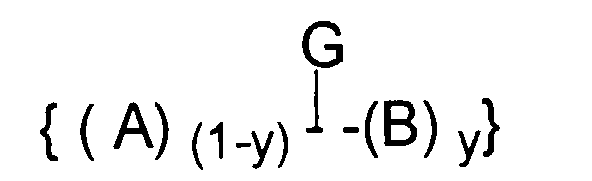 y est la fraction des unités B dans la branche de génération indiquée, et a une valeur de 0,01 à 1;les exposants 0, 1 et i désignent le niveau de génération de branche de peigne;et au moins n0 et n1 sont > 2.
 - Composition de matière selon la revendication 1, caractérisée en ce que le segment B pendant la polymérisation du segment B a la formule unitairedans laquelle R est un groupe alkyle de 1 à 4 atomes de carbone, aryle ou l'hydrogène.
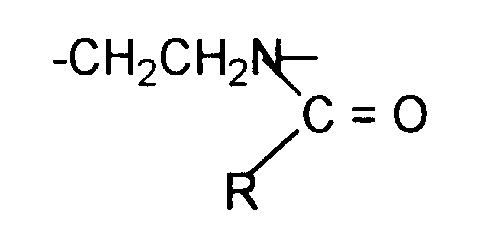
- Composition de matière selon la revendication 2, caractérisée en ce qu'il est un produit d'hydrolyse.
- Composition de matière selon la revendication 1, caractérisée en ce que le segment A a la formule unitaireet le segment B a la formule unitaire


- Composition selon la revendication 1, caractérisée en ce que lesdits monomères ou comonomères polymérisables dans une génération donnée de branches sont capables de supporter les conditions requises pour le greffage sur ceux-ci en étant protégés d'un tel greffage au moins pendant ladite polymérisation de {A - - B};
au moins lesdits monomères ou comonomères B ayant été déprotégés après la polymérisation et le greffage audit noyau ou une branche antérieure. - Composition selon la revendication 5, caractérisée en ce que lesdits monomères ou comonomères B dans une branche donnée sont protégés pendant ladite polymérisation, et sont ensuite déprotégés par hydrolyse.
- Composition selon la revendication 5, caractérisée en ce que lesdits monomères ou comonomères B dans une branche donnée sont protégés pendant ladite polymérisation et sont déprotégés par addition à ceux-ci d'une branche ou un groupe réactif de ramification.
- Composition de matière selon la revendication 1, caractérisée en ce que:
A est (-CH2 CH2NH-)x et B estet chacune desdites branches étant formée par des monomères qui laissent un membre protecteur sur chaque atome d'azote dans la branche en se greffant à ladite branche ou pendant son greffage à une branche antérieure ou au noyau, au moins quelques uns d'entre eux étant enlevés ensuite de ladite branche par une étape de déprotection effectuée après la polymérisation et le greffage de ladite branche à une branche antérieure ou audit noyau.
- Composition de matière selon la revendication 8, caractérisée en ce que ladite déprotection est effectuée par hydrolyse.
- Composition de matière selon la revendication 8, caractérisée en ce que ledit membre protecteur sur ledit atome d'azote estdans lequel R est un groupe alkyle de 1 à 4 atomes de carbone, aryle ou un hydrogène.
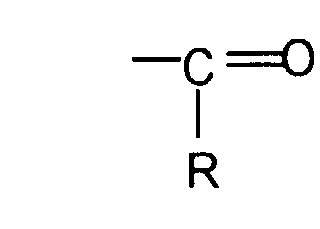
- Composition selon la revendication 8, caractérisée en ce qu'une polyéthylèneimine linéaire est mise à réagir avec des oligomères d'oxazoline et est greffée de cette façon.
- Composition selon la revendication 11, caractérisée en ce que l'oligomère d'oxazoline est une oxazoline poly-2-alkyle substituée.
- Composition selon la revendication 11, caractérisée en ce que l'oligomère d'oxazoline est une oxazoline poly-2-aryle substituée.
- Composition selon la revendication 13, caractérisée en ce que le polymère greffé est hydrolysé après greffage.
- Composition selon la revendication 12, caractérisée en ce que le polymère greffé est hydrolysé après greffage.
- Composition selon la revendication 11, caractérisée en ce que le polymère greffé est hydrolysé après greffage.
- Procédé de préparation de polymères multiplement ramifiés non réticulés ayant la formule généraledans laquelle:
 ledit procédé comprenantC est une molécule noyau;chaque R est le segment résiduel d'un initiateur choisi parmi un groupe formé par des initiateurs de radicaux libres, des initiateurs cationiques, des initiateurs anioniques, des initiateurs acides de Lewis et de transfert de groupes;A et B sont des monomères ou comonomères polymérisables capables de résister aux conditions requises pour la préparation d'un polymère greffé ou pour la préparation de jonctions greffées suivantes;chaque G est un constituant de greffage, et la désignationindique que G peut être relié soit à une unité (A) soit à une unité (B);
 n est le degré de polymérisation des branches de peigne de génération indiquée,y est la fraction des unités B dans la branche de génération indiquée, et a une valeur de 0,01 à 1;les exposants 0, 1 et i désignent le niveau de génération de branche de peigne;et au moins n0 et n1 sont > 2;(I) la formation d'un noyau ayant au moins un site réactif;(Il) la réaction de sensiblement tous les sites réactifs dudit noyau avec un polymère réactif ayant la formule unitairepour former des branches multiples qui contiennent des sites (B0) réactifs sur chaque branche, en utilisant un schéma réactionnel tel que les unités monomères réactives (B0) soient capables de supporter les conditions requises pour la préparation d'un polymère greffé pour assurer que ledit polymère réactif
 réagisse avec lesdits sites réactifs dudit noyau, mais qu'il n'y ait pas de réactions se produisant sur lesdits sites (B0);
 (III) la répétition de l'étape (Il) séquentiellement en faisant réagir le polymère réactif ayant la formule unitaireavec les sites réactifs desdits monomères ou comonomères polymérisables (Bi-1) de la génération précédente pour former une génération successive de branches pour donner le polymère multiplement ramifié non réticulé souhaité.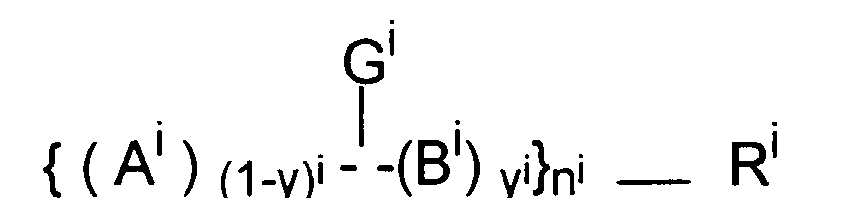
- Procédé selon la revendication 17, caractérisé en ce qu'on utilise une polyéthylèneamine linéaire comme dit noyau initiateur et que des oligomères à base d'oxazoline sont branchés sur celui-ci pour former les branches de génération zéro ayant des groupes oxazoline non réactifs sur celles-ci, lesdites branches de génération zéro étant ensuite hydrolysées pour former des sites amine réactifs sur lesquels sont ensuite greffés les oligomères oxazoline de la première génération, lesdites étapes d'hydrolyse et de réaction postérieures étant ensuite répétées séquentiellement pour former le polymère multiplement ramifié non réticulé souhaité.
- Procédé selon la revendication 18, caractérisé en ce que l'oligomère oxazoline est une oxazoline poly-2-alkyle substituée.
- Procédé selon la revendication 18, caractérisé en ce que l'oligomère oxazoline est une oxazoline poly-2-aryle substituée.
Applications Claiming Priority (4)
| Application Number | Priority Date | Filing Date | Title |
|---|---|---|---|
| US57336290A | 1990-08-27 | 1990-08-27 | |
| US73916791A | 1991-08-01 | 1991-08-01 | |
| US573362 | 1991-08-01 | ||
| US739167 | 1991-08-01 |
Publications (3)
| Publication Number | Publication Date |
|---|---|
| EP0473088A2 EP0473088A2 (fr) | 1992-03-04 |
| EP0473088A3 EP0473088A3 (en) | 1993-03-31 |
| EP0473088B1 true EP0473088B1 (fr) | 1998-01-21 |
Family
ID=27076090
Family Applications (1)
| Application Number | Title | Priority Date | Filing Date |
|---|---|---|---|
| EP91114255A Expired - Lifetime EP0473088B1 (fr) | 1990-08-27 | 1991-08-26 | Polymères non-réticulés, multiplement ramifiés |
Country Status (7)
| Country | Link |
|---|---|
| EP (1) | EP0473088B1 (fr) |
| JP (1) | JP3272001B2 (fr) |
| KR (1) | KR100227046B1 (fr) |
| AU (1) | AU644207B2 (fr) |
| DE (1) | DE69128748T2 (fr) |
| IL (1) | IL99234A (fr) |
| NO (1) | NO300143B1 (fr) |
Families Citing this family (11)
| Publication number | Priority date | Publication date | Assignee | Title |
|---|---|---|---|---|
| DE4319934A1 (de) * | 1993-06-16 | 1994-12-22 | Basf Ag | Gepfropfte Polyamidoamine und gepfropfte Polyethylenimine, Verfahren zu ihrer Herstellung und ihre Verwendung als Zusatz zu Waschmitteln |
| FI955320A7 (fi) * | 1994-03-07 | 1995-11-24 | Univ Michigan | Bioaktiivisia ja/tai kohdennettuja dendriimikonjugaatteja |
| US5919442A (en) * | 1995-08-11 | 1999-07-06 | Dendritech, Inc. | Hyper comb-branched polymer conjugates |
| EP0981555A4 (fr) * | 1997-02-18 | 2005-01-12 | Donald A Tomalia | Polymerisation a ramification autonome convergente |
| US6407169B1 (en) * | 2000-12-13 | 2002-06-18 | The University Of Waterloo | Method for synthesis of graft polymers |
| JP3984541B2 (ja) * | 2001-12-26 | 2007-10-03 | 財団法人川村理化学研究所 | 星型ポリオキサゾリンからなる粒子およびその製造方法 |
| EP1400555A1 (fr) | 2002-09-17 | 2004-03-24 | Kawamura Institute Of Chemical Research | Copolymère à blocs hydrosoluble et son procédé de fabrication |
| US7361715B2 (en) | 2003-12-16 | 2008-04-22 | Ppg Industries Ohio, Inc. | Polymer additives for powder coatings |
| US7160959B2 (en) | 2004-03-19 | 2007-01-09 | Ppg Industries Ohio, Inc. | Polymer additives for powder coatings |
| US7323521B2 (en) | 2004-03-19 | 2008-01-29 | Pp6 Industries Ohio, Inc. | Epoxy polymer additives for powder coatings |
| DE102005006030A1 (de) * | 2005-02-09 | 2006-08-10 | Basf Ag | Hyperverzweigte Polymere als Demulgatoren zum Spalten von Rohölemulsionen |
Family Cites Families (4)
| Publication number | Priority date | Publication date | Assignee | Title |
|---|---|---|---|---|
| US4694064A (en) * | 1986-02-28 | 1987-09-15 | The Dow Chemical Company | Rod-shaped dendrimer |
| IL83567A (en) * | 1986-08-18 | 1992-02-16 | Dow Chemical Co | Starburst conjugates with a carried material,such as an agricultural or pharmaceutical material |
| US4910268A (en) * | 1987-04-22 | 1990-03-20 | Shiro Kobayashi | Acryl type macromonomer having a polyethyleneimine derivative chain and process for producing the same, as well as graft polymer having a polyethyleneimine derivative chain as the graft chain and process for producing the same |
| US4857599A (en) | 1988-02-08 | 1989-08-15 | The Dow Chemical Company | Modified dense star polymers |
-
1991
- 1991-08-20 IL IL9923491A patent/IL99234A/en not_active IP Right Cessation
- 1991-08-23 JP JP21225691A patent/JP3272001B2/ja not_active Expired - Fee Related
- 1991-08-26 DE DE69128748T patent/DE69128748T2/de not_active Expired - Fee Related
- 1991-08-26 NO NO913330A patent/NO300143B1/no unknown
- 1991-08-26 EP EP91114255A patent/EP0473088B1/fr not_active Expired - Lifetime
- 1991-08-26 KR KR1019910014750A patent/KR100227046B1/ko not_active Expired - Fee Related
- 1991-08-27 AU AU82786/91A patent/AU644207B2/en not_active Ceased
Also Published As
| Publication number | Publication date |
|---|---|
| AU644207B2 (en) | 1993-12-02 |
| IL99234A0 (en) | 1992-07-15 |
| KR100227046B1 (ko) | 1999-10-15 |
| AU8278691A (en) | 1992-03-05 |
| JPH08120035A (ja) | 1996-05-14 |
| DE69128748T2 (de) | 1998-06-04 |
| EP0473088A3 (en) | 1993-03-31 |
| NO913330D0 (no) | 1991-08-26 |
| NO300143B1 (no) | 1997-04-14 |
| IL99234A (en) | 1994-05-30 |
| DE69128748D1 (de) | 1998-02-26 |
| EP0473088A2 (fr) | 1992-03-04 |
| KR920004446A (ko) | 1992-03-27 |
| JP3272001B2 (ja) | 2002-04-08 |
| NO913330L (no) | 1992-02-28 |
Similar Documents
| Publication | Publication Date | Title |
|---|---|---|
| US5773527A (en) | Non-crosslinked, polybranched polymers | |
| US5631329A (en) | Process for producing hyper-comb-branched polymers | |
| EP0195126B1 (fr) | Polyamides ramifiés en étoile et polyamines en dérivant | |
| Carlmark et al. | New methodologies in the construction of dendritic materials | |
| EP0671429B1 (fr) | Polymères en étoile ayant des groupes à grande densité et procédé de préparation de ces polymères | |
| US4857599A (en) | Modified dense star polymers | |
| EP0558556B1 (fr) | Polyesters hyper-ramifies | |
| US5919442A (en) | Hyper comb-branched polymer conjugates | |
| EP0636156B1 (fr) | Macromolecules dendritiques et leur procede de production | |
| EP0473088B1 (fr) | Polymères non-réticulés, multiplement ramifiés | |
| KR900003422B1 (ko) | 막대형 덴드리머 | |
| Six et al. | From star‐shaped to dendritic poly (ethylene oxide) s: Toward increasingly branched architectures by anionic polymerization | |
| WO1997006833A9 (fr) | Conjugues de polymeres hyper-ramifies en peigne | |
| US6541600B1 (en) | Water soluble and dispersible highly branched polyamides | |
| JPS59159830A (ja) | 連結枝分れコポリマおよびその製法 | |
| RU2269544C2 (ru) | Катионные блок-сополимеры | |
| US6353082B1 (en) | Highly branched polyesters through one-step polymerization process | |
| Cloutet et al. | Hexaarm star-shaped polystyrenes by core-first method | |
| CA2049643C (fr) | Polymeres polyramifies non reticules | |
| CA2279519A1 (fr) | Polymerisation a ramification autonome convergente | |
| Rempp et al. | Applications of anionic polymerization to macromolecular engineering | |
| GB2339202A (en) | Hyperbranched hybrid block copolymers | |
| Yamakawa et al. | One‐pot synthesis of dendritic polyamide | |
| Van Meirvenne et al. | Synthesis and reactions of telechelic polydioxolane containing quarternary ammonium end groups | |
| Schulz | Synthetic approaches to new polymers |
Legal Events
| Date | Code | Title | Description |
|---|---|---|---|
| PUAI | Public reference made under article 153(3) epc to a published international application that has entered the european phase |
Free format text: ORIGINAL CODE: 0009012 |
|
| AK | Designated contracting states |
Kind code of ref document: A2 Designated state(s): BE CH DE FR GB IT LI NL SE |
|
| PUAL | Search report despatched |
Free format text: ORIGINAL CODE: 0009013 |
|
| AK | Designated contracting states |
Kind code of ref document: A3 Designated state(s): BE CH DE FR GB IT LI NL SE |
|
| 17P | Request for examination filed |
Effective date: 19930607 |
|
| 17Q | First examination report despatched |
Effective date: 19940714 |
|
| RAP1 | Party data changed (applicant data changed or rights of an application transferred) |
Owner name: DENDRITECH INCORPORATED |
|
| GRAG | Despatch of communication of intention to grant |
Free format text: ORIGINAL CODE: EPIDOS AGRA |
|
| GRAG | Despatch of communication of intention to grant |
Free format text: ORIGINAL CODE: EPIDOS AGRA |
|
| GRAH | Despatch of communication of intention to grant a patent |
Free format text: ORIGINAL CODE: EPIDOS IGRA |
|
| GRAH | Despatch of communication of intention to grant a patent |
Free format text: ORIGINAL CODE: EPIDOS IGRA |
|
| GRAA | (expected) grant |
Free format text: ORIGINAL CODE: 0009210 |
|
| AK | Designated contracting states |
Kind code of ref document: B1 Designated state(s): BE CH DE FR GB IT LI NL SE |
|
| PG25 | Lapsed in a contracting state [announced via postgrant information from national office to epo] |
Ref country code: IT Free format text: LAPSE BECAUSE OF FAILURE TO SUBMIT A TRANSLATION OF THE DESCRIPTION OR TO PAY THE FEE WITHIN THE PRESCRIBED TIME-LIMIT;WARNING: LAPSES OF ITALIAN PATENTS WITH EFFECTIVE DATE BEFORE 2007 MAY HAVE OCCURRED AT ANY TIME BEFORE 2007. THE CORRECT EFFECTIVE DATE MAY BE DIFFERENT FROM THE ONE RECORDED. Effective date: 19980121 Ref country code: BE Free format text: LAPSE BECAUSE OF FAILURE TO SUBMIT A TRANSLATION OF THE DESCRIPTION OR TO PAY THE FEE WITHIN THE PRESCRIBED TIME-LIMIT Effective date: 19980121 Ref country code: NL Free format text: LAPSE BECAUSE OF FAILURE TO SUBMIT A TRANSLATION OF THE DESCRIPTION OR TO PAY THE FEE WITHIN THE PRESCRIBED TIME-LIMIT Effective date: 19980121 |
|
| REG | Reference to a national code |
Ref country code: CH Ref legal event code: NV Representative=s name: A. BRAUN, BRAUN, HERITIER, ESCHMANN AG PATENTANWAE Ref country code: CH Ref legal event code: EP |
|
| REF | Corresponds to: |
Ref document number: 69128748 Country of ref document: DE Date of ref document: 19980226 |
|
| ET | Fr: translation filed | ||
| PG25 | Lapsed in a contracting state [announced via postgrant information from national office to epo] |
Ref country code: SE Free format text: LAPSE BECAUSE OF FAILURE TO SUBMIT A TRANSLATION OF THE DESCRIPTION OR TO PAY THE FEE WITHIN THE PRESCRIBED TIME-LIMIT Effective date: 19980421 |
|
| NLV1 | Nl: lapsed or annulled due to failure to fulfill the requirements of art. 29p and 29m of the patents act | ||
| PLBE | No opposition filed within time limit |
Free format text: ORIGINAL CODE: 0009261 |
|
| STAA | Information on the status of an ep patent application or granted ep patent |
Free format text: STATUS: NO OPPOSITION FILED WITHIN TIME LIMIT |
|
| 26N | No opposition filed | ||
| REG | Reference to a national code |
Ref country code: CH Ref legal event code: NV Representative=s name: E. BLUM & CO. PATENTANWAELTE Ref country code: CH Ref legal event code: PUE Owner name: DENDRITECH INCORPORATED TRANSFER- THE DOW CHEMICAL |
|
| REG | Reference to a national code |
Ref country code: FR Ref legal event code: TP |
|
| REG | Reference to a national code |
Ref country code: GB Ref legal event code: IF02 |
|
| REG | Reference to a national code |
Ref country code: GB Ref legal event code: 732E |
|
| PGFP | Annual fee paid to national office [announced via postgrant information from national office to epo] |
Ref country code: FR Payment date: 20040528 Year of fee payment: 14 |
|
| PGFP | Annual fee paid to national office [announced via postgrant information from national office to epo] |
Ref country code: CH Payment date: 20040603 Year of fee payment: 14 |
|
| REG | Reference to a national code |
Ref country code: GB Ref legal event code: 732E |
|
| REG | Reference to a national code |
Ref country code: CH Ref legal event code: NV Representative=s name: FIAMMENGHI-FIAMMENGHI Ref country code: CH Ref legal event code: PUE Owner name: AVC HOLDINGS INC. Free format text: THE DOW CHEMICAL COMPANY#2030 DOW CENTER#MIDLAND, MICHIGAN 48674 (US) -TRANSFER TO- AVC HOLDINGS INC.#2030 DOW CENTER#MIDLAND, MI 48674 (US) Ref country code: CH Ref legal event code: PUE Owner name: DENDRITIC NANOTECHNOLOGIES INC. Free format text: AVC HOLDINGS INC.#2030 DOW CENTER#MIDLAND, MI 48674 (US) -TRANSFER TO- DENDRITIC NANOTECHNOLOGIES INC.#2625 DENISON DRIVE, SUITE B#MT. PLEASANT, MI 48858 (US) |
|
| PG25 | Lapsed in a contracting state [announced via postgrant information from national office to epo] |
Ref country code: CH Free format text: LAPSE BECAUSE OF NON-PAYMENT OF DUE FEES Effective date: 20050831 Ref country code: LI Free format text: LAPSE BECAUSE OF NON-PAYMENT OF DUE FEES Effective date: 20050831 |
|
| REG | Reference to a national code |
Ref country code: FR Ref legal event code: TP |
|
| REG | Reference to a national code |
Ref country code: CH Ref legal event code: PL |
|
| PG25 | Lapsed in a contracting state [announced via postgrant information from national office to epo] |
Ref country code: FR Free format text: LAPSE BECAUSE OF NON-PAYMENT OF DUE FEES Effective date: 20060428 |
|
| REG | Reference to a national code |
Ref country code: FR Ref legal event code: ST Effective date: 20060428 |
|
| PGFP | Annual fee paid to national office [announced via postgrant information from national office to epo] |
Ref country code: GB Payment date: 20060818 Year of fee payment: 16 |
|
| PGFP | Annual fee paid to national office [announced via postgrant information from national office to epo] |
Ref country code: DE Payment date: 20060831 Year of fee payment: 16 |
|
| REG | Reference to a national code |
Ref country code: FR Ref legal event code: RN |
|
| GBPC | Gb: european patent ceased through non-payment of renewal fee |
Effective date: 20070826 |
|
| PG25 | Lapsed in a contracting state [announced via postgrant information from national office to epo] |
Ref country code: DE Free format text: LAPSE BECAUSE OF NON-PAYMENT OF DUE FEES Effective date: 20080301 |
|
| REG | Reference to a national code |
Ref country code: FR Ref legal event code: FC |
|
| PG25 | Lapsed in a contracting state [announced via postgrant information from national office to epo] |
Ref country code: GB Free format text: LAPSE BECAUSE OF NON-PAYMENT OF DUE FEES Effective date: 20070826 |