EP0474533A1 - Bidimensionale organische Membrane und Verfahren zu ihrer Herstellung - Google Patents
Bidimensionale organische Membrane und Verfahren zu ihrer Herstellung Download PDFInfo
- Publication number
- EP0474533A1 EP0474533A1 EP91402281A EP91402281A EP0474533A1 EP 0474533 A1 EP0474533 A1 EP 0474533A1 EP 91402281 A EP91402281 A EP 91402281A EP 91402281 A EP91402281 A EP 91402281A EP 0474533 A1 EP0474533 A1 EP 0474533A1
- Authority
- EP
- European Patent Office
- Prior art keywords
- molecules
- layer
- molecule
- membrane according
- membrane
- Prior art date
- Legal status (The legal status is an assumption and is not a legal conclusion. Google has not performed a legal analysis and makes no representation as to the accuracy of the status listed.)
- Withdrawn
Links
Images

Classifications
-
- B—PERFORMING OPERATIONS; TRANSPORTING
- B05—SPRAYING OR ATOMISING IN GENERAL; APPLYING FLUENT MATERIALS TO SURFACES, IN GENERAL
- B05D—PROCESSES FOR APPLYING FLUENT MATERIALS TO SURFACES, IN GENERAL
- B05D1/00—Processes for applying liquids or other fluent materials
- B05D1/18—Processes for applying liquids or other fluent materials performed by dipping
- B05D1/20—Processes for applying liquids or other fluent materials performed by dipping substances to be applied floating on a fluid
- B05D1/202—Langmuir Blodgett films (LB films)
-
- B—PERFORMING OPERATIONS; TRANSPORTING
- B01—PHYSICAL OR CHEMICAL PROCESSES OR APPARATUS IN GENERAL
- B01D—SEPARATION
- B01D69/00—Semi-permeable membranes for separation processes or apparatus characterised by their form, structure or properties; Manufacturing processes specially adapted therefor
- B01D69/12—Composite membranes; Ultra-thin membranes
- B01D69/122—Separate manufacturing of ultra-thin membranes
-
- B—PERFORMING OPERATIONS; TRANSPORTING
- B01—PHYSICAL OR CHEMICAL PROCESSES OR APPARATUS IN GENERAL
- B01D—SEPARATION
- B01D71/00—Semi-permeable membranes for separation processes or apparatus characterised by the material; Manufacturing processes specially adapted therefor
- B01D71/06—Organic material
- B01D71/44—Polymers obtained by reactions only involving carbon-to-carbon unsaturated bonds, not provided for in a single one of groups B01D71/26-B01D71/42
-
- B—PERFORMING OPERATIONS; TRANSPORTING
- B82—NANOTECHNOLOGY
- B82Y—SPECIFIC USES OR APPLICATIONS OF NANOSTRUCTURES; MEASUREMENT OR ANALYSIS OF NANOSTRUCTURES; MANUFACTURE OR TREATMENT OF NANOSTRUCTURES
- B82Y30/00—Nanotechnology for materials or surface science, e.g. nanocomposites
-
- B—PERFORMING OPERATIONS; TRANSPORTING
- B82—NANOTECHNOLOGY
- B82Y—SPECIFIC USES OR APPLICATIONS OF NANOSTRUCTURES; MEASUREMENT OR ANALYSIS OF NANOSTRUCTURES; MANUFACTURE OR TREATMENT OF NANOSTRUCTURES
- B82Y40/00—Manufacture or treatment of nanostructures
-
- Y—GENERAL TAGGING OF NEW TECHNOLOGICAL DEVELOPMENTS; GENERAL TAGGING OF CROSS-SECTIONAL TECHNOLOGIES SPANNING OVER SEVERAL SECTIONS OF THE IPC; TECHNICAL SUBJECTS COVERED BY FORMER USPC CROSS-REFERENCE ART COLLECTIONS [XRACs] AND DIGESTS
- Y10—TECHNICAL SUBJECTS COVERED BY FORMER USPC
- Y10T—TECHNICAL SUBJECTS COVERED BY FORMER US CLASSIFICATION
- Y10T428/00—Stock material or miscellaneous articles
- Y10T428/26—Web or sheet containing structurally defined element or component, the element or component having a specified physical dimension
- Y10T428/261—In terms of molecular thickness or light wave length
Definitions
- the subject of the present invention is organic membranes made up of at least one organized thin layer, having particular properties which make them advantageous in numerous fields.
- ultrathin membranes which have identical physical properties on the microscopic scale in at least two directions of the plane of the membrane.
- Such organic membranes can be used in particular as an ultra-thin self-supporting membrane for the study of ion diffusion and the separation of chemical species in gaseous or liquid medium, as a hydrophobic, tenacious, insoluble and invisible protective membrane to protect various substrates against corrosion, oxidation, friction etc., as photo-resist, as a covering to mask the defects of a substrate, or even as an electrically conductive membrane.
- the thin organic membranes currently known consist of optionally crosslinked polymers, that is to say linear polymer chains optionally linked together by randomly distributed transverse bonds. Due to the absence or random distribution of transverse links between chains, these membranes have physical properties which differ on a microscopic scale when passes from the direction which corresponds to the direction of the chains to other directions.
- the present invention specifically relates to an organic membrane, having substantially the structure of a polymer, in which the molecules which correspond to the monomer units of the polymer are interconnected so as to form an organized network, which gives the membrane identical physical properties on a microscopic scale in at least two directions of the plane of the membrane.
- the membrane comprises at least one monomolecular layer of organic molecules and it is characterized in that each organic molecule of the monomolecular layer is linked to n identical molecules of the same layer, n being an integer at least equal to 3, by n direct chemical bonds or by n indirect chemical bonds each comprising a bivalent ion, and in that the n chemical bonds between a central molecule and the n adjacent molecules are arranged substantially symmetrically with respect to the center of the central molecule.
- the membrane of the invention has a very organized structure since in each monomolecular layer, each molecule is surrounded by n identical molecules to which it is linked, these n molecules being distributed symmetrically around the central molecule.
- the organic molecules are macrocyclic molecules comprising polar groups which are suitable for the formation of monomolecular layers.
- phthalocyanines As an example of macrocyclic molecules, mention may be made of phthalocyanines and porphyrins.
- the n chemical bonds are direct chemical bonds such as covalent bonds.
- the n chemical bonds are indirect chemical bonds between a first molecule of the layer and a second molecule adjacent to the layer and each indirect chemical bond comprises a first ionic bond between the first molecule and a bivalent ion and a second ionic bond between this bivalent ion and the second molecule.
- the organic membrane consists of different molecules.
- each monomolecular layer consists of molecules A and B, each molecule A being chemically linked to n molecules B, n being an integer at least equal to 3, and each molecule B being chemically linked to n molecules A, the n bonds between a molecule A and the n molecules B which surround it being arranged symmetrically with respect to the center of molecule A and the n bonds between a molecule B and the n molecules A which surround it being arranged symmetrically with respect to the center of molecule B.
- bonds between molecules A and B can be in particular ionic bonds.
- the membranes of the invention can be produced from identical or different molecules comprising n polymerizable functions or n reactive functions distributed symmetrically around the center of the molecule.
- the subject of the invention is also a process for preparing the abovementioned organic membranes, which consists in preparing at least one monomolecular layer of identical or different molecules each comprising n polymerizable functions or n reactive functions and in polymerizing or reacting these molecules within the layer, either before deposition or after deposition thereof on an appropriate support.
- the organic molecules used in the invention are molecules suitable for producing monomolecular layers.
- a known technique for producing monomolecular layers is the Langmuir Blodgett technique which uses "amphiphilic” or “amphiphatic” molecules.
- amphiphilic or "amphiphatic” molecules are organic molecules having a hydrophobic part, that is to say a part having a repulsion for polar liquids such as water, and a hydrophilic part, c ' that is, a part having an affinity for polar liquids such as water.
- amphiphilic molecules when introduced onto the surface of a liquid such as water, the molecules spread over the surface of the liquid and they orient themselves so that their hydrophilic part plunges into water, while their hydrophobic part, generally constituted by a long hydrocarbon chain, tends to move away from it so that the axis of the chain becomes perpendicular to the surface of the water. If the cohesive forces between molecules are sufficient, these molecules remain grouped and limit their spreading to a continuous monomolecular film having substantially the thickness of a molecule, which corresponds to a monomolecular layer or Langmuir film.
- Such films can be handled on the surface of the water, then deposited on a solid support after having been compressed under an appropriate surface pressure, according to the known method of Langmuir Blodgett described in J. of Am. Chem. Soc., Vol. 57 (1935) p. 1007-1010.
- Another known technique for forming monomolecular layers is the adsorption technique from a solution of molecules, for example on oxidized silicon.
- molecules deposited by the Langmuir Blodgett technique are preferably used, either amphiphilic molecules or molecules comprising highly hydrophilic groups which can be associated, for example by ionic bonds, with anions or cations having a long hydrophobic chain.
- molecules which can be used in the invention mention may be made of macrocyclic molecules of the phthalocyanine, porphyrin and porphyrazine type, comprising substituents formed from long hydrophobic chains, or these same molecules in the form of cations associated with anions with long hydrophobic chain.
- non-amphiphilic molecules for example of the phthalocyanine, porphyrin or porphyrazine type, by complexing them with other amphiphilic molecules as described in document FR-A-2 564 004 for depositing them under the form of a monomolecular layer on the surface of a liquid.
- the amphiphilic molecules associated with the non-amphiphilic molecules can be extracted by an appropriate solubilization treatment in order to obtain a membrane consisting solely of a crosslinked polymer non-amphiphilic molecules.
- the molecules consist of a non-amphiphilic cation carrying n polymerizable functions and of an amphiphilic anion comprising at least one hydrophobic chain
- the amphiphilic anions with hydrophobic chain are eliminated, after polymerization of the cations of the monomolecular layer.
- amphiphilic molecules polymerized and crosslinked thanks to the bonds established in the n directions of the plane of the layer are insoluble in water and in organic solvents.
- the films obtained in this way which are devoid of hydrophobic chains, are advantageous as materials allowing the tunnel current to pass, usable for example in microwave diodes, for display or for cold electronic emission.
- the molecules used in the invention must have n polymerizable functions or n reactive functions capable of forming ionic bonds or covalent bonds, either directly with the organic molecules of the layer, or indirectly via bivalent ions.
- n is at least equal to 3 and can for example take values ranging from 3 to 6. Generally, n is equal to 3 or 4.
- each layer of the membrane is formed of identical molecules A joined together by direct covalent bonds.
- Such a structure can be prepared by preparing and depositing on a substrate at least one monomolecular layer of molecules A each having n polymerizable functions, n being an integer at least equal to 3, and by polymerizing the molecules of the layer or layers for the chemically link them via these n functions.
- the polymerizable functions of molecules can be of different types. Generally, functions are preferred which do not require severe temperature or other conditions for their polymerization so as not to degrade the organization of the membrane into a monomolecular layer. For example, one can use ethylenically or acetylenically unsaturated functions.
- Acetylenically unsaturated molecules which can be used in this first embodiment of the invention can be, for example, tetra N- (propyne-2 yl) pyridynium porphyrin salts.
- the Langmuir-Blodgett technique is used to prepare each monomolecular layer on the surface of a tank filled with water.
- a monomolecular layer of the ⁇ -tricosenoic ester of pentaerythritol is thus formed on the surface of the tank, then the monomolecular layer is compressed under a pressure of 28mN / m and it is deposited on a silicon substrate which has been previously coated with 5 monomolecular layers of behenic acid.
- the substrate covered with the membrane is then immersed in ethanol, which dissolves the underlying layers of behenic acid and the non-polymerized areas protected by the mask.
- the polymerized membrane is thus detached from the substrate and then floats in methanol.
- Example 2 the same procedure is followed as in Example 1 for depositing, on a substrate which has first been coated with an aluminum film with a thickness of 60 nm (600 ⁇ ) by evaporation under vacuum. , 15 monomolecular layers of PEOM 1 which are then subjected to a beam of electrons accelerated to 5 kV with a total dose of 1 ⁇ C / cm2.
- the substrate thus treated is immersed in ethanol which dissolves the non-irradiated part of the membrane and does not peel off the polymerized membrane which then serves as a protective resist for etching of the aluminum by plasma.
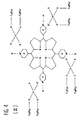
- the molecules used in this example are tetra-N- (propyne-2yle) tetrapyridyniumporphyrin dihexadecyl phosphate molecules corresponding to formula (II) of FIG. 4 appended.
- the basic molecule which has four symmetrical polymerizable acetylenic functions, is a molecule which cannot directly form a monomolecular layer on the surface of the water.
- tetra-3-pyridyl porphyrin is prepared by reacting 3-pyridylcarboxaldehyde with pyrrole in propionic acid. It is then purified in methanol in which it is insoluble, then it is recrystallized from a mixture of methanol and chloroform to obtain a pure product.
- the tetra-3-pyridyl porphyrin is then quaternized by bringing it to reflux for 15 h with a large excess of propyne-2 yl bromide in dimethylformamide.
- the quaternary salt is insoluble in hot ether which extracts the tetra-3-pyridylporphyrin and the unreacted bromide.
- This porphyrin is then dissolved in water and this aqueous solution is placed in a Langmuir tank.
- Dihexadecyl phosphoric acid is then introduced onto the surface of the tank, which spreads over the aqueous solution to form a monomolecular layer.
- the porphyrin molecules dissolved in the aqueous solution are attracted to the phosphate groups and form at the interface a very fluid monomolecular layer which can be transferred under a pressure of 40mN / m to an optically transparent fluorite substrate.
- Example 3 the same molecules are used as in Example 3, but after forming a monomolecular layer on the surface of the tank, this layer is polymerized by gradual replacement of the aqueous solution by an aqueous solution containing Ag ions +. A highly resistant polymerized monomolecular layer is thus obtained on the water surface which can be transferred to a substrate, for example to cover a porous substrate.
- This membrane can be used to smooth substrates or as a barrier with controlled permeability for the separation of gases or small molecules in solution.
- This membrane is insoluble in chloroform.
- Example 4 the same molecules are used as in Examples 3 and 4, operating as in Example 4, but carrying out the polymerization of the monomolecular layer on the surface of the tank by progressive replacement of the aqueous solution by a solution of cuprous chloride / cupric ammoniacal chloride which performs an oxidative coupling.
- the resulting diacetylene polymer which is very mechanically resistant is then transferred under a pressure of 45 mN / m to an insulating quartz substrate. 101 polymerized monomolecular layers are thus superimposed on the substrate and it is found that the membrane thus produced has low electrical conductivity (of the order of 10 ⁇ S.cm ⁇ 1).
- the organized structure of the membrane makes it possible to obtain an electrical conductivity without doping of the polymer.
- dihexadecylphosphoric acid chains associated with the diacetylene polymer can then be extracted by dissolving them in chloroform, after having treated the membrane for a few seconds with hydrochloric acid vapors which destroys the ionic bonds between the acid molecules. dihexadecylphosphoric and porphyrin, and replaces the dihexadecylphosphoric anion with the Cl ⁇ anion.
- thermally stable polyporphyrin films of very low thickness are obtained, suitable as a material allowing the current to pass by tunnel effect.
- FIG. 2 shows the second embodiment of the invention in which identical molecules A each having 4 negative charges distributed symmetrically around from their center are interconnected by bivalent ions M2+ carrying 2 positive charges.
- Molecules which may be suitable in this second embodiment are, for example, amphiphilic molecules comprising n acid functions.
- amphiphilic molecules comprising n positive charges and a bivalent anion.
- each layer can be formed from an alkaline earth salt of tetra-4-oxy (2-octadecanoic acid) phenyl porphyrin.
- Example 6 illustrates the production of such a membrane in the case where n is equal to 4.
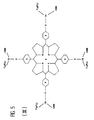
- an amphiphilic molecule is used as an amphiphilic tetraphenylporphyrin comprising 4 COOH groups and 4 hydrophobic chains of 18 carbon atoms having the formula (III) of FIG. 5 appended in which the center 0 is occupied by H2, Cu or Co / imidazole of formula:
- ethyl 2-bromooctadecanoate is prepared by reacting octadecanoic acid with SOCl2 at 100 ° C to form the corresponding acid chloride which is reacted with bromine at 60 ° C for 4 h to form 2-bromooctadecanoic acid bromide. This acid is then reacted with ethyl alcohol at room temperature to form ethyl 2-bromooctadecanoate. Ethyl 2-bromooctadecanoate is then used to prepare tetra-4-oxy (2-octadecanoic acid) phenylporphyrin.
- ethyl 2-bromooctadecanoate is reacted with hydroxybenzaldehyde in the presence of potassium hydroxide and ethyl alcohol for 4 h to form the aldehyde of formula:
- This molecule is then used to prepare a monomolecular layer on the surface of a tank filled with water containing BaCl2 in solution.
- the molecules of formula (III) spread over the surface of the tank liquid and the acid functions of two neighboring molecules are bridged together by the bivalent ions Ba2+ present in the water of the tank.
- the film thus obtained is then compressed under a pressure of 40 mN / m and it is transferred to a substrate at a reduced speed (at most equal to 0.5 cm / min).
- the membrane thus transferred is insoluble in chloroform.
- bonds between molecules A and B are ionic bonds.
- the molecules A can be tetraphenylporphyrins comprising 4 COO ⁇ substituents, for example the molecules of formula (III) of Example 6.
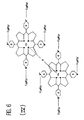
- the positively charged B molecules can be N-alkyl pyridyniumporphyrin tetra, for example, tetra-3-octadecylpyridyniumporphyrin in the form of complex with Fe20 which corresponds to formula (IV) of Figure 6 attached.
- Example 7 which follows illustrates the preparation of such a membrane from molecules A of formula (III) and of molecules B of formula (IV).
- the molecules B of formula (IV) are prepared by reaction of tetra-3-pyridyl porphyrin with octadecyl bromide by following the same procedure as in example 3. Two molecules of the porphyrin thus obtained are then coupled by l 'intermediate of two iron atoms and one oxygen atom as shown in the formula.
- An equimolecular mixture of molecules A and molecules B is spread over the aqueous surface of a Langmuir tank in chloroform.
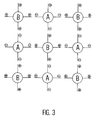
- a molecular layer is thus formed having the structure shown in Figure 3 on the surface of the water where ionic bonds are formed between molecules A which have four acid functions and molecules B which have four basic functions.
- the layer is then compressed under a pressure of 35 mN / m and it is transferred to an optically transparent fluorite substrate. 101 monolayers are thus deposited which remain perfectly transparent. The membrane thus deposited is insoluble in chloroform whereas the component molecules were.
- each layer of the membrane has the structure shown in FIG. 3.
Landscapes
- Chemical & Material Sciences (AREA)
- Engineering & Computer Science (AREA)
- Nanotechnology (AREA)
- Physics & Mathematics (AREA)
- Condensed Matter Physics & Semiconductors (AREA)
- General Physics & Mathematics (AREA)
- Crystallography & Structural Chemistry (AREA)
- Chemical Kinetics & Catalysis (AREA)
- Composite Materials (AREA)
- Materials Engineering (AREA)
- Manufacturing & Machinery (AREA)
- Application Of Or Painting With Fluid Materials (AREA)
- Laminated Bodies (AREA)
- Addition Polymer Or Copolymer, Post-Treatments, Or Chemical Modifications (AREA)
- Manufacture Of Macromolecular Shaped Articles (AREA)
Applications Claiming Priority (2)
| Application Number | Priority Date | Filing Date | Title |
|---|---|---|---|
| FR9010597A FR2666092B1 (fr) | 1990-08-23 | 1990-08-23 | Membranes organiques bidimensionnelles et leurs procedes de preparation. |
| FR9010597 | 1990-08-23 |
Publications (1)
| Publication Number | Publication Date |
|---|---|
| EP0474533A1 true EP0474533A1 (de) | 1992-03-11 |
Family
ID=9399813
Family Applications (1)
| Application Number | Title | Priority Date | Filing Date |
|---|---|---|---|
| EP91402281A Withdrawn EP0474533A1 (de) | 1990-08-23 | 1991-08-21 | Bidimensionale organische Membrane und Verfahren zu ihrer Herstellung |
Country Status (4)
| Country | Link |
|---|---|
| US (1) | US5196257A (de) |
| EP (1) | EP0474533A1 (de) |
| JP (1) | JPH04233947A (de) |
| FR (1) | FR2666092B1 (de) |
Cited By (1)
| Publication number | Priority date | Publication date | Assignee | Title |
|---|---|---|---|---|
| WO2021071824A1 (en) * | 2019-10-07 | 2021-04-15 | The University Of Chicago | Large lateral scale two-dimensional materials and other thin films, and associated systems and methods |
Families Citing this family (12)
| Publication number | Priority date | Publication date | Assignee | Title |
|---|---|---|---|---|
| FR2685340B1 (fr) * | 1991-12-18 | 1994-02-04 | Rhone Poulenc Films | Compositions electroconductrices de polymeres contenant des composes amphiphiles polymerisables derives du pyrrole, leur obtention et leur utilisation. |
| US6043510A (en) * | 1996-05-22 | 2000-03-28 | Akira Kawamoto | Molecule-doped negative-resistance device and method for manufacturing the same |
| FR2772984B1 (fr) | 1997-12-19 | 2003-07-25 | Commissariat Energie Atomique | Procede de formation d'un reseau regulier d'ilots semi-conducteurs sur un substrat isolant |
| FR2821575B1 (fr) * | 2001-03-02 | 2003-10-24 | Commissariat Energie Atomique | Procede de greffage organique localise sans masque sur des protions conductrices ou semiconductrices de surfaces composites |
| EP1481268A4 (de) * | 2002-02-07 | 2005-06-29 | Covalent Partners Llc | Nanofilm und membranzusammensetzungen |
| US20040034223A1 (en) * | 2002-02-07 | 2004-02-19 | Covalent Partners, Llc. | Amphiphilic molecular modules and constructs based thereon |
| JP2005517017A (ja) * | 2002-02-07 | 2005-06-09 | コバレント パートナーズ, エルエルシー | 大環状モジュール組成物 |
| US20040106741A1 (en) * | 2002-09-17 | 2004-06-03 | Kriesel Joshua W. | Nanofilm compositions with polymeric components |
| US7368564B2 (en) * | 2003-08-06 | 2008-05-06 | Covalent Partners, Llc | Bridged macrocyclic module compositions |
| JP5067691B2 (ja) * | 2007-05-21 | 2012-11-07 | 独立行政法人理化学研究所 | ポリマー薄膜の製造方法およびポリマー薄膜 |
| AT505905B1 (de) * | 2007-09-21 | 2009-05-15 | Chemiefaser Lenzing Ag | Cellulosepulver und verfahren zu seiner herstellung |
| CN110958548B (zh) * | 2019-12-02 | 2025-06-10 | 杭州士兰集成电路有限公司 | Mems麦克风及其制造方法 |
Citations (3)
| Publication number | Priority date | Publication date | Assignee | Title |
|---|---|---|---|---|
| EP0170535A2 (de) * | 1984-05-10 | 1986-02-05 | Commissariat A L'energie Atomique | Verfahren zur Herstellung eines dünnen Films, der mindestens eine monomolekulare Schicht von nichtamphiphilen Molekülen umfasst |
| EP0246500A1 (de) * | 1986-05-10 | 1987-11-25 | BASF Aktiengesellschaft | Schichtelemente, Verfahren zu ihrer Herstellung sowie ihre Verwendung |
| EP0334676A2 (de) * | 1988-03-28 | 1989-09-27 | Canon Kabushiki Kaisha | Verfahren zur Steuerung einer Einrichtung mit mim-Struktur |
-
1990
- 1990-08-23 FR FR9010597A patent/FR2666092B1/fr not_active Expired - Fee Related
-
1991
- 1991-08-20 US US07/747,746 patent/US5196257A/en not_active Expired - Fee Related
- 1991-08-21 EP EP91402281A patent/EP0474533A1/de not_active Withdrawn
- 1991-08-23 JP JP3212332A patent/JPH04233947A/ja active Pending
Patent Citations (3)
| Publication number | Priority date | Publication date | Assignee | Title |
|---|---|---|---|---|
| EP0170535A2 (de) * | 1984-05-10 | 1986-02-05 | Commissariat A L'energie Atomique | Verfahren zur Herstellung eines dünnen Films, der mindestens eine monomolekulare Schicht von nichtamphiphilen Molekülen umfasst |
| EP0246500A1 (de) * | 1986-05-10 | 1987-11-25 | BASF Aktiengesellschaft | Schichtelemente, Verfahren zu ihrer Herstellung sowie ihre Verwendung |
| EP0334676A2 (de) * | 1988-03-28 | 1989-09-27 | Canon Kabushiki Kaisha | Verfahren zur Steuerung einer Einrichtung mit mim-Struktur |
Non-Patent Citations (1)
| Title |
|---|
| THIN SOLID FILMS, vol. 133, nos. 1-4, novembre 1985, pages 83-91, Lausanne, CH; A. MILLER et al.: "Langmuir-blodgett films containing porphyrins in a well-defined environment" * |
Cited By (2)
| Publication number | Priority date | Publication date | Assignee | Title |
|---|---|---|---|---|
| WO2021071824A1 (en) * | 2019-10-07 | 2021-04-15 | The University Of Chicago | Large lateral scale two-dimensional materials and other thin films, and associated systems and methods |
| US12030081B2 (en) | 2019-10-07 | 2024-07-09 | The University Of Chicago | Large lateral scale two-dimensional materials and other thin films, and associated systems and methods |
Also Published As
| Publication number | Publication date |
|---|---|
| JPH04233947A (ja) | 1992-08-21 |
| US5196257A (en) | 1993-03-23 |
| FR2666092A1 (fr) | 1992-02-28 |
| FR2666092B1 (fr) | 1993-12-03 |
Similar Documents
| Publication | Publication Date | Title |
|---|---|---|
| FR2564004A1 (fr) | Procede de fabrication d'un film mince comportant au moins une couche monomoleculaire de molecules non amphiphiles | |
| CN111971803B (zh) | 用于原子层沉积的可聚合自组装单体 | |
| FR2666092A1 (fr) | Membranes organiques bidimensionnelles et leurs procedes de preparation. | |
| EP0473511B1 (de) | Material auf Basis eines elektrisch leitenden Polymers mit Magnetteilchen und Herstellungsverfahren | |
| EP0165111B1 (de) | Elektrisch leitfähige Folien mit zumindest einer monomolekularen Schicht eines organischen Energieüberführungskomplexes und Verfahren zur Herstellung desselben | |
| US5011518A (en) | Permselective membrane and process for producing the same | |
| WO1999007028A1 (fr) | Dispositif electroluminescent | |
| Guo et al. | Photo-active and electro-active protein films prepared by reconstitution with metalloporphyrins self-assembled on gold | |
| Harmer | Photomodification of surfaces using heterocyclic azides | |
| EP1948720B1 (de) | Verwendung eines diazoniumsalzs in einem verfahren zur modifizierung von isolierenden oder halbleitenden oberflächen und resultierende produkte | |
| JP2504770B2 (ja) | 重層単位体及びその製造方法 | |
| EP0188675B1 (de) | Ultradünne polyimine Filme und Verfahren zu deren Fabrikation | |
| FR2904319A1 (fr) | Sels de diazonium polymerisables, procede de fabrication et utilisations de ceux-ci | |
| JP2007521132A (ja) | キャリアー塗布被覆層 | |
| EP1704607A1 (de) | P-n-hybridmaterial für einen anorganischen/organischen halbleiter, herstellungsverfahren dafür und fotovoltaikzelle damit | |
| Sun et al. | A Comparative Langmuir− Blodgett Study on a Set of Covalently Linked Porphyrin-Based Amphiphiles: A Detailed Atomic Force Microscopic Study | |
| EP2842179A2 (de) | Verfahren zur abscheidung von nanopartikeln auf einem nanostrukturierten metalloxidsubstrat | |
| US6074744A (en) | Langmuir-Blodgett films containing tetrathiafulvalene | |
| Kim et al. | Tetrapyrazinoindoloporphyrazine Langmuir-Blodgett films | |
| JP2969902B2 (ja) | 有機薄膜 | |
| JPH08238454A (ja) | 配向制御された有機薄膜及び製膜法 | |
| JPH03252402A (ja) | 配向性有機薄膜及びその作製方法 | |
| JPH01273005A (ja) | 光学薄膜 | |
| EP0537047A1 (de) | Leitfähiges Verbundmaterial, Überzugsmittel und Messfühler durch Anwendung dieses leitfähigen Materials | |
| JPH02228331A (ja) | 有機薄膜素子 |
Legal Events
| Date | Code | Title | Description |
|---|---|---|---|
| PUAI | Public reference made under article 153(3) epc to a published international application that has entered the european phase |
Free format text: ORIGINAL CODE: 0009012 |
|
| AK | Designated contracting states |
Kind code of ref document: A1 Designated state(s): DE FR GB NL |
|
| 17P | Request for examination filed |
Effective date: 19920818 |
|
| 17Q | First examination report despatched |
Effective date: 19941229 |
|
| STAA | Information on the status of an ep patent application or granted ep patent |
Free format text: STATUS: THE APPLICATION IS DEEMED TO BE WITHDRAWN |
|
| 18D | Application deemed to be withdrawn |
Effective date: 19961003 |