EP0475596A1 - Verfahren zur Reinigung von Artikeln - Google Patents
Verfahren zur Reinigung von Artikeln Download PDFInfo
- Publication number
- EP0475596A1 EP0475596A1 EP91307501A EP91307501A EP0475596A1 EP 0475596 A1 EP0475596 A1 EP 0475596A1 EP 91307501 A EP91307501 A EP 91307501A EP 91307501 A EP91307501 A EP 91307501A EP 0475596 A1 EP0475596 A1 EP 0475596A1
- Authority
- EP
- European Patent Office
- Prior art keywords
- solvent
- process according
- aqueous medium
- azeotrope
- article
- Prior art date
- Legal status (The legal status is an assumption and is not a legal conclusion. Google has not performed a legal analysis and makes no representation as to the accuracy of the status listed.)
- Granted
Links
- 238000000034 method Methods 0.000 title claims description 33
- 238000004140 cleaning Methods 0.000 title claims description 24
- 239000002904 solvent Substances 0.000 claims abstract description 127
- 238000011109 contamination Methods 0.000 claims abstract description 17
- 238000001704 evaporation Methods 0.000 claims abstract description 12
- XLYOFNOQVPJJNP-UHFFFAOYSA-N water Substances O XLYOFNOQVPJJNP-UHFFFAOYSA-N 0.000 claims description 39
- 239000012736 aqueous medium Substances 0.000 claims description 32
- 235000007586 terpenes Nutrition 0.000 claims description 31
- 150000003505 terpenes Chemical class 0.000 claims description 29
- 238000009835 boiling Methods 0.000 claims description 23
- 239000000203 mixture Substances 0.000 claims description 11
- 238000007654 immersion Methods 0.000 claims description 10
- 239000003960 organic solvent Substances 0.000 claims description 10
- KFZMGEQAYNKOFK-UHFFFAOYSA-N Isopropanol Chemical compound CC(C)O KFZMGEQAYNKOFK-UHFFFAOYSA-N 0.000 claims description 8
- -1 aliphatic amines Chemical class 0.000 claims description 8
- 230000008020 evaporation Effects 0.000 claims description 8
- 239000000463 material Substances 0.000 claims description 5
- 239000004094 surface-active agent Substances 0.000 claims description 5
- 150000001298 alcohols Chemical class 0.000 claims description 4
- 229930007927 cymene Natural products 0.000 claims description 4
- 150000002170 ethers Chemical class 0.000 claims description 4
- 238000010438 heat treatment Methods 0.000 claims description 4
- 150000002576 ketones Chemical class 0.000 claims description 4
- 239000002609 medium Substances 0.000 claims description 4
- 239000007921 spray Substances 0.000 claims description 4
- LRHPLDYGYMQRHN-UHFFFAOYSA-N N-Butanol Chemical class CCCCO LRHPLDYGYMQRHN-UHFFFAOYSA-N 0.000 claims description 3
- 125000001931 aliphatic group Chemical group 0.000 claims description 3
- BDERNNFJNOPAEC-UHFFFAOYSA-N propan-1-ol Chemical class CCCO BDERNNFJNOPAEC-UHFFFAOYSA-N 0.000 claims description 3
- 125000001434 methanylylidene group Chemical group [H]C#[*] 0.000 claims description 2
- HFPZCAJZSCWRBC-UHFFFAOYSA-N p-cymene Chemical compound CC(C)C1=CC=C(C)C=C1 HFPZCAJZSCWRBC-UHFFFAOYSA-N 0.000 claims description 2
- 150000002932 p-cymene derivatives Chemical class 0.000 claims description 2
- 238000004064 recycling Methods 0.000 claims 1
- 239000007788 liquid Substances 0.000 description 11
- 238000010025 steaming Methods 0.000 description 10
- CURLTUGMZLYLDI-UHFFFAOYSA-N Carbon dioxide Chemical compound O=C=O CURLTUGMZLYLDI-UHFFFAOYSA-N 0.000 description 8
- 230000015572 biosynthetic process Effects 0.000 description 6
- 239000012071 phase Substances 0.000 description 6
- IJGRMHOSHXDMSA-UHFFFAOYSA-N Atomic nitrogen Chemical compound N#N IJGRMHOSHXDMSA-UHFFFAOYSA-N 0.000 description 4
- 125000004432 carbon atom Chemical group C* 0.000 description 4
- 229910002092 carbon dioxide Inorganic materials 0.000 description 4
- 239000001569 carbon dioxide Substances 0.000 description 4
- 230000007613 environmental effect Effects 0.000 description 4
- 239000002184 metal Substances 0.000 description 4
- 238000005191 phase separation Methods 0.000 description 4
- 150000001875 compounds Chemical class 0.000 description 3
- 239000010408 film Substances 0.000 description 3
- VNWKTOKETHGBQD-UHFFFAOYSA-N methane Chemical class C VNWKTOKETHGBQD-UHFFFAOYSA-N 0.000 description 3
- 230000001154 acute effect Effects 0.000 description 2
- 239000000654 additive Substances 0.000 description 2
- 238000013019 agitation Methods 0.000 description 2
- 239000000919 ceramic Substances 0.000 description 2
- 230000003749 cleanliness Effects 0.000 description 2
- 239000003599 detergent Substances 0.000 description 2
- 238000004821 distillation Methods 0.000 description 2
- 239000004744 fabric Substances 0.000 description 2
- 239000007789 gas Substances 0.000 description 2
- 239000011521 glass Substances 0.000 description 2
- 150000008282 halocarbons Chemical class 0.000 description 2
- 229930195733 hydrocarbon Natural products 0.000 description 2
- 150000002430 hydrocarbons Chemical class 0.000 description 2
- 239000011261 inert gas Substances 0.000 description 2
- ZXEKIIBDNHEJCQ-UHFFFAOYSA-N isobutanol Chemical compound CC(C)CO ZXEKIIBDNHEJCQ-UHFFFAOYSA-N 0.000 description 2
- 230000004048 modification Effects 0.000 description 2
- 238000012986 modification Methods 0.000 description 2
- 229910052757 nitrogen Inorganic materials 0.000 description 2
- 239000000047 product Substances 0.000 description 2
- 238000004506 ultrasonic cleaning Methods 0.000 description 2
- FAMJUFMHYAFYNU-UHFFFAOYSA-N 1-methyl-4-(propan-2-yl)cyclohex-1-ene Chemical compound CC(C)C1CCC(C)=CC1 FAMJUFMHYAFYNU-UHFFFAOYSA-N 0.000 description 1
- 241000779819 Syncarpia glomulifera Species 0.000 description 1
- 230000000996 additive effect Effects 0.000 description 1
- 150000007824 aliphatic compounds Chemical class 0.000 description 1
- 150000001412 amines Chemical class 0.000 description 1
- 239000008346 aqueous phase Substances 0.000 description 1
- QVGXLLKOCUKJST-UHFFFAOYSA-N atomic oxygen Chemical compound [O] QVGXLLKOCUKJST-UHFFFAOYSA-N 0.000 description 1
- 230000009286 beneficial effect Effects 0.000 description 1
- 150000008280 chlorinated hydrocarbons Chemical class 0.000 description 1
- 238000006356 dehydrogenation reaction Methods 0.000 description 1
- 230000000994 depressogenic effect Effects 0.000 description 1
- 239000002657 fibrous material Substances 0.000 description 1
- NBVXSUQYWXRMNV-UHFFFAOYSA-N fluoromethane Chemical compound FC NBVXSUQYWXRMNV-UHFFFAOYSA-N 0.000 description 1
- 238000005984 hydrogenation reaction Methods 0.000 description 1
- 239000007791 liquid phase Substances 0.000 description 1
- 239000003607 modifier Substances 0.000 description 1
- 239000001301 oxygen Substances 0.000 description 1
- 229910052760 oxygen Inorganic materials 0.000 description 1
- 125000000352 p-cymenyl group Chemical group C1(=C(C=C(C=C1)C)*)C(C)C 0.000 description 1
- CFJYNSNXFXLKNS-UHFFFAOYSA-N p-menthane Chemical compound CC(C)C1CCC(C)CC1 CFJYNSNXFXLKNS-UHFFFAOYSA-N 0.000 description 1
- 239000003348 petrochemical agent Substances 0.000 description 1
- 239000001739 pinus spp. Substances 0.000 description 1
- 238000011084 recovery Methods 0.000 description 1
- 239000013557 residual solvent Substances 0.000 description 1
- 239000012262 resinous product Substances 0.000 description 1
- 150000003839 salts Chemical class 0.000 description 1
- 229920006395 saturated elastomer Polymers 0.000 description 1
- 239000010409 thin film Substances 0.000 description 1
- 229940036248 turpentine Drugs 0.000 description 1
- 235000013311 vegetables Nutrition 0.000 description 1
- 238000005406 washing Methods 0.000 description 1
- 239000002699 waste material Substances 0.000 description 1
- 239000002023 wood Substances 0.000 description 1
Images
Classifications
-
- C—CHEMISTRY; METALLURGY
- C11—ANIMAL OR VEGETABLE OILS, FATS, FATTY SUBSTANCES OR WAXES; FATTY ACIDS THEREFROM; DETERGENTS; CANDLES
- C11D—DETERGENT COMPOSITIONS; USE OF SINGLE SUBSTANCES AS DETERGENTS; SOAP OR SOAP-MAKING; RESIN SOAPS; RECOVERY OF GLYCEROL
- C11D7/00—Compositions of detergents based essentially on non-surface-active compounds
- C11D7/22—Organic compounds
- C11D7/26—Organic compounds containing oxygen
- C11D7/261—Alcohols; Phenols
-
- C—CHEMISTRY; METALLURGY
- C11—ANIMAL OR VEGETABLE OILS, FATS, FATTY SUBSTANCES OR WAXES; FATTY ACIDS THEREFROM; DETERGENTS; CANDLES
- C11D—DETERGENT COMPOSITIONS; USE OF SINGLE SUBSTANCES AS DETERGENTS; SOAP OR SOAP-MAKING; RESIN SOAPS; RECOVERY OF GLYCEROL
- C11D7/00—Compositions of detergents based essentially on non-surface-active compounds
- C11D7/50—Solvents
-
- C—CHEMISTRY; METALLURGY
- C11—ANIMAL OR VEGETABLE OILS, FATS, FATTY SUBSTANCES OR WAXES; FATTY ACIDS THEREFROM; DETERGENTS; CANDLES
- C11D—DETERGENT COMPOSITIONS; USE OF SINGLE SUBSTANCES AS DETERGENTS; SOAP OR SOAP-MAKING; RESIN SOAPS; RECOVERY OF GLYCEROL
- C11D7/00—Compositions of detergents based essentially on non-surface-active compounds
- C11D7/50—Solvents
- C11D7/5004—Organic solvents
- C11D7/5013—Organic solvents containing nitrogen
-
- C—CHEMISTRY; METALLURGY
- C11—ANIMAL OR VEGETABLE OILS, FATS, FATTY SUBSTANCES OR WAXES; FATTY ACIDS THEREFROM; DETERGENTS; CANDLES
- C11D—DETERGENT COMPOSITIONS; USE OF SINGLE SUBSTANCES AS DETERGENTS; SOAP OR SOAP-MAKING; RESIN SOAPS; RECOVERY OF GLYCEROL
- C11D7/00—Compositions of detergents based essentially on non-surface-active compounds
- C11D7/50—Solvents
- C11D7/5004—Organic solvents
- C11D7/5022—Organic solvents containing oxygen
-
- C—CHEMISTRY; METALLURGY
- C11—ANIMAL OR VEGETABLE OILS, FATS, FATTY SUBSTANCES OR WAXES; FATTY ACIDS THEREFROM; DETERGENTS; CANDLES
- C11D—DETERGENT COMPOSITIONS; USE OF SINGLE SUBSTANCES AS DETERGENTS; SOAP OR SOAP-MAKING; RESIN SOAPS; RECOVERY OF GLYCEROL
- C11D7/00—Compositions of detergents based essentially on non-surface-active compounds
- C11D7/50—Solvents
- C11D7/5004—Organic solvents
- C11D7/5027—Hydrocarbons
-
- C—CHEMISTRY; METALLURGY
- C11—ANIMAL OR VEGETABLE OILS, FATS, FATTY SUBSTANCES OR WAXES; FATTY ACIDS THEREFROM; DETERGENTS; CANDLES
- C11D—DETERGENT COMPOSITIONS; USE OF SINGLE SUBSTANCES AS DETERGENTS; SOAP OR SOAP-MAKING; RESIN SOAPS; RECOVERY OF GLYCEROL
- C11D7/00—Compositions of detergents based essentially on non-surface-active compounds
- C11D7/50—Solvents
- C11D7/5031—Azeotropic mixtures of non-halogenated solvents
-
- C—CHEMISTRY; METALLURGY
- C23—COATING METALLIC MATERIAL; COATING MATERIAL WITH METALLIC MATERIAL; CHEMICAL SURFACE TREATMENT; DIFFUSION TREATMENT OF METALLIC MATERIAL; COATING BY VACUUM EVAPORATION, BY SPUTTERING, BY ION IMPLANTATION OR BY CHEMICAL VAPOUR DEPOSITION, IN GENERAL; INHIBITING CORROSION OF METALLIC MATERIAL OR INCRUSTATION IN GENERAL
- C23G—CLEANING OR DE-GREASING OF METALLIC MATERIAL BY CHEMICAL METHODS OTHER THAN ELECTROLYSIS
- C23G5/00—Cleaning or de-greasing metallic material by other methods; Apparatus for cleaning or de-greasing metallic material with organic solvents
- C23G5/02—Cleaning or de-greasing metallic material by other methods; Apparatus for cleaning or de-greasing metallic material with organic solvents using organic solvents
- C23G5/024—Cleaning or de-greasing metallic material by other methods; Apparatus for cleaning or de-greasing metallic material with organic solvents using organic solvents containing hydrocarbons
-
- H—ELECTRICITY
- H05—ELECTRIC TECHNIQUES NOT OTHERWISE PROVIDED FOR
- H05K—PRINTED CIRCUITS; CASINGS OR CONSTRUCTIONAL DETAILS OF ELECTRIC APPARATUS; MANUFACTURE OF ASSEMBLAGES OF ELECTRICAL COMPONENTS
- H05K3/00—Apparatus or processes for manufacturing printed circuits
- H05K3/22—Secondary treatment of printed circuits
- H05K3/26—Cleaning or polishing of the conductive pattern
-
- C—CHEMISTRY; METALLURGY
- C11—ANIMAL OR VEGETABLE OILS, FATS, FATTY SUBSTANCES OR WAXES; FATTY ACIDS THEREFROM; DETERGENTS; CANDLES
- C11D—DETERGENT COMPOSITIONS; USE OF SINGLE SUBSTANCES AS DETERGENTS; SOAP OR SOAP-MAKING; RESIN SOAPS; RECOVERY OF GLYCEROL
- C11D7/00—Compositions of detergents based essentially on non-surface-active compounds
- C11D7/22—Organic compounds
- C11D7/24—Hydrocarbons
-
- C—CHEMISTRY; METALLURGY
- C11—ANIMAL OR VEGETABLE OILS, FATS, FATTY SUBSTANCES OR WAXES; FATTY ACIDS THEREFROM; DETERGENTS; CANDLES
- C11D—DETERGENT COMPOSITIONS; USE OF SINGLE SUBSTANCES AS DETERGENTS; SOAP OR SOAP-MAKING; RESIN SOAPS; RECOVERY OF GLYCEROL
- C11D7/00—Compositions of detergents based essentially on non-surface-active compounds
- C11D7/22—Organic compounds
- C11D7/26—Organic compounds containing oxygen
- C11D7/263—Ethers
-
- C—CHEMISTRY; METALLURGY
- C11—ANIMAL OR VEGETABLE OILS, FATS, FATTY SUBSTANCES OR WAXES; FATTY ACIDS THEREFROM; DETERGENTS; CANDLES
- C11D—DETERGENT COMPOSITIONS; USE OF SINGLE SUBSTANCES AS DETERGENTS; SOAP OR SOAP-MAKING; RESIN SOAPS; RECOVERY OF GLYCEROL
- C11D7/00—Compositions of detergents based essentially on non-surface-active compounds
- C11D7/22—Organic compounds
- C11D7/26—Organic compounds containing oxygen
- C11D7/264—Aldehydes; Ketones; Acetals or ketals
-
- C—CHEMISTRY; METALLURGY
- C11—ANIMAL OR VEGETABLE OILS, FATS, FATTY SUBSTANCES OR WAXES; FATTY ACIDS THEREFROM; DETERGENTS; CANDLES
- C11D—DETERGENT COMPOSITIONS; USE OF SINGLE SUBSTANCES AS DETERGENTS; SOAP OR SOAP-MAKING; RESIN SOAPS; RECOVERY OF GLYCEROL
- C11D7/00—Compositions of detergents based essentially on non-surface-active compounds
- C11D7/22—Organic compounds
- C11D7/32—Organic compounds containing nitrogen
- C11D7/3209—Amines or imines with one to four nitrogen atoms; Quaternized amines
-
- H—ELECTRICITY
- H05—ELECTRIC TECHNIQUES NOT OTHERWISE PROVIDED FOR
- H05K—PRINTED CIRCUITS; CASINGS OR CONSTRUCTIONAL DETAILS OF ELECTRIC APPARATUS; MANUFACTURE OF ASSEMBLAGES OF ELECTRICAL COMPONENTS
- H05K2203/00—Indexing scheme relating to apparatus or processes for manufacturing printed circuits covered by H05K3/00
- H05K2203/07—Treatments involving liquids, e.g. plating, rinsing
- H05K2203/0779—Treatments involving liquids, e.g. plating, rinsing characterised by the specific liquids involved
- H05K2203/0783—Using solvent, e.g. for cleaning; Regulating solvent content of pastes or coatings for adjusting the viscosity
-
- H—ELECTRICITY
- H05—ELECTRIC TECHNIQUES NOT OTHERWISE PROVIDED FOR
- H05K—PRINTED CIRCUITS; CASINGS OR CONSTRUCTIONAL DETAILS OF ELECTRIC APPARATUS; MANUFACTURE OF ASSEMBLAGES OF ELECTRICAL COMPONENTS
- H05K2203/00—Indexing scheme relating to apparatus or processes for manufacturing printed circuits covered by H05K3/00
- H05K2203/07—Treatments involving liquids, e.g. plating, rinsing
- H05K2203/0779—Treatments involving liquids, e.g. plating, rinsing characterised by the specific liquids involved
- H05K2203/0786—Using an aqueous solution, e.g. for cleaning or during drilling of holes
-
- H—ELECTRICITY
- H05—ELECTRIC TECHNIQUES NOT OTHERWISE PROVIDED FOR
- H05K—PRINTED CIRCUITS; CASINGS OR CONSTRUCTIONAL DETAILS OF ELECTRIC APPARATUS; MANUFACTURE OF ASSEMBLAGES OF ELECTRICAL COMPONENTS
- H05K2203/00—Indexing scheme relating to apparatus or processes for manufacturing printed circuits covered by H05K3/00
- H05K2203/08—Treatments involving gases
- H05K2203/088—Using a vapour or mist, e.g. cleaning using water vapor
Definitions
- This invention relates to the cleaning of dirty articles.
- Such articles may be, for instance, relatively small metal, ceramic or glass articles, for instance circuit boards or machined parts.
- Aqueous detergent compositions may remove organic residues but are liable to leave residues of detergents, necessitating thorough rinsing to remove these residues.
- the chosen solvent must have adequate solvency power for the residues that are to be removed, it must have a flash point sufficiently above the temperature of use that it is safe to use, and it preferably has a volatility such that it does not leave a residual film of solvent after use.
- the solvent will evaporate relatively quickly when exposed to the ambient atmospheric temperature of, for instance, 30°C or below.
- Low boiling hydrocarbons often have adequate solvency power and may be adequately volatile, but they suffer from the disadvantage that they have low flash point.
- Higher boiling hydrocarbons may have adequate solvency power and a reasonably safe flash point, but their volatility is sufficiently low that residues of them remain on the articles unless the articles are deliberately heated, but this is undesirable because of the risk of the temperature then approaching or exceeding the flash point.
- halogenated solvents have become widely accepted as cleaners that have suitable solvency power, adequately high flash point and suitable volatility at safe temperatures.
- Examples are chlorocarbons, fluorocarbons and chlorofluorocarbons, the compounds generally containing below 4 carbon atoms, often 1 or 2 carbon atoms.
- terpene solvents are terpene solvents.
- Such solvents have been known for very long time, for instance we are aware that some terpene solvents were commercially available by the early 1940′s at least, and possibly earlier. However they have never proved to be of widespread commercial value and part of the problem seems to be that their use resulted in contamination of the article with residues of the terpene solvent, and this contamination rendered the article unacceptable. Also the terpenes are liable to be contaminated, or to form, resinous products and such residues can be difficult to remove.
- the purpose behind the invention therefore is to meet the acute need to provide a method of cleaning dirty articles, which method is environmentally acceptable and that provides articles having a cleanliness that can meet the highest standards, for instance the standards of the electronics industry.
- a dirty article is cleaned by contact with a solvent that comprise a hydrogenated or dehydrogenated analogue of a terpene compound.
- a solvent that comprise a hydrogenated or dehydrogenated analogue of a terpene compound.
- the preferred solvents are made by hydrogenation or dehydrogenation of components of terpenes derived from, for instance, wood and other vegetable products such as turpentine.
- these analgoues and derivatives are referred to below as "terpene solvents” even though they do not contain terpene.
- a dirty article is contacted with a terpene solvent under conditions that result in cleaning of dirt from the article and in solvent contamination of the article by the terpene solvent, and in this process the solvent contamination is removed by contacting the contaminated article at an elevated temperature with an aqueous medium and/or a low boiling organic solvent and evaporating the solvent contamination from the surface.
- the evaporation is by formation of an azeptrope.
- the flash point (closed cup) of the terpene solvent is usually below 150°C and often below 125°C.
- the solvent can be a mixture and generally most or all of the solvent in the mixture has a flash point below 100°C.
- the boiling point of the terpene solvent (which may be a mixture) is generally above 70°C and most usually above 100°C, generally above 130°C. Since the solvent is often a mixture, it will often boil over a range of temperatures, and the boiling point quoted above is the bottom of this range. Generally the boiling point is below 250°C (i.e., the top of the boiling range should be below 250°C). Solvents that boil at temperatures somewhere within the range 150 to 200°C are often preferred.
- the invention can also be applied with other methods of removing the residual solvent contamination.
- the article after cleaning with the defined terpene type solvent can be immersed in or sprayed with a medium consisting of the low boiling solvent at low or high temperatures or may be washed with an aqeuous solution of a surfactant, preferably a volatile surfactant.
- a surfactant preferably a volatile surfactant.
- washing in cold or warm water can be useful.
- the terpene analogues to which the present invention relates include cymenes, menthenes and menthanes, often as the para isomer.
- a preferred solvent comprises para cymene.
- An advantage of the invention is that it provides the advantage of terpene solvents as regards cleansing power and environmental factors while avoiding any risk of the formation of polymerisation products during use.
- the analogues can be blended with other materials, provide such other materisl do not destroy the advantages tht are gained by use of the analogues.
- at least 50% of the solvent is selected from cymene, menthene and/or menthane.
- Particularly preferred are novel compositions comprising 50-90% para or other methenes, 2-20% para or other cymeme, 0-40% para or other methadienes and 0-20% para or other methanes.
- the combination of at least 50% para methane with a lesser amount para cymeme is particularly valuable, as are blends of such solvents with terpene alcohols. Meta can be used in place of para.
- the solvent contamination that remains after the terpene cleaning stage is removed azeotropically by forming an azeotrope with an aqueous medium.
- the azeotrope-forming capabilities of terpene solvents are particularly advantageous, and this constitutes another reason why the terpene solvents are particularly preferred in the invention.
- azeotroping can be promoted, and in particular the azeotroping temperature can he reduced, by including a suitable tertiary solvent. Additionally, the removal of the solvent contamination is promoted if the contamination is spread as a thin film over the article, rather than being concentrated in droplets, and so the presence of a depressant for surface tension is beneficial. Many tertiary solvents that promote the formation of an azeotrope will also help film formation.
- additional solvents should be low boiling solvents so that they are more volatile than the terpene or other main solvent. In general, they should boil at a temperature below the azeotroping temperature, so as to ensure that none of the tertiary solvent remains as a residual contamination. Generally they boil at below 100°C.
- Various aliphatic compounds such as ketones or, preferably, amines, ethers or alcohols may be used. The total number of carbon atoms in such materials is generally below 8 and preferably each aliphatic group in such compounds contains less than 8, usually 2 to 4, carbon atoms.
- Particularly preferred materials are propanols and butanols such as isobutanol or, preferably, isopropanol.
- a surfactant instead of or in addition to including such low boiling solvents to promote film formation, it is also possible to include a surfactant.
- the aqueous medium contains the low boiling solvent or other additive.
- the aqueous medium can consist of water or a mixture of water and the low boiling solvent.
- the ratio low boiling solvent:water can be from 1:50 to 10:1, generally 1:20 to 1:1.
- terpene or other cleaning solvent Although some low boiling, and usually water miscible, organic solvent can be included in the terpene or other cleaning solvent, generally substantially all of this cleaning solvent is immiscible with water. From the environmental and economic point of view, an important feature of the invention is that the azeotrope that is formed between the terpene or other cleaning solvent and the water is condensed and is allowed to phase separate, and the terpene solvent phase is separated and is recycled for subsequent use in cleaning of dirty articles.
- the azeotrope is therefore preferably formed by evaporation of the azeotropic mixture (generally at a temperature below 100°C) in a vessel that contains the aqueous medium in its base and that has an outlet for evaporated azeotrope and a condenser across the outlet on which the azeotrope is condensed.
- the process is preferably conducted in multi-stage apparatus comprising one or more solvent-cleaning tank and one or more rinsing tanks inlcuding at least one azeotroping tank that has an outlet for volatile gases across which there is a condenser, including means for recovering condensate from the surfaces of the condenser.
- a solvent cleaning tank is, preferably, an immersion tank, i.e. it is designed for immersion of the dirty article in solvent in the tank. If there is more than one solvent cleaning tank, the second tank can be another immersion tank orit can be designed for vapour contact and for recovery of condensed solvent off the article.
- the azeotroping tank preferably has a reservoir at its base for containing aqueous medium and a heater for heating the aqueous medium.
- the condenser across the outlet (often an open top) of the steaming tank may be a cool heat exchanger, for instance cooled by cold water, equipped with means for collecting condensate that condenses on to its outer surfaces.
- the condenser should be constructed so as essentially to prevent the escape from the tank of any solvent.
- the condensate will consist of the solvent and generally some water and preferably this is subjected to phase separation with the solvent being recycled to the, or one of the solvent cleaning tanks and with the water either being run to waste or recycled to the steaming tank.
- the apparatus consists of a liquid solvent tank, a second solvent cleaning tank in which the articles are contacted with vaporised solvent in the presence of steam, and the steaming tank.
- the inclusion of water with the solvent vapour reduces flammability and so makes safer the vapour cleaning of the articles.
- the mixed condensate of solvent and water can be recycled to the reservoir of this intermediate tank without phase separation, although usually phase separation is performed so as to facilitate control of the proportions of solvent and water in the reservoir.
- a particularly valuable feature of the invention is that the apparatus in which it is performed can be substantially identical to existing ultrasonic cleaning apparatus for use with fluorocarbons and other halogenated, highly volatile, solvents.
- the only modification that has to be made is that aqueous medium is fed to the final tank in place of the fluorocarbon that previously was fed to that tank for evaporation, the heater in that tank has to have the required heat output and the temperature in the condenser has to be adjusted to condense the solvent and water.
- the conventional tank has two vapour phase stages after a liquid immersion tank, it will be necessary to provide means for supplying water also to the reservoir in the second stage.
- Contact of the articles with the terpene or other solvent can be vapour contact provided the vessel contains sufficient of an inert gas (for instance carbon dioxide, nitrogen, steam or other oxygen-free gas) to raise the flash point adequately, or the solvent itself has a sufficiently high flash point to cause no flash danger.
- an inert gas for instance carbon dioxide, nitrogen, steam or other oxygen-free gas
- contact is by immersion in liquid solvent at a temperature that preferably is well below the flash point, for instance at least 10°C and often at least 20°C below the flash point of the solvent.
- the effectiveness of contact can be promoted by mechanical or, preferably, ultrasonic agitation of the solvent.
- the azeotroping is preferably conducted at a temperature of below 100°C.
- the surface from which azeotropic evaporation is to occur should preferably have an elevated temperature.
- the article may have been pre-heated (either in the solvent treatment stages or previously) but often the article is heated to the desired azeotroping temperature by contact with the aqueous medium at an elevated temperature.
- the temperature of the surface is at least 60°C, usually at least 80°C and preferably at least 95°C. Best results are achieved if the temperature is 98 or, preferably, 100°C.
- the use of such temperatures facilitates removal of final residues of aqueous medium. Indeed it can be desirable to continue contact with hot aqueous medium after substantially all the azeotroping has been completed, primarily to raise the surface to a sufficiently high high temperature as to promote final evaporation of residues of aqueous medium.
- a preferred way of performing the contact with the aqueous medium is to contact the contaminated surface with the aqueous medium at a temperature of at least about 98°C.
- the aqueous medium is applied as steam, and this steam can either consist substantially only of water vapour or it can comprise water vapour and a spray of water very near to its boiling point.
- a boiling water spray i.e., wet steam is particularly preferred.
- aqueous medium can have a temperature of from 60 to 99°C and the temperature must be such, having regard to the components in the aqueous medium and the solvent, that azeotroping will occur off the surface when the article is lifted out of the aqueous medium.
- the article (preferably pre-heated) is immersed in liquid aqueous medium and azeotropic evaporation of the solvent and water (and optionally tertiary solvent) is conducted while the article remains immersed in the liquid.
- An advantage of the presence of the aqueous medium, and in particular of processes in which the atmosphere above the aqueous medium is saturated by steam, is that this raises the flash point of the solvent in the ambient atmosphere. In the absence of the steam the solvent would frequently be above its flash point and so simple heating at the temperature of the steaming would be dangerous. However the presence of the steam reduces fire hazard since it concludes oxygen and renders the process safer.
- An additional purpose that sometimes applies, especially when the steaming includes use of a spray of water very near to its boiling point, is that steam that condenses on to the article will wash off the article water-soluble residues that may not have been removed by the contact with solvent, examples being inorganic salts.
- the safety of the process, and the performance, can be improved further by including additional materials in the steam atmosphere either to promote volatilisation of the solvent or to raise the flash point of the combined vapours or both.
- additional materials in the steam atmosphere either to promote volatilisation of the solvent or to raise the flash point of the combined vapours or both.
- the flash point of the vapours will be raised if the steaming is conducted in the presence of an inert gas, such as carbon dioxide or nitrogen.
- the process of the invention can be applied to the treatment of soft surfaces such as fabrics and other fibrous materials, but preferably is applied to the treatment of hard surfaces such as glass, ceramics and metal.
- the articles having these surfaces can be, for instance, machined metal parts or, preferably, printed circuit boards.
- the articles are held in the solvent cleaning tank and the subsequent tank in or on suitable containers, for instance by being suspended from a holder or by being supported in or on a holder, for instance a tray.
- the apparatus consists of three adjacent tanks.
- the first tank is constructed to be substantially filled with liquid solvent.
- the second and third tanks are connected and each have a bottom reservoir provided with a heater for evaporating liquid in the reservoir, so that the articles being cleaned can be subjected to vapour contact with the solvent and solvent can condense on the articles and drain back into the reservoir. All the tanks are open at the top, so as to facilitate the articles being lowered into and drawn up from the liquid or vapour phase.
- Chilled condenser tubes surround the open outlets of the second and third tanks.
- the solvent is mainly para-menthenes with para-cymeme having a distillation range typically somewhere in the range 150 to 200°C and that optionally includes a small amount of isopropanol as a surface tension modifier.
- a tray of metal parts or circuit boards is immersed in the solvent at 35°C for 60 seconds with ultrasonic agitation or sub-surface circulation.
- the tray is removed from the immersion tank and allowed to drain into the second tank, the reservoir of which contains water (and some solvent) at 9(°C.
- the water and solvent azeotropes and the vapour condenses on to the articles and drains back into the reservoir. Carbon dioxide is blown into this tank so as to raise the flash point additionally.
- the articles are then transferred to the third tank, the reservoir of which again contains water heated to a temperature sufficient to cause distillation.
- the heating is preferably conducted for sufficient time for the temperature to reach 100°C, and again carbon dioxide is preferably blown into the tank.
- the articles are free of solvent and water.
- Water and solvent are collected from the condensers to the second and third tanks and subjected to phase separation, the solvent being returned to the immersion tank and the water to the final steaming tank.
- the second tank can be omitted in which event the solvent is preferably drained from the articles into the immersion tank before being transferred to the steaming tank.
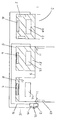
- Example 1 Apparatus suitable for use in the process of, for instance, Example 1 is illustrated schematically in the accompanying drawing. It comprises a tank 1 filled with solvent 20 the level shown and provided with ultrasonic generator 2 and an open top 3 for the introduction of articels 22 to be cleaned and a heater 4.
- a second tank 5 is equipped with a heater 6 and is connected by a weir 7 to a third tank 8 having a heater 9.
- Tank 5 is filled, to the level shown, with water 21 in its bases that is boiled by heater 9 to generate steam.
- the combined tanks 5,8, are open to permit articles 22 to be immersed in the hot water in tank 5 and then in the steam in tank 8.
- a condenser 10 extends around the open tanks 5, 8 to collect azeotrope condensate in trough 11. This leads to a vessel 12 in which the condensate separates into an aqueous phase 14 that is recycled by line 16 to tank 5, and a solvent phase 12 that is recycled tank 1 by line 15.
- Means (not shown) are provided for moving the articles 22 in sequence through the tanks.
Landscapes
- Chemical & Material Sciences (AREA)
- Engineering & Computer Science (AREA)
- Organic Chemistry (AREA)
- Chemical Kinetics & Catalysis (AREA)
- Life Sciences & Earth Sciences (AREA)
- Oil, Petroleum & Natural Gas (AREA)
- Wood Science & Technology (AREA)
- Emergency Medicine (AREA)
- Health & Medical Sciences (AREA)
- General Chemical & Material Sciences (AREA)
- Materials Engineering (AREA)
- Mechanical Engineering (AREA)
- Metallurgy (AREA)
- Manufacturing & Machinery (AREA)
- Microelectronics & Electronic Packaging (AREA)
- Cleaning By Liquid Or Steam (AREA)
Applications Claiming Priority (2)
| Application Number | Priority Date | Filing Date | Title |
|---|---|---|---|
| GB9017841 | 1990-08-14 | ||
| GB909017841A GB9017841D0 (en) | 1990-08-14 | 1990-08-14 | Methods and compositions for cleaning articles |
Publications (2)
| Publication Number | Publication Date |
|---|---|
| EP0475596A1 true EP0475596A1 (de) | 1992-03-18 |
| EP0475596B1 EP0475596B1 (de) | 1995-10-18 |
Family
ID=10680653
Family Applications (1)
| Application Number | Title | Priority Date | Filing Date |
|---|---|---|---|
| EP19910307501 Expired - Lifetime EP0475596B1 (de) | 1990-08-14 | 1991-08-14 | Verfahren zur Reinigung von Artikeln |
Country Status (4)
| Country | Link |
|---|---|
| EP (1) | EP0475596B1 (de) |
| DE (1) | DE69113941T2 (de) |
| ES (1) | ES2077807T3 (de) |
| GB (1) | GB9017841D0 (de) |
Cited By (6)
| Publication number | Priority date | Publication date | Assignee | Title |
|---|---|---|---|---|
| EP0559826A4 (en) * | 1990-12-07 | 1993-10-27 | Golden Technologies Company, Inc. | Method for finishing metal surfaces with terpene |
| EP0559777A4 (en) * | 1990-11-29 | 1994-08-17 | Petroferm Inc | A process and composition for cleaning contaminants with terpene and monobasic ester |
| DE19609119A1 (de) * | 1996-03-08 | 1997-09-11 | Wack O K Chemie Gmbh | Verfahren zum Reinigen von Gegenständen |
| WO1997032963A1 (de) * | 1996-03-08 | 1997-09-12 | Dr. O.K. Wack Chemie Gmbh | Verfahren zum reinigen von gegenständen |
| US5679175A (en) * | 1991-06-14 | 1997-10-21 | Petroferm Inc. | Cleaning process including use of solvating and rinsing agents |
| US6811616B2 (en) * | 2000-12-07 | 2004-11-02 | O. K. Wack | Method for the liquid cleaning of objects |
Citations (3)
| Publication number | Priority date | Publication date | Assignee | Title |
|---|---|---|---|---|
| EP0194589A2 (de) * | 1985-03-11 | 1986-09-17 | AlliedSignal Inc. | Einrichtung und Verfahren zum Reinigen und Trocknen von Oberflächen nicht-absorbierender Gegenstände |
| WO1987000209A1 (en) * | 1985-07-01 | 1987-01-15 | Petroferm Usa, Inc. | Compositions and methods for printed circuit board and/or printed wiring board cleaning and soldermask testing |
| EP0416763A1 (de) * | 1989-08-14 | 1991-03-13 | BUSH BOAKE ALLEN Limited | Verfahren und Zusammensetzungen zur Reinigung von Artikeln |
-
1990
- 1990-08-14 GB GB909017841A patent/GB9017841D0/en active Pending
-
1991
- 1991-08-14 DE DE1991613941 patent/DE69113941T2/de not_active Expired - Fee Related
- 1991-08-14 ES ES91307501T patent/ES2077807T3/es not_active Expired - Lifetime
- 1991-08-14 EP EP19910307501 patent/EP0475596B1/de not_active Expired - Lifetime
Patent Citations (3)
| Publication number | Priority date | Publication date | Assignee | Title |
|---|---|---|---|---|
| EP0194589A2 (de) * | 1985-03-11 | 1986-09-17 | AlliedSignal Inc. | Einrichtung und Verfahren zum Reinigen und Trocknen von Oberflächen nicht-absorbierender Gegenstände |
| WO1987000209A1 (en) * | 1985-07-01 | 1987-01-15 | Petroferm Usa, Inc. | Compositions and methods for printed circuit board and/or printed wiring board cleaning and soldermask testing |
| EP0416763A1 (de) * | 1989-08-14 | 1991-03-13 | BUSH BOAKE ALLEN Limited | Verfahren und Zusammensetzungen zur Reinigung von Artikeln |
Non-Patent Citations (3)
| Title |
|---|
| * abstract * * |
| PATENT ABSTRACTS OF JAPAN vol. 13, no. 255 (C-606)13 June 1989 & JP-A-1 056 798 ( TAIYO KORYO KK ) 3 March 1989 * |
| PATENT ABSTRACTS OF JAPAN vol. 13, no. 428 (P-936)25 September 1989 & JP-A-1 161 349 ( KONICA CORP ) 26 June 1989 * |
Cited By (9)
| Publication number | Priority date | Publication date | Assignee | Title |
|---|---|---|---|---|
| EP0559777A4 (en) * | 1990-11-29 | 1994-08-17 | Petroferm Inc | A process and composition for cleaning contaminants with terpene and monobasic ester |
| EP0559826A4 (en) * | 1990-12-07 | 1993-10-27 | Golden Technologies Company, Inc. | Method for finishing metal surfaces with terpene |
| US5679175A (en) * | 1991-06-14 | 1997-10-21 | Petroferm Inc. | Cleaning process including use of solvating and rinsing agents |
| US5716457A (en) * | 1991-06-14 | 1998-02-10 | Petroferm Inc. | Cleaning with solvating and rinsing agents |
| DE19609119A1 (de) * | 1996-03-08 | 1997-09-11 | Wack O K Chemie Gmbh | Verfahren zum Reinigen von Gegenständen |
| WO1997032963A1 (de) * | 1996-03-08 | 1997-09-12 | Dr. O.K. Wack Chemie Gmbh | Verfahren zum reinigen von gegenständen |
| DE19609119C2 (de) * | 1996-03-08 | 1999-08-26 | Wack O K Chemie Gmbh | Verfahren zum Reinigen von Gegenständen |
| EP1191095A3 (de) * | 1996-03-08 | 2002-08-07 | DR.O.K. WACK CHEMIE GmbH | Verfahren zum Reinigen von Gegenständen und Reinigungsflüssigkeit |
| US6811616B2 (en) * | 2000-12-07 | 2004-11-02 | O. K. Wack | Method for the liquid cleaning of objects |
Also Published As
| Publication number | Publication date |
|---|---|
| DE69113941T2 (de) | 1996-04-11 |
| GB9017841D0 (en) | 1990-09-26 |
| DE69113941D1 (de) | 1995-11-23 |
| ES2077807T3 (es) | 1995-12-01 |
| EP0475596B1 (de) | 1995-10-18 |
Similar Documents
| Publication | Publication Date | Title |
|---|---|---|
| US5300154A (en) | Methods for cleaning articles | |
| JP2614980B2 (ja) | ロジンハンダ付用フラックスをテルペン及び炭化水素で除去するための組成物及び方法 | |
| US5346645A (en) | Desiccant composition and a method of desiccating articles | |
| KR920702244A (ko) | 세정방법 및 세정장치 | |
| RU2002103601A (ru) | Система и способ для извлечения воды при процессе сухой химической чистки с применением растворителя на основе силикона и способов, улучшающих процесс чистки | |
| US7270717B2 (en) | Compositions and methods for cleaning contaminated articles | |
| JPH03140485A (ja) | 脱脂洗浄方法および装置 | |
| KR100394159B1 (ko) | 세정방법및세정장치 | |
| EP0475596B1 (de) | Verfahren zur Reinigung von Artikeln | |
| US20110030736A1 (en) | Process for cleaning articles | |
| JPH1036894A (ja) | 洗浄方法 | |
| AU657500B2 (en) | Composition containing c7-c10 organic polar compound, and method of cleaning articles using the same | |
| EP0416763A1 (de) | Verfahren und Zusammensetzungen zur Reinigung von Artikeln | |
| US5336429A (en) | Virtually constant boiling point compositions based on isoflurane | |
| US5242502A (en) | Method and apparatus for cleaning articles | |
| US3714075A (en) | Chlorinated hydrocarbon compositions and uses thereof | |
| JPS5820677B2 (ja) | オセンブツピンノセイジヨウカホウ オヨビ ソノセイジヨウカヨウノソウチ | |
| US5114495A (en) | Use of azeotropic compositions in vapor degreasing | |
| US3573212A (en) | Cleansing composition and method | |
| RU2113921C1 (ru) | Жидкая очищающая композиция, ее вариант и способ удаления загрязнений с подложкой с использованием очищающей композиции | |
| JP2006022167A (ja) | 洗浄剤組成物及びそれを用いた洗浄システム | |
| JPH0632797B2 (ja) | アルコールを用いた洗浄方法および装置 | |
| JPS6227003A (ja) | 水切り洗浄方法及び装置 | |
| JPS5818471A (ja) | 洗浄・脱水・乾燥方法 | |
| JPH0839019A (ja) | 乾燥方法 |
Legal Events
| Date | Code | Title | Description |
|---|---|---|---|
| PUAI | Public reference made under article 153(3) epc to a published international application that has entered the european phase |
Free format text: ORIGINAL CODE: 0009012 |
|
| AK | Designated contracting states |
Kind code of ref document: A1 Designated state(s): BE DE ES FR GB NL |
|
| 17P | Request for examination filed |
Effective date: 19920911 |
|
| 17Q | First examination report despatched |
Effective date: 19940224 |
|
| GRAA | (expected) grant |
Free format text: ORIGINAL CODE: 0009210 |
|
| AK | Designated contracting states |
Kind code of ref document: B1 Designated state(s): BE DE ES FR GB NL |
|
| REF | Corresponds to: |
Ref document number: 69113941 Country of ref document: DE Date of ref document: 19951123 |
|
| REG | Reference to a national code |
Ref country code: ES Ref legal event code: FG2A Ref document number: 2077807 Country of ref document: ES Kind code of ref document: T3 |
|
| ET | Fr: translation filed | ||
| PGFP | Annual fee paid to national office [announced via postgrant information from national office to epo] |
Ref country code: GB Payment date: 19960805 Year of fee payment: 6 |
|
| PGFP | Annual fee paid to national office [announced via postgrant information from national office to epo] |
Ref country code: FR Payment date: 19960809 Year of fee payment: 6 |
|
| PLBE | No opposition filed within time limit |
Free format text: ORIGINAL CODE: 0009261 |
|
| STAA | Information on the status of an ep patent application or granted ep patent |
Free format text: STATUS: NO OPPOSITION FILED WITHIN TIME LIMIT |
|
| PGFP | Annual fee paid to national office [announced via postgrant information from national office to epo] |
Ref country code: DE Payment date: 19960824 Year of fee payment: 6 |
|
| PGFP | Annual fee paid to national office [announced via postgrant information from national office to epo] |
Ref country code: NL Payment date: 19960828 Year of fee payment: 6 |
|
| PGFP | Annual fee paid to national office [announced via postgrant information from national office to epo] |
Ref country code: ES Payment date: 19960830 Year of fee payment: 6 |
|
| PGFP | Annual fee paid to national office [announced via postgrant information from national office to epo] |
Ref country code: BE Payment date: 19961003 Year of fee payment: 6 |
|
| 26N | No opposition filed | ||
| PG25 | Lapsed in a contracting state [announced via postgrant information from national office to epo] |
Ref country code: GB Free format text: LAPSE BECAUSE OF NON-PAYMENT OF DUE FEES Effective date: 19970814 |
|
| PG25 | Lapsed in a contracting state [announced via postgrant information from national office to epo] |
Ref country code: ES Free format text: LAPSE BECAUSE OF THE APPLICANT RENOUNCES Effective date: 19970816 |
|
| PG25 | Lapsed in a contracting state [announced via postgrant information from national office to epo] |
Ref country code: BE Free format text: LAPSE BECAUSE OF NON-PAYMENT OF DUE FEES Effective date: 19970831 |
|
| BERE | Be: lapsed |
Owner name: UNION CAMP CORP. Effective date: 19970831 |
|
| PG25 | Lapsed in a contracting state [announced via postgrant information from national office to epo] |
Ref country code: NL Free format text: LAPSE BECAUSE OF NON-PAYMENT OF DUE FEES Effective date: 19980301 |
|
| GBPC | Gb: european patent ceased through non-payment of renewal fee |
Effective date: 19970814 |
|
| PG25 | Lapsed in a contracting state [announced via postgrant information from national office to epo] |
Ref country code: FR Free format text: LAPSE BECAUSE OF NON-PAYMENT OF DUE FEES Effective date: 19980430 |
|
| PG25 | Lapsed in a contracting state [announced via postgrant information from national office to epo] |
Ref country code: DE Free format text: LAPSE BECAUSE OF NON-PAYMENT OF DUE FEES Effective date: 19980501 |
|
| NLV4 | Nl: lapsed or anulled due to non-payment of the annual fee |
Effective date: 19980301 |
|
| REG | Reference to a national code |
Ref country code: FR Ref legal event code: ST |
|
| REG | Reference to a national code |
Ref country code: ES Ref legal event code: FD2A Effective date: 20001009 |