EP0475665B1 - Dispositif pour attirer les mites - Google Patents
Dispositif pour attirer les mites Download PDFInfo
- Publication number
- EP0475665B1 EP0475665B1 EP91308083A EP91308083A EP0475665B1 EP 0475665 B1 EP0475665 B1 EP 0475665B1 EP 91308083 A EP91308083 A EP 91308083A EP 91308083 A EP91308083 A EP 91308083A EP 0475665 B1 EP0475665 B1 EP 0475665B1
- Authority
- EP
- European Patent Office
- Prior art keywords
- chamber
- stripes
- moth
- attractant
- moths
- Prior art date
- Legal status (The legal status is an assumption and is not a legal conclusion. Google has not performed a legal analysis and makes no representation as to the accuracy of the status listed.)
- Expired - Lifetime
Links
- 239000005667 attractant Substances 0.000 claims description 15
- 230000031902 chemoattractant activity Effects 0.000 claims description 14
- 239000003016 pheromone Substances 0.000 claims description 10
- 239000002917 insecticide Substances 0.000 claims description 5
- 241000726760 Cadra cautella Species 0.000 claims description 4
- 241000238631 Hexapoda Species 0.000 description 5
- 238000012544 monitoring process Methods 0.000 description 4
- 241000607479 Yersinia pestis Species 0.000 description 3
- 230000000694 effects Effects 0.000 description 3
- 235000013305 food Nutrition 0.000 description 3
- 239000000725 suspension Substances 0.000 description 3
- XXPBOEBNDHAAQH-SREVYHEPSA-N 9Z-Tetradecenyl acetate Chemical compound CCCC\C=C/CCCCCCCCOC(C)=O XXPBOEBNDHAAQH-SREVYHEPSA-N 0.000 description 2
- 239000000463 material Substances 0.000 description 2
- 241000894007 species Species 0.000 description 2
- 239000000758 substrate Substances 0.000 description 2
- 230000000007 visual effect Effects 0.000 description 2
- XXPBOEBNDHAAQH-UHFFFAOYSA-N (Z)-12-Tetradecenyl acetate Natural products CCCCC=CCCCCCCCCOC(C)=O XXPBOEBNDHAAQH-UHFFFAOYSA-N 0.000 description 1
- IHRPKOQVBCPMQH-OHAITUNLSA-N 9Z,12E-Tetradecadien-1-ol Chemical compound C\C=C\C\C=C/CCCCCCCCO IHRPKOQVBCPMQH-OHAITUNLSA-N 0.000 description 1
- 244000043261 Hevea brasiliensis Species 0.000 description 1
- 241000257226 Muscidae Species 0.000 description 1
- 241000595629 Plodia interpunctella Species 0.000 description 1
- 239000004698 Polyethylene Substances 0.000 description 1
- ZZGJZGSVLNSDPG-FZWLCVONSA-N [(9e,12e)-tetradeca-9,12-dienyl] acetate Chemical compound C\C=C\C\C=C\CCCCCCCCOC(C)=O ZZGJZGSVLNSDPG-FZWLCVONSA-N 0.000 description 1
- 239000000853 adhesive Substances 0.000 description 1
- 230000001070 adhesive effect Effects 0.000 description 1
- 239000002775 capsule Substances 0.000 description 1
- 150000001875 compounds Chemical class 0.000 description 1
- 238000010276 construction Methods 0.000 description 1
- 239000000356 contaminant Substances 0.000 description 1
- OEBRKCOSUFCWJD-UHFFFAOYSA-N dichlorvos Chemical compound COP(=O)(OC)OC=C(Cl)Cl OEBRKCOSUFCWJD-UHFFFAOYSA-N 0.000 description 1
- 235000011869 dried fruits Nutrition 0.000 description 1
- 230000008029 eradication Effects 0.000 description 1
- 238000003306 harvesting Methods 0.000 description 1
- 239000007788 liquid Substances 0.000 description 1
- 238000000034 method Methods 0.000 description 1
- 239000000203 mixture Substances 0.000 description 1
- 238000012986 modification Methods 0.000 description 1
- 230000004048 modification Effects 0.000 description 1
- 229920003052 natural elastomer Polymers 0.000 description 1
- 229920001194 natural rubber Polymers 0.000 description 1
- -1 polyethylene Polymers 0.000 description 1
- 229920000573 polyethylene Polymers 0.000 description 1
- 230000002265 prevention Effects 0.000 description 1
- 238000009877 rendering Methods 0.000 description 1
- 230000000717 retained effect Effects 0.000 description 1
- 239000002023 wood Substances 0.000 description 1
Images

Classifications
-
- A—HUMAN NECESSITIES
- A01—AGRICULTURE; FORESTRY; ANIMAL HUSBANDRY; HUNTING; TRAPPING; FISHING
- A01M—CATCHING, TRAPPING OR SCARING OF ANIMALS; APPARATUS FOR THE DESTRUCTION OF NOXIOUS ANIMALS OR NOXIOUS PLANTS
- A01M1/00—Stationary means for catching or killing insects
- A01M1/02—Stationary means for catching or killing insects with devices or substances, e.g. food, pheronones attracting the insects
- A01M1/04—Attracting insects by using illumination or colours
-
- A—HUMAN NECESSITIES
- A01—AGRICULTURE; FORESTRY; ANIMAL HUSBANDRY; HUNTING; TRAPPING; FISHING
- A01M—CATCHING, TRAPPING OR SCARING OF ANIMALS; APPARATUS FOR THE DESTRUCTION OF NOXIOUS ANIMALS OR NOXIOUS PLANTS
- A01M1/00—Stationary means for catching or killing insects
- A01M1/02—Stationary means for catching or killing insects with devices or substances, e.g. food, pheronones attracting the insects
-
- A—HUMAN NECESSITIES
- A01—AGRICULTURE; FORESTRY; ANIMAL HUSBANDRY; HUNTING; TRAPPING; FISHING
- A01M—CATCHING, TRAPPING OR SCARING OF ANIMALS; APPARATUS FOR THE DESTRUCTION OF NOXIOUS ANIMALS OR NOXIOUS PLANTS
- A01M2200/00—Kind of animal
- A01M2200/01—Insects
- A01M2200/012—Flying insects
Definitions
- This invention is concerned with a device for attracting moths.
- traps for the monitoring, study and control of flying insects.
- Such traps are of various designs and may be for example, tent shaped, plain strips of card and the like.
- E.P. 0 446 464 discloses a device for attracting common houseflies which comprises a hollow body having stripes of an attractant which consists of a mixture of feeding stimulant and insecticide. The stripes are preferably arranged on the inner wall but may also be outside and inside.
- DE-U-89 15 080 also discloses a fly attractant consisting of a substrate in the form of a polygon-semicylinder with attractant compound applied to it.
- traps having increased attraction and efficiency with respect to certain species of moth can be obtained if there is provided on the visible surfaces of said traps a pattern of vertical dark stripes on a light background.
- lures When loaded with appropriate lures they can be used as traps for statistical population monitoring purposes or as lure and kill devices for the control of moth populations.
- this invention comprises the use of a device having therein or thereon an attractant and comprising at least one external surface having thereon a plurality of light and dark stripes characterised in that the attractant is a pheromone attractant for moths and that the stripes are vertically oriented.
- a device of the kind described for use herein characterised in that it further comprises means for supporting the device such that the stripes are vertically oriented.
- At least one visible external surface has a pattern thereon which consists of at least two dark stripes on a light background. It is believed that the improved efficiency of the device is the result of visual attraction of the moth to the zone of contrast between the light and dark areas.
- the light background is preferably white in colour and the dark stripes are black, brown or red.
- the width of the light and/or dark stripes preferably lies within the range from about 5mm to 20mm.
- Devices for use according to the invention may take various forms. For example, they may be designed to function as a trap for collecting and counting moths for monitoring purposes. Alternatively they may take the form of a lure and kill device for the purpose of control and eradication. Thus, the device may be simply a strip of material such as cardboard which has thereon the striped pattern together with the attractant.
- the attractant is a pheromone which is attractive to at least one gender of the species of moth in respect of which the device is intended for use.
- the pheromone may be (Z,E)-9,12-tetradecadienyl acetate (TDA) with or without minor amounts of (Z)-9-tetradecenyl acetate (TA) and (Z,E)-9,12-tetradecadienol.
- TDA (Z,E)-9,12-tetradecadienyl acetate
- TA 9-tetradecenyl acetate
- Z,E -9,12-tetradecadienol.
- the strip device may be coated with an adhesive for trapping the attracted and alighting moths or may be coated or impregnated with an appropriate insecticide, for example 2,2-dichlorovinyl dimethyl phosphate.
- the device may comprise one or more chambers each of which has an opening sufficiently large to permit a moth to enter the chamber and sufficiently small to prevent the escape of the moth thereby from within the chamber.
- the opening may take the form of a single aperture or plurality of apertures, such as slots, in the wall of the chamber but more preferably is defined by the lower aperture of a funnel which narrows towards the interior or floor of the chamber.
- the funnel may be enclosed within the chamber or may project from the roof or wall thereof.
- the attractant may be present in the chamber or at the entrance to the chamber. For example, it may be placed on a tray or other like carrier within the chamber or, if rendered in liquid form, may be employed to impregnate the interior surface of the chamber.
- a wick or other type of porous substrate for example a natural rubber septum, a polyethylene capsule or hollow fibres.
- the chamber, and the device containing and/or defining said chamber may be cuboidal or of any other suitable geometrical configuration.
- a preferred construction of moth trap for use according to the invention is in the form of a cylinder within which the chamber is defined and which has the pattern of parallel light and dark stripes on its outer surface arranged in such a way that when the trap is disposed for use, for example by suspension in a desired location, the stripes are disposed vertically.
- the cylinder may have a closed base end and an opening through which a moth may pass into a funnel which narrows towards the interior of the chamber and has an opening sufficiently large to permit a moth to pass through to enter the chamber and sufficiently small to ensure the moth cannot escape from within the chamber.
- two or more traps may be arranged in series.
- the cylinder instead of a closed base end the cylinder may lead into a demountable second chamber in which the moths are retained and which may be detached and disposed of when full.
- the dimensions of the device are chosen to be appropriate having regard to such considerations as the average size of the moth, the space available for mounting the trap at the desired location and the rapidity with which the chamber becomes filled with the trapped moths.
- the dimensions of the striped pattern can be relevant to its degree of attraction to the moth.
- devices of cylindrical configuration it is preferred that they have a length of from about 15 to 70cm and a diameter of from 6 to 12cm. The required length may be obtained, if desired, by disposing two or more devices in series.
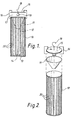
- a cylindrical chamber (10) is fitted internally at its upper end with a funnel (11) having an aperture (12) at its narrow end which is small enough to prevent the escape of moths trapped in the chamber below.
- the cylinder is closed at its lower end (13) and contains an insecticide (14) which may be omitted when the trap is intended for capture of live specimens and not as a lure and kill device.
- a cover (15) is positioned above the upper open end of the chamber and held in place by a wire connector (16), the gap (17) between the cover and cylinder being large enough to allow the entry of moths. Passing through the centre of the cover (15) is a wire hook (18) for suspending the trap and attaching a lure (19) consisting of or containing the pheromone below the cover.
- the external surface of the cylindrical chamber has thereon a pattern of dark stripes (20), preferably black, brown or red stripes on a white background.
- the cylindrical chamber (10) is preferably from 15 to 50cm long and has a diameter of from 6 to 12cm.
- the light and dark stripes preferably have a width within the range from about 6mm to 9mm.
- Figure 2 is an exploded view of the device of Figure 1 and shows the funnel (11), lid (15) and attachments (16) and (18) in more detail.
- FIG 3 there is shown a device wherein two units of the type represented in Figure 1 are employed in series.
- the lower unit (10a) is constructed similarly to the upper unit (10) except that the cover (15) and suspension hook (18) are omitted.
- the lower unit (10a) is attached to the upper unit (10) by means of a simple wire connector (21) and the vertical spacing of the units is sufficient to permit entry by moths.
- a wire carrier (22) is provided from the base of the upper unit for suspending the attractant or lure (19a) just above the open end of the lower unit.
- the third illustrative device is a lure and kill board as shown in Figure 4.
- the board has dimensions 50cm x 6 to 12cm and has 7.55mm wide black (26) and white stripes as used in the first illustrative device arranged parallel to the longest side and is designed to be suspended with its stripes vertically disposed by means of a wire or cord (25) or by any other appropriate suspension means, for example a hole pierced in the board itself.
- the board has an insecticide treated surface to kill alighting moths and has a lure (24) consisting of or containing the pheromone to attract them.
- the board may be made of any material such as wood, cardboard or man-made or natural fibres.
- the board is curled to a cylindrical configuration on which the stripes are disposed parallel to the axis of the cylinder and which is intended for disposition with its axis vertical.
- the cylinder has a length of 50cm and a diameter of 6 to 12 cm.
- the external surface of this cylinder has the same features as those of the board.
Landscapes
- Life Sciences & Earth Sciences (AREA)
- Pest Control & Pesticides (AREA)
- Engineering & Computer Science (AREA)
- Insects & Arthropods (AREA)
- Wood Science & Technology (AREA)
- Zoology (AREA)
- Environmental Sciences (AREA)
- Catching Or Destruction (AREA)
- Agricultural Chemicals And Associated Chemicals (AREA)
Claims (10)
- Application d'un dispositif comportant un système d'attraction et au moins une face extérieure portant une pluralité de bandes claires et foncées (20, 26), caractérisé en ce que le dispositif d'attraction est un dispositif comportant une hormone attirant les mites et en ce que les bandes sont orientées verticalement.
- Application d'un dispositif selon la revendication 1, dans lequel les bandes claires sont blanches et les bandes foncées sont noires, marrons ou rouges.
- Application d'un dispositif selon la revendication 1 ou 2, dans lequel certaines au moins des bandes ont une largeur comprise entre 5 mm et 20 mm.
- Application d'un dispositif selon l'une quelconque des revendications précédentes, dans lequel l'hormone attire au moins une espèce de mite Ephestia Cautella.
- Application d'un dispositif selon l'une quelconque des revendications précédentes, dans lequel ledit dispositif contient ou porte un insecticide.
- Application d'un dispositif selon l'une quelconque des revendications précédentes, dans lequel ledit dispositif comporte une chambre présentant une première ouverture suffisamment grande pour qu'une mite puisse la traverser et pénétrer dans la chambre, et suffisamment petite, pour empêcher la mite de s'échapper de la chambre.
- Application d'un dispositif selon la revendication 6, dans Lequel la chambre comporte une extrémité fermée (13) et au moins une seconde ouverture par laquelle une mite peut pénétrer dans un entonnoir (11) qui se rétrécit dans la direction de l'extrémité fermée (13) pour constituer ladite première ouverture (12).
- Application d'un dispositif selon l'une des revendications 6 ou 7, dans lequel ledit dispositif a la forme d'un cylindre (10) à l'intérieur duquel la chambre est délimitée.
- Application d'un dispositif selon la revendication 8, dans lequel ledit dispositif compprend au moins deux cylindres (10, 10a) montés en série.
- Dispositif pour l'application suivant l'une des revendications précédentes 1 à 9, comprenant les dispositions techniques définies dans l'une quelconque des revendications 1 à 9, lequel dispositif comprend en outre des moyens d'être supporté de manière que les bandes soient orientées verticalement.
Applications Claiming Priority (2)
| Application Number | Priority Date | Filing Date | Title |
|---|---|---|---|
| GB9020059 | 1990-09-13 | ||
| GB909020059A GB9020059D0 (en) | 1990-09-13 | 1990-09-13 | Device for attracting moths |
Publications (2)
| Publication Number | Publication Date |
|---|---|
| EP0475665A1 EP0475665A1 (fr) | 1992-03-18 |
| EP0475665B1 true EP0475665B1 (fr) | 1994-07-13 |
Family
ID=10682166
Family Applications (1)
| Application Number | Title | Priority Date | Filing Date |
|---|---|---|---|
| EP91308083A Expired - Lifetime EP0475665B1 (fr) | 1990-09-13 | 1991-09-04 | Dispositif pour attirer les mites |
Country Status (7)
| Country | Link |
|---|---|
| US (1) | US5170583A (fr) |
| EP (1) | EP0475665B1 (fr) |
| JP (1) | JPH04248947A (fr) |
| AU (1) | AU651614B2 (fr) |
| CA (1) | CA2050740A1 (fr) |
| DE (1) | DE69102845T2 (fr) |
| GB (1) | GB9020059D0 (fr) |
Families Citing this family (35)
| Publication number | Priority date | Publication date | Assignee | Title |
|---|---|---|---|---|
| JPH06141748A (ja) * | 1992-10-31 | 1994-05-24 | Hidemasa Miki | 害虫の駆除装置 |
| US7841131B2 (en) | 1993-01-04 | 2010-11-30 | Ecolab Inc. | Light trap for insects |
| US6493986B1 (en) * | 1993-01-04 | 2002-12-17 | Ecolab Inc. | Light trap for insects |
| US6959510B1 (en) * | 1994-10-21 | 2005-11-01 | Ecolab, Inc. | Insect trap with continuous light pattern |
| SE512111C2 (sv) * | 1997-03-26 | 2000-01-24 | Silvandersson Miljoe Ab | Anordning vid insektsfångare |
| GB9807169D0 (en) * | 1998-04-03 | 1998-06-03 | Astec Europ | Trap for catching insects |
| GB9807665D0 (en) | 1998-04-14 | 1998-06-10 | Agrisense Bcs Ltd | Insect attracting device |
| SE9803130L (sv) * | 1998-09-15 | 2000-05-15 | Rikard Unelius | Komposition avsedd att attrahera haninsekter |
| DE10019068A1 (de) * | 2000-04-18 | 2001-10-31 | Ecs Environment Care Sys Gmbh | Insektenfang-und Vernichtungssysteme |
| US20050055870A1 (en) * | 2000-10-06 | 2005-03-17 | Alvar Yelverton | Light attractant insect trap |
| DE10055135C2 (de) * | 2000-11-07 | 2003-06-18 | Ecs Environment Care Sys Gmbh | Vorrichtung zum Fangen von Fluginsekten |
| US6574913B2 (en) * | 2001-07-26 | 2003-06-10 | Takacs Stephen J. | Semiochemical and sonic signals for monitoring and control of clothes moths |
| US6928769B2 (en) * | 2001-08-07 | 2005-08-16 | Bugjammer, Inc. | Disposable insect-control member |
| US20050150153A1 (en) * | 2001-12-20 | 2005-07-14 | James Conroy | Insecticide presentation device |
| AU2003208341A1 (en) | 2002-03-09 | 2003-09-22 | Ecs Environment Care Systems Gmbh | Adhesive trap for flying insects with improved trapping properties |
| DE10227947C1 (de) * | 2002-06-22 | 2003-12-11 | Ecs Environment Care Sys Gmbh | Insektenfalle mit Hologramm |
| US7096621B2 (en) | 2002-10-11 | 2006-08-29 | Ecolab Inc. | Light trap for insects |
| WO2004054358A2 (fr) * | 2002-12-18 | 2004-07-01 | Universität Regensburg | Piege a insectes |
| USD522086S1 (en) | 2003-06-19 | 2006-05-30 | Blue Rhino Global Sourcing, Llc | Pattern for the exterior of an insect trap |
| USD533621S1 (en) | 2003-06-19 | 2006-12-12 | Cpd Associates Inc. | Sticky paper pattern |
| US20070020305A1 (en) * | 2004-02-11 | 2007-01-25 | Board Of Regents For Oklahoma State University | Attractant for monitoring or controlling female stored product moths |
| US20100154290A1 (en) * | 2008-12-23 | 2010-06-24 | Joan Fisher | Attract and kill pest control device |
| US9089121B2 (en) * | 2009-04-08 | 2015-07-28 | University Of Florida Research Foundation, Inc. | Fly attractant system with toxicant-treated cords |
| CA2758344A1 (fr) * | 2009-04-08 | 2010-10-14 | University Of Florida Research Foundation, Inc. | Systeme attirant les mouches avec cordons traites par un produit toxique |
| DE202010010823U1 (de) | 2010-07-29 | 2010-10-21 | Winkler, Constanze | Vorrichtung zur naturnahen Kontrolle von Insekten |
| DE102010032785A1 (de) | 2010-07-29 | 2012-02-02 | Constanze Winkler | Vorrichtung zur naturnahen Kontrolle von Insekten |
| US10292379B2 (en) * | 2011-06-15 | 2019-05-21 | Ecolab Usa Inc. | Flying insect attraction station |
| US20120317868A1 (en) * | 2011-06-15 | 2012-12-20 | Ecolab Usa Inc. | Flying insect attraction station |
| US9155293B2 (en) * | 2011-07-27 | 2015-10-13 | Bugjammer, Inc. | Resonating trap for catching insects |
| US10051851B2 (en) * | 2011-09-20 | 2018-08-21 | Hamamatsu University School Of Medicine | Attraction device, insect-capturing apparatus and insect-capturing method |
| AR087076A1 (es) * | 2012-07-05 | 2014-02-12 | Inst Nac De Tecnologia Agropecuaria | Trampa de observacion mata insectos para la captura masiva y control del picudo del algodonero |
| US20150068104A1 (en) * | 2013-09-10 | 2015-03-12 | Amber Mason | Insect trap system |
| GB2525897B (en) * | 2014-05-07 | 2018-04-11 | Russell Ipm Ltd | Insect trap |
| JP6802267B2 (ja) | 2015-05-29 | 2020-12-16 | エコラボ ユーエスエー インコーポレイティド | 飛翔昆虫を誘引し捕獲するための装置及び方法 |
| DE202020002111U1 (de) * | 2020-05-13 | 2020-06-30 | Reckhaus Ag | Lebendfalle zum lebendigen Fangen von lnsekten |
Family Cites Families (14)
| Publication number | Priority date | Publication date | Assignee | Title |
|---|---|---|---|---|
| US466637A (en) * | 1892-01-05 | Sticky fly-paper | ||
| GB191201297A (en) * | 1912-01-16 | 1912-08-08 | George Pettit | Improvements in or relating to Fly-catching Devices. |
| US1120046A (en) * | 1912-12-09 | 1914-12-08 | Joseph Fritsch | Insect and fly trap. |
| US1655128A (en) * | 1926-08-14 | 1928-01-03 | Berghorn Olga | Sticky fly paper |
| US2097924A (en) * | 1937-02-25 | 1937-11-02 | William S Kell | Fly paper |
| NL240708A (fr) * | 1958-07-03 | |||
| US4058462A (en) * | 1970-04-02 | 1977-11-15 | Gaf Corporation | System for sustained release of phenolic material from porous granules of insoluble polymeric phenolic complexes |
| US4671010A (en) * | 1981-04-10 | 1987-06-09 | Conlee Janet K | Device for insect control |
| CA1165564A (fr) * | 1982-05-25 | 1984-04-17 | B. Staffan Lindgren | Piege d'insectes |
| EP0160712A1 (fr) * | 1984-05-03 | 1985-11-13 | Montedison S.p.A. | Piège très efficace pour insectes |
| US4642936A (en) * | 1985-05-08 | 1987-02-17 | Canadian Patents And Development Limited | Multi-functional high capacity insect trap |
| DE8616750U1 (de) * | 1986-06-24 | 1986-10-23 | Terrasan-Chemie GmbH, 8070 Ingolstadt | Vorrichtung zum Vernichten von Fliegen |
| DE8915080U1 (de) * | 1989-12-22 | 1990-03-22 | Henkel KGaA, 4000 Düsseldorf | Fliegenköder |
| DE4008260A1 (de) * | 1990-03-15 | 1991-09-19 | Bayer Ag | Koeder fuer stubenfliegen |
-
1990
- 1990-09-13 GB GB909020059A patent/GB9020059D0/en active Pending
-
1991
- 1991-09-04 DE DE69102845T patent/DE69102845T2/de not_active Expired - Lifetime
- 1991-09-04 EP EP91308083A patent/EP0475665B1/fr not_active Expired - Lifetime
- 1991-09-04 US US07/754,837 patent/US5170583A/en not_active Expired - Fee Related
- 1991-09-05 CA CA002050740A patent/CA2050740A1/fr not_active Abandoned
- 1991-09-12 AU AU83818/91A patent/AU651614B2/en not_active Ceased
- 1991-09-13 JP JP3234796A patent/JPH04248947A/ja active Pending
Also Published As
| Publication number | Publication date |
|---|---|
| US5170583A (en) | 1992-12-15 |
| DE69102845D1 (de) | 1994-08-18 |
| AU8381891A (en) | 1992-03-19 |
| GB9020059D0 (en) | 1990-10-24 |
| CA2050740A1 (fr) | 1992-03-14 |
| AU651614B2 (en) | 1994-07-28 |
| EP0475665A1 (fr) | 1992-03-18 |
| DE69102845T2 (de) | 1994-11-24 |
| JPH04248947A (ja) | 1992-09-04 |
Similar Documents
| Publication | Publication Date | Title |
|---|---|---|
| US5170583A (en) | Device for attracting moths | |
| US9402383B2 (en) | Insect-killing monitoring trap for mass capturing and controlling cotton boll weevils | |
| CA1321708C (fr) | Piege a confinement pour insectes | |
| US6327810B1 (en) | Pest trap | |
| US4992268A (en) | Novel system for monitoring and controlling the papaya fruit fly | |
| JPH07508882A (ja) | 害虫駆除 | |
| US5150541A (en) | Device for killing insects | |
| NZ576112A (en) | Flying insect trap with spaced entryways | |
| WO1992014358A1 (fr) | Systeme de lutte contre les insectes | |
| KR20040036916A (ko) | 구충용 장치 | |
| US5111610A (en) | Insect-killing device | |
| KR101621958B1 (ko) | 농업용 해충 포획장치 | |
| US6550181B1 (en) | Elevated beetle trap | |
| GB2052942A (en) | Insect traps | |
| US4977701A (en) | Tamper resistant flying insect control device | |
| JPH09202703A (ja) | 害虫駆除剤および害虫駆除装置 | |
| US5836104A (en) | Flying insect trap | |
| JP4129671B2 (ja) | 害虫誘引捕獲器 | |
| JP4129673B2 (ja) | 害虫誘引捕獲器 | |
| JP6756725B2 (ja) | 害虫捕獲方法および害虫捕獲器 | |
| Quartey et al. | The development of an improved model trap for monitoring Ephestia cautella | |
| US20080256843A1 (en) | Insect Bait Station | |
| US7913449B2 (en) | Device for extending duration of volatile liquid lures | |
| CN211153449U (zh) | 一种简易防逃逸农业害虫诱捕器 | |
| EP0160712A1 (fr) | Piège très efficace pour insectes |
Legal Events
| Date | Code | Title | Description |
|---|---|---|---|
| PUAI | Public reference made under article 153(3) epc to a published international application that has entered the european phase |
Free format text: ORIGINAL CODE: 0009012 |
|
| AK | Designated contracting states |
Kind code of ref document: A1 Designated state(s): DE FR GB IT |
|
| 17P | Request for examination filed |
Effective date: 19920516 |
|
| 17Q | First examination report despatched |
Effective date: 19920703 |
|
| GRAA | (expected) grant |
Free format text: ORIGINAL CODE: 0009210 |
|
| AK | Designated contracting states |
Kind code of ref document: B1 Designated state(s): DE FR GB IT |
|
| REF | Corresponds to: |
Ref document number: 69102845 Country of ref document: DE Date of ref document: 19940818 |
|
| ET | Fr: translation filed | ||
| ITF | It: translation for a ep patent filed | ||
| PLBE | No opposition filed within time limit |
Free format text: ORIGINAL CODE: 0009261 |
|
| STAA | Information on the status of an ep patent application or granted ep patent |
Free format text: STATUS: NO OPPOSITION FILED WITHIN TIME LIMIT |
|
| 26N | No opposition filed | ||
| REG | Reference to a national code |
Ref country code: GB Ref legal event code: IF02 |
|
| PGFP | Annual fee paid to national office [announced via postgrant information from national office to epo] |
Ref country code: FR Payment date: 20101005 Year of fee payment: 20 |
|
| PGFP | Annual fee paid to national office [announced via postgrant information from national office to epo] |
Ref country code: GB Payment date: 20100809 Year of fee payment: 20 |
|
| PGFP | Annual fee paid to national office [announced via postgrant information from national office to epo] |
Ref country code: DE Payment date: 20100922 Year of fee payment: 20 |
|
| PGFP | Annual fee paid to national office [announced via postgrant information from national office to epo] |
Ref country code: IT Payment date: 20100928 Year of fee payment: 20 |
|
| REG | Reference to a national code |
Ref country code: DE Ref legal event code: R071 Ref document number: 69102845 Country of ref document: DE |
|
| REG | Reference to a national code |
Ref country code: DE Ref legal event code: R071 Ref document number: 69102845 Country of ref document: DE |
|
| REG | Reference to a national code |
Ref country code: GB Ref legal event code: PE20 Expiry date: 20110903 |
|
| PG25 | Lapsed in a contracting state [announced via postgrant information from national office to epo] |
Ref country code: GB Free format text: LAPSE BECAUSE OF EXPIRATION OF PROTECTION Effective date: 20110903 |
|
| PG25 | Lapsed in a contracting state [announced via postgrant information from national office to epo] |
Ref country code: DE Free format text: LAPSE BECAUSE OF EXPIRATION OF PROTECTION Effective date: 20110905 |