EP0475836A2 - Procédé pour la séparation sous pression du 2,7 diméthylnaphthalène - Google Patents
Procédé pour la séparation sous pression du 2,7 diméthylnaphthalène Download PDFInfo
- Publication number
- EP0475836A2 EP0475836A2 EP91402407A EP91402407A EP0475836A2 EP 0475836 A2 EP0475836 A2 EP 0475836A2 EP 91402407 A EP91402407 A EP 91402407A EP 91402407 A EP91402407 A EP 91402407A EP 0475836 A2 EP0475836 A2 EP 0475836A2
- Authority
- EP
- European Patent Office
- Prior art keywords
- dmn
- liquid
- solid
- pressure
- vessel
- Prior art date
- Legal status (The legal status is an assumption and is not a legal conclusion. Google has not performed a legal analysis and makes no representation as to the accuracy of the status listed.)
- Granted
Links
Images

Classifications
-
- C—CHEMISTRY; METALLURGY
- C07—ORGANIC CHEMISTRY
- C07C—ACYCLIC OR CARBOCYCLIC COMPOUNDS
- C07C7/00—Purification; Separation; Use of additives
- C07C7/14—Purification; Separation; Use of additives by crystallisation; Purification or separation of the crystals
Definitions
- the invention relates to a process for separating 2,7-dimethylnaphthalene in a high purity of more than 98 weight % from a mixture containing dimethylnaphthalenes.
- Dimethylnaphthalenes are referred to hereinafter as DMN.
- 2,7-DMN is oxidized to produce naphthalene 2,7-dicarboxylic acid, which is an industrially important material for manufacturing polyesters.
- 2,7-DMN is contained in various fractions of petroleum or coal tar as mixtures together with other DMN isomers.
- 2,7-DMN and 2,6-DMN have the melting points which are very close to each other and thus have a possibility to form an eutectic mixture or a solid solution.
- the present invention relates to a process for separating 2,7-DMN, characterized in that a mixture containing at least 50% by weight of 2,7-DMN and less than 50% of other DMN isomers, which is obtained by preliminarily concentrating a fraction in the range of 250 - 270°C of catalytically cracked petroleum oil, is preliminarily adjusted to a temperature of 60 - 90°C to form a slurry containing the 2,7-DMN, which is placed in a tightly sealed pressure vessel, adiabatically pressurized to the range of 500 - 2500 kgf/cm2 and solidified to form a state of co-existing of solid and liquid phases, liquid is then discharged under pressure from the solid-liquid co-existing system, the solid remaining in the vessel is pressed to discharge the liquid remaining between the solid particles, which are integrated to give 2,7-DMN having a purity of 98% by weight or more.
- this method is the one that a liquid mixture containing two or more substances are pressurized, and a certain substance in the mixture is solidified and separated from the residual liquid by the effect of the pressure.
- this method is a spearating and purifying method that a liquid mixture containing two or more substances is placed in a tightly sealed pressure vessel, a part of the objective substance, 2,7-dimethylnaphthalene, is solidified to form a solid-liquid co-existing state, the liquid is discharged from the co-existing system while maintaining the pressure of the solid-liquid co-existing system at a higher level than equilibrium pressure of the objective stabstance, then the solid remaining in the vessel is pressed for discharging the residual liquid between the solid particles and integrating the solid particles.
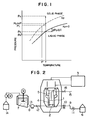
- the gradient of the solid-liquid equilibrium line of a substance dP0/dT is generally larger than zero.
- the impurity concentration is X2
- the pressure at the solid-liquid equilibrium is P0 + ⁇ P. If the discharge pressure is set at P L , solid in the neighborhood of a liquid having an impurity concentration X2 is melted, so that the solid-liquid equilibrium can be maintained at P L and a higher purity can be realized.
- the statistic mean pressure P3 at the contact surface of crystal particles is high far from these values, and thus pressing force is applied to the crystal particles and produces a so-called "squeezing out" state of the residual liquid between the particles.
- P0′ may be again defined as P0 for adjusting the discharging pressure or may be understood as a variable which returns to the original value along with the recovery of the temperature.
- a pressure vessel 1 is provided with a bottom cap 2 at a lower part, and a piston 5 is provided so that it is reciprocated vertically within the vessel 1 by the operation of a hydraulic device 3.
- a crystallization chamber 4 is formed by the piston 5 and the bottom cap 2 within the pressure vessel 1.
- the crystallization chamber 4 and discharged liquid tank 6 are connected through a pressure decreasing mechanism 10 and a value 11 by a pipe line 9.
- the crystallization chamber 4 and a preliminary crystallization vessel 7 are connected to each other through a raw material supplying pump 8 and a valve 12 by a pipe line 13.
- the raw material is supplied from the raw material tank 14 to the preliminary crystallization vessel 7, where the material is cooled and crystallized to form seed crystals for high pressure crystallization.
- the high pressure crystallization of a liquid free of seed crystals requires a high pressure for forming an initial crystal and super fine crystals may be formed due to the formation of crystals under an excessive supersaturation condition by a rapid pressurization, so that separation of solid and liquid becomes difficult.
- the raw material is supplied in the state of slurry containing seed crystals, such supersaturation will not occur and growth of crystals is initiated along with the pressurization.
- the raw material is next injected into the crystallization chamber 4 through the valve 12 from the pipe line 13.
- the overflow of the liquid starts through the overflow pipe 15 having an opening at the top of the piston, and thus the valves 12 and 16 are closed on the detection of the overflow to initiate pressurization by the piston 5.
- the crystallization of a specific substance in the raw material progresses to realize a solid-liquid co-existing state under a high pressure within the crystallization chamber 4.
- the solid generated in the time is generally a substance having an extremely high purity.
- temperature within the crystallization chamber 4 is increased by the latent heat of solidification generated with the progression of solidification.
- the valve 11 When pressurization is conducted up to a certain level and a certain ratio of solid and liquid is realized, the valve 11 is opened while the pressure acting from the hydraulic device 3 on the piston 5 is maintained and the pressure within the crystallization chamber 4 is maintained, and the liquid within the crystallization chamber 4 is discharged through the pressure decreasing mechanism 10 into the discharge tank 6.
- the piston When the piston is further lowered while the pressure applied to the piston 5 maintained, the crystal particle groups within the crystallization chamber 4 are pressurized and pressed and the residual liquid between the crystal particle groups is subjected to the so-called "squeezing-out action" and discharged into the discharge tank 6.
- the crystal particle groups is formed into a large block with the profile of the crystallization chamber 4.
- the pressure of the liquid phase between the crystal particles within the crystallization chamber 4 is gradually decreased, so that the surface of the crystal particles are melted partially and the so-called “sweating washing” is carried out to purify the solid product.
- the pressure of the discharge from the crystallization chamber is decreased to a certain pressure, the lowering of the piston 5 is stopped, the rising of the piston is initiated and the high pressure vessel 1 is also raised, the solid product can be removed from the vessel 1 in the state that the product is put on the bottom cap 2.
- the product is removed by a removing device (not shown in the figure), the high pressure vessel 1 is lowered and fitted with the bottom cap 2, and then the similar process is repeated from the raw material injecting step.
- residual liquid in the overflow pipe is purged by an inert gas to the product such as nitrogen gas to prepare for detecting the full liquid on injection in the following step.
- 2,7-DMN and other DMN isomers which contains at least 50% by weight of 2,7-DMN or more, preferably 70% by weight or more of 2,7-DMN as the raw material is used.
- 2,7-DMN is poorly recovered when 2,7-DMN in the raw material has a content of 50% by weight or less. In such cases, 2,7-DMN cannot be obtained in the purity of 98% by weight or more.
- the raw material for conducting the pressure crystallization contains 2,7-DMN of at least 50% by weight or more, preferably 70% by weight or more.
- a typical method is described in the following. Fractions having a boiling point of a catalytically cracked petroleum oil in the range of 250 - 270°C, preferably 257 - 265°C are used as a starting raw material. The fractions are cooled to a cooling temperature of -30 - -10°C according to the cooling crystallization method to crystallize and remove 2,6-DMN. The DMN mixture from which 2,6-DMN has been removed is treated with Na-Y Zeolite according to the Zeolite method at a temperature of 80 - 100°C under the condition of SV1 - 10 g/g/hr and further treated at a cooling crystallization temperature of -30 - 30°C according to the cooling crystallization method.
- the raw material is preferably supplied in a state of slurry as described above in the high pressure crystallization method, so that the raw mateerial system of the present invention is preferably formed into a slurry which contains solid in a ratio of about 5 - 25% by preliminarily cooling the raw material to a temperature of about 50 - 90°C.
- the raw material supplying temperature has also an intimate relationship to the purity and yield of the product.
- the purity is lowered due to the insufficient sweating washing and insufficient squeezing at the reduced pressure.
- the process is not economical because the lowering of the yield notwithstanding the improvement of the purity.
- a raw material mixture (D) comprising mainly DMN isomers such as a mixture containing 75.7% of 2,7-DMN and 10.1% of 2,6-DMN was adjusted to a temperature of 100°C to form a slurry containing the crystal of 2,7-DMN, supplied to a high pressure vessel having a piston/cylinder structure as shown in Fig. 2 and pressurized adiabatically at pressure of 800 kgf/cm2 (case E-1), 1,000 kgf/cm2 (case E-2) and 1,500 kgf/cm2 (case E-3) by the oil pressure acting on the piston.
- the temperature of the raw material supplied and the pressure of the high pressure crystallization were obtained from the melting latent heat of 2,7-DMN and the specific heat of the raw material mixture.
Landscapes
- Chemical & Material Sciences (AREA)
- Organic Chemistry (AREA)
- Crystallography & Structural Chemistry (AREA)
- Engineering & Computer Science (AREA)
- Analytical Chemistry (AREA)
- Oil, Petroleum & Natural Gas (AREA)
- Water Supply & Treatment (AREA)
- Organic Low-Molecular-Weight Compounds And Preparation Thereof (AREA)
Applications Claiming Priority (2)
| Application Number | Priority Date | Filing Date | Title |
|---|---|---|---|
| JP239984/90 | 1990-09-12 | ||
| JP2239984A JP2766059B2 (ja) | 1990-09-12 | 1990-09-12 | 2,7―ジメチルナフタレンの分離方法 |
Publications (3)
| Publication Number | Publication Date |
|---|---|
| EP0475836A2 true EP0475836A2 (fr) | 1992-03-18 |
| EP0475836A3 EP0475836A3 (en) | 1993-07-21 |
| EP0475836B1 EP0475836B1 (fr) | 1997-07-30 |
Family
ID=17052748
Family Applications (1)
| Application Number | Title | Priority Date | Filing Date |
|---|---|---|---|
| EP91402407A Expired - Lifetime EP0475836B1 (fr) | 1990-09-12 | 1991-09-10 | Procédé pour la séparation sous pression du 2,7-diméthylnaphtalène |
Country Status (4)
| Country | Link |
|---|---|
| US (1) | US5220098A (fr) |
| EP (1) | EP0475836B1 (fr) |
| JP (1) | JP2766059B2 (fr) |
| DE (1) | DE69127039T2 (fr) |
Cited By (1)
| Publication number | Priority date | Publication date | Assignee | Title |
|---|---|---|---|---|
| EP0644180A1 (fr) * | 1993-09-21 | 1995-03-22 | Showa Denko Kabushiki Kaisha | Procédé pour la purification de composés vinyliques polaires |
Families Citing this family (5)
| Publication number | Priority date | Publication date | Assignee | Title |
|---|---|---|---|---|
| US6057487A (en) * | 1997-12-30 | 2000-05-02 | Chevron Chemical Company | Method for producing 2,6-DMN from mixed dimethylnaphthalenes by crystallization, adsorption and isomerization |
| US5955641A (en) * | 1998-03-16 | 1999-09-21 | Chevron Chemical Company Llc | Method of making dimethylnaphthalenes |
| KR100621823B1 (ko) * | 2004-07-21 | 2006-09-14 | 재단법인서울대학교산학협력재단 | 2,6-디알킬테트랄린의 제조 방법 |
| CN101171215B (zh) * | 2005-04-06 | 2011-09-21 | 三菱瓦斯化学株式会社 | 2,7-二甲基萘的精制方法 |
| KR100754744B1 (ko) * | 2006-05-01 | 2007-09-03 | 주식회사 효성 | 2,6-디메틸나프탈렌의 분리 및 정제방법 |
Family Cites Families (9)
| Publication number | Priority date | Publication date | Assignee | Title |
|---|---|---|---|---|
| US3202726A (en) * | 1961-07-03 | 1965-08-24 | Sun Oil Co | Recovery of dimethylnaphthalenes |
| US3235615A (en) * | 1961-10-10 | 1966-02-15 | Sun Oil Co | Preparation of naphthalene and certain dimethylnaphthalenes |
| US3590091A (en) * | 1968-08-16 | 1971-06-29 | Sun Oil Co | Crystallization and purification of 2,6-dmn |
| US3594436A (en) * | 1969-02-03 | 1971-07-20 | Sun Oil Co | Separation of 2,6-and 2,7-dmn eutectic via 2,6-dimethyltetrahydronaphthalene crystallization |
| US3668267A (en) * | 1970-01-30 | 1972-06-06 | Sun Oil Co | Separation of 2,7-dimethylnaphthalene from 2,6-dimethylnaphthalene with molecular sieves |
| JPS5228792B1 (fr) * | 1971-01-27 | 1977-07-28 | ||
| US3996031A (en) * | 1972-10-19 | 1976-12-07 | Sun Ventures, Inc. | Fractionation of multicomponent dimethylnaphthelenes feeds by selective crystallization |
| JP2524800B2 (ja) * | 1988-03-07 | 1996-08-14 | 昭和シェル石油株式会社 | 圧力晶析法によるナフタレンのメチル誘導体の分離方法 |
| JPH02139001A (ja) * | 1988-11-17 | 1990-05-29 | Kobe Steel Ltd | 圧力晶析方法 |
-
1990
- 1990-09-12 JP JP2239984A patent/JP2766059B2/ja not_active Expired - Fee Related
-
1991
- 1991-09-09 US US07/756,792 patent/US5220098A/en not_active Expired - Lifetime
- 1991-09-10 DE DE69127039T patent/DE69127039T2/de not_active Expired - Fee Related
- 1991-09-10 EP EP91402407A patent/EP0475836B1/fr not_active Expired - Lifetime
Cited By (2)
| Publication number | Priority date | Publication date | Assignee | Title |
|---|---|---|---|---|
| EP0644180A1 (fr) * | 1993-09-21 | 1995-03-22 | Showa Denko Kabushiki Kaisha | Procédé pour la purification de composés vinyliques polaires |
| US5510515A (en) * | 1993-09-21 | 1996-04-23 | Showa Denko K.K. | Process for purifying polar vinyl compound |
Also Published As
| Publication number | Publication date |
|---|---|
| EP0475836B1 (fr) | 1997-07-30 |
| EP0475836A3 (en) | 1993-07-21 |
| JPH04120027A (ja) | 1992-04-21 |
| JP2766059B2 (ja) | 1998-06-18 |
| US5220098A (en) | 1993-06-15 |
| DE69127039T2 (de) | 1997-11-20 |
| DE69127039D1 (de) | 1997-09-04 |
Similar Documents
| Publication | Publication Date | Title |
|---|---|---|
| US4456480A (en) | Process for purifying metals by segregation | |
| EP1663439B1 (fr) | Procede de separation de liquide-solides | |
| EP0475836A2 (fr) | Procédé pour la séparation sous pression du 2,7 diméthylnaphthalène | |
| US3370082A (en) | Purification of adipodinitrile | |
| US4992619A (en) | Process for separating methyl substituted naphthalene by crystallization under pressure | |
| US2835598A (en) | Separation by crystallization | |
| US2855100A (en) | Fractional crystallization process and apparatus | |
| US3261170A (en) | Multi-stage crystallization process and apparatus | |
| US2981773A (en) | Separation by crystallization | |
| US3402047A (en) | Crystallization separation and purification utilizing fresh feed to reslurry crystals | |
| US3290891A (en) | Batch crystal purification | |
| US3050953A (en) | Separation by crystallization | |
| US2163581A (en) | Purification of crystallizable derivatives of coal tar | |
| US2794840A (en) | Fractional crystallization process and apparatus | |
| US5031754A (en) | Method of working up an overhead product of an extractive distillation of a hydrocarbon mixture and apparatus for same | |
| US4966978A (en) | Process for separating indole in refined form | |
| US3198607A (en) | Fractional crystallization apparatus including recycle control | |
| US2868830A (en) | Separation by crystallization | |
| JPS6161842B2 (fr) | ||
| JPH0774172B2 (ja) | 2,6−ジメチルナフタレンの分離方法 | |
| JPH05331079A (ja) | 2,6−ジイソプロピルナフタレンの分離精製法 | |
| JPH0779922B2 (ja) | 圧力晶析法を用いた物質の精製法 | |
| JPH09176055A (ja) | 結晶性物質の精製方法 | |
| JPS5810121B2 (ja) | 物質の分離精製装置 | |
| JPH0417682B2 (fr) |
Legal Events
| Date | Code | Title | Description |
|---|---|---|---|
| PUAI | Public reference made under article 153(3) epc to a published international application that has entered the european phase |
Free format text: ORIGINAL CODE: 0009012 |
|
| AK | Designated contracting states |
Kind code of ref document: A2 Designated state(s): DE FR GB |
|
| PUAL | Search report despatched |
Free format text: ORIGINAL CODE: 0009013 |
|
| AK | Designated contracting states |
Kind code of ref document: A3 Designated state(s): DE FR GB |
|
| 17P | Request for examination filed |
Effective date: 19930924 |
|
| 17Q | First examination report despatched |
Effective date: 19940620 |
|
| GRAG | Despatch of communication of intention to grant |
Free format text: ORIGINAL CODE: EPIDOS AGRA |
|
| GRAH | Despatch of communication of intention to grant a patent |
Free format text: ORIGINAL CODE: EPIDOS IGRA |
|
| GRAH | Despatch of communication of intention to grant a patent |
Free format text: ORIGINAL CODE: EPIDOS IGRA |
|
| GRAA | (expected) grant |
Free format text: ORIGINAL CODE: 0009210 |
|
| AK | Designated contracting states |
Kind code of ref document: B1 Designated state(s): DE FR GB |
|
| REF | Corresponds to: |
Ref document number: 69127039 Country of ref document: DE Date of ref document: 19970904 |
|
| ET | Fr: translation filed | ||
| PLBE | No opposition filed within time limit |
Free format text: ORIGINAL CODE: 0009261 |
|
| STAA | Information on the status of an ep patent application or granted ep patent |
Free format text: STATUS: NO OPPOSITION FILED WITHIN TIME LIMIT |
|
| 26N | No opposition filed | ||
| REG | Reference to a national code |
Ref country code: GB Ref legal event code: IF02 |
|
| PGFP | Annual fee paid to national office [announced via postgrant information from national office to epo] |
Ref country code: DE Payment date: 20040902 Year of fee payment: 14 |
|
| PGFP | Annual fee paid to national office [announced via postgrant information from national office to epo] |
Ref country code: GB Payment date: 20040908 Year of fee payment: 14 Ref country code: FR Payment date: 20040908 Year of fee payment: 14 |
|
| PG25 | Lapsed in a contracting state [announced via postgrant information from national office to epo] |
Ref country code: GB Free format text: LAPSE BECAUSE OF NON-PAYMENT OF DUE FEES Effective date: 20050910 |
|
| PG25 | Lapsed in a contracting state [announced via postgrant information from national office to epo] |
Ref country code: DE Free format text: LAPSE BECAUSE OF NON-PAYMENT OF DUE FEES Effective date: 20060401 |
|
| GBPC | Gb: european patent ceased through non-payment of renewal fee |
Effective date: 20050910 |
|
| PG25 | Lapsed in a contracting state [announced via postgrant information from national office to epo] |
Ref country code: FR Free format text: LAPSE BECAUSE OF NON-PAYMENT OF DUE FEES Effective date: 20060531 |
|
| REG | Reference to a national code |
Ref country code: FR Ref legal event code: ST Effective date: 20060531 |