EP0476500A2 - Dispositif pour l'attelage d'un dispositif faucheur ou autre dispositif mécanique au console d'attache d'un véhicule - Google Patents
Dispositif pour l'attelage d'un dispositif faucheur ou autre dispositif mécanique au console d'attache d'un véhicule Download PDFInfo
- Publication number
- EP0476500A2 EP0476500A2 EP91115358A EP91115358A EP0476500A2 EP 0476500 A2 EP0476500 A2 EP 0476500A2 EP 91115358 A EP91115358 A EP 91115358A EP 91115358 A EP91115358 A EP 91115358A EP 0476500 A2 EP0476500 A2 EP 0476500A2
- Authority
- EP
- European Patent Office
- Prior art keywords
- coupling device
- leg
- spring
- machine unit
- movement
- Prior art date
- Legal status (The legal status is an assumption and is not a legal conclusion. Google has not performed a legal analysis and makes no representation as to the accuracy of the status listed.)
- Granted
Links
Images






Classifications
-
- A—HUMAN NECESSITIES
- A01—AGRICULTURE; FORESTRY; ANIMAL HUSBANDRY; HUNTING; TRAPPING; FISHING
- A01B—SOIL WORKING IN AGRICULTURE OR FORESTRY; PARTS, DETAILS, OR ACCESSORIES OF AGRICULTURAL MACHINES OR IMPLEMENTS, IN GENERAL
- A01B61/00—Devices for, or parts of, agricultural machines or implements for preventing overstrain
- A01B61/02—Devices for, or parts of, agricultural machines or implements for preventing overstrain of the coupling devices between tractor and machine
-
- A—HUMAN NECESSITIES
- A01—AGRICULTURE; FORESTRY; ANIMAL HUSBANDRY; HUNTING; TRAPPING; FISHING
- A01B—SOIL WORKING IN AGRICULTURE OR FORESTRY; PARTS, DETAILS, OR ACCESSORIES OF AGRICULTURAL MACHINES OR IMPLEMENTS, IN GENERAL
- A01B59/00—Devices specially adapted for connection between animals or tractors and agricultural machines or implements
- A01B59/04—Devices specially adapted for connection between animals or tractors and agricultural machines or implements for machines pulled or pushed by a tractor
- A01B59/041—Devices specially adapted for connection between animals or tractors and agricultural machines or implements for machines pulled or pushed by a tractor preventing or limiting side-play of implements
Definitions
- the invention relates to a device for coupling a mower or other mechanical unit to the trestle of a commercial vehicle.
- the invention relates to a sickle mower that can be attached to the utility vehicle trestle, for example, so-called three-point suspension, by means of a coupling element.
- Coupling devices of the type mentioned are known from US Pat. No. 4,441,306 (FIG. 1) and DE-OS 36 32 871 (FIG. 2). Furthermore, from DE-PS 27 49 097 the interposition of an axis of rotation is known, about which the implement can be pivoted relative to a tractor against the influence of a spring which can only be subjected to tension.
- the coupling device Due to its articulation arranged in this way, the coupling device is given a rotational degree of freedom, which enables it to make compensatory movements when hitting an obstacle.
- these compensating movements are coupled with spring forces, these compensating movements or the obstacle impacts are considerably damped, so that the risk of damage to the mower, its housing frame, its coupling or suspension, etc. is largely avoided.
- the elasticity and thus operational reliability of the coupling device is further promoted in that the connecting member forming the swivel axis is mounted so as to be radially resiliently adjustable in the joint.
- a concrete realization of this idea is to surround the connecting member with a rubber bearing.
- a sensor which detects the pivoting movements and / or corresponding spring element deflections and thus generates an electrical switching signal in a corresponding manner.
- the switching signal can, for example, be coupled to a warning device, for example a horn, which, when triggered by the switching signal, informs the driver of an obstacle being hit. He can then stop the vehicle immediately.
- a warning device for example a horn
- Concrete ways of realizing this idea are to mount an electromechanical switch on the joint or on the spring element, which closes an electrical contact by mechanical rotating or deflecting movements of the elements mentioned.
- the coupling device with two legs which are rigidly connected to one another and which are provided in their connecting region with a common support element for engagement on the trestle; the free end of the first leg can be rotated via the joint on the machine unit, and the free end of the second leg can be adjusted via the spring element.
- both the joint and the spring element are each assigned a point of action or action, which results in the spring-damped pivoting mechanism in the coupling device.
- the spring element is designed as a hollow cylindrical rubber spring and / or helical spring, which is connected at one end to the machine unit, in particular a mower, and at its other end to the second leg.
- an advantageous embodiment of the invention is to provide the second leg approximately parallel to the pivot axis of the coupling device projecting bottom and side walls (front and rear wall), which the coil or rubber spring on its lower end face and on its (cylindrical) outer jacket reach under or include, the bottom wall of the end face and the side walls being assigned to the outer jacket; the remaining upper end face of the screw or rubber spring is acted upon by one end of a screw connection which is guided through the cylindrical inner cavities of the screw or rubber spring and the bottom wall of the second leg and is connected to the machine unit.
- the side walls and the bottom wall form a stable border and guidance of the spring elements in this embodiment.
- the support element can be designed as a connecting bolt which is guided through two leg assemblies - in particular through the apex regions of two adjoining legs. This is a favorable attack for a hydraulic lifting and lowerable three-point suspension or the like, which can reach under the support element like a hook.
- a hook or fork element of the trestle or the three-point suspension on the vehicle can engage between two leg assemblies on the support element.
- a spacer is provided, each of which rests on one of the mutually facing inner sides of leg assemblies lying opposite one another.
- the joint simultaneously functions as a (further) spacer, in that it is arranged between the first legs of two opposing leg assemblies.
- the joint is expediently provided or penetrated with a screw connection, which forms the pivot axis for the coupling device, is guided at its ends through a hole in the two first legs of opposite leg assemblies and thus engages behind the leg assemblies.
- the corresponding screw connections are advantageously braced with one another, so that a mechanically firm and stable cohesion is also provided by different leg connections.
- this rod or strut which is preferably parallel to the to form a stop stabilized against the direction of travel Pivot axis or transverse to the direction of travel has at its ends, as it were, tines of a fork, protruding rods which penetrate the rubber springs and are provided with screw threads at their free ends for the engagement of nuts.
- the known suspension device according to DE-PS 27 49 097 explained at the outset is used as a starting point: the only articulation axis 5 there is radially fixed or immovable relative to the attachment which can be pivoted about it. If the attachment encounters uneven floors or obstacles, the resulting impact forces are transmitted directly to the relatively sensitive articulation axis 5 and in particular its bearing parts, which can lead to their damage.
- this coupling device has a first movement element that rotates or Linear displacement movement of the machine unit relative to the vehicle trestle allows, proposed according to the invention, to provide a second movement element which is arranged relative to the first one such that the actuation of both movement elements changes the relative position of the first or second movement element relative to the machine unit.
- a further movement element creates, as it were, a further, additional degree of freedom for the first movement element, so that, for example, the latter can be adjusted relative to the coupled machine unit if this is exposed to force from uneven floors or obstacles.
- the movement elements are designed as pivoting, bending or articulating points, linear guides or also for bringing about combined rotary and linear movements.
- the second, additional movement element is designed with particular advantage at the same time as a swivel joint and linear guide, so that several additional degrees of freedom are created for the first movement element.
- damper and / or spring elements which are operatively connected to the first and / or second movement element in such a way that they adjust the machine unit from an initial or normal position counteract. If the machine assembly encounters an external obstacle, the movements brought about by the movement elements are damped and / or elastically reversed and returned. Hollow rubber springs, leaf springs, coil springs and / or conical springs are particularly suitable as construction parts. Another advantageous aspect arises when the movement element is structurally integrated with a damper and / or spring element and / or is made in one piece. In other words, the spring element, for example a hollow rubber spring or a coil or leaf spring, serves as it were to implement the movement element and the associated degrees of freedom for the coupling device.
- the movement elements are designed as connecting links to the set-up frame and / or the machine unit - each attached there in a stationary manner.
- the movement elements for example in the form of articulation points, can thus serve, as it were, as points of engagement for fastening to the machine unit and / or the trestle of the vehicle.
- a movement element is designed as a linear guide (translatory movement element) and another movement element is designed as a pivoting, bending or rotating point or swivel joint (rotary movement element), the latter being displaceably mounted in the linear guide.
- the linear guide can be designed to be stationary in the set-up frame, while the swivel joint is fixed to the machine unit to be coupled. If the latter encounters external obstacles, such as uneven floors, Due to the second rotary motion element, for example in the form of the swivel joint, the bearing components of the linear guide do not have to absorb the transmitted forces fully; rather, these are partially compensated for by swiveling the machine unit around the swivel joint. The compensation can be further promoted by the fact that a compression or tension spring is provided which is switched against a to-and-fro displacement of the swivel joint or the pivot point.
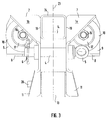
- the coupling device has two leg assemblies 1a, 1b spaced apart from one another (in the view on the right and left, respectively). Bores 3 are formed in the upper apex regions 2 thereof, through which a common connecting bolt 4, which serves as a supporting element and articulation point, leads. This is provided at one end (right) with a grip ring 5 and at its other end (left) with a locking device 6 with a transverse locking pin.
- a front wall 8 and a higher rear wall 7 project from the leg connections 1a, 1b, transversely to the direction of travel (running perpendicular to the plane of the drawing) to the outside.
- a rubber hollow spring 10 with an approximately cylindrical basic shape is inserted between each front and rear wall 8, 7 on a bottom wall 9 located therebetween (cf.
- each leg assembly 1a, 1b is bent outward in an L-shape, the shorter L-leg forming a front skirt 11.
- the front apron 11 is shortened below the rear wall 7 or the front wall 8 by a distance 12 in order to ensure a pivotable articulation of the coupling device via the joint 13.
- the joint 13 is inserted between the leg connections 1a, 1b in their lower regions - forming a spacer, as it were.
- 1 also shows a cross strut 14 (perpendicular to the direction of travel), from the two end regions of which a prong 15 projects vertically upward.
- the prong 15 passes through the hollow rubber spring 10 approximately along its central axis and has at its end 15a protruding from the hollow rubber spring 10 a nut 16 which meshes with the (not visible) screw thread of the tine end 15a.
- a washer 17 is clamped between the upper end face of the hollow rubber spring 10 and the underside of the nut 16, by means of which the hollow rubber spring 10 can be pretensioned downwards.
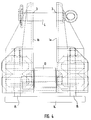
- the left leg assembly 1b according to FIG. 1 is visible in FIG. 2: It consists of a first leg 18 and a second, wider leg 19 rigidly connected thereto in the apex region 2. On the broad side of the first narrower leg 18, which is not visible in FIG.
- the joint 13 bears, the axis of rotation or pivoting of which is formed by means of a screw connection 20 which passes through the first leg 18 via a bore and engages behind by means of a screw nut 21.
- a linkage for pivoting 22 around the screw connection 20 is formed for the first leg (cf. also FIGS. 7 and 8).
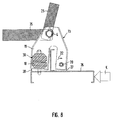
- the coupling device or its two leg assemblies 1a, 1b is designed or arranged symmetrically with respect to an imaginary center plane 23 which is perpendicular to the plane of the drawing in FIG. 3.
- a spacer 24 is inserted between the respective second legs 19 of each leg assembly 1a, 1b, which ensures a distance between the leg assemblies corresponding to the axial longitudinal extension of the joint 13.
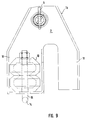
- FIGS. 4-6 the coupling device from FIGS. 1-3 is further illustrated by the fact that the lines which are not visible to the human eye in the respective view (front, side view, top view) are drawn with dashed lines.
- dashed lines For ease of understanding, some of the parts explained with reference to FIGS. 1-3 are provided with the same reference numerals.
- FIGS. 7 u. 8 each of which shows the same side view with different force effects, explained in more detail: the coupling device is hooked and articulated via its connecting bolt 4 in a schematically indicated set-up frame 25 of a vehicle, not shown. Furthermore, the coupling device is connected to the frame part 26 of a machine unit or mower (not shown). On the one hand, the connection takes place via the joint 13, the joint foot 27 of which supports the axle bearing housing and is fixed in place on the surface of the frame part 26. On the other hand, the frame part is arranged between the underside of the bottom wall 9 of the leg assembly 1b or the second leg 19 and the cross strut 14, the prongs 15 of which are guided through a bore in the frame part 26.
- the frame part 26 By tightening the screw nut 16 at the upper end 15a of the tine, the frame part 26 is clamped between the fork arrangement 14, 15 and the underside of the bottom wall 9, with the spring spring 10 being pretensioned or compressed. If the frame part 26 encounters an obstacle during driving operation, it is exposed to a force K opposite to the direction of travel.
- the stand 25 reacts with a corresponding counterforce which acts on the connecting pin 4. Due to the articulation about the hinge axis 20, the leg assembly 1b is given a pivoting movement 22 about the hinge axis 20, the second leg 19 is moved away from the frame part 26 or swung up.
- the bottom wall 9 presses on the hollow spring 10 from below, while the rear wall 7 is pressed from the side onto the outer surface of the hollow rubber spring 10.
- Another advantage is that it is easy to maintain: the coupling device can be removed and replaced easily if the screw connections 20, 21 or 15, 16, 17 are loosened.
- axle bearing housing can be provided with a rubber wall that delimits the cylindrical cavity for the screw connection.
- an adjustment movement which is radial with respect to the pivoting axis 20 is also made possible, which results in a further compensation for external forces or impacts K.
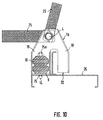
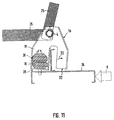
- a simplified embodiment lying within the scope of the invention consists, according to FIGS. 9-11, of omitting the joint 13 attached to it on the first leg.
- the rubber hollow spring 10 alone can in principle make sufficient compensating movements (pivoting 22, lifting 28) enable to a sufficient extent.
- the first leg 18 serves as a stop part with the stop part 32 facing the frame part 26 of the machine unit and possibly also as a carrying and assembly handle.
- the leg 18 is shortened in length compared to the second leg 19, so that when deflected around the rubber hollow spring 10 as a combined articulation and displacement point there is still sufficient free space between the frame part 26 and the leg stop surface 32.
- Such a simplified coupling element is particularly conceivable for the use or for the suspension of sickle mowers.
- the rear wall, front wall and bottom wall 7, 8, 9 are omitted and the rubber hollow spring 10 is replaced by a leaf spring 33.
- the leaf spring 33 also has an upper extension 34, which has a hook-like bend 35 on the connection bolt 4 of the stand 25 is articulated. If the machine unit or its frame part 26 encounters external obstacles, on the one hand the leaf spring 33 is bent accordingly and in addition a pivoting 36 is brought about around the connecting bolt 4.
- the connecting pin 4 as a joint or movement element can also move radially with respect to the machine unit or frame part 26 and thus better compensate for impact forces K on the frame part 26.
- a horizontally extending linear guide 37 is formed in the vehicle trestle 25 (shown schematically).
- this linear guide there is a bending or Articulation point 38 is mounted so that it can be moved back and forth in the horizontal direction of displacement 39.
- a support bracket 40 which is connected to the machine unit frame part 26 in a stationary manner, can be given a pivoting movement 41 if an impact force K acts on the frame part 26 due to external obstacles.
- the end of a helical tension spring 43 is suspended around a pin 42 of the bending or articulation point 38. The other, opposite end of which is attached to a fixed projection 44 of the vehicle trestle 25.
- the support bracket 40 with the frame part 26 attached to it is given a pivoting movement 41 about the bending or articulation point 38 or pin 42; at the same time, a displacement movement 39 is forced on the support bracket or the articulation point, so that the machine unit 26 changes its relative position relative to the vehicle trestle 25 not only rotationally but also translationally.
- the linear guide 37 serving as a moving element changes its relative position with respect to the machine assembly 26 and the joint 38 changes its relative position with respect to the set-up frame 25.
- This combination of rotational and translatory compensating movement makes the bearing components of both the linear guide 37 and the joint 38 largely protected against harmful loads when an external impact force K occurs.
- the spring element 43 counteracts the displacement movement 39 and thus dampens the impact force K; at the same time, it can ensure a reversal of the direction of displacement 39 or a return of the support bracket 40 with articulation point 38 to the starting position.
- the provision and shock compensation can additionally be promoted by a (schematically indicated) compression spring 45, which is installed according to the tension spring 43, but on the opposite side.
Landscapes
- Life Sciences & Earth Sciences (AREA)
- Engineering & Computer Science (AREA)
- Mechanical Engineering (AREA)
- Soil Sciences (AREA)
- Environmental Sciences (AREA)
- Zoology (AREA)
- Harvester Elements (AREA)
- Agricultural Machines (AREA)
Applications Claiming Priority (2)
| Application Number | Priority Date | Filing Date | Title |
|---|---|---|---|
| DE4028777A DE4028777A1 (de) | 1990-09-11 | 1990-09-11 | Kupplungsgeraet oder kupplungselement fuer ein maehwerk, insbesondere sichelmaehwerk |
| DE4028777 | 1990-09-11 |
Publications (3)
| Publication Number | Publication Date |
|---|---|
| EP0476500A2 true EP0476500A2 (fr) | 1992-03-25 |
| EP0476500A3 EP0476500A3 (en) | 1993-05-26 |
| EP0476500B1 EP0476500B1 (fr) | 1998-01-07 |
Family
ID=6414014
Family Applications (1)
| Application Number | Title | Priority Date | Filing Date |
|---|---|---|---|
| EP91115358A Expired - Lifetime EP0476500B1 (fr) | 1990-09-11 | 1991-09-11 | Accouplement d'une faucheuse à la console d'attache d'un véhicule |
Country Status (3)
| Country | Link |
|---|---|
| EP (1) | EP0476500B1 (fr) |
| AT (1) | ATE161677T1 (fr) |
| DE (2) | DE4028777A1 (fr) |
Cited By (3)
| Publication number | Priority date | Publication date | Assignee | Title |
|---|---|---|---|---|
| EP1181855A1 (fr) * | 2000-08-17 | 2002-02-27 | CLAAS Selbstfahrende Erntemaschinen GmbH | Dispositif d'accouplement |
| FR2829353A1 (fr) * | 2001-09-13 | 2003-03-14 | Exel Ind | Dispositif de fixation d'un appareil agricole du type porte sur un engin tracteur |
| EP3150066A1 (fr) * | 2015-09-29 | 2017-04-05 | Exel Industries | Système d'amortissement pour un pulvérisateur agricole suspendu |
Family Cites Families (4)
| Publication number | Priority date | Publication date | Assignee | Title |
|---|---|---|---|---|
| GB1586768A (en) * | 1976-09-22 | 1981-03-25 | Massey Ferguson Services Nv | Rotary cultivators |
| DE2749097A1 (de) * | 1977-11-02 | 1979-05-03 | Kloeckner Humboldt Deutz Ag | Vorrichtung zum aufhaengen eines landwirtschaftlichen anbaugeraetes, insbesondere eines maehwerkes an einen schlepper |
| US4441306A (en) * | 1982-09-01 | 1984-04-10 | Deere & Company | Implement working height-adjustment mechanism |
| DE3632871A1 (de) * | 1986-09-26 | 1988-04-07 | Fischer Helmut Dipl Ing Fh | Sichelmaehgeraet |
-
1990
- 1990-09-11 DE DE4028777A patent/DE4028777A1/de active Granted
-
1991
- 1991-09-11 DE DE59108917T patent/DE59108917D1/de not_active Expired - Fee Related
- 1991-09-11 EP EP91115358A patent/EP0476500B1/fr not_active Expired - Lifetime
- 1991-09-11 AT AT91115358T patent/ATE161677T1/de active
Cited By (3)
| Publication number | Priority date | Publication date | Assignee | Title |
|---|---|---|---|---|
| EP1181855A1 (fr) * | 2000-08-17 | 2002-02-27 | CLAAS Selbstfahrende Erntemaschinen GmbH | Dispositif d'accouplement |
| FR2829353A1 (fr) * | 2001-09-13 | 2003-03-14 | Exel Ind | Dispositif de fixation d'un appareil agricole du type porte sur un engin tracteur |
| EP3150066A1 (fr) * | 2015-09-29 | 2017-04-05 | Exel Industries | Système d'amortissement pour un pulvérisateur agricole suspendu |
Also Published As
| Publication number | Publication date |
|---|---|
| DE59108917D1 (de) | 1998-02-12 |
| DE4028777C2 (fr) | 1992-05-14 |
| EP0476500A3 (en) | 1993-05-26 |
| ATE161677T1 (de) | 1998-01-15 |
| DE4028777A1 (de) | 1991-05-23 |
| EP0476500B1 (fr) | 1998-01-07 |
Similar Documents
| Publication | Publication Date | Title |
|---|---|---|
| EP2042011B1 (fr) | Véhicule de chantier avec dispositif de montage | |
| EP1360886A1 (fr) | Dispositif d'accouplement pour véhicule de travail | |
| DE19818960A1 (de) | Aufhängung eines Vorsatzes | |
| DE1938698A1 (de) | Aufhaengung fuer eine Maeheinheit in einer Landmaschine | |
| EP1266551B1 (fr) | Appareil de travail pour le montage sur véhicule | |
| DE102005055289B3 (de) | Bodenbearbeitungsgerät mit Kurbelschutz | |
| DE10149364B4 (de) | Mähmaschine | |
| DE10113107B4 (de) | Ährenheber für Erntemaschinenmähsysteme | |
| EP0914761B1 (fr) | Véhicule de support avec suspension pour unités de travail montées aux deux cotés | |
| DE1782945C2 (de) | 14.09.67 Niederlande 6712613 Einrichtung zum Befestigen mindestens eines landwirtschaftlichen Gerätes an der Hebevorrichtung eines Landwirtschaftsschleppers Ausscheidung aus: 17 82 942 Landbouwwerktuigen- en Machinefabriek H. Vissers N.V, Nieuw-Vennep (Niederlande) | |
| EP0476500A2 (fr) | Dispositif pour l'attelage d'un dispositif faucheur ou autre dispositif mécanique au console d'attache d'un véhicule | |
| DE4202771C2 (de) | Überlastsicherung von Bodenbearbeitungsmaschinen | |
| DE102021118849B3 (de) | Portalschneidwerk | |
| DE4042401C2 (de) | Kupplungsgerät oder Kupplungselement für ein Mähwerk, insbesondere Sichelmähwerk | |
| EP0161466B1 (fr) | Appareil agricole porté | |
| DE9213458U1 (de) | Tragrahmen | |
| EP3756436B1 (fr) | Relevage avant ainsi que machine de travail doté d'un relevage avant | |
| EP2904888A1 (fr) | Dispositif de support d'équipement pour des machines agricoles | |
| EP1136625B1 (fr) | Dispositif de support d'accessoires pour un véhicule porteur | |
| EP3479669A1 (fr) | Machine agricole | |
| DE60010980T2 (de) | Gartenarbeitsgerät wie Rasenmäher oder dergleichen | |
| DE3739237A1 (de) | Anordnung eines zur kupplung mit zu schleppenden geraeten bestimmten auslegers an einem pflug oder dergl. land- oder forstwirtschaftlichem geraet | |
| DE9210389U1 (de) | Bodenbearbeitungsgerät | |
| EP0440114A2 (fr) | Dispositif d'attelage des outils de nettoyage de routes ou travail de sol aux véhicules | |
| EP0427149A1 (fr) | Dispositif pour la connexion d'une machine agricole à un attelage en trois points |
Legal Events
| Date | Code | Title | Description |
|---|---|---|---|
| PUAI | Public reference made under article 153(3) epc to a published international application that has entered the european phase |
Free format text: ORIGINAL CODE: 0009012 |
|
| AK | Designated contracting states |
Kind code of ref document: A2 Designated state(s): AT BE CH DE DK ES FR GB IT LI LU NL SE |
|
| PUAL | Search report despatched |
Free format text: ORIGINAL CODE: 0009013 |
|
| AK | Designated contracting states |
Kind code of ref document: A3 Designated state(s): AT BE CH DE DK ES FR GB IT LI LU NL SE |
|
| 17P | Request for examination filed |
Effective date: 19931126 |
|
| 17Q | First examination report despatched |
Effective date: 19950424 |
|
| GRAG | Despatch of communication of intention to grant |
Free format text: ORIGINAL CODE: EPIDOS AGRA |
|
| GRAG | Despatch of communication of intention to grant |
Free format text: ORIGINAL CODE: EPIDOS AGRA |
|
| GRAG | Despatch of communication of intention to grant |
Free format text: ORIGINAL CODE: EPIDOS AGRA |
|
| GRAH | Despatch of communication of intention to grant a patent |
Free format text: ORIGINAL CODE: EPIDOS IGRA |
|
| GRAH | Despatch of communication of intention to grant a patent |
Free format text: ORIGINAL CODE: EPIDOS IGRA |
|
| GRAA | (expected) grant |
Free format text: ORIGINAL CODE: 0009210 |
|
| RAP1 | Party data changed (applicant data changed or rights of an application transferred) |
Owner name: MASCHINEN-MOHR INH.: DIPL.-ING. PETER WICKE |
|
| AK | Designated contracting states |
Kind code of ref document: B1 Designated state(s): AT BE CH DE DK ES FR GB IT LI LU NL SE |
|
| PG25 | Lapsed in a contracting state [announced via postgrant information from national office to epo] |
Ref country code: IT Free format text: LAPSE BECAUSE OF FAILURE TO SUBMIT A TRANSLATION OF THE DESCRIPTION OR TO PAY THE FEE WITHIN THE PRE;WARNING: LAPSES OF ITALIAN PATENTS WITH EFFECTIVE DATE BEFORE 2007 MAY HAVE OCCURRED AT ANY TIME BEFORE 2007. THE CORRECT EFFECTIVE DATE MAY BE DIFFERENT FROM THE ONE RECORDED.SCRIBED TIME-LIMIT Effective date: 19980107 Ref country code: NL Free format text: LAPSE BECAUSE OF FAILURE TO SUBMIT A TRANSLATION OF THE DESCRIPTION OR TO PAY THE FEE WITHIN THE PRESCRIBED TIME-LIMIT Effective date: 19980107 Ref country code: ES Free format text: THE PATENT HAS BEEN ANNULLED BY A DECISION OF A NATIONAL AUTHORITY Effective date: 19980107 |
|
| REF | Corresponds to: |
Ref document number: 161677 Country of ref document: AT Date of ref document: 19980115 Kind code of ref document: T |
|
| REG | Reference to a national code |
Ref country code: CH Ref legal event code: NV Representative=s name: ISLER & PEDRAZZINI AG Ref country code: CH Ref legal event code: EP |
|
| REF | Corresponds to: |
Ref document number: 59108917 Country of ref document: DE Date of ref document: 19980212 |
|
| ET | Fr: translation filed | ||
| PG25 | Lapsed in a contracting state [announced via postgrant information from national office to epo] |
Ref country code: DK Free format text: LAPSE BECAUSE OF FAILURE TO SUBMIT A TRANSLATION OF THE DESCRIPTION OR TO PAY THE FEE WITHIN THE PRESCRIBED TIME-LIMIT Effective date: 19980407 Ref country code: SE Free format text: LAPSE BECAUSE OF FAILURE TO SUBMIT A TRANSLATION OF THE DESCRIPTION OR TO PAY THE FEE WITHIN THE PRESCRIBED TIME-LIMIT Effective date: 19980407 |
|
| GBT | Gb: translation of ep patent filed (gb section 77(6)(a)/1977) |
Effective date: 19980320 |
|
| NLV1 | Nl: lapsed or annulled due to failure to fulfill the requirements of art. 29p and 29m of the patents act | ||
| PG25 | Lapsed in a contracting state [announced via postgrant information from national office to epo] |
Ref country code: AT Free format text: LAPSE BECAUSE OF NON-PAYMENT OF DUE FEES Effective date: 19980911 Ref country code: GB Free format text: LAPSE BECAUSE OF NON-PAYMENT OF DUE FEES Effective date: 19980911 Ref country code: LU Free format text: LAPSE BECAUSE OF NON-PAYMENT OF DUE FEES Effective date: 19980911 |
|
| PG25 | Lapsed in a contracting state [announced via postgrant information from national office to epo] |
Ref country code: CH Free format text: LAPSE BECAUSE OF NON-PAYMENT OF DUE FEES Effective date: 19980930 Ref country code: BE Free format text: LAPSE BECAUSE OF NON-PAYMENT OF DUE FEES Effective date: 19980930 Ref country code: LI Free format text: LAPSE BECAUSE OF NON-PAYMENT OF DUE FEES Effective date: 19980930 |
|
| PLBE | No opposition filed within time limit |
Free format text: ORIGINAL CODE: 0009261 |
|
| STAA | Information on the status of an ep patent application or granted ep patent |
Free format text: STATUS: NO OPPOSITION FILED WITHIN TIME LIMIT |
|
| PGFP | Annual fee paid to national office [announced via postgrant information from national office to epo] |
Ref country code: DE Payment date: 19981125 Year of fee payment: 8 |
|
| 26N | No opposition filed | ||
| BERE | Be: lapsed |
Owner name: MASCHINEN-MOHR PETER WICKE Effective date: 19980930 |
|
| GBPC | Gb: european patent ceased through non-payment of renewal fee |
Effective date: 19980911 |
|
| REG | Reference to a national code |
Ref country code: CH Ref legal event code: PL |
|
| PG25 | Lapsed in a contracting state [announced via postgrant information from national office to epo] |
Ref country code: FR Free format text: LAPSE BECAUSE OF NON-PAYMENT OF DUE FEES Effective date: 19990531 |
|
| REG | Reference to a national code |
Ref country code: FR Ref legal event code: ST |
|
| PG25 | Lapsed in a contracting state [announced via postgrant information from national office to epo] |
Ref country code: DE Free format text: LAPSE BECAUSE OF NON-PAYMENT OF DUE FEES Effective date: 20000701 |