EP0476572A2 - Matériaux composites à partir de carbure de tantale - Google Patents
Matériaux composites à partir de carbure de tantale Download PDFInfo
- Publication number
- EP0476572A2 EP0476572A2 EP91115704A EP91115704A EP0476572A2 EP 0476572 A2 EP0476572 A2 EP 0476572A2 EP 91115704 A EP91115704 A EP 91115704A EP 91115704 A EP91115704 A EP 91115704A EP 0476572 A2 EP0476572 A2 EP 0476572A2
- Authority
- EP
- European Patent Office
- Prior art keywords
- tantalum carbide
- copper
- aluminum
- tac
- composite material
- Prior art date
- Legal status (The legal status is an assumption and is not a legal conclusion. Google has not performed a legal analysis and makes no representation as to the accuracy of the status listed.)
- Withdrawn
Links
Images


Classifications
-
- H—ELECTRICITY
- H01—ELECTRIC ELEMENTS
- H01J—ELECTRIC DISCHARGE TUBES OR DISCHARGE LAMPS
- H01J37/00—Discharge tubes with provision for introducing objects or material to be exposed to the discharge, e.g. for the purpose of examination or processing thereof
- H01J37/32—Gas-filled discharge tubes
- H01J37/32431—Constructional details of the reactor
- H01J37/32532—Electrodes
- H01J37/3255—Material
-
- C—CHEMISTRY; METALLURGY
- C22—METALLURGY; FERROUS OR NON-FERROUS ALLOYS; TREATMENT OF ALLOYS OR NON-FERROUS METALS
- C22C—ALLOYS
- C22C29/00—Alloys based on carbides, oxides, nitrides, borides, or silicides, e.g. cermets, or other metal compounds, e.g. oxynitrides, sulfides
- C22C29/02—Alloys based on carbides, oxides, nitrides, borides, or silicides, e.g. cermets, or other metal compounds, e.g. oxynitrides, sulfides based on carbides or carbonitrides
- C22C29/06—Alloys based on carbides, oxides, nitrides, borides, or silicides, e.g. cermets, or other metal compounds, e.g. oxynitrides, sulfides based on carbides or carbonitrides based on carbides, but not containing other metal compounds
-
- H—ELECTRICITY
- H05—ELECTRIC TECHNIQUES NOT OTHERWISE PROVIDED FOR
- H05H—PLASMA TECHNIQUE; PRODUCTION OF ACCELERATED ELECTRICALLY-CHARGED PARTICLES OR OF NEUTRONS; PRODUCTION OR ACCELERATION OF NEUTRAL MOLECULAR OR ATOMIC BEAMS
- H05H1/00—Generating plasma; Handling plasma
- H05H1/24—Generating plasma
- H05H1/26—Plasma torches
- H05H1/32—Plasma torches using an arc
- H05H1/34—Details, e.g. electrodes, nozzles
-
- H—ELECTRICITY
- H05—ELECTRIC TECHNIQUES NOT OTHERWISE PROVIDED FOR
- H05H—PLASMA TECHNIQUE; PRODUCTION OF ACCELERATED ELECTRICALLY-CHARGED PARTICLES OR OF NEUTRONS; PRODUCTION OR ACCELERATION OF NEUTRAL MOLECULAR OR ATOMIC BEAMS
- H05H1/00—Generating plasma; Handling plasma
- H05H1/24—Generating plasma
- H05H1/26—Plasma torches
- H05H1/32—Plasma torches using an arc
- H05H1/34—Details, e.g. electrodes, nozzles
- H05H1/40—Details, e.g. electrodes, nozzles using applied magnetic fields, e.g. for focusing or rotating the arc
-
- Y—GENERAL TAGGING OF NEW TECHNOLOGICAL DEVELOPMENTS; GENERAL TAGGING OF CROSS-SECTIONAL TECHNOLOGIES SPANNING OVER SEVERAL SECTIONS OF THE IPC; TECHNICAL SUBJECTS COVERED BY FORMER USPC CROSS-REFERENCE ART COLLECTIONS [XRACs] AND DIGESTS
- Y10—TECHNICAL SUBJECTS COVERED BY FORMER USPC
- Y10T—TECHNICAL SUBJECTS COVERED BY FORMER US CLASSIFICATION
- Y10T428/00—Stock material or miscellaneous articles
- Y10T428/12—All metal or with adjacent metals
- Y10T428/12486—Laterally noncoextensive components [e.g., embedded, etc.]
Definitions
- This invention relates to a tantalum carbide composite material developed for use as an electrode in high temperature/high current density applications.
- the material is especially suitable for plasma torches which use a reactive plasmagas.
- a new process for manufacturing this material is also disclosed.
- Electrode lifetime in general and cathode performance in particular has long been recognized as one of the most important considerations affecting the viability of a plasma process. Rapid electrode deterioration can diminish the value of a process both from an economic and a technical point of view. Consequently, parameters such as the frequency of reactor "down-time" for electrode replacement, the cost of electrodes, and the contamination of products with materials emitted from the electrodes, are crucial in determining the ultimate success of plasma technology. Of even greater importance is the stability of the plasma, which can be greatly affected by phenomena occurring on the surface of the cathode.
- all electrode plasma torches i.e. transferred arcs and d.c. arcs but not induction plasmas which are electrodeless torches
- Alloying elements such as silver for copper and thoria for tungsten, are commonly used in concentrations up to 2%. These elements reduce the cathodes work function (a measure of the material's ability to emit electrons) thus allowing the cathode to operate at lower temperatures and minimum erosion rates.
- Carbon electrodes do not include alloying elements. Thus, they have a relatively high work function (5.0 eV), exhibit high erosion rates and are referred to as a consumable electrode.
- the work function of tungsten is much lower at around 4.5 eV. However, pure tungsten would still erode rapidly in a plasma torch.
- the addition of 1% thoria can reduce the cathodic work function to below 3.0 eV allowing for a much more stable operation.
- Thoriated tungsten is the preferred cathode for thermionic emitting plasma torches.
- Metal halide gases such as TiCl4, NbCl5, etc.
- TiCl4, NbCl5, etc. are extremely corrosive at high temperatures.
- they react extensively with the cathode material. These reactions are deleterious to the plasma stability not only due to the mass loss occurring at the electrode but also due to the production of reduced metals (such as Ti and Nb) which blanket the electrode, increase its work function and ultimately suffocate the electron emission process.
- a stable electrode for plasma torches operating on metal halide plasmagas must not react with such gases even at the extremely high temperatures characteristic of the cathode's surface (around 3,700°C). It must also posses a low work function, high melting and vaporizing temperatures, good thermal and electrical conductivity, and high resistance to thermal shock.
- Tantalum carbide is a refractory material whose melting and boiling temperatures are 3,850°C and 5,470°C respectively. It also possesses an extremely low thermionic work function of around 3.8 eV. Compared to most ceramics, it is an excellent conductor with a room-temperature electrical resistivity of only 25 microhm-cm and a thermal conductivity of 21 W/(m.K). Finally, it is extremely resistant to chemical attack by the chlorides even at high temperatures.
- tantalum carbide Despite all the excellent properties of tantalum carbide, its performance as an electrode is rather unsatisfactory. It is highly susceptible to shattering upon arc ignition due to thermal shock. During operation, its thermal conductivity is too low to dissipate the enormous amount of energy absorbed at the electrodes, resulting in local melting. Due to its high melting temperature, it is a difficult material to sinter to high relative densities. Relative densities of only 50-65% were achieved by sintering for half hour at temperatures up to 2,000°C. The relative density can be increased to 75-80% by sintering for half hour at temperatures over 2,400°C. The material at low relative densities has poor strength and significantly reduced electrical and thermal conductivities, further contributing to the shattering and melting observed upon arc ignition. Finally, the material is very hard and brittle making it very difficult to shape into useful electrodes.
- a tantalum carbide composite material prepared by infiltrating a tantalum carbide preform with a relatively low melting temperature metal possessing complementary properties to the ceramic (i.e. high thermal shock resistance, high thermal and electrical conductivities, and good electron emitting properties).
- a relatively low melting temperature metal possessing complementary properties to the ceramic (i.e. high thermal shock resistance, high thermal and electrical conductivities, and good electron emitting properties).
- Aluminum and copper have been used as the infiltrating material.
- Various alloys of either aluminum or copper can also be used.
- Other metals, such as gold and silver may also be used.
- the TaC preform should be sintered prior to infiltration.
- TaC powder 10 about 1 ⁇ in size is pressed to form a TaC green body 12.
- the green body can then be sintered for 1/2 hr. at a temperature between 1,900°C and 2,500°C to form a TaC sintered preform 14.
- the density of the TaC preform after sintering is preferably from around 50% to over 80% and the preform is preferably reduced in size accordingly.
- Infiltration of non-sintered green bodies is also possible if high ceramic densities are not required.
- the infiltration can be accomplished by heating the TaC preform in a molten metal bath 16 at temperatures above 1,100°C and below 2,000°C. The optimum temperature for infiltration appears to be around 1,500°C.
- a graphite crucible 18 maintained under an inert gas atmosphere was used to contain the molten bath.
- the resulting TaC composite material was machined to the shape of an electrode 20 which had excellent properties relevant to its application as an electrode in a plasma torch.
- TaC composite electrodes Two examples were manufactured and tested. The first composite used aluminum as the infiltrating metal, whereas copper was used in the second. Both composites were very strong, had good thermal and electrical conductivities, were highly resistant to thermal shock (no cracking was observed upon arc ignition), and were easily machinable to desired shapes. Some properties of these materials are listed in the following Table I. TABLE I.
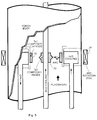
- the composite materials were made into electrodes (both anode and cathode) and tested in a plasma torch, shown schematically in Figure 3.
- the arc is operated between a TaC composite anode 30 and a TaC composite cathode 32 and rotated using a magnetic coil 34.
- the plasmagas flows radially through the electrodes' region. H2O is used for cooling the electrodes.
- Two plasmagas compositions were used for the tests. Pure argon plasmagas was used to assess the cathode's performance in an inert plasma, and argon containing 10-15% TiCl4 plasmagas was used to assess the electrodes' performance in a metal halide plasma.
- the performance of the new electrode materials were quite satisfactory. Stable operation and low erosion rates were observed under all experimental conditions investigated. Four examples of operating data, including electrode erosion data, are reported below:
- PURPOSE To evaluate the performance of TaC/Al composite electrodes in a plasma torch, using inert plasmagas.
- Plasmagas Argon at 8 L/min Duration : 60 minutes
- Arc Voltage 30 Volts
- Arc Current 100 Amps
- Arc Rotation 900 rpm
- Anode Erosion Rate 0.55 g/C
- Cathode Erosion Rate 1.3 g/C
- Plasmagas 15 L/min Argon + 23 g/min TiCl4 Duration: 20 minutes
- Arc Voltage 50 Volts
- Arc Current 100 Amps
- Arc Rotation Period 900 rpm
- Anode Erosion Rate 6.6 g/C
- Cathode Erosion Rate 25 g/C
- PURPOSE To evaluate the performance of TaC/Cu composite electrodes in a plasma torch, using inert plasmagas.
- Plasmagas Argon at 15 L/min Duration: 20 minutes
- Arc Voltage 26 Volts
- Arc Current 100 Amps
- Arc Rotation Period 1200 rpm
- Anode Erosion Rate 0.28 g/C
- Cathode Erosion Rate 0.40 g/C
- Plasmagas 15 L/min Argon + 15 g/min TiCl4 Duration: 10 minutes Arc Voltage: 42 Volts Arc Current: 100 Amps Arc Rotation Period: 1100 rpm Anode Erosion Rate: 3.4 g/C Cathode Erosion Rate: 16 g/C
Landscapes
- Engineering & Computer Science (AREA)
- Chemical & Material Sciences (AREA)
- Plasma & Fusion (AREA)
- Physics & Mathematics (AREA)
- Materials Engineering (AREA)
- Analytical Chemistry (AREA)
- Spectroscopy & Molecular Physics (AREA)
- Mechanical Engineering (AREA)
- Metallurgy (AREA)
- Organic Chemistry (AREA)
- Plasma Technology (AREA)
- Ceramic Products (AREA)
- Manufacture And Refinement Of Metals (AREA)
- Manufacture Of Alloys Or Alloy Compounds (AREA)
- Coating By Spraying Or Casting (AREA)
Applications Claiming Priority (2)
| Application Number | Priority Date | Filing Date | Title |
|---|---|---|---|
| CA002025619A CA2025619C (fr) | 1990-09-18 | 1990-09-18 | Materiaux composites a base de carbure de tantale |
| CA2025619 | 1990-09-18 |
Publications (2)
| Publication Number | Publication Date |
|---|---|
| EP0476572A2 true EP0476572A2 (fr) | 1992-03-25 |
| EP0476572A3 EP0476572A3 (en) | 1993-01-20 |
Family
ID=4146001
Family Applications (1)
| Application Number | Title | Priority Date | Filing Date |
|---|---|---|---|
| EP19910115704 Withdrawn EP0476572A3 (en) | 1990-09-18 | 1991-09-16 | Tantalum carbide composite materials |
Country Status (4)
| Country | Link |
|---|---|
| US (1) | US5196273A (fr) |
| EP (1) | EP0476572A3 (fr) |
| JP (1) | JPH04231394A (fr) |
| CA (1) | CA2025619C (fr) |
Cited By (3)
| Publication number | Priority date | Publication date | Assignee | Title |
|---|---|---|---|---|
| WO2000005931A1 (fr) * | 1998-07-20 | 2000-02-03 | Hypertherm, Inc. | Electrode pour chalumeau a arc de plasma dotee d'une piece inseree a configuration amelioree |
| CN107963887A (zh) * | 2017-12-06 | 2018-04-27 | 中国人民解放军国防科技大学 | 碳化钽陶瓷先驱体制备方法 |
| EP4606332A1 (fr) | 2024-02-23 | 2025-08-27 | Erbe Elektromedizin GmbH | Sonde à plasma |
Families Citing this family (1)
| Publication number | Priority date | Publication date | Assignee | Title |
|---|---|---|---|---|
| US5511603A (en) * | 1993-03-26 | 1996-04-30 | Chesapeake Composites Corporation | Machinable metal-matrix composite and liquid metal infiltration process for making same |
Family Cites Families (8)
| Publication number | Priority date | Publication date | Assignee | Title |
|---|---|---|---|---|
| US1918212A (en) * | 1930-10-08 | 1933-07-11 | Gen Electric | Method for making hard metal compositions |
| US2922721A (en) * | 1956-04-02 | 1960-01-26 | Sintercast Corp America | Method for coating and infiltrating a porous refractory body |
| US3553820A (en) * | 1967-02-21 | 1971-01-12 | Union Carbide Corp | Method of producing aluminum-carbon fiber composites |
| FR2038858A5 (fr) * | 1969-03-31 | 1971-01-08 | Combustible Nucleaire | |
| US4469654A (en) * | 1980-02-06 | 1984-09-04 | Minnesota Mining And Manufacturing Company | EDM Electrodes |
| JPS5922469A (ja) * | 1982-07-29 | 1984-02-04 | Nippon Telegr & Teleph Corp <Ntt> | 遅延検波回路 |
| SU1574414A1 (ru) * | 1987-05-04 | 1990-06-30 | Краматорский Индустриальный Институт | Электрод дл плазменной обработки |
| US4803334A (en) * | 1987-11-16 | 1989-02-07 | Westinghouse Electric Corp. | Method for laser beam welding metal matrix composite components |
-
1990
- 1990-09-18 CA CA002025619A patent/CA2025619C/fr not_active Expired - Fee Related
-
1991
- 1991-05-13 US US07/698,898 patent/US5196273A/en not_active Expired - Lifetime
- 1991-09-16 EP EP19910115704 patent/EP0476572A3/en not_active Withdrawn
- 1991-09-17 JP JP3236555A patent/JPH04231394A/ja active Pending
Cited By (5)
| Publication number | Priority date | Publication date | Assignee | Title |
|---|---|---|---|---|
| WO2000005931A1 (fr) * | 1998-07-20 | 2000-02-03 | Hypertherm, Inc. | Electrode pour chalumeau a arc de plasma dotee d'une piece inseree a configuration amelioree |
| US6130399A (en) * | 1998-07-20 | 2000-10-10 | Hypertherm, Inc. | Electrode for a plasma arc torch having an improved insert configuration |
| CN107963887A (zh) * | 2017-12-06 | 2018-04-27 | 中国人民解放军国防科技大学 | 碳化钽陶瓷先驱体制备方法 |
| CN107963887B (zh) * | 2017-12-06 | 2019-11-22 | 中国人民解放军国防科技大学 | 碳化钽陶瓷先驱体制备方法 |
| EP4606332A1 (fr) | 2024-02-23 | 2025-08-27 | Erbe Elektromedizin GmbH | Sonde à plasma |
Also Published As
| Publication number | Publication date |
|---|---|
| JPH04231394A (ja) | 1992-08-20 |
| CA2025619C (fr) | 1996-09-17 |
| EP0476572A3 (en) | 1993-01-20 |
| US5196273A (en) | 1993-03-23 |
| CA2025619A1 (fr) | 1992-03-19 |
Similar Documents
| Publication | Publication Date | Title |
|---|---|---|
| US4084942A (en) | Ultrasharp diamond edges and points and method of making | |
| EP0569407B1 (fr) | Electrode composite utilisee dans un traitement electrochimique et procede pour sa preparation par synthese de combustion sans filiere | |
| US4164680A (en) | Polycrystalline diamond emitter | |
| EP0465128B1 (fr) | Matériau composite à base d'argent ou d'alliage argent-cuivre et des oxydes métalliques ainsi que son procédé de préparation | |
| US5911919A (en) | Electron emission materials and components | |
| US2983996A (en) | Copper-tungsten-molybdenum contact materials | |
| US6350294B1 (en) | Powder-metallurgically produced composite material and method for its production | |
| CA2341779A1 (fr) | Matiere inerte, sous forme de poudre nanocristalline, pour fabrication d'electrodes | |
| CN87100389A (zh) | 真空阀用接点材料及其制造方法 | |
| CA1134457A (fr) | Electrode non consomptible pour le soudage a l'arc au plasma, et methode de fabrication connexe | |
| WO1996002062A1 (fr) | Structure d'electrode | |
| US4500406A (en) | Inert electrode connection | |
| EP1091009B1 (fr) | Alliage pour contacts électriques et électrodes et procédé pour sa préparation | |
| US5196273A (en) | Tantalum carbide composite materials | |
| EP1726386B1 (fr) | Procédé de fabrication et utilisation d'assemblage de barres comme charge d'alimentation dans un procédé de fusion | |
| US6051165A (en) | Electron emission materials and components | |
| EP0334981B1 (fr) | Matériau d'électrode à décharge | |
| JP2020521294A (ja) | 陰極材料 | |
| EP0460680B1 (fr) | Contact pour un interrupteur à vide | |
| GB2106141A (en) | Contactor for vacuum type circuit interrupter | |
| US4088480A (en) | Process for preparing refractory metal-silver-cadmium alloys | |
| Gao et al. | Characteristics and electrode erosion rates of a DC plasma torch operating with TiCl4 plasma gas | |
| EP0140979B1 (fr) | Alliage contenant des especes d'ions de metal liquide | |
| US5124528A (en) | Gas tungsten and plasma arc welding electrode having a carbide emitter end | |
| EP0675514B1 (fr) | Composition pour contacts électriques et méthode de fabrication |
Legal Events
| Date | Code | Title | Description |
|---|---|---|---|
| PUAI | Public reference made under article 153(3) epc to a published international application that has entered the european phase |
Free format text: ORIGINAL CODE: 0009012 |
|
| AK | Designated contracting states |
Kind code of ref document: A2 Designated state(s): DE FR GB IT |
|
| PUAL | Search report despatched |
Free format text: ORIGINAL CODE: 0009013 |
|
| AK | Designated contracting states |
Kind code of ref document: A3 Designated state(s): DE FR GB IT |
|
| STAA | Information on the status of an ep patent application or granted ep patent |
Free format text: STATUS: THE APPLICATION IS DEEMED TO BE WITHDRAWN |
|
| 18D | Application deemed to be withdrawn |
Effective date: 19930721 |