EP0476876A2 - Verfahren zur zerstörungsfreien Wärmebehandlung gewickelter silberbeschichteter Hochtemperatursupraleiter - Google Patents
Verfahren zur zerstörungsfreien Wärmebehandlung gewickelter silberbeschichteter Hochtemperatursupraleiter Download PDFInfo
- Publication number
- EP0476876A2 EP0476876A2 EP91308005A EP91308005A EP0476876A2 EP 0476876 A2 EP0476876 A2 EP 0476876A2 EP 91308005 A EP91308005 A EP 91308005A EP 91308005 A EP91308005 A EP 91308005A EP 0476876 A2 EP0476876 A2 EP 0476876A2
- Authority
- EP
- European Patent Office
- Prior art keywords
- wire
- superconductor
- spool
- silver
- cladding
- Prior art date
- Legal status (The legal status is an assumption and is not a legal conclusion. Google has not performed a legal analysis and makes no representation as to the accuracy of the status listed.)
- Withdrawn
Links
Images

Classifications
-
- H—ELECTRICITY
- H10—SEMICONDUCTOR DEVICES; ELECTRIC SOLID-STATE DEVICES NOT OTHERWISE PROVIDED FOR
- H10N—ELECTRIC SOLID-STATE DEVICES NOT OTHERWISE PROVIDED FOR
- H10N60/00—Superconducting devices
- H10N60/01—Manufacture or treatment
- H10N60/0268—Manufacture or treatment of devices comprising copper oxide
- H10N60/0801—Manufacture or treatment of filaments or composite wires
-
- Y—GENERAL TAGGING OF NEW TECHNOLOGICAL DEVELOPMENTS; GENERAL TAGGING OF CROSS-SECTIONAL TECHNOLOGIES SPANNING OVER SEVERAL SECTIONS OF THE IPC; TECHNICAL SUBJECTS COVERED BY FORMER USPC CROSS-REFERENCE ART COLLECTIONS [XRACs] AND DIGESTS
- Y10—TECHNICAL SUBJECTS COVERED BY FORMER USPC
- Y10S—TECHNICAL SUBJECTS COVERED BY FORMER USPC CROSS-REFERENCE ART COLLECTIONS [XRACs] AND DIGESTS
- Y10S505/00—Superconductor technology: apparatus, material, process
- Y10S505/70—High TC, above 30 k, superconducting device, article, or structured stock
- Y10S505/704—Wire, fiber, or cable
Definitions
- the present invention relates generally to methods and apparatus for manufacturing superconductor wire. More particularly, the present invention relates to methods and apparatus for manufacturing high transition temperature superconductor wire. The present invention relates particularly, though not exclusively, to methods and apparatus for heat processing and oxygenation of cladded, high transition temperature superconductor wires.
- the protective cladding is itself electrically conductive, in order to enhance the electrical conductivity of the superconductor wire as well as protect the wire.
- One method for encasing a superconductor wire in a protective cladding is disclosed in co-pending U.S. patent application for an invention entitled "Anhydrous Electrophoretic Silver Coating Technique" which is assigned to the same assignee as the present invention.
- Silver is ordinarily the preferred protective cladding material when the superconductor material is a ceramic, because silver will not readily react with the ceramic superconductor material. This is important because any reaction or interdiffusion of material between the protective cladding and the ceramic superconductor will adversely affect the superconducting properties of the superconductor. Additionally, silver is preferred because silver can establish an effective protective cladding which substantially blocks the diffusion of water, carbon dioxide, and other environmental impurities through the silver cladding and into the ceramic superconductor. Also, silver can form a low contact resistance electrical contact to the high temperature superconductors as well as to normally conductive material such as copper or solder, normally used for electrical current transport. Thus, silver is an ideal bridging material between the superconductor and other conductive materials.
- Silver does not, however, prevent the diffusion of oxygen through the protective cladding into the ceramic superconductor. This is desirable, because such oxygen diffusion is necessary in order to properly establish the oxygen content of the superconductor incident to the manufacturing process.
- x has values from zero to one (0-1).
- the superconductor in order to effectively operate as a superconductor at as high a temperature as possible, it is necessary that the superconductor be oxidized after the manufacturing process to establish a value for x that is as close to zero as possible.
- the transition temperature for the 1-2-3 superconductor is about ninety Kelvins (90 K) when x is zero, but is substantially reduced when x is greater than 0.3. Accordingly, ceramic 1-2-3 superconductors, including those which have a silver coating, are typically heated for a relatively lengthy period, e.g., several days, to establish an optimum oxygen concentration in the superconductor.
- the spool of wire is heated in the furnace, e.g., to oxygenate the superconductor in the case of 1-2-3 superconductor, or to sinter the superconductor at elevated temperatures in the case of bismuth-based superconductors
- this overlapping contact between portions of the wire allows the silver cladding material from one portion of the wire to diffuse into the silver cladding of other portions of the wire with which it is in contact.
- This diffusion of silver can not only impair the protective characteristics of the silver cladding, but also prevent an effective unspooling of the oxygenated wire because adjacent portions of the silver cladding can stick together.
- the present invention recognizes that a method can be provided to substantially prevent the diffusion of material between portions of a silver cladding which are in contact with each other during the superconductor oxidation process.
- a further object of the present invention is to provide a method for heat treating silver clad spooled superconductor wire which will result in wires which are not stuck together and not broken so that the wires may be unspooled as long continuous lengths of high quality superconductor wire.
- the invention provides a method for heat treating a superconductor wire having a protective cladding, which is characterised by comprising the steps of: depositing a diffusion inhibiting material on said protective cladding; winding said wire around the periphery of a spool; and heating said wire on said spool to a predetermined temperature for a predetermined time to heat process said superconductor wire.
- a method for heat processing a high transition temperature (high-T c ) superconductor wire which has a protective silver cladding includes depositing a layer of diffusion inhibiting material onto the silver cladding.
- the wire is then wound around the periphery of a spool in juxtaposed coils, i.e. portions of the silver cladding of the superconductor wire can contact other portions of the silver cladding.
- the spool and wire are then placed in a furnace and heated as appropriate to oxidize or sinter the superconductor material.
- silver is prevented from diffusing between the juxtaposed portions of the silver-clad wire during the heating process by the layer of diffusion inhibiting material.
- the present invention also provides an apparatus for heat processing a superconductor wire in accordance with the method described above. More particularly, the apparatus includes a base on which is mounted a container that holds a paint comprising a diffusion inhibiting material, preferably a rare earth oxide, and a cellulose-based binder material which are dissolved together in a non-aqueous alcohol-based solution.
- a vat which also contains the non-aqueous alcohol-based paint is connected in fluid communication with the container via a pair of fluid lines.
- a pump is connected to one of the fluid lines between the vat and the container and is operable to circulate the paint between the vat and container. Consequently, the paint in the container can be replenished during the deposition process with paint from the vat.
- the apparatus also includes a spool rotatably mounted on the base above the container which has a spongy metal mesh positioned on its outer surface to accommodate structural strains which can arise from different thermal expansions of the spool and wire during subsequent oxygenation or sintering processes.
- one end of the wire is attached to the spool, and the spool is rotated to draw the wire through the container.
- the paint which is held in the container comes into contact with the wire as the wire is drawn through the container, the paint adheres to the silver cladding.
- the paint dries before the wire is wound onto the spool. Consequently, a layer of dried paint is left on the silver cladding of the wire.
- the spool is rotated, successive portions of the wire are drawn sequentially through the paint container and are then wound around the spool into a coiled configuration.
- the spongy metal mesh is positioned between the coils of superconducting wire and the outer surface of the spool.
- the spool of superconductor wire can then be placed into a furnace where the superconductor wire is heat processed.
- a superconductor wire which has been heat processed in accordance with the method described above is also disclosed.
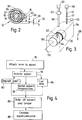
- an apparatus for processing a superconductor wire is shown and generally designated 10. As shown schematically, apparatus 10 is used to deposit a diffusion bonding inhibitor paint onto a silver-cladded superconductor wire 12.
- superconductor wire 12 can be any suitable wire which includes a ceramic superconductor material having a superconducting transition temperature above about twenty (20) Kelvins.
- superconductor wire 12 includes a metallic substrate 14 which has a diameter 16 of approximately fifty (50) to one hundred fifty (150) microns.
- the material of substrate 14 is preferably Duranickel 301, or any of the materials listed in the table below:
- substrate 14 can be made of alloys having 3 compositions such as; Ni 1-x Al x (x ⁇ .25); Ni x Al y B z (.6 ⁇ x, .1 ⁇ y ⁇ .25, and z ⁇ .1); and Ni x Al y Cu z (.6 ⁇ x, y ⁇ .25, and z ⁇ .25).
- Superconductor wire 12 is also shown in Figure 2 to include diffusion barrier 18, which has a thickness 20 of approximately one (1) to twenty (20) microns.
- Diffusion barrier 18 is any material which is chemically compatible with ceramic superconductor layer 22, and which substantially prevents the diffusion of material from substrate 14 to ceramic layer 22.
- diffusion barrier 18 is NdBa2Cu3O 7-x , where x is from 0 to 0.5.
- ceramic superconductor layer 22 is made of REBa2Cu3O 7-x , where RE is selected from the group consisting of yttrium and elements having an atomic number of fifty-seven (57) to seventy-one (71), inclusive, and x is from 0 to .5, inclusive.
- superconductor layer 22 is DyBa2Cu3O 7-x , where x is from 0 to 0.5 and has a thickness 24 of approximately fifty (50) to one hundred fifty (150) microns.
- ceramic superconductor layer 22 is encased in a protective cladding 26, which has a thickness 28 of approximately one (1) to twenty-five (25) microns.
- cladding 26 is silver which has been sintered into a dense, coherent protective cladding that substantially prevents the diffusion of water and other impurities (e.g., carbon dioxide) through protective silver cladding 26 to ceramic superconductor layer 22.
- impurities e.g., carbon dioxide
- silver cladding 26 does not substantially prevent the elevated temperature diffusion of oxygen through cladding 26 to superconductor layer 22.
- the method by which diffusion barrier 18, superconductor layer 22, and silver cladding 26 are deposited onto substrate 14 is disclosed in co-pending U.S.
- FIG 2 shows that after the diffusion inhibiting layer deposition step of the present invention, but before wire 12 is heated, wire 12 also includes a diffusion inhibiting layer 30, which has a thickness 32 of approximately ten to thirty (10-30) microns.
- diffusion inhibiting layer 30 in Figure 2 consists of a diffusion inhibiting material, a binder material, and excess solvent which has not dried.
- diffusion inhibiting layer 30 includes a diffusion inhibiting material which is chemically compatible with silver cladding 26, and which substantially prevents the diffusion of silver through diffusion inhibiting layer 30 when silver cladding 26 is heated.
- the diffusion inhibiting material of layer 30 is a ceramic, preferably yttria or a rare earth oxide.
- diffusion inhibiting layer 30 can be zirconia or boron nitride, or other appropriate material that does not chemically react with silver at the subsequent elevated temperatures to which the material will be subjected.
- the diffusion inhibiting material of layer 30 could be neodymium oxide, which is blue, or praseodymium oxide, which is black. It will be appreciated that the use of a non-white diffusion inhibiting material facilitates visual inspection of layer 30 against the substantially white background of the silver cladding 26.
- apparatus 10 is shown to include a base 33 on which a container 34 is mounted.
- a wire supply spool 35 which supplies the preferred starting wire material 11 is rotatably mounted on base 33.
- wire 11 can be positioned in container 34.
- container 34 can be formed with a leak-proof diaphragm 36, shown in phantom in Figure 1.
- container 34 holds a liquid paint 38. Paint 38 is a non-aqueous solution in which the material that is to form diffusion inhibiting layer 30 is dissolved.
- paint 38 includes a non-aqueous solvent, e.g., isopropanol, octanol, or diglyme ether/alcohol solution, and a suitable ceramic diffusion inhibiting material (e.g., yttria, rare earth oxide, zirconia, boron nitride). Also, paint 38 includes a suitable binder material, e.g. a cellulose-based binder, to more firmly adhere the diffusion inhibiting material to silver cladding 26. Such a paint is commercially available from ZYP Coatings Inc. as type YK yttrium oxide paint.
- Figure 1 also shows that container 34 is connected in fluid communication with a vat 40 through lines 42, 44.
- Vat 40 also holds paint 38. Paint 38 can be circulated between vat 40 and container 34 through lines 42, 44 by a pump 46. Accordingly, paint 38 in container 34 is continually replenished from vat 40.
- a magnetic stirrer 40 which is positioned externally to vat 40 causes magnetic stir bar 50, shown in phantom as being immersed in the vat 40, to rotate and thereby stir and mix paint 38.
- Figure 1 also shows that wire 12 is wound around a spool 60, which is removably rotatably mounted on base 33. It is to be appreciated that relatively long production lengths of wire 12 can be positioned on spool 60, e.g., upwards of five thousand (5000) meters of wire 12 can be wound onto spool 60.
- Spool 60 is made of a suitable metal, e.g., steel, aluminum, or inconel, that can withstand the elevated temperatures required for processing the appropriate superconductor material.
- spool 60 has a spongy metal mesh 62 positioned on the outer surface 64 of spool 60.
- Metal mesh 62 is positioned between wire 12 and outer surface 64 of spool 60 to cushion wire 12 during the heat processing method described below. Stated differently, spongy metal mesh 62 absorbs thermally-induced dimensional changes of both wire 12 and spool 60, to prevent undesired stretching of wire 12 and the consequent potential breaking of wire 12 as spool 60 expands during the heat processing of wire 12.
- spongy metal mesh 62 is a mesh made of 304 stainless steel fiber which has a fiber diameter of about eight (8) microns and which is marketed as "needle punched web" by the Technetics Corporation.
- Figure 1 shows that wire 12 is wound around spool 60 in a juxtaposed spooled configuration in a plurality of coils 70. More specifically, taking juxtaposed coils 70a, 70b as examples, coils 70a, 70b contact each other at a point 72. Although not shown in Figure 1, coils 70a, 70b can contact each other at other points in addition to point 72. Moreover, it is to be appreciated that while Figure 1 shows that coils 70a, 70b are in lateral contact with each other with respect to arrow 68, coils 70a, 70b can also overlap each other.
- FIG. 3 shows that spool 60 can be positioned in a furnace 74.
- Furnace 74 is any suitable device which can heat wire 12 to a temperature which is sufficient for the particular heat treatment of wire 12.
- a vacuum pump 59 is connected in fluid communication with furnace 74 via a line 61 for the purpose of evacuating the interior of furnace 74.
- a source 63 of oxygen is connected in fluid communication to furnace 74 via line 65.
- a pressure regulator 67 can be attached to line 65 to regulate the pressure of oxygen within furnace 74.
- Figure 3 shows that after wire 12 has been wound onto spool 60, spool 60 is removed from apparatus 10 and placed inside furnace 74.
- spool 60 is oriented in furnace 74 with axis 66 of spool 60 substantially horizontal to the direction of the force of gravity on spool 60, represented by arrow 68.
- starter wire 11 is positioned through container 34 and attached to spool 60.
- metal mesh 62 is disposed between wire 11 and outer surface 64 of spool 60.
- spool 60 is rotated about axis 66 to draw wire 11 through container 34, and around spool 60.
- wire 12 i.e., wire 11 after layer 30 has been deposited thereon
- paint 38 is deposited onto those portions of starter wire 11 which are drawn through container 34. More specifically, the binder material included in paint 38 causes the diffusion inhibiting material in paint 38 to adhere to silver cladding 26 of wire 11 as wire 11 is drawn through container 34 to thereby establish wire 12.
- those portions of wire 12 which have been drawn through container 34 are wound onto spool 60.
- portions of the excess solvent from paint 38 which have adhered to silver cladding 26 of wire 12 evaporate off of those portions of wire 12 which pass between container 38 and spool 60.
- furnace 74 is energized to heat wire 12 to a predetermined temperature for a predetermined time. More specifically, as indicated at block 86 of Figure 4, wire 12 heated to approximately two hundred degrees centigrade (200°C) at a heat up rate of about one degree per minute (1°/min). By so heating wire 12, excess solvent from paint 38 is evaporated from silver cladding 26. Importantly, during this solvent evaporation process, the pressure within furnace 74 is maintained at or near a vacuum by appropriately activating vacuum pump 59 to evacuate furnace 74 to avoid build up of excess solvent vapor pressure which might ignite.
- a partial pressure of oxygen can be established in furnace 74 during the solvent evaporation process.
- pressure regulator 67 passes oxygen from oxygen source 63 into furnace 74, to establish the predetermined partial pressure of oxygen.
- a predetermined partial pressure of oxygen of a few torr is established within furnace 74.
- wire 12 is heated in furnace 74 to about four hundred degrees centigrade (400°C) at a heat up rate of about one degree per minute to bake off excess binder material from paint 38.
- the binder material of paint 38 which combusts at a temperature of between two hundred degrees centigrade (200°C) and three hundred fifty degrees centigrade (350°C), reacts with the oxygen within furnace 74 to form carbon dioxide gas.
- the CO2 gas is evacuated from furnace 74 by vacuum pump 59. Consequently, after excess solvent and binder material from paint 38 has been removed as disclosed, a layer 30 of diffusion inhibiting material is left as a residue on silver cladding 26.
- Furnace 74 then heats wire 12 in an oxygen atmosphere to establish an optimum oxygen content in superconductor layer 22. This step is indicated at block 88 in Figure 4.
- furnace 74 heats wire 12 to a temperature in the range of three hundred fifty to five hundred fifty degrees centigrade (350°C-550°C) for a period in the range of one (1) hour to one (1) week.
- furnace 74 heats wire 12 to about four hundred degrees centigrade (400°C) for approximately one (1) day.
- silver material from those portions of wire 12 which are juxtaposed with other portions of wire 12 do not diffuse through diffusion inhibitor layer 30.
- substantially no silver in the silver cladding 26 of coil 70a diffuses through the diffusion inhibiting layer 30 of coil 70a into the silver cladding 26 of coil 70b.
- substantially no silver in the silver cladding 26 of coil 70b diffuses through the diffusion inhibiting layer 30 of coil 70b into the silver cladding 26 of coil 70a. Silver does not diffuse between the coils 70a and 70b even at point 72, wherein the coils 70a, 70b contact each other.
- spool 60 is oriented horizontally with respect to the direction of the force of gravity within furnace 60. Consequently, as the diameters of coils 70 and spool 60 respectively expand at potentially different rates because the materials of wire 12 and spool 60 can potentially have respectively different thermal expansion coefficients, each of the coils 70 remains at substantially the same axial position relative to spool 60 during the heating process. In other words, coils 70 do not droop onto each other as the coils 70 potentially become slack around spool 60 during the heat processing step.
- the method and apparatus of the present invention can be used in other superconductor heat processing applications.
- the present invention can be used to sinter the silver-clad bismuth-based superconductor.
- a layer of diffusion inhibiting material is deposited onto the bismuth-based superconductor wire, according to the method disclosed above.
- furnace 74 heats the bismuth-based superconductor wire to a temperature of approximately nine hundred degrees centigrade (900°C) for approximately one hundred (100) hours, to sinter the bismuth-based superconductor material.
Landscapes
- Engineering & Computer Science (AREA)
- Manufacturing & Machinery (AREA)
- Inorganic Compounds Of Heavy Metals (AREA)
- Superconductors And Manufacturing Methods Therefor (AREA)
- Oxygen, Ozone, And Oxides In General (AREA)
- Wire Processing (AREA)
Applications Claiming Priority (2)
| Application Number | Priority Date | Filing Date | Title |
|---|---|---|---|
| US586414 | 1990-09-21 | ||
| US07/586,414 US5140006A (en) | 1990-09-21 | 1990-09-21 | Process for non-destructive heat treatment of spooled silver coated high temperature superconductor |
Publications (2)
| Publication Number | Publication Date |
|---|---|
| EP0476876A2 true EP0476876A2 (de) | 1992-03-25 |
| EP0476876A3 EP0476876A3 (en) | 1992-07-29 |
Family
ID=24345615
Family Applications (1)
| Application Number | Title | Priority Date | Filing Date |
|---|---|---|---|
| EP19910308005 Withdrawn EP0476876A3 (en) | 1990-09-21 | 1991-08-30 | Process for non-destructive heat treatment of spooled silver coated high temperature superconductor |
Country Status (4)
| Country | Link |
|---|---|
| US (1) | US5140006A (de) |
| EP (1) | EP0476876A3 (de) |
| JP (1) | JP2865460B2 (de) |
| CA (1) | CA2049553C (de) |
Cited By (2)
| Publication number | Priority date | Publication date | Assignee | Title |
|---|---|---|---|---|
| WO1995030247A1 (en) * | 1994-04-29 | 1995-11-09 | American Superconductor Corporation | Process for heat treating superconductor wire |
| EP1052707A3 (de) * | 1999-05-10 | 2005-03-23 | Sumitomo Electric Industries, Ltd. | Verfahren zur Herstellung eines supraleitenden Drahts und Träger für Wärmebehandlung |
Families Citing this family (14)
| Publication number | Priority date | Publication date | Assignee | Title |
|---|---|---|---|---|
| FR2678432B1 (fr) * | 1991-06-27 | 1993-09-03 | Alsthom Gec | Procede de liaison entre une ceramique supraconductrice a haute temperature critique et un conducteur supraconducteur a base de niobium-titane. |
| US5661114A (en) | 1993-04-01 | 1997-08-26 | American Superconductor Corporation | Process of annealing BSCCO-2223 superconductors |
| EP0631331B1 (de) * | 1993-05-10 | 1998-03-11 | Sumitomo Electric Industries, Limited | Verfahren zum Herstellen eines hochtemperatursupraleitenden Drahtes |
| US6531426B1 (en) | 1993-07-06 | 2003-03-11 | The United States Of America As Represented By The Secretary Of The Air Force | Neodymium gallate surface barrier for melt-processed YBa2Cu3Ox conductor with nickel sheath |
| US6194352B1 (en) | 1994-01-28 | 2001-02-27 | American Superconductor Corporation | Multifilament composite BSCCO oxide superconductor |
| US5531015A (en) * | 1994-01-28 | 1996-07-02 | American Superconductor Corporation | Method of making superconducting wind-and-react coils |
| US6365554B1 (en) * | 1994-04-29 | 2002-04-02 | American Superconductor Corporation | Separating layer for heat treating superconducting wire |
| JP3444893B2 (ja) | 1995-05-19 | 2003-09-08 | アメリカン スーパーコンダクター コーポレイション | マルチフィラメント状超伝導性複合材料および製法 |
| US6428635B1 (en) | 1997-10-01 | 2002-08-06 | American Superconductor Corporation | Substrates for superconductors |
| US6458223B1 (en) | 1997-10-01 | 2002-10-01 | American Superconductor Corporation | Alloy materials |
| US6534718B1 (en) * | 2001-01-30 | 2003-03-18 | Shahin Pourrahimi | Reinforcement of superconducting coils by high-strength materials |
| NZ514068A (en) * | 2001-09-10 | 2001-09-28 | Ind Res Ltd | Parting agents for metal-clad high-temperature superconducting wires and tapes |
| US10453590B2 (en) * | 2012-06-01 | 2019-10-22 | University Of Houston System | Superconductor and method for superconductor manufacturing |
| US9941033B2 (en) * | 2014-03-12 | 2018-04-10 | Luvata Waterbury, Inc. | Methods and systems for preparing superconductors for reaction and integration |
Family Cites Families (7)
| Publication number | Priority date | Publication date | Assignee | Title |
|---|---|---|---|---|
| US4952554A (en) * | 1987-04-01 | 1990-08-28 | At&T Bell Laboratories | Apparatus and systems comprising a clad superconductive oxide body, and method for producing such body |
| JP2725721B2 (ja) * | 1987-06-08 | 1998-03-11 | 株式会社 フジクラ | 超電導導体の製造方法 |
| JPS642220A (en) * | 1987-06-25 | 1989-01-06 | Furukawa Electric Co Ltd:The | Manufacture of ceramic superconductive wire material |
| EP0301283B1 (de) * | 1987-07-24 | 1993-12-01 | Asea Brown Boveri Ag | Verfahren zur Herstellung eines ummantelten Drahtes aus einem keramischen Hochtemperatur-Supraleiter |
| AT388393B (de) * | 1987-11-09 | 1989-06-12 | Plansee Metallwerk | Verfahren zur herstellung eines supraleitenden drahtes mit perovskit-phase |
| US4959346A (en) * | 1988-05-09 | 1990-09-25 | General Electric Company | Composite with Y-BA-CU-O superconductive film |
| US5102865A (en) * | 1988-10-31 | 1992-04-07 | General Atomics | Substrate for ceramic superconductor with improved barrier |
-
1990
- 1990-09-21 US US07/586,414 patent/US5140006A/en not_active Expired - Fee Related
-
1991
- 1991-08-20 CA CA002049553A patent/CA2049553C/en not_active Expired - Fee Related
- 1991-08-30 EP EP19910308005 patent/EP0476876A3/en not_active Withdrawn
- 1991-09-20 JP JP3240829A patent/JP2865460B2/ja not_active Expired - Lifetime
Cited By (2)
| Publication number | Priority date | Publication date | Assignee | Title |
|---|---|---|---|---|
| WO1995030247A1 (en) * | 1994-04-29 | 1995-11-09 | American Superconductor Corporation | Process for heat treating superconductor wire |
| EP1052707A3 (de) * | 1999-05-10 | 2005-03-23 | Sumitomo Electric Industries, Ltd. | Verfahren zur Herstellung eines supraleitenden Drahts und Träger für Wärmebehandlung |
Also Published As
| Publication number | Publication date |
|---|---|
| CA2049553A1 (en) | 1992-03-22 |
| JPH04274115A (ja) | 1992-09-30 |
| JP2865460B2 (ja) | 1999-03-08 |
| US5140006A (en) | 1992-08-18 |
| CA2049553C (en) | 2000-05-16 |
| EP0476876A3 (en) | 1992-07-29 |
Similar Documents
| Publication | Publication Date | Title |
|---|---|---|
| US5140006A (en) | Process for non-destructive heat treatment of spooled silver coated high temperature superconductor | |
| US5118663A (en) | Fabrication of silver coated high temperature ceramic superconductor fiber with metal substrate | |
| EP1694432B1 (de) | Hochdurchsatz-ex-situ-verfahren zum wachsenlassen eines seltenerdmetall-barium-kupfer-oxid-films (rebco-films) | |
| US4880770A (en) | Metalorganic deposition process for preparing superconducting oxide films | |
| CN100367525C (zh) | 用于制造超导体材料的方法、系统和反应器 | |
| US6669774B1 (en) | Methods and compositions for making a multi-layer article | |
| US6784362B1 (en) | Polymer encapsulated ceramic superconductors | |
| US7727579B2 (en) | Process for the production of highly-textured, band-shaped, high-temperature superconductors | |
| US6673387B1 (en) | Control of oxide layer reaction rates | |
| JP2005534157A (ja) | テープ基板上の超伝導材料のための方法および装置 | |
| WO2001008236A1 (en) | Coated conductor thick film precursor | |
| HK145396A (en) | Method of fabricating a superconductive body, and apparatus and systems comprising the body | |
| CN1682385A (zh) | 带基底上的超导材料 | |
| US20050065035A1 (en) | Superconductor methods and reactors | |
| EP0417329A1 (de) | Verfahren zur herstellung eines supraleitenden drahtes auf oxidbasis | |
| CN102870244B (zh) | 单涂层的厚氧化物膜 | |
| US5093311A (en) | Oxide superconductor cable and method of producing the same | |
| JP2008130550A (ja) | 超伝導体を製造する方法 | |
| US20050014652A1 (en) | Vacuum processing for fabrication of superconducting thin films fabricated by metal-organic processing | |
| CA2029789A1 (en) | Flexible superconductor coated zirconia fibers | |
| US5196399A (en) | Apparatus for producing oxide superconductor cable | |
| US5254529A (en) | Superconducting fibers made with yttrium and yttrium oxide interlayers and barium cuprate cover layers | |
| USH1718H (en) | Method of producing high temperature superconductor wires | |
| EP1892319A1 (de) | Tauchbeschichtungsvorrichtung zum kontinuierlichen beschichten von langestrecktem Gut | |
| RU2124772C1 (ru) | Способ получения длинномерных высокотемпературных сверхпроводящих изделий |
Legal Events
| Date | Code | Title | Description |
|---|---|---|---|
| PUAI | Public reference made under article 153(3) epc to a published international application that has entered the european phase |
Free format text: ORIGINAL CODE: 0009012 |
|
| AK | Designated contracting states |
Kind code of ref document: A2 Designated state(s): AT BE DE FR GB IT NL SE |
|
| PUAL | Search report despatched |
Free format text: ORIGINAL CODE: 0009013 |
|
| AK | Designated contracting states |
Kind code of ref document: A3 Designated state(s): AT BE DE FR GB IT NL SE |
|
| STAA | Information on the status of an ep patent application or granted ep patent |
Free format text: STATUS: THE APPLICATION IS DEEMED TO BE WITHDRAWN |
|
| 18D | Application deemed to be withdrawn |
Effective date: 19930130 |