EP0476982A2 - Elektrisches Gerät mit einem Leistungswandler - Google Patents
Elektrisches Gerät mit einem Leistungswandler Download PDFInfo
- Publication number
- EP0476982A2 EP0476982A2 EP19910308487 EP91308487A EP0476982A2 EP 0476982 A2 EP0476982 A2 EP 0476982A2 EP 19910308487 EP19910308487 EP 19910308487 EP 91308487 A EP91308487 A EP 91308487A EP 0476982 A2 EP0476982 A2 EP 0476982A2
- Authority
- EP
- European Patent Office
- Prior art keywords
- output
- load
- value
- power
- voltage
- Prior art date
- Legal status (The legal status is an assumption and is not a legal conclusion. Google has not performed a legal analysis and makes no representation as to the accuracy of the status listed.)
- Granted
Links
- 239000003990 capacitor Substances 0.000 claims abstract description 140
- 230000003071 parasitic effect Effects 0.000 claims abstract description 82
- 238000006243 chemical reaction Methods 0.000 claims abstract description 20
- 238000001914 filtration Methods 0.000 claims abstract description 6
- 230000008859 change Effects 0.000 claims description 56
- 230000004044 response Effects 0.000 description 70
- 230000000694 effects Effects 0.000 description 30
- 238000010586 diagram Methods 0.000 description 6
- 230000007423 decrease Effects 0.000 description 5
- 230000010363 phase shift Effects 0.000 description 4
- 230000009467 reduction Effects 0.000 description 4
- 230000001052 transient effect Effects 0.000 description 4
- 230000003247 decreasing effect Effects 0.000 description 3
- 230000001419 dependent effect Effects 0.000 description 3
- 230000010355 oscillation Effects 0.000 description 3
- 230000009471 action Effects 0.000 description 2
- 238000013459 approach Methods 0.000 description 2
- 230000000712 assembly Effects 0.000 description 2
- 238000000429 assembly Methods 0.000 description 2
- 230000004888 barrier function Effects 0.000 description 2
- 230000008901 benefit Effects 0.000 description 2
- 230000033228 biological regulation Effects 0.000 description 2
- 230000001276 controlling effect Effects 0.000 description 2
- 238000000034 method Methods 0.000 description 2
- 238000001228 spectrum Methods 0.000 description 2
- 229910052715 tantalum Inorganic materials 0.000 description 2
- GUVRBAGPIYLISA-UHFFFAOYSA-N tantalum atom Chemical compound [Ta] GUVRBAGPIYLISA-UHFFFAOYSA-N 0.000 description 2
- 238000012546 transfer Methods 0.000 description 2
- 230000002411 adverse Effects 0.000 description 1
- 230000003466 anti-cipated effect Effects 0.000 description 1
- 230000015556 catabolic process Effects 0.000 description 1
- 239000003985 ceramic capacitor Substances 0.000 description 1
- PBAYDYUZOSNJGU-UHFFFAOYSA-N chelidonic acid Natural products OC(=O)C1=CC(=O)C=C(C(O)=O)O1 PBAYDYUZOSNJGU-UHFFFAOYSA-N 0.000 description 1
- 238000006731 degradation reaction Methods 0.000 description 1
- 238000004146 energy storage Methods 0.000 description 1
- 239000000284 extract Substances 0.000 description 1
- 230000003116 impacting effect Effects 0.000 description 1
- 230000006872 improvement Effects 0.000 description 1
- 238000007689 inspection Methods 0.000 description 1
- 238000012423 maintenance Methods 0.000 description 1
- 230000003534 oscillatory effect Effects 0.000 description 1
- 244000045947 parasite Species 0.000 description 1
- 230000000737 periodic effect Effects 0.000 description 1
- 238000012545 processing Methods 0.000 description 1
- 238000011084 recovery Methods 0.000 description 1
- 230000001105 regulatory effect Effects 0.000 description 1
- 238000005070 sampling Methods 0.000 description 1
- 238000004513 sizing Methods 0.000 description 1
Images






Classifications
-
- H—ELECTRICITY
- H02—GENERATION; CONVERSION OR DISTRIBUTION OF ELECTRIC POWER
- H02M—APPARATUS FOR CONVERSION BETWEEN AC AND AC, BETWEEN AC AND DC, OR BETWEEN DC AND DC, AND FOR USE WITH MAINS OR SIMILAR POWER SUPPLY SYSTEMS; CONVERSION OF DC OR AC INPUT POWER INTO SURGE OUTPUT POWER; CONTROL OR REGULATION THEREOF
- H02M3/00—Conversion of DC power input into DC power output
- H02M3/02—Conversion of DC power input into DC power output without intermediate conversion into AC
- H02M3/04—Conversion of DC power input into DC power output without intermediate conversion into AC by static converters
- H02M3/10—Conversion of DC power input into DC power output without intermediate conversion into AC by static converters using discharge tubes with control electrode or semiconductor devices with control electrode
-
- H—ELECTRICITY
- H02—GENERATION; CONVERSION OR DISTRIBUTION OF ELECTRIC POWER
- H02M—APPARATUS FOR CONVERSION BETWEEN AC AND AC, BETWEEN AC AND DC, OR BETWEEN DC AND DC, AND FOR USE WITH MAINS OR SIMILAR POWER SUPPLY SYSTEMS; CONVERSION OF DC OR AC INPUT POWER INTO SURGE OUTPUT POWER; CONTROL OR REGULATION THEREOF
- H02M1/00—Details of apparatus for conversion
- H02M1/14—Arrangements for reducing ripples from DC input or output
Definitions
- This invention relates to electrical apparatus comprising power converters.
- Known modular DC-DC switching power converters are intended to deliver an essentially constant voltage, Vo, to a load.
- Such converters include switching circuitry, control circuitry and an output filter.
- the switching circuitry which includes one or more switching devices, converts energy from an input source into a periodic pulsating voltage waveform (at a converter operating frequency which may either be fixed or variable) which is delivered to the output filter.
- the average value of the pulsating voltage waveform can be varied by means of control signals delivered to the switching circuitry.
- the output filter which consists of an output inductor (Lo) in series with an output capacitor (Co), is characterized by a first breakpoint frequency, which is set well below the lowest operating frequency of the converter.
- the output filter By connecting the load across the output capacitor, the output filter delivers the average value of the pulsating voltage waveforms to the load but attenuates the large time-varying component of the pulsating waveform so that its contribution to the output voltage (i.e. the output ripple) is small in comparison to the desired value, Vo, of the load voltage.
- the control circuitry By sensing the voltage across the load, and adjusting the control signals delivered to the switching circuitry, the control circuitry attempts to maintain the output voltage at a constant value, Vo, as the input source and load vary.
- Converters so described are generally self-contained assemblies with terminals (e.g. pins, wires) for making electrical connections to the input source and the load. In some cases the converter is mounted directly on the electronic assembly which forms the load; in others it may be physically separate from the assembly.
- the module output capacitor is also intended to act as an energy storage medium for minimizing output voltage variation in response to sudden changes in load current.
- the peak output voltage deviation in response to large changes in load current can be controlled through appropriate sizing of the output capacitor. In practice, however, this is not the case, since some parasite inductance unavoidably exists in the interconnections between the output capacitor and the load. The value of this parasitic inductance will depend on the geometry of both the interconnections between the output capacitor and the converter output terminals (Lp), and the interconnections between the converter terminals and the load (LI).
- the internal output capacitor acts as an essentially noncompliant voltage source when the converter is confronted with changes in load current.
- the internal output capacitor acts as an essentially noncompliant voltage source when the converter is confronted with changes in load current.
- the noncompliance of the voltage across the internal output capacitor exposes the load to the full effect of the voltage drop induced in the parasitic inductances by rapid changes in load current.
- the presence of an internal output capacitor acts as a barrier to corrective control response.
- the converter module responds to a change in load by increasing the current flowing in the module output inductor, the voltage slew rate limitation imposed by the internal output capacitor will delay a similar increase in current flowing in the parasitic inductances toward the load.
- a power converter module said module being adapted operatively to convert power from an input source for delivery to a load, said load being external to said power converter module and including an external filter capacitance of value Ce for providing ripple filtering of the load voltage delivered to said load, said load being connected to said power converter module via load interconnections external to said power module and having a total parasitic load inductance of value L1 and said load being subject to a change 41 0 on load current;
- said power converter module comprises:
- a load and a power converter module for connection between said load and an input power source, an external filter capacitance of value Ce providing ripple filtering of the load voltage delivered to said load, said load being connected to said power converter module via load interconnections external to said power converter module and having a total parasitic load inductance of value L1 and said load being subject to a change 41o in load current;
- said apparatus being characterised in that said power converter module comprises:
- a DC-DC converter module when used in combination with an external capacitor connected directly across the load, overcomes the impediments to control response and maintenance of stable load voltage which are inherent to prior art converters.
- parasitic inductances associated with interconnections between the converter and the load are effectively lumped into the output inductance of the converter and constraints on the slew rate of the voltage feeding the parasitic are eliminated.
- the present invention provides in a third alternative aspect thereof, a voltage-compliant DC-DC power converter module.
- an output capacitor which is included within the module is limited to a capacitance level which does not materially affect the compliance of the voltage feeding the parasitic inductances. In other embodiments, no output capacitance is included within the converter module.
- Preferred embodiments include the following features.
- the control circuitry sets the average value of the pulsating voltage waveform delivered by the switching devices to the power delivery circuitry based upon a comparison of a setpoint voltage, Vsp, to an electrical parameter delivered to the control circuitry, the electrical parameter being indicative of the load voltage.
- the output capacitance is zero. Some or all of the output inductances, Lo, is external to the converter module.
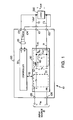
- FIG. 1 is a block diagram of an electronic system 10 consisting of a prior art DC-DC converter module 100 and a load 200.
- the prior art DC-DC converter module 100 accepts input power from a source 15, at an input voltage Vin, and delivers power to the load 200, at an output voltage Vout(t). All electrical connections to the prior art DC-DC converter module 100 are made via terminals 101 - 106 (e.g. pins, wires) which are part of the module 100.
- the DC-DC converter module 100 includes power conversion circuitry 50 and control circuitry 30 to which connections are made via the various terminals 101 -106 as shown in the Figure.
- the power conversion circuitry 50 which is of the switching type, includes one or more switching devices 53 (one of which is shown in the Figure), and an output filter 52 consisting of an output capacitor 60, of value Co, and an output inductor 80, of value Lo.
- the values of the output inductor 80, Lo, and the output capacitor 60, Co, define a characteristic first breakpoint frequency, for the output filter.
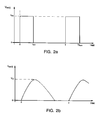
- Control signals 32 delivered to the power conversion circuitry set the times at which the switching devices 53 are turned on and off, thereby controlling the average value of the pulsating voltage waveform, Vsw(t), delivered to the output filter 52. Pulsed waveforms typically found in such power conversion circuitry 50 are illustrated in Figures 2A and 2B.
- the waveform Vsw(t) is essentially rectangular, having a peak value Vm and a minimum value of essentially zero volts.
- Figure 2B shows a waveform, Vsw(t) typical of the kind found in a power converter which transfers energy to the load in a series of quantized energy transfer cycles (e.g. a resonant converter, or a zero-current switching converter).
- the average value of Vsw(t) is adjusted by varying the operating frequency at which the switches 53 are turned on and off, or by varying the relative timing at which the switches 53 are turned on and off, or both.
- the output filter 52 extracts the average value of the waveform Vsw(t) so that an essentially DC voltage may be delivered to the load.
- the control circuitry 30 has sense inputs 55 and switch control circuitry (not shown) for generating the control signals 32 which are delivered to the power conversion circuitry 50.
- a setpoint voltage (not shown), representative of the desired value of converter output voltage, Vo, is either delivered to, or included within, the control circuitry.
- Vsense Vout(t), measured at the sense connections 55, differs from the desired value of output voltage, Vo, (as represented by the setpoint voltage) the control circuitry 30 will, depending on the specific topology of the power conversion circuitry 50, adjust either the operating frequency, or the relative timing at which the switching devices 53 are turned on and off, or both.
- the prior DC-DC converter module 100 will maintain the average voltage at the output terminals 101, 102 equal to the desired value of voltage output, Vo, as both the load 200 and the value of source voltage, Vin, vary.
- the basic function of the converter of Figure 1 is to maintain the instantaneous value of output voltage, Vo(t), within relatively narrow limits (for example, within +/-5% of the desired steady-state output voltage Vo).
- Two primary contributions to instantaneous variations in Vout(t) are output ripple and the closed-loop response of the converter to changes in load current, lout(t).
- Output ripple which is the contribution of the harmonic components of the pulsating waveform Vsw(t) (i.e. components in the frequency spectrum of Vsw(t) which are integer multiples of the operating frequency) to the output voltage, Vout(t), can be minimized by setting the first breakpoint frequency, f1, of the output filter to a suitable value well below the lowest necessary operating frequency of the converter.
- the closed-loop response of the converter is dependent on several factors which include the first beakpoint frequency, the frequency response characteristics of the control circuitry, the operating frequency of the converter, the magnitude and speed of the change in load current, and closed-loop stability considerations. Because the first breakpoint frequency is setwell below the lowest operating frequency of the converter, the converter output is essentially equal to the respnse of the output filter to the fundamental component of the pulsating waveform Vsw(t) (i.e. the component in the frequency spectrum of Vsw(t) which is at zero frequency).
- FIG. 3 the converter is modeled as a compensated controller 99 and an output filter 52.
- the compensated controller 99 models the response of the fundamental components of Vsw(t) (shown in the Figure as Vs(t)) to changes in Vsense and includes the effects of all of the lements of the converter 100 of Figure 1 which are in the signal processing path between the sense terminals 103, 104 and the input to the output filter 52.
- the open loop frequency response of the converter is the product of the responses of the compensated controller 99 and the output filter 52 (including any frequency response effects of the load 200).
- the gain and phase response of the output filter 52 are shown in Figures 4A and 4B respectively. Below the first breakpoint frequency, f1, the output filter 52 gain is essentially unity and the phase shift is essentially zero. Above the first breakpoint frequency, however, the output filter 52 attenuation increases as the square of the frequency and the phase shift is essentially 180 degrees (assuming ideal components). While high open-loop gain is desirable in terms of maintaining tight closed-loop regulation over output voltage, classical stability criteria require that, for negative feedback systems, the open-loop gain become less than one before the open-loop phase shift exceeds 180 degrees. One way of tailoring the frequency response of the compensated controller 99 is shown in Figure 4C and 4D.
- the compensated controller 99 has high open-loop gain at low frequencies, thereby ensuring tigh regulation of the DC output voltage under steady-state conditions, whereas at frequencies approaching the first breakpoint frequency the controller 99 introduces phase lead (and an increase in gain which is proportional to frequency) which compensates for the phase lag and attenuation of the output filter 52.
- the aggregate open-loop gain and phase (Figures 4Eand 4F) meets the criteria for closed loop stability and exihibits a cutoff frequency (i.e. the frequency at which the open loop gain equals unity), fc, above the first breakpoint frequency of the output filter 52.
- the cutoff frequency (which must generally be below one half the lowest operating frequency of the converter due to "sampling" effects of the pulsating waveform Vsw(t)) represents the small signal "bandwidth" of the closed loop converter. Below the cutoff frequency the relatively high values of open-loop gain provide for active closed-loop attenuation of disturbances and output impedance. Above the cutoff frequency, active control effects are relatively ineffective.
- the model of Figures 3 and 4 is useful for predicting response only to the extent that there are no constraints on the dynamic range of signals within the loop. In practice this is rarely true.
- the strength of the fundamental component (i.e. the average value) of Vsw(t) can, at most, vary between zero and Vm volts, which, in pratical converters, is typically limited to about twice the nominal output voltage, Vo.
- a change in load current, lout(t), must initially be supported by the output capacitor 60 which will start discharge as it supplies the incremental output current.
- the controller 30 will sense the change in output voltage resulting from the discharge of the capacitor 60 and will respond by increasing the average value of Vs(t) as a means of increasing the current in the output inductor 80.
- the rate at which the current can be changed in the output inductor 80 is constrained by the limit, Vmax, on the maximum average value of Vs(t).
- the maximum rate at which the current 11(t) can be increased in the output inductor 80 is limited to: To a first approximation, changes in output current which exihibitrates-of-change lower than Dl max can be considered to be within the limits of the active control response of the converter 100. Output current changes which exceed the Dl max limit, however, must be supported by the output capacitor 100 until sufficient time has elapsed for effective control action to occur.
- the size of the output capacitor 60 required to prevent the converter 100 output voltage from varying more than AVo volts from a nominal value of Vo volts, when the converter is confronted with a rapid increase in load current, ⁇ lo can be estimated by assuming that the current lout(t) increases instantaneously and that the controller 30 responds by instantly increasing the average value of Vs(t) to its maximum value Vsmax. Under these circumstances, the current I L(t), in the output inductor 80 will start to increase linearly at a rate, Dl max , given by Equation 1: The current in the capacitor 60, lc(t), equals the difference between the output current, lout(t), and the inductor current, ⁇ IL(t).
- a 50 microhenry inductor might typically be used in a 100 Watt "square-wave" converter (i.e. of the kind which produces a Vs(t) waveform as shown in Figure 2A) operating at a constant operating frequency of 50 KHz. It should be noted that the combination of a 50 microhenry inductor and a 10,000 microfarad capacitor results in a first breakpoint frequency equal to 225 Hz and a Dlmax of 0.1 ampere-per-microsecond.
- quantized-energy converters for example, zero-current switching converters of the kinds described in Vinciarelli, U.S.
- Patent No. 4,415,959 utilize smaller output inductor 80 and require proportionally lower values of output capacitance 60.
- Vm 10 V
- a zero-current switching converter having an 2 microhenry output inductor and using a 2000 microfarad output capacitor would exihibit a maximum output voltage variation of 0.04 Volts just 8 microseconds after the step change in current, and would exhibit a first breakpoint frequency of 2.5 KHz and a Dlmax of 2.5 amperes-per-microsecond.
- the value of the output capacitor 60 will generally depend primarily on output voltage response requirements and this value of capacitance will generally be ample in terms of being able to contribute to filter attenuations which are consistent with low output voltage ripple.
- Figure 5 reproduces the system 10 of Figure 1, but discloses this parasitic inductance as consisting of a parasitic output inductance 90, of value Lp, associated with the conducting paths 70, 71 between the output capacitor 60 and the output terminals 101, 102, and a parasitic load inductance 91, of value LI, associated with the conducting paths 73, 74 between the output terminals 101, 102 and the load 200.
- These parasitic inductances 90, 91, Lp and LI depend on the length and geometry of both the conducting paths 70, 71, 73, 74 and tthe output terminals 101, 102, and are generally smaller than the value, Lo, of the output inductor 80.
- the current in the capacitor 60 will equal and the voltage at the load 200, Vout(t), will be equal to the differnce between the voltage across the output capacitor 60, V i (t), and the sum of the voltage across the parasitic inductances 90, 91, Vp(t) and V L (t), where
- a step change in voltage will appear instataneously at time t1 across the parasitic inductances 90, 91 ( Figure 6B). Since the voltage across the output capacitor 60 cannot change instantaneously (Figure 6C), this step change in voltage across the parasitic inductance will appear as a step decrease in the output voltage, Vout(t) ( Figure 6D).
- the output capacitor 60 supplies part of the load current, causing the output capacitor 60 to discharge:
- the output capacitor 60 has discharged by an amount equal to and the peak deviation, Vd, in the output voltage is:
- the incremental current, 11 - lo will initially discharge the output capacitor 60 at a constant rate equal to until such time as the control response of the converter module 100 starts to charge the output capacitor 60 back to a value of Vo.
- V T 0.2 V, from Equation 7) throughout the interval during which the current is changing.
- the parasitic inductances 90, 91 were zero, the change in voltage across a 2000 microfarad output capacitor 60 at the end of the current ramp would be, from Equation 10, only 0.005 V.
- a total parasitic output inductance value at or below 10 nanoHenries is much lower than values typically encountered in practice, and attempting to achieve such low levels of parasitic output inductance would not only be difficult, it would be inefficient in terms of space and cost.
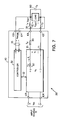
- Figure 7 is a block diagram of an electronic system 20 consisting of an input source 15, a DC-DC converter module 110 (which has no internal output capacitor), an external output capacitor 160 of value Ce, and a load 200. Excipting the fact that the converter 110 of Figure 7 does not contain the output capacitor 60 which was included within the converter of Figure 5, the converters 100, 110 may otherwise be considered to be identical. Although the converter module 110 of Figure 7 has a first breakpoint frequency which is infinite (because the amount of capacitance included within the converter module is zero), the first breakpoint frequency of the system 20 of Figure 7 is, by inspection, (which, for Lo » (Lp + LI), is closely approximated by
- the response of the converter 110 of Figure 7 to a rapid change in load current can be inferred by comparing the topologies of Figures 5 and 7.
- the essential difference between the prior art DC-DC converter module 100 of Figure 5 and the DC-DC converter module 110 of Figure 7 is that the prior art converter 100 includes an output capacitor 60, while the converter 110 of Figure 7 does not.
- the compliance of the voltage, V1(t), in the converter 100 of Figure 5 is limited by the presence of the capacitor 60; no such compliance limitation is imposed in the converter of Figure 7. Therefore, a converter module of the kind shown in Figure 7 is called a voltage-compliant DC-DC converter module.
- both converter 100,110 are intended to deliver an essentially constant value of DC voltage to the load 200.
- both the "internal" output capacitor 60 of Figure 5 and the external capacitor 160 of Figure 7 are intended to serve the same purpose: each sets the first breakpoint frequency to a value below the lowest necessary operating frequency of the converter as a means of minimizing output ripple, and each is entended to "hold up" the load voltage when the converter is confronted with large or rapid changes in load current.
- the system 20 of Figure 7 benefits from the noncompliance of the capacitor's 160 voltage to changes in load current.
- the noncompliance of the output capacitor 60 in the system 10 of Figure 5 is a drawback: the effects of series parasitics 90, 91 between the capacitor 60 and the load 200 are fully felt at the load. Said another way, placement of the output capacitor 60 internal to the converter 100 of Figure 5 requires that the output voltage decrease if current is to increase in the parasitic inductances 90, 91. No such restriction exists in the converter of Figure 7.
- FIG. 9 A conventional solution to adapting a prior art converter to applications which exhibits rapid changes in load current is shown in Figure 9.
- the system 30 consists of a prior art DC-DC converter module 120 (which includes an internal output capacitor 60), an external output capacitor 160 of value Ce, and a load 200.
- the internal output capacitor 60 is of a value, Co, which is sufficient to meet the both the ripple and control response requirements of the application.
- the external output capacitor 160 is added to perform the same bypassing function as the external output capacitor 60 of the system of Figure 7 (i.e. rapid changes in load current, lout, flow in the external output capacitor 60 and bypass the parasitic inductance 90).
- This solution of Figure 7 is an improvement over the solution of Figure 9 for the several reasons.
- addition of an external capacitor 160 increases both the overall size and cost of the system by increasing the total system capacitance, Co + Ce, to a value greater than that which would otherwise be required (i.e. Co).
- an external capacitor 160 creates the equivalent of a two-stage filter at the output of the converter, the first stage consisting of the output inductor 80 and the output capacitor 60, and the second stage consisting of the parasitic inductances 90, 91 and the external capacitor 160.
- the system 30 is characterized by two system breakpoint frequencies which are very closely approximated by: Assuming that Lo is much larger than the sum of the parasitics, LI + Lp, then these frequencies are essentially equal to:
- the first system breakpoint frequency, fl a resultas from lf ⁇ e combination of the output inductor 80 and the total output capacitance Co + Ce.
- the second system breakpoint frequency, f2a represents the resonant frequency of the closed loop formed by the two capacitors 60, 160 and the parasitic inductances 90, 91.
- the two stage filter of Figure 9 exhibits the gain and phase characteristics shown in Figures 10A and 10B, respectively.
- One effect of the use of extra external capacitance is that the first system breakpoint frequency, f1a, of the system 30 of Figure 9 is reduced relative to the first breakpoint frequency, f1, of the system 20 of Figure 7 (which, for comparison, would include an external capacitor 160 of value Co and would have a first breakpoint frequency, f1, equal to ) ).
- this reduction in the first system breakpoint frequency will reduce the cutoff frequency, fc, of the system and will slow system response. Since the compensation of the converter (i.e. as, for example, in Figures 4C and 4D) is not generally adjustable, and since the effect of the second system breakpoint frequency is to add an additional 180 degrees of open-loop phase shift at frequencies above f2a ( Figure 10B), selection of a value for the external capacitor 160 which results in a second system breakpoint frequency, f2a, which is close to or below the cutoff frequency of the system 30 will result in an unstable closed-loop system.
- Equation 22 is the discharge of the aggregate output capacitance and is the same as predicted by Equation 18 for a system with a single stage filter.
- the sinusoidal second term is caused by resonant current flow in the external capacitor 160 and is not signifiant.
- Equation 22 indicates that the peak sinusoidal voltage can be decreased by increasing the external capacitor. However, aside from earlier objections to size and cost, this will necessarily reduce the cutoff frequency and impair control performance. The most efficient solution is to use no more capacitance than is demanded by the requirements of the application, and this is most efficiently achieved in the system of Figure 7.
- the variation in output voltage of the converter 120 of Figure 9 in response to a step change in load current, ⁇ lo can be approximated by assuming that the control circuitry 30 responds to the change in load by instantly increasing Vs(t) to its maximum value Vsmax.
- the large signal response is then the response of the two stage filter to a simultaneous application of a step change, ⁇ lo, in load current, lout(t), and a step change in filter input voltage, Vs(t), from a value Vo to a value Vsmax.
- f2a » f1a the response of the filter during the time period of interest (e.g.
- Equation 45 indicates that an ESL of 2.5 nanohenries would increase the output voltage drop by a constant 0.05 V between times t1 and t2, and an ESR of 4 milliohms would contribute an additional voltage drop which would increase linearly from 0 V, at time t1, to 0.08 V at time t2 (it is to be noted that these increases in output voltage drop would apply equally to the system 10 of Figure 5, the system 20 of Figure 7, and the system 30 of Figure 9).
- Equation 45 The total deviation in output voltage for the systems of Figures 7 or 9 would be 0.05 V at time t1 (Equation 45) and 0.13 V at time t2 (Equation 47).
- Equation 47 the effects of output capacitor parasitics can be managed economically by using a quantity of appropiate devices. Capacitor selection will based upon the amount of bulk capacitance required, which can be estimated using Equation 8, and Equations 45 through 47, which can be used to estimate allowable limits on capacitor parasitics, Ls and Rs.
- some or all of the output inductance, Lo may be placed external to the converter module.
- the ideal response shows an essentially linear variation in current, A12 1 (t), which equals the change in current in the output inductor 80 induced by the step change in filter input voltage.
- the slope of the ideal current variation is, as predicted by Equations 30 and 33 (the effect of Equation 34 is negligible during the time period), 3.8 amperes-per-microsecond.
- the response of the two stage filter can be expressed as
- Equation 42 can be considered as one condition for defining a voltage-compliant converter. Furthermore, if Ce were set to zero, the value for Co would be set so that it could not, by itself, be able to provide sufficient ripplie filtering within the specified operating range of the converter. This condition will be satisfied if the first breakpoint frequency of the output filter 52, is greater than the minimum necessary operating frequency, fopmin, of the converter 120. Thereore another bound on Co is: In most cases the bound on Co defined by Equation 42 will be more restrictive than the bound defined in Equation 43.
- a converter module 120 of the kind shown in Figure 9 which includes an internal output capacitor 60 whose value, Co, satisfies the two bounds defined in Equations 42 and 43 is a voltage-compliant converter module.
- Equation 43 a value of Co which satisfies Equation 43 will, in practical cases, automatically satisfy closed-loop stability requirements.
- the fist system breakpoint frequency, f1a (Equations 21a, 21c), is determined by the desired amount of ripple attenuation at the lowest converter operating frequency, fopmin, and is generally set to value equal to a fraction of fopmin.
- the values of the output inductor 80, Lo, and the minimum value of the external output capacitor 160, Ce are selected to simultaneously satisfy both the first system breakpoint frequency requirement and requirements relative to maximum allowable output voltage deviation (i.e. Equation 8).
- Equation 21 b (and assuming that Ce » Co and that Lo » (Lp + Li)): Noting again that fcmax is generally limited to being less than one-half of fopmin due to samplig effects, a value of Co which satisfies Equation 43 will violate Equation 44 only if the sum of the parasitic inductances, Lp + LI, is four or more times the value of the output inductance, Lo. This is unlikely in practice.
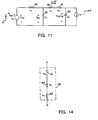
- the output capacitor will have some parasitic inductance and resistance, as shown in Figure 14.
- the capacitor 160 is shown to be composed of a pure capacitance 161, of value Ce, in series with both an equivalent series inductance (ESL) 162, of value Ls, and an equivalent series resistance (ESR) 163, of value Rs. If the external output capacitor 160 in the system 20 of Figure 7
Landscapes
- Engineering & Computer Science (AREA)
- Power Engineering (AREA)
- Dc-Dc Converters (AREA)
- Emergency Protection Circuit Devices (AREA)
- Control Of Electric Motors In General (AREA)
- Power Conversion In General (AREA)
- Amplifiers (AREA)
- Control Of High-Frequency Heating Circuits (AREA)
- Control Of Eletrric Generators (AREA)
Applications Claiming Priority (2)
| Application Number | Priority Date | Filing Date | Title |
|---|---|---|---|
| US07/583,863 US5088016A (en) | 1990-09-17 | 1990-09-17 | Voltage-compliant dc-dc converter module |
| US583863 | 1990-09-17 |
Publications (3)
| Publication Number | Publication Date |
|---|---|
| EP0476982A2 true EP0476982A2 (de) | 1992-03-25 |
| EP0476982A3 EP0476982A3 (en) | 1992-07-01 |
| EP0476982B1 EP0476982B1 (de) | 1995-12-27 |
Family
ID=24334890
Family Applications (1)
| Application Number | Title | Priority Date | Filing Date |
|---|---|---|---|
| EP91308487A Expired - Lifetime EP0476982B1 (de) | 1990-09-17 | 1991-09-17 | Elektrisches Gerät mit einem Leistungswandler |
Country Status (5)
| Country | Link |
|---|---|
| US (1) | US5088016A (de) |
| EP (1) | EP0476982B1 (de) |
| JP (1) | JP2607787B2 (de) |
| AT (1) | ATE132307T1 (de) |
| DE (1) | DE69115814T2 (de) |
Cited By (2)
| Publication number | Priority date | Publication date | Assignee | Title |
|---|---|---|---|---|
| EP1048328A2 (de) | 1999-04-26 | 2000-11-02 | Deuce Industries Ltd. | Gerät zum Spannen einer Saite |
| WO2012104707A3 (en) * | 2011-02-03 | 2012-11-15 | Universitat Politecnica De Catalunya | A voltage-sensing circuit structure for a switching power converter and method for an enhanced fast-scale stability margin of a switching power converter |
Families Citing this family (16)
| Publication number | Priority date | Publication date | Assignee | Title |
|---|---|---|---|---|
| FR2698743B1 (fr) * | 1992-11-27 | 1995-02-03 | Telemecanique | Module de filtrage pour convertisseur de fréquence. |
| US5530638A (en) * | 1993-09-24 | 1996-06-25 | At&T Corp. | Multi-resonant electronic power converter with a wide dynamic range |
| JP2868422B2 (ja) * | 1993-10-28 | 1999-03-10 | ヴィエルティー コーポレーション | 電力変換における電流検出装置及び方法 |
| US5838557A (en) * | 1997-07-28 | 1998-11-17 | Altor, Inc. | Circuit for use in a DC-DC converter having a booster module |
| US6069801A (en) * | 1998-07-16 | 2000-05-30 | Vlt Corporation | Power factor correction in switching power conversion |
| US6496366B1 (en) | 1999-10-26 | 2002-12-17 | Rackable Systems, Llc | High density computer equipment storage system |
| US6714092B1 (en) * | 2000-11-02 | 2004-03-30 | Intel Corporation | Supply noise filter for clock generator |
| US6911739B1 (en) * | 2003-01-29 | 2005-06-28 | Marvell International Ltd. | Methods and apparatus for improving high frequency input/output performance |
| US7173821B2 (en) * | 2003-05-16 | 2007-02-06 | Rackable Systems, Inc. | Computer rack with power distribution system |
| US7456655B1 (en) | 2005-05-16 | 2008-11-25 | Marvell Israel (Misl) Ltd. | System and process for overcoming wire-bond originated cross-talk |
| US7613019B2 (en) * | 2005-07-08 | 2009-11-03 | Power Integrations, Inc. | Method and apparatus to limit maximum switch current in a switch of a switching power supply |
| US7593245B2 (en) | 2005-07-08 | 2009-09-22 | Power Integrations, Inc. | Method and apparatus to limit maximum switch current in a switching power supply |
| DE102008058737B4 (de) * | 2008-09-08 | 2019-12-12 | Erbe Elektromedizin Gmbh | HF-Chirurgiegenerator |
| US20130141047A1 (en) * | 2011-12-02 | 2013-06-06 | Golden Crown New Energy (Hk) Limited | Battery management system and method thereof |
| CN114204793B (zh) * | 2021-12-04 | 2023-08-01 | 三峡大学 | 单相有源功率因数校正变换器无源器件的体积优化方法 |
| DE102022205488A1 (de) * | 2022-05-31 | 2023-11-30 | Rolls-Royce Deutschland Ltd & Co Kg | Dimensionierung des Spaltes zwischen Substrat und Kühlkörper in Hochspannungs-Leistungswandlern |
Family Cites Families (5)
| Publication number | Priority date | Publication date | Assignee | Title |
|---|---|---|---|---|
| US4415959A (en) * | 1981-03-20 | 1983-11-15 | Vicor Corporation | Forward converter switching at zero current |
| US4685041A (en) * | 1985-03-11 | 1987-08-04 | American Telephone And Telegraph Company, At&T Bell Laboratories | Resonant rectifier circuit |
| US4788634A (en) * | 1987-06-22 | 1988-11-29 | Massachusetts Institute Of Technology | Resonant forward converter |
| US4888675A (en) * | 1987-08-26 | 1989-12-19 | Harris Corporation | Switching power supply filter |
| US4800479A (en) * | 1988-03-31 | 1989-01-24 | Prime Computer, Inc. | High frequency power converter having compact output transformer, rectifier and choke |
-
1990
- 1990-09-17 US US07/583,863 patent/US5088016A/en not_active Expired - Lifetime
-
1991
- 1991-09-17 EP EP91308487A patent/EP0476982B1/de not_active Expired - Lifetime
- 1991-09-17 JP JP3311278A patent/JP2607787B2/ja not_active Expired - Fee Related
- 1991-09-17 DE DE69115814T patent/DE69115814T2/de not_active Expired - Fee Related
- 1991-09-17 AT AT91308487T patent/ATE132307T1/de not_active IP Right Cessation
Cited By (3)
| Publication number | Priority date | Publication date | Assignee | Title |
|---|---|---|---|---|
| EP1048328A2 (de) | 1999-04-26 | 2000-11-02 | Deuce Industries Ltd. | Gerät zum Spannen einer Saite |
| US6162139A (en) * | 1999-04-26 | 2000-12-19 | Deuce Industries Ltd. | String tensioning device |
| WO2012104707A3 (en) * | 2011-02-03 | 2012-11-15 | Universitat Politecnica De Catalunya | A voltage-sensing circuit structure for a switching power converter and method for an enhanced fast-scale stability margin of a switching power converter |
Also Published As
| Publication number | Publication date |
|---|---|
| JP2607787B2 (ja) | 1997-05-07 |
| US5088016A (en) | 1992-02-11 |
| ATE132307T1 (de) | 1996-01-15 |
| EP0476982A3 (en) | 1992-07-01 |
| DE69115814T2 (de) | 1996-05-30 |
| JPH05304767A (ja) | 1993-11-16 |
| DE69115814D1 (de) | 1996-02-08 |
| EP0476982B1 (de) | 1995-12-27 |
Similar Documents
| Publication | Publication Date | Title |
|---|---|---|
| EP0476982A2 (de) | Elektrisches Gerät mit einem Leistungswandler | |
| US6215288B1 (en) | Ultra-low power switching regulator method and apparatus | |
| US6465993B1 (en) | Voltage regulation employing a composite feedback signal | |
| US5903452A (en) | Adaptive slope compensator for current mode power converters | |
| US5982160A (en) | DC-to-DC converter with inductor current sensing and related methods | |
| US6222356B1 (en) | Current mode switching regulator configured such that a measuring resistor is not needed to measure the current at an inductor | |
| JP3574029B2 (ja) | 電圧レギュレータの負荷過渡応答を改善し出力コンデンサ・サイズを最小化する方法および装置 | |
| US7589517B1 (en) | Adaptive slope compensation for switching regulators | |
| US6894471B2 (en) | Method of regulating the supply voltage of a load and related voltage regulator | |
| US5724237A (en) | Apparatus and method for sharing a load current among frequency-controlled D.C.-to-D.C. converters | |
| US7199563B2 (en) | DC-DC converter | |
| US6674274B2 (en) | Multiple phase switching regulators with stage shedding | |
| US6979982B2 (en) | Switched-current power converter | |
| JP2001100849A (ja) | 出力電流を測定するためのシステムおよび方法、およびこれらのシステムおよび方法を使用するコンバータ | |
| WO2001071894A2 (en) | Oscillatorless dc-dc power converter | |
| WO1997031304A9 (en) | Self-compensating resonant switching power converter | |
| CN100492839C (zh) | Dc-dc变换器及其控制器和控制方法及包括其的装置 | |
| US7443229B1 (en) | Active filtering | |
| CN115437440A (zh) | 电压调节器及其补偿方法 | |
| KR20010050573A (ko) | 히스테리 스위치-모드 전원의 주파수 제어 | |
| JP4175805B2 (ja) | 電流を調整するプログラマブルロジックコントローラ(plc)、その回路及びその方法 | |
| US6052298A (en) | Inverter input noise suppression circuit | |
| EP4340203B1 (de) | Steuervorrichtung für einen schaltspannungsregler mit reduziertem audiorauschen und steuerverfahren | |
| TWI796061B (zh) | 切換式電源供應器及其控制電路與控制方法 | |
| CN115313817A (zh) | 用于降压转换器的输出电压缩放期间接通时间产生的控制电路 |
Legal Events
| Date | Code | Title | Description |
|---|---|---|---|
| PUAI | Public reference made under article 153(3) epc to a published international application that has entered the european phase |
Free format text: ORIGINAL CODE: 0009012 |
|
| AK | Designated contracting states |
Kind code of ref document: A2 Designated state(s): AT BE CH DE DK ES FR GB GR IT LI LU NL SE |
|
| RIN1 | Information on inventor provided before grant (corrected) |
Inventor name: VINCIARELLI, PATRIZIO Inventor name: PRAGER, JAY M. |
|
| PUAL | Search report despatched |
Free format text: ORIGINAL CODE: 0009013 |
|
| AK | Designated contracting states |
Kind code of ref document: A3 Designated state(s): AT BE CH DE DK ES FR GB GR IT LI LU NL SE |
|
| 17P | Request for examination filed |
Effective date: 19920819 |
|
| 17Q | First examination report despatched |
Effective date: 19930922 |
|
| GRAA | (expected) grant |
Free format text: ORIGINAL CODE: 0009210 |
|
| AK | Designated contracting states |
Kind code of ref document: B1 Designated state(s): AT BE CH DE DK ES FR GB GR IT LI LU NL SE |
|
| PG25 | Lapsed in a contracting state [announced via postgrant information from national office to epo] |
Ref country code: IT Free format text: LAPSE BECAUSE OF FAILURE TO SUBMIT A TRANSLATION OF THE DESCRIPTION OR TO PAY THE FEE WITHIN THE PRE;WARNING: LAPSES OF ITALIAN PATENTS WITH EFFECTIVE DATE BEFORE 2007 MAY HAVE OCCURRED AT ANY TIME BEFORE 2007. THE CORRECT EFFECTIVE DATE MAY BE DIFFERENT FROM THE ONE RECORDED.SCRIBED TIME-LIMIT Effective date: 19951227 Ref country code: BE Effective date: 19951227 Ref country code: CH Effective date: 19951227 Ref country code: LI Effective date: 19951227 Ref country code: AT Effective date: 19951227 Ref country code: DK Effective date: 19951227 Ref country code: ES Free format text: THE PATENT HAS BEEN ANNULLED BY A DECISION OF A NATIONAL AUTHORITY Effective date: 19951227 Ref country code: GR Free format text: LAPSE BECAUSE OF FAILURE TO SUBMIT A TRANSLATION OF THE DESCRIPTION OR TO PAY THE FEE WITHIN THE PRESCRIBED TIME-LIMIT Effective date: 19951227 Ref country code: NL Free format text: LAPSE BECAUSE OF FAILURE TO SUBMIT A TRANSLATION OF THE DESCRIPTION OR TO PAY THE FEE WITHIN THE PRESCRIBED TIME-LIMIT Effective date: 19951227 |
|
| REF | Corresponds to: |
Ref document number: 132307 Country of ref document: AT Date of ref document: 19960115 Kind code of ref document: T |
|
| REF | Corresponds to: |
Ref document number: 69115814 Country of ref document: DE Date of ref document: 19960208 |
|
| PG25 | Lapsed in a contracting state [announced via postgrant information from national office to epo] |
Ref country code: SE Effective date: 19960327 |
|
| ET | Fr: translation filed | ||
| NLV1 | Nl: lapsed or annulled due to failure to fulfill the requirements of art. 29p and 29m of the patents act | ||
| PG25 | Lapsed in a contracting state [announced via postgrant information from national office to epo] |
Ref country code: LU Free format text: LAPSE BECAUSE OF NON-PAYMENT OF DUE FEES Effective date: 19960930 |
|
| PLBE | No opposition filed within time limit |
Free format text: ORIGINAL CODE: 0009261 |
|
| STAA | Information on the status of an ep patent application or granted ep patent |
Free format text: STATUS: NO OPPOSITION FILED WITHIN TIME LIMIT |
|
| 26N | No opposition filed | ||
| REG | Reference to a national code |
Ref country code: GB Ref legal event code: IF02 |
|
| PGFP | Annual fee paid to national office [announced via postgrant information from national office to epo] |
Ref country code: GB Payment date: 20050914 Year of fee payment: 15 |
|
| PGFP | Annual fee paid to national office [announced via postgrant information from national office to epo] |
Ref country code: FR Payment date: 20050919 Year of fee payment: 15 |
|
| PGFP | Annual fee paid to national office [announced via postgrant information from national office to epo] |
Ref country code: DE Payment date: 20051031 Year of fee payment: 15 |
|
| PG25 | Lapsed in a contracting state [announced via postgrant information from national office to epo] |
Ref country code: DE Free format text: LAPSE BECAUSE OF NON-PAYMENT OF DUE FEES Effective date: 20070403 |
|
| GBPC | Gb: european patent ceased through non-payment of renewal fee |
Effective date: 20060917 |
|
| REG | Reference to a national code |
Ref country code: FR Ref legal event code: ST Effective date: 20070531 |
|
| PG25 | Lapsed in a contracting state [announced via postgrant information from national office to epo] |
Ref country code: GB Free format text: LAPSE BECAUSE OF NON-PAYMENT OF DUE FEES Effective date: 20060917 |
|
| PG25 | Lapsed in a contracting state [announced via postgrant information from national office to epo] |
Ref country code: FR Free format text: LAPSE BECAUSE OF NON-PAYMENT OF DUE FEES Effective date: 20061002 |