EP0477538A2 - Adsorbant, procédé et appareil pour diminuer éventuellement élimener des produits nocifs de milieux liquides - Google Patents
Adsorbant, procédé et appareil pour diminuer éventuellement élimener des produits nocifs de milieux liquides Download PDFInfo
- Publication number
- EP0477538A2 EP0477538A2 EP91114146A EP91114146A EP0477538A2 EP 0477538 A2 EP0477538 A2 EP 0477538A2 EP 91114146 A EP91114146 A EP 91114146A EP 91114146 A EP91114146 A EP 91114146A EP 0477538 A2 EP0477538 A2 EP 0477538A2
- Authority
- EP
- European Patent Office
- Prior art keywords
- adsorbent
- weight
- parts
- adsorbent according
- cleaned
- Prior art date
- Legal status (The legal status is an assumption and is not a legal conclusion. Google has not performed a legal analysis and makes no representation as to the accuracy of the status listed.)
- Withdrawn
Links
Images
Classifications
-
- B—PERFORMING OPERATIONS; TRANSPORTING
- B01—PHYSICAL OR CHEMICAL PROCESSES OR APPARATUS IN GENERAL
- B01J—CHEMICAL OR PHYSICAL PROCESSES, e.g. CATALYSIS OR COLLOID CHEMISTRY; THEIR RELEVANT APPARATUS
- B01J20/00—Solid sorbent compositions or filter aid compositions; Sorbents for chromatography; Processes for preparing, regenerating or reactivating thereof
- B01J20/28—Solid sorbent compositions or filter aid compositions; Sorbents for chromatography; Processes for preparing, regenerating or reactivating thereof characterised by their form or physical properties
- B01J20/28014—Solid sorbent compositions or filter aid compositions; Sorbents for chromatography; Processes for preparing, regenerating or reactivating thereof characterised by their form or physical properties characterised by their form
- B01J20/2803—Sorbents comprising a binder, e.g. for forming aggregated, agglomerated or granulated products
-
- B—PERFORMING OPERATIONS; TRANSPORTING
- B01—PHYSICAL OR CHEMICAL PROCESSES OR APPARATUS IN GENERAL
- B01D—SEPARATION
- B01D15/00—Separating processes involving the treatment of liquids with solid sorbents; Apparatus therefor
-
- B—PERFORMING OPERATIONS; TRANSPORTING
- B01—PHYSICAL OR CHEMICAL PROCESSES OR APPARATUS IN GENERAL
- B01J—CHEMICAL OR PHYSICAL PROCESSES, e.g. CATALYSIS OR COLLOID CHEMISTRY; THEIR RELEVANT APPARATUS
- B01J20/00—Solid sorbent compositions or filter aid compositions; Sorbents for chromatography; Processes for preparing, regenerating or reactivating thereof
- B01J20/02—Solid sorbent compositions or filter aid compositions; Sorbents for chromatography; Processes for preparing, regenerating or reactivating thereof comprising inorganic material
- B01J20/10—Solid sorbent compositions or filter aid compositions; Sorbents for chromatography; Processes for preparing, regenerating or reactivating thereof comprising inorganic material comprising silica or silicate
- B01J20/12—Naturally occurring clays or bleaching earth
-
- B—PERFORMING OPERATIONS; TRANSPORTING
- B01—PHYSICAL OR CHEMICAL PROCESSES OR APPARATUS IN GENERAL
- B01J—CHEMICAL OR PHYSICAL PROCESSES, e.g. CATALYSIS OR COLLOID CHEMISTRY; THEIR RELEVANT APPARATUS
- B01J20/00—Solid sorbent compositions or filter aid compositions; Sorbents for chromatography; Processes for preparing, regenerating or reactivating thereof
- B01J20/02—Solid sorbent compositions or filter aid compositions; Sorbents for chromatography; Processes for preparing, regenerating or reactivating thereof comprising inorganic material
- B01J20/20—Solid sorbent compositions or filter aid compositions; Sorbents for chromatography; Processes for preparing, regenerating or reactivating thereof comprising inorganic material comprising free carbon; comprising carbon obtained by carbonising processes
-
- B—PERFORMING OPERATIONS; TRANSPORTING
- B01—PHYSICAL OR CHEMICAL PROCESSES OR APPARATUS IN GENERAL
- B01J—CHEMICAL OR PHYSICAL PROCESSES, e.g. CATALYSIS OR COLLOID CHEMISTRY; THEIR RELEVANT APPARATUS
- B01J20/00—Solid sorbent compositions or filter aid compositions; Sorbents for chromatography; Processes for preparing, regenerating or reactivating thereof
- B01J20/28—Solid sorbent compositions or filter aid compositions; Sorbents for chromatography; Processes for preparing, regenerating or reactivating thereof characterised by their form or physical properties
- B01J20/28014—Solid sorbent compositions or filter aid compositions; Sorbents for chromatography; Processes for preparing, regenerating or reactivating thereof characterised by their form or physical properties characterised by their form
- B01J20/2805—Sorbents inside a permeable or porous casing, e.g. inside a container, bag or membrane
-
- B—PERFORMING OPERATIONS; TRANSPORTING
- B01—PHYSICAL OR CHEMICAL PROCESSES OR APPARATUS IN GENERAL
- B01J—CHEMICAL OR PHYSICAL PROCESSES, e.g. CATALYSIS OR COLLOID CHEMISTRY; THEIR RELEVANT APPARATUS
- B01J20/00—Solid sorbent compositions or filter aid compositions; Sorbents for chromatography; Processes for preparing, regenerating or reactivating thereof
- B01J20/28—Solid sorbent compositions or filter aid compositions; Sorbents for chromatography; Processes for preparing, regenerating or reactivating thereof characterised by their form or physical properties
- B01J20/28054—Solid sorbent compositions or filter aid compositions; Sorbents for chromatography; Processes for preparing, regenerating or reactivating thereof characterised by their form or physical properties characterised by their surface properties or porosity
- B01J20/28057—Surface area, e.g. B.E.T specific surface area
Definitions
- the invention relates to an adsorbent and to a method and a device for reducing or eliminating pollutants from liquid media.
- polluted media in particular liquids, occur.
- examples include industrial or municipal wastewater, leachate from landfills, flotation residues in mining, oily sludge, sewage sludge or the like, which contain various salts or heavy metals in addition to organic components.
- activated carbon as an adsorbent for removing various pollutants is also known.
- the activated carbon is packaged, for example, into a fixed bed and the wastewater to be disposed of is passed through.
- a major disadvantage of such fixed bed fillings made of activated carbon is that they tend to form channels, the waste water to be treated then flowing through the channels unpurified. It is therefore common practice to sprinkle the fine-grained activated carbon into the medium to be cleaned.
- the invention is based on the object of demonstrating a possibility of how contaminated media, in particular liquid media, can be cleaned safely and easily.
- the invention has recognized that the activated carbon and thus the positive properties associated with it need not be dispensed with; At the same time, however, the disadvantages described can be avoided if the activated carbon is used in a mixture with an at least partially hydrated inorganic binder and a clay or clay mineral component.
- the adsorbent according to the invention thus contains inorganic binder / clays / clay minerals per part by weight 0.5 to 5 parts by weight of activated carbon.
- the hydrophilic mineral components and the activated carbon particles possessing hydrophobic properties complement each other in a synergistic manner, although these surface phenomena have not yet been completely clarified.
- the activated carbon which includes the use of activated coke, can, if appropriate, also be at least partially replaced by other hydrophobic substances which act in the same way (eg zeolites).
- Another advantage is that the aqueous phase of the adsorbent is gradually displaced as the medium to be cleaned is passed through, so that a kind of fit cake is formed at the outlet end and finally only a filter cake with relatively little residual water, mainly from the one to be cleaned Fluid that must be disposed of.
- the adsorption effect of the agent is so high that, for example, at least 1.5 parts by weight of oil can be adsorbed per part by weight of the solid mixture.
- the individual components of the solid mixture are proposed to distribute homogeneously and to provide the adsorbent in the form of a suspension with a water content of at least one part by weight per part by weight of solid mixture.
- the water content can also be a multiple of the solid content.
- the invention proposes the use of cement, for example Portland cement or blast furnace cement, as the inorganic binder.
- cement for example Portland cement or blast furnace cement
- the increased adsorption effect of the agent according to the invention is obviously based, among other things, on the fact that the at least partially hydrated cement has a positive surface charge, while the clay and / or clay mineral particles have negative surface charges.
- the mechanism of action of the adsorbent has not yet been fully elucidated, previous attempts to do so suggest that the zeta potentials of the clay or clay mineral particles are enhanced by the at least partially hydrated binder and their potentials are supplemented.
- Preferred clays and / or clay minerals come from the bentonite group. Montmorillonite should be mentioned first. However, illitic, serial or smectitic clays / clay minerals can also be used according to the invention.
- the inorganic binder is preferably used in an initial grain fraction of less than 200 ⁇ m
- the clays / clay minerals can be much more finely divided and preferably contain an original grain size of less than 10 ⁇ m.
- the invention further relates to a method for reducing or eliminating pollutants from liquid media using an adsorbent of the type mentioned above, the medium to be cleaned being passed through the at least slightly compressed adsorbent, in which the solid components are largely homogeneously distributed.
- the adsorbent can be packaged in different ways.
- the adsorbent is filled into a column and at least slightly compressed there.
- a viscous adsorbent is obtained which is sealed at the entrance and exit of the column, for example, by means of appropriate filter cloths.
- the media to be cleaned for example the waste water or sludge mentioned at the outset, are then passed through the column and thus through the adsorbent from one end to the other, the pollutants, for example hydrocarbons, heavy metals or the like, being adsorbed by the described adsorbent that a more or less cleaned liquid can be drawn off at the outlet end of the column.
- the pollutants for example hydrocarbons, heavy metals or the like
- “More or less” means that, depending on the proportion of the individual mixture components, the choice of binder, the clays or clay minerals, the activated carbon and the flow time, different degrees of adsorption can be achieved.
- the flow time for the medium to be cleaned can be between 30 minutes and several hours.
- the process can work fully continuously. If the adsorption capacity of the adsorbent is exhausted, the medium to be cleaned runs freely, which, for example, can be immediately detected optically.
- the method can be designed in such a way that several cleaning devices are arranged in cascade and one device is switched off when the capacity of the adsorbent is reached and the next device is switched on.
- the device described above has a feed device for the contaminated liquid medium and a discharge device for the cleaned liquid medium, as well as a chamber, which is connected in the fluidic sense and is filled with the adsorbent.
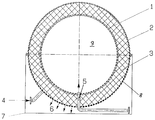
- the device is designed in the form of a hollow sphere, the feed device from the outside through the wall of the hollow sphere leads into the interior of the sphere, the wall is double-walled and can be flowed through from the inside to the outside and is filled with the abovementioned adsorbent, and the discharge device for the cleaned liquid medium runs from the outer wall section.
- a filter cloth for example, is arranged at least on the inside of the outer wall section in order to prevent the adsorbent from flowing out unintentionally.
- This embodiment of the device has the advantage that the medium to be cleaned can be passed through the adsorbent in all directions under the same pressure, so that the adsorption effect as a whole is also made more uniform.
- a particularly high flow area for the medium can be provided in this way.
- the procedural problems described above are eliminated because there are practically no edge regions between the wall of the device and the adsorbent (in the direction of flow).
- the hollow sphere consists of an inner, liquid-permeable wall section 1 and a spaced-apart, likewise liquid-permeable outer wall section 2, which are positioned relative to one another via corresponding spacers (not shown).
- a filter cloth 8 is arranged on the inside of the outer wall section 2.
- the wastewater which contains, for example, hydrocarbons or heavy metals as pollutants, is then pushed through the inner wall section 1, the adsorbent, the filter cloth 8 and the outer wall section 2 before it - cleaned - runs off on the surface of the outer wall section 2 and in one Collection container 7 is collected and carried away.
- the outlet direction of the cleaned wastewater is shown.
- the adsorbent between the wall sections 1, 2 gradually picks up the pollutants of the wastewater passed through to the saturation limit.
- the supply of further contaminated wastewater is then switched off and fed into a further, structurally identical device while the first device is being cleaned, that is to say the adsorbent is exchanged.
- Continuous cleaning can be achieved in this way.
- a reverse procedure can also be used.
- the wastewater is fed in from the outside and withdrawn from the system via the feed line 5, which now serves as a discharge line.
- the adhesive and capillary water in the adsorbent pack is displaced by water constituents (for example oil emulsions), and the water content of the adsorbent is substantially reduced, so that the adsorption process is also a dewatering process and the adsorbent to be disposed of later is only one has low water content (usually less than 30% by weight).
Landscapes
- Chemical & Material Sciences (AREA)
- Analytical Chemistry (AREA)
- Chemical Kinetics & Catalysis (AREA)
- Organic Chemistry (AREA)
- Inorganic Chemistry (AREA)
- Life Sciences & Earth Sciences (AREA)
- Dispersion Chemistry (AREA)
- Geochemistry & Mineralogy (AREA)
- Solid-Sorbent Or Filter-Aiding Compositions (AREA)
- Water Treatment By Sorption (AREA)
Applications Claiming Priority (2)
| Application Number | Priority Date | Filing Date | Title |
|---|---|---|---|
| DE19904029209 DE4029209A1 (de) | 1990-09-14 | 1990-09-14 | Adsorptionsmittel, verfahren und vorrichtung zur reduzierung beziehungsweise elimination von schadstoffen aus fluessigen medien |
| DE4029209 | 1990-09-14 |
Publications (2)
| Publication Number | Publication Date |
|---|---|
| EP0477538A2 true EP0477538A2 (fr) | 1992-04-01 |
| EP0477538A3 EP0477538A3 (en) | 1992-04-15 |
Family
ID=6414264
Family Applications (1)
| Application Number | Title | Priority Date | Filing Date |
|---|---|---|---|
| EP19910114146 Withdrawn EP0477538A3 (en) | 1990-09-14 | 1991-08-23 | Adsorbent, process and apparatus for reducing or eliminating of noxions substances from liquid media |
Country Status (2)
| Country | Link |
|---|---|
| EP (1) | EP0477538A3 (fr) |
| DE (1) | DE4029209A1 (fr) |
Cited By (1)
| Publication number | Priority date | Publication date | Assignee | Title |
|---|---|---|---|---|
| WO2005112669A3 (fr) * | 2004-04-29 | 2006-06-15 | Brown & Williamson Holdings | Elimination de composes azotes du tabac |
Families Citing this family (6)
| Publication number | Priority date | Publication date | Assignee | Title |
|---|---|---|---|---|
| FR2689121B1 (fr) * | 1992-03-27 | 1994-11-10 | Sol Cie | Composition pour la réalisation d'une barrière anti-pollution polyvalente et procédé pour réaliser une telle barrière. |
| US5178768A (en) * | 1992-08-20 | 1993-01-12 | Pall Corporation | Mixed filter bed composition and method of use |
| DE4238142A1 (de) * | 1992-11-12 | 1994-05-19 | Hasso Von Bluecher | Poröse Körper mit adsorbierenden Eigenschaften |
| DE4327598C2 (de) * | 1993-08-17 | 1997-01-30 | Etc Engineering & Technology C | Verwendung von Aktivkohle bei der Wasseraufbereitung, insbesondere für die Aufbereitung von Schwimm- und Badebeckenwasser |
| DE4327599C2 (de) * | 1993-08-17 | 2001-03-22 | Etc Engineering & Technology C | Mittel zur Adsorption von Trihalogenmethanen (Haloformen) und AOX sowie zur Reduktion von Chloraminen aus Wasser, insbesondere aus Schwimm- und Badebeckenwasser |
| AUPQ761400A0 (en) * | 2000-05-19 | 2000-06-15 | Commonwealth Scientific And Industrial Research Organisation | Removal of toxins from water |
Family Cites Families (2)
| Publication number | Priority date | Publication date | Assignee | Title |
|---|---|---|---|---|
| GB295623A (en) * | 1927-05-14 | 1928-08-14 | Buettner Werke Ag | Decolorising agents |
| US3612279A (en) * | 1969-11-21 | 1971-10-12 | Ernest W Hostetter | Carbon water filter |
-
1990
- 1990-09-14 DE DE19904029209 patent/DE4029209A1/de active Granted
-
1991
- 1991-08-23 EP EP19910114146 patent/EP0477538A3/de not_active Withdrawn
Cited By (2)
| Publication number | Priority date | Publication date | Assignee | Title |
|---|---|---|---|---|
| WO2005112669A3 (fr) * | 2004-04-29 | 2006-06-15 | Brown & Williamson Holdings | Elimination de composes azotes du tabac |
| EP1847184A3 (fr) * | 2004-04-29 | 2007-10-31 | Brown & Williamson Holdings, Inc. | Adsorbant pour l'élimination sélective de composes azotes du tabac |
Also Published As
| Publication number | Publication date |
|---|---|
| DE4029209A1 (de) | 1992-03-19 |
| DE4029209C2 (fr) | 1992-12-10 |
| EP0477538A3 (en) | 1992-04-15 |
Similar Documents
| Publication | Publication Date | Title |
|---|---|---|
| EP0323482B1 (fr) | Procede de depollution de materiaux contamines et utilisation du produit ainsi obtenu | |
| DE60308214T2 (de) | Wasserbehandlungsverfahren unter verwendung eines anorganischen pulverförmigen reagenzes mit grosser spezifischer oberfläche mit einem reagenzienrückführschritt | |
| DE2127323B2 (de) | Verfahren und Vorrichtung zur kontinuierlichen Reinigung eines Fluidstroms durch Adsorption oder Ionenaustausch | |
| EP2944612A1 (fr) | Installation destinée au traitement d'eaux usées | |
| DE4029209C2 (fr) | ||
| AT398324B (de) | Verwendung der feinfraktion von gewässersedimenten als deponiedichtungsmaterial | |
| DE60107960T2 (de) | Vorrichtung zur reinigung von mit flüssigen kohlenwasserstofftröpfchen verunreinigtem wasser | |
| DE3919788C1 (fr) | ||
| DE2834718A1 (de) | Verfahren zur kombinierten muellverwertung/abwasseraufbereitung und mehrstufen-filtrationsvorrichtung zur durchfuehrung des verfahrens | |
| DE9014484U1 (de) | Adsorptionsmittel und Vorrichtung zur Reduzierung beziehungsweise Elimination von Schadstoffen aus flüssigen Medien unter Verwendung des Adsorptionsmittels | |
| DE4206646C2 (de) | Verfahren zur Reinigung von Abwasser und Adsorptionsmittel | |
| DE4225886B4 (de) | Zusatzstoffe und Verfahren zur Entwässerung und/oder Verfestigung von Schlämmen | |
| DE3700725A1 (de) | Verfahren und anlage zur reinigung von feinschlamm fuehrendem rohabwasser | |
| DE2150915A1 (de) | Anlage zur Abscheidung von in einer Fluessigkeit enthaltenen Feststoffen | |
| DE69216579T2 (de) | Verfahren und anlage zur filtrierung einer fluessigkeit, die suspendierte teilchen enthaelt | |
| DE4029213C2 (fr) | ||
| DE2945609A1 (de) | Filtermedium, filtrationsverfahren und tiefenfilter | |
| DE2411828B2 (de) | Verfahren zum Adsorbieren von in einer wäßrigen Flüssigkeit enthaltenen Fremdstoffen an körniger Aktivkohle | |
| DE3809938A1 (de) | Verfahren zum erzeugen von flugasche enthaltenden formkoerpern | |
| DE10200616A1 (de) | Substrat sowie Verfahren sowie Rinne zur Behandlung von Oberflächenwasser | |
| DE19648849C2 (de) | Verfahren zum Verändern der Konsistenz eines Schlamms | |
| EP0817666A1 (fr) | Procede de separation solide-liquide et/ou de rupture d'emulsion | |
| DE2614588C2 (de) | Klärvorrichtung für die Wasseraufbereitung und Aufbereitungsanlage dazu | |
| DE102004053110B4 (de) | Verfahren zur Herstellung einer Deponieabdeckung | |
| DE19604662C1 (de) | Horizontal arbeitende Entwässerungspresse für Flüssigschlamm, insbesondere für Flüssigschlamm aus Abwasserreinigungsanlagen |
Legal Events
| Date | Code | Title | Description |
|---|---|---|---|
| PUAI | Public reference made under article 153(3) epc to a published international application that has entered the european phase |
Free format text: ORIGINAL CODE: 0009012 |
|
| PUAL | Search report despatched |
Free format text: ORIGINAL CODE: 0009013 |
|
| AK | Designated contracting states |
Kind code of ref document: A2 Designated state(s): AT BE CH DE DK ES FR GB GR IT LI LU NL SE |
|
| AK | Designated contracting states |
Kind code of ref document: A3 Designated state(s): AT BE CH DE DK ES FR GB GR IT LI LU NL SE |
|
| 17P | Request for examination filed |
Effective date: 19920404 |
|
| 17Q | First examination report despatched |
Effective date: 19920709 |
|
| STAA | Information on the status of an ep patent application or granted ep patent |
Free format text: STATUS: THE APPLICATION IS DEEMED TO BE WITHDRAWN |
|
| 18D | Application deemed to be withdrawn |
Effective date: 19921120 |