EP0477742B2 - Transparente Schrumpffolie aus biaxial orientiertem Polypropylen für die Rundumetikettierung - Google Patents
Transparente Schrumpffolie aus biaxial orientiertem Polypropylen für die Rundumetikettierung Download PDFInfo
- Publication number
- EP0477742B2 EP0477742B2 EP19910115801 EP91115801A EP0477742B2 EP 0477742 B2 EP0477742 B2 EP 0477742B2 EP 19910115801 EP19910115801 EP 19910115801 EP 91115801 A EP91115801 A EP 91115801A EP 0477742 B2 EP0477742 B2 EP 0477742B2
- Authority
- EP
- European Patent Office
- Prior art keywords
- roll
- range
- weight
- film
- transverse
- Prior art date
- Legal status (The legal status is an assumption and is not a legal conclusion. Google has not performed a legal analysis and makes no representation as to the accuracy of the status listed.)
- Expired - Lifetime
Links
- 229920006300 shrink film Polymers 0.000 title claims description 8
- 238000002372 labelling Methods 0.000 title claims description 6
- 229920006378 biaxially oriented polypropylene Polymers 0.000 title description 2
- 239000011127 biaxially oriented polypropylene Substances 0.000 title description 2
- 238000000034 method Methods 0.000 claims description 20
- 229920001155 polypropylene Polymers 0.000 claims description 20
- -1 polypropylene Polymers 0.000 claims description 17
- 239000004743 Polypropylene Substances 0.000 claims description 13
- 239000003795 chemical substances by application Substances 0.000 claims description 9
- 229920001577 copolymer Polymers 0.000 claims description 9
- 229920005989 resin Polymers 0.000 claims description 8
- 239000011347 resin Substances 0.000 claims description 8
- 239000000155 melt Substances 0.000 claims description 7
- VTYYLEPIZMXCLO-UHFFFAOYSA-L Calcium carbonate Chemical compound [Ca+2].[O-]C([O-])=O VTYYLEPIZMXCLO-UHFFFAOYSA-L 0.000 claims description 6
- 239000013032 Hydrocarbon resin Substances 0.000 claims description 6
- 229920006270 hydrocarbon resin Polymers 0.000 claims description 6
- 229910052799 carbon Inorganic materials 0.000 claims description 5
- 238000004519 manufacturing process Methods 0.000 claims description 5
- 229920001384 propylene homopolymer Polymers 0.000 claims description 5
- VGGSQFUCUMXWEO-UHFFFAOYSA-N Ethene Chemical compound C=C VGGSQFUCUMXWEO-UHFFFAOYSA-N 0.000 claims description 4
- 239000005977 Ethylene Substances 0.000 claims description 4
- VYPSYNLAJGMNEJ-UHFFFAOYSA-N Silicium dioxide Chemical group O=[Si]=O VYPSYNLAJGMNEJ-UHFFFAOYSA-N 0.000 claims description 4
- 238000001125 extrusion Methods 0.000 claims description 4
- 239000002245 particle Substances 0.000 claims description 4
- 229910000019 calcium carbonate Inorganic materials 0.000 claims description 3
- 239000000203 mixture Substances 0.000 claims description 3
- 239000000377 silicon dioxide Substances 0.000 claims description 2
- 235000012239 silicon dioxide Nutrition 0.000 claims description 2
- 239000000057 synthetic resin Substances 0.000 claims description 2
- 229920003002 synthetic resin Polymers 0.000 claims description 2
- 239000000470 constituent Substances 0.000 claims 1
- 229920005604 random copolymer Polymers 0.000 claims 1
- IMNFDUFMRHMDMM-UHFFFAOYSA-N N-Heptane Chemical compound CCCCCCC IMNFDUFMRHMDMM-UHFFFAOYSA-N 0.000 description 12
- 239000011888 foil Substances 0.000 description 7
- 229920000642 polymer Polymers 0.000 description 5
- 238000011282 treatment Methods 0.000 description 5
- ZSWFCLXCOIISFI-UHFFFAOYSA-N cyclopentadiene Chemical compound C1C=CC=C1 ZSWFCLXCOIISFI-UHFFFAOYSA-N 0.000 description 4
- 239000004205 dimethyl polysiloxane Substances 0.000 description 4
- 239000000463 material Substances 0.000 description 4
- 229920000435 poly(dimethylsiloxane) Polymers 0.000 description 4
- 239000004711 α-olefin Substances 0.000 description 4
- 125000004432 carbon atom Chemical group C* 0.000 description 3
- 239000000314 lubricant Substances 0.000 description 3
- 230000003287 optical effect Effects 0.000 description 3
- YBYIRNPNPLQARY-UHFFFAOYSA-N 1H-indene Chemical compound C1=CC=C2CC=CC2=C1 YBYIRNPNPLQARY-UHFFFAOYSA-N 0.000 description 2
- 239000004793 Polystyrene Substances 0.000 description 2
- PPBRXRYQALVLMV-UHFFFAOYSA-N Styrene Chemical compound C=CC1=CC=CC=C1 PPBRXRYQALVLMV-UHFFFAOYSA-N 0.000 description 2
- 239000000654 additive Substances 0.000 description 2
- 125000001931 aliphatic group Chemical group 0.000 description 2
- 238000001816 cooling Methods 0.000 description 2
- 230000000694 effects Effects 0.000 description 2
- 230000002349 favourable effect Effects 0.000 description 2
- 229920005606 polypropylene copolymer Polymers 0.000 description 2
- 229920002223 polystyrene Polymers 0.000 description 2
- 229920000915 polyvinyl chloride Polymers 0.000 description 2
- 239000004800 polyvinyl chloride Substances 0.000 description 2
- PMJHHCWVYXUKFD-SNAWJCMRSA-N (E)-1,3-pentadiene Chemical compound C\C=C\C=C PMJHHCWVYXUKFD-SNAWJCMRSA-N 0.000 description 1
- VXNZUUAINFGPBY-UHFFFAOYSA-N 1-Butene Chemical compound CCC=C VXNZUUAINFGPBY-UHFFFAOYSA-N 0.000 description 1
- 125000000954 2-hydroxyethyl group Chemical group [H]C([*])([H])C([H])([H])O[H] 0.000 description 1
- JLBJTVDPSNHSKJ-UHFFFAOYSA-N 4-Methylstyrene Chemical compound CC1=CC=C(C=C)C=C1 JLBJTVDPSNHSKJ-UHFFFAOYSA-N 0.000 description 1
- 240000009125 Myrtillocactus geometrizans Species 0.000 description 1
- 239000004698 Polyethylene Substances 0.000 description 1
- 229910004298 SiO 2 Inorganic materials 0.000 description 1
- 239000002253 acid Substances 0.000 description 1
- 230000000996 additive effect Effects 0.000 description 1
- 150000003973 alkyl amines Chemical class 0.000 description 1
- 125000000217 alkyl group Chemical group 0.000 description 1
- 239000002216 antistatic agent Substances 0.000 description 1
- IAQRGUVFOMOMEM-UHFFFAOYSA-N butene Natural products CC=CC IAQRGUVFOMOMEM-UHFFFAOYSA-N 0.000 description 1
- 150000001875 compounds Chemical class 0.000 description 1
- 238000003851 corona treatment Methods 0.000 description 1
- 239000013078 crystal Substances 0.000 description 1
- UAUDZVJPLUQNMU-KTKRTIGZSA-N erucamide Chemical compound CCCCCCCC\C=C/CCCCCCCCCCCC(N)=O UAUDZVJPLUQNMU-KTKRTIGZSA-N 0.000 description 1
- 150000002148 esters Chemical class 0.000 description 1
- 239000012530 fluid Substances 0.000 description 1
- 229920001519 homopolymer Polymers 0.000 description 1
- 229910052751 metal Inorganic materials 0.000 description 1
- 239000002184 metal Substances 0.000 description 1
- 229920000098 polyolefin Polymers 0.000 description 1
- HJWLCRVIBGQPNF-UHFFFAOYSA-N prop-2-enylbenzene Chemical compound C=CCC1=CC=CC=C1 HJWLCRVIBGQPNF-UHFFFAOYSA-N 0.000 description 1
- 238000005096 rolling process Methods 0.000 description 1
- 239000000344 soap Substances 0.000 description 1
- 229920006301 statistical copolymer Polymers 0.000 description 1
- 239000000126 substance Substances 0.000 description 1
- 238000004381 surface treatment Methods 0.000 description 1
- 150000003512 tertiary amines Chemical class 0.000 description 1
- 239000001993 wax Substances 0.000 description 1
Classifications
-
- C—CHEMISTRY; METALLURGY
- C08—ORGANIC MACROMOLECULAR COMPOUNDS; THEIR PREPARATION OR CHEMICAL WORKING-UP; COMPOSITIONS BASED THEREON
- C08L—COMPOSITIONS OF MACROMOLECULAR COMPOUNDS
- C08L23/00—Compositions of homopolymers or copolymers of unsaturated aliphatic hydrocarbons having only one carbon-to-carbon double bond; Compositions of derivatives of such polymers
- C08L23/02—Compositions of homopolymers or copolymers of unsaturated aliphatic hydrocarbons having only one carbon-to-carbon double bond; Compositions of derivatives of such polymers not modified by chemical after-treatment
- C08L23/10—Homopolymers or copolymers of propene
-
- B—PERFORMING OPERATIONS; TRANSPORTING
- B29—WORKING OF PLASTICS; WORKING OF SUBSTANCES IN A PLASTIC STATE IN GENERAL
- B29C—SHAPING OR JOINING OF PLASTICS; SHAPING OF MATERIAL IN A PLASTIC STATE, NOT OTHERWISE PROVIDED FOR; AFTER-TREATMENT OF THE SHAPED PRODUCTS, e.g. REPAIRING
- B29C61/00—Shaping by liberation of internal stresses; Making preforms having internal stresses; Apparatus therefor
- B29C61/003—Shaping by liberation of internal stresses; Making preforms having internal stresses; Apparatus therefor characterised by the choice of material
-
- B—PERFORMING OPERATIONS; TRANSPORTING
- B29—WORKING OF PLASTICS; WORKING OF SUBSTANCES IN A PLASTIC STATE IN GENERAL
- B29C—SHAPING OR JOINING OF PLASTICS; SHAPING OF MATERIAL IN A PLASTIC STATE, NOT OTHERWISE PROVIDED FOR; AFTER-TREATMENT OF THE SHAPED PRODUCTS, e.g. REPAIRING
- B29C61/00—Shaping by liberation of internal stresses; Making preforms having internal stresses; Apparatus therefor
- B29C61/06—Making preforms having internal stresses, e.g. plastic memory
-
- B—PERFORMING OPERATIONS; TRANSPORTING
- B29—WORKING OF PLASTICS; WORKING OF SUBSTANCES IN A PLASTIC STATE IN GENERAL
- B29K—INDEXING SCHEME ASSOCIATED WITH SUBCLASSES B29B, B29C OR B29D, RELATING TO MOULDING MATERIALS OR TO MATERIALS FOR MOULDS, REINFORCEMENTS, FILLERS OR PREFORMED PARTS, e.g. INSERTS
- B29K2023/00—Use of polyalkenes or derivatives thereof as moulding material
- B29K2023/10—Polymers of propylene
- B29K2023/12—PP, i.e. polypropylene
-
- B—PERFORMING OPERATIONS; TRANSPORTING
- B29—WORKING OF PLASTICS; WORKING OF SUBSTANCES IN A PLASTIC STATE IN GENERAL
- B29K—INDEXING SCHEME ASSOCIATED WITH SUBCLASSES B29B, B29C OR B29D, RELATING TO MOULDING MATERIALS OR TO MATERIALS FOR MOULDS, REINFORCEMENTS, FILLERS OR PREFORMED PARTS, e.g. INSERTS
- B29K2995/00—Properties of moulding materials, reinforcements, fillers, preformed parts or moulds
- B29K2995/0018—Properties of moulding materials, reinforcements, fillers, preformed parts or moulds having particular optical properties, e.g. fluorescent or phosphorescent
- B29K2995/0026—Transparent
-
- B—PERFORMING OPERATIONS; TRANSPORTING
- B29—WORKING OF PLASTICS; WORKING OF SUBSTANCES IN A PLASTIC STATE IN GENERAL
- B29L—INDEXING SCHEME ASSOCIATED WITH SUBCLASS B29C, RELATING TO PARTICULAR ARTICLES
- B29L2031/00—Other particular articles
- B29L2031/744—Labels, badges, e.g. marker sleeves
-
- C—CHEMISTRY; METALLURGY
- C08—ORGANIC MACROMOLECULAR COMPOUNDS; THEIR PREPARATION OR CHEMICAL WORKING-UP; COMPOSITIONS BASED THEREON
- C08L—COMPOSITIONS OF MACROMOLECULAR COMPOUNDS
- C08L2203/00—Applications
- C08L2203/10—Applications used for bottles
-
- C—CHEMISTRY; METALLURGY
- C08—ORGANIC MACROMOLECULAR COMPOUNDS; THEIR PREPARATION OR CHEMICAL WORKING-UP; COMPOSITIONS BASED THEREON
- C08L—COMPOSITIONS OF MACROMOLECULAR COMPOUNDS
- C08L23/00—Compositions of homopolymers or copolymers of unsaturated aliphatic hydrocarbons having only one carbon-to-carbon double bond; Compositions of derivatives of such polymers
- C08L23/02—Compositions of homopolymers or copolymers of unsaturated aliphatic hydrocarbons having only one carbon-to-carbon double bond; Compositions of derivatives of such polymers not modified by chemical after-treatment
- C08L23/10—Homopolymers or copolymers of propene
- C08L23/14—Copolymers of propene
- C08L23/142—Copolymers of propene at least partially crystalline copolymers of propene with other olefins
-
- C—CHEMISTRY; METALLURGY
- C08—ORGANIC MACROMOLECULAR COMPOUNDS; THEIR PREPARATION OR CHEMICAL WORKING-UP; COMPOSITIONS BASED THEREON
- C08L—COMPOSITIONS OF MACROMOLECULAR COMPOUNDS
- C08L57/00—Compositions of unspecified polymers obtained by reactions only involving carbon-to-carbon unsaturated bonds
- C08L57/02—Copolymers of mineral oil hydrocarbons
-
- Y—GENERAL TAGGING OF NEW TECHNOLOGICAL DEVELOPMENTS; GENERAL TAGGING OF CROSS-SECTIONAL TECHNOLOGIES SPANNING OVER SEVERAL SECTIONS OF THE IPC; TECHNICAL SUBJECTS COVERED BY FORMER USPC CROSS-REFERENCE ART COLLECTIONS [XRACs] AND DIGESTS
- Y10—TECHNICAL SUBJECTS COVERED BY FORMER USPC
- Y10S—TECHNICAL SUBJECTS COVERED BY FORMER USPC CROSS-REFERENCE ART COLLECTIONS [XRACs] AND DIGESTS
- Y10S428/00—Stock material or miscellaneous articles
- Y10S428/913—Material designed to be responsive to temperature, light, moisture
-
- Y—GENERAL TAGGING OF NEW TECHNOLOGICAL DEVELOPMENTS; GENERAL TAGGING OF CROSS-SECTIONAL TECHNOLOGIES SPANNING OVER SEVERAL SECTIONS OF THE IPC; TECHNICAL SUBJECTS COVERED BY FORMER USPC CROSS-REFERENCE ART COLLECTIONS [XRACs] AND DIGESTS
- Y10—TECHNICAL SUBJECTS COVERED BY FORMER USPC
- Y10T—TECHNICAL SUBJECTS COVERED BY FORMER US CLASSIFICATION
- Y10T428/00—Stock material or miscellaneous articles
- Y10T428/13—Hollow or container type article [e.g., tube, vase, etc.]
- Y10T428/1328—Shrinkable or shrunk [e.g., due to heat, solvent, volatile agent, restraint removal, etc.]
- Y10T428/1331—Single layer [continuous layer]
-
- Y—GENERAL TAGGING OF NEW TECHNOLOGICAL DEVELOPMENTS; GENERAL TAGGING OF CROSS-SECTIONAL TECHNOLOGIES SPANNING OVER SEVERAL SECTIONS OF THE IPC; TECHNICAL SUBJECTS COVERED BY FORMER USPC CROSS-REFERENCE ART COLLECTIONS [XRACs] AND DIGESTS
- Y10—TECHNICAL SUBJECTS COVERED BY FORMER USPC
- Y10T—TECHNICAL SUBJECTS COVERED BY FORMER US CLASSIFICATION
- Y10T428/00—Stock material or miscellaneous articles
- Y10T428/24—Structurally defined web or sheet [e.g., overall dimension, etc.]
- Y10T428/24942—Structurally defined web or sheet [e.g., overall dimension, etc.] including components having same physical characteristic in differing degree
- Y10T428/2495—Thickness [relative or absolute]
- Y10T428/24967—Absolute thicknesses specified
-
- Y—GENERAL TAGGING OF NEW TECHNOLOGICAL DEVELOPMENTS; GENERAL TAGGING OF CROSS-SECTIONAL TECHNOLOGIES SPANNING OVER SEVERAL SECTIONS OF THE IPC; TECHNICAL SUBJECTS COVERED BY FORMER USPC CROSS-REFERENCE ART COLLECTIONS [XRACs] AND DIGESTS
- Y10—TECHNICAL SUBJECTS COVERED BY FORMER USPC
- Y10T—TECHNICAL SUBJECTS COVERED BY FORMER US CLASSIFICATION
- Y10T428/00—Stock material or miscellaneous articles
- Y10T428/28—Web or sheet containing structurally defined element or component and having an adhesive outermost layer
- Y10T428/2813—Heat or solvent activated or sealable
- Y10T428/2817—Heat sealable
- Y10T428/2826—Synthetic resin or polymer
-
- Y—GENERAL TAGGING OF NEW TECHNOLOGICAL DEVELOPMENTS; GENERAL TAGGING OF CROSS-SECTIONAL TECHNOLOGIES SPANNING OVER SEVERAL SECTIONS OF THE IPC; TECHNICAL SUBJECTS COVERED BY FORMER USPC CROSS-REFERENCE ART COLLECTIONS [XRACs] AND DIGESTS
- Y10—TECHNICAL SUBJECTS COVERED BY FORMER USPC
- Y10T—TECHNICAL SUBJECTS COVERED BY FORMER US CLASSIFICATION
- Y10T428/00—Stock material or miscellaneous articles
- Y10T428/31504—Composite [nonstructural laminate]
- Y10T428/31855—Of addition polymer from unsaturated monomers
-
- Y—GENERAL TAGGING OF NEW TECHNOLOGICAL DEVELOPMENTS; GENERAL TAGGING OF CROSS-SECTIONAL TECHNOLOGIES SPANNING OVER SEVERAL SECTIONS OF THE IPC; TECHNICAL SUBJECTS COVERED BY FORMER USPC CROSS-REFERENCE ART COLLECTIONS [XRACs] AND DIGESTS
- Y10—TECHNICAL SUBJECTS COVERED BY FORMER USPC
- Y10T—TECHNICAL SUBJECTS COVERED BY FORMER US CLASSIFICATION
- Y10T428/00—Stock material or miscellaneous articles
- Y10T428/31504—Composite [nonstructural laminate]
- Y10T428/31855—Of addition polymer from unsaturated monomers
- Y10T428/31909—Next to second addition polymer from unsaturated monomers
- Y10T428/31913—Monoolefin polymer
Definitions
- the present invention relates to a roll of biaxially oriented transparent Polypropylene shrink film.
- the invention also relates to a method of manufacture such a role and its use for the All-round labeling of essentially cylindrical Containers, in particular bottles.
- a film is used for the first-mentioned process with a high shrinkage perpendicular to the longitudinal axis the bottle needed; that direction is identical to the transverse direction of the film.
- For the second method is a film with an elevated Shrinkage required in the roll direction; this means, longitudinal shrinkage is preferred here.
- the present invention relates to a Foil that is suitable for the second method, at the - at least in the relevant temperature range - a high longitudinal shrinkage at the same time low transverse shrinkage is realized.
- such foils mostly consist of Polyvinyl chloride or polystyrene and are in general elongated. Have both materials Disadvantage; in the case of polyvinyl chloride, it is comparatively high price due to the high density, for polystyrene it is the high recipe price for the crystal clear application.
- EP-A-0 348 749 describes polyolefinic ones Shrink films from at least one layer.
- This Layer contains polyolefin and resin.
- the foil has a transverse shrinkage of more than 20% at 90 ° C and in the longitudinal direction of less than 8% also at 90 ° C.
- This Shrink film is used for all-round labeling of Cans and bottles used.
- GB-A-2 055 688 describes a shrinkable, sealable film, which consists of a base layer and at least one top layer.
- the cover layer contains at least two polymers, selected from the group of polymers A, B and C.
- Polymer A is a copolymer of propylene and ethylene, which contains 0.5 to 10% ethylene.
- Polymer B is a copolymer of propylene and another ⁇ -olefin with 4 to 10 carbon atoms with an ⁇ -olefin content of 5 to 30%.
- Polymer C is a copolymer of butene and one further ⁇ -olefin with 4 to 10 carbon atoms with an ⁇ -olefin content of 1 to 30%.
- the foil is characterized by a shrinkage, which in Longitudinal and transverse direction is greater than 3.5%.
- the object of the present invention was in being a transparent, easy to stick and Long-shrinkable multilayer film for all-round labels based on polypropylene to develop the very good optical and mechanical Has properties and technical and economic Advantages over foils after State of the art enables. Beyond that the film does not change its dimension in the transverse direction, if they are subject to the shrinking process becomes.
- the propylene polymer is preferably an isotactic Polypropylene with an n-heptane soluble Proportion of 15% by weight or less, being isotactic Polypropylene with an n-heptane soluble Amount of 2 to 6 wt .-% particularly preferred are.
- Suitable propylene polymers expediently have a melt index of 0.5 g / 10 min to 8 g / 10 min at 230 ° C and 21.6 N load (determined according to DIN 53 735), in particular from 1.5 g / 10 min to 4 g / 10 min.
- the inventive film the propylene polymer in an amount of 60 to 95 wt .-% and also another hydrogenated hydrocarbon resin with a Softening point in the range from 130 to 180 ° C in an amount of 5 to 40 wt .-%, the Percentages are based on the total weight the mixture.
- hydrocarbon resin it is a low molecular weight synthetic Resin that has a softening point in the preferred Has range of 130 to 160 ° C determined according to ASTM E28.
- Such hydrocarbon resins are usually made from resin-forming Compounds such as styrene, methylstyrene, vinyltoluene, Indene, pentadiene, cyclopentadiene and the like. ⁇ . formed.
- resin-forming Compounds such as styrene, methylstyrene, vinyltoluene, Indene, pentadiene, cyclopentadiene and the like. ⁇ . formed.
- especially hydrogenated Resins, especially hydrogenated cyclopentadiene resins prefers.
- the color number according to Saybold is greater than 20, preferably greater than 25
- the invention still supports the film on both sides Cover layers made of propylene homopolymers or Ethylene-propylene copolymers.
- cover layers are made of propylene homopolymers exist, it is recommended to have one here use a higher one Melt index than that of the base layer.
- the top layer should be about same resin content as in the base layer.
- top layer selected An ethylene-propylene copolymer is used as the top layer selected, the film is also sealable, what for certain use cases of Advantage is.
- the vote on the melt index should also be here so that the material is more fluid in the top layer than that in the base layer.
- the propylene polymer of the top layers is an isotactic polypropylene with an n-heptane soluble Content of 15% by weight or less, wherein isotactic polypropylenes with an n-heptane soluble Share of 2 to 6 wt .-% particularly are preferred.
- Suitable for the top layers Propylene polymers are said to have a melt index in the Have a range of 5 to 20 g / 10 min.
- Suitable ethylene-propylene copolymers for the top layers are statistical copolymers and have an ethylene content in the range of 2 up to 10% by weight, preferably from 3 to 6% by weight
- the cover layers preferably additionally contain an inorganic or organic antiblocking agent.
- Suitable antiblocking agents are inorganic additives, e.g. B. silicon dioxide and calcium carbonate or the like. It is essential for the antiblocking agent that the average particle size is between 1.5 and 3 ⁇ m and its form factor is ⁇ 3, the form factor of the antiblocking agent being understood to mean the ratio of the largest surface area to the standardized thickness of the particles. According to this definition, a cube-shaped antiblocking agent has a form factor of 1.
- the refractive index of the antiblocking agent is between 1.4 and 1.6. SiO 2 and calcium carbonate are preferred as antiblocking agents.
- the amount added is 0.1 to 0.5% by weight.
- Additive in effective amounts contain, preferably antistatic and / or lubricants.
- Preferred antistatic agents are essentially straight-chain and saturated aliphatic, tertiary amines with an aliphatic radical having 10 to 20 carbon atoms which are substituted with 2-hydroxyalkyl (C 1 -C 4 ) groups, including N, N-bis- (2- hydroxyethyl) alkylamines with C 10 -C 20 , preferably C 12 - C 18 , are particularly suitable as alkyl groups.
- the effective amount of antistatic is in the range of 0.05 to 0.2% by weight based on the layer.
- lubricants are higher aliphatic acid amides, higher aliphatic acid esters, waxes and metal soaps as well as polydimethylsiloxane.
- the effective amount of lubricant is in the range of 0.1 to 2% by weight based on the weight of the layer.
- higher aliphatic acid amides e.g. B. erucic acid amide
- Very good results are achieved by adding polydimethylsiloxane to one or both top layers.
- the amount added is expediently in the range from 0.3 to 1.5% by weight, the viscosity of the polydimethylsiloxane being between 1000 and 100,000 mm 2 / s.
- the total thickness of the film according to the invention is in the range of 10 to 50 microns, preferably from 20 to 45 ⁇ m, the top layers being a Have a thickness of 0.2 to 0.7 ⁇ m.
- Foil stands out in particular through particularly desirable shrink properties out. It has one Shrinkage capacity of more than 10% at 100 ° C and more than 20% at 120 ° C in the longitudinal direction and at the same time a shrinkage capacity of less than 2% at 100 ° C and less than 10% at 120 ° C in the transverse direction, the percentages are each related to the respective Linear expansion of the film before the shrinking process.
- the specified shrinkage values are in each case in a forced air oven for 15 min determined according to DIN 406 34.
- the shrinking capacity of the invention Longitudinal film in a range of 14 up to 18% at 100 ° C and from 25 to 30% at 120 ° C and in the transverse direction in a range of maximum 0 to 2% at 100 ° C and maximum 3. up to 7% at 120 ° C, each based on the Linear expansion of the film before the shrinking process.
- the film according to the invention also has particularly advantageous mechanical properties.
- the modulus of elasticity is determined using a tension-stretching device from Zwick in Ulm-Einsingen of type 1445 in accordance with DIN 53 455.
- the film according to the invention then has a modulus of elasticity in the longitudinal direction of more than 2800 N / mm 2 , preferably from 3000 to 3300 N / mm 2 , and an elastic modulus in the transverse direction of more than 2500 N / mm 2 , preferably of 2800 N / mm 2 to 3300 N / mm 2 .
- the shrink film according to the invention has a tensile strength in the longitudinal direction of more than 170 N / mm 2 , preferably in the range from 180 to 200 N / mm 2 , and in the transverse direction of more than 150 N / mm 2 , preferably in the range from 160 to 180 N / mm 2 .
- the optical properties of the inventive film are very excellent.
- the gloss value is in the range from 110 to 130, determined according to DIN 67 530 or ASTM-D 523, and the haze of the film is less than 20%, preferably 10 to 15%, the turbidity of the Film measured based on ASTM-D 1003-52 becomes. Instead of a 4 ° aperture, a 1 ° slit is used used, and the turbidity in percent for four superimposed film lines specified. The four layers were chosen because the optimum measuring range is hereby exploited.
- the particularly high gloss value of the invention Foil has a particularly effective advertising effect from, and therefore the area of application of the see film according to the invention especially there where high on the product (can / bottle / dispenser) optical requirements are made.
- the object of the invention mentioned at the outset is also achieved by a method for producing the film described above.
- the process according to the invention consists in firstly producing a pre-film by means of extrusion or coextrusion in a slot die, which is then solidified on a cooling roll and then oriented in the longitudinal and transverse directions by stretching.
- the conditions in the longitudinal stretching are selected so that the longitudinally stretched film is highly oriented.
- the prerequisites for achieving a high longitudinal shrinkage and a low transverse shrinkage are then particularly favorable.
- a common measure for assessing the extent of the orientation of the elongated film is birefringence n.
- the birefringence ⁇ n should preferably be> 30 • 10 -3 .
- the longitudinal stretching is carried out at a temperature of less than 110 ° C., preferably in the range from 90 to 105 ° C., and with a stretching ratio of greater than 6.5, preferably in the range from 7.5 to 8.5.
- transverse stretching temperatures are included in the range> 140 ° C preferably greater than 145 - 150 ° C.
- the transverse stretching ratio should do not exceed a value of 8: 1.
- Prefers here is a range ⁇ 7: 1.
- the film in the transverse direction is followed by a final fixing step.
- the film is at a temperature of 20 to 40 ° C below the stretching temperature, in particular at a temperature below 130 ° C, preferably from below 120 ° C, in the Stretching frame, converging, continued.
- the printability or bondability of the film is through one of the usual surface treatments reached before rolling up, e.g. B. Flame treatment or electrical corona treatment. Flame treatment is preferred applied when the cover layers are made of PP homopolymer consist. For cover layers made of PE / PP copolymers can use both methods alternatively be used.
- the treatment intensities are in the usual framework. Treatment intensities from 38 to 42 mN / m are preferred.
- the shrink film thus produced has one Combination of properties that make them special highly suitable for their intended purpose Intended use as a film for Wrap-around labels. Your preferred area of application is especially to see where the shape change the can or bottle in the labeling area accounts for less than 10%.
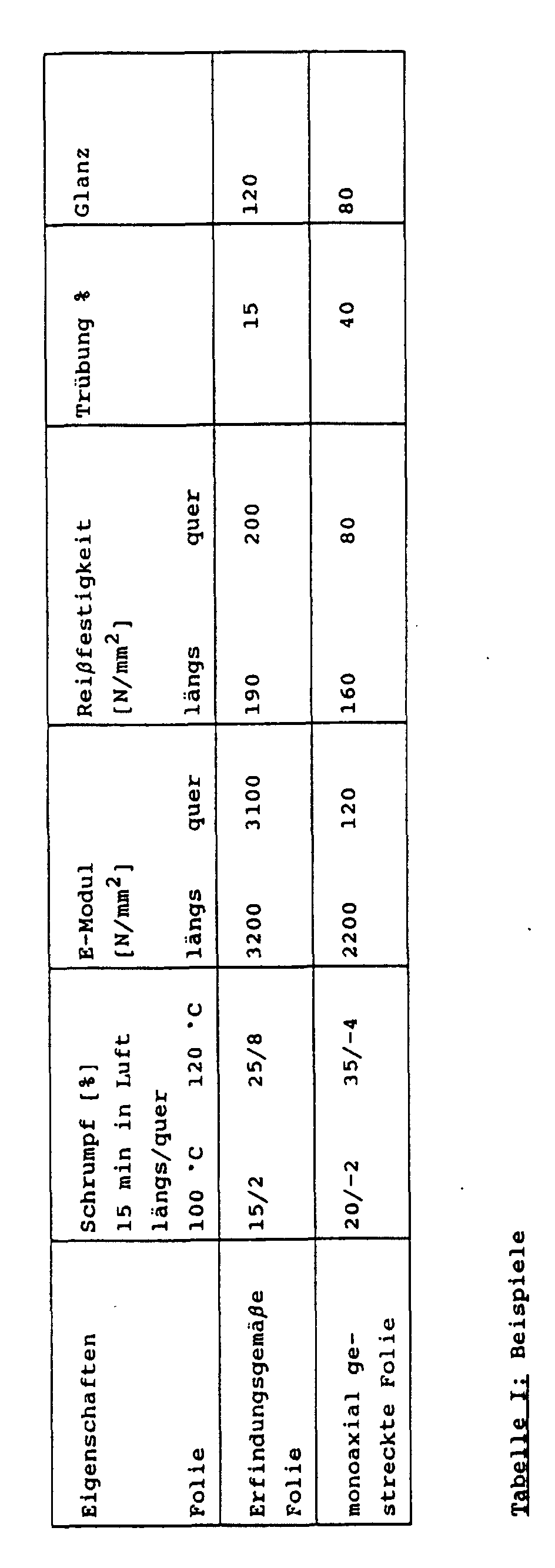
- the film produced in this way had the in properties listed in the table (first line).
- the film was one before being rolled up Flame treated for printability / glueability to ensure.
- the intensity of treatment was 39 mN / m.
- the film according to the invention is compared with a monoaxially oriented PP film.
- a comparison of the reported properties shows that the film according to the invention proves to be clearly superior, in particular with regard to the combination of properties sought in the task, of the monoaxially stretched film.
Landscapes
- Chemical & Material Sciences (AREA)
- Health & Medical Sciences (AREA)
- Chemical Kinetics & Catalysis (AREA)
- Medicinal Chemistry (AREA)
- Polymers & Plastics (AREA)
- Organic Chemistry (AREA)
- Shaping By String And By Release Of Stress In Plastics And The Like (AREA)
- Laminated Bodies (AREA)
- Packaging Of Annular Or Rod-Shaped Articles, Wearing Apparel, Cassettes, Or The Like (AREA)
- Wrappers (AREA)
- Manufacture Of Macromolecular Shaped Articles (AREA)
Description
Claims (24)
- Rolle aus biaxial oriender Transparenter Schrumpffolie aus Polypropylen, dadurch gekennzeichnet, daß sie als Hauptbestandteil, ein Propylenpolymeres enthält und daß sie bei 100 °C einen Schrumpf in Längsrichtung d.h. in Rollenrichtung von mindestens 10 % besitzt und der Schrumpf in Querrichtung kleiner als 2 % ist. wobei der Schrumpf nach DIN 40 634 bei einer Dauer von 15 min ermittelt wird und die Prozentangaben jeweils auf die Längenausdehnung der Folie vor dem Schrumpfprozeß bezogen sind.
- Rolle nach Anspruch 1, dadurch gekennzeichnet, daß das Propylenpolymere ein isotaktisches Polypropylen mit einem n-heptanlöslichen Anteil von 15 Gew.-% oder weniger, vorzugsweise von 2 bis 6 Gew.-%, ist.
- Rolle nach Anspruch 1 oder 2, dadurch gekennzeichnet, daß sie das Propylenpolymere in einer Menge von 60 bis 95 Gew.-% enthält und ein hydriertes Kohlenwasserstoffharz mit einem nach ASTM E28 bestimmten Erweichungspunkt im Bereich von 130 bis 180 °C in einer Menge 5 bis 40 Gew.-%, wobei die Prozentangaben bezogen sind auf das Gesamtgewicht der Mischung.
- Rolle nach Anspruch 3, dadurch gekennzeichnet, daß das Kohlenwasserstoffharz ein niedrigmolekulares synthetisches Harz ist, das einen Erweichungspunkt im Bereich von 130 bis 160 °C besitzt.
- Rolle nach einem der Ansprüche 1 bis 4, dadurch gekennzeichnet, daß sie beidseitig Deckschichten aus Propylen-Homopolymerem oder Ethylen-Propylen-Copolymeren trägt.
- Rolle nach Anspruch 5, dadurch gekennzeichnet, daß das Propylen-Homopolymere einen Schmelzindex im Bereich von 5 bis 20 g/10 min aufweist, wobei der Schmelzindex nach DIN 53 735 bei 230 °C und 21,6 N Belastung gemessen wird.
- Rolle nach Anspruch 6, dadurch gekennzeichnet, daß die Deckschichten Propylen-Homopolymer und bis zu 40 Gew.-% Kohlenwasserstoffharz enthalten, wobei der Harzanteil der Deckschichten in etwa so groß ist wie in der Basisschicht.
- Rolle nach Anspruch 5, dadurch gekennzeichnet. daß die Deckschichten Ethylen-Propylen-Copolymer enthalten und der Schmelzindex des Ethylen-Propylen-Copolymeren höher ist als der Schmelzindex des Propylenpolymeren der Basisschicht.
- Rolle nach Anspruch 8, dadurch gekennzeichnet, daß das Ethylen-Propylen-Copolymer ein statistisches Copolymer ist und einen Ethylengehalt im Bereich von 2 bis 10 Gew.-% besitzt.
- Rolle nach einem der Ansprüche 1 bis 9, dadurch gekennzeichnet, daß die Deckschichten zusätzlich ein Antiblockmittel enthalten.
- Rolle nach Anspruch 10, dadurch gekennzeichnet, daß das Antiblockmittel Siliciumdioxid oder Calciumcarbonat mit einer mittleren Teilchengröße zwischen 1,5 und 3 µm ist und in einer Zusatzmenge von 0,1 bis 0,5 Gew.-% enthalten ist.
- Rolle nach einem der Ansprüche 1 bis 11, dadurch gekennzeichnet, daß ihre Gesamtdikke im Bereich von 10 bis 50 µm liegt, vorzugsweise von 20 bis 45 µm, wobei die Deckschichten eine Dicke von 0,2 bis 0,7 µm aufweisen.
- Rolle nach einem der Ansprüche 1 bis 12, dadurch gekennzeichnet, daß sie ein Schrumpfvermögen von mehr als 10 % bei 100 °C und von mehr als 25 % bei 120 C in Längsrichtung und gleichzeitig ein Schrumpfvermögen von weniger als 2% bei 100 °C und von weniger als 10 % bei 120 °C in Querrichtung besitzt.
- Rolle nach einem der Ansprüche 1 bis 13, dadurch gekennzeichnet, daß sie einen Elastizitätsmodul, bestimmt nach DIN 53 455, in Längsrichtung von mehr als 2,800 N/mm2 und einen Elastizitätsmodul in Querrichtung von mehr als 2 500 N/mm2 besitzt.
- Rolle nach Anspruch 14, dadurch gekennzeichnet, daß der Elastizitätsmodul in Längsrichtung im Bereich von 3 000 bis 3 300 N/mm2 und in Querrichtung im Bereich von 2 800 bis 3 300 N/mm2 liegt.
- Rolle nach einem der Ansprüche 1 bis 15, dadurch gekennzeichnet, daß sie eine Reißfestigkeit, bestimmt nach DIN 53 455, in Längsrichtung von mehr als 170 N/mm2 und in Querrichtung von mehr als 150 N/mm2 besitzt.
- Rolle nach Anspruch 16, dadurch gekennzeichnet, daß die Reißfestigkeit in Längsrichtung im Bereich von 180 bis 200 N/mm2 und in Querrichtung im Bereich von 160 bis 180 N/mm2 liegt.
- Verfahren zur Herstellung einer Rolle nach einem der Ansprüche 1 bis 17, bei dem mittels Extrusion bzw. Coextrusion in einer Breitschlitzdüse zunächst eine Vorfolie hergestellt wird, die dann auf einer Kühlwalze verfestigt und daran anschließend in Längs- und Querrichtung durch Strecken orientiert wird, dadurch gekennzeichnet, daß die Doppelbrechung der längsgestreckten, aber noch nicht quergestreckten Folie einen Wert von Δn = 25 • 10-3 übersteigt, wobei die Längsstreckung bei einer Temperatur von weniger als 110 °C und mit einem Streckverhältnis von größer 6,5 durchgeführt wird.
- Verfahren nach Anspruch 18, dadurch gekennzeichnet, daß die Längsstreckung bei einer Temperatur im Bereich von 90 bis 105 ° C und mit einem Streckverhältnis im Bereich von 7,5 bis 8,5 durchgeführt wird.
- Verfahren nach Anspruch 18 oder 19, dadurch gekennzeichnet, daß die Doppelbrechung Δn >30 • 10-3 beträgt.
- Verfahren nach Anspruch 18, 19 oder 20, dadurch gekennzeichnet, daß die Querstrecktemperatur im Bereich > 140 °C liegt, wobei das Querstreckverhältnis höchstens 8:1 ist.
- Verfahren nach Anspruch 21, dadurch gekennzeichnet, daß die Querstrecktemperatur im Bereich von 145 bis 150 °C liegt und das Querstreckverhältnis <7:1 ist.
- Verwendung einer Rolle nach einem der Ansprüche 1 bis 17 zur Rundumetikettierung von zylindrischen Gefäßen.
- Verwendung nach Anspruch 23, dadurch gekennzeichnet, daß die zylindrischen Gefäße Flaschen sind.
Applications Claiming Priority (2)
| Application Number | Priority Date | Filing Date | Title |
|---|---|---|---|
| DE19904030385 DE4030385A1 (de) | 1990-09-26 | 1990-09-26 | Transparente schrumpffolie aus biaxial orientiertem polypropylen fuer die rundumetikettierung |
| DE4030385 | 1990-09-26 |
Publications (3)
| Publication Number | Publication Date |
|---|---|
| EP0477742A1 EP0477742A1 (de) | 1992-04-01 |
| EP0477742B1 EP0477742B1 (de) | 1995-12-20 |
| EP0477742B2 true EP0477742B2 (de) | 2001-08-08 |
Family
ID=6414982
Family Applications (1)
| Application Number | Title | Priority Date | Filing Date |
|---|---|---|---|
| EP19910115801 Expired - Lifetime EP0477742B2 (de) | 1990-09-26 | 1991-09-18 | Transparente Schrumpffolie aus biaxial orientiertem Polypropylen für die Rundumetikettierung |
Country Status (6)
| Country | Link |
|---|---|
| US (1) | US5292561A (de) |
| EP (1) | EP0477742B2 (de) |
| DE (2) | DE4030385A1 (de) |
| ES (1) | ES2082897T5 (de) |
| MX (1) | MX9101241A (de) |
| ZA (1) | ZA917660B (de) |
Families Citing this family (44)
| Publication number | Priority date | Publication date | Assignee | Title |
|---|---|---|---|---|
| US5851610A (en) * | 1991-02-07 | 1998-12-22 | Applied Extrusion Technologies, Inc. | Shrink films and articles including the same |
| ES2125239T3 (es) * | 1991-02-07 | 1999-03-01 | Applied Extrusion Technologies | Procedimiento para la fabricacion de pelicula contraible y laminados y capas de pelicula contraible resultantes. |
| CA2106258C (en) * | 1992-09-18 | 2003-11-04 | Gautam P. Shah | Moisture barrier film |
| US5460878A (en) * | 1992-10-26 | 1995-10-24 | Applied Extrusion Technologies, Inc. | Heat sealable shrink laminate |
| FR2703624B1 (fr) * | 1993-04-06 | 1995-07-07 | Bollore Technologies | Film composite thermoretractable, procede de fabrication et utilisation dudit film pour le suremballage d'articles. |
| DE69319061T2 (de) * | 1992-10-26 | 1999-03-18 | Bollore Technologies S.A., Quimper | Wärmeschrumpfbarer Verbundfilm, Verfahren zu seiner Herstellung und Verwendung für Verpackungen |
| DE4313640A1 (de) * | 1993-04-27 | 1994-11-03 | Hoechst Ag | Matte, biaxial orientierte Polypropylen-Mehrschichtfolie mit hohem Schrumpf, Verfahren zu ihrer Herstellung und ihre Verwendung |
| DE4317979A1 (de) * | 1993-05-28 | 1994-12-01 | Minnesota Mining & Mfg | Kunststoffband, dessen Verwendung sowie Verfahren zur Herstellung eines mit einem Kunststoffband umwickelten Körpers |
| US5536773A (en) * | 1993-07-16 | 1996-07-16 | Mitsui Petrochemical Industries, Ltd. | Polypropylene resin composition and the use of the same |
| DE4342383A1 (de) * | 1993-12-11 | 1995-06-14 | Hoechst Ag | Umweltfreundliche Verpackung |
| US5491019A (en) * | 1994-03-28 | 1996-02-13 | W. R. Grace & Co.-Conn. | Oxygen-permeable multilayer film |
| US6060136A (en) | 1995-10-13 | 2000-05-09 | Cryovac, Inc. | High modulus oxygen-permeable multilayer film |
| US5691043A (en) † | 1994-07-15 | 1997-11-25 | Mobil Oil Corporation | Uniaxially shrinkable biaxially oriented polypropylene film and its method of preparation |
| US6322883B1 (en) | 1994-07-15 | 2001-11-27 | Exxonmobil Oil Corporation | Uniaxially shrinkable biaxially oriented polypropylene film with HDPE skin |
| WO1996033864A1 (en) * | 1995-04-25 | 1996-10-31 | Mobil Oil Corporation | Uniaxially shrinkable biaxially oriented polypropylene films |
| US5741563A (en) * | 1995-09-18 | 1998-04-21 | Exxon Chemical Patents Inc. | Shrink films from propylene polymers |
| US5667902A (en) * | 1996-04-30 | 1997-09-16 | Mobil Oil Corporation | High moisture barrier polypropylene-based film |
| CA2207673A1 (en) * | 1996-06-25 | 1997-12-25 | Silvano Iaboni | Heat shrinkable packaging film with improved hot slip properties |
| GB2323325B (en) * | 1997-03-18 | 2001-04-25 | Hoechst Trespaphan Gmbh | Polymeric films |
| US6113996A (en) * | 1997-05-19 | 2000-09-05 | Mobil Oil Corporation | Composition for uniaxially heat shrinkable biaxially oriented polypropylene film |
| AU746233B2 (en) * | 1997-06-10 | 2002-04-18 | Mobil Oil Corporation | Uniaxially shrinkable biaxially oriented polypropylene film and method for use as tobacco pack overwrap |
| US5888640A (en) * | 1997-07-09 | 1999-03-30 | Mobil Oil Corporation | Metallized uniaxially shrinkable biaxially oriented polypropylene film |
| US6303233B1 (en) | 1998-04-06 | 2001-10-16 | Mobil Oil Corporation | Uniaxially shrinkable biaxially oriented polypropylene film |
| US6451425B1 (en) | 1999-06-16 | 2002-09-17 | 3M Innovative Properties Company | Adhesive tape backing |
| DE10022306A1 (de) * | 2000-05-09 | 2001-11-29 | Trespaphan Gmbh | Transparente biaxial orientierte Polyolefinfolie mit verbesserten Hafteigenschaften |
| US6329113B1 (en) | 2000-06-05 | 2001-12-11 | Eastman Kodak Company | Imaging material with dimensional adjustment by heat |
| ATE396472T1 (de) | 2002-06-26 | 2008-06-15 | Avery Dennison Corp | Längsorientierte polymere filme |
| US7541402B2 (en) * | 2002-10-15 | 2009-06-02 | Exxonmobil Chemical Patents Inc. | Blend functionalized polyolefin adhesive |
| US7550528B2 (en) | 2002-10-15 | 2009-06-23 | Exxonmobil Chemical Patents Inc. | Functionalized olefin polymers |
| US7700707B2 (en) | 2002-10-15 | 2010-04-20 | Exxonmobil Chemical Patents Inc. | Polyolefin adhesive compositions and articles made therefrom |
| BR0315341B1 (pt) | 2002-10-15 | 2014-02-18 | Adesivos compreendendo poliolefina. | |
| US6965474B2 (en) * | 2003-02-12 | 2005-11-15 | 3M Innovative Properties Company | Polymeric optical film |
| US7132065B2 (en) * | 2003-02-12 | 2006-11-07 | 3M Innovative Properties Company | Process for manufacturing polymeric optical film |
| US7405784B2 (en) * | 2003-02-12 | 2008-07-29 | 3M Innovative Properties Company | Compensators for liquid crystal displays with biaxially stretched single film with crystallization modifier |
| BRPI0711963B1 (pt) | 2006-06-14 | 2019-09-17 | Avery Dennison Corporation | Etiquetas e rótulos conformáveis e destacáveis de orientação direcionada por máquina, e processos para preparação |
| US9636895B2 (en) | 2006-06-20 | 2017-05-02 | Avery Dennison Corporation | Multilayered polymeric film for hot melt adhesive labeling and label stock and label thereof |
| WO2008074636A1 (en) * | 2006-12-21 | 2008-06-26 | Basell Poliolefine Italia S.R.L. | High shrink polypropylene films |
| US8282754B2 (en) | 2007-04-05 | 2012-10-09 | Avery Dennison Corporation | Pressure sensitive shrink label |
| US8535464B2 (en) | 2007-04-05 | 2013-09-17 | Avery Dennison Corporation | Pressure sensitive shrink label |
| BR122014017821A2 (pt) | 2010-01-28 | 2019-07-09 | Avery Dennison Corporation | Sistema para aplicação de rótulos em artigos |
| BR112014018765B1 (pt) | 2012-01-31 | 2021-04-20 | Avery Dennison Corporation | película de polipropileno de copolímero de impacto orientado |
| US9676532B2 (en) | 2012-08-15 | 2017-06-13 | Avery Dennison Corporation | Packaging reclosure label for high alcohol content products |
| US11459488B2 (en) | 2014-06-02 | 2022-10-04 | Avery Dennison Corporation | Films with enhanced scuff resistance, clarity, and conformability |
| JP6864083B2 (ja) | 2016-05-10 | 2021-04-21 | トレンチャード, ダグラス マイケルTRENCHARD, Douglas Michael | 太陽光反応性マルチフィルム |
Family Cites Families (2)
| Publication number | Priority date | Publication date | Assignee | Title |
|---|---|---|---|---|
| US3324218A (en) * | 1963-09-28 | 1967-06-06 | Kalle Ag | Process for the manufacture of polypropylene films |
| DE3821581A1 (de) * | 1988-06-25 | 1989-12-28 | Hoechst Ag | Transparente schrumpffolie auf bais von polypropylen, verfahren zu ihrer herstellung und ihre verwendung fuer schrumpfetiketten |
-
1990
- 1990-09-26 DE DE19904030385 patent/DE4030385A1/de not_active Withdrawn
-
1991
- 1991-09-18 DE DE59107114T patent/DE59107114D1/de not_active Expired - Fee Related
- 1991-09-18 EP EP19910115801 patent/EP0477742B2/de not_active Expired - Lifetime
- 1991-09-18 ES ES91115801T patent/ES2082897T5/es not_active Expired - Lifetime
- 1991-09-19 US US07/762,491 patent/US5292561A/en not_active Expired - Lifetime
- 1991-09-24 MX MX9101241A patent/MX9101241A/es unknown
- 1991-09-25 ZA ZA917660A patent/ZA917660B/xx unknown
Also Published As
| Publication number | Publication date |
|---|---|
| EP0477742A1 (de) | 1992-04-01 |
| US5292561A (en) | 1994-03-08 |
| MX9101241A (es) | 1992-05-04 |
| ZA917660B (en) | 1992-05-27 |
| ES2082897T5 (es) | 2001-12-01 |
| ES2082897T3 (es) | 1996-04-01 |
| DE59107114D1 (de) | 1996-02-01 |
| EP0477742B1 (de) | 1995-12-20 |
| DE4030385A1 (de) | 1992-04-02 |
Similar Documents
| Publication | Publication Date | Title |
|---|---|---|
| EP0477742B1 (de) | Transparente Schrumpffolie aus biaxial orientiertem Polypropylen für die Rundumetikettierung | |
| EP0400456B1 (de) | Mehrschichtige transparente Polyolefinfolie für die Schrumpfetikettieranwendung | |
| EP0622185B1 (de) | Matte, biaxial orientierte Polypropylen-Mehrschichtfolie, Verfahren zu ihrer Herstellung und ihre Verwendung | |
| EP0563796B1 (de) | Seidenmatte, biaxial orientierte Polyolefin-Mehrschichtfolie, Verfahren zu ihrer Herstellung und ihre Verwendung | |
| EP0484816B1 (de) | Heisssiegelfähige Verpackungsfolie | |
| EP0484817B1 (de) | Heisssiegelfähige Verpackungsfolie | |
| EP0348749A2 (de) | Transparente Schrumpffolie auf Basis von Polypropylen, Verfahren zu ihrer Herstellung und ihre Verwendung für Schrumpfetiketten | |
| EP0557875B1 (de) | Einseitig niedrig siegelnde, transparente Polyolefin-Mehrschichtfolie, Verfahren zu ihrer Herstellung und ihre Verwendung | |
| EP0340579B1 (de) | Heisssiegelfähige Schrumpffolie auf Basis von Polypropylen, Verfahren zu ihrer Herstellung und ihre Verwendung für Schrumpfetiketten | |
| EP0480282B1 (de) | Beidseitig niedrigsiegelnde, bedruckbare, biaxial orientierte Polyolefin-Mehrschichtfolie | |
| EP0614755B1 (de) | Siegelfähige orientierte Polyolefin-Mehrschichtfolie, Verfahren zu ihrer Herstellung und ihre Verwendung | |
| DE4135096A1 (de) | Siegelbare, matte biaxial orientierte polyolefin-mehrschichtfolie, verfahren zu ihrer herstellung und ihre verwendung | |
| EP0620111A1 (de) | Opake, matte Polypropylen-Mehrschichtfolie, Verfahren zu ihrer Herstellung und ihre Verwendung | |
| EP0538746A1 (de) | Nicht siegelbare, matte, trübe, biaxial orientierte Polyolefin-Mehrschichtfolie, Verfahren zu ihrer Herstellung und ihre Verwendung | |
| EP0745638A1 (de) | Biaxial orientierte Polypropylenfolie mit verbessertem Weiterreisswiderstand | |
| EP0622187B1 (de) | Matte, biaxial orientierte Polypropylen-Mehrschichtfolie mit hohem Schrumpf, Verfahren zu ihrer Herstellung und ihre Verwendung | |
| EP0622186A1 (de) | Matte, siegelbare, schrumpffähige, biaxial orientierte Polypropylen-Mehrschichtfolie, Verfahren zu ihrer Herstellung und ihre Verwendung | |
| EP0849073A2 (de) | Beidseitig siegelfähige orientierte Polyolefin-Mehrschichtfolie, Verfahren zu ihrer Herstellung und ihre Verwendung | |
| EP0627305B1 (de) | Harzhaltige, biaxial orientierte Polypropylen-Mehrschichtfolie, Verfahren zu ihrer Herstellung und ihre Verwendung | |
| EP0477797A1 (de) | Beidseitig siegelbare, biaxial orientierte Polyolefinmehrschichtfolie mit sehr guten optischen Eigenschaften | |
| EP0651011B1 (de) | Harzhaltige, biaxial orientierte Polypropylenfolie, Verfahren zu ihrer Herstellung und ihre Verwendung | |
| EP0432452B1 (de) | Dreheinschlagsfolie aus Polypropylen | |
| EP1615770A1 (de) | Biaxial orientierte polypropylenfolie mit kaltsiegelkleberbeschichtung und guten gleiteigenschaften | |
| WO2004090059A1 (de) | Biaxial orientierte polypropylenfolie mit kaltsiegelkleber | |
| EP0523542A1 (de) | Transparente Folie aus Polyethylen |
Legal Events
| Date | Code | Title | Description |
|---|---|---|---|
| PUAI | Public reference made under article 153(3) epc to a published international application that has entered the european phase |
Free format text: ORIGINAL CODE: 0009012 |
|
| AK | Designated contracting states |
Kind code of ref document: A1 Designated state(s): BE DE ES FR GB IT NL |
|
| GBC | Gb: translation of claims filed (gb section 78(7)/1977) | ||
| 17P | Request for examination filed |
Effective date: 19920919 |
|
| 17Q | First examination report despatched |
Effective date: 19940225 |
|
| GRAA | (expected) grant |
Free format text: ORIGINAL CODE: 0009210 |
|
| ITF | It: translation for a ep patent filed | ||
| AK | Designated contracting states |
Kind code of ref document: B1 Designated state(s): BE DE ES FR GB IT NL |
|
| REF | Corresponds to: |
Ref document number: 59107114 Country of ref document: DE Date of ref document: 19960201 |
|
| ET | Fr: translation filed | ||
| GBT | Gb: translation of ep patent filed (gb section 77(6)(a)/1977) |
Effective date: 19960227 |
|
| REG | Reference to a national code |
Ref country code: ES Ref legal event code: FG2A Ref document number: 2082897 Country of ref document: ES Kind code of ref document: T3 |
|
| PLBQ | Unpublished change to opponent data |
Free format text: ORIGINAL CODE: EPIDOS OPPO |
|
| PLBI | Opposition filed |
Free format text: ORIGINAL CODE: 0009260 |
|
| PLBF | Reply of patent proprietor to notice(s) of opposition |
Free format text: ORIGINAL CODE: EPIDOS OBSO |
|
| 26 | Opposition filed |
Opponent name: BRUECKNER-MASCHINENBAU GERNOT BRUECKNER GMBH & CO. Effective date: 19960919 |
|
| NLR1 | Nl: opposition has been filed with the epo |
Opponent name: BRUECKNER-MASCHINENBAU GERNOT BRUECKNER GMBH & CO. |
|
| PLBF | Reply of patent proprietor to notice(s) of opposition |
Free format text: ORIGINAL CODE: EPIDOS OBSO |
|
| PLBF | Reply of patent proprietor to notice(s) of opposition |
Free format text: ORIGINAL CODE: EPIDOS OBSO |
|
| PLAB | Opposition data, opponent's data or that of the opponent's representative modified |
Free format text: ORIGINAL CODE: 0009299OPPO |
|
| R26 | Opposition filed (corrected) |
Opponent name: BRUECKNER MASCHINENBAU GMBH Effective date: 19960919 |
|
| NLR1 | Nl: opposition has been filed with the epo |
Opponent name: BRUECKNER MASCHINENBAU GMBH |
|
| RAP2 | Party data changed (patent owner data changed or rights of a patent transferred) |
Owner name: HOECHST TRESPAPHAN GMBH |
|
| PLAW | Interlocutory decision in opposition |
Free format text: ORIGINAL CODE: EPIDOS IDOP |
|
| NLT2 | Nl: modifications (of names), taken from the european patent patent bulletin |
Owner name: HOECHST TRESPAPHAN GMBH |
|
| APAC | Appeal dossier modified |
Free format text: ORIGINAL CODE: EPIDOS NOAPO |
|
| APAE | Appeal reference modified |
Free format text: ORIGINAL CODE: EPIDOS REFNO |
|
| APAC | Appeal dossier modified |
Free format text: ORIGINAL CODE: EPIDOS NOAPO |
|
| NLS | Nl: assignments of ep-patents |
Owner name: HOECHST TRESPAPHAN GMBH |
|
| RAP2 | Party data changed (patent owner data changed or rights of a patent transferred) |
Owner name: TRESPAPHAN GMBH |
|
| NLT2 | Nl: modifications (of names), taken from the european patent patent bulletin |
Owner name: TRESPAPHAN GMBH |
|
| APAC | Appeal dossier modified |
Free format text: ORIGINAL CODE: EPIDOS NOAPO |
|
| PLAW | Interlocutory decision in opposition |
Free format text: ORIGINAL CODE: EPIDOS IDOP |
|
| PUAH | Patent maintained in amended form |
Free format text: ORIGINAL CODE: 0009272 |
|
| STAA | Information on the status of an ep patent application or granted ep patent |
Free format text: STATUS: PATENT MAINTAINED AS AMENDED |
|
| 27A | Patent maintained in amended form |
Effective date: 20010808 |
|
| AK | Designated contracting states |
Kind code of ref document: B2 Designated state(s): BE DE ES FR GB IT NL |
|
| NLR2 | Nl: decision of opposition | ||
| ET3 | Fr: translation filed ** decision concerning opposition | ||
| REG | Reference to a national code |
Ref country code: ES Ref legal event code: DC2A Kind code of ref document: T5 Effective date: 20011018 |
|
| BECN | Be: change of holder's name |
Effective date: 20010322 |
|
| REG | Reference to a national code |
Ref country code: GB Ref legal event code: IF02 |
|
| NLR3 | Nl: receipt of modified translations in the netherlands language after an opposition procedure | ||
| GBTA | Gb: translation of amended ep patent filed (gb section 77(6)(b)/1977) | ||
| NLT1 | Nl: modifications of names registered in virtue of documents presented to the patent office pursuant to art. 16 a, paragraph 1 |
Owner name: TRESPAPHAN GMBH |
|
| APAH | Appeal reference modified |
Free format text: ORIGINAL CODE: EPIDOSCREFNO |
|
| PGFP | Annual fee paid to national office [announced via postgrant information from national office to epo] |
Ref country code: ES Payment date: 20070925 Year of fee payment: 17 |
|
| PGFP | Annual fee paid to national office [announced via postgrant information from national office to epo] |
Ref country code: GB Payment date: 20070921 Year of fee payment: 17 |
|
| PGFP | Annual fee paid to national office [announced via postgrant information from national office to epo] |
Ref country code: BE Payment date: 20070921 Year of fee payment: 17 Ref country code: DE Payment date: 20071128 Year of fee payment: 17 Ref country code: IT Payment date: 20070925 Year of fee payment: 17 Ref country code: NL Payment date: 20070917 Year of fee payment: 17 |
|
| PGFP | Annual fee paid to national office [announced via postgrant information from national office to epo] |
Ref country code: FR Payment date: 20070926 Year of fee payment: 17 |
|
| BERE | Be: lapsed |
Owner name: *TRESPAPHAN G.M.B.H. Effective date: 20080930 |
|
| GBPC | Gb: european patent ceased through non-payment of renewal fee |
Effective date: 20080918 |
|
| PG25 | Lapsed in a contracting state [announced via postgrant information from national office to epo] |
Ref country code: NL Free format text: LAPSE BECAUSE OF NON-PAYMENT OF DUE FEES Effective date: 20090401 |
|
| NLV4 | Nl: lapsed or anulled due to non-payment of the annual fee |
Effective date: 20090401 |
|
| REG | Reference to a national code |
Ref country code: FR Ref legal event code: ST Effective date: 20090529 |
|
| PG25 | Lapsed in a contracting state [announced via postgrant information from national office to epo] |
Ref country code: BE Free format text: LAPSE BECAUSE OF NON-PAYMENT OF DUE FEES Effective date: 20080930 |
|
| PG25 | Lapsed in a contracting state [announced via postgrant information from national office to epo] |
Ref country code: IT Free format text: LAPSE BECAUSE OF NON-PAYMENT OF DUE FEES Effective date: 20080918 Ref country code: DE Free format text: LAPSE BECAUSE OF NON-PAYMENT OF DUE FEES Effective date: 20090401 |
|
| PG25 | Lapsed in a contracting state [announced via postgrant information from national office to epo] |
Ref country code: FR Free format text: LAPSE BECAUSE OF NON-PAYMENT OF DUE FEES Effective date: 20080930 |
|
| REG | Reference to a national code |
Ref country code: ES Ref legal event code: FD2A Effective date: 20080919 |
|
| PG25 | Lapsed in a contracting state [announced via postgrant information from national office to epo] |
Ref country code: GB Free format text: LAPSE BECAUSE OF NON-PAYMENT OF DUE FEES Effective date: 20080918 |
|
| PG25 | Lapsed in a contracting state [announced via postgrant information from national office to epo] |
Ref country code: ES Free format text: LAPSE BECAUSE OF NON-PAYMENT OF DUE FEES Effective date: 20080919 |