EP0477932A1 - Matériau photographique couleur à l'halogénure d'argent sensible à la lumière - Google Patents
Matériau photographique couleur à l'halogénure d'argent sensible à la lumière Download PDFInfo
- Publication number
- EP0477932A1 EP0477932A1 EP91116427A EP91116427A EP0477932A1 EP 0477932 A1 EP0477932 A1 EP 0477932A1 EP 91116427 A EP91116427 A EP 91116427A EP 91116427 A EP91116427 A EP 91116427A EP 0477932 A1 EP0477932 A1 EP 0477932A1
- Authority
- EP
- European Patent Office
- Prior art keywords
- group
- layers
- layer
- sensitive
- silver halide
- Prior art date
- Legal status (The legal status is an assumption and is not a legal conclusion. Google has not performed a legal analysis and makes no representation as to the accuracy of the status listed.)
- Withdrawn
Links
- 239000000463 material Substances 0.000 title claims abstract description 71
- 229910052709 silver Inorganic materials 0.000 title claims abstract description 58
- -1 Silver halide Chemical class 0.000 title claims abstract description 57
- 239000004332 silver Substances 0.000 title claims abstract description 57
- 238000000576 coating method Methods 0.000 claims abstract description 97
- 239000011248 coating agent Substances 0.000 claims abstract description 93
- WSFSSNUMVMOOMR-UHFFFAOYSA-N Formaldehyde Chemical compound O=C WSFSSNUMVMOOMR-UHFFFAOYSA-N 0.000 claims abstract description 76
- 239000000839 emulsion Substances 0.000 claims abstract description 51
- 239000004094 surface-active agent Substances 0.000 claims abstract description 25
- 239000002516 radical scavenger Substances 0.000 claims abstract description 20
- 125000000217 alkyl group Chemical group 0.000 claims description 24
- 125000004435 hydrogen atom Chemical group [H]* 0.000 claims description 12
- BQCADISMDOOEFD-UHFFFAOYSA-N Silver Chemical compound [Ag] BQCADISMDOOEFD-UHFFFAOYSA-N 0.000 claims description 10
- 125000003118 aryl group Chemical group 0.000 claims description 9
- 125000004432 carbon atom Chemical group C* 0.000 claims description 9
- 125000003277 amino group Chemical group 0.000 claims description 8
- 125000003710 aryl alkyl group Chemical group 0.000 claims description 8
- 230000035945 sensitivity Effects 0.000 claims description 8
- 125000001424 substituent group Chemical group 0.000 claims description 8
- 239000011324 bead Substances 0.000 claims description 7
- 125000003917 carbamoyl group Chemical group [H]N([H])C(*)=O 0.000 claims description 6
- 125000001997 phenyl group Chemical group [H]C1=C([H])C([H])=C(*)C([H])=C1[H] 0.000 claims description 5
- 125000002252 acyl group Chemical group 0.000 claims description 4
- 125000003342 alkenyl group Chemical group 0.000 claims description 4
- 150000001768 cations Chemical group 0.000 claims description 4
- 125000000113 cyclohexyl group Chemical group [H]C1([H])C([H])([H])C([H])([H])C([H])(*)C([H])([H])C1([H])[H] 0.000 claims description 4
- UFHFLCQGNIYNRP-UHFFFAOYSA-N Hydrogen Chemical group [H][H] UFHFLCQGNIYNRP-UHFFFAOYSA-N 0.000 claims description 3
- 125000004453 alkoxycarbonyl group Chemical group 0.000 claims description 3
- 230000008878 coupling Effects 0.000 claims description 3
- 238000010168 coupling process Methods 0.000 claims description 3
- 238000005859 coupling reaction Methods 0.000 claims description 3
- 125000004093 cyano group Chemical group *C#N 0.000 claims description 3
- 229910052739 hydrogen Inorganic materials 0.000 claims description 3
- 239000001257 hydrogen Substances 0.000 claims description 3
- 125000003545 alkoxy group Chemical group 0.000 claims description 2
- 125000004104 aryloxy group Chemical group 0.000 claims description 2
- 125000003236 benzoyl group Chemical group [H]C1=C([H])C([H])=C(C([H])=C1[H])C(*)=O 0.000 claims description 2
- 125000002915 carbonyl group Chemical group [*:2]C([*:1])=O 0.000 claims description 2
- 125000004181 carboxyalkyl group Chemical group 0.000 claims description 2
- 125000000623 heterocyclic group Chemical group 0.000 claims description 2
- 125000001841 imino group Chemical group [H]N=* 0.000 claims description 2
- 229910006067 SO3−M Inorganic materials 0.000 claims 1
- 239000010410 layer Substances 0.000 description 207
- 239000000243 solution Substances 0.000 description 34
- 150000001875 compounds Chemical class 0.000 description 19
- 239000011229 interlayer Substances 0.000 description 16
- 238000000034 method Methods 0.000 description 15
- 238000003860 storage Methods 0.000 description 15
- 230000006866 deterioration Effects 0.000 description 13
- 239000007789 gas Substances 0.000 description 10
- 238000004519 manufacturing process Methods 0.000 description 10
- 239000013078 crystal Substances 0.000 description 9
- 239000000975 dye Substances 0.000 description 8
- 238000009835 boiling Methods 0.000 description 7
- 239000011241 protective layer Substances 0.000 description 7
- 238000011160 research Methods 0.000 description 7
- 239000003795 chemical substances by application Substances 0.000 description 6
- 238000001035 drying Methods 0.000 description 6
- 239000000203 mixture Substances 0.000 description 6
- 239000003960 organic solvent Substances 0.000 description 6
- 239000004816 latex Substances 0.000 description 5
- 229920000126 latex Polymers 0.000 description 5
- XLYOFNOQVPJJNP-UHFFFAOYSA-N water Substances O XLYOFNOQVPJJNP-UHFFFAOYSA-N 0.000 description 5
- 108010010803 Gelatin Proteins 0.000 description 4
- 239000006185 dispersion Substances 0.000 description 4
- 230000000694 effects Effects 0.000 description 4
- 239000008273 gelatin Substances 0.000 description 4
- 229920000159 gelatin Polymers 0.000 description 4
- 235000019322 gelatine Nutrition 0.000 description 4
- 235000011852 gelatine desserts Nutrition 0.000 description 4
- 150000002430 hydrocarbons Chemical group 0.000 description 4
- 239000003607 modifier Substances 0.000 description 4
- 229920000642 polymer Polymers 0.000 description 4
- 238000012545 processing Methods 0.000 description 4
- 125000000547 substituted alkyl group Chemical group 0.000 description 4
- ZWEHNKRNPOVVGH-UHFFFAOYSA-N 2-Butanone Chemical compound CCC(C)=O ZWEHNKRNPOVVGH-UHFFFAOYSA-N 0.000 description 3
- XEKOWRVHYACXOJ-UHFFFAOYSA-N Ethyl acetate Chemical compound CCOC(C)=O XEKOWRVHYACXOJ-UHFFFAOYSA-N 0.000 description 3
- ZMXDDKWLCZADIW-UHFFFAOYSA-N N,N-Dimethylformamide Chemical compound CN(C)C=O ZMXDDKWLCZADIW-UHFFFAOYSA-N 0.000 description 3
- 235000010724 Wisteria floribunda Nutrition 0.000 description 3
- 239000000654 additive Substances 0.000 description 3
- 230000003247 decreasing effect Effects 0.000 description 3
- 238000011161 development Methods 0.000 description 3
- 230000018109 developmental process Effects 0.000 description 3
- 239000002270 dispersing agent Substances 0.000 description 3
- 125000005647 linker group Chemical group 0.000 description 3
- 239000007788 liquid Substances 0.000 description 3
- 238000005406 washing Methods 0.000 description 3
- WNWHHMBRJJOGFJ-UHFFFAOYSA-N 16-methylheptadecan-1-ol Chemical compound CC(C)CCCCCCCCCCCCCCCO WNWHHMBRJJOGFJ-UHFFFAOYSA-N 0.000 description 2
- JKFYKCYQEWQPTM-UHFFFAOYSA-N 2-azaniumyl-2-(4-fluorophenyl)acetate Chemical compound OC(=O)C(N)C1=CC=C(F)C=C1 JKFYKCYQEWQPTM-UHFFFAOYSA-N 0.000 description 2
- 229920002284 Cellulose triacetate Polymers 0.000 description 2
- CWNSVVHTTQBGQB-UHFFFAOYSA-N N,N-Diethyldodecanamide Chemical compound CCCCCCCCCCCC(=O)N(CC)CC CWNSVVHTTQBGQB-UHFFFAOYSA-N 0.000 description 2
- 206010070834 Sensitisation Diseases 0.000 description 2
- 229910021612 Silver iodide Inorganic materials 0.000 description 2
- XLOMVQKBTHCTTD-UHFFFAOYSA-N Zinc monoxide Chemical compound [Zn]=O XLOMVQKBTHCTTD-UHFFFAOYSA-N 0.000 description 2
- NNLVGZFZQQXQNW-ADJNRHBOSA-N [(2r,3r,4s,5r,6s)-4,5-diacetyloxy-3-[(2s,3r,4s,5r,6r)-3,4,5-triacetyloxy-6-(acetyloxymethyl)oxan-2-yl]oxy-6-[(2r,3r,4s,5r,6s)-4,5,6-triacetyloxy-2-(acetyloxymethyl)oxan-3-yl]oxyoxan-2-yl]methyl acetate Chemical compound O([C@@H]1O[C@@H]([C@H]([C@H](OC(C)=O)[C@H]1OC(C)=O)O[C@H]1[C@@H]([C@@H](OC(C)=O)[C@H](OC(C)=O)[C@@H](COC(C)=O)O1)OC(C)=O)COC(=O)C)[C@@H]1[C@@H](COC(C)=O)O[C@@H](OC(C)=O)[C@H](OC(C)=O)[C@H]1OC(C)=O NNLVGZFZQQXQNW-ADJNRHBOSA-N 0.000 description 2
- 238000010521 absorption reaction Methods 0.000 description 2
- 239000002216 antistatic agent Substances 0.000 description 2
- 239000007864 aqueous solution Substances 0.000 description 2
- 239000011230 binding agent Substances 0.000 description 2
- 238000004061 bleaching Methods 0.000 description 2
- 125000003178 carboxy group Chemical group [H]OC(*)=O 0.000 description 2
- 229920001429 chelating resin Polymers 0.000 description 2
- 239000006184 cosolvent Substances 0.000 description 2
- JHIVVAPYMSGYDF-UHFFFAOYSA-N cyclohexanone Chemical compound O=C1CCCCC1 JHIVVAPYMSGYDF-UHFFFAOYSA-N 0.000 description 2
- DOIRQSBPFJWKBE-UHFFFAOYSA-N dibutyl phthalate Chemical compound CCCCOC(=O)C1=CC=CC=C1C(=O)OCCCC DOIRQSBPFJWKBE-UHFFFAOYSA-N 0.000 description 2
- FKRCODPIKNYEAC-UHFFFAOYSA-N ethyl propionate Chemical compound CCOC(=O)CC FKRCODPIKNYEAC-UHFFFAOYSA-N 0.000 description 2
- 239000007850 fluorescent dye Substances 0.000 description 2
- 229930195733 hydrocarbon Natural products 0.000 description 2
- 239000003112 inhibitor Substances 0.000 description 2
- 230000005070 ripening Effects 0.000 description 2
- 229920006395 saturated elastomer Polymers 0.000 description 2
- 230000008313 sensitization Effects 0.000 description 2
- ZUNKMNLKJXRCDM-UHFFFAOYSA-N silver bromoiodide Chemical compound [Ag].IBr ZUNKMNLKJXRCDM-UHFFFAOYSA-N 0.000 description 2
- 229940045105 silver iodide Drugs 0.000 description 2
- 239000000126 substance Substances 0.000 description 2
- 238000012360 testing method Methods 0.000 description 2
- 239000002562 thickening agent Substances 0.000 description 2
- LOOCNDFTHKSTFY-UHFFFAOYSA-N 1,1,2-trichloropropyl dihydrogen phosphate Chemical compound CC(Cl)C(Cl)(Cl)OP(O)(O)=O LOOCNDFTHKSTFY-UHFFFAOYSA-N 0.000 description 1
- NWUYHJFMYQTDRP-UHFFFAOYSA-N 1,2-bis(ethenyl)benzene;1-ethenyl-2-ethylbenzene;styrene Chemical compound C=CC1=CC=CC=C1.CCC1=CC=CC=C1C=C.C=CC1=CC=CC=C1C=C NWUYHJFMYQTDRP-UHFFFAOYSA-N 0.000 description 1
- IAUKWGFWINVWKS-UHFFFAOYSA-N 1,2-di(propan-2-yl)naphthalene Chemical compound C1=CC=CC2=C(C(C)C)C(C(C)C)=CC=C21 IAUKWGFWINVWKS-UHFFFAOYSA-N 0.000 description 1
- ZRHUHDUEXWHZMA-UHFFFAOYSA-N 1,4-dihydropyrazol-5-one Chemical compound O=C1CC=NN1 ZRHUHDUEXWHZMA-UHFFFAOYSA-N 0.000 description 1
- KJCVRFUGPWSIIH-UHFFFAOYSA-N 1-naphthol Chemical compound C1=CC=C2C(O)=CC=CC2=C1 KJCVRFUGPWSIIH-UHFFFAOYSA-N 0.000 description 1
- 125000004343 1-phenylethyl group Chemical group [H]C1=C([H])C([H])=C(C([H])=C1[H])C([H])(*)C([H])([H])[H] 0.000 description 1
- VQNVPKIIYQJWCF-UHFFFAOYSA-N 1-tetradecylpyrrolidin-2-one Chemical compound CCCCCCCCCCCCCCN1CCCC1=O VQNVPKIIYQJWCF-UHFFFAOYSA-N 0.000 description 1
- RWKSBJVOQGKDFZ-UHFFFAOYSA-N 16-methylheptadecyl 2-hydroxypropanoate Chemical compound CC(C)CCCCCCCCCCCCCCCOC(=O)C(C)O RWKSBJVOQGKDFZ-UHFFFAOYSA-N 0.000 description 1
- WMVJWKURWRGJCI-UHFFFAOYSA-N 2,4-bis(2-methylbutan-2-yl)phenol Chemical compound CCC(C)(C)C1=CC=C(O)C(C(C)(C)CC)=C1 WMVJWKURWRGJCI-UHFFFAOYSA-N 0.000 description 1
- VTIMKVIDORQQFA-UHFFFAOYSA-N 2-Ethylhexyl-4-hydroxybenzoate Chemical compound CCCCC(CC)COC(=O)C1=CC=C(O)C=C1 VTIMKVIDORQQFA-UHFFFAOYSA-N 0.000 description 1
- BJCIHMAOTRVTJI-UHFFFAOYSA-N 2-butoxy-n,n-dibutyl-5-(2,4,4-trimethylpentan-2-yl)aniline Chemical compound CCCCOC1=CC=C(C(C)(C)CC(C)(C)C)C=C1N(CCCC)CCCC BJCIHMAOTRVTJI-UHFFFAOYSA-N 0.000 description 1
- SVONRAPFKPVNKG-UHFFFAOYSA-N 2-ethoxyethyl acetate Chemical compound CCOCCOC(C)=O SVONRAPFKPVNKG-UHFFFAOYSA-N 0.000 description 1
- UADWUILHKRXHMM-UHFFFAOYSA-N 2-ethylhexyl benzoate Chemical compound CCCCC(CC)COC(=O)C1=CC=CC=C1 UADWUILHKRXHMM-UHFFFAOYSA-N 0.000 description 1
- 229940106004 2-ethylhexyl benzoate Drugs 0.000 description 1
- 125000000094 2-phenylethyl group Chemical group [H]C1=C([H])C([H])=C(C([H])=C1[H])C([H])([H])C([H])([H])* 0.000 description 1
- DKPFZGUDAPQIHT-UHFFFAOYSA-N Butyl acetate Natural products CCCCOC(C)=O DKPFZGUDAPQIHT-UHFFFAOYSA-N 0.000 description 1
- OYPRJOBELJOOCE-UHFFFAOYSA-N Calcium Chemical compound [Ca] OYPRJOBELJOOCE-UHFFFAOYSA-N 0.000 description 1
- OKTJSMMVPCPJKN-UHFFFAOYSA-N Carbon Chemical group [C] OKTJSMMVPCPJKN-UHFFFAOYSA-N 0.000 description 1
- 239000004215 Carbon black (E152) Substances 0.000 description 1
- 239000004803 Di-2ethylhexylphthalate Substances 0.000 description 1
- PGIBJVOPLXHHGS-UHFFFAOYSA-N Di-n-decyl phthalate Chemical compound CCCCCCCCCCOC(=O)C1=CC=CC=C1C(=O)OCCCCCCCCCC PGIBJVOPLXHHGS-UHFFFAOYSA-N 0.000 description 1
- VOWAEIGWURALJQ-UHFFFAOYSA-N Dicyclohexyl phthalate Chemical compound C=1C=CC=C(C(=O)OC2CCCCC2)C=1C(=O)OC1CCCCC1 VOWAEIGWURALJQ-UHFFFAOYSA-N 0.000 description 1
- LFQSCWFLJHTTHZ-UHFFFAOYSA-N Ethanol Chemical compound CCO LFQSCWFLJHTTHZ-UHFFFAOYSA-N 0.000 description 1
- FYYHWMGAXLPEAU-UHFFFAOYSA-N Magnesium Chemical compound [Mg] FYYHWMGAXLPEAU-UHFFFAOYSA-N 0.000 description 1
- CGSLYBDCEGBZCG-UHFFFAOYSA-N Octicizer Chemical compound C=1C=CC=CC=1OP(=O)(OCC(CC)CCCC)OC1=CC=CC=C1 CGSLYBDCEGBZCG-UHFFFAOYSA-N 0.000 description 1
- 229910019142 PO4 Inorganic materials 0.000 description 1
- ISWSIDIOOBJBQZ-UHFFFAOYSA-N Phenol Chemical compound OC1=CC=CC=C1 ISWSIDIOOBJBQZ-UHFFFAOYSA-N 0.000 description 1
- ABLZXFCXXLZCGV-UHFFFAOYSA-N Phosphorous acid Chemical class OP(O)=O ABLZXFCXXLZCGV-UHFFFAOYSA-N 0.000 description 1
- PMZURENOXWZQFD-UHFFFAOYSA-L Sodium Sulfate Chemical compound [Na+].[Na+].[O-]S([O-])(=O)=O PMZURENOXWZQFD-UHFFFAOYSA-L 0.000 description 1
- QAOWNCQODCNURD-UHFFFAOYSA-L Sulfate Chemical compound [O-]S([O-])(=O)=O QAOWNCQODCNURD-UHFFFAOYSA-L 0.000 description 1
- YSMRWXYRXBRSND-UHFFFAOYSA-N TOTP Chemical compound CC1=CC=CC=C1OP(=O)(OC=1C(=CC=CC=1)C)OC1=CC=CC=C1C YSMRWXYRXBRSND-UHFFFAOYSA-N 0.000 description 1
- ZMZDMBWJUHKJPS-UHFFFAOYSA-M Thiocyanate anion Chemical compound [S-]C#N ZMZDMBWJUHKJPS-UHFFFAOYSA-M 0.000 description 1
- HOLVRJRSWZOAJU-UHFFFAOYSA-N [Ag].ICl Chemical compound [Ag].ICl HOLVRJRSWZOAJU-UHFFFAOYSA-N 0.000 description 1
- 230000001133 acceleration Effects 0.000 description 1
- 230000002378 acidificating effect Effects 0.000 description 1
- 230000002411 adverse Effects 0.000 description 1
- 230000032683 aging Effects 0.000 description 1
- 150000001298 alcohols Chemical class 0.000 description 1
- 125000005037 alkyl phenyl group Chemical group 0.000 description 1
- 150000001408 amides Chemical class 0.000 description 1
- 150000001448 anilines Chemical class 0.000 description 1
- 239000003957 anion exchange resin Substances 0.000 description 1
- 239000004599 antimicrobial Substances 0.000 description 1
- 239000012298 atmosphere Substances 0.000 description 1
- UADWUILHKRXHMM-ZDUSSCGKSA-N benzoflex 181 Natural products CCCC[C@H](CC)COC(=O)C1=CC=CC=C1 UADWUILHKRXHMM-ZDUSSCGKSA-N 0.000 description 1
- 150000001558 benzoic acid derivatives Chemical class 0.000 description 1
- 125000001797 benzyl group Chemical group [H]C1=C([H])C([H])=C(C([H])=C1[H])C([H])([H])* 0.000 description 1
- BJQHLKABXJIVAM-UHFFFAOYSA-N bis(2-ethylhexyl) phthalate Chemical compound CCCCC(CC)COC(=O)C1=CC=CC=C1C(=O)OCC(CC)CCCC BJQHLKABXJIVAM-UHFFFAOYSA-N 0.000 description 1
- SEBKNCYVSZUHCC-UHFFFAOYSA-N bis(3-ethylpentan-3-yl) benzene-1,2-dicarboxylate Chemical compound CCC(CC)(CC)OC(=O)C1=CC=CC=C1C(=O)OC(CC)(CC)CC SEBKNCYVSZUHCC-UHFFFAOYSA-N 0.000 description 1
- DTWCQJZIAHGJJX-UHFFFAOYSA-N bis[2,4-bis(2-methylbutan-2-yl)phenyl] benzene-1,2-dicarboxylate Chemical compound CCC(C)(C)C1=CC(C(C)(C)CC)=CC=C1OC(=O)C1=CC=CC=C1C(=O)OC1=CC=C(C(C)(C)CC)C=C1C(C)(C)CC DTWCQJZIAHGJJX-UHFFFAOYSA-N 0.000 description 1
- UEJPXAVHAFEXQR-UHFFFAOYSA-N bis[2,4-bis(2-methylbutan-2-yl)phenyl] benzene-1,3-dicarboxylate Chemical compound CCC(C)(C)C1=CC(C(C)(C)CC)=CC=C1OC(=O)C1=CC=CC(C(=O)OC=2C(=CC(=CC=2)C(C)(C)CC)C(C)(C)CC)=C1 UEJPXAVHAFEXQR-UHFFFAOYSA-N 0.000 description 1
- 238000007664 blowing Methods 0.000 description 1
- 239000011575 calcium Substances 0.000 description 1
- 229910052791 calcium Inorganic materials 0.000 description 1
- 239000011203 carbon fibre reinforced carbon Substances 0.000 description 1
- 125000005521 carbonamide group Chemical group 0.000 description 1
- 239000003729 cation exchange resin Substances 0.000 description 1
- 239000011247 coating layer Substances 0.000 description 1
- 239000002131 composite material Substances 0.000 description 1
- 230000003750 conditioning effect Effects 0.000 description 1
- 238000007796 conventional method Methods 0.000 description 1
- 125000004122 cyclic group Chemical group 0.000 description 1
- 230000007547 defect Effects 0.000 description 1
- 230000000593 degrading effect Effects 0.000 description 1
- 239000003599 detergent Substances 0.000 description 1
- 229960002380 dibutyl phthalate Drugs 0.000 description 1
- XWVQUJDBOICHGH-UHFFFAOYSA-N dioctyl nonanedioate Chemical compound CCCCCCCCOC(=O)CCCCCCCC(=O)OCCCCCCCC XWVQUJDBOICHGH-UHFFFAOYSA-N 0.000 description 1
- VJHINFRRDQUWOJ-UHFFFAOYSA-N dioctyl sebacate Chemical compound CCCCC(CC)COC(=O)CCCCCCCCC(=O)OCC(CC)CCCC VJHINFRRDQUWOJ-UHFFFAOYSA-N 0.000 description 1
- HMGMGVYGCBAGMQ-UHFFFAOYSA-L disodium 1,3,5-triazinane-2,4,6-trione dichloride Chemical compound [Cl-].[Cl-].N1C(=O)NC(=O)NC1=O.[Na+].[Na+] HMGMGVYGCBAGMQ-UHFFFAOYSA-L 0.000 description 1
- DLAHAXOYRFRPFQ-UHFFFAOYSA-N dodecyl benzoate Chemical compound CCCCCCCCCCCCOC(=O)C1=CC=CC=C1 DLAHAXOYRFRPFQ-UHFFFAOYSA-N 0.000 description 1
- 229940106055 dodecyl benzoate Drugs 0.000 description 1
- KWKXNDCHNDYVRT-UHFFFAOYSA-N dodecylbenzene Chemical compound CCCCCCCCCCCCC1=CC=CC=C1 KWKXNDCHNDYVRT-UHFFFAOYSA-N 0.000 description 1
- 239000003995 emulsifying agent Substances 0.000 description 1
- 150000002148 esters Chemical class 0.000 description 1
- 238000011156 evaluation Methods 0.000 description 1
- 239000007888 film coating Substances 0.000 description 1
- 238000009501 film coating Methods 0.000 description 1
- 229910052736 halogen Inorganic materials 0.000 description 1
- 125000005843 halogen group Chemical group 0.000 description 1
- 150000002367 halogens Chemical class 0.000 description 1
- FUZZWVXGSFPDMH-UHFFFAOYSA-N hexanoic acid Chemical compound CCCCCC(O)=O FUZZWVXGSFPDMH-UHFFFAOYSA-N 0.000 description 1
- 125000002887 hydroxy group Chemical group [H]O* 0.000 description 1
- 230000001788 irregular Effects 0.000 description 1
- 230000007774 longterm Effects 0.000 description 1
- 239000011777 magnesium Substances 0.000 description 1
- 229910052749 magnesium Inorganic materials 0.000 description 1
- 238000002156 mixing Methods 0.000 description 1
- 125000001624 naphthyl group Chemical group 0.000 description 1
- 239000002667 nucleating agent Substances 0.000 description 1
- 239000012188 paraffin wax Substances 0.000 description 1
- 150000002989 phenols Chemical class 0.000 description 1
- 235000021317 phosphate Nutrition 0.000 description 1
- 150000003013 phosphoric acid derivatives Chemical class 0.000 description 1
- 229920000139 polyethylene terephthalate Polymers 0.000 description 1
- 239000005020 polyethylene terephthalate Substances 0.000 description 1
- 239000004848 polyfunctional curative Substances 0.000 description 1
- 239000002243 precursor Substances 0.000 description 1
- 238000002360 preparation method Methods 0.000 description 1
- 125000002924 primary amino group Chemical group [H]N([H])* 0.000 description 1
- GZTPJDLYPMPRDF-UHFFFAOYSA-N pyrrolo[3,2-c]pyrazole Chemical class N1=NC2=CC=NC2=C1 GZTPJDLYPMPRDF-UHFFFAOYSA-N 0.000 description 1
- 150000003839 salts Chemical class 0.000 description 1
- 230000001235 sensitizing effect Effects 0.000 description 1
- 239000002356 single layer Substances 0.000 description 1
- 229910052938 sodium sulfate Inorganic materials 0.000 description 1
- 235000011152 sodium sulphate Nutrition 0.000 description 1
- XFTALRAZSCGSKN-UHFFFAOYSA-M sodium;4-ethenylbenzenesulfonate Chemical compound [Na+].[O-]S(=O)(=O)C1=CC=C(C=C)C=C1 XFTALRAZSCGSKN-UHFFFAOYSA-M 0.000 description 1
- 230000003595 spectral effect Effects 0.000 description 1
- 239000003381 stabilizer Substances 0.000 description 1
- 125000000542 sulfonic acid group Chemical group 0.000 description 1
- 239000002344 surface layer Substances 0.000 description 1
- 239000008399 tap water Substances 0.000 description 1
- 235000020679 tap water Nutrition 0.000 description 1
- IELLVVGAXDLVSW-UHFFFAOYSA-N tricyclohexyl phosphate Chemical compound C1CCCCC1OP(OC1CCCCC1)(=O)OC1CCCCC1 IELLVVGAXDLVSW-UHFFFAOYSA-N 0.000 description 1
- OHRVKCZTBPSUIK-UHFFFAOYSA-N tridodecyl phosphate Chemical compound CCCCCCCCCCCCOP(=O)(OCCCCCCCCCCCC)OCCCCCCCCCCCC OHRVKCZTBPSUIK-UHFFFAOYSA-N 0.000 description 1
- APVVRLGIFCYZHJ-UHFFFAOYSA-N trioctyl 2-hydroxypropane-1,2,3-tricarboxylate Chemical compound CCCCCCCCOC(=O)CC(O)(C(=O)OCCCCCCCC)CC(=O)OCCCCCCCC APVVRLGIFCYZHJ-UHFFFAOYSA-N 0.000 description 1
- XZZNDPSIHUTMOC-UHFFFAOYSA-N triphenyl phosphate Chemical compound C=1C=CC=CC=1OP(OC=1C=CC=CC=1)(=O)OC1=CC=CC=C1 XZZNDPSIHUTMOC-UHFFFAOYSA-N 0.000 description 1
- WTLBZVNBAKMVDP-UHFFFAOYSA-N tris(2-butoxyethyl) phosphate Chemical compound CCCCOCCOP(=O)(OCCOCCCC)OCCOCCCC WTLBZVNBAKMVDP-UHFFFAOYSA-N 0.000 description 1
- 229920002554 vinyl polymer Polymers 0.000 description 1
- 239000011787 zinc oxide Substances 0.000 description 1
Images
Classifications
-
- G—PHYSICS
- G03—PHOTOGRAPHY; CINEMATOGRAPHY; ANALOGOUS TECHNIQUES USING WAVES OTHER THAN OPTICAL WAVES; ELECTROGRAPHY; HOLOGRAPHY
- G03C—PHOTOSENSITIVE MATERIALS FOR PHOTOGRAPHIC PURPOSES; PHOTOGRAPHIC PROCESSES, e.g. CINE, X-RAY, COLOUR, STEREO-PHOTOGRAPHIC PROCESSES; AUXILIARY PROCESSES IN PHOTOGRAPHY
- G03C7/00—Multicolour photographic processes or agents therefor; Regeneration of such processing agents; Photosensitive materials for multicolour processes
- G03C7/30—Colour processes using colour-coupling substances; Materials therefor; Preparing or processing such materials
- G03C7/392—Additives
- G03C7/39208—Organic compounds
-
- B—PERFORMING OPERATIONS; TRANSPORTING
- B05—SPRAYING OR ATOMISING IN GENERAL; APPLYING FLUENT MATERIALS TO SURFACES, IN GENERAL
- B05C—APPARATUS FOR APPLYING FLUENT MATERIALS TO SURFACES, IN GENERAL
- B05C5/00—Apparatus in which liquid or other fluent material is projected, poured or allowed to flow on to the surface of the work
- B05C5/007—Slide-hopper coaters, i.e. apparatus in which the liquid or other fluent material flows freely on an inclined surface before contacting the work
-
- G—PHYSICS
- G03—PHOTOGRAPHY; CINEMATOGRAPHY; ANALOGOUS TECHNIQUES USING WAVES OTHER THAN OPTICAL WAVES; ELECTROGRAPHY; HOLOGRAPHY
- G03C—PHOTOSENSITIVE MATERIALS FOR PHOTOGRAPHIC PURPOSES; PHOTOGRAPHIC PROCESSES, e.g. CINE, X-RAY, COLOUR, STEREO-PHOTOGRAPHIC PROCESSES; AUXILIARY PROCESSES IN PHOTOGRAPHY
- G03C1/00—Photosensitive materials
- G03C1/005—Silver halide emulsions; Preparation thereof; Physical treatment thereof; Incorporation of additives therein
- G03C1/06—Silver halide emulsions; Preparation thereof; Physical treatment thereof; Incorporation of additives therein with non-macromolecular additives
- G03C1/38—Dispersants; Agents facilitating spreading
-
- G—PHYSICS
- G03—PHOTOGRAPHY; CINEMATOGRAPHY; ANALOGOUS TECHNIQUES USING WAVES OTHER THAN OPTICAL WAVES; ELECTROGRAPHY; HOLOGRAPHY
- G03C—PHOTOSENSITIVE MATERIALS FOR PHOTOGRAPHIC PURPOSES; PHOTOGRAPHIC PROCESSES, e.g. CINE, X-RAY, COLOUR, STEREO-PHOTOGRAPHIC PROCESSES; AUXILIARY PROCESSES IN PHOTOGRAPHY
- G03C1/00—Photosensitive materials
- G03C1/74—Applying photosensitive compositions to the base; Drying processes therefor
-
- B—PERFORMING OPERATIONS; TRANSPORTING
- B05—SPRAYING OR ATOMISING IN GENERAL; APPLYING FLUENT MATERIALS TO SURFACES, IN GENERAL
- B05C—APPARATUS FOR APPLYING FLUENT MATERIALS TO SURFACES, IN GENERAL
- B05C9/00—Apparatus or plant for applying liquid or other fluent material to surfaces by means not covered by any preceding group, or in which the means of applying the liquid or other fluent material is not important
- B05C9/06—Apparatus or plant for applying liquid or other fluent material to surfaces by means not covered by any preceding group, or in which the means of applying the liquid or other fluent material is not important for applying two different liquids or other fluent materials, or the same liquid or other fluent material twice, to the same side of the work
-
- G—PHYSICS
- G03—PHOTOGRAPHY; CINEMATOGRAPHY; ANALOGOUS TECHNIQUES USING WAVES OTHER THAN OPTICAL WAVES; ELECTROGRAPHY; HOLOGRAPHY
- G03C—PHOTOSENSITIVE MATERIALS FOR PHOTOGRAPHIC PURPOSES; PHOTOGRAPHIC PROCESSES, e.g. CINE, X-RAY, COLOUR, STEREO-PHOTOGRAPHIC PROCESSES; AUXILIARY PROCESSES IN PHOTOGRAPHY
- G03C1/00—Photosensitive materials
- G03C1/74—Applying photosensitive compositions to the base; Drying processes therefor
- G03C2001/7481—Coating simultaneously multiple layers
Definitions
- the present invention relates to a silver halide color photographic light-sensitive material and, more particularly, to a silver halide color photographic light-sensitive material in which deterioration in photographic performance caused by formaldehyde gas is prevented and performance deterioration with time is suppressed.
- the present inventor checked the actual use state of general-purpose color negative photographic materials in the market (Tokyo, Japan). As a result, it was found that about 40% of the entire color negative photographic materials have been stored for six months or more and about 10% of the materials have been stored for one year or more before they are used by general users after the manufacture. In addition, it is found that about 40% of the entire color negative photographic materials have been stored for two weeks or more and about 10% of the materials have been stored for one month or more before they are developed after the photographing. In these storage periods, performance deterioration is sometimes caused in the light-sensitive materials especially when they are stored at a high temperature or a high humidity.
- JP-A-58-10738 As a method of preventing performance deterioration in a silver halide color photographic light-sensitive material caused by formaldehyde gas, the use of a formalin scavenger is disclosed in JP-A-58-10738 ("JP-A" means Unexamined Published Japanese Patent Application).
- JP-A-57-94752 discloses a technique of using a high-boiling organic solvent in combination with a two-equivalent magenta polymer coupler latex in place of a four-equivalent magenta polymer coupler latex.
- JP-A-61-73150 describes that deterioration in photographic performance caused by formalin gas can be prevented by using a combination of a two-equivalent magenta polymer coupler and a formalin scavenger.
- an object of the present invention to provide a silver halide color photographic light-sensitive material in which performance deterioration caused by formaldehyde gas is prevented and performance deterioration caused by long-term storage is suppressed.
- the present inventor has made extensive studies and found that performance deterioration with time can be suppressed by the manner of using a surfactant used in the manufacture of a light-sensitive material.
- the present inventor has unexpectedly found that the storage stability of a light-sensitive material is changed in accordance with the manner of coating coating layers in the manufacture of the light-sensitive material.
- a silver halide color photographic light-sensitive material having, on a support, at least one of each of a blue-sensitive silver halide emulsion layer, a green-sensitive silver halide emulsion layer, and a red-sensitive silver halide emulsion layer, wherein the light-sensitive material has at least 12 layers simultaneously coated on the support by one coating cycle, contains at least one formalin scavenger in an amount of 0.1 g/m 2 to 0.7 g/m 2 , and contains a surfactant in an amount of 0.1 g/m 2 to 0.7 g/m 2 .
- the light-sensitive material of the present invention contains a surfactant represented by the following formula (A) in an amount of 0.1 g/m 2 to 0.6 g/m 2.
- a surfactant represented by the following formula (A) where R represents an alkyl group, an aryl group, an aralkyl group, or an alkenyl group, with the total number of carbon atoms contained in R being 8 to 36, L represents a divalent linking group, n represents 0 or an integer of from 1 to 10, and M represents hydrogen or a cation.
- a formalin scavenger used in the present invention is a compound which reacts with formaldehyde gas, and includes a compound represented by the following formula (S): where each of R 1 and R 2 independently represents a hydrogen atom, an alkyl group, an aryl group, an acyl group, an alkoxycarbamoyl group, a carbamoyl group, an imino group, or an amino group.
- the alkyl group and the aryl group may have substituent groups, and the alkyl group may be straight-chained or branched.
- R 1 and R 2 may form a ring or a fused ring. When R 1 and R 2 do not form a ring, at least one of R 1 and R 2 is an acyl group, a carbamoyl group, or an amino group.
- A represents >CH- or >N-.
- a formalin scavenger represented by formula (S) are compounds represented by the following formulas (S-I), (S-11), (S-III), and (S-IV):
- R 3 represents a divalent alkyl group
- each of R 4 , R s , and R 7 independently represents a hydrogen atom, an alkyl group, or (where R' represents a hydrogen atom)
- R 6 represents an alkyl group or an amino group
- Rg represents an alkyl group which may have a substituent group.
- R 4 and R 6 may form a ring or a fused ring, and R 7 and R 9 may form a ring.
- R 9 is a substituted alkyl group
- substituent group are an amino group, a hydrocarbon group, or an -OR' group (where R' represents a hydrocarbon group). These amino and hydrocarbon groups may have substituent groups.
- R 8 represents a carbonyl group or a carboimidoyl group
- R 10 represents a hydrogen atom, an alkyl group, a cyclohexyl group, a phenyl group, an aralkyl group, an alkoxyl group, an aryloxy group, a carbamoyl group, an alkoxycarbonyl group, or a cyano group. These groups may have substituting groups, if appropriate.
- R 11 represents a hydrogen atom, an alkyl group, a cyclohexyl group, a phenyl group, an aralkyl group, a heterocyclic group, a benzoyl group, a sulfonalkyl group, a sulfonaryl group, a carboxyalkyl group, a carbazoyl group, or a thiocarbamoyl group.
- R 3 , R 4 , Rs, R 6 , R 7 , R g and R 10 are alkyl groups, they preferably 1 to 8 carbon atoms.
- compounds SCV-1, SCV-2, SCV-5, SCV-6, SCV-7, and SCV-8 are commercially available
- the other compounds such as SCV-7 to SCV-16 can be synthesized by methods described in, e.g., British Patent 717,287, U.S. Patents 2,731,472 and 3,187,004, and JP-A-58-79248
- compound SCV-19 can be synthesized by methods described in, e.g., Beilstein Handbuch der Organischer Chemie H98, (1921), Chemische der Berichte 54, B, PP. 1,802 to 1,833, PP. 2,441 to 2,477, (1921), and Bulletion of the Chemical Society of Japan, 39, PP. 1,559 to 1,567, PP. 1,734 to 1,738, (1966).
- Compound SCV-28 can be synthesized by a method described in German Patent 148,108.
- the formalin scavengers for use in the present invention can be used in a combination of two or more types thereof.
- the formalin scavenger for use in the present invention can be added to at least one layer of a silver halide color photographic light-sensitive material, e.g., protective layers, silver halide emulsion layers, interlayers, filter layers, an undercoating layer, an antihalation layer, and other auxiliary layers.
- a silver halide color photographic light-sensitive material e.g., protective layers, silver halide emulsion layers, interlayers, filter layers, an undercoating layer, an antihalation layer, and other auxiliary layers.
- the formalin scavenger used in the present invention to these layers, may be directly added to a coating solution, or dissolved in a low-boiling organic solvent, such as water or alcohol, having no influence on a silver halide color photographic light-sensitive material, and then added to the solution.
- a low-boiling organic solvent such as water or alcohol
- the formalin scavenger of the present invention may be dissolved in a high-boiling organic solvent and the resultant solution may be emulsion-dispersed in an aqueous solution, or may be impregnated in a two-equivalent magenta polymer latex and then added.
- a coating amount of the formalin scavenger used in the present invention is 0.1 g/m 2 to 0.7 g/m 2 . If the coating amount is less than 0.1 g/m 2 , formaldehyde gas cannot be satisfactorily trapped. If the coating amount exceeds 0.7 g/m 2 , a degree of performance deterioration caused by storage especially in a high- humidity atmosphere is increased.
- the coating amount of the formalin scavenger is more preferably 0.1 g/m 2 to 0.5 g/m 2 , and most preferably, 0.1 g/m 2 to 0.3 g/m 2 .
- a surfactant used in the silver halide photographic light-sensitive material of the present invention includes various types of agents used in this field of art such as a coating aid, an antistatic agent, a slip properties modifier, an emulsion dispersant, an antiadhesion agent, and a photographic properties modifier (e.g., development acceleration, sensitization, and a high contrast treatment).
- a coating aid e.g., B.M. Deryagin, S.M. Levi, "Film Coating Theory", The Focal Press, 1964, PP. 159 to 164, U.S. Patents 4,242,444 and 4,547,459, JP-A-55-116799, and JP-A-60-209732.
- JP-B-48-9979 JP-B means Examined Published Japanese Patent Application
- JP-A-50-66230 JP-A-51-129229
- JP-A-53-138726 JP-A-54-99416
- JP-A-55-153933 JP-B-48-9979
- JP-B means Examined Published Japanese Patent Application
- JP-A-50-66230 JP-A-51-129229
- JP-A-53-138726 JP-A-54-99416
- JP-A-55-153933 JP-A-55-153933.
- a representative example of the photographic properties modifier is described in Kenichi Eda, "Studies on Surfactant 2, Application to Photographic Industry” (Sachi Shobo, 1963), PP. 384 to 391.
- a surfactant represented by the following formula (A) has a large effect.
- the total amount of a surfactant represented by formula (A) is preferably 0.6 g/m 2 or less, and most preferably, 0.1 g/m 2 to 0.5 g/m 2 .
- R represents an alkyl group, an aryl group, an aralkyl group, or an alkenyl group, with the total number of carbon atoms contained in R being 8 to 36
- L represents a divalent linking group
- n represents 0 or an integer of from 1 to 10
- M represents hydrogen or a cation.
- R when R represents an alkyl group, the group may be straight-chained, cyclic, or branched and has 8 to 36, and more preferably, 12 to 24 carbon atoms.
- R represents a substituted alkyl group
- examples of the substituted group are a hydroxyl group, a carboxyl group, an amino group, a cyano group, a halogen atom, an alkoxycarbonyl group, and a carbonamide group.
- the alkyl group includes a group containing at least one of -O-, -S-, -CO-, -C0 2 -, -CONR'-, -S0 2 , -S0 2 NR'-, -NR'CO-, and/or -NR'S0 2 - in a carbon chain (where R' represents a hydrogen atom, an alkyl group, or an aryl group).
- R represents an aryl group
- the group preferably has a phenyl ring or a naphthyl ring and may have, on these rings, the groups enumerated above as the substituent groups usable when R represents the substituted alkyl group.
- More preferable examples of the aryl group are an alkylphenyl group and an alkylnaphthyl group, in which the total number of carbon atoms is 12 to 24 and which may have substituent groups.
- R represents an aralkyl group
- the total number of carbon atoms is preferably 7 to 24.
- examples are a benzyl group, a phenethyl group, and a 1-phenylethyl group.
- R represents an alkenyl group
- the group may have a carbon-carbon double bond at any position and may be substituted by the groups enumerated above as the substituent groups usable when R represents the substituted alkyl group.
- the group has 12 to 24 carbon atoms and one to five double bonds.
- L represents a divalent linking group, and most preferably, -O-, -NH-, -CONH-, (OCH2CH2)m, fOCH 2 CH 2 )mO-, or (where m represents an integer from 1 to 10, and most preferably, 1 to 5).
- M represents a hydrogen atom or a cation, and preferably, H ⁇ , K ⁇ , Na + , 1/2Mg 2+ , 1/2Ca2+, 1/2Ba2+, NH 4 + , Ag and N + (R" 4 ) (wherein R" represents an alkyl group which may be the same or different and has 4 to 32, and preferably, 4 to 16 carbon atoms.
- the silver halide color photographic light-sensitive material contains a large amount of surfactants because of a problem in coating techniques that the number of layers is large. That is, not only an amount of surfactants as coating aids is large, but also a large amount of surfactants is used as an emulsion dispersant for emulsion-dispersing couplers.
- the most preferable coating method as an aspect of the present invention is to complete a product by one multilayer simultaneous overlap coating cycle. As a result, a product with less performance change with time can be obtained. However, even by a separate coating method of two or more cycles, if one coating cycle of the method is a multilayer simultaneous overlap coating cycle of coating 12 or more layers and a plurality of layers coated at the same time include main emulsion layers (blue-, red- and green-sensitive emulsion layers), a target product having good storage stability can be obtained.
- an antihalation layer as the lowermost layer, two interlayers, two upper layers, i.e., first and second protective layers, and some of emulsion layers and performing multilayer simultaneous overlap coating for other 12 or more layers, a product with less performance deterioration with time can be completed.
- a coating solution having a viscosity of 15 cp to 100 cp in the lowermost layer adjacent to a support that is, if the viscosity is less than 15 cp, color nonuniformity easily occurs in the simultaneous coating of 12 or more layers. If the viscosity exceeds 100 cp, coating properties become poor, and short of a solution easily occurs at two ends in the widthwise direction of a coating solution.
- the viscosity is preferably 20 to 70 cp, and more preferably, 20 to 60 cp.
- a coating solution having a viscosity of 15 cp to 100 cp must be used in the lowermost layer adjacent to a support as described above in order to prevent color nonuniformity.
- this care is unnecessary in simultaneous coating of the subsequent 12 or more layers.
- the layers when completing a product by one multilayer simultaneous overlap coating cycle or performing multilayer simultaneous overlap coating for the first 12 or more layers, it is preferred to adjust the layers such that the viscosity of a coating solution of each of 10 or more layers, except for the uppermost layer, sequentially formed adjacent to each other on the lowermost layer is 30 cp or more and an arithmetic mean of the viscosities of the coating solutions of the 10 or more layers is 60 to 300 cp. That is, if the viscosity of the coating solution of each of the 10 or more layers, except for the uppermost layer, sequentially formed adjacent to each other on the lowermost layer is less than 30 cp, color nonuniformity easily occurs.
- the arithmetic mean of the viscosities of the coating solutions of the 10 or more layers is preferably 70 to 250 cp, and more preferably, 80 to 200 cp.
- the viscosity of the coating solution of the second layer adjacent to the lowermost layer is preferably larger than that of the lowermost layer.
- the viscosity of the second layer is more preferably 1.5 times or more, and most preferably, 1.8 to 5 times that of the lowermost layer.
- the layers are coated by adjusting the arithmetic mean of the viscosities of the coating solutions of the 10 or more layers except for the lowermost and uppermost layers to be 60 to 300 cp.
- the viscosity of the coating solution of the lowermost layer and that of the second layer adjacent to the lowermost layer need not be made different from those of the subsequent upper coating solutions.
- each coating solution can be adjusted to be a predetermined value by adding an aqueous solution of a well-known thickening agent.
- a typical example of the thickening agent is poly (sodium p-styrenesulfonate).
- a vinyl polymer having a sulfonic acid group, sulfate, a carboxyl group, or salts thereof on its side chain described in JP-A-63-11934 can also be used.
- the coating amount of each layer is preferably 3 cc/m 2 or more. If the coating amount is smaller than this value, wavy nonuniformity is produced on the slide surface of a slide hopper (to be described later) to make it impossible to perform uniform multilayer coating on a support.
- the coating amount of each layer is more preferably 4 to 30 cc/m 2. When 12 or more layers are simultaneously coated while the coating amount of one layer is set to be 30 cc/m 2 or more, the coated photographic constituting layers easily cause color nonuniformity.
- the total coating amount of the lowermost layer and the 11 or more layers formed adjacent to the lowermost layer is preferably 250 cc/m 2 or less.
- the total coating amount of the 12 or more layers including the lowermost layer is preferably 250 cc/m 2 or less. If the coating amount exceeds this upper limit, the coated photographic constituting layers easily cause color nonuniformity. In order to moderate drying conditions, the total coating amount is preferably 200 cc/m 2 .
- a multilayer simultaneous coating apparatus for use in the present invention, an apparatus as described in JP-B-33-8977 is used.
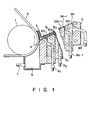
- a slide hopper coating apparatus capable of simultaneously coating 13 or more layers, like an n-layer simultaneous coating slide hopper apparatus as shown in Fig. 1, is used to supply predetermined coating solutions to 12 or more slits and coat the solutions so as to overlap each other while they are flowed on slide surfaces.
- a distal end 4 of a slide hopper liquid injecting device 3 is located close to a support 2 which moves while being supported by a back-up roller 1, with a predetermined interval therebetween, and a coating solution bridge (called a bead portion) 5 is formed in this portion, thereby coating solutions on the support 2.
- An interval between the support 2 and the distal end 4 is called a "bead interval”.
- a vacuum chamber 6 for evacuating a portion behind the bead is provided, and a vacuum pump 7 evacuates the chamber.
- a vacuum degree at that time is called a "bead back pressure".
- the slide hopper liquid injecting device in the multilayer simultaneous coating apparatus will be described below.
- Coating solutions for n layers are supplied to the injecting device 3 by liquid supply pumps 8 1 to 8 n , and thin coating solution films having a width corresponding to the full width of the support 2 are flowed from slits 9 1 to 9 n onto slide surfaces 10, to 10 n .
- the flowed thin coating solution films overlap each other from the upper portion of the device and simultaneously coated on the support as an n-layered overlapped coating solution films in the bead portion.
- the apparatus is called a "slide hopper" because the respective coating solutions overlap each other on the slide surfaces.
- the present invention can be applied to a multilayer simultaneous coating method of coating 12 or more layers.
- the coating rate in the color light-sensitive material manufacturing method of the present invention is 30 to 500 m/min as the moving speed of a support.
- the coating rate is preferably 60 to 300 m/min, and more preferably, 80 to 250 m/min.
- the coated photographic constituting layers are dried by a conventional method. That is, the coated photographic constituting layers are cooled and solidified immediately after they are coated.
- the layers are generally brought into contact with a low-temperature air at a dry-bulb temperature of -10 ° C to -20 C.
- drying is performed by air blow which is conventionally used.
- This drying using wind is generally performed by blowing an air at a dry-bulb temperature of 15 ° C to 45 °C and a relative humidity of 10% to 50%, at an air flow of 10 to 40 m 3 /m 2 ' min. This method is preferred because it can prevent an increase in fog caused by drying.
- the coated films thus dried are preferably wetted by an air at a dry-bulb temperature of 20 °C to 40 °C and a relative humidity of 50% to 70%.
- Representative examples of the support for the light-sensitive material of the present invention are those consisting of triacetylcellulose and polyethyleneterephthalate.
- the manufacturing method of the present invention is less adversely affected by undulations on the support than conventional manufacturing methods. Therefore, even if an undulation of a maximum of 5 ⁇ m is present, a color light-sensitive material having high surface quality can be coated at a high speed by the manufacturing method of the present invention.
- intervals between peaks of the undulations are preferably not 5 to 8 mm. An interval smaller or larger than this value is allowable. If the intervals between the peaks of the undulations are less than 4 mm or exceed 8 mm, the presence of undulations has almost no large influence on uniformity of coating.
- the light-sensitive material of the present invention is constituted by at least 12 layers which are simultaneously coated and include silver halide emulsion layers, i.e., blue-sensitive layers, green-sensitive layers, and red-sensitive layers formed on a support.
- silver halide emulsion layers i.e., blue-sensitive layers, green-sensitive layers, and red-sensitive layers formed on a support.
- unit light-sensitive layers are generally arranged such that red-, green-, and blue-sensitive layers are formed from a support side in the order named. However, this order may be reversed or a layer sensitive to one color may be sandwiched between layers sensitive to another color in accordance with the application.
- JP-A-61-34541, JP-A-61-201245, JP-A-61-198236, and JP-A-62-160448 describe layer arrangements in which, in order to improve color reproducibility, the fourth or more light-sensitive layers are used in addition to conventional three types of blue-, green-, and red-sensitive layers.
- the fourth or more light-sensitive layers may be arranged in any position.
- the fourth or more light-sensitive layers may be either a single layer or constituted by a plurality of layers.
- Non-light-sensitive layers such as various types of interlayers may be formed between the silver halide light-sensitive layers and as the uppermost layer and the lowermost layer.
- the interlayer may contain, e.g., couplers and DIR compounds as described in JP-A-61-43748, JP-A-59-113438, JP-A-59-113440, JP-A-61-20037, and JP-A-61-20038 or a color mixing inhibitor which is normally used.
- a two-layered structure of high- and low-sensitivity emulsion layers can be preferably used as described in West German Patent 1,121,470 or British Patent 923,045.
- layers are preferably arranged such that the sensitivity is sequentially decreased toward a support, and a non-light-sensitive layer may be formed between the silver halide emulsion layers.
- layers may be arranged such that a low-sensitivity emulsion layer is formed remotely from a support and a high-sensitivity layer is formed close to the support.
- layers may be arranged from the farthest side from a support in an order of low-sensitivity blue-sensitive layer (BL)/high-sensitivity blue-sensitive layer (BH)/high-sensitivity green-sensitive layer (GH)/low-sensitivity green-sensitive layer (GL)/high-sensitivity red-sensitive layer (RH)/Iow-sensitivity red-sensitive layer (RL), an order of BH/BL/GL/GH/RH/RL, or an order of BH/BL/GH/GL/RL/RH.
- BL low-sensitivity blue-sensitive layer
- BH high-sensitivity blue-sensitive layer
- GH high-sensitivity green-sensitive layer
- GL low-sensitivity green-sensitive layer
- RH high-sensitivity red-sensitive layer
- RL high-sensitivity red-sensitive layer
- layers may be arranged from the farthest side from a support in an order of blue-sensitive layer/GH/RH/GL/RL.
- layers may be arranged from the farthest side from a support in an order of blue-sensitive layer/GL/RL/GH/RH.
- three layers may be arranged such that a silver halide emulsion layer having the highest sensitivity is arranged as an upper layer, a silver halide emulsion layer having sensitivity lower than that of the upper layer is arranged as an interlayer, and a silver halide emulsion layer having sensitivity lower than that of the interlayer is arranged as a lower layer, i.e., three layers having different sensitivities may be arranged such that the sensitivity is sequentially decreased toward the support.
- these layers may be arranged in an order of medium-sensitivity emulsion layer/high-sensitivity emulsion layer/low-sensitivity emulsion layer from the farthest side from a support in a layer sensitive to one color as described in JP-A-59-202464.
- the arrangement can be changed as described above even when four or more layers are formed.
- a preferable layer arrangement is as follows.
- the following layer arrangement is also very preferable.
- the total amount of a silver halide used in the present invention is not particularly limited, it is preferably 2.5 g/m 2 to 8 g/m 2 , and more preferably, 2.5 g/m 2 to 6 g/m 2 in terms of a silver amount.
- the density of silver with respect to a gelatin binder is not particularly limited. However, it is preferably set within the range of a silver amount (weight)/gelatin (weight) ratio of 0.01 to 5.0 in accordance with high-sensitivity emulsion layers, low-sensitivity emulsion layers, and applications.
- a preferable silver halide contained in photographic emulsion layers of the photographic light-sensitive material of the present invention is silver iodobromide, silver iodochloride, or silver iodochlorobromide containing about 30 mol% or less of silver iodide.
- the most preferable silver halide is silver iodobromide or silver iodochlorobromide containing about 2 mol% to about 25 mol% of silver iodide.
- Silver halide grains contained in the photographic emulsion may have regular crystals such as cubic, octahedral, or tetradecahedral crystals, irregular crystals such as spherical or tabular crystals, crystals having crystal defects such as twinned crystal faces, or composite shapes thereof.
- a silver halide may consist of fine grains having a grain size of about 0.2 /1 .m or less or large grains having a projected area diameter of about 10 ⁇ m, and an emulsion may be either a polydisperse or monodisperse emulsion.
- a silver halide photographic emulsion which can be used in the light-sensitive material of the present invention can be prepared by methods described in, for example, Research Disclosure (RD) No. 17,643 (December, 1978), pp. 22 to 23, "I. Emulsion preparation and types” and RD No. 18,716 (November, 1979), page 648; P. Glafkides, "Chemie et Phisique Photographique", Paul Montel, 1967; G.F. Duffin, "Photographic Emulsion Chemistry", Focal Press, 1966; and V.L. Zelikman et al., “Making and Coating Photographic Emulsion", Focal Press, 1964.
- Monodisperse emulsions described in, for example, U.S. Patents 3,574,628 and 3,655,394 and British Patent 1,413,748 are also preferred.
- tabular grains having an aspect ratio of about 5 or more can be used in the present invention.
- the tabular grains can be easily prepared by methods described in, e.g., Gutoff, "Photographic Science and Engineering", Vol. 14, PP. 248 to 257 (1970); U.S. Patents 4,434,226, 4,414,310, 4,433,048, and 4,439,520, and British Patent 2,112,157.
- a crystal structure may be uniform, may have different halogen compositions in the interior and the surface layer thereof, or may be a layered structure.
- a silver halide having a different composition may be bonded by an epitaxial junction or a compound except for a silver halide such as silver rhodanide or zinc oxide may be bonded.
- a mixture of grains having various types of crystal shapes may be used.
- a silver halide emulsion layer is normally subjected to physical ripening, chemical ripening, and spectral sensitization steps before it is used. Additives for use in these steps are described in Research Disclosure Nos. 17,643 and 18,716, and they are summarized in the following table.
- a yellow coupler Preferred examples of a yellow coupler are described in, e.g., U.S. Patents 3,933,501, 4,022,620, 4,326,024, 4,401,752, and 4,248,961, JP-B-58-10739, British Patents 1,425,020 and 1,476,760, U.S. Patents 3,973,968, 4,314,023, and 4,511,649, and EP 249,473A.
- magenta coupler examples are preferably 5-pyrazolone and pyrazoloazole compounds, and more preferably, compounds described in, e.g., U.S. Patents 4,310,619 and 4,351,897, EP 73,636, U.S. Patents 3,061,432 and 3,725,067, Research Disclosure No. 24220 (June 1984), JP-A-60-33552, Research Disclosure No. 24230 (June 1984), JP-A-60-43659, JP-A-61-72238, JP-A-60-35730, JP-A-55-118034, and JP-A-60-185951, U.S. Patents 4,500,630, 4,540,654, and 4,565,630, and WO No. 88/04795.
- Examples of a cyan coupler are phenol and naphthol couplers, and preferably, those described in, e.g., U.S. Patents 4,052,212, 4,146,396, 4,228,233, 4,296,200, 2,369,929, 2,801,171, 2,772,162, 2,895,826, 3,772,002, 3,758,308, 4,343,011, and 4,327,173, EP Disclosure 3,329,729, EP 121,365A and 249,453A, U.S. Patents 3,446,622, 4,333,999, 4,775,616, 4,451,559, 4,427,767, 4,690,889, 4,254,212, and 4,296,199, and JP-A-61-42658.
- a colored coupler for correcting additional, undesirable absorption of a colored dye are those described in Research Disclosure No. 17643, VII-G, U.S. Patent 4,163,670, JP-B-57-39413, U.S. Patents 4,004,929 and 4,138,258, and British Patent 1,146,368.
- a coupler for correcting unnecessary absorption of a colored dye by a fluorescent dye released upon coupling described in U.S. Patent 4,774,181 or a coupler having a dye precursor group which can react with a developing agent to form a dye as a split- off group described in U.S. Patent 4,777,120 may be preferably used.
- a coupler capable of forming colored dyes having proper diffusibility are those described in U.S. Patent 4,366,237, British Patent 2,125,570, EP 96,570, and West German Patent Application (OLS) No. 3,234,533.
- Couplers releasing a photographically useful residue upon coupling are preferably used in the present invention.
- DIR couplers i.e., couplers releasing a development inhibitor are described in the patents cited in the above-described RD No. 17643, VII-F, RD No. 307105, VII-F, JP-A-57-151944, JP-A-57-154234, JP-A-60-184248, JP-A-63-37346, JP-A-63-37350, and U.S. Patents 4,248,962 and 4,782,012.
- a coupler for imagewise releasing a nucleating agent or a development accelerator are described in British Patents 2,097,140 and 2,131,188, JP-A-59-157638, and JP-A-59-170840.
- Examples of a coupler which can be used in the light-sensitive material of the present invention are competing couplers described in, e.g., U.S. Patent 4,130,427; poly-equivalent couplers described in, e.g., U.S.
- Patents 4,283,472, 4,338,393, and 4,310,618 a DIR redox compound releasing coupler, a DIR coupler releasing coupler, a DIR coupler releasing redox compound, or a DIR redox releasing redox compound described in, e.g., JP-A-60-185950 and JP-A-62-24252; couplers releasing a dye which turns to a colored form after being released described in EP 173,302A and 313,308A; bleaching accelerator releasing couplers described in, e.g., RD. Nos. 11,449 and 24,241 and JP-A-61-201247; a legand releasing coupler described in, e.g., U.S. Patent 4,553,477; a coupler releasing a leuco dye described in JP-A-63-75747; and a coupler releasing a fluorescent dye described in U.S. Patent 4,774,181.
- the couplers for use in this invention can be added to the light-sensitive material by various known dispersion methods.
- phthalic esters e.g., dibutylphthalate, dicyclohexylphthalate, di-2-ethylhexylphthalate, decylphthalate, bis(2,4-di-t-amylphenyl)phthalate, bis(2,4-dit-amylphenyl)isophthalate, bis(1,1-di-ethylpropyl)phthalate), phosphates or phosphonates (e.g., triphenylphosphate, tricresylphosphate, 2-ethylhexyldiphenylphosphate, tricyclohexylphosphate, tri-2-ethylhexyl- phosphate, tridodecylphosphate, tributoxyethylphosphate, trichloropropylphosphate
- phthalic esters e.g., dibutylphthalate, dicyclohexylphthalate, di-2-ethylhexylphthal
- An organic solvent having a boiling point of about 30 °C or more, and preferably, 50 ° C to about 160 ° C can be used as a co-solvent.
- Typical examples of the co-solvent are ethyl acetate, butyl acetate, ethyl propionate, methylethylketone, cyclohexanone, 2-ethoxyethylacetate, and dimethylformamide.
- the present invention can be applied to various color light-sensitive materials.
- the material are a color negative film for a general purpose or a movie, a color reversal film for a slide or a television, color paper, a color positive film, and color reversal paper.
- a support which can be suitably used in the present invention is described in, e.g., RD. No. 17643, page 28, RD. No. 18716, from the right column, page 647 to the left column, page 648.
- the sum total of film thicknesses of all hydrophilic colloidal layers (all the layers coated on the support, including emulsion layers, interlayers and protective layers) at the side having emulsion layers is preferably 22 ⁇ m or less, more preferably, 18 ⁇ m or less, and most preferably, 16 ⁇ m or less.
- a film swell speed T1 ⁇ 2 is preferably 30 sec. or less, and more preferably, 20 sec. or less.
- the film thickness means a film thickness measured under moisture conditioning at a temperature of 25°C and a relative humidity of 55% (two days).
- the film swell speed T1 ⁇ 2 can be measured in accordance with a known method in the art.
- the film swell speed T1 ⁇ 2 can be measured by using a swell meter described in Photographic Science & Engineering, A. Green et al., Vol. 19, No. 2, pp. 124 to 129.
- T1 ⁇ 2 is defined as a time required for reaching 1/2 of the saturated film thickness.
- the film swell speed T1 ⁇ 2 can be adjusted by adding a film hardening agent to gelatin as a binder or changing aging conditions after coating.
- a swell ratio is preferably 150% to 400%.
- the swell ratio is calculated from the maximum swell film thickness measured under the above conditions in accordance with a relation : (maximum swell film thickness - film thickness)/film thickness.
- the color photographic light-sensitive material according to the present invention can be developed by conventional methods described in RD. No. 17643, pp. 28 and 29, and RD. No. 18716, the left to right columns, page 615.
- the light-sensitive material of the present invention When using the light-sensitive material of the present invention in the form of a roll, it is preferably housed in a cartridge.
- the most general cartridge is a 135-format patrone which is currently used.
- cartridges proposed in the following patents can be used. (Unexamined Published Japanese Utility Model Application No. 58-67329, JP-A-58-181035, JP-A-58-182634, Unexamined Published Japanese Utility Model Application No. 58-195236, U.S. Patent 4,221,479, Japanese Patent Application Nos.
- a multilayered color light-sensitive material was formed by simultaneously coating a plurality of layers having the following compositions on an undercoated triacetylcellulose film support.
- a coating amount of a silver halide and colloidal silver is represented in units of g/m 2 of silver, and that of couplers, additives, and gelatin is represented in units of g/m 2.
- a coating amount of sensitizing dyes is represented by mols per mol of a silver halide in the same layer. Various compounds used will be listed in Table D (to be presented later).
- film hardeners H-11 and H-12, compounds Cpd-15 and Cpd-16 as antiseptic agents, a stabilizer Cpd-17, and antifoggants Cpd-18 and Cpd-19 were added to the respective layers.
- Samples 101 to 106 were formed by changing the amounts of the surfactants and the formalin scavengers as shown in Table 1.
- the 14 layers were not simultaneously formed by multilayer coating, but after the layer 6 was coated and dried, the layers 7 to 14 were subsequently coated, thereby forming a sample 107.
- each of the samples 101 to 107 was cut and loaded in an ISO-400 color negative film patrone, and the following tests were conducted.
- each sample was used to photograph a person with a gray plate having a reflecting ratio of 18%, at 11 a.m. on a fine day in summer by using a camera cardiahyte available from Fuji Photo Film Co., Ltd.
- Each photographed sample was stored at a temperature of 30 ° C and a relative humidity of 60% for seven days and developed under the processing conditions (A).
- each processed sample was printed on Fuji Color Paper Super HG using an auto printer FAP 3500 available from Fuji Photo Film Co., Ltd.
- the printing conditions of the auto printer were set such that the color balance of each sample stored under the storage conditions (b) was optimized.
- the color density in a portion of the gray plate of each print obtained by the samples 101 to 107 was measured by a Macbeth densitometer, thereby evaluating shifts in color balance caused by the storage conditions of the respective samples.
- the evaluation results are represented by the print densities of the respective samples stored under the storage conditions (a) and (c) with respect to those stored under the storage conditions (b), and summarized in Table 2.
- the sample 102 could not be practically used because color unbalance was caused by an influence of formalin gas generated by furniture during a storage period of only two weeks.
- a color unbalance was small to realize a high storage stability even under the storage conditions of a high temperature and a high humidity.
- compositions of the processing solutions will be presented below.
- Each of the bleach-fixing and washing steps was performed by a counter flow system piping from (2) to (1), and all of an overflow solution of the bleaching solution was supplied to the bleach-fixing step (2).
- an amount of the bleach-fixing solution carried to the washing step was 2 ml per meter of a 35-mm wide light-sensitive material.
- Washing Solution Common for mother and replenishment solutions
- Tap water was supplied to a mixed-bed column filled with an H type strongly acidic cation exchange resin (Amberlite IR-120B: available from Rohm & House Co.) and an OH type strongly basic anion exchange resin (Amberlite IR-400) to set the concentrations of calcium and magnesium to be 3 mg/l or less. Subsequently, 20 mg/l of sodium isocyanuric acid dichloride and 150 mg/l of sodium sulfate were added. The pH of the solution fell within the range of 6.5 to 7.5.
- the arrangement of the present invention can prevent performance deterioration caused by formalin gas and improve storage stability at a high temperature and a high humidity.
Landscapes
- Physics & Mathematics (AREA)
- Chemical & Material Sciences (AREA)
- General Physics & Mathematics (AREA)
- Engineering & Computer Science (AREA)
- Materials Engineering (AREA)
- Spectroscopy & Molecular Physics (AREA)
- Chemical Kinetics & Catalysis (AREA)
- Silver Salt Photography Or Processing Solution Therefor (AREA)
Applications Claiming Priority (2)
| Application Number | Priority Date | Filing Date | Title |
|---|---|---|---|
| JP259117/90 | 1990-09-28 | ||
| JP25911790A JPH04136844A (ja) | 1990-09-28 | 1990-09-28 | ハロゲン化銀カラー写真感光材料 |
Publications (1)
| Publication Number | Publication Date |
|---|---|
| EP0477932A1 true EP0477932A1 (fr) | 1992-04-01 |
Family
ID=17329554
Family Applications (1)
| Application Number | Title | Priority Date | Filing Date |
|---|---|---|---|
| EP91116427A Withdrawn EP0477932A1 (fr) | 1990-09-28 | 1991-09-26 | Matériau photographique couleur à l'halogénure d'argent sensible à la lumière |
Country Status (2)
| Country | Link |
|---|---|
| EP (1) | EP0477932A1 (fr) |
| JP (1) | JPH04136844A (fr) |
Cited By (3)
| Publication number | Priority date | Publication date | Assignee | Title |
|---|---|---|---|---|
| EP0724194A1 (fr) | 1995-01-30 | 1996-07-31 | Fuji Photo Film Co., Ltd. | Matériau photographique couleur à l'halogénure d'argent |
| FR2736286A1 (fr) * | 1995-07-07 | 1997-01-10 | Kodak Pathe | Dispositif et procede pour optimiser un parametre donne d'un processus d'enduction d'une composition liquide sur un support |
| WO2025058077A1 (fr) | 2023-09-15 | 2025-03-20 | 富士フイルム株式会社 | Composé, composition, matériau fonctionnel, matériau photographique à halogénure d'argent photosensible et matériau photographique à halogénure d'argent photosensible de type à transfert par diffusion |
Families Citing this family (1)
| Publication number | Priority date | Publication date | Assignee | Title |
|---|---|---|---|---|
| US5494776A (en) * | 1994-05-24 | 1996-02-27 | Minnesota Mining And Manufacturing Company | Hybrid graphic arts films with reduced occurrence of pepper fog |
Citations (6)
| Publication number | Priority date | Publication date | Assignee | Title |
|---|---|---|---|---|
| FR2215269A1 (fr) * | 1973-01-26 | 1974-08-23 | Eastman Kodak Co | |
| US4001024A (en) * | 1976-03-22 | 1977-01-04 | Eastman Kodak Company | Method of multi-layer coating |
| JPS62215271A (ja) * | 1985-12-14 | 1987-09-21 | Fuji Photo Film Co Ltd | ハロゲン化銀写真感光材料の処理方法 |
| EP0285176A2 (fr) * | 1987-04-02 | 1988-10-05 | Fuji Photo Film Co., Ltd. | Matériau photographique à l'halogénure d'argent |
| US4894318A (en) * | 1985-05-13 | 1990-01-16 | Fuji Photo Film Co., Ltd. | Silver halide color photographic material comprising a magenta coupler and a formaldehyde scavenger and method of processing therefor |
| EP0443528A2 (fr) * | 1990-02-20 | 1991-08-28 | Fuji Photo Film Co., Ltd. | Matériau d'halogénure d'argent pour la photographie en couleurs |
-
1990
- 1990-09-28 JP JP25911790A patent/JPH04136844A/ja active Pending
-
1991
- 1991-09-26 EP EP91116427A patent/EP0477932A1/fr not_active Withdrawn
Patent Citations (6)
| Publication number | Priority date | Publication date | Assignee | Title |
|---|---|---|---|---|
| FR2215269A1 (fr) * | 1973-01-26 | 1974-08-23 | Eastman Kodak Co | |
| US4001024A (en) * | 1976-03-22 | 1977-01-04 | Eastman Kodak Company | Method of multi-layer coating |
| US4894318A (en) * | 1985-05-13 | 1990-01-16 | Fuji Photo Film Co., Ltd. | Silver halide color photographic material comprising a magenta coupler and a formaldehyde scavenger and method of processing therefor |
| JPS62215271A (ja) * | 1985-12-14 | 1987-09-21 | Fuji Photo Film Co Ltd | ハロゲン化銀写真感光材料の処理方法 |
| EP0285176A2 (fr) * | 1987-04-02 | 1988-10-05 | Fuji Photo Film Co., Ltd. | Matériau photographique à l'halogénure d'argent |
| EP0443528A2 (fr) * | 1990-02-20 | 1991-08-28 | Fuji Photo Film Co., Ltd. | Matériau d'halogénure d'argent pour la photographie en couleurs |
Non-Patent Citations (1)
| Title |
|---|
| PATENT ABSTRACTS OF JAPAN vol. 12, no. 76 (P-675)(2923) 10 March 1988 & JP-A-62 215 271 ( FUJI ) 21 September 1987 * |
Cited By (4)
| Publication number | Priority date | Publication date | Assignee | Title |
|---|---|---|---|---|
| EP0724194A1 (fr) | 1995-01-30 | 1996-07-31 | Fuji Photo Film Co., Ltd. | Matériau photographique couleur à l'halogénure d'argent |
| FR2736286A1 (fr) * | 1995-07-07 | 1997-01-10 | Kodak Pathe | Dispositif et procede pour optimiser un parametre donne d'un processus d'enduction d'une composition liquide sur un support |
| US5646737A (en) * | 1995-07-07 | 1997-07-08 | Eastman Kodak Company | Device and method for optimizing a given parameter in a process of coating a support with a liquid composition |
| WO2025058077A1 (fr) | 2023-09-15 | 2025-03-20 | 富士フイルム株式会社 | Composé, composition, matériau fonctionnel, matériau photographique à halogénure d'argent photosensible et matériau photographique à halogénure d'argent photosensible de type à transfert par diffusion |
Also Published As
| Publication number | Publication date |
|---|---|
| JPH04136844A (ja) | 1992-05-11 |
Similar Documents
| Publication | Publication Date | Title |
|---|---|---|
| US5418124A (en) | Silver halide photographic emulsion and a photographic light-sensitive material | |
| US5550014A (en) | Silver halide photographic emulsion, method of manufacturing the same, and photographic light sensitive material | |
| US5550012A (en) | Silver halide emulsion and silver halide photographic light-sensitive material using the same | |
| US5525460A (en) | Silver halide photographic emulsion and light-sensitive material using the same | |
| EP0477932A1 (fr) | Matériau photographique couleur à l'halogénure d'argent sensible à la lumière | |
| EP0482599B1 (fr) | Matériau photographique à l'halogénure d'argent sensible à la lumière | |
| US5370982A (en) | Silver halide color photographic light-sensitive material | |
| US5326680A (en) | Silver halide color photographic light-sensitive material | |
| US5169746A (en) | Silver halide color photographic photosensitive material | |
| JP3470828B2 (ja) | ハロゲン化銀写真感光材料 | |
| EP0439069A2 (fr) | Matériau photographique à l'halogénure d'argent sensible à la lumière | |
| US5587282A (en) | Silver halide photographic material | |
| US5364755A (en) | Silver halide photographic light-sensitive material | |
| US5457019A (en) | Method of storing a silver halide photographic emulsion, silver halide photographic emulsion, and silver halide light-sensitive material | |
| US5476758A (en) | Silver halide color photographic light-sensitive material | |
| EP0443528A2 (fr) | Matériau d'halogénure d'argent pour la photographie en couleurs | |
| US5429915A (en) | Silver halide color photographic light-sensitive material comprising a red-sensitive silver halide emulsion layer unit having at least 3 sublayers of different sensitivity | |
| US5492800A (en) | Silver halide photographic light-sensitive material | |
| EP0572022A2 (fr) | Matériau photographique encapsulé | |
| US5238796A (en) | Silver halide photographic emulsion and photographic light-sensitive material | |
| US5426023A (en) | Silver halide photographic emulsion containing epitaxial silver halide grains and silver halide photographic light-sensitive material using the same | |
| US5439788A (en) | Method of manufacturing silver halide emulsion | |
| EP0438791B1 (fr) | Matériau photographique à l'halogénure d'argent sensible à la lumière | |
| US5580713A (en) | Silver halide color reversal photographic light-sensitive material | |
| US5514534A (en) | Silver halide photographic light-sensitive material |
Legal Events
| Date | Code | Title | Description |
|---|---|---|---|
| PUAI | Public reference made under article 153(3) epc to a published international application that has entered the european phase |
Free format text: ORIGINAL CODE: 0009012 |
|
| AK | Designated contracting states |
Kind code of ref document: A1 Designated state(s): DE FR GB NL |
|
| STAA | Information on the status of an ep patent application or granted ep patent |
Free format text: STATUS: THE APPLICATION IS DEEMED TO BE WITHDRAWN |
|
| 18D | Application deemed to be withdrawn |
Effective date: 19921002 |