EP0478132A1 - Unité de traitement synchrone à horloges multiples - Google Patents
Unité de traitement synchrone à horloges multiples Download PDFInfo
- Publication number
- EP0478132A1 EP0478132A1 EP91307415A EP91307415A EP0478132A1 EP 0478132 A1 EP0478132 A1 EP 0478132A1 EP 91307415 A EP91307415 A EP 91307415A EP 91307415 A EP91307415 A EP 91307415A EP 0478132 A1 EP0478132 A1 EP 0478132A1
- Authority
- EP
- European Patent Office
- Prior art keywords
- clock
- data
- section
- instructions
- bus
- Prior art date
- Legal status (The legal status is an assumption and is not a legal conclusion. Google has not performed a legal analysis and makes no representation as to the accuracy of the status listed.)
- Withdrawn
Links
Images



Classifications
-
- G—PHYSICS
- G06—COMPUTING OR CALCULATING; COUNTING
- G06F—ELECTRIC DIGITAL DATA PROCESSING
- G06F1/00—Details not covered by groups G06F3/00 - G06F13/00 and G06F21/00
- G06F1/04—Generating or distributing clock signals or signals derived directly therefrom
- G06F1/06—Clock generators producing several clock signals
-
- G—PHYSICS
- G06—COMPUTING OR CALCULATING; COUNTING
- G06F—ELECTRIC DIGITAL DATA PROCESSING
- G06F1/00—Details not covered by groups G06F3/00 - G06F13/00 and G06F21/00
- G06F1/04—Generating or distributing clock signals or signals derived directly therefrom
- G06F1/12—Synchronisation of different clock signals provided by a plurality of clock generators
-
- G—PHYSICS
- G06—COMPUTING OR CALCULATING; COUNTING
- G06F—ELECTRIC DIGITAL DATA PROCESSING
- G06F13/00—Interconnection of, or transfer of information or other signals between, memories, input/output devices or central processing units
- G06F13/38—Information transfer, e.g. on bus
- G06F13/42—Bus transfer protocol, e.g. handshake; Synchronisation
- G06F13/4204—Bus transfer protocol, e.g. handshake; Synchronisation on a parallel bus
- G06F13/4221—Bus transfer protocol, e.g. handshake; Synchronisation on a parallel bus being an input/output bus, e.g. ISA bus, EISA bus, PCI bus, SCSI bus
- G06F13/423—Bus transfer protocol, e.g. handshake; Synchronisation on a parallel bus being an input/output bus, e.g. ISA bus, EISA bus, PCI bus, SCSI bus with synchronous protocol
Definitions
- the present invention is directed generally to data processing systems, and in particular to a processor unit having one portion of the logic circuitry clocked at one clock frequency, and another clocked at a different clock frequency.
- processor units in use today are synchronous machines in that operations are performed in synchronous fashion, to the tune of a periodic clock signal ("clock").
- clock a periodic clock signal
- instructions are executed, data transferred, signals generated, in response to transitions from one level to another of the clock.
- a processor unit is generally divided into two sections, each section separately operated at a different clock frequency.
- One section running with a faster clock, preferably contains that circuitry most frequently used in processor operations: An execution unit for executing instructions and performing, for example, various logic and arithmetic functions, and a memory unit for storing instructions and data.
- the second section running with a slower clock, includes those circuit elements that are subject to relatively less frequent use in processor operation, such as those typically associated with handling external communications for the processor unit.
- Two data buses, one for each section are provided for communicating information (e.g., instructions, commands, and data) between the section elements.
- One communicates information between the elements of the faster clock section containing the execution unit and memory, and an extended data bus that communicates the circuit elements of the second slower clock section of the processor unit to one another.
- a buffer mechanism selectively couples the main data bus and the extended data bus to one another for selectively permitting information exchanges between the two sections.
- a clock generator provides independent "fast” and “slow” clocks for the two sections, respectively.
- the clock generator includes detection logic that monitors the instructions being executed by the execution unit. Detection, by the clock generator detection logic, of those instructions that require information to be communicated between the two sections will cause the clock generator to synchronize the fast and slow clocks, and enable the buffer to permit a synchronized information communication between the two sections on the main data bus and the extended data bus.
- a number of advantages are achieved by the present invention.
- using two or more different clock signals permits certain portions of the processor unit to be operated at a higher speed than other portions.
- the slower-operated portions can, thereby, be treated differently in light of the fact that they consume less power, require less heat sinking, and are subject to less stringent design requirements.
- the slower clock components can be implemented in less expensive circuitry in smaller semiconductor areas. Slower operation will also result in reduced electromagnetic interference generation.
- the invention permits existing processor designs to be easily modified so that sections of the design can operate at different clock speeds without undue and expensive modifications. Thereby, the work throughput of an existing processor design may be increased without the necessity of substantial redesign.
- FIG. 1 there is illustrated a processor unit, designated generally with the reference numeral 10, constructed according to the teachings of the present invention.
- the various circuit elements of the processor unit 10 are divided into two sections, preferably, according to usage in processor operations: A "fast" section 12, containing those elements most often used in processor operations, and a “slow” section 14, containing circuit elements enjoying relatively less frequent use.
- a "fast" section 12 containing those elements most often used in processor operations
- a “slow” section 14 containing circuit elements enjoying relatively less frequent use.
- a defining characteristic of the fast and slow sections 12, 14 is the frequency of the clock signals used to operate the respective sections.
- the fast section 12 will be operated with clock signals having a frequency higher than those used to operate the circuitry forming the slow section 14.
- the fast section 12 includes an instruction execution unit 20 coupled to memory circuits, comprising a cache memory 22 and a 32 megabyte main memory 24, by a main data bus 26 and an address bus 28.
- the cache memory 22 functions as the control store for the instruction execution unit 20, containing the control instructions, as well as data, that effect operation of the instruction execution unit 20.
- the instruction execution unit 20 is of generally conventional design in that it operates in response to central instructions accessed from the cache 22 to perform the various arithmetic, logic and control functions necessary for the processor unit 10 to operate as a processor. In fact, except for those circuit elements incorporated in the processor unit 10 to form the present invention, the processor unit itself is of conventional design.
- the main memory 24 includes address logic 30 that develops the addresses for memory access from information communicated on the main data bus 26 and the address bus 28.
- a memory control unit (MCU) 31 produces the signals necessary for access (e.g., read or write) with appropriate timing.
- the main memory 24 is a dynamic random access memory (DRAM).
- DRAM dynamic random access memory
- MCU 31 will also produce the required refresh signals.
- it is the cache memory 22 that is more often accessed, also via addresses communicated on the address bus 28.
- STAT status bus 32 in the form of a 4-bit nibble plus parity.
- the information on the STAT bus is used by the cache memory 22, via a decode circuit (not shown), to determine when an access will be made of the cache memory 22, and the type of information that will be accessed (e.g., control instruction, data, etc.).
- the slow section 14 preferably encompasses those elements of the processor unit 10 that are subject to less frequent use during processor operation, such as input/output operations.
- the present invention is designed for use in a multi-processor configuration in which processor- to-processor communications are conducted on redundant interprocessor buses. An illustration of such a multi-processor system can be found in U.S. Patent No. 4,228,496 or 4,888,684.
- the processor unit 10, therefore, includes logic for interfacing with each of the interprocessor buses (IPBs) X and Y in the form of IPB interface units 50 and 52.
- IPBs interprocessor buses
- an input/output channel (IOC) 54 connects the processor unit 10 to an I/O bus 55.
- MDP 56 is a separate, special-purpose processor unit responsible for handling various maintenance/diagnostic functions to ensure the credibility of the processor unit 10. Most functions, with one exception, performed by the MDP 56 are not relevant to the present invention. That exception is the assertion of EXEC signal which, when received at multiple locations within the processor unit 10, enables operation of the processor unit.
- the individual elements of the slow section 14, i.e., the IPBs 50, 52, the IOC 54, and the MDP 56, are coupled to one another for communication by an extended data bus 60.
- the elements of the slow section 14 typically do not communicate with one another, with one exception: On every slow clock cycle unused for communication between the fast and slow section 12, 14, one of the units 50 - 56 will transmit a data word on the extended data bus 60 for receipt by the other units. Data words transmitted on the extended data bus 60 (as well as the main data bus 26) are each accompanied by parity for error checking purposes. For this reason, the units of the slow section 14 communicate with one another, solely for error checking. Information transfers are conducted between the fast section 12 (i.e., the execution unit 20) and the elements of the slow section 14.
- the extended data bus 60 is coupled to the main data bus 26 by a tri-state buffer unit 62 that is controlled by a 2-bit buffer control (BUFFER CTRL) signal.
- BUFFER CTRL 2-bit buffer control
- the two data buses 26, 60 are electronically coupled to one another for communicating information from one to the other of the main and extended data buses 26, 60.
- BUFFER CTRL will also identify the direction of communication (e.g., from the fast section 12 to the slow section 14).
- the main data bus 26 is effectively decoupled from the extended data bus 60 so that information flow on the extended data bus 60 will not interfere with that on the main data bus 26, and vice versa, when the two sections are operating independently.
- fast and slow sections 12, 14 are clocked by clock signals having different frequencies. It is only when information is to be passed between the two separate sections that synchronization between the clocks must be effected, and the data buses 26 and 60 intercoupled.
- the clock signals used by each section are produced by a clock generator 70 that operates in response to a periodic, 15-nanosecond master clock signal (MCLK) produced by a master oscillator 72.
- the clock generator 70 produces, from MCLX, those clocking signals necessary for synchronous operation of the elements of the fast section 12 and the slow section 14.
- the major clocks are FAST CLK and 2XFAST CLK for the fast section 12, and SLOW CLK for the slow section 14.
- the IN CLK and OUT CLK signal is used to latch status information in the in-latch 80 synchronous to operation of the instruction execution unit 20, as will be described below.
- the OUT CLK signal provided by the clock generator 70 operates to synchronously (relative to the slow section 14) load the out-latch 76 with address and control information.
- the preferred embodiment of the invention has a ratio of 3:2 for the frequencies of FAST CLK to SLOW CLK although it should be evident that other ratios may be used.
- the FAST CLK signal is used for synchronous operation of the instruction execution unit 20, as well as other circuitry of the fast section 12, including operation of the cache and main memories 22 and 24 and associated circuitry.
- the 2XFAST CLK signal is used by the MCU 31 for various timing purposes.
- the SLOW CLK is used for effecting synchronous operation of the elements of the slow section 14.
- processor units such as processor unit 10 (not implementing the features of the present invention) typically have state changes on one or another of the transitions between the LOW and HIGH levels of a periodic clock signal.
- data would be transferred from the instruction execution unit 20 to the IOC by the same clock signal, and relative to the same transition (e.g., LOW to HIGH) of that clock signal.
- Asynchronous transfers between synchronously operated units may be effected, obviating the need for the information transfer to occur relative to a specified clock transition, but this requires the logic to be specifically designed for such transfers, and it is a slower technique.
- the major (clocked) elements of the processor 10 will change state on the LOW to HIGH transition ("rising edge") of FAST CLK (for those elements of the fast section 12), or SLOW CLK (for those elements of the slow section 14).
- the transfer operation e.g., assertion of the information on the bus, accepting the information from the bus, etc.
- the instruction that will effect that transfer begins execution (an instruction cycle) in the instruction execution unit 20, with the rising edge of FAST CLK.
- the FAST CLK and SLOW CLK signals Since there is a 3:2 ratio between the FAST CLK and SLOW CLK signals, rising edges of those two signals may not coincide when needed (e.g., see Fig. 4). Thus, the FAST CLK and SLOW CLK signals must be "synchronized;” that is, rising edges of the two signals must be made to coincide when a communication of information is to occur between the two sections 12 and 14. This, as will be seen, is the function of the clock generator 70.
- Information transfers between the fast and slow sections 12, 14 of the processor unit 10 are not limited to utilizing the main and extended data buses 26, 60. Selection and control information is communicated from the fast section 12 to the slow section 14 via the out latch 76. Thus, a 5-bit portion of the address bus 28, and the information appearing on the STAT bus 32, are communicated to the slow section 14 via an out latch 76.
- the STAT information is latched in the out latch 76 with OUT CLK, from which it is passed to a decode unit 78.
- the decode unit 78 operates to produce the BUFFER CTRL signals that control the buffer 62 as well as the SELECT signals, carried by signal lines 79, for enabling one of the slow section functional units 50, ..., 56.
- the address information is conducted from the out latch 76 by a bus 80 to the elements of the slow section 14, identifying the function to be performed by the selected unit when it is placed in communication with the instruction execution unit 20.
- every information transfer cycle between the fast and slow section 12, 14 on the main and extended data buses 26, 60 invokes a return of status information from the selected unit.
- This return status information is communicated on three signal lines 81 from the slow section 14 to the fast section 12 via a 3-bit in-latch 80, and latched therein by the IN CLK which is synchronized to the SLOW CLK.
- the IN CLK is present only when the FAST CLK and SLOW CLK signals are synchronized.
- the clock generator 70 includes a state machine 90 that cycles through various states, dependent upon input signals FAST ERR, EXEC, STAT, and a delayed version of EXEC, EXEC DLD.
- the state machine 90 is responsible for synchronizing the FAST CLK and SLOW CLK signals when information is to be transferred between the fast and slow sections of the processor unit 10 via the main and extended data buses 26, 60.
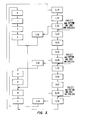
- a state diagram for the state machine 90 is shown in Fig. 3.
- Fig. 4 illustrates the various waveforms produced by the clock generator 70 when no synchronization between FAST CLK and SLOW CLK is needed.
- FIG. 5 illustrates the three unique waveform patterns (i.e., the three forms of synchronization that can occur - labeled A, B and C in Fig. 5) that are formed by the clock generator 70 when transitions of the FAST CLK and SLOW CLK signals are matched for synchronization.
- the clock generator 70 includes a state decode logic 92 that receives the 6-bit output from the state machine 90, defining each state entered by the state machine. State decode logic 92, in turn, produces, for each state assumed, the proper level for each of the signals generated by the clock generator 70.
- Output lines 94 of the state decode logic 92 each of which carries one of the clock signals generated by the clock generator 70 (e.g., FAST CLK, IN CLK, etc.) are each applied to a respective input of a D-type flip-flop, cumulatively represented in Fig. 2A at 96.
- Each of the D-type flip-flops is clocked by the master clock signal (MCLX) produced by the master oscillator 72.
- the state machine 90 will change state upon each rising transition of MCLK. As a result, the various stages of the state machine 90 most likely will change at different rates, causing the corresponding outputs of the state machine to change levels at different times. In turn, the state decode logic 92 will most likely produce multiple transitions between HI and LOW levels before settling to a signal state representative of the proper state of the state machine 90. This is the reason for the D-type flip-flops 96: To mask these transitions during each change of state machine 90. In effect, use of the D-type flip-flops will delay, one period of the MCLK signal, the actual state change, as it results in the signals produced by the clock generator 70.
- the clock generator 70 includes a D-type flip-flop 100 that is used to develop a delayed, synchronized version of the EXEC signal for diagnostic purposes.
- the EXEC signal is applied to the data (D) input of the flip-flop 100, and the SLOW CLK signal is applied to the clock (CK) input.
- the output (Q) of the flip-flop 100 produces the EXEC_DLD signal.
- the EXEC signal is produced by the MDP 56 (Fig. 1) and, in effect is an enable signal that enables operation of the processor unit 10 when asserted. When not asserted, the processor unit 10 is disabled. EXEC is synchronized to the SLOW CLK signal, and is asserted/de-asserted for simultaneous start/stop of all elements of the processor unit 10 so that operation begins or ends in a consistent manner.
- the EXEC_DLD signal is used for single-stepping the processor unit 10.
- the first instruction cycle following assertion of EXEC will always be a synchronized slow cycle - independent of the value carried by the STAT bus 32.
- the timing diagram of Fig. 2B shows the relationship between EXEC and EXEC DLD relative to SLOW CLK.
- Fig. 3 illustrates the states assumed by the state machine 90 to produce the various signals shown in Fig. 1, including versions of FAST CLK synchronized (i.e., a LOW to HI transition aligned) with a rising edge of SLOW CLK.
- the state machine 90 will sequence through only those states labeled 0_FC, 1_FC, ... 11_FC to produce the various waveforms shown in Fig. 4.
- the states assumed by the state machine 90 are identified along the bottom of Fig. 4, and correspond to the states labeled in Fig. 3.
- the first HIGH portion 201 of the FAST CLK waveform 200 is produced by the states 0_FC, 1_FC; the immediately following LOW portion 202 of the waveform is derived from the states 2_FC, 3_FC.
- the next two successive periods of FAST CLK are produced by the states 4 FC - 7_FC and 8 FC - 11 FC.
- the state machine 90 returns to state 0 FC to begin over again.
- Each of the states 0_FC, ..., 11_FC, as well as the other states illustrated in Fig. 3, are assumed for a 15 nanosecond period, the period of the MCLK produced by the master oscillator 72.
- a FAST CLK period is developed from four MCLK periods. Instructions are executed one per FAST CLK cycle.
- Fig. 3 exhibits this relationship:
- the twelve states 0_FC, ..., 11_FC assumed by the state machine 90 represent execution of three instructions.
- an instruction is executed in each of the three instruction execution cycles defined by the states 0 FC - 3_FC, 4 FC - 7_FC and 8_FC - 11_FC.
- Each instruction execution cycle is entered assuming that it will be completed within four sequential state transitions of the state machine 90. This is a correct assumption if the FAST CLK and SLOW CLK signals do not require synchronization. If, however, the two signals require synchronization, completion of FAST CLK will require more than four states. It is during the third state of each fast clock instruction cycle (i.e., the states 2_FC, 6_FC, and 10_FC) that a determination is made of whether the instruction being executed by the instruction execution unit 20 will require an information transfer between the fast and slow sections 12, 14 - necessitating synchronization.
- the execution cycle will continue along the path of normal FAST CLK generation as long as the value (hex) of the four bits carried by the STAT bus 32 are not an E or an F, and the FAST_ERR signal is not asserted, and the EXEC and EXEC DLD are TRUE. If, however, an information transfer is to be made between the fast and slow sections 12, 14, rising edges of the FAST CLK and SLOW CLK signals must be aligned, i.e., the two must be synchronized. Such a transfer will be indicated by a value of E or F (hex) on the STAT bus 32.
- FAST CLK is modified to achieve the synchronization between FAST CLK and SLOW CLK.
- the rising edge of FAST CLK will be delayed, relative to the immediately preceding falling edge, by an amount of time dependent upon which of the three instruction execution cycles will call for synchronization; e.g., during of the states 2_FC, 6_FC, or 10_FC it is determined that the instruction being then executed will require an information transfer between the fast and slow sections 12, 14.
- the SLOW CLK signal is not modified for synchronization.
- the state machine 90 will traverse from state 2 FC to 3_SC, rather than as would be normal (when synchronization is not required) to the state 3_FC. From there, (i.e., state 3_SC), the state machine 90 will pass through idle states 10 and 11, during which the level of FAST CLK is held LOW, returning to the 0_FC state to produce the next occurring rising edge 206 (Fig. 5) of the FAST CLK waveform 200a. Note, as Fig. 5 indicates, that the rising edge 204 of SLOW CLK coincides with the rising edge 206 of FAST CLK.
- the third state, 6_FC, of that execution cycle will be followed by the delay states 7_SC, 8, 9, 10 and 11 (i.e., waveform pattern B, Fig. 5), as Fig. 3 indicates. Note that there are too additional states, 8 and 9, traversed, when compared to the delay added to the execution cycle of 0_FC - 3 FC. This is the result, again, of the phase relationships between the FAST CLK and SLOW CLK signals that exist at the time the determination is made.
- the longest delay for synchronization of rising edges of the FAST CLK and SLOW CLK signals are produced if the determination for the necessity of synchronization is made during the state (10_FC).
- the state machine 90 then passes through the states 11 SC, 0, 1, 2, 3, 10 and 11, as indicated in Fig. 3 (and Fig. 5 - waveform pattern C).
- Selection of the synchronization path depends upon the state of several signals applied to the state machine 90, as indicated in Fig. 3.
- EXEC enables operation of the processor unit. If EXEC is LOW, the processor unit 10 is disabled and not operating. This does not mean, however, that clock signals need not be generated. The main memory, for example, will need to maintain its refresh cycle. Thus, even though the processor is disabled, with EXEC not asserted, the FAST CLK signal continues, but in the slow cycle loop 0_FC, 1_FC, 2_FC, 3_SC, 10 and 11.
- the processor unit 10 contains, in both the fast and slow sections 12 and 14, circuitry (not shown) that will monitor various operating parameters. If this circuitry detects an error, an error flag of one sort or another will be raised. When such error detection occurs, is desirable to halt operation of the processor unit. In the case of the present invention, it is desirable to halt the fast and slow sections 12, 14 at the same time, i.e., on the same rising edge. Thus, when one of the error conditions occur within the fast section 12, the FAST_ERR signal will be asserted to halt operation of the processor unit 10.
- the FAST ERR signal When asserted, the FAST ERR signal will cause the state machine 90 to take one of the synchronization paths, so that when the rising edges of FAST CLK and SLOW CLK coincide, EXEC can be dropped, thereby halting both sections at the same time.
- EXEC_DLD delayed version of EXEC
- the IN CLK signal operates the in-latch 80 to temporarily store three bits of information (e.g., interrupts, status, and the like) communicated from the slow section 14.
- the latching operation is synchronized to operation of the execution unit 20, i.e., to the FAST CLK signal. Accordingly, as illustrated in Figs. 4 and 5 by the waveforms 208 and 210, the IN CLK signal is produced by (1) the idle states 10 and 11, (2) the fast clock states 10_FC and 11_FC, or (3) the fast clock state 10_FC and the initial synchronizing state 11_SC.
- Latches used in the design of the present invention are level-sensitive, and are of the type in which the outputs follow the inputs while the control signal is HIGH; and the input is latched when the control signal goes LOW. Since it is obviously undesirable to have the output of a latch changing state when it is attempted to be read, the need for synchronizing the in-latch 80 to operation of the instruction execution unit 20 is evident. Thus, the IN CLK signal is produced, relative to FAST CLK, so that data will be held steady in the in-latch 80 a sufficient set-up time for the destination circuits (e.g., instruction execution 20).
- the out latch 76 is synchronized to the operation of the elements of the slow section 14.
- the OUT CLK is produced by the fast clock states 0 FC - 1_FC and 6 FC - 7_FC.
- the OUT CLK signal will also be produced by the states 6FC - 7 SC and the idle states 0 - 1.
- the information carried by the address and STAT buses 28, 32 will change on the rising edge (LOW to HIGH transition) of FAST CLK.
- the slow section 14 elements being edge-triggered devices (as are most elements of the fast section 12) accept the information on the rising edge of SLOW CLK.
- OUT CLK holds the data in the out-latch 76 steady to allow it to set up for rising edges of SLOW CLK; thereafter, OUT CLK goes HIGH, permitting the output of the out-latch 76 to follow the input. See Fig. 5.
Landscapes
- Engineering & Computer Science (AREA)
- Theoretical Computer Science (AREA)
- Physics & Mathematics (AREA)
- General Engineering & Computer Science (AREA)
- General Physics & Mathematics (AREA)
- Information Transfer Systems (AREA)
- Bus Control (AREA)
- Microcomputers (AREA)
- Multi Processors (AREA)
Applications Claiming Priority (2)
| Application Number | Priority Date | Filing Date | Title |
|---|---|---|---|
| US07/589,847 US5309561A (en) | 1990-09-28 | 1990-09-28 | Synchronous processor unit with interconnected, separately clocked processor sections which are automatically synchronized for data transfer operations |
| US589847 | 1990-09-28 |
Publications (1)
| Publication Number | Publication Date |
|---|---|
| EP0478132A1 true EP0478132A1 (fr) | 1992-04-01 |
Family
ID=24359805
Family Applications (1)
| Application Number | Title | Priority Date | Filing Date |
|---|---|---|---|
| EP91307415A Withdrawn EP0478132A1 (fr) | 1990-09-28 | 1991-08-12 | Unité de traitement synchrone à horloges multiples |
Country Status (5)
| Country | Link |
|---|---|
| US (1) | US5309561A (fr) |
| EP (1) | EP0478132A1 (fr) |
| JP (1) | JP2711035B2 (fr) |
| AU (1) | AU644901B2 (fr) |
| CA (1) | CA2048514C (fr) |
Cited By (20)
| Publication number | Priority date | Publication date | Assignee | Title |
|---|---|---|---|---|
| EP0530712A1 (fr) * | 1991-08-29 | 1993-03-10 | Nec Corporation | Processeur à horloges multiples et sa méthode de mise en oeuvre |
| GB2260631B (en) * | 1991-10-17 | 1995-06-28 | Intel Corp | Microprocessor 2X core design |
| EP0666541A1 (fr) * | 1994-02-04 | 1995-08-09 | Hewlett-Packard Company | Dispositif et méthode d'opération synchrone de puces, à des vitesses dépassant la vitesse du bus |
| EP0639032A3 (fr) * | 1993-08-09 | 1995-11-29 | C Cube Microsystems | Structure et méthode pour un vidéo codeur/décodeur multistandard. |
| US5634131A (en) * | 1992-11-06 | 1997-05-27 | Intel Corporation | Method and apparatus for independently stopping and restarting functional units |
| US5655127A (en) * | 1994-02-04 | 1997-08-05 | Intel Corporation | Method and apparatus for control of power consumption in a computer system |
| US5821784A (en) * | 1995-12-29 | 1998-10-13 | Intel Corporation | Method and apparatus for generating 2/N mode bus clock signals |
| US5826067A (en) | 1996-09-06 | 1998-10-20 | Intel Corporation | Method and apparatus for preventing logic glitches in a 2/n clocking scheme |
| US5834956A (en) * | 1995-12-29 | 1998-11-10 | Intel Corporation | Core clock correction in a 2/N mode clocking scheme |
| US5842029A (en) * | 1991-10-17 | 1998-11-24 | Intel Corporation | Method and apparatus for powering down an integrated circuit transparently and its phase locked loop |
| US5862373A (en) * | 1996-09-06 | 1999-01-19 | Intel Corporation | Pad cells for a 2/N mode clocking scheme |
| US5910909A (en) * | 1995-08-28 | 1999-06-08 | C-Cube Microsystems, Inc. | Non-linear digital filters for interlaced video signals and method thereof |
| US5918043A (en) * | 1992-11-03 | 1999-06-29 | Intel Corporation | Method and apparatus for asynchronously stopping the clock in a processor |
| US5935253A (en) * | 1991-10-17 | 1999-08-10 | Intel Corporation | Method and apparatus for powering down an integrated circuit having a core that operates at a speed greater than the bus frequency |
| US6114887A (en) | 1995-12-29 | 2000-09-05 | Intel Corporation | Apparatus for generating bus clock signals with a 1/N characteristic in a 2/N mode clocking scheme |
| GB2361082A (en) * | 1996-11-13 | 2001-10-10 | Intel Corp | Processor with data depedency checker |
| GB2406935A (en) * | 2003-10-06 | 2005-04-13 | Hewlett Packard Development Co | Multiple clock zone CPU each zone having a clock controller adjusting the frequency according to a zone power signal and adjustments from other zones |
| EP1460532A3 (fr) * | 2003-03-20 | 2006-06-21 | Sun Microsystems, Inc. | Unité pour préextraction de données dans un processeur d'ordinateur, et procédé correspondant |
| US7076679B2 (en) | 2003-10-06 | 2006-07-11 | Hewlett-Packard Development Company, L.P. | System and method for synchronizing multiple variable-frequency clock generators |
| US7100012B2 (en) | 1996-11-13 | 2006-08-29 | Intel Corporation | Processor and data cache with data storage unit and tag hit/miss logic operated at a first and second clock frequencies |
Families Citing this family (27)
| Publication number | Priority date | Publication date | Assignee | Title |
|---|---|---|---|---|
| JPH05204634A (ja) * | 1991-08-29 | 1993-08-13 | Internatl Business Mach Corp <Ibm> | マイクロプロセツサ回路 |
| CA2092854A1 (fr) * | 1993-03-29 | 1994-09-30 | Richard C. Madter | Dispositif et methode pour ameliorer la performance des ordinateurs personnels |
| JP3489147B2 (ja) * | 1993-09-20 | 2004-01-19 | 株式会社日立製作所 | データ転送方式 |
| US5418934A (en) * | 1993-09-30 | 1995-05-23 | Intel Corporation | Synchronizing chained distributed digital chronometers by the use of an echo signal |
| JPH07154381A (ja) * | 1993-11-30 | 1995-06-16 | Hitachi Ltd | データ転送装置 |
| US6112307A (en) * | 1993-12-30 | 2000-08-29 | Intel Corporation | Method and apparatus for translating signals between clock domains of different frequencies |
| WO1995020193A1 (fr) * | 1994-01-25 | 1995-07-27 | Apple Computer, Inc. | Protocole de bus ameliore utilisant des horloges separees pour l'arbitrage et le transfert de donnees |
| IL110181A (en) * | 1994-06-30 | 1998-02-08 | Softchip Israel Ltd | Install microprocessor and peripherals |
| US5754867A (en) * | 1996-03-20 | 1998-05-19 | Vlsi Technology, Inc. | Method for optimizing performance versus power consumption using external/internal clock frequency ratios |
| US6256745B1 (en) * | 1998-06-05 | 2001-07-03 | Intel Corporation | Processor having execution core sections operating at different clock rates |
| US5966544A (en) * | 1996-11-13 | 1999-10-12 | Intel Corporation | Data speculatable processor having reply architecture |
| US5828868A (en) * | 1996-11-13 | 1998-10-27 | Intel Corporation | Processor having execution core sections operating at different clock rates |
| US6182210B1 (en) | 1997-12-16 | 2001-01-30 | Intel Corporation | Processor having multiple program counters and trace buffers outside an execution pipeline |
| US6463522B1 (en) | 1997-12-16 | 2002-10-08 | Intel Corporation | Memory system for ordering load and store instructions in a processor that performs multithread execution |
| US6240509B1 (en) | 1997-12-16 | 2001-05-29 | Intel Corporation | Out-of-pipeline trace buffer for holding instructions that may be re-executed following misspeculation |
| US6772324B2 (en) | 1997-12-17 | 2004-08-03 | Intel Corporation | Processor having multiple program counters and trace buffers outside an execution pipeline |
| US6081904A (en) * | 1998-04-30 | 2000-06-27 | International Business Machines Corporation | Method for insuring data integrity during transfers |
| US6577316B2 (en) * | 1998-07-17 | 2003-06-10 | 3Dlabs, Inc., Ltd | Wide instruction word graphics processor |
| CN1196065C (zh) * | 1999-02-23 | 2005-04-06 | 株式会社日立制作所 | 集成电路和使用它的信息处理装置 |
| US6735707B1 (en) * | 2000-10-27 | 2004-05-11 | Sun Microsystems, Inc. | Hardware architecture for a multi-mode power management system using a constant time reference for operating system support |
| DE10152195A1 (de) * | 2001-10-23 | 2003-04-30 | Koninkl Philips Electronics Nv | Schaltungsanordnung |
| CN1759368A (zh) * | 2003-01-23 | 2006-04-12 | 罗切斯特大学 | 多时钟域微处理器 |
| US8930434B2 (en) * | 2005-09-15 | 2015-01-06 | Finisar Corporation | Integrated multiply and divide circuit |
| US7937568B2 (en) * | 2007-07-11 | 2011-05-03 | International Business Machines Corporation | Adaptive execution cycle control method for enhanced instruction throughput |
| US7779237B2 (en) * | 2007-07-11 | 2010-08-17 | International Business Machines Corporation | Adaptive execution frequency control method for enhanced instruction throughput |
| US8909509B2 (en) * | 2010-10-01 | 2014-12-09 | Rockwell Automation Technologies, Inc. | Dynamically selecting master clock to manage non-linear simulation clocks |
| KR102348912B1 (ko) * | 2019-12-06 | 2022-01-11 | 주식회사 이와이엘 | 부채널 공격 방어를 위한 난수발생기 및 이의 동작 방법 |
Citations (4)
| Publication number | Priority date | Publication date | Assignee | Title |
|---|---|---|---|---|
| US4095267A (en) * | 1975-11-29 | 1978-06-13 | Tokyo Electric Co., Ltd. | Clock pulse control system for microcomputer systems |
| EP0054243A2 (fr) * | 1980-12-17 | 1982-06-23 | Hitachi, Ltd. | Appareil de commande de mémoire |
| US4467413A (en) * | 1981-06-08 | 1984-08-21 | Dshkhunian Valery | Microprocessor apparatus for data exchange |
| US4473879A (en) * | 1981-01-16 | 1984-09-25 | Hitachi, Ltd. | Data transfer system in which time for transfer of data to a memory is matched to time required to store data in memory |
Family Cites Families (4)
| Publication number | Priority date | Publication date | Assignee | Title |
|---|---|---|---|---|
| US4393464A (en) * | 1980-12-12 | 1983-07-12 | Ncr Corporation | Chip topography for integrated circuit communication controller |
| EP0058083B1 (fr) * | 1981-02-09 | 1987-06-24 | Mita Industrial Co. Ltd. | Matériau d'enregistrement sensible à la chaleur, formateur de couleur et sa préparation |
| US4680779A (en) * | 1985-01-14 | 1987-07-14 | David Systems, Inc. | Distributed clock synchronization in a digital data switching system |
| US5133064A (en) * | 1987-04-27 | 1992-07-21 | Hitachi, Ltd. | Data processing system generating clock signal from an input clock, phase locked to the input clock and used for clocking logic devices |
-
1990
- 1990-09-28 US US07/589,847 patent/US5309561A/en not_active Expired - Lifetime
-
1991
- 1991-08-07 CA CA002048514A patent/CA2048514C/fr not_active Expired - Fee Related
- 1991-08-12 EP EP91307415A patent/EP0478132A1/fr not_active Withdrawn
- 1991-09-27 AU AU84842/91A patent/AU644901B2/en not_active Ceased
- 1991-09-30 JP JP3252099A patent/JP2711035B2/ja not_active Expired - Lifetime
Patent Citations (4)
| Publication number | Priority date | Publication date | Assignee | Title |
|---|---|---|---|---|
| US4095267A (en) * | 1975-11-29 | 1978-06-13 | Tokyo Electric Co., Ltd. | Clock pulse control system for microcomputer systems |
| EP0054243A2 (fr) * | 1980-12-17 | 1982-06-23 | Hitachi, Ltd. | Appareil de commande de mémoire |
| US4473879A (en) * | 1981-01-16 | 1984-09-25 | Hitachi, Ltd. | Data transfer system in which time for transfer of data to a memory is matched to time required to store data in memory |
| US4467413A (en) * | 1981-06-08 | 1984-08-21 | Dshkhunian Valery | Microprocessor apparatus for data exchange |
Cited By (36)
| Publication number | Priority date | Publication date | Assignee | Title |
|---|---|---|---|---|
| EP0530712A1 (fr) * | 1991-08-29 | 1993-03-10 | Nec Corporation | Processeur à horloges multiples et sa méthode de mise en oeuvre |
| GB2260631B (en) * | 1991-10-17 | 1995-06-28 | Intel Corp | Microprocessor 2X core design |
| US5935253A (en) * | 1991-10-17 | 1999-08-10 | Intel Corporation | Method and apparatus for powering down an integrated circuit having a core that operates at a speed greater than the bus frequency |
| US5481731A (en) * | 1991-10-17 | 1996-01-02 | Intel Corporation | Method and apparatus for invalidating a cache while in a low power state |
| US5884068A (en) * | 1991-10-17 | 1999-03-16 | Intel Corporation | Integrated circuit having a core which operates at a speed greater than the frequency of the bus |
| US5842029A (en) * | 1991-10-17 | 1998-11-24 | Intel Corporation | Method and apparatus for powering down an integrated circuit transparently and its phase locked loop |
| US5630146A (en) * | 1991-10-17 | 1997-05-13 | Intel Corporation | Method and apparatus for invalidating a cache while in a low power state |
| US5634117A (en) * | 1991-10-17 | 1997-05-27 | Intel Corporation | Apparatus for operating a microprocessor core and bus controller at a speed greater than the speed of a bus clock speed |
| US5918043A (en) * | 1992-11-03 | 1999-06-29 | Intel Corporation | Method and apparatus for asynchronously stopping the clock in a processor |
| US5634131A (en) * | 1992-11-06 | 1997-05-27 | Intel Corporation | Method and apparatus for independently stopping and restarting functional units |
| US5598514A (en) * | 1993-08-09 | 1997-01-28 | C-Cube Microsystems | Structure and method for a multistandard video encoder/decoder |
| US6122442A (en) * | 1993-08-09 | 2000-09-19 | C-Cube Microsystems, Inc. | Structure and method for motion estimation of a digital image by matching derived scores |
| US5740340A (en) * | 1993-08-09 | 1998-04-14 | C-Cube Microsystems, Inc. | 2-dimensional memory allowing access both as rows of data words and columns of data words |
| US6071004A (en) * | 1993-08-09 | 2000-06-06 | C-Cube Microsystems, Inc. | Non-linear digital filters for interlaced video signals and method thereof |
| EP0639032A3 (fr) * | 1993-08-09 | 1995-11-29 | C Cube Microsystems | Structure et méthode pour un vidéo codeur/décodeur multistandard. |
| US5600824A (en) * | 1994-02-04 | 1997-02-04 | Hewlett-Packard Company | Clock generating means for generating bus clock and chip clock synchronously having frequency ratio of N-1/N responsive to synchronization signal for inhibiting data transfer |
| EP0666541A1 (fr) * | 1994-02-04 | 1995-08-09 | Hewlett-Packard Company | Dispositif et méthode d'opération synchrone de puces, à des vitesses dépassant la vitesse du bus |
| US5655127A (en) * | 1994-02-04 | 1997-08-05 | Intel Corporation | Method and apparatus for control of power consumption in a computer system |
| US5708801A (en) * | 1994-02-04 | 1998-01-13 | Hewlett-Packard Company | Apparatus and method for operating chips synchronously at speeds exceeding the bus speed |
| US5910909A (en) * | 1995-08-28 | 1999-06-08 | C-Cube Microsystems, Inc. | Non-linear digital filters for interlaced video signals and method thereof |
| US6208180B1 (en) | 1995-12-29 | 2001-03-27 | Intel Corporation | Core clock correction in a 2/N mode clocking scheme |
| US6268749B1 (en) | 1995-12-29 | 2001-07-31 | Intel Corporation | Core clock correction in a 2/n mode clocking scheme |
| US5821784A (en) * | 1995-12-29 | 1998-10-13 | Intel Corporation | Method and apparatus for generating 2/N mode bus clock signals |
| US6104219A (en) * | 1995-12-29 | 2000-08-15 | Intel Corporation | Method and apparatus for generating 2/N mode bus clock signals |
| US6114887A (en) | 1995-12-29 | 2000-09-05 | Intel Corporation | Apparatus for generating bus clock signals with a 1/N characteristic in a 2/N mode clocking scheme |
| US5834956A (en) * | 1995-12-29 | 1998-11-10 | Intel Corporation | Core clock correction in a 2/N mode clocking scheme |
| US5862373A (en) * | 1996-09-06 | 1999-01-19 | Intel Corporation | Pad cells for a 2/N mode clocking scheme |
| US5826067A (en) | 1996-09-06 | 1998-10-20 | Intel Corporation | Method and apparatus for preventing logic glitches in a 2/n clocking scheme |
| GB2361082A (en) * | 1996-11-13 | 2001-10-10 | Intel Corp | Processor with data depedency checker |
| GB2361082B (en) * | 1996-11-13 | 2002-01-30 | Intel Corp | Processor |
| US7100012B2 (en) | 1996-11-13 | 2006-08-29 | Intel Corporation | Processor and data cache with data storage unit and tag hit/miss logic operated at a first and second clock frequencies |
| EP1460532A3 (fr) * | 2003-03-20 | 2006-06-21 | Sun Microsystems, Inc. | Unité pour préextraction de données dans un processeur d'ordinateur, et procédé correspondant |
| GB2406935A (en) * | 2003-10-06 | 2005-04-13 | Hewlett Packard Development Co | Multiple clock zone CPU each zone having a clock controller adjusting the frequency according to a zone power signal and adjustments from other zones |
| GB2406935B (en) * | 2003-10-06 | 2006-07-05 | Hewlett Packard Development Co | Central processing unit with multiple clock zones and operating method |
| US7076679B2 (en) | 2003-10-06 | 2006-07-11 | Hewlett-Packard Development Company, L.P. | System and method for synchronizing multiple variable-frequency clock generators |
| US8006115B2 (en) | 2003-10-06 | 2011-08-23 | Hewlett-Packard Development Company, L.P. | Central processing unit with multiple clock zones and operating method |
Also Published As
| Publication number | Publication date |
|---|---|
| JP2711035B2 (ja) | 1998-02-10 |
| US5309561A (en) | 1994-05-03 |
| JPH04273506A (ja) | 1992-09-29 |
| CA2048514A1 (fr) | 1992-03-29 |
| AU8484291A (en) | 1992-04-02 |
| CA2048514C (fr) | 1998-08-25 |
| AU644901B2 (en) | 1993-12-23 |
Similar Documents
| Publication | Publication Date | Title |
|---|---|---|
| US5309561A (en) | Synchronous processor unit with interconnected, separately clocked processor sections which are automatically synchronized for data transfer operations | |
| US5948111A (en) | Real time comparison of integrated circuit operation | |
| US5600824A (en) | Clock generating means for generating bus clock and chip clock synchronously having frequency ratio of N-1/N responsive to synchronization signal for inhibiting data transfer | |
| US5263172A (en) | Multiple speed synchronous bus having single clock path for providing first or second clock speed based upon speed indication signals | |
| EP1381930B1 (fr) | Recepteur synchrone a boucle asservie numerique (dll) et detection de signal d'horloge | |
| US5564042A (en) | Asynchronous clock switching between first and second clocks by extending phase of current clock and switching after a predetermined time and appropriated transitions | |
| US4855616A (en) | Apparatus for synchronously switching frequency source | |
| JPH06510648A (ja) | 高周波低電力cmos回路 | |
| JPH07306827A (ja) | P/q整数比関係を有する周波数で動作するディジタル装置間で同期データ伝送を行うための方法および装置 | |
| US6989695B2 (en) | Apparatus and method for reducing power consumption by a data synchronizer | |
| EP0242879B1 (fr) | Processeur de données avec commande d'attente permettant l'accès à haute vitesse | |
| KR20010099599A (ko) | 다중 컴포넌트 시스템을 위한 클럭 시스템 | |
| US5537582A (en) | Bus interface circuitry for synchronizing central processors running at multiple clock frequencies to other computer system circuitry | |
| US20080068904A1 (en) | System and method for providing programmable delay read data strobe gating with voltage and temperature compensation | |
| EP0273642B1 (fr) | Dispositif pour lire des données d'une mémoire | |
| JPH0763135B2 (ja) | 半導体集積論理回路 | |
| US7571396B2 (en) | System and method for providing swap path voltage and temperature compensation | |
| US5197126A (en) | Clock switching circuit for asynchronous clocks of graphics generation apparatus | |
| US4691121A (en) | Digital free-running clock synchronizer | |
| US6928575B2 (en) | Apparatus for controlling and supplying in phase clock signals to components of an integrated circuit with a multiprocessor architecture | |
| KR940009099B1 (ko) | 마이크로 프로세서 | |
| US6092129A (en) | Method and apparatus for communicating signals between circuits operating at different frequencies | |
| Kessels | Register-communication between mutually asynchronous domains | |
| US6088811A (en) | Method and apparatus for generating both a uniform duty cycle clock and a variable duty cycle clock using a single state machine | |
| US6175257B1 (en) | Integrated circuit comprising a master circuit working at a first frequency to control slave circuits working at a second frequency |
Legal Events
| Date | Code | Title | Description |
|---|---|---|---|
| PUAI | Public reference made under article 153(3) epc to a published international application that has entered the european phase |
Free format text: ORIGINAL CODE: 0009012 |
|
| AK | Designated contracting states |
Kind code of ref document: A1 Designated state(s): DE FR GB IT SE |
|
| 17P | Request for examination filed |
Effective date: 19920911 |
|
| 17Q | First examination report despatched |
Effective date: 19960403 |
|
| GRAG | Despatch of communication of intention to grant |
Free format text: ORIGINAL CODE: EPIDOS AGRA |
|
| GRAG | Despatch of communication of intention to grant |
Free format text: ORIGINAL CODE: EPIDOS AGRA |
|
| GRAH | Despatch of communication of intention to grant a patent |
Free format text: ORIGINAL CODE: EPIDOS IGRA |
|
| STAA | Information on the status of an ep patent application or granted ep patent |
Free format text: STATUS: THE APPLICATION IS DEEMED TO BE WITHDRAWN |
|
| 18D | Application deemed to be withdrawn |
Effective date: 19990823 |