EP0478220A2 - Peroxid-härtende (Meth)acrylesterzusammensetzungen unter Verwendung von Metalldithiolat-Katalysatoren - Google Patents
Peroxid-härtende (Meth)acrylesterzusammensetzungen unter Verwendung von Metalldithiolat-Katalysatoren Download PDFInfo
- Publication number
- EP0478220A2 EP0478220A2 EP91308529A EP91308529A EP0478220A2 EP 0478220 A2 EP0478220 A2 EP 0478220A2 EP 91308529 A EP91308529 A EP 91308529A EP 91308529 A EP91308529 A EP 91308529A EP 0478220 A2 EP0478220 A2 EP 0478220A2
- Authority
- EP
- European Patent Office
- Prior art keywords
- composition
- salt
- group
- dithiolate
- meth
- Prior art date
- Legal status (The legal status is an assumption and is not a legal conclusion. Google has not performed a legal analysis and makes no representation as to the accuracy of the status listed.)
- Granted
Links
- 0 CC1(C(*)*1)N Chemical compound CC1(C(*)*1)N 0.000 description 1
Images



Classifications
-
- C—CHEMISTRY; METALLURGY
- C09—DYES; PAINTS; POLISHES; NATURAL RESINS; ADHESIVES; COMPOSITIONS NOT OTHERWISE PROVIDED FOR; APPLICATIONS OF MATERIALS NOT OTHERWISE PROVIDED FOR
- C09J—ADHESIVES; NON-MECHANICAL ASPECTS OF ADHESIVE PROCESSES IN GENERAL; ADHESIVE PROCESSES NOT PROVIDED FOR ELSEWHERE; USE OF MATERIALS AS ADHESIVES
- C09J4/00—Adhesives based on organic non-macromolecular compounds having at least one polymerisable carbon-to-carbon unsaturated bond ; adhesives, based on monomers of macromolecular compounds of groups C09J183/00 - C09J183/16
Definitions
- Sulfimide accelerators particularly saccharin (benzoic sulfimide), have been used in most anaerobic formulations since the disclosure of their utility in U.S. 3,046,262.
- Other accelerator systems which are known for use in anaerobic formulations include various amine compounds as disclosed, for instance, in U.S. 3,041,322, 3,203,941 and 3,218,305 and various compounds having structures analogous to sulfimides such as disclosed in U.S. 4,513,127 and U.S. 4,622,348 and the references disclosed therein.
- Certain acyl hydrazine compounds are disclosed as anaerobic accelerators in U.S. 4,180,640 and 4,287,330, preferably in combination with an acid having a small pKa of 6 or less.
- the various known types of accelerators are often used in combination in commercial formulations.
- Formulations employing combinations of anaerobic and chemical activation are also known.
- U.S. 3,672,942 there is described an impregnation process employing the steps of impregnating a porous article with an anaerobically curable composition and then treating the surface with a chemical activator to induce surface cure where the impregnant is exposed to oxygen.
- Suitable activators include solutions of amine/aldehyde condensation products, various metal salts or chelates and various thiourea or other sulfur containing compounds. While the presence of uncured surface monomer has been reduced by the improved processes of U.S. 3,969,552 and U.S. 4, 165,400, it is still generally advised to use an accelerator rinse to activate cure of the composition nearest of the surface of the impregnated article. Erythrobic or ascorbic acids have become preferred impregnation surface activators in more recent years.
- transition metals especially copper or iron
- Transition metal oxidation is often part of the redox reaction which produces free radicals from peroxy initiators.
- Transition metal may be supplied by the substrate itself or in the form of salts of metals incorporated into the formulation or applied to the substrate. Copper, manganese, iron, cobalt and vanadium salts are all known for this purpose, copper and iron being the most commonly used.
- impregnation processes which employ aeration of the acrylic monomer formulation it is typical to add 1-10 ppm copper as a copper salt directly to the formulation.
- combinations of copper and iron salts or complexes may also be employed.
- dialkyldithiocarbamates with an unsaturated peroxy compound such as t-butyl permalinate or t-butyl perethyl fumerate are taught as a low temperature polymerization initiation system for vinyl compounds such as acrylic esters and unsaturated polyesters.
- dithiocarbamates are also reported as free radical inhibitors in other polymerization or vulcanization reactions.
- dialkyldithiocarbamate salts are disclosed as scorch retarders (on i.e. inhibitors of premature vulcanization) for peroxy vulcanized saturated rubbery polymers.
- US 4,632,950 also identifies chlorinated polyethylene, 1,4-polybutadiene and fluoroelastomers as suitable polymers.
- dialkyldithiocarbamates e.g. Zn dimethlydithiocarbamate
- JP (1986)/6578 describes a two-liquid type resin composition utilizing an acrylic monomer.
- a peroxide e.g. cumene hydroperoxide
- a vanadium compound, together with a nickel xanthate compound are used in the second part.
- At least a portion of the monomer must have an additional functional group, as for instance a carboxylic or phosphate acid group, a hydroxy, amino amide or ether group.
- the xanthate compound acts as a stabilizer against decomposition of the vanadium compound, and as an inhibitor against premature gelling of the vanadium containing monomer solution, not as an active ingredient of the cure system.
- this invention comprises a novel curable composition comprising:
- the composition may also include other conventional accelerators such as phenyl hydrazide and amine accelerators.
- the cure accelerating dithiolate salt may be applied to a substrate surface, rather than directly into the composition and still give effective acceleration. In this way the salt can be used as a cure accelerator for the composition without causing premature polymerization of the formulation. Therefore, as a further aspect of the invention there is the process of bonding or sealing two metallic substrates comprising coating at least one of the substrates with a composition comprising a dithiolate salt as specified above, applying to at least one of said substrates a composition comprising:
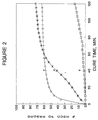
- Figures 1-5 are plots of degree of cure versus time as determined by real time FTIR studies comparing results obtained with formulations of the invention with various comparative formulations.
- the preferred radically polymerizable ethylenically unsaturated compounds employed in the photocurable compositions of the invention are (meth)acrylic ester compounds.
- One class of monomers suited for use in this invention comprises acrylate esters having the following general formula: wherein R4 represents a radical selected from the group consisting of hydrogen, halogen, alkyl of 1-4 carbon atoms, inclusive, hydroxyalkyl of 1-4 carbon atoms inclusive, phenyl, and R3 is a radical selected from the group consisting of hydrogen, halogen, and lower alkyl of 1-4 carbon atoms; R5 is a radical selected from the group consisting of hydrogen, -OH and m is an integer equal to at least 1, e.g. from 1 to 8 or higher, for instance, from 1 to 4 inclusive, n is an integer equal to at least 1, for example, 1 to 20 or more; and p is 0 or 1.
- the polymerizable polyacrylate esters utilized in accordance with the invention and corresponding to the above general formula are exemplified by, but not restricted to, the following materials: diethylene glycol dimethacrylate, triethylene glycol dimethacrylate, tetraethylene glycol dimethacrylate, dipropylene glycol dimethacrylate, di-(pentamethylene glycol) dimethacrylate, tetraethylene diglycerol diacrylate, diglycerol tetramethacrylate, tetramethylene dimethacrylate, ethylene dimethacrylate, neopentyl glycol diacrylate, and trimethylol propane triacrylate.
- the preferred monomers are triethylene glycol dimethacrylate and polyethylene glycol dimethacrylate.
- epoxy acrylate monomers i.e. the reaction products of epoxy compounds or prepolymers with acrylic or methacrylic acids
- urethane acrylate capped prepolymers such as those described in U.S. Patents 4,309,526, 4,295,909, 4,018,851, 4,380,613, and 4,439,600
- (meth)acrylic esters of alkoxylated bisphenol A for instance ethoxylated bisphenol A diacrylates of the formula: where q is an integer to at least 1, e.g. from 1 to 8 or higher, for instance, from 1 to 4 inclusive, and structurally similar compounds.
- monoacrylate esters can be used, particularly if the non-acrylate portion of the ester contains a hydroxyl or amino group, or other reactive substituent which serves as a site for potential crosslinking.
- useful mono(meth)acrylate monomers are hydroxyethyl methacrylate, cyanoethyl acrylate, t-butylaminoethyl methacrylate, glycidyl methacrylate, dicyclopentadiene methacrylate, lauryl acrylate and lauryl methacrylate. Further details on useful monomers may be found in U.S. Patent 4,287,330 at Col. 3, line 51 - Col. 6, line 44.
- Silicones having (meth)acrylate ester functionality are another class of monomers which may be used in the invention. Examples of such silicones may be found in U.S. patents 3,878,263, 4,035,355, 4,348,454, 4,477,326, 4,503,208, 4,504,629, 4,575,545, 4,575,546, 4,640,940 and 4,684,538, all incorporated herein by reference.
- metal ions if present, from the polymerizable monomer. This may be particularly desirable in the event that commercially obtained monomers, which often contain significant amounts of metal ions are employed in these compositions. Removal of metal ions may be effected by means known to those skilled in the art.
- radically polymerizable ethylenically unsaturated compounds may also be employed in admixture with (meth)acrylate esters.
- examples include maleic acid and fumeric acid esters and half esters; cinnamate esters; acrylamide and N-substituted acrylamides; acrylonitrile; vinyl functional compounds such as vinyl acetate, N-vinyl carbazole and N-vinyl pyrrolidone; and styryl functional compounds such as styrene, divinylbenzene and the styryloxy compounds described in US 4543397, US 4640849 and in EP 0229033.
- Such compounds, if employed, will represent a minor portion, suitably less than 30% of the monomer component of the formulation.
- compositions of the invention may comprise a single type of polymerizable monomer or may comprise a blend of two or more different polymerizable monomers. Preferably they are substantially 100% solids formulations, i.e. they cure to solids without substantial weight loss due to solvent volatilization, or the like.
- the preferred compositions include at least one monomer or prepolymer which is characterized by at least two acrylate or methacrylate groups per molecule. Such compounds are suitably used at levels of 30% or more by weight of the composition.
- the improved thermal properties of the inventive compositions are usually most striking when the formulation contains a urethane acrylate or urethane methacrylate capped prepolymer.
- compositions of the inventions cure via a peroxy initiated free radical mechanism.
- useful initiators are any of a wide variety of known peroxy compounds. Illustrative of such initiators are the diacyl peroxides such as benzoyl peroxide; dialkyl peroxides such as di-t-butyl peroxide; ketone peroxides such as methylethyl ketone peroxides; peresters which readily hydrolyze, e.g., t-butyl peracetate, t-butyl perbenzoate, di-t-butyl diperphthalate; and peroxycarbonates, i.e., reaction products of isocyanates and hydroperoxides.
- a particularly useful class of peroxy initiators are the organic hydroperoxides such as cumene hydroperoxide, methyl ethyl ketone hydroperoxide, t-butyl hydroperoxide, etc. Of these, cumene hydroperoxide is especially preferred. It is also known in the art to generate hydroperoxides in-situ by aeration of some (meth)acrylic ester monomers.
- the peroxy initiators should be used at a concentration of about 0.01% to about 10% by weight of the total formulation, preferably 0.1% to about 5% by weight, most preferably about 1%-3% by weight.
- compositions of the invention also include an accelerator compound having a functional group of the formula - SO2 - NH - CO - in a conventional amount.
- an accelerator compound having a functional group of the formula - SO2 - NH - CO - in a conventional amount.
- Such compounds are well known in anaerobic formulations and include sulfimide compounds of which saccharin (benzoic sulfimide) is the most widely used.
- Other examples of anaerobic accelerator compounds in this category are described in U.S. patents 3,046,262, 4,429,063, 4,443,587, 4,447,588, 4,513,127 and 4,622,348.
- sulfimide type " accelerators for purposes of this application all such compounds will be referred to as "sulfimide type " accelerators.
- such compounds will be employed at levels of between about 0.01-10%, more typically 0.1-5%, preferably 1-3% by weight.
- the dithiolate salts used in the anaerobic formulations of the invention should be added shortly before use on a substrate if active aeration of composition is not maintained. Thin layers of the dithiolate containing composition will remain uncured while exposed to atmospheric oxygen but even relatively small bulk volumes of the accelerated composition will begin to polymerize shortly after mixing without active aeration. This is not a serious drawback since the anaerobic formulation of the invention can readily be prepared from a two-part composition by mixing or contact diffusion of the two parts at the time of use.
- the xanthate, dithiocarbamate, dithiocarboxylate and dithiophosphate salts used in the inventive formulation and process are dithiolate compounds which may be represented by the formula: where Z is R2NC, R1OC, R1SC or (OR1)2P, M is an n valent transition metal selected from the group consisting of Cu, Co, Ni, Mo, Mn, Cr, Ru, Fe and V, n is 1, 2 or 3, R is a hydrocarbon or hydroxyhydrocarbon group and R1 is a hydrocarbon group which is optionally substituted by one or more hydroxyl or halo groups or interrupted by one or more ether oxygen atoms.
- Cu, Co, Ni and Fe are preferred transition metals.
- the hydrocarbon groups may be selected from alkyl, alkenyl, aryl, arylalkyl and alkylaryl.
- C1-C20 Alkyl and arylalkyl groups are preferred hydrocarbon groups, C1-C10 alkyl and arylalkyl groups being particularily preferred.
- the dithiolate salts exist as neutral complexes in which the metal ion is tightly associated with the dithiolate functional group until decomposition or reaction during the redox cycle of polymeric initiation. This gives the dithiolate salts good solubility in anaerobic systems. Moreover, manipulation of the organo group can easily be performed to improve solubility of the salt in a particular monomer system. It is also believed that the dithiolate liquid or counterion can provide adhesion enhancement of the cured adhesives to metal substrates.
- Solubility of the dithiolate can be modified by selection of the R or R1 groups. For instance, dibenzyldithiocarbamates are more soluble in (meth)acrylate capped ethoxylated bisphenol A than are dibutyldithiocarbamates.
- the effective level of dithiolate salt may be very low. For surface activation, just a few ppm on the surface can be sufficient to substantially improve the cure rate. When added to adhesive and sealant composition, the level is generally recommended to be between 0.01 and 5.0 percent, preferably between 0.1 and 1.0 percent by weight.
- agents such as thickeners, plasticizers, additional accelerators, colorants, adhesion promoters etc., are also known in the art and may advantageously be incorporated where functionally desirable, provided only that they do not interfere with the functioning of the composition for its intended purpose. This, of course, can be determined by simple experimentation.
- the invention may be illustrated by the following non-limiting examples.
- a base anaerobic formulation (formulation E) was prepared by adding to 100 gms triethylene glycol dimethacrylate, 2.75 ml cumene hydroperoxide and 0.7 gm benzoic sulfimide.
- Identical formulations (A - D) to which had been added 0.35 gms, respectively, of copper diacetylacetonate, copper ethyl xanthate, copper dimethyl dithiocarbamate, nickel dioctadecyl dithiophospate were also prepared.
- Cure rates of the various formulations between a sodium chloride salt plate and a polished aluminum panel (having a trace content of copper) were monitored for two hours by real time FTIR. The results of the monitoring are plotted in Figure 1 where the measured degree of cure was determined as the percentage loss in the observed acrylic unsaturation in the formulation from the level observed immediately upon placing the formulation between the salt and aluminum plates.
- formulations A-D all grave significant acceleration of the cure relative to the base formulation E. Further, of the three copper containing formulations, the two within the invention (B and C) reached their cure plateau much faster (i.e. they had a much faster fixture time) than did formulation A which contained a commonly used prior art copper accelerator salt.
- a base formulation free of sulfmide type coaccelerator (formulation I) was prepared by adding 2.75 ml cumene hydroperoxide to 100 gms triethylene glycol dimethacrylate. An identical formulation to which had been added 0.35 gm copper dimethyldithiocarbamate was also prepared (formulation J). Cure of both formulations was observed as in example 1.
- Figure 4, which plots the results of these observations against the results for formulation C and E, demonstrates that the sulfimide type coaccelerator is necessary to obtain any significant acceleration with the dithiolate complex salt compounds.
Landscapes
- Chemical & Material Sciences (AREA)
- Organic Chemistry (AREA)
- Adhesives Or Adhesive Processes (AREA)
- Polymerization Catalysts (AREA)
- Addition Polymer Or Copolymer, Post-Treatments, Or Chemical Modifications (AREA)
- Polymerisation Methods In General (AREA)
- Organic Low-Molecular-Weight Compounds And Preparation Thereof (AREA)
Applications Claiming Priority (2)
| Application Number | Priority Date | Filing Date | Title |
|---|---|---|---|
| US588068 | 1990-09-25 | ||
| US07/588,068 US5039767A (en) | 1990-09-25 | 1990-09-25 | Peroxy cured (meth)acrylic ester compositions employing metal dithiolate catalysts |
Publications (3)
| Publication Number | Publication Date |
|---|---|
| EP0478220A2 true EP0478220A2 (de) | 1992-04-01 |
| EP0478220A3 EP0478220A3 (de) | 1992-04-08 |
| EP0478220B1 EP0478220B1 (de) | 1995-01-18 |
Family
ID=24352347
Family Applications (1)
| Application Number | Title | Priority Date | Filing Date |
|---|---|---|---|
| EP91308529A Expired - Lifetime EP0478220B1 (de) | 1990-09-25 | 1991-09-18 | Peroxid-härtende (Meth)acrylesterzusammensetzungen unter Verwendung von Metalldithiolat-Katalysatoren |
Country Status (5)
| Country | Link |
|---|---|
| US (1) | US5039767A (de) |
| EP (1) | EP0478220B1 (de) |
| JP (1) | JPH04339812A (de) |
| CA (1) | CA2048984A1 (de) |
| DE (1) | DE69106826T2 (de) |
Cited By (2)
| Publication number | Priority date | Publication date | Assignee | Title |
|---|---|---|---|---|
| EP0659859A1 (de) * | 1993-12-20 | 1995-06-28 | National Starch and Chemical Investment Holding Corporation | Strukturelle Acrylklebstoffe |
| GB2546320A (en) * | 2016-01-15 | 2017-07-19 | Henkel IP & Holding GmbH | Cure of anaerobic compositions |
Families Citing this family (4)
| Publication number | Priority date | Publication date | Assignee | Title |
|---|---|---|---|---|
| JP2001192529A (ja) * | 2000-01-13 | 2001-07-17 | Denki Kagaku Kogyo Kk | 硬化性樹脂組成物、接着剤組成物、硬化体及び複合体 |
| CN100398568C (zh) * | 2003-07-25 | 2008-07-02 | 株式会社三键 | 厌氧固化性组合物 |
| JP2005060650A (ja) * | 2003-07-25 | 2005-03-10 | Three Bond Co Ltd | 嫌気硬化性組成物 |
| KR100673778B1 (ko) * | 2005-08-19 | 2007-01-24 | 제일모직주식회사 | 저온 속경화형 이방성 도전 필름용 조성물, 그로부터제조된 이방성 도전 필름 및 그 제조방법 |
Family Cites Families (9)
| Publication number | Priority date | Publication date | Assignee | Title |
|---|---|---|---|---|
| US3046262A (en) * | 1960-08-19 | 1962-07-24 | Vernon K Krieble | Accelerated anaerobic curing compositions |
| NL6717760A (de) * | 1967-12-28 | 1969-07-01 | ||
| US3625930A (en) * | 1967-12-28 | 1971-12-07 | Loctite Corp | Anaerobic composition and process for bonding nonporous surfaces, said composition comprising an acrylic monomer a peroxy initiator and a bonding accelerator |
| JPS5738836A (en) * | 1980-08-21 | 1982-03-03 | Toyo Soda Mfg Co Ltd | Production of particulate organic rubber chemicals composition |
| US4513127A (en) * | 1984-09-13 | 1985-04-23 | Loctite Corporation | Soluble sulfimide accelerators for free radical cured compositions |
| US4622348A (en) * | 1984-11-27 | 1986-11-11 | Loctite Corporation | Chlorosulfonyl isocyanate derivatives as anaerobic accelerators |
| US4632945A (en) * | 1985-05-31 | 1986-12-30 | Loctite Corporation | Anaerobic sealant unaffected by water contamination |
| US4764239A (en) * | 1985-07-24 | 1988-08-16 | Loctite Corporation | Substituted saccharin compounds and curable compositions containing same |
| DE3689667T2 (de) * | 1985-07-24 | 1994-07-14 | Loctite Corp | Substituierte saccharinverbindungen und vernetzbare zusammensetzungen daraus. |
-
1990
- 1990-09-25 US US07/588,068 patent/US5039767A/en not_active Expired - Fee Related
-
1991
- 1991-08-12 CA CA002048984A patent/CA2048984A1/en not_active Abandoned
- 1991-09-18 EP EP91308529A patent/EP0478220B1/de not_active Expired - Lifetime
- 1991-09-18 DE DE69106826T patent/DE69106826T2/de not_active Expired - Fee Related
- 1991-09-25 JP JP3273357A patent/JPH04339812A/ja active Pending
Cited By (4)
| Publication number | Priority date | Publication date | Assignee | Title |
|---|---|---|---|---|
| EP0659859A1 (de) * | 1993-12-20 | 1995-06-28 | National Starch and Chemical Investment Holding Corporation | Strukturelle Acrylklebstoffe |
| GB2546320A (en) * | 2016-01-15 | 2017-07-19 | Henkel IP & Holding GmbH | Cure of anaerobic compositions |
| GB2546320B (en) * | 2016-01-15 | 2018-02-14 | Henkel IP & Holding GmbH | Cure of anaerobic compositions |
| US10414948B2 (en) | 2016-01-15 | 2019-09-17 | Henkel IP & Holding GmbH | Cure of anaerobic compositions |
Also Published As
| Publication number | Publication date |
|---|---|
| DE69106826T2 (de) | 1995-08-10 |
| US5039767A (en) | 1991-08-13 |
| EP0478220B1 (de) | 1995-01-18 |
| EP0478220A3 (de) | 1992-04-08 |
| DE69106826D1 (de) | 1995-03-02 |
| JPH04339812A (ja) | 1992-11-26 |
| CA2048984A1 (en) | 1992-03-26 |
Similar Documents
| Publication | Publication Date | Title |
|---|---|---|
| US3836377A (en) | Cyanoacrylate adhesive composition | |
| US4174311A (en) | Hardenable composition containing diisopropylbenzene dihydroperoxide | |
| CA2243573A1 (en) | Free radical polymerizable compositions including para-halogenated aniline derivatives | |
| JPH039155B2 (de) | ||
| EP0502733B1 (de) | Luftaktivierbare Polymerzusammensetzung | |
| KR102390137B1 (ko) | 혐기 경화성 (메트)아크릴레이트 조성물 | |
| US4451615A (en) | Polyisoprene toughened adhesive composition | |
| CN1210364C (zh) | 粘合剂制剂 | |
| EP0379305B1 (de) | Geruchsarme Klebstoff-Zusammensetzungen | |
| GB2121811A (en) | Solventless two-part adhesive composition | |
| EP0738286B1 (de) | Aktivatorformulierung und zusammensetzung diese verwendend | |
| US5290831A (en) | Multicomponent adhesive composition | |
| EP0478220B1 (de) | Peroxid-härtende (Meth)acrylesterzusammensetzungen unter Verwendung von Metalldithiolat-Katalysatoren | |
| JPH09511014A (ja) | 非−オゾン破壊補助溶剤組成物 | |
| USRE35058E (en) | Peroxy cured (meth)acrylic ester compositions employing nitrite, borate, silicate or carbonate salt accelerators | |
| HK128694A (en) | Radical polymerizable compositions and their use | |
| JPS5984964A (ja) | 亜鉛処理基材用接着剤組成物 | |
| WO2010090826A2 (en) | Fast curing, two part anaerobic adhesive composition | |
| EP0718386B1 (de) | Luftaktivierbare polymerisierbare Zusammensetzungen, die Tetrazole enthalten | |
| JP3262328B2 (ja) | 空気欠如状態で保存可能な新規のラジカル重合性多成分混合物とその使用 | |
| IL31723A (en) | Composition and process for bonding surfaces | |
| EP3137565B1 (de) | Anaerobe härtbare zusammensetzungen mit einem block poly(carbonsäure)segment | |
| JPH05239410A (ja) | アクリル反応体をベースとする構造用接着剤 | |
| JP4416179B2 (ja) | 二液型アクリル系硬化性組成物 | |
| EP1190011A2 (de) | Klebstoffzusammensetzungen |
Legal Events
| Date | Code | Title | Description |
|---|---|---|---|
| PUAI | Public reference made under article 153(3) epc to a published international application that has entered the european phase |
Free format text: ORIGINAL CODE: 0009012 |
|
| PUAL | Search report despatched |
Free format text: ORIGINAL CODE: 0009013 |
|
| AK | Designated contracting states |
Kind code of ref document: A2 Designated state(s): DE FR GB IT |
|
| AK | Designated contracting states |
Kind code of ref document: A3 Designated state(s): DE FR GB IT |
|
| 17P | Request for examination filed |
Effective date: 19920806 |
|
| 17Q | First examination report despatched |
Effective date: 19940415 |
|
| GRAA | (expected) grant |
Free format text: ORIGINAL CODE: 0009210 |
|
| AK | Designated contracting states |
Kind code of ref document: B1 Designated state(s): DE FR GB IT |
|
| ITF | It: translation for a ep patent filed | ||
| REF | Corresponds to: |
Ref document number: 69106826 Country of ref document: DE Date of ref document: 19950302 |
|
| ET | Fr: translation filed | ||
| PLBE | No opposition filed within time limit |
Free format text: ORIGINAL CODE: 0009261 |
|
| STAA | Information on the status of an ep patent application or granted ep patent |
Free format text: STATUS: NO OPPOSITION FILED WITHIN TIME LIMIT |
|
| 26N | No opposition filed | ||
| PGFP | Annual fee paid to national office [announced via postgrant information from national office to epo] |
Ref country code: FR Payment date: 19970820 Year of fee payment: 7 |
|
| PGFP | Annual fee paid to national office [announced via postgrant information from national office to epo] |
Ref country code: DE Payment date: 19970822 Year of fee payment: 7 |
|
| PGFP | Annual fee paid to national office [announced via postgrant information from national office to epo] |
Ref country code: GB Payment date: 19970826 Year of fee payment: 7 |
|
| PG25 | Lapsed in a contracting state [announced via postgrant information from national office to epo] |
Ref country code: GB Free format text: LAPSE BECAUSE OF NON-PAYMENT OF DUE FEES Effective date: 19980918 |
|
| GBPC | Gb: european patent ceased through non-payment of renewal fee |
Effective date: 19980918 |
|
| PG25 | Lapsed in a contracting state [announced via postgrant information from national office to epo] |
Ref country code: FR Free format text: LAPSE BECAUSE OF NON-PAYMENT OF DUE FEES Effective date: 19990531 |
|
| PG25 | Lapsed in a contracting state [announced via postgrant information from national office to epo] |
Ref country code: DE Free format text: LAPSE BECAUSE OF NON-PAYMENT OF DUE FEES Effective date: 19990701 |
|
| REG | Reference to a national code |
Ref country code: FR Ref legal event code: ST |
|
| PG25 | Lapsed in a contracting state [announced via postgrant information from national office to epo] |
Ref country code: IT Free format text: LAPSE BECAUSE OF NON-PAYMENT OF DUE FEES;WARNING: LAPSES OF ITALIAN PATENTS WITH EFFECTIVE DATE BEFORE 2007 MAY HAVE OCCURRED AT ANY TIME BEFORE 2007. THE CORRECT EFFECTIVE DATE MAY BE DIFFERENT FROM THE ONE RECORDED. Effective date: 20050918 |