EP0478921A1 - Verfahren und Vorrichtung zur kontinuierlichen Intensivbefeuchtung von Flächengebilden, insbesondere bahnförmigen Textilien u. dgl. - Google Patents
Verfahren und Vorrichtung zur kontinuierlichen Intensivbefeuchtung von Flächengebilden, insbesondere bahnförmigen Textilien u. dgl. Download PDFInfo
- Publication number
- EP0478921A1 EP0478921A1 EP91112729A EP91112729A EP0478921A1 EP 0478921 A1 EP0478921 A1 EP 0478921A1 EP 91112729 A EP91112729 A EP 91112729A EP 91112729 A EP91112729 A EP 91112729A EP 0478921 A1 EP0478921 A1 EP 0478921A1
- Authority
- EP
- European Patent Office
- Prior art keywords
- textile web
- drum
- follower
- adjustable
- web
- Prior art date
- Legal status (The legal status is an assumption and is not a legal conclusion. Google has not performed a legal analysis and makes no representation as to the accuracy of the status listed.)
- Granted
Links
- 239000004753 textile Substances 0.000 title claims abstract description 33
- 238000000034 method Methods 0.000 title claims abstract description 20
- 239000000463 material Substances 0.000 title description 3
- 238000009489 vacuum treatment Methods 0.000 claims abstract description 3
- XLYOFNOQVPJJNP-UHFFFAOYSA-N water Substances O XLYOFNOQVPJJNP-UHFFFAOYSA-N 0.000 claims description 12
- 239000004744 fabric Substances 0.000 claims description 6
- 238000010438 heat treatment Methods 0.000 claims description 4
- 239000007788 liquid Substances 0.000 claims description 4
- 230000001360 synchronised effect Effects 0.000 claims description 2
- 238000013016 damping Methods 0.000 claims 1
- 239000000835 fiber Substances 0.000 description 5
- 210000002268 wool Anatomy 0.000 description 5
- 230000000694 effects Effects 0.000 description 4
- 238000009736 wetting Methods 0.000 description 4
- 238000004519 manufacturing process Methods 0.000 description 2
- 239000000126 substance Substances 0.000 description 2
- 238000010521 absorption reaction Methods 0.000 description 1
- 238000004378 air conditioning Methods 0.000 description 1
- 238000000889 atomisation Methods 0.000 description 1
- 230000015572 biosynthetic process Effects 0.000 description 1
- 238000001035 drying Methods 0.000 description 1
- 238000001704 evaporation Methods 0.000 description 1
- 230000008020 evaporation Effects 0.000 description 1
- 239000000834 fixative Substances 0.000 description 1
- 238000005755 formation reaction Methods 0.000 description 1
- 238000007654 immersion Methods 0.000 description 1
- 238000003825 pressing Methods 0.000 description 1
- 229920006395 saturated elastomer Polymers 0.000 description 1
- 239000007921 spray Substances 0.000 description 1
- 238000005507 spraying Methods 0.000 description 1
- 230000008961 swelling Effects 0.000 description 1
Images
Classifications
-
- D—TEXTILES; PAPER
- D06—TREATMENT OF TEXTILES OR THE LIKE; LAUNDERING; FLEXIBLE MATERIALS NOT OTHERWISE PROVIDED FOR
- D06B—TREATING TEXTILE MATERIALS USING LIQUIDS, GASES OR VAPOURS
- D06B3/00—Passing of textile materials through liquids, gases or vapours to effect treatment, e.g. washing, dyeing, bleaching, sizing, impregnating
- D06B3/10—Passing of textile materials through liquids, gases or vapours to effect treatment, e.g. washing, dyeing, bleaching, sizing, impregnating of fabrics
- D06B3/20—Passing of textile materials through liquids, gases or vapours to effect treatment, e.g. washing, dyeing, bleaching, sizing, impregnating of fabrics with means to improve the circulation of the treating material on the surface of the fabric
- D06B3/201—Passing of textile materials through liquids, gases or vapours to effect treatment, e.g. washing, dyeing, bleaching, sizing, impregnating of fabrics with means to improve the circulation of the treating material on the surface of the fabric the treating material being forced through the textile material
- D06B3/203—Passing of textile materials through liquids, gases or vapours to effect treatment, e.g. washing, dyeing, bleaching, sizing, impregnating of fabrics with means to improve the circulation of the treating material on the surface of the fabric the treating material being forced through the textile material by suction, e.g. by means of perforated drums
-
- D—TEXTILES; PAPER
- D06—TREATMENT OF TEXTILES OR THE LIKE; LAUNDERING; FLEXIBLE MATERIALS NOT OTHERWISE PROVIDED FOR
- D06C—FINISHING, DRESSING, TENTERING OR STRETCHING TEXTILE FABRICS
- D06C2700/00—Finishing or decoration of textile materials, except for bleaching, dyeing, printing, mercerising, washing or fulling
- D06C2700/13—Steaming or decatising of fabrics or yarns
- D06C2700/135—Moistening of fabrics or yarns as a complementary treatment
-
- Y—GENERAL TAGGING OF NEW TECHNOLOGICAL DEVELOPMENTS; GENERAL TAGGING OF CROSS-SECTIONAL TECHNOLOGIES SPANNING OVER SEVERAL SECTIONS OF THE IPC; TECHNICAL SUBJECTS COVERED BY FORMER USPC CROSS-REFERENCE ART COLLECTIONS [XRACs] AND DIGESTS
- Y10—TECHNICAL SUBJECTS COVERED BY FORMER USPC
- Y10S—TECHNICAL SUBJECTS COVERED BY FORMER USPC CROSS-REFERENCE ART COLLECTIONS [XRACs] AND DIGESTS
- Y10S68/00—Textiles: fluid treating apparatus
- Y10S68/903—Perforated drum and continuous textile feed and discharge
Definitions
- the invention relates to a method and an apparatus for the continuous intensive moistening of fabrics, in particular web-shaped textiles and the like. the like
- the correct and, above all, uniform moisture content of woolen goods or the like is very important, even crucial for fixing processes, in particular to achieve permanent fixing processes in the wet (flat-setting hydroflat fixation) and in the dry state (Permenentdekatur).
- the fixative is processed in the wet state, i.e. after squeezing the foulard or the like with a residual moisture content of approx. 50-70%, depending on the quality of the foulard or the like.
- a streak-free and intensively working humidification device that works continuously at a speed of at least 16 - 25 m / min. Goods transport speed that brings the required results does not yet exist.
- the object of the invention is to demonstrate a method and an apparatus for carrying it out, with which a continuous streak-free intensive moistening of the material to be treated, eg. B. the textile web, the same can be carried out at a comparatively high speed.
- the textile web is moistened by two continuously moist, permeable followers arranged on both sides thereof, at least one of which exerts compressive forces on the textile web and that the textile web and the two followers one Be subjected to negative pressure treatment.
- the tensioned idler with a hot, gaseous medium, such as water vapor or hot air.
- the device for carrying out the method according to the invention has a cylindrical, rotatable drum which can be connected to a vacuum source and has a perforated outer surface against which the one follower rests, the other follower being an endless pressure band which is against the part of the textile web which wraps around the drum creates.
- the follower which is designed as an endless printing belt, is guided over deflecting rollers, of which at least one deflecting roller can be adjusted and locked in order to change the contact pressure, part of the deflecting rollers being drive rollers for the follower.
- the drum is immersed in a container filled with water and holding a heating device.
- the required moisture values (up to 35%) of the goods can be achieved without streaks.
- the degree of moistening can also be influenced by other parameters, regardless of the speed of the goods. B. from the temperature of the water bath, the level of the water in the container (immersion depth of the drum), the suction volume of the vacuum generator and the amount of steam.
- Another advantage is that less pressing or finishing effects are lost in the goods due to the wetting under surface pressure than with wetting without surface pressure.
- the goods under surface pressure are less converted to the raw state because fiber swelling and volume increase are prevented.
- the amount of moisture offered is pressed into the core of the goods.
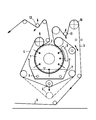
- a permeable follower 2 bears against the jacket of the drum 1, which is a manchon in the embodiment shown.
- the idler 2 can also be endless and guided over deflection rollers.
- the textile web is indicated, which is pressed against the follower 2 by means of a further, permeable follower 4 designed as an endless pressure band. This ensures a frictional entrainment of the drum 1 and thus the textile web 3.
- the contact pressure is generated by means of a controllable deflection roller 5.
- One of the deflection rollers, namely 6, is the drive roller for the idler 4.
- the material of the textile web 3 cannot swell, so that the moisture can penetrate into the core of the goods.
- the drum 1 dips with the textile web 3 and the two followers 2, 4 in one with the dampening liquid, for. B. water, filled container 7, in which a heating device 8 is arranged.
- the level in the receptacle 7 and the temperature of the heating device 8 are expediently controllable.
- the rotary movement of the drum 1 in the heated water bath results in a constant moistening of the two idlers 2, 4 and thus inevitably also the textile web 3, the moistening of the idler 4 from the outside and that of the idler 2 from the inside of the drum 1 (wick system) .
- the cocked follower 4 is with a hot, gaseous medium, for. B. steam or hot air. This is done via one or more steam boxes 9 which emit saturated steam or hot air which is drawn into the drum 1 by the negative pressure through the two idlers 2, 4 and the textile web 3.
- the steam and the pressurized textile web 3 already produce good moisture contact, which is further strengthened in the further course by sucking in hot moisture. In this way, the textile web 3 becomes more hygroscopic.
- a closed and internally heated drum 1 is used instead of the perforated because the heat supply makes the textile web 3 more hygroscopic and absorbs the moisture offered by the followers 2, 4 more quickly.
- the advantage of the perforated drum 1 is essentially that the absorption capacity can be further increased by the more or less pronounced intake quantity.
- the degree of moistening can be influenced via the amount of suction and the strength of the negative pressure, especially if one assumes that the throughput speed of the textile web 3 is constant.
- the moistening device according to the invention can be easily carried out with a downstream bear combine processing machines.
- the driven roller 10 ensures that the textile web to be moistened is fed to the moistening device without tension.
- a dancer device 11 connected downstream of this roller 10 automatically regulates the drive speed of the roller 10, so that conditions are always constant and ultimately no goods train is produced.
- a dancer device 12 connected downstream of the moistening device takes over the synchronous control of the textile web 3 for the subsequent processing process.
Landscapes
- Engineering & Computer Science (AREA)
- Textile Engineering (AREA)
- Treatment Of Fiber Materials (AREA)
Abstract
Description
- Die Erfindung bezieht sich auf ein Verfahren bzw. eine Vorrichtung zur kontinuierlichen Intensivbefeuchtung von Flächengebilden, insbesondere bahnförmigen Textilien u. dgl.
- Es ist bekannt, daß bei der Verarbeitung von Wollwaren u. dgl. die Feuchtigkeit der Faser eine ausschlaggebende Rolle spielt. So verdanken beispielsweise englische Tuche ihren Weltruf im wesentlichen der Tatsache, daß die an die Wollfaser gebundene Feuchtigkeit etwas größer ist als bei den besten Tuchen deutscher bzw. italienischer Herkunft. Der Grund hierfür liegt in dem überwiegend feuchteren englischen Klima. Aber selbst dort werden durch zunehmende Rationalisierungsmaßnahmen und Produktionssteigerungen die Durchlaufzeiten für die Fertigung immer geringer, da die sonst üblichen Ruhepausen zur Klimatisierung der Wolle fortfallen. Die bereits seit langem eingeschalteten ..künstlichen Erholungspausen", z.B. durch Befeuchtungsmaßnahmen, bringen aber nur zu einem relativ geringen Anteil Erfolge. Die bis heute bekannten Befeuchtungsmethoden erfüllen die gestellten Aufgaben nur unvollkommen, weil die damit erzielte Zerstäubung des Wassers zu grob ist und folglich nur eine Nässung der Stoffoberfläche, keineswegs aber eine innige Verbindung der Feuchtigkeit mit der Wollfaser, insbesondere aber mit deren Kern, u. dgl. stattfindet.
- Die auf dem Markt befindlichen Befeuchtungseinrichtungen arbeiten nach unterschiedlichen Methoden, z. B.:
- Die damit erzielbare Feuchtigkeitszunahme in der Ware ist begrenzt (8 - 12 %). Bei größeren Mengen (oft über 5 %) entstehen bereits ungleiche Effekte. An denjenigen Stellen, an welchen eine Überdeckung der Sprühstrahlen auftritt, werden Streifenbildungen auf der Ware sichtbar. Weitere Probleme entstehen immer wieder durch Kalkablagerungen in den Düsen oder Rotoren.
- Diese Geräte, z. B. Nebelatoren o. dgl. bringen eine relativ gute Gleichmäßigkeit über die gesamte Warenbreite, wenn geeignete Maschinen mit gleichmäßigem Einsaugvermögen vorhanden sind, die die angebotene Feuchtigkeit durch die Ware hindurchsaugen. Die erzielbaren, effektiven Feuchtewerte sind jedoch auch hierbei relativ gering.
- Diese Geräte sind auch nur bedingt für Woll-oder Wollmischgewebe einsetzbar, weil durch Abriß des Flüssigkeitsfilmes immer wieder Unregelmäßigkeiten beim Pflatschen entstehen (Bilderungen, Flecken, Tropfen, Schlieren o. dgl.).
- Der richtige und vor allem gleichmäßige Feuchtegehalt von Wollwaren o. dgl. ist aber ganz wichtig, ja sogar ausschlaggebend für Fixiervorgänge, insbesondere zur Erzielung von permanenten Fixiervorgängen im nassen (Flat-Setting Hydroflachfixierung) sowie im trockenen Zustand (Permenentdekatur). Bei der z. Zt. in der Praxis durchgeführten Hydroflachfixierung verarbeitet man das Fixiergut im nassen Zustand, d.h. nach dem Abquetschvorgang des Foulards o. dgl. bei einem Restfeuchtegehalt von ca. 50-70%, je nach Qualität des Foulards o. dgl.
- Diese bekannte Methode verursacht hohe Kosten, weil sehr viel Energie zum Trocknen benötigt wird, um die nasse Ware nach dem Fixieren wieder auf Normalfeuchte zu bringen. Wissenschaftliche Untersuchungen haben aber bereits schon vor einigen Jahren eindeutig gezeigt, daß man die besten Fixierwerte, z. B. bei Wollwaren, zwischen 25 und 35 % Feuchtegehalt erzielen kann. Solche Werte lassen sich jedoch - zumindest bis heute - in der Praxis nicht erreichen.
- Mit totaler Netzung im Wasserbad und anschließendem Abquetschvorgang können im Grenzfall ca. 50 % Feuchtegehalt realisiert werden. Andererseits bringt die Befeuchtung von trockener Ware im Maximum 10 - 12 %, wobei diese Werte lediglich als Momentanwerte angesehen werden müssen. Die Feuchtigkeit geht dabei nicht in die Tiefe der Faser und wird durch Verdunstung an die Umwelt - leider in der Regel noch ungleichmäßig - teilweise wieder abgegeben. Ungleiche Befeuchtungseffekte führen aber zu äquivalent ungleich verlaufenden Fixiereffekten.
- Eine streifenfrei und intensiv arbeitende Befeuchtungseinrichtung, die im kontinuierlichen Betrieb bei zumindest 16 - 25 m/min. Warentransportgeschwindigkeit die geforderten Ergebnisse bringt, gibt es derzeit noch nicht.
- Hier setzt der Erfindungsgedanke ein. Aufgabe der Erfindung ist es, ein Verfahren sowie eine Vorrichtung zu dessen Durchführung aufzuzeigen, mit welchen eine kontinuierliche streifenfreie Intensivbefeuchtung des zu behandelnden Gutes, z. B. der Textilbahn, bei vergleichsweise hoher Geschwindigkeit derselben durchführbar ist.
- Diese Aufgabe wird bei dem Verfahren gemäß der Erfindung dadurch gelöst, daß die Textilbahn von zwei beidseitig derselben angeordneten, laufend befeuchteten, durchlässigen Mitläufern befeuchtet wird, von welchen zumindest der eine durch Spannung auf die Textilbahn Druckkräfte ausübt und daß die Textilbahn und die beiden Mitläufer einer Unterdruckbehandlung unterworfen werden.
- Dabei wird der gespannte Mitläufer mit einem heißen, gasförmigen Medium, z.B. Wasserdampf oder Heißluft beaufschlagt.
- Die Vorrichtung zur Durchführung der erfindungsgemäßen Methode weist eine zylinderförmige, drehbare und an eine Vakuumquelle anschließbare Trommel mit perforierter Mantelfläche auf, gegen welche sich der eine Mitläufer anlegt, wobei der andere Mitläufer ein endloses Druckband ist, welches sich gegen den die Trommel umschlingenden Teil der Textilbahn anlegt.
- Nach einem weiteren Merkmal der erfindungsgemäßen Vorrichtung ist der als endloses Druckband ausgebildete Mitläufer über Umlenkwalzen geführt, von welchen zur Veränderung der Anpreßkraft zumindest eine Umlenkwalze verstellbar und arretierbar ist, wobei ein Teil der Umlenkwalzen Antriebswalzen für den Mitläufer sind.
- Die Trommel taucht dabei in einen mit Wasser gefüllten, eine Heizvorrichtung aufnehmenden Behälter ein.
- Durch den erfindungsgemäßen Vorschlag können die geforderten Feuchtigkeitswerte (bis zu 35 %) der Ware streifenfrei verwirklicht werden. Darüber hinaus kann der Grad der Befeuchtung unabhängig von der Waren-Durchlaufgeschwindigkeit auch von weiteren Parametern beeinflußt werden, z. B. von der Temperatur des Wasserbades, dem Niveau des Wasserstandes im Behälter (Eintauchtiefe der Trommel), vom Einsaugvolumen des Unterdruckerzeugers sowie von der Dampfmenge.
- Ein weiterer Vorteil liegt darin, daß durch die Befeuchtung unter Flächendruck weniger Preß-oder Finisheffekte in der Ware verloren gehen als bei einer flächendrucklosen Befeuchtung. Die unter Flächenpressung stehende Ware wird weniger in Richtung Rohzustand verwandelt, weil eine Faserquellung und Volumenzunahme verhindert werden. Die angebotene Feuchtigkeitsmenge wird in den Kern der Ware gepreßt.
- Weitere Merkmale der Erfindung gehen aus den Unteransprüchen, der nachfolgenden Beschreibung sowie der Zeichnung hervor. Die Zeichnung zeigt einen senkrechten Schnitt durch die Vorrichtung gemäß der Erfindung.
- Mit 1 ist die zylinderförmige, drehbar gelagerte Trommel der Vorrichtung bezeichnet, deren Mantelfläche perforiert ist. Die Trommel 1 ist an eine nicht dargestellte Vakuumquelle, z. B. einen Ablüfter u. dgl. anschließbar. Gegen den Mantel der Trommel 1 legt sich ein durchlässiger Mitläufer 2 an, der bei der dargestellten Ausführungsform ein Manchon ist. Die Erfindung ist aber auf diese besondere Ausführungsform keineswegs beschränkt. Der Mitläufer 2 kann auch endlos ausgebildet und über Umlenkwalzen geführt werden.
- Mit 3 ist die Textilbahn angedeutet, die gegen den Mitläufer 2 mittels eines weiteren, als endloses Druckband ausgebildeten, durchlässigen Mitläufers 4 angepreßt wird. Hierdurch ist eine kraftschlüssige Mitnahme der Trommel 1 und damit der Textilbahn 3 sichergestellt. Der Anpreßdruck wird mittels einer regelbaren Umlenkwalze 5 erzeugt. Die eine der Umlenkwalzen, nämlich 6, ist Antriebswalze für den Mitläufer 4.
- Durch den von dem Mitläufer 4 ausgeübten Druck kann das Material der Textilbahn 3 nicht quellen, so daß die Feuchtigkeit in den Kern der Ware eindringen kann.
- Als Folge der laufenden Evakuierung der Trommel 1 werden die Textilbahn 3 und die beiden Mitläufer 2, 4 im Umschlingungsbereich der Trommel 1 einer Unterdruckbehandlung unterworfen.
- Wie die Zeichnung deutlich macht, taucht die Trommel 1 mit der Textilbahn 3 sowie den beiden Mitläufern 2, 4 in einen mit der Befeuchtungsflüssigkeit, z. B. Wasser, gefüllten Behälter 7 ein, in welchem eine Heizvorrichtung 8 angeordnet ist. Das Niveau im Aufnahmebehälter 7 sowie die Temperatur der Heizvorrichtung 8 sind zweckmäßig regelbar. Durch die Drehbewegung der Trommel 1 im beheizten Wasserbad wird eine ständige Befeuchtung der beiden Mitläufer 2, 4 und damit zwangsläufig auch der Textilbahn 3 erreicht, wobei die Befeuchtung des Mitläufers 4 von außen und diejenige des Mitläufers 2 von innen der Trommel 1 erfolgt (Dochtsystem).
- Der gespannte Mitläufer 4 wird mit einem heißen, gasförmigen Medium, z. B. Wasserdampf oder Heißluft beaufschlagt. Dies geschieht über einen oder mehrere Dämpfkästen 9, welche gesättigten Dampf oder Heißluft ausstoßen, der durch den Unterdruck durch die beiden Mitläufer 2, 4 und die Textilbahn 3 in die Trommel 1 eingezogen wird. Durch den Dampf und die unter Druck stehende Textilbahn 3 ist bereits ein guter Feuchtekontakt hergestellt, der im weiteren Verlaufe durch Einsaugen von heißer Feuchtigkeit noch verstärkt wird. Auf diese Weise wird die Textilbahn 3 hygroskopischer.
- In vereinfachter Form ist denkbar, daß anstelle der perforierten eine geschlossene und von innen beheizte Trommel 1 verwendet wird, weil durch die Wärmezufuhr die Textilbahn 3 hygroskopischer wird und die angebotene Feuchte aus den Mitläufern 2, 4 schneller aufnimmt. Der Vorteil der perforierten Trommel 1 liegt im wesentlichen darin, daß durch die mehr oder weniger ausgeprägte Einsaugmenge das Aufnahmevermögen zusätzlich verstärkt werden kann.
- Über die Einsaugmenge und die Stärke des Unterdruckes kann der Grad der Befeuchtung beeinflußt werden, namentlich, wenn man davon ausgeht, daß die Durchlaufgeschwindigkeit der Textilbahn 3 konstant ist.
- Die erfindungsgemäße Befeuchtungsvorrichtung läßt sich einfach mit nachgeschalteten Bearbeitungsmaschinen kombinieren. So sorgt beispielsweise die angetriebene Walze 10 dafür, daß die zu befeuchtende Textilbahn ohne Zug der Befeuchtungsvorrichtung zugeführt wird. Eine dieser Walze 10 nachgeschalteten Tänzereinrichtung 11 regelt automatisch die Antriebsgeschwindigkeit der Walze 10, so daß stets gleichbleibende Verhältnisse und letztlich kein Warenzug entsteht.
- Eine der Befeuchtungsvorrichtung nachgeschaltete Tänzereinrichtung 12 übernimmt die Synchronregelung der Textilbahn 3 für den nachfolgenden Bearbeitungsprozeß.
- Es wäre denkbar, Chemikalien zu applizieren, die - im Wasser gelöst - mit der Ware in Verbindung gebracht werden. In diesem Falle würden der Behandlungsflotte lediglich Chemikalien beigemischt werden.
Claims (12)
Applications Claiming Priority (2)
| Application Number | Priority Date | Filing Date | Title |
|---|---|---|---|
| DE4031063 | 1990-10-02 | ||
| DE4031063A DE4031063C2 (de) | 1990-10-02 | 1990-10-02 | Vorrichtung zur kontinuierlichen Intensivbefeuchtung einer Textilbahn |
Publications (2)
| Publication Number | Publication Date |
|---|---|
| EP0478921A1 true EP0478921A1 (de) | 1992-04-08 |
| EP0478921B1 EP0478921B1 (de) | 1997-05-28 |
Family
ID=6415383
Family Applications (1)
| Application Number | Title | Priority Date | Filing Date |
|---|---|---|---|
| EP91112729A Expired - Lifetime EP0478921B1 (de) | 1990-10-02 | 1991-07-29 | Verfahren und Vorrichtung zur kontinuierlichen Intensivbefeuchtung von Flächengebilden, insbesondere bahnförmigen Textilien u. dgl. |
Country Status (4)
| Country | Link |
|---|---|
| US (1) | US5203043A (de) |
| EP (1) | EP0478921B1 (de) |
| JP (1) | JPH04272266A (de) |
| DE (2) | DE4031063C2 (de) |
Families Citing this family (53)
| Publication number | Priority date | Publication date | Assignee | Title |
|---|---|---|---|---|
| IT1269484B (it) * | 1994-01-27 | 1997-04-01 | Sperotto Rimar Spa | Apparecchiatura per il trattamento superficiale ad umido di materiali tessili continui |
| ES2138475B1 (es) * | 1995-10-09 | 2000-09-16 | M Tel Maschinenbaugesellschaft | Metodo y dispositivo para el decatizado continuo de bienes textiles en forma de tiras. |
| DE19712485A1 (de) * | 1997-03-25 | 1998-10-01 | M Tec Maschbau Gmbh | Verfahren zur kontinuierlichen Intensivbefeuchtung einer Textilbahn |
| US6634192B2 (en) * | 2001-02-12 | 2003-10-21 | Pti Advanced Filtration, Inc. | System and method for flushing a membrane web using a vacuum roller |
| US8417374B2 (en) | 2004-04-19 | 2013-04-09 | Curt G. Joa, Inc. | Method and apparatus for changing speed or direction of an article |
| US7703599B2 (en) * | 2004-04-19 | 2010-04-27 | Curt G. Joa, Inc. | Method and apparatus for reversing direction of an article |
| US7640962B2 (en) | 2004-04-20 | 2010-01-05 | Curt G. Joa, Inc. | Multiple tape application method and apparatus |
| US7708849B2 (en) | 2004-04-20 | 2010-05-04 | Curt G. Joa, Inc. | Apparatus and method for cutting elastic strands between layers of carrier webs |
| US20050230037A1 (en) * | 2004-04-20 | 2005-10-20 | Curt G. Joa, Inc. | Staggered cutting knife |
| US7638014B2 (en) | 2004-05-21 | 2009-12-29 | Curt G. Joa, Inc. | Method of producing a pants-type diaper |
| US7537215B2 (en) * | 2004-06-15 | 2009-05-26 | Curt G. Joa, Inc. | Method and apparatus for securing stretchable film using vacuum |
| US7811403B2 (en) | 2005-03-09 | 2010-10-12 | Curt G. Joa, Inc. | Transverse tab application method and apparatus |
| US7452436B2 (en) | 2005-03-09 | 2008-11-18 | Curt G. Joa, Inc. | Transverse tape application method and apparatus |
| US8007484B2 (en) * | 2005-04-01 | 2011-08-30 | Curt G. Joa, Inc. | Pants type product and method of making the same |
| US20060265867A1 (en) * | 2005-05-31 | 2006-11-30 | Curt G. Joa, Inc. | Use of ultrasonic horn to mechanically secure hooks to a smooth material web |
| US7533709B2 (en) | 2005-05-31 | 2009-05-19 | Curt G. Joa, Inc. | High speed vacuum porting |
| US7618513B2 (en) | 2005-05-31 | 2009-11-17 | Curt G. Joa, Inc. | Web stabilization on a slip and cut applicator |
| US7770712B2 (en) | 2006-02-17 | 2010-08-10 | Curt G. Joa, Inc. | Article transfer and placement apparatus with active puck |
| US8016972B2 (en) | 2007-05-09 | 2011-09-13 | Curt G. Joa, Inc. | Methods and apparatus for application of nested zero waste ear to traveling web |
| US7780052B2 (en) | 2006-05-18 | 2010-08-24 | Curt G. Joa, Inc. | Trim removal system |
| US9433538B2 (en) | 2006-05-18 | 2016-09-06 | Curt G. Joa, Inc. | Methods and apparatus for application of nested zero waste ear to traveling web and formation of articles using a dual cut slip unit |
| US8172977B2 (en) | 2009-04-06 | 2012-05-08 | Curt G. Joa, Inc. | Methods and apparatus for application of nested zero waste ear to traveling web |
| US9622918B2 (en) | 2006-05-18 | 2017-04-18 | Curt G. Joe, Inc. | Methods and apparatus for application of nested zero waste ear to traveling web |
| US10456302B2 (en) | 2006-05-18 | 2019-10-29 | Curt G. Joa, Inc. | Methods and apparatus for application of nested zero waste ear to traveling web |
| US9550306B2 (en) | 2007-02-21 | 2017-01-24 | Curt G. Joa, Inc. | Single transfer insert placement and apparatus with cross-direction insert placement control |
| US9944487B2 (en) | 2007-02-21 | 2018-04-17 | Curt G. Joa, Inc. | Single transfer insert placement method and apparatus |
| CA2622049C (en) | 2007-02-21 | 2015-04-21 | Curt G. Joa, Inc. | Single transfer insert placement method and apparatus |
| US8398793B2 (en) | 2007-07-20 | 2013-03-19 | Curt G. Joa, Inc. | Apparatus and method for minimizing waste and improving quality and production in web processing operations |
| US9387131B2 (en) | 2007-07-20 | 2016-07-12 | Curt G. Joa, Inc. | Apparatus and method for minimizing waste and improving quality and production in web processing operations by automated threading and re-threading of web materials |
| US8182624B2 (en) | 2008-03-12 | 2012-05-22 | Curt G. Joa, Inc. | Registered stretch laminate and methods for forming a registered stretch laminate |
| US8673098B2 (en) | 2009-10-28 | 2014-03-18 | Curt G. Joa, Inc. | Method and apparatus for stretching segmented stretchable film and application of the segmented film to a moving web |
| US9089453B2 (en) | 2009-12-30 | 2015-07-28 | Curt G. Joa, Inc. | Method for producing absorbent article with stretch film side panel and application of intermittent discrete components of an absorbent article |
| US8460495B2 (en) | 2009-12-30 | 2013-06-11 | Curt G. Joa, Inc. | Method for producing absorbent article with stretch film side panel and application of intermittent discrete components of an absorbent article |
| US8663411B2 (en) | 2010-06-07 | 2014-03-04 | Curt G. Joa, Inc. | Apparatus and method for forming a pant-type diaper with refastenable side seams |
| US9603752B2 (en) | 2010-08-05 | 2017-03-28 | Curt G. Joa, Inc. | Apparatus and method for minimizing waste and improving quality and production in web processing operations by automatic cuff defect correction |
| US9566193B2 (en) | 2011-02-25 | 2017-02-14 | Curt G. Joa, Inc. | Methods and apparatus for forming disposable products at high speeds with small machine footprint |
| US8656817B2 (en) | 2011-03-09 | 2014-02-25 | Curt G. Joa | Multi-profile die cutting assembly |
| USD684613S1 (en) | 2011-04-14 | 2013-06-18 | Curt G. Joa, Inc. | Sliding guard structure |
| US8820380B2 (en) | 2011-07-21 | 2014-09-02 | Curt G. Joa, Inc. | Differential speed shafted machines and uses therefor, including discontinuous and continuous side by side bonding |
| ES2561754T3 (es) | 2012-02-20 | 2016-02-29 | Curt G. Joa, Inc. | Método para formar uniones entre componentes discretos de artículos desechables |
| US9809414B2 (en) | 2012-04-24 | 2017-11-07 | Curt G. Joa, Inc. | Elastic break brake apparatus and method for minimizing broken elastic rethreading |
| US9283683B2 (en) | 2013-07-24 | 2016-03-15 | Curt G. Joa, Inc. | Ventilated vacuum commutation structures |
| USD703247S1 (en) | 2013-08-23 | 2014-04-22 | Curt G. Joa, Inc. | Ventilated vacuum commutation structure |
| USD703248S1 (en) | 2013-08-23 | 2014-04-22 | Curt G. Joa, Inc. | Ventilated vacuum commutation structure |
| USD703712S1 (en) | 2013-08-23 | 2014-04-29 | Curt G. Joa, Inc. | Ventilated vacuum commutation structure |
| USD704237S1 (en) | 2013-08-23 | 2014-05-06 | Curt G. Joa, Inc. | Ventilated vacuum commutation structure |
| USD703711S1 (en) | 2013-08-23 | 2014-04-29 | Curt G. Joa, Inc. | Ventilated vacuum communication structure |
| US9289329B1 (en) | 2013-12-05 | 2016-03-22 | Curt G. Joa, Inc. | Method for producing pant type diapers |
| CA2991328C (en) | 2015-07-24 | 2021-10-26 | Curt G. Joa, Inc. | Vacuum commutation apparatus and methods |
| CN106595261B (zh) * | 2016-12-12 | 2019-01-11 | 顾正娣 | 一种面料干燥装置及干燥方法 |
| CN111088603A (zh) * | 2019-12-30 | 2020-05-01 | 安洁利德科技(江苏)有限公司 | 一种用于加工纤网的浸润式热熔机构 |
| US11737930B2 (en) | 2020-02-27 | 2023-08-29 | Curt G. Joa, Inc. | Configurable single transfer insert placement method and apparatus |
| CN116490650A (zh) * | 2020-09-14 | 2023-07-25 | 拉巴内有限责任公司 | 用于清洗织物的系统和方法 |
Citations (6)
| Publication number | Priority date | Publication date | Assignee | Title |
|---|---|---|---|---|
| FR1389015A (fr) * | 1963-01-14 | 1965-02-12 | Establishment For Automation | Dispositif pour le traitement par voie humide de matières perméables à l'humidité |
| FR1411928A (fr) * | 1963-08-26 | 1965-09-24 | Patentdienst Anst | Procédé et dispositif pour le traitement de matières textiles en lés, de filés,de rubans, de traits de laine peignée ou de matériaux similaires |
| DE2738998A1 (de) * | 1977-08-30 | 1979-03-15 | Monforts Fa A | Vorrichtung zum kontinuierlichen heissbehandeln einer textilen warenbahn |
| DE2808949A1 (de) * | 1978-03-02 | 1979-09-06 | Monforts Fa A | Verfahren zum auftragen einer behandlungsflotte auf ein textilmaterial |
| DE2814231A1 (de) * | 1978-04-03 | 1979-10-11 | Kleinewefers Gmbh | Kontinuierliches nasstransferdruckverfahren und vorrichtung zu seiner durchfuehrung |
| DE2814196A1 (de) * | 1978-04-03 | 1979-10-11 | Kleinewefers Gmbh | Vorrichtung zum fortlaufenden behandeln einer textilen warenbahn durch durchdringen der warenbahn mit einem fluid |
Family Cites Families (13)
| Publication number | Priority date | Publication date | Assignee | Title |
|---|---|---|---|---|
| BE642495A (de) * | ||||
| US1432319A (en) * | 1921-04-08 | 1922-10-17 | Brandwood John | Apparatus for the dyeing and other treatment of textile fibers in the loose state |
| CH179744A (de) * | 1933-06-07 | 1935-09-30 | Gronau Baumwollspinnerei | Vorrichtung zur Merzerisation von Zellulosefasern aller Art in loser Form und in allen Übergangszuständen von loser Form bis zu einschliesslich fertigen Gespinsten. |
| US2817227A (en) * | 1950-08-07 | 1957-12-24 | Svensktkonstsilke Ab | Means for treatment of freshly spun rayon filament yarn |
| US3270532A (en) * | 1962-09-28 | 1966-09-06 | Unisearch Ltd | Device for treating a mass of loose fibers |
| GB1074759A (en) * | 1964-11-21 | 1967-07-05 | Hans Fleissner | Device for the wet treatment of fibrous or granular materials |
| US3499176A (en) * | 1965-10-21 | 1970-03-10 | Steiner American Corp | Continuous washing method and apparatus |
| DE1926742C3 (de) * | 1969-05-24 | 1979-08-02 | Vepa Ag, Riehen B. Basel (Schweiz) | Vorrichtung zum kontinuierlichen Behandeln von Textilgut o.dgl |
| DE2121722A1 (en) * | 1971-05-03 | 1972-11-23 | Vepa Ag, Riehen, Basel (Schweiz) | Impregnating appts - partic for uniformly impregnating a binding agent into fleece |
| DE2139710A1 (de) * | 1971-08-07 | 1973-02-15 | Kuesters Eduard Maschf | Behandlungsvorrichtung fuer warenbahnen |
| DE2622897C3 (de) * | 1976-05-21 | 1981-05-14 | Ivanovskij naučno-issledovatelskij eksperimentalno-konstruktorskij mašinostroitelnyj institut, Ivanovo | Verfahren zum kontinuierlichen Dekatieren von Textilgut und Vorrichtung zur Durchführung dieses Verfahrens |
| US4324116A (en) * | 1978-08-18 | 1982-04-13 | Envirotech Corporation | Twin belt vacuum washer |
| DE3629963A1 (de) * | 1986-09-03 | 1988-03-10 | Menschner Maschf Johannes | Vorrichtung zum kontinuierlichen dekatieren von geweben, gewirken u. dgl. |
-
1990
- 1990-10-02 DE DE4031063A patent/DE4031063C2/de not_active Expired - Fee Related
-
1991
- 1991-07-29 DE DE59108720T patent/DE59108720D1/de not_active Expired - Fee Related
- 1991-07-29 EP EP91112729A patent/EP0478921B1/de not_active Expired - Lifetime
- 1991-08-23 JP JP3295228A patent/JPH04272266A/ja active Pending
- 1991-09-05 US US07/755,434 patent/US5203043A/en not_active Expired - Fee Related
Patent Citations (6)
| Publication number | Priority date | Publication date | Assignee | Title |
|---|---|---|---|---|
| FR1389015A (fr) * | 1963-01-14 | 1965-02-12 | Establishment For Automation | Dispositif pour le traitement par voie humide de matières perméables à l'humidité |
| FR1411928A (fr) * | 1963-08-26 | 1965-09-24 | Patentdienst Anst | Procédé et dispositif pour le traitement de matières textiles en lés, de filés,de rubans, de traits de laine peignée ou de matériaux similaires |
| DE2738998A1 (de) * | 1977-08-30 | 1979-03-15 | Monforts Fa A | Vorrichtung zum kontinuierlichen heissbehandeln einer textilen warenbahn |
| DE2808949A1 (de) * | 1978-03-02 | 1979-09-06 | Monforts Fa A | Verfahren zum auftragen einer behandlungsflotte auf ein textilmaterial |
| DE2814231A1 (de) * | 1978-04-03 | 1979-10-11 | Kleinewefers Gmbh | Kontinuierliches nasstransferdruckverfahren und vorrichtung zu seiner durchfuehrung |
| DE2814196A1 (de) * | 1978-04-03 | 1979-10-11 | Kleinewefers Gmbh | Vorrichtung zum fortlaufenden behandeln einer textilen warenbahn durch durchdringen der warenbahn mit einem fluid |
Also Published As
| Publication number | Publication date |
|---|---|
| DE59108720D1 (de) | 1997-07-03 |
| US5203043A (en) | 1993-04-20 |
| JPH04272266A (ja) | 1992-09-29 |
| DE4031063C2 (de) | 1996-02-01 |
| EP0478921B1 (de) | 1997-05-28 |
| DE4031063A1 (de) | 1992-04-09 |
Similar Documents
| Publication | Publication Date | Title |
|---|---|---|
| DE4031063C2 (de) | Vorrichtung zur kontinuierlichen Intensivbefeuchtung einer Textilbahn | |
| DE3145842A1 (de) | Kettschlichtverfahren und -maschine | |
| DE2938244A1 (de) | Verfahren zur kontrolle des feuchtigkeitsgehalts einer faserbahn und vorrichtung zur durchfuehrung des verfahrens und papierherstellungsmaschine zur durchfuehrung des verfahrens und papierherstellungsmaschine mit einer vorrichtung zur durchfuehrung des verfahrens | |
| DD152819A5 (de) | Verfahren und vorrichtung zum kontinuierlichen behandeln von textilen und aehnlichen warenbahnen | |
| DE2939797A1 (de) | Verfahren zum kontinuierlichen beschaeumen eines textilen flaechengebildes und vorrichtung zum durchfuehren des verfahrens | |
| DE3040024A1 (de) | Verfahren und vorrichtung zur kontinuierlichen behandlung eines gewebes | |
| DE3610943C1 (de) | Verfahren und Vorrichtung zum beidseitigen Auftragen von fluessigen,pastoesen oder schaumigen Massen auf Materialbahnen | |
| DE2939796C2 (de) | Verfahren zum kontinuierlichen Ausrüsten und/oder Färben von textilen Flächengebilden und Vorrichtung zum Durchführen des Verfahrens | |
| DE3101386A1 (de) | "verfahren zum ordnen des langflors einer stoffbahn in eine richtung und vorrichtung zum durchfuehren des verfahrens" | |
| EP0395861B1 (de) | Verfahren zum kontinuierlichen permanenten Dekatieren und Fixieren von bahnförmigem Textilgut, wie Gewebe, Gewirke oder dergleichen | |
| DE10195585B3 (de) | Vorrichtung und Verfahren zur Steuerung des Verwerfens von Papier oder Pappe | |
| EP0869211B1 (de) | Verfahren zur kontinuierlichen Intensivbefeuchtung einer Textilbahn | |
| DE2654180A1 (de) | Verfahren und vorrichtung zum entfernen ueberschuessigen restammoniaks aus geweben nach einer behandlung mit fluessigem ammoniak | |
| DE3003796C2 (de) | ||
| EP0286767A1 (de) | Verfahren und Vorrichtung zum kontinuierlichen Aufbringen von Flotte auf eine saugfähige, kompressible Materialbahn | |
| DE3047137C2 (de) | ||
| DE2808949A1 (de) | Verfahren zum auftragen einer behandlungsflotte auf ein textilmaterial | |
| WO2023041236A1 (de) | Verfahren zum beschichten einer bedruckten warenbahn | |
| DE1817912A1 (de) | Vorrichtung zum kontinuierlichen aufbringen einer behandlungsfluessigkeit, insbesondere einer faerbefluessigkeit, auf ein bahnfoermiges gut, insbesondere textilgut | |
| EP0117979A1 (de) | Verfahren und Vorrichtung zum Auftragen von Flotte in verschäumter Form auf faseriges Material aufweisende Ware | |
| DE574648C (de) | Verfahren und Vorrichtung zum Entfernen von Feuchtigkeit aus schlauchfoermigem Textilgut | |
| DE2837359A1 (de) | Verfahren zum faerben von dickem, bahnfoermigem textilgut | |
| DE709847C (de) | Vorrichtung zum Traenken von saugfaehigen Papier- oder aehnlichen Stoffbahnen mit Viscose | |
| DE3017967A1 (de) | Verfahren und vorrichtung zur kontinuierlichen gewichtsreduzierung und verfilzung einer textilen warenbahn | |
| DE2731713B2 (de) | Verfahren und Vorrichtung zum Waschen einer laufenden Gewebebahn |
Legal Events
| Date | Code | Title | Description |
|---|---|---|---|
| PUAI | Public reference made under article 153(3) epc to a published international application that has entered the european phase |
Free format text: ORIGINAL CODE: 0009012 |
|
| AK | Designated contracting states |
Kind code of ref document: A1 Designated state(s): BE CH DE ES FR GB IT LI |
|
| 17P | Request for examination filed |
Effective date: 19920810 |
|
| 17Q | First examination report despatched |
Effective date: 19950612 |
|
| GRAG | Despatch of communication of intention to grant |
Free format text: ORIGINAL CODE: EPIDOS AGRA |
|
| GRAH | Despatch of communication of intention to grant a patent |
Free format text: ORIGINAL CODE: EPIDOS IGRA |
|
| GRAH | Despatch of communication of intention to grant a patent |
Free format text: ORIGINAL CODE: EPIDOS IGRA |
|
| GRAA | (expected) grant |
Free format text: ORIGINAL CODE: 0009210 |
|
| AK | Designated contracting states |
Kind code of ref document: B1 Designated state(s): BE CH DE ES FR GB IT LI |
|
| PG25 | Lapsed in a contracting state [announced via postgrant information from national office to epo] |
Ref country code: FR Effective date: 19970528 Ref country code: ES Free format text: THE PATENT HAS BEEN ANNULLED BY A DECISION OF A NATIONAL AUTHORITY Effective date: 19970528 |
|
| REG | Reference to a national code |
Ref country code: CH Ref legal event code: EP |
|
| GBT | Gb: translation of ep patent filed (gb section 77(6)(a)/1977) |
Effective date: 19970528 |
|
| REF | Corresponds to: |
Ref document number: 59108720 Country of ref document: DE Date of ref document: 19970703 |
|
| PGFP | Annual fee paid to national office [announced via postgrant information from national office to epo] |
Ref country code: GB Payment date: 19970708 Year of fee payment: 7 |
|
| PG25 | Lapsed in a contracting state [announced via postgrant information from national office to epo] |
Ref country code: LI Free format text: LAPSE BECAUSE OF NON-PAYMENT OF DUE FEES Effective date: 19970731 Ref country code: CH Free format text: LAPSE BECAUSE OF NON-PAYMENT OF DUE FEES Effective date: 19970731 Ref country code: BE Effective date: 19970731 |
|
| ITF | It: translation for a ep patent filed | ||
| EN | Fr: translation not filed | ||
| BERE | Be: lapsed |
Owner name: JOHANNES MENSCHNER MASCHINENFABRIK G.M.B.H. & CO. Effective date: 19970731 |
|
| REG | Reference to a national code |
Ref country code: CH Ref legal event code: PL |
|
| PG25 | Lapsed in a contracting state [announced via postgrant information from national office to epo] |
Ref country code: DE Free format text: LAPSE BECAUSE OF NON-PAYMENT OF DUE FEES Effective date: 19980401 |
|
| PLBE | No opposition filed within time limit |
Free format text: ORIGINAL CODE: 0009261 |
|
| STAA | Information on the status of an ep patent application or granted ep patent |
Free format text: STATUS: NO OPPOSITION FILED WITHIN TIME LIMIT |
|
| 26N | No opposition filed | ||
| PG25 | Lapsed in a contracting state [announced via postgrant information from national office to epo] |
Ref country code: GB Free format text: LAPSE BECAUSE OF NON-PAYMENT OF DUE FEES Effective date: 19980729 |
|
| GBPC | Gb: european patent ceased through non-payment of renewal fee |
Effective date: 19980729 |
|
| PG25 | Lapsed in a contracting state [announced via postgrant information from national office to epo] |
Ref country code: IT Free format text: LAPSE BECAUSE OF NON-PAYMENT OF DUE FEES Effective date: 20050729 |