EP0480288A2 - Ultradünne thermostabile Bismaleinimidschichten sowie ein Verfahren zu ihrer Herstellung - Google Patents
Ultradünne thermostabile Bismaleinimidschichten sowie ein Verfahren zu ihrer Herstellung Download PDFInfo
- Publication number
- EP0480288A2 EP0480288A2 EP91116741A EP91116741A EP0480288A2 EP 0480288 A2 EP0480288 A2 EP 0480288A2 EP 91116741 A EP91116741 A EP 91116741A EP 91116741 A EP91116741 A EP 91116741A EP 0480288 A2 EP0480288 A2 EP 0480288A2
- Authority
- EP
- European Patent Office
- Prior art keywords
- layers
- precursor
- stable
- ionic
- thermostable
- Prior art date
- Legal status (The legal status is an assumption and is not a legal conclusion. Google has not performed a legal analysis and makes no representation as to the accuracy of the status listed.)
- Granted
Links
Images


Classifications
-
- C—CHEMISTRY; METALLURGY
- C08—ORGANIC MACROMOLECULAR COMPOUNDS; THEIR PREPARATION OR CHEMICAL WORKING-UP; COMPOSITIONS BASED THEREON
- C08J—WORKING-UP; GENERAL PROCESSES OF COMPOUNDING; AFTER-TREATMENT NOT COVERED BY SUBCLASSES C08B, C08C, C08F, C08G or C08H
- C08J5/00—Manufacture of articles or shaped materials containing macromolecular substances
- C08J5/18—Manufacture of films or sheets
-
- H—ELECTRICITY
- H10—SEMICONDUCTOR DEVICES; ELECTRIC SOLID-STATE DEVICES NOT OTHERWISE PROVIDED FOR
- H10P—GENERIC PROCESSES OR APPARATUS FOR THE MANUFACTURE OR TREATMENT OF DEVICES COVERED BY CLASS H10
- H10P14/00—Formation of materials, e.g. in the shape of layers or pillars
- H10P14/60—Formation of materials, e.g. in the shape of layers or pillars of insulating materials
- H10P14/63—Formation of materials, e.g. in the shape of layers or pillars of insulating materials characterised by the formation processes
- H10P14/6326—Deposition processes
- H10P14/6342—Liquid deposition, e.g. spin-coating, sol-gel techniques or spray coating
- H10P14/6344—Liquid deposition, e.g. spin-coating, sol-gel techniques or spray coating using Langmuir-Blodgett techniques
-
- B—PERFORMING OPERATIONS; TRANSPORTING
- B05—SPRAYING OR ATOMISING IN GENERAL; APPLYING FLUENT MATERIALS TO SURFACES, IN GENERAL
- B05D—PROCESSES FOR APPLYING FLUENT MATERIALS TO SURFACES, IN GENERAL
- B05D1/00—Processes for applying liquids or other fluent materials
- B05D1/18—Processes for applying liquids or other fluent materials performed by dipping
- B05D1/20—Processes for applying liquids or other fluent materials performed by dipping substances to be applied floating on a fluid
- B05D1/202—Langmuir Blodgett films (LB films)
-
- B—PERFORMING OPERATIONS; TRANSPORTING
- B82—NANOTECHNOLOGY
- B82Y—SPECIFIC USES OR APPLICATIONS OF NANOSTRUCTURES; MEASUREMENT OR ANALYSIS OF NANOSTRUCTURES; MANUFACTURE OR TREATMENT OF NANOSTRUCTURES
- B82Y30/00—Nanotechnology for materials or surface science, e.g. nanocomposites
-
- B—PERFORMING OPERATIONS; TRANSPORTING
- B82—NANOTECHNOLOGY
- B82Y—SPECIFIC USES OR APPLICATIONS OF NANOSTRUCTURES; MEASUREMENT OR ANALYSIS OF NANOSTRUCTURES; MANUFACTURE OR TREATMENT OF NANOSTRUCTURES
- B82Y40/00—Manufacture or treatment of nanostructures
-
- H—ELECTRICITY
- H10—SEMICONDUCTOR DEVICES; ELECTRIC SOLID-STATE DEVICES NOT OTHERWISE PROVIDED FOR
- H10P—GENERIC PROCESSES OR APPARATUS FOR THE MANUFACTURE OR TREATMENT OF DEVICES COVERED BY CLASS H10
- H10P14/00—Formation of materials, e.g. in the shape of layers or pillars
- H10P14/60—Formation of materials, e.g. in the shape of layers or pillars of insulating materials
- H10P14/68—Organic materials, e.g. photoresists
- H10P14/683—Organic materials, e.g. photoresists carbon-based polymeric organic materials, e.g. polyimides, poly cyclobutene or PVC
-
- Y—GENERAL TAGGING OF NEW TECHNOLOGICAL DEVELOPMENTS; GENERAL TAGGING OF CROSS-SECTIONAL TECHNOLOGIES SPANNING OVER SEVERAL SECTIONS OF THE IPC; TECHNICAL SUBJECTS COVERED BY FORMER USPC CROSS-REFERENCE ART COLLECTIONS [XRACs] AND DIGESTS
- Y10—TECHNICAL SUBJECTS COVERED BY FORMER USPC
- Y10T—TECHNICAL SUBJECTS COVERED BY FORMER US CLASSIFICATION
- Y10T428/00—Stock material or miscellaneous articles
- Y10T428/31504—Composite [nonstructural laminate]
- Y10T428/31721—Of polyimide
Definitions
- the ionic precursors suitable for the formation of the bismaleimide layers according to the invention are selected from the group of bis - (- p-aminophenyl) fluorene, bisaniline P, 4,4'-bis (p-aminophenoxy) by reacting a reaction product of maleic anhydride with a diamine ) -biphenyl and 1,8-diaminonaphthalene with a long-chain amine having 8 to 30 carbon atoms, preferably with octadecylamine or dimethyldodecylamine.
- the homogeneous bismaleinimide layers are formed from the LB multilayers of the ionic precursor in a layer thickness which can be set as a function of the number of layers of the ionic precursor deposited.
- FIG. 3 shows an example of such a relationship between the number of layers (Z) and the thickness d of the multilayer, line 1) representing the measured values for the layer thickness from the ionic precursor and line 2) those for the bismaleimide layer formed by imidization.
Landscapes
- Engineering & Computer Science (AREA)
- Chemical & Material Sciences (AREA)
- Nanotechnology (AREA)
- Physics & Mathematics (AREA)
- Condensed Matter Physics & Semiconductors (AREA)
- General Physics & Mathematics (AREA)
- Manufacturing & Machinery (AREA)
- Crystallography & Structural Chemistry (AREA)
- Materials Engineering (AREA)
- Composite Materials (AREA)
- Health & Medical Sciences (AREA)
- Chemical Kinetics & Catalysis (AREA)
- Medicinal Chemistry (AREA)
- Polymers & Plastics (AREA)
- Organic Chemistry (AREA)
- Laminated Bodies (AREA)
- Application Of Or Painting With Fluid Materials (AREA)
- Macromolecular Compounds Obtained By Forming Nitrogen-Containing Linkages In General (AREA)
- Polymers With Sulfur, Phosphorus Or Metals In The Main Chain (AREA)
- Manufacture Of Macromolecular Shaped Articles (AREA)
- Formation Of Insulating Films (AREA)
- Physical Or Chemical Processes And Apparatus (AREA)
- Addition Polymer Or Copolymer, Post-Treatments, Or Chemical Modifications (AREA)
Abstract
Description
- Die Erfindung betrifft ultradünne thermostabile Bismaleinimidschichten sowie Verfahren zu ihrer Herstellung.
- Polyimide werden als thermostabile Schichten im Halbleiterbereich in vielfältiger Weise eingesetzt. Sie können als Planarisierungsmittel, als Isolationsschicht oder auch als strukturierbares Dielektrikum in Form der löslichen Vorstufe - der Polyamidsäure - aufgebracht werden. Auch im Bereich der Flüssigkristalle spielen Polyimide als Orientierungsschicht eine große Rolle. Für Anwendungen als Isolationsmaterial im Bereich der Halbleiter sind Schichten mit sehr dünner, einheitlicher Schichtdicke erforderlich. Durch Spin-coating von Polyamidsäurelösungen sind bisher Schichten von nicht dünner als 1 µm darstellbar. Um zu noch geringeren Schichtdicken zu gelangen, wurde bereits die Langmuir-Blodgett-Technik herangezogen. So beschreibt u.a. die DE-A 36 39 380 die Herstellung von monomolekular aufgebauten Filmen, welche im wesentlichen aus einem Polyimid aufgebaut sind, wobei amphiphil modifizierte Polyamidsäure Langmuir-Blodgett-Schichten auf thermischem oder chemischem Wege in das Imid überführt werden.
- In dem Bestreben thermostabile ultradünne Polymerschichten mit einem erweiterten Aufgabenprofil bereitzustellen, stellte sich die Aufgabe, diese insbesondere hinsichtlich der isolierenden Eigenschaften und der Möglichkeit der nachträglichen Strukturierung mittels energiereicher Strahlung zu verbessern oder die Funktionalisierung der Oberfläche mit Aminen zu ermöglichen.
- Es wurde nun gefunden, daß sich mit thermostabilen homogenen Bismaleinimidschichten mit einer einstellbaren Schichtdicke von kleiner 1 µm, erhalten durch Imidisierung von ionischen, durch Umsetzung eines Reaktionsprodukts aus einem Diamin und Maleinsäureanhydrid mit einem langkettigen Amin entstandenen Vorläufern, die gestellte Aufgabe lösen läßt.
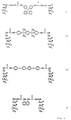
- Die für die Bildung der erfindungsgemäßen Bismaleinimidschichten geeigneten ionischen Vorläufer werden durch Umsetzung eines Reaktionsproduktes aus Maleinsäureanhydrid mit einem Diamin ausgewäht aus der Gruppe von Bis-(-p-Aminophenyl)-fluoren, Bisanilin P, 4,4'-Bis-(p-Aminophenoxy)-biphenyl sowie 1,8-Diaminonaphthalin mit einem langkettigen Amin mit 8 bis 30 C-Atomen, vorzugsweise mit Octadecylamin oder auch Dimethyldodecylamin erhalten.
- Derartig aufgebaute ionische Vorläufer sind die in Figur 1 wiedergebenen Verbindungen I bis IV.
- Die Herstellung dieser Substanzen erfolgt in der Weise, daß zuerst ein Bismaleinsäureamid synthetisiert wird. Hierzu werden Lösungen des Diamins und des Maleinsäureanhydrids unter Zugabe eines Katalysators, wie z.B. Tributylamin oder Diazabicyclooctan, bei Temperaturen zwischen Raumtemperatur und 80°C zur Reaktion gebracht. Geeignete Lösungsmittel sind beispielsweise N-Methylpyrrolidon, N,N-Dimethylpropylenharnstoff und Dimethylacetamid. Die so erhaltenen Bismaleinsäureanhydride werden anschließend mit dem langkettigen Amin mit 8 bis 30 C-Atomen, vorzugsweise mit Octadecylamin oder auch mit Dimethyldodecylamin, zum ionischen Vorläufer umgesetzt.
- Gemäß dem erfindungsgemäßen Verfahren wird nun zunächst eine Lösung des ionischen Vorläufers in einem organischen Lösungsmittel auf einer Wasseroberfläche ausgebreitet und nach dem Langmuir-Blodgett-Verfahren (LB-Verfahren, Polymer Surfaces and Interfaces, Hrsg. W.J. Feast u. H.S. Munro, 1987 John Wiley & Sons Ltd. , 163-187) eine Multischicht auf einem Substrat gebildet.
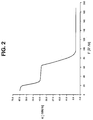
- Voraussetzung zur Herstellung definierter Multischichten nach dem LB-Verfahren ist das Vorliegen einer stabilen Monoschicht auf der Wasseroberfläche des Langmuir-Troges. Dieses Verhalten läßt sich mittels sog. Druck/Flächen (π/A)-Diagramme charakterisieren (Figur 2). Hierbei wird der Oberflächendruck π, der der Differenz der Oberflächenspannung zwischen filmfreier und filmbedeckter Oberfläche des Langmuir-Troges entspricht, über dem molekularen Flächenbedarf A aufgetragen, welcher hier der Fläche pro Wiederholungseinheit entspricht. Die jeweiligen Maßeinheiten sind mN/m bzw. Ų/Molekül. Ein steiler Anstieg im π/A-Diagramm bei abnehmender Fläche ist günstig für eine Übertragung auf feste Träger. Ferner muß der Oberflächenfilm bei einem zur Übertragung geeigneten Druck stabil sein, d.h. er darf nicht kollabieren. Üblicherweise wird ein Druck zur Übertragung der Schichten gewählt, der deutlich unter dem Kollapsdruck liegt, aber der einen über längere Zeit stabilen Oberflächenfilm im festanalogen Zustand gewährleisten. Weiter muß die optimale Ein- und Austauchgeschwindigkeit mit Hilfe des Filmliftes ermittelt werden. Sie beträgt im vorliegenden Fall 1 bis 50, vorzugsweise 3 bis 5 mm/min.
- Als zu beschichtende Substrate wurden vorwiegend Si-Wafer gewählt. Auch auf mit Gold, Aluminium oder Silber bedampfte Si-Wafer oder hydrophobisiertes Glas ist eine Multischichtübertragung möglich. Auf diese Träger ziehen die Schichten in der sogenannten Y-Konfiguration, d.h. Kopf an Kopf und Kette an Kette als Doppelschicht auf.
- Solcherart aufgebaute Multischichten aus den ionischen Vorläufern werden nun durch Imidisierung in die erfindungsgemäßen homogenen Bismaleinimidschichten überführt. Diese Imidisierung ist sowohl auf thermischem als auch auf chemischem Wege durchführbar. So findet bei Temperaturen zwischen 150 und 300°C der Ringschluß zum Imid unter Austritt von Wasser statt. Eine Imidisierung auf chemischem Wege geschieht durch Behandlung mit Wasser entziehenden Mitteln. Hierfür eignen sich insbesondere Acetanhydrid, Pyridin, Thionylchlorid und Oxalsäuredichlorid. Die Imidisierung läßt sich gut IR-spektroskopisch verfolgen. Außerdem ist eine Verringerung der Schichtdicken feststellbar.
- Mit dieser Imidisierung entstehen aus den LB-Multischichten des ionischen Vorläufers die homogenen Bismaleinimidschichten in einer Schichtdicke, welche sich in Abhängigkeit von der Anzahl der aufgezogenen Schichten des ionischen Vorläufers einstellen läßt. Figur 3 zeigt beispielhaft einen solchen Zusammenhang zwischen der Anzahl der Schichten (Z) und der Dicke d der Multischicht, wobei die Gerade 1) die Meßwerte für die Schichtdicke aus ionischem Vorläufer und der Gerade 2) diejenigen für die durch Imidisierung entstandene Bismaleinimidschicht wiedergibt.
- Generell gilt, daß mit Hilfe des erfindungsgemäßen Verfahrens Schichtdicken von weniger als 1 µm, insbesondere solche zwischen 0,3 bis 500 nm herstellen lassen.
- Die erfindungsgemäßen homogenen thermostabilen und ultradünnen Schichten lassen sich in besonders vorteilhafter Weise hinsichtlich ihrer dielektrischen Eigenschaften für Isolationszwecke heranziehen. Messungen der Kapazität derartiger dünner Schichten lassen sich mit einer Anordnung, wie schematisch in Figur 4 angezeigt, durchführen. Auf dem Si-Wafer A befindet sich als Basiselektrode eine Silberaufdampfschicht B. Darauf werden dann die LB-Schichten C in einer unterschiedlichen Schichtzahl Z1, Z2 und Z3 aufgebracht und durch eine Maske D Deckelektroden E aus Aluminium aufgedampft. Die Abhängigkeit der Kapazität, 1/C, in Farad⁻¹·10⁹ von der Schichtanzahl Z zeigt Figur 5. Die lineare Abhängigkeit von 1/C von der Schichtdicke belegt eine definierte und defekt freie Schichtübertragung.
Claims (3)
- Thermostabile homogene Bismaleinimidschichten mit einer Schichtdicke von kleiner 1 µm, erhalten durch Imidisierung von ionischen, durch Umsetzung eines Reaktionsprodukts aus einem Diamin und Maleinsäureanhydrid mit einem langkettigen Amin entstandenen Vorläufern.
- Verfahren zur Herstellung von thermostabilen homogenen Bismaleinimidschichten durch Aufbringen einer Multischicht eines ionischen Vorläufers, entstandenen durch Umsetzung eines Reaktionsprodukts aus einem Diamin und Maleinsäureanhydrid mit einem langkettigen Amin mittels der Langmuir-Blodgett-Technik auf ein Substrat, und Imidisieren dieses Vorläufers durch Erhitzen der Multischicht auf eine Temperatur zwischen 150 und 300°C.
- Verfahren zur Herstellung von thermostabilen homogenen Bismaleinimidschichten durch Aufbringen einer Multischicht eines ionischen Vorläufers, entstandenen durch Umsetzung eines Reaktionsprodukts aus einem Diamin und Maleinsäureanhydrid mit einem langkettigen Amin mittels der Langmuir-Blodgett-Technik auf ein Substrat, und Imidisieren dieses Vorläufers mittels wasserentziehender Mittel.
Applications Claiming Priority (2)
| Application Number | Priority Date | Filing Date | Title |
|---|---|---|---|
| DE4032004 | 1990-10-09 | ||
| DE19904032004 DE4032004A1 (de) | 1990-10-09 | 1990-10-09 | Ultraduenne thermoplastische bismaleinimidschichten sowie ein verfahren zu ihrer herstellung |
Publications (3)
| Publication Number | Publication Date |
|---|---|
| EP0480288A2 true EP0480288A2 (de) | 1992-04-15 |
| EP0480288A3 EP0480288A3 (en) | 1992-05-20 |
| EP0480288B1 EP0480288B1 (de) | 1994-07-27 |
Family
ID=6415934
Family Applications (1)
| Application Number | Title | Priority Date | Filing Date |
|---|---|---|---|
| EP19910116741 Expired - Lifetime EP0480288B1 (de) | 1990-10-09 | 1991-10-01 | Ultradünne thermostabile Bismaleinimidschichten sowie ein Verfahren zu ihrer Herstellung |
Country Status (8)
| Country | Link |
|---|---|
| US (1) | US5246784A (de) |
| EP (1) | EP0480288B1 (de) |
| JP (1) | JPH04290542A (de) |
| KR (1) | KR920008120A (de) |
| AT (1) | ATE109170T1 (de) |
| CA (1) | CA2052067A1 (de) |
| DE (2) | DE4032004A1 (de) |
| ES (1) | ES2057704T3 (de) |
Families Citing this family (8)
| Publication number | Priority date | Publication date | Assignee | Title |
|---|---|---|---|---|
| US6034194A (en) * | 1994-09-02 | 2000-03-07 | Quantum Materials/Dexter Corporation | Bismaleimide-divinyl adhesive compositions and uses therefor |
| US6852814B2 (en) | 1994-09-02 | 2005-02-08 | Henkel Corporation | Thermosetting resin compositions containing maleimide and/or vinyl compounds |
| US6960636B2 (en) | 1994-09-02 | 2005-11-01 | Henkel Corporation | Thermosetting resin compositions containing maleimide and/or vinyl compounds |
| US7645899B1 (en) | 1994-09-02 | 2010-01-12 | Henkel Corporation | Vinyl compounds |
| US20030055121A1 (en) * | 1996-09-10 | 2003-03-20 | Dershem Stephen M. | Thermosetting resin compositions containing maleimide and/or vinyl compounds |
| US11555576B2 (en) | 2014-12-24 | 2023-01-17 | Veltek Associates, Inc. | Stationary transfer platform and cleaning device for supply transport device |
| USD809730S1 (en) | 2015-12-22 | 2018-02-06 | Veltek Associates, Inc. | Cart |
| CN117186458B (zh) * | 2023-08-07 | 2024-08-13 | 深圳大学 | 双马来酰亚胺基热固性电介质薄膜及其制备方法、电容器 |
Family Cites Families (6)
| Publication number | Priority date | Publication date | Assignee | Title |
|---|---|---|---|---|
| ZA796150B (en) * | 1978-12-07 | 1980-10-29 | Ici Ltd | Chlorination process |
| JP2625689B2 (ja) * | 1985-11-18 | 1997-07-02 | 淑夫 今井 | 単分子又は単分子累積膜の製造方法 |
| EP0239980A3 (de) * | 1986-04-01 | 1990-04-11 | Kanegafuchi Kagaku Kogyo Kabushiki Kaisha | Elektrisches-elektronisches Bauelement mit einer dünnen Schicht aus Polyimid |
| CA1294731C (en) * | 1986-04-25 | 1992-01-21 | Masakazu Uekita | Copolymeric and amphiphilic polyimide precursor, process for preparing the same and thin film |
| CA1302675C (en) * | 1986-05-20 | 1992-06-09 | Masakazu Uekita | Thin film and device having the same |
| JPS633024A (ja) * | 1986-06-20 | 1988-01-08 | Kanegafuchi Chem Ind Co Ltd | イオン結合を含む高分子化合物 |
-
1990
- 1990-10-09 DE DE19904032004 patent/DE4032004A1/de not_active Withdrawn
-
1991
- 1991-09-23 CA CA 2052067 patent/CA2052067A1/en not_active Abandoned
- 1991-09-24 KR KR1019910016605A patent/KR920008120A/ko not_active Withdrawn
- 1991-09-30 JP JP3250787A patent/JPH04290542A/ja not_active Withdrawn
- 1991-10-01 AT AT91116741T patent/ATE109170T1/de not_active IP Right Cessation
- 1991-10-01 DE DE59102337T patent/DE59102337D1/de not_active Expired - Fee Related
- 1991-10-01 EP EP19910116741 patent/EP0480288B1/de not_active Expired - Lifetime
- 1991-10-01 US US07/769,439 patent/US5246784A/en not_active Expired - Fee Related
- 1991-10-01 ES ES91116741T patent/ES2057704T3/es not_active Expired - Lifetime
Also Published As
| Publication number | Publication date |
|---|---|
| EP0480288B1 (de) | 1994-07-27 |
| ES2057704T3 (es) | 1994-10-16 |
| KR920008120A (ko) | 1992-05-27 |
| CA2052067A1 (en) | 1992-04-10 |
| DE59102337D1 (de) | 1994-09-01 |
| DE4032004A1 (de) | 1992-04-16 |
| EP0480288A3 (en) | 1992-05-20 |
| US5246784A (en) | 1993-09-21 |
| ATE109170T1 (de) | 1994-08-15 |
| JPH04290542A (ja) | 1992-10-15 |
Similar Documents
| Publication | Publication Date | Title |
|---|---|---|
| EP0472990B1 (de) | Auf Trägern angebrachte ein oder mehrlagige Schichtelemente und ihre Herstellung | |
| DE69118119T2 (de) | Verstärkung der Polyimidadhäsion an reaktiven Metallen | |
| DE3750591T2 (de) | Anordnung mit Polymer-Dünnschicht. | |
| DE69305318T2 (de) | Verfahren zur Herstellung eines Siliziumoxid-Filmes | |
| EP0480288B1 (de) | Ultradünne thermostabile Bismaleinimidschichten sowie ein Verfahren zu ihrer Herstellung | |
| DE3639380C2 (de) | Monomolekularer Film oder aus monomolekularen Schichten aufgebauter Film und Verfahren zu dessen Herstellung | |
| DE19813669A1 (de) | Gebondeter Wafer sowie Verfahren zu seiner Herstellung | |
| DE3850147T2 (de) | Polyimid-Filme. | |
| DE3787500T2 (de) | Isolierharz-Zusammensetzung und Halbleitervorrichtung unter deren Verwendung. | |
| US4801420A (en) | Process for forming a film | |
| DE69211354T2 (de) | Polyimide mit niedrigem waermeausdehnungskoeffizienten und verbesserter dehnung | |
| DE3786628T2 (de) | Hoch molekulare, amphiphile, photoempfindliche Photopolymere und Herstellungsverfahren. | |
| DE69320498T2 (de) | Verfahren zur Herstellung von Dünnfilm-Leiterplatten | |
| EP0596149B1 (de) | Lösungen von polyimidbildenden Ausgangsstoffen | |
| EP0362689B1 (de) | Polyharnstoff und Film aus mindestens einer monomolekularen Schicht eines Polyharnstoffs | |
| DE10136382A1 (de) | Phenylverknüpfte Oxazolcyanurate als Dielektrikum mit guten Klebe-und Fülleigenschaften | |
| EP0354432B1 (de) | Beschichtete Träger mit ultradünner, ein- oder mehrlagiger Beschichtung, Verfahren zu ihrer Herstellung und Polyurethane als Zwischenprodukte für die beschichteten Träger | |
| EP0489825A1 (de) | Verfahren zur herstellung eines feuchtesensors | |
| GB1582860A (en) | Device | |
| DE3700301C2 (de) | Verfahren zur Herstellung einer Vielschicht-Verdrahtungsstruktur | |
| KR102290101B1 (ko) | 단분자 나노 박막의 제조 방법 | |
| EP0359016A2 (de) | Beschichtete Träger mit ultradünner, mehrlagiger Beschichtung und Verfahren zu ihrer Herstellung | |
| US4988570A (en) | Process for forming a film | |
| JP2550786B2 (ja) | 液晶配向膜の作製方法 | |
| CN1089280C (zh) | 金属色谱柱管内壁活性中心的脱除方法 |
Legal Events
| Date | Code | Title | Description |
|---|---|---|---|
| PUAI | Public reference made under article 153(3) epc to a published international application that has entered the european phase |
Free format text: ORIGINAL CODE: 0009012 |
|
| PUAL | Search report despatched |
Free format text: ORIGINAL CODE: 0009013 |
|
| AK | Designated contracting states |
Kind code of ref document: A2 Designated state(s): AT BE DE ES FR GB IT NL SE |
|
| AK | Designated contracting states |
Kind code of ref document: A3 Designated state(s): AT BE DE ES FR GB IT NL SE |
|
| 17P | Request for examination filed |
Effective date: 19920520 |
|
| 17Q | First examination report despatched |
Effective date: 19930910 |
|
| 17Q | First examination report despatched |
Effective date: 19931217 |
|
| GRAA | (expected) grant |
Free format text: ORIGINAL CODE: 0009210 |
|
| AK | Designated contracting states |
Kind code of ref document: B1 Designated state(s): AT BE DE ES FR GB IT NL SE |
|
| REF | Corresponds to: |
Ref document number: 109170 Country of ref document: AT Date of ref document: 19940815 Kind code of ref document: T |
|
| REF | Corresponds to: |
Ref document number: 59102337 Country of ref document: DE Date of ref document: 19940901 |
|
| GBT | Gb: translation of ep patent filed (gb section 77(6)(a)/1977) |
Effective date: 19940808 |
|
| ITF | It: translation for a ep patent filed | ||
| REG | Reference to a national code |
Ref country code: ES Ref legal event code: FG2A Ref document number: 2057704 Country of ref document: ES Kind code of ref document: T3 |
|
| ET | Fr: translation filed | ||
| EAL | Se: european patent in force in sweden |
Ref document number: 91116741.9 |
|
| PLBE | No opposition filed within time limit |
Free format text: ORIGINAL CODE: 0009261 |
|
| STAA | Information on the status of an ep patent application or granted ep patent |
Free format text: STATUS: NO OPPOSITION FILED WITHIN TIME LIMIT |
|
| 26N | No opposition filed | ||
| PGFP | Annual fee paid to national office [announced via postgrant information from national office to epo] |
Ref country code: SE Payment date: 19950918 Year of fee payment: 5 Ref country code: FR Payment date: 19950918 Year of fee payment: 5 Ref country code: AT Payment date: 19950918 Year of fee payment: 5 |
|
| PGFP | Annual fee paid to national office [announced via postgrant information from national office to epo] |
Ref country code: NL Payment date: 19950920 Year of fee payment: 5 |
|
| PGFP | Annual fee paid to national office [announced via postgrant information from national office to epo] |
Ref country code: GB Payment date: 19951002 Year of fee payment: 5 |
|
| PGFP | Annual fee paid to national office [announced via postgrant information from national office to epo] |
Ref country code: BE Payment date: 19951006 Year of fee payment: 5 |
|
| PGFP | Annual fee paid to national office [announced via postgrant information from national office to epo] |
Ref country code: ES Payment date: 19951011 Year of fee payment: 5 |
|
| PGFP | Annual fee paid to national office [announced via postgrant information from national office to epo] |
Ref country code: DE Payment date: 19951024 Year of fee payment: 5 |
|
| PG25 | Lapsed in a contracting state [announced via postgrant information from national office to epo] |
Ref country code: GB Effective date: 19961001 Ref country code: AT Effective date: 19961001 |
|
| PG25 | Lapsed in a contracting state [announced via postgrant information from national office to epo] |
Ref country code: SE Effective date: 19961002 Ref country code: ES Free format text: LAPSE BECAUSE OF THE APPLICANT RENOUNCES Effective date: 19961002 |
|
| PG25 | Lapsed in a contracting state [announced via postgrant information from national office to epo] |
Ref country code: BE Effective date: 19961031 |
|
| BERE | Be: lapsed |
Owner name: BASF A.G. Effective date: 19961031 |
|
| PG25 | Lapsed in a contracting state [announced via postgrant information from national office to epo] |
Ref country code: NL Effective date: 19970501 |
|
| GBPC | Gb: european patent ceased through non-payment of renewal fee |
Effective date: 19961001 |
|
| PG25 | Lapsed in a contracting state [announced via postgrant information from national office to epo] |
Ref country code: FR Effective date: 19970630 |
|
| NLV4 | Nl: lapsed or anulled due to non-payment of the annual fee |
Effective date: 19970501 |
|
| PG25 | Lapsed in a contracting state [announced via postgrant information from national office to epo] |
Ref country code: DE Effective date: 19970701 |
|
| EUG | Se: european patent has lapsed |
Ref document number: 91116741.9 |
|
| REG | Reference to a national code |
Ref country code: FR Ref legal event code: ST |
|
| REG | Reference to a national code |
Ref country code: ES Ref legal event code: FD2A Effective date: 19991007 |
|
| PG25 | Lapsed in a contracting state [announced via postgrant information from national office to epo] |
Ref country code: IT Free format text: LAPSE BECAUSE OF NON-PAYMENT OF DUE FEES;WARNING: LAPSES OF ITALIAN PATENTS WITH EFFECTIVE DATE BEFORE 2007 MAY HAVE OCCURRED AT ANY TIME BEFORE 2007. THE CORRECT EFFECTIVE DATE MAY BE DIFFERENT FROM THE ONE RECORDED. Effective date: 20051001 |