EP0480724A1 - Renforcement de non-tissés déposés par jet d'air - Google Patents
Renforcement de non-tissés déposés par jet d'air Download PDFInfo
- Publication number
- EP0480724A1 EP0480724A1 EP19910309320 EP91309320A EP0480724A1 EP 0480724 A1 EP0480724 A1 EP 0480724A1 EP 19910309320 EP19910309320 EP 19910309320 EP 91309320 A EP91309320 A EP 91309320A EP 0480724 A1 EP0480724 A1 EP 0480724A1
- Authority
- EP
- European Patent Office
- Prior art keywords
- wetlaid
- airlaid
- layers
- layer
- composite
- Prior art date
- Legal status (The legal status is an assumption and is not a legal conclusion. Google has not performed a legal analysis and makes no representation as to the accuracy of the status listed.)
- Ceased
Links
- 230000002787 reinforcement Effects 0.000 title description 2
- 239000004745 nonwoven fabric Substances 0.000 title 1
- 239000000835 fiber Substances 0.000 claims abstract description 122
- 239000002131 composite material Substances 0.000 claims abstract description 68
- 239000000853 adhesive Substances 0.000 claims abstract description 24
- 230000001070 adhesive effect Effects 0.000 claims abstract description 24
- 230000004927 fusion Effects 0.000 claims abstract description 6
- 238000000034 method Methods 0.000 claims description 30
- -1 polyethylene Polymers 0.000 claims description 19
- 239000011230 binding agent Substances 0.000 claims description 18
- 238000004049 embossing Methods 0.000 claims description 13
- 238000002844 melting Methods 0.000 claims description 13
- 230000008018 melting Effects 0.000 claims description 13
- 229920000728 polyester Polymers 0.000 claims description 12
- 229920001131 Pulp (paper) Polymers 0.000 claims description 11
- 239000004698 Polyethylene Substances 0.000 claims description 8
- 229920000573 polyethylene Polymers 0.000 claims description 8
- 238000004519 manufacturing process Methods 0.000 claims description 7
- 239000004743 Polypropylene Substances 0.000 claims description 6
- 229920001155 polypropylene Polymers 0.000 claims description 6
- 238000000151 deposition Methods 0.000 claims description 4
- 238000010438 heat treatment Methods 0.000 claims description 3
- 239000004816 latex Substances 0.000 description 19
- 229920000126 latex Polymers 0.000 description 19
- 239000000047 product Substances 0.000 description 13
- 230000003014 reinforcing effect Effects 0.000 description 12
- 229920001169 thermoplastic Polymers 0.000 description 8
- 239000004416 thermosoftening plastic Substances 0.000 description 8
- 239000000463 material Substances 0.000 description 7
- 229920005989 resin Polymers 0.000 description 6
- 239000011347 resin Substances 0.000 description 6
- 238000001035 drying Methods 0.000 description 5
- 239000000839 emulsion Substances 0.000 description 4
- 238000003475 lamination Methods 0.000 description 4
- 229920000139 polyethylene terephthalate Polymers 0.000 description 4
- 239000005020 polyethylene terephthalate Substances 0.000 description 4
- 229920002994 synthetic fiber Polymers 0.000 description 4
- 238000005299 abrasion Methods 0.000 description 3
- 230000000704 physical effect Effects 0.000 description 3
- 230000000452 restraining effect Effects 0.000 description 3
- 239000007787 solid Substances 0.000 description 3
- QTBSBXVTEAMEQO-UHFFFAOYSA-M Acetate Chemical compound CC([O-])=O QTBSBXVTEAMEQO-UHFFFAOYSA-M 0.000 description 2
- ACOGMWBDRJJKNB-UHFFFAOYSA-N acetic acid;ethene Chemical group C=C.CC(O)=O ACOGMWBDRJJKNB-UHFFFAOYSA-N 0.000 description 2
- 230000015572 biosynthetic process Effects 0.000 description 2
- 229920001577 copolymer Polymers 0.000 description 2
- MTHSVFCYNBDYFN-UHFFFAOYSA-N diethylene glycol Chemical compound OCCOCCO MTHSVFCYNBDYFN-UHFFFAOYSA-N 0.000 description 2
- 230000000694 effects Effects 0.000 description 2
- 229920001971 elastomer Polymers 0.000 description 2
- HYBBIBNJHNGZAN-UHFFFAOYSA-N furfural Chemical compound O=CC1=CC=CO1 HYBBIBNJHNGZAN-UHFFFAOYSA-N 0.000 description 2
- 230000035515 penetration Effects 0.000 description 2
- 229920000642 polymer Polymers 0.000 description 2
- 229920000098 polyolefin Polymers 0.000 description 2
- 229920002689 polyvinyl acetate Polymers 0.000 description 2
- 239000011118 polyvinyl acetate Substances 0.000 description 2
- 239000004800 polyvinyl chloride Substances 0.000 description 2
- 229920000915 polyvinyl chloride Polymers 0.000 description 2
- 239000005060 rubber Substances 0.000 description 2
- 238000003860 storage Methods 0.000 description 2
- 229920001059 synthetic polymer Polymers 0.000 description 2
- 229920001187 thermosetting polymer Polymers 0.000 description 2
- XLYOFNOQVPJJNP-UHFFFAOYSA-N water Substances O XLYOFNOQVPJJNP-UHFFFAOYSA-N 0.000 description 2
- 235000007173 Abies balsamea Nutrition 0.000 description 1
- NIXOWILDQLNWCW-UHFFFAOYSA-M Acrylate Chemical compound [O-]C(=O)C=C NIXOWILDQLNWCW-UHFFFAOYSA-M 0.000 description 1
- 229920000178 Acrylic resin Polymers 0.000 description 1
- 239000004925 Acrylic resin Substances 0.000 description 1
- 241000218645 Cedrus Species 0.000 description 1
- 229920001875 Ebonite Polymers 0.000 description 1
- 239000001856 Ethyl cellulose Substances 0.000 description 1
- ZZSNKZQZMQGXPY-UHFFFAOYSA-N Ethyl cellulose Chemical compound CCOCC1OC(OC)C(OCC)C(OCC)C1OC1C(O)C(O)C(OC)C(CO)O1 ZZSNKZQZMQGXPY-UHFFFAOYSA-N 0.000 description 1
- 229920002633 Kraton (polymer) Polymers 0.000 description 1
- 229920000877 Melamine resin Polymers 0.000 description 1
- 229910002651 NO3 Inorganic materials 0.000 description 1
- NHNBFGGVMKEFGY-UHFFFAOYSA-N Nitrate Chemical compound [O-][N+]([O-])=O NHNBFGGVMKEFGY-UHFFFAOYSA-N 0.000 description 1
- 239000004677 Nylon Substances 0.000 description 1
- ISWSIDIOOBJBQZ-UHFFFAOYSA-N Phenol Chemical compound OC1=CC=CC=C1 ISWSIDIOOBJBQZ-UHFFFAOYSA-N 0.000 description 1
- 241000218657 Picea Species 0.000 description 1
- 235000005018 Pinus echinata Nutrition 0.000 description 1
- 241001236219 Pinus echinata Species 0.000 description 1
- 235000017339 Pinus palustris Nutrition 0.000 description 1
- 229920002319 Poly(methyl acrylate) Polymers 0.000 description 1
- 239000004952 Polyamide Substances 0.000 description 1
- 239000004793 Polystyrene Substances 0.000 description 1
- 239000004372 Polyvinyl alcohol Substances 0.000 description 1
- 229920001328 Polyvinylidene chloride Polymers 0.000 description 1
- 229910000831 Steel Inorganic materials 0.000 description 1
- 241000218685 Tsuga Species 0.000 description 1
- 229920001807 Urea-formaldehyde Polymers 0.000 description 1
- UGZICOVULPINFH-UHFFFAOYSA-N acetic acid;butanoic acid Chemical compound CC(O)=O.CCCC(O)=O UGZICOVULPINFH-UHFFFAOYSA-N 0.000 description 1
- 230000002411 adverse Effects 0.000 description 1
- NTXGQCSETZTARF-UHFFFAOYSA-N buta-1,3-diene;prop-2-enenitrile Chemical compound C=CC=C.C=CC#N NTXGQCSETZTARF-UHFFFAOYSA-N 0.000 description 1
- MTAZNLWOLGHBHU-UHFFFAOYSA-N butadiene-styrene rubber Chemical compound C=CC=C.C=CC1=CC=CC=C1 MTAZNLWOLGHBHU-UHFFFAOYSA-N 0.000 description 1
- 125000004432 carbon atom Chemical group C* 0.000 description 1
- 238000001816 cooling Methods 0.000 description 1
- 238000005516 engineering process Methods 0.000 description 1
- 229920001249 ethyl cellulose Polymers 0.000 description 1
- 235000019325 ethyl cellulose Nutrition 0.000 description 1
- 229920006242 ethylene acrylic acid copolymer Polymers 0.000 description 1
- 239000004744 fabric Substances 0.000 description 1
- 210000003746 feather Anatomy 0.000 description 1
- 239000012467 final product Substances 0.000 description 1
- 238000005187 foaming Methods 0.000 description 1
- IVJISJACKSSFGE-UHFFFAOYSA-N formaldehyde;1,3,5-triazine-2,4,6-triamine Chemical compound O=C.NC1=NC(N)=NC(N)=N1 IVJISJACKSSFGE-UHFFFAOYSA-N 0.000 description 1
- SLGWESQGEUXWJQ-UHFFFAOYSA-N formaldehyde;phenol Chemical compound O=C.OC1=CC=CC=C1 SLGWESQGEUXWJQ-UHFFFAOYSA-N 0.000 description 1
- 229920001519 homopolymer Polymers 0.000 description 1
- 238000005304 joining Methods 0.000 description 1
- 230000005012 migration Effects 0.000 description 1
- 238000013508 migration Methods 0.000 description 1
- 239000000203 mixture Substances 0.000 description 1
- 238000012986 modification Methods 0.000 description 1
- 230000004048 modification Effects 0.000 description 1
- 229920001778 nylon Polymers 0.000 description 1
- 229920001568 phenolic resin Polymers 0.000 description 1
- 229920001200 poly(ethylene-vinyl acetate) Polymers 0.000 description 1
- 229920003229 poly(methyl methacrylate) Polymers 0.000 description 1
- 229920002037 poly(vinyl butyral) polymer Polymers 0.000 description 1
- 229920000058 polyacrylate Polymers 0.000 description 1
- 229920002647 polyamide Polymers 0.000 description 1
- 229920001748 polybutylene Polymers 0.000 description 1
- 239000004926 polymethyl methacrylate Substances 0.000 description 1
- ODGAOXROABLFNM-UHFFFAOYSA-N polynoxylin Chemical compound O=C.NC(N)=O ODGAOXROABLFNM-UHFFFAOYSA-N 0.000 description 1
- 229920002223 polystyrene Polymers 0.000 description 1
- 229920001343 polytetrafluoroethylene Polymers 0.000 description 1
- 239000004810 polytetrafluoroethylene Substances 0.000 description 1
- 229920002635 polyurethane Polymers 0.000 description 1
- 239000004814 polyurethane Substances 0.000 description 1
- 229920002451 polyvinyl alcohol Polymers 0.000 description 1
- 239000005033 polyvinylidene chloride Substances 0.000 description 1
- 239000012779 reinforcing material Substances 0.000 description 1
- 238000009877 rendering Methods 0.000 description 1
- 229920002379 silicone rubber Polymers 0.000 description 1
- 239000004945 silicone rubber Substances 0.000 description 1
- 238000005507 spraying Methods 0.000 description 1
- 239000010959 steel Substances 0.000 description 1
- 229920003048 styrene butadiene rubber Polymers 0.000 description 1
- KKEYFWRCBNTPAC-UHFFFAOYSA-L terephthalate(2-) Chemical compound [O-]C(=O)C1=CC=C(C([O-])=O)C=C1 KKEYFWRCBNTPAC-UHFFFAOYSA-L 0.000 description 1
Images

Classifications
-
- B—PERFORMING OPERATIONS; TRANSPORTING
- B32—LAYERED PRODUCTS
- B32B—LAYERED PRODUCTS, i.e. PRODUCTS BUILT-UP OF STRATA OF FLAT OR NON-FLAT, e.g. CELLULAR OR HONEYCOMB, FORM
- B32B5/00—Layered products characterised by the non- homogeneity or physical structure, i.e. comprising a fibrous, filamentary, particulate or foam layer; Layered products characterised by having a layer differing constitutionally or physically in different parts
- B32B5/22—Layered products characterised by the non- homogeneity or physical structure, i.e. comprising a fibrous, filamentary, particulate or foam layer; Layered products characterised by having a layer differing constitutionally or physically in different parts characterised by the presence of two or more layers which are next to each other and are fibrous, filamentary, formed of particles or foamed
- B32B5/24—Layered products characterised by the non- homogeneity or physical structure, i.e. comprising a fibrous, filamentary, particulate or foam layer; Layered products characterised by having a layer differing constitutionally or physically in different parts characterised by the presence of two or more layers which are next to each other and are fibrous, filamentary, formed of particles or foamed one layer being a fibrous or filamentary layer
- B32B5/26—Layered products characterised by the non- homogeneity or physical structure, i.e. comprising a fibrous, filamentary, particulate or foam layer; Layered products characterised by having a layer differing constitutionally or physically in different parts characterised by the presence of two or more layers which are next to each other and are fibrous, filamentary, formed of particles or foamed one layer being a fibrous or filamentary layer another layer next to it also being fibrous or filamentary
-
- B—PERFORMING OPERATIONS; TRANSPORTING
- B32—LAYERED PRODUCTS
- B32B—LAYERED PRODUCTS, i.e. PRODUCTS BUILT-UP OF STRATA OF FLAT OR NON-FLAT, e.g. CELLULAR OR HONEYCOMB, FORM
- B32B5/00—Layered products characterised by the non- homogeneity or physical structure, i.e. comprising a fibrous, filamentary, particulate or foam layer; Layered products characterised by having a layer differing constitutionally or physically in different parts
- B32B5/02—Layered products characterised by the non- homogeneity or physical structure, i.e. comprising a fibrous, filamentary, particulate or foam layer; Layered products characterised by having a layer differing constitutionally or physically in different parts characterised by structural features of a fibrous or filamentary layer
- B32B5/12—Layered products characterised by the non- homogeneity or physical structure, i.e. comprising a fibrous, filamentary, particulate or foam layer; Layered products characterised by having a layer differing constitutionally or physically in different parts characterised by structural features of a fibrous or filamentary layer characterised by the relative arrangement of fibres or filaments of different layers, e.g. the fibres or filaments being parallel or perpendicular to each other
-
- B—PERFORMING OPERATIONS; TRANSPORTING
- B32—LAYERED PRODUCTS
- B32B—LAYERED PRODUCTS, i.e. PRODUCTS BUILT-UP OF STRATA OF FLAT OR NON-FLAT, e.g. CELLULAR OR HONEYCOMB, FORM
- B32B38/00—Ancillary operations in connection with laminating processes
- B32B38/06—Embossing
-
- B—PERFORMING OPERATIONS; TRANSPORTING
- B32—LAYERED PRODUCTS
- B32B—LAYERED PRODUCTS, i.e. PRODUCTS BUILT-UP OF STRATA OF FLAT OR NON-FLAT, e.g. CELLULAR OR HONEYCOMB, FORM
- B32B5/00—Layered products characterised by the non- homogeneity or physical structure, i.e. comprising a fibrous, filamentary, particulate or foam layer; Layered products characterised by having a layer differing constitutionally or physically in different parts
- B32B5/02—Layered products characterised by the non- homogeneity or physical structure, i.e. comprising a fibrous, filamentary, particulate or foam layer; Layered products characterised by having a layer differing constitutionally or physically in different parts characterised by structural features of a fibrous or filamentary layer
- B32B5/022—Non-woven fabric
-
- B—PERFORMING OPERATIONS; TRANSPORTING
- B32—LAYERED PRODUCTS
- B32B—LAYERED PRODUCTS, i.e. PRODUCTS BUILT-UP OF STRATA OF FLAT OR NON-FLAT, e.g. CELLULAR OR HONEYCOMB, FORM
- B32B7/00—Layered products characterised by the relation between layers; Layered products characterised by the relative orientation of features between layers, or by the relative values of a measurable parameter between layers, i.e. products comprising layers having different physical, chemical or physicochemical properties; Layered products characterised by the interconnection of layers
- B32B7/04—Interconnection of layers
- B32B7/12—Interconnection of layers using interposed adhesives or interposed materials with bonding properties
-
- D—TEXTILES; PAPER
- D04—BRAIDING; LACE-MAKING; KNITTING; TRIMMINGS; NON-WOVEN FABRICS
- D04H—MAKING TEXTILE FABRICS, e.g. FROM FIBRES OR FILAMENTARY MATERIAL; FABRICS MADE BY SUCH PROCESSES OR APPARATUS, e.g. FELTS, NON-WOVEN FABRICS; COTTON-WOOL; WADDING ; NON-WOVEN FABRICS FROM STAPLE FIBRES, FILAMENTS OR YARNS, BONDED WITH AT LEAST ONE WEB-LIKE MATERIAL DURING THEIR CONSOLIDATION
- D04H1/00—Non-woven fabrics formed wholly or mainly of staple fibres or like relatively short fibres
- D04H1/40—Non-woven fabrics formed wholly or mainly of staple fibres or like relatively short fibres from fleeces or layers composed of fibres without existing or potential cohesive properties
- D04H1/54—Non-woven fabrics formed wholly or mainly of staple fibres or like relatively short fibres from fleeces or layers composed of fibres without existing or potential cohesive properties by welding together the fibres, e.g. by partially melting or dissolving
- D04H1/559—Non-woven fabrics formed wholly or mainly of staple fibres or like relatively short fibres from fleeces or layers composed of fibres without existing or potential cohesive properties by welding together the fibres, e.g. by partially melting or dissolving the fibres being within layered webs
-
- D—TEXTILES; PAPER
- D04—BRAIDING; LACE-MAKING; KNITTING; TRIMMINGS; NON-WOVEN FABRICS
- D04H—MAKING TEXTILE FABRICS, e.g. FROM FIBRES OR FILAMENTARY MATERIAL; FABRICS MADE BY SUCH PROCESSES OR APPARATUS, e.g. FELTS, NON-WOVEN FABRICS; COTTON-WOOL; WADDING ; NON-WOVEN FABRICS FROM STAPLE FIBRES, FILAMENTS OR YARNS, BONDED WITH AT LEAST ONE WEB-LIKE MATERIAL DURING THEIR CONSOLIDATION
- D04H1/00—Non-woven fabrics formed wholly or mainly of staple fibres or like relatively short fibres
- D04H1/70—Non-woven fabrics formed wholly or mainly of staple fibres or like relatively short fibres characterised by the method of forming fleeces or layers, e.g. reorientation of fibres
- D04H1/72—Non-woven fabrics formed wholly or mainly of staple fibres or like relatively short fibres characterised by the method of forming fleeces or layers, e.g. reorientation of fibres the fibres being randomly arranged
- D04H1/732—Non-woven fabrics formed wholly or mainly of staple fibres or like relatively short fibres characterised by the method of forming fleeces or layers, e.g. reorientation of fibres the fibres being randomly arranged by fluid current, e.g. air-lay
-
- D—TEXTILES; PAPER
- D21—PAPER-MAKING; PRODUCTION OF CELLULOSE
- D21H—PULP COMPOSITIONS; PREPARATION THEREOF NOT COVERED BY SUBCLASSES D21C OR D21D; IMPREGNATING OR COATING OF PAPER; TREATMENT OF FINISHED PAPER NOT COVERED BY CLASS B31 OR SUBCLASS D21G; PAPER NOT OTHERWISE PROVIDED FOR
- D21H15/00—Pulp or paper, comprising fibres or web-forming material characterised by features other than their chemical constitution
- D21H15/02—Pulp or paper, comprising fibres or web-forming material characterised by features other than their chemical constitution characterised by configuration
- D21H15/10—Composite fibres
-
- B—PERFORMING OPERATIONS; TRANSPORTING
- B32—LAYERED PRODUCTS
- B32B—LAYERED PRODUCTS, i.e. PRODUCTS BUILT-UP OF STRATA OF FLAT OR NON-FLAT, e.g. CELLULAR OR HONEYCOMB, FORM
- B32B2262/00—Composition or structural features of fibres which form a fibrous or filamentary layer or are present as additives
- B32B2262/06—Vegetal fibres
- B32B2262/062—Cellulose fibres, e.g. cotton
-
- Y—GENERAL TAGGING OF NEW TECHNOLOGICAL DEVELOPMENTS; GENERAL TAGGING OF CROSS-SECTIONAL TECHNOLOGIES SPANNING OVER SEVERAL SECTIONS OF THE IPC; TECHNICAL SUBJECTS COVERED BY FORMER USPC CROSS-REFERENCE ART COLLECTIONS [XRACs] AND DIGESTS
- Y10—TECHNICAL SUBJECTS COVERED BY FORMER USPC
- Y10T—TECHNICAL SUBJECTS COVERED BY FORMER US CLASSIFICATION
- Y10T428/00—Stock material or miscellaneous articles
- Y10T428/29—Coated or structually defined flake, particle, cell, strand, strand portion, rod, filament, macroscopic fiber or mass thereof
- Y10T428/2913—Rod, strand, filament or fiber
- Y10T428/2929—Bicomponent, conjugate, composite or collateral fibers or filaments [i.e., coextruded sheath-core or side-by-side type]
-
- Y—GENERAL TAGGING OF NEW TECHNOLOGICAL DEVELOPMENTS; GENERAL TAGGING OF CROSS-SECTIONAL TECHNOLOGIES SPANNING OVER SEVERAL SECTIONS OF THE IPC; TECHNICAL SUBJECTS COVERED BY FORMER USPC CROSS-REFERENCE ART COLLECTIONS [XRACs] AND DIGESTS
- Y10—TECHNICAL SUBJECTS COVERED BY FORMER USPC
- Y10T—TECHNICAL SUBJECTS COVERED BY FORMER US CLASSIFICATION
- Y10T442/00—Fabric [woven, knitted, or nonwoven textile or cloth, etc.]
- Y10T442/60—Nonwoven fabric [i.e., nonwoven strand or fiber material]
- Y10T442/637—Including strand or fiber material which is a monofilament composed of two or more polymeric materials in physically distinct relationship [e.g., sheath-core, side-by-side, islands-in-sea, fibrils-in-matrix, etc.] or composed of physical blend of chemically different polymeric materials or a physical blend of a polymeric material and a filler material
- Y10T442/641—Sheath-core multicomponent strand or fiber material
-
- Y—GENERAL TAGGING OF NEW TECHNOLOGICAL DEVELOPMENTS; GENERAL TAGGING OF CROSS-SECTIONAL TECHNOLOGIES SPANNING OVER SEVERAL SECTIONS OF THE IPC; TECHNICAL SUBJECTS COVERED BY FORMER USPC CROSS-REFERENCE ART COLLECTIONS [XRACs] AND DIGESTS
- Y10—TECHNICAL SUBJECTS COVERED BY FORMER USPC
- Y10T—TECHNICAL SUBJECTS COVERED BY FORMER US CLASSIFICATION
- Y10T442/00—Fabric [woven, knitted, or nonwoven textile or cloth, etc.]
- Y10T442/60—Nonwoven fabric [i.e., nonwoven strand or fiber material]
- Y10T442/659—Including an additional nonwoven fabric
- Y10T442/664—Including a wood fiber containing layer
Definitions
- the present invention relates to reinforced cloth-like composite laminates of cellulosic fibers.
- Airlaid technology is used to form a variety of cellulosic paper products. It is usually desirable that cellulosic composite laminates exhibit a number of qualities such as a cloth-like appearance, excellent wet and dry strength, exceptional porosity, very good abrasion resistance and wash durability, bulk and water holding capacity, and a lack of a paper rattle. Cellulosic composite laminates that possess these qualities can be used to make towels or tissues that are valuable assets in the performance of a variety of tasks. For example, such a towel or tissue can be used by doctors or nurses as a highly effective and strong hand towel or tissue in both a hospital and an office.
- the wet and dry strength, elongation and breaking strength of the resulting composite laminate be stronger than the sum of the individual layers making up the composite laminate.
- Such a composite laminate would be very durable and effective in a number of applications.
- the reinforcing layer is a scrim that is coated with a thermoplastic binder onto which the cellulosic fiber layers are provided, wherein the scrim and two cellulosic layers are passed through a station to heat the laminate to a temperature sufficient to activate the thermoplastic binder.
- the present invention provides a cloth-like composite laminate with a superior balance of properties, such as strength, bulk, cloth-like appearance, abrasion resistance, wash durability, better wiping performance and porosity.
- Another feature of the present invention is the provision of a flat and smooth cloth-like composite laminate and method for its manufacture.
- the present invention provides a flat, cloth-like, multi-layered composite laminate structure comprising a wetlaid, nonwoven bicomponent fiber web layer and two nonwoven airlaid pulp web layers provided on opposite sides of the bicomponent layer.
- the layers of the laminate are bonded together by fusion bonding of fibers of the wetlaid layer to fibers of the airlaid layers.
- the fusion bonding is effected by heating the layered structure to soften the bicomponent fibers, and thereby bond the layers together.
- the assembly is preferably hot embossed.
- One or both of the airlaid webs may be treated with binder.
- the bonding may be enhanced if desired by additionally employing adhesive, e.g. latex.
- the adhesive may be applied between the wetlaid layer and one or both of the airlaid layers. For example, it may be applied to one or both faces of the wetlaid layers and/or to the face of one or each of the airlaid layers which is intended to contact a face of the wetlaid layer.
- the laminate can be bonded by a combination of prebonding the bicomponent nonwoven web, providing a latex as an adhesive between the bicomponent layer and the airlaid pulp web layers, and hot embossing the laminate by a pattern of point bonds.
- the flat cloth-like composite laminate is obtained by a method comprising the steps of forming the wetlaid nonwoven bicomponent fiber web layer by passing the bicomponent layer over a dryer, for example a Yankee Dryer of a low-speed paper machine, whereby the bicomponent fibers can be thermally bonded to one another, introducing the wetlaid bicomponent layer between two nonwoven layers of airlaid pulp web to form a three component, layered structure, and embossing the layered structure under conditions which cause softening of the bicomponent fiber thereby causing the airlaid pulp web layers to adhere to the bicomponent fiber layer to form said composite laminate.
- a dryer for example a Yankee Dryer of a low-speed paper machine
- the two nonwoven layers, between which the bicomponent fiber layer is inserted, can be made by forming two separate layers of three-dimensional cellulosic fibers, applying binder to each layer and drying the binder to form two separate nonwoven layers of cellulosic fibers.
- the cloth-like composite laminate of the present invention may also be formed with the use of adhesives on one or more layers of the airlaid pulp web layer or the combined use of adhesives and embossing.
- the resultant laminate of the present invention exhibits an increased strength due to the thermal bonding of the fibers in the bicomponent web and the fusion bonding of the bicomponent nonwoven web to the airlaid pulp fibers e.g. in a hot embossed pattern.
- the prebonding of the bicomponent nonwoven web permits the airlaid pulp fiber webs to be adhered thereto with a much reduced quantity of latex adhesive, thus making a softer and better wiping product while at the same time producing a more economical product.
- the use of the low-cost bicomponent fiber nonwoven web provides a reinforcement layer which is not water sensitive and eliminates the problem of puckering in the finished product.
- the cellulosic composite laminates of the present invention exhibit high wet and dry strength properties and exceptional porosity. Towels or tissues made from the composite laminates have a cloth-like appearance and possess excellent abrasion resistance and wash durability. The towels or tissues also lack the noisy paper rattle that is commonly associated with most cellulosic products.
- intimate intermingling can be achieved between the bicomponent fibers of the wetlaid layer and the cellulosic fibers of the airlaid pulp layers whereby the cellulosic fibers become entangled within the holes of the bicomponent web layer to enhance the bond between said layer and the airlaid pulp webs disposed on both sides thereof.
- the method of the present invention can be performed by various apparatus known in the art, such as the apparatus of U.S. Patent No. 4,292,271 to Buob et al.
- a flat- cloth-like composite laminate can be manufactured by depositing a first airlaid pulp web onto a wire conveyor belt to form a nonwoven layer, introducing a wetlaid bicomponent fiber, nonwoven web layer onto the airlaid pulp layer, depositing a second airlaid pulp web onto the wetlaid bicomponent fiber, nonwoven web layer to form a three component layered structure, and hot embossing said layered structure, whereby the softening of the bicomponent fiber causes the airlaid pulp web layers to adhere to the bicomponent fiber nonwoven web layer to form the composite laminate.
- the wetlaid bicomponent fiber, nonwoven layer is prebonded, e.g.
- the nonwoven web by passing the nonwoven web through a Yankee Dryer of a low speed paper machine.
- the resultant laminate exhibits increased strength due to the thermal bonding of the fibers in the bicomponent web and the bonding of the nonwoven web to the pulp fibers by way of the hot embossing pattern.
- an adhesive can be applied to the airlaid pulp layer or to the biocomponent layer during the formation of the composite structure. Prebonding the nonwoven web permits the airlaid pulp fiber web to be adhered thereto with a much reduced quantity of latex, thus making a softer and better wiping product.
- an air laying station 10 is utilized to deposit a cellulosic fiber layer 11 onto a conveyor belt 12.
- a wetlaid nonwoven bicomponent fiber web 13 which was previously thermally treated on a Yankee Dryer is unwound from a supply roll 14 and deposited on top of the cellulosic fiber layer 11.
- a second cellulosic fiber layer 15 is dispersed from the air laying station 16 on top of the bicomponent fiber web 13.
- Suction boxes 16′ are disposed below the air laying stations 10 and 16. The composite structure is then advantageously passed through heated rolls 17 to compact and control the caliper of the composite.
- the heated rolls are effective in rendering the composite self-supporting for conveyance to the embossing station 18 where the process can be completed.
- the laminate is fed between hot embossing rollers where a hot embossing pattern is applied to the composite laminate to form a completed product with specific-properties.
- the embossing station is replaced with heated rolls or calender rolls followed by the further treatment with a latex binder which is applied at latex dispensing station 19 followed by drying at the drying station 20.
- Vacuum box 21 is utilized to facilitate the penetration of the binder into the composite
- vacuum box 22 is utilized to effect the penetration of the drying air into the composite.
- the completed product 23 can then be stored onto the reel 24.
- the completed product 23 can be further strengthened by flipping the composite structure, for example, through the use of reversing rollers, and treating the other side of the composite with a latex adhesive followed by drying, similar to stations 19 and 20.
- the bicomponent fibers of the wetlaid web may be fibers such as sheath/core or side-by-side bicomponent fibers wherein there is a lower melting component and a higher melting component, with a significant proportion of the surface of the fiber being the lower melting component.
- Sheath/core bicomponent fibers wherein the sheath member has a lower melting point than the core member are preferred because they exhibit a better bonding efficiency than side-by-side bicomponent fibers, and because in some cases side-by-side bicomponent fibers may exhibit an excessive tendency to curl, crimp, or shrink during the heat bonding step. Both concentric and eccentric sheath/core bicomponent fibers can be used.
- the sheath has a melting point low enough so that the bicomponent fibers can be bonded to one another by passing the nonwoven web through a Yankee Dryer of a low speed paper machine. The thermally prebonded bicomponent web 13 can then be utilized as indicated in Figure 1, discussed hereinabove, or collected on a supply roll 24.
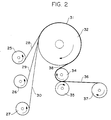
- Figure 2 shows an off-line method and apparatus for manufacturing a flat, cloth-like composite laminate according to the present invention when a heavier weight product is desired wherein the wetlaid bicomponent fiber layer 29 is unwound from a supply roll 26 and is inserted between two nonwoven layers of airlaid pulp 28 and 30 previously treated with a latex binder and unwound from supply rolls 25 and 27, respectively.
- the nonwoven layers 28 and 30 and the bicomponent reinforcing layer 29, together forming the composite 31, are conveyed over a heated roll 32 and then through the nip of rubber roller 34 and a hot embossing roller 35 whereby the laminated structure is hot embossed by a pattern of point bonds to form the flat, cloth-like composite laminate of the present invention.
- the heated roll 32 such as for example a heated steam cylinder, is provided to activate the bicomponent reinforcing layer and the binder to bond the two nonwoven layers to opposite sides of the biocomponent reinforcing layer.
- the heated roll 32 has a temperature sufficient to activate the thermoplastic bicomponent reinforcing layer and is preferably within the range of 138°C to 232°C (280°F to 450°F).
- an adhesive can be applied to both sides of the bicomponent layer or to the sides of the nonwoven layers which face the bicomponent layer, prior to heat treating the composite structure.
- the composite 38 after passing over the heated roll 32, can also be pressed together by replacing rolls 34 and 35 with a pair of calender rolls.
- the nip pressure of the calender rolls is within the range of 1.8 to 5.4 kg per linear mm (100 pli to 300 pli).
- the temperature of the calender rolls is within the range of 138°C to 232°C (280°F to 450°F).
- one of the calender rolls is an electrically heated steel calender roll having a temperature of about 177°C (350°F).
- the other calender roll is a hard rubber roll having a rubber roll shore hardness of 80 to 100 durometers.
- the formed composite laminate 36 is then taken up on a supply roll 37 for storage until later use.
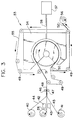
- Figure 3 shows a method and apparatus for manufacturing the flat, cloth-like composite laminate of the present invention utilizing a rotary thru-air dryer rather than a heated drum for treating thick composites.
- airlaid cellulosic fiber layers previously treated with a latex binder and dried to form two separate nonwoven layers 44 and 45 are unwound from rolls 40 and 41, respectively, and applied to both sides of a nonwoven bicomponent fiber web 39.
- the bicomponent fiber web is optionally preheated with heaters 42 and 43.
- the nonwoven cellulosic fiber layers 44 and 45 and the bicomponent fiber web 39 together form the composite 48 which is passed through a pair of rollers 46 and 47 into a lamination station 53.
- the composite 48 is guided by a restraining belt 55 and rollers 49 onto the circular carrying wires 51 which are positioned within a hood 54.
- Hot air 58 preferably at a temperature within the range of 104°C to 210°C (220° to 410°F), is fed into the hood 54 from a hot air source 57 to soften the sheath members of the fibers of the bicomponent fiber web 39.
- the hot air 58 is directed onto the composite 48 positioned on the circular carrying wires 51.
- the hot air causes the nonwoven cellulosic fiber layers and the nonwoven bicomponent fiber web to laminate together to form the composite laminate 52.
- the restraining belts 55 While it is desirable that the restraining belts 55 are maintained fairly taut throughout the process, it is also desired that while the composite 48 is on the restraining belt 55 and being heated by the hot air 57, the layers 44, 39, 45 are not pressed together with excessive pressure. This absence of significant pressure of the composite layers during the heating step prevents both the bicomponent fiber web from interrupting the outer surface of the nonwoven layers and the migration of the thermoplastic sheath away from the biocomponent fiber web into the cellulosic fiber layers.
- the formed composite laminate 52 exits from the hood 54 and passes over a cooling roll 50.
- the composite laminate is then taken up on supply roll 56, for storage until later use.
- the airlaid three-dimensional cellulosic fibers are preferably wood pulp fibers and, most preferably, twisted wood pulp fibers.
- the wood pulp fibers are chemically treated and predried to obtain a 90 to 95% solids content.
- wood pulp fibers include various mechanical and chemical pulp fibers, such as cedar fibers, southern pine fibers, spruce fibers, and hemlock fibers.
- Suitable three-dimensional and twisted fibers are prepared by several methods, such as those described in U.S. Patent Nos. 4,036,679 to Back, 3,809,604 to Estes, and 3,756,913 to Wodka.
- the particular fibers used depend upon the type of texture, such as soft, woolly or fluffy, that is desired.
- Suitable dimensions for the fibers include lengths of from 0.5 millimeters to 5 millimeters, and thicknesses of from 1 micron to 6 microns.
- the weight of the cellulosic fibers forming each nonwoven layer is within the range of 9.1 kg (20 pounds)/ream to 22.7 kg (50 pounds)/ream.
- the separate layers containing the cellulosic fibers can by formed by air laying the cellulosic fibers onto various belts known in the art.
- One type of apparatus for air forming each layer of cellulosic fibers is shown in U.S. Patent No. 4,292,271 to Buob et al.
- the binder used to bind together the three-dimensional cellulosic fibers in each nonwoven layer, or used as the additional adhesive, can be selected from various latex adhesives known in the art.
- Acceptable latex adhesives include acrylate emulsions, butadiene-styrene emulsions, acetate-ethylene emulsions, and acrylonitrile-butadiene emulsions.
- An especially effective latex adhesive is acetate-ethylene, which is sold under the trademark AIRFLEX A-106 by Air Products, inc. of Penna.
- the skilled artisan can select the particular latex adhesive depending upon the type of cellulosic fibers that are to be bound.
- the latex adhesive may be applied by known techniques such as spraying or foaming.
- the amount of solids in the latex adhesive used depends, inter alia, on the weight of the cellulosic fibers in each layer. Generally, latex adhesives having from 15 to 25% solids are used.
- the bicomponent fibers of the wetlaid nonwoven web preferably have a sheath-core configuration wherein the sheath member has a lower melting point than that of the core member.
- both the sheath and core members are made of a thermoplastic synthetic material although it is possible for the sheath member to be made of a thermoplastic synthetic material and the core member to be made of a thermosetting synthetic material. It is also possible for the sheath member and the core member to be made of the same synthetic polymer such as polyethylene as long as the polymer which forms the sheath member has a lower melting point than the polymer which forms the core member.
- Typical bicomponent fibers of the wetlaid nonwoven web may comprise a polyolefin sheath, for example polyethylene, surrounding a polyester core such as for example polyethylene terephthalate.
- the polyethylene sheath has a melting point low enough so that the biocomponent fibers can be bonded to one another by passing the nonwoven web through the Yankee Dryer of a low speed paper machine.
- Another effective combination is a sheath member made of a polypropylene and a core member made of polyester.
- thermoplastic synthetic polymers utilized for the sheath members of the present invention preferably melt or soften at a temperature below about 300°F.
- Typical thermoplastic synthetic materials that may be used to form the bicomponent fibers are selected from polyolefins containing 1 to 8 carbon atoms, e.g. polyethylene, polypropylene, polybutylene and copolymers thereof, polytetrafluoroethylene, polyesters, e.g. polyethylene terephthalate, polyvinyl acetate, polyvinyl chloride/acetate polyvinyl butyral, acrylic resins, e.g.
- polyamides namely nylon, polyvinyl chloride, polyvinylidene chloride, polystyrene, polyvinyl alcohol, polyurethanes, cellulosic resins, namely cellulosic nitrate, cellulosic acetate, cellulosic
- the core member can also be made of a thermosetting resin such as phenol-formaldehyde, phenol furfural, urea-formaldehyde, melamine-formaldehyde, silicone rubber, and the like.
- a thermosetting resin such as phenol-formaldehyde, phenol furfural, urea-formaldehyde, melamine-formaldehyde, silicone rubber, and the like.
- the sheath-core bicomponent wetlaid nonwoven web may also contain up to about 20% by weight, preferably about 5 to 10% by weight of wood pulp with the substantial balance being composed of the bicomponent fibers.
- a preferred mixture is about 90% by weight of the bicomponent fibers and about 10% by weight of the wood pulp. The use of the wood pulp reduces the overall cost of the final laminate product without materially affecting the physical properties thereof.
- a wetlaid nonwoven reinforcing, fiber layer composed of 90% by weight of a sheath/core bicomponent fiber of polyethylene/polyethylene terephthalate and 10% by weight wood pulp at a basis weight of 3.5 to 11 pounds per ream is thermally bonded by running it over a Yankee Dryer of a low speed paper machine.
- the dryer is maintained at a temperature of 121°C (250°F) which is sufficient to satisfy the melting point of 128°C (263°F) of the polyethylene sheath of the bicomponent fiber.
- the physical properties of the thermally bonded wetlaid web of the present invention (JR 3276-2) is compared in the following table with the physical properties of a web made with fibers of two homopolymers, i.e. 85% by weight of polyethylene terephthalate fibers and 15% by weight of poly-diethylene glycol terephthalate fibers (Reemay 2250).
- a layered composite was formed by inserting the wetlaid web of bicomponent fiber (JR 3276-2) between two pre-formed airlaid cellulosic webs of the kind sold as Airtex by James River Corporation and having a basis weight of between 20 and 50 lbs per ream, and then hot embossing the layered assembly to heat soften the sheath material of the bicomponent fiber and thereby cause fusion of the fibers to fibers of the airlaid webs and thus bond the layers together.
- the product was a soft cloth-like material which was substantially free of puckering and exhibited good porosity and high wet and dry strength despite the absence of adhesive other than any employed in the formation of the airlaid webs.
Landscapes
- Engineering & Computer Science (AREA)
- Textile Engineering (AREA)
- Nonwoven Fabrics (AREA)
Applications Claiming Priority (2)
| Application Number | Priority Date | Filing Date | Title |
|---|---|---|---|
| US596496 | 1984-04-04 | ||
| US07/596,496 US5246772A (en) | 1990-10-12 | 1990-10-12 | Wetlaid biocomponent web reinforcement of airlaid nonwovens |
Publications (1)
| Publication Number | Publication Date |
|---|---|
| EP0480724A1 true EP0480724A1 (fr) | 1992-04-15 |
Family
ID=24387520
Family Applications (1)
| Application Number | Title | Priority Date | Filing Date |
|---|---|---|---|
| EP19910309320 Ceased EP0480724A1 (fr) | 1990-10-12 | 1991-10-10 | Renforcement de non-tissés déposés par jet d'air |
Country Status (3)
| Country | Link |
|---|---|
| US (1) | US5246772A (fr) |
| EP (1) | EP0480724A1 (fr) |
| CA (1) | CA2053384A1 (fr) |
Cited By (18)
| Publication number | Priority date | Publication date | Assignee | Title |
|---|---|---|---|---|
| EP0530769A1 (fr) * | 1991-09-03 | 1993-03-10 | Hoechst Trevira GmbH & Co. KG | Procédé et produit intermédiaire pour la production d'un stratifié thermofusionné et l'utilisation de ce produit |
| WO1993014267A1 (fr) * | 1992-01-21 | 1993-07-22 | James River Corporation Of Virginia | Papier absorbant renforce |
| EP0642922A4 (fr) * | 1993-01-25 | 1995-07-19 | Daikin Ind Ltd | Procede permettant de laminer un materiau en feuille et permeable aux gaz. |
| WO1997013909A3 (fr) * | 1995-10-11 | 1997-05-29 | Jacob Holm Ind France Sas | Non-tisses composites et procedes de realisation |
| US5693162A (en) * | 1994-02-03 | 1997-12-02 | Yhtyneet Paperitehtaat Oy | Method for manufacturing an absorbent fibre layer, and an absorbent fibre layer |
| WO2000034567A3 (fr) * | 1998-12-10 | 2000-08-10 | Kimberly Clark Co | Structure absorbante comprenant un composite aerolique calendre fin et procede de fabrication de ce composite |
| WO2001066345A1 (fr) * | 2000-03-03 | 2001-09-13 | The Procter & Gamble Company | Bande non tissee absorbante non pelucheuse |
| WO2001079599A3 (fr) * | 2000-04-13 | 2002-01-24 | Procter & Gamble | Non tisse souple, epais et non pelucheux |
| US6355135B1 (en) | 1993-01-25 | 2002-03-12 | Daikin Industries, Ltd. | Method of laminating gas permeable sheet material |
| US6368609B1 (en) | 1999-04-12 | 2002-04-09 | Kimberly-Clark Worldwide, Inc. | Absorbent structure including a thin, calendered airlaid composite and a process for making the composite |
| US6911174B2 (en) | 2002-12-30 | 2005-06-28 | Kimberly-Clark Worldwide, Inc. | Process of making multicomponent fiber incorporating thermoplastic and thermoset polymers |
| US7063917B2 (en) * | 2001-02-21 | 2006-06-20 | Ahlstrom Mount Holly Springs, Llc | Laminated battery separator material |
| WO2006073710A3 (fr) * | 2005-01-06 | 2006-12-21 | Bki Holding Corp | Lingette a allongement et resistance eleves |
| WO2008050311A3 (fr) * | 2006-10-27 | 2008-06-19 | Procter & Gamble | Structures fibreuses non tissées de type vêtement et procédés pour les fabriquer |
| WO2009012333A3 (fr) * | 2007-07-17 | 2009-03-05 | Bki Holding Corp | Piège collant pour allergène et milieu filtrant, et procédé pour contenir les allergènes |
| US7727915B2 (en) | 2006-01-18 | 2010-06-01 | Buckeye Technologies Inc. | Tacky allergen trap and filter medium, and method for containing allergens |
| US7878301B2 (en) | 2005-04-01 | 2011-02-01 | Buckeye Technologies Inc. | Fire retardant nonwoven material and process for manufacture |
| WO2013013006A1 (fr) * | 2011-07-20 | 2013-01-24 | International Paper Company | Substrat pour bande de raccord de panneau mural et son processus de fabrication |
Families Citing this family (54)
| Publication number | Priority date | Publication date | Assignee | Title |
|---|---|---|---|---|
| US5607766A (en) * | 1993-03-30 | 1997-03-04 | American Filtrona Corporation | Polyethylene terephthalate sheath/thermoplastic polymer core bicomponent fibers, method of making same and products formed therefrom |
| AT399507B (de) * | 1993-07-30 | 1995-05-26 | Chemiefaser Lenzing Ag | Bikomponentenformkörper aus polytetrafluorethylen (ptfe) und verfahren zu seiner herstellung |
| US5509430A (en) * | 1993-12-14 | 1996-04-23 | American Filtrona Corporation | Bicomponent fibers and tobacco smoke filters formed therefrom |
| US6025050A (en) * | 1994-06-15 | 2000-02-15 | Bba Nonwovens Simpsonville, Inc. | Thermally appertured nonwoven laminates for wipes and coverstock for hygienic articles |
| US5851935A (en) * | 1996-08-29 | 1998-12-22 | Bba Nonwovens Simpsonville, Inc. | Cross-directionally stretchable elastomeric fabric laminated by thermal spot bonding |
| WO1996012615A1 (fr) * | 1994-10-19 | 1996-05-02 | Kimberly-Clark Worldwide, Inc. | Serviette crepee en deux etapes, fixee par la chaleur et resistante aux solvants |
| US5667864A (en) * | 1995-06-07 | 1997-09-16 | Landoll; Leo M. | Absorbant laminates and method of making same |
| US5843055A (en) * | 1996-07-24 | 1998-12-01 | The Procter & Gamble Company | Stratified, multi-functional fluid absorbent members |
| SG64435A1 (en) * | 1996-09-27 | 1999-04-27 | Uni Charm Corp | Disposable wiper sheet and method for producing the same |
| US5886306A (en) * | 1997-07-22 | 1999-03-23 | Kg Fibers, Inc. | Layered acoustical insulating web |
| US6129720A (en) * | 1997-12-31 | 2000-10-10 | Kimberly-Clark Worldwide, Inc. | Extensible absorbent article including an extensible absorbent pad layer |
| US6110848A (en) * | 1998-10-09 | 2000-08-29 | Fort James Corporation | Hydroentangled three ply webs and products made therefrom |
| US6562742B2 (en) | 1999-01-11 | 2003-05-13 | Bki Holding Corporation | High-performance absorbent structure |
| US7195810B1 (en) * | 1999-04-27 | 2007-03-27 | Fort James Corporation | Air-laid absorbent sheet with sinuate emboss |
| US6893525B1 (en) * | 1999-05-05 | 2005-05-17 | Fort James Corporation | Method for embossing air-laid webs using laser engraved heated embossing rolls |
| US6267252B1 (en) * | 1999-12-08 | 2001-07-31 | Kimberly-Clark Worldwide, Inc. | Fine particle filtration medium including an airlaid composite |
| KR100655842B1 (ko) | 1999-12-21 | 2006-12-12 | 킴벌리-클라크 월드와이드, 인크. | 미세한 데니어의 다성분 섬유 |
| BR0002299C1 (pt) * | 2000-05-05 | 2002-11-26 | Johnson & Johnson Ind Com | Absorvente ìntimo, núcleo absorvente e método de fabricação de núcleo absorvente |
| US7732357B2 (en) | 2000-09-15 | 2010-06-08 | Ahlstrom Nonwovens Llc | Disposable nonwoven wiping fabric and method of production |
| EP1339477A4 (fr) | 2000-11-14 | 2007-07-04 | Lydall Inc | Materiau de filtration de gaz forme par voie seche/humide |
| US20030082358A1 (en) * | 2001-10-29 | 2003-05-01 | Wenstrup David Edward | Varied density nonwoven |
| JP3802839B2 (ja) * | 2002-05-24 | 2006-07-26 | 呉羽テック株式会社 | フィルター用不織布及びエンジン用フィルター |
| US8129297B2 (en) * | 2002-07-29 | 2012-03-06 | E. I. Du Pont De Nemours And Company | Method and apparatus for heating nonwoven webs |
| WO2004022331A1 (fr) * | 2002-09-06 | 2004-03-18 | S. C. Johnson & Son, Inc. | Etoffe pour nettoyer et epousseter |
| US20060009105A1 (en) * | 2002-09-06 | 2006-01-12 | S.C. Johnson & Son, Inc. | Cleaning and dusting fabric |
| JP4460459B2 (ja) * | 2002-12-16 | 2010-05-12 | アルバニー インターナショナル コーポレイション | 偏平フィラメントからなる布地を使用する水流交絡法 |
| US8877316B2 (en) * | 2002-12-20 | 2014-11-04 | The Procter & Gamble Company | Cloth-like personal care articles |
| ES2319774T3 (es) * | 2003-10-08 | 2009-05-12 | Buckeye Technologies Inc. | Material generador de dioxido de carbono latente. |
| US7416638B2 (en) * | 2003-11-18 | 2008-08-26 | Georgia-Pacific Consumer Products Lp | Apparatus and method for manufacturing a multi-layer web product |
| US12172111B2 (en) | 2004-11-05 | 2024-12-24 | Donaldson Company, Inc. | Filter medium and breather filter structure |
| US8057567B2 (en) | 2004-11-05 | 2011-11-15 | Donaldson Company, Inc. | Filter medium and breather filter structure |
| EP1827649B1 (fr) | 2004-11-05 | 2013-02-27 | Donaldson Company, Inc. | Milieu filtre et structure de filtre |
| US8021457B2 (en) * | 2004-11-05 | 2011-09-20 | Donaldson Company, Inc. | Filter media and structure |
| US8177875B2 (en) | 2005-02-04 | 2012-05-15 | Donaldson Company, Inc. | Aerosol separator; and method |
| WO2006091594A1 (fr) | 2005-02-22 | 2006-08-31 | Donaldson Company, Inc. | Separateur d’aerosol |
| CA2603421C (fr) * | 2005-04-01 | 2013-05-21 | James R. Gross | Isolant acoustique non-tisse, et procede de fabrication |
| US7837009B2 (en) * | 2005-04-01 | 2010-11-23 | Buckeye Technologies Inc. | Nonwoven material for acoustic insulation, and process for manufacture |
| JP2009504347A (ja) * | 2005-08-19 | 2009-02-05 | ザ プロクター アンド ギャンブル カンパニー | 吸収性物品 |
| EP1968791B1 (fr) * | 2005-12-24 | 2019-09-04 | Sympatex Technologies GmbH | Membrane multicouche etanche a l'eau et permeable a la vapeur d'eau |
| DE102006013988A1 (de) * | 2006-03-22 | 2007-09-27 | Concert Gmbh | Faserverstärkter Thermoplast |
| EP2117674A1 (fr) | 2007-02-22 | 2009-11-18 | Donaldson Company, Inc. | Élément filtrant et procédé associé |
| WO2008103821A2 (fr) | 2007-02-23 | 2008-08-28 | Donaldson Company, Inc. | Élément de filtre formé |
| US20080315465A1 (en) * | 2007-03-05 | 2008-12-25 | Alan Smithies | Method of manufacturing composite filter media |
| US20090019825A1 (en) * | 2007-07-17 | 2009-01-22 | Skirius Stephen A | Tacky allergen trap and filter medium, and method for containing allergens |
| US8267681B2 (en) | 2009-01-28 | 2012-09-18 | Donaldson Company, Inc. | Method and apparatus for forming a fibrous media |
| US9437348B2 (en) | 2010-12-17 | 2016-09-06 | 3M Innovative Properties Company | Electrical insulation material |
| EP2861418B1 (fr) | 2012-06-15 | 2021-02-17 | 3M Innovative Properties Company | Matériau d'isolation électrique |
| JP6353085B2 (ja) * | 2015-01-29 | 2018-07-04 | 山田 菊夫 | パルプ積繊シート、及びパルプ積繊シートの製造方法 |
| US10982177B2 (en) | 2017-09-18 | 2021-04-20 | The Clorox Company | Cleaning wipes with particular lotion retention and efficacy characteristics |
| US11472164B2 (en) | 2018-12-21 | 2022-10-18 | The Clorox Company | Multi-layer substrates comprising sandwich layers and polyethylene |
| CN111528524B (zh) * | 2019-01-21 | 2025-07-01 | 浙江迈博高分子材料有限公司 | 一种具有导液元件的气雾散化装置 |
| MX2021011796A (es) | 2019-04-02 | 2021-10-13 | Clorox Co | Proceso para fabricar sustratos multicapa que comprenden capas de sandwich y polietileno. |
| WO2024039387A1 (fr) * | 2022-08-19 | 2024-02-22 | Paul Zhang | Produit de pâte composite multicouche, et système et procédé de fabrication de celui-ci |
| CN117966362A (zh) * | 2024-02-21 | 2024-05-03 | 赛得利(常州)纤维有限公司 | 一种非织造布及其生产工艺 |
Citations (2)
| Publication number | Priority date | Publication date | Assignee | Title |
|---|---|---|---|---|
| DE2342811B2 (de) * | 1972-09-09 | 1977-10-06 | Karl Kroyer St. Anne's Ltd, Bristol (Großbritannien) | Verfahren und vorrichtung zur herstellung einer mehrschichtigen papier- oder kartonbahn |
| US4636418A (en) * | 1984-05-17 | 1987-01-13 | James River Corporation | Cloth-like composite laminate and a method of making |
Family Cites Families (5)
| Publication number | Priority date | Publication date | Assignee | Title |
|---|---|---|---|---|
| US4552603A (en) * | 1981-06-30 | 1985-11-12 | Akzona Incorporated | Method for making bicomponent fibers |
| US4634621A (en) * | 1984-05-17 | 1987-01-06 | The James River Corporation | Scrim reinforced, cloth-like composite laminate and a method of making |
| US4637949A (en) * | 1984-07-03 | 1987-01-20 | James River Corporation | Scrim reinforced, flat cloth-like composite laminate and a method of making |
| US4731276A (en) * | 1984-07-03 | 1988-03-15 | The James River Corporation | Scrim reinforced, quilted cloth-like composite laminate and a method of making |
| US4883707A (en) * | 1988-04-21 | 1989-11-28 | James River Corporation | High loft nonwoven fabric |
-
1990
- 1990-10-12 US US07/596,496 patent/US5246772A/en not_active Expired - Lifetime
-
1991
- 1991-10-10 EP EP19910309320 patent/EP0480724A1/fr not_active Ceased
- 1991-10-11 CA CA 2053384 patent/CA2053384A1/fr not_active Abandoned
Patent Citations (2)
| Publication number | Priority date | Publication date | Assignee | Title |
|---|---|---|---|---|
| DE2342811B2 (de) * | 1972-09-09 | 1977-10-06 | Karl Kroyer St. Anne's Ltd, Bristol (Großbritannien) | Verfahren und vorrichtung zur herstellung einer mehrschichtigen papier- oder kartonbahn |
| US4636418A (en) * | 1984-05-17 | 1987-01-13 | James River Corporation | Cloth-like composite laminate and a method of making |
Cited By (28)
| Publication number | Priority date | Publication date | Assignee | Title |
|---|---|---|---|---|
| EP0530769A1 (fr) * | 1991-09-03 | 1993-03-10 | Hoechst Trevira GmbH & Co. KG | Procédé et produit intermédiaire pour la production d'un stratifié thermofusionné et l'utilisation de ce produit |
| WO1993014267A1 (fr) * | 1992-01-21 | 1993-07-22 | James River Corporation Of Virginia | Papier absorbant renforce |
| US6355135B1 (en) | 1993-01-25 | 2002-03-12 | Daikin Industries, Ltd. | Method of laminating gas permeable sheet material |
| EP0642922A4 (fr) * | 1993-01-25 | 1995-07-19 | Daikin Ind Ltd | Procede permettant de laminer un materiau en feuille et permeable aux gaz. |
| US5693162A (en) * | 1994-02-03 | 1997-12-02 | Yhtyneet Paperitehtaat Oy | Method for manufacturing an absorbent fibre layer, and an absorbent fibre layer |
| WO1997013909A3 (fr) * | 1995-10-11 | 1997-05-29 | Jacob Holm Ind France Sas | Non-tisses composites et procedes de realisation |
| US5989688A (en) * | 1995-10-11 | 1999-11-23 | Jacob Holm Industries (France) Sas | Composite nonwovens and methods for the preparation thereof |
| WO2000034567A3 (fr) * | 1998-12-10 | 2000-08-10 | Kimberly Clark Co | Structure absorbante comprenant un composite aerolique calendre fin et procede de fabrication de ce composite |
| US6479061B2 (en) | 1998-12-10 | 2002-11-12 | Kimberly-Clark Worldwide, Inc. | Absorbent structure including a thin, calendered airlaid composite and a process for making the composite |
| US6368609B1 (en) | 1999-04-12 | 2002-04-09 | Kimberly-Clark Worldwide, Inc. | Absorbent structure including a thin, calendered airlaid composite and a process for making the composite |
| WO2001066345A1 (fr) * | 2000-03-03 | 2001-09-13 | The Procter & Gamble Company | Bande non tissee absorbante non pelucheuse |
| WO2001079599A3 (fr) * | 2000-04-13 | 2002-01-24 | Procter & Gamble | Non tisse souple, epais et non pelucheux |
| US7063917B2 (en) * | 2001-02-21 | 2006-06-20 | Ahlstrom Mount Holly Springs, Llc | Laminated battery separator material |
| US6911174B2 (en) | 2002-12-30 | 2005-06-28 | Kimberly-Clark Worldwide, Inc. | Process of making multicomponent fiber incorporating thermoplastic and thermoset polymers |
| WO2006073710A3 (fr) * | 2005-01-06 | 2006-12-21 | Bki Holding Corp | Lingette a allongement et resistance eleves |
| CN101133199B (zh) * | 2005-01-06 | 2010-09-22 | Bki控股公司 | 高强度和高伸长率擦拭物 |
| JP2008527190A (ja) * | 2005-01-06 | 2008-07-24 | ビーケイアイ・ホールディング・コーポレーション | 高強度および高伸長率のワイパー |
| US7465684B2 (en) | 2005-01-06 | 2008-12-16 | Buckeye Technologies Inc. | High strength and high elongation wipe |
| US8501647B2 (en) | 2005-01-06 | 2013-08-06 | Buckeye Technologies Inc. | High strength and high elongation wipes |
| US7919419B2 (en) | 2005-01-06 | 2011-04-05 | Buckeye Technologies Inc. | High strength and high elongation wipe |
| US7878301B2 (en) | 2005-04-01 | 2011-02-01 | Buckeye Technologies Inc. | Fire retardant nonwoven material and process for manufacture |
| US7727915B2 (en) | 2006-01-18 | 2010-06-01 | Buckeye Technologies Inc. | Tacky allergen trap and filter medium, and method for containing allergens |
| EP1973628A4 (fr) * | 2006-01-18 | 2016-01-27 | Buckeye Technologies Inc | Piege a allergenes adhesif, moyen de filtre et procede de retention d allergenes |
| WO2008050311A3 (fr) * | 2006-10-27 | 2008-06-19 | Procter & Gamble | Structures fibreuses non tissées de type vêtement et procédés pour les fabriquer |
| WO2009012333A3 (fr) * | 2007-07-17 | 2009-03-05 | Bki Holding Corp | Piège collant pour allergène et milieu filtrant, et procédé pour contenir les allergènes |
| WO2013013006A1 (fr) * | 2011-07-20 | 2013-01-24 | International Paper Company | Substrat pour bande de raccord de panneau mural et son processus de fabrication |
| US9017803B2 (en) | 2011-07-20 | 2015-04-28 | International Paper Company | Substrate for wallboard joint tape and process for making same |
| US10106932B2 (en) | 2011-07-20 | 2018-10-23 | International Paper Company | Substrate for wallboard joint tape and process for making same |
Also Published As
| Publication number | Publication date |
|---|---|
| US5246772A (en) | 1993-09-21 |
| CA2053384A1 (fr) | 1992-04-13 |
Similar Documents
| Publication | Publication Date | Title |
|---|---|---|
| US5246772A (en) | Wetlaid biocomponent web reinforcement of airlaid nonwovens | |
| US4731276A (en) | Scrim reinforced, quilted cloth-like composite laminate and a method of making | |
| US4634621A (en) | Scrim reinforced, cloth-like composite laminate and a method of making | |
| US4957805A (en) | Method of making laminated reinforced thermoplastic sheets and articles made therefrom | |
| JP7106605B2 (ja) | 不織布積層体 | |
| EP1243697B1 (fr) | Papier multicouche pelable en au moins deux feuilles minces | |
| US5401556A (en) | Laminated wood-based fibrous web and molded article formed of such web and process for manufacturing article | |
| EP0162654B1 (fr) | Stratifié composite ressemblant à un tissu et procédé pour sa fabrication | |
| US4488928A (en) | Method and apparatus for forming soft, bulky absorbent webs and resulting product | |
| US5399422A (en) | Laminate | |
| US5204165A (en) | Nonwoven laminate with wet-laid barrier fabric and related method | |
| US4548856A (en) | Method for forming soft, bulky absorbent webs and resulting product | |
| US3765997A (en) | Laminate | |
| EP0800451B1 (fr) | Serviette crepee en deux etapes, fixee par la chaleur et resistante aux solvants | |
| CA1255577A (fr) | Stratifie de plastique et de pellicule non tissee, et sa fabrication | |
| EP1710076B1 (fr) | Stratifié à base une Matte non-tissée et procédé pour la production de stratifié | |
| JPWO2001090481A1 (ja) | 少なくとも2つの薄葉シートに剥離可能な多層紙 | |
| US4637949A (en) | Scrim reinforced, flat cloth-like composite laminate and a method of making | |
| JPS5814737A (ja) | 積層クレ−プ布とその製造方法 | |
| JPH04285502A (ja) | 紙ボード製品 | |
| US4908176A (en) | Process for producing moldable non-woven fabrics | |
| US6221798B1 (en) | Method for producing laminated webs | |
| JP3512302B2 (ja) | プレス成形用紙を使用しプレス成形により成形品を製造する方法 | |
| US4591526A (en) | Laminated protective jacket for disc | |
| JP6812298B2 (ja) | 不織布ワイパーおよびその製造方法 |
Legal Events
| Date | Code | Title | Description |
|---|---|---|---|
| PUAI | Public reference made under article 153(3) epc to a published international application that has entered the european phase |
Free format text: ORIGINAL CODE: 0009012 |
|
| AK | Designated contracting states |
Kind code of ref document: A1 Designated state(s): AT BE CH DE DK ES FR GB GR IT LI LU NL SE |
|
| 17P | Request for examination filed |
Effective date: 19921009 |
|
| 17Q | First examination report despatched |
Effective date: 19931215 |
|
| STAA | Information on the status of an ep patent application or granted ep patent |
Free format text: STATUS: THE APPLICATION HAS BEEN REFUSED |
|
| 18R | Application refused |
Effective date: 19950115 |