EP0481107B1 - Synthétiseur de parole utilisant un modèle de markov caché phonétique - Google Patents
Synthétiseur de parole utilisant un modèle de markov caché phonétique Download PDFInfo
- Publication number
- EP0481107B1 EP0481107B1 EP90119789A EP90119789A EP0481107B1 EP 0481107 B1 EP0481107 B1 EP 0481107B1 EP 90119789 A EP90119789 A EP 90119789A EP 90119789 A EP90119789 A EP 90119789A EP 0481107 B1 EP0481107 B1 EP 0481107B1
- Authority
- EP
- European Patent Office
- Prior art keywords
- speech
- sequence
- aehmm
- phonetic
- text
- Prior art date
- Legal status (The legal status is an assumption and is not a legal conclusion. Google has not performed a legal analysis and makes no representation as to the accuracy of the status listed.)
- Expired - Lifetime
Links
- 239000013598 vector Substances 0.000 claims abstract description 52
- 238000000034 method Methods 0.000 claims abstract description 30
- 230000015572 biosynthetic process Effects 0.000 claims description 26
- 238000003786 synthesis reaction Methods 0.000 claims description 26
- 238000002372 labelling Methods 0.000 claims description 21
- 230000007704 transition Effects 0.000 claims description 17
- 238000012549 training Methods 0.000 claims description 13
- 239000011159 matrix material Substances 0.000 claims description 12
- 230000006870 function Effects 0.000 claims description 11
- 230000003595 spectral effect Effects 0.000 claims description 10
- 238000001228 spectrum Methods 0.000 claims description 10
- 238000004519 manufacturing process Methods 0.000 claims description 7
- 230000009466 transformation Effects 0.000 claims description 5
- 238000013139 quantization Methods 0.000 claims description 3
- 230000000875 corresponding effect Effects 0.000 claims 6
- 230000002596 correlated effect Effects 0.000 claims 1
- 230000001131 transforming effect Effects 0.000 claims 1
- 238000013518 transcription Methods 0.000 abstract description 6
- 230000035897 transcription Effects 0.000 abstract description 6
- 230000003993 interaction Effects 0.000 abstract description 4
- 230000002194 synthesizing effect Effects 0.000 abstract 1
- 238000010586 diagram Methods 0.000 description 10
- 230000008569 process Effects 0.000 description 8
- 238000009826 distribution Methods 0.000 description 7
- 238000013459 approach Methods 0.000 description 5
- 238000012545 processing Methods 0.000 description 4
- 238000005311 autocorrelation function Methods 0.000 description 2
- 230000005284 excitation Effects 0.000 description 2
- 238000007476 Maximum Likelihood Methods 0.000 description 1
- 230000009471 action Effects 0.000 description 1
- 230000001143 conditioned effect Effects 0.000 description 1
- 230000001419 dependent effect Effects 0.000 description 1
- 238000009792 diffusion process Methods 0.000 description 1
- 238000005315 distribution function Methods 0.000 description 1
- 230000000750 progressive effect Effects 0.000 description 1
- 238000005309 stochastic process Methods 0.000 description 1
Images




Classifications
-
- G—PHYSICS
- G10—MUSICAL INSTRUMENTS; ACOUSTICS
- G10L—SPEECH ANALYSIS TECHNIQUES OR SPEECH SYNTHESIS; SPEECH RECOGNITION; SPEECH OR VOICE PROCESSING TECHNIQUES; SPEECH OR AUDIO CODING OR DECODING
- G10L15/00—Speech recognition
- G10L15/08—Speech classification or search
- G10L15/14—Speech classification or search using statistical models, e.g. Hidden Markov Models [HMMs]
Definitions
- the present invention relates to the field of speech synthesis and regards a new technique to synthesize speech from unrestricted written text.
- Text-to-speech synthesis is usually obtained by computing, for each sentence to be synthesized, an intonative contour and the spectra features sequence that represents the phonetic information to synthesize. Correct spectral representation of speech is a major issue in speech synthesis.
- the prior art methods stem from two general approaches: concatenative synthesis and synthesis by rules.
- Concatenative synthesis is based on a proper representation, usually Linear Prediction Coding (LPC), of prerecorded segments of speech, that are stretched and adjoined together in order to construct the desired synthetic speech.
- LPC Linear Prediction Coding
- Synthesis by rules known also as formant synthesis, provides a spectral description of the steady states for each phoneme. Spectra between two adjacent phonemes are then interpolated on the basis of rules drawn by human phoneticians.
- the drawbacks of the prior art are that the first method requires a large set of segments (hundreds or more) that are to be extracted from natural speech and the second method requires a high degree of phonetic knowledge.
- the above requirements, together with the intrinsic complexity of rules, have limited the diffusion of synthesizers using the above methods.
- a text-to-speech synthesizer is strictly language dependent.
- phonetic rules vary from a language to another, as well as the speech segments to be used in concatenative synthesis, so that the complexity of customizing a synthesizer to another language is close to that of designing a completely new one.
- Object of the present invention is a new technique to synthesize speech from unrestricted text, based on a statistical approach, that does not require prerecorded segments or explicit rules.
- the present synthesizer is based on the interaction of two Hidden Markov Models and requires a phonetically aligned speech data base to train the models.
- the present invention requires a phonetic description of the language in which speech is to be synthesized, i.e. a catalog of the phomemes of that language. Procedures for building such a catalog are well known in the art. For that language it is also assumed the availability of a speech data base of preferably existing words which are phonetically aligned; this means that for each uttered word of the data base its phonetic transcription is available and for each phoneme of the words the rough starting and ending points are identified. A proper size of the data base is of about two thousands words, even if different sizes can be used as well.
- the synthesizer of the invention as claimed makes use of a prosodic processor and of two Hidden Markov Models.
- a prosodic processor converts the input string of text into a sequence of phonetic observations. Each observation string can be considered as the observations sequence of a Hidden Markov Model, from here on named Phonetic Ergodic Hidden Markov Model (PhEHMM). The hidden state sequence is then computed. To each state a set of speech features vectors is associated by the use of another Hidden Markov Model, from here on named Acoustic Ergodic Hidden Markov Model (AEHMM). A proper transformation of the speech features vectors is used by the synthesis filter to produce the synthetic speech output.
- the invention teaches the structure of the PhEHMM and the AEHMM, and the method of their training.
- the invention achieves the object of providing a method for constructing a speech synthesizer that is largely independent from the particular language in which speech is to be synthesized. Moreover, the preferred speech features vectors can be obtained by a fully automatic training with extremely reduced human knowledge and interaction.
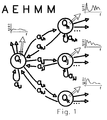
- Fig. 1 shows a simplified drawing of the structure of the AEHMM.
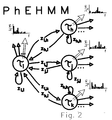
- Fig. 2 shows a simplified drawing of the structure of the PhEHMM.
- Fig. 3 shows a block diagram of the text-to-speech synthesizer of the present invention.
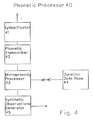
- Fig. 4 shows the block diagram of the Phonetic Processor of Fig. 3.
- Fig. 5 reports a sample of the text processing performed by the Phonetic Processor.
- Fig. 6 shows an array of the labels and their probability for different observations.
- Fig. 7 shows the block diagram of a proposed implementation of the Labelling Unit of Fig. 3.
- Fig. 8 shows the block diagram of another proposed implementation of the Labelling Unit of Fig. 3.
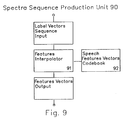
- Fig. 9 shows the block diagram of the Spectral Sequence Production Unit used with the Labelling Unit of Fig. 7.
- Fig. 10 shows the block diagram of the Spectral Sequence Production Unit used with the Labelling Unit of Fig. 8.
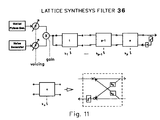
- Fig. 11 shows the structure of the lattice Synthesis Filter used in the proposed implementation.
- the synthesizer of the present invention is based on the interaction of two different Hidden Markov Models.
- the first one is the Acoustic Ergodic Hidden Markov Model (AEHMM), shown in Fig. 1.
- AEHMM Acoustic Ergodic Hidden Markov Model
- This figure shows a simplified scheme of the AEHMM, where q i , q j Vietnamese, represent the states of the model and a i,j represents the transition probability from state q i to state q j .
- Near each state q i a diagram represents the mean power density spectrum, computed from the expected value of the features vectors output probability density function.
- the AEHMM is a fully connected model, since it is possible to move from each state to any other state in one or more steps. It is assumed that the speech signal is represented by a multidimensional space of features.
- the space is continuous, as it is for the probability distributions. That means that each component of the speech features vectors and distribution values can assume real and continuous, not quantized, values.
- This approach presents some advantages; however a discrete approach is possible as well.
- Additional parameters, as voicing parameter or energy, may be embodied in the set of features or can be determined by external knowledge, according to the identity of the phoneme to be synthesized.
- Each state of the AEHMM can be considered as a local model, i.e. a source of features with a continuous density distribution probability to emit a speech features vector (that will also be referred as observation).
- This means that the speech is modeled by an Autoregressive Process of order p.
- the speech is sampled at a proper frequency, for example at 10 kHz, and the resulting quantized speech signal is stored.
- the speech signal is then divided into slices of the same length, named frames; autocorrelation function and LPC are computed for each frame.
- a suitable value for p is 12, but other values can be used as well.
- the AEHMM is described by: ⁇ AEHMM ⁇ M , Q , ⁇ , A , F ⁇
- M is the size of the model, i.e. the number of model's states
- Q is the set of states
- ⁇ is the initial probability vector
- A is the state transition matrix
- F is a set of observation probability functions.
- the observation probability functions F are continuous multivariate Gaussian distributions, giving for each state, the probability that a speech event, represented by the parametric vector O, is observed from that state, i.e.: 1 ⁇ i ⁇ M
- r ⁇ i (j) is the j-th lag of autocorrelation vector of state i
- r t (j) is the j-th lag of autocorrelation vector of input speech frame.
- ⁇ i are the eigenvalues of state autocorrelation matrix
- m vi ⁇ vi are the parameters defining the Gaussian voicing probability distribution for state i, which is supposed to be independent from the spectral density.
- N is a constant value generally proportional to the analysis frame length.
- Each state can be considered as a local autoregressive source of signal; the probability of observing a frame of speech of given autocorrelation is given by (A.2); these sources will be referred to as local sources in the following.
- the local sources are connected by a transition probability matrix, representing the phonotactical constrains of the speech.
- a Hidden Markov Model represents two stochastic processes, one that is directly observable and one that is hidden.
- the observed process is the sequence of features extracted from speech, while the underlying hidden process is the sequence of local sources that most probably have generated the observed speech.
- the AEHMM associates the features, computed from each speech signal frame, to the state, or set of states, and therefore the corresponding signal sources, that most probably have emitted that signal frame feature.
- Each source may be represented by a progressive number, named label; thus the total number of the labels is equal to the size of the AEHMM.
- the basic point in the use of the AEHMM in the present invention is that of generating for a speech utterance, the sequence of sources, and hence of labels, that most probably have generated the observed speech utterance, where the probability is computed on the whole utterance and not only locally, as it happens usually by using standard vector quantizers. This means that the source identification is not made locally, but considering the whole evolution of the utterance and the phonotactical costrains that are embodied in the transition probability matrix.
- the AEHMM is initialized by any standard clustering algorithm applied to the same parametric representation of speech used in the AEHMM.
- the model is preferably initialized by a Vector Quantization clustering scheme (VQ in the following), having the same size of the AEHMM and applied to a set of speech utterances emitted by the same speaker whose speech is used for the AEHMM re-estimation procedure.
- VQ Vector Quantization clustering scheme
- the Vector Quantization is known in prior art articles. Initial estimates for the state observation densities can be directly obtained by the speech features vectors of the Vector Quantizer codebook centroids, while the variance in the proposed features representation is the normalized LPC residual energy.
- Initial estimates of the state transition probability matrix can be obtained by using the set of VQ quantized speech utterances from the number of occurences of VQ label l i and VQ label l j in sequence, divided by the total number of observed couples starting with VQ label l i , i.e.: 1 ⁇ i , j ⁇ M where Coc( l i t -1 , l j t ) is the co-occurrence of VQ label l i at time t-1 followed by VQ label l j at time t in the training data.
- Initial estimates of initial probability vector (A.3) can be computed in the same way as the number of occurrences of VQ label l i divided by the total number of observed labels, that is: where Cnt(l i ) is the number of occurrences of VQ label l i in the training data. Training is then performed on a speech corpus by usual Forward Backward recursion and Baum-Welch re-estimation formulas. In order to reduce the training data size requirements, and to improve the overall estimation procedure, it is preferred that all the speech data can be uttered by the same speaker. Moreover it is preferable that the utterances be phonetically balanced, that is they should be representative of the phonetic events typical of the language and present the phoneme probability typical of the considered language.
- Fig. 2 shows the second Hidden Markov Model used in the present invention, the Phonetic Ergodic Hidden Markov Model (PhEHMM).
- PhEHMM Phonetic Ergodic Hidden Markov Model
- the PhEHMM is a model similar to the previously described AEHMM in that: it has the same size, i.e. the same number of states and it is initialized with the same transition probability among the states obtained by the transition probability matrix of the AEHMM.
- the observation probability functions of the PhEHMM are different from the ones of the AEHMM, in that to each state of the PhEHMM it is associated an observation probability function of emitting a phoneme of the adopted phonetic alphabet.
- the sequence of phonemes, each repeated a number of times proportional to their durations in the utterance to be synthesized, are called here synthetic observations.
- the role of the PhEHMM is hence that of establishing a correspondence between a string of synthetic observations and the sequence of the phonetic sources that most probably have emitted said synthetic observations.
- the PhEHMM is hence described by the following formula: ⁇ PhEHMM ⁇ M, T, ⁇ , Z, ⁇ where M is the size of the model, i.e. the same as for the AEHMM, T is the set of states, ⁇ is the initial probability vector, Z is the state transition probability matrix and ⁇ is a set of observation probability functions.
- the observation probability functions are discrete because of the nature of phonetic symbols domain.
- E is the size of the adopted phonetic alphabet.
- the PhEHMM Given a string of phonetic symbols, the PhEHMM is used to compute the most probable sequence of labels that constitutes the hidden state sequence, and therefore, using the AEHMM, the most probable sequence of spectral features corresponding to the phonetic symbols string.
- Fig. 2 shows a simplified scheme of the PhEHMM, where ⁇ i , ⁇ j , ⁇ k Vietnamese, represent the states of the model, z i,j represents the transition probability from state ⁇ i to state ⁇ j . Near each state a diagram represents the discrete density probability of emitting each phoneme of the adopted phonetic alphabet.
- the PhEHMM is initialized using the same speech corpus, acoustically and phonetically labelled, previously defined in connection with the AEHMM.
- Initial estimates for the initial probability vector and transition probability matrix can be obtained by the corresponding stochastic descriptions of the AEHMM, considering as transition probability matrix Z the same transition probability matrix A of the AEHMM. The same is done for the initial probability vector ⁇ . ⁇ 0 ⁇ , Z0 ⁇ A
- the observation distribution function of each state is initialized via the following procedure.
- the previously defined speech corpus is acoustically labelled using the AEHMM, obtaining the AEHMM state sequence: S ⁇ ⁇ 0, ⁇ 1, .., ⁇ T ⁇
- a phonetic transcription of the same speech corpus is obtained using a suitable method, obtaining a sequence of phonetic symbols: S ⁇ ⁇ ⁇ , ⁇ 1, .., ⁇ T ⁇
- the initial estimate of the observation probability function for each state can now be obtained using: 1 ⁇ i ⁇ E , 1 ⁇ j ⁇ M giving for each state the probability that a phonetic symbol ⁇ i , is observed from that state.
- Cnt ( ⁇ i , ⁇ j ) is the number of joint observed occurrences of phonetic symbol ⁇ i and state ⁇ j .
- the PhEHMM is then iteratively re-estimated by well-known Baum-Welch algorithm on a suitable phonetically transcribed text corpus.
- Fig. 3 illustrates the block diagram of Text-to-speech Synthesizer 30.
- Synthesizer 30 includes Text Input Unit 31, Phonetic Processor 32, Prosodic Processor 34, Labelling Unit 33, Spectra Sequence Production Unit 35 and Synthesis Filter 36.
- Text Input Unit 31 provides the text input interface and the processing needed to divide the input text into sentences for the following processing.
- Phonetic Processor 32 is depicted in more details in Fig. 4.
- Syllabificator 41 is a syllabification unit, having the purpose of dividing input text into syllables for the next process;
- Phonetic Transcriber 42 converts input graphemes into the corresponding phonemes.
- a phonetic alphabet of 29 symbols was used in the proposed embodiment, as that reported in table 1. However other phonetic alphabets, also more detailed, can be used if desired.
- Microprosody Processor 43 computes the overall duration for each phoneme to be synthesized. It makes use of a syllable model and morphosyntactical information in order to produce the desired output. It is based on a concept of intrinsic duration of the phoneme. Each phoneme is considered differently according to its position in the syllables and respect to the lexical stress. To each different phoneme position a different duration value, stored in Duration Data Base 44, is associated. Syllable models of this kind have been proposed in literature. Intrinsic durations are then stretched accordingly to the part-of-speech of the word in the sentence. Algorithms to modify durations accordingly to the part-of-speech are reported in prior art.
- Synthetic Observations Generator 45 has the role of converting the sequence of phonemes and corresponding overall durations into a string of PhEHMM synthetic observations; it produces a string of phonemes, where each phoneme is repeated as many times as the number of frames corresponding to its overall computed duration.
- Fig. 5.A a sample of the input string text is reported in Fig. 5.A where the Italian sentence "Questo è un esempio di frase" is used as an example of text to be synthesized.
- Fig. 5.B reports the phonetic transcription of the sentence used in that example.
- Fig. 5.C the sequence of words and the corresponding part-of-speech are reported.
- Fig. 5.D shows each phoneme repeated as many times as the number of frames corresponding to its overall computed duration.
- Labelling Unit (LU) 33 of Fig. 3 has the purpose of computing the most probable state sequence, corresponding to synthetic observations sequence. Labelling Unit 33 is shown in two different implementations, LU 70 and LU 80 in Fig. 7 and Fig. 8 respectively. Labelling Unit 70 of Fig. 7 computes from the synthetic observations sequence, as the one reported in Fig. 5.D, the underlying sequence of states of the PhEHMM. Baum-Welch PhEHMM Processor 71 performs the well-known Baum-Welch algorithm. Processor 71 has the purpose of generating for each observed phoneme the probability vector of each state which caused that phonetic symbol observation, as reported in Fig. 6. Each element in the array of Fig.
- L1, L2, L3. label probability
- P(1), P(2), P(3) label probability for each observation, where an observation is, as specified above, a phonetic symbol of the synthetic observations sequence and for each column of the table
- LBL represents the label of the state of the PhEHMM
- Prob is the probability of the label to have generated the observation.
- Fig. 8 shows the second implementation of Labelling Unit (LU) 33 of Fig. 3 as LU 80. It computes from the synthetic observations sequence the best sequence of the states of the PhEHMM using any optimality criterion. Only one state (i.e. one label) is associated to each item of the synthetic sequence observations. As an example, the state sequence can be computed by the well-known Viterbi algorithm performed by Viterbi PhEHMM Processor 81 on the whole synthetic observations sequence.
- LU Labelling Unit
- the Spectra Sequence Production Unit (SSPU) of Fig. 3 has the purpose of converting the input labels sequence, as generated by Labelling Unit 70 or 80, into a sequence of filter coefficients.
- Fig. 9 and 10 show the structure of SSPU 90 and 100 corresponding to the two implementations of Labelling Unit 70 and 80 respectively.
- SSPU 90 is composed by Speech Features Codebook (SFC) 92 and the Features Interpolator (FI) 91.
- SFC 92 associates to each label the corresponding source model of the AEHMM, as determined by the previous AEHMM training. This means that in the present embodiment the vector of expected values of the source parameters is associated to each label produced by Labelling Unit 70. This is immediate using multivariate Gaussian distributions.
- FI 91 provides the computing to generate the actual features vector to be used in the synthesis filter. In this purpose, it computes a weighted mean of the speech features vectors of the AEHMM codebook. It is of course desirable that the features be linear with respect to the interpolation scheme. When prediction coefficients are used, it is preferable to transform them into more linear features as, for instance, Log Area Ratios.
- the output features vector, for each frame to be synthesized, is then computed by weighting each features vector of the codebook by the probability of the corresponding label at time t, as here reported: where prob( ⁇ i t ) are the probabilities of each state as computed by Labelling Unit 70, and u i are the transformation of the associated features vectors of the codebook, and u t av is the resulting features vector to be sent to the synthesis filter.
- the result is then back converted into a spectral representation suitable for the synthesis process.
- reflection coefficients k are used, back transformed as in (C.3).
- K ⁇ k i ⁇ ( u i ) ⁇ , 1 ⁇ i ⁇ M where ⁇ is the back transformation operator.
- SSPU 100 suitable for LU 80 is shown in Fig. 10 and is composed by Spectral Features Codebook 102 and Features Selector 101.
- Features Selector 101 associates to each label the corresponding speech features vectors of the AEHMM, stored in Speech Features Vectors Codebook 102, selected accordingly to the optimum algorithm.
- Resulting speech features vectors are then transformed into filter coefficients to be used by Synthesis Filter 36.
- the synthesis filter assumes the structure shown in Fig. 11.
- gain values are provided by the energy contour, computed by Prosody Processor 34.
- voicing can be computed in different ways: if it is imbedded in the spectral features set, it is processed in the same way as the other features. A threshold decision may be used in order to classify the speech frame as voiced or unvoiced, or mixed excitations may be used as well. Otherwise, voicing parameter should be associated to each phoneme to be synthesized, and changed in the synthesis process accordingly to the actually synthesized phoneme.
Landscapes
- Engineering & Computer Science (AREA)
- Physics & Mathematics (AREA)
- Probability & Statistics with Applications (AREA)
- Computational Linguistics (AREA)
- Health & Medical Sciences (AREA)
- Audiology, Speech & Language Pathology (AREA)
- Human Computer Interaction (AREA)
- Acoustics & Sound (AREA)
- Multimedia (AREA)
- Machine Translation (AREA)
- Document Processing Apparatus (AREA)
Claims (6)
- Procédé pour générer une parole synthétisée dans lequel un modèle de Markov caché acoustique ergodique (AEHMM), reflétant les contraintes phonotacticales est corrélé à un modèle de Markov caché ergodique phonétique (PhEHMM), le procédé comprenant les étapes suivantes:a) construction d'un AEHMM, considérant comme une séquence d'observations les vecteurs caractéristiques de la parole extraits des cadres dans lesquels la parole prononcée au cours de l'entraînement du AEHMM est divisée et comme une séquence cachée la séquence de sources qui a le plus probablement émis les cadres de prononciation de la parole,b) initialisation dudit AEHMM par un schéma de groupement de quantification de vecteurs, ayant la même dimension que ledit AEHMM,c) formation dudit AEHMM par l'algorithme avant-arrière et les formules de re-estimation de Baum-Welch,d) association à chaque cadre de l'étiquette de la source la plus probable,e) construction d'un PhEHMM de la même dimension que ledit AEHMM, en considérant comme une séquence d'observations une séquence d'observations synthétique obtenue à partir d'un texte écrit et comme une séquence cachée la séquence des étiquettes,f) initialisation de ladite matrice de probabilité de transision PhEHMM en attribuant aux probabilités de transition d'état les mêmes valeurs que les probabilités de transition des états correspondants dudit AEHMM,g) initialisation desdites fonctions de probabilité d'observation PhEHMM pari) utilisation d'un domaine de rationalité de parole alignée phonétiquementii) génération pour ledit domaine de rationalité de parole de la séquence des étiquettes les plus probables, en utilisant la caractéristique d'étiquetage acoustique dudit AEHMM,iii) calcul de la fonction de probabilité d'observations pour chaque phonème, en comptant le nombre d'apparitions du phonème dans un état divisé par le nombre total de phonèmes émis par ledit état,h) formation dudit PhEHMM par l'algorithme de Baum-Welch sur un domaine de rationalité approprié d'observations synthétiques,i) détermination pour chaque mot à synthétiser d'une observation synthétique et par l'intermédiaire dudit PhEHMM de la séquence d'étiquettes correspondante au moyen d'un critère d'optimalité approprié,j) détermination à partir du texte d'entrée d'une série de paramètres supplémentaires, comme l'énergie, les contours de prosodie et la prononciation, par un dispositif de traitement prosodique,k) détermination pour ladite séquence d'étiquettes de la série correspondante de vecteurs caractéristiques de la parole par l'intermédiaire dudit AEHMM,l) transformation desdits vecteurs caractéristiques en une série de coefficients de filtrage préservant l'information spectrale etm) utilisation de ladite série de coefficients de filtrage et desdits paramètres supplémentaires dans un filtre de synthèse pour produire une sortie vocale synthétisée.
- Procédé pour générer la parole à partir d'un texte écrit non limité selon la revendication 1, dans lequel le critère d'optimalité approprié de l'étape i) est donné par l'algorithme de Baum-Welch et dans lequel la détermination des vecteurs caractéristiques de la parole de l'étape k) est obtenue par pondération de chacun des vecteurs caractéristiques par la probabilité des étiquettes correspondantes.
- Procédé pour générer la parole à partir d'un texte écrit non limité selon la revendication 1, dans lequel le critère d'optimalité approprié de l'étape i) est donné par l'algorithme de Viterbi et dans lequel la détermination des vecteurs caractéristiques de la parole de l'étape k) est obtenue par association à chaque étiquette des vecteurs caractéristiques de la parole correspondants dudit AEHMM.
- Système synthétiseur texte-parole comportant un dispositif (31) d'introduction de texte pour introduire le texte à synthétiser, un dispositif (32) de traitement phonétique pour convertir le graphème introduit en une représentation phonétique et pour déterminer les paramètres de durée phonétique, un dispositif (34) de traitement prosodique pour déterminer les contours prosodiques et énergétiques pour la prononciation de la parole à synthétiser et un filtre de synthèse (36) qui, en utilisant lesdits contours prosodiques et énergétiques et les coefficients de filtrage, synthétise la parole à générer caractérisé en ce qu'il comprend
ledit dispositif (32) de traitement phonétique comportant un générateur (45) d'observations synthétiques qui transforme ladite représentation phonétique du texte introduit en une chaîne de symboles phonétiques, répétés chacun pour refléter de manière appropriée la durée du phonème telle que calculée par ledit dispositif (34) de traitement prosodique et pour générer une séquence d'observations de modèle de Markov caché ergodique phonétique (PhEHMM); une unité (33) d'étiquetage associant à chaque observation de ladite séquence d'observations la probabilité que ledit état a généré ladite observation par un critère d'optimalité et une unité (35) de production de séquence de spectres calculant pour chaque cadre de parole à synthétiser le vecteur caractéristique de la parole par une corrélation entre les étiquettes et les vecteurs caractéristiques de la parole, calculés par un modèle de Markov caché ergodique acoustique (AEHMM), construit sur le domaine de rationalité de la parole prononcée au préalaboe, ladite unité (35) de production de séquence de spectres convertissant par une transformation inverse les vecteurs caractéristiques de la parole en coefficients de filtrage à utiliser par ledit filtre de synthèse (36). - Système synthétiseur texte-parole selon la revendication 4, dans lequel le critère d'optimalité utilisé dans ladite unité (33) d'étiquetage consiste à calculer la probabilité que chaque état a généré une observation donnée par l'algorithme de Baum-Welch et dans lequel chaque vecteur caractéristique de la parole est calculé comme la somme des vecteurs caractéristiques de la parole, associée à chaque étiquette par ledit AEHMM, pondérée par la probabilité de chaque étiquette, calculée par ladite unité (33) d'étiquetage.
- Système synthétiseur texte-parole selon la revendication 4, dans lequel le critère d'otimalité utilisé dans ladite unité (33) d'étiquetage consiste à calculer la séquence des états qui le plus probablement ont généré la séquence d'observations synthétiques observées telle qu'obtenue par l'algorithme de Viterbi et dans lequel chaque vecteur caractéristique de la parole est obtenu en associant à chaque étiquette le modèle source correspondant dudit AEHMM et en supposant comme vecteur caractéristique de la parole le vecteur moyen associé au modèle source.
Priority Applications (4)
| Application Number | Priority Date | Filing Date | Title |
|---|---|---|---|
| EP90119789A EP0481107B1 (fr) | 1990-10-16 | 1990-10-16 | Synthétiseur de parole utilisant un modèle de markov caché phonétique |
| DE69022237T DE69022237T2 (de) | 1990-10-16 | 1990-10-16 | Sprachsyntheseeinrichtung nach dem phonetischen Hidden-Markov-Modell. |
| US07/716,022 US5230037A (en) | 1990-10-16 | 1991-06-07 | Phonetic hidden markov model speech synthesizer |
| JP3200126A JP2826215B2 (ja) | 1990-10-16 | 1991-07-15 | 合成音声生成方法及びテキスト音声合成装置 |
Applications Claiming Priority (1)
| Application Number | Priority Date | Filing Date | Title |
|---|---|---|---|
| EP90119789A EP0481107B1 (fr) | 1990-10-16 | 1990-10-16 | Synthétiseur de parole utilisant un modèle de markov caché phonétique |
Publications (2)
| Publication Number | Publication Date |
|---|---|
| EP0481107A1 EP0481107A1 (fr) | 1992-04-22 |
| EP0481107B1 true EP0481107B1 (fr) | 1995-09-06 |
Family
ID=8204620
Family Applications (1)
| Application Number | Title | Priority Date | Filing Date |
|---|---|---|---|
| EP90119789A Expired - Lifetime EP0481107B1 (fr) | 1990-10-16 | 1990-10-16 | Synthétiseur de parole utilisant un modèle de markov caché phonétique |
Country Status (4)
| Country | Link |
|---|---|
| US (1) | US5230037A (fr) |
| EP (1) | EP0481107B1 (fr) |
| JP (1) | JP2826215B2 (fr) |
| DE (1) | DE69022237T2 (fr) |
Families Citing this family (48)
| Publication number | Priority date | Publication date | Assignee | Title |
|---|---|---|---|---|
| KR940002854B1 (ko) * | 1991-11-06 | 1994-04-04 | 한국전기통신공사 | 음성 합성시스팀의 음성단편 코딩 및 그의 피치조절 방법과 그의 유성음 합성장치 |
| US5606645A (en) * | 1992-02-28 | 1997-02-25 | Kabushiki Kaisha Toshiba | Speech pattern recognition apparatus utilizing multiple independent sequences of phonetic segments |
| US5383120A (en) * | 1992-03-02 | 1995-01-17 | General Electric Company | Method for tagging collocations in text |
| DE69309557T2 (de) * | 1992-06-29 | 1997-10-09 | Nippon Telegraph & Telephone | Verfahren und Vorrichtung zur Sprachkodierung |
| EP0680653B1 (fr) * | 1993-10-15 | 2001-06-20 | AT&T Corp. | Procede d'apprentissage pour un systeme tts, appareil resultant et son procede d'utilisation |
| JP3450411B2 (ja) * | 1994-03-22 | 2003-09-22 | キヤノン株式会社 | 音声情報処理方法及び装置 |
| GB2290684A (en) * | 1994-06-22 | 1996-01-03 | Ibm | Speech synthesis using hidden Markov model to determine speech unit durations |
| US5633983A (en) * | 1994-09-13 | 1997-05-27 | Lucent Technologies Inc. | Systems and methods for performing phonemic synthesis |
| US5497337A (en) * | 1994-10-21 | 1996-03-05 | International Business Machines Corporation | Method for designing high-Q inductors in silicon technology without expensive metalization |
| GB2296846A (en) * | 1995-01-07 | 1996-07-10 | Ibm | Synthesising speech from text |
| US5719996A (en) * | 1995-06-30 | 1998-02-17 | Motorola, Inc. | Speech recognition in selective call systems |
| US6038533A (en) * | 1995-07-07 | 2000-03-14 | Lucent Technologies Inc. | System and method for selecting training text |
| US5822731A (en) * | 1995-09-15 | 1998-10-13 | Infonautics Corporation | Adjusting a hidden Markov model tagger for sentence fragments |
| US5832441A (en) * | 1996-09-16 | 1998-11-03 | International Business Machines Corporation | Creating speech models |
| JPH10153998A (ja) * | 1996-09-24 | 1998-06-09 | Nippon Telegr & Teleph Corp <Ntt> | 補助情報利用型音声合成方法、この方法を実施する手順を記録した記録媒体、およびこの方法を実施する装置 |
| US5950162A (en) * | 1996-10-30 | 1999-09-07 | Motorola, Inc. | Method, device and system for generating segment durations in a text-to-speech system |
| US5933805A (en) * | 1996-12-13 | 1999-08-03 | Intel Corporation | Retaining prosody during speech analysis for later playback |
| JPH10260692A (ja) * | 1997-03-18 | 1998-09-29 | Toshiba Corp | 音声の認識合成符号化/復号化方法及び音声符号化/復号化システム |
| JP3033514B2 (ja) * | 1997-03-31 | 2000-04-17 | 日本電気株式会社 | 大語彙音声認識方法及び装置 |
| DE59800737D1 (de) * | 1997-09-17 | 2001-06-21 | Siemens Ag | Verfahren zur bestimmung einer wahrscheinlichkeit für das auftreten einer folge von mindestens zwei wörtern bei einer spracherkennung |
| CA2354871A1 (fr) * | 1998-11-13 | 2000-05-25 | Lernout & Hauspie Speech Products N.V. | Synthese de la parole par concatenation de signaux vocaux |
| US6185533B1 (en) * | 1999-03-15 | 2001-02-06 | Matsushita Electric Industrial Co., Ltd. | Generation and synthesis of prosody templates |
| DE19915648A1 (de) * | 1999-04-07 | 2000-10-12 | Rohde & Schwarz | Verfahren zum Bewerten der Sprachqualität von Telefonverbindungen |
| US6178402B1 (en) | 1999-04-29 | 2001-01-23 | Motorola, Inc. | Method, apparatus and system for generating acoustic parameters in a text-to-speech system using a neural network |
| US7219056B2 (en) * | 2000-04-20 | 2007-05-15 | International Business Machines Corporation | Determining and using acoustic confusability, acoustic perplexity and synthetic acoustic word error rate |
| US6999926B2 (en) * | 2000-11-16 | 2006-02-14 | International Business Machines Corporation | Unsupervised incremental adaptation using maximum likelihood spectral transformation |
| US7124082B2 (en) * | 2002-10-11 | 2006-10-17 | Twisted Innovations | Phonetic speech-to-text-to-speech system and method |
| US7593845B2 (en) * | 2003-10-06 | 2009-09-22 | Microsoflt Corporation | Method and apparatus for identifying semantic structures from text |
| US7412377B2 (en) * | 2003-12-19 | 2008-08-12 | International Business Machines Corporation | Voice model for speech processing based on ordered average ranks of spectral features |
| JP2006047866A (ja) * | 2004-08-06 | 2006-02-16 | Canon Inc | 電子辞書装置およびその制御方法 |
| CN1755796A (zh) * | 2004-09-30 | 2006-04-05 | 国际商业机器公司 | 文本到语音转换中基于统计技术的距离定义方法和系统 |
| US7684988B2 (en) * | 2004-10-15 | 2010-03-23 | Microsoft Corporation | Testing and tuning of automatic speech recognition systems using synthetic inputs generated from its acoustic models |
| US20060136215A1 (en) * | 2004-12-21 | 2006-06-22 | Jong Jin Kim | Method of speaking rate conversion in text-to-speech system |
| US20070213987A1 (en) * | 2006-03-08 | 2007-09-13 | Voxonic, Inc. | Codebook-less speech conversion method and system |
| JP2008263543A (ja) * | 2007-04-13 | 2008-10-30 | Funai Electric Co Ltd | 記録再生装置 |
| US8321222B2 (en) * | 2007-08-14 | 2012-11-27 | Nuance Communications, Inc. | Synthesis by generation and concatenation of multi-form segments |
| US20090248647A1 (en) * | 2008-03-25 | 2009-10-01 | Omer Ziv | System and method for the quality assessment of queries |
| CA2724753A1 (fr) * | 2008-05-30 | 2009-12-03 | Nokia Corporation | Procede, appareil et programme informatique pour fournir une synthese amelioree de la parole |
| DK2242045T3 (da) * | 2009-04-16 | 2012-09-24 | Univ Mons | Talesyntese og kodningsfremgangsmåder |
| WO2012063424A1 (fr) * | 2010-11-08 | 2012-05-18 | 日本電気株式会社 | Dispositif, procédé et programme de génération de série de quantités de caractéristiques |
| WO2012134877A2 (fr) * | 2011-03-25 | 2012-10-04 | Educational Testing Service | Systèmes et procédés, implémentés dans des ordinateurs, servant à évaluer des traits prosodiques de contenus vocaux |
| CN103531196B (zh) * | 2013-10-15 | 2016-04-13 | 中国科学院自动化研究所 | 一种波形拼接语音合成的选音方法 |
| WO2016011189A1 (fr) | 2014-07-15 | 2016-01-21 | The Regents Of The University Of California | Stimuli de parole-sons à multiplexage en fréquence pour une caractérisation neurale hiérarchique d'un traitement de parole |
| US10002543B2 (en) * | 2014-11-04 | 2018-06-19 | Knotbird LLC | System and methods for transforming language into interactive elements |
| JP6672114B2 (ja) * | 2016-09-13 | 2020-03-25 | 本田技研工業株式会社 | 会話メンバー最適化装置、会話メンバー最適化方法およびプログラム |
| CN109087630B (zh) * | 2018-08-29 | 2020-09-15 | 深圳追一科技有限公司 | 语音识别的方法及相关装置 |
| WO2022259836A1 (fr) * | 2021-06-11 | 2022-12-15 | パナソニック インテレクチュアル プロパティ コーポレーション オブ アメリカ | Procédé d'identification de locuteur, dispositif d'identification de locuteur et programme d'identification de locuteur |
| KR20250077893A (ko) * | 2023-11-24 | 2025-06-02 | 주식회사 오니온에이아이 | 인공지능을 이용하여 언어학 및 인지과학 기반의 음성기술이 적용된 더빙 생성 시스템 및 방법 |
Family Cites Families (5)
| Publication number | Priority date | Publication date | Assignee | Title |
|---|---|---|---|---|
| US4882759A (en) * | 1986-04-18 | 1989-11-21 | International Business Machines Corporation | Synthesizing word baseforms used in speech recognition |
| US4852180A (en) * | 1987-04-03 | 1989-07-25 | American Telephone And Telegraph Company, At&T Bell Laboratories | Speech recognition by acoustic/phonetic system and technique |
| JPH01159698A (ja) * | 1987-12-16 | 1989-06-22 | Matsushita Electric Ind Co Ltd | パターン認識用モデル作成装置 |
| JP2545914B2 (ja) * | 1988-02-09 | 1996-10-23 | 日本電気株式会社 | 音声認識方法 |
| US5033087A (en) * | 1989-03-14 | 1991-07-16 | International Business Machines Corp. | Method and apparatus for the automatic determination of phonological rules as for a continuous speech recognition system |
-
1990
- 1990-10-16 EP EP90119789A patent/EP0481107B1/fr not_active Expired - Lifetime
- 1990-10-16 DE DE69022237T patent/DE69022237T2/de not_active Expired - Fee Related
-
1991
- 1991-06-07 US US07/716,022 patent/US5230037A/en not_active Expired - Fee Related
- 1991-07-15 JP JP3200126A patent/JP2826215B2/ja not_active Expired - Lifetime
Also Published As
| Publication number | Publication date |
|---|---|
| JP2826215B2 (ja) | 1998-11-18 |
| DE69022237D1 (de) | 1995-10-12 |
| JPH04313034A (ja) | 1992-11-05 |
| US5230037A (en) | 1993-07-20 |
| EP0481107A1 (fr) | 1992-04-22 |
| DE69022237T2 (de) | 1996-05-02 |
Similar Documents
| Publication | Publication Date | Title |
|---|---|---|
| US5230037A (en) | Phonetic hidden markov model speech synthesizer | |
| US5682501A (en) | Speech synthesis system | |
| EP2179414B1 (fr) | Synthèse par génération et concaténation de segments multiforme | |
| US7478039B2 (en) | Stochastic modeling of spectral adjustment for high quality pitch modification | |
| JP4176169B2 (ja) | 言語合成のためのランタイムアコースティックユニット選択方法及び装置 | |
| US7155390B2 (en) | Speech information processing method and apparatus and storage medium using a segment pitch pattern model | |
| US11763797B2 (en) | Text-to-speech (TTS) processing | |
| Malfrère et al. | High-quality speech synthesis for phonetic speech segmentation. | |
| US10692484B1 (en) | Text-to-speech (TTS) processing | |
| Yoshimura | Simultaneous modeling of phonetic and prosodic parameters, and characteristic conversion for HMM-based text-to-speech systems | |
| Chu et al. | Microsoft Mulan-a bilingual TTS system | |
| JPH11504734A (ja) | 擬音素ユニットに自動音声分節するための方法及び装置 | |
| US10699695B1 (en) | Text-to-speech (TTS) processing | |
| EP0515709A1 (fr) | Méthode et dispositif pour la représentation d'unités segmentaires pour la conversion texte-parole | |
| Mullah | A comparative study of different text-to-speech synthesis techniques | |
| Lee et al. | A segmental speech coder based on a concatenative TTS | |
| Phan et al. | A study in vietnamese statistical parametric speech synthesis based on HMM | |
| Venkatagiri et al. | Digital speech synthesis: Tutorial | |
| El Ouahabi et al. | Amazigh speech recognition using triphone modeling and clustering tree decision | |
| Furui | Recent advances in speech recognition technology at NTT laboratories | |
| Hirose et al. | Superpositional modeling of fundamental frequency contours for HMM-based speech synthesis | |
| Baudoin et al. | Advances in very low bit rate speech coding using recognition and synthesis techniques | |
| Phan et al. | Extracting MFCC, F0 feature in Vietnamese HMM-based speech synthesis | |
| JP2862306B2 (ja) | 音声認識装置 | |
| Hirose | Modeling of fundamental frequency contours for HMM-based speech synthesis: Representation of fundamental frequency contours for statistical speech synthesis |
Legal Events
| Date | Code | Title | Description |
|---|---|---|---|
| PUAI | Public reference made under article 153(3) epc to a published international application that has entered the european phase |
Free format text: ORIGINAL CODE: 0009012 |
|
| AK | Designated contracting states |
Kind code of ref document: A1 Designated state(s): DE FR GB IT |
|
| 17P | Request for examination filed |
Effective date: 19920522 |
|
| 17Q | First examination report despatched |
Effective date: 19941118 |
|
| GRAA | (expected) grant |
Free format text: ORIGINAL CODE: 0009210 |
|
| AK | Designated contracting states |
Kind code of ref document: B1 Designated state(s): DE FR GB IT |
|
| PGFP | Annual fee paid to national office [announced via postgrant information from national office to epo] |
Ref country code: GB Payment date: 19950926 Year of fee payment: 6 |
|
| PGFP | Annual fee paid to national office [announced via postgrant information from national office to epo] |
Ref country code: FR Payment date: 19951009 Year of fee payment: 6 |
|
| REF | Corresponds to: |
Ref document number: 69022237 Country of ref document: DE Date of ref document: 19951012 |
|
| PGFP | Annual fee paid to national office [announced via postgrant information from national office to epo] |
Ref country code: DE Payment date: 19951030 Year of fee payment: 6 |
|
| ITF | It: translation for a ep patent filed | ||
| ET | Fr: translation filed | ||
| PLBE | No opposition filed within time limit |
Free format text: ORIGINAL CODE: 0009261 |
|
| STAA | Information on the status of an ep patent application or granted ep patent |
Free format text: STATUS: NO OPPOSITION FILED WITHIN TIME LIMIT |
|
| 26N | No opposition filed | ||
| PG25 | Lapsed in a contracting state [announced via postgrant information from national office to epo] |
Ref country code: GB Effective date: 19961016 |
|
| GBPC | Gb: european patent ceased through non-payment of renewal fee |
Effective date: 19961016 |
|
| PG25 | Lapsed in a contracting state [announced via postgrant information from national office to epo] |
Ref country code: FR Effective date: 19970630 |
|
| PG25 | Lapsed in a contracting state [announced via postgrant information from national office to epo] |
Ref country code: DE Effective date: 19970701 |
|
| REG | Reference to a national code |
Ref country code: FR Ref legal event code: ST |
|
| PG25 | Lapsed in a contracting state [announced via postgrant information from national office to epo] |
Ref country code: IT Free format text: LAPSE BECAUSE OF NON-PAYMENT OF DUE FEES;WARNING: LAPSES OF ITALIAN PATENTS WITH EFFECTIVE DATE BEFORE 2007 MAY HAVE OCCURRED AT ANY TIME BEFORE 2007. THE CORRECT EFFECTIVE DATE MAY BE DIFFERENT FROM THE ONE RECORDED. Effective date: 20051016 |