EP0481226A1 - Verfahren zur Herstellung von Wasserabsorptionsmaterial auf Polymerbasis und dessen Verwendung - Google Patents
Verfahren zur Herstellung von Wasserabsorptionsmaterial auf Polymerbasis und dessen Verwendung Download PDFInfo
- Publication number
- EP0481226A1 EP0481226A1 EP91115709A EP91115709A EP0481226A1 EP 0481226 A1 EP0481226 A1 EP 0481226A1 EP 91115709 A EP91115709 A EP 91115709A EP 91115709 A EP91115709 A EP 91115709A EP 0481226 A1 EP0481226 A1 EP 0481226A1
- Authority
- EP
- European Patent Office
- Prior art keywords
- component
- water
- polymer
- fertilizer
- weight
- Prior art date
- Legal status (The legal status is an assumption and is not a legal conclusion. Google has not performed a legal analysis and makes no representation as to the accuracy of the status listed.)
- Granted
Links
- XLYOFNOQVPJJNP-UHFFFAOYSA-N water Substances O XLYOFNOQVPJJNP-UHFFFAOYSA-N 0.000 title claims abstract description 60
- 229920000642 polymer Polymers 0.000 title claims abstract description 51
- 238000000034 method Methods 0.000 title claims abstract description 20
- 238000010521 absorption reaction Methods 0.000 title claims abstract description 18
- 238000004519 manufacturing process Methods 0.000 title claims abstract description 9
- 239000000463 material Substances 0.000 title claims description 12
- 229920001577 copolymer Polymers 0.000 claims abstract description 17
- 239000000243 solution Substances 0.000 claims abstract description 17
- 239000007788 liquid Substances 0.000 claims abstract description 14
- 239000007795 chemical reaction product Substances 0.000 claims abstract description 11
- 239000000126 substance Substances 0.000 claims abstract description 11
- 239000000843 powder Substances 0.000 claims abstract description 10
- 239000007864 aqueous solution Substances 0.000 claims abstract description 9
- 229920001059 synthetic polymer Polymers 0.000 claims abstract description 8
- 238000006243 chemical reaction Methods 0.000 claims abstract description 7
- 150000001875 compounds Chemical class 0.000 claims abstract description 6
- 230000014759 maintenance of location Effects 0.000 claims abstract description 6
- 235000015097 nutrients Nutrition 0.000 claims abstract description 5
- 239000012736 aqueous medium Substances 0.000 claims abstract description 3
- 238000013270 controlled release Methods 0.000 claims abstract description 3
- 239000003814 drug Substances 0.000 claims abstract description 3
- 239000003337 fertilizer Substances 0.000 claims description 63
- 239000000178 monomer Substances 0.000 claims description 25
- 239000004576 sand Substances 0.000 claims description 21
- 239000000203 mixture Substances 0.000 claims description 15
- 239000002689 soil Substances 0.000 claims description 12
- SMZOUWXMTYCWNB-UHFFFAOYSA-N 2-(2-methoxy-5-methylphenyl)ethanamine Chemical compound COC1=CC=C(C)C=C1CCN SMZOUWXMTYCWNB-UHFFFAOYSA-N 0.000 claims description 10
- 239000000835 fiber Substances 0.000 claims description 10
- HRPVXLWXLXDGHG-UHFFFAOYSA-N Acrylamide Chemical compound NC(=O)C=C HRPVXLWXLXDGHG-UHFFFAOYSA-N 0.000 claims description 9
- CERQOIWHTDAKMF-UHFFFAOYSA-N Methacrylic acid Chemical compound CC(=C)C(O)=O CERQOIWHTDAKMF-UHFFFAOYSA-N 0.000 claims description 9
- 239000002250 absorbent Substances 0.000 claims description 9
- 230000002745 absorbent Effects 0.000 claims description 9
- NIXOWILDQLNWCW-UHFFFAOYSA-N 2-Propenoic acid Natural products OC(=O)C=C NIXOWILDQLNWCW-UHFFFAOYSA-N 0.000 claims description 8
- 229920006037 cross link polymer Polymers 0.000 claims description 8
- 229920003043 Cellulose fiber Polymers 0.000 claims description 5
- 229920002472 Starch Polymers 0.000 claims description 5
- 150000004676 glycans Chemical class 0.000 claims description 5
- 229920001282 polysaccharide Polymers 0.000 claims description 5
- 239000005017 polysaccharide Substances 0.000 claims description 5
- 235000019698 starch Nutrition 0.000 claims description 5
- 239000008107 starch Substances 0.000 claims description 5
- XTXRWKRVRITETP-UHFFFAOYSA-N Vinyl acetate Chemical compound CC(=O)OC=C XTXRWKRVRITETP-UHFFFAOYSA-N 0.000 claims description 4
- 150000001735 carboxylic acids Chemical class 0.000 claims description 4
- 229920002678 cellulose Polymers 0.000 claims description 4
- 239000001913 cellulose Substances 0.000 claims description 4
- 235000010980 cellulose Nutrition 0.000 claims description 4
- 239000000945 filler Substances 0.000 claims description 4
- 235000013312 flour Nutrition 0.000 claims description 4
- FQPSGWSUVKBHSU-UHFFFAOYSA-N methacrylamide Chemical compound CC(=C)C(N)=O FQPSGWSUVKBHSU-UHFFFAOYSA-N 0.000 claims description 4
- 230000007935 neutral effect Effects 0.000 claims description 4
- 238000003976 plant breeding Methods 0.000 claims description 4
- 229920000536 2-Acrylamido-2-methylpropane sulfonic acid Polymers 0.000 claims description 3
- XHZPRMZZQOIPDS-UHFFFAOYSA-N 2-Methyl-2-[(1-oxo-2-propenyl)amino]-1-propanesulfonic acid Chemical compound OS(=O)(=O)CC(C)(C)NC(=O)C=C XHZPRMZZQOIPDS-UHFFFAOYSA-N 0.000 claims description 3
- QTBSBXVTEAMEQO-UHFFFAOYSA-M Acetate Chemical compound CC([O-])=O QTBSBXVTEAMEQO-UHFFFAOYSA-M 0.000 claims description 3
- 239000004372 Polyvinyl alcohol Substances 0.000 claims description 3
- 229920002451 polyvinyl alcohol Polymers 0.000 claims description 3
- 229920002994 synthetic fiber Polymers 0.000 claims description 3
- 239000012209 synthetic fiber Substances 0.000 claims description 3
- 229920002101 Chitin Polymers 0.000 claims description 2
- 229920000742 Cotton Polymers 0.000 claims description 2
- 239000004971 Cross linker Substances 0.000 claims description 2
- 229920001353 Dextrin Polymers 0.000 claims description 2
- 239000004375 Dextrin Substances 0.000 claims description 2
- WHNWPMSKXPGLAX-UHFFFAOYSA-N N-Vinyl-2-pyrrolidone Chemical compound C=CN1CCCC1=O WHNWPMSKXPGLAX-UHFFFAOYSA-N 0.000 claims description 2
- 239000004952 Polyamide Substances 0.000 claims description 2
- 229920000297 Rayon Polymers 0.000 claims description 2
- 229920006221 acetate fiber Polymers 0.000 claims description 2
- 239000010839 body fluid Substances 0.000 claims description 2
- 210000001124 body fluid Anatomy 0.000 claims description 2
- 235000019425 dextrin Nutrition 0.000 claims description 2
- 239000000975 dye Substances 0.000 claims description 2
- 235000013399 edible fruits Nutrition 0.000 claims description 2
- 125000005395 methacrylic acid group Chemical group 0.000 claims description 2
- 239000003415 peat Substances 0.000 claims description 2
- 239000006069 physical mixture Substances 0.000 claims description 2
- 229920002239 polyacrylonitrile Polymers 0.000 claims description 2
- 229920002647 polyamide Polymers 0.000 claims description 2
- 229920000728 polyester Polymers 0.000 claims description 2
- 229920000098 polyolefin Polymers 0.000 claims description 2
- 229920002635 polyurethane Polymers 0.000 claims description 2
- 239000004814 polyurethane Substances 0.000 claims description 2
- 229920005989 resin Polymers 0.000 claims description 2
- 239000011347 resin Substances 0.000 claims description 2
- 229920006304 triacetate fiber Polymers 0.000 claims description 2
- 239000002023 wood Substances 0.000 claims description 2
- 210000002268 wool Anatomy 0.000 claims description 2
- 229920002396 Polyurea Polymers 0.000 claims 1
- 239000003513 alkali Substances 0.000 claims 1
- 150000001447 alkali salts Chemical class 0.000 claims 1
- 150000003863 ammonium salts Chemical class 0.000 claims 1
- 238000009395 breeding Methods 0.000 claims 1
- 230000001488 breeding effect Effects 0.000 claims 1
- 239000004927 clay Substances 0.000 claims 1
- 238000009792 diffusion process Methods 0.000 claims 1
- 229920000591 gum Polymers 0.000 claims 1
- 239000000049 pigment Substances 0.000 claims 1
- 238000002360 preparation method Methods 0.000 claims 1
- 239000006096 absorbing agent Substances 0.000 abstract description 4
- 229940079593 drug Drugs 0.000 abstract 1
- DZMOLBFHXFZZBF-UHFFFAOYSA-N prop-2-enyl dihydrogen phosphate Chemical class OP(O)(=O)OCC=C DZMOLBFHXFZZBF-UHFFFAOYSA-N 0.000 description 22
- VYPSYNLAJGMNEJ-UHFFFAOYSA-N Silicium dioxide Chemical compound O=[Si]=O VYPSYNLAJGMNEJ-UHFFFAOYSA-N 0.000 description 21
- 238000006116 polymerization reaction Methods 0.000 description 19
- 238000002156 mixing Methods 0.000 description 12
- KRKNYBCHXYNGOX-UHFFFAOYSA-N citric acid Chemical class OC(=O)CC(O)(C(O)=O)CC(O)=O KRKNYBCHXYNGOX-UHFFFAOYSA-N 0.000 description 10
- 239000002253 acid Substances 0.000 description 9
- 150000007513 acids Chemical class 0.000 description 8
- 150000003839 salts Chemical class 0.000 description 8
- -1 fuller earth Substances 0.000 description 7
- 230000003111 delayed effect Effects 0.000 description 6
- 238000001035 drying Methods 0.000 description 6
- 150000002148 esters Chemical class 0.000 description 6
- NBIIXXVUZAFLBC-UHFFFAOYSA-N Phosphoric acid Chemical class OP(O)(O)=O NBIIXXVUZAFLBC-UHFFFAOYSA-N 0.000 description 5
- XSQUKJJJFZCRTK-UHFFFAOYSA-N Urea Chemical compound NC(N)=O XSQUKJJJFZCRTK-UHFFFAOYSA-N 0.000 description 5
- 150000001408 amides Chemical class 0.000 description 5
- 239000003054 catalyst Substances 0.000 description 5
- 239000000706 filtrate Substances 0.000 description 5
- 150000007522 mineralic acids Chemical class 0.000 description 5
- 239000000047 product Substances 0.000 description 5
- 238000012360 testing method Methods 0.000 description 5
- IJGRMHOSHXDMSA-UHFFFAOYSA-N Atomic nitrogen Chemical compound N#N IJGRMHOSHXDMSA-UHFFFAOYSA-N 0.000 description 4
- PPBRXRYQALVLMV-UHFFFAOYSA-N Styrene Chemical compound C=CC1=CC=CC=C1 PPBRXRYQALVLMV-UHFFFAOYSA-N 0.000 description 4
- WNLRTRBMVRJNCN-UHFFFAOYSA-N hexanedioic acid Chemical class OC(=O)CCCCC(O)=O WNLRTRBMVRJNCN-UHFFFAOYSA-N 0.000 description 4
- 229910052751 metal Inorganic materials 0.000 description 4
- 239000002184 metal Substances 0.000 description 4
- ZIUHHBKFKCYYJD-UHFFFAOYSA-N n,n'-methylenebisacrylamide Chemical group C=CC(=O)NCNC(=O)C=C ZIUHHBKFKCYYJD-UHFFFAOYSA-N 0.000 description 4
- 150000007524 organic acids Chemical class 0.000 description 4
- 235000005985 organic acids Nutrition 0.000 description 4
- 238000001556 precipitation Methods 0.000 description 4
- 150000003460 sulfonic acids Chemical class 0.000 description 4
- KWVGIHKZDCUPEU-UHFFFAOYSA-N 2,2-dimethoxy-2-phenylacetophenone Chemical compound C=1C=CC=CC=1C(OC)(OC)C(=O)C1=CC=CC=C1 KWVGIHKZDCUPEU-UHFFFAOYSA-N 0.000 description 3
- QTBSBXVTEAMEQO-UHFFFAOYSA-N Acetic acid Natural products CC(O)=O QTBSBXVTEAMEQO-UHFFFAOYSA-N 0.000 description 3
- 241000196324 Embryophyta Species 0.000 description 3
- HEMHJVSKTPXQMS-UHFFFAOYSA-M Sodium hydroxide Chemical compound [OH-].[Na+] HEMHJVSKTPXQMS-UHFFFAOYSA-M 0.000 description 3
- FEWJPZIEWOKRBE-UHFFFAOYSA-N Tartaric acid Chemical class [H+].[H+].[O-]C(=O)C(O)C(O)C([O-])=O FEWJPZIEWOKRBE-UHFFFAOYSA-N 0.000 description 3
- 239000000654 additive Substances 0.000 description 3
- 230000000996 additive effect Effects 0.000 description 3
- QGZKDVFQNNGYKY-UHFFFAOYSA-O ammonium group Chemical group [NH4+] QGZKDVFQNNGYKY-UHFFFAOYSA-O 0.000 description 3
- ISAOCJYIOMOJEB-UHFFFAOYSA-N benzoin Chemical compound C=1C=CC=CC=1C(O)C(=O)C1=CC=CC=C1 ISAOCJYIOMOJEB-UHFFFAOYSA-N 0.000 description 3
- 235000013339 cereals Nutrition 0.000 description 3
- 238000004132 cross linking Methods 0.000 description 3
- 239000000839 emulsion Substances 0.000 description 3
- 239000002657 fibrous material Substances 0.000 description 3
- 150000002763 monocarboxylic acids Chemical class 0.000 description 3
- VLKZOEOYAKHREP-UHFFFAOYSA-N n-Hexane Chemical compound CCCCCC VLKZOEOYAKHREP-UHFFFAOYSA-N 0.000 description 3
- 229920006395 saturated elastomer Polymers 0.000 description 3
- OZAIFHULBGXAKX-UHFFFAOYSA-N 2-(2-cyanopropan-2-yldiazenyl)-2-methylpropanenitrile Chemical compound N#CC(C)(C)N=NC(C)(C)C#N OZAIFHULBGXAKX-UHFFFAOYSA-N 0.000 description 2
- KUDUQBURMYMBIJ-UHFFFAOYSA-N 2-prop-2-enoyloxyethyl prop-2-enoate Chemical compound C=CC(=O)OCCOC(=O)C=C KUDUQBURMYMBIJ-UHFFFAOYSA-N 0.000 description 2
- 125000003903 2-propenyl group Chemical group [H]C([*])([H])C([H])=C([H])[H] 0.000 description 2
- PXRKCOCTEMYUEG-UHFFFAOYSA-N 5-aminoisoindole-1,3-dione Chemical class NC1=CC=C2C(=O)NC(=O)C2=C1 PXRKCOCTEMYUEG-UHFFFAOYSA-N 0.000 description 2
- DLFVBJFMPXGRIB-UHFFFAOYSA-N Acetamide Chemical compound CC(N)=O DLFVBJFMPXGRIB-UHFFFAOYSA-N 0.000 description 2
- NLHHRLWOUZZQLW-UHFFFAOYSA-N Acrylonitrile Chemical compound C=CC#N NLHHRLWOUZZQLW-UHFFFAOYSA-N 0.000 description 2
- KAKZBPTYRLMSJV-UHFFFAOYSA-N Butadiene Chemical compound C=CC=C KAKZBPTYRLMSJV-UHFFFAOYSA-N 0.000 description 2
- 229920002134 Carboxymethyl cellulose Polymers 0.000 description 2
- MHAJPDPJQMAIIY-UHFFFAOYSA-N Hydrogen peroxide Chemical compound OO MHAJPDPJQMAIIY-UHFFFAOYSA-N 0.000 description 2
- DGAQECJNVWCQMB-PUAWFVPOSA-M Ilexoside XXIX Chemical compound C[C@@H]1CC[C@@]2(CC[C@@]3(C(=CC[C@H]4[C@]3(CC[C@@H]5[C@@]4(CC[C@@H](C5(C)C)OS(=O)(=O)[O-])C)C)[C@@H]2[C@]1(C)O)C)C(=O)O[C@H]6[C@@H]([C@H]([C@@H]([C@H](O6)CO)O)O)O.[Na+] DGAQECJNVWCQMB-PUAWFVPOSA-M 0.000 description 2
- RRHGJUQNOFWUDK-UHFFFAOYSA-N Isoprene Chemical compound CC(=C)C=C RRHGJUQNOFWUDK-UHFFFAOYSA-N 0.000 description 2
- 229920000161 Locust bean gum Polymers 0.000 description 2
- 229920000881 Modified starch Polymers 0.000 description 2
- 229910019142 PO4 Inorganic materials 0.000 description 2
- KWYUFKZDYYNOTN-UHFFFAOYSA-M Potassium hydroxide Chemical compound [OH-].[K+] KWYUFKZDYYNOTN-UHFFFAOYSA-M 0.000 description 2
- 244000028419 Styrax benzoin Species 0.000 description 2
- 235000000126 Styrax benzoin Nutrition 0.000 description 2
- 235000008411 Sumatra benzointree Nutrition 0.000 description 2
- 244000269722 Thea sinensis Species 0.000 description 2
- 229920006322 acrylamide copolymer Polymers 0.000 description 2
- 239000001361 adipic acid Chemical class 0.000 description 2
- 150000001298 alcohols Chemical class 0.000 description 2
- 150000001299 aldehydes Chemical class 0.000 description 2
- 229910000147 aluminium phosphate Inorganic materials 0.000 description 2
- WURBFLDFSFBTLW-UHFFFAOYSA-N benzil Chemical compound C=1C=CC=CC=1C(=O)C(=O)C1=CC=CC=C1 WURBFLDFSFBTLW-UHFFFAOYSA-N 0.000 description 2
- 229960002130 benzoin Drugs 0.000 description 2
- KGBXLFKZBHKPEV-UHFFFAOYSA-N boric acid Chemical compound OB(O)O KGBXLFKZBHKPEV-UHFFFAOYSA-N 0.000 description 2
- 239000004327 boric acid Substances 0.000 description 2
- 239000004202 carbamide Substances 0.000 description 2
- 239000001768 carboxy methyl cellulose Substances 0.000 description 2
- 235000010948 carboxy methyl cellulose Nutrition 0.000 description 2
- 239000008112 carboxymethyl-cellulose Substances 0.000 description 2
- 230000000052 comparative effect Effects 0.000 description 2
- 150000001991 dicarboxylic acids Chemical class 0.000 description 2
- 230000000694 effects Effects 0.000 description 2
- 206010016256 fatigue Diseases 0.000 description 2
- 239000011521 glass Substances 0.000 description 2
- 229920000578 graft copolymer Polymers 0.000 description 2
- 235000019382 gum benzoic Nutrition 0.000 description 2
- 229910001385 heavy metal Inorganic materials 0.000 description 2
- 229920001519 homopolymer Polymers 0.000 description 2
- 239000012535 impurity Substances 0.000 description 2
- 238000004898 kneading Methods 0.000 description 2
- 235000010420 locust bean gum Nutrition 0.000 description 2
- 239000000711 locust bean gum Substances 0.000 description 2
- BDAGIHXWWSANSR-UHFFFAOYSA-N methanoic acid Chemical class OC=O BDAGIHXWWSANSR-UHFFFAOYSA-N 0.000 description 2
- 235000019426 modified starch Nutrition 0.000 description 2
- 229910052757 nitrogen Inorganic materials 0.000 description 2
- 235000021317 phosphate Nutrition 0.000 description 2
- 150000003013 phosphoric acid derivatives Chemical class 0.000 description 2
- 229920002401 polyacrylamide Polymers 0.000 description 2
- USHAGKDGDHPEEY-UHFFFAOYSA-L potassium persulfate Chemical compound [K+].[K+].[O-]S(=O)(=O)OOS([O-])(=O)=O USHAGKDGDHPEEY-UHFFFAOYSA-L 0.000 description 2
- KGMXPXPXPAAUMD-UHFFFAOYSA-N propane;dihydrochloride Chemical compound Cl.Cl.CCC KGMXPXPXPAAUMD-UHFFFAOYSA-N 0.000 description 2
- 229910052708 sodium Inorganic materials 0.000 description 2
- 239000011734 sodium Substances 0.000 description 2
- 150000003467 sulfuric acid derivatives Chemical class 0.000 description 2
- 239000011975 tartaric acid Chemical class 0.000 description 2
- 235000002906 tartaric acid Nutrition 0.000 description 2
- CIHOLLKRGTVIJN-UHFFFAOYSA-N tert‐butyl hydroperoxide Chemical compound CC(C)(C)OO CIHOLLKRGTVIJN-UHFFFAOYSA-N 0.000 description 2
- 238000010998 test method Methods 0.000 description 2
- UMGDCJDMYOKAJW-UHFFFAOYSA-N thiourea Chemical compound NC(N)=S UMGDCJDMYOKAJW-UHFFFAOYSA-N 0.000 description 2
- 229920002554 vinyl polymer Polymers 0.000 description 2
- AKUNSTOMHUXJOZ-UHFFFAOYSA-N 1-hydroperoxybutane Chemical compound CCCCOO AKUNSTOMHUXJOZ-UHFFFAOYSA-N 0.000 description 1
- JXYKGPQCZJRXKK-UHFFFAOYSA-N 1-oxoprop-2-ene-1-diazonium Chemical class C=CC(=O)[N+]#N JXYKGPQCZJRXKK-UHFFFAOYSA-N 0.000 description 1
- BJELTSYBAHKXRW-UHFFFAOYSA-N 2,4,6-triallyloxy-1,3,5-triazine Chemical compound C=CCOC1=NC(OCC=C)=NC(OCC=C)=N1 BJELTSYBAHKXRW-UHFFFAOYSA-N 0.000 description 1
- OEPOKWHJYJXUGD-UHFFFAOYSA-N 2-(3-phenylmethoxyphenyl)-1,3-thiazole-4-carbaldehyde Chemical compound O=CC1=CSC(C=2C=C(OCC=3C=CC=CC=3)C=CC=2)=N1 OEPOKWHJYJXUGD-UHFFFAOYSA-N 0.000 description 1
- NNUKIFWPXHLEET-UHFFFAOYSA-N 2-pentan-3-yloxy-1,2-diphenylethanone Chemical compound C(C)C(CC)OC(C(C1=CC=CC=C1)=O)C1=CC=CC=C1 NNUKIFWPXHLEET-UHFFFAOYSA-N 0.000 description 1
- KGIGUEBEKRSTEW-UHFFFAOYSA-N 2-vinylpyridine Chemical compound C=CC1=CC=CC=N1 KGIGUEBEKRSTEW-UHFFFAOYSA-N 0.000 description 1
- OSWFIVFLDKOXQC-UHFFFAOYSA-N 4-(3-methoxyphenyl)aniline Chemical class COC1=CC=CC(C=2C=CC(N)=CC=2)=C1 OSWFIVFLDKOXQC-UHFFFAOYSA-N 0.000 description 1
- JLBJTVDPSNHSKJ-UHFFFAOYSA-N 4-Methylstyrene Chemical compound CC1=CC=C(C=C)C=C1 JLBJTVDPSNHSKJ-UHFFFAOYSA-N 0.000 description 1
- OZAIFHULBGXAKX-VAWYXSNFSA-N AIBN Substances N#CC(C)(C)\N=N\C(C)(C)C#N OZAIFHULBGXAKX-VAWYXSNFSA-N 0.000 description 1
- 244000215068 Acacia senegal Species 0.000 description 1
- NIXOWILDQLNWCW-UHFFFAOYSA-M Acrylate Chemical compound [O-]C(=O)C=C NIXOWILDQLNWCW-UHFFFAOYSA-M 0.000 description 1
- 229920002126 Acrylic acid copolymer Polymers 0.000 description 1
- 239000005995 Aluminium silicate Substances 0.000 description 1
- 229920000945 Amylopectin Polymers 0.000 description 1
- 229920000856 Amylose Polymers 0.000 description 1
- 241000416162 Astragalus gummifer Species 0.000 description 1
- 239000004342 Benzoyl peroxide Substances 0.000 description 1
- OMPJBNCRMGITSC-UHFFFAOYSA-N Benzoylperoxide Chemical compound C=1C=CC=CC=1C(=O)OOC(=O)C1=CC=CC=C1 OMPJBNCRMGITSC-UHFFFAOYSA-N 0.000 description 1
- ZOXJGFHDIHLPTG-UHFFFAOYSA-N Boron Chemical compound [B] ZOXJGFHDIHLPTG-UHFFFAOYSA-N 0.000 description 1
- GAWIXWVDTYZWAW-UHFFFAOYSA-N C[CH]O Chemical group C[CH]O GAWIXWVDTYZWAW-UHFFFAOYSA-N 0.000 description 1
- OYPRJOBELJOOCE-UHFFFAOYSA-N Calcium Chemical compound [Ca] OYPRJOBELJOOCE-UHFFFAOYSA-N 0.000 description 1
- 244000025254 Cannabis sativa Species 0.000 description 1
- 235000012766 Cannabis sativa ssp. sativa var. sativa Nutrition 0.000 description 1
- 235000012765 Cannabis sativa ssp. sativa var. spontanea Nutrition 0.000 description 1
- KXDHJXZQYSOELW-UHFFFAOYSA-N Carbamic acid Chemical class NC(O)=O KXDHJXZQYSOELW-UHFFFAOYSA-N 0.000 description 1
- 244000303965 Cyamopsis psoralioides Species 0.000 description 1
- 229920002307 Dextran Polymers 0.000 description 1
- FEWJPZIEWOKRBE-JCYAYHJZSA-N Dextrotartaric acid Chemical class OC(=O)[C@H](O)[C@@H](O)C(O)=O FEWJPZIEWOKRBE-JCYAYHJZSA-N 0.000 description 1
- 239000004908 Emulsion polymer Substances 0.000 description 1
- VGGSQFUCUMXWEO-UHFFFAOYSA-N Ethene Chemical compound C=C VGGSQFUCUMXWEO-UHFFFAOYSA-N 0.000 description 1
- 239000005977 Ethylene Substances 0.000 description 1
- PIICEJLVQHRZGT-UHFFFAOYSA-N Ethylenediamine Chemical compound NCCN PIICEJLVQHRZGT-UHFFFAOYSA-N 0.000 description 1
- RYECOJGRJDOGPP-UHFFFAOYSA-N Ethylurea Chemical compound CCNC(N)=O RYECOJGRJDOGPP-UHFFFAOYSA-N 0.000 description 1
- 239000004606 Fillers/Extenders Substances 0.000 description 1
- 229920002907 Guar gum Polymers 0.000 description 1
- 229920000084 Gum arabic Polymers 0.000 description 1
- 244000043261 Hevea brasiliensis Species 0.000 description 1
- UFHFLCQGNIYNRP-UHFFFAOYSA-N Hydrogen Chemical compound [H][H] UFHFLCQGNIYNRP-UHFFFAOYSA-N 0.000 description 1
- 229920001612 Hydroxyethyl starch Polymers 0.000 description 1
- VQTUBCCKSQIDNK-UHFFFAOYSA-N Isobutene Chemical group CC(C)=C VQTUBCCKSQIDNK-UHFFFAOYSA-N 0.000 description 1
- 240000007049 Juglans regia Species 0.000 description 1
- 235000009496 Juglans regia Nutrition 0.000 description 1
- WHXSMMKQMYFTQS-UHFFFAOYSA-N Lithium Chemical compound [Li] WHXSMMKQMYFTQS-UHFFFAOYSA-N 0.000 description 1
- FYYHWMGAXLPEAU-UHFFFAOYSA-N Magnesium Chemical compound [Mg] FYYHWMGAXLPEAU-UHFFFAOYSA-N 0.000 description 1
- CERQOIWHTDAKMF-UHFFFAOYSA-M Methacrylate Chemical compound CC(=C)C([O-])=O CERQOIWHTDAKMF-UHFFFAOYSA-M 0.000 description 1
- 239000004368 Modified starch Substances 0.000 description 1
- JNRIBISOHWNKKE-UHFFFAOYSA-N NO.OO.Cl Chemical compound NO.OO.Cl JNRIBISOHWNKKE-UHFFFAOYSA-N 0.000 description 1
- ZLMJMSJWJFRBEC-UHFFFAOYSA-N Potassium Chemical compound [K] ZLMJMSJWJFRBEC-UHFFFAOYSA-N 0.000 description 1
- FAPWRFPIFSIZLT-UHFFFAOYSA-M Sodium chloride Chemical compound [Na+].[Cl-] FAPWRFPIFSIZLT-UHFFFAOYSA-M 0.000 description 1
- 229920002125 Sokalan® Polymers 0.000 description 1
- 240000006394 Sorghum bicolor Species 0.000 description 1
- 229920001615 Tragacanth Polymers 0.000 description 1
- DAKWPKUUDNSNPN-UHFFFAOYSA-N Trimethylolpropane triacrylate Chemical compound C=CC(=O)OCC(CC)(COC(=O)C=C)COC(=O)C=C DAKWPKUUDNSNPN-UHFFFAOYSA-N 0.000 description 1
- HCHKCACWOHOZIP-UHFFFAOYSA-N Zinc Chemical compound [Zn] HCHKCACWOHOZIP-UHFFFAOYSA-N 0.000 description 1
- LXEKPEMOWBOYRF-UHFFFAOYSA-N [2-[(1-azaniumyl-1-imino-2-methylpropan-2-yl)diazenyl]-2-methylpropanimidoyl]azanium;dichloride Chemical compound Cl.Cl.NC(=N)C(C)(C)N=NC(C)(C)C(N)=N LXEKPEMOWBOYRF-UHFFFAOYSA-N 0.000 description 1
- YKTSYUJCYHOUJP-UHFFFAOYSA-N [O--].[Al+3].[Al+3].[O-][Si]([O-])([O-])[O-] Chemical compound [O--].[Al+3].[Al+3].[O-][Si]([O-])([O-])[O-] YKTSYUJCYHOUJP-UHFFFAOYSA-N 0.000 description 1
- 235000010489 acacia gum Nutrition 0.000 description 1
- 239000000205 acacia gum Substances 0.000 description 1
- 150000008062 acetophenones Chemical class 0.000 description 1
- 235000011037 adipic acid Nutrition 0.000 description 1
- 230000002411 adverse Effects 0.000 description 1
- 238000007605 air drying Methods 0.000 description 1
- 150000001338 aliphatic hydrocarbons Chemical class 0.000 description 1
- 125000005250 alkyl acrylate group Chemical group 0.000 description 1
- 125000000217 alkyl group Chemical group 0.000 description 1
- 229910052782 aluminium Inorganic materials 0.000 description 1
- XAGFODPZIPBFFR-UHFFFAOYSA-N aluminium Chemical compound [Al] XAGFODPZIPBFFR-UHFFFAOYSA-N 0.000 description 1
- 235000012211 aluminium silicate Nutrition 0.000 description 1
- 125000003277 amino group Chemical group 0.000 description 1
- 239000003242 anti bacterial agent Substances 0.000 description 1
- 125000000751 azo group Chemical group [*]N=N[*] 0.000 description 1
- 239000000440 bentonite Substances 0.000 description 1
- 229910000278 bentonite Inorganic materials 0.000 description 1
- SVPXDRXYRYOSEX-UHFFFAOYSA-N bentoquatam Chemical compound O.O=[Si]=O.O=[Al]O[Al]=O SVPXDRXYRYOSEX-UHFFFAOYSA-N 0.000 description 1
- 235000019400 benzoyl peroxide Nutrition 0.000 description 1
- 239000011230 binding agent Substances 0.000 description 1
- ZPOLOEWJWXZUSP-WAYWQWQTSA-N bis(prop-2-enyl) (z)-but-2-enedioate Chemical compound C=CCOC(=O)\C=C/C(=O)OCC=C ZPOLOEWJWXZUSP-WAYWQWQTSA-N 0.000 description 1
- 150000001638 boron Chemical class 0.000 description 1
- 229910052796 boron Inorganic materials 0.000 description 1
- 150000001649 bromium compounds Chemical class 0.000 description 1
- 239000013590 bulk material Substances 0.000 description 1
- CDQSJQSWAWPGKG-UHFFFAOYSA-N butane-1,1-diol Chemical compound CCCC(O)O CDQSJQSWAWPGKG-UHFFFAOYSA-N 0.000 description 1
- 125000000484 butyl group Chemical group [H]C([*])([H])C([H])([H])C([H])([H])C([H])([H])[H] 0.000 description 1
- 239000011575 calcium Substances 0.000 description 1
- 229910052791 calcium Inorganic materials 0.000 description 1
- 235000009120 camo Nutrition 0.000 description 1
- BVKZGUZCCUSVTD-UHFFFAOYSA-N carbonic acid Chemical class OC(O)=O BVKZGUZCCUSVTD-UHFFFAOYSA-N 0.000 description 1
- 150000004649 carbonic acid derivatives Chemical class 0.000 description 1
- 150000004653 carbonic acids Chemical class 0.000 description 1
- 150000001732 carboxylic acid derivatives Chemical class 0.000 description 1
- 238000006555 catalytic reaction Methods 0.000 description 1
- 125000002091 cationic group Chemical group 0.000 description 1
- 235000005607 chanvre indien Nutrition 0.000 description 1
- 150000001805 chlorine compounds Chemical class 0.000 description 1
- YACLQRRMGMJLJV-UHFFFAOYSA-N chloroprene Chemical compound ClC(=C)C=C YACLQRRMGMJLJV-UHFFFAOYSA-N 0.000 description 1
- 238000011109 contamination Methods 0.000 description 1
- 239000000645 desinfectant Substances 0.000 description 1
- 125000004386 diacrylate group Chemical group 0.000 description 1
- 125000004663 dialkyl amino group Chemical group 0.000 description 1
- 150000001470 diamides Chemical class 0.000 description 1
- 238000010790 dilution Methods 0.000 description 1
- 239000012895 dilution Substances 0.000 description 1
- 125000000118 dimethyl group Chemical group [H]C([H])([H])* 0.000 description 1
- 239000006185 dispersion Substances 0.000 description 1
- 229920001971 elastomer Polymers 0.000 description 1
- 239000003995 emulsifying agent Substances 0.000 description 1
- FFYWKOUKJFCBAM-UHFFFAOYSA-N ethenyl 2-methylprop-2-enoate Chemical compound CC(=C)C(=O)OC=C FFYWKOUKJFCBAM-UHFFFAOYSA-N 0.000 description 1
- IQIJRJNHZYUQSD-UHFFFAOYSA-N ethenyl(phenyl)diazene Chemical compound C=CN=NC1=CC=CC=C1 IQIJRJNHZYUQSD-UHFFFAOYSA-N 0.000 description 1
- 150000002170 ethers Chemical class 0.000 description 1
- YOMFVLRTMZWACQ-UHFFFAOYSA-N ethyltrimethylammonium Chemical group CC[N+](C)(C)C YOMFVLRTMZWACQ-UHFFFAOYSA-N 0.000 description 1
- 238000002474 experimental method Methods 0.000 description 1
- 238000000605 extraction Methods 0.000 description 1
- 238000011010 flushing procedure Methods 0.000 description 1
- 239000003205 fragrance Substances 0.000 description 1
- 239000003673 groundwater Substances 0.000 description 1
- 230000012010 growth Effects 0.000 description 1
- 239000000665 guar gum Substances 0.000 description 1
- 235000010417 guar gum Nutrition 0.000 description 1
- 229960002154 guar gum Drugs 0.000 description 1
- 239000011487 hemp Substances 0.000 description 1
- 229920006158 high molecular weight polymer Polymers 0.000 description 1
- 239000010903 husk Substances 0.000 description 1
- 239000001257 hydrogen Substances 0.000 description 1
- 229910052739 hydrogen Inorganic materials 0.000 description 1
- 230000002209 hydrophobic effect Effects 0.000 description 1
- 125000002887 hydroxy group Chemical group [H]O* 0.000 description 1
- 125000002768 hydroxyalkyl group Chemical group 0.000 description 1
- 229940050526 hydroxyethylstarch Drugs 0.000 description 1
- 238000010348 incorporation Methods 0.000 description 1
- 239000003999 initiator Substances 0.000 description 1
- 150000002484 inorganic compounds Chemical class 0.000 description 1
- 150000004694 iodide salts Chemical class 0.000 description 1
- 159000000014 iron salts Chemical class 0.000 description 1
- 238000003973 irrigation Methods 0.000 description 1
- 230000002262 irrigation Effects 0.000 description 1
- NLYAJNPCOHFWQQ-UHFFFAOYSA-N kaolin Chemical compound O.O.O=[Al]O[Si](=O)O[Si](=O)O[Al]=O NLYAJNPCOHFWQQ-UHFFFAOYSA-N 0.000 description 1
- 229910052744 lithium Inorganic materials 0.000 description 1
- 239000011777 magnesium Substances 0.000 description 1
- 229910052749 magnesium Inorganic materials 0.000 description 1
- 238000005259 measurement Methods 0.000 description 1
- 150000002734 metacrylic acid derivatives Chemical class 0.000 description 1
- 125000002496 methyl group Chemical group [H]C([H])([H])* 0.000 description 1
- 229920003052 natural elastomer Polymers 0.000 description 1
- 229920005615 natural polymer Polymers 0.000 description 1
- 229920001194 natural rubber Polymers 0.000 description 1
- 150000002823 nitrates Chemical class 0.000 description 1
- 150000002894 organic compounds Chemical class 0.000 description 1
- 150000001451 organic peroxides Chemical class 0.000 description 1
- 239000003960 organic solvent Substances 0.000 description 1
- 239000002245 particle Substances 0.000 description 1
- 235000010987 pectin Nutrition 0.000 description 1
- 239000001814 pectin Substances 0.000 description 1
- 229920001277 pectin Polymers 0.000 description 1
- 125000000864 peroxy group Chemical group O(O*)* 0.000 description 1
- 239000003208 petroleum Substances 0.000 description 1
- 230000008635 plant growth Effects 0.000 description 1
- 239000004584 polyacrylic acid Substances 0.000 description 1
- 229920005862 polyol Polymers 0.000 description 1
- 150000003077 polyols Chemical class 0.000 description 1
- 229920002689 polyvinyl acetate Polymers 0.000 description 1
- 239000011118 polyvinyl acetate Substances 0.000 description 1
- 229920000915 polyvinyl chloride Polymers 0.000 description 1
- 239000004800 polyvinyl chloride Substances 0.000 description 1
- 229910052700 potassium Inorganic materials 0.000 description 1
- 239000011591 potassium Substances 0.000 description 1
- FGIUAXJPYTZDNR-UHFFFAOYSA-N potassium nitrate Chemical class [K+].[O-][N+]([O-])=O FGIUAXJPYTZDNR-UHFFFAOYSA-N 0.000 description 1
- 235000010333 potassium nitrate Nutrition 0.000 description 1
- 235000019394 potassium persulphate Nutrition 0.000 description 1
- 229920001592 potato starch Polymers 0.000 description 1
- 230000036515 potency Effects 0.000 description 1
- 238000012545 processing Methods 0.000 description 1
- 230000005855 radiation Effects 0.000 description 1
- 150000003254 radicals Chemical class 0.000 description 1
- HRZFUMHJMZEROT-UHFFFAOYSA-L sodium disulfite Chemical compound [Na+].[Na+].[O-]S(=O)S([O-])(=O)=O HRZFUMHJMZEROT-UHFFFAOYSA-L 0.000 description 1
- 235000010262 sodium metabisulphite Nutrition 0.000 description 1
- 235000010344 sodium nitrate Nutrition 0.000 description 1
- 239000007787 solid Substances 0.000 description 1
- 239000012798 spherical particle Substances 0.000 description 1
- 238000009987 spinning Methods 0.000 description 1
- 150000003440 styrenes Chemical class 0.000 description 1
- 230000008961 swelling Effects 0.000 description 1
- 239000000454 talc Substances 0.000 description 1
- 229910052623 talc Inorganic materials 0.000 description 1
- 230000036962 time dependent Effects 0.000 description 1
- 238000012546 transfer Methods 0.000 description 1
- VPYJNCGUESNPMV-UHFFFAOYSA-N triallylamine Chemical compound C=CCN(CC=C)CC=C VPYJNCGUESNPMV-UHFFFAOYSA-N 0.000 description 1
- 150000003672 ureas Chemical class 0.000 description 1
- 125000000391 vinyl group Chemical group [H]C([*])=C([H])[H] 0.000 description 1
- NLVXSWCKKBEXTG-UHFFFAOYSA-N vinylsulfonic acid Chemical compound OS(=O)(=O)C=C NLVXSWCKKBEXTG-UHFFFAOYSA-N 0.000 description 1
- 235000020234 walnut Nutrition 0.000 description 1
- 229920003176 water-insoluble polymer Polymers 0.000 description 1
- 229920003169 water-soluble polymer Polymers 0.000 description 1
- 229910052725 zinc Inorganic materials 0.000 description 1
- 239000011701 zinc Substances 0.000 description 1
Classifications
-
- B—PERFORMING OPERATIONS; TRANSPORTING
- B01—PHYSICAL OR CHEMICAL PROCESSES OR APPARATUS IN GENERAL
- B01J—CHEMICAL OR PHYSICAL PROCESSES, e.g. CATALYSIS OR COLLOID CHEMISTRY; THEIR RELEVANT APPARATUS
- B01J20/00—Solid sorbent compositions or filter aid compositions; Sorbents for chromatography; Processes for preparing, regenerating or reactivating thereof
- B01J20/22—Solid sorbent compositions or filter aid compositions; Sorbents for chromatography; Processes for preparing, regenerating or reactivating thereof comprising organic material
- B01J20/26—Synthetic macromolecular compounds
-
- A—HUMAN NECESSITIES
- A61—MEDICAL OR VETERINARY SCIENCE; HYGIENE
- A61L—METHODS OR APPARATUS FOR STERILISING MATERIALS OR OBJECTS IN GENERAL; DISINFECTION, STERILISATION OR DEODORISATION OF AIR; CHEMICAL ASPECTS OF BANDAGES, DRESSINGS, ABSORBENT PADS OR SURGICAL ARTICLES; MATERIALS FOR BANDAGES, DRESSINGS, ABSORBENT PADS OR SURGICAL ARTICLES
- A61L15/00—Chemical aspects of, or use of materials for, bandages, dressings or absorbent pads
- A61L15/16—Bandages, dressings or absorbent pads for physiological fluids such as urine or blood, e.g. sanitary towels, tampons
- A61L15/18—Bandages, dressings or absorbent pads for physiological fluids such as urine or blood, e.g. sanitary towels, tampons containing inorganic materials
-
- A—HUMAN NECESSITIES
- A61—MEDICAL OR VETERINARY SCIENCE; HYGIENE
- A61L—METHODS OR APPARATUS FOR STERILISING MATERIALS OR OBJECTS IN GENERAL; DISINFECTION, STERILISATION OR DEODORISATION OF AIR; CHEMICAL ASPECTS OF BANDAGES, DRESSINGS, ABSORBENT PADS OR SURGICAL ARTICLES; MATERIALS FOR BANDAGES, DRESSINGS, ABSORBENT PADS OR SURGICAL ARTICLES
- A61L15/00—Chemical aspects of, or use of materials for, bandages, dressings or absorbent pads
- A61L15/16—Bandages, dressings or absorbent pads for physiological fluids such as urine or blood, e.g. sanitary towels, tampons
- A61L15/20—Bandages, dressings or absorbent pads for physiological fluids such as urine or blood, e.g. sanitary towels, tampons containing organic materials
-
- A—HUMAN NECESSITIES
- A61—MEDICAL OR VETERINARY SCIENCE; HYGIENE
- A61L—METHODS OR APPARATUS FOR STERILISING MATERIALS OR OBJECTS IN GENERAL; DISINFECTION, STERILISATION OR DEODORISATION OF AIR; CHEMICAL ASPECTS OF BANDAGES, DRESSINGS, ABSORBENT PADS OR SURGICAL ARTICLES; MATERIALS FOR BANDAGES, DRESSINGS, ABSORBENT PADS OR SURGICAL ARTICLES
- A61L15/00—Chemical aspects of, or use of materials for, bandages, dressings or absorbent pads
- A61L15/16—Bandages, dressings or absorbent pads for physiological fluids such as urine or blood, e.g. sanitary towels, tampons
- A61L15/40—Bandages, dressings or absorbent pads for physiological fluids such as urine or blood, e.g. sanitary towels, tampons containing ingredients of undetermined constitution or reaction products thereof, e.g. plant or animal extracts
-
- A—HUMAN NECESSITIES
- A61—MEDICAL OR VETERINARY SCIENCE; HYGIENE
- A61L—METHODS OR APPARATUS FOR STERILISING MATERIALS OR OBJECTS IN GENERAL; DISINFECTION, STERILISATION OR DEODORISATION OF AIR; CHEMICAL ASPECTS OF BANDAGES, DRESSINGS, ABSORBENT PADS OR SURGICAL ARTICLES; MATERIALS FOR BANDAGES, DRESSINGS, ABSORBENT PADS OR SURGICAL ARTICLES
- A61L15/00—Chemical aspects of, or use of materials for, bandages, dressings or absorbent pads
- A61L15/16—Bandages, dressings or absorbent pads for physiological fluids such as urine or blood, e.g. sanitary towels, tampons
- A61L15/42—Use of materials characterised by their function or physical properties
- A61L15/60—Liquid-swellable gel-forming materials, e.g. super-absorbents
Definitions
- the invention relates to a process for the production of absorption materials which consist of a combination of synthetic polymers and other substances, preferably of well or limited water-soluble substances, which are incorporated into the polymer body.
- absorption materials which consist of a combination of synthetic polymers and other substances, preferably of well or limited water-soluble substances, which are incorporated into the polymer body.
- Such an absorption material which absorbs water and aqueous liquids quickly, can then be used for the absorption and / or retention of water and / or aqueous solutions and for the subsequent controlled release of water and the substances contained in the swollen polymer gel and dissolved in an aqueous medium (component B).
- component B aqueous medium
- starch-based products such as Starch-acrylonitrile graft polymers according to US Pat. No. 3,997,484; US-PS 4,155,888 or cellulose-based, carboxymethyl cellulose according to GB-PS 1 159 949 and based on polysaccharide according to DE-OS 26 50 377.
- the known synthetic absorbents are crosslinked polymers which are practically water-insoluble and can absorb many times their weight in water or other aqueous solutions in equilibrium.
- Such products are mainly used in the hygiene industry (diapers, sanitary napkins), but also in plant breeding as water-storing soil improvers, e.g. in DE-PS 27 37 941, or mixed with kaolin, fuller earth, talc, bentonite or aluminum silicate in EP-PS 0 072 213.
- absorbent material For many applications of absorbent material, it is desirable to incorporate other compounds, which are mostly soluble or only slightly soluble, into the absorbent, in order then to achieve controlled and preferably delayed release of these substances to other bodies (e.g. fertilizers to the plants) when swollen.
- other bodies e.g. fertilizers to the plants
- component B such a compound (hereinafter referred to as component B) directly to the monomer solution of component A (synthetic polymer), to homogenize it and then to start the polymerization, as in EP-PS 0 181 983, EP PS 071 063 and DE-PS 31 28 100 is only feasible if component B does not adversely affect the course of the polymerization.
- component B more or less influences the course of the polymerization by disturbing the start or growth reaction (reaction with the primary radicals, transfer, termination). Even small amounts of impurities in component B, which is otherwise harmless to the polymerization, can have a strong influence on the polymerization, e.g. Trace amounts of heavy metals in the usual fertilizers, so that a uniform, complete conversion is impossible. In particular, attempts to incorporate larger amounts of component B into the polymer lead to incomplete polymerization and to an end product with a fairly high residual monomer content.
- the object of the invention is therefore to incorporate into the known synthetic polymers with high absorption capacity for water and aqueous liquids which are readily or to a limited extent water-soluble substances in any, preferably larger amounts, in order to end products with delayed release of the water-soluble substances to other bodies Maintaining the good Obtain absorption properties.
- component B in powder form or in dissolved or liquid form in the final phase of the manufacturing process of the synthetic, crosslinked polymer A, i.e. in the final phase of the polymerization in aqueous solution, added and integrated into the synthetic polymer by subsequent drying, if necessary, to form an effective absorption material.
- Component A is produced by known methods.
- component A can be prepared as a swollen polymer gel discontinuously in a polymerization vessel or continuously on an endless belt.
- DE-PS 35 44 770 e.g. polymerization in an aqueous solution containing the water-soluble monomer and possibly the comonomers in a concentration of 2.2 to 8.3 moles of polymerizable double bonds per kilo of monomer solution, in particular 3.5 to 6.25 moles (corresponding to 16-60% by weight) , in particular 25-45% by weight of acrylic acid, if this is used as a monomer) and in the temperature range of approximately 10-120 ° C.
- Component A is primarily the polymers of acrylic acid and methacrylic acid, alone as a homopolymer or as a copolymer, but also also the polymers of other water-soluble monomers such as acrylamide and polymerizable acids and their salts, in particular maleic, fumaric, itacon- , Vinylsulfonic or 2-acrylamido-2-methylpropanesulfonic acid.
- hydroxyl-containing esters of polymerizable acids in particular the hydroxyethyl and hydroxypropyl esters of acrylic and methacrylic acid, as well as amino group-containing and ammonium group-containing esters and amides of polymerizable acids, such as the dialkylamino esters, in particular Dimethyl and the diethylaminoalkyl esters of acrylic and methacrylic acid, as well as the trimethyl and triethylammonium alkyl esters and the corresponding amides.
- Crosslinking monomers such as e.g. Monomers with more than one polymerizable group in the molecule polymerized together with the above monomers.
- the above monomers can be polymerized alone to form crosslinked homopolymers or with one another to form crosslinked copolymers.
- water-insoluble or even water-insoluble monomers such as (meth) acrylonitrile, vinyl pyridine and vinyl acetate can be copolymerized, such as the esters of acrylic and / or methacrylic acid with C, -C, o-alcohols, styrene and alkylated styrenes.
- the proportion of water-soluble monomers is 40-100% by weight, based on the total of the monomers.
- the proportion of the crosslinking monomers is 0-20% by weight, preferably 0.01-2.0% by weight, based on the total of the monomers.
- the water-insoluble, hydrophobic monomers generally make up 0 to 40% by weight of the monomers.
- Crosslinking monomers are bi- or polyfunctional monomers, e.g. Amides, such as methylene bisacryl or methacrylamide or ethylene bisacrylamide, furthermore esters of unsaturated mono- or polycarboxylic acids of polyols, such as diacrylates or triacrylates, e.g.
- the polymerization can be initiated by chemical catalysis and / or by high-energy radiation / light.
- Suitable catalysts can e.g. Peroxy compounds such as potassium peroxydisulfate, hydrogen peroxide, organic peroxides such as benzoyl peroxide, tert. Butyl hydroperoxide, tert. Butyl perpivalate, redox systems, e.g. Potassium peroxidisulfate sodium disulfite, hydrogen peroxide hydroxylamine chloride or azo initiators such as AIBN (2,2'-azobis (isobutyronitrile)) or 2,2'-azobis (2-amidinopropane) dihydrochloride can be used.
- photoinitiators e.g.
- Benzoin and its derivatives e.g. Benzoin ethers such as benzoin-ethyl-propyl ether, benzil and its derivatives such as benzil ketals or acryldiazonium salts, acetophenone derivatives and others can be used alone or in mixtures.
- the content of photoinitiators is 0.002 to 2.0% by weight, preferably 0.01 to 0.2% by weight, based on the monomers used.
- the catalyst content is generally 0.02 to 5.0% by weight, preferably between 0.20 and 2.0% by weight, based on the monomers.
- inorganic or organic compounds which are present as a free-flowing powder at normal temperature and are water-soluble or at least to a limited extent can be used.
- Such compounds are, for example, salts of inorganic or organic acids, preferably the ammonium, sodium, potassium, lithium, calcium, magnesium, zinc, aluminum or iron salts.
- Preferred salts of inorganic acids are: the chlorides, bromides, iodides, sulfates, hydrosulfates, phosphates, hydrogen or dihydrogen phosphates, tetraborates, nitrates, carbonates or hydrogen carbonates te, as salts of organic carboxylic acids, the salts of acetic, formic, adipic, citric or tartaric acid or also the salts of low molecular weight polymeric carboxylic or sulfonic acids with molar weights between 100 and 1,000,000, preferably 2,000 to 200,000, on the Based on homo- or copolymers of unsaturated mono- or dicarboxylic acids, sulfonic acids, aldehydes, alcohols and (meth) acrylamide.
- Suitable inorganic acids are boric acid or phosphoric acid.
- Suitable organic acids are monocarboxylic acids or polycarboxylic acids such as citric, tartaric or adipic acid or low molecular weight polymeric carbonic or sulfonic acids with molecular weights between 200 and 1,000,000 g / mol, preferably between 2,000 and 200,000 g / mol, based on homo- or copolymers of unsaturated Mono- or dicarboxylic acids, sulfonic acids, aldehydes, alcohols and (meth) acrylamide.
- component B is the salts of the inorganic or organic acids and the acids themselves, such as ammonium, sodium or potassium nitrates, phosphates, sulfates or phosphoric acid, which are suitable as fertilizers.
- the water-soluble, solid derivatives and carboxylic acid such as aminocarboxylic acids, amides or diamides, preferably acetamide, urea and urea derivatives such as thiourea, methyl or ethyl urea.
- natural polysaccharide-based polymers such as modified cellulose and cellulose derivatives, e.g. Alkyl, hydroxyalkyl, carboxymethyl cellulose, rubber resins, e.g. Guar, locust bean gum, gum tragacanth, gum arabic, pectin and others, starch and starch derivatives, e.g. Corn, grain, potato starch, amylose, amylopectin, dextrin, dextran, modified starch, hydroxyethyl starch, cationic starch, starch graft polymers, etc. be added.
- modified cellulose and cellulose derivatives e.g. Alkyl, hydroxyalkyl, carboxymethyl cellulose
- rubber resins e.g. Guar, locust bean gum, gum tragacanth, gum arabic, pectin and others
- starch and starch derivatives e.g. Corn, grain, potato starch, amylose, amylopectin, dextrin
- Fiber material made from natural fibers preferably cotton, hemp, wool and silk fibers
- furthermore fiber material made from cellulose fibers such as viscose, acetate and triacetate fibers or from synthetic fibers based on polyester, polyolefins, polyacrylonitrile, polyamide, polyvinyl alcohol, acetate and - chloride, polyurethane, polyvinyl urea and the copolymers of these polymers
- the fiber materials can preferably be incorporated into the component together with component B as a short cut fiber with a length of 0.1 to 60 mm.
- the addition of natural or synthetic fibers to the swellable polymer containing B component causes water, aqueous liquids and the substances dissolved in water (fertilizer solution) to be absorbed more quickly by the swellable polymer. This increased and, above all, faster absorption of the liquid is due to the capillary action of the fiber portion. It is therefore also possible, through the addition of fibers (and the amount of fibers) to the polymer containing the B component, to determine the rate at which the water-soluble fertilizer is released into the excess water (rain, watering) and passed on to other bodies (for example plants) and absorbed to control the fertilizer solution within certain limits using a partially swollen or semi-dry polymer.
- fragrances for perfuming the end product disinfectants, antibacterial agents, dyes, but also neutral fillers for stretching component A, such as Wood flour, peat, ground walnut shells, pome fruit husks, flour containing chitin, sand, soil for plant breeding or other extenders can also be used as an additive.
- the finely ground component A can also be added dried in powder form or in partially swollen form with component B to the polymer gel of component A.
- the process according to the invention consists in adding component B as a powder or in the liquid state or as a solution to the swollen polymer gel of component A during the production of the synthetic polymer (component A). It is advantageous if component B only in the final phase of the production of component A, i.e. only after a conversion of more than 90%, preferably more than 95% and particularly preferably more than 98% is reached, is added to the swollen polymer gel of component A and is then processed further.
- an end product is obtained in which component B (for example a fertilizer) in the synthetic polymer is so integrated that the water-soluble component B can be extracted from the swollen end product much more slowly than with a physical mixture of the two components.
- component B for example a fertilizer
- a slow extraction of the fertilizer from the polymer body ie a slow release of the fertilizer to the excess water
- the two components can be mixed in a suitable mixing device.
- the mixer used in the following examples consisted of a vertical or horizontal metal cylinder, the mixing tool of which was equipped with guide vanes that thoroughly wipe the walls of the mixer cylinder. After a certain speed of the agitator was reached, the entire length of the metal cylinder was mixed evenly and the two components were kneaded on the walls.
- a trough kneader with a double U cross-section can also be used.
- a pair of kneading shafts moves in the trough in the same or opposite directions, the same or different speeds, and the shape of the blades can also be specifically selected depending on the mix.
- a trough kneader from Werner & Pfleiderer, Stuttgart, with toothed, counter-rotating Sigma blades can be used for this purpose.
- the trough kneader can be equipped with a discharge cylinder and a discharge screw, which either works in the opposite direction to the inside of the trough and thus intensify the mixing and kneading process, or which is switched in the opposite direction to discharge the mixture.
- machine facilities suitable for continuous operation include: single-shaft mixers such as single-screw extruders, co-kneaders, twin-shaft mixers with co-rotating or counter-rotating double-screw, conical cotruder screw, twin-shaft continuous kneader and continuous multi-shaft devices, e.g. a four-screw extruder.
- single-shaft mixers such as single-screw extruders, co-kneaders, twin-shaft mixers with co-rotating or counter-rotating double-screw, conical cotruder screw, twin-shaft continuous kneader and continuous multi-shaft devices, e.g. a four-screw extruder.
- the low or high molecular weight, water-soluble or water-swellable polymers on a synthetic or natural basis e.g. polysaccharides in dissolved or swollen state
- the low or high molecular weight, water-soluble or water-swellable polymers on a synthetic or natural basis e.g. polysaccharides in dissolved or swollen state
- water-soluble or water-swellable polymers on a synthetic basis are the polymers or copolymers based on (meth) acrylic acid or (meth) acrylic acid derivatives such as the homo- or copolymers of acrylic, methacrylic, 2-acrylamido-2-methylpropane sulfonic acid, the salts of these acids, the acrylic or methacrylamide with one another or with vinylpyrrolidone and / or vinyl acetate and also polyvinyl alcohol.
- the oil phase usually consists of water-immiscible organic solvents such as aliphatic hydrocarbons (e.g. hexane, white oil).
- polymers which can form oil-in-water emulsions are polymers of butadiene, styrene, isoprene, chloroprene, acrylonitrile, vinyl acetate, vinyl and vinylidene chloride, alkyl acrylates and methacrylates and copolymers of these monomers with one another and also with methylstyrene, Isobutylene or ethylene.
- water-soluble or water-swellable polymers or copolymers based on (meth) acrylic acid derivatives which can be uncrosslinked or crosslinked.
- the end product consists of components A and B in a weight ratio of 20 to 99.8% by weight, preferably 40 to 95% by weight, of component A to 0.2 to 80% by weight, preferably 0.5 to 60% by weight Component B and or 0 to 80% by weight of neutral filler.
- a tea bag test was carried out as a method for determining the liquid absorption capacity.
- the liquid absorption of 0.2 g of test substance was determined gravimetrically in a tea bag after 10 minutes (maximum value) and after spinning in a centrifuge, for example in a commercially available clothes dryer at 1400 rpm, and converted to 1 g of product (retention value).
- the aqueous 0.9% NaCl solution was used as the test liquid.
- the polymer gel which was formed was comminuted and mixed in a mixing device with commercially available fertilizer (17-17-17) as component B in various ratios.
- the number sequence of the fertilizer designation refers to the content of the individual components of 17% K 2 0, 17% P 2 0 5 and 17% nitrogen in the fertilizer.
- the polymer gel was mixed and processed with component B in a mixer with a rotating mixing tool.
- the device consists of a vertically or horizontally located metal cylinder (volume approx. 6000 ml), the mixing tool of which is equipped with guide vanes that thoroughly wipe the walls of the mixer cylinder. After an agitator speed of 300 rpm has been reached, a fluidized bed forms over the entire length of the metal cylinder when the rotating guide vanes of the mixing tool emerge from the individual particles of the bulk material thrown out. At this stage, the two components are mixed and kneaded evenly.
- the resulting polymer gel mass was then dried at 120 ° C. in a forced-air drying cabinet and then ground.
- the absorption capacity of the end products was determined using the teabag test method (see Table 1).
- the absorption capacity of the composition (retention, maximum value) is borne only by the proportion of component A.
- the washability of the fertilizer incorporated in the swollen polymer body is significantly slower than when the components A and B are simply mixed with water, which, in practical use, results in the desired delayed release of the fertilizer to other bodies, e.g. Plants.
- the polymer gel that was formed was comminuted and mixed in portions in various proportions in a mixing device with commercially available fertilizer (17-17-17) and dried at 180 ° C.
- the absorption capacity of the composition (retention, maximum value) is borne only by the proportion of component A.
- the washability of the fertilizer incorporated in the swollen polymer body is significantly slower than when the components A and B are simply mixed with water, which, in practical use, results in the desired delayed release of the fertilizer to other bodies, e.g. Plants.
- a polymer gel with a crosslinker content of 0.3% by weight was prepared by the process according to Example 1 and mixed with different amounts of fertilizer and short cellulose fibers in the mixer already described and in the same manner as described in Examples 1 and 2, processed.
- the result was a polymer mass with incorporated cellulose fibers and fertilizers, which was dried at 50 ° C. and tested for its absorption capacity. The results are summarized in the following table.
- a commercially available synthetic fertilizer 17-17-17 was first mixed with fine sea sand (grain size 0.1-0.3 mm) on a glass frit (diameter 90 mm ) sprinkled with water several times and the concentration of the washed-out fertilizer was determined in the filtrate.
- the sand layer was sprinkled over a perforated plate (watering can effect), and the amount of water was chosen so that it approximately corresponded to the amount of water during heavy rain (5 - 8 I / m 2 within 5 min.).
- the sand layer of 120 g sea sand with the addition of 0.12 artificial fertilizer (0.1% by weight) was approx. 1 cm high and required 47.5 g water to be completely saturated with water.
- a total of 100 ml of water was therefore used for the first sprinkling, so that after the sand layer had been saturated with water, about 50 ml of filtrate had flowed through the sand layer.
- the next and further boron measurements were carried out with 50 ml of water.
- the water volume of 50 ml used for sprinkling corresponds to a precipitation of 7.86 mm on the test area of 63.6 cm 2 .
- the total amount of water (350 ml) that was used for sprinkling in Table 8 therefore corresponds to a precipitation of 55.0 mm that fell in a relatively short time, which in turn resulted in a tropical heavy rain (35 - 50 mm precipitation in 2 to 3 Hours) would be comparable. With heavy rain in our climatic conditions, this is only 5 - 8 mm of precipitation.
Landscapes
- Health & Medical Sciences (AREA)
- Chemical & Material Sciences (AREA)
- Life Sciences & Earth Sciences (AREA)
- Veterinary Medicine (AREA)
- Materials Engineering (AREA)
- Epidemiology (AREA)
- Engineering & Computer Science (AREA)
- Animal Behavior & Ethology (AREA)
- General Health & Medical Sciences (AREA)
- Public Health (AREA)
- Hematology (AREA)
- Chemical Kinetics & Catalysis (AREA)
- Botany (AREA)
- Dispersion Chemistry (AREA)
- Zoology (AREA)
- Analytical Chemistry (AREA)
- Organic Chemistry (AREA)
- Inorganic Chemistry (AREA)
- Fertilizers (AREA)
- Cultivation Of Plants (AREA)
- Solid-Sorbent Or Filter-Aiding Compositions (AREA)
- Compositions Of Macromolecular Compounds (AREA)
- Agricultural Chemicals And Associated Chemicals (AREA)
Abstract
Description
- Die Erfindung betrifft ein Verfahren zur Herstellung von Absorptionsmaterialien, die aus einer Kombination von synthetischen Polymeren und anderen Substanzen, bevorzugt von gut oder begrenzt wasserlöslichen Substanzen, die in den Polymerkörper eingebunden sind, bestehen. Ein solches Absorptionsmaterial, das Wasser und wäßrige Flüssigkeiten schnell aufnimmt, kann dann zur Aufnahme und/oder Zurückhaltung von Wasser und/oder wäßrigen Lösungen und zur nachfolgenden gesteuerten Abgabe von Wasser und der im aufgequollenen Polymergel enthaltenen und in wäßrigem Medium gelösten Substanzen (Komponente B) an andere Körper, wie z.B. in Nährböden für verschiedene Kulturen, beim Dosieren von Nährstoffen oder Arzneimitteln oder als wasser- und düngemittelspeicherndes Bodenverbesserungsmittel verwendet werden.
- In den letzten Jahren wurde eine Anzahl verschiedener Polymerisate entwickelt, die hohes Absorptionsvermögen für Wasser und Körperflüssigkeiten aufweisen. Zu den vollsynthetischen, in zahlreichen Potenten beschriebenen Absorptionsmitteln gehören vernetzte Polymere und Copolymere auf Acryl- oder Methacrylsäurebasis (DE-PS 244 236; DE-OS 26 14 662; DE-OS 26 53 135; DE-OS 26 50 377; DE-OS 23 13 634) oder Acrylamidopropansulfonsäurecopolymerisate (DE-PS 31 24 008).
- Weitere Produkte wurden auf Stärkebasis, wie z.B. Stärke-Acrylnitril-Pfropfpolymerisate nach US-PS 3,997,484; US-PS 4,155,888 oder Cellulosebasis, Carboxymethylcellulose nach GB-PS 1 159 949 und auf Polysaccharidbasis nach DE-OS 26 50 377 hergestellt.
- Die bekannten synthetischen Absorptionsmittel sind vernetzte Polymerisate, die praktisch wasserunlöslich sind und im Gleichgewicht das Vielfache ihres Gewichts an Wasser oder anderen wäßrigen Lösungen absorbieren können. Solche Produkte werden vorwiegend in der Hygieneindustrie (Windeln, Damenbinden), aber auch in der Pflanzenzucht als wasserspeichernde Bodenverbesserungsmittel eingesetzt, wie z.B. in der DE-PS 27 37 941, oder vermischt mit Kaolin, Fuller-Erden, Talk, Bentonit oder Aluminiumsilikat in der EP-PS 0 072 213 beschrieben.
- Abmischungen von synthetischen Absorptionsmitteln mit den meistens gut oder mindestens begrenzt wasserlöslichen Düngemitteln sind bereits bekannt, aber die Einarbeitung des Düngers in das Absorptionsmittel ist schwierig. Nach der EP-PS 0 181 983 wird z.B. das Düngemittel während der Polymerisation zu dem Acrylamidhomo- oder -copolymerisat in einer Menge von 10 bis 50 Gew% zugesetzt. Gemäß EP 0 186 721 wird der Dünger zu einem sehr verdünnten Polyacrylamidgel (2 Gew%) zugegeben, und in der JP 60-141192 (CA 103 (25):214126g) wird ein pulverförmiges Acrylamid/Acrylsäure-Copolymerisat in Düngemittellösung getaucht und danach getrocknet. Eine komplizierte Mischung von Düngemittel mit Naturgummi wie Guargummi oder Johannisbrotkernmehl in Anwesenheit von hochmolekularen Polycarboxylsäuren und Borsäure bzw. Borsalzen ist in der US-PS 4,052,190 beschrieben.
- Der Zusatz eines Düngemittels während der Polymerisation zur Monomerlösung beeinflußt wegen der im Düngemittel enthaltenen Verunreinigungen (Schwermetalle) negativ den Polymerisationsverlauf, die Polymerisation verläuft nicht vollständig, und es resultiert daher ein Polymerisat mit sehr hohem Restmonomergehalt. Weitere erwähnte Verfahren, die diese Abmischung in sehr hoher Verdünnung durchführen, sind kaum wirtschaftlich, denn zur Herstellung eines pulverförmigen Produktes müssen hohe Wassermengen wieder durch Trocknung entfernt werden.
- Für viele Anwendungen von Absorptionsmaterial ist es wünschenswert, noch andere meistens gut oder begrenzt lösliche Verbindungen in das Absorptionsmittel einzubauen, um dann in gequollenem Zustand eine gesteuerte und bevorzugt verzögerte Abgabe dieser Substanzen an andere Körper (z.B. Düngemittel an die Pflanzen) zu erreichen.
- Die einfachste Lösung dieser Aufgabe, eine derartige Verbindung (im weiteren als Komponente B bezeichnet) direkt zur Monomerlösung der Komponente A (synthetisches Polymerisat) zuzusetzen, zu homogenisieren und danach die Polymerisation zu starten, wie in den EP-PS 0 181 983, EP-PS 071 063 und DE-PS 31 28 100 beschrieben, ist nur dann durchführbar, wenn die Komponente B den Polymerisationsverlauf nicht negativ beeinflußt.
- In den übrigen Fällen beeinflußt die Komponente B mehr oder weniger den Polymerisationsverlauf durch die Störung der Start- oder Wachstumsreaktion (Reaktion mit den Primärradikalen, Übertragung, Termination). Auch kleine Mengen an Verunreinigungen in der sonst für die Polymerisation unschädlichen Komponente B können die Polymerisation stark beeinflussen, wie z.B. Spurenmengen an Schwermetallen in den üblichen Düngemitteln, so daß eine gleichmäßige, bis zum vollständigen Umsatz geführte Polymerisation unmöglich ist. Besonders die Versuche, größere Mengen an Komponente B in das Polymerisat einzuarbeiten, führen zu einer unvollständigen Polymerisation und zu einem Endprodukt mit recht hohem Restmonomergehalt.
- Die Aufgabe der Erfindung ist daher, in die bekannten als Absorptionsmittel eingesetzten synthetischen Polymerisate mit hohem Aufnahmevermögen für Wasser und wässrige Flüssigkeiten, die gut oder begrenzt wesserlösliche Substanzen in beliebigen, vorzugsweise größeren Mengen einzuarbeiten, um Endprodukte mit verzögerter Abgabe der wasserlöslichen Substanzen an andere Körper unter Beibehaltung der guten Absorptionseigenschaften zu erhalten.
- Diese Aufgabe wird erfindungsgemäß gelöst, indem die Komponente B in Pulverform oder in gelöster bzw. flüssiger Form in der Endphase des Herstellungsprozesses des synthetischen, vernetzten Polymerisats A, d.h. in der Endphase der Polymerisation in wäßriger Lösung, zugesetzt und unter Bildung eines wirksamen Absorptionsmaterials in das synthetische Polymerisat durch anschließende Trocknung, falls notwendig, eingebunden wird.
- Die Herstellung der Komponente A erfolgt nach dabei bekannten Methoden. So kann die Herstellung der Komponente A als gequollenes Polymergel diskontinuierlich in einem Polymerisationsgefäß oder kontinuierlich auf einem endlosen band erfolgen. Gemäß DE-PS 35 44 770 wird z.B. die Polymerisation in einer wäßrigen Lösung, enthaltend das wasserlösliche Monomere und ggf. die Comonomeren, in einer Konzentration von 2,2 bis 8,3 Mole polymerisationsfähiger Doppelbindungen pro Kilo Monomerenlösung, insbesondere 3,5 bis 6,25 Mole (entsprechend 16 - 60 Gew&, insbesondere 25 - 45 Gew% Acrylsäure, wenn diese als Monomeres verwendet wird) und im Temperaturbereich von etwa 10 - 120 ° C durchgeführt.
- Als Komponente A kommen in Frage in erster Linie die Polymerisate von Acrylsäure und Methacrylsäure, allein als Homopolymerisat oder als Copolymerisat, ferner aber auch die Polymerisate von anderen waserlöslichen Monomeren wie Acrylamid sowie polymerisationsfähige Säuren und ihre Salze, insbesondere Malein-, Fumar-, Itacon-, Vinylsulfon- oder 2-Acrylamido-2-methylpropansulfonsäure.Ferner Können hydroxygruppenhaltige Ester polymerisationsfähiger Säuren, insbesondere die Hydroxyethyl- und Hydroxypropylester der Acryl und der Methacrylsäure, verwendet werden, ebenso aminogruppenhaltige und ammoniumgruppenhaltige Ester und Amide polymerisationsfähiger Säuren, wie die Dialkylaminoester, insbesondere die Dimethyl- und die Diethylaminoalkylester der Acryl- und der Methacrylsäure, sowie die Trimethyl- und die Triethylammoniumalkylester und die entsprechenden Amide. Weiterhin werden in geringen Anteilen vernetzende Monomere, wie z.B. Monomere mit mehr als einer polymerisationsfähigen Gruppe im Molekül, zusammen mit den vorstehenden Monomeren polymerisiert.
- Die vorstehenden Monomeren können allein zu vernetzten Homo- oder untereinander zu vernetzten Copolymerisaten polymerisiert werden.
- In geringen Mengen können noch in Wasser schwerlösliche oder sogar wasserunlösliche Monomere wie (Meth)acrylnitril, Vinylpyridin und Vinylacetat copolymerisiert werden wie die Ester der Acryl- und/oder Methacrylsäure mit C, -C, o-Alkoholen, Styrol und alkylierte Styrole. Im allgemeinen liegt der Anteil an den wasserlöslichen Monomeren bei 40 - 100 Gew%, bezogen auf die Gesamtheit der Monomeren. Der Anteil an den vernetzenden Monomeren liegt bei 0 - 20 Gew%, vorzugsweise bei 0,01 - 2,0 Gew%, bezogen auf die Gesamtheit der Monomeren. Die wasserunlöslichen, hydrophoben Monomeren machen in der Regel 0 - 40 Gew% der Monomeren aus.
- Als vernetzende Monomere seien bi- oder mehrfunktionelle Monomere, z.B. Amide, wie das Methylenbisacryl- bzw. -methacrylamid oder Ethylenbisacrylamid, ferner Ester der ungesättigten Mono-oder Polycarbonsäuren von Polyolen, wie Diacrylate oder Triacrylate, z.B. Butandiol- oder Ethylenglykoldiacrylat bzw. -methacrylat Trimethylolpropantriacrylat, ferner Vinylmethacrylat und Allylverbindungen wie Allyl(meth)acrylat, Triallylcyanurat, Maleinsäurediallylester, Polyallylester, Tetraallyloxiethan, Triallylamin, Tetraallylethylendiamin, Allylester der Phosphorsäure bzw. phosphorigen Säure, ferner vernetzungsfähige Monomere, wie die N-Methylolverbindungen von Amiden, wie Methacrylamid bzw. Acrylamid und die davon abgeleiteten Ether.
- Die Polymerisation kann durch chemische Katalyse und/oder durch energiereiche Strahlung/Licht initiiert werden. Als geeignete Katalysatoren können z.B. Peroxiverbindungen wie Kaliumperoxidisulfat, Wasserstoffperoxid, organische Peroxide wie Benzoylperoxid, tert. Butylhydroperoxid, tert. Butylperpivalat, Redox-Systeme, wie z.B. Kaliumperoxidisulfat-Natriumdisulfit, Wasserstoffperoxid-Hydroxylaminchlorid oder Azoinitiatoren wie AIBN (2,2'-Azobis-(isobutyronitril)) oder 2,2'-Azobis(2-amidinopropan)dihydrochlorid verwendet werden. Als Photoinitiatoren können z.B. Benzoin und seine Derivate, z.B. Benzoinether wie Benzoin-Ethyl-Propyl-Ether, Benzil und seine Derivate, wie Benzilketale oder Acryldiazoniumsalze, Acetophenonderivate und andere allein oder in Gemischen verwendet werden. Im allgemeinen liegt der Gehalt an Photoinitiatoren bei 0,002 bis 2,0 Gew%, vorzugsweise 0,01 bis 0,2 Gew%, bezogen auf die eingesetzten Monomeren. Der Gehalt an Katalysatoren liegt im allgemeinen bei 0,02 bis 5,0 Gew%, vorzugsweise zwischen 0,20 und 2,0 Gew%, bezogen auf die Monomeren.
- Als Komponente B können anorganische oder organische Verbindungen, die bei normaler Temperatur als rieselfähiges Pulver vorliegen und gut oder mindestens begrenzt wasserlöslich sind, verwendet werden. Solche Verbindungen sind z.B. Salze der anorganischen oder organischen Säuren, bevorzugt die Ammonium-, Natrium-, Kalium-, Lithium-, Calcium-, Magnesium-, Zink-, Aluminium- oder Eisensalze. Als Salze anorganischer Säuren werden bevorzugt: die Chloride, Bromide, Jodide, Sulfate, Hydrosulfate, Phosphate, Hydrogen- oder Dihydrogenphosphate, Tetraborate, Nitrate, Carbonate oder Hydrogencarbonate, als Salze organischer Carbonsäuren die Salze der Essig-, Ameisen-, Adipin-, Citronen- oder Weinsäure oder auch die Salze von niedermolekularen polymeren Carbon- bzw. Sulfonsäuren mit Mol-Gewichten zwischen 100 und 1000000, vorzugsweise 2000 bis 200000, auf der Basis von Homo- oder Copolymerisaten ungesättigter Mono- oder Dicarbonsäuren, Sulfonsäuren, Aldehyden, Alkoholen sowie (Meth-)Acrylamid. Es können auch die anorganischen oder organischen Säuren selbst, sofern sie wasermischbar sind, als Komponente B verwendet werden. Geeignete anorganische Säuren sind Borsäure oder Phosphorsäure. Geeignete organische Säuren sind Monocarbonsäuren oder Polycarbonsäuren wie Citronen-, Wein- oder Adipinsäure oder niedermolekulare polymere Carbon- bzw. Sulfonsäuren mit Molekulargewichten zwischen 200 und 1000000 g/Mol, vorzugsweise zwischen 2000 und 200000 g/Mol auf der Basis von Homo- oder Copolymerisaten ungesättiger Mono- oder Dicarbonsäuren, Sulfonsäuren, Aldehyden, Alkoholen sowie (Meth-)Acrylamid.
- Besonders bevorzugt als Komponente B werden die Salze der anorganischen oder organischen Säuren sowie die Säuren selbst, wie Ammonium-, Natrium- oder Kaliumnitrate, -phosphate, -sulfate oder Phosphorsäure, die als Düngemittel geeignet sind.
- Weiter sind geeignet: die wasserlöslichen, festen Derivate und Carbonsäure wie Aminocarbonsäuren, Amide oder Diamide, vorzugsweise Acetamid, Harnstoff und Harnstoff-Derivate wie Thioharnstoff, Methyl-oder Ethylharnstoff.
- Zusätzlich Können zu der Komponente B noch natürliche Polymerisate auf Polysaccharidbasis, wie modifizierte Cellulose und Cellulosederivate, z.B. Alkyl-, Hydroxyalkyl-, Carboxymethylcellulose, Gummizarze, z.B. Guar-, Johannisbrotkernmehl, Traganthgummi, Gummi Arabicum, Pektin u.a., Stärke und Stärkederivate, wie z.B. Mais-, Korn-, Kartoffelstärke, Amylose, Amylopektin, Dextrin, Dextran, modifizierte Stärke, Hydroxyethylstärke, kationische Stärke, Stärkepfropfpolymerisate u.a. zugesetzt werden.
- Neben diesen Naturpolymeren können zu der Komponente B noch andere Materialien mit großer Oberfläche, wie z.B. Fasermaterial aus Naturfasern, bevorzugt Baumwolle-, Hanf-, Wolle- und Seidenfasern, weiterhin Fasermaterial aus Cellulosefasern wie Viskose-, Acetat- und Triacetatfasern oder aus synthetischen Fasern auf der Basis von Polyester, Polyolefinen, Polyacrylnitril, Polyamid, Polyvinylalkohol, -acetat und -chlorid, Polyurethan, Polyvinylharnstoff und der Copolymerisate von diesen Polymeren, verwendet werden. Die Fasermaterialien können bevorzugt als Kurzschnittfaser von einer Länge von 0,1 bis 60 mm in die Komponente gemeinsam mit der Komponente B eingearbeitet werden.
- Der Zusatz von Natur- oder synthetischen Fasern zu dem quellfähigen, B-Komponente enthaltenden Polymerisat bewirkt eine schnellere Aufnahme von Wasser, wäßrigen Flüssigkeiten und den in Wasser gelösten Stoffen (Düngemittellösung) durch das quellfähige Polymerisat. Diese erhöhte und vor allem schnellere Aufnahme der Flüssigkeit ist auf die Kapillarwirkung des Faseranteils zurückzuführen. Es ist daher auch möglich, durch den Faserzusatz (und die Fasermenge) zu dem B-Komponente enthaltenden Polymerisat die Geschwindigkeit der Abgabe des wasserlöslichen Düngemittels an das überschüssige Wasser (Regen, Gießen) und sein Weiterführen an andere Körper (z.B. Pflanzen) sowie die Aufnahme der Düngemittellösung durch ein teilgequollenes oder halbtrockenes Polymerisat in bestimmten Grenzen noch zusätzlich zu steuern.
- Weitere Materialien wie Riechstoffe zur Parfümierung des Endproduktes, Desinfektionsmittel, antibakterielle Mittel, Farbstoffe, aber auch neutrale Füllstoffe zur Streckung der Komponente A, wie z.B. Holzmehl, Torf, gemahlene Walnußschalen, Kernobstschalen, chitinhaltiges Mehl, Sand, Erde für Pflanzenzucht oder andere Streckmittel, können auch als Zusatz verwendet werden. Letztlich kann auch die feingemahlene Komponente A getrocknet in Pulverform oder in teilgequollener Form mit der Komponente B zum Polymergel der Komponente A zugesetzt werden.
- Das erfindungsgemäße Verfahren besteht darin, daß die Komponente B als Pulver oder in flüssigem Zustand bzw. als eine Lösung während der Herstellung des synthetischen Polymeren (Komponente A) zu dem gequollenen Polymergel der Komponente A zugesetzt wird. Vorteilhaft ist, wenn die Komponente B erst in der Endphase der Herstellung der Komponente A, d.h. erst nachdem ein Umsatz von mehr als 90 %, bevorzugt mehr als 95 % und besonders bevorzugt mehr als 98 %, erreicht wird, zu dem gequollenen Polymergel der Komponente A zugesetzt und danach weiter verarbeitet wird.
- Durch weitere Verarbeitung der Abmischung der beiden Komponenten in einem Mischer mit rotierendem Mischwerkzeug und eventueller nachträglicher Trocknung der Polymergelmasse bei einer Temperatur in einem Bereich von 50 bis 260 °C erhält man ein Endprodukt, in dem die Komponente B (z.B. ein Düngemittel) im synthetischen Polymerisat so eingebunden ist, daß die in Wasser lösliche Komponente B aus dem gequollenen Endprodukt deutlich langsamer extrahierbar ist als bei einem physikalischen Gemisch der beiden Komponenten.
- Eine verlangsamte Extraktion des Düngemittels aus dem Polymerkörper, d.h. eine verlangsamte Abgabe des Düngemittels an das überschüssige Wasser, kann sich sehr positiv in der praktischen Anwendung in zweierlei Hinsicht zeigen: Erstens bleibt das Düngemittel bei großen Regenfällen längere Zeit in dem Polymerkörper gebunden und steht daher auch den Pflanzen für längere Zeit zur Verfügung und zweitens werden beim Regen oder beim Gießen die Düngemittelbestandteile nicht so schnell ausgewaschen, wodurch eine nicht so starke Belastung des Grundwassers erreicht wird. In beiden Fällen erzielt man eine bessere Ausnutzung des Düngemittels für das Pflanzenwachstum.
- Die Einarbeitung der Materialien mit großer Oberfläche wie z.B. Kurzschnittfaser zusammen mit der Komponente B in das Polymergel bringt zusätzliche Vorteile bei der Trocknung des Endproduktes. Durch die vergrößerte Oberfläche werden die Trocknungszeiten kürzer, so daß die Trocknung auch bei niedrigerer Temperatur effektiv erfolgen kann.
- Die Abmischung der beiden Komponenten kann in einer geeigneten Mischeinrichtung erfolgen. Der in den nachfolgenden Beispielen benutzte Mischer bestand aus einem vertikal oder horizontal gelegenen Metallzylinder, dessen Mischwerkzeug mit Leitschaufeln, die die Wände des Mischerzylinders gründlich abstreifen, ausgerüstet war. Nachdem eine bestimmte Drehzahl des Rührwerks erreicht wurde, erfolgte auf der ganzen Länge des Metallzylinders eine gleichmäßige Durchmischung und an den Wänden eine Durchknetung der beiden Komponenten.
- Für eine gleichmäßige Durchmischung der beiden Komponenten A und B kann auch ein Trogkneter mit Doppel-U-Querschnitt verwendet werden. Im Trog bewegt sich ein Knetwellenpaar gleich- oder gegensinnig, gleich oder verschieden schnell, wobei auch die Schaufelform je nach Mischgut gezielt gewählt werden kann.
- Zum Beispiel kann zu diesem Zweck ein Trogkneter der Firma Werner & Pfleiderer, Stuttgart, mit gezähnten, gegensinnig laufenden Sigma-Schaufeln benutzt werden. Zum kontinuierlichen Betrieb kann der Trogkneter mit einem Austragzylinder und einer Austragschnecke, die entweder gegenläufig zum Troginnern arbeitet und damit den Misch- und Knetvorgang verstärkt oder die in umgekehrter Richtung zur Austragung des Mischgutes geschaltet wird, ausgestattet werden.
- Zu den weiteren, für einen kontinuierlichen Betrieb geeigneten Maschineneinrichtungen gehören: Einwellenmischer wie Einschneckenextruder, Ko-Kneter, Zweiwellenmischer mit gleichläufiger oder gegenläufiger Doppelschnecke, konische CotruderSchnecke, Zweiwellendurchlaufkneter und kontinuierliche Mehrwellengeräte, wie z.B. ein Vierschneckenextruder.
- Als Bindemittel für die beiden Komponenten A und B kann man noch zusätzlich als Hilfsmittel zur Bindung der beiden Komponenten die nieder- oder hochmolekularen, wasserlöslichen oder wasserquellbaren Polymerisate auf synthetischer oder natürlicher Grundlage (z.B. Polysaccharide in gelöstem oder aufgequollenem Zustand) verwenden. Beispiele für wasserlösliche oder wasserquellbare Polymerisate auf synthetischer Basis sind die Polymeren oder Copolymeren auf der Basis von (Meth-)Acrylsäure oder (Meth- )Acrylsäurederivaten wie die Homo- oder Copolymere der Acryl-, Methacryl-, 2-Acrylamido-2-methylpropan- sulfonsäure, der Salze dieser Säuren, des Acryl- oder Methacrylamids untereinander oder mit Vinylpyrrolidon und/oder Vinylacetat sowie Polyvinylalkohol.
- Es können aber auch nieder- oder hochmolekulare Polymerisate, die als Emulsionspolymerisate in einer wäßrigen Dispersion in Form der durch Emulgator solubilisierten winzigen kugelförmigen Partikel vorhanden sind, verwendetwerden, wobei beide Emulsionsformen "ÖI-in-Wasser" (für wasserunlösliche POlymere) sowie "Wasser-in-ÖI" (für wasserlösliche Polymere) möglich sind. Die Ölphase besteht bekanntlich meist aus mit Wasser nicht mischbaren organischen Lösungsmitteln wie aliphatischen Kohlenwasserstoffen (z.B. Hexan, Weißöl).
- Beispiele für Polymerisate, die Öl-in-Wasser-Emulsionen bilden können, sind Polymerisate von Butadien, Styrol, Isopren, Chloropren, Acrylnitril, Vinylacetat, Vinyl- und Vinylidenchlorid, Alkylacrylate und -methacrylate und Copolymerisate von diesen Monomeren untereinander sowie auch mit Methylstyrol, Isobutylen oder Aethylen.
- Als Beispiele für Polymerisate, die in Wasser-in-Öl-Emulsionen verwendet werden, sind die schon o.a. wasserlöslichen oder wasserquellbaren Polymerisate bzw. Copolymeriate auf Basis von (Meth- )Acrylsäurederivaten, die unvernetzt oder auch vernetzt sein können.
- Das Endprodukt besteht aus den Komponenten A und B in einem Gewichtsverhältnis 20 bis 99,8 Gew%, vorzugsweise 40 bis 95 Gew%, der Komponente A, zu 0,2 bis 80 Gew%, vorzugsweise 0,5 bis 60 Gew%, der Komponente B und oder 0 bis 80 Gew% an neutralem Füllstoff.
- Als Methode zur Bestimmung des Flüssigkeitsaufnahmevermögens wurde ein Teebeuteltest durchgeführt. Die Flüssigkeitsaufnahme von 0,2 g Prüfsubstanz wurde in einem Teebeutel nach 10 Minuten (Maximalwert) und nach dem Schleudern in einer Zentrifuge, beispielsweise in einer handelsüblichen Wäscheschleuder bei 1400 Upm, gravimetrisch ermittelt und auf 1 g Produkt umgerechnet (Retentionswert). Als Prüfflüssigkeit wurde die wäßrige 0,9%ige NaCI-Lösung verwendet.
- Die Erfindung wird durch die nachfolgenden Beispiele erläutert.
- In einem Polymerisationsgefäß wurden 423 g Acrylsäure, 625 g Acrylamid und 4,2 g N,N'-Methylenbis- acrylamid in 2100 ml Wasser gelöst und mit 680 g Kalilauge (45%ig) neutralisiert. Bei Raumtemperatur wurden die Katalysatorkomponenten (1,02 g Azobisamidinpropandihydrochlorid, 0,24 g Benzyldimethylketal (Irgacure 651, Ciba Geigy AG) und 1,04 g t-Butylhydroperoxid, gelöst in Wasser) zugegeben und die adiabatische Polymerisation durch UV-Licht unter Stickstoff gestartet. Das sich bildende Polymergel wurde zerkleinert und in einer Mischeinrichtung mit handelsüblichem Düngemittel (17-17-17) als Komponente B in verschiedenen Verhältnissen vermischt. Die Zahlenfolge der Düngemittelbezeichnung bezieht sich auf den Gehalt der einzelnen Komponenten von 17 % K20, 17 % P205 und 17 % Stickstoff im Düngemittel.
- Die Abmischung und Verarbeitung des Polymergels mit der Komponente B erfolgte in einem Mischer mit rotierenden Mischwerkzeug. Das Gerät besteht aus einem vertikal oder horizontal gelegenen Metallzylinder (Volumen ca. 6000 ml), dessen Mischwerkzeug mit Leitschaufeln, die die Wände des Mischerzylinders gründlich abstreifen, ausgerüstet ist. Nachdem eine Rührwerksdrehzahl von 300 Upm erreicht wurde, bildet sich beim Austreten der rotierenden Leitschaufeln des Mischwerkzeuges aus den heraugeschleuderten einzelnen Teilchen der Gutmasse ein Fließbett auf der ganzen Länge des Metallzylinders. In diesem Stadium erfolgt eine gleichmäßige Durchmischung und Durchknetung der beiden Komponenten.
- Anschließend wurde die entstandene Polymergelmasse bei 120°C im Umlufttrockenschrank getrocknet und danach gemahlen. Das Aufnahmevermögen der Endprodukte wurde nach der Teebeuteltestmethode ermittelt (s. Tabelle 1).

- Wie aus der Tabelle zu ersehen ist, wird das Aufnahmevermögen der Zusammensetzung (Retention, Maximalwert) nur durch den Anteil an Komponente A getragen. Beim Kontakt der Zusammensetzung mit Wasser ist die Auswaschbarkeit des im gequollenen Polymerkörper eingebundenen Düngemittels deutlich langsamer als bei einer Wassereinwirkung auf die einfache Abmischung der Komponenten A und B, was bei einer praktischen Anwendung die gewünschte verzögerte Abgabe des Düngemittels an andere Körper, wie z.B. Pflanzen, ermöglicht.
- Nach dem Verfahren gemäß Beispiel 1 wurden in einem Polymerisationsgefäß 105 g Acrylsäure, 945 g Acrylamid und 4,2 g N,N'-Methylenbisacrylamid in 2100 ml Waser gelöst, mit Kalilauge (45%ig) auf pH = 6 neutralisiert und mit einem Katalysatorsystem gemaß Beispiel 1 polymerisiert. Das sich bildende Polymergel wurde zerkleinert und in einer Mischeinrichtung mit handelsüblichem Düngemittel (17-17-17) als Komponente B in verschiedenen Verhältnissen portionsweise vermischt und bei 180°C getrocknet.

- Wie aus der Tabelle zu ersehen ist, wird das Aufnahmevermögen der Zusammensetzung (Retention, Maximalwert) nur durch den Anteil an Komponente A getragen. Beim Kontakt der Zusammensetzung mit Wasser ist die Auswaschbarkeit des im gequollenen Polymerkörper eingebundenen Düngemittels deutlich langsamer als bei einer Wassereinwirkung auf die einfache Abmischung der Komponenten A und B, was bei einer praktischen Anwendung die gewünschte verzögerte Abgabe des Düngemittels an andere Körper, wie z.B. Pflanzen, ermöglicht.
- Nach dem Verfahren gemäß Beispiel 1 wurde ein Polymergel mit einem Vernetzergehalt von 0,3 Gew% (bezogen auf Polyacrylsäure) hergestellt und mit unterschiedlichen Mengen an Düngemittel und Cellulosekurzfasern im bereits beschriebenen Mischer vermischt und in gleicher Weise, wie in Beispielen 1 und 2 beschrieben, verarbeitet. Es entstand eine Polymermasse mit eingearbeiteten Cellulosefasern und Düngemittel, die bei 50 ° C getrocknet und auf ihr Aufnahmevermögen geprüft wurde.. Die Ergebnisse sind in der folgenden Tabelle zusammengefaßt.

- In einem Polymerisationsgefäß wurden 370 g Acrylsäure, 1,1 g N,N'Methylenbisacrylamid in 410 ml Wasser gelöst und mit Natronlauge z.T. neutralisiert. Bei Raumtemperatur wurden die Katalysatorkomponenten (0,26 g Azobisamidinpropandihydrochlorid, 0,06 g Benzildimethylketal (Irgacure 651) und 0,26 g t-Butylhydroperoxid, gelöst in Wasser) zugegeben und die adiabatische Polymerisaton durch UV-Licht gestartet. Das entstandene Polymergel wurde zerkleinert und in einer Mischeinrichtung gemäß den Beispielen 1 - 3 mit der Citronensäure bzw. Abmischungen der Citronensäure mit Cellulosekurzfasern vermischt und bei 120°C getrocknet. Die Zusammensetzung der Polymerprodukte in den einzelnen Beispielen und die Teebeuteltestwerte sind in nachfolgender Tabelle zusammengefaßt:


- Eine verzögerte Abgabe des im vernetzten Polymerisat eingebauten Düngemittels wurde mit folgender Versuchsdurchführung demonstriert:
- Das gemäß Beispiel 1 hergestellte Polymerisat mit 16,7 Gew% Düngemittelgehalt (Einwaage 0,4 g) wurde 1:1 mit feinem Seesand (Korngröße 0,1 - 0,3 mm.) vermischt und auf einer Glasfritte dreimal nacheinander jeweils mit 20 ml dest. Wasser durchgespült. Das im Gemisch nicht gebundene Wasser wurde abgesaugt und die Konzentration des Düngemittels im Eluat bestimmt.
- Als Vergleichsprobe wurde 0,2 g Düngemittel ebenso mit Seesand vermischt und dreimal nacheinander mit 20 ml dest. Wasser durchgespült.
- Die Ergebnisse sind in folgender Tabelle zusammengefaßt:


- Die Ergebnisse zeigen, daß bei der Vergleichsprobe bereits nach der ersten Durchspülung mit 20 ml Wasser fast die ganze Menge des Düngemittels (96,5 Gew%) aus der Probe beseitigt wird. Im erfindungsgemäßen Polymerisat verbleiben nach dem ersten Spülgang immer noch 62 Gew% Düngemittel im gequollenen Polymergel gebunden und nach drei Spülgängen sogar noch 33,3 Gew%, indem in der Vergleichsprobe das Düngemittel nach drei Spülgängen vollständig ausgewaschen ist.
- In diesem Beispiel wurde eine verzögerte Abgabe des im vernetzten Polymerisat enthaltenen Düngemittels demonstriert, wobei der Düngemittelgehalt in der Sandprobe und die Wassermengen zur Berieselung so gewählt wurden, daß sie den praxisnahen Bedingungen entsprechen.
- 1. Als Vergleichsbeispiel zur Ermittlung der Auswaschbarkeit eines Düngemittels aus der Bodenprobe (ohne Superabsorberzusatz) wurde zunächst ein handelsübicher Kunstdünger 17-17-17 mit feinem Seesand (Korngröße 0,1 - 0,3 mm) vermischt, auf einer Glasfritte (Durchmesser 90 mm) mehrmals mit Wasser berieselt und im Filtrat die Konzentration des ausgewaschenen Düngemittels ermittelt.
- Die Berieselung der Sandschicht erfolgte über eine gelochte Platte (Gießkanneneffekt), und die Wassermenge wurde so gewählt, daß sie in etwa der Wassermenge bei einem Starkregen (5 - 8 I/m2 innerhalb von 5 min.) entsprach. Die Sandschicht von 120 g Seesand mit Zusatz von 0,12 Kunstdünger (0,1 Gew%) war ca. 1 cm hoch und benötigte 47,5 g Wasser zur vollständigen Sättigung mit Wasser. Für die erste Berieselung wurden daher insgesamt 100 ml Wasser verwendet, so daß nach der Sättigung der Sandschicht mit Wasser ca. 50 ml als Filtrat durch die Sandschicht durchgeflossen sind. Die nächste und weitere Borieselungen wurden mit 50 ml Wasser durchgeführt. Nach jeder Berieselung wurde im Filtrat die Düngemittelmenge ermittelt. Nach dreimaligem Berieseln mit Wasser wurde die feuchte Sandschicht noch zweimal mit der Petrilösung (0,118%ige Kunstdünger-17-17-17-Lösung) berieselt und die Düngemittelmenge im Filtrat ebenfalls ermittelt. Die Ergebnisse sind in den folgenden Tabellen 6 und 7 zusammengefaßt.
-
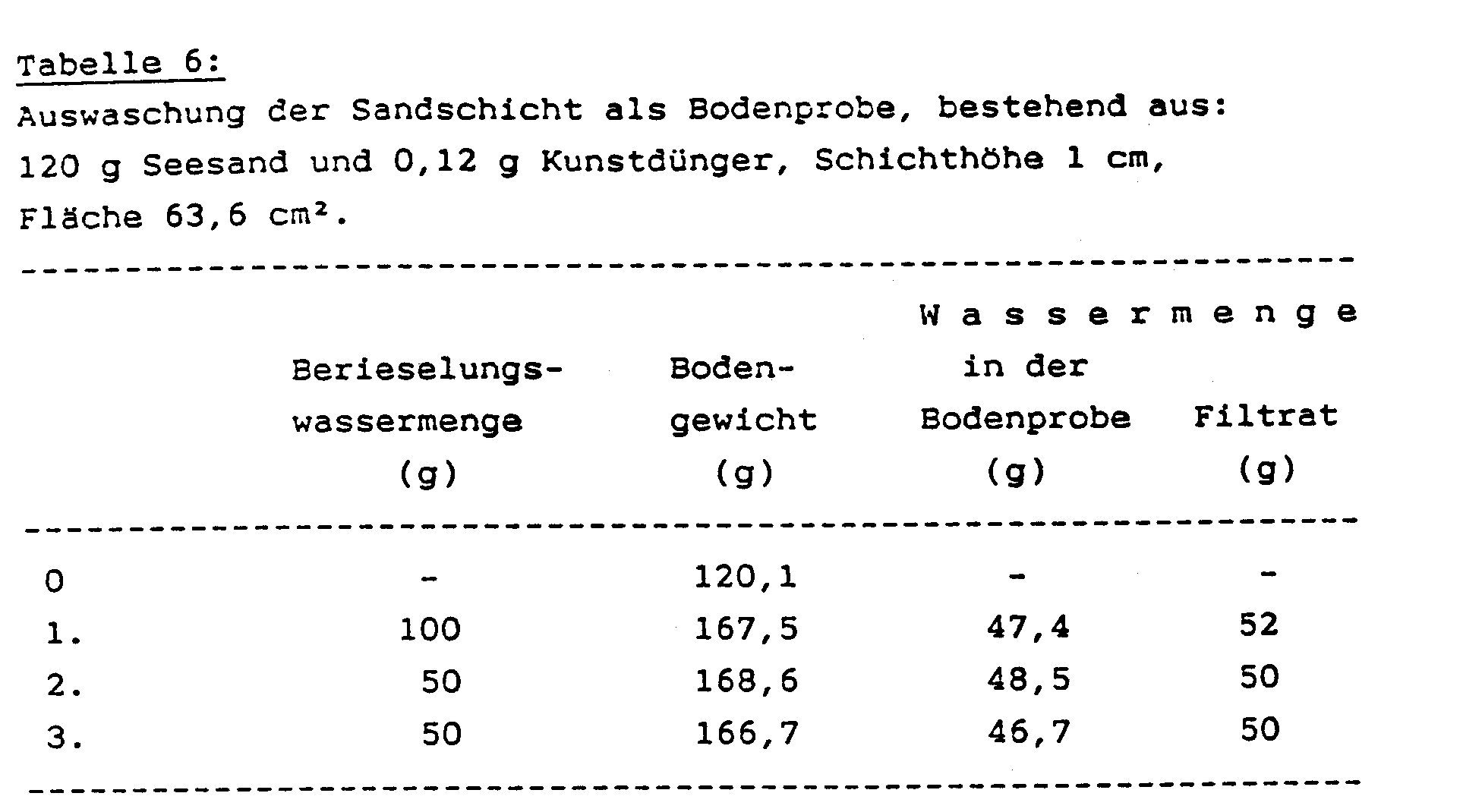


- 2. Zur Ermittlung der Auswaschbarkeit eines Düngemittels aus einer Bodenprobe mit Superabsorberzuatz wurden zunächst 20 Gew% Kunstdünger 17-17-17 in das Polymergel gemäß Beispiel 1 eingearbeitet, das Polymergel getrocknet und gemahlen. Die getrocknete düngemittelhaltige Probe (0,6 g) wurde dann mit 240 g feinem Seesand vermischt und wie im vorigen Fall mit Wasser mehrmals berieselt, wobei nach jeder Berieselung die ausgewaschene Düngemittelmenge im Filtrat ermittelt wurde. Nach fünfmaliger Berieselung wurde anschließend die feuchte Sandschicht noch zweimal mit Petri-Lösung durchgespült und der Düngemittelgehalt in der superabsorberhaltigen Sandschicht ermittelt.
- Die Ergebnisse sind in den Tabellen 8 und 9 zusammengefaßt.


- Wenn man jetzt die Tabellen 6 und 8 vergleicht, sieht man, daß die Auswaschung des Düngemittels aus der Sandschicht ohne Superabsorberzusatz bereits nach einmaliger Berieselung (Tabelle 6) zu 57 % erfolgte und nach zweimaliger Berieselung praktisch vollständig war (d.h. bis zu 97 %). Dagegen erfolgte bei einem Zusatz von düngemittelhaltigem Superabsorber zu gleicher Sandprobe die Auswaschung des Düngemittels aus der Sandschicht deutlich langsamer (s. Tabelle 8). Nach erster Berieselung der mit Wasser vollgesättigten Bodenprobe blieben noch 70 % und nach zweiter Berieselung immer noch 45 % des Düngemittels in der Sandschicht.
- Auch bei der Berieselung der vom Düngemittel ausgewaschenen Sandschicht mit Petri-Lösung (s. Tabellen 7 und 8) zeigte sich, daß mehr Düngemittel aus der Petri-Lösung in der Sandschicht gebunden blieb, in der das synthetische, vernetzte Polymerisat vorhanden war (Tabelle 9).
- Die zur Berieselung benutzte Wassermenge von 50 ml entspricht auf der Prüffläche von 63,6 cm2 einem Niederschlag von 7,86 mm. Die Gesamtmenge von Wasser (350 ml), die in der Tabelle 8 zur Berieselung benutzt wurde, entspricht daher einem in relativ kurzer Zeit gefallenen Niederschlag von 55,0 mm, was wiederum mit einem tropischen Starkregen (35 - 50 mm Niederschlag in 2 bis 3 Stunden) vergleichbar wäre. Bei einem Starkregen in unseren Klimatischen Bedingungen sind das nur 5 - 8 mm Niederschlag.
- Die Auswaschbarkeit des Düngemittels wurde in einer 2 cm dicken Schicht ermittelt, die mehrmals mit Wasser berieselt wurde. Durch diese relativ dünne Schicht konnte das Wasser schnell durchlaufen, so daß die Quellung des Superabsorbers, die zeitabhängig ist, nur unvollständig verlaufen konnte, wie man dies auch in Tabelle 8 (gebundene Wassermenge in der Bodenprobe) nach jeder jeweiligen Berieselung verfolgen kann. Trotzdem nimmt die gebundene Wassermenge in der Bodenprobe nach jeder Berieselung deutlich zu. Diese 2 cm dicke Schicht stellt die oberste Schicht der Erdprobe dar, die eigentlich vom Regen am meisten durchgespült wird. In einem den wirklichen Bedingungen bei der Pflanzenzüchtung entsprechenden Versuch mit einer Bodenschichtdicke von mehr als 2 cm wird der Wasserdurchlaufdurch diese dickere Bodenschicht langsamer, so daß noch mehr Wasser vom Superabsorber aufgenommen werden kann und dadurch auch weniger Düngemittel aus der Bodenschicht ausgewaschen wird.
Claims (12)
ein Polysaccharid oder Polysaccharidderivat, bevorzugt modifizierte Cellulose, Stärke, Dextrin oder Gummiharz bzw. ihre Abmischung, zugesetzt werden.
Applications Claiming Priority (2)
| Application Number | Priority Date | Filing Date | Title |
|---|---|---|---|
| DE4029591 | 1990-09-19 | ||
| DE4029591A DE4029591C2 (de) | 1990-09-19 | 1990-09-19 | Verfahren zur Herstellung von Absorptionsmaterial auf Polymerbasis mit Zusatz von wasserlöslichen Substanzen und Verwendung dieses Absorptionsmaterials zur Aufnahme und/oder zur nachfolgenden Abgabe von Wasser oder wäßrigen Lösungen |
Publications (3)
| Publication Number | Publication Date |
|---|---|
| EP0481226A1 true EP0481226A1 (de) | 1992-04-22 |
| EP0481226B1 EP0481226B1 (de) | 1994-06-08 |
| EP0481226B2 EP0481226B2 (de) | 2003-04-23 |
Family
ID=6414493
Family Applications (1)
| Application Number | Title | Priority Date | Filing Date |
|---|---|---|---|
| EP91115709A Expired - Lifetime EP0481226B2 (de) | 1990-09-19 | 1991-09-17 | Verfahren zur Herstellung von Wasserabsorptionsmaterial auf Polymerbasis und dessen Verwendung |
Country Status (5)
| Country | Link |
|---|---|
| US (1) | US5264471A (de) |
| EP (1) | EP0481226B2 (de) |
| AT (1) | ATE106774T1 (de) |
| DE (2) | DE4029591C2 (de) |
| ES (1) | ES2055502T3 (de) |
Cited By (7)
| Publication number | Priority date | Publication date | Assignee | Title |
|---|---|---|---|---|
| WO1994025519A1 (de) * | 1992-03-05 | 1994-11-10 | Chemische Fabrik Stockhausen Gmbh | Polymerzusammensetzung, absorptionsmaterialzusammensetzung, deren herstellung und verwendung |
| WO1994025521A1 (de) * | 1992-03-05 | 1994-11-10 | Chemische Fabrik Stockhausen Gmbh | Polymerzusammensetzungen, herstellung von polymerzusammensetzungen, insbesondere absorptionsmaterialien und deren verwendung |
| WO1994025520A1 (de) * | 1993-05-03 | 1994-11-10 | Chemische Fabrik Stockhausen Gmbh | Polymerzusammensetzung, absorptionsmaterialzusammensetzung, deren herstellung und verwendung |
| AU677581B2 (en) * | 1993-05-03 | 1997-05-01 | Chemische Fabrik Stockhausen Gmbh | Polymer compositions and their production, in particular absorbent materials, and their use |
| RU2126427C1 (ru) * | 1993-05-03 | 1999-02-20 | Штокхаузен ГбмХ унд Ко.КГ | Полимерная композиция и способ ее получения |
| EP0849228A3 (de) * | 1996-12-17 | 1999-04-21 | Nisshinbo Industries, Inc. | Verfahren und Trägerkörper zur Behandlung von Abwasser |
| US6329324B1 (en) | 1999-08-05 | 2001-12-11 | Stockhausen Gmbh & Co. Kg | Active substance-containing composition, its production and its use |
Families Citing this family (32)
| Publication number | Priority date | Publication date | Assignee | Title |
|---|---|---|---|---|
| DE4243340A1 (de) * | 1992-12-21 | 1994-06-23 | Sued Chemie Ag | Sorptionsmittel |
| US5973029A (en) * | 1993-10-12 | 1999-10-26 | The Sherwin-Williams Company | Corrosion-resistant waterborne paints |
| JPH09509592A (ja) * | 1994-02-17 | 1997-09-30 | ザ、プロクター、エンド、ギャンブル、カンパニー | 変性表面特性を有する多孔性吸収性材料およびその製法 |
| US5849405A (en) * | 1994-08-31 | 1998-12-15 | The Procter & Gamble Company | Absorbent materials having improved absorbent property and methods for making the same |
| US5843575A (en) * | 1994-02-17 | 1998-12-01 | The Procter & Gamble Company | Absorbent members comprising absorbent material having improved absorbent property |
| US5599335A (en) | 1994-03-29 | 1997-02-04 | The Procter & Gamble Company | Absorbent members for body fluids having good wet integrity and relatively high concentrations of hydrogel-forming absorbent polymer |
| US5849816A (en) * | 1994-08-01 | 1998-12-15 | Leonard Pearlstein | Method of making high performance superabsorbent material |
| US5549590A (en) * | 1994-08-01 | 1996-08-27 | Leonard Pearlstein | High performance absorbent particles and methods of preparation |
| US5858514A (en) * | 1994-08-17 | 1999-01-12 | Triton Digital Imaging Systems, Inc. | Coatings for vinyl and canvas particularly permitting ink-jet printing |
| IL118372A0 (en) * | 1995-05-23 | 1996-09-12 | Kobe Steel Ltd | Water-blocking composite and its preparation |
| US6495627B1 (en) * | 1995-07-11 | 2002-12-17 | Nihon Kohden Corporation | Conductive composition for biological electrode |
| DE19722340A1 (de) * | 1997-05-28 | 1998-12-03 | Clariant Gmbh | Wasserquellbare, hydrophile Polymerzusammensetzungen |
| DE19752127A1 (de) | 1997-11-25 | 1999-07-29 | Stockhausen Chem Fab Gmbh | Verfahren zur Herstellung von synthetischen Polymerisaten mit sehr niedrigem Restmonomergehalt, danach hergestellte Produkte und deren Verwendung |
| DE19752128A1 (de) * | 1997-11-25 | 1999-07-29 | Stockhausen Chem Fab Gmbh | Verfahren zur Herstellung von wasserlöslichen bzw. wasserquellbaren Polymerisaten mit sehr niedrigem Restmonomergehalt, danach hergestellte Produkte und deren Verwendung |
| US6639120B1 (en) | 1997-12-12 | 2003-10-28 | Kimberly-Clark Worldwide, Inc. | Structure having balanced pH profile |
| ZA9810779B (en) * | 1997-12-12 | 1999-09-21 | Kimberly Clark Co | Structure having balanced pH profile. |
| US6169223B1 (en) | 1999-02-08 | 2001-01-02 | Internationale Verbandstoff Fabrik Schaffhausen | Compress for medical treatment |
| DE19910267A1 (de) | 1999-03-08 | 2000-09-14 | Stockhausen Chem Fab Gmbh | Mischung aus einem pflanzlichen Rückstand und einem wasserabsorbierenden Polymerisat |
| DE19911114C2 (de) * | 1999-03-12 | 2003-03-20 | Titv Greiz | Fasermatte zur Förderung des Kulturpflanzenwachstums |
| US6423109B2 (en) * | 2000-01-19 | 2002-07-23 | Adjuvants Unlimited Inc. | Free flowing fertilizer composition with enhanced deposition/anti drift characteristics |
| WO2001070287A2 (en) * | 2000-03-21 | 2001-09-27 | Kimberly-Clark Worldwide, Inc. | Permanently wettable superabsorbent fibers |
| EP1296555A4 (de) | 2000-07-03 | 2004-04-28 | Nft Ind Llc | Durch kontrollierte freisetzung charakterisierte landwirtschaftliche produkte und verfahren zur herstellung derselben |
| DE10157350A1 (de) * | 2001-11-22 | 2003-05-28 | Stockhausen Chem Fab Gmbh | Herstellung von Wirkstoffzusammensetzung durch Extrudieren von wasserabsorbierenden Polymeren |
| CA2382419A1 (en) * | 2002-04-24 | 2003-10-24 | Le Groupe Lysac Inc. | Synergistic blends of polysaccharides as biodegradable absorbent materials or superabsorbents |
| KR20140095569A (ko) | 2006-02-28 | 2014-08-01 | 에보니크 데구사 게엠베하 | 우수한 흡수성과 보유성을 지니는 생분해성 초흡수성 중합체 조성물 |
| DE102006019400A1 (de) * | 2006-04-24 | 2007-10-25 | Stockhausen Gmbh | Farbige Superabsorber |
| WO2011141522A1 (de) | 2010-05-11 | 2011-11-17 | Geohumus International Research & Development Gmbh | Bioabbaubarer superabsorber |
| WO2011141526A1 (de) | 2010-05-11 | 2011-11-17 | Geohumus International Research & Development Gmbh | Bioabbaubares wasserquellbares hybridmaterial |
| WO2018233731A1 (de) | 2017-06-21 | 2018-12-27 | Geohumus Gmbh | Wasserquellbares hybridmaterial |
| KR102603201B1 (ko) * | 2018-12-11 | 2023-11-16 | 주식회사 엘지화학 | 고흡수성 수지 및 이의 제조 방법 |
| CN115259942A (zh) * | 2022-07-29 | 2022-11-01 | 青岛农业大学 | 一种聚合耐盐保水肥料及其制备方法 |
| JP2026522826A (ja) * | 2024-05-23 | 2026-07-09 | 香港▲紡▼▲織▼及成衣研▲発▼中心有限公司 | 肥料組成物及びその製造方法 |
Citations (3)
| Publication number | Priority date | Publication date | Assignee | Title |
|---|---|---|---|---|
| US4116899A (en) * | 1977-08-15 | 1978-09-26 | The United States Of America As Represented By The Secretary Of Agriculture | Increasing absorbency of polymeric compositions by curing |
| EP0071063A1 (de) * | 1981-07-16 | 1983-02-09 | Chemische Fabrik Stockhausen GmbH | Absorptionsmittel für Blut und seröse Körperflüssigkeiten |
| WO1987003208A1 (fr) * | 1985-11-22 | 1987-06-04 | Beghin-Say Sa | Procede de preparation d'une composition absorbant les liquides |
Family Cites Families (12)
| Publication number | Priority date | Publication date | Assignee | Title |
|---|---|---|---|---|
| AT214573B (de) * | 1959-12-17 | 1961-04-10 | Abbott Laboratories | |
| CH468192A (de) * | 1964-06-19 | 1969-02-15 | Ciba Geigy | Verfahren zur Herstellung von Arzneimitteln in Perlenform |
| US3577512A (en) * | 1968-10-11 | 1971-05-04 | Nat Patent Dev Corp | Sustained release tablets |
| US3900378A (en) * | 1971-11-01 | 1975-08-19 | Union Carbide Corp | Hydrogels from radiation crosslinked blends of hydrophilic polymers and fillers |
| CA1134981A (en) * | 1976-08-24 | 1982-11-02 | Robert H. Eikhof | Amendment for modifying soil matrices |
| US4110431A (en) * | 1976-11-12 | 1978-08-29 | Weyerhaeuser Company | Wet weather resistant binder composition for adhering a plant treatment additive powder formulation to plant foliage |
| GR76888B (de) * | 1981-08-07 | 1984-09-04 | Unilever Nv | |
| DE3314003A1 (de) * | 1983-04-18 | 1984-10-18 | Boehringer Ingelheim KG, 6507 Ingelheim | Teilbare tablette mit verzoegerter wirkstofffreigabe und verfahren zu deren herstellung |
| JPS60163956A (ja) * | 1984-02-04 | 1985-08-26 | Arakawa Chem Ind Co Ltd | 吸水性樹脂の製法 |
| US4666975A (en) * | 1984-03-05 | 1987-05-19 | Kao Corporation | Absorptive material |
| DE3641893A1 (de) * | 1986-12-08 | 1988-06-09 | Steen Hanfspinnerei | Faserhaltiges polymerprodukt mit hoher absorptionsfaehigkeit, verfahren zu dessen herstellung und verwendung |
| DE3741158A1 (de) * | 1987-12-04 | 1989-06-15 | Stockhausen Chem Fab Gmbh | Polymerisate mit hoher aufnahmegeschwindigkeit fuer wasser und waessrige fluessigkeiten, verfahren zu ihrer herstellung und verwendung als absorptionsmittel |
-
1990
- 1990-09-19 DE DE4029591A patent/DE4029591C2/de not_active Expired - Fee Related
-
1991
- 1991-09-17 ES ES91115709T patent/ES2055502T3/es not_active Expired - Lifetime
- 1991-09-17 EP EP91115709A patent/EP0481226B2/de not_active Expired - Lifetime
- 1991-09-17 US US07/761,073 patent/US5264471A/en not_active Expired - Lifetime
- 1991-09-17 AT AT91115709T patent/ATE106774T1/de active
- 1991-09-17 DE DE59101857T patent/DE59101857D1/de not_active Expired - Lifetime
Patent Citations (3)
| Publication number | Priority date | Publication date | Assignee | Title |
|---|---|---|---|---|
| US4116899A (en) * | 1977-08-15 | 1978-09-26 | The United States Of America As Represented By The Secretary Of Agriculture | Increasing absorbency of polymeric compositions by curing |
| EP0071063A1 (de) * | 1981-07-16 | 1983-02-09 | Chemische Fabrik Stockhausen GmbH | Absorptionsmittel für Blut und seröse Körperflüssigkeiten |
| WO1987003208A1 (fr) * | 1985-11-22 | 1987-06-04 | Beghin-Say Sa | Procede de preparation d'une composition absorbant les liquides |
Cited By (13)
| Publication number | Priority date | Publication date | Assignee | Title |
|---|---|---|---|---|
| AU681581B2 (en) * | 1992-03-05 | 1997-09-04 | Chemische Fabrik Stockhausen Gmbh | Polymer composition, absorbent material composition, their production and use |
| WO1994025521A1 (de) * | 1992-03-05 | 1994-11-10 | Chemische Fabrik Stockhausen Gmbh | Polymerzusammensetzungen, herstellung von polymerzusammensetzungen, insbesondere absorptionsmaterialien und deren verwendung |
| RU2126023C1 (ru) * | 1992-03-05 | 1999-02-10 | Штокхаузен Гмбх Унд Ко. Кг | Полимерная композиция и способ ее получения |
| WO1994025519A1 (de) * | 1992-03-05 | 1994-11-10 | Chemische Fabrik Stockhausen Gmbh | Polymerzusammensetzung, absorptionsmaterialzusammensetzung, deren herstellung und verwendung |
| US5847031A (en) * | 1993-05-03 | 1998-12-08 | Chemische Fabrik Stockhausen Gmbh | Polymer composition, absorbent composition, their production and use |
| AU681076B2 (en) * | 1993-05-03 | 1997-08-21 | Chemische Fabrik Stockhausen Gmbh | Polymer composition, absorbent material composition, their production and their use |
| AU677581B2 (en) * | 1993-05-03 | 1997-05-01 | Chemische Fabrik Stockhausen Gmbh | Polymer compositions and their production, in particular absorbent materials, and their use |
| WO1994025520A1 (de) * | 1993-05-03 | 1994-11-10 | Chemische Fabrik Stockhausen Gmbh | Polymerzusammensetzung, absorptionsmaterialzusammensetzung, deren herstellung und verwendung |
| RU2126427C1 (ru) * | 1993-05-03 | 1999-02-20 | Штокхаузен ГбмХ унд Ко.КГ | Полимерная композиция и способ ее получения |
| RU2146270C1 (ru) * | 1993-05-03 | 2000-03-10 | Хемише Фабрик Штокхаузен ГмбХ | Полимерные композиции и способы их получения |
| EP0849228A3 (de) * | 1996-12-17 | 1999-04-21 | Nisshinbo Industries, Inc. | Verfahren und Trägerkörper zur Behandlung von Abwasser |
| US6214619B1 (en) | 1996-12-17 | 2001-04-10 | Nisshinbo Industries, Inc. | Water swellable thermoplastic polyurethane gel bioreactor carrier containing a nutrient substance |
| US6329324B1 (en) | 1999-08-05 | 2001-12-11 | Stockhausen Gmbh & Co. Kg | Active substance-containing composition, its production and its use |
Also Published As
| Publication number | Publication date |
|---|---|
| DE4029591A1 (de) | 1992-03-26 |
| ATE106774T1 (de) | 1994-06-15 |
| EP0481226B2 (de) | 2003-04-23 |
| DE4029591C2 (de) | 1995-01-26 |
| EP0481226B1 (de) | 1994-06-08 |
| US5264471A (en) | 1993-11-23 |
| DE59101857D1 (de) | 1994-07-14 |
| ES2055502T3 (es) | 1994-08-16 |
Similar Documents
| Publication | Publication Date | Title |
|---|---|---|
| EP0481226B1 (de) | Verfahren zur Herstellung von Wasserabsorptionsmaterial auf Polymerbasis und dessen Verwendung | |
| EP0476574B1 (de) | Verfahren zur Herstellung von Wasseradsorptionsmaterial und dessen Verwendung in Hygieneartikeln und zur Bodenverbesserung | |
| DE4029592C2 (de) | Quellmittel und Absorptionsmittel auf Polymerbasis mit verbesserter Abbaubarkeit und verbesserter Absorption von Wasser, wäßrigen Lösungen und Körperflüssigkeiten sowie ihre Verwendung zur Herstellung von Hygieneartikeln und zur Bodenverbesserung | |
| EP0736060B1 (de) | Vernetzte synthetische polymerisate mit poröser struktur | |
| EP0318989B1 (de) | Polymerisate mit hoher Aufnahmegeschwindigkeit für wässrige Flüssigkeiten | |
| EP1165631B1 (de) | Pulverförmige, vernetzte, wässrige flüssigkeiten sowie blut absorbierende polymere, verfahren zu ihrer herstellung und ihre verwendung | |
| EP0721354B1 (de) | Pulverförmige, wässrige flüssigkeiten absorbierende polymere, verfahren zu ihrer herstellung und ihre verwendung als absorptionsmittel | |
| DE60038504T2 (de) | Superabsorbierende polymere mit einer langsamen absorptionsrate | |
| DE19529348C2 (de) | Absorptionsmittel für Wasser und wäßrige Flüssigkeiten auf Polyacrylatbasis sowie Verfahren zu ihrer Herstellung und Verwendung | |
| DE10130427A1 (de) | Stabile, wasserquellbare und -saugende anionische Polymere mit Schwammstruktur sowie deren Herstellung und Verwendung | |
| DE10125599A1 (de) | Superabsorber, Verfahren zu ihrer Herstellung und ihre Verwendung | |
| EP1210383A1 (de) | Polymerzusammensetzung und ein verfahren zu dessen herstellung | |
| DE2712043A1 (de) | Verfahren zur erhoehung der absorptionsrate von acrylamidpolymerisaten fuer wasser oder salzloesung und mittel zu seiner durchfuehrung | |
| DE4244548A1 (de) | Pulverförmige, unter Belastung wäßrige Flüssigkeiten sowie Blut absorbierende Polymere, Verfahren zu ihrer Herstellung und ihre Verwendung in textilen Konstruktionen für die Körperhygiene | |
| DE102005018922A1 (de) | Mit Polykationen oberflächenbehandeltes wasserabsorbierendes Polymergebilde | |
| WO2003022316A1 (de) | Super-absorbierende hydrogele bestimmter teilchengroessenverteilung | |
| WO1997019116A1 (de) | Flüssigkeitsabsorbierende polymere, verfahren zu deren herstellung und deren verwendung | |
| DE102005004285A1 (de) | Wasserlösliche oder wasserquellbare Polymerisate, insbesondere wasserlösliche oder wasserquellbare Copolymere aus Acrylamid und mindestens einem ionischen Comonomeren mit niedrigem Restmonomerengehalt | |
| EP2773691B1 (de) | Superabsorbierende polymere für hochgefüllte oder faserfreie hygieneartikel | |
| DE3887187T2 (de) | Verfahren zur Herstellung eines Polymers mit hoher Wasseraufnahme. | |
| DE19813443A1 (de) | Wasser- und wäßrige Flüssigkeiten absorbierende Polymerisatteilchen, Verfahren zu ihrer Herstellung und ihre Verwendung | |
| DE3917646C1 (en) | Agglomeration of natural or synthetic polymer powder - obtd. by agglomerating small sized fractions of powder in presence of soln. or dispersion of agglomerating aid | |
| EP2912110B1 (de) | Geruchs- und farbstabile wasserabsorbierende zusammensetzung | |
| WO2002058841A2 (de) | Wasserabsorbierendes mittel, verfahren zu seiner herstellung und seine verwendung | |
| DE20221830U1 (de) | Feststoffhaltige, wasserabsorbierende, anionische Polymere mit Schwammstruktur |
Legal Events
| Date | Code | Title | Description |
|---|---|---|---|
| PUAI | Public reference made under article 153(3) epc to a published international application that has entered the european phase |
Free format text: ORIGINAL CODE: 0009012 |
|
| 17P | Request for examination filed |
Effective date: 19910919 |
|
| AK | Designated contracting states |
Kind code of ref document: A1 Designated state(s): AT BE CH DE DK ES FR GB GR IT LI LU NL SE |
|
| 17Q | First examination report despatched |
Effective date: 19930125 |
|
| GRAA | (expected) grant |
Free format text: ORIGINAL CODE: 0009210 |
|
| AK | Designated contracting states |
Kind code of ref document: B1 Designated state(s): AT BE CH DE DK ES FR GB GR IT LI LU NL SE |
|
| REF | Corresponds to: |
Ref document number: 106774 Country of ref document: AT Date of ref document: 19940615 Kind code of ref document: T |
|
| REF | Corresponds to: |
Ref document number: 59101857 Country of ref document: DE Date of ref document: 19940714 |
|
| ET | Fr: translation filed | ||
| REG | Reference to a national code |
Ref country code: ES Ref legal event code: FG2A Ref document number: 2055502 Country of ref document: ES Kind code of ref document: T3 |
|
| ITF | It: translation for a ep patent filed | ||
| PGFP | Annual fee paid to national office [announced via postgrant information from national office to epo] |
Ref country code: SE Payment date: 19940825 Year of fee payment: 4 |
|
| REG | Reference to a national code |
Ref country code: GR Ref legal event code: FG4A Free format text: 3012331 |
|
| PGFP | Annual fee paid to national office [announced via postgrant information from national office to epo] |
Ref country code: LU Payment date: 19940901 Year of fee payment: 4 |
|
| PGFP | Annual fee paid to national office [announced via postgrant information from national office to epo] |
Ref country code: CH Payment date: 19940909 Year of fee payment: 4 |
|
| PGFP | Annual fee paid to national office [announced via postgrant information from national office to epo] |
Ref country code: AT Payment date: 19940912 Year of fee payment: 4 Ref country code: BE Payment date: 19940912 Year of fee payment: 4 Ref country code: ES Payment date: 19940912 Year of fee payment: 4 |
|
| PGFP | Annual fee paid to national office [announced via postgrant information from national office to epo] |
Ref country code: GR Payment date: 19940916 Year of fee payment: 4 |
|
| GBT | Gb: translation of ep patent filed (gb section 77(6)(a)/1977) |
Effective date: 19940823 |
|
| PGFP | Annual fee paid to national office [announced via postgrant information from national office to epo] |
Ref country code: DK Payment date: 19940929 Year of fee payment: 4 |
|
| PGFP | Annual fee paid to national office [announced via postgrant information from national office to epo] |
Ref country code: NL Payment date: 19940930 Year of fee payment: 4 |
|
| EAL | Se: european patent in force in sweden |
Ref document number: 91115709.7 |
|
| PLBI | Opposition filed |
Free format text: ORIGINAL CODE: 0009260 |
|
| 26 | Opposition filed |
Opponent name: BASF AKTIENGESELLSCHAFT, LUDWIGSHAFEN Effective date: 19950306 |
|
| NLR1 | Nl: opposition has been filed with the epo |
Opponent name: BASF AG |
|
| PG25 | Lapsed in a contracting state [announced via postgrant information from national office to epo] |
Ref country code: LU Free format text: LAPSE BECAUSE OF NON-PAYMENT OF DUE FEES Effective date: 19950917 Ref country code: DK Effective date: 19950917 Ref country code: AT Effective date: 19950917 |
|
| PG25 | Lapsed in a contracting state [announced via postgrant information from national office to epo] |
Ref country code: SE Effective date: 19950918 |
|
| PG25 | Lapsed in a contracting state [announced via postgrant information from national office to epo] |
Ref country code: LI Effective date: 19950930 Ref country code: BE Effective date: 19950930 Ref country code: CH Effective date: 19950930 |
|
| BERE | Be: lapsed |
Owner name: CHEMISCHE FABRIK STOCKHAUSEN G.M.B.H. Effective date: 19950930 |
|
| PG25 | Lapsed in a contracting state [announced via postgrant information from national office to epo] |
Ref country code: GR Free format text: THE PATENT HAS BEEN ANNULLED BY A DECISION OF A NATIONAL AUTHORITY Effective date: 19960331 |
|
| PG25 | Lapsed in a contracting state [announced via postgrant information from national office to epo] |
Ref country code: NL Effective date: 19960401 |
|
| REG | Reference to a national code |
Ref country code: CH Ref legal event code: PL |
|
| REG | Reference to a national code |
Ref country code: GR Ref legal event code: MM2A Free format text: 3012331 |
|
| NLV4 | Nl: lapsed or anulled due to non-payment of the annual fee |
Effective date: 19960401 |
|
| EUG | Se: european patent has lapsed |
Ref document number: 91115709.7 |
|
| RDAH | Patent revoked |
Free format text: ORIGINAL CODE: EPIDOS REVO |
|
| APAC | Appeal dossier modified |
Free format text: ORIGINAL CODE: EPIDOS NOAPO |
|
| APAE | Appeal reference modified |
Free format text: ORIGINAL CODE: EPIDOS REFNO |
|
| APAC | Appeal dossier modified |
Free format text: ORIGINAL CODE: EPIDOS NOAPO |
|
| APAE | Appeal reference modified |
Free format text: ORIGINAL CODE: EPIDOS REFNO |
|
| PG25 | Lapsed in a contracting state [announced via postgrant information from national office to epo] |
Ref country code: ES Free format text: LAPSE BECAUSE OF THE APPLICANT RENOUNCES Effective date: 19991201 |
|
| REG | Reference to a national code |
Ref country code: ES Ref legal event code: FD2A Effective date: 19991007 |
|
| APAC | Appeal dossier modified |
Free format text: ORIGINAL CODE: EPIDOS NOAPO |
|
| REG | Reference to a national code |
Ref country code: GB Ref legal event code: IF02 |
|
| PLAW | Interlocutory decision in opposition |
Free format text: ORIGINAL CODE: EPIDOS IDOP |
|
| PLAW | Interlocutory decision in opposition |
Free format text: ORIGINAL CODE: EPIDOS IDOP |
|
| PUAH | Patent maintained in amended form |
Free format text: ORIGINAL CODE: 0009272 |
|
| STAA | Information on the status of an ep patent application or granted ep patent |
Free format text: STATUS: PATENT MAINTAINED AS AMENDED |
|
| 27A | Patent maintained in amended form |
Effective date: 20030423 |
|
| AK | Designated contracting states |
Designated state(s): AT BE CH DE DK ES FR GB GR IT LI LU NL SE |
|
| GBTA | Gb: translation of amended ep patent filed (gb section 77(6)(b)/1977) | ||
| ET3 | Fr: translation filed ** decision concerning opposition | ||
| PGFP | Annual fee paid to national office [announced via postgrant information from national office to epo] |
Ref country code: FR Payment date: 20050819 Year of fee payment: 15 |
|
| PG25 | Lapsed in a contracting state [announced via postgrant information from national office to epo] |
Ref country code: IT Free format text: LAPSE BECAUSE OF NON-PAYMENT OF DUE FEES;WARNING: LAPSES OF ITALIAN PATENTS WITH EFFECTIVE DATE BEFORE 2007 MAY HAVE OCCURRED AT ANY TIME BEFORE 2007. THE CORRECT EFFECTIVE DATE MAY BE DIFFERENT FROM THE ONE RECORDED. Effective date: 20050917 |
|
| APAH | Appeal reference modified |
Free format text: ORIGINAL CODE: EPIDOSCREFNO |
|
| PGFP | Annual fee paid to national office [announced via postgrant information from national office to epo] |
Ref country code: GB Payment date: 20060821 Year of fee payment: 16 |
|
| REG | Reference to a national code |
Ref country code: FR Ref legal event code: ST Effective date: 20070531 |
|
| PG25 | Lapsed in a contracting state [announced via postgrant information from national office to epo] |
Ref country code: FR Free format text: LAPSE BECAUSE OF NON-PAYMENT OF DUE FEES Effective date: 20061002 |
|
| GBPC | Gb: european patent ceased through non-payment of renewal fee |
Effective date: 20070917 |
|
| PG25 | Lapsed in a contracting state [announced via postgrant information from national office to epo] |
Ref country code: GB Free format text: LAPSE BECAUSE OF NON-PAYMENT OF DUE FEES Effective date: 20070917 |
|
| PG25 | Lapsed in a contracting state [announced via postgrant information from national office to epo] |
Ref country code: ES Free format text: LAPSE BECAUSE OF THE APPLICANT RENOUNCES Effective date: 19950930 |
|
| REG | Reference to a national code |
Ref country code: FR Ref legal event code: CD Ref country code: FR Ref legal event code: TP |
|
| PGFP | Annual fee paid to national office [announced via postgrant information from national office to epo] |
Ref country code: DE Payment date: 20090922 Year of fee payment: 19 |
|
| REG | Reference to a national code |
Ref country code: DE Ref legal event code: R119 Ref document number: 59101857 Country of ref document: DE Effective date: 20110401 |
|
| PG25 | Lapsed in a contracting state [announced via postgrant information from national office to epo] |
Ref country code: DE Free format text: LAPSE BECAUSE OF NON-PAYMENT OF DUE FEES Effective date: 20110401 |