EP0481279A2 - Procédé de pliage spatial par roulage et étirage en combinaison avec une machine de pliage à mandrin - Google Patents
Procédé de pliage spatial par roulage et étirage en combinaison avec une machine de pliage à mandrin Download PDFInfo
- Publication number
- EP0481279A2 EP0481279A2 EP91116744A EP91116744A EP0481279A2 EP 0481279 A2 EP0481279 A2 EP 0481279A2 EP 91116744 A EP91116744 A EP 91116744A EP 91116744 A EP91116744 A EP 91116744A EP 0481279 A2 EP0481279 A2 EP 0481279A2
- Authority
- EP
- European Patent Office
- Prior art keywords
- mandrel
- profile
- bending
- station
- bent
- Prior art date
- Legal status (The legal status is an assumption and is not a legal conclusion. Google has not performed a legal analysis and makes no representation as to the accuracy of the status listed.)
- Granted
Links
Images


Classifications
-
- B—PERFORMING OPERATIONS; TRANSPORTING
- B21—MECHANICAL METAL-WORKING WITHOUT ESSENTIALLY REMOVING MATERIAL; PUNCHING METAL
- B21D—WORKING OR PROCESSING OF SHEET METAL OR METAL TUBES, RODS OR PROFILES WITHOUT ESSENTIALLY REMOVING MATERIAL; PUNCHING METAL
- B21D9/00—Bending tubes using mandrels or the like
- B21D9/05—Bending tubes using mandrels or the like co-operating with forming members
- B21D9/07—Bending tubes using mandrels or the like co-operating with forming members with one or more swinging forming members engaging tube ends only
- B21D9/073—Bending tubes using mandrels or the like co-operating with forming members with one or more swinging forming members engaging tube ends only with one swinging forming member
Definitions
- the invention relates to a spatial roll-stretch bending process in connection with a mandrel bending station and to the device for carrying out the process, the profile to be bent first being clamped at both ends and subjected to a pretension and then the profile being bent, and in this case at least one profile roll of a profile rolling station in the forming area pressed to the profile and three-dimensionally tracked.
- the essence of the invention is therefore that the mandrel bending station or the one or more mandrels of this station perform the same, possibly three-dimensional movement of the profile rollers of the profile roller station. Accordingly, as soon as the profile rolls are tracked three-dimensionally on the profile to be bent, the mandrel is likewise moved three-dimensionally. This movement in the area of the bending mandrel was previously unknown in the prior art. In the previously known methods, only a stationary mandrel was used. In the invention, however, the mandrel moves in all room levels, i.e. in the X, Y and in the direction of rotation and follows the movement of the profile rollers, the profile rollers being pressed from the outside onto the profile to be bent or onto the bending mandrel.
- the cavity of the profile is generally known to be filled in with a mandrel during the bending process, however, these methods usually only take place in a single bending plane. It is only known here to bend such simple profiles in the plane with a constant radius, the mandrel bending station remaining with the mandrel. It is known to arrange the mandrel holding station stationary beyond the workpiece clamping station, and to guide the mandrel to be held, which fills the closed or partially open cross section of the profile to be bent, through the clamping station in order to introduce this mandrel into the workpiece and to hold it in the workpiece .
- the mandrel always remains in the same place, namely at the bending point, and that the mandrel bending station (or mandrel holding station) is therefore also fixed when bending uniform radii. After bending, the mandrel can be hydraulically withdrawn from the bending zone so that the bent workpiece can be easily removed.
- the object of the present invention is therefore to provide a method for operating a mandrel bending station and a mandrel bending station for carrying out the method in such a way that closed or partially open profiles can be bent using the known spatial roll-stretch bending method.
- the method is thereby used to solve the problem characterized in that the mandrel bending station moves in motion congruence with the profile roller station, which profile roller station with corresponding profile rollers lies opposite the workpiece on the bending template and that the mandrel held in the cross section of the workpiece to be bent is rotatably mounted, for example, in the mandrel bending station.
- the mandrel is positively received in the profile to be bent and that a mandrel holding rod engages in the mandrel, which is connected to the mandrel via a pivot bearing.
- the mandrel is non-rotatably connected to the mandrel holding rod and that the mandrel holding rod is rotatably held in the mandrel bending station.
- the mandrel is non-rotatably connected to the mandrel holding rod and that the mandrel rod is positively controlled rotatably connected to the mandrel bending station and moves congruently with the clamping head to the left or right to initiate a torsion.
- the method according to the invention is not only for the known RASB method (spatial roll-stretch-bending process), but also for an ASB process (roll-stretch-bending process) in which the profile is bent only in one level, e.g. the XY plane, while in the other RASB method the bend is made in a total of 3 spatial axes (X, Y, Z) with a possible additional torsion option.
- This torsion option is also possible with the known ASB processes. This makes it possible to curve through the moving XY axis to bend different bending radii. Instead, it is also possible to generate the bend in the XY plane not by moving the axis of rotation, but by moving the profile roller station relative to the bending point.
- This clamping station thus follows the workpiece itself when the profile is "wound up" on the bending template in the longitudinal direction of the workpiece, that is to say in the X direction, while the mandrel bending station or mandrel holding station has a completely different function, which consists in the mandrel always in motion -Congruence with the profile roller station at the bending point of the workpiece to be bent.
- the holding station therefore makes the same movement in the Y direction as the roller bending station and the mandrel bending station, but only in the Y direction, while the clamping station executes a completely different movement sequence in the X direction.
- protection is also claimed for special mandrel shapes which are held and guided by the mandrel bending station.
- the mandrel is a simple, rod-shaped tool which, in accordance with the two previously described exemplary embodiments, is either rotatably mounted on a mandrel holding rod or is fastened in a rotationally fixed manner to a mandrel holding rod, which in turn (in this second exemplary embodiment) is rotatably received in the receiving chuck of the mandrel holding station.
- a third embodiment provides for the mandrel to be rotated under forced control.
- the mandrel holding rod can be rotatably stored in a receiving chuck of the mandrel holding station or, in the third embodiment, rotated in a positively controlled manner.
- a further embodiment of a mandrel is provided.
- double profiles can also be bent with the mandrel holding station.
- Double profiles of this type are two coaxially guided profiles which are at a mutual radial distance from one another.
- a correspondingly adapted mandrel is necessary, for which separate protection is claimed in the context of the present invention.
- Such a mandrel initially consists of an inner mandrel holding rod which is connected to an inner mandrel in accordance with the two previously mentioned exemplary embodiments. This inner mandrel serves to support the inner profile of the inner one Coaxial profile tube.
- a further profile-shaped mandrel is provided, which extends into the space between the outer circumference of the inner profile and the inner circumference of the outer profile is inserted and moved synchronously with the inner mandrel.
- the outer profile mandrel has a separate mandrel holding rod, which is accordingly also designed as a hollow profile tube and coaxially surrounds the other, radially inner mandrel holding rod.
- the two mandrel holding rods are therefore clamped into one another in the mandrel holding station according to the invention as coaxial profile tubes.
- coaxial hollow profiles can be bent at the same time, always ensuring that the radial space between the inner profile and the outer profile remains constant, regardless of the bending radius and the bending shape in the three spatial levels.
- double mandrel bending station or double mandrel holding station can also be used in conventionally known standard systems, e.g. after the ASB process, and can also be used in normal pipe mandrel bending systems, such as those used in exhaust pipe production.
- the profile shape of the mandrels is adapted to the cross section of the profile to be bent. This means that any profile shapes of workpieces can be bent and a profile shape of the mandrel must accordingly be selected, which is positively on the inner circumference of the workpiece to be bent.
- the profile shape of the inner mandrel deviates from the profile shape of the outer mandrel, so that coaxial profiles can also be bent, the coaxially internal profile being completely has a different profile shape than the coaxial external profile.
- the inner circumference of the coaxially inner profile is shaped differently than the outer circumference of this profile and that the inner circumference of the coaxially outer profile is shaped differently than its outer circumference.
- the inner and outer surfaces of the mandrels lying coaxially one inside the other are then selected in accordance with these different possibilities.
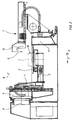
- the system essentially consists of a bending tool 1, which is firmly attached to a turntable 2.
- the workpiece 16 to be bent bears positively on the outer circumference of the bending tool 1.
- the turntable 2 is rotatably driven and is otherwise received by a turntable bracket 3 which is fastened to a slide 4 which can be moved in the Z direction.
- the slide guide of the Z-slide 4 in turn is held pivotably in a pivot bearing 5, which pivot bearing 5 is rotatably driven about the axis 6.
- the profile roller bending station 7 is shifted downward in the direction of the arrow X in order to make the bending point visible.
- the workpiece itself is not shown in FIG. 1, but the mandrel arrangement feeding in the interior of the workpiece.
- the mandrel arrangement here consists of a mandrel 15 which is arranged on the front of a mandrel holding rod 14.
- the mandrel holding rod 14 extends through a clamping head 18 of a clamping station 12 and is received in the holding head 19 of a mandrel bending station 13.
- the workpiece 16 to be bent is, on the one hand, clamped firmly on the bending tool 1 on the turntable 2 and, on the other hand, is clamped firmly with its other end in the clamping head 18 of the clamping station 12.
- Figure 2 of the profile roll bending station only a curved rail 10 is shown, in which the brackets for the Profile rollers 8 are added. Furthermore, the bending point 9 is shown schematically, so that it can be seen that the profile rollers 8 are arranged in the profile roller bending station 7 so that they always follow the bending point 9 moving in the three spatial levels.
- FIG. 3 shows a first embodiment of the mounting of a mandrel 15 on a mandrel holding rod 14. It can be seen that the mandrel 15 bears in a form-fitting manner in the inner profile of the workpiece 16 and the mandrel 15 is rotatably connected to the mandrel holding rod 14 via a pivot bearing 17, which in turn is connected is rotatably received in the holding head 19 of the mandrel bending station 13.
- the mandrel 15 is connected in a rotationally fixed manner to the mandrel holding rod 14, for example by means of a thread, and that the mandrel holding rod 14 is then rotatably mounted in the holding head 19 by means of a pivot bearing (not shown).
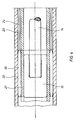
- FIG. 4 shows a double mandrel arrangement as used according to the invention for bending in the X, Y and Z directions of coaxial tubes.
- an inner profile 21 is in the inner circumference of an outer profile 22 arranged, the two profiles a space 23 between them form.
- the double mandrel arrangement consists of an outer hollow mandrel 22 which is inserted into the space 23 between the inner circumference of the outer profile 22 and the outer circumference of the inner profile 21.
- the hollow mandrel 20 is connected via the two previously described storage methods to a hollow mandrel holding rod 24, which in turn is received in the holding head 19 of the mandrel bending station 13.
- the outer circumference of the mandrel 15 bears in a form-fitting manner on the inner circumference of the inner profile 21, which in turn is connected to the mandrel holding rod 14 via the two previously described holding options.
- the mandrel holding rod 14 is guided coaxially in the interior of the hollow mandrel rod 24 and is also received in the holding head 19 of the mandrel bending station 13.
- the bending point 9 remains stationary in the Z plane because the workpiece 16 itself moves in the Z direction on the rotary table.
- the bending point 9 therefore only moves in the X or Y direction, depending on which contour is intended for the workpiece to be bent.
- the profile roller station only has to move in the X or Y direction; as well as the clamping station 12 and the mandrel bending station 13.
- Such a double-profile tube arrangement is thus held in the clamping station 12 with a correspondingly coaxial clamping head 18, whereby after the bending has been carried out and after the application of possibly several bends in series, an arbitrarily spatially shaped double profile can be bent, always ensuring that the two profiles remain the same Have space 23 also in the bending point.
- profiles of any shape can be bent in the three spatial axes, the profiles - if it is a coaxial arrangement - can have different external and internal profiles, and despite these different profiles when used accordingly profiled mandrels can also be bent such complicated profile shapes.
Landscapes
- Engineering & Computer Science (AREA)
- Mechanical Engineering (AREA)
- Bending Of Plates, Rods, And Pipes (AREA)
- Shaping Of Tube Ends By Bending Or Straightening (AREA)
- Casting Or Compression Moulding Of Plastics Or The Like (AREA)
Applications Claiming Priority (2)
| Application Number | Priority Date | Filing Date | Title |
|---|---|---|---|
| DE4033031A DE4033031A1 (de) | 1990-10-18 | 1990-10-18 | Raeumliches abroll-streckbiegeverfahren in zusammenhang mit einer dornbiegestation |
| DE4033031 | 1990-10-18 |
Publications (3)
| Publication Number | Publication Date |
|---|---|
| EP0481279A2 true EP0481279A2 (fr) | 1992-04-22 |
| EP0481279A3 EP0481279A3 (en) | 1992-10-21 |
| EP0481279B1 EP0481279B1 (fr) | 1994-06-08 |
Family
ID=6416517
Family Applications (1)
| Application Number | Title | Priority Date | Filing Date |
|---|---|---|---|
| EP91116744A Expired - Lifetime EP0481279B1 (fr) | 1990-10-18 | 1991-10-01 | Procédé de pliage spatial par roulage et étirage en combinaison avec une machine de pliage à mandrin |
Country Status (6)
| Country | Link |
|---|---|
| US (1) | US5333481A (fr) |
| EP (1) | EP0481279B1 (fr) |
| JP (1) | JPH04258318A (fr) |
| AT (1) | ATE106783T1 (fr) |
| DE (2) | DE4033031A1 (fr) |
| ES (1) | ES2057705T3 (fr) |
Cited By (1)
| Publication number | Priority date | Publication date | Assignee | Title |
|---|---|---|---|---|
| EP0546319A1 (fr) * | 1991-12-10 | 1993-06-16 | Walter E. Späth | Procédé de pliage par étirage de profils creux et machine de pliage par étirage à mandrin |
Families Citing this family (1)
| Publication number | Priority date | Publication date | Assignee | Title |
|---|---|---|---|---|
| JP4031827B2 (ja) * | 2002-10-10 | 2008-01-09 | 三桜工業株式会社 | 二重管の曲げ方法 |
Family Cites Families (13)
| Publication number | Priority date | Publication date | Assignee | Title |
|---|---|---|---|---|
| DE162751C (fr) * | ||||
| US1587931A (en) * | 1923-10-11 | 1926-06-08 | Wolders Cornelis Theodorus | Tube-bending machine |
| US1982164A (en) * | 1932-12-08 | 1934-11-27 | Gustav A Hoener | Bending machine |
| US3121538A (en) * | 1960-11-28 | 1964-02-18 | Westinghouse Electric Corp | Coil winding apparatus |
| US3339391A (en) * | 1964-12-04 | 1967-09-05 | Ben C Kowalski | Stretch bending machine |
| DE1627531C3 (de) * | 1967-09-01 | 1974-08-22 | Arog Armaturen + Apparate + Roehren Gmbh, 4630 Bochum-Gerthe | Einrichtung zur Herstellung von Mantelrohrbogen |
| DE2101162A1 (de) * | 1971-01-12 | 1972-07-20 | J. Banning Ag, 4700 Hamm | Rohrbiegemaschine |
| US4009601A (en) * | 1975-01-24 | 1977-03-01 | K.K. Shimizu Seisakusho | Method of and apparatus for bending a double pipe |
| DE2746721C3 (de) * | 1977-10-18 | 1981-03-19 | Schwarze, Rigobert, Dipl.-Ing., 5000 Köln | Rohrbiegemaschine |
| US4238945A (en) * | 1978-12-22 | 1980-12-16 | Rigobert Schwarze | Apparatus for bending a jacketed tube |
| DE3415077C1 (de) * | 1984-04-21 | 1985-09-05 | Schmitz & Brill GmbH & Co. KG, 5950 Finnentrop | Verfahren zum Herstellen von doppelwandigen,gekruemmten Rohrabschnitten fuer Abgasanlagen an Kraftfahrzeugen od.dgl. und Werkzeug zur Durchfuehrung des Verfahrens |
| DE3618701A1 (de) * | 1986-06-04 | 1987-12-10 | Spaeth Gmbh & Co Kg Stahlbau B | Verfahren und vorrichtung zum kaltumformen von profilen aus eisen- und nichteisenmetallen |
| DE3719033C2 (de) * | 1987-06-06 | 1995-09-14 | Schwarze Rigobert | Rohrbiegemaschine mit Biegedorn |
-
1990
- 1990-10-18 DE DE4033031A patent/DE4033031A1/de not_active Withdrawn
-
1991
- 1991-10-01 AT AT91116744T patent/ATE106783T1/de active
- 1991-10-01 EP EP91116744A patent/EP0481279B1/fr not_active Expired - Lifetime
- 1991-10-01 ES ES91116744T patent/ES2057705T3/es not_active Expired - Lifetime
- 1991-10-01 DE DE59101858T patent/DE59101858D1/de not_active Expired - Fee Related
- 1991-10-16 US US07/776,068 patent/US5333481A/en not_active Expired - Fee Related
- 1991-10-18 JP JP3271367A patent/JPH04258318A/ja active Pending
Cited By (1)
| Publication number | Priority date | Publication date | Assignee | Title |
|---|---|---|---|---|
| EP0546319A1 (fr) * | 1991-12-10 | 1993-06-16 | Walter E. Späth | Procédé de pliage par étirage de profils creux et machine de pliage par étirage à mandrin |
Also Published As
| Publication number | Publication date |
|---|---|
| EP0481279A3 (en) | 1992-10-21 |
| JPH04258318A (ja) | 1992-09-14 |
| EP0481279B1 (fr) | 1994-06-08 |
| DE59101858D1 (de) | 1994-07-14 |
| US5333481A (en) | 1994-08-02 |
| DE4033031A1 (de) | 1992-04-23 |
| ATE106783T1 (de) | 1994-06-15 |
| ES2057705T3 (es) | 1994-10-16 |
Similar Documents
| Publication | Publication Date | Title |
|---|---|---|
| DE3635169C2 (fr) | ||
| AT391440B (de) | Verfahren und vorrichtung zum handhaben von gegenstaenden mittels kontinuierlich bewegter arbeitsmittel | |
| DE69700915T2 (de) | Maschine zum biegen oder wölben von profilen und biegekopf für solche maschine | |
| DE10011755A1 (de) | Verfahren und Vorrichtung zum Herstellen von Bauteilen mit über der Länsachse veränderlichen Querschnitten | |
| EP0492211B1 (fr) | Procédé de pliage de profilés creux en métal et dispositif pour l'exécution du procédé | |
| EP2691195A1 (fr) | Tête de pliage pour plier des pièces en forme de barre et de tube | |
| DE3601231A1 (de) | Verfahren zum automatischen biegen metallischer rohre und vorrichtung zur durchfuehrung des verfahrens | |
| DE2840773C2 (de) | Halte- und Führungskorb für den Dorn eines Walzwerks | |
| EP1863604B1 (fr) | Dispositif de formage libre de profiles allonges, en particulier de tubes, et dispositif combine de formage libre et d'etirage de profiles allonges, en particulier de tubes | |
| EP2289643B1 (fr) | Dispositif pour le pliage de longues pièces usinées | |
| DE19717232A1 (de) | Verfahren und Vorrichtung zum dreidimensionalen Biegen von Metall-Hohlprofilen | |
| EP1350577A1 (fr) | Machine de pliage des pièces en forme de barre ou tige, en particulier des tubes | |
| EP0546319A1 (fr) | Procédé de pliage par étirage de profils creux et machine de pliage par étirage à mandrin | |
| EP0949021A2 (fr) | Dispositif pour le formage de fil ayant un dispositif de freinage de fil | |
| DE3322194A1 (de) | Verfahren zur herstellung flexibler rohrkoerper, vorrichtung zur durchfuehrung dieses verfahrens und nach dem verfahren hergestellte rohrkoerper | |
| EP0115012A1 (fr) | Procédé et dispositif pour la formation de filets | |
| EP0894553A2 (fr) | Appareil pour plier un profil creux avec un élément de serrage | |
| EP0481279B1 (fr) | Procédé de pliage spatial par roulage et étirage en combinaison avec une machine de pliage à mandrin | |
| DE10214275A1 (de) | Biegemaschine für Profile und Rundrohre | |
| EP2200779A2 (fr) | Tour | |
| DE2843444A1 (de) | Federwickelmaschine | |
| EP1350578B1 (fr) | Machine de pliage des pièces en forme de barre et/ou tige, en particulier des tubes | |
| EP1048374A2 (fr) | Dispositif d'enroulement de ressorts, en particulier pour machines d'enroulement de ressorts | |
| EP1348515A1 (fr) | Machine-outil | |
| DE69528239T2 (de) | Verfahren und Vorrichtung zum automatischen Rollen von Aluminiumprofilen zur Herstellung von Abstandhalterrahmen für Isolierglasscheiben |
Legal Events
| Date | Code | Title | Description |
|---|---|---|---|
| PUAI | Public reference made under article 153(3) epc to a published international application that has entered the european phase |
Free format text: ORIGINAL CODE: 0009012 |
|
| AK | Designated contracting states |
Kind code of ref document: A2 Designated state(s): AT CH DE ES FR GB IT LI SE |
|
| PUAL | Search report despatched |
Free format text: ORIGINAL CODE: 0009013 |
|
| AK | Designated contracting states |
Kind code of ref document: A3 Designated state(s): AT CH DE ES FR GB IT LI SE |
|
| 17P | Request for examination filed |
Effective date: 19930130 |
|
| 17Q | First examination report despatched |
Effective date: 19930805 |
|
| GRAA | (expected) grant |
Free format text: ORIGINAL CODE: 0009210 |
|
| AK | Designated contracting states |
Kind code of ref document: B1 Designated state(s): AT CH DE ES FR GB IT LI SE |
|
| REF | Corresponds to: |
Ref document number: 106783 Country of ref document: AT Date of ref document: 19940615 Kind code of ref document: T |
|
| REF | Corresponds to: |
Ref document number: 59101858 Country of ref document: DE Date of ref document: 19940714 |
|
| PGFP | Annual fee paid to national office [announced via postgrant information from national office to epo] |
Ref country code: FR Payment date: 19940729 Year of fee payment: 4 |
|
| ITF | It: translation for a ep patent filed | ||
| GBT | Gb: translation of ep patent filed (gb section 77(6)(a)/1977) |
Effective date: 19940808 |
|
| PG25 | Lapsed in a contracting state [announced via postgrant information from national office to epo] |
Ref country code: SE Effective date: 19941002 |
|
| PG25 | Lapsed in a contracting state [announced via postgrant information from national office to epo] |
Ref country code: ES Free format text: LAPSE BECAUSE OF EXPIRATION OF PROTECTION Effective date: 19941003 |
|
| ET | Fr: translation filed | ||
| REG | Reference to a national code |
Ref country code: ES Ref legal event code: FG2A Ref document number: 2057705 Country of ref document: ES Kind code of ref document: T3 |
|
| PG25 | Lapsed in a contracting state [announced via postgrant information from national office to epo] |
Ref country code: LI Effective date: 19941031 Ref country code: CH Effective date: 19941031 |
|
| EAL | Se: european patent in force in sweden |
Ref document number: 91116744.3 |
|
| PLBE | No opposition filed within time limit |
Free format text: ORIGINAL CODE: 0009261 |
|
| STAA | Information on the status of an ep patent application or granted ep patent |
Free format text: STATUS: NO OPPOSITION FILED WITHIN TIME LIMIT |
|
| 26N | No opposition filed | ||
| REG | Reference to a national code |
Ref country code: CH Ref legal event code: PL |
|
| PG25 | Lapsed in a contracting state [announced via postgrant information from national office to epo] |
Ref country code: DE Effective date: 19950701 |
|
| EUG | Se: european patent has lapsed |
Ref document number: 91116744.3 |
|
| PG25 | Lapsed in a contracting state [announced via postgrant information from national office to epo] |
Ref country code: GB Effective date: 19951001 |
|
| GBPC | Gb: european patent ceased through non-payment of renewal fee |
Effective date: 19951001 |
|
| PG25 | Lapsed in a contracting state [announced via postgrant information from national office to epo] |
Ref country code: FR Effective date: 19960628 |
|
| REG | Reference to a national code |
Ref country code: FR Ref legal event code: ST |
|
| PGFP | Annual fee paid to national office [announced via postgrant information from national office to epo] |
Ref country code: AT Payment date: 19980202 Year of fee payment: 7 |
|
| PG25 | Lapsed in a contracting state [announced via postgrant information from national office to epo] |
Ref country code: AT Free format text: LAPSE BECAUSE OF NON-PAYMENT OF DUE FEES Effective date: 19981001 |
|
| REG | Reference to a national code |
Ref country code: ES Ref legal event code: FD2A Effective date: 20010201 |
|
| PG25 | Lapsed in a contracting state [announced via postgrant information from national office to epo] |
Ref country code: IT Free format text: LAPSE BECAUSE OF NON-PAYMENT OF DUE FEES;WARNING: LAPSES OF ITALIAN PATENTS WITH EFFECTIVE DATE BEFORE 2007 MAY HAVE OCCURRED AT ANY TIME BEFORE 2007. THE CORRECT EFFECTIVE DATE MAY BE DIFFERENT FROM THE ONE RECORDED. Effective date: 20051001 |