EP0481344B1 - Feuille multicouche de polyoléfines, scellable à basse température sur l'une de ses faces et orientée biaxialement pour la métallisation - Google Patents
Feuille multicouche de polyoléfines, scellable à basse température sur l'une de ses faces et orientée biaxialement pour la métallisation Download PDFInfo
- Publication number
- EP0481344B1 EP0481344B1 EP91117220A EP91117220A EP0481344B1 EP 0481344 B1 EP0481344 B1 EP 0481344B1 EP 91117220 A EP91117220 A EP 91117220A EP 91117220 A EP91117220 A EP 91117220A EP 0481344 B1 EP0481344 B1 EP 0481344B1
- Authority
- EP
- European Patent Office
- Prior art keywords
- polyolefin film
- multilayer polyolefin
- propylene
- layer
- film according
- Prior art date
- Legal status (The legal status is an assumption and is not a legal conclusion. Google has not performed a legal analysis and makes no representation as to the accuracy of the status listed.)
- Expired - Lifetime
Links
- 229920000098 polyolefin Polymers 0.000 title claims description 33
- 238000001465 metallisation Methods 0.000 title claims description 18
- 239000010410 layer Substances 0.000 claims description 120
- 239000002344 surface layer Substances 0.000 claims description 48
- 238000007789 sealing Methods 0.000 claims description 42
- -1 ethylene-propylene-butylene Chemical group 0.000 claims description 33
- 229920001577 copolymer Polymers 0.000 claims description 30
- VGGSQFUCUMXWEO-UHFFFAOYSA-N Ethene Chemical compound C=C VGGSQFUCUMXWEO-UHFFFAOYSA-N 0.000 claims description 29
- 239000005977 Ethylene Substances 0.000 claims description 26
- 229910052751 metal Inorganic materials 0.000 claims description 26
- 239000002184 metal Substances 0.000 claims description 26
- 239000003795 chemical substances by application Substances 0.000 claims description 19
- 239000000155 melt Substances 0.000 claims description 18
- QQONPFPTGQHPMA-UHFFFAOYSA-N propylene Natural products CC=C QQONPFPTGQHPMA-UHFFFAOYSA-N 0.000 claims description 18
- 230000015556 catabolic process Effects 0.000 claims description 17
- 238000006731 degradation reaction Methods 0.000 claims description 17
- 125000004805 propylene group Chemical group [H]C([H])([H])C([H])([*:1])C([H])([H])[*:2] 0.000 claims description 15
- 238000009826 distribution Methods 0.000 claims description 11
- 238000000034 method Methods 0.000 claims description 11
- 238000004519 manufacturing process Methods 0.000 claims description 10
- 229920001897 terpolymer Polymers 0.000 claims description 9
- 229910052782 aluminium Inorganic materials 0.000 claims description 8
- XAGFODPZIPBFFR-UHFFFAOYSA-N aluminium Chemical compound [Al] XAGFODPZIPBFFR-UHFFFAOYSA-N 0.000 claims description 8
- 238000003851 corona treatment Methods 0.000 claims description 8
- 239000008187 granular material Substances 0.000 claims description 7
- 239000000843 powder Substances 0.000 claims description 7
- 229920001384 propylene homopolymer Polymers 0.000 claims description 7
- 125000000383 tetramethylene group Chemical group [H]C([H])([*:1])C([H])([H])C([H])([H])C([H])([H])[*:2] 0.000 claims description 7
- 239000002985 plastic film Substances 0.000 claims description 5
- 229920006255 plastic film Polymers 0.000 claims description 5
- 230000008569 process Effects 0.000 claims description 5
- 239000004411 aluminium Substances 0.000 claims description 4
- 229920005653 propylene-ethylene copolymer Polymers 0.000 claims description 4
- BQCADISMDOOEFD-UHFFFAOYSA-N Silver Chemical compound [Ag] BQCADISMDOOEFD-UHFFFAOYSA-N 0.000 claims description 3
- HCHKCACWOHOZIP-UHFFFAOYSA-N Zinc Chemical compound [Zn] HCHKCACWOHOZIP-UHFFFAOYSA-N 0.000 claims description 3
- 239000000654 additive Substances 0.000 claims description 3
- 239000000956 alloy Substances 0.000 claims description 3
- 229910045601 alloy Inorganic materials 0.000 claims description 3
- PCHJSUWPFVWCPO-UHFFFAOYSA-N gold Chemical compound [Au] PCHJSUWPFVWCPO-UHFFFAOYSA-N 0.000 claims description 3
- 239000010931 gold Substances 0.000 claims description 3
- 229910052737 gold Inorganic materials 0.000 claims description 3
- 239000000203 mixture Substances 0.000 claims description 3
- 229910052709 silver Inorganic materials 0.000 claims description 3
- 229920001519 homopolymer Polymers 0.000 claims description 2
- 239000004332 silver Substances 0.000 claims description 2
- 238000007711 solidification Methods 0.000 claims description 2
- 230000008023 solidification Effects 0.000 claims description 2
- 229910052725 zinc Inorganic materials 0.000 claims description 2
- 239000011701 zinc Substances 0.000 claims description 2
- 239000012785 packaging film Substances 0.000 claims 2
- 229920006280 packaging film Polymers 0.000 claims 2
- 150000002739 metals Chemical class 0.000 claims 1
- 239000010408 film Substances 0.000 description 75
- 239000002585 base Substances 0.000 description 33
- 239000004743 Polypropylene Substances 0.000 description 22
- 229920001155 polypropylene Polymers 0.000 description 22
- 229920005629 polypropylene homopolymer Polymers 0.000 description 13
- VYPSYNLAJGMNEJ-UHFFFAOYSA-N Silicium dioxide Chemical compound O=[Si]=O VYPSYNLAJGMNEJ-UHFFFAOYSA-N 0.000 description 12
- 230000000052 comparative effect Effects 0.000 description 12
- VTYYLEPIZMXCLO-UHFFFAOYSA-L Calcium carbonate Chemical compound [Ca+2].[O-]C([O-])=O VTYYLEPIZMXCLO-UHFFFAOYSA-L 0.000 description 11
- 230000035699 permeability Effects 0.000 description 11
- 229920005672 polyolefin resin Polymers 0.000 description 11
- 238000002844 melting Methods 0.000 description 10
- 230000008018 melting Effects 0.000 description 10
- 239000011342 resin composition Substances 0.000 description 10
- XLYOFNOQVPJJNP-UHFFFAOYSA-N water Chemical compound O XLYOFNOQVPJJNP-UHFFFAOYSA-N 0.000 description 10
- 230000003647 oxidation Effects 0.000 description 9
- 238000007254 oxidation reaction Methods 0.000 description 9
- 239000002245 particle Substances 0.000 description 9
- 229920000642 polymer Polymers 0.000 description 9
- 238000011282 treatment Methods 0.000 description 8
- 239000002994 raw material Substances 0.000 description 7
- 230000000694 effects Effects 0.000 description 6
- 238000005259 measurement Methods 0.000 description 6
- 239000000377 silicon dioxide Substances 0.000 description 6
- 239000003381 stabilizer Substances 0.000 description 6
- 125000000954 2-hydroxyethyl group Chemical group [H]C([*])([H])C([H])([H])O[H] 0.000 description 5
- 150000003973 alkyl amines Chemical class 0.000 description 5
- 230000003287 optical effect Effects 0.000 description 5
- 235000012239 silicon dioxide Nutrition 0.000 description 5
- 229910000019 calcium carbonate Inorganic materials 0.000 description 4
- 230000007774 longterm Effects 0.000 description 4
- 239000011104 metalized film Substances 0.000 description 4
- 238000012360 testing method Methods 0.000 description 4
- UHOVQNZJYSORNB-UHFFFAOYSA-N Benzene Chemical compound C1=CC=CC=C1 UHOVQNZJYSORNB-UHFFFAOYSA-N 0.000 description 3
- 108010014172 Factor V Proteins 0.000 description 3
- IMNFDUFMRHMDMM-UHFFFAOYSA-N N-Heptane Chemical compound CCCCCCC IMNFDUFMRHMDMM-UHFFFAOYSA-N 0.000 description 3
- 230000004888 barrier function Effects 0.000 description 3
- 239000002131 composite material Substances 0.000 description 3
- 239000012792 core layer Substances 0.000 description 3
- LSXWFXONGKSEMY-UHFFFAOYSA-N di-tert-butyl peroxide Chemical compound CC(C)(C)OOC(C)(C)C LSXWFXONGKSEMY-UHFFFAOYSA-N 0.000 description 3
- KPUWHANPEXNPJT-UHFFFAOYSA-N disiloxane Chemical class [SiH3]O[SiH3] KPUWHANPEXNPJT-UHFFFAOYSA-N 0.000 description 3
- 239000011888 foil Substances 0.000 description 3
- 238000010438 heat treatment Methods 0.000 description 3
- 239000000314 lubricant Substances 0.000 description 3
- 229920006294 polydialkylsiloxane Polymers 0.000 description 3
- 229940088417 precipitated calcium carbonate Drugs 0.000 description 3
- 238000012545 processing Methods 0.000 description 3
- 230000035945 sensitivity Effects 0.000 description 3
- 239000004698 Polyethylene Substances 0.000 description 2
- 239000002390 adhesive tape Substances 0.000 description 2
- 239000002216 antistatic agent Substances 0.000 description 2
- 125000004432 carbon atom Chemical group C* 0.000 description 2
- ZSWFCLXCOIISFI-UHFFFAOYSA-N cyclopentadiene Chemical class C1C=CC=C1 ZSWFCLXCOIISFI-UHFFFAOYSA-N 0.000 description 2
- 238000000354 decomposition reaction Methods 0.000 description 2
- 239000000428 dust Substances 0.000 description 2
- 238000004806 packaging method and process Methods 0.000 description 2
- 229920000573 polyethylene Polymers 0.000 description 2
- 229920005989 resin Polymers 0.000 description 2
- 239000011347 resin Substances 0.000 description 2
- 238000006748 scratching Methods 0.000 description 2
- 230000002393 scratching effect Effects 0.000 description 2
- 238000004611 spectroscopical analysis Methods 0.000 description 2
- 238000007738 vacuum evaporation Methods 0.000 description 2
- 238000004804 winding Methods 0.000 description 2
- 239000004711 α-olefin Substances 0.000 description 2
- QVLAWKAXOMEXPM-DICFDUPASA-N 1,1,1,2-tetrachloro-2,2-dideuterioethane Chemical compound [2H]C([2H])(Cl)C(Cl)(Cl)Cl QVLAWKAXOMEXPM-DICFDUPASA-N 0.000 description 1
- 238000001644 13C nuclear magnetic resonance spectroscopy Methods 0.000 description 1
- DMWVYCCGCQPJEA-UHFFFAOYSA-N 2,5-bis(tert-butylperoxy)-2,5-dimethylhexane Chemical compound CC(C)(C)OOC(C)(C)CCC(C)(C)OOC(C)(C)C DMWVYCCGCQPJEA-UHFFFAOYSA-N 0.000 description 1
- 229920000089 Cyclic olefin copolymer Polymers 0.000 description 1
- 238000005481 NMR spectroscopy Methods 0.000 description 1
- 241000170793 Phalaris canariensis Species 0.000 description 1
- 239000004952 Polyamide Substances 0.000 description 1
- 239000007983 Tris buffer Substances 0.000 description 1
- 238000004833 X-ray photoelectron spectroscopy Methods 0.000 description 1
- BGYHLZZASRKEJE-UHFFFAOYSA-N [3-[3-(3,5-ditert-butyl-4-hydroxyphenyl)propanoyloxy]-2,2-bis[3-(3,5-ditert-butyl-4-hydroxyphenyl)propanoyloxymethyl]propyl] 3-(3,5-ditert-butyl-4-hydroxyphenyl)propanoate Chemical compound CC(C)(C)C1=C(O)C(C(C)(C)C)=CC(CCC(=O)OCC(COC(=O)CCC=2C=C(C(O)=C(C=2)C(C)(C)C)C(C)(C)C)(COC(=O)CCC=2C=C(C(O)=C(C=2)C(C)(C)C)C(C)(C)C)COC(=O)CCC=2C=C(C(O)=C(C=2)C(C)(C)C)C(C)(C)C)=C1 BGYHLZZASRKEJE-UHFFFAOYSA-N 0.000 description 1
- NRTJGTSOTDBPDE-UHFFFAOYSA-N [dimethyl(methylsilyloxy)silyl]oxy-dimethyl-trimethylsilyloxysilane Chemical compound C[SiH2]O[Si](C)(C)O[Si](C)(C)O[Si](C)(C)C NRTJGTSOTDBPDE-UHFFFAOYSA-N 0.000 description 1
- 230000001070 adhesive effect Effects 0.000 description 1
- 125000001931 aliphatic group Chemical group 0.000 description 1
- 239000003513 alkali Substances 0.000 description 1
- 125000000217 alkyl group Chemical group 0.000 description 1
- QVGXLLKOCUKJST-UHFFFAOYSA-N atomic oxygen Chemical compound [O] QVGXLLKOCUKJST-UHFFFAOYSA-N 0.000 description 1
- 238000005452 bending Methods 0.000 description 1
- 235000010216 calcium carbonate Nutrition 0.000 description 1
- CJZGTCYPCWQAJB-UHFFFAOYSA-L calcium stearate Chemical compound [Ca+2].CCCCCCCCCCCCCCCCCC([O-])=O.CCCCCCCCCCCCCCCCCC([O-])=O CJZGTCYPCWQAJB-UHFFFAOYSA-L 0.000 description 1
- 235000013539 calcium stearate Nutrition 0.000 description 1
- 239000008116 calcium stearate Substances 0.000 description 1
- 239000003054 catalyst Substances 0.000 description 1
- 230000008859 change Effects 0.000 description 1
- 239000011248 coating agent Substances 0.000 description 1
- 238000000576 coating method Methods 0.000 description 1
- 238000001816 cooling Methods 0.000 description 1
- 230000002950 deficient Effects 0.000 description 1
- 235000014113 dietary fatty acids Nutrition 0.000 description 1
- 238000009713 electroplating Methods 0.000 description 1
- 238000005516 engineering process Methods 0.000 description 1
- 229920005674 ethylene-propylene random copolymer Polymers 0.000 description 1
- 238000011156 evaluation Methods 0.000 description 1
- 238000002474 experimental method Methods 0.000 description 1
- 238000001125 extrusion Methods 0.000 description 1
- 238000007765 extrusion coating Methods 0.000 description 1
- 239000000194 fatty acid Substances 0.000 description 1
- 229930195729 fatty acid Natural products 0.000 description 1
- 150000004665 fatty acids Chemical class 0.000 description 1
- 238000007380 fibre production Methods 0.000 description 1
- 235000013305 food Nutrition 0.000 description 1
- 239000007789 gas Substances 0.000 description 1
- 238000009998 heat setting Methods 0.000 description 1
- CKAPSXZOOQJIBF-UHFFFAOYSA-N hexachlorobenzene Chemical compound ClC1=C(Cl)C(Cl)=C(Cl)C(Cl)=C1Cl CKAPSXZOOQJIBF-UHFFFAOYSA-N 0.000 description 1
- 230000001771 impaired effect Effects 0.000 description 1
- 230000006872 improvement Effects 0.000 description 1
- 238000001746 injection moulding Methods 0.000 description 1
- 229910010272 inorganic material Inorganic materials 0.000 description 1
- 239000011147 inorganic material Substances 0.000 description 1
- 238000010030 laminating Methods 0.000 description 1
- 238000011866 long-term treatment Methods 0.000 description 1
- HCWCAKKEBCNQJP-UHFFFAOYSA-N magnesium orthosilicate Chemical compound [Mg+2].[Mg+2].[O-][Si]([O-])([O-])[O-] HCWCAKKEBCNQJP-UHFFFAOYSA-N 0.000 description 1
- 239000000391 magnesium silicate Substances 0.000 description 1
- 229910052919 magnesium silicate Inorganic materials 0.000 description 1
- 235000019792 magnesium silicate Nutrition 0.000 description 1
- 239000011159 matrix material Substances 0.000 description 1
- 238000000691 measurement method Methods 0.000 description 1
- 230000003472 neutralizing effect Effects 0.000 description 1
- 238000000655 nuclear magnetic resonance spectrum Methods 0.000 description 1
- 150000001451 organic peroxides Chemical class 0.000 description 1
- 229910052760 oxygen Inorganic materials 0.000 description 1
- 239000001301 oxygen Substances 0.000 description 1
- 150000002978 peroxides Chemical class 0.000 description 1
- ISWSIDIOOBJBQZ-UHFFFAOYSA-N phenol group Chemical group C1(=CC=CC=C1)O ISWSIDIOOBJBQZ-UHFFFAOYSA-N 0.000 description 1
- 239000004033 plastic Substances 0.000 description 1
- 229920003023 plastic Polymers 0.000 description 1
- 229920002647 polyamide Polymers 0.000 description 1
- 229920000728 polyester Polymers 0.000 description 1
- 229920002959 polymer blend Polymers 0.000 description 1
- 238000010926 purge Methods 0.000 description 1
- 238000000518 rheometry Methods 0.000 description 1
- 239000000243 solution Substances 0.000 description 1
- 239000011877 solvent mixture Substances 0.000 description 1
- 238000001228 spectrum Methods 0.000 description 1
- 238000004544 sputter deposition Methods 0.000 description 1
- 230000006641 stabilisation Effects 0.000 description 1
- 238000011105 stabilization Methods 0.000 description 1
- 238000009864 tensile test Methods 0.000 description 1
- 150000003512 tertiary amines Chemical class 0.000 description 1
- 238000001757 thermogravimetry curve Methods 0.000 description 1
- 229920001169 thermoplastic Polymers 0.000 description 1
- 239000004416 thermosoftening plastic Substances 0.000 description 1
Classifications
-
- B—PERFORMING OPERATIONS; TRANSPORTING
- B32—LAYERED PRODUCTS
- B32B—LAYERED PRODUCTS, i.e. PRODUCTS BUILT-UP OF STRATA OF FLAT OR NON-FLAT, e.g. CELLULAR OR HONEYCOMB, FORM
- B32B27/00—Layered products comprising a layer of synthetic resin
- B32B27/32—Layered products comprising a layer of synthetic resin comprising polyolefins
-
- B—PERFORMING OPERATIONS; TRANSPORTING
- B29—WORKING OF PLASTICS; WORKING OF SUBSTANCES IN A PLASTIC STATE IN GENERAL
- B29D—PRODUCING PARTICULAR ARTICLES FROM PLASTICS OR FROM SUBSTANCES IN A PLASTIC STATE
- B29D7/00—Producing flat articles, e.g. films or sheets
- B29D7/01—Films or sheets
-
- B—PERFORMING OPERATIONS; TRANSPORTING
- B29—WORKING OF PLASTICS; WORKING OF SUBSTANCES IN A PLASTIC STATE IN GENERAL
- B29K—INDEXING SCHEME ASSOCIATED WITH SUBCLASSES B29B, B29C OR B29D, RELATING TO MOULDING MATERIALS OR TO MATERIALS FOR MOULDS, REINFORCEMENTS, FILLERS OR PREFORMED PARTS, e.g. INSERTS
- B29K2023/00—Use of polyalkenes or derivatives thereof as moulding material
-
- B—PERFORMING OPERATIONS; TRANSPORTING
- B32—LAYERED PRODUCTS
- B32B—LAYERED PRODUCTS, i.e. PRODUCTS BUILT-UP OF STRATA OF FLAT OR NON-FLAT, e.g. CELLULAR OR HONEYCOMB, FORM
- B32B38/00—Ancillary operations in connection with laminating processes
- B32B38/0012—Mechanical treatment, e.g. roughening, deforming, stretching
- B32B2038/0028—Stretching, elongating
-
- B—PERFORMING OPERATIONS; TRANSPORTING
- B32—LAYERED PRODUCTS
- B32B—LAYERED PRODUCTS, i.e. PRODUCTS BUILT-UP OF STRATA OF FLAT OR NON-FLAT, e.g. CELLULAR OR HONEYCOMB, FORM
- B32B38/00—Ancillary operations in connection with laminating processes
- B32B2038/0052—Other operations not otherwise provided for
- B32B2038/0092—Metallizing
-
- B—PERFORMING OPERATIONS; TRANSPORTING
- B32—LAYERED PRODUCTS
- B32B—LAYERED PRODUCTS, i.e. PRODUCTS BUILT-UP OF STRATA OF FLAT OR NON-FLAT, e.g. CELLULAR OR HONEYCOMB, FORM
- B32B2307/00—Properties of the layers or laminate
- B32B2307/20—Properties of the layers or laminate having particular electrical or magnetic properties, e.g. piezoelectric
- B32B2307/21—Anti-static
-
- B—PERFORMING OPERATIONS; TRANSPORTING
- B32—LAYERED PRODUCTS
- B32B—LAYERED PRODUCTS, i.e. PRODUCTS BUILT-UP OF STRATA OF FLAT OR NON-FLAT, e.g. CELLULAR OR HONEYCOMB, FORM
- B32B2309/00—Parameters for the laminating or treatment process; Apparatus details
- B32B2309/08—Dimensions, e.g. volume
- B32B2309/10—Dimensions, e.g. volume linear, e.g. length, distance, width
- B32B2309/105—Thickness
-
- B—PERFORMING OPERATIONS; TRANSPORTING
- B32—LAYERED PRODUCTS
- B32B—LAYERED PRODUCTS, i.e. PRODUCTS BUILT-UP OF STRATA OF FLAT OR NON-FLAT, e.g. CELLULAR OR HONEYCOMB, FORM
- B32B37/00—Methods or apparatus for laminating, e.g. by curing or by ultrasonic bonding
- B32B37/14—Methods or apparatus for laminating, e.g. by curing or by ultrasonic bonding characterised by the properties of the layers
- B32B37/15—Methods or apparatus for laminating, e.g. by curing or by ultrasonic bonding characterised by the properties of the layers with at least one layer being manufactured and immediately laminated before reaching its stable state, e.g. in which a layer is extruded and laminated while in semi-molten state
- B32B37/153—Methods or apparatus for laminating, e.g. by curing or by ultrasonic bonding characterised by the properties of the layers with at least one layer being manufactured and immediately laminated before reaching its stable state, e.g. in which a layer is extruded and laminated while in semi-molten state at least one layer is extruded and immediately laminated while in semi-molten state
Definitions
- the invention relates to a metallizable, biaxially oriented polyolefin multilayer film comprising at least one base layer, which is surrounded on both sides by surface layers.
- the multilayer film is characterized by a low haze, a high surface gloss, the low sealing start temperature on one side, a high scratch resistance, good metal adhesion and a low water vapor permeability after metallization.
- the invention further relates to a method for producing the film and its use.
- EP-A-0 194 588 describes a polyolefin film made of a polypropylene base layer with sealing layers applied on both sides.
- One of the two sealing layers contains 0.5 to 3% by weight of polydialkylsiloxane incorporated.
- This layer A is not corona treated.
- the other sealing layer B is corona-treated and contains no incorporated polydialkylsiloxane.
- the siloxane of the non-corona-treated layer A is in contact with the two film surfaces, for. B. during winding, transferred from the siloxane-containing sealing layer A to the surface of the other sealing layer B.
- This layer B therefore has a relative siloxane coating of at most 15 on its outer surface (determined by means of ESCA spectroscopy).
- EP-AO 023 389 describes a coextruded multilayer film for the metallization application, which consists of a core layer of essentially polypropylene, which has cover layers on both sides of an ethylene-olefin copolymer, the ethylene content being 85 to 99.75% by weight and the molecule of the alpha olefin contains 3 to 6 carbon atoms.
- This film has the disadvantages that it has a high sealing start temperature. In addition, their surface gloss and cloudiness are unsatisfactory and their scratch resistance is still in need of improvement.
- EP-A-0 282 917 describes a metallizable, sealable, coextruded multilayer film which consists of a base layer essentially made of polypropylene and two polyolefinic cover layers, all layers containing a precipitated calcium carbonate as neutralizing agent and a stabilizer against thermal degradation.
- EP-A-0 021 672 also describes a laminate produced by coextrusion, consisting of a polypropylene core layer and an ethylene-propylene copolymer on at least one outside of the core layer.
- the outer layer contains 2 to 4% by weight of ethylene, with outer layers containing 2.5 to 3.5% by weight of ethylene being particularly preferred.
- DE-A-37 01 307 describes sealable multilayer films for the metallization application, the metallizable surface layer of which consists of polypropylene.
- the present invention has for its object to provide a metallizable, transparent polyolefinic multilayer film which has a low sealing start temperature on one side and is characterized by low haze, high surface gloss, high scratch resistance, good metal adhesion and low water vapor permeability after metallization .
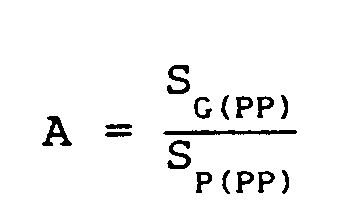
- a polyolefin multilayer film of the type mentioned at the outset the characteristic features of which are that the base layer contains a peroxide-degraded propylene homopolymer and an antistatic and the degradation factor of the peroxidically degraded propylene homopolymer is in the range from 3 to 10 and this degradation factor is defined as wherein
- S G (pp) is the melt index of the degraded propylene homopolymer granules
- Sp (pp) is the melt index of the propylene homopolymer starting powder and is less than 1.5 g / 10 min, and the respective melt indices are determined according to DIN 53 735 at 21.6 N and 230 ° C. and a surface layer of the multilayer film is low-sealing and contains an ethylene-propylene-butylene terpolymer and a propylene-butylene copolymer and the other surface layer is metallizable and corona-treated and has a thickness of greater than 0.5 ⁇ m.
- the base layer and the top layers can additionally excessive additives, such as. B. contain stabilizers.
- the base layer consists of a peroxide-degraded propylene polymer, which mainly consists of propylene and has a melting point in the range from 162 to 168 ° C. Isotactic polypropylene with an n-heptane soluble content of 6% by weight and less is a preferred propylene polymer.
- the peroxidically degraded polypropylene homopolymer has a degradation factor A of 3 to 10, preferably 4 to 8.
- the melt index of the polypropylene starting powder is less than 1.5 g / 10 min, preferably 0.2 to 0.9 g / 10 min (measurement DIN 53 735, 21.6 H load and 230 ° C.).
- the polypropylene starting powder is made by adding organic peroxides [e.g. B. dialkyl peroxides such as 2.5 dimethyl-2.5 di (t-butylperoxy) hexane or di-t-butyl peroxide] when extruding to a granulate melt index of 2 to 5.5 g / 10 min (measurement DIN 53 735, 21.6 H load and 230 ° C) reduced.
- organic peroxides e.g. B. dialkyl peroxides such as 2.5 dimethyl-2.5 di (t-butylperoxy) hexane or di-t-butyl peroxide
- Peroxidic degradation or peroxidically degraded or CR controlled rheology
- polypropylene homopolymers as such are known in the literature (cf. Plastverischen, 38th year, 1987, No. 4; Polymer Engineering and Science, March 1989, Vol. 29, No. 6; plastics processor, 36th year, 1985, No. 11).
- Peroxidically degraded polypropylene homopolymers of this type are used in particular in injection molding technology and fiber production. The size of the degradation factor for these products is not described.
- polypropylene films of the type described at the outset meet the requirements particularly well if the degradation factor of the polypropylene homopolymer of the base layer is adhered to within narrow limits.
- the degradation factor of the polypropylene homopolymer is less than 3, the optical properties deteriorate (significant increase in film clouding, lowering of the surface gloss). If the degradation factor is above 10, problems occur with stretching, which has an extremely negative effect on the running safety in the film production. With a degradation factor above 10, the polypropylene homopolymer can only be stretched in a very narrow temperature range or not at all.
- the film has a very high electrical surface resistance.
- the film tends to electrostatically charge and attracts dust.
- the dust particles adhering to the film surface are only insufficiently or not metallized, as a result of which the water vapor permeability of the metallized film increases significantly (i.e. the barrier property or the barrier effect is lost).
- the adhesion between the foil and the applied metal layer is poor.
- the antistatic content of the base layer should preferably be between 0.02% by weight and 0.1% by weight, and that the sealing layers (outer layers) should be equipped only slightly, preferably not with an antistatic .
- Preferred antistatic agents are alkali alkane sulfonates, polyether-modified, ie ethoxylated and / or propoxylated polydiorganosiloxanes (polydialkylsiloxanes, polyalkylphenylsiloxanes and the like) and / or the essentially straight-chain and saturated aliphatic, tertiary amines with an aliphatic radical with 2 to 20 carbon atoms Hydroxyl (C 1 -C 4 ) alkyl groups, of which N, N'-bis (2-hydroxyethyl) alkylamines having 10-20, preferably 12-18, carbon atoms in the alkyl part are particularly suitable.
- the first polyolefinic, low-sealing surface layer of the multilayer film according to the invention consists of an olefin resin composition consisting of an ethylene-propylene-butylene terpolymer and a propylene-butylene copolymer corresponding to a total content in the surface layer of 0.1 to 7% by weight of ethylene, 53 to 89.9% by weight of propylene and 10 to 40% by weight of butylene, based on the olefin resin composition.
- This olefin resin composition has a p-xylene-soluble fraction at 20 ° C. of from 25 to 70% by weight, preferably from 40 to 60% by weight.
- the melting point of the olefin resin composition is 120 ° C or higher.
- the olefin resin composition has a melt flow index of 1 to 16 g / 10 min at 230 ° C and 2.16 kp load (DIN 53 735), in particular from 4 to 10 g / 10 min at 230 ° C and 2.16 kp load.
- the copolymer of ⁇ -olefins which is available from Mitsui Petrochemical Industries, Ltd., has proven to be particularly suitable. is marketed under the name (R) Tafmer XR-107 L.
- the low-sealing cover layer contains an antiblocking agent.
- Suitable antiblocking agents for this layer are inorganic additives such as silicon dioxide, calcium carbonate, magnesium silicate and / or antiblocking agents such as.
- These agents are particularly preferably used if they have a spherical shape.
- Such spherical inorganic materials and their addition to films made of thermoplastics are known, for. B. described in EP-A-0 236 945 and DE-A-38 01 535.
- the amount of antiblocking agent added is 0.1 to 2% by weight, preferably 0.1 to 0.5% by weight, based on the total weight of the first polyolefinic, low-sealing surface layer.
- the layer thickness of the low-sealing surface layer is preferably between 0.4 and 1.0 ⁇ m. If the layer thickness is less than 0.4 ⁇ m, the sealing properties deteriorate (increase in the sealing start temperature, lowering the sealing seam strength). With layer thicknesses of greater than 1.0 ⁇ m, the film optics deteriorate (increase in haze) and the processing behavior.
- the second polyolefinic, metallizable surface layer consists of a statistical ethylene-propylene copolymer which has an ethylene content of 2.0-7.0% by weight, a distribution factor V F of greater than 8 and a thermal oxidation temperature T ox of greater than 230 ° C. .
- the ethylene content and the distribution factor of the copolymer are determined using C 13 NMR spectroscopy.
- the measurements were carried out using a nuclear magnetic resonance spectrometer from Bruker, model HX-270 (Germany), which was equipped with a computer from Bruker, type Bruker Aspect 2000.
- the ethylene-propylene copolymer to be characterized is dissolved in a solvent mixture of 65% by volume hexachlorobenzene and 35% by volume 1,1-dideuterotetrachloroethane, so that a 10% by weight solution is formed.
- Octamethyltetrasiloxane (OMTS) was added as a reference standard.
- the 67.9 MHz C13 nuclear magnetic resonance spectrum was measured at 130 ° C. The spectra were evaluated according to the procedure described in JC Randall, Polymer Sequence Distribution (Academic Press, New York, 1977).
- the distribution factor is defined as where C G is the total ethylene content in the copolymer in% by weight and C i is the percentage of ethylene in% by weight which is present as an isolated ethylene component, ie a single ethylene component is isolated between two propylene components in the manner outlined below:
- the idealized thermal oxidation temperature T ox is determined in the following way: 2 to 5 mg of the raw material to be examined are heated in a differential calorimeter at a heating rate of 20 K / min. Air is used as the purge gas, the initial temperature is 295 K. During the measurement, the change in the heat flow with increasing temperature is shown. While this curve initially runs almost horizontally after the raw material has melted (baseline), these values rise sharply as a result of oxidation at a certain temperature (exothermic branch).
- the idealized thermal oxidation temperature is defined as the intersection of the straight line that extends the exothermic branch of the thermogram with the baseline.
- the parameters mentioned for the propylene-ethylene copolymer of the second polyolefinic metallizable surface layer of the film according to the invention should expediently be adhered to within very narrow limits in order to optimally achieve all of the properties mentioned in the task.
- the ethylene content and the distribution factor V F of the copolymer are important for the surface treatability by means of electrical corona discharge, for the long-term metallizability and for the optical properties. If the ethylene content is below 2.0% by weight, the corona treatability is reduced and the decay behavior of the treatment effect is unfavorable. If the ethylene content is above 7.0% by weight or the distribution factor is below 8, the optical properties, in particular the surface gloss, deteriorate.
- the thermal oxidation temperature is of particular importance for metal adhesion. If the thermal oxidation temperature of the metallizable top layer is below 230 ° C., decomposition products form on the surface due to the corona treatment to such an extent that the adhesion of a subsequent metallization is impaired.
- the second polyolefin-safe, metallizable surface layer contains neither a lubricant nor an antistatic, but only an antiblocking agent.
- Silicon dioxide and calcium carbonate are particularly preferred as antiblocking agents.
- the average particle size is preferably between 2 and 5 ⁇ m.
- the film tends to block, which has a negative effect on the processing behavior. In addition, the film shows a high sensitivity to scratching. If the average particle size is over 5 ⁇ m, the antiblocking agent is very difficult to embed in the polymer matrix, which leads to defective metallization and an increase in the water vapor permeability of the metallized film. If the metallizable surface layer contains a lubricant or an antistatic, the adhesion between the top layer and the applied metal layer is reduced.
- the thickness of the second polyolefinic, metallizable surfaces is greater than 0.5 ⁇ m, preferably 0.8 ⁇ m to 1.3 ⁇ m.
- This surface layer is corona-treated, the surface tension having a value of greater than 37 mN / m, preferably from 38 to 41 mN / m, immediately after production.
- layer thicknesses of less than 0.5 ⁇ m the corona treatability is worse and the decay behavior of the treatment effect is unfavorable.
- layer thicknesses of greater than 1.3 ⁇ m the multi-view film shows reduced optical properties. If the surface tension of the treated layer is below 37 mN / m, it is difficult to metallize the film.
- the adhesion between the top layer and the applied metal layer is insufficient.
- a pretreatment intensity of greater Due to the strong corona treatment, 41 mN / m decomposition products form on the surface, which have a negative effect on the adhesion of a subsequent metallization.
- the olefin resin composition of the first polyolefinic, low-sealing surface layer and the ethylene-propylene copolymer of the second metallizable surface layer have a lower melting point than the peroxidically degraded propylene polymer of the base layer.
- the melting point of both top layer raw materials is generally in the range from 80 to 150 ° C.
- the melt flow index of both top layer raw materials is higher than that of the polypropylene homopolymer of the base layer.
- the melt flow index of the olefin resin composition and the melt flow index of the copolymer is generally 3 to 15 g / 10 min, preferably 4 to 10 g / 10 min, at 230 ° C. and 2.16 kg load (DIN 53 735).
- the base layer, the first low-sealing and the second metallizable surface layer preferably contain a phenolic stabilizer with a molecular weight of more than 500 g / mol.
- Pentaerythrityl-tetrakis-3- (3,5-di-tertiary-butyl-4-hydroxyphenyl) propionate or 1,3,5-trimethyl-2,4,6-tris (3,5-di-tertiary-butyl) are particularly suitable as stabilizers -4-hydroxybenzyl) benzene.
- the amount added is 0.1 to 0.6% by weight, preferably 0.15 to 0.3% by weight.
- calcium stearate and / or calcium carbonate with an average particle size of preferably at most 0.07 mm, an absolute particle size of less than 5 ⁇ m and a specific surface area of at least 40 m 2 / g are preferably used.
- the amount added is 0.01 to 0.05% by weight.
- the total thickness of the multilayer film according to the invention is between 10 and 70 ⁇ m, preferably between 10 and 50 ⁇ m.
- the polyolefin film according to the invention which is formed from three layers, is produced by the known coextrusion process.
- the procedure is such that the melts corresponding to the individual layers of the film are coextruded through a flat die, the film obtained by coextrusion is cooled for solidification, the film is biaxially stretched (oriented), the biaxially stretched film is heat-set and on the Corona treatment provided corona-treated metallizable surface layer.
- the biaxial stretching (orientation) can be carried out simultaneously or in succession, with the successive biaxial stretching, in which stretching first lengthwise (in the machine direction) and then transversely (perpendicular to the machine direction) being preferred.
- the polymer or the polymer mixture of the individual layers is compressed or liquefied in an extruder.
- the melts are then pressed simultaneously through a flat die (slot die), and the pressed multilayer film is cooled and solidified on one or more rollers which are kept at about 30 to 50 ° C. by cooling.
- the film thus obtained is then stretched longitudinally and transversely to the direction of extrusion, which leads to an orientation of the molecular chains. Stretching is preferably 4 to 7: 1 in the longitudinal direction and preferably 8 to 10: 1 in the transverse direction.
- the longitudinal stretching is carried out at a film temperature of preferably 120 to 140 ° C. and the transverse stretching is preferably carried out at 160 to 175 ° C.
- the longitudinal stretching is expediently carried out with the aid of two rollers running at different speeds in accordance with the desired stretching ratio, and the transverse stretching with the aid of a corresponding tenter frame.
- the biaxial stretching of the film is followed by its heat setting (heat treatment).
- the film is held at a temperature of 150 to 160 ° C for about 0.5 to 10 s.
- the corona treatment is preferably carried out with an alternating voltage of approximately 10,000 V and 10,000 Hz.
- the film produced in this way is wound up in the usual way with the aid of a winding device.
- the polyolefin multilayer film according to the invention is particularly suitable for the metallization application. It has all the important properties that are required by polyolefin films with a view to its use as a low-sealing metallizing film.
- the thickness of the metal layer is approximately 20 to 600 nm, preferably 25 to 100 nm.
- Metallized foils are increasingly used for packaging purposes, especially of food.
- a metal layer applied to the plastic film lowers the oxygen permeability and the water vapor permeability, while the rigidity and machinability are generally increased and the light density reaches a maximum value.
- the good barrier properties of metallized plastic films are only permanent if the applied metallization on the one hand has excellent adhesion, on the other hand but care is taken to ensure that the metal layer is not damaged, in particular by stretching, bending, scratching or creasing.
- the metallizable multilayer film according to the invention is therefore also suitable for this purpose because of the outstanding adhesive properties of the particularly flat, high-gloss metallizable top layer.
- the metal layer on the multilayer film according to the invention can be protected from mechanical damage by laminating on a polyethylene film. Thin layers of polyethylene can also be applied by extrusion coating.
- the metallizable film according to the invention can be used in an excellent manner for producing composites with other films (PP, PET, etc.) or paper.
- the multilayer film according to the invention which has a low seal on one side, is particularly suitable for producing composites with another low-sealing or biaxially oriented polyolefin film which has a low seal on one side, so that a composite with a low seal on both sides results.
- the examples and comparative examples below are each biaxially oriented (longitudinal stretch ratio 5: 1, transverse stretch ratio 10: 1) polyolefin films with a base layer and two cover layers, the base layer in each case made of an isotactic polypropylene with an n-heptane-soluble fraction of 4% by weight. -%, with a melting point of 165 ° C and a melt flow index of 3.5 g / 10 min at 230 ° C and 2.16 kg load (DIN 53 735) as the main component.
- the base layer is about 18 ⁇ m thick.
- the thickness of the two cover layers surrounding the base layer is given in the individual examples and comparative examples.
- the three-layer polyolefin films have been produced by the known coextrusion process.
- All layers contain 0.15% by weight of pentaerythrityl tetrakis-3- (3,5-di-tert-butyl-4-hydroxyphenyl) propionate ( (R) Irganox 1010) for stabilization.
- the base layer contains 0.05% by weight of N, N'-bis (2-hydroxyethyl) - (C 10 -C 20 ) alkylamine as an antistatic.
- the olefin resin composition contains 0.2% by weight of silica having an average particle diameter of 4.0 ⁇ m.
- the thickness of the low-sealing layer is 0.8 ⁇ m.
- Example 1 is repeated.
- Example 1 A three-layer film is produced as in Example 1.
- the polypropylene polymer of the base layer has a granulate melt index of 3.5 g / 10 min (DIN 53 735 at 21.6 ° C).
- the homopolymer of the base layer is not degraded peroxidically and contains no antistatic.
- the first low-sealing surface layer corresponds in composition and thickness to that from Example 1.
- the second metallizable top layer corresponds to that from Example 1. However, the layer thickness is 0.6 ⁇ m.
- a multilayer film is produced as in Example 1.
- the polypropylene polymer of the base layer is not degraded peroxidically and contains 0.2% by weight of N, N'-bis (2-hydroxyethyl) - (C 10 -C 2 o) alkylamine as an antistatic.
- the first low-sealing surface layer corresponds to that from Example 1.
- the second metallizable top layer corresponds to that from Example 1, but the layer thickness is 0.6 ⁇ m.
- a multilayer film is produced as in Example 1.
- the polypropylene homopolymer contains 0.05% by weight of antistatic. However, the polypropylene polymer is not degraded peroxidically.
- the first low-sealing surface layer is identical to that from Example 1.
- the second metallizable top layer consists of ethylene-propylene copolymers with an ethylene content of 1.8% by weight and a propylene content of 98.2% by weight.
- the copolymer contains 0.15% by weight of N, N'-bis (2-hydroxyethyl) - (C 10 -C 20 ) alkylamine as an antistatic and no silicon dioxide.
- a multilayer film is produced as in Example 1.
- the propylene polymer of the base layer is not peroxidically degraded and, as in Example 1, contains 0.05% by weight of antistatic.
- the layer thickness is 0.8 ⁇ m.
- the second metallizable surface layer is identical to that from Example 1.
- Example 1 of European patent application 0282917 is reworked.
- the base layer and the metallizable top layer consist of a polypropylene homopolymer that is not peroxidically degraded and contains no antistatic.
- the first sealable cover layer consists essentially of an ethylene-propylene copolymer with an ethylene content of 4.5% by weight, based on the copolymer. All layers are equipped with 0.05% by weight of a precipitated calcium carbonate and 0.1% by weight of a stabilizer.
- the metallizable layer also contains 6% by weight of a fully hydrogenated cyclopentadiene resin.
- the sealable top layer contains 0.2% by weight of the antiblocking agent (R) Syloid 244. The thickness of the top layers is 0.6 ⁇ m.
- Example 2 of European patent application 0282917 is reworked.
- the base layer consists of a polypropylene polymer that is not peroxidically degraded and contains no antistatic.
- the first metallizable cover layer is 0.6 ⁇ m thick and consists of an ethylene-propylene copolymer with an ethylene content of 4.5% by weight.
- the second sealable cover layer consists of an ethylene-propylene-butylene terpolymer with a content of 1.4% by weight of ethylene, 92.2% by weight of propylene and 6.4% by weight of butylene, based on the terpolymer.
- This second layer contains 0.3% by weight of the antiblocking agent ASP 900 ( R ). All layers are equipped with 0.05% by weight of a precipitated calcium carbonate and with 0.1% by weight of a stabilizer.
- the first metallizable cover layer also contains 6% by weight of a fully hydrogenated cyclopentadiene resin.
- Example 1 of the European patent application 0023389 is reworked.
- the base layer consists of a polypropylene polymer that is not peroxidically degraded and contains no antistatic.
- the base layer is surrounded by 0.4 ⁇ m thick cover layers made of an ethylene-propylene copolymer with a propylene content of 3.4% by weight and an ethylene content of 96.5% by weight.
- the top layer to be metallized is corona treated.
- the scratch resistance is determined based on DIN 53 754.
- the Taber model 503 Abraser from Teledyne Taber is used to determine the scratch resistance, using Calibrade R H18 friction wheels that are loaded with 250 g.
- Scratch resistance or scratch sensitivity means the increase in haze of the scratched film compared to the original film after 50 rotations of the sample plate.
- the scratch resistance is rated very good (+ +) if the increase in haze is less than 22%, good (+) if the increase in haze is 22 to 25%, moderate ( ⁇ ) if the increase in haze is 25 - 30% lies and with bad (-) with an increase in turbidity of more than 30%.
- Two 15 mm wide film strips are placed on top of each other and sealed at 110 ° C, a sealing time of 0.5 s and a sealing pressure of 1.5 N / cm 2 (device: Brugger type NDS, sealing jaw heated on one side).
- the seal seam strength is determined according to the T-Peel method.
- heat-sealed samples (sealing seam 20 mm x 100 mm) are produced by using a film at different temperatures with the help of two heated sealing jaws with a sealing pressure of 15 N / cm 2 and a sealing time of 0.5 s is sealed. Test strips 15 mm wide are cut from the sealed samples.
- the T-seal strength ie the force required to separate the test strips, is determined with a tensile testing machine at a take-off speed of 200 mm / min, the seal plane forming a right angle with the direction of pull.
- the seal start temperature (or minimum seal temperature) is the temperature at which a seal seam strength of at least 0.5 N / 15 mm is achieved.
- the corona treatment was carried out in such a way that the treated film surface in each case had a treatment intensity of 39-40 mN / m directly after the treatment.
- the treatment intensity was determined using the so-called ink method (DIN 53 364).
- the water vapor permeability of the metallized film is determined in accordance with DIN 53 122, part 2 (measuring conditions: 23 ° C., 85% relative atmospheric humidity).
- the water vapor permeability is assessed with:
- the properties of the polyolefin multilayer films of the examples and the comparative examples are summarized in Table 1 below.
- the superiority of the films according to the invention in accordance with Example 1 and Example 2 is clearly evident from the table.
- Comparative examples 1 to 7 show good properties in some cases, but no multi-layer film according to comparative examples 1 to 7 can meet all requirements, ie low film haze, high surface gloss, homogeneous film appearance, high scratch resistance, one-sided low sealing start temperature, good immediate and long-term metallization properties, good metal adhesion and low water vapor permeability after metallization. Only the polyolefinic multilayer films according to the invention from Examples 1 and 2 meet all requirements at the same time.
Landscapes
- Engineering & Computer Science (AREA)
- Mechanical Engineering (AREA)
- Laminated Bodies (AREA)
Claims (18)
les indices de fluidité à chaud respectifs étant déterminés à 230 ° C et sous une charge de 21,6 N, selon DIN 53 735, et une couche superficielle de la pellicule multicouche est soudable à basse température et contient un terpolymère éthylène/propylène/butylène et un copolymère propylè- ne/butylène, et l'autre couche superficielle est traitée par effet couronne et métallisable, et présente une épaisseur de plus de 0,5 um.
Applications Claiming Priority (2)
| Application Number | Priority Date | Filing Date | Title |
|---|---|---|---|
| DE4032588 | 1990-10-13 | ||
| DE4032588A DE4032588A1 (de) | 1990-10-13 | 1990-10-13 | Einseitig niedrig siegelnde, biaxial orientierte polyolefin-mehrschichtfolie fuer die metallisieranwendung |
Publications (3)
| Publication Number | Publication Date |
|---|---|
| EP0481344A1 EP0481344A1 (fr) | 1992-04-22 |
| EP0481344B1 true EP0481344B1 (fr) | 1995-09-20 |
| EP0481344B2 EP0481344B2 (fr) | 1999-01-07 |
Family
ID=6416252
Family Applications (1)
| Application Number | Title | Priority Date | Filing Date |
|---|---|---|---|
| EP91117220A Expired - Lifetime EP0481344B2 (fr) | 1990-10-13 | 1991-10-09 | Feuille multicouche de polyoléfines, scellable à basse température sur l'une de ses faces et orientée biaxialement pour la métallisation |
Country Status (3)
| Country | Link |
|---|---|
| EP (1) | EP0481344B2 (fr) |
| DE (2) | DE4032588A1 (fr) |
| ES (1) | ES2079013T5 (fr) |
Families Citing this family (10)
| Publication number | Priority date | Publication date | Assignee | Title |
|---|---|---|---|---|
| DE4222740A1 (de) * | 1992-07-10 | 1994-01-13 | Hoechst Ag | Niedrig siegelnde, biaxial orientierte Polyolefin-Mehrschichtfolie mit hohem Schrumpf |
| US5527608A (en) * | 1994-12-27 | 1996-06-18 | Mobil Oil Corporation | Oriented multilayer heat sealable packaging film capable of withstanding high altitude effects |
| US6013353A (en) * | 1996-05-07 | 2000-01-11 | Mobil Oil Corporation | Metallized multilayer packaging film |
| CA2192765C (fr) * | 1996-12-12 | 2006-08-29 | Cheng-Kang Kao | Lamine hydrofuge, facile a dechirer |
| AU700323C (en) * | 1997-03-17 | 2001-11-08 | Insul-Box (Nz) Limited | Improvements in or relating to containers |
| DE19720313A1 (de) * | 1997-05-15 | 1998-11-19 | Wolff Walsrode Ag | Mehrschichtige, gereckte, heißsiegelbare im Vakuum bedampfte Polypropylenfolie |
| DE19834348A1 (de) * | 1998-07-30 | 2000-02-03 | Grundig Ag | Verfahren zur Metallisierung einer Kunststoffoberfläche |
| DE10200925A1 (de) * | 2002-01-12 | 2003-07-24 | Hydro Aluminium Deutschland | Folie für Lebensmittelverpackungen |
| DE10224131A1 (de) * | 2002-05-29 | 2003-12-18 | Hydro Aluminium Deutschland | Folie aus einem Aluminiumwerkstoff |
| CN102802946B (zh) | 2009-04-10 | 2015-05-27 | 陶氏环球技术有限责任公司 | 高性能可密封共挤出双轴取向的聚丙烯膜 |
Family Cites Families (3)
| Publication number | Priority date | Publication date | Assignee | Title |
|---|---|---|---|---|
| US4514534A (en) * | 1984-04-13 | 1985-04-30 | United States Steel Corporation | Modified polypropylene for film |
| DE3509384A1 (de) * | 1985-03-15 | 1986-09-18 | Hoechst Ag, 6230 Frankfurt | Bedruckbare und beidseitig siegelbare, biaxial orientierte polyolefin-mehrschichtfolie, ihre herstellung und ihre verwendung |
| DE3709252A1 (de) * | 1987-03-20 | 1988-09-29 | Hoechst Ag | Metallisierbare mehrschichtfolie, ihre herstellung und ihre verwendung |
-
1990
- 1990-10-13 DE DE4032588A patent/DE4032588A1/de not_active Withdrawn
-
1991
- 1991-10-09 DE DE59106522T patent/DE59106522D1/de not_active Expired - Fee Related
- 1991-10-09 ES ES91117220T patent/ES2079013T5/es not_active Expired - Lifetime
- 1991-10-09 EP EP91117220A patent/EP0481344B2/fr not_active Expired - Lifetime
Also Published As
| Publication number | Publication date |
|---|---|
| DE4032588A1 (de) | 1992-04-16 |
| ES2079013T3 (es) | 1996-01-01 |
| EP0481344A1 (fr) | 1992-04-22 |
| EP0481344B2 (fr) | 1999-01-07 |
| ES2079013T5 (es) | 1999-05-16 |
| DE59106522D1 (de) | 1995-10-26 |
Similar Documents
| Publication | Publication Date | Title |
|---|---|---|
| EP0480282B1 (fr) | Stratifié de polyoléfine imprimable et biaxiallement orienté, avec une couche scellable à température basse sur ses deux faces | |
| EP0538747B1 (fr) | Film en polyoléfine multicouche, scellable, mat, orienté biaxiallement, procédé pour sa fabrication et son utilisation | |
| EP0282917B1 (fr) | Feuille multicouche métallisable, sa fabrication et son utilisation | |
| EP0563796B1 (fr) | Film multicouche en polyoléfine, biaxialement orienté et à surface matte-satinée, procédé de sa fabrication et usage | |
| EP0538746B1 (fr) | Film en polyoléfine multicouche, non scellable, mat, opaque, orienté biaxiallement, procédé pour sa fabrication et son utilisation | |
| EP0557875B1 (fr) | Film multicouche polyoléfinique transparent scellable d'un côté à temperature basse, procédé pour sa fabrication et sa application | |
| EP0482501B1 (fr) | Feuille multicouche en polyoléfin orientée biaxialement scellable sur ses deux faces à rétraction élevée | |
| EP0622186B1 (fr) | Film en polypropylène multicouche, mat, scellable, rétrécissable biaxiallement orienté, procédé pour sa fabrication et son utilisation | |
| EP0361280A2 (fr) | Feuille en polypropylène biaxiallement orientée et métallisable | |
| EP0622185A1 (fr) | Film en polypropylène multicouche, mat, orienté biaxiallement, procédé pour sa fabrication et son utilisation | |
| EP0477797B1 (fr) | Feuille multicouche de polyoléfines, scellable sur les deux faces et orientée biaxialement ayant de trés bonnes propriétés optiques | |
| EP0489373B1 (fr) | Laminé nétrécissable de polyolefine, scellable à deux faces, ayant des propriétés de barrière | |
| EP0622187B1 (fr) | Film en polypropylène multicouche mat, orienté biaxiallement et à rétraction élevée, son procédé de fabrication et son utlisation | |
| EP0481344B1 (fr) | Feuille multicouche de polyoléfines, scellable à basse température sur l'une de ses faces et orientée biaxialement pour la métallisation | |
| DE4009350A1 (de) | Polypropylenfolie mit guten hafteigenschaften | |
| DE3933695C2 (de) | Polypropylenfolie mit guten Hafteigenschaften | |
| DE4312388A1 (de) | Reflexionsreduzierte, verklebbare gereckte Folie als Fensterfolie für Briefumschläge | |
| EP0351620B1 (fr) | Film multicouche, laminable à chaud | |
| EP0463517B1 (fr) | Film non soudable, transparent à base de polymères de polypropylène ayant une bonne adhérance et de très bonnes propriétés optiques | |
| DE9017725U1 (de) | Einseitig niedrig siegelnde, biaxial orientierte Polyolefin-Mehrschichtfolie für die Metallisieranwendung | |
| DE9204518U1 (de) | Seidenmatte, biaxial orientierte Polyolefin-Mehrschichtfolie |
Legal Events
| Date | Code | Title | Description |
|---|---|---|---|
| PUAI | Public reference made under article 153(3) epc to a published international application that has entered the european phase |
Free format text: ORIGINAL CODE: 0009012 |
|
| AK | Designated contracting states |
Kind code of ref document: A1 Designated state(s): DE ES FR GB IT |
|
| GBC | Gb: translation of claims filed (gb section 78(7)/1977) | ||
| 17P | Request for examination filed |
Effective date: 19920919 |
|
| 17Q | First examination report despatched |
Effective date: 19940223 |
|
| GRAA | (expected) grant |
Free format text: ORIGINAL CODE: 0009210 |
|
| AK | Designated contracting states |
Kind code of ref document: B1 Designated state(s): DE ES FR GB IT |
|
| REF | Corresponds to: |
Ref document number: 59106522 Country of ref document: DE Date of ref document: 19951026 |
|
| ET | Fr: translation filed | ||
| ITF | It: translation for a ep patent filed | ||
| REG | Reference to a national code |
Ref country code: ES Ref legal event code: FG2A Ref document number: 2079013 Country of ref document: ES Kind code of ref document: T3 |
|
| GBT | Gb: translation of ep patent filed (gb section 77(6)(a)/1977) |
Effective date: 19951127 |
|
| PLBI | Opposition filed |
Free format text: ORIGINAL CODE: 0009260 |
|
| 26 | Opposition filed |
Opponent name: BAYER AG, LEVERKUSEN KONZERNVERWALTUNG RP PATENTE Effective date: 19960619 |
|
| PLBF | Reply of patent proprietor to notice(s) of opposition |
Free format text: ORIGINAL CODE: EPIDOS OBSO |
|
| PLBF | Reply of patent proprietor to notice(s) of opposition |
Free format text: ORIGINAL CODE: EPIDOS OBSO |
|
| PLBF | Reply of patent proprietor to notice(s) of opposition |
Free format text: ORIGINAL CODE: EPIDOS OBSO |
|
| PLBF | Reply of patent proprietor to notice(s) of opposition |
Free format text: ORIGINAL CODE: EPIDOS OBSO |
|
| PLAW | Interlocutory decision in opposition |
Free format text: ORIGINAL CODE: EPIDOS IDOP |
|
| RAP2 | Party data changed (patent owner data changed or rights of a patent transferred) |
Owner name: HOECHST TRESPAPHAN GMBH |
|
| PLAW | Interlocutory decision in opposition |
Free format text: ORIGINAL CODE: EPIDOS IDOP |
|
| PUAH | Patent maintained in amended form |
Free format text: ORIGINAL CODE: 0009272 |
|
| STAA | Information on the status of an ep patent application or granted ep patent |
Free format text: STATUS: PATENT MAINTAINED AS AMENDED |
|
| 27A | Patent maintained in amended form |
Effective date: 19990107 |
|
| AK | Designated contracting states |
Kind code of ref document: B2 Designated state(s): DE ES FR GB IT |
|
| ET3 | Fr: translation filed ** decision concerning opposition | ||
| ITF | It: translation for a ep patent filed | ||
| GBTA | Gb: translation of amended ep patent filed (gb section 77(6)(b)/1977) | ||
| REG | Reference to a national code |
Ref country code: ES Ref legal event code: DC2A Kind code of ref document: T5 Effective date: 19990325 |
|
| PGFP | Annual fee paid to national office [announced via postgrant information from national office to epo] |
Ref country code: ES Payment date: 20011005 Year of fee payment: 11 |
|
| REG | Reference to a national code |
Ref country code: GB Ref legal event code: IF02 |
|
| PGFP | Annual fee paid to national office [announced via postgrant information from national office to epo] |
Ref country code: GB Payment date: 20020925 Year of fee payment: 12 |
|
| PGFP | Annual fee paid to national office [announced via postgrant information from national office to epo] |
Ref country code: FR Payment date: 20021017 Year of fee payment: 12 |
|
| PGFP | Annual fee paid to national office [announced via postgrant information from national office to epo] |
Ref country code: DE Payment date: 20021214 Year of fee payment: 12 |
|
| PG25 | Lapsed in a contracting state [announced via postgrant information from national office to epo] |
Ref country code: GB Free format text: LAPSE BECAUSE OF NON-PAYMENT OF DUE FEES Effective date: 20031009 |
|
| PG25 | Lapsed in a contracting state [announced via postgrant information from national office to epo] |
Ref country code: ES Free format text: LAPSE BECAUSE OF NON-PAYMENT OF DUE FEES Effective date: 20031010 |
|
| PG25 | Lapsed in a contracting state [announced via postgrant information from national office to epo] |
Ref country code: DE Free format text: LAPSE BECAUSE OF NON-PAYMENT OF DUE FEES Effective date: 20040501 |
|
| GBPC | Gb: european patent ceased through non-payment of renewal fee |
Effective date: 20031009 |
|
| PG25 | Lapsed in a contracting state [announced via postgrant information from national office to epo] |
Ref country code: FR Free format text: LAPSE BECAUSE OF NON-PAYMENT OF DUE FEES Effective date: 20040630 |
|
| REG | Reference to a national code |
Ref country code: FR Ref legal event code: ST |
|
| REG | Reference to a national code |
Ref country code: ES Ref legal event code: FD2A Effective date: 20031010 |
|
| PG25 | Lapsed in a contracting state [announced via postgrant information from national office to epo] |
Ref country code: IT Free format text: LAPSE BECAUSE OF NON-PAYMENT OF DUE FEES;WARNING: LAPSES OF ITALIAN PATENTS WITH EFFECTIVE DATE BEFORE 2007 MAY HAVE OCCURRED AT ANY TIME BEFORE 2007. THE CORRECT EFFECTIVE DATE MAY BE DIFFERENT FROM THE ONE RECORDED. Effective date: 20051009 |