EP0481362A2 - Organische-anorganische Übergitter - Google Patents
Organische-anorganische Übergitter Download PDFInfo
- Publication number
- EP0481362A2 EP0481362A2 EP91117306A EP91117306A EP0481362A2 EP 0481362 A2 EP0481362 A2 EP 0481362A2 EP 91117306 A EP91117306 A EP 91117306A EP 91117306 A EP91117306 A EP 91117306A EP 0481362 A2 EP0481362 A2 EP 0481362A2
- Authority
- EP
- European Patent Office
- Prior art keywords
- layer
- species
- organic
- monolayer
- inorganic
- Prior art date
- Legal status (The legal status is an assumption and is not a legal conclusion. Google has not performed a legal analysis and makes no representation as to the accuracy of the status listed.)
- Withdrawn
Links
- 239000002131 composite material Substances 0.000 title claims description 19
- 239000010410 layer Substances 0.000 claims abstract description 177
- 238000000034 method Methods 0.000 claims abstract description 91
- 239000002356 single layer Substances 0.000 claims abstract description 86
- 230000008569 process Effects 0.000 claims abstract description 63
- 239000000758 substrate Substances 0.000 claims abstract description 41
- 239000007787 solid Substances 0.000 claims abstract description 35
- 238000001338 self-assembly Methods 0.000 claims abstract description 32
- 238000009830 intercalation Methods 0.000 claims abstract description 26
- 239000013626 chemical specie Substances 0.000 claims abstract description 7
- 239000000126 substance Substances 0.000 claims description 43
- 238000000151 deposition Methods 0.000 claims description 36
- 230000008021 deposition Effects 0.000 claims description 34
- 238000001179 sorption measurement Methods 0.000 claims description 34
- 230000006870 function Effects 0.000 claims description 30
- 238000006243 chemical reaction Methods 0.000 claims description 27
- 229910052751 metal Inorganic materials 0.000 claims description 22
- 239000002184 metal Substances 0.000 claims description 21
- 229910021645 metal ion Inorganic materials 0.000 claims description 18
- 239000000470 constituent Substances 0.000 claims description 17
- 239000000203 mixture Substances 0.000 claims description 14
- 239000012530 fluid Substances 0.000 claims description 13
- 230000002269 spontaneous effect Effects 0.000 claims description 11
- 230000003287 optical effect Effects 0.000 claims description 10
- 230000008859 change Effects 0.000 claims description 8
- 230000005291 magnetic effect Effects 0.000 claims description 6
- 230000004048 modification Effects 0.000 claims description 6
- 238000012986 modification Methods 0.000 claims description 6
- 239000003153 chemical reaction reagent Substances 0.000 claims description 5
- 239000002904 solvent Substances 0.000 claims description 5
- 238000004519 manufacturing process Methods 0.000 claims description 4
- 230000001404 mediated effect Effects 0.000 claims description 4
- 230000005670 electromagnetic radiation Effects 0.000 claims description 3
- 239000002887 superconductor Substances 0.000 claims description 3
- 230000009466 transformation Effects 0.000 claims description 3
- 238000000844 transformation Methods 0.000 claims description 3
- 238000010894 electron beam technology Methods 0.000 claims description 2
- 238000010884 ion-beam technique Methods 0.000 claims description 2
- 230000005693 optoelectronics Effects 0.000 claims description 2
- 239000011229 interlayer Substances 0.000 abstract description 27
- 230000002687 intercalation Effects 0.000 abstract description 24
- 238000007385 chemical modification Methods 0.000 abstract description 18
- 230000000737 periodic effect Effects 0.000 abstract description 4
- YXFVVABEGXRONW-UHFFFAOYSA-N Toluene Chemical compound CC1=CC=CC=C1 YXFVVABEGXRONW-UHFFFAOYSA-N 0.000 description 66
- 239000000243 solution Substances 0.000 description 39
- -1 Ca2+ ions Chemical class 0.000 description 38
- ZEYHEAKUIGZSGI-UHFFFAOYSA-N 4-methoxybenzoic acid Chemical compound COC1=CC=C(C(O)=O)C=C1 ZEYHEAKUIGZSGI-UHFFFAOYSA-N 0.000 description 37
- 229910000077 silane Inorganic materials 0.000 description 30
- BLRPTPMANUNPDV-UHFFFAOYSA-N Silane Chemical compound [SiH4] BLRPTPMANUNPDV-UHFFFAOYSA-N 0.000 description 28
- 230000015572 biosynthetic process Effects 0.000 description 26
- DCAYPVUWAIABOU-UHFFFAOYSA-N hexadecane Chemical compound CCCCCCCCCCCCCCCC DCAYPVUWAIABOU-UHFFFAOYSA-N 0.000 description 24
- 238000004873 anchoring Methods 0.000 description 23
- 239000010408 film Substances 0.000 description 22
- 150000002500 ions Chemical group 0.000 description 22
- FOIXSVOLVBLSDH-UHFFFAOYSA-N Silver ion Chemical compound [Ag+] FOIXSVOLVBLSDH-UHFFFAOYSA-N 0.000 description 21
- UHOVQNZJYSORNB-UHFFFAOYSA-N Benzene Chemical compound C1=CC=CC=C1 UHOVQNZJYSORNB-UHFFFAOYSA-N 0.000 description 18
- WVIIMZNLDWSIRH-UHFFFAOYSA-N cyclohexylcyclohexane Chemical group C1CCCCC1C1CCCCC1 WVIIMZNLDWSIRH-UHFFFAOYSA-N 0.000 description 18
- 239000000463 material Substances 0.000 description 18
- 239000010453 quartz Substances 0.000 description 18
- VYPSYNLAJGMNEJ-UHFFFAOYSA-N silicon dioxide Inorganic materials O=[Si]=O VYPSYNLAJGMNEJ-UHFFFAOYSA-N 0.000 description 18
- 229910019142 PO4 Inorganic materials 0.000 description 17
- 235000021317 phosphate Nutrition 0.000 description 17
- XLYOFNOQVPJJNP-UHFFFAOYSA-N water Substances O XLYOFNOQVPJJNP-UHFFFAOYSA-N 0.000 description 17
- 238000007654 immersion Methods 0.000 description 16
- 239000010452 phosphate Substances 0.000 description 16
- 238000001228 spectrum Methods 0.000 description 16
- 239000004065 semiconductor Substances 0.000 description 15
- NBIIXXVUZAFLBC-UHFFFAOYSA-K phosphate Chemical compound [O-]P([O-])([O-])=O NBIIXXVUZAFLBC-UHFFFAOYSA-K 0.000 description 14
- JGCBNZLRTUKUAQ-UHFFFAOYSA-M sodium 4-[[4-(benzylamino)phenyl]diazenyl]benzenesulfonate Chemical compound [Na+].C1=CC(S(=O)(=O)[O-])=CC=C1N=NC(C=C1)=CC=C1NCC1=CC=CC=C1 JGCBNZLRTUKUAQ-UHFFFAOYSA-M 0.000 description 12
- 239000007864 aqueous solution Substances 0.000 description 11
- 238000010276 construction Methods 0.000 description 11
- SBIBMFFZSBJNJF-UHFFFAOYSA-N selenium;zinc Chemical compound [Se]=[Zn] SBIBMFFZSBJNJF-UHFFFAOYSA-N 0.000 description 11
- 229910052709 silver Inorganic materials 0.000 description 10
- 239000004332 silver Substances 0.000 description 10
- 238000002211 ultraviolet spectrum Methods 0.000 description 10
- JPVYNHNXODAKFH-UHFFFAOYSA-N Cu2+ Chemical compound [Cu+2] JPVYNHNXODAKFH-UHFFFAOYSA-N 0.000 description 9
- OKKJLVBELUTLKV-UHFFFAOYSA-N Methanol Chemical compound OC OKKJLVBELUTLKV-UHFFFAOYSA-N 0.000 description 9
- 238000000605 extraction Methods 0.000 description 9
- 230000009467 reduction Effects 0.000 description 9
- 238000009835 boiling Methods 0.000 description 8
- 150000002430 hydrocarbons Chemical group 0.000 description 8
- 239000012044 organic layer Substances 0.000 description 8
- 239000010409 thin film Substances 0.000 description 8
- RTZKZFJDLAIYFH-UHFFFAOYSA-N Diethyl ether Chemical compound CCOCC RTZKZFJDLAIYFH-UHFFFAOYSA-N 0.000 description 7
- WQZGKKKJIJFFOK-GASJEMHNSA-N Glucose Natural products OC[C@H]1OC(O)[C@H](O)[C@@H](O)[C@@H]1O WQZGKKKJIJFFOK-GASJEMHNSA-N 0.000 description 7
- WQZGKKKJIJFFOK-VFUOTHLCSA-N beta-D-glucose Chemical compound OC[C@H]1O[C@@H](O)[C@H](O)[C@@H](O)[C@@H]1O WQZGKKKJIJFFOK-VFUOTHLCSA-N 0.000 description 7
- 230000001588 bifunctional effect Effects 0.000 description 7
- 150000007942 carboxylates Chemical class 0.000 description 7
- 238000009792 diffusion process Methods 0.000 description 7
- OGQYPPBGSLZBEG-UHFFFAOYSA-N dimethyl(dioctadecyl)azanium Chemical compound CCCCCCCCCCCCCCCCCC[N+](C)(C)CCCCCCCCCCCCCCCCCC OGQYPPBGSLZBEG-UHFFFAOYSA-N 0.000 description 7
- 230000009365 direct transmission Effects 0.000 description 7
- 230000000694 effects Effects 0.000 description 7
- 239000008103 glucose Substances 0.000 description 7
- 229910001410 inorganic ion Inorganic materials 0.000 description 7
- 238000002360 preparation method Methods 0.000 description 7
- XKRFYHLGVUSROY-UHFFFAOYSA-N Argon Chemical compound [Ar] XKRFYHLGVUSROY-UHFFFAOYSA-N 0.000 description 6
- HEDRZPFGACZZDS-UHFFFAOYSA-N Chloroform Chemical compound ClC(Cl)Cl HEDRZPFGACZZDS-UHFFFAOYSA-N 0.000 description 6
- ZMXDDKWLCZADIW-UHFFFAOYSA-N N,N-Dimethylformamide Chemical compound CN(C)C=O ZMXDDKWLCZADIW-UHFFFAOYSA-N 0.000 description 6
- BQCADISMDOOEFD-UHFFFAOYSA-N Silver Chemical compound [Ag] BQCADISMDOOEFD-UHFFFAOYSA-N 0.000 description 6
- 239000002253 acid Substances 0.000 description 6
- 125000003118 aryl group Chemical group 0.000 description 6
- WLZRMCYVCSSEQC-UHFFFAOYSA-N cadmium(2+) Chemical compound [Cd+2] WLZRMCYVCSSEQC-UHFFFAOYSA-N 0.000 description 6
- 150000001732 carboxylic acid derivatives Chemical group 0.000 description 6
- 230000001747 exhibiting effect Effects 0.000 description 6
- 238000005342 ion exchange Methods 0.000 description 6
- 239000007788 liquid Substances 0.000 description 6
- 238000005259 measurement Methods 0.000 description 6
- 230000007935 neutral effect Effects 0.000 description 6
- 230000003647 oxidation Effects 0.000 description 6
- 238000007254 oxidation reaction Methods 0.000 description 6
- 238000012856 packing Methods 0.000 description 6
- 239000012286 potassium permanganate Substances 0.000 description 6
- 150000003839 salts Chemical class 0.000 description 6
- NINIDFKCEFEMDL-UHFFFAOYSA-N Sulfur Chemical compound [S] NINIDFKCEFEMDL-UHFFFAOYSA-N 0.000 description 5
- 150000001450 anions Chemical class 0.000 description 5
- 125000002091 cationic group Chemical group 0.000 description 5
- 239000003638 chemical reducing agent Substances 0.000 description 5
- 238000000576 coating method Methods 0.000 description 5
- 150000001875 compounds Chemical class 0.000 description 5
- 229930195733 hydrocarbon Natural products 0.000 description 5
- 238000011065 in-situ storage Methods 0.000 description 5
- 230000010287 polarization Effects 0.000 description 5
- 230000035484 reaction time Effects 0.000 description 5
- 238000003860 storage Methods 0.000 description 5
- 229910052717 sulfur Inorganic materials 0.000 description 5
- 239000011593 sulfur Substances 0.000 description 5
- JOXIMZWYDAKGHI-UHFFFAOYSA-N toluene-4-sulfonic acid Chemical class CC1=CC=C(S(O)(=O)=O)C=C1 JOXIMZWYDAKGHI-UHFFFAOYSA-N 0.000 description 5
- VHYFNPMBLIVWCW-UHFFFAOYSA-N 4-Dimethylaminopyridine Chemical compound CN(C)C1=CC=NC=C1 VHYFNPMBLIVWCW-UHFFFAOYSA-N 0.000 description 4
- 239000004215 Carbon black (E152) Substances 0.000 description 4
- XUIMIQQOPSSXEZ-UHFFFAOYSA-N Silicon Chemical compound [Si] XUIMIQQOPSSXEZ-UHFFFAOYSA-N 0.000 description 4
- 238000000944 Soxhlet extraction Methods 0.000 description 4
- 230000004913 activation Effects 0.000 description 4
- 125000000129 anionic group Chemical group 0.000 description 4
- 125000004432 carbon atom Chemical group C* 0.000 description 4
- 238000010668 complexation reaction Methods 0.000 description 4
- 238000005137 deposition process Methods 0.000 description 4
- 239000012154 double-distilled water Substances 0.000 description 4
- 239000007789 gas Substances 0.000 description 4
- 230000007246 mechanism Effects 0.000 description 4
- 239000012071 phase Substances 0.000 description 4
- 239000002243 precursor Substances 0.000 description 4
- 230000027756 respiratory electron transport chain Effects 0.000 description 4
- 229910052710 silicon Inorganic materials 0.000 description 4
- 239000010703 silicon Substances 0.000 description 4
- 230000003595 spectral effect Effects 0.000 description 4
- 238000004483 ATR-FTIR spectroscopy Methods 0.000 description 3
- 238000001157 Fourier transform infrared spectrum Methods 0.000 description 3
- 229910021578 Iron(III) chloride Inorganic materials 0.000 description 3
- 229910010084 LiAlH4 Inorganic materials 0.000 description 3
- ZMANZCXQSJIPKH-UHFFFAOYSA-N Triethylamine Chemical compound CCN(CC)CC ZMANZCXQSJIPKH-UHFFFAOYSA-N 0.000 description 3
- 238000002835 absorbance Methods 0.000 description 3
- VSCWAEJMTAWNJL-UHFFFAOYSA-K aluminium trichloride Chemical class Cl[Al](Cl)Cl VSCWAEJMTAWNJL-UHFFFAOYSA-K 0.000 description 3
- 229910052786 argon Inorganic materials 0.000 description 3
- 229910052793 cadmium Inorganic materials 0.000 description 3
- 150000001768 cations Chemical class 0.000 description 3
- 150000004770 chalcogenides Chemical class 0.000 description 3
- 230000008878 coupling Effects 0.000 description 3
- 238000010168 coupling process Methods 0.000 description 3
- 238000005859 coupling reaction Methods 0.000 description 3
- 239000013078 crystal Substances 0.000 description 3
- 238000011161 development Methods 0.000 description 3
- KPUWHANPEXNPJT-UHFFFAOYSA-N disiloxane Chemical class [SiH3]O[SiH3] KPUWHANPEXNPJT-UHFFFAOYSA-N 0.000 description 3
- 238000001962 electrophoresis Methods 0.000 description 3
- 238000002474 experimental method Methods 0.000 description 3
- 239000011521 glass Substances 0.000 description 3
- 229910052739 hydrogen Inorganic materials 0.000 description 3
- 239000001257 hydrogen Substances 0.000 description 3
- 230000002209 hydrophobic effect Effects 0.000 description 3
- RBTARNINKXHZNM-UHFFFAOYSA-K iron trichloride Chemical compound Cl[Fe](Cl)Cl RBTARNINKXHZNM-UHFFFAOYSA-K 0.000 description 3
- 239000012280 lithium aluminium hydride Substances 0.000 description 3
- 239000012528 membrane Substances 0.000 description 3
- 150000002739 metals Chemical class 0.000 description 3
- 230000005855 radiation Effects 0.000 description 3
- 238000000926 separation method Methods 0.000 description 3
- SQGYOTSLMSWVJD-UHFFFAOYSA-N silver(1+) nitrate Chemical compound [Ag+].[O-]N(=O)=O SQGYOTSLMSWVJD-UHFFFAOYSA-N 0.000 description 3
- 239000007790 solid phase Substances 0.000 description 3
- 150000004763 sulfides Chemical class 0.000 description 3
- 238000003786 synthesis reaction Methods 0.000 description 3
- 150000003573 thiols Chemical class 0.000 description 3
- SZTBSJOMNRSBGA-MHWRWJLKSA-N 4-[(1e)-cyclododecen-1-yl]morpholine Chemical compound C1COCCN1C/1=C/CCCCCCCCCC\1 SZTBSJOMNRSBGA-MHWRWJLKSA-N 0.000 description 2
- QTBSBXVTEAMEQO-UHFFFAOYSA-N Acetic acid Chemical compound CC(O)=O QTBSBXVTEAMEQO-UHFFFAOYSA-N 0.000 description 2
- IJGRMHOSHXDMSA-UHFFFAOYSA-N Atomic nitrogen Chemical compound N#N IJGRMHOSHXDMSA-UHFFFAOYSA-N 0.000 description 2
- UXVMQQNJUSDDNG-UHFFFAOYSA-L Calcium chloride Chemical compound [Cl-].[Cl-].[Ca+2] UXVMQQNJUSDDNG-UHFFFAOYSA-L 0.000 description 2
- SXVPOSFURRDKBO-UHFFFAOYSA-N Cyclododecanone Chemical compound O=C1CCCCCCCCCCC1 SXVPOSFURRDKBO-UHFFFAOYSA-N 0.000 description 2
- QOSSAOTZNIDXMA-UHFFFAOYSA-N Dicylcohexylcarbodiimide Chemical compound C1CCCCC1N=C=NC1CCCCC1 QOSSAOTZNIDXMA-UHFFFAOYSA-N 0.000 description 2
- LFQSCWFLJHTTHZ-UHFFFAOYSA-N Ethanol Chemical compound CCO LFQSCWFLJHTTHZ-UHFFFAOYSA-N 0.000 description 2
- 238000005033 Fourier transform infrared spectroscopy Methods 0.000 description 2
- UCKMPCXJQFINFW-UHFFFAOYSA-N Sulphide Chemical compound [S-2] UCKMPCXJQFINFW-UHFFFAOYSA-N 0.000 description 2
- PTFCDOFLOPIGGS-UHFFFAOYSA-N Zinc dication Chemical compound [Zn+2] PTFCDOFLOPIGGS-UHFFFAOYSA-N 0.000 description 2
- 150000001299 aldehydes Chemical class 0.000 description 2
- 229940071248 anisate Drugs 0.000 description 2
- 238000005102 attenuated total reflection Methods 0.000 description 2
- BDOSMKKIYDKNTQ-UHFFFAOYSA-N cadmium atom Chemical compound [Cd] BDOSMKKIYDKNTQ-UHFFFAOYSA-N 0.000 description 2
- 239000001110 calcium chloride Substances 0.000 description 2
- 229910001628 calcium chloride Inorganic materials 0.000 description 2
- 235000011148 calcium chloride Nutrition 0.000 description 2
- 239000011248 coating agent Substances 0.000 description 2
- 239000000084 colloidal system Substances 0.000 description 2
- 238000009833 condensation Methods 0.000 description 2
- 230000005494 condensation Effects 0.000 description 2
- XTVVROIMIGLXTD-UHFFFAOYSA-N copper(II) nitrate Chemical compound [Cu+2].[O-][N+]([O-])=O.[O-][N+]([O-])=O XTVVROIMIGLXTD-UHFFFAOYSA-N 0.000 description 2
- VPUGDVKSAQVFFS-UHFFFAOYSA-N coronene Chemical compound C1=C(C2=C34)C=CC3=CC=C(C=C3)C4=C4C3=CC=C(C=C3)C4=C2C3=C1 VPUGDVKSAQVFFS-UHFFFAOYSA-N 0.000 description 2
- 238000000354 decomposition reaction Methods 0.000 description 2
- BBGKDYHZQOSNMU-UHFFFAOYSA-N dicyclohexano-18-crown-6 Chemical compound O1CCOCCOC2CCCCC2OCCOCCOC2CCCCC21 BBGKDYHZQOSNMU-UHFFFAOYSA-N 0.000 description 2
- 238000009826 distribution Methods 0.000 description 2
- 238000005516 engineering process Methods 0.000 description 2
- 150000004820 halides Chemical group 0.000 description 2
- 230000007062 hydrolysis Effects 0.000 description 2
- 238000006460 hydrolysis reaction Methods 0.000 description 2
- 238000002329 infrared spectrum Methods 0.000 description 2
- 229910001412 inorganic anion Inorganic materials 0.000 description 2
- 229910001411 inorganic cation Inorganic materials 0.000 description 2
- 238000009812 interlayer coupling reaction Methods 0.000 description 2
- XHXFXVLFKHQFAL-UHFFFAOYSA-N phosphoryl trichloride Chemical compound ClP(Cl)(Cl)=O XHXFXVLFKHQFAL-UHFFFAOYSA-N 0.000 description 2
- 238000007539 photo-oxidation reaction Methods 0.000 description 2
- 238000006116 polymerization reaction Methods 0.000 description 2
- KOUKXHPPRFNWPP-UHFFFAOYSA-N pyrazine-2,5-dicarboxylic acid;hydrate Chemical compound O.OC(=O)C1=CN=C(C(O)=O)C=N1 KOUKXHPPRFNWPP-UHFFFAOYSA-N 0.000 description 2
- BBEAQIROQSPTKN-UHFFFAOYSA-N pyrene Chemical compound C1=CC=C2C=CC3=CC=CC4=CC=C1C2=C43 BBEAQIROQSPTKN-UHFFFAOYSA-N 0.000 description 2
- 230000005616 pyroelectricity Effects 0.000 description 2
- 230000004044 response Effects 0.000 description 2
- 229910052711 selenium Inorganic materials 0.000 description 2
- 150000003346 selenoethers Chemical class 0.000 description 2
- GGCZERPQGJTIQP-UHFFFAOYSA-N sodium;9,10-dioxoanthracene-2-sulfonic acid Chemical compound [Na+].C1=CC=C2C(=O)C3=CC(S(=O)(=O)O)=CC=C3C(=O)C2=C1 GGCZERPQGJTIQP-UHFFFAOYSA-N 0.000 description 2
- 125000001424 substituent group Chemical group 0.000 description 2
- 229910052714 tellurium Inorganic materials 0.000 description 2
- 238000000870 ultraviolet spectroscopy Methods 0.000 description 2
- MZFGYVZYLMNXGL-UHFFFAOYSA-N undec-10-enoyl chloride Chemical compound ClC(=O)CCCCCCCCC=C MZFGYVZYLMNXGL-UHFFFAOYSA-N 0.000 description 2
- 239000012808 vapor phase Substances 0.000 description 2
- 229910052984 zinc sulfide Inorganic materials 0.000 description 2
- QGKMIGUHVLGJBR-UHFFFAOYSA-M (4z)-1-(3-methylbutyl)-4-[[1-(3-methylbutyl)quinolin-1-ium-4-yl]methylidene]quinoline;iodide Chemical compound [I-].C12=CC=CC=C2N(CCC(C)C)C=CC1=CC1=CC=[N+](CCC(C)C)C2=CC=CC=C12 QGKMIGUHVLGJBR-UHFFFAOYSA-M 0.000 description 1
- RYHBNJHYFVUHQT-UHFFFAOYSA-N 1,4-Dioxane Chemical compound C1COCCO1 RYHBNJHYFVUHQT-UHFFFAOYSA-N 0.000 description 1
- IETWCRRCPURZOC-UHFFFAOYSA-N 4-[[4-(dimethylamino)phenyl]diazenyl]benzenesulfonic acid Chemical compound C1=CC(N(C)C)=CC=C1N=NC1=CC=C(S(O)(=O)=O)C=C1 IETWCRRCPURZOC-UHFFFAOYSA-N 0.000 description 1
- IRQWEODKXLDORP-UHFFFAOYSA-N 4-ethenylbenzoic acid Chemical compound OC(=O)C1=CC=C(C=C)C=C1 IRQWEODKXLDORP-UHFFFAOYSA-N 0.000 description 1
- ICGLPKIVTVWCFT-UHFFFAOYSA-N 4-methylbenzenesulfonohydrazide Chemical compound CC1=CC=C(S(=O)(=O)NN)C=C1 ICGLPKIVTVWCFT-UHFFFAOYSA-N 0.000 description 1
- QGZKDVFQNNGYKY-UHFFFAOYSA-O Ammonium Chemical class [NH4+] QGZKDVFQNNGYKY-UHFFFAOYSA-O 0.000 description 1
- HIBWGGKDGCBPTA-UHFFFAOYSA-N C=CC1=CC=CC=C1.C=CC1=CC=CC=C1 Chemical class C=CC1=CC=CC=C1.C=CC1=CC=CC=C1 HIBWGGKDGCBPTA-UHFFFAOYSA-N 0.000 description 1
- 239000005046 Chlorosilane Substances 0.000 description 1
- 239000005977 Ethylene Substances 0.000 description 1
- 238000004566 IR spectroscopy Methods 0.000 description 1
- LSDPWZHWYPCBBB-UHFFFAOYSA-N Methanethiol Chemical compound SC LSDPWZHWYPCBBB-UHFFFAOYSA-N 0.000 description 1
- 229910020175 SiOH Inorganic materials 0.000 description 1
- PPBRXRYQALVLMV-UHFFFAOYSA-N Styrene Chemical compound C=CC1=CC=CC=C1 PPBRXRYQALVLMV-UHFFFAOYSA-N 0.000 description 1
- 239000005083 Zinc sulfide Substances 0.000 description 1
- 238000000862 absorption spectrum Methods 0.000 description 1
- 229910052946 acanthite Inorganic materials 0.000 description 1
- 229960000583 acetic acid Drugs 0.000 description 1
- 238000005903 acid hydrolysis reaction Methods 0.000 description 1
- 230000002378 acidificating effect Effects 0.000 description 1
- 150000007513 acids Chemical class 0.000 description 1
- ORILYTVJVMAKLC-UHFFFAOYSA-N adamantane Chemical class C1C(C2)CC3CC1CC2C3 ORILYTVJVMAKLC-UHFFFAOYSA-N 0.000 description 1
- 239000003463 adsorbent Substances 0.000 description 1
- 150000001298 alcohols Chemical class 0.000 description 1
- 125000001931 aliphatic group Chemical group 0.000 description 1
- 229910052782 aluminium Inorganic materials 0.000 description 1
- 125000003277 amino group Chemical group 0.000 description 1
- 230000005290 antiferromagnetic effect Effects 0.000 description 1
- 238000013459 approach Methods 0.000 description 1
- 238000000429 assembly Methods 0.000 description 1
- 230000000712 assembly Effects 0.000 description 1
- QVGXLLKOCUKJST-UHFFFAOYSA-N atomic oxygen Chemical compound [O] QVGXLLKOCUKJST-UHFFFAOYSA-N 0.000 description 1
- 230000004888 barrier function Effects 0.000 description 1
- 229940077388 benzenesulfonate Drugs 0.000 description 1
- SRSXLGNVWSONIS-UHFFFAOYSA-N benzenesulfonic acid Chemical compound OS(=O)(=O)C1=CC=CC=C1 SRSXLGNVWSONIS-UHFFFAOYSA-N 0.000 description 1
- 229940092714 benzenesulfonic acid Drugs 0.000 description 1
- 238000006664 bond formation reaction Methods 0.000 description 1
- 230000005587 bubbling Effects 0.000 description 1
- 150000001661 cadmium Chemical class 0.000 description 1
- 150000001735 carboxylic acids Chemical class 0.000 description 1
- YENOLDYITNSPMQ-UHFFFAOYSA-N carboxysilicon Chemical compound OC([Si])=O YENOLDYITNSPMQ-UHFFFAOYSA-N 0.000 description 1
- 239000003054 catalyst Substances 0.000 description 1
- 150000001767 cationic compounds Chemical class 0.000 description 1
- 238000001311 chemical methods and process Methods 0.000 description 1
- KOPOQZFJUQMUML-UHFFFAOYSA-N chlorosilane Chemical compound Cl[SiH3] KOPOQZFJUQMUML-UHFFFAOYSA-N 0.000 description 1
- 238000004587 chromatography analysis Methods 0.000 description 1
- 239000011247 coating layer Substances 0.000 description 1
- 230000009918 complex formation Effects 0.000 description 1
- 239000004020 conductor Substances 0.000 description 1
- 229910052802 copper Inorganic materials 0.000 description 1
- 150000003983 crown ethers Chemical class 0.000 description 1
- 239000002178 crystalline material Substances 0.000 description 1
- 125000004122 cyclic group Chemical group 0.000 description 1
- 238000013461 design Methods 0.000 description 1
- 238000003795 desorption Methods 0.000 description 1
- 230000001627 detrimental effect Effects 0.000 description 1
- WVPKAWVFTPWPDB-UHFFFAOYSA-M dichlorophosphinate Chemical compound [O-]P(Cl)(Cl)=O WVPKAWVFTPWPDB-UHFFFAOYSA-M 0.000 description 1
- 150000002019 disulfides Chemical class 0.000 description 1
- 239000000975 dye Substances 0.000 description 1
- 230000032050 esterification Effects 0.000 description 1
- 238000005886 esterification reaction Methods 0.000 description 1
- 150000002148 esters Chemical class 0.000 description 1
- 238000011156 evaluation Methods 0.000 description 1
- 230000005621 ferroelectricity Effects 0.000 description 1
- 230000005294 ferromagnetic effect Effects 0.000 description 1
- 239000007888 film coating Substances 0.000 description 1
- 238000009501 film coating Methods 0.000 description 1
- GVEPBJHOBDJJJI-UHFFFAOYSA-N fluoranthrene Natural products C1=CC(C2=CC=CC=C22)=C3C2=CC=CC3=C1 GVEPBJHOBDJJJI-UHFFFAOYSA-N 0.000 description 1
- NBVXSUQYWXRMNV-UHFFFAOYSA-N fluoromethane Chemical group FC NBVXSUQYWXRMNV-UHFFFAOYSA-N 0.000 description 1
- 230000014509 gene expression Effects 0.000 description 1
- 239000012362 glacial acetic acid Substances 0.000 description 1
- 229910052737 gold Inorganic materials 0.000 description 1
- 229910052736 halogen Inorganic materials 0.000 description 1
- 150000002367 halogens Chemical class 0.000 description 1
- 230000000977 initiatory effect Effects 0.000 description 1
- 150000002484 inorganic compounds Chemical class 0.000 description 1
- 229910010272 inorganic material Inorganic materials 0.000 description 1
- 229910052500 inorganic mineral Inorganic materials 0.000 description 1
- 229910052945 inorganic sulfide Inorganic materials 0.000 description 1
- 230000003993 interaction Effects 0.000 description 1
- 230000009878 intermolecular interaction Effects 0.000 description 1
- 150000004715 keto acids Chemical class 0.000 description 1
- 239000013547 langmuir monolayer Substances 0.000 description 1
- 238000011031 large-scale manufacturing process Methods 0.000 description 1
- 239000003446 ligand Substances 0.000 description 1
- 230000000670 limiting effect Effects 0.000 description 1
- 239000003550 marker Substances 0.000 description 1
- 238000001465 metallisation Methods 0.000 description 1
- 150000004702 methyl esters Chemical class 0.000 description 1
- STZCRXQWRGQSJD-GEEYTBSJSA-M methyl orange Chemical compound [Na+].C1=CC(N(C)C)=CC=C1\N=N\C1=CC=C(S([O-])(=O)=O)C=C1 STZCRXQWRGQSJD-GEEYTBSJSA-M 0.000 description 1
- 229940012189 methyl orange Drugs 0.000 description 1
- DDIZAANNODHTRB-UHFFFAOYSA-N methyl p-anisate Chemical compound COC(=O)C1=CC=C(OC)C=C1 DDIZAANNODHTRB-UHFFFAOYSA-N 0.000 description 1
- 239000010445 mica Substances 0.000 description 1
- 229910052618 mica group Inorganic materials 0.000 description 1
- 238000004452 microanalysis Methods 0.000 description 1
- 238000004377 microelectronic Methods 0.000 description 1
- 239000011707 mineral Substances 0.000 description 1
- 235000010755 mineral Nutrition 0.000 description 1
- 238000001451 molecular beam epitaxy Methods 0.000 description 1
- 239000002052 molecular layer Substances 0.000 description 1
- 238000012544 monitoring process Methods 0.000 description 1
- 229910052757 nitrogen Inorganic materials 0.000 description 1
- 239000013307 optical fiber Substances 0.000 description 1
- 150000002894 organic compounds Chemical class 0.000 description 1
- 239000011368 organic material Substances 0.000 description 1
- 229910052760 oxygen Inorganic materials 0.000 description 1
- 239000001301 oxygen Substances 0.000 description 1
- 230000005298 paramagnetic effect Effects 0.000 description 1
- 239000002245 particle Substances 0.000 description 1
- 230000035699 permeability Effects 0.000 description 1
- 125000001997 phenyl group Chemical group [H]C1=C([H])C([H])=C(*)C([H])=C1[H] 0.000 description 1
- PAYRUJLWNCNPSJ-UHFFFAOYSA-O phenylazanium Chemical compound [NH3+]C1=CC=CC=C1 PAYRUJLWNCNPSJ-UHFFFAOYSA-O 0.000 description 1
- 150000003013 phosphoric acid derivatives Chemical class 0.000 description 1
- 238000006552 photochemical reaction Methods 0.000 description 1
- IEQIEDJGQAUEQZ-UHFFFAOYSA-N phthalocyanine Chemical compound N1C(N=C2C3=CC=CC=C3C(N=C3C4=CC=CC=C4C(=N4)N3)=N2)=C(C=CC=C2)C2=C1N=C1C2=CC=CC=C2C4=N1 IEQIEDJGQAUEQZ-UHFFFAOYSA-N 0.000 description 1
- 125000003367 polycyclic group Chemical group 0.000 description 1
- 239000011148 porous material Substances 0.000 description 1
- 125000002924 primary amino group Chemical group [H]N([H])* 0.000 description 1
- 230000002035 prolonged effect Effects 0.000 description 1
- JUJWROOIHBZHMG-UHFFFAOYSA-O pyridinium Chemical compound C1=CC=[NH+]C=C1 JUJWROOIHBZHMG-UHFFFAOYSA-O 0.000 description 1
- 230000009257 reactivity Effects 0.000 description 1
- 238000001953 recrystallisation Methods 0.000 description 1
- 238000006479 redox reaction Methods 0.000 description 1
- 238000011946 reduction process Methods 0.000 description 1
- 230000002441 reversible effect Effects 0.000 description 1
- 229920006395 saturated elastomer Polymers 0.000 description 1
- 239000002094 self assembled monolayer Substances 0.000 description 1
- CQLFBEKRDQMJLZ-UHFFFAOYSA-M silver acetate Chemical compound [Ag+].CC([O-])=O CQLFBEKRDQMJLZ-UHFFFAOYSA-M 0.000 description 1
- 229940071536 silver acetate Drugs 0.000 description 1
- 229940056910 silver sulfide Drugs 0.000 description 1
- XUARKZBEFFVFRG-UHFFFAOYSA-N silver sulfide Chemical compound [S-2].[Ag+].[Ag+] XUARKZBEFFVFRG-UHFFFAOYSA-N 0.000 description 1
- ATPMIJKNBKPHBD-UHFFFAOYSA-M silver;4-dodecoxybenzoate Chemical compound [Ag+].CCCCCCCCCCCCOC1=CC=C(C([O-])=O)C=C1 ATPMIJKNBKPHBD-UHFFFAOYSA-M 0.000 description 1
- CLDWGXZGFUNWKB-UHFFFAOYSA-M silver;benzoate Chemical compound [Ag+].[O-]C(=O)C1=CC=CC=C1 CLDWGXZGFUNWKB-UHFFFAOYSA-M 0.000 description 1
- ACECBHHKGNTVPB-UHFFFAOYSA-N silylformic acid Chemical compound OC([SiH3])=O ACECBHHKGNTVPB-UHFFFAOYSA-N 0.000 description 1
- 239000007858 starting material Substances 0.000 description 1
- 230000003637 steroidlike Effects 0.000 description 1
- 238000003756 stirring Methods 0.000 description 1
- 238000006467 substitution reaction Methods 0.000 description 1
- HXJUTPCZVOIRIF-UHFFFAOYSA-N sulfolane Chemical compound O=S1(=O)CCCC1 HXJUTPCZVOIRIF-UHFFFAOYSA-N 0.000 description 1
- 150000003871 sulfonates Chemical class 0.000 description 1
- 239000002344 surface layer Substances 0.000 description 1
- 230000002194 synthesizing effect Effects 0.000 description 1
- 238000012360 testing method Methods 0.000 description 1
- 125000003944 tolyl group Chemical group 0.000 description 1
- 238000012546 transfer Methods 0.000 description 1
- JJCHJVKOPMFQDP-UHFFFAOYSA-N trichloro(nonadec-18-enyl)silane Chemical compound Cl[Si](Cl)(Cl)CCCCCCCCCCCCCCCCCC=C JJCHJVKOPMFQDP-UHFFFAOYSA-N 0.000 description 1
- 125000000391 vinyl group Chemical group [H]C([*])=C([H])[H] 0.000 description 1
- DRDVZXDWVBGGMH-UHFFFAOYSA-N zinc;sulfide Chemical compound [S-2].[Zn+2] DRDVZXDWVBGGMH-UHFFFAOYSA-N 0.000 description 1
Images








Classifications
-
- B—PERFORMING OPERATIONS; TRANSPORTING
- B82—NANOTECHNOLOGY
- B82Y—SPECIFIC USES OR APPLICATIONS OF NANOSTRUCTURES; MEASUREMENT OR ANALYSIS OF NANOSTRUCTURES; MANUFACTURE OR TREATMENT OF NANOSTRUCTURES
- B82Y10/00—Nanotechnology for information processing, storage or transmission, e.g. quantum computing or single electron logic
-
- H—ELECTRICITY
- H10—SEMICONDUCTOR DEVICES; ELECTRIC SOLID-STATE DEVICES NOT OTHERWISE PROVIDED FOR
- H10K—ORGANIC ELECTRIC SOLID-STATE DEVICES
- H10K10/00—Organic devices specially adapted for rectifying, amplifying, oscillating or switching; Organic capacitors or resistors having potential barriers
- H10K10/701—Organic molecular electronic devices
-
- H—ELECTRICITY
- H10—SEMICONDUCTOR DEVICES; ELECTRIC SOLID-STATE DEVICES NOT OTHERWISE PROVIDED FOR
- H10K—ORGANIC ELECTRIC SOLID-STATE DEVICES
- H10K85/00—Organic materials used in the body or electrodes of devices covered by this subclass
- H10K85/701—Langmuir Blodgett films
-
- F—MECHANICAL ENGINEERING; LIGHTING; HEATING; WEAPONS; BLASTING
- F02—COMBUSTION ENGINES; HOT-GAS OR COMBUSTION-PRODUCT ENGINE PLANTS
- F02B—INTERNAL-COMBUSTION PISTON ENGINES; COMBUSTION ENGINES IN GENERAL
- F02B75/00—Other engines
- F02B75/02—Engines characterised by their cycles, e.g. six-stroke
- F02B2075/022—Engines characterised by their cycles, e.g. six-stroke having less than six strokes per cycle
- F02B2075/027—Engines characterised by their cycles, e.g. six-stroke having less than six strokes per cycle four
Definitions
- the present invention relates to a method of synthesizing superlattices and, more particularly, to a method for making layered structures, each layer being a mono-molecular or mono-atomic film, with compositional modulation from layer to layer.
- MBE Molecular Beam Epitaxy
- Such organic self-assembling multilayer films are prepared by the repetition of a sequence of two-steps, involving first the spontaneous self-assembly on the selected solid surface of an ordered monolayer, followed by chemical modification of the outer exposed layer surface so as to create surface binding sites to which a next well-defined self-assembling monolayer of the same or a different material may adhere. Repetition of this two-step sequence, for each deposited layer, enables deposition of any number of discrete self-assembling monolayers, one on top of the other, in a precisely controllable fashion.
- the above described multilayer deposition methods are applicable to certain bifunctional molecules, having both a terminal binding function at one end, and a non-binding moiety at the other end of the molecule, or at some other position along the molecule.
- Such bifunctionality facilitates the oriented anchoring of the molecule, with the binding function attaching to a polar solid surface or to a chemically modified film-coated surface, and with the non-binding moiety pointing away from the surface.
- the non-binding moiety should be a binding site precursor, or possess a latent binding function, in the sense that its activation by an appropriate surface chemical operation can convert the non-binding moiety into an active binding group.
- controlled self-assembly process for the production of a composite organic-inorganic superlattice structure attached to a solid substrate, the structure comprising discrete monolayers of organic, inorganic and/or organic-inorganic species, the method comprising forming a first discrete monolayer on the solid substrate by spontaneous adsorption/chemisorption of the layer constituents from an adjacent fluid, under conditions preventing self-adherence of the layer constituents on top of said first monolayer, and triggering sequential deposition of additional discrete monolayers in a discontinuous, stepwise manner, each layer being formed by spontaneous adsorption/chemisorption of the layer constituents from an adjacent fluid, such that in each step self-adherence of the layer constituents on top of the respective layer is prevented.
- a process wherein the triggering of the deposition of a monolayer is effected by modification of the chemical nature of a latent binding function of the exposed outer surface of the last deposited layer, thus converting it into an active binding group which enables the adsorption/chemisorption on top of it of an additional discrete monolayer of a desired species, which may be the same or a different species.
- a process wherein the triggering is effected by alternating the deposition of layers of different species such that the species have adequate affinity to each other so that the exposed outer surface of a monolayer of one of the species enables the adsorption/chemisorption on top of it of an additional discrete monolayer of the other species.
- Adequate affinity includes lack of self-adherence affinity of the species.
- Each monolayer may be wholly organic or inorganic or organic-inorganic.
- the entire superlattice must contain both organic and inorganic species to fall within the scope of the invention.
- the superlattice contains organic monolayers formed from amphiphilic molecules or chromophores and inorganic monolayers formed from a species containing a metal ion which may be mono- or polyvalent.
- the solid substrate of the superlattice is glass, quartz, a metal, a semiconductor, a polymeric or any other suitable amorphous or crystalline material.
- a superlattice formed as above is modified through the intercalation of distinct chemical species between the layers, with optional chemical modification of the intercalated species of the initial superlattice or of both.
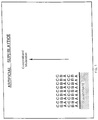
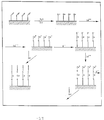
- the present invention provides a chemically controlled self-assembly process which allows precise sequential building of any desired number of discrete one-molecule thick and/or one-atom thick layers, each containing both organic and/or inorganic species, so that various combined or intercalated organic-inorganic layered structures, or superlattices, with precisely predetermined molecular/atomic order, at least in the direction of the layer stacking, may be produced on various solid substrates (Fig. 1).
- Each layer within these novel types of composite superlattices of the present invention may be made of one or a combination of several distinct chemical species, either organic or inorganic, and different layers may be deposited in various periodic or non-periodic sequences.
- the layers may be crystalline or amorphous, with or without interlayer epitaxial relationship, and/or epitaxial relationship to the superlattice solid substrate.
- certain new species may be formed following synthesis through processes of post-assembly intercalation, with optional further chemical modification.
- the present invention is of film building processes for the preparation of composite organic-inorganic superlattices.
- solid substrate and "surface” as used herein are intended to encompass both the original solid substrate and the monolayers-covered solid substrate.
- the chemical "trigger” operation may consist of a surface chemical reaction resulting in the in-situ modification of a latent binding function, or binding site precursor, into an active one, as defined by Sagiv in U.S. Patent No. 4,539,061, which is herein incorporated by reference in its entirety.
- each of the constituents in the adjacent fluid should not adhere to its own layer, each of them may have sufficient affinity for the other, so that the deposition of a layer of one of the materials automatically creates an exposed outer surface on which adsorption of a layer of the other material may occur.
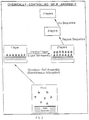
- layer self-assembly and triggering occurs in one single step (Fig. 2).
- the chemical "trigger” is thus to be regarded as any operation or sequence of operations, involving chemical, photochemical or electrochemical processes or reactions. Such processes or reactions may be mediated by various chemical reagents, electrical current, electromagnetic radiation of any wavelength, electric or magnetic fields, electron or ion beams, electric discharge, or plasma of any type.
- triggering mechanisms included are ion/molecular exchange processes, adsorption/chemisorption of any appropriate organic, inorganic and/or organic/inorganic species from a solution, melt or vapor phase, change in the nature of the solvent, such as from organic to aqueous or vice versa, change in the composition of the solvent or composition of a vapor phase environment, change of temperature, pressure, vapor pressure, or any other chemical or physical operation or set of operations which are effective in modifying the exposed outer surface of a solid substrate, or that of the last deposited layer of a solid-supported superlattice structure, so as to facilitate its utilization as "active" substrate, i.e., as substrate on which the self-assembly of a new layer of one or of a mixture of selected materials is possible.
- Organic-inorganic superlattice structures of the types described in this invention have potential commercial applications as polar non-centrosymmetric thin films exhibiting non-linear optical response (second harmonic generation, SHG), ferroelectricity and piezo and pyroelectricity, thin films exhibiting planned photoelectric effects, specific electrochemical and photoelectrochemical response, photochromic and electrochromic effects, electrical rectification (diode effects), magnetic thin films with ferromagnetic, antiferromagnetic or paramagnetic properties, thin films exhibiting selective permeability towards certain molecular and ionic species (selective membranes), ultrathin coating films exhibiting controllable adsorptivity or controllable lateral diffusion or transport characteristics towards certain selected molecular and/or ionic species, superconducting films, films exhibiting other useful chemical, electrochemical, photochemical, optical, electric, magnetic, permeation, diffusion or lateral transport property.
- superlattice films according to the present invention are of value in a number of novel electronic, optical and optoelectronic microdevices, devices based on superconducting effects, sensors of various types, photocells and photoelectrochemical cells, including use in solar energy conversion, display technology, special ultrathin coatings for optical fibers, semiconductors, metals, ultrathin separatory membranes and ultrathin coatings for the production of molecularly engineered adsorbents for various chromatographic, electrophoresis, or related separation processes, ultrathin coatings for various metal or semiconductor materials, for use as molecularly engineered electrodes in various applications based on electrochemical and/or photoelectrochemical processes, ultrathin film coatings with desirable special properties for any polymeric or mineral material, including porous material.
- the bifunctional organic amphiphiles described by Sagiv in U.S. Patent No. 4,539,061, are suitable for the construction of ion-containing superlattice structures according to the present invention.
- Inorganic ions, cations or anions may be included as distinct constituents in such structures.
- Ions capable of multiple coordination or with formal valency higher than one are preferred because of their ability to bind multidirectionally and the remarkably improved structural flexibility, tenacity and physico-chemical stability which such ions thereby confer to the respective overall structures.
- Fig. 3 provides, for illustrative purposes only, schematic examples of a number of specific synthetic routes enabling the stepwise construction of ion-containing organic-inorganic superlattice structures with interlayer coupling based on practically any type of known interlayer chemical bond, such as ionic, covalent, coordinative, or combined binding modes involving the simultaneous participation of any combination of covalent, ionic and coordination bonds.
- Interlayer hydrogen-bonded structures are also possible, as described hereinafter.
- the bifunctional amphiphiles in Fig. 3 are C23 and C19 normal aliphatic chains having 23 and 19 carbon atoms, respectively, with a phosphate ester and respective chlorosilane binding function (polar head group) which is convertible into siloxane upon hydrolysis and condensation with a similar neighbor group, and a terminal ethylenic double bond, which serves as a latent binding function, with no intrinsic binding capability in its initial, inactivated form.
- oriented monolayers of such bifunctional amphiphiles may be obtained on various polar solid substrates by self-assembly via spontaneous adsorption/chemisorption from organic solutions, involving the anchoring of the polar head groups to the polar solid, and the exposure to the outer environment of the non-binding ethylenic double bond functions.
- Hydrophobicity which is a basic condition in the formation of insoluble Langmuir monolayers on water, is not required for the self-assembly of monolayers from a bulk fluid phase.
- highly hydrophobic moieties such as long hydrocarbon or fluorocarbon chains, or saturated polycyclic units, such as steroidal skeletons, is thus not a necessary requirement in monolayer self-assembly. Consequently, various compounds, such as organic chromophores and other molecules with delocalized ⁇ electrons, which may be of interest in connection with their special optical or electronic properties, can be successfully self-assembled into ordered mono- and multilayer structures.
- Chromophoric compounds suitable for use as layer components in the construction of superlattice structures according to the present invention must be equipped with appropriate binding functions and latent binding functions or binding site precursors. Their molecular geometry should be sterically compatible with the desired orientation and packing in an ordered surface layer, and the surface bound molecules should withstand the necessary chemical modification operations providing the chemical "trigger" for the deposition of additional layers.
- the binding and latent binding functions in such chromophoric compounds may be selected as integral parts of the active chromophore, or even as the entire chromophore itself, in which case the sequential deposition of such layers on top of each other will result in new chromophoric entities, i.e., the initial ones after their modification as effected by the respective selected modes of intra/interlayer binding. Charge redistribution due to electrostatic forces, orbitals overlap, dipole-dipole, charge-dipole, and other intermolecular interactions may determine the final properties of such chromophoric superlattices.
- Fig. 15 depicts schematically the chemically controlled self-assembly of a family of composite superlattice structures with intercalated layers of a long chain hydrocarbon amphiphile and an inorganic chalcogenide semiconductor material (CdS).
- the deposition process in Fig. 15 consists of a sequence of chemical steps, each of which results in the addition of a discrete layer of just one chemical species, while providing the necessary trigger for the deposition of a next layer having affinity for the layer already deposited.
- a sulfide layer is generated on the outer surface of the organic monolayer through photochemical addition of H2S to the terminal double bond of the hydrocarbon amphiphile, which creates a surface with high chemical affinity for Cd2+ ions.
- a layer of cadmium ions may then be introduced by adsorption from a solution of a soluble cadmium salt, followed by any desired number of additional sulfide and cadmium layers, deposited sequentially from solutions of soluble salts of the respective ions [see Y.F. Nicolau, Applications of Surface Science, 22/33 , 1061 (1985)].
- the inorganic sulfide may be replaced, at any stage of this layer-by-layer build-up process by an organic thiol (mercaptan), thus yielding an outer layer of the respective cadmium thiolate (mercaptide), to which H2S may again be added through the above photochemical reaction.
- organic thiol mercaptan
- H2S cadmium thiolate
- Composite organic-inorganic superlattices prepared by the sequential deposition of discrete monolayers, according to the chemically-controlled self-assembly processes disclosed above, may be utilized as starting materials in the assembly of other, more complex, superlattices, using processes of post-assembly intercalation and/or chemical modification.
- the intercalation is achieved by replacing mobile atomic or molecular species, charged or neutral, located within the stable multilayer backbone of a superlattice produced according to any of the processes disclosed above, with other mobile species diffusing from an adjacent fluid or solid phase brought in contact with the initial superlattice.
- Such intercalation processes may be repeated any number of times, in any practically useful manner, so as to create a large variety of new multilayer intercalated structures.
- This intercalation approach offers the additional possibility of simultaneous modification of some or all layers of a superlattice initially produced in the self-assembly process described above.
- the initial superlattice plays the role of a fixed 3-dimensional layered template which controls the intercalation of selected mobile species into an organized 3-dimensional structure with predefined architecture.
- various chemical species will be intercalated into various interlayer spaces of the initial superlattice, according to the chemical characteristics of the respective layers and respective intercalable species.
- either superlattices assembled by the step-by-step processes disclosed above, or superlattices constructed by post-assembly intercalation may be further modified by subsequent chemical transformations conducted on the entire superlattice and leading to the in situ generation of new chemical species in the superlattice layers or between them.
- transformations include chemical, photochemical, and electrochemical processes or reactions involving one or more superlattice species, or a superlattice species and one or more outer species diffusing into the superlattice, for example, from an outer gas, liquid or solid medium, including the solid substrate of the superlattice, or a superlattice species and other species or a reagent located in an outer medium contacting the superlattice, including the superlattice solid substrate.
- complex "superlattice-within-superlattice” structures may be assembled by sequential intercalation, with or without further chemical modification, leading to the layer-by-layer formation of a new set of multilayers within all or a selectable portion of the interlayer spaces of the initial superlattice.
- Example 1 Superlattice Structures of Organic Long-Chain Bifunctional Amphiphiles with Intra and Interlayer Intercalated Inorganic Ions
- a ZnSe ATR crystal plate (Harrick, single pass, parallelepiped, 50 x 10 x 3 mm, 45° aperture angle) was activated (cleaned) for adsorption by 20 minutes extraction with boiling toluene in a Soxhlet extractor, followed by 10 minute exposure to argon plasma in a RF discharge apparatus (Harrick PDC-3XG).
- a first phosphate layer was adsorbed on the activated ZnSe surface by immersing the ZnSe plate for 15 minutes in a 4.0 x 10 ⁇ 4M solution of the C23 phosphate amphiphile (22-tricosenyl dihydrogen phosphate), in bicyclohexyl at ambient temperature, after which the plate was withdrawn and rinsed for 15 minutes in pure toluene at ambient temperature.
- the synthesis of 22-tricosenyl dihydrogen phosphate can proceed as follows.
- the C23-phosphate-terminal double bond amphiphile was synthesized starting with the commercially available 10-undecenoyl chloride and 1-morpholinocyclododecene (Fluka), and proceeding along a synthetic route leading to extension of the hydrocarbon chain 11 to 23 carbon atoms and final introduction of the phosphate ester function.
- the C23 keto-acid was converted to the respective tosyl hydrazone by stirring a mixture of the keto-acid and tosyl hydrazine in glacial acetic acid for 72 hours at the ambient temperature, after which the mixture was poured in water and the precipitated solid filtered, dried, and recrystallized from methanol.
- the tosyl hydrazone product was reduced with NaCNBH3 in acidic dimethylformamide (DMF) and sulfolane according to Hutchins et al. [R.O. Hutchins, C.A. Milewski and B.E. Maryanoff, J. Amer. Chem. Soc., 95 , 3662 (1973)].
- the resulting C23 carboxylic acid was esterified with methanol by the dicyclohexylcarbodiimide (DCC) method, in the presence of 4-dimethylaminopyridine (4-DMAP) in Benzene [B. Neises and W. Steglich, Agnew. Chemie Int. Ed. Engl. 17 , 522 (1978)], and the methyl ester reduced to the C23 alcohol with LiAlH4 in diethyl ether. Esterification of the C23 alcohol with phosphorus oxychloride, followed by hydrolysis in H2O of the resulting C23 phosphorodichloridate, by a method similar to that of Cremlyn et al. [R.G.W.
- the monolayer coated surface obtained above is hydrophobic, autophobic and oleophobic, i.e., it is not wetted by water, by the adsorption solution or by a series of liquids usually employed in wettability studies, such as pure bicyclohexyl (BCH), n -hexadecane (HD), and toluene (employed in the present preparation as a rinsing solvent), producing typical contact angle values with no difference or only a very small difference between advancing and receding angles (no contact angle hysteresis): 51°-49° for BCH; 43°-42° for HD; 100°-98° for H2O. Repetition of the adsorption/rinse cycle did not lead to any further change in the amount of the adsorbed material, as evidenced by the IR and contact angle data, indicating the formation of a densely packed and well defined phosphate monolayer.
- BCH bicyclohexyl
- HD n
- the chemical modification (oxidation) of the outer exposed ethylenic double bond functions of the C23 phosphate monolayer into terminal K+-carboxylate functions was carried out by immersing the monolayer-coated ZnSe plate in a 1.0 x 10 ⁇ 3 M benzene solution of the KMnO4-crown ether complex, consisting of equimolar quantities of KMnO4 and dicyclohexano-18-crown 6 (Sigma, 98%) dissolved in benzene at ambient temperature, for a total period of time of about 44 hours.
- the plate was withdrawn every 5-10 minutes, rinsed with cold toluene and checked for the presence of residual double bond functions (by IR and wettability measurements). It was found that about 80%-90% of the double bonds were oxidized within one hour, while much larger reaction times (up to a total of about 44 hours) were required to bring to completion the oxidation of the remaining unreacted functions.
- the reaction procedure finally adopted was to perform 4 reaction cycles of about 10-12 hours each, with thorough rinsing of the plate with cold toluene, and replacement of the KMnO4-crown ether solution with a fresh one after the completion of each reaction cycle.
- the outer monolayer surface consisting of carboxylate (-COO ⁇ K+) polar functions is wetted by each of the above-mentioned test liquids, i.e., it becomes both oleophilic and hydrophilic.
- the carboxylate surface functions were converted into free carboxylic acids (-COOH) by immersion for 10 minutes in a solution of 5% HCl in double distilled water, followed by rinsing with cold toluene.
- a second phosphate layer was adsorbed through the formation of ionic bonds [as in Fig. 3(h)] on the Ca2+ carboxylate outer surface of the modified first layer in a manner identical to the adsorption of the first phosphate layer on the bare ZnSe surface, and the surface chemical modification and adsorption of two additional phosphate layers in the structure were carried out by the same procedures as described above for the first layer. Identical contact angles were measured on each of the four phosphate layers.
- silane layers were sequentially adsorbed on top of the four phosphate layers through the formation of covalent bonds [as in Fig. 3(g)] from a 2.0 x 10 ⁇ 3 M solution of the C19 silane amphiphile (18-nonadecenyltrichlorosilane-NTS) in BCH at ambient temperature (10 minute adsorption time) followed by thorough rinsing with cold toluene. Contact angles similar to those of the phosphates were measured on each of the silane layers.
- the surface chemical modification of each of the silane layers was performed in a manner identical to that of the phosphate layers, except for the immersion in the CaCl2 solution.
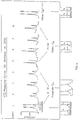
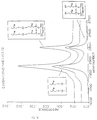
- Fig. 4 shows a series of ATR-FTIR (Attenuated Total Reflection - Fourier Transform Infrared) spectra and difference spectra recorded during the construction of the 8 organic layer superlattice structure of this example.
- Curves 2-8 are different spectra, each n-th layer contribution being obtained as the mathematical subtraction of the spectrum of n-1 layers from that of the corresponding n-layers film (the composition of each layer in the structure is schematically indicated in the corresponding inserts).
- the spectrum of a monolayer of the C19-silane adsorbed directly on the AnSe surface is also shown (first curve from right).
- the difference spectra provide evidence for the discrete deposition of individual layers in this 8 organic layer superlattice structure.
- each of the 8 organic monolayers is demonstrated by the corresponding integrated peak intensities, which are constant and proportional to the chain length of the respective layer forming amphiphile, as well as by the typical and constant angles recorded for three representative liquids on each of the 8 layers.
- Observed differences in peak width and position, between the phosphate and the silane layers, are indicative of significant lack of interlayer correlation as regarding the in-plane lateral distribution and packing of the respective paraffinic chains.
- the lateral molecular distribution within each layer of a multilayer structure of this type may be largely independent of that of the layer located underneath it. Intralayer lateral interactions should, therefore, prevail in such situations. This suggests interesting possibilities as regarding the development of continuous, gap-bridging monolayers, applicable, among others, to the preparation of ultrathin molecularly engineered membranes.
- Fig. 5 Some schematic structural compositions of superlattices of organic long chain amphiphiles with Al3+ and Ca2+ ions, involving different modes of inter- and intralayer bonding are depicted in Fig. 5 where the hydrocarbon chain (with 18, 19, 22, and 23 carbon atoms) are symbolically represented by segments containing only several CH2 units per chain. They include (Fig. 5a) the silane-Al3+-carboxylate covalent-ionic-coordinative mode of binding [as in Fig.
- the phosphate Al3+-carboxylic acid ionic-coordinative mode of binding (Fig. 5b), with the Al3+ ion introduced from either aqueous or organic solutions of the AlCl3 salt, and similar structures with ions such as Cd2+, Fe3+, Zr4+, Ti4+, Cu2+, Cu+, Ag+.
- Structures with carboxylate-Fe3+-carboxylate interlayer binding have also been constructed, as well as structures with alternate layers of different ions, such as phosphate-Al3+-carboxylic acid and phosphate-Ca2+ carboxylic acid (see Fig. 5b).
- chromophoric superlattices containing metal ions constructed by chemically controlled self-assembly, are illustrated in Figs. 6 and 7, depicting schematically the controlled assembly of multilayers of anisic acid (AA) (4-methoxybenzoic acid) and benzyl orange (BO), [4-(4-benzylaminophenylazo) benzenesulfonic acid], respectively, with inter and possibly intralayer binding mediated by Ag+ ions.
- AA anisic acid
- BO benzyl orange
- Ag+ ion may bind four, or even more ligands, in a planar or tetrahedral configuration.
- the layer-by-layer deposition process in these chromophoric superlattices starts with an "anchoring" silane-terminal ethylenic double bond monolayer, continues with the in situ chemical modification converting the double bonds to terminal carboxylic acid functions, and proceeds through the alternate deposition of layers of Ag+ ions using a soluble silver salt and layers of the respective chromophores.
- the first Ag+ layer binds to the exposed -COOH functions of the anchoring silane monolayer as silver carboxylate salt species, while each of the next deposited Ag+ layers adheres to the outer exposed surfaces of the chromophoric layers via coordination, complex formation, with either the outer ether oxygens of AA (Fig. 6) or the outer amino and possibly phenyl groups of BO (Fig. 7).
- Each layer of chromophores binds to a previously deposited outer Ag+ layer as the respective silver sulfonate salt.
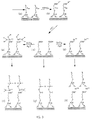
- Fig. 8 shows schematically the actual surface ion exchange process employed in the construction of the AA-Ag+ and BO-Ag+ superlattices of Figs. 6 and 7.
- the silver salt utilized in these examples is that of the p -toluene sulfonate (PTS) chromophore, which forms an oriented self-assembly monolayer with molecular packing identical or very similar to that of the AA or BO chromophores.
- PTS p -toluene sulfonate
- PTS serves, therefore, as a convenient and easily displaceable Ag+ carrier, enabling the controlled deposition of well defined monolayers of the silver metal ion, in alternation with well defined monolayers of a suitable layer-forming chromophore.
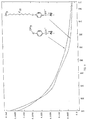
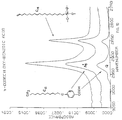
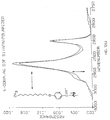
- Figs. 9 and 10 display the UV and IR absorbance spectra recorded for one layer of AA-Ag+ and one layer of a long-chain-substituted (C12 - carbon atoms) AA-Ag+ analog (4-dodecyloxybenzoic acid-DDBA), deposited on an anchoring silane monolayer on quartz.
- the spectra are corrected for the absorbance of the anchoring monolayer and the quartz slide below about 220 nm.
- the AA and the C12-substituted chromophores can repeatedly replace each other on the Ag+-treated surface (of the anchoring monolayer), via the above-described ion-exchange process, the exchanged layers displaying very similar UV absorbance curves (Fig. 9), which implies similar molecular packing and orientation of the respective chromophores on the surface, but significantly different contact angles, as expected on the basis of the different chemical constitution of the outer exposed surfaces produced by each of these components.
- the C12 hydrocarbon chain of the long-chain-substituted chromophore serves as a convenient IR and contact angle marker, allowing the evaluation of the molecular density of this compound on the surface.
- the contact angles measured on the AA-Ag+ layer of Fig. 9 were 32° for BCH, 30° for HD, 73-75° (advancing) and 65° (receding) for H2O, while those measured on the corresponding DDBA-Ag+ layer were 51-52° for BCH, 42-44° for HD and 108-109° for H2O (no detectable hysteresis).
- the IR see Fig.
- the same DDBA chromophore is adsorbed as the free acid on a bare quartz surface, i.e., with no Ag+ ions attached to an anchoring monolayer, it forms an incomplete monolayer containing only 37% of the material present in the respective tightly packed layer, as shown in the lower curve in Fig. 10, and its UV spectrum, illustrated in Fig. 11, displays a prominent peak around 260 nm, as expected for such chromophores in a parallel orientation on the underlying surface. No such peak appears in the UV spectra of perpendicularly oriented AA-Ag+ chromophores. Accordingly, the contact angles of this incomplete layer were very low -28° for BCH, 19° for HD and 49° for H2O.
- spectral regions 1800cm ⁇ 1 to 1500cm ⁇ 1 and 3050 cm ⁇ 1 to 2750cm ⁇ 1 are shown at different scales, in Fig. 12(a) and 12(b), respectively.
- the chain (-CH2-) stretch modes around 2900 cm ⁇ 1 appear with almost equal intensities in both polarizations, as expected for such vibrations parallel to the surface, corresponding to a perpendicular orientation of the chains [see R. Maoz and J. Sagiv, J. Colloid Interface Sci. 100 , 465 (1984)].
- AA and BO chromophoric superlattices were constructed as non-centrosymmetric structures, with polar axes pointing along the normal to the layer planes.
- Polar films of this type are expected to display piezo and pyroelectricity as well as non-linear optical effects, such as second-harmonic-generation (SHG).
- SHG second-harmonic-generation
- the silane monolayer was adsorbed on the activated quartz slide from a 2.0 x 10 ⁇ 1 M solution of 18-Nonadecenyltrichlorosilane (NTS) in BCH at ambient temperature, by repeating 3 times an adsorption-extraction cycle consisting of 15 minutes immersion in the silane solution followed by 10 minutes extraction with boiling toluene in a Soxhlet extractor, after which the slide was subjected to 4 cycles, each consisting of 8-12 hours immersion in the silane solution and 15 minutes Soxhlet extraction with toluene, and final Soxhlet extraction with toluene for 30 minutes.
- the silane solution was replaced with a freshly prepared solution after each of the adsorption cycles.
- the slide coated with the silane monolayer was immersed for 10-12 hours in a 1.0 x 10 ⁇ 3 M benzene solution of equimolar quantities of KMnO4 and dicyclohexano-18-crown 6 (Sigma, 98%) at ambient temperature, after which it was rinsed with toluene, followed by 10 minutes Soxhlet extraction with boiling toluene.
- This reaction-rinse-extraction cycle was repeated for additional three times (total reaction time - about 44-48 hours), each cycle starting with a fresh KMnO4-crown ether solution.
- the first AA layer was deposited on the activated anchoring silane monolayer by the following 2-step process: (1) immersion of the slide for 1 hour in a 5 x 10 ⁇ 3 aqueous solution of Ag+- p -toluenesulfonate Ag+-PTS, Aldrich, 99+%) at ambient temperature, followed by (2) immersion for 10 minutes in a 5 x 10 ⁇ 4 M solution of p-Anisic Acid (BDH, 99+%) in BCH/CHCl3 (2% CHCl3) at ambient temperature. Additional AA layers were adsorbed on top of the first deposited layer in a similar fashion, the adsorption time of Ag+-PTS being, however, equal to that of AA (10 minutes).
- a number of other model superlattice structures with organic chromophores and inorganic metal ions have been constructed, including: structures similar to those of Figs. 6 and 7, but with methyl orange [4-(4-dimethylaminophenylazo) benzenesulfonic acid] (MO) instead of BO; similar structures, but with silver benzoate or AgNO3, instead of Ag+-PTS, as silver ion carrier; similar structures, where the anchoring monolayer is a long chain silane with a terminal thiol (-SH) function; similar structures, but with Cu2+, Cu+, or Fe3+ ions rather than Ag+; BO-Ag+ multilayers assembled from either organic or aqueous solutions of BO, with aqueous Ag+-BO species serving as the silver ion carrier (i.e., the layer deposition process proceeding through alternate immersions in aqueous solutions of the Ag+-BO salt and organic or aqueous solutions of the neutral BO); multilayers of 4-vinyl benzoic
- superlattices containing organic chromophores and inorganic ions that can be produced by chemically controlled self-assembly are listed below: Disk-like aromatic molecules such as benzene, coronene, pyrene, naphtodianthracene and their derivatives, porphyrine and derivatives, phthalocyanine and derivatives, crown ethers, and many others, may be used as components in superlattices with intercalated metal ions.
- the binding of the metal ion to flat aromatics of this kind will be via complexation and/or salt formation with the aromatic rings themselves and/or their substituents.
- Such disk-like chromophores play the double role of both their own binding functions and latent binding functions, their symmetry forcing them to adopt a flat orientation on the surface, i.e., with the aromatic planes parallel to superlattice layer planes.
- Other possibilities include the use of cationic organic chromophores, such as anilinium or pyridinium species and their derivatives, with intra and/or interlayer inorganic anionic species. Structures made of ionic chromophores of both cationic and anionic type, with or without the participation of inorganic counter ions, are also possible.
- construction of a large variety of chromophoric superlattices combining different organic chromophores and inorganic ionic species, in various mixed or intercalated configurations, is feasible through chemically controlled self-assembly.
- the composite superlattices suggested by Fig. 15 serve to illustrate the general principles involved in the assembly of such organic-semiconductor and related structures. There are, of course, many other possible chemical routes complying with the general requirements of chemically controlled self-assembly which can be employed in the construction of various superlattices of this kind. A large variety of semiconductor and organic materials may be employed as well as chemical procedures for the coupling of the organic and the inorganic species.
- Sulfur may be coupled to hydrocarbons through any useful synthetic route leading to the formation of thiols, sulfides and disulfides, such as the photo-addition of thioacetic acid to terminal double bonds followed by reduction with LiAlH4, or substitution of terminal halide atoms (Cl, Br) by -SCN, or by thioacetic acid, followed by reduction with LiAlH4.
- Cadmium ions may be replaced by Zn++ or Ag+, leading to the formation of zinc sulfide or silver sulfide species, sulfur may be replaced by Se or Te, resulting in the respective selenides or telurides, and so on.
- Utilization of chromophoric species such as vinyl benzene (styrene) derivatives is also possible, leading to superlattices with intercalated semiconductor and organic layers of chromophores.
- the build-up process of Fig. 15 may be reversed, by first binding the metal ion to a suitable organic monolayer and then attaching the selected chalcogenide or other inorganic anionic species.
- Ag+ ions bound to an organic layer by complexation with double bonds, halide atoms or aromatic moieties, or as salts of anionic moieties such as carboxylates (-COO ⁇ ) or sulfides (-S ⁇ ), may be reduced photochemically to the Ag0 metal by exposure to electromagnetic radiation in the visible-UV-X ray regions, or by reaction with an aldehyde or any other suitable reducing agent (such as those usually employed in the photographic image development), or by electrochemical means, provided the superlattice is electrically conducting or is constructed on an electrically conducting substrate. Similar electroless or electrochemical reduction processes may be applied to the controlled deposition of monolayers of Au, Cu, or any other metal of interest.
- One-by-one deposition of monolayers of a selected metal species is achieved by adsorbing a new layer of the metal ions onto the last layer of reduced metal, reducing this new layer of ions by an analogous reduction procedure, and repeating these adsorption and reduction steps until the desired metal film thickness, or number of superimposed metal monolayers, is achieved.
- metal deposition processes one may identify the reduction step with the chemical "trigger" operation of Fig. 2.
- the conversion of each monolayer of metal ions to the respective metal element is required to promote the adsorption of a new layer of metal ions on top of it.
- Intercalation of metallic layers of interest with organic layers of selected species results in composite superlattices combining layers of various organic molecules and metal elements.
- Superlattice structures of higher structural and compositional complexity may be obtained by intercalating layers of selected metals, semiconductors and organic species.
- NTS N19-silane-terminal double bond
- the monolayer coated quartz slide was introduced in a quartz tube connected to a cylinder of pure H2S gas (Matheson), purged for approximately 10 minutes with H2S, and then irradiated for about 2.5 hours with a UV lamp producing radiation at a wavelength of 254 nm, while maintaining positive pressure of H2S in the quartz tube during the UV radiation.
- a thin layer of bulk sulfur was deposited on the slide, becoming visible to the eye by the end of the irradiation period.
- the slide was then rinsed in cold toluene, to remove the bulk sulfur coating, and finally extracted for approximately 15 minutes with boiling toluene in a Soxhlet extractor.
- Cd2+ ions were attached to the H2S-reacted monolayer surface by immersing the slide for 30 minutes in a 1.0 x 10 ⁇ 3 M solution of Cd2+-acetate (BDH, Analar) in double distilled water, at ambient temperature.
- BDH Cd2+-acetate
- a C18-thiol monolayer was adsorbed on the Cd2+-treated surface by immersing the slide for 10 minutes in a 5.0 x 10 ⁇ 3 M solution of n-octadecylthiol (Fluka, 95%, twice recrystallized from methanol) in BCH at ambient temperature, followed by rinsing with cold toluene.
- n-octadecylthiol Fluka, 95%, twice recrystallized from methanol
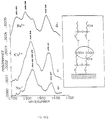
- Post assembly intercalation is illustrated below with a simple example comprising intercalation of mobile metal ions into a hydrogen-bonded multilayer structure with fixed carboxylic acid (-COOH) groups in the interlayer planes (Fig. 18).
- Fig. 19 illustrates IR spectra showing quantitative conversion of the free -COOH groups into carboxylates (-COO ⁇ ) of Na+, Cu2+, and Fe3+, upon immersion of the initial superlattice into aqueous solutions of the respective ions. No change in the C-H vibrations of the hydrocarbon chains was observed [Fig. 19(1)], pointing to the overall high structural stability of the initial superlattice upon exchange of the mobile ionic species. This conclusion is further corroborated by the constant contact angles measured on the outer film surface, before and following ion intercalation.
- Rapid conversion of monolayer terminal double bonds to terminal carboxylic acid functions is conveniently achieved by the FeCl3-catalyzed photo-oxidation of the double bonds, with O2 in aqueous FeCl3.
- the mono/multilayer covered substrate is immersed in an oxygen-saturated aqueous solution of FeCl3 (1.0 x 10 ⁇ 3 M) at ambient temperature and then irradiated for 1-3 minutes with a halogen lamp (visible light) under continuous bubbling of pure O2 gas.
- the resulting Fe3+-carboxylate functions are converted to the free acid (-COOH) by immersion in concentrated aqueous HCl for several seconds.
- the reacted surface is rinsed with pure water and dried in a stream of clean nitrogen or argon.
- the use of air instead of pure O2 is also possible, but results in a somewhat slower reaction.
- Carboxylic acid outer surfaces produced by this procedure are suitable for fast formation of polymerized hydrogen-bonded silane monolayers, as described above.
- the self-assembly of such silane monolayers is complete within seconds following immersion of the coated substrate into the solution of the selected monolayer-forming silane.
- Hydrogen-bonded multilayer structures such as those depicted in Fig. 18 have been successfully assembled by this fast photo-oxidation fast monolayer formation process at a rate of less than 5 minutes per monolayer.
- the process involves simple preparative conditions, and is easily adaptable to automation as well as large scale production.
- IR spectral data collected after completion of each of the above operations indicate discrete, layer-by-layer, uptake of glucose and silver ions, with the apparent layer-by-layer reduction of Ag+ to metallic silver and the corresponding oxidation of interlayer incorporated glucose.
- the alternate uptake of glucose and silver ions falls within the general definition of a chemically controlled self-assembly process (Fig. 2), as each new layer of glucose is added only following the deposition of a layer of silver ions, and vice versa.
- Both glucose and silver layers are intercalated into the interlayer spaces of the initial035Xsuperlatticethe overall process thus involving sequential post-assembly intercalation combined with further chemical modification through the redox reaction of the intercalated glucose and Ag+ species.
- a large variety of complex intercalation processes is feasible, using complex superlattices and more than one intercalable species.
- cations, anions and neutral species may be simultaneously intercalated into various predetermined interlayer spaces of the initial superlattice, according to the nature of fixed ionizable groups and the specific chemical affinity of other fixed chemical moieties, neutral or charged, present in the respective spaces.
- Simultaneous as well as sequential intercalation from one or more fluid and/or solid phases is also possible.
- intercalated metal ions such as Cd2+, Zn2+, Cu2+, Ag+, and others, may combine with H2S, S2 ⁇ , HS+, or similar Se or Te species diffusing from an outer liquid, gas or solid phase, to form the respective sulfides, selenides or telurides simultaneously in all metal ion-containing layers of the superlattice.
- metal layers such as Ag
- metal layers may be produced by the simultaneous reduction of any number of Ag+-containing layers of a preassembled superlattice into the free metal element.
- the reduction may be carried out photochemically, electrochemically, or chemically, with reducing agents diffusing into the Ag+ superlattice layers, or via electron transfer from reducing agents located in adjacent layers of the superlattice, or reducing agents located in an outer fluid or solid medium, including the superlattice substrate.
Landscapes
- Engineering & Computer Science (AREA)
- Chemical & Material Sciences (AREA)
- Nanotechnology (AREA)
- Physics & Mathematics (AREA)
- Theoretical Computer Science (AREA)
- Mathematical Physics (AREA)
- Spectroscopy & Molecular Physics (AREA)
- Crystallography & Structural Chemistry (AREA)
- Materials Engineering (AREA)
- Recrystallisation Techniques (AREA)
- Electroluminescent Light Sources (AREA)
- Crystals, And After-Treatments Of Crystals (AREA)
- Liquid Deposition Of Substances Of Which Semiconductor Devices Are Composed (AREA)
- Physical Or Chemical Processes And Apparatus (AREA)
Applications Claiming Priority (4)
| Application Number | Priority Date | Filing Date | Title |
|---|---|---|---|
| IL95953A IL95953A0 (en) | 1990-10-10 | 1990-10-10 | Process for the production of composite organic-inorganic superlattices |
| IL95953 | 1990-10-10 | ||
| IL98753A IL98753A0 (en) | 1990-10-10 | 1991-07-05 | Process for the production of composite organic-inorganic superlattices |
| IL98753 | 1991-07-05 |
Publications (2)
| Publication Number | Publication Date |
|---|---|
| EP0481362A2 true EP0481362A2 (de) | 1992-04-22 |
| EP0481362A3 EP0481362A3 (en) | 1994-05-11 |
Family
ID=26322139
Family Applications (1)
| Application Number | Title | Priority Date | Filing Date |
|---|---|---|---|
| EP19910117306 Withdrawn EP0481362A3 (en) | 1990-10-10 | 1991-10-10 | Composite organic-inorganic superlattices |
Country Status (3)
| Country | Link |
|---|---|
| EP (1) | EP0481362A3 (de) |
| JP (1) | JPH04273477A (de) |
| IL (1) | IL98753A0 (de) |
Cited By (14)
| Publication number | Priority date | Publication date | Assignee | Title |
|---|---|---|---|---|
| US5869136A (en) * | 1992-02-27 | 1999-02-09 | Matsushita Electric Industrial Co., Ltd. | Method of manufacturing a chemically adsorbed multilayer film |
| EP0881519A3 (de) * | 1997-05-30 | 1999-11-17 | Hitachi, Ltd. | Optischer Modulator vom Supergittertyp mit organisch/anorganischer Zusammensetzung |
| WO2001061330A3 (en) * | 2000-02-20 | 2001-12-13 | Yeda Res & Dev | Constructive nanolithography |
| WO2003088372A3 (en) * | 2002-04-05 | 2003-11-20 | Ibm | Molecular electronic device using metal-metal bonded complexes |
| WO2004006353A3 (en) * | 2002-07-03 | 2004-08-05 | Univ Cambridge Tech | Organic-inorganic hybrid transistors |
| EP1179863A3 (de) * | 2000-08-10 | 2006-01-18 | Matsushita Electric Industrial Co., Ltd. | Organische elektronische Anordnung, Herstellungsmethode und Verwendung |
| US7007370B2 (en) | 2000-07-20 | 2006-03-07 | President And Fellows Of Harvard College | Self-assembled electrical networks |
| EP1355323A4 (de) * | 2000-12-26 | 2006-11-22 | Matsushita Electric Industrial Co Ltd | Leitfähiger organischer dünnfilm, prozess zu seiner herstellung und organisches photölektronisches bauelement, elektrischer draht und elektroden-äch damit |
| US7662009B2 (en) | 2001-08-10 | 2010-02-16 | Panasonic Corporation | Organic electronic device, method of producing the same, and method of operating the same |
| USRE41427E1 (en) * | 2001-04-11 | 2010-07-13 | Rutgers, The State University | Hybrid nanostructured materials based in II-VI semiconductors |
| US8471290B2 (en) | 2008-03-24 | 2013-06-25 | Rutgers. The State University of New Jersey | Compositions and methods for generating white light |
| US8515232B2 (en) * | 2001-01-26 | 2013-08-20 | Nanogram Corporation | Polymer-inorganic particle composites |
| US9142562B2 (en) | 2013-02-21 | 2015-09-22 | Kabushiki Kaisha Toshiba | Nonvolatile semiconductor memory device |
| CN112625277A (zh) * | 2020-12-01 | 2021-04-09 | 吉林大学 | 一种金属有机框架@聚多巴胺薄膜的制备方法 |
Families Citing this family (4)
| Publication number | Priority date | Publication date | Assignee | Title |
|---|---|---|---|---|
| ATE357977T1 (de) * | 2003-03-31 | 2007-04-15 | Eidgenoess Tech Hochschule | Kontrolierte oberflächen-stoffgradienten |
| JP2005074578A (ja) | 2003-09-01 | 2005-03-24 | Sony Corp | 微粒子アレイ及びその製造方法並びに磁気記録媒体 |
| JP2008053631A (ja) * | 2006-08-28 | 2008-03-06 | Toyota Motor Corp | 電気化学活性を有する有機薄膜、その製造方法、およびそれを用いた素子 |
| FR3061440B1 (fr) * | 2017-01-05 | 2021-02-12 | Centre Nat Rech Scient | Procede de fabrication d’une membrane multicouche sur support solide a base de copolymere a blocs amphiphile |
Family Cites Families (4)
| Publication number | Priority date | Publication date | Assignee | Title |
|---|---|---|---|---|
| US4539061A (en) * | 1983-09-07 | 1985-09-03 | Yeda Research And Development Co., Ltd. | Process for the production of built-up films by the stepwise adsorption of individual monolayers |
| GB8513770D0 (en) * | 1985-05-31 | 1985-07-03 | Gen Electric Co Plc | Optically non-linear materials |
| US4939556A (en) * | 1986-07-10 | 1990-07-03 | Canon Kabushiki Kaisha | Conductor device |
| US4968524A (en) * | 1987-10-16 | 1990-11-06 | Matsushita Electric Industrial Co., Ltd. | Process for producing a polyacetylene |
-
1991
- 1991-07-05 IL IL98753A patent/IL98753A0/xx unknown
- 1991-10-10 EP EP19910117306 patent/EP0481362A3/en not_active Withdrawn
- 1991-10-11 JP JP3264060A patent/JPH04273477A/ja active Pending
Cited By (22)
| Publication number | Priority date | Publication date | Assignee | Title |
|---|---|---|---|---|
| US5869136A (en) * | 1992-02-27 | 1999-02-09 | Matsushita Electric Industrial Co., Ltd. | Method of manufacturing a chemically adsorbed multilayer film |
| EP0881519A3 (de) * | 1997-05-30 | 1999-11-17 | Hitachi, Ltd. | Optischer Modulator vom Supergittertyp mit organisch/anorganischer Zusammensetzung |
| WO2001061330A3 (en) * | 2000-02-20 | 2001-12-13 | Yeda Res & Dev | Constructive nanolithography |
| US7374813B2 (en) | 2000-02-20 | 2008-05-20 | Yeda Research And Development, Co. | Constructive nanolithography |
| US7724541B2 (en) | 2000-07-20 | 2010-05-25 | President And Fellows Of Harvard College | Self-assembled electrical networks |
| US7007370B2 (en) | 2000-07-20 | 2006-03-07 | President And Fellows Of Harvard College | Self-assembled electrical networks |
| EP1179863A3 (de) * | 2000-08-10 | 2006-01-18 | Matsushita Electric Industrial Co., Ltd. | Organische elektronische Anordnung, Herstellungsmethode und Verwendung |
| US7220468B2 (en) | 2000-12-26 | 2007-05-22 | Matsushita Electric Industrial Co., Ltd. | Conductive organic thin film, method for manufacturing the same, and electronic device, electric cable, electrode, pyrrolyl compound, and thienyl compound using the same |
| US7198829B2 (en) | 2000-12-26 | 2007-04-03 | Matsushita Electric Industrial Co., Ltd. | Conductive organic thin film, process for producing the same, electronic device employing the same, electrical cable, electrode, pyrrolyl compound, and theienyl compound |
| EP1355323A4 (de) * | 2000-12-26 | 2006-11-22 | Matsushita Electric Industrial Co Ltd | Leitfähiger organischer dünnfilm, prozess zu seiner herstellung und organisches photölektronisches bauelement, elektrischer draht und elektroden-äch damit |
| EP1357612A4 (de) * | 2000-12-26 | 2007-01-03 | Matsushita Electric Industrial Co Ltd | "leitfähiger organischer dünnfilm, prozess zu seiner herstellung, elektronisches bauelement damit, elektrisches kabel, elektrode, pyrrolylverbindung und theienylverbindung" |
| US8515232B2 (en) * | 2001-01-26 | 2013-08-20 | Nanogram Corporation | Polymer-inorganic particle composites |
| USRE41427E1 (en) * | 2001-04-11 | 2010-07-13 | Rutgers, The State University | Hybrid nanostructured materials based in II-VI semiconductors |
| US7662009B2 (en) | 2001-08-10 | 2010-02-16 | Panasonic Corporation | Organic electronic device, method of producing the same, and method of operating the same |
| KR100745527B1 (ko) * | 2002-04-05 | 2007-08-03 | 인터내셔널 비지네스 머신즈 코포레이션 | 금속-금속 결합된 착물을 사용한 분자 전자 디바이스 |
| WO2003088372A3 (en) * | 2002-04-05 | 2003-11-20 | Ibm | Molecular electronic device using metal-metal bonded complexes |
| WO2004006353A3 (en) * | 2002-07-03 | 2004-08-05 | Univ Cambridge Tech | Organic-inorganic hybrid transistors |
| US8471290B2 (en) | 2008-03-24 | 2013-06-25 | Rutgers. The State University of New Jersey | Compositions and methods for generating white light |
| US9142562B2 (en) | 2013-02-21 | 2015-09-22 | Kabushiki Kaisha Toshiba | Nonvolatile semiconductor memory device |
| US9245969B2 (en) | 2013-02-21 | 2016-01-26 | Kabushiki Kaisha Toshiba | Nonvolatile semiconductor memory device |
| CN112625277A (zh) * | 2020-12-01 | 2021-04-09 | 吉林大学 | 一种金属有机框架@聚多巴胺薄膜的制备方法 |
| CN112625277B (zh) * | 2020-12-01 | 2022-02-15 | 吉林大学 | 一种金属有机框架@聚多巴胺薄膜的制备方法 |
Also Published As
| Publication number | Publication date |
|---|---|
| EP0481362A3 (en) | 1994-05-11 |
| JPH04273477A (ja) | 1992-09-29 |
| IL98753A0 (en) | 1992-07-15 |
Similar Documents
| Publication | Publication Date | Title |
|---|---|---|
| Allendorf et al. | A roadmap to implementing metal–organic frameworks in electronic devices: challenges and critical directions | |
| JPH04273477A (ja) | 有機・無機複合超格子製造方法 | |
| Byrd et al. | Role of the template layer in organizing self-assembled films: zirconium phosphonate monolayers and multilayers at a Langmuir-Blodgett template | |
| Mallouk et al. | Designer solids and surfaces | |
| CN1269991C (zh) | 沉积金属和金属氧化物膜以及图案薄膜的方法 | |
| Zacher et al. | Deposition of microcrystalline [Cu3 (btc) 2] and [Zn2 (bdc) 2 (dabco)] at alumina and silica surfaces modified with patterned self assembled organic monolayers: evidence of surface selective and oriented growth | |
| US5057339A (en) | Metallized polyacetylene-type or polyacene-type ultralong conjugated polymers and process for producing the same | |
| US8227035B2 (en) | Templated monolayer polymerization and replication | |
| Genesio et al. | Recent status on MOF thin films on transparent conductive oxides substrates (ITO or FTO) | |
| US4632800A (en) | Process for producing a thin film having at least one monomolecular layer of non-amphiphilic molecules | |
| Tillman et al. | Oxidation of a sulfide group in a self-assembled monolayer | |
| WO1996007487A1 (en) | Method of synthesising materials having controlled electronic, magnetic and/or optical properties | |
| Cammarata et al. | Spectroscopy and electrochemistry of Langmuir-Blodgett films formed from rigid rod oligoimides | |
| Gao et al. | Fabrication of asymmetric molecular junctions by the oriented assembly of dithiocarbamate rectifiers | |
| Tsao et al. | Semifluorinated/hydrogenated alkylthiol thin films: a comparison between disulfides and thiol binary mixtures | |
| WO2017075704A1 (en) | Methods of forming carbene-functionalized composite materials | |
| Bartual-Murgui et al. | High quality nano-patterned thin films of the coordination compound {Fe (pyrazine)[Pt (CN) 4]} deposited layer-by-layer | |
| Uosaki et al. | Electron and ion transfer through multilayers of gold nanoclusters covered by self-assembled monolayers of alkylthiols with various functional groups | |
| Lefevre et al. | Chemical reactivity in organized medium: building up a two-dimensional polymer | |
| Fournier et al. | Chemical passivation with phosphonic acid derivatives of ZnO deposited by atomic layer deposition and its influence on the halide perovskite interface | |
| Lau et al. | Conformal ultrathin film metal–organic framework analogues: Characterization of growth, porosity, and electronic transport | |
| Kaschak et al. | Artificial photosynthesis in lamellar assemblies of metal poly (pyridyl) complexes and metalloporphyrins | |
| Magnera et al. | The organometallic ‘molecular tinkertoy’approach to planar grid polymers | |
| Elliot et al. | Fabrication of nano-sized particles of metallic copper and copper sulfide in Langmuir–Blodgett films | |
| Sun et al. | A Comparative Langmuir− Blodgett Study on a Set of Covalently Linked Porphyrin-Based Amphiphiles: A Detailed Atomic Force Microscopic Study |
Legal Events
| Date | Code | Title | Description |
|---|---|---|---|
| PUAI | Public reference made under article 153(3) epc to a published international application that has entered the european phase |
Free format text: ORIGINAL CODE: 0009012 |
|
| AK | Designated contracting states |
Kind code of ref document: A2 Designated state(s): AT BE CH DE DK ES FR GB GR IT LI NL SE |
|
| PUAL | Search report despatched |
Free format text: ORIGINAL CODE: 0009013 |
|
| AK | Designated contracting states |
Kind code of ref document: A3 Designated state(s): AT BE CH DE DK ES FR GB GR IT LI NL SE |
|
| STAA | Information on the status of an ep patent application or granted ep patent |
Free format text: STATUS: THE APPLICATION IS DEEMED TO BE WITHDRAWN |
|
| 18D | Application deemed to be withdrawn |
Effective date: 19941112 |