EP0481458A2 - Synchrones Hochgeschwindigkeitsverarbeitungssystem für die parallele Verarbeitung von Programmen - Google Patents
Synchrones Hochgeschwindigkeitsverarbeitungssystem für die parallele Verarbeitung von Programmen Download PDFInfo
- Publication number
- EP0481458A2 EP0481458A2 EP91117661A EP91117661A EP0481458A2 EP 0481458 A2 EP0481458 A2 EP 0481458A2 EP 91117661 A EP91117661 A EP 91117661A EP 91117661 A EP91117661 A EP 91117661A EP 0481458 A2 EP0481458 A2 EP 0481458A2
- Authority
- EP
- European Patent Office
- Prior art keywords
- synchronous
- processing
- computer
- parallel processing
- iteration
- Prior art date
- Legal status (The legal status is an assumption and is not a legal conclusion. Google has not performed a legal analysis and makes no representation as to the accuracy of the status listed.)
- Withdrawn
Links
Images



Classifications
-
- G—PHYSICS
- G06—COMPUTING OR CALCULATING; COUNTING
- G06F—ELECTRIC DIGITAL DATA PROCESSING
- G06F8/00—Arrangements for software engineering
- G06F8/40—Transformation of program code
- G06F8/41—Compilation
- G06F8/45—Exploiting coarse grain parallelism in compilation, i.e. parallelism between groups of instructions
Definitions
- the present invention relates to a high speed synchronous processing system for executing a loop parallel processing of programs by a plurality of computers.
- each iteration of the loop is executed by a respective computer. In this case, if an operation synchronized between computers is not effected, a true execution will often not occur.
- a parallel (processing) execution image of an original program for a serial execution is represented.
- the parallel execution image is as follows. That is, each iteration of a loop is executed by every execution unit of parallel processing and a processing thereof is parallel-executed by two computers. For this reason, utilizing a parity of loop parameters, the image is divided into procedures by a cyclic distribution mode.
- Syn #1 and syn #2 are variables used for a synchronous processing, that is synchronous variables, and take three kinds of values, "posted”, “waiting” and “cleared”, post, wait, and reset denote procedures for utilizing synchronous variables to effect a synchronous processing.
- (Wait) denotes a procedure that, if a value of a synchronous variable given as an argument is not "posted”, the value is changed to "waiting” and then the continuation of processing is kept on inactive until the value is changed to "posted”.
- (Post) denotes a procedure such that the value of a synchronous variable of an argument is reduced to "posted” and the execution of the inactive procedure is restarted.
- (Reset) denotes a procedure that, when the value of a synchronous variable is equal to "posted", the value is changed to "cleared”.
- each procedure of (post), (wait) and (reset) is executed during each iteration of a loop, and the operation of synchronization is carried out at a synchronization point (at a time of (wait) procedure).
- synchronous variable syn #1 and syn #2 are required to be shared with the two computers. From this, conversely, the two computers are able to effect a reference operation and a change operation at the same time on the one synchronous variable. In this case, the relevant synchronous variables are destructible and as a result, a true processing is impossible.
- a data processing system for executing a parallel processing of programs by a plurality of computers, said system including: a plurality of parallel processing execution units for dividing a predetermined processing into a plurality of processings; a plurality of computers for executing a parallel processing of the parallel processing execution unit; a plurality of wait-until procedure units for synchronization therewith between the plurality of computers in the case of executing a parallel processing; wherein one computer assigns a value to a synchronous variable in the course of synchronous processing between processors, to vary the value of said synchronous variable regularly, the other computer is adapted to wait to operate by a wait-until procedure until a value of a synchronous variable surpasses a predetermined value and an overhead time of the synchronous processing is reduced.
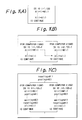
- Figure 1 is a view showing a serial processing execution original program (Fig. 1 (A)), a parallel processing execution image (Fig. 1 (B)) and a parallel processing execution image-1 (Fig. 1 (C)) in each conventional form.
- each iteration of the loop is executed by a respective computer. In this case, if an operation synchronous between computers is not effected, a case will often occur which does not lead to a true execution result.
- a parallel (processing) execution image of an original program for a serial execution as shown in Fig. 1-(A) is represented as shown in Fig. 1 (B).
- the parallel execution image is as follows. That is, each iteration of a loop is executed by every execution unit of parallel processing and a processing thereof is parallel-executed by two computers. For this reason, utilizing a parity of loop parameters, the image is divided into procedures shown in Fig. 1 (B) by a cyclic distribution mode.
- (Post) denotes a procedure such that the value of a synchronous variable of an argument is reduced to "posted” and the execution of the inactive procedure is restarted.
- (Reset) denotes a procedure that, when the value of a synchronous variable is equal to "posted", the value is changed to "cleared”.
- each procedure of (post), (wait) and (reset) is executed during each iteration of a loop, and the operation of synchronization is carried out at a synchronization point (at a time of (wait) procedure).
- synchronous variables syn #1 and syn #2 are required to be shared with the two computers. From this, conversely, the two computers are able to effect a reference operation and a change operation at the same time on the one synchronous variable. In this case, the relevant synchronous variables are destructible and as a result, a right processing is impossible.
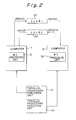
- Figure 2 is a schematic view showing a function of the present invention.
- reference numerals 11 and 12 denote computers, 21 and 22 synchronous variables, 31 and 32 wait-until (abbreviated by wu) procedure-units and 41 and 42 parallel execution units.
- a plurality of computers 11 and 12 perform respective parallel processing execution units 41 and 42. That is, a predetermined processing is divided into a plurality of parallel processing execution units 41 and 42 and a parallel processing is executed by a plurality of computers 11 and 12.
- Parallel processing execution units 41 and 42 denote each iteration of a loop such as a DO loop.
- a set of parallel processing execution units performed by a first computer 11 is denoted by a parallel processing execution unit 41, as well as a parallel processing execution unit 42.
- a plurality of synchronous variables 21 and 22 does not denote the above-described three kinds of values, but describes an iterative state of loop performed in each computer 11 and 12, that is, an iterative state of parallel processing execution units 41 and 42 (iterative order number).
- a synchronous variable 21 responsive to a computer 11 can be updated by a computer 11 only and a computer is only allowed to effect reference, as is the same with a synchronous variable 22.
- the wu prosecution units 31 and 32 perform a wu (wait-until) processing and thereby are synchronized between self computers 11 and 12 and other computers 12 and 11, respectively. That is, the wu prosecution unit 31 compares a state of iteration in the self computer 11 (equal to syn #1) with a synchronous variable 22 (syn #2) denoting a state of iteration in the other computer 12, to wait for an execution of the parallel processing execution unit 41, until the relationship between them becomes a predetermined value, as well as the wu prosecution 32.
- the computer 11 updates a synchronous variable 21 to represent the state of its iteration in an execution of the parallel processing execution unit 41. Also, a synchronous variable 22 is updated by the computer 12.
- the wu prosecution unit 31 called from a parallel processing execution unit 41 under the execution compares a state of iteration in the self computer 11 with a synchronous variable 22 (syn #2) of the other computer 12, to wait until the relationship between them becomes a predetermined value, as well as the wu prosecution unit 32.
- the wu prosecution unit 31 waits for a processing until
- the following execution of one iteration is started in the computer 12 only when the execution of one iteration of a loop in the computer 11 has been terminated And then, an execution of the following iteration is started in the computer 11, only when the execution of one iteration of a loop in the computer 12 has terminated.
- Figure 3 is a schematic block diagram showing an embodiment of the present invention.
- reference numeral 5 denotes a loaded parallel processing execution unit, 6 a wu access unit, 7 an iteration order number area, 8 an external memory such as a direct access storage device and 9 a shared memory.
- FIG. 3 illustrates a case where each of the two computers 11 and 12 can execute a parallel processing in synchronization with an even and an odd iteration in a (DO) loop.
- the computers 11 and 12 includes a central processing unit (CPU) and a main memory.
- Parallel processing execution units (that is, load modules) 41 and 42 are loaded with the main memory from a load memory 8 to be a parallel processing execution unit in a running state 51 and 52, respectively.
- Each wu procedure unit 31 and 32 is provided on a main memory of a respective computer 11 and 12.
- a predetermined area of the main memory is utilized to store each iteration order number (J, j) of parallel processing execution units 51 and 52 as each iteration order number area 71 and 72.
- the computers 11 and 12 include a shared memory 9.
- a predetermined area of the shared memory 9 is utilized as an area for storing synchronous variables 21 and 22.
- the loaded parallel processing execution unit 51 Prior to calling the wu procedure unit 31, the loaded parallel processing execution unit 51 sets the self iteration order number J to an iteration order number area 71 and using the said number J, updates a synchronous variable 21 of a self computer 11 in the shared memory 9. After calling the wu procedure unit 31, that is, after a return from the wu procedure unit 31, the said number J is counted up by + 1 to perform the following iteration.
- a wu calling unit 61 of the parallel processing execution unit 51 calls the wu procedure unit 31 and delivers a predetermined relational expression to it, to request a wu processing.
- the wu procedure unit 31 refers to the iteration order number area 71 of the self computer 11 to recognize an iteration order number J. Therefore, the iteration order number area 71 is a means for delivering the number J from the parallel processing execution unit 51 to the wu procedure division 31.
- the wu procedure division 31 refers to a synchronous variable 22 (syn #2) of another computer 12 in the shared memory 9 to recognize it. Then, since the wu procedure division 31 can only refer to a synchronous variable 22, the said synchronous variable 22 (syn #2) is not destroyed and can be referred thereto regardless of its updating.
- the wu procedure unit 31 refers to the said number J and variable syn #2 by using a relational expression delivered from the parallel processing execution unit 51 and waits until the relational expression is satisfied. If the relational expression is established, the wu procedure unit 31 returns to the parallel processing execution unit 51 (reset a control). Therefore, since the synchronous variable 22 of another computer 12 is a predetermined value at a time of reversion, the synchronization is carried out.
- a wu calling unit 62 and a wu procedure unit 32 is operated in the same manner as the wu calling unit 61 and the wu procedure unit 31.
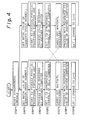
- Figure 4 illustrates a flow chart of a parallel processing execution.
- a parallel processing execution unit 52 in a computer 12 sets "1" " as an initial value of a self iteration order number j to an iteration order number area 72.
- Step 3 The parallel processing execution unit 51 starts to perform a J-th iteration processing.
- the parallel processing execution unit 52 starts to perform a j-th iteration processing.
- Step 4 The parallel processing execution unit 51 carries out a processing of a value referred to from another computer 12, that is, the parallel processing execution unit 52.
- Step 5 The parallel processing execution unit 51 sets a value "J" stored in the iteration order number area 71 to a self synchronous variable 21.
- the parallel processing execution unit 52 sets a value "j" stored in the iteration order number area 71 to a self synchronous variable 22.
- Step 6 Then, after a definite processing, a wu calling unit 61 calls the wu procedure unit 31.
- the wu procedure unit 31 carries out a wu processing to be in synchronization with another computer 12, that is, the parallel processing execution unit 52.
- Step 7 After synchronization, the parallel processing execution unit 51 carries out a processing which refers to a value processed by another computer 12, that is, the parallel processing execution unit 52.
- Step 8 For an execution of the following iteration, the parallel processing execution unit 51 counts the iteration order number J by (+1) to set it to an iteration order number area 71.
- the parallel processing execution unit 52 counts the iteration order number j by (+1) to set it to an iteration order number area 72.
- Step 3 to Step 8 are processed iteratively a predetermined number of times and the parallel processing execution terminates.
- a processing in Step 7 is performed after a synchronous processing in Step 6, a processing using a right value is possible.
- a processing in step 4 necessary for an after-synchronization processing is performed before the synchronous processing in Step 6, a processing in Step 7 can be performed immediately after synchronization.
- a processing in Step 5 is carried out immediately after a processing in Step 4, if another computer system is in a state of a processing in Step 6, it can be synchronized therewith immediately and each synchronous variable can always be set in an updating state so as to be ready for a synchronous processing.
- Figure 5 is a flow chart for a wu processing (of a synchronous processing).
- the following processing can be carried out by a wu procedure unit 31 or 32.
- wait-until is a wu calling unit 61 and is delivered as a relational expression which satisfies
- a relational expression to be satisfied in the wu procedure unit 31 and 32 is determined by a distance x (a distance between a self computer 11 or 12 and another computer 12 or 11.
- the distance x is defined as follows. That is, the computers in which an execution of a 1-st iteration, a second iteration, ..., a n-th iteration of the loop is allocated are referred to as the 1-st computer, the 2-nd computer, ... the n-th computer, respectively.
- a distance x between the i-th computer and the j-th computer as for the j-th computer is defined as "j - i”.
- the wu procedure unit 31 is devised to request the iteration order number (J - 1). If the distance is positive, that is, the wu procedure unit 32 is devised not to carry out the said processing. That is, the iteration order number j is used intact.
- An improved method of the present invention is outlined as follows.
- a synchronous processing where we consider a parallel processing system in which each iteration of a loop is performed by different computers, there is provided a feature that, once a wait state is released, a wait state is not again present until its portion is passed. From this, every time a loop is iterated by one computer, a variable is ready which increases the value regularly, and the other computer waits until the value of the variable satisfies a predetermined value (Fig. 6).
- a feature of the present invention resides in the point that both the side for updating a value and the side for referring should utilize a general hardware instruction. As a result, with reference to "post”, “wait”, and “reset" for which a special hardware instruction for synchronous processing is utilized, a high speed synchronous processing can be performed.
- Loop slicing is performed by a process such that each iteration of a loop is allocated to n virtual processors.
- Virtual processors to which the 1-st iteration, the 2-nd iteration, ..., the n-th iteration are allocated are referred to as the first processor, the second processor, ... the n-th processor, respectively.
- a distance between processors" between the i-th processor and the j-th processor is defined as (j-i).
- First, the i-th iteration, next, (i + n)-th iteration, ... are allocated in the i-th processor.
- “Time distance” between (i + K x n)-th iteration and (j + L x n)-th iteration (L K, i ⁇ m, j n) is defined as (L - K).
- Inter-Iterational Dependency IID
- a data dependent relationship between all iterations of a loop referred to as Inter-Iterational Dependency: IID
- IID Inter-Iterational Dependency
- the waiting side (virtual processor 10) waits by a wait-until procedure, until the value of a synchronous variable is equal to or larger than the "iteration order number + D" in a virtual computer waiting. Nevertheless, if the distance between processors is negative, a condition that is equal to or larger than the (iteration order number + D - 1) can be used.
- the wait-until procedure is a simple procedure such that a given conditional expression is evaluated if a value is false, an evaluation of the conditional expression is repeated and if a value is true, it terminates, and an overhead is considerably rare.
Landscapes
- Engineering & Computer Science (AREA)
- General Engineering & Computer Science (AREA)
- Theoretical Computer Science (AREA)
- Software Systems (AREA)
- Physics & Mathematics (AREA)
- General Physics & Mathematics (AREA)
- Multi Processors (AREA)
- Complex Calculations (AREA)
Applications Claiming Priority (2)
| Application Number | Priority Date | Filing Date | Title |
|---|---|---|---|
| JP277552/90 | 1990-10-16 | ||
| JP2277552A JPH04152465A (ja) | 1990-10-16 | 1990-10-16 | データ処理システム及びデータ処理方法 |
Publications (2)
| Publication Number | Publication Date |
|---|---|
| EP0481458A2 true EP0481458A2 (de) | 1992-04-22 |
| EP0481458A3 EP0481458A3 (en) | 1993-01-27 |
Family
ID=17585124
Family Applications (1)
| Application Number | Title | Priority Date | Filing Date |
|---|---|---|---|
| EP19910117661 Withdrawn EP0481458A3 (en) | 1990-10-16 | 1991-10-16 | High speed synchronous processing system for executing parallel processing of programs |
Country Status (3)
| Country | Link |
|---|---|
| US (1) | US5586320A (de) |
| EP (1) | EP0481458A3 (de) |
| JP (1) | JPH04152465A (de) |
Families Citing this family (6)
| Publication number | Priority date | Publication date | Assignee | Title |
|---|---|---|---|---|
| US6463580B1 (en) * | 1998-11-18 | 2002-10-08 | Intel Corporation | Parallel processing utilizing highly correlated data values |
| US6269440B1 (en) * | 1999-02-05 | 2001-07-31 | Agere Systems Guardian Corp. | Accelerating vector processing using plural sequencers to process multiple loop iterations simultaneously |
| US20010042138A1 (en) * | 1999-12-23 | 2001-11-15 | Reinhard Buendgen | Method and system for parallel and procedural computing |
| JP2004362086A (ja) * | 2003-06-03 | 2004-12-24 | Matsushita Electric Ind Co Ltd | 情報処理装置および機械語プログラム変換装置 |
| JP4908363B2 (ja) * | 2007-09-25 | 2012-04-04 | 株式会社東芝 | 情報処理装置、並列処理最適化方法およびプログラム |
| US8799629B2 (en) * | 2008-12-04 | 2014-08-05 | Microsoft Corporation | Parallel execution of a loop |
Family Cites Families (4)
| Publication number | Priority date | Publication date | Assignee | Title |
|---|---|---|---|---|
| US4445197A (en) * | 1981-10-27 | 1984-04-24 | International Business Machines Corporation | Weak synchronization and scheduling among concurrent asynchronous processors |
| US4809169A (en) * | 1986-04-23 | 1989-02-28 | Advanced Micro Devices, Inc. | Parallel, multiple coprocessor computer architecture having plural execution modes |
| JPH01240965A (ja) * | 1988-03-23 | 1989-09-26 | Hitachi Ltd | 同期制御方式 |
| JPH0630094B2 (ja) * | 1989-03-13 | 1994-04-20 | インターナショナル・ビジネス・マシーンズ・コーポレイション | マルチプロセツサ・システム |
-
1990
- 1990-10-16 JP JP2277552A patent/JPH04152465A/ja active Pending
-
1991
- 1991-10-16 EP EP19910117661 patent/EP0481458A3/en not_active Withdrawn
-
1994
- 1994-11-04 US US08/337,238 patent/US5586320A/en not_active Expired - Fee Related
Non-Patent Citations (3)
| Title |
|---|
| COMPUTER ARCHITECTURE NEWS vol. 18, no. 3, 11 June 1990, NEW YORK US pages 177 - 186 P. TANG, P.C. YEW AND C.Q. ZHU 'Compiler Techniques for Data Synchronization in Nested Parallel Loops' * |
| PROCEEDINGS OF THE 1986 INTERNATIONAL CONFERENCE ON PARALLEL PROCESSING 19 August 1986, pages 544 - 551 S.P. MIDKIFF AND D.A. PADUA 'Compiler Generated Synchronization for DO Loops' * |
| PROCEEDINGS OF THE 1986 INTERNATIONAL CONFERENCE ON PARALLEL PROCESSING 19 August 1986, pages 836 - 844 RON CYTRON 'Doacross: Beyond Vectorization for Multiprocessors' * |
Also Published As
| Publication number | Publication date |
|---|---|
| US5586320A (en) | 1996-12-17 |
| EP0481458A3 (en) | 1993-01-27 |
| JPH04152465A (ja) | 1992-05-26 |
Similar Documents
| Publication | Publication Date | Title |
|---|---|---|
| EP0352899B1 (de) | Staffelverfahren zur Ausführung von verschachtelten Schleifen in Mehrprozessorrechnern | |
| US4482956A (en) | Parallel queueing method | |
| US6848033B2 (en) | Method of memory management in a multi-threaded environment and program storage device | |
| US5010482A (en) | Multi-event mechanism for queuing happened events for a large data processing system | |
| US5666523A (en) | Method and system for distributing asynchronous input from a system input queue to reduce context switches | |
| KR970016979A (ko) | 다중 처리 시스템에서 타스크의 큐잉 시스템 및 방법 | |
| US20040117793A1 (en) | Operating system architecture employing synchronous tasks | |
| CN112286917B (zh) | 数据处理方法、装置、电子设备和存储介质 | |
| US6523059B1 (en) | System and method for facilitating safepoint synchronization in a multithreaded computer system | |
| US5524257A (en) | Method of parallel processing for inference and a system therefor | |
| US20170123861A1 (en) | Efficiency sequencer for multiple concurrently-executing threads of execution | |
| US5355488A (en) | Method for adaptively building a library of program threads | |
| US5586320A (en) | High speed synchronous processing system for executing parallel processing of programs having loops | |
| WO2025091863A1 (zh) | 多核操作系统的任务处理方法、装置及计算设备 | |
| JPH05257902A (ja) | 処理プログラム・モードにおけるロック獲得処理方式 | |
| Burton et al. | Worst case scheduling for parallel functional programs1 | |
| US5287509A (en) | Multitasking system for in-procedure loops | |
| Chung et al. | Parallelizing image feature extraction on coarse-grain machines | |
| JPS635780B2 (de) | ||
| GB2030331A (en) | Real-time Data Processing System for Processing Time Period Commands | |
| US5870603A (en) | Method and system for storing exponent codes in a multi-processor computer to produce putputs according to an execution schedule | |
| JP2871693B2 (ja) | クリティカルセクション最適化方式 | |
| US20250390974A1 (en) | GPU-accelerated scheduling system and scheduling method of GPU-accelerated scheduling system | |
| JP2683274B2 (ja) | 関数トレース出力方式 | |
| JPH1153327A (ja) | マルチプロセッサシステム |
Legal Events
| Date | Code | Title | Description |
|---|---|---|---|
| PUAI | Public reference made under article 153(3) epc to a published international application that has entered the european phase |
Free format text: ORIGINAL CODE: 0009012 |
|
| AK | Designated contracting states |
Kind code of ref document: A2 Designated state(s): DE FR GB |
|
| PUAL | Search report despatched |
Free format text: ORIGINAL CODE: 0009013 |
|
| AK | Designated contracting states |
Kind code of ref document: A3 Designated state(s): DE FR GB |
|
| 17P | Request for examination filed |
Effective date: 19930719 |
|
| 17Q | First examination report despatched |
Effective date: 19950405 |
|
| STAA | Information on the status of an ep patent application or granted ep patent |
Free format text: STATUS: THE APPLICATION IS DEEMED TO BE WITHDRAWN |
|
| 18D | Application deemed to be withdrawn |
Effective date: 19990112 |