EP0481615A2 - Globale Befehlsablaufsteuerung für einen Rechner - Google Patents
Globale Befehlsablaufsteuerung für einen Rechner Download PDFInfo
- Publication number
- EP0481615A2 EP0481615A2 EP91308797A EP91308797A EP0481615A2 EP 0481615 A2 EP0481615 A2 EP 0481615A2 EP 91308797 A EP91308797 A EP 91308797A EP 91308797 A EP91308797 A EP 91308797A EP 0481615 A2 EP0481615 A2 EP 0481615A2
- Authority
- EP
- European Patent Office
- Prior art keywords
- instructions
- graph
- dependence
- instruction
- blocks
- Prior art date
- Legal status (The legal status is an assumption and is not a legal conclusion. Google has not performed a legal analysis and makes no representation as to the accuracy of the status listed.)
- Withdrawn
Links
Images


Classifications
-
- G—PHYSICS
- G06—COMPUTING OR CALCULATING; COUNTING
- G06F—ELECTRIC DIGITAL DATA PROCESSING
- G06F8/00—Arrangements for software engineering
- G06F8/40—Transformation of program code
- G06F8/41—Compilation
- G06F8/44—Encoding
- G06F8/445—Exploiting fine grain parallelism, i.e. parallelism at instruction level
Definitions
- the present invention relates to an instruction scheduler for a computer and in particular to an instruction scheduler which enables the scheduling of instructions beyond basic block boundaries (i.e. global scheduling) in a manner suitable for use with a parallel/pipelined computer.
- Instruction scheduling is a process of rearranging or transforming program statements before execution by a processor in order to reduce possible run-time delays between compiled instructions. Instruction scheduling is usually performed at an intermediate language or assembly code level. Such transformations must preserve data dependences and are subject to other constraints. This can be particularly advantageous when compiling for pipelined machine architectures, which allow increased throughput by overlapping instruction execution. For example, if there is a delay of one cycle between fetching and using a value V, it would be desirable to "cover” this delay with an instruction that is independent of V and is “ready” to be executed.
- RISC Reduced Instruction Set Computers
- the RISC approach to building high speed processors which emerged in the late seventies, emphasises the need for the streamlining of program instructions.
- instructions have to be rearranged, usually at the intermediate language or assembly code level, to take full advantage of pipelining and thereby to improve performance.
- the burden of the instruction scheduling is placed on optimising compilers that generate code for RISC processors.
- the compilers perform instruction scheduling at the basic block level, solving most of the problems posed by the pipelined structure of RISC processors.
- VLIW Very Long Instruction Word
- a basic block is a sequence of consecutive instructions for which the flow of control enters at the beginning of the sequence and exits at the end thereof without a wait or branch possibility, except at the point of exit.
- the object of the present invention is to provide for an instruction scheduler which is able to perform global (i.e. intra-block) scheduling in an efficient and flexible manner.
- an instruction scheduler for a computer comprising program dependence graph generating logic for representing data and control dependences among instructions in an input code sequence and sequencing logic which is responsive to the program dependence graph to re-order the instructions of the input code sequence, where appropriate beyond basic block boundaries, to generate an output code sequence.
- the invention enables global scheduling beyond basic block boundaries to be performed by use of the program dependence graph.
- the instruction scheduling can be applied before or after the register allocation phase of a compiler is invoked. It is advantageous to perform the scheduling before the register allocation step, so as to leave a greater degree of flexibility for reordering the instructions.
- the program dependence graph generates a program dependence graph comprising a control dependence sub-graph and a data dependence sub-graph.
- the control dependence sub-graph represents the control dependences and the data dependence sub-graph represents the data dependences in the program defined by the input code sequence.
- the sequencing (or scheduling) logic preferably schedules basic blocks of instructions in the input code sequence block by block using the control dependence sub-graph; the sequencing logic determining, for a block currently being scheduled, a list of candidate blocks which can contribute instructions to the current block.
- the list of candidate blocks preferably includes all the blocks which are identified in the control dependence sub-graph as immediate successors of the current block or as immediate successors of the blocks that are equivalent to the current block and are dominated by the current block.
- the sequencing logic can determine a set of candidate instructions from within the set of candidate blocks.
- the list of candidate instructions preferably includes all instructions, including instructions whose execution is speculative, which belong to the current block or a block in the set of candidate blocks, unless the instruction is of a type which cannot be moved beyond a block boundary and/or the instruction is of a type which cannot be scheduled speculatively. It is from this list of candidate instructions that the sequencing logic determines one or more instructions to be scheduled next from the list of candidate instructions in accordance with a machine description.
- the machine description is preferably stored as a parametric machine description representative of a range of computers and a set of scheduling heuristics for a specific computer.
- the instruction scheduler can be adapted to generate efficient code for a range of computers.
- the scheduler can be fine tuned to specific computers within the range.
- the invention also includes a computer which comprises an instruction scheduler as defined above.
- the computer can have a superscalar/superpipelined architecture.
- the computer has a superscalar/superpipelined architecture.
- FIG. 1 is a schematic block diagram providing an overview of an instruction scheduler 10 in accordance with the invention.
- the instruction scheduler takes as its input 11 a sequence of instructions and a control flow graph 12 for the sequence of instructions and provides as its output a rescheduled sequence of instructions 18.
- the instruction scheduler 10 comprises Program Dependence Graph Generation Logic 13 for generating a Program Dependence Graph (PDG) 14 and sequencing logic (or scheduling logic) 15, which uses the PDG, along with a Parametric Machine Description (PMD) 16 and a set of heuristics 17 to reschedule the instructions.
- PDG Program Dependence Graph
- PMD Parametric Machine Description
- the program dependence graph generation logic 13 and the sequencing logic 15 form part of a compiler, specifically one of the IBM XL family of compilers for the IBM RISC System/6000 computers.
- the program dependence graph 14, parametric machine description 16 and the set of heuristics 17, as well as the input and output sequences of instructions 11,17 and the control flow graph 12, are held in the working storage of the IBM RISC System/6000 computer on which the compiler is running.
- the instruction scheduling can be applied before or after the register allocation phase of a compiler is invoked. It is advantageous to perform the instruction scheduling before the register allocation step, so as to leave a greater degree of flexibility for reordering the instructions.
- the parametric machine description is based on a generic model for a superscalar machine having a typical RISC processor whose only instructions that reference memory are load and store instructions, while all the computations are done in registers.
- the superscalar machine can be viewed as a collection of functional units of m types, where the machine has n1, n2, ... ,n m units of each type. Each instruction in the code can be executed potentially by more than one unit of a specified type.
- Each instruction requires an integral number of machine cycles to be executed by one of the functional units of its type. Also, there are pipelined constraints imposed on the execution of instructions which are modelled by the integer delays assigned to the data dependence edges of the program dependence graph.
- the parametric machine description configures the generic model of a superscalar machine to fit the IBM RISC System/6000 machine.
- the IBM RISC System/6000 processor is modelled as follows:
- the operation of the program dependence graph generation logic 13 is described below using as an example, a small section of code illustrated in Table 1.
- Table 1 which is written in the C language, computes the minimum and the maximum of an array. In this program, concentrating on the loop which is marked in Table 1, we notice that two elements of the array 'a' are fetched every iteration of the loop. Next, these elements of 'a' are compared one to another (if (u > v)), and subsequently they are compared to the maximum and minimum variables, updating the maximum and the minimum, if needed.
- Table 2 An excerpt of the IBM RISC System/6000 pseudo-code for the loop in Table 1, that corresponds to the real code created by the XL-C compiler, is presented in Table 2.
- LR instructions maximum and minimum variables
- the program dependence graph 14 is a convenient way to summarise all the control dependences and data dependences of the instructions in the code.
- the program dependence graph produced by the program dependence graph generation logic 13 comprises a control dependence sub-graph representing the control dependences and a data dependence sub-graph representing the data dependences. While the concept of data dependences, that carries the basic idea of one instruction computing a data value and another instruction using this value, was employed in compilers a long time ago, the notion of control dependences was introduced quite recently. See the following article:
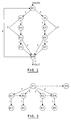
- control flow graph 12 for use by the program dependence graph generation logic 13, specifically the control flow graph for the loop of Table 2, is illustrated in Figure 2.
- the control flow graph is stored in the memory of the computer on which the compiler is running in the form of a data structure having a set of linked records corresponding to the nodes in the graph, with the edges between the nodes represented by pointers between records.
- the control flow graph can be generated by conventional compiler logic for identifying basic blocks and loops in the code sequence and for checking the status of the various processor registers on entry into each block.
- control flow graph in Figure 2 is augmented with a unique ENTRY node and an EXIT node for convenience.
- the assumption of a single entry control flow graph corresponds to the assumption that the control flow graph is reducible.
- edges i.e. the pointers in the data structure
- the edges are annotated with the conditions that control the flow of the program from one basic block to another.
- control dependence sub-graph represents the control dependence sub-graph for the loop of Table 2.
- the program dependence graph generation logic 13 generates a control dependence sub-graph in the form of a data structure having a set of linked records corresponding to the nodes in the graph, with the edges between the nodes represented by pointers between records.
- Each node of the graph corresponds to a basic block of the program, similarly to the control flow graph of Figure 2.
- an edge from a node X to a node Y means that basic block Y will be executed under the condition computed at the end of basic block X, where the edges are again annotated with the corresponding conditions.
- control dependence graph generation logic only generates a forward control dependence graph.
- the program dependence graph generation logic first generates a post-dominator tree identifying all the postdominating relationships and from this generates the forward control dependence graph. Control dependences that result from or propagate through the back edges in the control flow graph are not generated.
- control dependence sub-graph of Figure 3 is a forward control dependence graph. Note that forward control dependence graphs are a-cyclic.
- the sequencing logic 15 employs the control dependence sub-graph for both 'useful' and 'speculative' scheduling. To find equivalent nodes, the sequencing logic searches the control dependence sub-graph data structure for nodes that are identically control dependent, i.e. they depend from the same set of nodes under the same conditions. For example, in Figure 3, B1 and B10 are equivalent, since they do not depend on any node. Also, B2 and B4 are equivalent, since both of them depend on B1 under the condition TRUE. In Figure 3 the equivalent nodes are marked with the dashed edges, the direction of these edges providing the dominance relation between the nodes. For example, for equivalent nodes B1 and B10, B1 dominates B10.
- the control dependence sub-graph provides "the degree of speculativeness" for moving instructions from one block to another.
- the control dependence sub-graph provides for every pair of nodes the number of branches gambled on (in case of 'speculative' scheduling). For example, when moving instructions from B8 to B1, a gamble is made on the outcome of a single branch, since when moving from B8 to B1 in Figure 3, only a single edge is crossed. Note that this is not apparent from the control flow graph of Figure 2.
- program dependence graph generation logic computes control dependences on the basic block level, it computes data dependences on the instruction by instruction basis. Both intrablock and interblock data dependences are computed. A data dependence may be caused by the usage of registers or by accessing memory locations.
- the data dependence edges leading from a definition of a register to its use carry a (potentially non-zero) delay, which is a characteristic of the underlying machine.
- the rest of the data dependence edges carry zero delays.
- the sequencing logic schedules instructions in the program on a loop by loop basis. It starts with the innermost loops, followed by the outer loops. There are a few principles that govern the scheduling process in general:
- Figure 4 is a flow diagram illustrating the scheduling of instructions by the sequencing logic. This is done by processing the basic blocks one at a time. The basic blocks are encountered in the topological order, i.e. if there is a path in the control flow graph from X to Y, then X is processed before Y.
- the sequencing logic identifies a set C(X) of candidate blocks for X, i.e. a list of basic blocks which can contribute instructions to X.
- the determination of which blocks are candidate blocks is done from the control dependence graph in accordance with the principles of scheduling to be applied. In the present embodiment there are two levels of scheduling:
- the sequencing logic After initialising (at 20) a set of candidate blocks for the current block, the sequencing logic computes (at 21) the set of candidate instructions for scheduling. Instructions which are ready for scheduling execution are held in a ready list. An instruction I is a candidate for scheduling in block X if it belongs to one of the following categories:
- Not all instructions are allowed to be scheduled speculatively. For example, 'speculative' loads may cause exceptions due to access to a non-existing virtual memory location.
- the sequencing logic determines which instructions may be scheduled speculatively and what payoff is expected in this case.
- the sequencing logic 15 then proceeds to schedule instructions (22) from the ready list for a given instruction cycle.
- the sequencing logic updates the list of ready instructions, i.e. 'useful' candidate instructions whose data and control dependences were fulfilled and 'speculative' candidate instructions whose only data dependences are fulfilled. Every cycle as many instructions as required by the machine architecture are picked from the ready list to be scheduled next. If there are too many ready instructions, the "best" of them are chosen by the sequencing logic based on their priority. Once an instruction is picked up to be scheduled, it is moved to the proper place in the code, and its data and control dependence to the following instructions are marked as fulfilled, potentially enabling new instructions to become ready. This process is repeated 23 until all the instructions in block X are scheduled. Then, 25, the next block is scheduled until all the blocks in the loop are scheduled.
- the relative priority of instructions for determining the instruction to be scheduled next by the sequencing logic at step 22, is derived in accordance with the set of heuristics. For example, the maximal number of delays in the path to the root of the data dependence sub-graph of the basic block to which the instruction belongs is chosen as a heuristic for fixing the priority of an instruction. However, other heuristics may be used instead or in addition to this heuristic. Table 3 illustrates an example of how global scheduling works.
- Table 3 illustrates the result of applying global scheduling to the instruction sequence of Table 2 with only so-called useful instructions being permitted to move beyond the basic block boundaries.
- the code illustrated in Table 3 executes in about 13 cycles per iteration of the loop.
- Table 4 illustrates the result of applying global scheduling to the instruction sequence of Table 2 where it speculative scheduling is also performed (i.e. where speculative instructions are also permitted to move beyond the basic block boundaries).
- the code illustrated in Table 3 executes in about 12 cycles per iteration of the loop.
- a scheduler for global instruction scheduling has been described which allows to move instructions well beyond basic blocks boundaries within the scope of the enclosed loop.
- the scheduler employs a Program Dependence Graph, which was proposed by Ferrante et. al. (see reference R14) for use in compilers to expose parallelism for the purposes of vectorisation and generation of code for multiprocessors.
- the scheduler uses this program dependence graph in combination with a parametric description of a family of superscalar machines to provide a powerful framework for global instruction scheduling by optimising compilers.
- the scheduler uses a set of heuristics to provide a relative priority of an instruction in program dependence graph.
- the set of heuristic rules employed is dependent on the specific architecture of the machine for which the scheduler is intended.
- An example of the sort of heuristic rules relate to critical path information.
- the scheduler issues instructions according to their priority, trying to fully utilise machine resources, as described above. By changing the set of heuristic rules, the scheduler is fine tuned to a selected machine architecture, without changing the other parts of the scheduler.
- instructions are allowed to move from one basic block to another up to existing control and data dependences.
- 'useful' instructions are allowed, meaning, only instructions whose result is used at least once during execution of the program are scheduled.
- 'speculative' instructions can be moved as well within desired constraints. In this more aggressive approach to instruction scheduling, such 'speculative' instructions are moved from basic block X to basic block Y; that is, in disregard to any control dependence that exists from X to Y. If a 'speculative' instruction is moved to a place where it will be executed by otherwise idle functional unit, then such a transformation can only improve the running time of the program and is considered profitable.
Landscapes
- Engineering & Computer Science (AREA)
- General Engineering & Computer Science (AREA)
- Theoretical Computer Science (AREA)
- Software Systems (AREA)
- Physics & Mathematics (AREA)
- General Physics & Mathematics (AREA)
- Devices For Executing Special Programs (AREA)
Applications Claiming Priority (2)
| Application Number | Priority Date | Filing Date | Title |
|---|---|---|---|
| IL95996 | 1990-10-15 | ||
| IL95996A IL95996A0 (en) | 1990-10-15 | 1990-10-15 | Global instruction scheduler for a computer |
Publications (2)
| Publication Number | Publication Date |
|---|---|
| EP0481615A2 true EP0481615A2 (de) | 1992-04-22 |
| EP0481615A3 EP0481615A3 (en) | 1993-01-07 |
Family
ID=11061659
Family Applications (1)
| Application Number | Title | Priority Date | Filing Date |
|---|---|---|---|
| EP19910308797 Withdrawn EP0481615A3 (en) | 1990-10-15 | 1991-09-26 | Global instruction scheduler for a computer |
Country Status (3)
| Country | Link |
|---|---|
| EP (1) | EP0481615A3 (de) |
| JP (1) | JPH04263331A (de) |
| IL (1) | IL95996A0 (de) |
Cited By (7)
| Publication number | Priority date | Publication date | Assignee | Title |
|---|---|---|---|---|
| EP0797143A3 (de) * | 1996-03-22 | 1999-11-17 | Matsushita Electric Industrial Co., Ltd. | Datenverarbeitungsvorrichtung und -verfahren und Ablauffolgeplanungsgerät |
| GB2380825A (en) * | 2001-10-12 | 2003-04-16 | Siroyan Ltd | Compiling methods for parallel processing |
| WO2003067431A1 (en) * | 2002-02-08 | 2003-08-14 | Xelerated Ab | A method and system for determining total code execution time in a data processor |
| US7007272B2 (en) | 2000-10-12 | 2006-02-28 | Stmicroelectronics Limited | Compiling computer programs including branch instructions |
| US7155707B2 (en) | 2000-10-12 | 2006-12-26 | Stmicroelectronics Limited | Compiling computer programs including branch instructions |
| US7331045B2 (en) | 2003-08-08 | 2008-02-12 | International Business Machines Corporation | Scheduling technique for software pipelining |
| US11275611B2 (en) | 2019-02-08 | 2022-03-15 | Fujitsu Limited | Information processing device, information processing method, and computer-readable recording medium recording program |
Families Citing this family (1)
| Publication number | Priority date | Publication date | Assignee | Title |
|---|---|---|---|---|
| JP4892022B2 (ja) * | 2009-03-03 | 2012-03-07 | 株式会社東芝 | コンパイル装置およびコンパイルプログラム |
Family Cites Families (4)
| Publication number | Priority date | Publication date | Assignee | Title |
|---|---|---|---|---|
| JPS6081641A (ja) * | 1983-10-11 | 1985-05-09 | Matsushita Electric Ind Co Ltd | レジスタトレース方法 |
| JPS61262936A (ja) * | 1985-05-17 | 1986-11-20 | Fujitsu Ltd | マスク生成処理方式 |
| JPS62217325A (ja) * | 1986-03-18 | 1987-09-24 | Nec Corp | アセンブラコ−ド最適化方式 |
| JPS6365530A (ja) * | 1986-09-05 | 1988-03-24 | Nec Corp | コ−ド最適化方式 |
-
1990
- 1990-10-15 IL IL95996A patent/IL95996A0/xx unknown
-
1991
- 1991-08-05 JP JP3195374A patent/JPH04263331A/ja active Pending
- 1991-09-26 EP EP19910308797 patent/EP0481615A3/en not_active Withdrawn
Non-Patent Citations (5)
| Title |
|---|
| COMPUTER, vol. 20, no. 5, August 1987, LONG BEACH US pages 72 - 93 VELJKO MILUTINOVIC ET AL.: 'Architecture / Compiler Synergism in GaAs Computer Systems' * |
| IBM TECHNICAL DISCLOSURE BULLETIN, vol. 27, no. 12, May 1985, NEW YORK US pages 7221 - 7224 'Program Dependence Graph' * |
| IBM TECHNICAL REPORT RC 10543, June 1984, NEW YORK US pages 1 - 33 JEANNE FERRANTE ET AL.: 'The Program Dependence Graph and its Use in Optimization' * |
| OPERATING SYSTEMS REVIEW (SIGOPS), vol. 21, no. 4, October 1987, NEW YORK US pages 100 - 104 DAVID W. WALL ET AL.: 'The Mahler Experience: Using an Intermediate Language as the Machine Description' * |
| SIGPLAN NOTICES, vol. 26, no. 6, June 1991, TORONTO CA pages 241 - 255 BERNSTEIN, D. ET AL: 'Global instruction scheduling for superscalar machines' * |
Cited By (19)
| Publication number | Priority date | Publication date | Assignee | Title |
|---|---|---|---|---|
| EP0797143A3 (de) * | 1996-03-22 | 1999-11-17 | Matsushita Electric Industrial Co., Ltd. | Datenverarbeitungsvorrichtung und -verfahren und Ablauffolgeplanungsgerät |
| CN1109978C (zh) * | 1996-03-22 | 2003-05-28 | 松下电器产业株式会社 | 信息处理设备和方法,及调度装置 |
| US7155707B2 (en) | 2000-10-12 | 2006-12-26 | Stmicroelectronics Limited | Compiling computer programs including branch instructions |
| US7007272B2 (en) | 2000-10-12 | 2006-02-28 | Stmicroelectronics Limited | Compiling computer programs including branch instructions |
| GB2398411B (en) * | 2001-10-12 | 2005-04-27 | Pts Corp | Processors and compiling methods for processors |
| US8677330B2 (en) | 2001-10-12 | 2014-03-18 | Altera Corporation | Processors and compiling methods for processors |
| GB2398411A (en) * | 2001-10-12 | 2004-08-18 | Pts Corp | Scheduling of consumer and producer instructions in a processor with parallel execution units. |
| GB2398412B (en) * | 2001-10-12 | 2005-02-09 | Pts Corp | Processors and Compiling methods for Processors |
| GB2380825B (en) * | 2001-10-12 | 2004-07-14 | Siroyan Ltd | Processors and compiling methods for processors |
| GB2380825A (en) * | 2001-10-12 | 2003-04-16 | Siroyan Ltd | Compiling methods for parallel processing |
| GB2398412A (en) * | 2001-10-12 | 2004-08-18 | Pts Corp | Scheduling of consumer and producer instructions in a processor with parallel execution units. |
| US7747990B2 (en) | 2001-10-12 | 2010-06-29 | Altera Corporation | Processors and compiling methods for processors |
| US8966459B2 (en) | 2001-10-12 | 2015-02-24 | Altera Corporation | Processors and compiling methods for processors |
| WO2003067431A1 (en) * | 2002-02-08 | 2003-08-14 | Xelerated Ab | A method and system for determining total code execution time in a data processor |
| US7661100B2 (en) | 2002-02-08 | 2010-02-09 | Xelerated Ab | Method and system for determining total code execution time in a data processor |
| US7331045B2 (en) | 2003-08-08 | 2008-02-12 | International Business Machines Corporation | Scheduling technique for software pipelining |
| US7962907B2 (en) | 2003-08-08 | 2011-06-14 | International Business Machines Corporation | Scheduling technique for software pipelining |
| US7930688B2 (en) | 2003-08-08 | 2011-04-19 | International Business Machines Corporation | Scheduling technique for software pipelining |
| US11275611B2 (en) | 2019-02-08 | 2022-03-15 | Fujitsu Limited | Information processing device, information processing method, and computer-readable recording medium recording program |
Also Published As
| Publication number | Publication date |
|---|---|
| IL95996A0 (en) | 1991-07-18 |
| EP0481615A3 (en) | 1993-01-07 |
| JPH04263331A (ja) | 1992-09-18 |
Similar Documents
| Publication | Publication Date | Title |
|---|---|---|
| Bernstein et al. | Global instruction scheduling for superscalar machines | |
| Friendly et al. | Putting the fill unit to work: Dynamic optimizations for trace cache microprocessors | |
| US6044222A (en) | System, method, and program product for loop instruction scheduling hardware lookahead | |
| US6718541B2 (en) | Register economy heuristic for a cycle driven multiple issue instruction scheduler | |
| US6487715B1 (en) | Dynamic code motion optimization and path tracing | |
| US5526499A (en) | Speculative load instruction rescheduler for a compiler which moves load instructions across basic block boundaries while avoiding program exceptions | |
| JP3311462B2 (ja) | コンパイル処理装置 | |
| Huang et al. | Speculative disambiguation: A compilation technique for dynamic memory disambiguation | |
| Tirumalai et al. | Parallelization of loops with exits on pipelined architectures | |
| Bradlee et al. | The Marion system for retargetable instruction scheduling | |
| JPH01108638A (ja) | 並列化コンパイル方式 | |
| Lorenz et al. | Energy aware compilation for DSPs with SIMD instructions | |
| EP0481615A2 (de) | Globale Befehlsablaufsteuerung für einen Rechner | |
| Schlansker et al. | Height reduction of control recurrences for ILP processors | |
| Lavery et al. | Modulo scheduling of loops in control-intensive non-numeric programs | |
| Bernstein et al. | Code duplication: An assist for global instruction scheduling | |
| Dietz | Common Subexpression Induction? | |
| Chen et al. | Using profile information to assist advanced compiler optimization and scheduling | |
| Chuang et al. | Phi-predication for light-weight if-conversion | |
| Lin | Compiler support for predicated execution in superscalar processors | |
| Altman et al. | Efficient instruction scheduling with precise exceptions | |
| Rao et al. | Storage assignment using expression tree transformations to generate compact and efficient DSP code | |
| Shieh et al. | On reordering instruction streams for pipelined computers | |
| Liu et al. | A near-optimal instruction scheduler for a tightly constrained, variable instruction set embedded processor | |
| Unger et al. | Static speculation, dynamic resolution |
Legal Events
| Date | Code | Title | Description |
|---|---|---|---|
| PUAI | Public reference made under article 153(3) epc to a published international application that has entered the european phase |
Free format text: ORIGINAL CODE: 0009012 |
|
| AK | Designated contracting states |
Kind code of ref document: A2 Designated state(s): DE FR GB |
|
| 17P | Request for examination filed |
Effective date: 19920817 |
|
| PUAL | Search report despatched |
Free format text: ORIGINAL CODE: 0009013 |
|
| AK | Designated contracting states |
Kind code of ref document: A3 Designated state(s): DE FR GB |
|
| 17Q | First examination report despatched |
Effective date: 19960625 |
|
| STAA | Information on the status of an ep patent application or granted ep patent |
Free format text: STATUS: THE APPLICATION IS DEEMED TO BE WITHDRAWN |
|
| 18D | Application deemed to be withdrawn |
Effective date: 19961106 |