EP0481717B1 - Veresterte Polyoxyalkylenblockcopolymere als kalorienarme Fettersatzmittel - Google Patents
Veresterte Polyoxyalkylenblockcopolymere als kalorienarme Fettersatzmittel Download PDFInfo
- Publication number
- EP0481717B1 EP0481717B1 EP91309466A EP91309466A EP0481717B1 EP 0481717 B1 EP0481717 B1 EP 0481717B1 EP 91309466 A EP91309466 A EP 91309466A EP 91309466 A EP91309466 A EP 91309466A EP 0481717 B1 EP0481717 B1 EP 0481717B1
- Authority
- EP
- European Patent Office
- Prior art keywords
- food composition
- block copolymer
- polyoxyalkylene
- esterified
- block
- Prior art date
- Legal status (The legal status is an assumption and is not a legal conclusion. Google has not performed a legal analysis and makes no representation as to the accuracy of the status listed.)
- Expired - Lifetime
Links
- 229920001400 block copolymer Polymers 0.000 title claims abstract description 66
- 235000013341 fat substitute Nutrition 0.000 title abstract description 20
- 239000003778 fat substitute Substances 0.000 title abstract description 20
- 239000000203 mixture Substances 0.000 claims abstract description 56
- 235000013305 food Nutrition 0.000 claims abstract description 39
- 239000003999 initiator Substances 0.000 claims abstract description 35
- 239000001257 hydrogen Substances 0.000 claims abstract description 18
- 229910052739 hydrogen Inorganic materials 0.000 claims abstract description 18
- UFHFLCQGNIYNRP-UHFFFAOYSA-N Hydrogen Chemical compound [H][H] UFHFLCQGNIYNRP-UHFFFAOYSA-N 0.000 claims abstract description 17
- 229910052799 carbon Inorganic materials 0.000 claims abstract description 15
- OKTJSMMVPCPJKN-UHFFFAOYSA-N Carbon Chemical compound [C] OKTJSMMVPCPJKN-UHFFFAOYSA-N 0.000 claims abstract description 13
- 230000007062 hydrolysis Effects 0.000 claims abstract description 12
- 238000006460 hydrolysis reaction Methods 0.000 claims abstract description 12
- QVGXLLKOCUKJST-UHFFFAOYSA-N atomic oxygen Chemical compound [O] QVGXLLKOCUKJST-UHFFFAOYSA-N 0.000 claims abstract description 10
- 239000001301 oxygen Substances 0.000 claims abstract description 10
- 229910052760 oxygen Inorganic materials 0.000 claims abstract description 10
- 125000004435 hydrogen atom Chemical group [H]* 0.000 claims abstract description 7
- 150000002148 esters Chemical class 0.000 claims abstract description 5
- -1 polyoxyethylene Polymers 0.000 claims description 36
- 239000000194 fatty acid Substances 0.000 claims description 35
- 235000014113 dietary fatty acids Nutrition 0.000 claims description 34
- 229930195729 fatty acid Natural products 0.000 claims description 34
- 150000004665 fatty acids Chemical class 0.000 claims description 27
- PEDCQBHIVMGVHV-UHFFFAOYSA-N Glycerine Chemical compound OCC(O)CO PEDCQBHIVMGVHV-UHFFFAOYSA-N 0.000 claims description 18
- 150000002632 lipids Chemical class 0.000 claims description 11
- LFQSCWFLJHTTHZ-UHFFFAOYSA-N Ethanol Chemical compound CCO LFQSCWFLJHTTHZ-UHFFFAOYSA-N 0.000 claims description 10
- 229920003171 Poly (ethylene oxide) Polymers 0.000 claims description 10
- 229920001451 polypropylene glycol Polymers 0.000 claims description 10
- 125000003545 alkoxy group Chemical group 0.000 claims description 9
- 125000002887 hydroxy group Chemical group [H]O* 0.000 claims description 9
- 229920000642 polymer Polymers 0.000 claims description 9
- 239000004006 olive oil Substances 0.000 claims description 6
- 235000008390 olive oil Nutrition 0.000 claims description 6
- 150000002430 hydrocarbons Chemical group 0.000 claims description 5
- 239000004367 Lipase Substances 0.000 claims description 4
- 102000004882 Lipase Human genes 0.000 claims description 4
- 108090001060 Lipase Proteins 0.000 claims description 4
- 125000004185 ester group Chemical group 0.000 claims description 4
- 238000000338 in vitro Methods 0.000 claims description 4
- 229940040461 lipase Drugs 0.000 claims description 4
- 235000019421 lipase Nutrition 0.000 claims description 4
- 102000019280 Pancreatic lipases Human genes 0.000 claims description 3
- 108050006759 Pancreatic lipases Proteins 0.000 claims description 3
- 230000032050 esterification Effects 0.000 claims description 3
- 238000005886 esterification reaction Methods 0.000 claims description 3
- 229940116369 pancreatic lipase Drugs 0.000 claims description 3
- 125000003158 alcohol group Chemical group 0.000 claims description 2
- 125000003976 glyceryl group Chemical group [H]C([*])([H])C(O[H])([H])C(O[H])([H])[H] 0.000 claims 1
- XLYOFNOQVPJJNP-UHFFFAOYSA-N water Substances O XLYOFNOQVPJJNP-UHFFFAOYSA-N 0.000 abstract description 21
- 230000037406 food intake Effects 0.000 abstract description 12
- 238000010521 absorption reaction Methods 0.000 abstract description 3
- 230000007071 enzymatic hydrolysis Effects 0.000 abstract description 2
- 238000006047 enzymatic hydrolysis reaction Methods 0.000 abstract description 2
- 230000008719 thickening Effects 0.000 abstract description 2
- 150000002431 hydrogen Chemical class 0.000 abstract 1
- GOOHAUXETOMSMM-UHFFFAOYSA-N Propylene oxide Chemical compound CC1CO1 GOOHAUXETOMSMM-UHFFFAOYSA-N 0.000 description 24
- 239000003921 oil Substances 0.000 description 22
- 235000019198 oils Nutrition 0.000 description 22
- 150000002118 epoxides Chemical class 0.000 description 20
- 235000019210 fat mimetic Nutrition 0.000 description 17
- IAYPIBMASNFSPL-UHFFFAOYSA-N Ethylene oxide Chemical compound C1CO1 IAYPIBMASNFSPL-UHFFFAOYSA-N 0.000 description 15
- KWYUFKZDYYNOTN-UHFFFAOYSA-M Potassium hydroxide Chemical compound [OH-].[K+] KWYUFKZDYYNOTN-UHFFFAOYSA-M 0.000 description 15
- 239000000047 product Substances 0.000 description 15
- 239000003925 fat Substances 0.000 description 12
- 235000019197 fats Nutrition 0.000 description 11
- IJGRMHOSHXDMSA-UHFFFAOYSA-N Atomic nitrogen Chemical compound N#N IJGRMHOSHXDMSA-UHFFFAOYSA-N 0.000 description 10
- 229920002176 Pluracol® Polymers 0.000 description 10
- 238000000034 method Methods 0.000 description 9
- 238000002360 preparation method Methods 0.000 description 9
- 239000003054 catalyst Substances 0.000 description 8
- LQZZUXJYWNFBMV-UHFFFAOYSA-N dodecan-1-ol Chemical compound CCCCCCCCCCCCO LQZZUXJYWNFBMV-UHFFFAOYSA-N 0.000 description 8
- 125000006353 oxyethylene group Chemical group 0.000 description 8
- 125000002252 acyl group Chemical group 0.000 description 7
- 235000011187 glycerol Nutrition 0.000 description 7
- FBPFZTCFMRRESA-FSIIMWSLSA-N D-Glucitol Natural products OC[C@H](O)[C@H](O)[C@@H](O)[C@H](O)CO FBPFZTCFMRRESA-FSIIMWSLSA-N 0.000 description 6
- 239000004386 Erythritol Substances 0.000 description 6
- UNXHWFMMPAWVPI-UHFFFAOYSA-N Erythritol Natural products OCC(O)C(O)CO UNXHWFMMPAWVPI-UHFFFAOYSA-N 0.000 description 6
- OKKJLVBELUTLKV-UHFFFAOYSA-N Methanol Chemical compound OC OKKJLVBELUTLKV-UHFFFAOYSA-N 0.000 description 6
- 150000001720 carbohydrates Chemical class 0.000 description 6
- 125000004432 carbon atom Chemical group C* 0.000 description 6
- 150000001875 compounds Chemical class 0.000 description 6
- 235000005911 diet Nutrition 0.000 description 6
- UNXHWFMMPAWVPI-ZXZARUISSA-N erythritol Chemical compound OC[C@H](O)[C@H](O)CO UNXHWFMMPAWVPI-ZXZARUISSA-N 0.000 description 6
- 235000019414 erythritol Nutrition 0.000 description 6
- 229940009714 erythritol Drugs 0.000 description 6
- HCWCAKKEBCNQJP-UHFFFAOYSA-N magnesium orthosilicate Chemical compound [Mg+2].[Mg+2].[O-][Si]([O-])([O-])[O-] HCWCAKKEBCNQJP-UHFFFAOYSA-N 0.000 description 6
- 239000000391 magnesium silicate Substances 0.000 description 6
- 229910052919 magnesium silicate Inorganic materials 0.000 description 6
- 235000019792 magnesium silicate Nutrition 0.000 description 6
- 239000000600 sorbitol Substances 0.000 description 6
- 239000004094 surface-active agent Substances 0.000 description 6
- UFTFJSFQGQCHQW-UHFFFAOYSA-N triformin Chemical compound O=COCC(OC=O)COC=O UFTFJSFQGQCHQW-UHFFFAOYSA-N 0.000 description 6
- RBACIKXCRWGCBB-UHFFFAOYSA-N 1,2-Epoxybutane Chemical compound CCC1CO1 RBACIKXCRWGCBB-UHFFFAOYSA-N 0.000 description 5
- 229920005682 EO-PO block copolymer Polymers 0.000 description 5
- PIICEJLVQHRZGT-UHFFFAOYSA-N Ethylenediamine Chemical compound NCCN PIICEJLVQHRZGT-UHFFFAOYSA-N 0.000 description 5
- 244000068988 Glycine max Species 0.000 description 5
- 235000010469 Glycine max Nutrition 0.000 description 5
- 239000002253 acid Substances 0.000 description 5
- 238000006243 chemical reaction Methods 0.000 description 5
- 230000037213 diet Effects 0.000 description 5
- 210000001035 gastrointestinal tract Anatomy 0.000 description 5
- 229910052757 nitrogen Inorganic materials 0.000 description 5
- 230000000704 physical effect Effects 0.000 description 5
- 239000000126 substance Substances 0.000 description 5
- 235000012970 cakes Nutrition 0.000 description 4
- 239000003795 chemical substances by application Substances 0.000 description 4
- 239000008157 edible vegetable oil Substances 0.000 description 4
- 238000010438 heat treatment Methods 0.000 description 4
- 238000002156 mixing Methods 0.000 description 4
- 125000005702 oxyalkylene group Chemical group 0.000 description 4
- 239000003549 soybean oil Substances 0.000 description 4
- 235000012424 soybean oil Nutrition 0.000 description 4
- WRIDQFICGBMAFQ-UHFFFAOYSA-N (E)-8-Octadecenoic acid Natural products CCCCCCCCCC=CCCCCCCC(O)=O WRIDQFICGBMAFQ-UHFFFAOYSA-N 0.000 description 3
- LQJBNNIYVWPHFW-UHFFFAOYSA-N 20:1omega9c fatty acid Natural products CCCCCCCCCCC=CCCCCCCCC(O)=O LQJBNNIYVWPHFW-UHFFFAOYSA-N 0.000 description 3
- QSBYPNXLFMSGKH-UHFFFAOYSA-N 9-Heptadecensaeure Natural products CCCCCCCC=CCCCCCCCC(O)=O QSBYPNXLFMSGKH-UHFFFAOYSA-N 0.000 description 3
- UKMSUNONTOPOIO-UHFFFAOYSA-N Behenic acid Natural products CCCCCCCCCCCCCCCCCCCCCC(O)=O UKMSUNONTOPOIO-UHFFFAOYSA-N 0.000 description 3
- LYCAIKOWRPUZTN-UHFFFAOYSA-N Ethylene glycol Chemical compound OCCO LYCAIKOWRPUZTN-UHFFFAOYSA-N 0.000 description 3
- KFZMGEQAYNKOFK-UHFFFAOYSA-N Isopropanol Chemical compound CC(C)O KFZMGEQAYNKOFK-UHFFFAOYSA-N 0.000 description 3
- ZQPPMHVWECSIRJ-UHFFFAOYSA-N Oleic acid Natural products CCCCCCCCC=CCCCCCCCC(O)=O ZQPPMHVWECSIRJ-UHFFFAOYSA-N 0.000 description 3
- 235000019483 Peanut oil Nutrition 0.000 description 3
- DNIAPMSPPWPWGF-UHFFFAOYSA-N Propylene glycol Chemical compound CC(O)CO DNIAPMSPPWPWGF-UHFFFAOYSA-N 0.000 description 3
- 229920002359 Tetronic® Polymers 0.000 description 3
- 229920005628 alkoxylated polyol Polymers 0.000 description 3
- 125000002947 alkylene group Chemical group 0.000 description 3
- 235000014633 carbohydrates Nutrition 0.000 description 3
- 238000010411 cooking Methods 0.000 description 3
- MTHSVFCYNBDYFN-UHFFFAOYSA-N diethylene glycol Chemical compound OCCOCCO MTHSVFCYNBDYFN-UHFFFAOYSA-N 0.000 description 3
- 150000002009 diols Chemical class 0.000 description 3
- 235000012020 french fries Nutrition 0.000 description 3
- 230000000968 intestinal effect Effects 0.000 description 3
- QXJSBBXBKPUZAA-UHFFFAOYSA-N isooleic acid Natural products CCCCCCCC=CCCCCCCCCC(O)=O QXJSBBXBKPUZAA-UHFFFAOYSA-N 0.000 description 3
- 239000007788 liquid Substances 0.000 description 3
- 231100000252 nontoxic Toxicity 0.000 description 3
- 230000003000 nontoxic effect Effects 0.000 description 3
- ZQPPMHVWECSIRJ-KTKRTIGZSA-N oleic acid group Chemical group C(CCCCCCC\C=C/CCCCCCCC)(=O)O ZQPPMHVWECSIRJ-KTKRTIGZSA-N 0.000 description 3
- 239000000312 peanut oil Substances 0.000 description 3
- 230000008569 process Effects 0.000 description 3
- 235000000346 sugar Nutrition 0.000 description 3
- 150000005846 sugar alcohols Chemical class 0.000 description 3
- 238000005809 transesterification reaction Methods 0.000 description 3
- GELKGHVAFRCJNA-UHFFFAOYSA-N 2,2-Dimethyloxirane Chemical compound CC1(C)CO1 GELKGHVAFRCJNA-UHFFFAOYSA-N 0.000 description 2
- 239000004215 Carbon black (E152) Substances 0.000 description 2
- SRBFZHDQGSBBOR-IOVATXLUSA-N D-xylopyranose Chemical compound O[C@@H]1COC(O)[C@H](O)[C@H]1O SRBFZHDQGSBBOR-IOVATXLUSA-N 0.000 description 2
- DJOWTWWHMWQATC-KYHIUUMWSA-N Karpoxanthin Natural products CC(=C/C=C/C=C(C)/C=C/C=C(C)/C=C/C1(O)C(C)(C)CC(O)CC1(C)O)C=CC=C(/C)C=CC2=C(C)CC(O)CC2(C)C DJOWTWWHMWQATC-KYHIUUMWSA-N 0.000 description 2
- 240000008415 Lactuca sativa Species 0.000 description 2
- 208000008589 Obesity Diseases 0.000 description 2
- 239000005642 Oleic acid Substances 0.000 description 2
- ISWSIDIOOBJBQZ-UHFFFAOYSA-N Phenol Chemical compound OC1=CC=CC=C1 ISWSIDIOOBJBQZ-UHFFFAOYSA-N 0.000 description 2
- 229920002004 Pluronic® R Polymers 0.000 description 2
- ZLMJMSJWJFRBEC-UHFFFAOYSA-N Potassium Chemical compound [K] ZLMJMSJWJFRBEC-UHFFFAOYSA-N 0.000 description 2
- 235000019484 Rapeseed oil Nutrition 0.000 description 2
- VYPSYNLAJGMNEJ-UHFFFAOYSA-N Silicium dioxide Chemical compound O=[Si]=O VYPSYNLAJGMNEJ-UHFFFAOYSA-N 0.000 description 2
- KEAYESYHFKHZAL-UHFFFAOYSA-N Sodium Chemical compound [Na] KEAYESYHFKHZAL-UHFFFAOYSA-N 0.000 description 2
- UIIMBOGNXHQVGW-UHFFFAOYSA-M Sodium bicarbonate Chemical compound [Na+].OC([O-])=O UIIMBOGNXHQVGW-UHFFFAOYSA-M 0.000 description 2
- WQDUMFSSJAZKTM-UHFFFAOYSA-N Sodium methoxide Chemical compound [Na+].[O-]C WQDUMFSSJAZKTM-UHFFFAOYSA-N 0.000 description 2
- 244000061456 Solanum tuberosum Species 0.000 description 2
- 235000002595 Solanum tuberosum Nutrition 0.000 description 2
- QAOWNCQODCNURD-UHFFFAOYSA-N Sulfuric acid Chemical compound OS(O)(=O)=O QAOWNCQODCNURD-UHFFFAOYSA-N 0.000 description 2
- 125000001931 aliphatic group Chemical group 0.000 description 2
- 229910052783 alkali metal Inorganic materials 0.000 description 2
- 150000001340 alkali metals Chemical class 0.000 description 2
- 150000001412 amines Chemical class 0.000 description 2
- 238000013459 approach Methods 0.000 description 2
- PYMYPHUHKUWMLA-UHFFFAOYSA-N arabinose Natural products OCC(O)C(O)C(O)C=O PYMYPHUHKUWMLA-UHFFFAOYSA-N 0.000 description 2
- 230000008901 benefit Effects 0.000 description 2
- SRBFZHDQGSBBOR-UHFFFAOYSA-N beta-D-Pyranose-Lyxose Natural products OC1COC(O)C(O)C1O SRBFZHDQGSBBOR-UHFFFAOYSA-N 0.000 description 2
- WERYXYBDKMZEQL-UHFFFAOYSA-N butane-1,4-diol Chemical compound OCCCCO WERYXYBDKMZEQL-UHFFFAOYSA-N 0.000 description 2
- 150000001721 carbon Chemical class 0.000 description 2
- 229920002678 cellulose Polymers 0.000 description 2
- 235000010980 cellulose Nutrition 0.000 description 2
- 235000013351 cheese Nutrition 0.000 description 2
- HVYWMOMLDIMFJA-DPAQBDIFSA-N cholesterol Chemical compound C1C=C2C[C@@H](O)CC[C@]2(C)[C@@H]2[C@@H]1[C@@H]1CC[C@H]([C@H](C)CCCC(C)C)[C@@]1(C)CC2 HVYWMOMLDIMFJA-DPAQBDIFSA-N 0.000 description 2
- 235000005687 corn oil Nutrition 0.000 description 2
- 239000002285 corn oil Substances 0.000 description 2
- 235000012343 cottonseed oil Nutrition 0.000 description 2
- 239000002385 cottonseed oil Substances 0.000 description 2
- 230000001079 digestive effect Effects 0.000 description 2
- 235000013601 eggs Nutrition 0.000 description 2
- QYDYPVFESGNLHU-UHFFFAOYSA-N elaidic acid methyl ester Natural products CCCCCCCCC=CCCCCCCCC(=O)OC QYDYPVFESGNLHU-UHFFFAOYSA-N 0.000 description 2
- VKOBVWXKNCXXDE-UHFFFAOYSA-N ethyl stearic acid Natural products CCCCCCCCCCCCCCCCCCCC(O)=O VKOBVWXKNCXXDE-UHFFFAOYSA-N 0.000 description 2
- 235000013410 fast food Nutrition 0.000 description 2
- 239000006260 foam Substances 0.000 description 2
- KEMQGTRYUADPNZ-UHFFFAOYSA-N heptadecanoic acid Chemical compound CCCCCCCCCCCCCCCCC(O)=O KEMQGTRYUADPNZ-UHFFFAOYSA-N 0.000 description 2
- 229930195733 hydrocarbon Natural products 0.000 description 2
- 239000004615 ingredient Substances 0.000 description 2
- 239000003112 inhibitor Substances 0.000 description 2
- 230000002475 laxative effect Effects 0.000 description 2
- 238000004519 manufacturing process Methods 0.000 description 2
- 150000004702 methyl esters Chemical class 0.000 description 2
- QYDYPVFESGNLHU-KHPPLWFESA-N methyl oleate Chemical compound CCCCCCCC\C=C/CCCCCCCC(=O)OC QYDYPVFESGNLHU-KHPPLWFESA-N 0.000 description 2
- 229940073769 methyl oleate Drugs 0.000 description 2
- 235000020824 obesity Nutrition 0.000 description 2
- 235000014593 oils and fats Nutrition 0.000 description 2
- IPCSVZSSVZVIGE-UHFFFAOYSA-N palmitic acid group Chemical group C(CCCCCCCCCCCCCCC)(=O)O IPCSVZSSVZVIGE-UHFFFAOYSA-N 0.000 description 2
- IVDFJHOHABJVEH-UHFFFAOYSA-N pinacol Chemical compound CC(C)(O)C(C)(C)O IVDFJHOHABJVEH-UHFFFAOYSA-N 0.000 description 2
- 229920000223 polyglycerol Polymers 0.000 description 2
- 229920005862 polyol Polymers 0.000 description 2
- 150000003077 polyols Chemical class 0.000 description 2
- 235000013606 potato chips Nutrition 0.000 description 2
- 150000003141 primary amines Chemical class 0.000 description 2
- 125000002924 primary amino group Chemical group [H]N([H])* 0.000 description 2
- BDERNNFJNOPAEC-UHFFFAOYSA-N propan-1-ol Chemical compound CCCO BDERNNFJNOPAEC-UHFFFAOYSA-N 0.000 description 2
- 235000012045 salad Nutrition 0.000 description 2
- 150000003839 salts Chemical class 0.000 description 2
- 150000003335 secondary amines Chemical class 0.000 description 2
- 238000004904 shortening Methods 0.000 description 2
- 235000011888 snacks Nutrition 0.000 description 2
- 239000007787 solid Substances 0.000 description 2
- 239000003760 tallow Substances 0.000 description 2
- YLQBMQCUIZJEEH-UHFFFAOYSA-N tetrahydrofuran Natural products C=1C=COC=1 YLQBMQCUIZJEEH-UHFFFAOYSA-N 0.000 description 2
- DNIAPMSPPWPWGF-VKHMYHEASA-N (+)-propylene glycol Chemical compound C[C@H](O)CO DNIAPMSPPWPWGF-VKHMYHEASA-N 0.000 description 1
- CUXYLFPMQMFGPL-WPOADVJFSA-N (9Z,11E,13E)-octadeca-9,11,13-trienoic acid Chemical compound CCCC\C=C\C=C\C=C/CCCCCCCC(O)=O CUXYLFPMQMFGPL-WPOADVJFSA-N 0.000 description 1
- 125000004191 (C1-C6) alkoxy group Chemical group 0.000 description 1
- DNIAPMSPPWPWGF-GSVOUGTGSA-N (R)-(-)-Propylene glycol Chemical compound C[C@@H](O)CO DNIAPMSPPWPWGF-GSVOUGTGSA-N 0.000 description 1
- YPFDHNVEDLHUCE-UHFFFAOYSA-N 1,3-propanediol Substances OCCCO YPFDHNVEDLHUCE-UHFFFAOYSA-N 0.000 description 1
- STMDPCBYJCIZOD-UHFFFAOYSA-N 2-(2,4-dinitroanilino)-4-methylpentanoic acid Chemical compound CC(C)CC(C(O)=O)NC1=CC=C([N+]([O-])=O)C=C1[N+]([O-])=O STMDPCBYJCIZOD-UHFFFAOYSA-N 0.000 description 1
- LKMJVFRMDSNFRT-UHFFFAOYSA-N 2-(methoxymethyl)oxirane Chemical compound COCC1CO1 LKMJVFRMDSNFRT-UHFFFAOYSA-N 0.000 description 1
- OTTZHAVKAVGASB-HYXAFXHYSA-N 2-Heptene Chemical compound CCCC\C=C/C OTTZHAVKAVGASB-HYXAFXHYSA-N 0.000 description 1
- LCZVSXRMYJUNFX-UHFFFAOYSA-N 2-[2-(2-hydroxypropoxy)propoxy]propan-1-ol Chemical compound CC(O)COC(C)COC(C)CO LCZVSXRMYJUNFX-UHFFFAOYSA-N 0.000 description 1
- WHNBDXQTMPYBAT-UHFFFAOYSA-N 2-butyloxirane Chemical compound CCCCC1CO1 WHNBDXQTMPYBAT-UHFFFAOYSA-N 0.000 description 1
- OTTZHAVKAVGASB-UHFFFAOYSA-N 2-heptene Natural products CCCCC=CC OTTZHAVKAVGASB-UHFFFAOYSA-N 0.000 description 1
- QTWJRLJHJPIABL-UHFFFAOYSA-N 2-methylphenol;3-methylphenol;4-methylphenol Chemical compound CC1=CC=C(O)C=C1.CC1=CC=CC(O)=C1.CC1=CC=CC=C1O QTWJRLJHJPIABL-UHFFFAOYSA-N 0.000 description 1
- ILPBINAXDRFYPL-UHFFFAOYSA-N 2-octene Chemical compound CCCCCC=CC ILPBINAXDRFYPL-UHFFFAOYSA-N 0.000 description 1
- GJEZBVHHZQAEDB-UHFFFAOYSA-N 6-oxabicyclo[3.1.0]hexane Chemical compound C1CCC2OC21 GJEZBVHHZQAEDB-UHFFFAOYSA-N 0.000 description 1
- 244000099147 Ananas comosus Species 0.000 description 1
- 235000007119 Ananas comosus Nutrition 0.000 description 1
- 206010003210 Arteriosclerosis Diseases 0.000 description 1
- 108010011485 Aspartame Proteins 0.000 description 1
- DPUOLQHDNGRHBS-UHFFFAOYSA-N Brassidinsaeure Natural products CCCCCCCCC=CCCCCCCCCCCCC(O)=O DPUOLQHDNGRHBS-UHFFFAOYSA-N 0.000 description 1
- 229920003043 Cellulose fiber Polymers 0.000 description 1
- 244000223760 Cinnamomum zeylanicum Species 0.000 description 1
- 244000060011 Cocos nucifera Species 0.000 description 1
- 235000013162 Cocos nucifera Nutrition 0.000 description 1
- WQZGKKKJIJFFOK-QTVWNMPRSA-N D-mannopyranose Chemical compound OC[C@H]1OC(O)[C@@H](O)[C@@H](O)[C@@H]1O WQZGKKKJIJFFOK-QTVWNMPRSA-N 0.000 description 1
- 244000000626 Daucus carota Species 0.000 description 1
- 235000002767 Daucus carota Nutrition 0.000 description 1
- URXZXNYJPAJJOQ-UHFFFAOYSA-N Erucic acid Natural products CCCCCCC=CCCCCCCCCCCCC(O)=O URXZXNYJPAJJOQ-UHFFFAOYSA-N 0.000 description 1
- 229930091371 Fructose Natural products 0.000 description 1
- RFSUNEUAIZKAJO-ARQDHWQXSA-N Fructose Chemical compound OC[C@H]1O[C@](O)(CO)[C@@H](O)[C@@H]1O RFSUNEUAIZKAJO-ARQDHWQXSA-N 0.000 description 1
- 239000005715 Fructose Substances 0.000 description 1
- WQZGKKKJIJFFOK-GASJEMHNSA-N Glucose Natural products OC[C@H]1OC(O)[C@H](O)[C@@H](O)[C@@H]1O WQZGKKKJIJFFOK-GASJEMHNSA-N 0.000 description 1
- LKDRXBCSQODPBY-AMVSKUEXSA-N L-(-)-Sorbose Chemical compound OCC1(O)OC[C@H](O)[C@@H](O)[C@@H]1O LKDRXBCSQODPBY-AMVSKUEXSA-N 0.000 description 1
- OYHQOLUKZRVURQ-HZJYTTRNSA-N Linoleic acid Chemical compound CCCCC\C=C/C\C=C/CCCCCCCC(O)=O OYHQOLUKZRVURQ-HZJYTTRNSA-N 0.000 description 1
- 241001465754 Metazoa Species 0.000 description 1
- 235000019482 Palm oil Nutrition 0.000 description 1
- ALQSHHUCVQOPAS-UHFFFAOYSA-N Pentane-1,5-diol Chemical compound OCCCCCO ALQSHHUCVQOPAS-UHFFFAOYSA-N 0.000 description 1
- 244000025272 Persea americana Species 0.000 description 1
- 235000008673 Persea americana Nutrition 0.000 description 1
- FQYUMYWMJTYZTK-UHFFFAOYSA-N Phenyl glycidyl ether Chemical compound C1OC1COC1=CC=CC=C1 FQYUMYWMJTYZTK-UHFFFAOYSA-N 0.000 description 1
- 239000004372 Polyvinyl alcohol Substances 0.000 description 1
- 239000004111 Potassium silicate Substances 0.000 description 1
- 229920001131 Pulp (paper) Polymers 0.000 description 1
- 244000000231 Sesamum indicum Species 0.000 description 1
- 235000003434 Sesamum indicum Nutrition 0.000 description 1
- 229920002472 Starch Polymers 0.000 description 1
- 235000021355 Stearic acid Nutrition 0.000 description 1
- AWMVMTVKBNGEAK-UHFFFAOYSA-N Styrene oxide Chemical compound C1OC1C1=CC=CC=C1 AWMVMTVKBNGEAK-UHFFFAOYSA-N 0.000 description 1
- CZMRCDWAGMRECN-UGDNZRGBSA-N Sucrose Chemical compound O[C@H]1[C@H](O)[C@@H](CO)O[C@@]1(CO)O[C@@H]1[C@H](O)[C@@H](O)[C@H](O)[C@@H](CO)O1 CZMRCDWAGMRECN-UGDNZRGBSA-N 0.000 description 1
- 229930006000 Sucrose Natural products 0.000 description 1
- XSTXAVWGXDQKEL-UHFFFAOYSA-N Trichloroethylene Chemical compound ClC=C(Cl)Cl XSTXAVWGXDQKEL-UHFFFAOYSA-N 0.000 description 1
- GTTSNKDQDACYLV-UHFFFAOYSA-N Trihydroxybutane Chemical compound CCCC(O)(O)O GTTSNKDQDACYLV-UHFFFAOYSA-N 0.000 description 1
- ZJCCRDAZUWHFQH-UHFFFAOYSA-N Trimethylolpropane Chemical compound CCC(CO)(CO)CO ZJCCRDAZUWHFQH-UHFFFAOYSA-N 0.000 description 1
- 235000009499 Vanilla fragrans Nutrition 0.000 description 1
- 244000263375 Vanilla tahitensis Species 0.000 description 1
- 235000012036 Vanilla tahitensis Nutrition 0.000 description 1
- 235000021068 Western diet Nutrition 0.000 description 1
- 238000009825 accumulation Methods 0.000 description 1
- 230000002378 acidificating effect Effects 0.000 description 1
- 230000002411 adverse Effects 0.000 description 1
- 150000004703 alkoxides Chemical group 0.000 description 1
- WQZGKKKJIJFFOK-PHYPRBDBSA-N alpha-D-galactose Chemical compound OC[C@H]1O[C@H](O)[C@H](O)[C@@H](O)[C@H]1O WQZGKKKJIJFFOK-PHYPRBDBSA-N 0.000 description 1
- 229940053200 antiepileptics fatty acid derivative Drugs 0.000 description 1
- 239000003963 antioxidant agent Substances 0.000 description 1
- PYMYPHUHKUWMLA-WDCZJNDASA-N arabinose Chemical compound OC[C@@H](O)[C@@H](O)[C@H](O)C=O PYMYPHUHKUWMLA-WDCZJNDASA-N 0.000 description 1
- 150000004982 aromatic amines Chemical class 0.000 description 1
- 208000011775 arteriosclerosis disease Diseases 0.000 description 1
- 239000000605 aspartame Substances 0.000 description 1
- IAOZJIPTCAWIRG-QWRGUYRKSA-N aspartame Chemical compound OC(=O)C[C@H](N)C(=O)N[C@H](C(=O)OC)CC1=CC=CC=C1 IAOZJIPTCAWIRG-QWRGUYRKSA-N 0.000 description 1
- 235000010357 aspartame Nutrition 0.000 description 1
- 229960003438 aspartame Drugs 0.000 description 1
- 239000010480 babassu oil Substances 0.000 description 1
- 230000037208 balanced nutrition Effects 0.000 description 1
- 235000019046 balanced nutrition Nutrition 0.000 description 1
- 239000002585 base Substances 0.000 description 1
- WQZGKKKJIJFFOK-VFUOTHLCSA-N beta-D-glucose Chemical compound OC[C@H]1O[C@@H](O)[C@H](O)[C@@H](O)[C@@H]1O WQZGKKKJIJFFOK-VFUOTHLCSA-N 0.000 description 1
- 230000015572 biosynthetic process Effects 0.000 description 1
- 230000036760 body temperature Effects 0.000 description 1
- 238000009835 boiling Methods 0.000 description 1
- 235000008429 bread Nutrition 0.000 description 1
- 235000019577 caloric intake Nutrition 0.000 description 1
- 235000017803 cinnamon Nutrition 0.000 description 1
- 239000003086 colorant Substances 0.000 description 1
- 235000009508 confectionery Nutrition 0.000 description 1
- 239000008162 cooking oil Substances 0.000 description 1
- 229930003836 cresol Natural products 0.000 description 1
- ZWAJLVLEBYIOTI-UHFFFAOYSA-N cyclohexene oxide Chemical compound C1CCCC2OC21 ZWAJLVLEBYIOTI-UHFFFAOYSA-N 0.000 description 1
- FWFSEYBSWVRWGL-UHFFFAOYSA-N cyclohexene oxide Natural products O=C1CCCC=C1 FWFSEYBSWVRWGL-UHFFFAOYSA-N 0.000 description 1
- 230000000378 dietary effect Effects 0.000 description 1
- 235000013367 dietary fats Nutrition 0.000 description 1
- 235000019621 digestibility Nutrition 0.000 description 1
- 230000029087 digestion Effects 0.000 description 1
- 239000006185 dispersion Substances 0.000 description 1
- 230000000694 effects Effects 0.000 description 1
- 229910001651 emery Inorganic materials 0.000 description 1
- 239000003995 emulsifying agent Substances 0.000 description 1
- DPUOLQHDNGRHBS-KTKRTIGZSA-N erucic acid Chemical compound CCCCCCCC\C=C/CCCCCCCCCCCC(O)=O DPUOLQHDNGRHBS-KTKRTIGZSA-N 0.000 description 1
- 150000002170 ethers Chemical class 0.000 description 1
- 230000001747 exhibiting effect Effects 0.000 description 1
- 238000002474 experimental method Methods 0.000 description 1
- 125000005313 fatty acid group Chemical group 0.000 description 1
- 238000001914 filtration Methods 0.000 description 1
- 239000012467 final product Substances 0.000 description 1
- 235000021323 fish oil Nutrition 0.000 description 1
- 239000000796 flavoring agent Substances 0.000 description 1
- 235000019634 flavors Nutrition 0.000 description 1
- 235000013312 flour Nutrition 0.000 description 1
- 239000003205 fragrance Substances 0.000 description 1
- 235000011389 fruit/vegetable juice Nutrition 0.000 description 1
- 229930182830 galactose Natural products 0.000 description 1
- 239000008103 glucose Substances 0.000 description 1
- 150000004676 glycans Chemical class 0.000 description 1
- 150000004820 halides Chemical class 0.000 description 1
- 230000036541 health Effects 0.000 description 1
- TZMQHOJDDMFGQX-UHFFFAOYSA-N hexane-1,1,1-triol Chemical compound CCCCCC(O)(O)O TZMQHOJDDMFGQX-UHFFFAOYSA-N 0.000 description 1
- 235000009200 high fat diet Nutrition 0.000 description 1
- 235000015243 ice cream Nutrition 0.000 description 1
- 239000012535 impurity Substances 0.000 description 1
- 238000010348 incorporation Methods 0.000 description 1
- 229910052500 inorganic mineral Inorganic materials 0.000 description 1
- 230000003993 interaction Effects 0.000 description 1
- 229940119170 jojoba wax Drugs 0.000 description 1
- 239000008141 laxative Substances 0.000 description 1
- 150000002634 lipophilic molecules Chemical class 0.000 description 1
- 239000000314 lubricant Substances 0.000 description 1
- 235000013310 margarine Nutrition 0.000 description 1
- 239000003264 margarine Substances 0.000 description 1
- 239000000463 material Substances 0.000 description 1
- 235000010746 mayonnaise Nutrition 0.000 description 1
- 239000008268 mayonnaise Substances 0.000 description 1
- 235000013372 meat Nutrition 0.000 description 1
- 230000002503 metabolic effect Effects 0.000 description 1
- 235000013336 milk Nutrition 0.000 description 1
- 239000008267 milk Substances 0.000 description 1
- 210000004080 milk Anatomy 0.000 description 1
- 239000011707 mineral Substances 0.000 description 1
- 235000010755 mineral Nutrition 0.000 description 1
- 230000004048 modification Effects 0.000 description 1
- 238000012986 modification Methods 0.000 description 1
- 208000010125 myocardial infarction Diseases 0.000 description 1
- SLCVBVWXLSEKPL-UHFFFAOYSA-N neopentyl glycol Chemical compound OCC(C)(C)CO SLCVBVWXLSEKPL-UHFFFAOYSA-N 0.000 description 1
- 230000000269 nucleophilic effect Effects 0.000 description 1
- 230000035764 nutrition Effects 0.000 description 1
- 235000016709 nutrition Nutrition 0.000 description 1
- 235000014571 nuts Nutrition 0.000 description 1
- QIQXTHQIDYTFRH-UHFFFAOYSA-N octadecanoic acid Chemical compound CCCCCCCCCCCCCCCCCC(O)=O QIQXTHQIDYTFRH-UHFFFAOYSA-N 0.000 description 1
- OQCDKBAXFALNLD-UHFFFAOYSA-N octadecanoic acid Natural products CCCCCCCC(C)CCCCCCCCC(O)=O OQCDKBAXFALNLD-UHFFFAOYSA-N 0.000 description 1
- WWZKQHOCKIZLMA-UHFFFAOYSA-N octanoic acid Chemical compound CCCCCCCC(O)=O WWZKQHOCKIZLMA-UHFFFAOYSA-N 0.000 description 1
- 150000002889 oleic acids Chemical class 0.000 description 1
- 229920001542 oligosaccharide Polymers 0.000 description 1
- 150000002482 oligosaccharides Chemical class 0.000 description 1
- 239000003346 palm kernel oil Substances 0.000 description 1
- 235000019865 palm kernel oil Nutrition 0.000 description 1
- 239000002540 palm oil Substances 0.000 description 1
- WXZMFSXDPGVJKK-UHFFFAOYSA-N pentaerythritol Chemical compound OCC(CO)(CO)CO WXZMFSXDPGVJKK-UHFFFAOYSA-N 0.000 description 1
- FVGBHSIHHXTYTH-UHFFFAOYSA-N pentane-1,1,1-triol Chemical compound CCCCC(O)(O)O FVGBHSIHHXTYTH-UHFFFAOYSA-N 0.000 description 1
- GTCCGKPBSJZVRZ-UHFFFAOYSA-N pentane-2,4-diol Chemical compound CC(O)CC(C)O GTCCGKPBSJZVRZ-UHFFFAOYSA-N 0.000 description 1
- QMMOXUPEWRXHJS-UHFFFAOYSA-N pentene-2 Natural products CCC=CC QMMOXUPEWRXHJS-UHFFFAOYSA-N 0.000 description 1
- 150000002989 phenols Chemical class 0.000 description 1
- 229920000151 polyglycol Polymers 0.000 description 1
- 239000010695 polyglycol Substances 0.000 description 1
- 229920001282 polysaccharide Polymers 0.000 description 1
- 239000005017 polysaccharide Substances 0.000 description 1
- 229920000166 polytrimethylene carbonate Polymers 0.000 description 1
- 229920002689 polyvinyl acetate Polymers 0.000 description 1
- 239000011118 polyvinyl acetate Substances 0.000 description 1
- 229920002451 polyvinyl alcohol Polymers 0.000 description 1
- 229910052700 potassium Inorganic materials 0.000 description 1
- 239000011591 potassium Substances 0.000 description 1
- BDAWXSQJJCIFIK-UHFFFAOYSA-N potassium methoxide Chemical compound [K+].[O-]C BDAWXSQJJCIFIK-UHFFFAOYSA-N 0.000 description 1
- 229910052913 potassium silicate Inorganic materials 0.000 description 1
- 235000019353 potassium silicate Nutrition 0.000 description 1
- 235000012015 potatoes Nutrition 0.000 description 1
- 239000000843 powder Substances 0.000 description 1
- 239000003755 preservative agent Substances 0.000 description 1
- 150000005374 primary esters Chemical class 0.000 description 1
- 102000004169 proteins and genes Human genes 0.000 description 1
- 108090000623 proteins and genes Proteins 0.000 description 1
- 229920005604 random copolymer Polymers 0.000 description 1
- 239000011541 reaction mixture Substances 0.000 description 1
- 235000009643 reducing diet Nutrition 0.000 description 1
- CVHZOJJKTDOEJC-UHFFFAOYSA-N saccharin Chemical compound C1=CC=C2C(=O)NS(=O)(=O)C2=C1 CVHZOJJKTDOEJC-UHFFFAOYSA-N 0.000 description 1
- 239000003813 safflower oil Substances 0.000 description 1
- 210000003296 saliva Anatomy 0.000 description 1
- 229920006395 saturated elastomer Polymers 0.000 description 1
- 238000000926 separation method Methods 0.000 description 1
- 239000000377 silicon dioxide Substances 0.000 description 1
- 229910000030 sodium bicarbonate Inorganic materials 0.000 description 1
- 235000017557 sodium bicarbonate Nutrition 0.000 description 1
- 239000012312 sodium hydride Substances 0.000 description 1
- 229910000104 sodium hydride Inorganic materials 0.000 description 1
- 239000002904 solvent Substances 0.000 description 1
- 235000013599 spices Nutrition 0.000 description 1
- 235000019698 starch Nutrition 0.000 description 1
- 238000001256 steam distillation Methods 0.000 description 1
- 239000008117 stearic acid Substances 0.000 description 1
- 125000001424 substituent group Chemical group 0.000 description 1
- 238000006467 substitution reaction Methods 0.000 description 1
- 239000005720 sucrose Substances 0.000 description 1
- 235000021092 sugar substitutes Nutrition 0.000 description 1
- 150000008163 sugars Chemical class 0.000 description 1
- BDHFUVZGWQCTTF-UHFFFAOYSA-N sulfonic acid Chemical compound OS(=O)=O BDHFUVZGWQCTTF-UHFFFAOYSA-N 0.000 description 1
- 235000020238 sunflower seed Nutrition 0.000 description 1
- 239000000725 suspension Substances 0.000 description 1
- 239000003765 sweetening agent Substances 0.000 description 1
- 238000010189 synthetic method Methods 0.000 description 1
- 239000006188 syrup Substances 0.000 description 1
- 235000020357 syrup Nutrition 0.000 description 1
- ADXGNEYLLLSOAR-UHFFFAOYSA-N tasosartan Chemical compound C12=NC(C)=NC(C)=C2CCC(=O)N1CC(C=C1)=CC=C1C1=CC=CC=C1C=1N=NNN=1 ADXGNEYLLLSOAR-UHFFFAOYSA-N 0.000 description 1
- 150000003512 tertiary amines Chemical class 0.000 description 1
- 239000002562 thickening agent Substances 0.000 description 1
- JOXIMZWYDAKGHI-UHFFFAOYSA-N toluene-4-sulfonic acid Chemical compound CC1=CC=C(S(O)(=O)=O)C=C1 JOXIMZWYDAKGHI-UHFFFAOYSA-N 0.000 description 1
- 235000008371 tortilla/corn chips Nutrition 0.000 description 1
- 231100000331 toxic Toxicity 0.000 description 1
- 230000002588 toxic effect Effects 0.000 description 1
- 230000009466 transformation Effects 0.000 description 1
- 238000000844 transformation Methods 0.000 description 1
- 150000003626 triacylglycerols Chemical class 0.000 description 1
- 150000004072 triols Chemical class 0.000 description 1
- 235000015112 vegetable and seed oil Nutrition 0.000 description 1
- 235000013311 vegetables Nutrition 0.000 description 1
- 235000013343 vitamin Nutrition 0.000 description 1
- 239000011782 vitamin Substances 0.000 description 1
- 229940088594 vitamin Drugs 0.000 description 1
- 229930003231 vitamin Natural products 0.000 description 1
- 239000001993 wax Substances 0.000 description 1
- DTOSIQBPPRVQHS-UHFFFAOYSA-N α-Linolenic acid Chemical compound CCC=CCC=CCC=CCCCCCCCC(O)=O DTOSIQBPPRVQHS-UHFFFAOYSA-N 0.000 description 1
Classifications
-
- A—HUMAN NECESSITIES
- A23—FOODS OR FOODSTUFFS; TREATMENT THEREOF, NOT COVERED BY OTHER CLASSES
- A23D—EDIBLE OILS OR FATS, e.g. MARGARINES, SHORTENINGS OR COOKING OILS
- A23D9/00—Other edible oils or fats, e.g. shortenings or cooking oils
- A23D9/007—Other edible oils or fats, e.g. shortenings or cooking oils characterised by ingredients other than fatty acid triglycerides
-
- A—HUMAN NECESSITIES
- A21—BAKING; EDIBLE DOUGHS
- A21D—TREATMENT OF FLOUR OR DOUGH FOR BAKING, e.g. BY ADDITION OF MATERIALS; BAKING; BAKERY PRODUCTS
- A21D2/00—Treatment of flour or dough by adding materials thereto before or during baking
- A21D2/08—Treatment of flour or dough by adding materials thereto before or during baking by adding organic substances
- A21D2/36—Vegetable material
-
- A—HUMAN NECESSITIES
- A23—FOODS OR FOODSTUFFS; TREATMENT THEREOF, NOT COVERED BY OTHER CLASSES
- A23L—FOODS, FOODSTUFFS OR NON-ALCOHOLIC BEVERAGES, NOT OTHERWISE PROVIDED FOR; PREPARATION OR TREATMENT THEREOF
- A23L33/00—Modifying nutritive qualities of foods; Dietetic products; Preparation or treatment thereof
- A23L33/20—Reducing nutritive value; Dietetic products with reduced nutritive value
- A23L33/21—Addition of substantially indigestible substances, e.g. dietary fibres
- A23L33/25—Synthetic polymers, e.g. vinylic or acrylic polymers
-
- A—HUMAN NECESSITIES
- A23—FOODS OR FOODSTUFFS; TREATMENT THEREOF, NOT COVERED BY OTHER CLASSES
- A23L—FOODS, FOODSTUFFS OR NON-ALCOHOLIC BEVERAGES, NOT OTHERWISE PROVIDED FOR; PREPARATION OR TREATMENT THEREOF
- A23L5/00—Preparation or treatment of foods or foodstuffs, in general; Food or foodstuffs obtained thereby; Materials therefor
- A23L5/10—General methods of cooking foods, e.g. by roasting or frying
- A23L5/19—General methods of cooking foods, e.g. by roasting or frying using chemicals before or during cooking, e.g. liquid cooking media other than water or oil; Cooking using inert particles, e.g. fluidised bed cooking
-
- C—CHEMISTRY; METALLURGY
- C08—ORGANIC MACROMOLECULAR COMPOUNDS; THEIR PREPARATION OR CHEMICAL WORKING-UP; COMPOSITIONS BASED THEREON
- C08G—MACROMOLECULAR COMPOUNDS OBTAINED OTHERWISE THAN BY REACTIONS ONLY INVOLVING UNSATURATED CARBON-TO-CARBON BONDS
- C08G65/00—Macromolecular compounds obtained by reactions forming an ether link in the main chain of the macromolecule
- C08G65/02—Macromolecular compounds obtained by reactions forming an ether link in the main chain of the macromolecule from cyclic ethers by opening of the heterocyclic ring
- C08G65/32—Polymers modified by chemical after-treatment
- C08G65/329—Polymers modified by chemical after-treatment with organic compounds
- C08G65/331—Polymers modified by chemical after-treatment with organic compounds containing oxygen
- C08G65/332—Polymers modified by chemical after-treatment with organic compounds containing oxygen containing carboxyl groups, or halides, or esters thereof
- C08G65/3322—Polymers modified by chemical after-treatment with organic compounds containing oxygen containing carboxyl groups, or halides, or esters thereof acyclic
Definitions
- This invention relates to a food composition containing an esterified polyoxyalkylene block copolymers useful as fat mimetics in food compositions.
- the esterified polyoxyalkylene block copolymers have good organoleptic characteristics and physical properties resembling those of naturally occurring edible oils and fats, but are substantially non-digestible and hence suitable for reducing the available caloric content of a food composition without altering the expected mouth feel and consistency of the composition.
- the fat mimetics of this invention have the further advantage of minimizing the problems with anal leakage which can sometimes occur when other types of non-digestible or non-absorbable fat substitutes are introduced at high dietary levels.
- Fats and oils are necessary for balanced nutrition. However, the average consumer simply consumes more than is needed for proper nutrition. It is estimated that lipids constitute about 40% of the total calories in the typical western diet. Fats are consumed directly in meats, spreads, salad oils, and in natural produce such as nuts and avocados. Fats and oils are also consumed as a result of absorption or incorporation in foods during baking and frying. The sharp increase in consumption of fast foods is a major contributor to the increase in the amount of dietary fat since fast foods rely extensively on frying processes employing fats and oils. In addition, the snack food industry uses large amounts of fats and oils in the production of potato chips, corn chips and other snack items.
- fats and oils are all-pervasive in food products. In part, this is because they play an important role in the organoleptic acceptability of food products.
- a fat substitute providing fewer calories than a conventional triglyceride must be non-digestible, that is, not hydrolyzed in the digestive tract. In addition, it should not be directly absorbed through the intestinal wall. While some types of fat substitutes may be non-digestible, they are not of sufficiently high molecular weight to prevent them from being absorbed through the intestinal wall. The threshold molecular weight of non-absorbability for lipophilic molecules appears to be about 600.
- the fat substitute must itself be non-toxic at high levels of ingestion. It must contain no toxic residues or impurities. To the extent that a fat substitute may be partially hydrolyzed in the digestive tract, any hydrolysis products must be non-toxic and/or metabolizable. If metabolizable, they should have very low caloric value. In general, fat substitutes must be without any serious physiological side effects.
- the fat substitutes must also have good organoleptic qualities of mouth feel and must not unacceptably alter the taste of a food composition.
- fat substitutes must have appropriate physical properties for use in food compositions. For example, they should be liquids or solids depending on whether they are to be used as oil or shortening substitutes and, where used for cooking, must be thermally stable.
- a prominent disadvantage of certain of the non-digestible or non-absorbable fat substitutes which have been developed to date is the tendency for such substances to promote an undesired laxative effect when ingested at relatively high levels in the diet. Since these fat substitutes are not altered by or removed from the gastrointestinal tract, they remain in an oil-like physical state and thus tend to promote anal leakage or short bowel transit times due to their lubricant properties and general immiscibility with the aqueous components of the diet. This problem has been addressed in the past by using "anti-anal leakage agents" in combination with the fat substitute. Such anti-anal leakage agents (e.g., silica, cellulose fiber) may undesirably alter the mouth feel and organoleptic properties of the food composition, however.
- anti-anal leakage agents e.g., silica, cellulose fiber
- DE-OLS-1595369 describes block copolymers of ethylene oxide and 1,2-propylene oxide with the general structure according to formulas Ia and Ib X n (-A-B-R) n X n (-B-A-R) n where X n stands for the residue of an n-hydric aliphatic alcohol with 3-6 C atoms; n stands for a value of 3-6; A stands for polyethylene oxide blocks with an average molecular weight M A of 400-6,000; B stands for poly-1,2-propylene oxide blocks with an average molecular weight M B of 400-6,000; and R stands for hydrogen and/or the acyl residue of a fatty acid with 2-24 C atoms, and to a process for the production of the block copolymers. These block copolymers are said to be useful as foam inhibitors, especially for aqueous systems, in particular paper pulp suspensions.
- EP-A-0264826 describes fatty acid esters of polyglycerol polyglycol ethers obtained by first reacting a polyglycerol with ethylene oxide and with propylene oxide, and then esterifying the resulting alkylene oxide adduct with a fatty acid. These products are also described as foam inhibitors for aqueous systems.
- US-A-4849242 describes reduced calorie food compositions obtained by replacing at least a portion of the fat content of a conventional food with a low calorie edible oil substitute that does not cause anal leakage.
- the substitute is an oil-like polymer fatty acid ester such as a tri-stearate ester of a glycerine-initiated trifunctional polyoxyalkylene random copolymer containing oxyethylene and oxypropylene groups.
- the product is an oil-like polymer fatty acid ester having the property of being substantially hydrolysed during the process of intestinal digestion into a mixture of fatty acids and a non-caloric water-soluble or water-dispersible polymeric alcohol.
- This digestive mixture is said to be in a non-laxative, non-oily physical state which avoids the problem of anal leakage common to oils with limited digestibility.
- the property of reduced anal leakage is thus obtained by a chemical transformation of the polymer fatty acid ester.
- a food composition containing an edible lipid component with reduced calorie availability characterised in that the edible lipid component comprises at least one esterified polyoxyalkylene block copolymer satisfying the formula wherein A is the residue obtained by removal of the active hydrogen atoms from an active hydrogen-containing initiator, other than a glycerol oligomer or polymer, having z active hydrogen atoms where z is at least 1, IB is a hydrophilic polyoxyalkylene inner block having a carbon / oxygen molar ratio of less than 2.5, OB is a lipophilic polyoxyalkylene outer block having an ester linkage to the in vitro lipase hydrolysis rate value of which, using porcine pancreatic lipase, is less than 30% of the value of an olive oil standard and having a carbon / oxygen molar ratio of greater than 2.5, R is a C 7 -C 23 hydrocarbon moiety, and on average at least 85% of the carbons attached to ester groups in the block copoly
- the esterified polyoxyalkylene block copolymers employed in the food composition of this invention are substantially non-digestible, non-absorbable, and non-toxic upon ingestion and exhibit physical and functional properties which are similar to conventional edible lipids.
- the instant fat mimetics are thermally stable and thus are suitable for use at elevated temperatures in applications such as frying and cooking.
- the fat substitutes of this invention have been found to unexpectedly increase greatly in viscosity upon mixing with minor amounts of water.
- the esterified polyoxyalkylene block copolymers will tend to thicken or gel. More intimate mixing or association with the other components of the food composition will result, thereby reducing or preventing separation of the fat mimetic. Because of these unique properties, anal leakage problems are minimized and bowel transit times are not significantly affected when the fat mimetics of this invention are employed. The addition of antianal leakage agents to the food composition is therefore not necessary.
- esterified polyoxyalkylene block copolymers of this invention are comprised of four types of covalently bonded moieties, namely, (1) an initiator moiety A, (2) a hydrophilic polyoxyalkylene inner block IB, (3) a lipophilic polyoxyalkylene outer block OB, and (4) an acyl group
- the presence of both a hydrophilic polyoxyalkylene inner block and a lipophilic polyoxyalkylene outer block is critical to the desirable performance characteristics of the fat mimetics of this invention.
- the inner block apparently helps to promote the viscosity increase observed upon mixing the fat mimetic with water.
- Analogous esterified polyoxyalkylene polymers lacking a hydrophilic inner block do not exhibit a similar increase in viscosity.
- the presence of a lipophilic outer block is similarly essential as it renders the esterified polyoxyalkylene block copolymer more oil-like in properties than an analogous material containing only a hydrophilic inner block.
- An esterified polyoxyethylene polymer which does not contain a lipophilic outer block, is highly susceptible to enzymatic hydrolysis upon ingestion due to the high proportion of primary ester linkages. Consequently, such substances will be much more readily digested and will have a significantly higher degree of caloric availability than the fat mimetics of this invention.
- the initiator moiety A is derived from an active hydrogen-containing initiator having at least 1 active hydrogen group.
- the number of active hydrogen groups is from 1 to 8 (and most preferably is 2 or 3) and the active hydrogen-containing initiator is an alcohol.
- other types of active hydrogen-containing initiators such as primary or secondary amines are also suitable for use.
- Suitable alcohol initiators include, for example, monols, diols, triols, tetrols, saccharides, and sugar alcohols.
- Examples of preferred monols include aliphatic and aromatic alcohols such as methanol, ethanol, n-propanol, 2-propanol, and C 4 -C 24 straight chain or branched aliphatic alcohols as well as phenol and substituted phenols such as cresol.
- aliphatic and aromatic alcohols such as methanol, ethanol, n-propanol, 2-propanol, and C 4 -C 24 straight chain or branched aliphatic alcohols as well as phenol and substituted phenols such as cresol.
- Suitable diols are compounds having two hydroxyl groups, including, but not limited to, 1,2-glycols such as ethylene glycol and propylene glycol as well as dihydroxyl compounds such as 1,3-propanediol, 2,2-dimethyl-1,3-propanediol, 1,4-butanediol, 1,5-pentanediol, diethylene glycol, tripropylene glycol, 2,4-pentanediol, pinacol, and the like.
- Specific examples of preferred trials include, but are not limited to, glycerin, trimethylol propane, trihydroxybutane, trihydroxypentane, trihydroxyhexane, and their mixtures.
- Pentaerythritol and erythritol are examples of suitable tetrol initiators.
- suitable saccharides include, for example, glucose, fructose, mannose, galactose, arabinose, xylose, sorbose, sucrose, and the like.
- the preferred initiator is glycerin.
- Aliphatic or aromatic amines may alternatively be employed as initiators, provided at least one active hydrogen is present.
- Suitable amines include the amino analogs of the alcohol initiators described herein.
- Aliphatic diamines such as ethylenediamine are particularly preferred.
- Mixtures of alcohol and amine initiators may be employed if desired.
- the initiator may contain both an amino and a hydroxy group.
- Polymeric active hydrogen-containing initiators such as oligosaccharides, polysaccharides, polyvinyl alcohol, partially hydrolyzed polyvinyl acetate, celluloses are also suitable for use.
- the hydrophilic polyoxyalkylene inner block IB is a segment of alkylene oxide repeating units having an affinity for water. That is, the inner block would have high solubility in water if it were to be separated from the other component segments of the esterified polyoxyalkylene block copolymer. For this reason, the carbon / oxygen molar ratio in the inner block must be less than 2.5.
- the inner block is preferably comprised of oxyethylene repeating units derived from ethylene oxide, but may contain other types of oxyalkylene repeating units. Preferably, no less than 75 mole percent of the oxyalkylene repeating units are oxyethylene repeating units.
- the other oxyalkylene repeating units be derived from epoxides containing no more than four carbon atoms since epoxides having a greater number of carbon atoms will tend to decrease the desired hydrophilic character of the inner block.
- Epoxides such as propylene oxide, 1,2-butene oxide, 2,3-butene oxide, and isobutylene oxide are therefore most preferred for use as the comonomer epoxide.
- the ethylene oxide and comonomer epoxide repeating units are arranged randomly in the structure of the inner block. However, it is also possible to have sub-blocks within the inner block.
- the inner block may contain a sub-block of ethylene oxide and a sub-block of another epoxide provided that minimum hydrophilicity requirement of the entire inner block is met.
- the equivalent weight of the inner block is preferably from about 88 to 1540 on average. If the inner block is comprised of oxyethylene repeating units, it is preferred that the number of such repeating units per inner block segment be from about 2 to 35 on average.
- the lipophilic polyoxyalkylene outer block OB is a segment of polymerized alkylene oxide repeating units having a lower affinity for water than the inner block. That is, the outer block would have lower solubility in water and higher solubility in a hydrocarbon solvent than the inner block if it were to be separated from the other component moieties of the esterified polyoxyalkylene block copolymer.
- the outer block is preferably comprised of oxyalkylene repeating units derived from epoxides having three or more carbon atoms. To maintain a suitable lipophilic character, the carbon / oxygen molar ratio in the outer block must be greater than 2.5.
- the outer block contains no more than about 25 mole percent of oxyethylene repeating units; preferably, the oxyethylene repeating units are randomly interspersed in the outer block.
- the outer block may have a sub-block of propylene oxide and sub-block of 1,2-butene oxide or other epoxide.
- the minimum lipophilicity requirement for the outer block must still be met.
- the lipophilic polyoxyalkylene outer block is preferably derived from one or more C 3 -C 10 epoxides.
- propylene oxide is the most preferred epoxide for this purpose
- other epoxides such as 1,2-butene oxide, 2,3-butene oxide, isobutylene oxide, 1,2-pentene oxide, 1,2-hexene oxide, 1,2-heptene oxide, 1,2-octene oxide, phenyl glycidyl ether, cyclohexene oxide, cyclopentene oxide, methyl glycidyl ether, styrene oxide, allyl glycidyl ether, and ethyl glycidyl ether, as well as mixtures of these epoxides may also be employed.
- the outer block is comprised of at least about 75 mole percent oxypropylene repeating units.
- the equivalent weight of the outer block is preferably from about 110 to 2030. If the outer block is comprised of oxypropylene repeating units, it is preferred that the number of such repeating units per outer block segment be from about 2 to 35 on average.
- the acyl group in the esterified polyoxyalkylene block copolymer has an R group which is a C 7 -C 23 hydrocarbon moiety (more preferably, a C 11 -C 21 hydrocarbon moiety). Preferably, this moiety is paraffinic or olefinic in structure. Most preferably, the acyl group is derived from a fatty acid.
- any of the known natural or synthetic fatty acids may be used, including, for example, caprylic, capric, lauric, myristic, myristoleic, stearic, palmitic, palmitoleic, rincinoleic, linoleic, linolenic, elaeostearic, arachidic, behenic, erucic, oleic, and heptadecanoic acid.
- the physical properties of the esterified polyoxyalkylene block copolymers may be varied as desired by changing the length and structure of hydrocarbon group R; products which are liquid oils, fats, greases, or solid waxes may thus be obtained.
- the fatty acid chain length is also believed to contribute to the non-digestible properties of the esterified polyoxyalkylene block copolymer by making the compound non-absorbable in the digestive tract.
- the fatty acids can be either synthetic or naturally occurring fatty acids and may be either saturated or unsaturated.
- Shorter chain fatty acids can be provided by coconut, palm kernel oil, or babassu oils.
- Corn oil, fish oil lard, olive oil, palm oil, peanut oil, safflower seed oil, sesame seed oil, jojoba oil and sunflower seed oil are examples of other natural oils which can serve as the source of the-fatty acid component.
- the preferred sources for the fatty acid components are natural fats and oils which have a high content of these fatty acids, e.g., soybean oil, rapeseed oil, olive oil, cottonseed oil, corn oil, tallow and lard.
- ester linkage between the lipophilic polyoxyalkylene outer block and the acyl group be substantially resistant to hydrolysis upon ingestion.
- the esterified polyoxyalkylene block copolymer is thereby rendered non-digestible and suitable for use as a reduced calorie replacement for conventional triglyceride oils and fats which are hydrolyzed and digested upon ingestion.
- "Substantially resistant to hydrolysis" in this context means that a substance has an in vitro lipase hydrolysis rate value using porcine pancreatic lipase which is less than about 30% of the value of an olive oil standard.
- the hydrolysis rate value is less than about 10% of the olive oil value.
- the experimental procedure for determining the in vitro lipase hydrolysis rate is described in U.S. Pat. No. 4,861,613.
- the carbon connected to the ester group should be from about 85 to 100% secondary and/or tertiary on average. In other words, this carbon should be no greater than about 15 percent primary on average.
- This key structural feature may be achieved by the use of an outer block having predominantly secondary and/or tertiary hydroxyl groups prior to formation of the ester linkage to
- the esterified polyoxyalkylene block copolymers of this invention may be prepared using any appropriate synthetic method.
- One such method involves first alkoxylating a starting active hydrogen-containing initiator such as a diol, triol, tetrol, saccharide, sugar alcohol, or primary or secondary amine with the desired number of equivalents of a first epoxide (or mixture of epoxides) to form the inner block and then reacting the alkoxylated intermediate thus formed with the desired amount of a second epoxide (or mixture of epoxides) to form the outer block
- the hydroxy groups of the A[(IB) ⁇ (OB)H] Z intermediate are subsequently esterified using one or more fatty acids or fatty acid derivatives.
- the alkoxylation steps are preferably performed under base-catalyzed conditions using, for example, an alkali metal catalyst such as potassium hydroxide, sodium methoxide, sodium hydride, sodium metal dispersion or the like.
- an alkali metal catalyst such as potassium hydroxide, sodium methoxide, sodium hydride, sodium metal dispersion or the like.
- the ethylene oxide should be introduced in a manner such that substantially all of it is reacted prior to complete consumption of all of the other epoxide (e.g., propylene oxide).
- epoxide e.g., propylene oxide
- the esterification of the intermediate alkoxylated initiator may be accomplished using any suitable method known for synthetic transformations of this type.
- a fatty acid or mixture of fatty acids may be reacted with the alkoxylated polyol to yield the esterified polyoxyalkylene block copolymer and water as a co-product.
- a catalyst may be used to accelerate the reaction, preferably an acidic catalyst such as a mineral acid (sulfuric acid, for example) or a sulphonic acid (p-toluene sulphonic acid, for example).
- a transesterification reaction may be employed wherein a fatty acid ester or mixture of fatty acid esters is reacted with the alkoxylated polyol.
- the low boiling alcohol formed as a co-product may be removed from the transesterification reaction mixture in order to drive the equilibrium reaction to completion in the desired direction.
- a catalyst may be used in the transesterification.
- a base such as a tertiary amine may be added to remove the HX generated.
- esterified polyoxyalkylene block copolymers by the nature of the chemical reactions used to prepare the esterified polyoxyalkylene block copolymers, the products obtained will generally be mixtures of individual compounds which have a range of molecular weights and which may contain structural isomers. It may be useful to deliberately blend individually prepared esterified polyoxyalkylene block copolymers having different degrees of alkoxylation, different functionality (varying values of z) and/or different R substituents in order to obtain fat mimetics having certain desired properties.
- a convenient method for the preparation of the esterified polyoxyalkylene block copolymers of this invention is to esterify an ethylene oxide-propylene oxide block copolymer of the type sold commercially for use as nonionic surface active agents. Any of these types of block copolymers are suitable for use provided that the ethylene oxide block is at the interior of the polymer chain and the propylene oxide block(s) are on the outside of the molecule.
- the "Pluronic R” and “Tetronic R” surfactants available from BASF Corporation are examples of suitable block copolymers of this type.
- the "Pluronic R” series of surfactants which have a central polyoxyethylene'block and two terminal polyoxypropylene blocks, contain from 10 to 80 weight percent ethylene oxide and from 20 to 90 weight percent propylene oxide overall. The equivalent weight of each polyoxypropylene block ranges from 550 to 1550.
- the "Tetronic R” series of surfactants employ ethylenediamine as the active hydrogen-containing initiator and consequently have four polyoxyethylene inner blocks and four polyoxypropylene outer blocks. These surfactants contain from 10 to 80 weight percent polyoxyethylene and from 20 to 90 weight percent polyoxypropylene.
- the equivalent weight of each outer block is from 525 to 1675.
- composition of the alkoxylated initiator before esterification is preferably selected such that the hydrophilic-to-lipophilic balance (HLB) value is from 1 to 30.
- HLB hydrophilic-to-lipophilic balance
- the esterified polyoxyalkylene block copolymer is used as a partial or total replacement for a conventional lipid in any edible fat-containing food composition.
- the amount of the fat mimetic is sufficient to effectively reduce the available calories of the food composition compared to a food composition prepared using a conventional fully digestible triglyceride lipid.
- at least 10 percent (more preferably, at least 25 percent) of the edible oil component of the composition is comprised of the esterified polyoxyalkylene block copolymer.
- the fat substitute of this invention can replace a triglyceride lipid in a cooking oil, frying oil, salad oil, or shortening, for example.
- Additional uses include combining the esterified alkoxylated block copolymer with other ingredients to form food compositions such as cakes, breads, ice cream, candy, mayonnaise, margarine, cheese and cheese spreads, cold cuts, potato chips, and the like.
- Illustrative ingredients which may be used in combination with the fat mimetics in the food compositions of this invention include carbohydrates (starches, sugars, celluloses), edible lipids (triglycerides), proteins (from animal or vegetable sources), vitamins antioxidants, emulsifiers, thickeners, preservatives, colorants, flavors, fragrances, sugar substitutes, water, milk, spices, eggs, and the like.
- the instant esterified polyoxyalkylene block copolymers are particularly suitable for the preparation of food compositions requiring exposure to elevated temperatures.
- the fat mimetics of this invention are exceptionally stable thermally and do not readily decompose or lose their fat-like properties when heated.
- An esterified polyoxyalkylene block copolymer was prepared by heating 1800 parts by weight "Pluracol 12R3" block copolymer with excess oleic acid at 240°C under nitrogen pressure (3.325 kPa (25 torr)) for over 15 hours.
- "Pluracol 12R3” is an ethylene oxide-propylene oxide block copolymer sold by the BASF Corporation which contains about 30 weight (36 mole) percent polyoxyethylene. The equivalent weight of each of the two polyoxypropylene end blocks is about 600.
- Pluracol 12R3 may be represented as follows: wherein A is a difunctional alkoxy moiety, (i.e., -OCH 2 CH 2 O--), x is about 6 on average, and y is about 10 on average.
- the esterified polyoxyalkylene block copolymer product was comprised predominantly of the compound wherein A is a difunctional alkoxy moiety, x is about 6 on average, and y is about 10 on average.
- the viscosity of the esterified polyoxyalkylene block copolymer was measured before and after admixing 10 weight percent water with the block copolymer.
- the viscosity data thus obtained are shown in Table I; viscosities were measured using a Brookfield LV viscometer. Viscosity 10 -3 Pa.s (cps) Temp. (°C) Spindle Speed (rpm) Neat 10% Water 26 6 350 580 60 198 421 40 6 115 320 60 110 148
- Pluracol 31R4 is an ethylene oxide-propylene oxide block copolymer sold by the BASF Corporation which contains about 40 weight (47 mole) percent polyoxyethylene. The equivalent weight of each of the two polyoxypropylene end blocks is about 1550.
- the structure of "Pluracol 31R4" may be represented as follows: wherein A is a difunctional alkoxy moiety (i.e., -OCH 2 CH 2 O-), x is about 24 on average, and y is about 27 on average.
- the esterified polyoxyalkylene block thus obtained was a clear oil resembling a conventional digestible triglyceride oil in skin feel and consistency.
- the major portion of the product had the structure wherein A is a difunctional alkoxy moiety, x is about 24 on average, and y is about 27 on average.
- the viscosity of the esterified polyoxyalkylene block copolymer increased substantially when admixed with 10 weight percent water, as shown in Table II. The increases in viscosity were observed both at room temperature and at a slightly elevated temperature close to a normal body temperature of 37°C. Viscosity 10 -3 Pa.s (cps) Temp. (°C) Spindle Speed (rpm) Neat 10% Water 26 6 380 3500 12 215 3450 40 6 260 800 12 125 768
- Example 1 was repeated using "Pluracol 25R4" instead of "Pluracol 12R3".
- "Pluracol 25R4" is an ethylene oxide-propylene oxide block copolymer sold by the BASF Corporation which contains about 40 weight percent polyoxethylene. The equivalent weight of each of the two polyoxypropylene end blocks is about 1250.
- the esterified polyoxyalkylene block copolymer produced was a clear oil having good oil-like organoleptic characteristics.
- the product was comprised predominantly of wherein A is a difunctional alkoxy moiety (i.e, -OCH 2 CH 2 O-), x is about 19 on average, and y is about 22 on average.
- This example demonstrates the preparation of an esterified polyoxyalkylene block copolymer using glycerin as the active hydrogen-containing initiator and soybean fatty acids.
- Glycerin (920 parts) is heated with potassium hydroxide (25 parts) at 110°C under 3.325 kPa (25 torr) pressure for 1 hr.
- Ethylene oxide (4400 parts) is added at 110°C on a pressure demand basis. After the addition is complete, the mixture is heated at 110°C for an additional 4 hr. to completely polymerize the ethylene oxide.
- Propylene oxide (5800 parts) is then added at 110°C on a pressure demand basis. When the propylene oxide has completely reacted, the alkoxylated initiator intermediate is heated with magnesium silicate (150 parts) at 90°C for 1 hr. and then filtered to remove the residual potassium and magnesium silicate.
- the alkoxylated initiator intermediate (1000 parts) is heated with excess soybean fatty acids (1140 parts) under the conditions of Example 1.
- the unreacted fatty acid is removed by vacuum steam distillation at 240°C and 133 Pa (1 mm).
- the resulting product is expected to be a clear oil having the physical appearance, odor, and taste of soybean oil and exhibiting a significant increase in viscosity when mixed with water.
- the structure of the esterified polyoxyalkylene block copolymer produced is wherein x and y are each about 3.3 on average and is an acyl moiety derived from the soybean fatty acids.
- Sorbitol (180 parts) is heated with potassium hydroxide (5 parts) at 110°C under nitrogen at 3.325 kPa (25 mm) pressure. Ethylene oxide (528 parts) and propylene oxide (696 parts) are then reacted sequentially with the sorbitol to yield an alkoxylated sorbitol intermediate. The residual catalyst is removed by heating with magnesium silicate.
- the alkoxylated sorbitol intermediate (1000 parts) is heated with a 1:2 mixture of stearic and oleic acid (800 parts) at 240°C under nitrogen with continuous removal of water. When the hydroxyl conversion is 95 percent or higher, the excess unreacted fatty acid is removed by vacuum steam stripping at 240°C and 133 Pa (1 mm).
- This example demonstrates the preparation of an esterified polyoxyalkylene block copolymer using dodecanol as the active hydrogen-containing initiator.
- Dodecanol (186 parts) is heated with potassium hydroxide (5 parts) at 110°C under nitrogen at 3.325 kPa (25 mm) pressure. A mixture of ethylene oxide (176 parts) and propylene oxide (58 parts) is then added on a pressure demand basis. The mixture is heated for 3 hours at 110°C to react all of the epoxide before starting the addition of propylene oxide (290 parts) on a pressure demand basis. When all of the propylene oxide is completely reacted, the alkoxylated dodecanol intermediate is treated with magnesium silicate and filtered to remove the potassium catalyst.
- This example demonstrates the preparation of an esterified polyoxyalkylene block copolymer using erythritol as the active hydrogen containing initiator.
- Erythritol (122 parts) is heated with potassium hydroxide (10 parts) at 110°C under nitrogen at 3.325 kPa (25 mm) pressure. Ethylene oxide (880 parts) is added at 110°C on a pressure demand basis. After continued heating at 110°C to react all of the ethylene oxide, a mixture of 50 mole percent propylene oxide (232 parts) and 50 mole percent 1,2-butene oxide (288 parts) is added on a pressure demand basis. When all of the propylene oxide and 1,2-butene oxide are completely consumed, the alkoxylated erythritol intermediate is treated with magnesium silicate to remove the residual alkali metal catalyst.
- the alkoxylated erythritol intermediate (1522 parts) is reacted with methyl oleate (325 parts) and potassium methoxide catalyst (10 parts) for 3 hours at 150°C while removing methanol continuously.
- the product is purified by heating with magnesium silicate (50 parts) for 2 hours at 90°C, filtering, and then removing the excess methyl oleate by vacuum steam stripping.
- the esterified polyoxyalkylene product thus obtained is expected to be oil-like in appearance and physical properties, substantially resistant to hydrolysis and absorption upon ingestion, and capable of thickening when mixed with minor amounts of water.
- A is a tetrafunctional alkoxy moiety derived from the erythritol x is about 5 on average
- Tetronic 90R4 (7240 parts; an ethylene oxide-propylene oxide block copolymer surfactant sold by the BASF Corporation and produced by the sequential addition of ethylene oxide and propylene oxide to ethylene diamine) is reacted with soya acid methyl ester (1780 parts; available from Emery Chemicals) using the procedure described in Example 7.
- the structure of the esterified polyoxyalkylene block copolymer thus produced is wherein A is an initiator moiety derived from ethylenediamine x is about 16-17 on average, y is about 18-19 on average, and is derived from the soya acid methyl ester.
- This example demonstrates the preparation of reduced calorie french fries using the esterified polyoxyalkylene block copolymer of this invention.
- Potatoes are pared and then cut lengthwise in strips approximately 9.5 mm (3/8 inch) in width.
- the esterified polyoxyalkylene block copolymer of Example 1 is heated to 182°C (360°F) in a suitable deep-fat cooking vessel; sufficient block copolymer is employed to provide a layer at least about 51 mm (2 inches) deep in the vessel.
- the cut potato strips are then placed in the hot block copolymer for 6 to 7 minutes or until crisp and golden. Drain on paper towels and sprinkle with salt.
- french fries thus prepared are expected to be similar in taste, odor, and appearance to french fries prepared using a conventional triglyceride oil.
- their available caloric content is significantly reduced owing to the substantially non-digestible and non-absorbable character of the esterified polyoxyalkylene block copolymer.
- the mixture is beaten 2 minutes at medium speed using an electric mixer, placed in a greased and floured 229 mm x 229 mm x 51 mm (9 x 9 x 2 inch) pan, and baked at 177°C (350°F) for 35 minutes of until done. Cool 10 minutes and remove from pan.
- the cake thus prepared is expected to be similar in taste, odor, appearance, and texture to a cake prepared using soybean oil instead of the esterified polyoxyalkylene block copolymer, yet is substantially lower in available calorie content due to the hydrolysis- and absorption-resistance of the fat mimetic.
Landscapes
- Chemical & Material Sciences (AREA)
- Life Sciences & Earth Sciences (AREA)
- Engineering & Computer Science (AREA)
- Food Science & Technology (AREA)
- Polymers & Plastics (AREA)
- Health & Medical Sciences (AREA)
- Chemical Kinetics & Catalysis (AREA)
- General Chemical & Material Sciences (AREA)
- Oil, Petroleum & Natural Gas (AREA)
- Nutrition Science (AREA)
- Medicinal Chemistry (AREA)
- Organic Chemistry (AREA)
- Mycology (AREA)
- Edible Oils And Fats (AREA)
- Coloring Foods And Improving Nutritive Qualities (AREA)
- Organic Low-Molecular-Weight Compounds And Preparation Thereof (AREA)
- Polyethers (AREA)
- Pharmaceuticals Containing Other Organic And Inorganic Compounds (AREA)
Claims (14)
- Lebensmittelzubereitung, umfassend eine essbare Fettkomponente mit verringerter Kalorienverfügbarkeit, dadurch gekennzeichnet, dass die essbare Fettkomponente mindestens ein verestertes Polyoxyalkylen-Blockcopolymer genügend der Formelenthält, in der A der durch die Entfernung der aktiven Wasserstoffatome aus einem anderen aktiven Wasserstoff enthaltenden Initiator als einem Glycerololigomer oder -polymer mit z aktiven Wasserstoffatomen erhaltene Rest ist, wobei z mindestens 1 beträgt, IB ein hydrophiler innerer Polyoxyalkylenblock mit einem Molverhältnis von Kohlenstoff zu Sauerstoffstoff von weniger als 2,5 ist, OB ein lipophiler äußerer Polyoxyalkylenblock mit einer Esterbindung zu
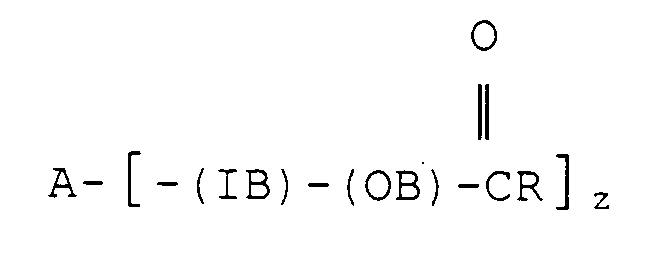 ist, dessen Lipasehydrolyse-Geschwindigkeitswert in vitro bei Verwendung von Schweinepankreaslipase weniger als 30 % des Wertes eines Olivenölstandards beträgt und der ein Molverhältnis von Kohlenstoff zu Sauerstoff von mehr als 2,5 aufweist, R eine C7-C23-Kohlenwasserstoffkomponente ist und durchschnittlich mindestens 85 % der an den Estergruppen im Blockcopolymer befestigten Kohlenstoffe sekundär oder tertiär sind.
- Lebensmittelzubereitung nach Anspruch 1, dadurch gekennzeichnet, dass der aktiven Wasserstoff enthaltende Initiator ein Alkohol ist.
- Lebensmittelzubereitung nach Anspruch 1 oder 2, dadurch gekennzeichnet, dass IB ein hydrophiler innerer Polyoxyethylenblock ist.
- Lebensmittelzubereitung nach einem der Ansprüche 1 bis 3, dadurch gekennzeichnet, dass OB ein lipophiler äußerer Polyoxypropylenblock ist.
- Lebensmittelzubereitung nach einem der Ansprüche 1 bis 4, dadurch gekennzeichnet, dass z 2 oder 3 ist.
- Lebensmittelzubereitung nach einem der Ansprüche 1 bis 3, dadurch gekennzeichnet, dass A eine von einem Alkohol mit 2 oder 3 Hydroxylgruppen abgeleitete Alkoxykomponente ist, IB ein hydrophiler innerer Polyoxyethylenblock ist, OB ein lipophiler äußerer Polyoxypropylenblock ist und R eine paraffinische oder olefinische C11-C21-Kohlenwasserstoffeinheit ist.
- Lebensmittelzubereitung nach einem der Ansprüche 1 bis 6, dadurch gekennzeichnet, dass das Polyoxyalkylen-Blockcopolymer vor der Veresterung ein Gleichgewichtswert von hydrophilen zu lipophilen Gruppen (hydrophilic-to-lipophilic balance = HLB-Wert) von 1 zu 30 aufweist.
- Lebensmittelzubereitung nach einem der Ansprüche 1 bis 7, dadurch gekennzeichnet, dass das Äquivalentgewicht von IB durchschnittlich 88 bis 1540 und das Äquivalentgewicht von OB durchschnittlich 110 bis 2030 beträgt.
- Lebensmittelzubereitung nach einem der Ansprüche 1 bis 8, dadurch gekennzeichnet, dassvon einer Fettsäure abgeleitet ist.

- Lebensmittelzubereitung nach Anspruch 1, dadurch gekennzeichnet, dass das veresterte Polyoxyalkylen-Blockcopolymer die Formelhat, in der A eine von einem Alkohol mit 2 oder 3 Hydroxylgruppen abgeleitete Alkoxykomponente ist, x und y jeweils unabhängig voneinander durchschnittlich 2 bis 35 sind, R eine paraffinische oder olefinische C11-C23-Kohlenwasserstoffeinheit ist und
 von einer Fettsäure abgeleitet ist.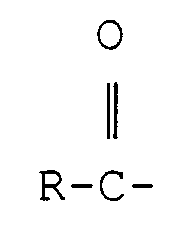
- Lebensmittelzubereitung nach einem der Ansprüche 1 bis 10, dadurch gekennzeichnet, dass A Glyceryl ist.
- Lebensmittelzubereitung nach einem der Ansprüche 1 bis 11, dadurch gekennzeichnet, dass 10 bis 100 % der essbaren Fettkomponente mindestens ein verestertes Polyoxyalkylen-Blockcopolymer umfassen.
- Lebensmittelzubereitung nach einem der Ansprüche 1 bis 11, dadurch gekennzeichnet, dass 25 bis 100 % der essbaren Fettkomponente mindestens ein verestertes Polyoxyalkylen-Blockcopolymer umfassen.
- Verwendung mindestens eines in einem der Ansprüche 1 bis 11 definierten veresterten Polyoxyalkylen-Blockcopolymeren als essbare Fettkomponente in einer Lebensmittelzubereitung.
Applications Claiming Priority (2)
| Application Number | Priority Date | Filing Date | Title |
|---|---|---|---|
| US59790890A | 1990-10-15 | 1990-10-15 | |
| US597908 | 1990-10-15 |
Publications (3)
| Publication Number | Publication Date |
|---|---|
| EP0481717A2 EP0481717A2 (de) | 1992-04-22 |
| EP0481717A3 EP0481717A3 (en) | 1992-05-27 |
| EP0481717B1 true EP0481717B1 (de) | 2000-12-13 |
Family
ID=24393415
Family Applications (1)
| Application Number | Title | Priority Date | Filing Date |
|---|---|---|---|
| EP91309466A Expired - Lifetime EP0481717B1 (de) | 1990-10-15 | 1991-10-15 | Veresterte Polyoxyalkylenblockcopolymere als kalorienarme Fettersatzmittel |
Country Status (7)
| Country | Link |
|---|---|
| US (1) | US5308634A (de) |
| EP (1) | EP0481717B1 (de) |
| JP (1) | JP3122823B2 (de) |
| AT (1) | ATE198077T1 (de) |
| CA (1) | CA2053147A1 (de) |
| DE (1) | DE69132492T2 (de) |
| ES (1) | ES2153348T3 (de) |
Families Citing this family (25)
| Publication number | Priority date | Publication date | Assignee | Title |
|---|---|---|---|---|
| US5389392A (en) * | 1990-12-27 | 1995-02-14 | Arco Chemical Technology, L.P. | Esterified polyether fat mimetics containing ring-opened oxolane units |
| US5298637A (en) * | 1992-10-22 | 1994-03-29 | Arco Chemical Technology, L.P. | Process for producing a reduced calorie lipid composition |
| US5288884A (en) * | 1992-10-22 | 1994-02-22 | Arco Chemical Technology, L.P. | Process for producing a reduced calorie fat mimetic composition |
| US5399729A (en) * | 1993-08-31 | 1995-03-21 | Arco Chemical Technology, L.P. | Esterified alkoxylated polyol fat substitutes having high primary ester content |
| US5362894A (en) * | 1993-11-12 | 1994-11-08 | Arco Chemical Technology, L.P. | Process for producing an esterified alkoxylated polyol |
| US5427815A (en) * | 1993-12-10 | 1995-06-27 | Arco Chemical Technology, L.P. | Linked esterified alkoxylated polyols useful as reduced calorie fat substitutes |
| US5374446A (en) * | 1993-12-10 | 1994-12-20 | Arco Chemical Technology, L.P. | Linked esterified alkoxylated polyols useful as reduced calorie fat substitutes |
| US5736174A (en) * | 1994-03-14 | 1998-04-07 | Arco Chemical Technology, L.P. | Alkoxylated alcohol fat substitutes |
| US5466843A (en) * | 1994-04-29 | 1995-11-14 | Arco Chemical Technology, L.P. | Process for preparing a C12 -C24 saturated fatty acid esterified alkoxylated polyol |
| US5681939A (en) * | 1995-08-22 | 1997-10-28 | Arco Chemical Technology, L.P. | Direct esterification of propoxylated glycerin |
| US6235335B1 (en) | 1995-12-13 | 2001-05-22 | Bestfoods | Method of making a reduced calorie reconstituted milk composition |
| US5645881A (en) * | 1995-12-13 | 1997-07-08 | Cpc International Inc. | Reduced calorie ice cream-type frozen dessert and butter fat mimetics therefor |
| GB9606216D0 (en) * | 1996-03-25 | 1996-05-29 | Scotia Holdings Plc | Polyethylene glycol esters of fatty acids |
| DE69734366T2 (de) * | 1996-07-01 | 2006-07-13 | The Procter & Gamble Company, Cincinnati | Verfahren zur Herstellung getrockneter Kartoffelflocken |
| DE59809319D1 (de) * | 1997-05-17 | 2003-09-25 | Goldschmidt Ag Th | Entschäumercompounds zur Entschäumung von Polymerdispersionen und wässrigen Lacksystemen |
| DE19839054A1 (de) | 1998-08-28 | 2000-03-02 | Forschungszentrum Juelich Gmbh | Verfahren zur Effizienzsteigerung von Tensiden bei simultaner Unterdrückung lamellarer Mesophasen sowie Tenside, welchen ein Additiv beigefügt ist |
| US6039998A (en) * | 1999-03-04 | 2000-03-21 | Bestfoods | Freezable low-calorie spoonable dressing and method for their production |
| US6268010B1 (en) | 1999-06-15 | 2001-07-31 | Bestfoods | Reduced calorie fat mimetics with an average number of oxyalkylene groups per molecule of no more than five |
| US6361817B1 (en) | 1999-12-17 | 2002-03-26 | Bestfoods | Low calorie nut butters |
| HU0100956D0 (en) | 2000-03-06 | 2001-05-28 | Bestfoods Bestfoods | Freezable low-calorie spoonable dressings and method for their production |
| JP2004509633A (ja) * | 2000-09-26 | 2004-04-02 | ザ プロクター アンド ギャンブル カンパニー | 脱水デンプン成分の作製で使用するための改良型乳化剤系 |
| US6793956B2 (en) | 2000-10-23 | 2004-09-21 | The Procter & Gamble Co. | Low-moisture, reduced fat, lipid-based fillings |
| US6720021B2 (en) * | 2000-10-23 | 2004-04-13 | The Procter + Gamble Co. | Process for making a low-fat nut spread composition |
| US6743458B2 (en) | 2000-10-23 | 2004-06-01 | The Procter + Gamble Co. | Reduced fat lipid-based fillings |
| US20020098267A1 (en) * | 2000-10-23 | 2002-07-25 | The Procter & Gamble Co. | Filled snacks |
Family Cites Families (30)
| Publication number | Priority date | Publication date | Assignee | Title |
|---|---|---|---|---|
| DE207070C (de) * | ||||
| CA564516A (en) * | 1958-10-14 | Atlas Powder Company | Polyoxyalkylene hexitol esters | |
| US2610125A (en) * | 1949-11-16 | 1952-09-09 | Drew & Co Inc E F | Edible fatty material |
| US2908681A (en) * | 1957-02-25 | 1959-10-13 | Dow Chemical Co | Esters of 2-hydroxypropylsucrose |
| GB976289A (en) * | 1960-04-14 | 1964-11-25 | Pittsburgh Plate Glass Co | Hydroxy alkylated polyol partial esters |
| US3337595A (en) * | 1960-09-15 | 1967-08-22 | Nalco Chemical Co | Fatty acid esters of polyoxypropylated glycerol |
| US3435024A (en) * | 1965-03-18 | 1969-03-25 | Ledoga Spa | Process for the preparation of surfactants from hydroxylated organic compounds,fatty acid esters and alkylene oxides |
| LU52504A1 (de) * | 1966-12-02 | 1968-08-16 | ||
| DE1595369C3 (de) * | 1966-12-15 | 1973-10-04 | Badische Anilin- & Soda-Fabrik Ag, 6700 Ludwigshafen | Derivate von Blockcopolymerisaten des Äthylenoxids und des 1,2-Propylends und Verfahren zu deren Herstellung |
| US4022808A (en) * | 1973-11-19 | 1977-05-10 | Nippon Soda Company Limited | Process for the production of alkylene glycol ether of organic carboxylic acid |
| US4115415A (en) * | 1973-11-19 | 1978-09-19 | Nisso Petrochemical Industries Co., Ltd. | Process for the production of alkylene glycol ether ester of organic carboxylic acid |
| JPS5579313A (en) * | 1978-12-08 | 1980-06-14 | Nisshin Oil Mills Ltd:The | Cosmetic |
| JPS55160710A (en) * | 1979-05-30 | 1980-12-13 | Nisshin Oil Mills Ltd:The | Cosmetic |
| US4464182A (en) * | 1981-03-31 | 1984-08-07 | Exxon Research & Engineering Co. | Glycol ester flow improver additive for distillate fuels |
| DE3239564C1 (de) * | 1982-10-26 | 1984-05-10 | Goldschmidt Ag Th | Mit Fettsaeure und/oder Isostearinsaeure veresterte Polyoxyalkylenether des Glycerins oder 1.2-Propandiols,deren Herstellung sowie Verwendung als Verdickungs- oder Solubilisierungsmittel |
| DE3338890A1 (de) * | 1983-10-27 | 1985-05-09 | Beiersdorf Ag, 2000 Hamburg | Neue o/w-emulgatoren fuer kosmetische zwecke |
| US4952413A (en) * | 1984-11-26 | 1990-08-28 | The Dow Chemical Company | Sugarless or fat free food compositions |
| US4687843A (en) * | 1985-07-16 | 1987-08-18 | Amerchol Corporation | Esterified propoxylated glucose compositions |
| US4849242A (en) * | 1986-03-31 | 1989-07-18 | The Dow Chemical Company | Method for reducing the available calories in a food composition |
| NL8601767A (nl) * | 1986-07-07 | 1988-02-01 | Schreuder Chem Adviesbureau | Huidbruiningsmiddel. |
| US4861613A (en) * | 1986-07-25 | 1989-08-29 | Arco Chemical Technology, Inc. | Non-digestible fat substitutes of low-caloric value |
| DE3636086A1 (de) * | 1986-10-23 | 1988-04-28 | Henkel Kgaa | Fettsaeureester von polyglycerinpolyglykolethern, ihre herstellung und ihre verwendung |
| US5175323A (en) * | 1988-08-01 | 1992-12-29 | Arco Chemical Technology, L.P. | Preparation of esterified propoxylated glycerin by transesterification |
| US4983329A (en) * | 1988-08-26 | 1991-01-08 | Arco Chemical Technology, Inc. | Preparation of esterified propoxylated glycerin from free fatty acids |
| EP0396405A3 (de) * | 1989-05-05 | 1991-05-08 | Arco Chemical Technology, Inc. | Kosmetische Präparate auf Basis von verestertem alkoxylierten Polyol-Träger |
| EP0396406A3 (de) * | 1989-05-05 | 1992-03-18 | ARCO Chemical Technology, L.P. | Arzneimittelformulierungen, die verestertre alkoxylierte Polyole als Träger verwenden |
| US5077073A (en) * | 1989-08-25 | 1991-12-31 | The Proctor & Gamble Company | Ethoxylated sugar and sugar alcohol esters useful as fat substitutes |
| US5059443A (en) * | 1989-08-30 | 1991-10-22 | The Procter & Gamble Co. | Esterified ethoxylated alkyl glycosides useful in low calorie fat-containing food compositions |
| US4959169A (en) * | 1989-10-20 | 1990-09-25 | The Dow Chemical Company | Esterified polyglycol lubricants for refrigeration compressors |
| CA2031879C (en) * | 1989-12-11 | 1999-08-24 | Charles F. Cooper | Compositions useful as high temperature media |
-
1991
- 1991-10-10 CA CA002053147A patent/CA2053147A1/en not_active Abandoned
- 1991-10-15 JP JP03293799A patent/JP3122823B2/ja not_active Expired - Fee Related
- 1991-10-15 ES ES91309466T patent/ES2153348T3/es not_active Expired - Lifetime
- 1991-10-15 DE DE69132492T patent/DE69132492T2/de not_active Expired - Fee Related
- 1991-10-15 AT AT91309466T patent/ATE198077T1/de active
- 1991-10-15 EP EP91309466A patent/EP0481717B1/de not_active Expired - Lifetime
-
1993
- 1993-01-06 US US08/001,016 patent/US5308634A/en not_active Expired - Fee Related
Also Published As
| Publication number | Publication date |
|---|---|
| EP0481717A3 (en) | 1992-05-27 |
| CA2053147A1 (en) | 1992-04-16 |
| ATE198077T1 (de) | 2000-12-15 |
| DE69132492T2 (de) | 2001-06-28 |
| DE69132492D1 (de) | 2001-01-18 |
| US5308634A (en) | 1994-05-03 |
| JP3122823B2 (ja) | 2001-01-09 |
| JPH04281760A (ja) | 1992-10-07 |
| ES2153348T3 (es) | 2001-03-01 |
| EP0481717A2 (de) | 1992-04-22 |
Similar Documents
| Publication | Publication Date | Title |
|---|---|---|
| US5308634A (en) | Esterified polyoxyalkylene block copolymers as reduced calorie fat substitutes | |
| US5374446A (en) | Linked esterified alkoxylated polyols useful as reduced calorie fat substitutes | |
| US5273772A (en) | Food compositions containing esterified alkoxylated polysaccharide fat substitutes | |
| US5512313A (en) | Esterified alkoxylated polyol fat substitutes having high primary ester content | |
| US5427815A (en) | Linked esterified alkoxylated polyols useful as reduced calorie fat substitutes | |
| US5736174A (en) | Alkoxylated alcohol fat substitutes | |
| US4849242A (en) | Method for reducing the available calories in a food composition | |
| EP0254547B1 (de) | Nicht verdaubares Fettsurrogat mit niedrigem Kaloriengehalt | |
| AU667400B2 (en) | Process for producing a reduced calorie lipid composition | |
| EP0757031B1 (de) | Kalorienarmer Fettersatz | |
| JPH0770589A (ja) | 高エステル化アルコキシル化ポリオール組成物の製造方法 | |
| US5288884A (en) | Process for producing a reduced calorie fat mimetic composition | |
| RU2095993C1 (ru) | Пищевой продукт пониженной калорийности | |
| EP0571219B1 (de) | Esterifierter propoxylierter Glycerin enthaltende Fettsatzzusammenstellung ohne Magen- und Darmennebenscheinungen | |
| US5635236A (en) | Reduced calorie fried foods | |
| EP0415635A1 (de) | Alkoxilierte Zucker- und Zuckeralkoholester zur Verwendung als Fettersatzstoffe | |
| EP0654220B1 (de) | Kalorienarme Nährungszusammensetzung | |
| US5389392A (en) | Esterified polyether fat mimetics containing ring-opened oxolane units | |
| EP0325010B1 (de) | Nicht verdauliche Fettersätze von niedrigem kalorischem Wert | |
| JPH0499445A (ja) | 高温度媒体として有用な組成物 | |
| EP1060675A2 (de) | Kalorienreduzierter Fettersatzstoff mit durchschnittlich mindestens 5 Oxyalkylengruppen pro Molekül | |
| HUT55047A (en) | Process for producing fat imitating compounds with low calorie content and foodstuff comprising such compounds |
Legal Events
| Date | Code | Title | Description |
|---|---|---|---|
| PUAI | Public reference made under article 153(3) epc to a published international application that has entered the european phase |
Free format text: ORIGINAL CODE: 0009012 |
|
| PUAL | Search report despatched |
Free format text: ORIGINAL CODE: 0009013 |
|
| AK | Designated contracting states |
Kind code of ref document: A2 Designated state(s): AT BE CH DE ES FR GB IT LI NL SE |
|
| AK | Designated contracting states |
Kind code of ref document: A3 Designated state(s): AT BE CH DE ES FR GB IT LI NL SE |
|
| RAP1 | Party data changed (applicant data changed or rights of an application transferred) |
Owner name: ARCO CHEMICAL TECHNOLOGY, L.P. |
|
| 17P | Request for examination filed |
Effective date: 19920920 |
|
| 17Q | First examination report despatched |
Effective date: 19950626 |
|
| GRAG | Despatch of communication of intention to grant |
Free format text: ORIGINAL CODE: EPIDOS AGRA |
|
| 17Q | First examination report despatched |
Effective date: 19950626 |
|
| GRAG | Despatch of communication of intention to grant |
Free format text: ORIGINAL CODE: EPIDOS AGRA |
|
| GRAH | Despatch of communication of intention to grant a patent |
Free format text: ORIGINAL CODE: EPIDOS IGRA |
|
| GRAH | Despatch of communication of intention to grant a patent |
Free format text: ORIGINAL CODE: EPIDOS IGRA |
|
| GRAA | (expected) grant |
Free format text: ORIGINAL CODE: 0009210 |
|
| AK | Designated contracting states |
Kind code of ref document: B1 Designated state(s): AT BE CH DE ES FR GB IT LI NL SE |
|
| PG25 | Lapsed in a contracting state [announced via postgrant information from national office to epo] |
Ref country code: SE Free format text: LAPSE BECAUSE OF FAILURE TO SUBMIT A TRANSLATION OF THE DESCRIPTION OR TO PAY THE FEE WITHIN THE PRESCRIBED TIME-LIMIT Effective date: 20001213 Ref country code: NL Free format text: LAPSE BECAUSE OF FAILURE TO SUBMIT A TRANSLATION OF THE DESCRIPTION OR TO PAY THE FEE WITHIN THE PRESCRIBED TIME-LIMIT Effective date: 20001213 Ref country code: LI Free format text: LAPSE BECAUSE OF FAILURE TO SUBMIT A TRANSLATION OF THE DESCRIPTION OR TO PAY THE FEE WITHIN THE PRESCRIBED TIME-LIMIT Effective date: 20001213 Ref country code: CH Free format text: LAPSE BECAUSE OF FAILURE TO SUBMIT A TRANSLATION OF THE DESCRIPTION OR TO PAY THE FEE WITHIN THE PRESCRIBED TIME-LIMIT Effective date: 20001213 Ref country code: BE Free format text: LAPSE BECAUSE OF FAILURE TO SUBMIT A TRANSLATION OF THE DESCRIPTION OR TO PAY THE FEE WITHIN THE PRESCRIBED TIME-LIMIT Effective date: 20001213 Ref country code: AT Free format text: LAPSE BECAUSE OF FAILURE TO SUBMIT A TRANSLATION OF THE DESCRIPTION OR TO PAY THE FEE WITHIN THE PRESCRIBED TIME-LIMIT Effective date: 20001213 |
|
| REF | Corresponds to: |
Ref document number: 198077 Country of ref document: AT Date of ref document: 20001215 Kind code of ref document: T |
|
| REG | Reference to a national code |
Ref country code: CH Ref legal event code: EP |
|
| ITF | It: translation for a ep patent filed | ||
| REF | Corresponds to: |
Ref document number: 69132492 Country of ref document: DE Date of ref document: 20010118 |
|
| REG | Reference to a national code |
Ref country code: ES Ref legal event code: FG2A Ref document number: 2153348 Country of ref document: ES Kind code of ref document: T3 |
|
| ET | Fr: translation filed | ||
| NLV1 | Nl: lapsed or annulled due to failure to fulfill the requirements of art. 29p and 29m of the patents act | ||
| REG | Reference to a national code |
Ref country code: CH Ref legal event code: PL |
|
| PGFP | Annual fee paid to national office [announced via postgrant information from national office to epo] |
Ref country code: GB Payment date: 20010921 Year of fee payment: 11 |
|
| PG25 | Lapsed in a contracting state [announced via postgrant information from national office to epo] |
Ref country code: ES Free format text: LAPSE BECAUSE OF NON-PAYMENT OF DUE FEES Effective date: 20011016 |
|
| PLBE | No opposition filed within time limit |
Free format text: ORIGINAL CODE: 0009261 |
|
| STAA | Information on the status of an ep patent application or granted ep patent |
Free format text: STATUS: NO OPPOSITION FILED WITHIN TIME LIMIT |
|
| 26N | No opposition filed | ||
| REG | Reference to a national code |
Ref country code: GB Ref legal event code: IF02 |
|
| PG25 | Lapsed in a contracting state [announced via postgrant information from national office to epo] |
Ref country code: FR Free format text: LAPSE BECAUSE OF NON-PAYMENT OF DUE FEES Effective date: 20020628 |
|
| PG25 | Lapsed in a contracting state [announced via postgrant information from national office to epo] |
Ref country code: DE Free format text: LAPSE BECAUSE OF NON-PAYMENT OF DUE FEES Effective date: 20020702 |
|
| REG | Reference to a national code |
Ref country code: FR Ref legal event code: ST |
|
| PG25 | Lapsed in a contracting state [announced via postgrant information from national office to epo] |
Ref country code: GB Free format text: LAPSE BECAUSE OF NON-PAYMENT OF DUE FEES Effective date: 20021015 |
|
| GBPC | Gb: european patent ceased through non-payment of renewal fee |
Effective date: 20021015 |
|
| REG | Reference to a national code |
Ref country code: ES Ref legal event code: FD2A Effective date: 20021113 |
|
| PG25 | Lapsed in a contracting state [announced via postgrant information from national office to epo] |
Ref country code: IT Free format text: LAPSE BECAUSE OF NON-PAYMENT OF DUE FEES;WARNING: LAPSES OF ITALIAN PATENTS WITH EFFECTIVE DATE BEFORE 2007 MAY HAVE OCCURRED AT ANY TIME BEFORE 2007. THE CORRECT EFFECTIVE DATE MAY BE DIFFERENT FROM THE ONE RECORDED. Effective date: 20051015 |