EP0481939A2 - Zweifleckenanwender - Google Patents
Zweifleckenanwender Download PDFInfo
- Publication number
- EP0481939A2 EP0481939A2 EP91850059A EP91850059A EP0481939A2 EP 0481939 A2 EP0481939 A2 EP 0481939A2 EP 91850059 A EP91850059 A EP 91850059A EP 91850059 A EP91850059 A EP 91850059A EP 0481939 A2 EP0481939 A2 EP 0481939A2
- Authority
- EP
- European Patent Office
- Prior art keywords
- active agent
- layer
- layers
- carrier layer
- adhesive
- Prior art date
- Legal status (The legal status is an assumption and is not a legal conclusion. Google has not performed a legal analysis and makes no representation as to the accuracy of the status listed.)
- Granted
Links
Images

Classifications
-
- A—HUMAN NECESSITIES
- A61—MEDICAL OR VETERINARY SCIENCE; HYGIENE
- A61K—PREPARATIONS FOR MEDICAL, DENTAL OR TOILETRY PURPOSES
- A61K9/00—Medicinal preparations characterised by special physical form
- A61K9/70—Web, sheet or filament bases ; Films; Fibres of the matrix type containing drug
-
- A—HUMAN NECESSITIES
- A61—MEDICAL OR VETERINARY SCIENCE; HYGIENE
- A61K—PREPARATIONS FOR MEDICAL, DENTAL OR TOILETRY PURPOSES
- A61K9/00—Medicinal preparations characterised by special physical form
- A61K9/70—Web, sheet or filament bases ; Films; Fibres of the matrix type containing drug
- A61K9/7023—Transdermal patches and similar drug-containing composite devices, e.g. cataplasms
- A61K9/703—Transdermal patches and similar drug-containing composite devices, e.g. cataplasms characterised by shape or structure; Details concerning release liner or backing; Refillable patches; User-activated patches
-
- A—HUMAN NECESSITIES
- A61—MEDICAL OR VETERINARY SCIENCE; HYGIENE
- A61K—PREPARATIONS FOR MEDICAL, DENTAL OR TOILETRY PURPOSES
- A61K9/00—Medicinal preparations characterised by special physical form
- A61K9/70—Web, sheet or filament bases ; Films; Fibres of the matrix type containing drug
- A61K9/7023—Transdermal patches and similar drug-containing composite devices, e.g. cataplasms
- A61K9/703—Transdermal patches and similar drug-containing composite devices, e.g. cataplasms characterised by shape or structure; Details concerning release liner or backing; Refillable patches; User-activated patches
- A61K9/7092—Transdermal patches having multiple drug layers or reservoirs, e.g. for obtaining a specific release pattern, or for combining different drugs
Definitions
- the present invention relates to devices for applying active agents to a patient. More particularly, the present invention relates to devices for applying more than one active agent to the skin or mucosa of a patient. Still more particularly, the present invention relates to devices for applying active agents and film layers to the skin or mucosa of a patient. Still more particularly, the present invention relates to the application of devices allowing for the topical and systemic administration to the host or administration through the skin or mucosa of the host over a period of time.
- the structure of the device shown in the '441 patent employs a single membrane to define more than one reservoir; that is, by heat sealing the area encompassed by the membrane to subdivide the membrane into separate reservoirs.
- the object is to obtain intermixing between the reservoirs during application, and not to keep the two systems separate even after application to the patient simultaneously.
- the '441 patent discusses simultaneous application of different drugs, that is only in the context of the use of non-burstable boundaries between the compartments to maintain them separate during application.
- a device for applying a plurality of active agents to a patient comprising a liner layer including a first surface and a second surface, the first surface of the liner layer comprising a releasable surface, a carrier layer including a first surface and a second surface, and a plurality of active agent carrying members disposed on the first surface of the carrier layer, the first surface of the liner layer being releasably heat sealed to the first surface of the carrier layer at least at a location between the plurality of active agent carrying members so as to physically separate the plurality of active agents prior to separation of the liner layer from the carrier layer.
- the device includes a plurality of film layers disposed on the first surface of the carrier layer between the carrier layer and the active agent carrying members whereby the active agent carrying members are applied to the patient along with the film layers.
- the plurality of active agent carrier members comprises a plurality of reservoirs containing the active agents, release means for the controlled release of the active agents from the plurality of reservoirs, and a plurality of active agent impermeable barrier layers between the plurality of reservoirs in the carrier layer whereby the plurality of active agents may only be released from the inner surface of the plurality of reservoirs towards the patient upon application of the plurality of active agent carriers to the patient.
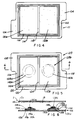
- FIG. 1 shows a device of the present invention. More particularly, FIG. 1 shows the portion of the device in which the liner layer is exposed, while FIG. 3 shows the portion of the device including the carrier layer as well as the active agent carrying members, and FIG. 2 shows a cross section of the entire device in its sealed configuration.
- the liner layer 2 is basically intended to protect the active agents as well as any film layers used in the device of this invention prior to use, and to render them transportable while not interfering with their ultimate application. Furthermore, in accordance with this invention, the liner layer 2 must be heat sealed to the carrier layer 6 in order to not only protect the active agents, but to maintain them separate from each other for the purposes discussed herein.
- the liner layer 2 can therefore comprise various layers, including paper or paper-containing layers or laminates; various thermoplastics, such as extruded polyolefins, such as polyethylene; various polyester films; foil liners; other such layers, including fabric layers, coated or laminated to various polymers, as well as extruded polyethylene, polyethylene terephthalate, various polyamides, and the like.
- this liner layer 2 must have an inner surface which is releasable with respect to the materials or layers with which it is initially in contact, such as the adhesive layers 9a and 9b on the carrier layer 6 (see FIG. 2). It should therefore include a release coating, such as where a paper layer or the like is employed.
- a particularly preferred embodiment of the present invention includes a laminate of an outer foil layer 2a and an inner layer 2b of plastic, such as polyethylene or the like, which is rendered releasable not only by means of a siliconized coating, but which includes an embossed or roughened surface. Embossment of this surface can be accomplished by a number of conventional methods. In general, preparation of embossed surfacing can be accomplished by the use of male-female tooling, preferably enhanced by the application of heat.
- embossment process is to roughen the surface or render it uneven so that less than the entire surface will be in physical contact with the corresponding inner surface of the carrier layer 6 discussed in more detail below.
- This embossment technique is thus carried out on the liner layer 2 prior to completion of the manufacture of this device by combining the liner layer 2 with the carrier layer 6.
- the actual pattern of embossment carried out can vary, and in some instances may involve embossment of large contiguous areas of the liner layer 2. For example, where an active agent carrier or the like is included on the carrier layer 6, it is possible to emboss the entire area, or at least those portions of the area of the liner layer 2 corresponding to the area surrounding the active agents or active agent carriers.
- the overall intent behind doing so is to reduce the area of direct contact between the carrier layer and the liner layer so as to facilitate subsequent separation thereof.
- approximately 30% of the surface of the liner layer will thus be embossed.
- the particular design of the embossment such as the production of a grainy texture or the like, is a matter of choice within the parameters discussed above.
- the presence of the embossed surface on the inner surface of the liner layer 2 is thus extremely significant in preventing the liner layer 2 from sticking or adhering to the carrier layer 6, which would cause these layers to fail to properly separate when it is desired to use the device of the present invention. This ease of operation is an important element in commercialization of these devices.
- a particular liner layer 2 will also depend upon other ultimate requirements of the particular device in question, including whether there is a desire for a transparent or opaque liner, etc. It can thus be seen that essentially throughout the area of contact between the carrier layer 6 and the liner layer 2, although there is adhesive present on at least a portion of the side of the carrier layer 6 which is in contact with the liner layer 2 in order to maintain these two layers in contact, that the seal throughout that area is "peelable,” or releasable, by merely pulling apart the edge of the liner layer 2.
- the active agent carriers possibly in combination with film layers, remain in contact with the lower surface of the carrier layer 6 because of the relationship between the adhesive materials in the adhesive layer maintaining the active agent carrier in contact with the carrier layer 6 vis-a-vis the adhesive layer between the surface of the active agent carrier, or film layers, and/or carrier layer 6 and the liner layer 2.
- this portion of the device of the present invention includes carrier layer 6, upon which are maintained the active agents, either alone or in combination with film layers.
- the active agent carriers 12a and 12b are placed upon separate film layers 10a and 10b, both of which are to be applied to the skin simultaneously.
- Use of the film layers is not essential to this invention, however, and an embodiment of this invention includes only the active agent carriers 12a and 12b, which can be in a number of forms, including that of the active agent carriers 128a and 128b which are discussed below with reference to FIGS. 4 through 6 hereof. In that case, however, means must be provided to ensure that these active agent carriers 128a and 128b will remain associated with the carrier layers upon separation of the liner layer therefrom.
- a separate adhesive layer is applied between the active agent carriers and the carrier layer therefor.
- the carrier layer 6 itself should be flexible enough to generally follow the contour of the area of the host where the device is to be applied. On the other hand, it should have enough strength and substance so as to serve its function of carrying the active agent carriers and possibly the film layers without wrinkling, etc.
- the actual material from which the carrier layer 6 can be produced can therefore include a variety of different materials.
- this layer includes, for example, polyethylene, polypropylene, polyvinylidene chloride, polyethylene terephthalate, polyesters, polyamides, and others, as well as laminates of two or more of these layers with each other or with additional layers, such as foil, paper, various fabrics, etc., but in these cases preferably with the polymer layer on the inside, i.e., in contact with and thereby carrying the active agent carrier, and possibly film layers 10a and 10b. Therefore, in the preferred embodiment of the invention as is shown in FIG. 2 the carrier layer 6 comprises a laminate of an outer foil layer 6a and an inner layer 6b of plastic, such as polyethylene or the like.
- these monolithic active agent carriers 12a and 12b themselves, in this embodiment as shown in FIGS. 1-3, they basically comprise a monolithic active agent carrier.
- these monolithic active agent carriers basically comprise an adhesive layer which is admixed with the active agent or drug component.
- this monolithic active agent carrier 12b is supported on an occlusive barrier layer 13b.
- This layer is occlusive primarily with respect to solvents or enhancers which are contained along with the active agent in the monolithic active agent carrier 12b.
- the presence of occlusive barrier layer 13b prevents the escape or seepage of enhancer towards the carrier layer 6 so that the effectiveness of the active agent carrier 12b is not lost or diminished.
- the occlusive barrier layer 13b can itself comprise the same types of plastic components as are discussed above in connection with the film layer 2 and the carrier layer 6, preferably comprising extruded polyethylene terephthalate, various polyamides, or polyvinylidene chloride or SARAN material.
- film layer 10b supports the active agent carrier 12b. Furthermore, the surface of film layer 12b includes adhesive layer 9b thereon. Subsequent to application of the film layer and the active agent carrier layer to the skin the principal function of holding these components to the skin will be met by the presence of this adhesive layer 9b.
- an active agent carrier such as active agent carrier 12b alone is to be applied to the skin, the requirements for the adhesive characteristics of the adhesive in the active agent carrier 12b are increased. In the embodiments of FIGS. 1-3, this can pose a problem. For this reason, the embodiment shown, which includes film layer 10b, is highly preferred.
- the adhesive characteristics of the adhesive component will be reduced.
- difficulty can be created in terms of rendering the adhesive strong enough to meet the requirements for applying same to the skin in a relatively permanent fashion.
- the adhesive 9b is present in connection with film layer 10b, any reduction in the adhesive characteristics of the monolithic active agent carrier 12b will not be detrimental. It is, in fact, for this reason that yet another embodiment of the present invention exists, i.e., one in which the active agent carrier represented by reference numeral 12b includes no adhesive component at all; for example, where it is a gel or hydrogel component.
- hydrogels for use herein can be formed using the following water soluble or water insoluble gums or resins, with or without known crosslinking agents: agarose, alginates, alkyl and hydroxyalkylcellulose, amylopectin, arabinoglactan, carboxymethylcellulose, carrageenan, Vietnameseeuma, fucoidan, furcellaran, gelatin, guar gum, gum agar, gum arabic, gum ghatti, gum karaya, gum tragacanth, hydroxethyl cellulose, hydroxypropyl cellulose, hypnea, keratin, laminaran, locust bean gum, pectin, polyacrylamide, poly(acrylic) acid and homologs, polyethylene glycol, poly(ethylene) oxide, poly(hydroxyalkyl methacrylate), polyvinyl alcohol, polyvinylpyrrolidone, propylene glycol alginate, starch and modified analogs, tamarind gum, n-
- hydrogels can also be formed by the copolymerization and crosslinking of both hydrophilic and hydrophobic monomers, such as hydroxyalkyl esters of acrylic and methacrylic acids, derivatives of acrylamide and methacrylamide, and n-vinyl-2-pyrrolidone, alkyl acrylates and methacrylates, vinyl acetate, acrylonitrile, and styrene.
- hydrophilic and hydrophobic monomers such as hydroxyalkyl esters of acrylic and methacrylic acids, derivatives of acrylamide and methacrylamide, and n-vinyl-2-pyrrolidone, alkyl acrylates and methacrylates, vinyl acetate, acrylonitrile, and styrene.
- the adhesive layer 9b thereon will hold the entire device, including the active agent carrier 12b, on the skin whether or not it is adhesive in nature.
- the active agent carriers 128a and 128b are applied to the surface of the carrier layer 106 by means of adhesive layers 136a and 136b (in the embodiment shown, film layers 110a and 110b are employed, and are thus interposed between the active agent carriers 128a and 128b and carrier layer 106 by means of further adhesive layers 137a and 137b).
- the active agent carriers 128a and 128b themselves include the active agent contained in separate and distinct reservoirs 134a and 134b created by backing members 138a and 138b and membranes 132a and 132b, which are sealed to each other about the circumference or perimeter of the membrane, preferably by means of a heat seal.
- Active agent permeable adhesive layers 130a and 130b can be applied to the surface of the membranes opposite the reservoirs.
- the active agent carriers are maintained in contact with the surface of film layers 10a and 10b (and 110a and 110b). In the case of the embodiment in FIGS. 4-6, this is accomplished by means of adhesive layers 136a and 136b.
- the active agent carriers either alone or in combination with the film layers, must be adhered to the carrier layers 6 with sufficient strength to maintain same when these active agent carriers and/or film layers are exposed or uncovered by removing the liner layer therefrom, while at the same time this bond must be sufficiently weak in relative terms so that it will readily peel off or be removable from the carrier layers 6 after the active agent carriers, including the film layers, have been applied to the skin, by means of the adhesive layers 9a and 9b (and 136a and 136b) discussed herein.
- the adhesive layer between the carrier layer and the film layers has a coefficient of adhesion which is less than the coefficient of adhesion of the adhesive layer between the film layers and the liner layer.
- the liner layer 2 is brought into face-to-face contact with the carrier layer 6 with the active agents (and possibly film layers) therebetween.
- the active agents and possibly film layers
- heat seals are also provided between the liner layer 2 and the carrier layer 6 in a particular critical configuration.
- such a "peelable seal” can be created by the incorporation of a release coating on the inner surface of a layer such as liner layer 2 so as to render the heat sealed area then created between these two layers, in this case between liner layer 2 and carrier layer 6, by weakening the thermal bond created therein. It is also disclosed in this patent that one alternative for achieving this result is to employ two different materials as the inner layers for the liner layer 2 and the carrier layer 6, such as polyethylene and polypropylene, etc. In such a case no release coating would then be required on the inner surface of the liner layer 2, at lease for the purposes of creating such a "peelable seal” at these locations.
- this "peelable seal” is not only to provide the advantages discussed above in terms of separating the active agent carrier and preventing migration of the enhancers, solvents, or the like, which would then adversely effect the transfer rates of the various drugs contained therein, but at the same time these "peelable seals” permit the ready separation of the liner layer 2 and the carrier layer 6.
- these "peelable seals” permit the ready separation of the liner layer 2 and the carrier layer 6.
- the nature of these "peelable seals" is an important feature of the present invention.
- peelable seals which critically separate the two active agent carriers 12a and 12b thereof are located not only therebetween, but extend along path 16 so as to surround both active agent carrier 12a and active agent carrier 12b, as well as their respective film layers. Furthermore, a separate continuous heat seal 14 separated from heat seal 16 surrounds the entire device including both active agent carriers 12a and 12b.
- each of the active agent carriers, as well as their respective film layers, is isolated prior to separation of the liner layer 2 from the carrier layer 6.
- the significance of this separation has been discussed above, and primarily relates to the fact that where, for example, different drugs are to be applied in connection with active agent carriers 12a and 12b, it will generally be necessary to carefully specify each of the formulations for each of these active agents.
- These formulations will include the use of relatively volatile solvents or enhancers, such as ethanol and the like, which are utilized in connection with these active agents.
- the term “enhancer” is meant to refer to those additives which have the effect of opening the patient's pores and thus facilitating delivery of the drugs or other active agents thereby.
- the primary purpose of these solvents and/or other carriers is to determine the rate of transdermal application which will apply when these active agents are applied to the skin of the patient. Since this delivery rate is a critical element in the use of any such active agents, any premature migration or mixing of these solvents or carriers will alter this delivery rate, with obvious untoward consequences. Placement of the heat seals described above between these active agent carriers, however, will prevent such migration or mixing, and thus permit maintenance of the critical and carefully devised delivery rates and potency for each of the separate active agents therein, and at the same time will have no adverse effect upon use of this device, i.e., the carrier and liner layers are still readily separated when it is desired to apply these active agents to the patient's skin.
- these portions of these adhesive layers are designated by reference numerals 130a and 130b in FIG. 6.
- these active agent permeable adhesive layers 130a and 130b should be limited to the area of the membranes themselves, and the remaining portion of the adhesive necessary for coating the surface of the liner layers 6 and 106 can comprise active agent impermeable adhesive layers which are discussed in more detail below. The reason for this is that the use of an active agent permeable adhesive over the entire surface of the liner layer or at least beyond the periphery of the active agent carriers themselves would concomitantly increase the drug delivery surface, and the treatment dosage for the particular drug delivery system in question would be undesirably altered thereby.
- the remainder of the surface of the film layers 10a and 10b (and 110a and 110b) can comprise layers of active agent impermeable adhesive, and more particularly a relatively strong adhesive for maintaining the film layers in firm contact with the skin of the host.
- the presence of an adhesive layer on the surface of the active agent carrier becomes of little significance, since that surface will be maintained in contact with the skin by means of the surrounding adhesive layers 11a and 11b, and 111a and 111b.
- an adhesive layer for the area of the active agent carrier at least for assuring the maintenance of contact between the active agent carrier and the skin of the host.
- a contact type adhesive of substantially less strength, can thus be utilized.
- the outer surface layer is preferably made of a material or combination of materials which is substantially impermeable to the layer or layers with which it can be in contact, i.e., to the active agent, the impermeable and permeable adhesives, etc.
- a primary purpose is to prevent seepage of the active agent through the outer surface layer of the device so that, if the outer surface layer is coated on the surface in contact with the remainder of the device with the active agent impermeable adhesive layer, this impermeable adhesive layer will perform this purpose even if the outer surface layer is not totally impermeable to the active agent.
- the outer surface layer be impermeable to the active agent, although in most instances, it normally is.
- substantially impermeable we mean that the other components in contact with the layer or component under consideration will not appreciably permeate through such layer or component for the normal period of use and storage of the device, see the discussion of impermeability, infra.
- the actual material used for the outer surface layer i.e., the overlay covering and/or the backing members 138a and 138b, will depend on the properties of the materials in contact therewith.
- suitable materials include, for example, cellophane, cellulose acetate, ethyl cellulose, plasticized vinyl acetate-vinyl chloride copolymers, ethylene-vinyl acetate copolymer, polyethylene terephthalate, nylon, polyethylene, polypropylene, polyvinylidene chloride (e.g., SARAN), paper, cloth, and aluminum foil.
- the material which forms this outer surface layer may be flexible or non-flexible.
- a flexible outer surface layer is employed to conform to the shape of the body member to which the device is attached.
- the material which forms the overall covering layer and/or the backing members 138a and 138b are a film or a composite film.
- the composite can be a metallized (e.g., aluminized) film or a laminate of two or more films or a combination thereof.
- a laminate of polyethylene terephthalate and polyethylene or a polyethylene/metallized polyethylene terephthalate/polyethylene laminate can be employed.
- the preferred polymers include polyethylene, polypropylene, polyvinyl chloride, polyethylene terephthalate, and polyvinylidene chloride (SARAN).
- a highly preferred composition of the present invention employs polyvinylidene chloride or SARAN as the backing members 138a and 138b in conjunction with a film layer 110a and 110b which comprises the PEBAX materials discussed below.
- SARAN polyvinylidene chloride
- the SARAN component is highly occlusive with respect to the materials in question, it also is relatively stiff or hard, and therefore use of a very soft and flexible film, such as those discussed below as the film layers 110a and 110b hereof, provides an excellent combination from the point of view of comfort and application to the user.
- the adhesive layers between the carrier layers and the outer surface of the active agent carriers will comprise a pressure sensitive adhesive, such as a cross-linkable acrylic copolymer.
- a pressure sensitive adhesive such as a cross-linkable acrylic copolymer.
- the adhesive itself can be an acrylic copolymer adhesive such as Avery Chemical Company's AS-351 HSX, preferably at a coating weight of between about 25 and 35 g/m2.
- This pressure sensitive adhesive is a cross-linkable polymer which dries to provide a permanently tacky film having a total solids content of about 52%, a Brookfield viscosity (LVT/04/12 RPM @ 25°C.) of from about 15,000 to 25,000 cps and a weight per gallon of about 7.4 lbs. It can also be diluted with hexane or toluene to a desired solids and/or viscosity range, particularly for use in conventional coating equipment.
- Adhesives which can also be used for these purposes include an acrylic pressure-sensitive adhesive sold by National Adhesives under the designation DUROTAK 80-1054.
- This adhesive has a solids content of 47.5%, a viscosity of 3,000 cps, and a plasticity (Williams) of 2.9 mm. It is generally used with a solvent system including ethyl acetate, heptane, isopropyl alcohol and toluene.
- Another such adhesive is sold by Monsanto under the designation GELVA Multipolymer Emulsion 2484, and comprises a stable aqueous acrylic emulsion pressure-sensitive adhesive having a solids content of 59%, and a viscosity of 1,500-Z, 300 cps.
- these active agent carriers 112a and 112b again include the active agent contained in a reservoirs 134a and 134b created by backing members 138a and 138b and membranes 132a and 132b, which are again sealed to each other about the perimeter thereof.
- Active agent permeable adhesive layers 130a and 130b are also employed.
- the film layers 110a and 110b with layers of active agent impermeable adhesive 136a and 136b thereon are employed. In this manner, the active agent impermeable adhesive layer surrounds at least the periphery of the active agent permeable adhesive layer.
- the active agent impermeable adhesive layer such as adhesive layers 9a and 9b, or 136a and 136b, is to provide adhesion to the skin or mucosa, to prevent seepage of the active agent from the device during storage and use, and to maintain the overall film layers against the skin or mucosa surrounding the active agent carriers.
- any adhesive which performs these functions will be suitable for use in the present invention.
- the degree of impermeability of the active agent impermeable adhesive layer to the active agent will vary depending upon the active agent, carrier, transportation agent, etc.
- the active agent impermeable adhesive layer is a pressure sensitive adhesive suitable for contact with the skin or mucosa, e.g., dermatologically acceptable.
- suitable pressure sensitive adhesive for use in the present invention as the active agent impermeable adhesive layer include natural rubber adhesive such as R-1072 from B.F. Goodrich Co., No. 735 from C.L. Hathaway, and No. 5702 from Evans St. Clair; acrylic adhesives such as PS-41 from C.L. Hathaway, Vr-0833 from H.B. Fuller, Adcote 73A207A from Morton Chemical, Nos. 80-2404, 80-1054, 72-9056, and 72-9399 from National Starch, Nos. E-2015, E-2067 and E-1960 from Rohm & Haas, M-6112 from Uniroyal, Inc. and Daratak 74 L from W.R. Grace; and synthetic rubber adhesives such as Jowatherm 270-00 and Jowatherm S-3202 from Jowat Corp. and 70-9416 from National Starch.
- natural rubber adhesive such as R-1072 from B.F. Goodrich Co., No. 735 from C.L. Hathaway,
- the width and thickness of the active agent impermeable adhesive layer for contact with the skin or mucosa is that width and thickness which provides at least sufficient impermeability to the active agent (and, if necessary, to the other components of the device with which the impermeable adhesive layer is in contact) so that the active agent does not seep out of the device as explained above.
- Some suitable widths include 1/16 to 2 inches, and preferably 1/8 to 1 inches. In most instances, the width will be 1/4 to 1/2 inch depending on the specific use.
- the width and thickness need not be uniform and may vary around the perimeter of the device, e.g., to provide a specific geometric shape or to provide a tab for removal of a protective liner.
- the active agent permeable adhesive layers also join the device to the skin or mucosa of the host, but in the case where the active agent carriers are being applied along with the film layers 110a and 110b, as is discussed above, the active agent permeable adhesive layers are used primarily to maintain contact, and thus, it can have less adhesive strength.
- the adhesive is also preferably dermatologically acceptable.
- the active agent permeable adhesive layers are also preferably a pressure-sensitive adhesive. Any of the well-known, dermatologically acceptable, pressure-sensitive adhesives which permit drug migration therethrough can be used in the present invention.
- Suitable permeable adhesives include acrylic or methacrylic acid (e.g., n-butanol, n-pentanol, isopentanol, 2-methyl butanol, 1-methyl butanol, 1 methyl pentanol, 2-methyl pentanol, 3-methyl pentanol, 2-ethyl butanol, isooctanol, n-decanol, or n-dodecanol esters thereof), alone or copolymerized with ethylenically unsaturated monomers such as acrylic acid, methacrylic acid, acrylamide, methacrylamides, N-alkoxymethyl acrylamides, N-alkoxymethyl methacrylamides, N-t-butylacrylamide, itaconic acid, vinyl acetate, N-branched alkyl maleamic acids wherein the alkyl group has 10 to 24 carbon atoms, glycol diacrylates, or mixture of these monomers; natural or synthetic rubber
- the active agent permeable adhesive layers preferably contain some of the active agent when the device is placed on the skin. This provides an initial drug presence at the skin or mucosa and eliminates delay in absorption of the active agents or in topical application, if that is desired. Thus, the drugs are immediately available to the host. The initial drug presence may be due to the permeations through the membrane and/or to an amount of the drug mixed in with active agent permeable adhesive layers during manufacture, while on the other hand a surrounding layer of active agent impermeable adhesive serves to limit and clearly define the area of drug administration.
- the amount of the active agent present in the permeable adhesive layers depends on the initial drug presence desired, e.g., for a pulse dosage.
- U.S. Patent No. 4,031,894 discloses that 10-200 micrograms scopolamine base per cm2 effective surface area is a suitable initial amount of active agent in the permeable adhesive layer.
- the width and thickness of the permeable adhesive layer for contact with the skin or mucosa is that width and thickness which provides sufficient permeability to the active agents and a suitable surface area to allow the dosage rates desired to the skin or mucosa.
- the impermeable adhesive layer is in most instances in direct contact and/or adjacent to the permeable adhesive layer. However, this is not necessary and there may be a gap between the permeable adhesive layer and the impermeable adhesive layer if desired.
- the thickness and shapes of the permeable and impermeable adhesive layers in the devices of the present invention need not be the same or correspond. This is a particular advantage to the invention in that the device can be made to adhere to specific portions of the skin or mucosa by primary means of the impermeable adhesive layers while not affecting the surface area of the permeable adhesive layer through which the active agent passes (i.e., the shape of the device can be varied without varying the surface area of the membrane and permeable adhesive layer which determines the amount of active agent delivered to the skin or mucosa).
- the reservoirs are separated from the permeable adhesive layers by membranes.
- These membranes may be microporous, in which case the pores become filled with active agents from the reservoirs.
- the membranes may also function in any other way as long as the active agents permeate through the membranes at a suitable rate.
- the membranes and the permeable adhesive layers can be monolithic. In this instance, their surfaces are treated to make them adhesive in nature so that they will adhere to the skin or mucosa but still provide membrane permeability characteristics.
- the suitability of the rate or permeation of the active agents through the membranes depends on the desired dosage rates and the permeabilities of the active agents through the skin or mucosa. Effective amounts of the active agents are contained in the reservoirs to provide the desired dosages. Sometimes, the skin or mucosa itself determines the rates at which the active agents will be administered therethrough. In these latter instances, if the dosage rates through the skin or mucosa are the dosage rates desired, the membranes need not provide any limiting rates of permeation function but need only supply sufficient active agents to the skin or mucosa to allow the desired permeation through the skin or mucosa which itself determines the dosage rates at which the active agents will be absorbed by the host.
- the materials suitable for use as the membrane are conventional in the art and need not be discussed in detail here.
- Some preferred materials for a separate membrane layers may be, for example, polypropylene, polycarbonates, polyvinyl chloride, cellulose acetate, cellulose nitrate, and polyacrylonitrile.
- Some suitable encapsulating membrane materials include, for example, hydrophobic polymers such as polyvinyl chloride either unplasticized or plasticized with long-chain fatty amides or other plasticizers, plasticized nylon, unplasticized soft nylon, silicone rubber, polyethylene, and polyethylene terephthalate.
- Hydrophilic polymers can also be employed such as esters of acrylic and methacrylic acid (e.g., as described in U.S. Pat. Nos.
- the active agents suitable for use in the present invention may be, for example, systemic or topical drugs. Individual active agents or mixtures thereof, if desired, can be employed. Any drug which passes through the skin or mucosa can be employed for internal administration in the device of the invention, so long as the drug will pass through the permeable adhesive layers and the material forming the membranes or microcapsules.
- Suitable systemic drugs for administration by the claimed device include those useful in treating emesis and nausea as is described in U.S. Pat. No. 4,031,894, e.g., preferably, scopolamine.
- pairs of film layers 10a and 10b, and 110a and 110b are also utilized.
- these film layers are materials which are extremely difficult to handle by themselves and which are intended to act as wound dressings when applied to the skin.
- Film layers 10a and 10b, or 110a and 110b, or "skin" are thus extremely flimsy materials which preferably allow air and moisture vapor to pass therethrough, but will not permit the passage of bacteria or undesired elements or materials.
- these film layers thus be composed of various thin, plastic materials, or they can comprise extremely thin foil layers, or layers of other non-woven materials; most particularly they will comprise materials which are sufficiently thin and flexible to be conformable to the skin, and will thus preferably be thinner than about 2 mils, preferably less than about 1.5 mils, and most preferably 1 mil or less.
- These film layers are preferably thermoplastic materials which are at least partially elastomeric in nature. They will therefore exhibit a high degree of elongation (preferably greater than about 130% elongation), and will thus exhibit excellent conformability characteristics without having the tendency to exhibit significant memory characteristics, although they will have some degree of recovery when stretched, for example. In terms of being breathable films it is preferred that these materials, in addition to permitting air to pass therethrough, will also permit moisture vapor to pass through them, at least more readily than is the case with materials such as polyethylene, for example. All of these film layers must be occlusive, at least with respect to particulates, in order to protect the wound, etc. However, their overall occlusive characteristics can then vary, depending upon the ultimate use intended for them in each particular case.
- films which are permeable to various glycols, such as polyethylene glycols, but rather occlusive films can also be employed in selected circumstances, including, for example, 1 and 2 mil layers of ethylene-vinyl acetate copolymers, or various nylon or polyester films.
- laminated or coated films could also be utilized, such as by employing a non-occlusive film such as those discussed above which is fully or partially selectively coated with an occlusive film.
- thermoplastic films themselves can generally be produced with either a matte, glossy, or a clear surface, which is obtained by selection or modification of the surface of the chilling roller generally used downstream of the film extruder from which the film is extruded, and they can include various colors, such as skin color, as well as fillers, such as TiO2, clay or other such materials for the purpose of rendering film opaque, and various organic additives, odor inhibitors, and/or various medications, etc. directly on the surface thereof.
- thermoplastic polyurethanes which also meet the above requirements.
- thermoplastic polyurethanes include such commercial polyurethane compositions as Dow Chemical Company's PELLETHANE, including its 2363-80AE grade thereof; K. J. Quinn's Q-THANE; B. F. Goodrich's ESTANE; Mobay Chemical Company's TXIN; and others.
- these film layers 2 can also comprise various polyesters, such as the copolymers of various cyclic polyesters including DuPont's HYTREL, including its 4056 grade thereof, and General Electric's LOMOD, both of which are copolymers of polyether prepolymers and polybutylene terephthalate and polyisobutyl terephthalate, respectively, as well as Eastman Chemical's PCCE.
- various polyesters such as the copolymers of various cyclic polyesters including DuPont's HYTREL, including its 4056 grade thereof, and General Electric's LOMOD, both of which are copolymers of polyether prepolymers and polybutylene terephthalate and polyisobutyl terephthalate, respectively, as well as Eastman Chemical's PCCE.
Landscapes
- Health & Medical Sciences (AREA)
- Engineering & Computer Science (AREA)
- Bioinformatics & Cheminformatics (AREA)
- Dermatology (AREA)
- Life Sciences & Earth Sciences (AREA)
- Public Health (AREA)
- Pharmacology & Pharmacy (AREA)
- Epidemiology (AREA)
- Chemical & Material Sciences (AREA)
- Animal Behavior & Ethology (AREA)
- General Health & Medical Sciences (AREA)
- Medicinal Chemistry (AREA)
- Veterinary Medicine (AREA)
- Medicinal Preparation (AREA)
- Preparation Of Compounds By Using Micro-Organisms (AREA)
- Breeding Of Plants And Reproduction By Means Of Culturing (AREA)
- Infusion, Injection, And Reservoir Apparatuses (AREA)
- Pharmaceuticals Containing Other Organic And Inorganic Compounds (AREA)
- Materials For Medical Uses (AREA)
Applications Claiming Priority (2)
| Application Number | Priority Date | Filing Date | Title |
|---|---|---|---|
| US07/599,686 US5064422A (en) | 1990-10-18 | 1990-10-18 | Twin patch applicator |
| US599686 | 1990-10-18 |
Publications (3)
| Publication Number | Publication Date |
|---|---|
| EP0481939A2 true EP0481939A2 (de) | 1992-04-22 |
| EP0481939A3 EP0481939A3 (en) | 1992-07-01 |
| EP0481939B1 EP0481939B1 (de) | 1996-06-12 |
Family
ID=24400654
Family Applications (1)
| Application Number | Title | Priority Date | Filing Date |
|---|---|---|---|
| EP91850059A Expired - Lifetime EP0481939B1 (de) | 1990-10-18 | 1991-03-08 | Zweifleckenanwender |
Country Status (11)
| Country | Link |
|---|---|
| US (1) | US5064422A (de) |
| EP (1) | EP0481939B1 (de) |
| JP (1) | JPH072653A (de) |
| KR (1) | KR940000003B1 (de) |
| AT (1) | ATE139125T1 (de) |
| AU (1) | AU636015B2 (de) |
| BR (1) | BR9101061A (de) |
| CA (1) | CA2037536A1 (de) |
| DE (1) | DE69120202T2 (de) |
| IE (1) | IE910729A1 (de) |
| PT (1) | PT96960B (de) |
Cited By (3)
| Publication number | Priority date | Publication date | Assignee | Title |
|---|---|---|---|---|
| US8530022B2 (en) | 2006-04-11 | 2013-09-10 | Molnlycke Health Care Ab | Article or component of a medical and technical nature for affixing a medical article or part thereof to skin, provided with a releasable protection layer |
| CN109513105A (zh) * | 2018-12-04 | 2019-03-26 | 徐萍 | 一种中医烫熨治疗包 |
| CN109966633A (zh) * | 2019-01-04 | 2019-07-05 | 湖北健身医疗器械有限公司 | 一种经皮给药系统及其应用 |
Families Citing this family (27)
| Publication number | Priority date | Publication date | Assignee | Title |
|---|---|---|---|---|
| US5788983A (en) * | 1989-04-03 | 1998-08-04 | Rutgers, The State University Of New Jersey | Transdermal controlled delivery of pharmaceuticals at variable dosage rates and processes |
| EP0484543B1 (de) * | 1990-04-24 | 1995-12-13 | Teijin Limited | Pflaster |
| US5484604A (en) * | 1990-07-21 | 1996-01-16 | Chatfield Pharmaceuticals Limited | Cross-linked alginate transdermal medicine delivery devices |
| US5756117A (en) * | 1992-04-08 | 1998-05-26 | International Medical Asscociates, Inc. | Multidose transdermal drug delivery system |
| US5405614A (en) * | 1992-04-08 | 1995-04-11 | International Medical Associates, Inc. | Electronic transdermal drug delivery system |
| CA2078961A1 (en) * | 1992-04-21 | 1993-10-22 | John Wick | Two-hand pouch patch application |
| AU682853B2 (en) | 1993-03-22 | 1997-10-23 | Minnesota Mining And Manufacturing Company | Windowless frame delivered dressing and method of manufacture |
| US6685682B1 (en) | 1993-03-22 | 2004-02-03 | 3M Innovative Properties Company | Carrier delivered dressing and method of manufacture |
| AU7172794A (en) * | 1993-06-24 | 1995-01-17 | Cygnus Therapeutic Systems | Transdermal delivery system package |
| US5851549A (en) * | 1994-05-25 | 1998-12-22 | Becton Dickinson And Company | Patch, with system and apparatus for manufacture |
| FR2728463A1 (fr) * | 1994-12-21 | 1996-06-28 | Lhd Lab Hygiene Dietetique | Systeme transdermique d'administration simultanee de plusieurs principes actifs |
| US5792090A (en) * | 1995-06-15 | 1998-08-11 | Ladin; Daniel | Oxygen generating wound dressing |
| US5888943A (en) * | 1995-06-30 | 1999-03-30 | Baroid Drilling Fluids, Inc. | Drilling compositions and methods |
| US5730721A (en) * | 1996-01-25 | 1998-03-24 | Vesture Corporation | Medical applicator and method |
| JP4086317B2 (ja) * | 1996-03-25 | 2008-05-14 | エルティエス ローマン テラピー―ズュステーメ アーゲー | 塗布領域の厚さが薄く柔軟性が高い経皮治療システムおよびその製造方法 |
| US7150881B2 (en) | 1997-06-26 | 2006-12-19 | Mylan Technologies, Inc. | Adhesive mixture for transdermal delivery of highly plasticizing drugs |
| US5846217A (en) * | 1997-07-29 | 1998-12-08 | Iomed, Inc. | Iontophoretic bioelectrode and method of using same |
| TW406018B (en) * | 1998-05-21 | 2000-09-21 | Elan Corp Plc | Improved adhesive system for medical devices |
| AU2000231576A1 (en) * | 2000-02-18 | 2001-08-27 | Angelo Dotta | Sealed package for adhesive wound dressing, and apparatus therefore |
| AU2002313517B2 (en) * | 2001-08-31 | 2007-09-06 | Bayer Schering Pharma Oy | Drug delivery system |
| US8524272B2 (en) * | 2003-08-15 | 2013-09-03 | Mylan Technologies, Inc. | Transdermal patch incorporating active agent migration barrier layer |
| US7243788B2 (en) * | 2003-10-22 | 2007-07-17 | Kimberly-Clark Worldwide, Inc. | Package for segregating and mixing substances |
| US20050245852A1 (en) * | 2004-04-30 | 2005-11-03 | Ellefson Kimberly L | System and method for providing therapy to an area of a body |
| WO2009009651A1 (en) * | 2007-07-10 | 2009-01-15 | Agile Therapeutics, Inc. | Dermal delivery device with ultrasonic weld |
| US8246978B2 (en) * | 2007-07-10 | 2012-08-21 | Agile Therapeutics, Inc. | Dermal delivery device with reduced loss of its volatile components |
| DE212009000180U1 (de) * | 2008-09-26 | 2012-01-27 | Novartis Ag | Bandage für die Behandlung von Gelenkschmerz umfassend mindestens zwei transdermale Pflaster |
| US20100221313A1 (en) * | 2008-12-01 | 2010-09-02 | Innovative Pharmaceuticals, Llc | Transdermal reservoir patch |
Family Cites Families (11)
| Publication number | Priority date | Publication date | Assignee | Title |
|---|---|---|---|---|
| US716265A (en) * | 1901-08-19 | 1902-12-16 | Bauer & Black | Blister-plaster. |
| US2807262A (en) * | 1952-12-10 | 1957-09-24 | Robert B Lew | Perforated plastic adhesive tape bandage |
| US3342183A (en) * | 1964-08-13 | 1967-09-19 | Johnson & Johnson | Absorbent adhesive patch impregnated with a vasoconstrictor |
| US3814095A (en) * | 1972-03-24 | 1974-06-04 | H Lubens | Occlusively applied anesthetic patch |
| US3900027A (en) * | 1974-01-02 | 1975-08-19 | Pall Corp | Process for preparing integral absorbent pad bandages and product |
| GB8319096D0 (en) * | 1983-07-14 | 1983-08-17 | Harlands Of Hull Ltd | Topical dressings |
| US4666441A (en) * | 1985-12-17 | 1987-05-19 | Ciba-Geigy Corporation | Multicompartmentalized transdermal patches |
| US4917676A (en) * | 1986-11-20 | 1990-04-17 | Ciba-Geigy Corporation | User-activated transdermal therapeutic system |
| US4917688A (en) * | 1987-01-14 | 1990-04-17 | Nelson Research & Development Co. | Bandage for transdermal delivery of systemically-active drug |
| US4911707A (en) * | 1987-02-13 | 1990-03-27 | Ciba-Geigy Corporation | Monolithic user-activated transdermal therapeutic system |
| US4983395A (en) * | 1987-11-12 | 1991-01-08 | Theratech Inc. | Device for administering an active agent to the skin or mucosa |
-
1990
- 1990-10-18 US US07/599,686 patent/US5064422A/en not_active Expired - Lifetime
-
1991
- 1991-03-05 IE IE072991A patent/IE910729A1/en unknown
- 1991-03-05 CA CA002037536A patent/CA2037536A1/en not_active Abandoned
- 1991-03-07 PT PT96960A patent/PT96960B/pt not_active IP Right Cessation
- 1991-03-08 AT AT91850059T patent/ATE139125T1/de not_active IP Right Cessation
- 1991-03-08 DE DE69120202T patent/DE69120202T2/de not_active Expired - Lifetime
- 1991-03-08 EP EP91850059A patent/EP0481939B1/de not_active Expired - Lifetime
- 1991-03-15 AU AU72951/91A patent/AU636015B2/en not_active Ceased
- 1991-03-18 BR BR919101061A patent/BR9101061A/pt not_active IP Right Cessation
- 1991-04-04 JP JP3101940A patent/JPH072653A/ja active Pending
- 1991-04-24 KR KR1019910006557A patent/KR940000003B1/ko not_active Expired - Fee Related
Cited By (3)
| Publication number | Priority date | Publication date | Assignee | Title |
|---|---|---|---|---|
| US8530022B2 (en) | 2006-04-11 | 2013-09-10 | Molnlycke Health Care Ab | Article or component of a medical and technical nature for affixing a medical article or part thereof to skin, provided with a releasable protection layer |
| CN109513105A (zh) * | 2018-12-04 | 2019-03-26 | 徐萍 | 一种中医烫熨治疗包 |
| CN109966633A (zh) * | 2019-01-04 | 2019-07-05 | 湖北健身医疗器械有限公司 | 一种经皮给药系统及其应用 |
Also Published As
| Publication number | Publication date |
|---|---|
| CA2037536A1 (en) | 1992-04-19 |
| EP0481939A3 (en) | 1992-07-01 |
| US5064422A (en) | 1991-11-12 |
| AU7295191A (en) | 1992-04-30 |
| EP0481939B1 (de) | 1996-06-12 |
| JPH072653A (ja) | 1995-01-06 |
| ATE139125T1 (de) | 1996-06-15 |
| KR920007623A (ko) | 1992-05-27 |
| DE69120202T2 (de) | 1996-10-10 |
| AU636015B2 (en) | 1993-04-08 |
| PT96960B (pt) | 1998-10-30 |
| BR9101061A (pt) | 1992-07-21 |
| DE69120202D1 (de) | 1996-07-18 |
| KR940000003B1 (ko) | 1994-01-05 |
| IE910729A1 (en) | 1992-04-22 |
| PT96960A (pt) | 1993-01-29 |
Similar Documents
| Publication | Publication Date | Title |
|---|---|---|
| EP0481939B1 (de) | Zweifleckenanwender | |
| EP0356614B1 (de) | Dermales Auftragegerät | |
| US4573996A (en) | Device for the administration of an active agent to the skin or mucosa | |
| US5662926A (en) | Transdermal patch incorporating a polymer film incorporated with an active agent | |
| JP3585128B2 (ja) | 経皮治療用パッチ(tts)の製造方法 | |
| US7049479B2 (en) | Ultra thin film transdermal/dermal or transmucosal/mucosal delivery system | |
| EP0571700A1 (de) | Hydrogel Applikator und Verfahren zu seiner Herstellung | |
| AU2004266563B2 (en) | Transdermal patch incorporating active agent migration barrier layer | |
| KR101035041B1 (ko) | 양면 비점착성 릴리스 필름 | |
| EP2190392A1 (de) | Transdermale arzneiabgabesysteme mit einer beschichteten ablöseschicht | |
| CZ281267B6 (cs) | Způsob kontinuální výroby transdermálních terapeutických náplastí | |
| US20100292660A1 (en) | Dermal delivery device with ultrasonic weld | |
| EP0401949A2 (de) | Dünner Filmaufleger | |
| JPS62230720A (ja) | 積層製剤 |
Legal Events
| Date | Code | Title | Description |
|---|---|---|---|
| PUAI | Public reference made under article 153(3) epc to a published international application that has entered the european phase |
Free format text: ORIGINAL CODE: 0009012 |
|
| AK | Designated contracting states |
Kind code of ref document: A2 Designated state(s): AT BE CH DE DK ES FR GB GR IT LI LU NL SE |
|
| PUAL | Search report despatched |
Free format text: ORIGINAL CODE: 0009013 |
|
| AK | Designated contracting states |
Kind code of ref document: A3 Designated state(s): AT BE CH DE DK ES FR GB GR IT LI LU NL SE |
|
| 17P | Request for examination filed |
Effective date: 19921229 |
|
| RAP1 | Party data changed (applicant data changed or rights of an application transferred) |
Owner name: MLI ACQUISITION CORP. II |
|
| RHK1 | Main classification (correction) |
Ipc: A61L 15/44 |
|
| 17Q | First examination report despatched |
Effective date: 19950404 |
|
| GRAA | (expected) grant |
Free format text: ORIGINAL CODE: 0009210 |
|
| AK | Designated contracting states |
Kind code of ref document: B1 Designated state(s): AT BE CH DE DK ES FR GB GR IT LI LU NL SE |
|
| PG25 | Lapsed in a contracting state [announced via postgrant information from national office to epo] |
Ref country code: IT Free format text: LAPSE BECAUSE OF FAILURE TO SUBMIT A TRANSLATION OF THE DESCRIPTION OR TO PAY THE FEE WITHIN THE PRE;WARNING: LAPSES OF ITALIAN PATENTS WITH EFFECTIVE DATE BEFORE 2007 MAY HAVE OCCURRED AT ANY TIME BEFORE 2007. THE CORRECT EFFECTIVE DATE MAY BE DIFFERENT FROM THE ONE RECORDED.SCRIBED TIME-LIMIT Effective date: 19960612 Ref country code: ES Free format text: THE PATENT HAS BEEN ANNULLED BY A DECISION OF A NATIONAL AUTHORITY Effective date: 19960612 Ref country code: GR Free format text: LAPSE BECAUSE OF FAILURE TO SUBMIT A TRANSLATION OF THE DESCRIPTION OR TO PAY THE FEE WITHIN THE PRESCRIBED TIME-LIMIT Effective date: 19960612 Ref country code: NL Free format text: LAPSE BECAUSE OF FAILURE TO SUBMIT A TRANSLATION OF THE DESCRIPTION OR TO PAY THE FEE WITHIN THE PRESCRIBED TIME-LIMIT Effective date: 19960612 Ref country code: DK Effective date: 19960612 Ref country code: CH Effective date: 19960612 Ref country code: LI Effective date: 19960612 Ref country code: AT Effective date: 19960612 Ref country code: BE Effective date: 19960612 |
|
| REF | Corresponds to: |
Ref document number: 139125 Country of ref document: AT Date of ref document: 19960615 Kind code of ref document: T |
|
| REF | Corresponds to: |
Ref document number: 69120202 Country of ref document: DE Date of ref document: 19960718 |
|
| ET | Fr: translation filed | ||
| PG25 | Lapsed in a contracting state [announced via postgrant information from national office to epo] |
Ref country code: SE Effective date: 19960912 |
|
| NLV1 | Nl: lapsed or annulled due to failure to fulfill the requirements of art. 29p and 29m of the patents act | ||
| REG | Reference to a national code |
Ref country code: CH Ref legal event code: PL |
|
| PG25 | Lapsed in a contracting state [announced via postgrant information from national office to epo] |
Ref country code: GB Effective date: 19970308 |
|
| PG25 | Lapsed in a contracting state [announced via postgrant information from national office to epo] |
Ref country code: LU Free format text: LAPSE BECAUSE OF NON-PAYMENT OF DUE FEES Effective date: 19970331 |
|
| PLBE | No opposition filed within time limit |
Free format text: ORIGINAL CODE: 0009261 |
|
| STAA | Information on the status of an ep patent application or granted ep patent |
Free format text: STATUS: NO OPPOSITION FILED WITHIN TIME LIMIT |
|
| 26N | No opposition filed | ||
| GBPC | Gb: european patent ceased through non-payment of renewal fee |
Effective date: 19970308 |
|
| PGFP | Annual fee paid to national office [announced via postgrant information from national office to epo] |
Ref country code: FR Payment date: 20100318 Year of fee payment: 20 |
|
| PGFP | Annual fee paid to national office [announced via postgrant information from national office to epo] |
Ref country code: DE Payment date: 20100331 Year of fee payment: 20 |
|
| REG | Reference to a national code |
Ref country code: DE Ref legal event code: R071 Ref document number: 69120202 Country of ref document: DE |
|
| PG25 | Lapsed in a contracting state [announced via postgrant information from national office to epo] |
Ref country code: DE Free format text: LAPSE BECAUSE OF EXPIRATION OF PROTECTION Effective date: 20110308 |