EP0482276A1 - Verfahren zur katalytischen Dehydrierung von alkylaromatischen Kohlenwasserstoffen - Google Patents
Verfahren zur katalytischen Dehydrierung von alkylaromatischen Kohlenwasserstoffen Download PDFInfo
- Publication number
- EP0482276A1 EP0482276A1 EP90870199A EP90870199A EP0482276A1 EP 0482276 A1 EP0482276 A1 EP 0482276A1 EP 90870199 A EP90870199 A EP 90870199A EP 90870199 A EP90870199 A EP 90870199A EP 0482276 A1 EP0482276 A1 EP 0482276A1
- Authority
- EP
- European Patent Office
- Prior art keywords
- catalyst
- dehydrogenation
- process according
- reactor
- temperature
- Prior art date
- Legal status (The legal status is an assumption and is not a legal conclusion. Google has not performed a legal analysis and makes no representation as to the accuracy of the status listed.)
- Granted
Links
- 229930195733 hydrocarbon Natural products 0.000 title claims abstract description 41
- 150000002430 hydrocarbons Chemical class 0.000 title claims abstract description 41
- 238000006356 dehydrogenation reaction Methods 0.000 title claims description 42
- 238000000034 method Methods 0.000 title claims description 42
- 230000003197 catalytic effect Effects 0.000 title claims description 16
- 239000003054 catalyst Substances 0.000 claims abstract description 84
- 229910052751 metal Inorganic materials 0.000 claims abstract description 12
- 239000002184 metal Substances 0.000 claims abstract description 12
- MYMOFIZGZYHOMD-UHFFFAOYSA-N Dioxygen Chemical compound O=O MYMOFIZGZYHOMD-UHFFFAOYSA-N 0.000 claims description 18
- 229910001882 dioxygen Inorganic materials 0.000 claims description 18
- 239000007789 gas Substances 0.000 claims description 14
- CPLXHLVBOLITMK-UHFFFAOYSA-N magnesium oxide Inorganic materials [Mg]=O CPLXHLVBOLITMK-UHFFFAOYSA-N 0.000 claims description 14
- VYPSYNLAJGMNEJ-UHFFFAOYSA-N Silicium dioxide Chemical compound O=[Si]=O VYPSYNLAJGMNEJ-UHFFFAOYSA-N 0.000 claims description 12
- UGFAIRIUMAVXCW-UHFFFAOYSA-N Carbon monoxide Chemical compound [O+]#[C-] UGFAIRIUMAVXCW-UHFFFAOYSA-N 0.000 claims description 9
- 229910002091 carbon monoxide Inorganic materials 0.000 claims description 9
- 239000003638 chemical reducing agent Substances 0.000 claims description 9
- 239000000395 magnesium oxide Substances 0.000 claims description 9
- 239000000463 material Substances 0.000 claims description 9
- 239000004215 Carbon black (E152) Substances 0.000 claims description 8
- 239000000203 mixture Substances 0.000 claims description 8
- 229910052799 carbon Inorganic materials 0.000 claims description 6
- 229910019142 PO4 Inorganic materials 0.000 claims description 5
- 230000000694 effects Effects 0.000 claims description 5
- ATUOYWHBWRKTHZ-UHFFFAOYSA-N Propane Chemical compound CCC ATUOYWHBWRKTHZ-UHFFFAOYSA-N 0.000 claims description 4
- XLOMVQKBTHCTTD-UHFFFAOYSA-N Zinc monoxide Chemical compound [Zn]=O XLOMVQKBTHCTTD-UHFFFAOYSA-N 0.000 claims description 4
- 229910052791 calcium Inorganic materials 0.000 claims description 4
- AXZKOIWUVFPNLO-UHFFFAOYSA-N magnesium;oxygen(2-) Chemical compound [O-2].[Mg+2] AXZKOIWUVFPNLO-UHFFFAOYSA-N 0.000 claims description 4
- VNWKTOKETHGBQD-UHFFFAOYSA-N methane Chemical compound C VNWKTOKETHGBQD-UHFFFAOYSA-N 0.000 claims description 4
- 229910052720 vanadium Inorganic materials 0.000 claims description 4
- 229910052776 Thorium Inorganic materials 0.000 claims description 3
- 229910052770 Uranium Inorganic materials 0.000 claims description 3
- 229910052804 chromium Inorganic materials 0.000 claims description 3
- 229910052739 hydrogen Inorganic materials 0.000 claims description 3
- 239000001257 hydrogen Substances 0.000 claims description 3
- 229910052742 iron Inorganic materials 0.000 claims description 3
- 229910052749 magnesium Inorganic materials 0.000 claims description 3
- 239000011777 magnesium Substances 0.000 claims description 3
- 229910052748 manganese Inorganic materials 0.000 claims description 3
- 239000010452 phosphate Substances 0.000 claims description 3
- 229910052814 silicon oxide Inorganic materials 0.000 claims description 3
- 229910052718 tin Inorganic materials 0.000 claims description 3
- 229910052719 titanium Inorganic materials 0.000 claims description 3
- 229910052725 zinc Inorganic materials 0.000 claims description 3
- 239000011701 zinc Substances 0.000 claims description 3
- 229910052726 zirconium Inorganic materials 0.000 claims description 3
- OTMSDBZUPAUEDD-UHFFFAOYSA-N Ethane Chemical compound CC OTMSDBZUPAUEDD-UHFFFAOYSA-N 0.000 claims description 2
- XHCLAFWTIXFWPH-UHFFFAOYSA-N [O-2].[O-2].[O-2].[O-2].[O-2].[V+5].[V+5] Chemical compound [O-2].[O-2].[O-2].[O-2].[O-2].[V+5].[V+5] XHCLAFWTIXFWPH-UHFFFAOYSA-N 0.000 claims description 2
- 229910000323 aluminium silicate Inorganic materials 0.000 claims description 2
- 239000001273 butane Substances 0.000 claims description 2
- 229910052745 lead Inorganic materials 0.000 claims description 2
- IJDNQMDRQITEOD-UHFFFAOYSA-N n-butane Chemical compound CCCC IJDNQMDRQITEOD-UHFFFAOYSA-N 0.000 claims description 2
- OFBQJSOFQDEBGM-UHFFFAOYSA-N n-pentane Natural products CCCCC OFBQJSOFQDEBGM-UHFFFAOYSA-N 0.000 claims description 2
- 239000001294 propane Substances 0.000 claims description 2
- 230000001172 regenerating effect Effects 0.000 claims description 2
- 229910001935 vanadium oxide Inorganic materials 0.000 claims description 2
- 239000011787 zinc oxide Substances 0.000 claims description 2
- 238000004064 recycling Methods 0.000 claims 2
- 125000004435 hydrogen atom Chemical class [H]* 0.000 claims 1
- 238000011084 recovery Methods 0.000 claims 1
- 230000003647 oxidation Effects 0.000 abstract description 9
- 238000007254 oxidation reaction Methods 0.000 abstract description 9
- 230000008929 regeneration Effects 0.000 abstract description 9
- 238000011069 regeneration method Methods 0.000 abstract description 9
- YNQLUTRBYVCPMQ-UHFFFAOYSA-N Ethylbenzene Chemical compound CCC1=CC=CC=C1 YNQLUTRBYVCPMQ-UHFFFAOYSA-N 0.000 description 24
- 238000006243 chemical reaction Methods 0.000 description 11
- CURLTUGMZLYLDI-UHFFFAOYSA-N Carbon dioxide Chemical compound O=C=O CURLTUGMZLYLDI-UHFFFAOYSA-N 0.000 description 10
- 239000002245 particle Substances 0.000 description 8
- IJGRMHOSHXDMSA-UHFFFAOYSA-N Atomic nitrogen Chemical compound N#N IJGRMHOSHXDMSA-UHFFFAOYSA-N 0.000 description 6
- PPBRXRYQALVLMV-UHFFFAOYSA-N Styrene Chemical compound C=CC1=CC=CC=C1 PPBRXRYQALVLMV-UHFFFAOYSA-N 0.000 description 6
- 230000000052 comparative effect Effects 0.000 description 6
- 229910002092 carbon dioxide Inorganic materials 0.000 description 5
- 239000001569 carbon dioxide Substances 0.000 description 5
- 239000000725 suspension Substances 0.000 description 5
- 229910052784 alkaline earth metal Inorganic materials 0.000 description 4
- 230000015572 biosynthetic process Effects 0.000 description 4
- UNTBPXHCXVWYOI-UHFFFAOYSA-O azanium;oxido(dioxo)vanadium Chemical compound [NH4+].[O-][V](=O)=O UNTBPXHCXVWYOI-UHFFFAOYSA-O 0.000 description 3
- 239000011575 calcium Substances 0.000 description 3
- 238000010924 continuous production Methods 0.000 description 3
- 229910052757 nitrogen Inorganic materials 0.000 description 3
- 238000005839 oxidative dehydrogenation reaction Methods 0.000 description 3
- 239000000843 powder Substances 0.000 description 3
- RMAQACBXLXPBSY-UHFFFAOYSA-N silicic acid Chemical compound O[Si](O)(O)O RMAQACBXLXPBSY-UHFFFAOYSA-N 0.000 description 3
- 239000000243 solution Substances 0.000 description 3
- XLYOFNOQVPJJNP-UHFFFAOYSA-N water Substances O XLYOFNOQVPJJNP-UHFFFAOYSA-N 0.000 description 3
- 239000003513 alkali Substances 0.000 description 2
- 150000001342 alkaline earth metals Chemical class 0.000 description 2
- QVGXLLKOCUKJST-UHFFFAOYSA-N atomic oxygen Chemical compound [O] QVGXLLKOCUKJST-UHFFFAOYSA-N 0.000 description 2
- 238000001354 calcination Methods 0.000 description 2
- 239000003085 diluting agent Substances 0.000 description 2
- 230000002349 favourable effect Effects 0.000 description 2
- 238000005470 impregnation Methods 0.000 description 2
- 239000012535 impurity Substances 0.000 description 2
- 239000011261 inert gas Substances 0.000 description 2
- 239000003915 liquefied petroleum gas Substances 0.000 description 2
- 229910044991 metal oxide Inorganic materials 0.000 description 2
- 150000004706 metal oxides Chemical class 0.000 description 2
- 150000002739 metals Chemical class 0.000 description 2
- 239000003921 oil Substances 0.000 description 2
- 239000001301 oxygen Substances 0.000 description 2
- 229910052760 oxygen Inorganic materials 0.000 description 2
- 239000012429 reaction media Substances 0.000 description 2
- 229910052710 silicon Inorganic materials 0.000 description 2
- 238000001694 spray drying Methods 0.000 description 2
- 239000012808 vapor phase Substances 0.000 description 2
- HYFLWBNQFMXCPA-UHFFFAOYSA-N 1-ethyl-2-methylbenzene Chemical compound CCC1=CC=CC=C1C HYFLWBNQFMXCPA-UHFFFAOYSA-N 0.000 description 1
- OYPRJOBELJOOCE-UHFFFAOYSA-N Calcium Chemical compound [Ca] OYPRJOBELJOOCE-UHFFFAOYSA-N 0.000 description 1
- UFHFLCQGNIYNRP-UHFFFAOYSA-N Hydrogen Chemical compound [H][H] UFHFLCQGNIYNRP-UHFFFAOYSA-N 0.000 description 1
- DGAQECJNVWCQMB-PUAWFVPOSA-M Ilexoside XXIX Chemical compound C[C@@H]1CC[C@@]2(CC[C@@]3(C(=CC[C@H]4[C@]3(CC[C@@H]5[C@@]4(CC[C@@H](C5(C)C)OS(=O)(=O)[O-])C)C)[C@@H]2[C@]1(C)O)C)C(=O)O[C@H]6[C@@H]([C@H]([C@@H]([C@H](O6)CO)O)O)O.[Na+] DGAQECJNVWCQMB-PUAWFVPOSA-M 0.000 description 1
- 229910052777 Praseodymium Inorganic materials 0.000 description 1
- XUIMIQQOPSSXEZ-UHFFFAOYSA-N Silicon Chemical compound [Si] XUIMIQQOPSSXEZ-UHFFFAOYSA-N 0.000 description 1
- 238000010521 absorption reaction Methods 0.000 description 1
- 150000001299 aldehydes Chemical class 0.000 description 1
- 229910052782 aluminium Inorganic materials 0.000 description 1
- 229910052788 barium Inorganic materials 0.000 description 1
- 125000004432 carbon atom Chemical group C* 0.000 description 1
- 239000012159 carrier gas Substances 0.000 description 1
- 238000002485 combustion reaction Methods 0.000 description 1
- 238000003795 desorption Methods 0.000 description 1
- 230000001627 detrimental effect Effects 0.000 description 1
- 238000010586 diagram Methods 0.000 description 1
- 238000009826 distribution Methods 0.000 description 1
- 238000001704 evaporation Methods 0.000 description 1
- 230000008020 evaporation Effects 0.000 description 1
- 238000011010 flushing procedure Methods 0.000 description 1
- 239000001307 helium Substances 0.000 description 1
- 229910052734 helium Inorganic materials 0.000 description 1
- SWQJXJOGLNCZEY-UHFFFAOYSA-N helium atom Chemical compound [He] SWQJXJOGLNCZEY-UHFFFAOYSA-N 0.000 description 1
- 150000002431 hydrogen Chemical class 0.000 description 1
- 239000003701 inert diluent Substances 0.000 description 1
- 230000000977 initiatory effect Effects 0.000 description 1
- 238000002347 injection Methods 0.000 description 1
- 239000007924 injection Substances 0.000 description 1
- 238000004519 manufacturing process Methods 0.000 description 1
- 238000012544 monitoring process Methods 0.000 description 1
- TVMXDCGIABBOFY-UHFFFAOYSA-N octane Chemical compound CCCCCCCC TVMXDCGIABBOFY-UHFFFAOYSA-N 0.000 description 1
- MMKQUGHLEMYQSG-UHFFFAOYSA-N oxygen(2-);praseodymium(3+) Chemical compound [O-2].[O-2].[O-2].[Pr+3].[Pr+3] MMKQUGHLEMYQSG-UHFFFAOYSA-N 0.000 description 1
- 238000012856 packing Methods 0.000 description 1
- 230000000704 physical effect Effects 0.000 description 1
- 239000004033 plastic Substances 0.000 description 1
- 239000011148 porous material Substances 0.000 description 1
- PUDIUYLPXJFUGB-UHFFFAOYSA-N praseodymium atom Chemical compound [Pr] PUDIUYLPXJFUGB-UHFFFAOYSA-N 0.000 description 1
- 229910003447 praseodymium oxide Inorganic materials 0.000 description 1
- 238000001556 precipitation Methods 0.000 description 1
- 238000002360 preparation method Methods 0.000 description 1
- HJWLCRVIBGQPNF-UHFFFAOYSA-N prop-2-enylbenzene Chemical compound C=CCC1=CC=CC=C1 HJWLCRVIBGQPNF-UHFFFAOYSA-N 0.000 description 1
- 238000010405 reoxidation reaction Methods 0.000 description 1
- 238000007873 sieving Methods 0.000 description 1
- 239000010703 silicon Substances 0.000 description 1
- 239000011734 sodium Substances 0.000 description 1
- 229910052708 sodium Inorganic materials 0.000 description 1
- 238000001179 sorption measurement Methods 0.000 description 1
- 238000010561 standard procedure Methods 0.000 description 1
- 229920003051 synthetic elastomer Polymers 0.000 description 1
- 239000005061 synthetic rubber Substances 0.000 description 1
- LSGOVYNHVSXFFJ-UHFFFAOYSA-N vanadate(3-) Chemical class [O-][V]([O-])([O-])=O LSGOVYNHVSXFFJ-UHFFFAOYSA-N 0.000 description 1
- LEONUFNNVUYDNQ-UHFFFAOYSA-N vanadium atom Chemical compound [V] LEONUFNNVUYDNQ-UHFFFAOYSA-N 0.000 description 1
Images

Classifications
-
- C—CHEMISTRY; METALLURGY
- C07—ORGANIC CHEMISTRY
- C07C—ACYCLIC OR CARBOCYCLIC COMPOUNDS
- C07C5/00—Preparation of hydrocarbons from hydrocarbons containing the same number of carbon atoms
- C07C5/32—Preparation of hydrocarbons from hydrocarbons containing the same number of carbon atoms by dehydrogenation with formation of free hydrogen
- C07C5/327—Formation of non-aromatic carbon-to-carbon double bonds only
- C07C5/333—Catalytic processes
- C07C5/3332—Catalytic processes with metal oxides or metal sulfides
-
- B—PERFORMING OPERATIONS; TRANSPORTING
- B01—PHYSICAL OR CHEMICAL PROCESSES OR APPARATUS IN GENERAL
- B01J—CHEMICAL OR PHYSICAL PROCESSES, e.g. CATALYSIS OR COLLOID CHEMISTRY; THEIR RELEVANT APPARATUS
- B01J23/00—Catalysts comprising metals or metal oxides or hydroxides, not provided for in group B01J21/00
- B01J23/16—Catalysts comprising metals or metal oxides or hydroxides, not provided for in group B01J21/00 of arsenic, antimony, bismuth, vanadium, niobium, tantalum, polonium, chromium, molybdenum, tungsten, manganese, technetium or rhenium
- B01J23/20—Vanadium, niobium or tantalum
- B01J23/22—Vanadium
-
- B—PERFORMING OPERATIONS; TRANSPORTING
- B01—PHYSICAL OR CHEMICAL PROCESSES OR APPARATUS IN GENERAL
- B01J—CHEMICAL OR PHYSICAL PROCESSES, e.g. CATALYSIS OR COLLOID CHEMISTRY; THEIR RELEVANT APPARATUS
- B01J23/00—Catalysts comprising metals or metal oxides or hydroxides, not provided for in group B01J21/00
- B01J23/16—Catalysts comprising metals or metal oxides or hydroxides, not provided for in group B01J21/00 of arsenic, antimony, bismuth, vanadium, niobium, tantalum, polonium, chromium, molybdenum, tungsten, manganese, technetium or rhenium
- B01J23/24—Chromium, molybdenum or tungsten
-
- B—PERFORMING OPERATIONS; TRANSPORTING
- B01—PHYSICAL OR CHEMICAL PROCESSES OR APPARATUS IN GENERAL
- B01J—CHEMICAL OR PHYSICAL PROCESSES, e.g. CATALYSIS OR COLLOID CHEMISTRY; THEIR RELEVANT APPARATUS
- B01J23/00—Catalysts comprising metals or metal oxides or hydroxides, not provided for in group B01J21/00
- B01J23/70—Catalysts comprising metals or metal oxides or hydroxides, not provided for in group B01J21/00 of the iron group metals or copper
-
- B—PERFORMING OPERATIONS; TRANSPORTING
- B01—PHYSICAL OR CHEMICAL PROCESSES OR APPARATUS IN GENERAL
- B01J—CHEMICAL OR PHYSICAL PROCESSES, e.g. CATALYSIS OR COLLOID CHEMISTRY; THEIR RELEVANT APPARATUS
- B01J23/00—Catalysts comprising metals or metal oxides or hydroxides, not provided for in group B01J21/00
- B01J23/90—Regeneration or reactivation
- B01J23/92—Regeneration or reactivation of catalysts comprising metals, oxides or hydroxides provided for in groups B01J23/02 - B01J23/36
-
- B—PERFORMING OPERATIONS; TRANSPORTING
- B01—PHYSICAL OR CHEMICAL PROCESSES OR APPARATUS IN GENERAL
- B01J—CHEMICAL OR PHYSICAL PROCESSES, e.g. CATALYSIS OR COLLOID CHEMISTRY; THEIR RELEVANT APPARATUS
- B01J37/00—Processes, in general, for preparing catalysts; Processes, in general, for activation of catalysts
- B01J37/16—Reducing
-
- C—CHEMISTRY; METALLURGY
- C07—ORGANIC CHEMISTRY
- C07C—ACYCLIC OR CARBOCYCLIC COMPOUNDS
- C07C5/00—Preparation of hydrocarbons from hydrocarbons containing the same number of carbon atoms
- C07C5/42—Preparation of hydrocarbons from hydrocarbons containing the same number of carbon atoms by dehydrogenation with a hydrogen acceptor
- C07C5/48—Preparation of hydrocarbons from hydrocarbons containing the same number of carbon atoms by dehydrogenation with a hydrogen acceptor with oxygen as an acceptor
-
- Y—GENERAL TAGGING OF NEW TECHNOLOGICAL DEVELOPMENTS; GENERAL TAGGING OF CROSS-SECTIONAL TECHNOLOGIES SPANNING OVER SEVERAL SECTIONS OF THE IPC; TECHNICAL SUBJECTS COVERED BY FORMER USPC CROSS-REFERENCE ART COLLECTIONS [XRACs] AND DIGESTS
- Y02—TECHNOLOGIES OR APPLICATIONS FOR MITIGATION OR ADAPTATION AGAINST CLIMATE CHANGE
- Y02P—CLIMATE CHANGE MITIGATION TECHNOLOGIES IN THE PRODUCTION OR PROCESSING OF GOODS
- Y02P20/00—Technologies relating to chemical industry
- Y02P20/50—Improvements relating to the production of bulk chemicals
- Y02P20/584—Recycling of catalysts
Definitions
- the present invention relates to a process for the catalytic dehydrogenation of hydrocarbons.
- the present invention relates to the dehydrogenation of alkylaromatic hydrocarbons to produce the corresponding alkenylaromatic hydrocarbons.
- the process of the invention uses catalytic systems of the redox type.
- Catalytic dehydrogenation of hydrocarbons has been carried out for many years and constitutes an important catalytic process in view of the increasing demand in dehydrogenated products which may be valorized under the most various forms such as high octane gasolines, plastic materials and synthetic rubbers.
- An object of the present invention is to provide an improved process for the catalytic dehydrogenation of alkylaromatic hydrocarbons in the presence of a redox catalytic system.
- Another object of the present invention is to provide an improved process for the catalytic dehydrogenation of alkylaromatic hydrocarbons in the absence of molecular oxygen.
- a further object of the present invention is to provide an improved process for the catalytic dehydrogenation of alkylaromatic hydrocarbons in the presence of a redox catalytic system, whether or not supported, and of which one or more oxidation stages show a dehydrogenating activity.
- a further object of the present invention is to provide a continuous process of improved selectivity for the dehydrogenation of alkylaromatic hydrocarbons in the presence of a redox catalytic system.
- the present invention provides for a process for the catalytic dehydrogenation of alkylaromatic hydrocarbons into corresponding alkenylaromatic hydrocarbons which comprises :
- oxygenated derivatives of alkylaromatics are formed, which impart a dark brown colour to the product of the dehydrogenation reaction and are very difficult to separate from the alkenylaromatic hydrocarbons.
- the preliminary partial reduction of the catalyst is preferably carried out with a reducing agent whose oxidized form can be easily separated and does not impart a colour to the alkenylaromatic hydrocarbons whilst no alkylaromatics are converted.
- the pre-reducing agent should be a weaker reducing agent in the pre-reduction conditions than alkylaromatics in the dehydrogenation conditions.
- suitable pre-reducing agents there can be cited hydrogen, carbon monoxide, methane, ethane, propane, butane, and mixtures thereof, such as LPG (liquid petroleum gas).
- the reducing agents may be used either alone or in admixture with one or more inert gases.
- said partial reduction is preferably carried out with carbon monoxide, at a temperature comprised between 200 and about 800 ° C, preferably between 300 and 550 °C, and at a pressure comprised between 0.001 and 1 MPa, preferably about equal to atmospheric pressure.
- the contact time is preferably determined by monitoring the carbon dioxide in the outlet gases : there is little advantage in pursuing when the carbon dioxide yield is becoming less than 5 mol %, more particularly less than 1 mol %, of the carbon monoxide.
- the CO/metal(l) molar ratio is set at a value greater than 0.2, preferably higher than 0.4, and adjusted if necessary.
- the feedstock of alkylaromatic hydrocarbons to be dehydrogenated is contacted with a catalyst which has to fulfil several conditions.
- the catalyst comprises at least a reducible oxide of a metal selected from V, Cr, Mn, Fe, Co, Bi, Mo, U and Sn; reducible oxides as used herein mean the hereabove metal oxides which are reduced by contact with hydrocarbons, when operating under dehydrogenation conditions.
- the metal oxide used has to have a dehydrogenating action under the reaction conditions.
- the Applicant has found that it is advantageous that these oxides be deposited on a support.
- suitable supports it may be cited the oxides of metals selected from Ti, Zr, Zn, Mg, Th, Si, Ca, Ba and Al, as well as clays and zeolitic materials of the metallo-silicate or metallo-alumino-phosphate type.
- zeolitic materials it may be cited the alumino-silicates, the borosilicates, silico-alumino-phosphates and other analogues.
- Preferred supports are magnesium oxide, silicon oxide, zinc oxide, and mixtures thereof.
- the supported catalysts used in the process of the invention may also comprise promoters such as alkali or alkaline-earth metals.
- the supported catalyst may be prepared according to usual methods such as absorption, precipitation or still impregnation.
- the contact between the feedstock to be dehydrogenated and the catalyst may be performed according to different ways; for instance the catalyst particles may be used in a fixed bed, or they may be used in a fluidized bed reactor wherein said particles are circulated and thereafter recovered, what implies a suitable distribution of the particles sizes.
- the catalyst is placed in a fixed bed and contacted with the feedstock of alkylaromatic hydrocarbons to be dehydrogenated, in the absence of a molecular oxygen containing gas, at a temperature comprised between about 300 and about 800 ° C, in order to maintain the feedstock in the vapor phase.
- a temperature comprised between about 300 and about 800 ° C
- the activity of the catalyst is reduced over the limits which are currently acceptable, generally a reduction of about 10 % to 30 % of the conversion
- the feedstock is no longer contacted with the catalyst, and an air stream is passed over the catalyst bed at a temperature of from about 200 °C to about 1000 * C in order to regenerate said catalyst under mild conditions.
- This regeneration comprises at least a mild oxidation of the catalyst, and must include a subsequent partial reduction of the catalyst, as described above.
- the catalyst is regenerated the feedstock is again contacted with the catalyst.
- the catalyst particles whose sizes are comprised between about 0.02 and 0.3 mm, the catalyst being taken in its oxidized form, are circulating in the dehydrogenation reaction zone, and contacted with the feedstock to be dehydrogenated, in the absence of an oxygen containing gas, at a temperature comprised between about 300 and 800 C in order to maintain the feedstock in the vapor phase.
- the gas pressure at the outlet of the reactor is generally comprised between about 10 5 and 1.3 10 5 Pa while residence time of the feedstock in the reactor is of about 0.5 to 15 seconds, while the residence time of the catalyst is comprised between about 0.5 second and 5 minutes; the upper limit of the residence time of the catalyst depends obviously on its activity.
- the dehydrogenation reaction and the transportation of the catalyst to the regenerator are more particularly carried out in a fluidized bed reactor.
- the catalyst in the reactor effluent is separated from the hydrocarbon effluent by suitable means.
- the separated catalyst is a reduced catalyst because it is in a lower oxidation state than that of the fresh catalyst which enters the reaction zone.
- the separated catalyst is sent to a regeneration zone where it is regenerated with gaseous stream containing molecular oxygen.
- This regeneration comprises at least a mild oxidation of the catalyst.
- the temperature in the regeneration zone is most often maintained between about 200 and about 1000°C; the residence time of the catalyst in said zone is of at least about 5 seconds, while that of the gas containing molecular oxygen is usually of about 1 to 30 seconds.
- the amount of gas together with the oxygen concentration must be sufficient to reoxidize the catalyst in its initial form.
- the catalyst must then be partially reduced, as described hereabove, prior to contacting it with fresh alkylaromatic feedstock to be dehydrogenated. If this embodiment is used for the regeneration of the catalyst, then the dehydrogenation process may be carried out continuously, while it was not the case with the previous embodiment.
- catalysts of the MgO - Si0 2 - V 2 0 5 type which may also comprise promoters such as alkali or alkaline-earth metals.
- These catalysts comprise 40-60 wt % (preferably about 50 %) MgO, 20-40 wt % (preferably about 30 %) Si0 2 , 10-30 wt % (preferably about 15 %) V 2 0 s , and minor amounts of promoters (typically about 0,5 wt % CaO and about 1,5 wt % Na 2 0) and of other impurities.
- They can be prepared by spray-drying of an MgO/Si0 2 suspension, followed by impregnation with an ammonium vanadate solution preferably also with a further amount of Si0 2 as silicasol, evaporation and calcination at a temperature of from about 500 ° C to about 800 C. Simultaneous spray-drying of an MgO/Si0 2 suspension in an ammonium vanadate solution can also be used, followed by a calcination at about 500-800 ° C.
- the process of the invention is suitable for the dehydrogenation of alkylaromatic hydrocarbons into corresponding alkenylaromatic hydrocarbons.
- the process of the invention is applied to the catalytic dehydrogenation of ethylbenzene and ethyltoluene into styrene or vinyltoluene respectively.
- the process is generally carried out at a temperature comprised between 350 and 800 ° C and preferably between 400 and 650 °C, at a pressure comprised between 0.001 and 1 MPa, and at a hourly space velocity comprised between about 0.01 and 20.0 kg of hydrocarbon per hour and per kg of catalyst, preferably between 1 and 10.
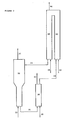
- Figures 1 and 2 represent schematic diagrams of the reaction zone and the regeneration zone of the catalyst in two different embodiments of continuous processes according to the invention.
- the feedstock of hydrocarbons to be dehydrogenated enters the dehydrogenation zone 10 through pipe 12 while the catalyst under its partially reduced form enters through pipe 14.
- the reduced catalyst is separated in the area 18 of the reactor, using e.g. a nitrogen or steam flow entering through pipe 19.
- the dehydrogenated feed is withdrawn through pipe 16, while the reduced catalyst is collected into pipe 24 and transported to the top of the regeneration reactor 20.
- Gas containing molecular oxygen is introduced into reactor 20 through pipe 22 while the pre-reducing agent is introduced through pipe 23.
- the regenerated catalyst is recovered in the outlet pipe 14 and recycled into the dehydrogenation reactor 10.
- Pipe 21 is the exit pipe for gases from reactor 20.
- Figure 2 represents another embodiment of the invention, wherein the dehydrogenation is as described for Figure 1, while the regeneration occurs in two different reactors.
- the reduced catalyst is transported through pipe 24 to the top of the oxidation reactor 20.
- Gas containing molecular oxygen is introduced into reactor 20 through pipe 23 and exits through pipe 21, while the oxidized catalyst is recovered in the outlet pipe 26 and transported to the pre-reduction reactor 30.
- the pre-reducing agent is introduced through pipe 28 into reactor 30 and exits through pipe 32.
- the pre-reduced catalyst is recovered in the outlet pipe 14 and recycled into the dehydrogenation reactor 10.
- the process of the present invention shows many advantages with respect to the usual processes and particularly it enables to avoid drastically the formation of oxygenated products, due to the fact that the presence of molecular oxygen is excluded. Moreover, hydrogen is eliminated upon its formation, which enables to displace the equilibrium of the reaction and to run at less high temperatures.
- Another non-negligible advantage of the process of the invention resides in the fact that it allows to work at a less high temperature than with the prior processes.
- the powder fraction between 0.04 and 0.15 mm was separated by sieving.
- the resulting mixture was introduced into a rotating flask kept in an oil bath and homogenised at 90 ° C during 15 minutes. The temperature of the oil bath was then raised to 120°C to dry the mixture maintained at that temperature and under slight nitrogen flushing for 18 hours.
- the powder then obtained was sieved to retain particles between 0.04 and 0.15 mm and placed in an oven.
- the oven temperature was raised at a rate of 60 °C/hour up to 600 °C and kept at that temperature for 4 hours.
- a catalyst was obtained, which was sieved to retain the particles between 0.04 and 0.15 mm. It contained 16 wt % of vanadium (expressed as V 2 0 5 ), 30 % wt % of silicon (expressed as Si0 2 ), 1.5 wt % of sodium (expressed as Na 2 0), and 0.45 wt % of calcium (expressed as CaO).
- the catalyst had the following physical properties :
- a pulse microreactor was loaded with 500 mg catalyst (as hereabove obtained), heated at 500 ° C, using helium under atmospheric pressure as carrier gas.
- the catalyst was pre-reduced by passing thereon 400 pulses of 0,5 ml carbon monoxide each (Example
- Example 2 the reduced catalyst was oxidized by passing thereon 10 pulses of 5 ml air each (the volumes being measured aut 25 ° C and under atmospheric pressure.
- Table 1 summarizes the average results obtained during the third to seventh pulses of ethylbenzene (EB), expressed as follows :
- Example 3 shows that increasing the pre-reduction with carbon monoxide has no detrimental effect on the catalyst.
- a fluidized bed reactor was used, with a setup as described by Figure 1.
- the catalyst was prepared as hereabove described and calcined at 550 ° C immediately before use.
- the experimental conditions and the results obtained are set out in Table 4.
Landscapes
- Chemical & Material Sciences (AREA)
- Organic Chemistry (AREA)
- Chemical Kinetics & Catalysis (AREA)
- Engineering & Computer Science (AREA)
- Materials Engineering (AREA)
- Organic Low-Molecular-Weight Compounds And Preparation Thereof (AREA)
- Low-Molecular Organic Synthesis Reactions Using Catalysts (AREA)
Priority Applications (4)
| Application Number | Priority Date | Filing Date | Title |
|---|---|---|---|
| EP90870199A EP0482276B1 (de) | 1990-10-22 | 1990-10-22 | Verfahren zur katalytischen Dehydrierung von alkylaromatischen Kohlenwasserstoffen |
| ES90870199T ES2081970T3 (es) | 1990-10-22 | 1990-10-22 | Proceso para la deshidrogenacion catalitica de hidrocarburos alkiloaromaticos. |
| DE69024653T DE69024653T2 (de) | 1990-10-22 | 1990-10-22 | Verfahren zur katalytischen Dehydrierung von alkylaromatischen Kohlenwasserstoffen |
| AT90870199T ATE132478T1 (de) | 1990-10-22 | 1990-10-22 | Verfahren zur katalytischen dehydrierung von alkylaromatischen kohlenwasserstoffen |
Applications Claiming Priority (1)
| Application Number | Priority Date | Filing Date | Title |
|---|---|---|---|
| EP90870199A EP0482276B1 (de) | 1990-10-22 | 1990-10-22 | Verfahren zur katalytischen Dehydrierung von alkylaromatischen Kohlenwasserstoffen |
Publications (2)
| Publication Number | Publication Date |
|---|---|
| EP0482276A1 true EP0482276A1 (de) | 1992-04-29 |
| EP0482276B1 EP0482276B1 (de) | 1996-01-03 |
Family
ID=8206089
Family Applications (1)
| Application Number | Title | Priority Date | Filing Date |
|---|---|---|---|
| EP90870199A Expired - Lifetime EP0482276B1 (de) | 1990-10-22 | 1990-10-22 | Verfahren zur katalytischen Dehydrierung von alkylaromatischen Kohlenwasserstoffen |
Country Status (4)
| Country | Link |
|---|---|
| EP (1) | EP0482276B1 (de) |
| AT (1) | ATE132478T1 (de) |
| DE (1) | DE69024653T2 (de) |
| ES (1) | ES2081970T3 (de) |
Cited By (11)
| Publication number | Priority date | Publication date | Assignee | Title |
|---|---|---|---|---|
| EP0785177A2 (de) | 1996-01-19 | 1997-07-23 | Basf Aktiengesellschaft | Verfahren zur Oxidation und Oxidehydrierung von Kohlenwasserstoffen in der Wirbelschicht |
| NL1001349C2 (nl) * | 1994-10-12 | 1997-09-12 | Basf Ag | Werkwijze voor de katalytische oxidatieve dehydrogenering van alkylaromaten en paraffinen. |
| EP0806241A1 (de) * | 1996-05-06 | 1997-11-12 | AUSIMONT S.p.A. | Verfahren zur Regenerierung eines Katalysators auf der Basis von dreiwertigen Chromverbindungen |
| US5691262A (en) * | 1994-10-18 | 1997-11-25 | Basf Aktiengesellschaft | Regeneration of catalysts used in oxidative dehydrogenation of alkylaromatics and paraffins |
| EP1057530A1 (de) * | 1999-06-03 | 2000-12-06 | Enichem S.p.A. | Katalytisches System und Verfahren zur oxidativen Dehydrierung von Alkylaromaten oder Parafinen zu den entsprechenden Alkenylaromaten oder Olefinen |
| EP1160011A1 (de) * | 2000-06-01 | 2001-12-05 | Enichem S.p.A. | Verfahren zur Herstellung von Katalysatorzusammenstezungen für die oxidative Dehydrierung von Alkylaromaten oder Paraffinen |
| JP2008266246A (ja) * | 2007-04-24 | 2008-11-06 | Mitsubishi Chemicals Corp | 芳香族炭化水素の製造方法 |
| US7964765B2 (en) | 2008-06-14 | 2011-06-21 | Lummus Technology Inc. | Styrene monomer process based on oxidative dehydrogenation of ethylbenzene using CO2 as a soft oxidant |
| US8237000B2 (en) | 2008-06-19 | 2012-08-07 | Lummus Technology, Inc. | Combined carbon dioxide and oxygen process for ethylbenzene dehydrogenation to styrene |
| WO2020046978A1 (en) * | 2018-08-31 | 2020-03-05 | Dow Global Technologies Llc | Methods for dehydrogenating hydrocarbons |
| US11794181B2 (en) | 2018-08-31 | 2023-10-24 | Dow Global Technologies Llc | Methods of producing hydrogen-selective oxygen carrier materials |
Families Citing this family (1)
| Publication number | Priority date | Publication date | Assignee | Title |
|---|---|---|---|---|
| CN102909015B (zh) * | 2011-08-01 | 2016-02-10 | 中国石油化工股份有限公司 | 以含co气体还原活化脱氢催化剂的方法 |
Citations (6)
| Publication number | Priority date | Publication date | Assignee | Title |
|---|---|---|---|---|
| FR827068A (fr) * | 1936-10-15 | 1938-04-15 | Universal Oil Prod Co | Procédé de déshydrogénation des hydrocarbures aliphatiques |
| GB840082A (en) * | 1958-01-10 | 1960-07-06 | Bataafsche Petroleum | A process for the preparation of diolefins by dehydrogenation of mono-olefins |
| US3118007A (en) * | 1956-09-24 | 1964-01-14 | Bayer Ag | Dehydrogenation of hydrocarbons |
| US4607129A (en) * | 1985-06-10 | 1986-08-19 | Phillips Petroleum Company | Catalytic dehydrocyclization and dehydrogenation of hydrocarbons |
| US4644089A (en) * | 1986-07-10 | 1987-02-17 | Phillips Petroleum Company | Catalytic reforming of hydrocarbons |
| EP0397637A1 (de) * | 1989-05-12 | 1990-11-14 | Fina Research S.A. | Verfahren zur katalytischen Dehydrierung von alkylaromatischen Kohlenwasserstoffen |
-
1990
- 1990-10-22 AT AT90870199T patent/ATE132478T1/de active
- 1990-10-22 DE DE69024653T patent/DE69024653T2/de not_active Expired - Lifetime
- 1990-10-22 ES ES90870199T patent/ES2081970T3/es not_active Expired - Lifetime
- 1990-10-22 EP EP90870199A patent/EP0482276B1/de not_active Expired - Lifetime
Patent Citations (6)
| Publication number | Priority date | Publication date | Assignee | Title |
|---|---|---|---|---|
| FR827068A (fr) * | 1936-10-15 | 1938-04-15 | Universal Oil Prod Co | Procédé de déshydrogénation des hydrocarbures aliphatiques |
| US3118007A (en) * | 1956-09-24 | 1964-01-14 | Bayer Ag | Dehydrogenation of hydrocarbons |
| GB840082A (en) * | 1958-01-10 | 1960-07-06 | Bataafsche Petroleum | A process for the preparation of diolefins by dehydrogenation of mono-olefins |
| US4607129A (en) * | 1985-06-10 | 1986-08-19 | Phillips Petroleum Company | Catalytic dehydrocyclization and dehydrogenation of hydrocarbons |
| US4644089A (en) * | 1986-07-10 | 1987-02-17 | Phillips Petroleum Company | Catalytic reforming of hydrocarbons |
| EP0397637A1 (de) * | 1989-05-12 | 1990-11-14 | Fina Research S.A. | Verfahren zur katalytischen Dehydrierung von alkylaromatischen Kohlenwasserstoffen |
Cited By (21)
| Publication number | Priority date | Publication date | Assignee | Title |
|---|---|---|---|---|
| NL1001349C2 (nl) * | 1994-10-12 | 1997-09-12 | Basf Ag | Werkwijze voor de katalytische oxidatieve dehydrogenering van alkylaromaten en paraffinen. |
| US5780700A (en) * | 1994-10-12 | 1998-07-14 | Basf Aktiengesellschaft | Catalytic oxidative dehydrogenation of alkylaromatics and paraffins |
| US5691262A (en) * | 1994-10-18 | 1997-11-25 | Basf Aktiengesellschaft | Regeneration of catalysts used in oxidative dehydrogenation of alkylaromatics and paraffins |
| EP0785177A2 (de) | 1996-01-19 | 1997-07-23 | Basf Aktiengesellschaft | Verfahren zur Oxidation und Oxidehydrierung von Kohlenwasserstoffen in der Wirbelschicht |
| US5866737A (en) * | 1996-01-19 | 1999-02-02 | Basf Aktiengesellschaft | Oxidation and oxydehydrogenation of hydrocarbons in the fluidized bed |
| EP0806241A1 (de) * | 1996-05-06 | 1997-11-12 | AUSIMONT S.p.A. | Verfahren zur Regenerierung eines Katalysators auf der Basis von dreiwertigen Chromverbindungen |
| US5817895A (en) * | 1996-05-06 | 1998-10-06 | Ausimont, S.P.A. | Process for the regeneration of a catalyst based on trivalent chromium compounds |
| AU712733B2 (en) * | 1996-05-06 | 1999-11-11 | Ausimont S.P.A. | Process for the regeneration of a catalyst based on trivalent chromium compounds |
| EP1057530A1 (de) * | 1999-06-03 | 2000-12-06 | Enichem S.p.A. | Katalytisches System und Verfahren zur oxidativen Dehydrierung von Alkylaromaten oder Parafinen zu den entsprechenden Alkenylaromaten oder Olefinen |
| US6531638B2 (en) | 2000-06-01 | 2003-03-11 | Enichem S.P.A. | Process for the preparation of catalytic systems for the oxidative dehydrogenation of alkylaromatics or paraffins |
| EP1160011A1 (de) * | 2000-06-01 | 2001-12-05 | Enichem S.p.A. | Verfahren zur Herstellung von Katalysatorzusammenstezungen für die oxidative Dehydrierung von Alkylaromaten oder Paraffinen |
| CZ301831B6 (cs) * | 2000-06-01 | 2010-07-07 | ENICHEM S. p. A. | Zpusob prípravy katalytické kompozice sestávající z oxidu vanadu, oxidu vismutu a nosice tvoreného oxidem horecnatým, katalytická kompozice pro oxidacní dehydrogenaci alkylaromatických látek a zpusob dehydrogenace alkylaromatických látek |
| JP2008266246A (ja) * | 2007-04-24 | 2008-11-06 | Mitsubishi Chemicals Corp | 芳香族炭化水素の製造方法 |
| US7964765B2 (en) | 2008-06-14 | 2011-06-21 | Lummus Technology Inc. | Styrene monomer process based on oxidative dehydrogenation of ethylbenzene using CO2 as a soft oxidant |
| US8237000B2 (en) | 2008-06-19 | 2012-08-07 | Lummus Technology, Inc. | Combined carbon dioxide and oxygen process for ethylbenzene dehydrogenation to styrene |
| US8765082B2 (en) | 2008-06-19 | 2014-07-01 | Lummus Technology Inc. | Combined carbon dioxide and oxygen process for ethylbenzene dehydrogenation to styrene |
| WO2020046978A1 (en) * | 2018-08-31 | 2020-03-05 | Dow Global Technologies Llc | Methods for dehydrogenating hydrocarbons |
| US11724974B2 (en) | 2018-08-31 | 2023-08-15 | Dow Global Technologies Llc | Methods for dehydrogenating hydrocarbons |
| US11794181B2 (en) | 2018-08-31 | 2023-10-24 | Dow Global Technologies Llc | Methods of producing hydrogen-selective oxygen carrier materials |
| US12151233B2 (en) | 2018-08-31 | 2024-11-26 | Dow Global Technologies Llc | Hydrogen-selective oxygen carrier materials and methods of use |
| US12344577B2 (en) | 2018-08-31 | 2025-07-01 | Dow Global Technologies Llc | Methods for dehydrogenating hydrocarbons |
Also Published As
| Publication number | Publication date |
|---|---|
| EP0482276B1 (de) | 1996-01-03 |
| DE69024653T2 (de) | 1996-06-05 |
| DE69024653D1 (de) | 1996-02-15 |
| ATE132478T1 (de) | 1996-01-15 |
| ES2081970T3 (es) | 1996-03-16 |
Similar Documents
| Publication | Publication Date | Title |
|---|---|---|
| CA1292248C (en) | Steam dehydrogenation and oxidative reheat process using only one catalyst system | |
| EP2408558B1 (de) | Dehydrierungsverfahren und dessen katalysator | |
| CA2554083C (en) | Process for the preparation of dehydrogenated hydrocarbon compounds | |
| EP0403462A1 (de) | Verfahren zur katalytischen Dehydrierung von Kohlenwasserstoffen | |
| US5866737A (en) | Oxidation and oxydehydrogenation of hydrocarbons in the fluidized bed | |
| US3541179A (en) | Process for manufacturing olefins by catalytic partial oxidation of hydrocarbons | |
| EP0482276B1 (de) | Verfahren zur katalytischen Dehydrierung von alkylaromatischen Kohlenwasserstoffen | |
| JP2011116789A (ja) | アルケン分離方法 | |
| ZA200403496B (en) | Catalytic composition for the dehydrogenation of alkylaromatic hydrocarbons | |
| US3810953A (en) | Dehydrogenation of organic compounds | |
| US5780700A (en) | Catalytic oxidative dehydrogenation of alkylaromatics and paraffins | |
| CA2021573C (en) | Process of oxidizing aliphatic hydrocarbons employing a molybdate catalyst composition | |
| US5691262A (en) | Regeneration of catalysts used in oxidative dehydrogenation of alkylaromatics and paraffins | |
| US4754095A (en) | Chemical conversion process | |
| US4737595A (en) | Hydrocarbon dehydrogenation | |
| US4560823A (en) | Hydrocarbon dehydrogenation | |
| US5510553A (en) | Catalytic dehydrogenation of alkylaromatic hydrocarbons | |
| EP0397637B1 (de) | Verfahren zur katalytischen Dehydrierung von alkylaromatischen Kohlenwasserstoffen | |
| CA2310203C (en) | Catalytic system and process for the oxidative dehydrogenation of alkylaromatics or paraffins to the corresponding alkenylaromatics or to the corresponding olefins | |
| US3926845A (en) | Catalysts compositions | |
| US4568789A (en) | Hydrocarbon dehydrogenation | |
| US4742180A (en) | Hydrocarbon dehydrogenation | |
| US3050572A (en) | Dehydrogenation process | |
| CA1250316A (en) | Methane conversion | |
| US5902918A (en) | Catalyst and catalytic oxidative dehydrogenation of alkylaromatics and paraffins |
Legal Events
| Date | Code | Title | Description |
|---|---|---|---|
| PUAI | Public reference made under article 153(3) epc to a published international application that has entered the european phase |
Free format text: ORIGINAL CODE: 0009012 |
|
| AK | Designated contracting states |
Kind code of ref document: A1 Designated state(s): AT BE CH DE DK ES FR GB GR IT LI LU NL SE |
|
| 17P | Request for examination filed |
Effective date: 19921028 |
|
| 17Q | First examination report despatched |
Effective date: 19940223 |
|
| GRAA | (expected) grant |
Free format text: ORIGINAL CODE: 0009210 |
|
| AK | Designated contracting states |
Kind code of ref document: B1 Designated state(s): AT BE CH DE DK ES FR GB GR IT LI LU NL SE |
|
| PG25 | Lapsed in a contracting state [announced via postgrant information from national office to epo] |
Ref country code: DK Effective date: 19960103 Ref country code: GR Free format text: LAPSE BECAUSE OF FAILURE TO SUBMIT A TRANSLATION OF THE DESCRIPTION OR TO PAY THE FEE WITHIN THE PRESCRIBED TIME-LIMIT Effective date: 19960103 Ref country code: LI Effective date: 19960103 Ref country code: CH Effective date: 19960103 Ref country code: AT Effective date: 19960103 |
|
| REF | Corresponds to: |
Ref document number: 132478 Country of ref document: AT Date of ref document: 19960115 Kind code of ref document: T |
|
| ET | Fr: translation filed | ||
| REF | Corresponds to: |
Ref document number: 69024653 Country of ref document: DE Date of ref document: 19960215 |
|
| REG | Reference to a national code |
Ref country code: ES Ref legal event code: FG2A Ref document number: 2081970 Country of ref document: ES Kind code of ref document: T3 |
|
| ITF | It: translation for a ep patent filed | ||
| PG25 | Lapsed in a contracting state [announced via postgrant information from national office to epo] |
Ref country code: SE Effective date: 19960403 |
|
| REG | Reference to a national code |
Ref country code: CH Ref legal event code: PL |
|
| PG25 | Lapsed in a contracting state [announced via postgrant information from national office to epo] |
Ref country code: LU Free format text: LAPSE BECAUSE OF NON-PAYMENT OF DUE FEES Effective date: 19961031 |
|
| PLBE | No opposition filed within time limit |
Free format text: ORIGINAL CODE: 0009261 |
|
| STAA | Information on the status of an ep patent application or granted ep patent |
Free format text: STATUS: NO OPPOSITION FILED WITHIN TIME LIMIT |
|
| 26N | No opposition filed | ||
| REG | Reference to a national code |
Ref country code: GB Ref legal event code: IF02 |
|
| NLT1 | Nl: modifications of names registered in virtue of documents presented to the patent office pursuant to art. 16 a, paragraph 1 |
Owner name: TOTAL PETROCHEMICALS RESEARCH FELUY Owner name: ATOFINA RESEARCH |
|
| PGFP | Annual fee paid to national office [announced via postgrant information from national office to epo] |
Ref country code: ES Payment date: 20091023 Year of fee payment: 20 Ref country code: DE Payment date: 20091026 Year of fee payment: 20 |
|
| PGFP | Annual fee paid to national office [announced via postgrant information from national office to epo] |
Ref country code: NL Payment date: 20091016 Year of fee payment: 20 |
|
| PGFP | Annual fee paid to national office [announced via postgrant information from national office to epo] |
Ref country code: FR Payment date: 20091110 Year of fee payment: 20 Ref country code: GB Payment date: 20091022 Year of fee payment: 20 Ref country code: IT Payment date: 20091028 Year of fee payment: 20 |
|
| PGFP | Annual fee paid to national office [announced via postgrant information from national office to epo] |
Ref country code: BE Payment date: 20091130 Year of fee payment: 20 |
|
| BE20 | Be: patent expired |
Owner name: S.A. *FINA RESEARCH Effective date: 20101022 |
|
| REG | Reference to a national code |
Ref country code: NL Ref legal event code: V4 Effective date: 20101022 |
|
| REG | Reference to a national code |
Ref country code: GB Ref legal event code: PE20 Expiry date: 20101021 |
|
| PG25 | Lapsed in a contracting state [announced via postgrant information from national office to epo] |
Ref country code: NL Free format text: LAPSE BECAUSE OF EXPIRATION OF PROTECTION Effective date: 20101022 |
|
| PG25 | Lapsed in a contracting state [announced via postgrant information from national office to epo] |
Ref country code: GB Free format text: LAPSE BECAUSE OF EXPIRATION OF PROTECTION Effective date: 20101021 |
|
| REG | Reference to a national code |
Ref country code: ES Ref legal event code: FD2A Effective date: 20110615 |
|
| PG25 | Lapsed in a contracting state [announced via postgrant information from national office to epo] |
Ref country code: ES Free format text: LAPSE BECAUSE OF EXPIRATION OF PROTECTION Effective date: 20101023 |
|
| PG25 | Lapsed in a contracting state [announced via postgrant information from national office to epo] |
Ref country code: DE Free format text: LAPSE BECAUSE OF EXPIRATION OF PROTECTION Effective date: 20101022 |