EP0482470A1 - Verwendung von Malein- und Fumarsäurehalbestern und ihren Salzen zur Verminderung der Nitrosaminbildung bei der Schwefelvulkanisation - Google Patents
Verwendung von Malein- und Fumarsäurehalbestern und ihren Salzen zur Verminderung der Nitrosaminbildung bei der Schwefelvulkanisation Download PDFInfo
- Publication number
- EP0482470A1 EP0482470A1 EP91117522A EP91117522A EP0482470A1 EP 0482470 A1 EP0482470 A1 EP 0482470A1 EP 91117522 A EP91117522 A EP 91117522A EP 91117522 A EP91117522 A EP 91117522A EP 0482470 A1 EP0482470 A1 EP 0482470A1
- Authority
- EP
- European Patent Office
- Prior art keywords
- salts
- vulcanization
- rubber
- bayer
- nitrosamines
- Prior art date
- Legal status (The legal status is an assumption and is not a legal conclusion. Google has not performed a legal analysis and makes no representation as to the accuracy of the status listed.)
- Withdrawn
Links
- VZCYOOQTPOCHFL-UHFFFAOYSA-N trans-butenedioic acid Natural products OC(=O)C=CC(O)=O VZCYOOQTPOCHFL-UHFFFAOYSA-N 0.000 title claims abstract description 16
- VZCYOOQTPOCHFL-OWOJBTEDSA-N Fumaric acid Chemical compound OC(=O)\C=C\C(O)=O VZCYOOQTPOCHFL-OWOJBTEDSA-N 0.000 title claims abstract description 14
- OFOBLEOULBTSOW-UHFFFAOYSA-N Propanedioic acid Natural products OC(=O)CC(O)=O OFOBLEOULBTSOW-UHFFFAOYSA-N 0.000 title claims abstract description 9
- VZCYOOQTPOCHFL-UPHRSURJSA-N maleic acid Chemical compound OC(=O)\C=C/C(O)=O VZCYOOQTPOCHFL-UPHRSURJSA-N 0.000 title claims abstract description 9
- 239000011976 maleic acid Substances 0.000 title claims abstract description 9
- 150000003839 salts Chemical class 0.000 title claims abstract description 8
- 239000001530 fumaric acid Substances 0.000 title claims abstract description 7
- 238000004073 vulcanization Methods 0.000 title abstract description 14
- 150000002148 esters Chemical class 0.000 title abstract description 6
- 150000004005 nitrosamines Chemical class 0.000 title abstract description 6
- 230000015572 biosynthetic process Effects 0.000 title abstract description 4
- 235000001508 sulfur Nutrition 0.000 title 1
- 229920001971 elastomer Polymers 0.000 claims abstract description 28
- 239000005060 rubber Substances 0.000 claims abstract description 27
- 150000003751 zinc Chemical class 0.000 claims abstract description 5
- -1 ethyl hexyl ester Chemical class 0.000 claims description 15
- 125000004432 carbon atom Chemical group C* 0.000 claims description 6
- 238000010059 sulfur vulcanization Methods 0.000 claims description 5
- XKLJHFLUAHKGGU-UHFFFAOYSA-N nitrous amide Chemical compound ON=N XKLJHFLUAHKGGU-UHFFFAOYSA-N 0.000 claims description 4
- VTWGIDKXXZRLGH-HJWRWDBZSA-N (z)-4-octoxy-4-oxobut-2-enoic acid Chemical group CCCCCCCCOC(=O)\C=C/C(O)=O VTWGIDKXXZRLGH-HJWRWDBZSA-N 0.000 claims 1
- GCFAUZGWPDYAJN-UHFFFAOYSA-N cyclohexyl 3-phenylprop-2-enoate Chemical compound C=1C=CC=CC=1C=CC(=O)OC1CCCCC1 GCFAUZGWPDYAJN-UHFFFAOYSA-N 0.000 claims 1
- 239000003795 chemical substances by application Substances 0.000 description 19
- NINIDFKCEFEMDL-UHFFFAOYSA-N Sulfur Chemical compound [S] NINIDFKCEFEMDL-UHFFFAOYSA-N 0.000 description 14
- 239000011593 sulfur Substances 0.000 description 12
- 229910052717 sulfur Inorganic materials 0.000 description 12
- XLOMVQKBTHCTTD-UHFFFAOYSA-N Zinc monoxide Chemical compound [Zn]=O XLOMVQKBTHCTTD-UHFFFAOYSA-N 0.000 description 10
- KUAZQDVKQLNFPE-UHFFFAOYSA-N thiram Chemical class CN(C)C(=S)SSC(=S)N(C)C KUAZQDVKQLNFPE-UHFFFAOYSA-N 0.000 description 10
- KAKZBPTYRLMSJV-UHFFFAOYSA-N vinyl-ethylene Natural products C=CC=C KAKZBPTYRLMSJV-UHFFFAOYSA-N 0.000 description 10
- 229920000459 Nitrile rubber Polymers 0.000 description 9
- 229920002943 EPDM rubber Polymers 0.000 description 8
- RRHGJUQNOFWUDK-UHFFFAOYSA-N Isoprene Chemical compound CC(=C)C=C RRHGJUQNOFWUDK-UHFFFAOYSA-N 0.000 description 7
- 150000001993 dienes Chemical class 0.000 description 7
- 239000000203 mixture Substances 0.000 description 7
- 229960002447 thiram Drugs 0.000 description 7
- PPBRXRYQALVLMV-UHFFFAOYSA-N Styrene Chemical compound C=CC1=CC=CC=C1 PPBRXRYQALVLMV-UHFFFAOYSA-N 0.000 description 6
- 150000001875 compounds Chemical class 0.000 description 6
- NLHHRLWOUZZQLW-UHFFFAOYSA-N Acrylonitrile Chemical compound C=CC#N NLHHRLWOUZZQLW-UHFFFAOYSA-N 0.000 description 5
- 229920001577 copolymer Polymers 0.000 description 5
- VQTUBCCKSQIDNK-UHFFFAOYSA-N iso-butene Natural products CC(C)=C VQTUBCCKSQIDNK-UHFFFAOYSA-N 0.000 description 5
- DEQZTKGFXNUBJL-UHFFFAOYSA-N n-(1,3-benzothiazol-2-ylsulfanyl)cyclohexanamine Chemical compound C1CCCCC1NSC1=NC2=CC=CC=C2S1 DEQZTKGFXNUBJL-UHFFFAOYSA-N 0.000 description 5
- 239000011787 zinc oxide Substances 0.000 description 5
- OKTJSMMVPCPJKN-UHFFFAOYSA-N Carbon Chemical compound [C] OKTJSMMVPCPJKN-UHFFFAOYSA-N 0.000 description 4
- 235000021355 Stearic acid Nutrition 0.000 description 4
- 229920005549 butyl rubber Polymers 0.000 description 4
- 239000006229 carbon black Substances 0.000 description 4
- YACLQRRMGMJLJV-UHFFFAOYSA-N chloroprene Chemical compound ClC(=C)C=C YACLQRRMGMJLJV-UHFFFAOYSA-N 0.000 description 4
- 238000010438 heat treatment Methods 0.000 description 4
- 239000000178 monomer Substances 0.000 description 4
- QIQXTHQIDYTFRH-UHFFFAOYSA-N octadecanoic acid Chemical compound CCCCCCCCCCCCCCCCCC(O)=O QIQXTHQIDYTFRH-UHFFFAOYSA-N 0.000 description 4
- OQCDKBAXFALNLD-UHFFFAOYSA-N octadecanoic acid Natural products CCCCCCCC(C)CCCCCCCCC(O)=O OQCDKBAXFALNLD-UHFFFAOYSA-N 0.000 description 4
- 229920001084 poly(chloroprene) Polymers 0.000 description 4
- 239000008117 stearic acid Substances 0.000 description 4
- OKKJLVBELUTLKV-UHFFFAOYSA-N Methanol Chemical compound OC OKKJLVBELUTLKV-UHFFFAOYSA-N 0.000 description 3
- 239000006057 Non-nutritive feed additive Substances 0.000 description 3
- YXFVVABEGXRONW-UHFFFAOYSA-N Toluene Chemical compound CC1=CC=CC=C1 YXFVVABEGXRONW-UHFFFAOYSA-N 0.000 description 3
- DMBHHRLKUKUOEG-UHFFFAOYSA-N diphenylamine Chemical compound C=1C=CC=CC=1NC1=CC=CC=C1 DMBHHRLKUKUOEG-UHFFFAOYSA-N 0.000 description 3
- 238000005516 engineering process Methods 0.000 description 3
- 238000005984 hydrogenation reaction Methods 0.000 description 3
- 229920002857 polybutadiene Polymers 0.000 description 3
- 229920003048 styrene butadiene rubber Polymers 0.000 description 3
- PCPYTNCQOSFKGG-ONEGZZNKSA-N (1e)-1-chlorobuta-1,3-diene Chemical compound Cl\C=C\C=C PCPYTNCQOSFKGG-ONEGZZNKSA-N 0.000 description 2
- OJOWICOBYCXEKR-KRXBUXKQSA-N (5e)-5-ethylidenebicyclo[2.2.1]hept-2-ene Chemical compound C1C2C(=C/C)/CC1C=C2 OJOWICOBYCXEKR-KRXBUXKQSA-N 0.000 description 2
- OPNUROKCUBTKLF-UHFFFAOYSA-N 1,2-bis(2-methylphenyl)guanidine Chemical compound CC1=CC=CC=C1N\C(N)=N\C1=CC=CC=C1C OPNUROKCUBTKLF-UHFFFAOYSA-N 0.000 description 2
- YXIWHUQXZSMYRE-UHFFFAOYSA-N 1,3-benzothiazole-2-thiol Chemical compound C1=CC=C2SC(S)=NC2=C1 YXIWHUQXZSMYRE-UHFFFAOYSA-N 0.000 description 2
- OWRCNXZUPFZXOS-UHFFFAOYSA-N 1,3-diphenylguanidine Chemical compound C=1C=CC=CC=1NC(=N)NC1=CC=CC=C1 OWRCNXZUPFZXOS-UHFFFAOYSA-N 0.000 description 2
- HECLRDQVFMWTQS-RGOKHQFPSA-N 1755-01-7 Chemical compound C1[C@H]2[C@@H]3CC=C[C@@H]3[C@@H]1C=C2 HECLRDQVFMWTQS-RGOKHQFPSA-N 0.000 description 2
- LIFLRQVHKGGNSG-UHFFFAOYSA-N 2,3-dichlorobuta-1,3-diene Chemical compound ClC(=C)C(Cl)=C LIFLRQVHKGGNSG-UHFFFAOYSA-N 0.000 description 2
- IJGRMHOSHXDMSA-UHFFFAOYSA-N Atomic nitrogen Chemical compound N#N IJGRMHOSHXDMSA-UHFFFAOYSA-N 0.000 description 2
- LFQSCWFLJHTTHZ-UHFFFAOYSA-N Ethanol Chemical compound CCO LFQSCWFLJHTTHZ-UHFFFAOYSA-N 0.000 description 2
- KFZMGEQAYNKOFK-UHFFFAOYSA-N Isopropanol Chemical compound CC(C)O KFZMGEQAYNKOFK-UHFFFAOYSA-N 0.000 description 2
- LRHPLDYGYMQRHN-UHFFFAOYSA-N N-Butanol Chemical compound CCCCO LRHPLDYGYMQRHN-UHFFFAOYSA-N 0.000 description 2
- PXHVJJICTQNCMI-UHFFFAOYSA-N Nickel Chemical compound [Ni] PXHVJJICTQNCMI-UHFFFAOYSA-N 0.000 description 2
- ISWSIDIOOBJBQZ-UHFFFAOYSA-N Phenol Chemical compound OC1=CC=CC=C1 ISWSIDIOOBJBQZ-UHFFFAOYSA-N 0.000 description 2
- 239000005062 Polybutadiene Substances 0.000 description 2
- VYPSYNLAJGMNEJ-UHFFFAOYSA-N Silicium dioxide Chemical compound O=[Si]=O VYPSYNLAJGMNEJ-UHFFFAOYSA-N 0.000 description 2
- DKGAVHZHDRPRBM-UHFFFAOYSA-N Tert-Butanol Chemical compound CC(C)(C)O DKGAVHZHDRPRBM-UHFFFAOYSA-N 0.000 description 2
- NIXOWILDQLNWCW-UHFFFAOYSA-N acrylic acid group Chemical group C(C=C)(=O)O NIXOWILDQLNWCW-UHFFFAOYSA-N 0.000 description 2
- 239000012190 activator Substances 0.000 description 2
- 229910052784 alkaline earth metal Inorganic materials 0.000 description 2
- XXROGKLTLUQVRX-UHFFFAOYSA-N allyl alcohol Chemical compound OCC=C XXROGKLTLUQVRX-UHFFFAOYSA-N 0.000 description 2
- NTXGQCSETZTARF-UHFFFAOYSA-N buta-1,3-diene;prop-2-enenitrile Chemical class C=CC=C.C=CC#N NTXGQCSETZTARF-UHFFFAOYSA-N 0.000 description 2
- 230000006835 compression Effects 0.000 description 2
- 238000007906 compression Methods 0.000 description 2
- MGNZXYYWBUKAII-UHFFFAOYSA-N cyclohexa-1,3-diene Chemical compound C1CC=CC=C1 MGNZXYYWBUKAII-UHFFFAOYSA-N 0.000 description 2
- ZSWFCLXCOIISFI-UHFFFAOYSA-N cyclopentadiene Chemical compound C1C=CC=C1 ZSWFCLXCOIISFI-UHFFFAOYSA-N 0.000 description 2
- 229920006168 hydrated nitrile rubber Polymers 0.000 description 2
- ZXEKIIBDNHEJCQ-UHFFFAOYSA-N isobutanol Chemical compound CC(C)CO ZXEKIIBDNHEJCQ-UHFFFAOYSA-N 0.000 description 2
- HOEFWOBLOGZQIQ-UHFFFAOYSA-N morpholin-4-yl morpholine-4-carbodithioate Chemical compound C1COCCN1C(=S)SN1CCOCC1 HOEFWOBLOGZQIQ-UHFFFAOYSA-N 0.000 description 2
- IUJLOAKJZQBENM-UHFFFAOYSA-N n-(1,3-benzothiazol-2-ylsulfanyl)-2-methylpropan-2-amine Chemical compound C1=CC=C2SC(SNC(C)(C)C)=NC2=C1 IUJLOAKJZQBENM-UHFFFAOYSA-N 0.000 description 2
- CMAUJSNXENPPOF-UHFFFAOYSA-N n-(1,3-benzothiazol-2-ylsulfanyl)-n-cyclohexylcyclohexanamine Chemical compound C1CCCCC1N(C1CCCCC1)SC1=NC2=CC=CC=C2S1 CMAUJSNXENPPOF-UHFFFAOYSA-N 0.000 description 2
- ILSQBBRAYMWZLQ-UHFFFAOYSA-N n-(1,3-benzothiazol-2-ylsulfanyl)-n-propan-2-ylpropan-2-amine Chemical compound C1=CC=C2SC(SN(C(C)C)C(C)C)=NC2=C1 ILSQBBRAYMWZLQ-UHFFFAOYSA-N 0.000 description 2
- GLDOVTGHNKAZLK-UHFFFAOYSA-N octadecan-1-ol Chemical compound CCCCCCCCCCCCCCCCCCO GLDOVTGHNKAZLK-UHFFFAOYSA-N 0.000 description 2
- 239000004014 plasticizer Substances 0.000 description 2
- 229920000642 polymer Polymers 0.000 description 2
- 239000005077 polysulfide Substances 0.000 description 2
- 229920001021 polysulfide Polymers 0.000 description 2
- 150000008117 polysulfides Polymers 0.000 description 2
- 239000000126 substance Substances 0.000 description 2
- 229920003051 synthetic elastomer Polymers 0.000 description 2
- 239000005061 synthetic rubber Substances 0.000 description 2
- 238000012360 testing method Methods 0.000 description 2
- OJOWICOBYCXEKR-APPZFPTMSA-N (1S,4R)-5-ethylidenebicyclo[2.2.1]hept-2-ene Chemical compound CC=C1C[C@@H]2C[C@@H]1C=C2 OJOWICOBYCXEKR-APPZFPTMSA-N 0.000 description 1
- RRKODOZNUZCUBN-CCAGOZQPSA-N (1z,3z)-cycloocta-1,3-diene Chemical compound C1CC\C=C/C=C\C1 RRKODOZNUZCUBN-CCAGOZQPSA-N 0.000 description 1
- PRBHEGAFLDMLAL-GQCTYLIASA-N (4e)-hexa-1,4-diene Chemical compound C\C=C\CC=C PRBHEGAFLDMLAL-GQCTYLIASA-N 0.000 description 1
- HYBLFDUGSBOMPI-BQYQJAHWSA-N (4e)-octa-1,4-diene Chemical compound CCC\C=C\CC=C HYBLFDUGSBOMPI-BQYQJAHWSA-N 0.000 description 1
- PMJHHCWVYXUKFD-SNAWJCMRSA-N (E)-1,3-pentadiene Chemical compound C\C=C\C=C PMJHHCWVYXUKFD-SNAWJCMRSA-N 0.000 description 1
- PRBHEGAFLDMLAL-UHFFFAOYSA-N 1,5-Hexadiene Natural products CC=CCC=C PRBHEGAFLDMLAL-UHFFFAOYSA-N 0.000 description 1
- SDJHPPZKZZWAKF-UHFFFAOYSA-N 2,3-dimethylbuta-1,3-diene Chemical compound CC(=C)C(C)=C SDJHPPZKZZWAKF-UHFFFAOYSA-N 0.000 description 1
- DSAYAFZWRDYBQY-UHFFFAOYSA-N 2,5-dimethylhexa-1,5-diene Chemical compound CC(=C)CCC(C)=C DSAYAFZWRDYBQY-UHFFFAOYSA-N 0.000 description 1
- SMZOUWXMTYCWNB-UHFFFAOYSA-N 2-(2-methoxy-5-methylphenyl)ethanamine Chemical compound COC1=CC=C(C)C=C1CCN SMZOUWXMTYCWNB-UHFFFAOYSA-N 0.000 description 1
- BQMRDZKGDWXTSA-UHFFFAOYSA-N 2-methylsulfanyl-1h-benzimidazole;zinc Chemical compound [Zn].C1=CC=C2NC(SC)=NC2=C1 BQMRDZKGDWXTSA-UHFFFAOYSA-N 0.000 description 1
- 125000003903 2-propenyl group Chemical group [H]C([*])([H])C([H])=C([H])[H] 0.000 description 1
- LIVZWWLQNHAXBN-UHFFFAOYSA-N 4-methyl-1,3-dihydrobenzimidazole-2-thione;zinc Chemical compound [Zn].CC1=CC=CC2=C1N=C(S)N2 LIVZWWLQNHAXBN-UHFFFAOYSA-N 0.000 description 1
- NWPQAENAYWENSD-UHFFFAOYSA-N 5-butylidenebicyclo[2.2.1]hept-2-ene Chemical compound C1C2C(=CCCC)CC1C=C2 NWPQAENAYWENSD-UHFFFAOYSA-N 0.000 description 1
- DMGCMUYMJFRQSK-UHFFFAOYSA-N 5-prop-1-en-2-ylbicyclo[2.2.1]hept-2-ene Chemical compound C1C2C(C(=C)C)CC1C=C2 DMGCMUYMJFRQSK-UHFFFAOYSA-N 0.000 description 1
- PNCMVPIPNMSOIO-UHFFFAOYSA-M C(CCCCCCC)OC(C=C/C(=O)[O-])=O.[Zn+] Chemical compound C(CCCCCCC)OC(C=C/C(=O)[O-])=O.[Zn+] PNCMVPIPNMSOIO-UHFFFAOYSA-M 0.000 description 1
- BWGNESOTFCXPMA-UHFFFAOYSA-N Dihydrogen disulfide Chemical compound SS BWGNESOTFCXPMA-UHFFFAOYSA-N 0.000 description 1
- 239000004908 Emulsion polymer Substances 0.000 description 1
- VGGSQFUCUMXWEO-UHFFFAOYSA-N Ethene Chemical compound C=C VGGSQFUCUMXWEO-UHFFFAOYSA-N 0.000 description 1
- 239000005977 Ethylene Substances 0.000 description 1
- 244000043261 Hevea brasiliensis Species 0.000 description 1
- 241001441571 Hiodontidae Species 0.000 description 1
- DGAQECJNVWCQMB-PUAWFVPOSA-M Ilexoside XXIX Chemical compound C[C@@H]1CC[C@@]2(CC[C@@]3(C(=CC[C@H]4[C@]3(CC[C@@H]5[C@@]4(CC[C@@H](C5(C)C)OS(=O)(=O)[O-])C)C)[C@@H]2[C@]1(C)O)C)C(=O)O[C@H]6[C@@H]([C@H]([C@@H]([C@H](O6)CO)O)O)O.[Na+] DGAQECJNVWCQMB-PUAWFVPOSA-M 0.000 description 1
- WHXSMMKQMYFTQS-UHFFFAOYSA-N Lithium Chemical compound [Li] WHXSMMKQMYFTQS-UHFFFAOYSA-N 0.000 description 1
- CERQOIWHTDAKMF-UHFFFAOYSA-N Methacrylic acid Chemical compound CC(=C)C(O)=O CERQOIWHTDAKMF-UHFFFAOYSA-N 0.000 description 1
- GYCMBHHDWRMZGG-UHFFFAOYSA-N Methylacrylonitrile Chemical compound CC(=C)C#N GYCMBHHDWRMZGG-UHFFFAOYSA-N 0.000 description 1
- 229920013648 Perbunan Polymers 0.000 description 1
- 229920006170 Therban® Polymers 0.000 description 1
- FZWLAAWBMGSTSO-UHFFFAOYSA-N Thiazole Chemical compound C1=CSC=N1 FZWLAAWBMGSTSO-UHFFFAOYSA-N 0.000 description 1
- RYYWUUFWQRZTIU-UHFFFAOYSA-N Thiophosphoric acid Chemical class OP(O)(S)=O RYYWUUFWQRZTIU-UHFFFAOYSA-N 0.000 description 1
- RTAQQCXQSZGOHL-UHFFFAOYSA-N Titanium Chemical compound [Ti] RTAQQCXQSZGOHL-UHFFFAOYSA-N 0.000 description 1
- 229910052770 Uranium Inorganic materials 0.000 description 1
- HCHKCACWOHOZIP-UHFFFAOYSA-N Zinc Chemical compound [Zn] HCHKCACWOHOZIP-UHFFFAOYSA-N 0.000 description 1
- 239000000654 additive Substances 0.000 description 1
- 230000032683 aging Effects 0.000 description 1
- 150000001298 alcohols Chemical class 0.000 description 1
- 125000001931 aliphatic group Chemical group 0.000 description 1
- 239000003513 alkali Substances 0.000 description 1
- 150000001342 alkaline earth metals Chemical class 0.000 description 1
- 125000001118 alkylidene group Chemical group 0.000 description 1
- 230000003712 anti-aging effect Effects 0.000 description 1
- 125000003118 aryl group Chemical group 0.000 description 1
- AXCZMVOFGPJBDE-UHFFFAOYSA-L calcium dihydroxide Chemical compound [OH-].[OH-].[Ca+2] AXCZMVOFGPJBDE-UHFFFAOYSA-L 0.000 description 1
- 239000000920 calcium hydroxide Substances 0.000 description 1
- 229910001861 calcium hydroxide Inorganic materials 0.000 description 1
- 230000000711 cancerogenic effect Effects 0.000 description 1
- 239000003054 catalyst Substances 0.000 description 1
- 125000002091 cationic group Chemical group 0.000 description 1
- 150000001768 cations Chemical class 0.000 description 1
- 238000006243 chemical reaction Methods 0.000 description 1
- 125000001309 chloro group Chemical group Cl* 0.000 description 1
- 229910017052 cobalt Inorganic materials 0.000 description 1
- 239000010941 cobalt Substances 0.000 description 1
- GUTLYIVDDKVIGB-UHFFFAOYSA-N cobalt atom Chemical compound [Co] GUTLYIVDDKVIGB-UHFFFAOYSA-N 0.000 description 1
- HPXRVTGHNJAIIH-UHFFFAOYSA-N cyclohexanol Chemical compound OC1CCCCC1 HPXRVTGHNJAIIH-UHFFFAOYSA-N 0.000 description 1
- AFZSMODLJJCVPP-UHFFFAOYSA-N dibenzothiazol-2-yl disulfide Chemical compound C1=CC=C2SC(SSC=3SC4=CC=CC=C4N=3)=NC2=C1 AFZSMODLJJCVPP-UHFFFAOYSA-N 0.000 description 1
- 235000014113 dietary fatty acids Nutrition 0.000 description 1
- CJSBUWDGPXGFGA-UHFFFAOYSA-N dimethyl-butadiene Natural products CC(C)=CC=C CJSBUWDGPXGFGA-UHFFFAOYSA-N 0.000 description 1
- 150000002019 disulfides Chemical class 0.000 description 1
- 239000012990 dithiocarbamate Substances 0.000 description 1
- 150000004659 dithiocarbamates Chemical class 0.000 description 1
- 239000000806 elastomer Substances 0.000 description 1
- RTZKZFJDLAIYFH-UHFFFAOYSA-N ether Substances CCOCC RTZKZFJDLAIYFH-UHFFFAOYSA-N 0.000 description 1
- 239000000194 fatty acid Substances 0.000 description 1
- 229930195729 fatty acid Natural products 0.000 description 1
- 150000004665 fatty acids Chemical class 0.000 description 1
- 239000000945 filler Substances 0.000 description 1
- 238000010528 free radical solution polymerization reaction Methods 0.000 description 1
- 230000009477 glass transition Effects 0.000 description 1
- 125000005843 halogen group Chemical group 0.000 description 1
- PYGSKMBEVAICCR-UHFFFAOYSA-N hexa-1,5-diene Chemical compound C=CCCC=C PYGSKMBEVAICCR-UHFFFAOYSA-N 0.000 description 1
- ZSIAUFGUXNUGDI-UHFFFAOYSA-N hexan-1-ol Chemical class CCCCCCO ZSIAUFGUXNUGDI-UHFFFAOYSA-N 0.000 description 1
- 238000012487 in-house method Methods 0.000 description 1
- 229910052744 lithium Inorganic materials 0.000 description 1
- 239000000395 magnesium oxide Substances 0.000 description 1
- CPLXHLVBOLITMK-UHFFFAOYSA-N magnesium oxide Inorganic materials [Mg]=O CPLXHLVBOLITMK-UHFFFAOYSA-N 0.000 description 1
- AXZKOIWUVFPNLO-UHFFFAOYSA-N magnesium;oxygen(2-) Chemical compound [O-2].[Mg+2] AXZKOIWUVFPNLO-UHFFFAOYSA-N 0.000 description 1
- 238000005259 measurement Methods 0.000 description 1
- 229910044991 metal oxide Inorganic materials 0.000 description 1
- 150000004706 metal oxides Chemical class 0.000 description 1
- 238000000034 method Methods 0.000 description 1
- GOQYKNQRPGWPLP-UHFFFAOYSA-N n-heptadecyl alcohol Natural products CCCCCCCCCCCCCCCCCO GOQYKNQRPGWPLP-UHFFFAOYSA-N 0.000 description 1
- CAXJFBOSFXRPOJ-UHFFFAOYSA-N n-phenyl-n-(trichloromethylsulfanyl)benzenesulfonamide Chemical compound C=1C=CC=CC=1S(=O)(=O)N(SC(Cl)(Cl)Cl)C1=CC=CC=C1 CAXJFBOSFXRPOJ-UHFFFAOYSA-N 0.000 description 1
- 229920003052 natural elastomer Polymers 0.000 description 1
- 229920001194 natural rubber Polymers 0.000 description 1
- 229910052759 nickel Inorganic materials 0.000 description 1
- 125000002560 nitrile group Chemical group 0.000 description 1
- 229910052757 nitrogen Inorganic materials 0.000 description 1
- 125000002347 octyl group Chemical group [H]C([*])([H])C([H])([H])C([H])([H])C([H])([H])C([H])([H])C([H])([H])C([H])([H])C([H])([H])[H] 0.000 description 1
- QYZLKGVUSQXAMU-UHFFFAOYSA-N penta-1,4-diene Chemical compound C=CCC=C QYZLKGVUSQXAMU-UHFFFAOYSA-N 0.000 description 1
- WVDDGKGOMKODPV-ZQBYOMGUSA-N phenyl(114C)methanol Chemical compound O[14CH2]C1=CC=CC=C1 WVDDGKGOMKODPV-ZQBYOMGUSA-N 0.000 description 1
- PMJHHCWVYXUKFD-UHFFFAOYSA-N piperylene Natural products CC=CC=C PMJHHCWVYXUKFD-UHFFFAOYSA-N 0.000 description 1
- 229920001195 polyisoprene Polymers 0.000 description 1
- 238000006116 polymerization reaction Methods 0.000 description 1
- QQONPFPTGQHPMA-UHFFFAOYSA-N propylene Natural products CC=C QQONPFPTGQHPMA-UHFFFAOYSA-N 0.000 description 1
- 150000003254 radicals Chemical class 0.000 description 1
- 230000035484 reaction time Effects 0.000 description 1
- 239000000377 silicon dioxide Substances 0.000 description 1
- 239000011734 sodium Substances 0.000 description 1
- 229910052708 sodium Inorganic materials 0.000 description 1
- 230000035882 stress Effects 0.000 description 1
- 229920001897 terpolymer Polymers 0.000 description 1
- 238000010998 test method Methods 0.000 description 1
- 239000010936 titanium Substances 0.000 description 1
- 229910052719 titanium Inorganic materials 0.000 description 1
- 229960001295 tocopherol Drugs 0.000 description 1
- 239000011732 tocopherol Substances 0.000 description 1
- DNYWZCXLKNTFFI-UHFFFAOYSA-N uranium Chemical compound [U][U][U][U][U][U][U][U][U][U][U][U][U][U][U][U][U][U][U][U][U][U][U][U][U][U][U][U][U][U][U][U][U][U][U][U][U][U][U][U][U][U][U][U][U][U][U][U][U][U][U][U][U][U][U][U][U][U][U][U][U][U][U][U][U][U][U][U][U][U][U][U][U][U][U][U][U][U][U][U][U][U][U][U][U][U][U][U][U][U][U][U][U][U][U][U][U][U][U][U][U][U][U][U][U][U][U][U][U][U][U][U][U][U] DNYWZCXLKNTFFI-UHFFFAOYSA-N 0.000 description 1
- 239000011701 zinc Substances 0.000 description 1
- 229910052725 zinc Inorganic materials 0.000 description 1
- DTVJYIOJDUCXBA-KVVVOXFISA-L zinc;(z)-2-octylbut-2-enedioate Chemical compound [Zn+2].CCCCCCCC\C(C([O-])=O)=C\C([O-])=O DTVJYIOJDUCXBA-KVVVOXFISA-L 0.000 description 1
- GVJHHUAWPYXKBD-IEOSBIPESA-N α-tocopherol Chemical compound OC1=C(C)C(C)=C2O[C@@](CCC[C@H](C)CCC[C@H](C)CCCC(C)C)(C)CCC2=C1C GVJHHUAWPYXKBD-IEOSBIPESA-N 0.000 description 1
Classifications
-
- C—CHEMISTRY; METALLURGY
- C08—ORGANIC MACROMOLECULAR COMPOUNDS; THEIR PREPARATION OR CHEMICAL WORKING-UP; COMPOSITIONS BASED THEREON
- C08K—Use of inorganic or non-macromolecular organic substances as compounding ingredients
- C08K5/00—Use of organic ingredients
- C08K5/04—Oxygen-containing compounds
- C08K5/09—Carboxylic acids; Metal salts thereof; Anhydrides thereof
- C08K5/098—Metal salts of carboxylic acids
-
- C—CHEMISTRY; METALLURGY
- C08—ORGANIC MACROMOLECULAR COMPOUNDS; THEIR PREPARATION OR CHEMICAL WORKING-UP; COMPOSITIONS BASED THEREON
- C08K—Use of inorganic or non-macromolecular organic substances as compounding ingredients
- C08K5/00—Use of organic ingredients
- C08K5/04—Oxygen-containing compounds
- C08K5/10—Esters; Ether-esters
- C08K5/11—Esters; Ether-esters of acyclic polycarboxylic acids
Definitions
- the invention relates to the use of maleic and fumaric acid half-esters and their salts, in particular their zinc salts, for reducing the nitrosamine content of rubber vulcanizates produced by sulfur vulcanization.
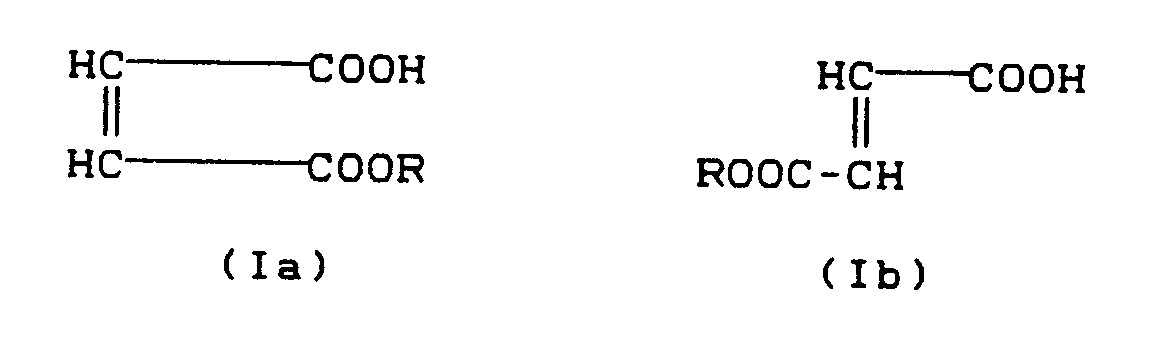
- the invention thus relates to the use of maleic acid half-esters and fumaric acid half-esters of the formula and their salts, wherein
- R is an organic radical having 1 to 18, preferably 4 to 18, carbon atoms, for reducing the nitrosamine content of rubber vulcanizates produced by sulfur vulcanization.
- Preferred maleic acid half esters and fumaric acid half esters include half esters of C1-C 22 , preferably C 4 -C 18 alcohols.
- Preferred alcohol components include methanol, isopropanol, n-, iso- and tert-butanol, hexanols, octanols, Stearyl alcohol, allyl alcohol, cyclohexanol, benzyl alcohol, phenol, maleic acid mono-n-butyl, octyl, ethylhexyl and allyl esters are particularly preferred.
- the cations of the half-ester salts to be used according to the invention are preferably derived from alkali and alkaline earth metals and from zinc, the zinc salts being particularly preferred because they also have a positive influence on the Mooney viscosity, the compression set, the stability against hot air aging and can exert the strength of the vulcanizates.
- the maleic and fumaric acid half-esters (salts) to be used according to the invention can be used in amounts of 0.1 to 8, preferably 1 to 6, in particular 1.5 to 4,% by weight, based on rubber.
- rubbers suitable for the use according to the invention also include synthetic rubbers.
- Preferred synthetic rubbers are described, for example, by W. Hofmann, Kautschuk-Technologie, Gentner Verlag, Stuttgart 1980. They include
- SBR - styrene / butadiene copolymers with styrene contents from 1 to 60, preferably from 20 to 50% by weight
- NBR - butadiene / acrylonitrile copolymers with acrylonitrile contents of 5 to 60, preferably 10 to 50% by weight, and in particular
- the rubbers generally have Mooney viscosities (according to DIN 53 523) from 5 to 140, preferably from 10 to 120, in particular 20 to 80 (ML 1 + 4) 100 ° C. and glass transition temperatures below 20 ° C., preferably below 0 ° C. determined in the torsional vibration test according to DIN 53 445.
- suitable diene monomers in EPDM are: conjugated dienes, e.g. Isoprene and butadiene-1,3, and non-conjugated dienes with 5 to 25 carbon atoms, e.g. 1,4-pentadiene, 1,4-hexadiene, 1,5-hexadiene, 2,5-dimethyl-1,5-hexadiene and 1,4-octadiene; cyclic dienes, e.g.
- the non-conjugated dienes are preferably hexadiene-1,5, ethylidene-norbornene and dicyclopentadiene.
- the diene content in the EPDM is preferably 0.5 to 10% by weight, based on EPDM.
- EPDM rubbers are e.g. described in DE-OS 2 808 709.
- butyl rubber in the context of the invention encompasses isobutene copolymers of 95 to 99.5, preferably 97.5 to 99.5,% by weight of isobutene and 0.5 to 5, preferably 0.5 to 2.5, % By weight of copolymerizable diene, such as Butadiene, dimethylbutadiene, 1,3-pentadiene, especially isoprene.
- Butyl rubber is produced on an industrial scale almost exclusively as an isobutene / isoprene copolymer by cationic solution polymerization at low temperature; see. e.g. Kirk-Othmer, Encyclopedia of Chemical Technology, 2nd ed., Vol. 7, p.
- the polybutadienes comprise polybutadiene rubbers with a cis-1,4-structure content of 20 to 100%, preferably 30 to 100%, e.g. can be obtained by butadiene polymerization with the aid of catalysts based on lithium, nickel, titanium, cobalt, rare earths, uranium.
- Polychloroprenes are chloroprene polymers which, in addition to polymerized 2-chloroprene units, may contain up to 30, preferably up to 20% by weight, based on chloroprene polymer, of copolymerized units of other ethylenically unsaturated monomers, that is to say polychloroprene, as described, for example, in "Methods of Organic Chemistry” (Houben- Weyl), Vol. E20 / 2, 842-859, Georg Thieme Verlag, Stuttgart - New York 1987.
- preferred “other monomers” are styrene, 2,3-dichlorobutadiene, 1-chlorobutadiene, butadiene, isoprene, acrylic acid, methacrylic acid, acrylonitrile and methacrylonitrile.
- the most important comonomers are 2,3-dichlorobutadiene and 1-chlorobutadiene.
- Preferred styrene / butadiene copolymers are those with copolymerized styrene contents of 18 to 60, preferably 20 to 50,% by weight.
- Solution and emulsion polymers are particularly preferred.
- Nitrile rubbers and hydrogenated nitrile rubbers are nitrile rubbers, e.g. in Ullmann's Encyclopedia of Technical Chemistry, Volume 13, Verlag Chemie, Weinheim-New York 1977, pp. 611-614, and fully and partially hydrogenated nitrile rubbers, such as those e.g. in Angewandte Makromolekulare Chemie 145/146 (1986) 161-179.
- nitrile rubber stands for butadiene / acrylonitrile copolymers with a copolymerized acrylonitrile content of 5 to 60, preferably 10 to 50,% by weight.
- the hydrogenation of nitrile rubber is known; US-PS 3 700 637, DE-OS 25 39 132, 30 46 008, 30 46 251, 32 27 650, 33 29 974, EP-A 111 412, FR-PS 2 540 503.
- Suitable sulfur donors include thiuram polysulfides such as e.g. Dipentamethylene thiuram tetra and hexasulfide, tetramethyl thiuram disulfide; Amine disulfides such as e.g. Dimorpholyl disulfide; Sodium polysulfides and thioplasts.
- the amount a) used is generally from 0.2 to 3.0% by weight of sulfur (in the case of sulfur donors: calculated as the sulfur released), based on rubber.
- Sulfur-modified polychloroprene can also act as a sulfur donor.
- vulcanization accelerators b) include diphenylguanidine (DPG) and di-o-tolylguanidine (DOTG); Thiurams such as thiuram mono- and disulfides; and dithiocarbamates, as well as thiophosphates and their derivatives and salts, e.g. their zinc salts.
- DPG diphenylguanidine
- DDG di-o-tolylguanidine
- Thiurams such as thiuram mono- and disulfides
- dithiocarbamates as well as thiophosphates and their derivatives and salts, e.g. their zinc salts.
- the most important activators c) are the metal oxides, especially zinc oxide. Magnesium oxide or calcium hydroxide is also used in individual cases.
- the vulcanization can be filled with fillers such as Add carbon black, plasticizers, anti-aging agents and / or processing aids in the usual amounts.
- processing aids are fatty acids, such as Stearic acid, in question.
- the components can be mixed on conventional mixing units.
- Preferred mixing units are the kneaders, rollers, internal mixers and mixing extruders customary in the rubber industry, which generally operate with shear rates of 1 to 1000 sec -1 , preferably 1 to 200 sec -1 .
- the vulcanization can take place at temperatures from 100 to 200 ° C., preferably 130 to 180 ° C., optionally under a pressure of 10 to 200 bar. After vulcanization, the vulcanizates can be tempered by storage at a higher temperature.
- Vulcanized in the sense of the invention means that when extracted for 10 hours in a Soxhlet attachment with toluene as the extracting agent, less than 10, preferably less than 5% by weight, based on rubber, can be extracted.
- nitrosamine content was determined according to Franck, Kunststoffe-33 Lfg. August 1984, p. 37 f.
- the rubber used was a hydrogenated acrylonitrile / butadiene copolymer with an acrylonitrile content of 33.7% by weight, a degree of hydrogenation of 96.4%, based on the CC double bonds originally present, and a Mooney viscosity of 67 (ML 1 +4 ) 100 ° C (®Therban 1707 S from Bayer AG).
- the rubber was masticated in a laboratory kneader at 50 ° C. for 0.5 minutes, and then sulfur, stearic acid, zinc oxide (®Zinc oxide active from Bayer AG), styrenated diphenylamine (@Vulkanox DDA from Bayer AG), zinc-methylmercaptobenzimidazole (@ Vulkanox ZMB2 from Bayer AG), carbon black (Corax N550 from Degussa / Wesseling) and zinc ethylhexyl maleate (for amounts see Table 1) were added and kneaded until homogenized (4.5 minutes).
- an accelerator system consisting of tetramethylthiuram disulfide (®Vulkacit Thiuram C from Bayer AG) and benzothiazyl-2-cyclohexylsulfenamide (®Vulkacit CZ / MG from Bayer AG) was added.
- the rubber was masticated in a laboratory kneader at 50 ° C. for 0.5 minutes, and then 50% by weight sulfur paste (®Struktol SU 105 from Schill & Seilacher / Hamburg), carbon black (®Corax N 326 or ® Durex O from Degussa / Wesseling), styrenated diphenylamine (@Vulkanox DPA from Bayer AG), polymeric 2.2.4-trimethyl-1,2-dihydroquinoline (@Vulkanox HS from Bayer AG), plasticizers (ether thioether; ®Vulkanol OT from Bayer AG ), Processing aids based on highly active silica (®Aflux S from Rheinchemie Rheinau GmbH, Mannheim), zinc oxide (Zink contend RS from Zink availability-Forschungsgesellschaft, Oberhausen), stearic acid and zinc n-octylmaleinate were added and kneaded until homogenized (4.5 minutes).
- sulfur paste ®Strukto
- an accelerator system consisting of tetramethylthiuram disulfide (®Vulkacit Thiuram C from Bayer AG) and benzothiazyl-2-cyclohexyl-sulfenamide (®Vulkacit CZ / MG from Bayer AG) and optionally N- Trichloromethylsulfenylbenzenesulfanilid (®Vulkalent E from Bayer AG) admixed.
- compositions and properties of the vulcanizates can be found in Tables 5 and 6 below.
Landscapes
- Chemical & Material Sciences (AREA)
- Health & Medical Sciences (AREA)
- Chemical Kinetics & Catalysis (AREA)
- Medicinal Chemistry (AREA)
- Polymers & Plastics (AREA)
- Organic Chemistry (AREA)
- Compositions Of Macromolecular Compounds (AREA)
- Processes Of Treating Macromolecular Substances (AREA)
Abstract
Malein- und Fumarsäurehalbester und ihre Salze, insbesondere ihre Zinksalze können die Nitrosaminbildung bei der Schwefelvulkanisation von Kautschuken vermindern.
Description
- Die Erfindung betrifft die Verwendung von Malein- und Fumarsäurehalbestern und ihren Salzen, insbesondere ihren Zinksalzen, zur Verminderung des Nitrosamingehalts durch Schwefelvulkanisation hergestellter Kautschukvulkanisate.
- Beim Mischen von Kautschuken mit Vulkanisiersystemen, die Verbindungen mit chemisch gebundenem Stickstoff enthalten (wie z.B. Schwefelspender bzw. Beschleuniger aus der Reihe der Thiuramverbindungen oder Vulkanisationsbeschleuniger aus der Reihe der Thiazolverbindungen), und in noch höherem Maße bei der Vulkanisation dieser Kautschukmassen besteht das Risiko der unerwünschten Bildung von Nitrosaminen. Wegen der cancerogenen Wirkung der Nitrosamine möchte man gerne Nitrosamin-arme bzw. Nitrosamin-freie Kautschukmassen und -vulkanisate herstellen können.
- Während man z.B. Schwefelspender oft problemlos durch elementaren Schwefel ersetzen kann, hat man bis heute keine Stickstoff-freien Vulkanisationsbeschleuniger gefunden, die so wirksam wie die bisher eingesetzten Substanzen sind.
- Solange solche an sich erwünschten hochwirksamen N-freien Vulkanisationsbeschleuniger nicht zur Verfügung stehen, sind auch Zusätze interessant, die entweder die Nitrosaminbildung unterdrücken oder entstehende Nitrosamine durch eine chemische Reaktion abfangen. Als eine solche Verbindung ist a-Tocopherol beschrieben worden (Kautschuk + Gummi-Kunststoffe 43 (1990), 95-106). Der hohe Preis von a-Tocopherol dürfte seinem Einsatz in großtechnischem Maßstab in der Kautschukindustrie allerdings entgegenstehen.
- Überraschenderweise wurde nun gefunden, daß sich Maleinsäurehalbester und ihre Salze zu diesem Zweck hervorragend eignen.
- Gegenstand der Erfindung ist also die Verwendung von Maleinsäurehalbestern und Fumarsäurehalbestern der Formel

und ihrer Salze,
worin - R einen organischen Rest mit 1 bis 18, vorzugsweise 4 bis 18, C-Atomen bedeutet, zur Verminderung des Nitrosamingehalts durch Schwefelvulkanisation hergestellter Kautschukvulkanisate.
- Bevorzugte Maleinsäurehalbester und Fumarsäurehalbester umfassen Halbester von C1- C22-, vorzugsweise C4-C18 -Alkoholen. Die Alkoholkomponenten der Halbester können aliphatisch, cycloaliphatisch, araliphatisch und aromatisch sein; sie können (cyclo)olefinische C = C-Doppelbindungen ebenso wie Halogensubstituenten, z.B. Chlorsubstituenten, enthalten, und sie können linear oder verzweigt sein, Bevorzugte Alkoholkomponenten umfassen Methanol, Isopropanol, n-, iso- und tert.-Butanol, Hexanole, Octanole, Stearylalkohol, Allylalkohol, Cyclohexanol, Benzylalkohol, Phenol, Maleinsäuremono-n-butyl-, -octyl-, - ethylhexyl- und -allylester sind besonders bevorzugt.
- Die Kationen der erfindungsgemäß zu verwendenden Halbester-Salze leiten sich vorzugsweise von Alkali- und Erdalkalimetallen und von Zink ab, wobei die Zinksalze besonders zu bevorzugen sind, weil sie auch einen positiven Einfluß auf die Mooney-Viskosität, den Druckverformungsrest, die Stabilität gegen Heißluftalterung und die Festigkeit der Vulkanisate ausüben können.
- Die erfindungsgemäß zu verwendenden Malein- und Fumarsäurehalbester(salze) können in Mengen von 0,1 bis 8, vorzugsweise 1 bis 6, insbesondere 1,5 bis 4, Gew.-%, bezogen auf Kautschuk, eingesetzt werden.
- Für die erfindungsgemäße Verwendung geeignete Kautschuke umfassen neben Naturkautschuk auch Synthesekautschuke. Bevorzugte Synthesekautschuke sind beispielsweise bei W. Hofmann, Kautschuk-Technologie, Gentner Verlag, Stuttgart 1980, beschrieben. Sie umfassen u.a.
- EPDM - Ethylen/Propylen/Dien-Terpolymerisate
- IIR - Butylkautschuk
- BR - Polybutadien
- ABR - Butadien/Acrylsäure-C1-C4-alkylester-Copolymerisate mit Acrylester-Gehalten von 5 bis 60, vorzugsweise von 15 bis 50 Gew.-%
- CR - Polychloropren
- IR - Polyisopren
- SBR - Styrol/Butadien-Copolymerisate mit Styrolgehalten von 1 bis 60, vorzugsweise von 20 bis 50 Gew.-%
- NBR - Butadien/Acrylnitril-Copolymerisate mit Acrylnitrilgehalten von 5 bis 60, vorzugsweise 10 bis 50 Gew.-%, und insbesondere
- HNBR - Hydrierungsprodukte von NBR.
- Die Kautschuke besitzen im allgemeinen Mooney-Viskositäten (nach DIN 53 523) von 5 bis 140, vorzugsweise von 10 bis 120, insbesondere 20 bis 80 (ML 1 + 4) 100°C und Glasübergangstemperaturen unter 20 C, vorzugsweise unter 0°C, bestimmt im Torsionsschwingungsversuch nach DIN 53 445.
- EPDMs umfassen Kautschuke, in denen das Gewichtsverhältnis von Ethylen- zu Propylenresten im Bereich von 40:60 bis 65:35 liegt und die 1 bis 20 C=C-Doppelbindungen/1.000 C-Atome aufweisen können. Als geeignete Dien-Monomere im EPDM seien beispielsweise genannt: konjugierte Diene, z.B. Isopren und Butadien-1,3, und nicht-konjugierte Diene mit 5 bis 25 C-Atomen, z.B. 1,4-Pentadien, 1,4-Hexadien, 1,5-Hexadien, 2,5-Dimethyl-1,5-hexadien und 1,4-Octadien; cyclische Diene, z.B. Cyclopentadien, Cyclohexadien, Cyclooctadien und Dicyclopentadien; Alkyliden- und Alkenylnorbornene, z.B. 5-Ethyliden-2-norbornen, 5-Butyliden-2-norbornen, 2-Methallyl-5-norbornen, 2-Isopropenyl-5-norbornen und Tricyclo-diene.
- Bevorzugt sind die nicht-konjugierten Diene Hexadien-1,5, Ethyliden-norbornen und Dicyclopentadien. Der Diengehalt im EPDM beträgt vorzugsweise 0,5 bis 10 Gew.-%, bezogen auf EPDM.
- Derartige EPDM-Kautschuke sind z.B. in der DE-OS 2 808 709 beschrieben.
- Der Begriff "Butylkautschuk" im Sinne der Erfindung umfaßt Isobuten-Copolymerisate aus 95 bis 99,5, vorzugsweise 97,5 bis 99,5, Gew.-% Isobuten und 0,5 bis 5, vorzugsweise 0,5 bis 2,5, Gew.-% copolymerisierbarem Dien, wie z.B. Butadien, Dimethylbutadien, Pentadien-1,3, insbesondere Isopren. Butylkautschuk wird in großtechnischem Maßstab fast ausschließlich als Isobuten/Isopren-Copolymerisat durch kationische Lösungspolymerisation bei niedriger Temperatur hergestellt; vgl. z.B. Kirk-Othmer, Encyclopedia of Chemical Technology, 2nd ed., Bd. 7, S. 688, Interscience Publ., New York-London-Sydney 1965 und Winnacker-Küchler, Chemische Technologie, 4. Aufl., Bd. 6, S. 550-555, Carl Hanser Verlag, München-Wien 1962.
- Die Polybutadiene umfassen Polybutadienkautschuke mit cis-1,4-Struktur-Gehalten von 20 bis 100%, vorzugsweise von 30 bis 100%, wie sie z.B. durch Butadienpolymerisation mit Hilfe von Katalysatoren auf Basis von Lithium, Nickel, Titan, Cobalt, Seltenen Erden, Uran erhalten werden können.
- Polychloroprene sind Chloroprenpolymerisate, die neben polymerisierten 2-Chloropreneinheiten bis 30, vorzugsweise bis 20 Gew.-%, bezogen auf Chloroprenpolymerisat, copolymerisierte Einheiten anderer ethylenisch ungesättigter Monomerer enthalten können, also Polychloroprene, wie sie beispielsweise in "Methoden der Organischen Chemie" (Houben-Weyl), Bd. E20/2, 842-859, Georg Thieme Verlag, Stuttgart - New York 1987, beschrieben sind.
- Bevorzugte, mit Chloropren copolymerisierbare, ethylenisch ungesättigte "andere Monomere" umfassen Verbindungen mit 3 bis 12 C-Atomen und 1 oder 2 copolymerisierbaren C = C-Doppelbindungen pro Molekül. Beispiele bevorzugter "anderer Monomerer" sind Styrol, 2,3-Dichlorbutadien, 1-Chlorbutadien, Butadien, Isopren, Acrylsäure, Methacrylsäure, Acrylnitril und Methacrylnitril. Wichtigste Comonomere sind 2,3-Dichlorbutadien und 1-Chlorbutadien.
- Bevorzugte Styrol/Butadien-Copolymerisate sind solche mit Gehalten an einpolymerisiertem Styrol von 18 bis 60, vorzugsweise 20 bis 50, Gew.-%. Lösungs- und Emulsionspolymerisate sind besonders bevorzugt.
- Nitrilkautschuke und hydrierte Nitrilkautschuke sind Nitrilkautschuke, wie sie z.B. in Ullmanns Encyclopädie der technischen Chemie, Band 13, Verlag Chemie, Weinheim-New York 1977, S. 611-614, und voll-und teilhydrierte Nitrilkautschuke, wie sie z.B. in Die Angewandte Makromolekulare Chemie 145/146 (1986) 161-179 beschrieben sind.
- Der Ausdruck "Nitrilkautschuk" steht für Butadien/Acrylnitril-Copolymerisate mit einem Gehalt an copolymerisiertem Acrylnitril von 5 bis 60, vorzugsweise 10 bis 50 Gew.-%. "Hydriert" bedeutet in diesem Zusammenhang, daß 90 bis 98,5, vorzugsweise 94 bis 98 % der hydrierbaren C = C-Doppelbindungen hydriert sind, während die C=-N-Dreifachbindungen der Nitrilgruppen nicht hydriert sind. Die Hydrierung von Nitrilkautschuk ist bekannt; US-PS 3 700 637, DE-OS 25 39 132, 30 46 008, 30 46 251, 32 27 650, 33 29 974, EP-A 111 412, FR-PS 2 540 503.
- Ausführliche Beschreibungen von Schwefelvulkanisiersystemen finden sich bei W. Hofmann, "Vulkanisation und Vulkanisationshilfsmittel", Verlag Berliner Union GmbH, Stuttgart 1965 und bei Alliger und Sjothun, "Vulcanization of Elastomers", Reinhold Pub. Corp. New York 1964. Geeignete Schwefelspender umfassen Thiurampolysulfide wie z.B. Dipentamethylenthiuram-tetra- und -hexasulfid, Tetramethylthiuram-disulfid; Amindisulfide wie z.B. Dimorpholyldisulfid; Natriumpolysulfide und Thioplaste.
- Bevorzugte Schwefelvulkanisiersysteme enthalten
- a) Schwefel oder Schwefelspender,
- b) gegebenenfalls Vulkanisationsbeschleuniger und
- c) gegebenenfalls einen oder mehrere Aktivatoren.
- Als Menge a) verwendet man in der Regel 0,2 bis 3,0 Gew.-% Schwefel (im Falle von Schwefelspender: berechnet als freiwerdender Schwefel), bezogen auf Kautschuk. Auch Schwefel- modifiziertes Polychloropren kann als Schwefelspender fungieren.
- Die Vulkanisationsbeschleuniger b) verwendet man im allgemeinen in Mengen von 1 bis 3,5 Gew.-%, bezogen auf Kautschuk. Bevorzugte Vulkanisationsbeschleuniger b) umfassen Thiazolbeschleuniger wie z.B. 2-Mercaptobenzothiazol,
- Dibenzothiazyl-disulfid,
- Benzothiazyl-2-cyclohexylsulfenamid (CBS),
- Benzothiazyl-2-tert.-butylsulfenamid (TBBS),
- N-Morpholinothio-2-benzothiazol (MBS),
- Benzothiazyl-2-diisopropylsulfenamid (DIBS),
- Benzothiazyl-2-tert.-amylsulfenamid (AMZ),
- Benzothiazyl-dicyclohexylsulfenamid (DCBS) und
- Morpholino-thiocarbonyl-sulfenmorpholid (OTOS).
- Weitere bevorzugte Vulkanisationsbeschleuniger b) umfassen Diphenylguanidin (DPG) und Di-o-tolylguanidin (DOTG); Thiurame wie Thiurammono- und -disulfide; und Dithiocarbamate, sowie Thiophosphate und deren Derivate und Salze, wie z.B. ihre Zinksalze.
- Die bedeutendsten Aktivatoren c) sind die Metalloxide, insbesondere Zinkoxid. In einzelnen Fällen wird auch Magnesiumoxid oder Calciumhydroxid verwendet.
- Den Kautschuken kann man vor der Vulkanisation Füllstoffe, wie z.B. Ruß, Weichmacher, Alterungsschutzmittel und/oder Verarbeitungshilfsmittel in üblichen Mengen zusetzen.
- Als Verarbeitungshilfsmittel kommen beispielsweise Fettsäuren, wie z.B. Stearinsäure, in Frage.
- Das Mischen der Komponenten kann auf üblichen Mischaggregaten erfolgen.
- Bevorzugte Mischaggregate sind die in der Kautschukindustrie üblichen Kneter, Walzen, Innenmischer und Mischextruder, die in der Regel mit Scherraten von 1 bis 1000 sec-1, vorzugsweise 1 bis 200 sec-1 arbeiten.
- Die Vulkanisation kann bei Temperaturen von 100 bis 200 °C, vorzugsweise 130 bis 180°C, gegebenenfalls unter einem Druck von 10 bis 200 bar, erfolgen. Im Anschluß an die Vulkanisation können die Vulkanisate durch Lagerung bei höherer Temperatur getempert werden.
- "Vulkanisiert" im Sinne der Erfindung bedeutet, daß bei 10-stündiger Extraktion im Soxhlet-Aufsatz mit Toluol als Extraktionsmittel weniger als 10, vorzugsweise weniger als 5 Gew.-%, bezogen auf Kautschuk, extrahierbar ist.
- Verzeichnis und Abkürzungen der Prüfmethoden:
- Vulkameter Frank-Vulkameter System Bayer, Aufheizung jeweils 1 min, Meßbereich 3/20 mV, Laufdauer bei 150°C: 30 min, Vorschub 600 mm/h
- ts/120°C bzw. Anvulkanisationszeit aus Vulkametermessung bei 120°C bzw. 130°C,
- 130°C (min) Zeit bis zum Anstieg der Schubmodulkurve um 15 mm über Minimum
- t90 (min) Ausheizzeit, Zeit bis zum Erreichen von 90 % des Schubmoduls (Bayer-Vulkameter) bei Laufzeitende
- tso - ts (min) Reaktionszeit, Differenz zwischen Ausheizzeit t90 und Anvulkanisaitonszeit ts, gemessen bei derselben Temperatur, z.B. 150°C
- Schubmodul AF (N) Endwert-Anfangswert des Schubmoduls aus Vulkameterversuch
- Stufenheizung 4 mm Klappen, Pressenheizung in mehreren Zeitstufen
- M300 (MPa) Spannungswert bei 300 % Dehnung, DIN 53 504
- F (MPa) Zerreißfestigkeit, DIN 53 504, Normring R I
- D (%) Bruchdehnung, DIN 53 504, Normring R I
- H (Shore A) Härte nach Shore A, DIN 53 505
- E (%) Rückprallelastizität DIN 53 512
- W (N) Ringstruktur nach Pohle (Hausmethode)
- Druckverformungsrest [%] Anlehnung an DIN 53 517, konstante Verformung, 10 mm hoher Zylinder, 10 mm Durchmesser
- Die Bestimmung des Nitrosamingehaltes erfolgte gemäß Franck, Kunststoffe-33 Lfg. August 1984, S. 37 f.
- Als Kautschuk wurde ein hydriertes Acrylnitril/Butadien-Copolymerisat mit einem Acrylnitrilgehalt von 33,7 Gew.-%, einem Hydrierungsgrad von 96,4%, bezogen auf ursprünglich vorhandene C-C-Doppelbindungen, und einer Mooney-Viskosität von 67 (ML 1 +4) 100 °C eingesetzt (®Therban 1707 S der Bayer AG).
- In einem Laborkneter wurde bei 50 °C der Kautschuk 0,5 Minuten lang mastiziert, und dann wurden Schwefel, Stearinsäure, Zinkoxid (®Zinkoxyd aktiv der Bayer AG), styrolisiertes Diphenylamin (@Vulkanox DDA der Bayer AG), Zink-Methylmercaptobenzimidazol (@Vulkanox ZMB2 der Bayer AG), Ruß (Corax N550 der Fa. Degussa/Wesseling) und Zink-ethylhexylmaleinat (Mengen siehe Tabelle 1) zugegeben und bis zur Homogenisierung geknetet (4,5 Minuten).
- Nach Abkühlen der Kautschukmasse auf ca. 100°C auf einer Walze wurde ein Beschleunigersystem bestehend aus Tetramethylthiuramdisulfid (®Vulkacit Thiuram C der Bayer AG) und Benzothiazyl-2-cycloh- exylsulfenamid (®Vulkacit CZ/ MG der Bayer AG) zugemischt.
- Die Eigenschaften der erhaltenen Mischungen und ihrer Vulkanisate werden in Tabelle 2 aufgelistet.

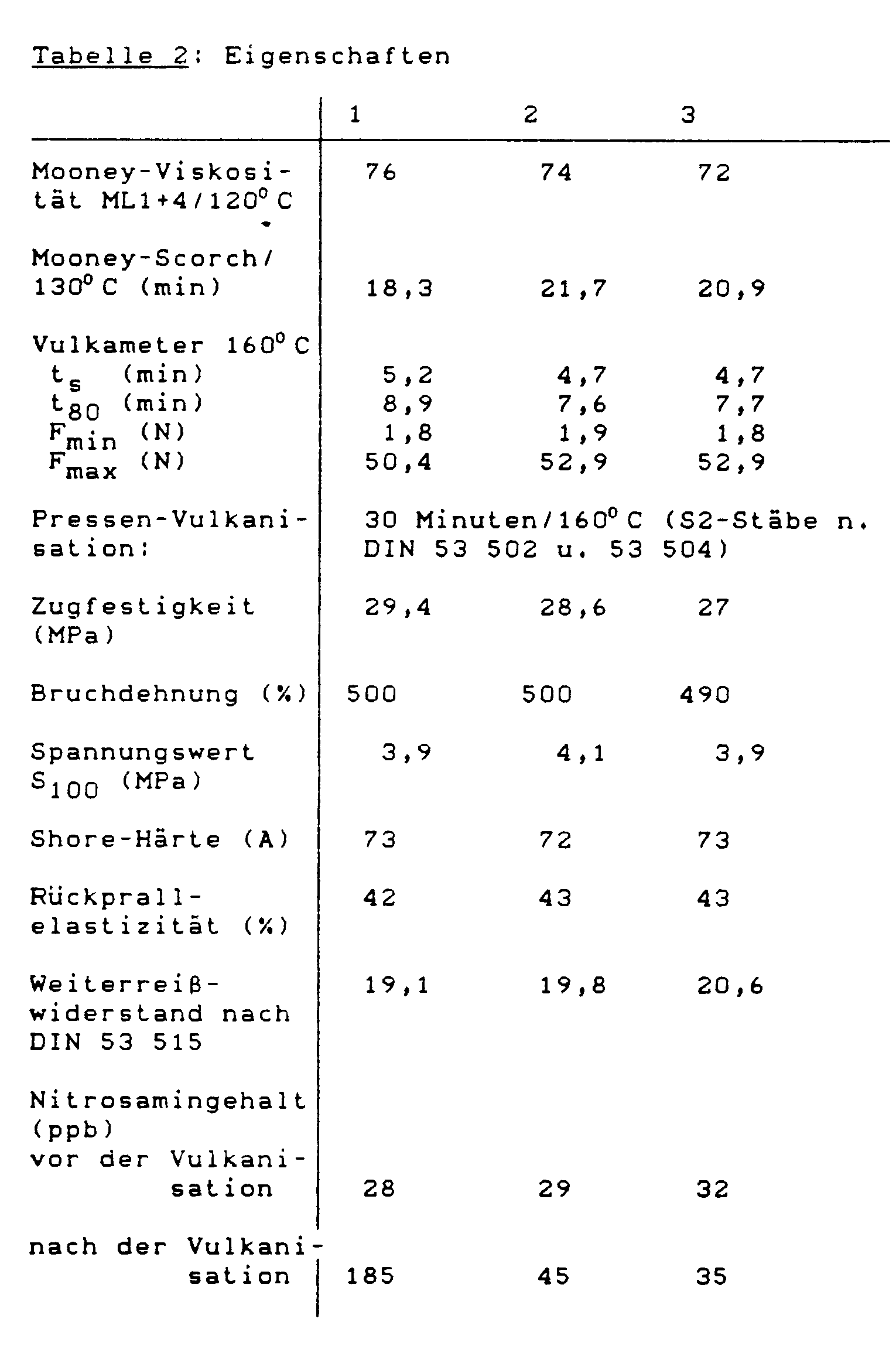
- Als Kautschuk wurde eine Acrylnitril/Butadien-Copolymerisat mit einem Acrylnitrilgehalt von 28 Gew.-% und einer Mooney-Viskosität von 45 (ML 4) 100°C eingesetzt (®Perbunan N 2807 NS der Bayer AG).
- In einem Laborkneter wurde bei 50 °C der Kautschuk 0,5 Minuten lang mastiziert, und dann wurden 50 gew.-%ige Schwefelpaste (®Struktol SU 105 der Fa. Schill & Seilacher/Hamburg), Ruß (®Corax N 326 bzw ®Durex O der Fa. Degussa/Wesseling), styrolisiertes Diphenylamin (@Vulkanox DPA der Bayer AG), polymeres 2.2.4-Trimethyl-1.2-dihydrochinolin (@Vulkanox HS der Bayer AG), Weichmacher (Etherthioether; ®Vulkanol OT der Bayer AG), Verarbeitungshilfsmittel auf Basis hochaktiver Kieselsäure (®Aflux S der Fa. Rheinchemie Rheinau GmbH, Mannheim), Zinkoxid (Zinkweiß RS der Zinkweiß-Forschungsgesellschaft, Oberhausen), Stearinsäure und Zink-n-octylmaleinat zugegeben und bis zur Homogenisierung geknetet (4.5 Minuten).
- Nach Abkühlen der Kautschukmasse auf ca. 100°C auf einer Walze wurde Tetramethylthiuramdisulfid (@Vulkacit Thiuram/C der Bayer AG) zugemischt. Zusammensetzung und experimentelle Befunde ergeben sich aus den nachfolgenden Tabellen 3 und 4.


- Als Kautschuk wurde ein EPDM (@Buna AP 331 mit Ethylidennorbornen als Termonomer, Mooney-Viskosität: 70 (ML 1 +4) 100 C, Produkt der Fa. Hüls AG, Marl) eingesetzt.
- In einem Laborkneter wurde bei 50 °C der Kautschuk 0,5 Minuten lang mastiziert, und dann wurden Schwefel, Stearinsäure, Zinkoxid (®Zinkoxyd aktiv der Bayer AG), styrolisiertes Diphenylamin (@Vulkanox DDA der Bayer AG), Zink-Methylmercaptobenzimidazol (®Vulkanox ZMB 2 der Bayer AG, Ruß (®Corax N 550 der Fa. Degussa, Wesseling) sowie Zink-mono-n-octylmaleinat zugegeben und bis zur Homogenisierung geknetet.
- Nach Abkühlen der Kautschukmasse auf ca. 100°C auf einer Walze wurde ein Beschleunigersystem bestehend aus Tetramethylthiuramdisulfid (®Vulkacit Thiuram C der Bayer AG) und Benzothiazyl-2-cyclohexyl-sulfenamid (®Vulkacit CZ/MG der Bayer AG) und gegebenenfalls N-Trichlormethylsulfenylbenzolsulfanilid (®Vulkalent E der Bayer AG) zugemischt.
- Zusammensetzungen und Eigenschaften der Vulkanisate finden sich in den nachfolgenden Tabellen 5 und 6.


Claims (4)
1. Verwendung von Maleinsäurehalbestern und Fumarsäurehalbestern der Formel
und ihrer Salze,
worin
R einen organischen Rest mit 1 bis 22 C-Atomen bedeutet,
zur Verminderung des Nitrosamingehalts durch Schwefelvulkanisation hergestellter Kautschukvulkanisate.
und ihrer Salze,
worin
R einen organischen Rest mit 1 bis 22 C-Atomen bedeutet,
zur Verminderung des Nitrosamingehalts durch Schwefelvulkanisation hergestellter Kautschukvulkanisate.
2. Verwendung nach Anspruch 1, wobei R einen organischen Rest mit 4 bis 18 C-Atomen bedeutet.
3. Verwendung nach Ansprüchen 1 und 2, wobei der Halbester Maleinsäure-n-octylester, -ethylhexylester, -allylester oder -cyclohexylester ist.
4. Verwendung nach Ansprüchen 1-3, wobei die Halbester-Salze die Zinksalze sind.
Applications Claiming Priority (2)
| Application Number | Priority Date | Filing Date | Title |
|---|---|---|---|
| DE19904033903 DE4033903A1 (de) | 1990-10-25 | 1990-10-25 | Verwendung von maleinsaeurehalbestern und ihren salzen zur verminderung der nitrosaminbildung bei der schwefelvulkanisation |
| DE4033903 | 1990-10-25 |
Publications (1)
| Publication Number | Publication Date |
|---|---|
| EP0482470A1 true EP0482470A1 (de) | 1992-04-29 |
Family
ID=6417006
Family Applications (1)
| Application Number | Title | Priority Date | Filing Date |
|---|---|---|---|
| EP91117522A Withdrawn EP0482470A1 (de) | 1990-10-25 | 1991-10-14 | Verwendung von Malein- und Fumarsäurehalbestern und ihren Salzen zur Verminderung der Nitrosaminbildung bei der Schwefelvulkanisation |
Country Status (4)
| Country | Link |
|---|---|
| EP (1) | EP0482470A1 (de) |
| JP (1) | JPH04266946A (de) |
| CA (1) | CA2053981A1 (de) |
| DE (1) | DE4033903A1 (de) |
Cited By (5)
| Publication number | Priority date | Publication date | Assignee | Title |
|---|---|---|---|---|
| EP0551818B1 (de) * | 1992-01-16 | 1996-09-18 | Bayer Ag | Vulkanisierbare Kautschukkompositionen |
| GB2310858A (en) * | 1996-03-04 | 1997-09-10 | Rhone Poulenc Chemicals | Inhibiting nitrosamine formation in rubber |
| US6063873A (en) * | 1997-12-31 | 2000-05-16 | Bridgestone Corporation | Process to scavenge amines in polymeric compounds by treatment with triazine derivatives, and compositions therefrom |
| US6235819B1 (en) | 1997-12-31 | 2001-05-22 | Bridgestone Corporation | Process to scavenge amines in polymeric compounds by treatment with triazine derivatives and compositions therefrom |
| US6495065B1 (en) | 1999-09-09 | 2002-12-17 | Atofina Chemicals, Inc. | Nitrosamine-inhibiting compositions for shortstopping of free radical emulsion polymerizations |
Citations (2)
| Publication number | Priority date | Publication date | Assignee | Title |
|---|---|---|---|---|
| GB1092175A (en) * | 1965-07-03 | 1967-11-22 | Bayer Ag | Process for the production of light rubber vulcanisates |
| US4434266A (en) * | 1982-09-23 | 1984-02-28 | Monsanto Company | Method for rubber treatment and the rubber thus treated |
-
1990
- 1990-10-25 DE DE19904033903 patent/DE4033903A1/de not_active Withdrawn
-
1991
- 1991-10-14 EP EP91117522A patent/EP0482470A1/de not_active Withdrawn
- 1991-10-21 JP JP29958291A patent/JPH04266946A/ja active Pending
- 1991-10-22 CA CA 2053981 patent/CA2053981A1/en not_active Abandoned
Patent Citations (2)
| Publication number | Priority date | Publication date | Assignee | Title |
|---|---|---|---|---|
| GB1092175A (en) * | 1965-07-03 | 1967-11-22 | Bayer Ag | Process for the production of light rubber vulcanisates |
| US4434266A (en) * | 1982-09-23 | 1984-02-28 | Monsanto Company | Method for rubber treatment and the rubber thus treated |
Non-Patent Citations (1)
| Title |
|---|
| KAUTSCHUK UND GUMMI - KUNSTSTOFFE - ASBEST. Bd. 43, Nr. 2, Februar 1990, HEIDELBERG DE M.LHEUREUX ET AL.: 'NITROSAMINES IN RUBBER VULCANIZATE: AN EVALUATION OF SPECIFIC INHIBITORS' * |
Cited By (6)
| Publication number | Priority date | Publication date | Assignee | Title |
|---|---|---|---|---|
| EP0551818B1 (de) * | 1992-01-16 | 1996-09-18 | Bayer Ag | Vulkanisierbare Kautschukkompositionen |
| GB2310858A (en) * | 1996-03-04 | 1997-09-10 | Rhone Poulenc Chemicals | Inhibiting nitrosamine formation in rubber |
| WO1997032927A1 (en) * | 1996-03-04 | 1997-09-12 | Rhodia Limited | Inhibiting nitrosamine formation in rubber |
| US6063873A (en) * | 1997-12-31 | 2000-05-16 | Bridgestone Corporation | Process to scavenge amines in polymeric compounds by treatment with triazine derivatives, and compositions therefrom |
| US6235819B1 (en) | 1997-12-31 | 2001-05-22 | Bridgestone Corporation | Process to scavenge amines in polymeric compounds by treatment with triazine derivatives and compositions therefrom |
| US6495065B1 (en) | 1999-09-09 | 2002-12-17 | Atofina Chemicals, Inc. | Nitrosamine-inhibiting compositions for shortstopping of free radical emulsion polymerizations |
Also Published As
| Publication number | Publication date |
|---|---|
| DE4033903A1 (de) | 1992-04-30 |
| JPH04266946A (ja) | 1992-09-22 |
| CA2053981A1 (en) | 1992-04-26 |
Similar Documents
| Publication | Publication Date | Title |
|---|---|---|
| EP2284217B1 (de) | Vulkanisationsbeschleunigende Mischung | |
| EP0423593B1 (de) | Kautschukmischungen aus Polychloropren und hydriertem Nitrilkautschuk | |
| EP2311907A1 (de) | Neue Kautschukmischungen | |
| EP2724870A1 (de) | Polysulfidmischungen, Verfahren zu ihrer Herstellung und Verwendung der Polysulfidmischungen in Kautschukmischungen | |
| EP0386499A1 (de) | Schwefel-vulkanisierbare Kautschukmassen mit vermindertem Ausblüheffekt | |
| EP0403918B1 (de) | Hitzebeständige Kautschukmassen auf Basis von hydriertem Nitrilkautschuk | |
| EP0433808A2 (de) | Verfahren zur Vulkanisation von Polychloropren | |
| WO2022207729A1 (de) | Kautschukmischungen enthaltend n, n'-dialkyl-p-phenylenediamine | |
| DE69318091T2 (de) | Verfahren zur Vulkanisation, von Kautschuk ohne Nitrosaminbildung | |
| EP0482470A1 (de) | Verwendung von Malein- und Fumarsäurehalbestern und ihren Salzen zur Verminderung der Nitrosaminbildung bei der Schwefelvulkanisation | |
| EP2423234A1 (de) | Kautschukblends aus verschiedenen Nitrilkautschuken | |
| EP0551818B1 (de) | Vulkanisierbare Kautschukkompositionen | |
| DE4033902A1 (de) | Verwendung von n-trichlormethylsulfenylbenzolsulfanilid zur verminderung der nitrosaminbildung bei der schwefelvulkanisation | |
| EP0301347B1 (de) | Polychloroprenmischungen | |
| EP3959085B1 (de) | Silan, kautschukmischung enthaltend das silan und fahrzeugreifen, der die kautschukmischung in wenigstens einem bauteil aufweist sowie verfahren zur herstellung des silans | |
| EP2671727A1 (de) | Kieselsäurehaltige Kautschukmischungen mit schwefelhaltigen Additiven | |
| DE1298266B (de) | Verfahren zum Covulkanisieren von Kautschuk mit einem weiteren Polymeren | |
| EP1951763B1 (de) | Schwefelvernetzte hydrierte vinylpolybutadiene sowie deren verwendung zur herstellung von technischen gummiartikeln mit gutem rückverformungsverhalten über einen breiten temperaturbereich | |
| DE60200048T2 (de) | Kautschukzusammensetzung enthaltend ein aromatisches Pentaerythritolderivat sowie daraus hergestellte Reifenkomponten | |
| EP4112625A1 (de) | Organosilylpolysulfide und diese enthaltende kautschukmischungen | |
| EP0479083A1 (de) | Schwefel-vulkanisierbare Kautschukmassen mit verbessertem Vulkanisationsgrad | |
| DE2001695B2 (de) | Kautschukmischung auf basis von butadien-1,3/acrylnitril-copolymerisat und deren verwendung | |
| EP0533015A1 (de) | Neue, Schwefel-modifizierte funktionelle Gruppen enthaltende Butadien-Copolymere sowie deren Mischungen mit anderen Kautschuken | |
| DE112012002035T5 (de) | Chloroprenkautschuk, eine Chloroprenkautschukzusammensetzung, ein Vulkanisat davon und Formkörper | |
| EP0406603A2 (de) | Nitrosamin-frei vulkanisierbase Kautschukmassen |
Legal Events
| Date | Code | Title | Description |
|---|---|---|---|
| PUAI | Public reference made under article 153(3) epc to a published international application that has entered the european phase |
Free format text: ORIGINAL CODE: 0009012 |
|
| AK | Designated contracting states |
Kind code of ref document: A1 Designated state(s): AT BE DE ES FR GB IT NL SE |
|
| 17P | Request for examination filed |
Effective date: 19920714 |
|
| STAA | Information on the status of an ep patent application or granted ep patent |
Free format text: STATUS: THE APPLICATION HAS BEEN WITHDRAWN |
|
| 18W | Application withdrawn |
Withdrawal date: 19930503 |