EP0482500A1 - Leitvorrichtung zum Führen, Aus- und/oder Umlenken einer Materialbahn - Google Patents
Leitvorrichtung zum Führen, Aus- und/oder Umlenken einer Materialbahn Download PDFInfo
- Publication number
- EP0482500A1 EP0482500A1 EP91117662A EP91117662A EP0482500A1 EP 0482500 A1 EP0482500 A1 EP 0482500A1 EP 91117662 A EP91117662 A EP 91117662A EP 91117662 A EP91117662 A EP 91117662A EP 0482500 A1 EP0482500 A1 EP 0482500A1
- Authority
- EP
- European Patent Office
- Prior art keywords
- block
- material web
- guide device
- medium
- bores
- Prior art date
- Legal status (The legal status is an assumption and is not a legal conclusion. Google has not performed a legal analysis and makes no representation as to the accuracy of the status listed.)
- Granted
Links
- 239000000463 material Substances 0.000 title claims abstract description 62
- 239000007788 liquid Substances 0.000 claims description 11
- 239000012530 fluid Substances 0.000 abstract 1
- 238000007664 blowing Methods 0.000 description 14
- 238000001035 drying Methods 0.000 description 4
- 229910052782 aluminium Inorganic materials 0.000 description 3
- XAGFODPZIPBFFR-UHFFFAOYSA-N aluminium Chemical compound [Al] XAGFODPZIPBFFR-UHFFFAOYSA-N 0.000 description 3
- 238000009713 electroplating Methods 0.000 description 3
- 238000012544 monitoring process Methods 0.000 description 3
- 230000000694 effects Effects 0.000 description 2
- 238000012806 monitoring device Methods 0.000 description 2
- 230000006978 adaptation Effects 0.000 description 1
- 239000000853 adhesive Substances 0.000 description 1
- 230000001070 adhesive effect Effects 0.000 description 1
- 230000003750 conditioning effect Effects 0.000 description 1
- 238000001816 cooling Methods 0.000 description 1
- 238000011156 evaluation Methods 0.000 description 1
- 239000011888 foil Substances 0.000 description 1
- 238000010438 heat treatment Methods 0.000 description 1
- 229910052751 metal Inorganic materials 0.000 description 1
- 239000002184 metal Substances 0.000 description 1
- 230000001105 regulatory effect Effects 0.000 description 1
- 230000002441 reversible effect Effects 0.000 description 1
Images


Classifications
-
- B—PERFORMING OPERATIONS; TRANSPORTING
- B65—CONVEYING; PACKING; STORING; HANDLING THIN OR FILAMENTARY MATERIAL
- B65H—HANDLING THIN OR FILAMENTARY MATERIAL, e.g. SHEETS, WEBS, CABLES
- B65H47/00—Unfolding thin limp material
-
- B—PERFORMING OPERATIONS; TRANSPORTING
- B65—CONVEYING; PACKING; STORING; HANDLING THIN OR FILAMENTARY MATERIAL
- B65H—HANDLING THIN OR FILAMENTARY MATERIAL, e.g. SHEETS, WEBS, CABLES
- B65H23/00—Registering, tensioning, smoothing or guiding webs
- B65H23/04—Registering, tensioning, smoothing or guiding webs longitudinally
- B65H23/24—Registering, tensioning, smoothing or guiding webs longitudinally by fluid action, e.g. to retard the running web
-
- B—PERFORMING OPERATIONS; TRANSPORTING
- B65—CONVEYING; PACKING; STORING; HANDLING THIN OR FILAMENTARY MATERIAL
- B65H—HANDLING THIN OR FILAMENTARY MATERIAL, e.g. SHEETS, WEBS, CABLES
- B65H23/00—Registering, tensioning, smoothing or guiding webs
- B65H23/02—Registering, tensioning, smoothing or guiding webs transversely
- B65H23/032—Controlling transverse register of web
- B65H23/035—Controlling transverse register of web by guide bars
-
- B—PERFORMING OPERATIONS; TRANSPORTING
- B65—CONVEYING; PACKING; STORING; HANDLING THIN OR FILAMENTARY MATERIAL
- B65H—HANDLING THIN OR FILAMENTARY MATERIAL, e.g. SHEETS, WEBS, CABLES
- B65H23/00—Registering, tensioning, smoothing or guiding webs
- B65H23/04—Registering, tensioning, smoothing or guiding webs longitudinally
- B65H23/32—Arrangements for turning or reversing webs
-
- B—PERFORMING OPERATIONS; TRANSPORTING
- B65—CONVEYING; PACKING; STORING; HANDLING THIN OR FILAMENTARY MATERIAL
- B65H—HANDLING THIN OR FILAMENTARY MATERIAL, e.g. SHEETS, WEBS, CABLES
- B65H2406/00—Means using fluid
- B65H2406/10—Means using fluid made only for exhausting gaseous medium
- B65H2406/11—Means using fluid made only for exhausting gaseous medium producing fluidised bed
- B65H2406/111—Means using fluid made only for exhausting gaseous medium producing fluidised bed for handling material along a curved path, e.g. fluidised turning bar
-
- B—PERFORMING OPERATIONS; TRANSPORTING
- B65—CONVEYING; PACKING; STORING; HANDLING THIN OR FILAMENTARY MATERIAL
- B65H—HANDLING THIN OR FILAMENTARY MATERIAL, e.g. SHEETS, WEBS, CABLES
- B65H2406/00—Means using fluid
- B65H2406/10—Means using fluid made only for exhausting gaseous medium
- B65H2406/14—Means using fluid made only for exhausting gaseous medium with selectively operated air supply openings
Definitions
- the invention relates to a guide device for guiding, deflecting and / or deflecting a material web, which is guided over a number of rolls, the guide device being connected to a medium supply device and extending over the entire width of the rolls and having bores through which a Medium flow flows against the material web in the given direction.
- an air guiding device for guiding an endless web, e.g. a paper web that runs in a meandering shape over a plurality of cylinders or alternately over cylinders and guide rollers.
- This air guiding device is connected to a blown air supply and extends across the entire width of the cylinders and guide rolls, air being blown against the material web in each case in a predetermined direction via blown openings.
- the blowing direction of the air is reversible, this is done in such a way that two successive, mutually separated pressure chambers, one of which acts as a suction chamber and the subsequent one as a blowing chamber in normal operation, can be switched so that the inlet-side pressure chamber as a blowing chamber and the subsequent pressure chamber as Suction chamber take effect.
- the air guiding device can also be subdivided into a number of separate air chambers in relation to the direction of travel of the material web, an edge-side chamber being provided for transferring a transfer strip when starting up or after a goods tear.
- the air chambers are individually adjustable with respect to the blowing direction in accordance with the predetermined or the inverted blowing direction.
- the air volumes can also be adjusted depending on the blowing direction.
- the known air guiding device on the one hand guides the endless web of goods safely on their way to and between the cylinders and / or the guide rollers and on the other hand maximizes the conditioning of the web of goods, for example their drying.
- the paper web runs from cylinder to cylinder.
- the air guiding device counteracts the forces acting on the web by means of adhesion, friction, negative pressure, dynamic pressure, dead weight and centrifugal forces. It must be taken into account that an optimal drying effect should also be achieved with such air guiding devices, which is best when air is blown out against the direction of travel of the paper web, since this creates turbulence on the surface of the paper web which accelerates drying.
- transfer strip When starting up a paper machine or after tearing off the paper web when threading the so-called transfer strip, however, such a blowing direction against the running direction of the paper web is unfavorable, since the relatively narrow transfer strip is blown away by the blowing jet due to its relatively low weight.
- blowing direction can be inverted and, furthermore, the paper web, viewed in the running direction, can be blown differently in sections in different directions.
- DE-OS 40 03 956 describes a vacuum nozzle system for contactless carrying and handling of material webs, e.g. for drying, heating and cooling, known.
- This vacuum system consists of a nozzle box, which has a surface lying opposite the web, on which there are two nozzle gaps, the nozzle system being asymmetrical with respect to the vertical central plane of the vacuum support surface.
- the nozzle box has a substantially flat wing, on one edge of which an arc-shaped Coanda air guide surface is attached, on which the first nozzle of the nozzle system is located.
- Their blowing direction initially runs essentially perpendicular to the plane of the web to be carried.
- the Coanda air guiding surface is arranged in such a way that it deflects the air flow emerging from the first nozzle in the direction of the plane of the airfoil and the web running over it.
- a guide vane In the edge area opposite to the first nozzle there is a guide vane, which continues the flat wing continuously.
- a second blowing nozzle In the area or on the outer edge of the guide surface, a second blowing nozzle is arranged, the direction of which runs parallel to the guide surface of the wing.
- a device for web edge monitoring of a guided web is described in DE-OS 39 03 783.
- This is a device for conveying a flat object, in particular an endless material web, which comprises conveying means for moving the object in a predetermined direction and a monitoring device for monitoring the position of the object.
- the monitoring device contains a blowing nozzle directed towards the edge region of the surface of the object, which blows out a gaseous jet.
- the pressure measuring device is connected to an evaluation and control arrangement for processing the measuring signals into position signals which represent the position of the edge of the object.
- Such a device enables an exact processing and processing of objects the, whereby a material web, in particular of paper, or another flat object is conveyed along a predetermined path and lateral positional deviations are prevented. This is done by continuously monitoring the position of an edge of the material web or the flat object, and corrective measures are initiated when deviations from a predetermined position of the edge occur. This side edge control thus prevents the object from migrating sideways.
- the object of the invention is to improve a guide device of the type described at the outset so that when the material web is deflected and / or deflected, the curvature of the material web depending on the web width changing, the side edges of the material web are guided without lateral deviation .
- the block is cylindrical, the bores are accommodated in sections and a predetermined number of bores in the sections are connected to one another.
- the bores are arranged as throttle bores in a surface facing the material web and this surface is at a predetermined distance from the rear sides of the sections of the block.
- the different actuation of the individual sections of the segmented block which is a kind of support nozzle, creates lateral force components in addition to the longitudinal edges of the material web, which are used to guide the side edges.
- the invention can be used both for material webs carried in air and for material webs which are transported in baths filled with liquids.
- the transport of thin foils or metal strips in dryer devices can be involved, while in the second case the strip guidance of aluminum strips in electroplating baths can be considered.
- a material web 2 for example an aluminum band, paper web, film web or the like, which is guided over rollers 19 and a guide device 1, is shown schematically in FIG.
- the guide device 1 comprises, as an essential component, a segmented, i.e. sectioned support nozzle in the form of a block with a curved surface, in which holes are arranged within the individual sections.
- the supporting nozzle is pressurized with compressed air via a supply device and ensures problem-free deflection, deflection and precise side edge guidance of the material web 2.
- Deflection means deviating from the original movement plane. Deflection is a deviation from the original direction of movement in the same plane of movement.
- FIG. 2 shows a schematic overview of the transport of a material web 2 through a liquid bath, for example the passage of an aluminum strip through an electroplating bath.
- the material web 2 is a deflection rollers 20, 21
- Guide device 1 and a further deflection roller 22 are introduced into the liquid bath, transported through it and guided out of it.
- the bath liquid of the liquid bath is expediently used as the operating medium for the guide device 1.
- the guide device 1 facilitates the deflection of the material web 2, since this is lifted off the surface by the medium flowing out of the holes in the surface of the support nozzle of the guide device 1, so that neither adhesive nor frictional forces have to be overcome during the directional change.
- a further guide device 1 can be provided.
- FIG 3 a first embodiment of a guide device 1 according to the invention is shown schematically in section.
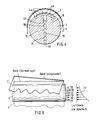
- the guide device 1 includes a support nozzle in the form of a block 3 with a curved surface, which has a circular cross section, as can be seen from Figure 4.
- a material web 2 is guided over the supporting nozzle at a short distance from the curved surface.
- Holes 4A to 4F which are accommodated in sections 5A, 5B,... 5F of block 3, run transversely to the material web in block 3.
- the individual sections there is in each case a predetermined number of bores which are connected to one another and are connected to a medium supply device 8 via a common line 7A, 7B,... 7F.
- the bores 4A to 4F are designed as throttle bores and are arranged in a surface 6 facing the material web 2. This surface 6 is at a certain distance from the rear sides 18 of the sections 5A,... 5F of the block 3.
- each of the sections 5A,... 5F is via a line 7A,... 7F, which are passed through the block 3, connected to the medium supply device 8.
- a control valve 9A,... 9F via which the respective medium flow through the lines can be regulated towards the bores of the individual section.
- the medium flows through the throttle bores of the individual sections flow against the direction of movement of the material web in the given direction.
- the flow through the lines is controlled by means of the control valves 9A,...
- the material web 2 is deflected via the cylindrical block 3.
- the various throttle bores are located in the individual sections in the region of the curvature, only the throttle bores of section 5A being shown in FIG. 4, for example. Either compressed air or a liquid can be used as the medium. If the throttle bores are supplied with compressed air in the individual sections, a carrier air film is formed between the block 3 and the material web 2. The gaps in front of and behind the bores and to the side of the bores form throttle zones, so that a pressure build-up takes place between the material web 2 and the block 3.
- the distance of this column from the surface of the block can be varied locally, which is equivalent to the fact that the material web is guided in different radii above the individual sections and thus not only the material web in the desired manner deflected, but can also be deflected, as will be explained in more detail below.
- Controlled deflection or lateral guidance of the material web can be achieved by the targeted application of the compressed air to the sections 5A,... 5F, as will be explained in more detail with reference to FIG. 5.
- FIG. 4 shows a section through section 5A of block 3 or the carrying nozzle along line II in FIG. 3.
- the central bore of this sectional illustration shows the cross section of line 7A, from which a channel leads upwards, which opens into section 5A .
- the throttle bores 4A are designed like a lattice and ensure that pressure builds up in the section 5A and the medium, for example air, emerges from the throttle bores 4A with appropriate pressure and flows against the material web.
- FIG. 5 schematically shows the deflection of the material web 2, which is normally guided around the block 3 at a constant distance. If the air pressure in each of the sections 5A to 5F of the first embodiment of the guide device 1 is increased in accordance with the air pressure curve 23, the air pressure prevailing in line 7A and section 5A is the lowest and the air pressure prevailing in line 7F and section 5F is greatest highest, whereby the result is that the material web 2 at the right end of the block 3 is the smallest and at the left end of the block 3 the greatest distance from the surface of the block and is thereby deflected from its normal orbit and the position shown as deflected material web 2 'occupies.
- FIG. 6 shows a section through a section A of a second embodiment of the guide device.
- the block or the carrying nozzle is as Deflection block 10 formed with an elliptical cross section.
- Deflection block 10 formed with an elliptical cross section.
- the cross section of the central bore 11 is considerably larger than the cross section of the radial channels 12A, which leads to a corresponding throttling of the medium flow and thus to an increase in pressure of the medium which emerges through the throttle bores 13A of section A of the elliptical deflection block 10.
- the deflecting block 10 of the second embodiment of the guiding device serves primarily to deflect the material web 2 around 1800.
- the deflecting block 10 looks similar to the block 3 of the first embodiment according to FIG. 3 off, ie the deflection block 10 is divided into different sections A to E, and each section is assigned a number of throttle bores 13A to 13E.
- FIG. 6 only the central bore 11 and the radial channels 12A and the throttle bores 13A of section A are shown in cross section. The remaining sections with their channels and with their central bore are constructed in the same way.
- gaps 14 and 15 in front of and behind the throttle bores 13A, as seen in the direction of travel of the material web 2. Gaps are also provided to the side of the throttle bores 13A, which together with the gaps 14 and 15 throttle points for form the outflowing medium, so that a pressure build-up between the deflection block 10 and the material web 2 takes place, which ensures that the material web 2 is guided at a distance around the surface of the deflection block 10.
- the carrier medium film formed between the deflection block 10 and the material web 2 has a thickness which varies in accordance with the respective medium pressure in the individual channels 12A,... 12E of the sections A to E of the deflection block 10.
- the deflection block 16 has a parabolic cross section. This embodiment of the guide device is particularly suitable for a web deflection of less than 180.
- the deflection block 16 is also divided into sections A to E, in each of which throttle bores 17A, ... 17E are arranged.
- the medium for guiding and deflecting the material web 2 can be either compressed air or the respective bath liquid if the material web 2 is passed through a liquid bath, for example an electroplating bath.
Landscapes
- Advancing Webs (AREA)
- Registering, Tensioning, Guiding Webs, And Rollers Therefor (AREA)
- Absorbent Articles And Supports Therefor (AREA)
- Knitting Machines (AREA)
Abstract
Description
- Die Erfindung betrifft eine Leitvorrichtung zum Führen, Aus- und/oder Umlenken einer Materialbahn, die über eine Anzahl von Rollen geführt ist, wobei die Leitvorrichtung an eine Mediumversorgungseinrichtung angeschlossen ist und sich über die gesamte Breite der Rollen erstreckt und Bohrungen aufweist, durch die ein Mediumstrom gegen die Materialbahn in jeweils vorgegebener Richtung hindurchströmt.
- Aus der DE-OS 39 04 314 ist eine derartige Luftleiteinrichtung zur Führung einer endlosen Warenbahn, z.B. einer Papierbahn, die mäanderförmig über eine Mehrzahl von Zylindern oder abwechselnd über Zylinder und Leitwalzen läuft, bekannt. Diese Luftleiteinrichtung ist an eine Blasluftversorgung angeschlossen und erstreckt sich quer über die gesamte Breite der Zylinder und Leitwalzen, wobei Luft über Blasöffnungen jeweils in vorgegebener Richtung gegen die Warenbahn geblasen wird. Die Blasrichtung der Luft ist umkehrbar, dies geschieht in der Weise, daß zwei aufeinanderfolgende, gegeneinander separierte Druckkammern, von denen eine im Normalbetrieb als Saugkammer und die nachfolgende als Blaskammer wirken, so umschaltbar sind, daß die zulaufseitige Druckkammer als Blaskammer und die nachfolgende Druckkammer als Saugkammer wirksam werden. Die Luftleiteinrichtung kann auch guer zur Laufrichtung der Warenbahn in eine Anzahl von separaten Luftkammern unterteilt sein, wobei eine randseitige Kammer zur Überführung eines Überführstreifens beim Anfahren oder nach einem Warenabriß vorgesehen ist. Die Luftkammern sind bezüglich der Blasrichtung je für sich entsprechend der vorgegebenen oder der hierzu invertierten Blasrichtung einstellbar. Ebenso sind die Luftmengen je nach Blasrichtung einstellbar.
- Durch die bekannte Luftleiteinrichtung wird einerseits die endlose Warenbahn auf ihren Weg an und zwischen den Zylindern und/oder den Leitwalzen sicher geführt und andererseits die Konditionierung der Warenbahn, beispielsweise ihre Trocknung, maximiert.
- Im Normalbetrieb einer Papiermaschine läuft die Papierbahn von Zylinder zu Zylinder. Die Luftleiteinrichtung wirkt den auf die Bahn wirkenden Kräften durch Haftung, Reibung, Unter-, Staudruck, Eigengewicht und durch Zentrifugalkräfte entgegen. Dabei muß berücksichtigt werden, daß mit solchen Luftleiteinrichtungen auch ein optimaler Trocknungseffekt erreicht werden soll, der dann am günstigsten ist, wenn gegen die Laufrichtung der Papierbahn Luft ausgeblasen wird, da hierdurch an der Oberfläche der Papierbahn Turbulenzen erzeugt werden, die die Trocknung beschleunigen. Beim Anfahren einer Papiermaschine oder nach einem Abriß der Papierbahn beim Einfädeln des sogenannten Überführungsstreifens ist jedoch eine derartige Blasrichtung gegen die Laufrichtung der Papierbahn ungünstig, da der relativ schmale Überführstreifen infolge seines relativ geringen Eigengewichts vom Blasstrahl weggeblasen wird. Bei der bekannten Luftleiteinrichtung ist eine individuelle Anpassung der Blasluftrichtung und der - verhältnisse an den jeweiligen Betriebszustand und die jeweilige Warenart möglich, indem die Blasrichtung invertierbar ist und darüberhinaus noch die Papierbahn, in Laufrichtung betrachtet, abschnittsweise unterschiedlich angeblasen werden kann.
- Aus der DE-OS 40 03 956 ist ein Unterdruckdüsensystem zum berührungslosen Tragen und Behandeln von Warenbahnen, z.B. zum Trocknen, Heizen und Kühlen, bekannt. Dieses Unterdrucksystem besteht aus einem Düsenkasten, der eine gegen die Bahn liegende Fläche hat, an der sich zwei Düsenspalte befinden, wobei das Düsensystem in bezug auf die senkrechte Mittelebene der Unterdrucktragfläche unsymmetrisch ist. Der Düsenkasten besitzt eine im wesentlichen ebene Tragfläche, an deren einer Kante eine bogenförmige Coanda-Luftleitfläche angebracht ist, an der sich die erste Düse des Düsensystems befindet. Deren Blasrichtung verläuft anfänglich im wesentlichen senkrecht gegen die Ebene der zu tragenden Warenbahn. Die Coanda-Luftleitfläche ist so angeordnet, daß sie die aus der ersten Düse austretende Luftströmung in Richtung der Ebene der Tragfläche und der über diese laufende Warenbahn umlenkt. In dem zur ersten Düse entgegengesetzten Randbereich befindet sich eine Leitschaufel, welche die ebene Tragfläche stufenlos fortsetzt. Im Bereich oder an der Außenkante der Leitfläche ist eine zweite Blasdüse angeordnet, deren Richtung parallel zur Leitfläche der Tragfläche verläuft.
- Eine Vorrichtung zur Bahnkantenüberwachung einer geführten Warenbahn ist in der DE-OS 39 03 783 beschrieben. Dabei handelt es sich um eine Vorrichtung zum Fördern eines flachen Gegenstandes, insbesondere einer endlosen Materialbahn, die Fördermittel zum Bewegen des Gegenstandes in einer vorgegebenen Richtung und eine Überwachungseinrichtung zum Überwachen der Lage des Gegenstandes umfaßt. Die Überwachungseinrichtung enthält eine auf den Kantenbereich der Oberfläche des Gegenstandes gerichtete Blasdüse, die einen gasförmigen Strahl ausbläst. Auf der der Blasdüse gegenüberliegenden Seite des Gegenstandes befindet sich eine Druckmeßeinrichtung zum Erzeugen eines dem an der Kante vorbeiströmenden Anteil des Gasstrahls entsprechenden Meßsignals. Die Druckmeßeinrichtung ist mit einer Auswert- und Steueranordnung zum Verarbeiten der Meßsignale zu Lagesignalen, welche die Position der Kante des Gegenstandes wiedergeben, verbunden. Eine derartige Vorrichtung ermöglicht eine exakte Ver- und Bearbeitung von Gegenständen, wobei eine Materialbahn, insbesondere aus Papier, oder ein sonstiger flacher Gegenstand entlang einer vorgegebenen Bahn befördert und seitliche Lageabweichungen verhindert werden. Dies erfolgt durch die kontinuierliche Überwachung der Lage einer Kante der Materialbahn oder des flachen Gegenstandes, und beim Auftreten von Abweichungen von einer vorgegebenen Lage der Kante werden Korrekturmaßnahmen eingeleitet. Durch diese Seitenkantensteuerung wird somit ein seitliches Auswandern des Gegenstandes verhindert.
- Es sind auch Seitenkantensteuerungen bekannt, bei denen die Abwickelspule für die Materialbahn axial verschoben wird oder der Winkel einer Leitwalze senkrecht zu einer Bandebene verändert wird. Beide Versionen erfordern größeren mechanischen Aufwand und sind in ihrer Dynamik begrenzt.
- Aufgabe der Erfindung ist es, eine Leitvorrichtung der eingangs beschriebenen Art so zu verbessern, daß beim Aus- und/oder Umlenken der Materialbahn, wobei die Krümmung der Materialbahn in Abhängigkeit von der Bahnbreite sich ändern kann, die Seitenkanten der Materialbahn ohne seitliches Abweichen geführt sind.
- Diese Aufgabe wird erfindungsgemäß dadurch gelöst, daß in einem gekrümmten Block, über den die Materialbahn geführt ist, Bohrungen quer zur Materialbahn untergebracht sind, die mit Mediumströmen unterschiedlicher Geschwindigkeit bzw. mit unterschiedlichen Mediummengen beaufschlagbar sind.
- So ist in einer Ausführungsform der Erfindung der Block zylinderförmig, sind die Bohrungen in Abschnitten untergebracht und ist jeweils eine vorgegebene Anzahl von Bohrungen in den Abschnitten miteinander verbunden. Dabei sind die Bohrungen als Drosselbohrungen in einer der Materialbahn zugewandten Fläche angeordnet und befindet sich diese Fläche in einem vorgegebenen Abstand zu Rückseiten der Abschnitte des Blocks.
- Die weitere Ausgestaltung der Erfindung ergibt sich aus den Merkmalen der Patentansprüche 4 bis 11.
- Durch die unterschiedliche Ansteuerung der einzelnen Abschnitte des segmentierten Blocks, bei dem es sich um eine Art Tragdüse handelt, entstehen seitliche Kraftkomponenten neben den Längskanten der Materialbahn, die zur Seitenkantenführung genutzt werden.
- Die Erfindung ist sowohl bei in Luft geführten Materialbahnen als auch bei Materialbahnen einsetzbar, die in mit Flüssigkeiten gefüllten Bädern transportiert werden. Im ersteren Fall kann es sich um den Transport von dünnen Folien oder Metallbändern in Trocknervorrichtungen handeln, während für den zweiten Fall die Bandführung von Aluminiumbändern in Galvanikbädern in Betracht kommt.
- Die Erfindung wird im folgenden anhand von zeichnerisch dargestellten Ausführungsbeispielen näher erläutert. Es zeigen:
- Figur 1 eine schematische Darstellung einer Materialbahn, die über eine Anzahl von Rollen und eine Luftleitvorrichtung geführt ist,
- Figur 2 eine schematische Darstellung einer Materialbahn, die ein Flüssigkeitsbad durchläuft und um eine oder mehrere hydraulische Leitvorrichtungen herumgeführt ist,
- Figur 3 einen Schnitt durch eine schematisch dargestellte erste Ausführungsform der Leitvorrichtung mit kreisförmigem Querschnitt der Tragdüse, nach der Erfindung,
- Figur 4 einen Schnitt durch einen Abschnitt 5A der Tragdüse entlang der Linie I-I in Figur 1,
- Figur 5 eine schematische Ansicht des Auslenkens einer Materialbahn mittels der Leitvorrichtung nach den Figuren 3 und 4,
- Figur 6 einen Schnitt durch einen Abschnitt A einer zweiten Ausführungsform der Leitvorrichtung mit eliptischem Querschnitt der Tragdüse und
- Figur 7 einen Querschnitt durch einen Abschnitt A einer dritten Ausführungsform einer Leitvorrichtung mit einer Tragdüse parabelförmigen Querschnitts.
- In Figur 1 ist eine Materialbahn 2, beispielsweise ein Aluminiumband, Papierbahn, Folienbahn oder dergleichen schematisch dargestellt, die über Rollen 19 und eine Leitvorrichtung 1 geführt ist. Die Leitvorrichtung 1 umfaßt als wesentlichen Bestandteil eine segmentierte, d.h. in Abschnitte unterteilte Tragdüse in Gestalt eines Blocks mit gekrümmter Oberfläche, in der Bohrungen innerhalb der einzelnen Abschnitte angeordnet sind. Die Tragdüse wird über eine Versorgungseinrichtung mit Druckluft beaufschlagt und besorgt ein problemloses Umlenken, Auslenken und eine exakte Seitenkantenführung der Materialbahn 2. Umlenken bedeutet dabei ein Abweichen aus der ursprünglichen Bewegungsebene. Unter Auslenkung ist ein Abweichen aus der ursprünglichen Bewegungsrichtung in der gleichen Bewegungsebene zu verstehen.
- Figur 2 zeigt in schematischer Übersicht den Transport einer Materialbahn 2 durch ein Flüssigkeitsbad hindurch, beispielsweise den Durchlauf eines Aluminiumbandes durch ein Galvanikbad. Die Materialbahn 2 wird über Umlenkrollen 20, 21, eine Leitvorrichtung 1 und eine weitere Umlenkrolle 22 in das Flüssigkeitsbad eingeführt, durch dieses hindurchtransportiert und aus diesem herausgeführt. Für die Leitvorrichtung 1 wird in diesem Fall als Betriebsmedium zweckmäßigerweise die Badflüssigkeit des Flüssigkeitsbades verwendet. Die Leitvorrichtung 1 erleichtert das Umlenken der Materialbahn 2, da diese durch das aus den Bohrungen in der Oberfläche der Tragdüse der Leitvorrichtung 1 ausströmende Medium von der Oberfläche abgehoben wird, so daß weder Haft- noch Reibungskräfte während der Richtungsumlenkung überwunden werden müssen. Anstelle der einen Umlenkrolle 21 kann eine weitere Leitvorrichtung 1 vorgesehen werden.
- In Figur 3 ist im Schnitt eine erste Ausführungsform einer Leitvorrichtung 1 nach der Erfindung schematisch dargestellt. Die Leitvorrichtung 1 umfaßt u.a. eine Tragdüse in Gestalt eines Blocks 3 mit gekrümmter Oberfläche, der einen kreisförmigen Querschnitt besitzt, wie aus Figur 4 ersichtlich ist. Im geringen Abstand zu der gekrümmten Oberfläche wird eine Materialbahn 2 über die Tragdüse geführt. Quer zur Materialbahn verlaufen in dem Block 3 Bohrungen 4A bis 4F, die in Abschnitten 5A, 5B, ... 5F des Blocks 3 untergebracht sind. In den einzelnen Abschnitten ist jeweils eine vorgegebene Anzahl von Bohrungen vorhanden, die miteinander verbunden sind und über eine gemeinsame Leitung 7A, 7B, ... 7F mit einer Mediumversorgungseinrichtung 8 in Verbindung stehen. Die Bohrungen 4A bis 4F sind als Drosselbohrungen ausgebildet und in einer der Materialbahn 2 zugewandten Fläche 6 angeordnet. Diese Fläche 6 befindet sich in einem bestimmten Abstand zu Rückseiten 18 der Abschnitte 5A, ... 5F des Blocks 3. Wie schon voranstehend erwähnt wurde, ist jeder der Abschnitte 5A, ... 5F über eine Leitung 7A, ... 7F, die durch den Block 3 hindurchgeführt sind, an die Mediumversorgungseinrichtung 8 angeschlossen. In jeder der Leitungen 7A, ... 7F außerhalb des Blocks 3 befindet sich ein Regelventil 9A, ... 9F, über welches der jeweilige Mediumstrom durch die Leitungen hindurch zu den Bohrungen des einzelnen Abschnitts hin regelbar ist. Die Mediumströme durch die Drosselbohrungen der einzelnen Abschnitte strömen gegen die Bewegungsrichtung der Materialbahn in jeweils vorgegebener Richtung. Mittels der Regelventile 9A, ... 9F wird der Durchfluß durch die Leitungen so gesteuert, daß die Mediumströme beispielsweise in den einzelnen Abschnitten unterschiedliche Geschwindigkeit besitzen bzw. die einzelnen Abschnitte mit unterschiedlich großen Mediummengen beaufschlagt werden. Die Materialbahn 2 wird über den zylindrischen Block 3 umgelenkt. Im Bereich der Krümmung befinden sich die verschiedenen Drosselbohrungen in den einzelnen Abschnitten, wobei in Figur 4 beispielsweise nur die Drosselbohrungen des Abschnitts 5A dargestellt sind. Als Medium kann entweder Druckluft oder eine Flüssigkeit verwendet werden. Falls die Drosselbohrungen in den einzelnen Abschnitten mit Druckluft versorgt werden, entsteht zwischen dem Block 3 und der Materialbahn 2 ein Tragluftfilm. Die Spalte vor den und hinter den Bohrungen sowie seitlich der Bohrungen bilden Drosselzonen, so daß ein Druckaufbau zwischen der Materialbahn 2 und dem Block 3 stattfindet. Werden die einzelnen Abschnitte unterschiedlich mit Druck beaufschlagt, so kann der Abstand dieser Spalte von der Oberfläche des Blocks lokal variiert werden, was gleichbedeutend damit ist, daß die Materialbahn in unterschiedlichen Radien oberhalb der einzelnen Abschnitte geführt ist und somit in gewünschter Weise die Materialbahn nicht nur umgelenkt, sondern auch ausgelenkt werden kann, wie nachstehend noch näher erläutert werden wird. Daraus resultiert eine von der Schrägstellung der Materialbahn gegenüber der Oberfläche des Blocks 3 abhängige Auslenkung der Materialbahn. Durch die gezielte Beaufschlagung der Abschnitte 5A, ... 5F mit Druckluft läßt sich eine gesteuerte Auslenkung bzw. Seitenführung der Materialbahn erreichen, wie noch anhand von Figur 5 näher erläutert werden wird.
- Figur 4 zeigt einen Schnitt durch den Abschnitt 5A des Blocks 3 bzw. der Tragdüse entlang der Linie I-I in Figur 3. Die zentrale Bohrung dieser Schnittdarstellung zeigt den Querschnitt der Leitung 7A, von der ein Kanal nach oben führt, der in den Abschnitt 5A mündet. Die Drosselbohrungen 4A sind gitterähnlich ausgestaltet und sorgen dafür, daß es zu einem Druckaufbau in dem Abschnitt 5A kommt und das Medium, beispielsweise Luft, mit entsprechendem Druck aus den Drosselbohrungen 4A austritt und gegen die Materialbahn strömt.
- In Figur 5 ist schematisch das Auslenken der Materialbahn 2 dargestellt, die im Normalfall um den Block 3 mit gleichbleibendem Abstand herumgeführt ist. Wird der Luftdruck in jedem der Abschnitte 5A bis 5F der ersten Ausführungsform der Leitvorrichtung 1 entsprechend der Luftdruckkurve 23 erhöht, so ist der in der Leitung 7A und im Abschnitt 5A herrschende Luftdruck am niedrigsten und der in der Leitung 7F und im Abschnitt 5F herrschende Luftdruck am höchsten, wodurch erreicht wird, daß die Materialbahn 2 am rechten Ende des Blocks 3 den geringsten und am linken Ende des Block 3 den größten Abstand von der Oberfläche des Blocks einnimmt und dadurch aus ihrer normalen Umlaufbahn ausgelenkt wird und die gezeigte Lage als ausgelenkte Materialbahn 2' einnimmt.
- In Figur 6 ist ein Schnitt durch einen Abschnitt A einer zweiten Ausführungsform der Leitvorrichtung gezeigt. Der Block bzw. die Tragdüse ist als Umlenkblock 10 mit einem elliptischen Querschnitt ausgebildet. Im Inneren des elliptischen Umlenkblocks 10 befindet sich eine zentrale Bohrung 11, von der radiale Kanäle 12A zu Drosselbohrungen 13A in der Oberfläche des Umlenkblocks 10 führen. Der Querschnitt der zentralen Bohrung 11 ist erheblich größer als der Querschnitt der radialen Kanäle 12A, wodurch es zu einer entsprechenden Drosselung der Mediumströmung und somit zu einem Druckanstieg des Mediums kommt, das durch die Drosselbohrungen 13A des Abschnitts A des elliptischen Umlenkblocks 10 austritt. Der Umlenkblock 10 der zweiten Ausführungsform der Leitvorrichtung dient, ebenso wie der Block 3 der ersten Ausführungsform der Leitvorrichtung, in erster Linie zu einer Umlenkung der Materialbahn 2 um 1800. Im Längsschnitt sieht der Umlenkblock 10 ähnlich wie der Block 3 der ersten Ausführungsform gemäß Figur 3 aus, d.h. der Umlenkblock 10 ist in verschiedene Abschnitte A bis E unterteilt, und jedem Abschnitt ist eine Anzahl von Drosselbohrungen 13A bis 13E zugeordnet. In Figur 6 sind im Querschnitt nur die zentrale Bohrung 11 sowie die radialen Kanäle 12A und die Drosselbohrungen 13A des Abschnitts A gezeigt. Die übrigen Abschnitte mit ihren Kanälen und mit ihrer zentralen Bohrung sind in der gleichen Weise aufgebaut.
- Wie aus Figur 6 ersichtlich ist, befinden sich vor und hinter den Drosselbohrungen 13A, in Laufrichtung der Materialbahn 2 gesehen, jeweils ein Spalt 14 und 15. Seitlich von den Drosselbohrungen 13A sind gleichfalls Spalte vorhanden, die zusammen mit den Spalten 14 und 15 Drosselstellen für das abströmende Medium bilden, so daß ein Druckaufbau zwischen dem Umlenkblock 10 und der Materialbahn 2 stattfindet, der sicherstellt, daß die Materialbahn 2 im Abstand um die Oberfläche des Umlenkblocks 10 herumgeführt wird. Der zwischen dem Umlenkblock 10 und der Materialbahn 2 ausgebildete Tragmediumfilm hat eine Dicke, die entsprechend dem jeweiligen Mediumdruck in den einzelnen Kanälen 12A, ... 12E der Abschnitte A bis E des Umlenkblocks 10 variiert.
- In einer dritten Ausführungsform der Leitvorrichtung, wie sie in Figur 7 gezeigt ist, besitzt der Umlenkblock 16 einen parabelförmigen Querschnitt. Diese Ausführungsform der Leitvorrichtung ist insbesondere für eine Materialbahnumlenkung kleiner als 180 geeignet. Der Umlenkblock 16 ist gleichfalls in Abschnitte A bis E unterteilt, in denen jeweils Drosselbohrungen 17A, ... 17E angeordnet sind.
- Bei allen drei Ausführungsformen der Leitvorrichtung kann das Medium für die Führung und Umlenkung der Materialbahn 2 entweder Druckluft oder die jeweilige Badflüssigkeit sein, wenn die Materialbahn 2 durch ein Flüssigbad, beispielsweise ein Galvanikbad, hindurchgeführt wird.
Claims (11)
Applications Claiming Priority (2)
| Application Number | Priority Date | Filing Date | Title |
|---|---|---|---|
| DE4033642A DE4033642A1 (de) | 1990-10-23 | 1990-10-23 | Leitvorrichtung zum fuehren, aus- und/oder umlenken einer materialbahn |
| DE4033642 | 1990-10-23 |
Publications (2)
| Publication Number | Publication Date |
|---|---|
| EP0482500A1 true EP0482500A1 (de) | 1992-04-29 |
| EP0482500B1 EP0482500B1 (de) | 1994-08-03 |
Family
ID=6416860
Family Applications (1)
| Application Number | Title | Priority Date | Filing Date |
|---|---|---|---|
| EP91117662A Expired - Lifetime EP0482500B1 (de) | 1990-10-23 | 1991-10-16 | Leitvorrichtung zum Führen, Aus- und/oder Umlenken einer Materialbahn |
Country Status (5)
| Country | Link |
|---|---|
| US (1) | US5353979A (de) |
| EP (1) | EP0482500B1 (de) |
| JP (1) | JPH05124759A (de) |
| KR (1) | KR920007909A (de) |
| DE (2) | DE4033642A1 (de) |
Cited By (3)
| Publication number | Priority date | Publication date | Assignee | Title |
|---|---|---|---|---|
| EP0548419A1 (de) * | 1990-06-02 | 1993-06-30 | Spooner Industries Limited | Pneumatische Umlenkvorrichtung |
| WO2002020386A1 (de) * | 2000-09-09 | 2002-03-14 | Vits-Maschinenbau Gmbh | Wendestange |
| WO2011142944A1 (en) * | 2010-05-12 | 2011-11-17 | Eastman Kodak Company | Media transport system turnover mechanism |
Families Citing this family (32)
| Publication number | Priority date | Publication date | Assignee | Title |
|---|---|---|---|---|
| JP3686679B2 (ja) * | 1996-06-14 | 2005-08-24 | ケーニツヒ ウント バウエル アクチエンゲゼルシヤフト | フローティングドライヤ |
| DE19633710A1 (de) * | 1996-08-21 | 1998-02-26 | Brueckner Apparatebau Gmbh | Einrichtung zum Breithalten von nassen Warenbahnen |
| US6035259A (en) * | 1997-06-18 | 2000-03-07 | Eastman Kodak Company | Web material camber measurement apparatus and method |
| DE19747040A1 (de) * | 1997-08-28 | 1999-03-04 | Heidelberger Druckmasch Ag | Luftpolsterführung |
| DE19833977A1 (de) * | 1998-07-28 | 2000-02-03 | Voith Sulzer Papiertech Patent | Verfahren zum Steuern der Querposition einer laufenden Materialbahn, insbesondere aus Papier oder Karton |
| US6397495B1 (en) | 1999-12-30 | 2002-06-04 | Heidelberger Druckmaschinen Ag | Web steering air flotation device for printing equipment |
| US6565691B2 (en) | 2000-05-16 | 2003-05-20 | Kimberly-Clark Worldwide, Inc. | Method and apparatus for forming a lap seam |
| US6723034B2 (en) | 2000-05-16 | 2004-04-20 | Kimberly-Clark Worldwide, Inc. | Presentation of fastening components for making prefastened and refastenable pants |
| US6513221B2 (en) | 2000-05-16 | 2003-02-04 | Kimberly-Clark Worldwide, Inc. | Garment side panel conveyor system and method |
| US6562167B2 (en) | 2000-05-16 | 2003-05-13 | Kimberly-Clark Worldwide, Inc. | Methods for making garments with fastening components |
| US6846374B2 (en) | 2000-05-16 | 2005-01-25 | Kimberly-Clark Worldwide | Method and apparatus for making prefastened and refastenable pant with desired waist and hip fit |
| US6481362B2 (en) | 2000-05-16 | 2002-11-19 | Kimberly-Clark Worldwide, Inc. | Orbital motion device for seaming garments |
| US7387148B2 (en) | 2001-05-15 | 2008-06-17 | Kimberly-Clark Worldwide, Inc. | Garment side panel conveyor system and method |
| US6497032B2 (en) | 2000-05-16 | 2002-12-24 | Kimberly-Clark Worldwide, Inc. | Refastenable bonding of garment side panels |
| US6596113B2 (en) | 2000-05-16 | 2003-07-22 | Kimberly-Clark Worldwide, Inc. | Presentation and bonding of garment side panels |
| US6514187B2 (en) | 2000-05-16 | 2003-02-04 | Kimberly-Clark Worldwide, Inc. | Folding and manufacture of pants |
| DE10115916B4 (de) * | 2001-03-30 | 2006-03-23 | Koenig & Bauer Ag | Wendestange für eine Materialbahn |
| US6991717B2 (en) * | 2002-04-05 | 2006-01-31 | 3M Innovative Properties Company | Web processing method and apparatus |
| DE10248249B4 (de) * | 2002-10-16 | 2006-06-01 | Koenig & Bauer Ag | Trockner für eine Materialbahn |
| DE10322519A1 (de) * | 2003-05-19 | 2004-12-09 | Voith Paper Patent Gmbh | Bahnführungseinrichtung |
| DE10339262A1 (de) * | 2003-08-26 | 2005-03-17 | Voith Paper Patent Gmbh | Bahnführungseinrichtung |
| DE10344715A1 (de) * | 2003-09-26 | 2005-04-21 | Heidelberger Druckmasch Ag | Vorrichtung zum Leiten eines Bedruckstoffes |
| DE10359113A1 (de) * | 2003-12-17 | 2005-07-21 | Voith Paper Patent Gmbh | Breitstreckvorrichtung |
| GB0719218D0 (en) * | 2007-10-02 | 2007-11-14 | Lymn Peter P A | Process tank |
| EP2243735A1 (de) * | 2009-04-21 | 2010-10-27 | Applied Materials, Inc. | Leitvorrichtungen und Verfahren zur kontaktlosen Leitung eines Netzes in einem Netzbeschichtungsverfahren |
| US20100266766A1 (en) * | 2009-04-21 | 2010-10-21 | Stefan Hein | Guiding devices and methods for contactless guiding of a web in a web coating process |
| US9038414B2 (en) * | 2012-09-26 | 2015-05-26 | Corning Incorporated | Methods and apparatuses for steering flexible glass webs |
| US9771655B2 (en) | 2015-07-29 | 2017-09-26 | Eastman Kodak Company | Web transport system including fluid shield |
| US9862179B2 (en) * | 2015-07-29 | 2018-01-09 | Eastman Kodak Company | Web transport system including scavenger blade |
| US9689073B2 (en) | 2015-07-29 | 2017-06-27 | Eastman Kodak Company | Electroless plating system including bubble guide |
| US9925761B2 (en) * | 2015-12-02 | 2018-03-27 | Eastman Kodak Company | Liquid ejection hole orientation for web guide |
| WO2017122229A1 (ja) * | 2016-01-12 | 2017-07-20 | 株式会社Jcu | 樹脂フィルムの湿式処理装置 |
Citations (3)
| Publication number | Priority date | Publication date | Assignee | Title |
|---|---|---|---|---|
| FR1385098A (fr) * | 1964-03-04 | 1965-01-08 | Kodak Pathe | Dispositif pour le retournement de bandes continues en mouvement |
| US3521802A (en) * | 1967-05-12 | 1970-07-28 | Masson Scott Thrissell Eng Ltd | Web guide members |
| EP0001323A1 (de) * | 1977-09-21 | 1979-04-04 | International Business Machines Corporation | Vorrichtung zum Führen einer Bahn |
Family Cites Families (10)
| Publication number | Priority date | Publication date | Assignee | Title |
|---|---|---|---|---|
| US3125268A (en) * | 1964-03-17 | bartholomay | ||
| DE285760C (de) * | ||||
| US3087664A (en) * | 1960-10-17 | 1963-04-30 | Ibm | Web guide |
| US3971496A (en) * | 1975-01-14 | 1976-07-27 | Bell & Howell Company | Tape centering methods and apparatus |
| US4037767A (en) * | 1975-11-17 | 1977-07-26 | Bell & Howell Company | Tape transporting apparatus |
| US4138047A (en) * | 1977-04-11 | 1979-02-06 | Western Electric Company, Inc. | Fluid bearing |
| NL8501697A (nl) * | 1985-06-12 | 1987-01-02 | Docdata Bv | Inrichting voor het geleiden van een bandvormige informatiedrager. |
| DE3904314A1 (de) * | 1989-02-14 | 1990-08-16 | Voith Gmbh J M | Luftleiteinrichtung zur fuehrung einer endlosen warenbahn durch eine mehrstufige maschine, insbesondere zur anwendung in der trockenpartie einer papiermaschine |
| FI890785A7 (fi) * | 1989-02-17 | 1990-08-18 | Valmet Paper Machinery Inc | System av undertrycksmunstycken avsett foer behandling av roerliga aemnesbanor. |
| US5152080A (en) * | 1991-06-25 | 1992-10-06 | W. R. Grace & Co.-Conn. | Steerable air bar/edge dam apparatus |
-
1990
- 1990-10-23 DE DE4033642A patent/DE4033642A1/de not_active Withdrawn
-
1991
- 1991-10-16 EP EP91117662A patent/EP0482500B1/de not_active Expired - Lifetime
- 1991-10-16 DE DE59102427T patent/DE59102427D1/de not_active Expired - Fee Related
- 1991-10-22 KR KR1019910018574A patent/KR920007909A/ko not_active Withdrawn
- 1991-10-23 JP JP3304028A patent/JPH05124759A/ja active Pending
-
1993
- 1993-06-17 US US08/077,504 patent/US5353979A/en not_active Expired - Fee Related
Patent Citations (3)
| Publication number | Priority date | Publication date | Assignee | Title |
|---|---|---|---|---|
| FR1385098A (fr) * | 1964-03-04 | 1965-01-08 | Kodak Pathe | Dispositif pour le retournement de bandes continues en mouvement |
| US3521802A (en) * | 1967-05-12 | 1970-07-28 | Masson Scott Thrissell Eng Ltd | Web guide members |
| EP0001323A1 (de) * | 1977-09-21 | 1979-04-04 | International Business Machines Corporation | Vorrichtung zum Führen einer Bahn |
Cited By (3)
| Publication number | Priority date | Publication date | Assignee | Title |
|---|---|---|---|---|
| EP0548419A1 (de) * | 1990-06-02 | 1993-06-30 | Spooner Industries Limited | Pneumatische Umlenkvorrichtung |
| WO2002020386A1 (de) * | 2000-09-09 | 2002-03-14 | Vits-Maschinenbau Gmbh | Wendestange |
| WO2011142944A1 (en) * | 2010-05-12 | 2011-11-17 | Eastman Kodak Company | Media transport system turnover mechanism |
Also Published As
| Publication number | Publication date |
|---|---|
| JPH05124759A (ja) | 1993-05-21 |
| KR920007909A (ko) | 1992-05-27 |
| DE59102427D1 (de) | 1994-09-08 |
| EP0482500B1 (de) | 1994-08-03 |
| US5353979A (en) | 1994-10-11 |
| DE4033642A1 (de) | 1992-04-30 |
Similar Documents
| Publication | Publication Date | Title |
|---|---|---|
| EP0482500B1 (de) | Leitvorrichtung zum Führen, Aus- und/oder Umlenken einer Materialbahn | |
| DE69219707T2 (de) | Unterdruckdüsenanordnung zur Behandlung von Bahnen | |
| EP0427015B1 (de) | Vorrichtung zum schwebenden Führen von zu fördernden Materialbahnen oder Materialablagebogen | |
| DE3218306C2 (de) | Trenn- und Führungsvorrichtung für einen von einem Papierbahnende zur Überführung einer Papierbahn abgetrennten Einführstreifen | |
| DE3630571C2 (de) | ||
| CH679693A5 (de) | ||
| DE3739338A1 (de) | Luftleitkasten zum stabilisieren des laufs einer warenbahn, insbesondere einer papierbahn | |
| DE1474239C3 (de) | Verfahren und Einrichtung zur Stabilisierung der Lage unter Wirkung eines Blasmittels schwebend geführter Warenbahnen | |
| DE2411238A1 (de) | Verfahren und vorrichtung zur fuehrung des anfanges einer materialbahn | |
| DE2160131B2 (de) | Vorrichtung zum berUhrungslosen Tragen und Trocknen von laufenden Materialbahnen | |
| DE2827495C2 (de) | ||
| DE29924658U1 (de) | Vorrichtung zum Befördern und Führen eines Einführstreifens einer Bahn bei einer Papiermaschine | |
| DE3224879C2 (de) | ||
| DE19916342A1 (de) | Druckbogenumlenkkeil mit Luftauslässen | |
| DE10356037A1 (de) | Schneid-Vorrichtung | |
| DE69909371T2 (de) | Verfahren und Vorrichtung zum Dämpfen des Flatterns einer Bahn, und Anwendung beim Bahnspleissen | |
| EP0277159B1 (de) | Vorrichtung zum beaufschlagen von materialbahnen mit strömungsmedium | |
| EP0908310B1 (de) | Bahnstrangantrieb oberhalb eines Falzapparates | |
| DE3942029B4 (de) | Vorrichtung zum Tragen, Umlenken und Spreizen einer Bahn | |
| DE69806629T2 (de) | Vorrichtung zum abschneiden einer bahn | |
| DE69500781T2 (de) | Luftleitflügel für eine pneumatische Wendestange | |
| DE4003956A1 (de) | Unterdruckduesensystem zur behandlung von beweglichen materialbahnen | |
| DE3130450C2 (de) | Vorrichtung zum Trocknen von bahn- oder bogenförmigem Gut | |
| DE3049790C2 (de) | Blasluftgespeiste Hohlwalze | |
| EP0723523B1 (de) | Verfahren und vorrichtung zur stabilisierung einer laufenden bahn |
Legal Events
| Date | Code | Title | Description |
|---|---|---|---|
| PUAI | Public reference made under article 153(3) epc to a published international application that has entered the european phase |
Free format text: ORIGINAL CODE: 0009012 |
|
| AK | Designated contracting states |
Kind code of ref document: A1 Designated state(s): DE FR GB IT NL |
|
| 17P | Request for examination filed |
Effective date: 19920827 |
|
| 17Q | First examination report despatched |
Effective date: 19921113 |
|
| GRAA | (expected) grant |
Free format text: ORIGINAL CODE: 0009210 |
|
| AK | Designated contracting states |
Kind code of ref document: B1 Designated state(s): DE FR GB IT NL |
|
| REF | Corresponds to: |
Ref document number: 59102427 Country of ref document: DE Date of ref document: 19940908 |
|
| ET | Fr: translation filed | ||
| ITTA | It: last paid annual fee | ||
| ITF | It: translation for a ep patent filed | ||
| GBT | Gb: translation of ep patent filed (gb section 77(6)(a)/1977) |
Effective date: 19941102 |
|
| PLBI | Opposition filed |
Free format text: ORIGINAL CODE: 0009260 |
|
| 26 | Opposition filed |
Opponent name: MAN ROLAND DRUCKMASCHINEN AG Effective date: 19950502 |
|
| NLR1 | Nl: opposition has been filed with the epo |
Opponent name: MAN ROLAND DRUCKMASCHINEN AG |
|
| PLBO | Opposition rejected |
Free format text: ORIGINAL CODE: EPIDOS REJO |
|
| PLBN | Opposition rejected |
Free format text: ORIGINAL CODE: 0009273 |
|
| STAA | Information on the status of an ep patent application or granted ep patent |
Free format text: STATUS: OPPOSITION REJECTED |
|
| 27O | Opposition rejected |
Effective date: 19960523 |
|
| NLR2 | Nl: decision of opposition | ||
| PGFP | Annual fee paid to national office [announced via postgrant information from national office to epo] |
Ref country code: FR Payment date: 19970917 Year of fee payment: 7 |
|
| PGFP | Annual fee paid to national office [announced via postgrant information from national office to epo] |
Ref country code: NL Payment date: 19970922 Year of fee payment: 7 |
|
| PGFP | Annual fee paid to national office [announced via postgrant information from national office to epo] |
Ref country code: GB Payment date: 19971001 Year of fee payment: 7 |
|
| PGFP | Annual fee paid to national office [announced via postgrant information from national office to epo] |
Ref country code: DE Payment date: 19971220 Year of fee payment: 7 |
|
| PG25 | Lapsed in a contracting state [announced via postgrant information from national office to epo] |
Ref country code: GB Free format text: LAPSE BECAUSE OF NON-PAYMENT OF DUE FEES Effective date: 19981016 |
|
| PG25 | Lapsed in a contracting state [announced via postgrant information from national office to epo] |
Ref country code: NL Free format text: LAPSE BECAUSE OF NON-PAYMENT OF DUE FEES Effective date: 19990501 |
|
| GBPC | Gb: european patent ceased through non-payment of renewal fee |
Effective date: 19981016 |
|
| PG25 | Lapsed in a contracting state [announced via postgrant information from national office to epo] |
Ref country code: FR Free format text: LAPSE BECAUSE OF NON-PAYMENT OF DUE FEES Effective date: 19990630 |
|
| NLV4 | Nl: lapsed or anulled due to non-payment of the annual fee |
Effective date: 19990501 |
|
| REG | Reference to a national code |
Ref country code: FR Ref legal event code: ST |
|
| PG25 | Lapsed in a contracting state [announced via postgrant information from national office to epo] |
Ref country code: DE Free format text: LAPSE BECAUSE OF NON-PAYMENT OF DUE FEES Effective date: 19990803 |
|
| PG25 | Lapsed in a contracting state [announced via postgrant information from national office to epo] |
Ref country code: IT Free format text: LAPSE BECAUSE OF NON-PAYMENT OF DUE FEES;WARNING: LAPSES OF ITALIAN PATENTS WITH EFFECTIVE DATE BEFORE 2007 MAY HAVE OCCURRED AT ANY TIME BEFORE 2007. THE CORRECT EFFECTIVE DATE MAY BE DIFFERENT FROM THE ONE RECORDED. Effective date: 20051016 |